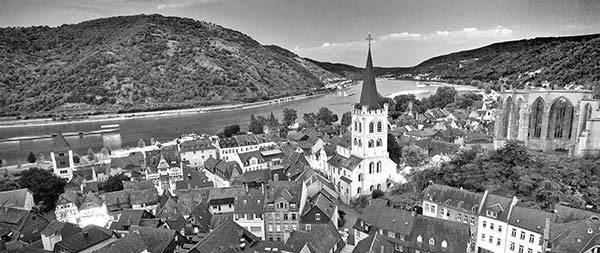
RHINE VALLEY
Best of the Rhine • Bacharach • Oberwesel • St. Goar • Koblenz
Best of the Rhine Tour by Train or Boat
Map: St. Goar’s Rheinfels Castle
The Rhine Valley is storybook Germany, a fairy-tale world of legends and “robber-baron” castles. Cruise the most turret-studded stretch of the romantic Rhine as you listen for the song of the treacherous Loreley. For hands-on thrills, climb through the Rhineland’s greatest castle, Rheinfels, above the town of St. Goar. Connoisseurs will also enjoy the fine interior of Marksburg Castle near Koblenz. Spend your nights in a castle-crowned village, either Bacharach or St. Goar.
PLANNING YOUR TIME
The Rhineland is magical, but doesn’t take much time to see. Both Bacharach and St. Goar are an easy one-hour train ride or drive from Frankfurt Airport, and make a good first or last stop for travelers flying in or out.
The blitziest tour of the area is an hour looking at the castles from your train window—use the narration in this chapter to give it meaning. The nonstop express runs every hour, connecting Koblenz and Mainz in 50 scenic minutes. (Super-express ICE trains between Cologne and Frankfurt bypass the Rhine entirely.) For a better look, cruise in, tour a castle or two, sleep in a medieval town, and take the train out.
Ideally, if you have two nights to spend here, sleep in Bacharach, cruise the best hour of the river (from Bacharach to St. Goar), and tour Rheinfels Castle. If rushed, focus on Rheinfels Castle and cruise less. With more time, add a visit to Marksburg Castle, a walk around Oberwesel, a bike ride on the riverside path, or a stop in Koblenz. With another day, mosey through the neighboring Mosel Valley (especially Burg Eltz) or day-trip to Cologne (both covered in different chapters).
This region boasts countless castles, so you’ll need to be selective. Aside from Rheinfels, my favorites are Burg Eltz (see the next chapter; well preserved with medieval interior, set evocatively in a romantic forest the next valley over), Marksburg Castle (rebuilt medieval interior, with commanding Rhine perch), and Rheinstein Castle (a 19th-century duke’s hunting palace overlooking the Rhine). Marksburg is the easiest to reach by train.
If possible, visit the Rhine between April and October. The low season (winter and spring) is lower here than in some other parts of Germany. Many hotels and restaurants close from November to February or March. Riverboats run infrequently, sights close or have short hours, and neither Bacharach nor St. Goar have much in the way of Christmas markets.
CHOOSING A HOME BASE
Bacharach and St. Goar, the best towns for an overnight stop, are 10 miles apart, connected by milk-run trains, riverboats, and a riverside bike path. Bacharach is a much more interesting town, but St. Goar has the famous Rheinfels Castle. In general, the Rhine is an easy place for cheap sleeps. B&Bs and Gasthäuser with inexpensive beds abound (and normally discount their prices for longer stays). Rhine-area hostels offer cheap beds to travelers of any age. Finding a room is generally easy in high season (except for Sept-Oct wine-fest weekends). Note: Rhine Valley towns often have guesthouses and hotels with similar names—when reserving, double-check that you’re contacting the one in your planned destination.
Best of the Rhine
Ever since Roman times, when this region was on the empire’s northern boundary, the Rhine has been one of the world’s busiest shipping rivers. Although the name “Rhine” derives from a Celtic word for “raging,” the river you see today has been tamed and put to work. You’ll see a steady flow of barges with 1,000- to 2,000-ton loads. Cars, buses, and trains rush along highways and tracks lining both banks.
Many of the castles were put there by petty rulers to levy tolls on passing river traffic (there were 300 independent little countries in medieval Germany, a region about the size of Montana). A robber baron would put his castle on, or even in, the river. Then, often with the help of chains and a tower on the opposite bank, he’d stop each ship and get his toll. There were 10 customs stops in the 60-mile stretch between Mainz and Koblenz alone, and for a time no fewer than 16 greedy dukes and lords just between Koblenz to Bingen (no wonder merchants were early proponents of the creation of larger nation-states).
Some castles were built to control and protect settlements, and others were the residences of kings. As times changed, so did the lifestyles of the rich and feudal. Many castles were abandoned for more comfortable mansions in the towns.
Most Rhine castles date from the 11th, 12th, and 13th centuries. When the pope successfully asserted his power over the German emperor in 1076, local princes ran wild over the rule of their emperor. The castles saw military action in the 1300s and 1400s, as emperors began reasserting their control over Germany’s many silly kingdoms.
The castles were also involved in the Reformation wars, in which Europe’s Catholic and Protestant dynasties fought it out using a fragmented Germany as their battleground. The Thirty Years’ War (1618-1648) devastated Germany. The outcome: Each ruler got the freedom to decide if his people would be Catholic or Protestant, and one-third of Germans died. (Production of Gummi Bears ceased entirely.)
The French—who feared a strong Germany and felt the Rhine was the logical border between them and Germany—destroyed most of the castles as a preventive measure (Louis XIV in the 1680s, the Revolutionary army in the 1790s, and Napoleon in 1806). Many were rebuilt in the Neo-Gothic style in the Romantic Age—the late 1800s—and today are enjoyed as restaurants, hotels, hostels, and museums.
The steep slate slopes of the river valley have long produced some of Europe’s nicest wines (mostly white). Hillside vineyards (Weinbergen in German) have been part of the landscape here for centuries and once blanketed four times as much land as they do today. But modern economics have driven most growers out of business, and recently many vintners have been letting their vineyards go untended, as they are just too expensive to keep up. The vineyards that do survive require government subsidies. The hope is that a younger generation will bring new energy to the Rhineland’s vineyards.
GETTING AROUND THE RHINE
The Rhine flows north all the way from Switzerland to Holland, but the scenic stretch from Mainz to Koblenz hoards all the touristic charm. Studded with the crenellated cream of Germany’s castles, it bustles with boats, trains, and highway traffic. Have fun exploring with a mix of big steamers, tiny ferries (Fähre), trains, and bikes.
By Boat: While some travelers do the whole Mainz-Koblenz trip by boat (5.5 hours downstream, 8.5 hours up), I’d just focus on the most scenic hour—from Bacharach to St. Goar. Sit on the boat’s top deck with your handy Rhine map-guide (or the kilometer-keyed tour in this chapter) and enjoy the parade of castles, towns, boats, and vineyards.
Two boat companies take travelers along this stretch of the Rhine. Boats run daily in both directions from early April through October, with typically only one boat running off-season.
Most travelers opt for the bigger, more expensive, and romantic Köln-Düsseldorfer (K-D) Line (recommended Bacharach-St. Goar trip: €17 one-way, €19 round-trip, bikes-€2.80/day; discounts: up to 30 percent if over 60, 20 percent with connecting train ticket, 20 percent with rail passes and does not require use of a flexipass day; +49 6741 1634 in St. Goar, +49 6743 1322 in Bacharach, www.k-d.com). I’ve included an abridged K-D cruise schedule in this chapter. Complete, up-to-date schedules are posted at any Rhineland boat dock, hotel, TI, and the K-D website. Purchase tickets online or at the dock before departure. The boat is never full. Romantics will enjoy the old-time paddle-wheeler Goethe, which runs in each direction once a day (noted on schedule, confirm time locally).
The smaller Bingen-Rüdesheimer Line is slightly cheaper than the K-D, doesn’t offer any rail pass deals, and makes two trips in each direction daily from April through October (Bacharach-St. Goar: €16 one-way, €17 round-trip, bikes-€2/day, buy tickets at ticket booth or on boat, ticket booth opens just before boat departs, 30 percent discount if over 60; departs Bacharach at 14:20 and 16:20; departs St. Goar at 13:00 and 15:00; +49 6721 308 0810, www.bingen-ruedesheimer.de).
By Car: It’s cheap and easy to day-trip from a home-base Rhine town to other towns by train or boat, though a car can help you maximize some castle-visiting time. Parking costs are generally reasonable. When exploring by car, don’t hesitate to pop onto one of the many little ferries that shuttle across the bridgeless-around-here river.
By Ferry: As there are no bridges between Koblenz and Mainz, you’ll see car-and-passenger ferries (usually family-run for generations) about every three miles. Bingen-Rüdesheim, Lorch-Niederheimbach, Engelsburg-Kaub, and St. Goar-St. Goarshausen are some of the most useful routes (times vary; St. Goar-St. Goarshausen ferry departs each side every 20 minutes daily until 22:30 in summer, until 21:00 Sept-May; one-way fares: adult-€2, car and driver-€5, pay on boat; www.faehre-loreley.de). For a fun little jaunt, take a quick round-trip to explore the other side, allowing time to visit Marksburg Castle and/or the top of the Loreley cliffs.
By Bike: Biking is a great way to explore the valley. You can bike either side of the Rhine, but for a designated bike path, stay on the west side, where a 35-mile path runs between Koblenz and Bingen. The eight-mile stretch between St. Goar and Bacharach is smooth and scenic, but mostly along the highway. The bit from Bacharach to Bingen hugs the riverside and is car-free. Some hotels have bikes for guests; Hotel an der Fähre in St. Goar also rents to the public (see here).
Consider biking one-way and taking the bike back on the riverboat, or design a circular trip using the fun and frequent shuttle ferries. A good target is Kaub (where a tiny boat shuttles sightseers to the better-from-a-distance castle on the island) or Rheinstein Castle (upstream from Bacharach).
By Train: Hourly milk-run trains hit every town along the Rhine (Bacharach-St. Goar in both directions about :50 after the hour, 10 minutes; Mainz-Bacharach, 40 minutes; Mainz-Koblenz, 1 hour). Express trains speed past the small towns, taking only 50 minutes nonstop between Mainz and Koblenz. Most stations on this stretch are unstaffed—buy tickets at machines or through the easy DB Navigator app. The ticket machine may give you the choice of validating your ticket for that day or a day in the near future—but only for some destinations (if you’re not given this option, your ticket will automatically be validated for the day of purchase).
The Rheinland-Pfalz-Ticket day pass covers travel on milk-run trains to anywhere in this chapter—plus the Mosel Valley and Trier chapters (and also Remagen—but not Frankfurt, Cologne, or Bonn). It can save heaps of money, particularly on longer day trips or for groups (1 person-€25, up to 4 additional people-€6/each, buy at station ticket machines—may need to select “Rhineland-Palatinate,” good after 9:00 Mon-Fri and all day Sat-Sun, valid on trains labeled RB, RE, and MRB, as well as public buses). For a day trip between Bacharach and Burg Eltz (normally €36 round-trip), even one person saves with a Rheinland-Pfalz-Ticket, and a group of five adults saves €133—look for travel partners at breakfast.
Best of the Rhine Tour by Train or Boat
One of Europe’s great train thrills is zipping along the Rhine enjoying this self-guided blitz tour, worth ▲▲▲. Or, even better, do it while relaxing on the deck of a Rhine steamer, surrounded by the wonders of this romantic and historic gorge. This quick and easy tour (you can cut in anywhere) skips most of the syrupy myths filling normal Rhine guides. You can follow along on a train, boat, bike, or car. By train or boat, sit on the left (river) side going south (upriver) from Koblenz. While nearly all the castles listed are viewed from this side, train travelers need to clear a path to the right window for the times I yell, “Cross over!” (Unfortunately, in summer trains may be quite crowded.)
You’ll notice large black-and-white kilometer markers along the riverbank. I erected these years ago to make this tour easier to follow. They tell the distance from the Rhine Falls in the town of Schaffhausen, where the Rhine leaves Switzerland and becomes navigable. (Today, river-barge pilots also use these markers to navigate.)
We’re tackling just 36 miles (58 km) of the 820-mile-long (1,320-km) Rhine. Your Best of the Rhine Tour starts at Koblenz and heads upstream to Bingen. If you’re going the other direction, it still works. Just hold the book upside-down.
 Download my free Best of the Rhine audio tour—it works in either direction.
KOBLENZ TO BINGEN
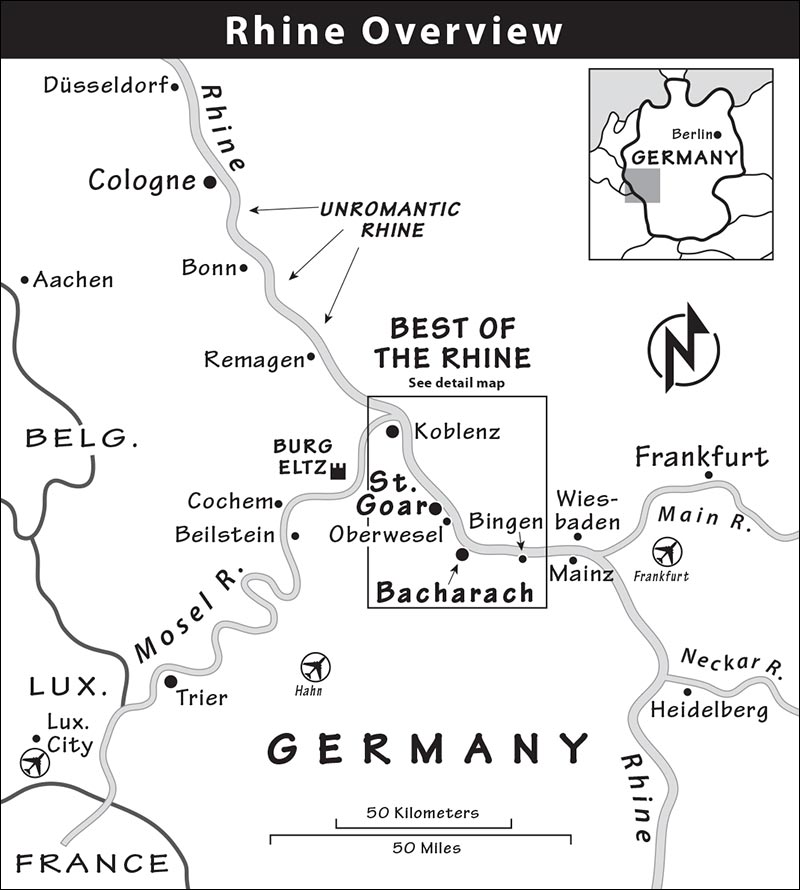
Of the major sights and towns mentioned here, Marksburg and Rheinstein castles and the Loreley clifftop are described in more detail under “Sights Along the Rhine” (see next section); the others—Koblenz, St. Goar (and Rheinfels Castle), Oberwesel, and Bacharach—are covered later in this chapter. For Burg Eltz, see the next chapter.
Km 590—Koblenz: This Rhine blitz starts with Romantic Rhine thrills, at Koblenz. Koblenz isn’t terribly attractive (it was hit hard in World War II), but its place at the historic Deutsches Eck (“German Corner”)—the tip of land where the Mosel River joins the Rhine—gives it a certain patriotic charm. A cable car links the Deutsches Eck with the yellow Ehrenbreitstein Fortress across the river.
Km 586—Lahneck Castle: Above the modern autobahn bridge over the Lahn River, this castle was built in 1240 to defend local silver mines. The castle was ruined by the French in 1688 and rebuilt in the 1850s in Neo-Gothic style. Burg Lahneck faces another Romantic rebuild, the yellow Schloss Stolzenfels (€5, out of view above the train, Tue-Sun 10:00-17:00, closed Mon, off-season Sat-Sun only, closed Dec-Jan, a 10-minute climb from tiny parking lot, www.schloss-stolzenfels.de). A Burg is a defensive fortress, while a Schloss is mainly a showy palace.
Km 580—Marksburg Castle: This castle stands bold and white—restored to look like most Rhine castles once did, with their slate stonework covered with stucco to look as if made from a richer stone. You’ll spot Marksburg with the three modern smokestacks behind it (these vent one of Europe’s biggest car-battery recycling plants just up the valley), just before the town of Spay. This is the best-looking of all the Rhine castles and the only undestroyed medieval castle on the river. Because of its commanding position, it was never attacked in the Middle Ages (though it was captured by the US Army in March 1945). It’s now a museum with a medieval interior second only to the Mosel Valley’s Burg Eltz.
Now’s a good time to read the “Rhine River Trade and Barge-Watching” sidebar in this chapter.
Km 570—Boppard: Once a Roman town, Boppard has some impressive remains of fourth-century walls. Look for the Roman towers and the substantial chunk of Roman wall near the train station, just above the main square. You’ll notice that a church is a big part of each townscape. Many small towns have two towering churches. Four centuries ago, after enduring a horrific war, each prince or king decided which faith his subjects would follow (more often Protestant to the north and east, Catholic to the south and west). While church attendance in Germany is way down, the towns here, like Germany as a whole, are still divided between Catholic and Protestant.
If you visit Boppard, head to the fascinating Church of St. Severus below the main square. Find the carved Romanesque crazies at the doorway. Inside, to the right of the entrance, you’ll see Christian symbols from Roman times, as well as painted arches and vaults (originally, most Romanesque churches were painted this way). Down by the river, the arches show the high-water (Hochwasser) marks from various flood years. You’ll find these flood marks throughout the Rhine and Mosel valleys.
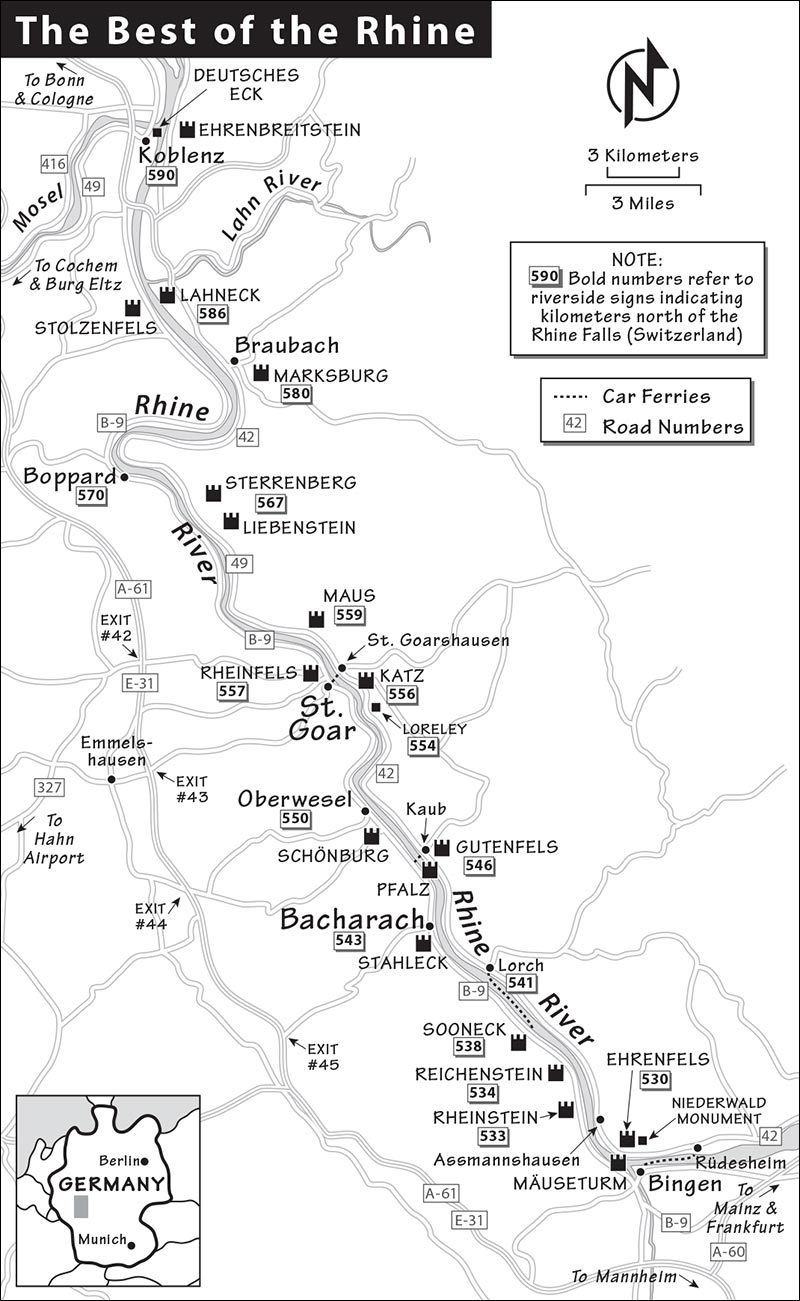
Km 567—Sterrenberg Castle and Liebenstein Castle: These neighboring castles, across from the town of Bad Salzig, are known as the “Hostile Brothers.” Notice how they’re isolated from each other by a low-slung wall. The wall was built to improve defenses from both castles…but this is the romantic Rhine, so there has to be a legend: Take one wall between castles, add two greedy and jealous brothers and a fair maiden, and create your own legend. $$$ Burg Liebenstein is now a fun, friendly, and reasonably affordable family-run hotel (9 rooms, giant king-and-the-family room, easy parking, +49 6773 251, www.castle-liebenstein.com, info@burg-liebenstein.de, Nickenig family).
Boats run from early April through October (usually 4/day between Bacharach and St. Goar May-Oct). From November through March, one boat runs daily for groups, but individuals can tag along if they know you’re coming—call the boat directly (+49 172 1360 335) or the main office in Cologne (+49 221 2088 318). The times listed below are based on the 2022 schedule. Check www.k-d.com for the latest.
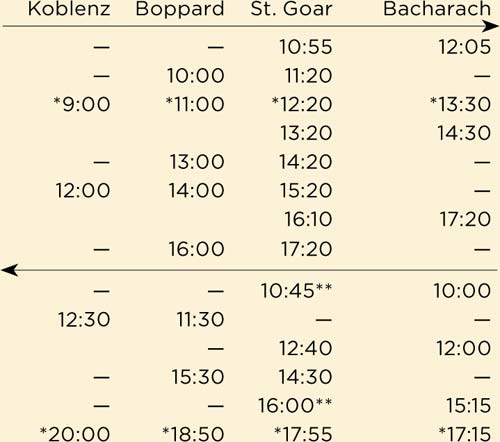
*These departures are on the 1913 paddle-wheeler Goethe.
**To St. Goarshausen: Cheap ferries cross from St. Goar every 20 minutes (see “Getting around the Rhine/By Ferry,” earlier).
Km 560: While you can see nothing of it from here, a 19th-century lead mine functioned on both sides of the river, with a shaft actually tunneling completely under the Rhine.
Km 559—Maus Castle: The Maus (mouse) got its name because the next castle was owned by the Katzenelnbogen family. (Katz means “cat.”) In the 1300s, it was considered a state-of-the-art fortification...until 1806, when Napoleon Bonaparte had it blown apart with state-of-the-art explosives. It was rebuilt true to its original plans in about 1900. Today, Burg Maus is open for concerts, weddings, and guided tours in German.
Since ancient times, the Rhine has been a highway for trade. Rotterdam, the Dutch city waiting at the mouth of the river, is now Europe’s biggest port.
Logically, imports go upstream (Japanese cars, coal, and oil) and exports go downstream (German cars, chemicals, and pharmaceuticals). A clever boat captain manages to ship goods in each direction. Recently, high-capacity Dutch container ships have been driving many of the traditional barges out of business, presenting the German economy with another challenge.
But this stretch of the Rhine remains great for barge-watching. There’s a constant parade of action, and each boat is different. Barge workers are almost a subculture. Deckhands generally live in the bow, while the captain lives in the stern, often with his family—you’ll likely see a family car or two parked on a boat’s stern. Many captains own their own ships
In the Rhine town of Kaub, there was once a boarding school for the children of the Rhine merchant marines—but today it’s closed, since most captains are Dutch, Belgian, or Swiss. The flag of the boat’s home country flies in the stern (Dutch—horizontal red, white, and blue; Belgian—vertical black, yellow, and red; Swiss—white cross on a red field; German—horizontal black, red, and yellow; French—vertical red, white, and blue).
Going downstream, tugs can push a floating train of up to five barges at once, but upstream, as the slope gets steeper (and the stream gradient gets higher), they can push only one at a time. Before modern shipping, horses dragged boats upstream (the faint remains of towpaths survive at points along the river). From 1873 to 1900, workers laid a chain from Bonn to Bingen, and boats with cogwheels and steam engines hoisted themselves upstream. Today, 265 million tons travel each year along the 530 miles from Basel on the German-Swiss border to the Dutch city of Rotterdam on the Atlantic.
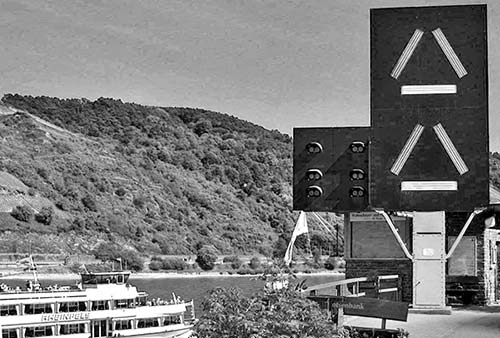
Riverside navigational aids are of vital interest to captains who don’t wish to meet the Loreley (see Km 554 on the “Best of the Rhine” tour). Boats pass on the right unless they clearly signal otherwise with a large blue sign. Since ships heading downstream can’t stop or maneuver as freely, boats heading upstream are expected to do the tricky do-si-do work. Cameras monitor traffic all along and relay warnings of oncoming ships by posting large triangular signals before narrow and troublesome bends in the river. There may be two or three triangles per signpost, depending upon how many “sectors,” or segments, of the river are covered. The lowest triangle indicates the nearest stretch of river. Each triangle tells whether there’s a ship in that sector. When the bottom side of a triangle is lit, that sector is empty. When the left side is lit, an oncoming ship is in that sector.
Km 557—St. Goar and Rheinfels Castle: Cross to the other side of the train. The pleasant town of St. Goar was named for a sixth-century hometown monk. It originated in Celtic times (i.e., really old) as a place where boatsmen would stop, catch their breath, send home a postcard, and give thanks after surviving the seductive and treacherous Loreley crossing. St. Goar is worth a stop to explore its mighty Rheinfels Castle.
Km 556—Katz Castle: Burg Katz (Katzenelnbogen) faces St. Goar from across the river. Together, Burg Katz (built in 1371) and Rheinfels Castle had a clear view up and down the river, effectively controlling traffic (there was absolutely no duty-free shopping on the medieval Rhine). Katz got Napoleoned in 1806 and rebuilt in about 1900.
In 1995, a wealthy and eccentric Japanese man bought it for about $4 million. His vision: to make the castle—so close to the Loreley that Japanese tourists are wild about—an exotic escape for his countrymen. But the town wouldn’t allow his planned renovation of the historic (and therefore protected) building. Stymied, the frustrated investor abandoned his plans. Today, Burg Katz sits empty...the Japanese ghost castle.
Below the castle, notice the derelict grape terraces—worked since the eighth century, but abandoned in the last generation. Yet Rhine wine remains in demand. The local slate absorbs the heat of the sun and stays warm all night, resulting in sweeter grapes. Wine from the steep side of the Rhine gorge—where grapes are harder to grow and harvest—is tastier and more expensive.
About Km 555: A statue of the Loreley, the beautiful-but-deadly nymph, combs her hair at the end of a long spit—built to give barges protection from vicious ice floes that until recent years raged down the river in the winter. The actual Loreley, a landmark cliff, is just ahead.
Km 554—The Loreley: Steep a big slate rock in centuries of legend and it becomes a tourist attraction—the ultimate Rhinestone. The Loreley (name painted near shoreline), rising 450 feet over the narrowest and deepest point of the Rhine, has long been important. It was a holy site in pre-Roman days. The fine echoes here—thought to be ghostly voices—fertilized legend-tellers’ imaginations.
Because of the reefs just upstream (at km 552), many ships never made it to St. Goar. Boatsmen (after days on the river) blamed their misfortune on a wunderbare Fräulein, whose long, blond hair almost covered her body. Heinrich Heine’s Song of Loreley (the CliffsNotes version is on local postcards, and you’ll hear it on K-D boats) tells the story of a count sending his men to kill or capture this siren after she distracted his horny son, who forgot to watch where he was going and drowned. When the soldiers cornered the nymph in her cave, she called her father (Father Rhine) for help. Huge waves, the likes of which you’ll never see today, rose from the river and carried Loreley to safety. And she has never been seen since.
But alas, when the moon shines brightly and the tour buses are parked, a soft, playful Rhine whine can still be heard from the Loreley. As you pass, listen carefully.
Km 552—The Seven Maidens: Killer reefs, marked by red-and-green buoys, are called the “Seven Maidens.” OK, one more goofy legend: The prince of Schönburg Castle (über Oberwesel—described next) had seven spoiled daughters who always dumped men because of their shortcomings. Fed up, he invited seven of his knights to the castle and demanded that his daughters each choose one to marry. But they complained that each man had too big a nose, was too fat, too stupid, and so on. The rude and teasing girls escaped into a riverboat. Just downstream, God turned them into the seven rocks that form this reef. While this story probably isn’t entirely true, there was a lesson in it for medieval children: Don’t be hard-hearted.
Km 550—Oberwesel: Cross to the other side of the train. The town of Oberwesel, topped by the commanding Schönburg Castle (now a hotel), boasts some of the best medieval wall and tower remains on the Rhine.
Notice how many of the train tunnels along here have entrances designed like medieval turrets—they were actually built in the Romantic 19th century. OK, back to the riverside.
Km 547—Gutenfels Castle and Pfalz Castle, the Classic Rhine View: Burg Gutenfels (now a privately owned hotel) and the shipshape Pfalz Castle (built in the river in the 1300s) worked very effectively to tax medieval river traffic. The town of Kaub grew rich as Pfalz raised its chains when boats came, and lowered them only when the merchants had paid their duty. Those who didn’t pay spent time touring its prison, on a raft at the bottom of its well. In 1504, a pope called for the destruction of Pfalz, but the locals withstood a six-week siege, and the castle still stands. Notice the overhanging outhouse (tiny white room between two wooden ones). Pfalz (also known as Pfalzgrafenstein) is tourable but bare and dull (€7 for ferry from Kaub and castle entry; ferry runs 2/hour, castle open Wed-Sun 10:00-13:00 & 14:00-17:00, closed Mon-Tue; Nov and Feb-mid-March open Sat-Sun until 16:00 only, closed Dec-Jan; last entry one hour before closing, +49 677 4745, www.burg-pfalzgrafenstein.de).
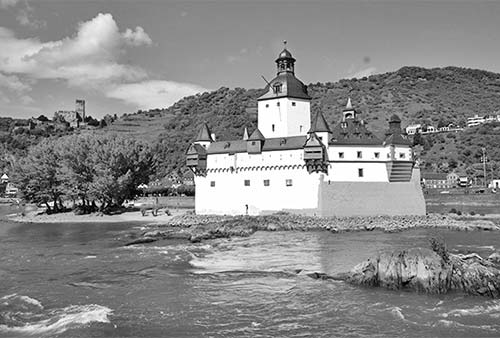
In Kaub, on the riverfront directly below the castles, a green statue (near the waving flags) honors the German general Gebhard von Blücher. He was Napoleon’s nemesis. In 1813, as Napoleon fought his way back to Paris after his disastrous Russian campaign, he stopped at Mainz—hoping to fend off the Germans and Russians pursuing him by controlling that strategic bridge. Blücher tricked Napoleon. By building the first major pontoon bridge of its kind here at the Pfalz Castle, he crossed the Rhine and outflanked the French. Two years later, Blücher and Wellington teamed up to defeat Napoleon once and for all at Waterloo.
Immediately opposite Kaub (where the ferry lands, marked by blue roadside flags) is a gaping hole in the mountainside. This marks the last slate mine on the Rhine still in operation.
Km 544—“The Raft Busters”: Just before Bacharach, at the top of the island, buoys mark a gang of rocks notorious for busting up rafts. The Black Forest, upstream from here, was once poor, and wood was its best export. Black Foresters would ride log booms down the Rhine to the Ruhr (where their timber fortified coal-mine shafts) or to Holland (where logs were sold to shipbuilders). If they could navigate the sweeping bend just before Bacharach and then survive these “raft busters,” they’d come home reckless and horny—the German folkloric equivalent of American cowboys after payday.
Km 543—Bacharach and Stahleck Castle: Cross to the other side of the train. The town of Bacharach is a great stop. Some of the Rhine’s best wine is from this town, whose name likely derives from “altar to Bacchus” (the Roman god of wine). Local vintners brag that the medieval Pope Pius II ordered Bacharach wine by the cartload. Perched above the town, the 13th-century Burg Stahleck is now a hostel. Return to the riverside.
Km 541—Lorch: This pathetic stub of a castle is barely visible from the road. Notice the small car ferry, one of several along the bridgeless stretch between Mainz and Koblenz.
Km 538—Sooneck Castle: Cross back to the other side of the train. Built in the 11th century, this castle was twice destroyed by people sick and tired of robber barons.
Km 534—Reichenstein Castle and Km 533—Rheinstein Castle: Stay on the other side of the train to see two of the first castles to be rebuilt in the Romantic era. Both are privately owned, tourable, and connected by a pleasant trail. Go back to the river side.
Km 530—Ehrenfels Castle: Opposite Bingerbrück and the Bingen station, you’ll see the ghostly Ehrenfels Castle (clobbered by the Swedes in 1636 and by the French in 1689). Since it had no view of the river traffic to the north, the owner built the cute little Mäuseturm (mouse tower) on an island (the yellow tower you’ll see near the train station today). Rebuilt in the 1800s in Neo-Gothic style, it’s now used as a Rhine navigation signal station.
Km 528—Niederwald Monument: Across from the Bingen station on a hilltop is the 120-foot-high Niederwald monument, a memorial built with 32 tons of bronze in 1877 to commemorate “the re-establishment of the German Empire.” A lift takes tourists to this statue from the famous and extremely touristy wine town of Rüdesheim.
From here, the Romantic Rhine becomes the industrial Rhine, and our tour is over.
Sights Along the Rhine
▲▲Marksburg Castle (Marksburg)
Medieval invaders decided to give Marksburg a miss thanks to its formidable defenses. This best-preserved castle on the Rhine can be toured only with a guide on a 50-minute tour. In summer, tours in English normally run daily at 13:00. Otherwise, you can join a German tour that’s almost as good—there are no explanations in English in the castle itself, but your ticket includes an English handout. It’s an awesome castle, and between the handout and my commentary, you’ll feel fully informed, so don’t worry about being on time for the English tours.
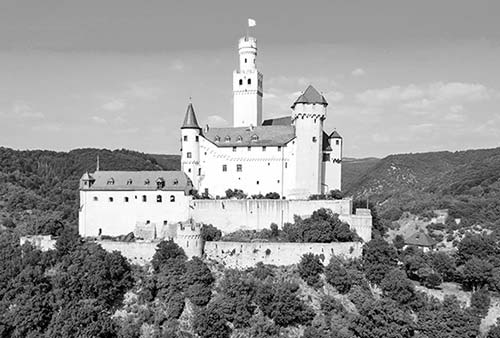
Cost and Hours: €11, daily 10:00-18:00, Nov-mid-March 11:00-16:00, German tours run when enough people have gathered, last tour departs one hour before closing, +49 2627 206, www.marksburg.de.
Getting There: Marksburg caps a hill above the village of Braubach, on the east bank of the Rhine. By train, it’s a 15-minute trip from Koblenz to Braubach (1-2/hour); from Bacharach or St. Goar, it can take up to two hours, depending on the length of the layover in Koblenz. The train is quicker than the boat (downstream from Bacharach to Braubach-2 hours, upstream return-3.5 hours; €37 one-way). Consider taking the downstream boat to Braubach, and the train back. If traveling with luggage, store it in the convenient lockers in the underground passage at the Koblenz train station (Braubach has no enclosed station—just platforms—and no lockers).
Once you reach Braubach, walk into the old town (follow Altstadt signs—coming out of tunnel from train platforms, it’s to your right); then follow the Zur Burg signs to the path up to the castle. Allow 25 minutes for the climb up. Scarce taxis charge at least €10 from the train platforms to the castle. Even if you take the tourist train, you’ll still have to climb the last five minutes up to the castle from its parking lot.
Visiting the Castle: Your guided tour starts inside the castle’s first gate.
Inside the First Gate: While the dramatic castles lining the Rhine are generally Romantic rebuilds, Marksburg is the real McCoy—nearly all original construction. It’s littered with bits of its medieval past, like the big stone ball that was swung on a rope to be used as a battering ram. Ahead, notice how the inner gate—originally tall enough for knights on horseback to gallop through—was made smaller to deter enemies on horseback. Climb the Knights’ Stairway, carved out of slate, and pass under the murder hole—handy for pouring boiling pitch on invaders. (Germans still say someone with bad luck “has pitch on his head.”)
Coats of Arms: Colorful coats of arms line the wall just inside the gate. These are from the noble families who have owned the castle since 1283. In that year, financial troubles drove the first family to sell to the powerful and wealthy Katzenelnbogen family (who made the castle into what you see today). When Napoleon took this region in 1803, an Austrian family who sided with the French got the keys. When Prussia took the region in 1866, control passed to a friend of the Prussians who had a passion for medieval things—typical of this Romantic period. Then it was sold to the German Castles Association in 1900. Its offices are in the main palace at the top of the stairs.
Romanesque Palace: White outlines mark where the larger original windows were located, before they were replaced by easier-to-defend smaller ones. On the far right, a bit of the original plaster survives. Slate, which is vulnerable to the elements, needs to be covered—in this case, by plaster. Because this is a protected historic building, restorers can use only the traditional plaster methods...but no one knows how to make plaster that works as well as the 800-year-old surviving bits.
Cannons: The oldest cannon here—from 1500—was back-loaded. This was advantageous because many cartridges could be preloaded. But since the seal was leaky, it wasn’t very powerful. The bigger, more modern cannons—from 1640—were one piece and therefore airtight, but had to be front-loaded. They could easily hit targets across the river from here. Stone balls were rough, so they let the explosive force leak out. The best cannonballs were stones covered in smooth lead—airtight and therefore more powerful and more accurate.
Gothic Garden: Walking along an outer wall, you’ll see 160 plants from the Middle Ages—used for cooking, medicine, and witchcraft. Schierling (hemlock, in the first corner) is the same poison that killed Socrates.
Inland Rampart: This most vulnerable part of the castle had a triangular construction to better deflect attacks. Notice the factory in the valley. In the 14th century, this was a lead, copper, and silver mine. Today’s factory—one of Europe’s largest car-battery recycling plants—uses the old mine shafts as vents (see the three modern smokestacks).
Wine Cellar: Since Roman times, wine has been the traditional Rhineland drink. Because castle water was impure, wine—less alcoholic than today’s beer—was the way knights got their fluids. The pitchers on the wall were their daily allotment. The bellows were part of the barrel’s filtering system. Stairs lead to the...
Gothic Hall: This hall is set up as a kitchen, with an oven designed to roast an ox whole. The arms holding the pots have notches to control the heat. To this day, when Germans want someone to hurry up, they say, “give it one tooth more.” Medieval windows were made of thin sheets of translucent alabaster or animal skins. A nearby wall is peeled away to show the wattle-and-daub construction (sticks, straw, clay, mud, then plaster) of a castle’s inner walls. The iron plate to the left of the next door enabled servants to stoke the heater without being seen by the noble family.
Bedroom: This was the only heated room in the castle. The canopy kept in heat and kept out critters. In medieval times, it was impolite for a lady to argue with her lord in public. She would wait for him in bed to give him what Germans still call “a curtain lecture.” The deep window seat caught maximum light for needlework and reading. Women would sit here and chat (or “spin a yarn”) while working the spinning wheel.
Hall of the Knights: This was the dining hall. The long table is an unattached plank. After each course, servants could replace it with another preset plank. Even today, when a meal is over and Germans are ready for the action to begin, they say, “Let’s lift up the table.” The action back then consisted of traveling minstrels who sang and told of news gleaned from their travels.
Notice the outhouse—made of wood—hanging over thin air. When not in use, its door was locked from the outside (the castle side) to prevent any invaders from entering this weak point in the castle’s defenses.
Chapel: This chapel is still painted in Gothic style with the castle’s namesake, St. Mark, and his lion. Even the chapel was designed with defense in mind. The small doorway kept out heavily armed attackers. The staircase spirals clockwise, favoring the sword-wielding defender (assuming he was right-handed).
Linen Room: About the year 1800, the castle—with diminished military value—housed disabled soldiers. They’d earn a little extra money working raw flax into linen.
Two Thousand Years of Armor: Follow the evolution of armor since Celtic times. Because helmets covered the entire head, soldiers identified themselves as friendly by tipping their visor up with their right hand. This evolved into the military salute that is still used around the world today. Armor and the close-range weapons along the back were made obsolete by the invention of the rifle. Armor was replaced with breastplates—pointed (like the castle itself) to deflect enemy fire. This design was used as late as the start of World War I. A medieval lady’s armor hangs over the door. While popular fiction has men locking up their women before heading off to battle, chastity belts were actually used by women as protection against rape when traveling.
The Keep: This served as an observation tower, a dungeon (with a 22-square-foot cell in the bottom), and a place of last refuge. When all was nearly lost, the defenders would bundle into the keep and burn the wooden bridge, hoping to outwait their enemies.
Horse Stable: The stable shows off bits of medieval crime and punishment. Cheaters were attached to stones or pillories. Shame masks punished gossipmongers. A mask with a heavy ball had its victim crawling around with his nose in the mud. The handcuffs with a neck hole were for the transport of prisoners. The pictures on the wall show various medieval capital punishments. Many times the accused was simply taken into a torture dungeon to see all these tools, and, guilty or not, confessions spilled out of him. On that cheery note, your tour is over.
Loreley Clifftops
Atop the famous Loreley rock, an impressive viewpoint overlooks the Rhine Valley and the plateaus high above the river. It’s easily reached by walking five minutes from the bus stop outside the Loreley visitors center. (For the Loreley legend, see the Km 544 marker of the “Best of the Rhine Tour,” earlier.)
The visitors center (Besucherzentrum) has a lightweight exhibit that reflects a little on Loreley, but focuses mainly on the landscape, culture, and people of the Rhine Valley. Though English explanations accompany most of the geological and cultural displays, the information about the famous mythical Mädchen is given in German only. The 3-D movie is essentially a tourist brochure for the region, with scenes of the grape harvest over Bacharach that are as beautiful as the sword-fighting is lame.
Cost and Hours: Free, daily 10:00-17:00, Nov-Feb daily 11:00-16:00, café, +49 6771 599 093, www.loreley-touristik.de.
Getting There: For a good hour’s hike, catch the ferry from St. Goar across to the village of St. Goarshausen (for ferry details, see here). Then follow green Burg Katz (Katz Castle) signs up Burgstrasse under the train tracks to find steps on the right (Loreley über Burg Katz) leading to Katz Castle (privately owned) and beyond. Traverse the hillside, always bearing right toward the river. You’ll pass through a residential area, hike down a 50-yard path through trees, then cross a wheat field until you reach the rock-capping viewpoint.
If you’re not up for a hike, catch bus #535 from just left of the St. Goarshausen ferry ramp (€3 each way, departs 1-2/hour, Mon-Fri 8:45-18:45, Sat-Sun from 9:45). A taxi up costs about €13.
To return to St. Goarshausen and the St. Goar ferry, you can take the bus (last departure 19:00), retrace your steps along the Burg Katz trail, or hike a steep 15 minutes directly down to the river, where the riverfront road takes you back to St. Goarshausen.
Loreley-Bob Luge Ride
Next to the Loreley visitors center is the Loreley-Bob, a summer luge course (Sommerrodelbahn), with wheeled carts that seat one or two riders and whisk you down a stainless-steel track. It’s a fun diversion, especially if you don’t plan to visit other summer-luge rides on your trip. For tips on riding a summer luge, see the sidebar on here.
Cost and Hours: €3/ride, €14 shareable 6-ride card; daily 10:00-17:00, closed mid-Nov-mid-March, may close in bad weather—call ahead; no children under age 3, ages 3-8 may ride with an adult, +49 6771 959 4833 or +49 6651 9800, www.loreleybob.de.
▲▲Rheinstein Castle (Schloss Burg Rheinstein)
This castle seems to rule its chunk of the Rhine from a commanding position. While its 13th-century exterior is medieval as can be, the interior is mostly a 19th-century duke’s hunting palace. Visitors wander freely (with an English flier) among trophies, armor, and Romantic Age decor.
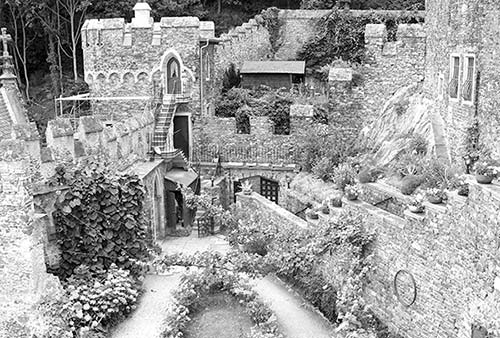
Cost and Hours: €7, daily 10:00-18:00, Nov-mid-Dec Sat-Sun only 11:00-16:30, closed mid-Dec-mid-March, last entry one hour before closing, +49 6721 6348, www.burg-rheinstein.de.
Getting There: Rheinstein Castle (at km 533 marker, 2 km upstream from Trechtingshausen on the main B-9 highway) is easy to reach by car (small, free parking lot on B-9, steep 5-minute hike from there), or bike (35 minutes upstream from Bacharach, stick to the great riverside path, after km 534 marker look for small Burg Rheinstein sign and Rösler-Linie dock). It’s less convenient by boat (no K-D stop nearby) or train (nearest stop in Trechtingshausen, a 30-minute walk away).
Bacharach
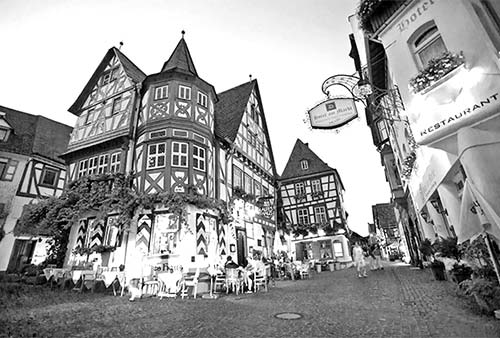
Once prosperous from the wine and wood trade, charming Bacharach (BAHKH-ah-rahkh) is now just a pleasant half-timbered village of 2,000 people working hard to keep its tourists happy. Businesses that have been in the family for eons are dealing with succession challenges, as the allure of big-city jobs and a more cosmopolitan life lure away the town’s younger generation. But Bacharach retains its time-capsule quaintness.
Orientation to Bacharach
Bacharach cuddles, long and narrow, along the Rhine. The village is easily strollable—you can walk from one end of town to the other along its main drag, Oberstrasse, in about 10 minutes. Bacharach widens at its stream, where more houses trickle up its small valley (along Blücherstrasse) away from the Rhine. The hillsides above town are occupied by vineyards, scant remains of the former town walls, and a castle-turned-hostel.
TOURIST INFORMATION
The bright and well-stocked TI, on the main street a block-and-a-half from the train station, will store bags and bikes for day-trippers (Mon-Fri 9:00-17:00, Sat-Sun 10:00-14:00; Nov-March Mon-Fri 9:00-13:00, closed Sat-Sun; from the train station, exit right and walk down the main street with the castle high on your left—the TI will be on your right at Oberstrasse 10; +49 6743 919 303, www.bacharach.de or www.rhein-nahe-touristik.de, Herr Kuhn and his team).
HELPFUL HINTS
Carry Cash: Although more places accept credit cards every year, come prepared to pay cash for most things in the Rhine Valley.
Laundry: The Sonnenstrand campground may let you use their facilities even if you’re not staying there, but priority goes to those who are. Call ahead (+49 6743 1752).
Picnics: You can pick up picnic supplies at Tomi’s, a basic grocery store (Mon-Sat 8:00-12:30 & 14:00-18:00, closed Sun, Koblenzer Strasse 2). For a gourmet picnic, call the recommended Rhein Hotel to reserve a “picnic bag” (a cooler bag in backpack form, complete with wine, cheese, classy picnicware, and a hiking map; €45/2 people, arrange a day in advance, +49 6743 1243).
Bike Rental: Some hotels loan bikes to guests. For bike rental in town, head to Rent-a-Bike Weber (€10/day, e-bike-€25/day, daily 9:00-18:00, closes in bad weather, Koblenzer Strasse 35, +49 6743 1898, mobile +49 175 168 0735, heidi100450@aol.com).
Taxi: Call Jasmin Baumgarten at +49 6743 1653.
Parking: It’s simple to park along the highway next to the train tracks or, better, in the big public lot by the boat dock (€4, 9:00-18:00, pay with coins at Parkscheinautomat, display ticket on dash, free overnight).
Local Guides: Thomas Gundlach happily gives 1.5-hour town walks to individuals or small groups for €40. History buffs will enjoy his “war tour,” which focuses on the town’s survival from 1864 through World War II. He also offers 4- to 10-hour hiking or biking tours for the more ambitious (+49 179 353 6004, thomas_gundlach@gmx.de). Also good is Birgit Wessels (€45/1.5-hour walk, +49 6743 937 514, wessels.birgit@t-online.de). Or take my self-guided town walk or walk the walls—both are described next.
Bacharach Town Walk
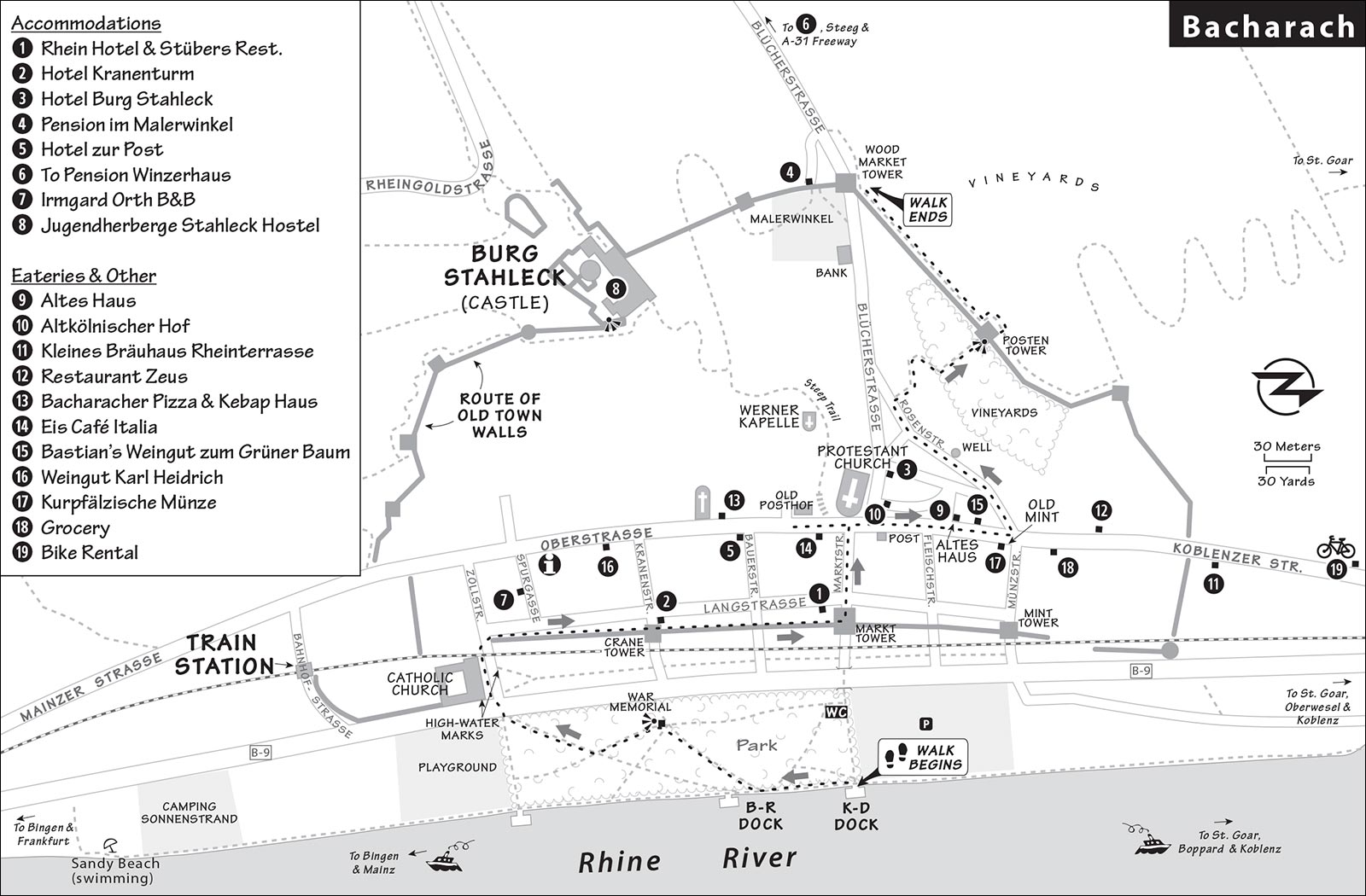
• Start this self-guided walk at the Köln-Düsseldorfer ferry dock (next to a fine picnic park).
Riverfront: View the town from the parking lot—a modern landfill. The Rhine used to lap against Bacharach’s town wall, just over the present-day highway. Every few years the river floods, covering the highway with several feet of water. Flat land like this is rare in the Rhine Valley, where towns are often shaped like the letter “T,” stretching thin along the riverfront and up a crease in the hills beyond.
Reefs farther upstream forced boats to unload upriver and reload here. Consequently, in the Middle Ages, Bacharach was the biggest wine-trading town on the Rhine. A riverfront crane hoisted huge kegs of prestigious “Bacharach” wine (which, in practice, was from anywhere in the region). Today, the economy is based on tourism.
Look above town. The castle on the hill is now a hostel. Two of the town’s 16 towers are visible from here (up to five if you look really hard). The bluff on the right, with the blue flag, is the Heinrich Heine Viewpoint (the end point of a popular hike). A few old-timers remember when, rather than the flag marking the town as a World Heritage site, a swastika sculpture 30 feet wide and tall stood there. Realizing that it could be an enticing target for Allied planes in the last months of World War II, locals tore it down even before Hitler fell.
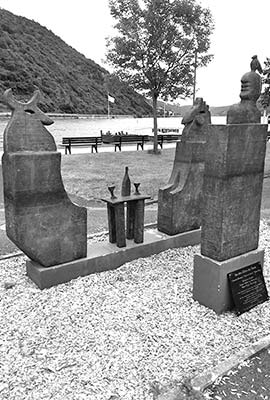
Nearby, a stone column in the park describes the Bingen to Koblenz stretch of the Rhine gorge.
• Before entering the town, walk upstream through the...
Riverside Park: The park was originally laid out in 1910 in the English style: Notice how the trees were planted to frame fine town views, highlighting the most picturesque bits of architecture. Erected in 2016, a Picasso-esque sculpture by Bacharach artist Liesel Metten depicts three figures sharing a bottle of wine (a Riesling, perhaps?). This piece celebrates three men who brought fame to the area through poetry and prose: Victor Hugo, Clemens Brentano, and Heinrich Heine. Other new elements of the park are designed to bring people to the riverside and combat flooding.
The dark, sad-looking monument—its “eternal” flame long snuffed out—is a war memorial. The German psyche is permanently scarred by war memories. Today, many Germans would rather avoid monuments like this, which recall the dark periods before Germany became a nation of pacifists. The Prussian Iron Cross—flanked by classic German helmets—has a W at its center, for Kaiser Wilhelm. On the opposite side, each panel honors sons of Bacharach who died for the kaiser: in 1864 against Denmark, in 1866 against Austria, in 1870-1871 against France, in 1914-1918 during World War I. Review the family names below: You may later recognize them on today’s restaurants and hotels.
• If you look upstream from here you may be able to see the...
Trailer Park and Campground: In Germany, trailer vacationers and campers are two distinct subcultures. Folks who travel in motorhomes, like many retirees in the US, are a nomadic bunch, cruising around the countryside and paying a few euros a night to park. Campers, on the other hand, tend to set up camp in one place—complete with comfortable lounge chairs and TVs—and stay put for weeks, even months. They often come back to the same spot year after year, treating it like their own private estate. These camping devotees have made a science out of relaxing. Tourists are welcome to pop in for a drink or meal at the campground café (see “Activities in Bacharach,” later).
• Continue to where the park meets the playground, and then cross the highway to the fortified riverside wall of the Catholic church, decorated with...
High-Water Marks: These recall various floods. Before the 1910 reclamation project, the river extended out to here, and boats would tie up at mooring rings that used to be in this wall.
• From the church, go under the 1858 train tracks (and past more high-water marks) and hook right up the stairs at the yellow floodwater yardstick to reach the town wall. Atop the wall, turn left and walk under the long arcade. After 30 yards, on your left, notice a...
Well: Rebuilt as it appeared in the 17th century, this is one of seven such wells that brought water to the townsfolk until 1900. Each neighborhood’s well also provided a social gathering place and the communal laundry. Walk 50 yards past the well along the wall to an alcove in the medieval tower with a view of the war memorial in the park. You’re under the crane tower (Kranenturm). After barrels of wine were moved overland from Bingen, avoiding dangerous stretches of river, the precious cargo could be lowered by cranes from here into ships to continue more safely down the river.
The Rhine has long been a major shipping route through Germany. But in modern times, its narrow banks have made it a bottleneck in Germany’s train system. And increasing rail traffic has made nearly constant train noise quite an issue for Rhinelanders. It’s estimated that, on average, a train barrels down each side of the Rhine every three minutes—that’s 500 trains a day. Landowners complain that the noise has made it nearly impossible to sell a piece of property along this stretch. The train company at least gives hotels and residents along the tracks money for soundproof windows.
• Continue walking along the town wall. Pass the recommended Rhein Hotel just before reaching the...
Markt Tower: This stands at one of the town’s 16 original 14th-century gates; it’s named for the big wine market located at its base back then.
• Descend the stairs closest to the Rhein Hotel, pass another well, and follow Marktstrasse away from the river toward the town center, the two-tone church, and the town’s...
Main Square: From here, Bacharach’s main street (Oberstrasse) goes right to the half-timbered red-and-white Altes Haus (which we’ll visit later) and left 400 yards to the train station. Spin around to enjoy the higgledy-piggledy building styles. The town has a case of the doldrums: The younger generation is moving to the big cities and many long-established family businesses have no one to take over for their aging owners. In the winter the town is particularly dead.
• To the left (south) of the church, a golden horn hangs over the old...
Posthof: Throughout Europe, the postal horn is the symbol of the postal service. In olden days, when the postman blew this, traffic stopped and the mail sped through. This post station dates from 1724, when stagecoaches ran from Cologne to Frankfurt and would change horses here, Pony Express-style. Notice the cornerstones at the Posthof entrance, protecting the venerable building from reckless carriage wheels. If it’s open, head inside the old oak doors to see (on the left) the actual door to the post office that served Bacharach for 200 years. Find the mark on the wall labeled Rheinhöhe 30/1-4/2 1850. This recalls a historic flood caused by an ice jam at the Loreley just downstream. Notice also the fascist eagle in the alcove on the right (from 1936; a swastika once filled its center). The courtyard was once a carriage house and inn that accommodated Bacharach’s first VIP visitors.
Two hundred years ago, Bacharach’s main drag was the only road along the Rhine. Napoleon widened it to fit his cannon wagons. The steps alongside the church lead to the ruins of the 15th-century Werner Chapel and the castle.
• Return to the church, passing (or perhaps paying a visit to) the recommended Italian ice-cream parlor Eis Café Italia, where friendly Mimo serves his special invention: Riesling wine-flavored gelato.
Protestant Church: Inside the church (daily 10:00-18:00, closed Nov-March, English booklet for sale), you’ll find grotesque capitals, brightly painted in medieval style, and a mix of round Romanesque and pointed Gothic arches. The church was fancier before the Reformation wars, when it (and the region) was Catholic. Bacharach lies on the religious border of Germany and, like the country as a whole, is split between Catholics and Protestants. To the left of the altar, some medieval (pre-Reformation) frescoes survive where an older Romanesque arch was cut by a pointed Gothic one.
If you’re considering bombing the town, take note: A blue-and-white plaque just outside the church’s door warns that, according to the Hague Convention, this historic building shouldn’t be targeted in times of war.
• Continue down Oberstrasse to the...
Altes Haus: Dating from 1389, this is indeed the oldest house in town. Notice the 14th-century building style—the first floor is made of stone, while upper floors are half-timbered (in the ornate style common in the Rhine Valley). Some of its windows still look medieval, with small, flattened circles as panes (small because that’s all that the glass-blowing technology of the time would allow), pieced together with molten lead (like medieval stained glass in churches). Frau Weber welcomes visitors to enjoy the fascinating ground floor of the recommended Altes Haus restaurant, with its evocative old photos and etchings (consider eating here later).
• Keep going down Oberstrasse to the...
Old Mint (Münze): The old mint is marked by a crude coin in its sign. As a practicality, any great trading town needed coinage, and since 1356, Bacharach minted theirs here. Now, it’s a bar, Kurpfälzische Münze, with occasional live music. Across from the mint, the recommended Bastian family’s wine garden is another lively place in the evening (see “Nightlife in Bacharach” and “Wine Tasting,” later).
• At the next street, look down the lane to the right and see the mint tower, painted in the medieval style. Then turn left and wander 30 yards up Rosenstrasse to the well. Notice the sundial and the wall painting of 1632 Bacharach with its walls intact. Study the fine slate roof over the well: The town’s roof tiles were quarried and split right here in the Rhineland. Continue another 30 yards up Rosenstrasse to find the tiny-stepped lane on the right leading up into the vineyard and to the...
Posten Tower: The slate steps lead to a small path through the vineyard that deposits you at a viewpoint atop the stubby remains of the medieval wall and a tower. The town’s towers jutted out from the wall and had only three sides, with the “open” side facing the town. Towers were covered with stucco to make them look more impressive, as if they were made of a finer white stone.
• If this tower’s open, climb the stairs for the best view. (The top floor has been closed to give nesting falcons some privacy.)
Romantic Rhine View: Looking south, a grand medieval town spreads before you. For 300 years (1300-1600), Bacharach was big (population 4,000), rich, and politically powerful.
From this perch, you can see the ruins of a 15th-century chapel and six surviving city towers. Visually trace the wall to the Stahleck Castle. The castle was actually the capital of Germany for a couple of years in the 1200s. When Holy Roman Emperor Frederick Barbarossa went away to fight the Crusades, he left his brother (who lived here) in charge of his vast realm. Bacharach was home to one of the seven electors who voted for the Holy Roman Emperor in 1275. To protect their own power, these prince electors did their best to choose the weakest guy on the ballot. The elector from Bacharach helped select a two-bit prince named Rudolf von Habsburg (from a no-name castle in Switzerland). However, the underestimated Rudolf brutally silenced the robber barons along the Rhine and established the mightiest dynasty in European history. His family line, the Habsburgs, ruled much of central and eastern Europe from Vienna until 1918.
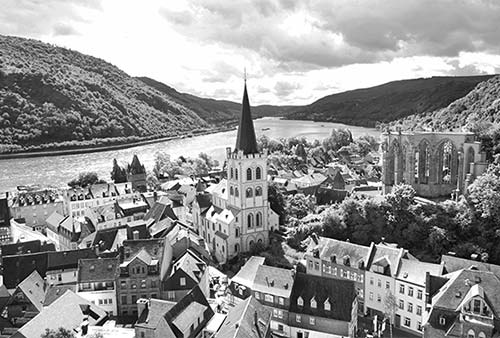
Plagues, fires, and the Thirty Years’ War (1618-1648) finally did in Bacharach. The town has slumbered for several centuries. Today, the castle houses commoners—40,000 overnights annually by hostelers.
In the mid-19th century, painters such as J. M. W. Turner and writers such as Victor Hugo were charmed by the Rhineland’s romantic mix of past glory, present poverty, and rich legend. They put this part of the Rhine on the old Grand Tour map as the “Romantic Rhine.” Hugo pondered the chapel ruins that you see under the castle: In his 1842 travel book, Excursions Along the Banks of the Rhine, he wrote, “No doors, no roof or windows, a magnificent skeleton puts its silhouette against the sky. Above it, the ivy-covered castle ruins provide a fitting crown. This is Bacharach, land of fairy tales, covered with legends and sagas.” If you’re enjoying the Romantic Rhine, thank Victor Hugo and company.
• You could end the walk here and retrace your steps to get back into town—but to return an even prettier way, take the level path away from the river that leads along the once-mighty wall up the valley to the next tower, the...
Wood Market Tower: Timber was gathered here in Bacharach and lashed together into vast log booms—as big as a soccer field and known as “Holland rafts”—that were floated downstream. Two weeks later the lumber would reach Amsterdam, where it was in high demand as foundation posts for buildings and for the great Dutch shipbuilders. Notice the four stones above the arch on the side of the tower facing away from town—these guided the gate as it was hoisted up and down.
• From here, head down the ramp, cross the street, and go downhill into the parking lot to get back within the town walls. Pass the recommended Pension im Malerwinkel on your right, being careful not to damage the old arch with your head. Follow the creek past a delightful little series of half-timbered homes and cheery gardens known as the Painters’ Corner (Malerwinkel). Resist looking into some weirdo’s peep show (on the right) and continue downhill back to the town center.
Activities in Bacharach
Walk Along the Old Town Walls
A steep and rocky but clearly marked walking path follows the remains of Bacharach’s old town walls and makes for a good hour’s workout. Along the way benches prompt you to pause and take in views of the Rhine and Bacharach’s slate roofs. The TI has maps that show the entire route. The path starts near the train station, climbs up to the hostel in what was Stahleck Castle (drinks and snacks available), descends into the side valley, and then continues up the other side to the tower in the vineyards before returning to town. To start the walk at the train station, find the house at Oberstrasse 2 and climb up the stairway to its left. Then follow the Stadtmauer-Rundweg signs. Good bilingual signposts tell the history of each of the towers along the wall—some are intact, one is a private residence, and others are now only stubs.
Swimming, Eating, and Drinking at Camping Sonnenstrand
This campground, a 10-minute walk upstream from Bacharach, has a sandy beach with water as still as a lake, and welcomes visitors (especially if you buy a drink at their café). On hot summer days you can enjoy a dip in the Rhine at the beach at your own risk (free, no lifeguard—beware of strong current). This is a chance to see Euro-style camping, which comes with a sense of community. Campers are mostly Dutch, English, Belgian, and German, with lots of kids (and a playground). The $ terrace café overlooking the campsites and the river is the social center and works well for a drink or meal (inside or outside with river view, daily 17:00-21:00, closed Nov-March, +49 6743 1752, www.camping-rhein.de).
Sleeping in Bacharach
The only listings with their own parking are Pension im Malerwinkel, Pension Winzerhaus, and the hostel. For the others, you can drive in to unload your bags and then park in the public lot (see “Helpful Hints,” earlier). If you’ll arrive after 20:00, let your hotel know in advance (many hotels with restaurants stay open late, but none have 24-hour reception desks).
$$ Rhein Hotel, overlooking the river with 14 spacious and comfortable rooms, is classy, well run, and decorated with modern flair. This place has been in the Stüber family for six generations and is decorated with works of art by the current owner’s siblings. Each room has been thoughtfully and uniquely designed. The large family room downstairs is über stylish, while the bright “hiker room” on the top floor features terrific views of both the town and river—and an in-room sauna. You can sip local wines in the renovated room where owner Andreas was born (air-con, river- and train-side rooms come with quadruple-paned windows, packages available including big three-course dinner, ask about picnic bags when you check in, free loaner bikes, directly inland from the K-D boat dock at Langstrasse 50, +49 6743 1243, www.rhein-hotel-bacharach.de, info@rhein-hotel-bacharach.de). Their recommended Stübers Restaurant is the best in town.
$$ Hotel Kranenturm, part of the medieval town wall, has 16 rooms with rustic castle ambience and Privatzimmer funkiness right downtown. The rooms in its former Kranenturm (crane tower) have the best views. While just 15 feet from the train tracks, a combination of medieval sturdiness and triple-paned windows makes the riverside rooms sleepable (family room, Rhine views come with train noise—earplugs on request, back rooms are quieter, closed Jan-Feb, Langstrasse 30, +49 6743 1308, mobile +49 176 8056 3863, www.kranenturm.com, hotel.kranenturm@gmail.com).
$ Hotel Burg Stahleck rents six big, bright rooms in the town center. The hotel’s cozy café serves homemade cakes (family room, view room, free parking, Blücherstrasse 6, +49 6743 1388, www.cafe-burg-stahleck.de, info@cafe-burg-stahleck.de, Hakar).
$ Pension im Malerwinkel sits like a grand gingerbread house that straddles the town wall in a quiet little area so charming it’s called the “Painters’ Corner” (Malerwinkel). The Vollmer family’s super-quiet 20-room place is a short stroll from the town center. Here guests can sit in a picturesque garden on a brook and enjoy views of the vineyards (cash only, family rooms, elevator, no train noise, bike rentals for guests, free and easy parking; from Oberstrasse, turn onto Blücherstrasse at the church, walkers can follow the path to the left just before the town gate but drivers must pass through the gate to find the hotel parking lot, Blücherstrasse 41; +49 6743 1239, www.im-malerwinkel.de, pension@im-malerwinkel.de, Armin and Daniela).
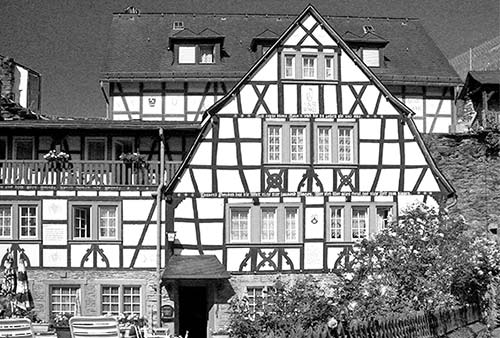
$ Hotel zur Post, refreshingly clean and quiet, is conveniently located right in the town center with no train noise. Its 12 rooms are a good value. Run by friendly and efficient Ute, the hotel offers more solid comfort than old-fashioned character, though the lovely wood-paneled breakfast room has a rustic feel (family room, Oberstrasse 38, +49 6743 1277, www.hotel-zur-post-bacharach.de [URL inactive], h.zurpost@t-online.de).
$ Pension Winzerhaus, an eight-room place run by friendly Sybille and Stefan, is just outside the town walls, directly under the vineyards. The rooms are simple, clean, and modern, and parking is a breeze (cash only, parking, Blücherstrasse 60, +49 6743 1294, www.pension-winzerhaus.de, winzerhaus@gmx.de).
¢ Irmgard Orth B&B rents one room with an en-suite bath and, to families or others traveling together, two rooms that share a small bathroom on the hall. Charming Frau Orth speaks almost no English, but is exuberantly cheery (cash only, Spurgasse 2, +49 6743 1553—speak slowly; she prefers email: orth.irmgard@gmail.com).
¢ Jugendherberge Stahleck hostel is a 12th-century castle on the hilltop—350 steps above Bacharach—with a royal Rhine view. Open to travelers of any age, this gem has 36 rooms, eight with private showers and WCs. The hostel offers hearty all-you-can-eat buffet dinners (18:00-19:30 nightly); in summer, its bistro serves drinks and snacks until 21:00. If you arrive at the train station with luggage, it’s a minimum €10 taxi ride to the hostel—call +49 6743 1653 (reception open 8:00-19:00—call if arriving later, +49 6743 1266, www.diejugendherbergen.de, bacharach@diejugendherbergen.de). If driving, don’t go in the driveway; park on the street and walk 200 yards.
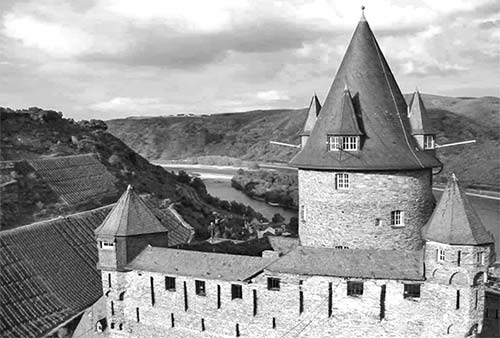
Eating in Bacharach
Bacharach has several reasonably priced, atmospheric restaurants offering fine indoor and outdoor dining, as well as some casual options. Most don’t take credit cards.
The recommended Rhein Hotel’s $$$ Stübers Restaurant is Bacharach’s top-end choice. Andreas Stüber, his family’s sixth-generation chef, creates regional plates prepared with a slow-food ethic. The menu changes with the season and is served at river- and track-side seating or indoors with a spacious white-tablecloth elegance. Consider the William Turner pâté starter plate, named after the British painter who liked Bacharach. Book in advance for the special slow-food menu (discount for hotel guests, always good vegetarian and vegan options, Wed-Mon 17:00-21:15 plus Sun 12:00-14:15, closed Tue except to hotel guests, closed mid-Dec-Feb, call or email to reserve on weekends or for an outdoor table when balmy, family-friendly with a play area, Langstrasse 50, +49 6743 1243, info@rhein-hotel-bacharach.de). Their Posten Riesling is well worth the splurge and pairs well with both the food and the atmosphere.
$$ Altes Haus, the oldest building in town (see the “Bacharach Town Walk,” earlier), serves classic German dishes within Bacharach’s most romantic atmosphere. Find the cozy little dining room with photos of the opera singer who sang about Bacharach, adding to its fame (Mon and Thu-Fri 18:00-21:30, Sat-Sun 12:30-21:00, closed Tue-Wed, Nov weekdays, and Dec-Easter, dead center on the main square, +49 6743 1209).
$$$ Altkölnischer Hof is a family-run place with outdoor seating right on the main square, serving Rhine specialties that burst with flavor. This restored 18th-century banquet hall feels formal and sophisticated inside, with high ceilings and oil paintings depicting the building’s history. Reserve an outdoor table for a more relaxed meal, especially on weekends, when locals pack the place (Tue-Wed and Fri-Sun 18:30-20:00, closed Mon, Thu, and Nov-Easter, Blücherstrasse 2, +49 6743 947 780, www.altkoelnischer-hof.de).
$$ Kleines Brauhaus Rheinterrasse is a funky microbrewery serving hearty meals, fresh-baked bread, and homemade beer under a 1958 circus carousel that overlooks the town and river. Sweet Annette cooks while Armin brews, and the kids run free in this family-friendly place. For a sweet finish, try the “beer-liquor,” which tastes like Christmas. Don’t leave without putting €0.20 in the merry-go-round-in-a-box in front of the Rhine Theater next door (Tue-Sun 12:00-21:00, closed Mon, at the downstream end of town, Koblenzer Strasse 14, +49 6743 919 179).
$$ Restaurant Zeus, with delicious Greek fare and vine-draped outdoor seating, adds a spark to this end of town (daily 17:00-21:00, cash only, Koblenzer Strasse 11, +49 6743 909 7171).
$ Bacharacher Pizza and Kebap Haus, on the main drag, is the town favorite for döner kebabs, cheap pizzas, and salads. Imam charges the same to eat in or take out (daily 11:00-22:00, Oberstrasse 43, +49 6743 3127).
Camping Sonnenstrand, a 10-minute walk from town, has a café (dinner only) with great river views inside and out (see “Activities in Bacharach,” earlier).
Gelato: Right on the main street, Eis Café Italia is run by friendly Mimo Calabrese, who brought gelato to town in 1976. He’s known for his refreshing, not-too-sweet Riesling-flavored gelato. He also makes one with rose petals from a nearby farm. Eat in or take it on your evening stroll (no tastes offered, Waldmeister flavor is made with forest herbs—top secret, daily 11:00-20:00, closed mid-Oct-March, Oberstrasse 48).
WINE TASTING
Bacharach is proud of its wine. These places offer visitors an inexpensive tasting memory.
$$ Bastian’s Weingut zum Grüner Baum offers an array of cheeses to go along with its wines. Sit in their medieval interior or choose one of their three nice terraces: front for shade and people-watching, back for sun, or a courtyard (daily 12:00-21:00, Nov-Dec closed Mon-Wed, closed Jan-Feb, just past Altes Haus, +49 6743 1208).
$$ Weingut Karl Heidrich is a fun family-run wine shop and Stube in the town center, where Markus proudly shares his family’s centuries-old wine tradition with travelers. Check out a variety of €16 carousels with six wines, English descriptions, and bread—ideal for the more sophisticated wine taster. This inviting space, with beautiful outside seating on the main street, also does light meals and a meat-and-cheese plate (cash only, Tue-Sat 12:00-22:00, kitchen closes at 19:00, closed Sun-Mon and Nov-Easter, Oberstrasse 16, +49 6743 93060).
Nightlife in Bacharach
Bacharach goes to bed early, so your options are limited for a little after-dinner action. But the places listed below and the two wine places listed above are welcoming and can be fun in the evening hours.
Kurpfälzische Münze (Old Mint) has live music some nights, ranging from jazz and blues to rock to salsa, and pairs local wines with meat-and-cheese plates and other local specialties (Tue-Sun 18:00-22:00 or later, closed Mon).
For something a bit off the beaten path try Jugendherberge Stahleck—Bacharach’s hostel—where the bistro serves munchies and drinks with priceless views until 21:00 in summer (listed earlier, under “Sleeping in Bacharach”).
Bacharach Connections
BY TRAIN
Milk-run trains stop at Rhine towns each hour starting as early as 5:00, connecting at Mainz and Koblenz to trains farther afield. Trains between St. Goar and Bacharach depart at about :50 after the hour in each direction (buy tickets online or from the machine in the unstaffed stations, carry cash since some machines won’t accept US credit cards).
The durations listed below are calculated from Bacharach; for St. Goar, the difference is only 10 minutes. From Bacharach (or St. Goar), to go anywhere distant, you’ll need to change trains in Koblenz for points north, or in Mainz for points south. Milk-run connections to these towns depart hourly, at about :50 past the hour for northbound trains, and at about :05 past the hour for southbound trains (with a few more on the half hour). Train info: www.bahn.com.
From Bacharach by Train to: St. Goar (hourly, 10 minutes), Moselkern near Burg Eltz (hourly, 1.5 hours, change in Koblenz), Cochem (hourly, 2 hours, change in Koblenz), Trier (hourly, 2-2.5 hours, change in Koblenz), Cologne (hourly, 2 hours with change in Koblenz, 2.5 hours direct), Frankfurt Airport (hourly, 1 hour, change in Mainz or Bingen), Frankfurt (hourly, 1.5 hours, change in Mainz or Bingen), Rothenburg ob der Tauber (every 2 hours, 4.5 hours, 3-4 changes), Munich (hourly, 5 hours, 2 changes), Berlin (every 2 hours with a transfer in Frankfurt, 5.5 hours; more with 2-3 changes), Amsterdam (hourly, 5-7 hours, change in Cologne, sometimes 1-2 more changes).
ROUTE TIPS FOR DRIVERS
This area is a logical first (or last) stop in Germany. If you’re using Frankfurt Airport, here are some tips.
Frankfurt Airport to the Rhine: Driving from Frankfurt to the Rhine or Mosel takes about an hour (follow blue autobahn signs from airport—major cities are signposted).
The Rhine to Frankfurt: From St. Goar or Bacharach, follow the river to Bingen, then autobahn signs to Mainz, then Frankfurt. From there, head for the airport (Flughafen) or downtown (signs to Messe, then Hauptbahnhof, to find the parking under Frankfurt’s main train station—see “Arrival in Frankfurt—By Car” on here).
Oberwesel
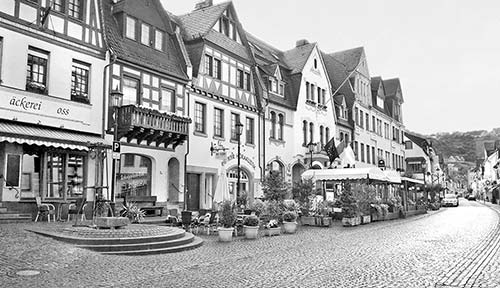
Oberwesel (OH-behr-vay-zehl) is just four miles from Bacharach. Oberwesel was a Celtic town in 400 BC, then a Roman military station. It’s worth a quick visit, with a charming main square, a fun-to-walk medieval wall, and a museum with the best collection of historic Rhine artifacts I’ve seen within the Rhine Valley. From the river, you’ll notice its ship’s masts rising from terra firma—a memorial to the generations of riverboat captains and boatsmen for whom this town is famous. Like most towns on the Rhine, Oberwesel is capped by a castle (Schönburg). The other town landmark is its 130-foot-tall crenellated Ochsenturm (Oxen Tower), standing high and solitary overlooking the river.
Oberwesel is an easy stop by boat, train, bike, or car from Bacharach. There’s free parking by the river (as in many small towns, you must display a plastic clock—see here).
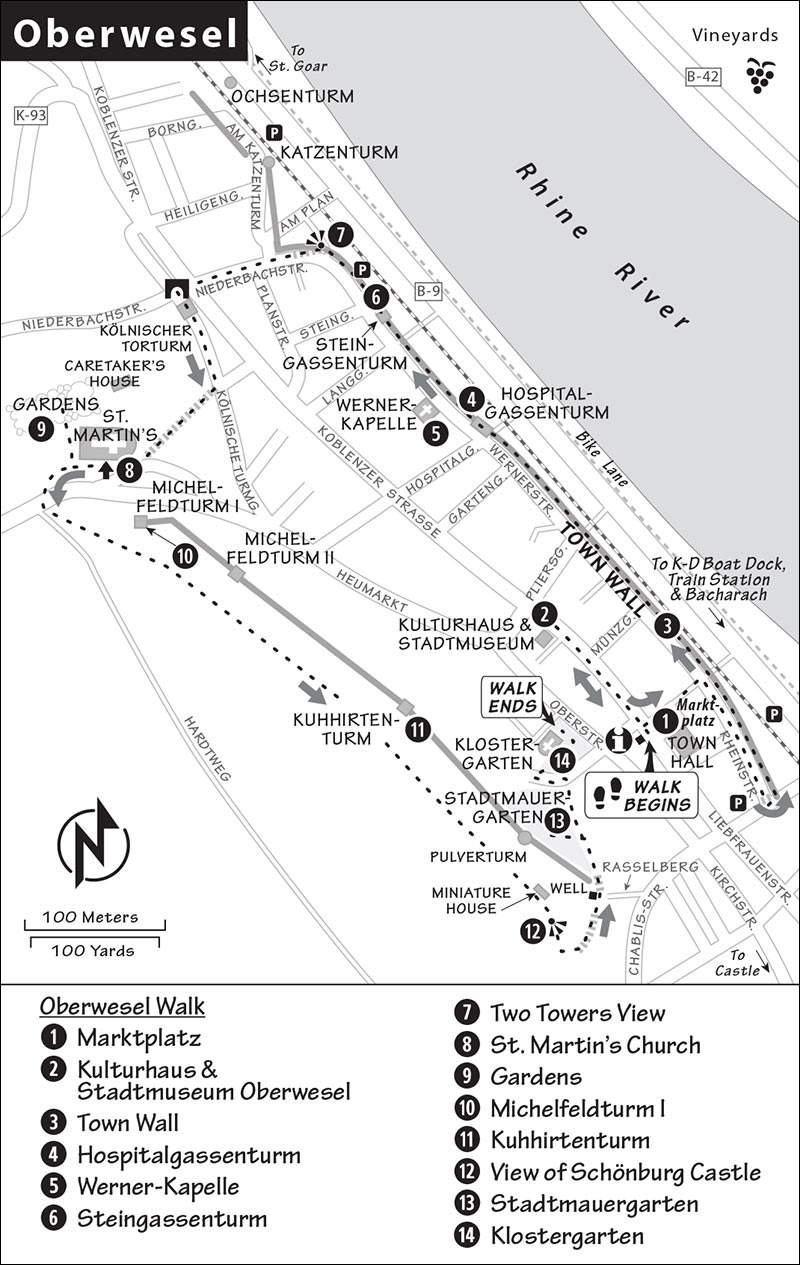
Exploring Oberwesel is a breeze when you follow my self-guided walk. The TI on the Marktplatz stocks free maps outside its door at Liebfrauenstrasse 3—but the map in this book should suffice (Mon-Fri 9:00-13:00 & 14:00-17:00, Sat-Sun 10:00-14:00, closed weekends off-season, +49 6744 710 624, www.oberwesel.de).
Oberwesel Walk
I’ve laced together Oberwesel’s sights with this self-guided walk. Allow at least an hour without stops. Here’s an overview: Starting at the Marktplatz, visit the museum and walk the lower wall to the Ochsenturm at the far end of town, then climb to the top of town and walk the upper wall, passing through the Stadtmauergarten and Klostergarten (former monastery) before returning to the Marktplatz, where you can get a bite to eat at one of several cafés.
• The first stop is a 10-minute walk from the train station: Leave the station by heading right onto Liebfrauenstrasse, which leads directly to the...
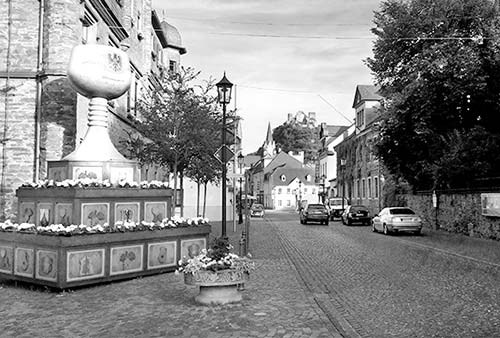
1 Marktplatz: For centuries this has been Oberwesel’s social and commercial center, and today still hosts tourist-friendly cafés and wine bars. If you’re here in the summer, you can’t miss the oversized wine glass declaring that Oberwesel is a winegrowers’ town. Around harvest time, the city hosts a huge wine festival and elects a “Wine Witch.” This is a new tradition—not a long-steeped medieval one—designed to make the town’s ceremonial wine-production mascot stand out from a crowd of other towns’ wine “queens.”
• Continue along the main drag, passing several cafés, until you see the entrance (marked Eingang) for the museum on the left.
2 Kulturhaus and Stadtmuseum Oberwesel: This is the region’s best museum on local history and traditions. The ground floor retraces the history of Oberwesel, from the Romans to the 19th-century Romantics. Upstairs, exhibits explain how salmon were once fished here, and how timber traders lashed together huge rafts of wood and floated them to the Netherlands to sell. Dramatic photos show the river when it was jammed with ice, and you can survey wine witches from the past few decades (€4; Tue-Fri 10:00-17:00, Sat-Sun from 14:00, closed Mon; Nov-March Tue-Fri until 14:00, closed Sat-Mon; borrow the English descriptions, Rathausstrasse 23, +49 6744 7147 26, www.kulturhaus-oberwesel.de).
• Return to the Marktplatz, turn toward the river, and walk to the...
3 Town Wall: The wall in front of you is part of some of the best-preserved walls in the Middle Rhine Valley, thanks to the work of local volunteers.
• Turn right on Rheinstrasse (before the tunnel), climb the narrow steps on the left to the top of the wall, and start walking downstream (left), toward the leaning tower.
4 Hospitalgassenturm: This tower was constructed to rest on the wall...but it was too heavy. In an attempt to “fix” it, builders straightened out the top.
• Continue along until you come to the...
5 Werner-Kapelle: In the 13th century this chapel was built right into the town wall to serve Oberwesel’s medieval hospital. The sick lay in bed here with their eyes on the cross, confident that a better life awaited them in heaven. Today this chapel serves the town’s adjacent modern hospital. If the chapel’s open, pop in for a quick look.
• Continue hiking along the wall to reach the next tower. If you’d like, climb up the...
6 Steingassenturm: If you climb to the top, consider how many Romantic painters and poets in centuries past enjoyed this same view.
Consider the description Victor Hugo penned after a visit here: “This is the warlike Oberwesel, whose old walls are riddled with the havoc of shot and shells. Upon them you easily recognize the trace of the huge cannon balls of the bishops of Treves, the Biscayans of Louis XIV, and the revolutionary grape shot of France. At the present day Oberwesel resembles an old veteran soldier turned winemaker, and what excellent wine he produces.”
• Carry on toward the two towers beyond the wall. Just before the break in the wall, stop to take in the view.
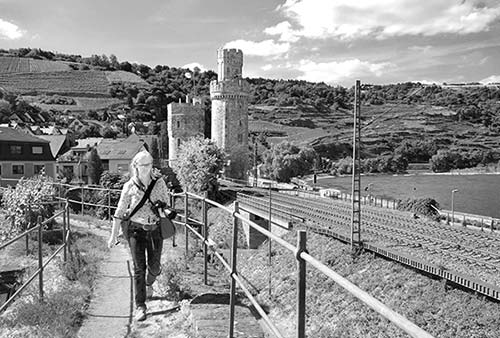
7 Two Towers View: The nearer Katzenturm (named for a count, not a cat) and Ochsenturm (Oxen Tower) behind it were among 32 towers that once protected Oberwesel (16 survive). The Ochsenturm was built in the 14th century as a lookout and signal tower, but with its fancy design it also served as a status symbol for the archbishop, declaring his power to all who passed here along the Rhine.
Between this spot and the river are a bike lane (once a towpath for mighty horses pulling boats upstream), a train line (one of the first in Germany), and today’s riverside road (built in the 1950s). Until modern times there was just one small road through Oberwesel—the one you walked along to get to the center of town.
• A set of stairs leads down to the street. To continue to the upper town walls, walk straight ahead along Niederbachstrasse until you’ve passed under the arch. Then make an immediate left to walk through the Kölnischer Torturm (Cologne-Gate Tower). Follow Kölnische Turmgasse two blocks to find a staircase on the right, and climb it to reach the big church with the bell tower.
8 St. Martin’s Church: This 14th-century church, known locally as the “white church,” is one of two major churches in town. Head toward the picturesque little house to the left, which was long the home of the church caretaker.
• Have a peek inside the church if it’s open. Then continue around the back of the building through the gate to the gardens overlooking the Rhine.
9 Gardens: The church garden—notice the green cross of hedges—was planted in the 17th century. From here, take a look at the tower attached to the back of the church. Built long before the church as part of the town walls’ defensive system, the tower was incorporated into the church’s design.
• Exit the churchyard through the cemetery gate near the road. (If it’s closed, walk back around the church and leave through the gate across from the church’s side entrance, then head up the road to the right.) Across the road, go uphill a few steps into the paved area to find a dirt path on the left, and follow it along, beside the upper town wall, until you reach the first tower.
10 Michelfeldturm I: Take a good look at the top of this tower—it’s actually someone’s residence. The city leases these towers for €1 for 100 years. The hitch? Residents have to agree to restore them.
• Continue past the next tower until you come to the...
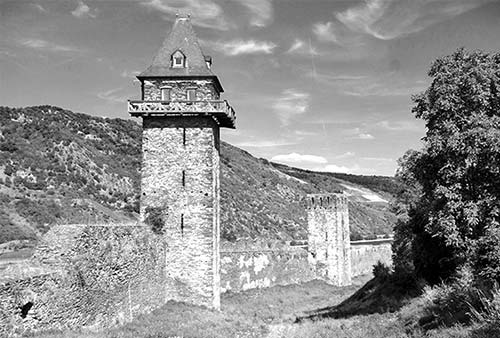
11 Kuhhirtenturm (Cowherder’s Tower): Once you’re close enough to it, notice that this tower-top private home has a fanciful drawbridge. If the bridge is down, someone’s home. According to local folklore, a teenage son of the tower’s owners once had a rowdy graduation party here. With all the noise, neighbors complained. But when the police came, they just hoisted up the drawbridge and partied on.
• The nice view along this last stretch of the wall includes the rooftops of the town center and the Town Hall (look for its clock on top) marking the Marktplatz, where this walk began (and ends). Pass the Pulverturm (Powder Tower) and start downhill, stopping just beyond the miniature house.
12 View of Schönburg Castle: There’s been a castle in Oberwesel since the 10th century. After the original was destroyed by the French in 1689, it sat in ruins for 200 years before being rebuilt. Today it houses a hotel/restaurant, youth hostel, and small museum. While there’s not much to see at the castle itself, the hike to reach it is a scenic one.
• Turning away from the castle, continue downhill and take the first set of stairs on the left, bordering a vineyard. At the bottom of the stairs follow the path to the left, past the backyard gardens. Zigzag down another small set of stairs, and then, before heading all the way down to street level, immediately walk up some more stairs. When you reach the ivy-lined wall, enter the gardens through the gate on the left.
13 Stadtmauergarten (Town-Wall Gardens): These gardens were made possible by a local who’d left town as a lad to pursue his fortune but returned to Oberwesel as a retiree. He established a private foundation and spent his last years back in his childhood home.
• Exit the gardens, turn left, and walk downhill. At the end of the lane, turn right and walk until you see the cross (on the left) at the next intersection. Take a left and walk to the entrance of the...
14 Klostergarten (Monastery Garden): For 600 years Franciscan monks lived, worked, and prayed here. During Napoleon’s reign this monastery was vacated and later fell victim to fire. The poor took refuge in what was left and built their homes inside the former cloister, sacristy, and other remnants. At its peak, after World War II, about 70 people were living here. Only a dozen remain today in this unique (and cramped) living space.
• Feel free to enter and explore a bit, but be respectful and remember that this is a private residence. When you reach the information board (in English) beside the church entrance, you’ve hit the end of this walk. Retrace your steps back to the entrance and walk downhill to reach the Marktplatz.
St. Goar
St. Goar (sahnkt gwahr) is a classic Rhine tourist town. Its hulk of a castle overlooks a half-timbered shopping street and leafy riverside park, busy with sightseeing ships and contented strollers. Rheinfels Castle, once the mightiest on the river, is the single best Rhineland ruin to explore. While the town of St. Goar itself is less interesting than Bacharach, be sure to explore beyond the shops: Thoughtful little placards scattered around town explain factoids about each street, lane, and square. St. Goar also makes a good base for hiking or biking the region. A tiny car ferry will shuttle you back and forth across the busy Rhine from here. (If you run out of things to see, a great pastime in St. Goar is simply chatting with friendly Heike at the K-D boat kiosk.) For train connections, see “Bacharach Connections,” earlier.
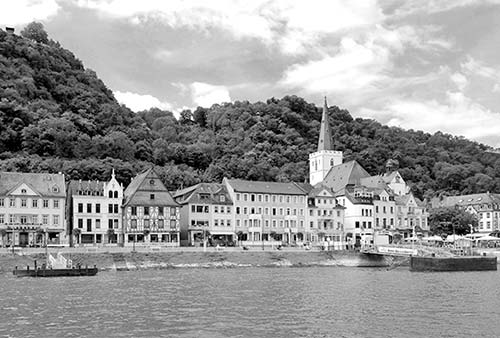
Orientation to St. Goar
St. Goar is dominated by its mighty castle, Rheinfels. The village—basically a wide spot in the road at the foot of Rheinfels’ hill—isn’t much more than a few hotels and restaurants. From the riverboat docks, the main drag—Heerstrasse, a dull pedestrian mall without history—cuts through town before ending at the road up to the castle.
TOURIST INFORMATION
The helpful St. Goar TI, which stores bags for free (and also doubles as the post office), is on the main pedestrian street, just steps off the Markt (Mon-Tue and Thu-Fri 10:00-16:30, Wed and Sat-Sun until 13:00; shorter hours and closed Sat-Sun off-season; from train station, go downhill around church and turn left after the recommended Hotel Am Markt, Heerstrasse 81; +49 6741 383, www.stadt-st-goar.de).
HELPFUL HINTS
Picnics: St. Goar’s waterfront park has benches perfect for a picnic. You can buy picnic fixings on the pedestrian street at the tiny St. Goarer Stadtladen grocery store (Mon-Tue and Thu-Fri 8:00-18:00, Wed and Sat until 13:00, closed Sun, Heerstrasse 106) or at the recommended Café St. Goar.
Shopping: The Montag family runs an intense souvenir shop specializing in beer steins and cuckoo clocks—as one might well guess, as it boasts “the largest free-hanging cuckoo clock in the world” hanging outside (RS%—10 percent discount, €10 minimum purchase; open daily at least 11:00-16:30 and often longer, shorter hours Nov-April, at the castle end of the main drag at Heerstrasse 131). They’ll ship your souvenirs home—or give you a VAT form to claim your tax refund at the airport if you’re carrying your items with you. One or two other souvenir shops are across from the K-D boat dock.
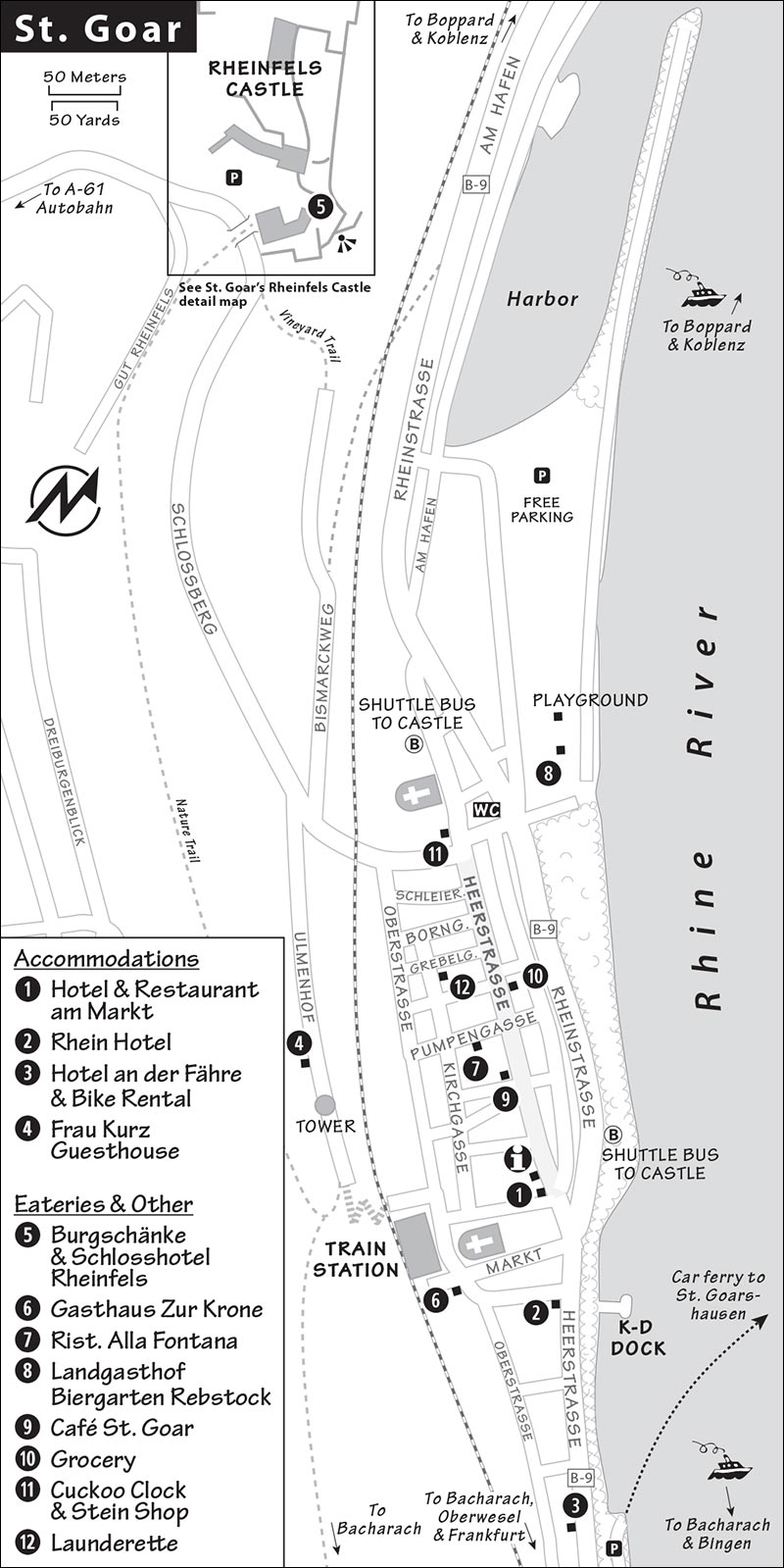
Laundry: Helmut Dubrulle can pick up and drop off your laundry, or you can drop it off (do so by noon, and it’ll be ready by 18:00). There’s no self-service (Mon-Fri 9:00-12:30, closed Sat-Sun, right next to Herpellstrasse 5, one street above the main drag, +49 6741 512).
Bike Rental: Call ahead to reserve a bike at Hotel an der Fähre, which rents wheels to the public (€10/day, pickup after 10:00, Heerstrasse 47, +49 6741 980 577).
Parking: A free lot is at the downstream end of town, by the harbor. For on-street parking by the K-D boat dock and recommended hotels, get a ticket from the machine (Parkscheinautomat) (€5/day, daily 9:00-18:00). Make sure you press the button for a day ticket.
Sights in St. Goar
Rheinfels Castle is St. Goar’s only real sight. For day trips from here, see “Sights Along the Rhine,” earlier.
▲▲▲Rheinfels Castle (Burg Rheinfels)
Perched proudly atop the hill above St. Goar, the ruins of this once mightiest of Rhine River castles still exude a hint of menace. Built in the 13th century, Rheinfels ruled the river for more than 500 years. The castle you see today, though impressive and an evocative sight to visit, is but a shadow of its former sprawling self. This hollow but interesting shell offers your single best hands-on ruined-castle experience on the river. The free castle map shows which areas are accessible without a guided tour, and my self-guided tour, next, covers most everything worth seeing.
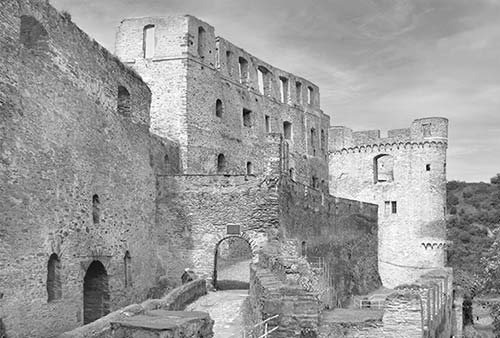
Cost and Hours: €6, daily 9:00-18:00, Nov-mid-March Fri-Sun 10:00-15:00, closed Mon-Thu, closed first week of Sept for concert series, last entry one hour before closing—weather permitting.
Information: +49 6741 7753, www.st-goar.de.
Tours: While a multiyear restoration is underway, parts of the castle grounds, including the tunnels, can only be seen with a guided tour. Tours run in German or English depending on who shows up. If you plan to take a tour, you must bring a flashlight (your phone flashlight is good enough) for the dark tunnels.
WCs: A handy WC is immediately across from the ticket booth (men take note of the guillotine urinals—stand back when you pull to flush). The hotel across from the entrance also has WCs.
Getting to the Castle: You can walk to the castle in about 15 minutes on any of the following routes: 1) Simply follow the main road up through the railroad underpass at the top end of the pedestrian street—head left before the (recommended) souvenir shop with the giant cuckoo clock. 2) It’s more fun to hike the nature trail. From the train station, take the underpass under the tracks at the north end of the station, climb the steep stairs uphill, turn right (following Burg Rheinfels signs), and keep straight along the path just above the old city wall. Small red-and-white signs show the way. 3) Or, from the town center, walk up through the castle’s vineyard—from the cuckoo-clock souvenir shop, follow Schlossberg up and through the underpass, but turn right, off the main road, along Bismarckweg, which lands you on the vineyard path.
You can also take a shuttle bus from either end of the town center: along Rheinstrasse (at the riverside, directly downhill from the train station and across the street from the Markt), or from a stop at the castle end of the pedestrian street—just outside a gas station beyond the church (€3.50 one-way, €6 round-trip, May-Oct daily roughly 10:00-16:00, departs every 30 minutes but no bus 12:15-14:15 except Sat-Sun). Parking at the castle costs €0.60/30 minutes (coins only).
Background: Burg Rheinfels was once huge—for five centuries, it was the biggest castle on the Rhine. Built in 1245 to guard a toll station, it soon earned the nickname “the unconquerable fortress.” In the 1400s, the castle was thickened to withstand cannon fire. Rheinfels became a thriving cultural center and, in the 1520s, was visited by the artist Albrecht Dürer and the religious reformer Ulrich Zwingli. It saw lots of action in the Thirty Years’ War (1618-1648), and later became the strongest and most modern fortress in the Holy Roman Empire. It withstood a siege of 28,000 French troops in 1692. But eventually the castle surrendered to the French without a fight, and in 1797, the French Revolutionary army destroyed it. For years, the ruined castle was used as a source of building stone, and today—while still mighty—it’s only a small fraction of its original size.
 Self-Guided Tour: We’ll start at the museum, then circulate through the courtyards, up to the highest lookout point, finishing in a big cellar. To walk around the fortified ramparts and to access the dark tunnels, you’ll need to take a guided tour (see earlier). If it’s damp, be careful of slippery stones.
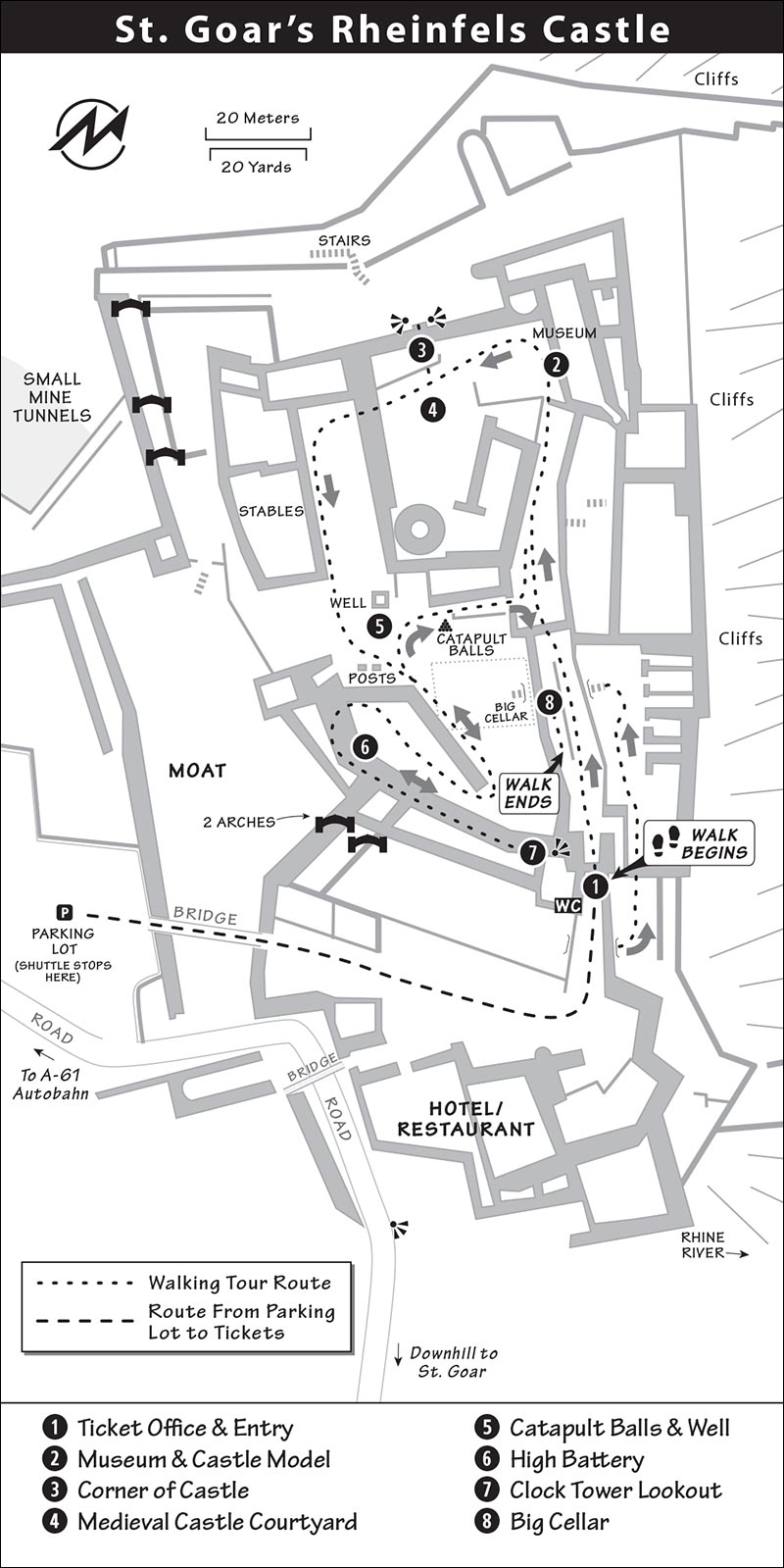
If you like, pick up the free map when you get your ticket; this self-guided tour route is similar to the one marked on the castle map. (You’ll notice that I’ve skipped a couple of stops.)
• At the 1 entry, buy your ticket and walk through the castle’s clock tower, Uhrturm. Continue straight, passing a giant cellar (which we’ll visit later), until you get to the….
2 Museum and Castle Model: The pleasant museum is located in the only finished room of the castle. It features a sweeping history exhibit with good English descriptions and Romantic Age etchings that give a sense of the place as it was in the 19th century (daily 10:00-12:30 & 13:00-17:30; Nov-mid-March Fri-Sun 11:00-14:30, closed Mon-Thu).
The massive fortification was the only Rhineland castle to withstand Louis XIV’s assault during the 17th century. The model reconstruction of the castle in the middle of the room, just inside the door, shows how much bigger it was before French Revolutionary troops destroyed it in the 18th century. Give it a good look and find where you are. (Hint: Look for the tall tower.) This room was the living quarters of the original castle, which was only the smallest ring of buildings around the tiny central courtyard (13th century). The ramparts were added in the 14th century. By 1650, the fortress was largely complete. Since its destruction nearly 150 years later, it’s had no military value. While no WWII bombs were wasted on this ruin, it served St. Goar as a stone quarry for generations.
Follow the castle’s history counterclockwise around the room. The seven-foot-tall carved stone immediately to the right of the model, labeled in English as “Palatinate Column,” is a tombstone from a nearby Celtic grave...from 400 years before Christ. Given the site’s strategic advantages, perhaps it’s not too surprising that there were people here long before there was a castle, and even well before the Romans.
The basement of the museum shows the castle pharmacy and an exhibit of Rhine-region odds and ends, including tools, an 1830 loom, and photos of icebreaking on the Rhine. While once routine, icebreaking hasn’t been necessary here since 1963.
• Exit the museum and walk 20 yards directly out, slightly uphill and halfway into the castle courtyard. At the first opening on the right, step up for a peek out at the...
3 Corner of Castle: Look right. That’s the original castle tower. A three-story, half-timbered building originally rose beyond the tower’s stone fortification. The two stones jutting out near the top supported the toilet. Lean and look left.
Thoop…You’re Dead: Notice the smartly placed crossbow slits. While you’re lying there, notice the stonework. The little round holes were for the scaffolds they used as they built up, which indicate that this stonework is original.
• Pick yourself up and walk back into the inner courtyard.
4 Medieval Castle Courtyard: Five hundred years ago, the entire castle encircled this courtyard (Innenhof). The place was self-sufficient and ready for a siege, with a bakery, pharmacy, herb garden, brewery, well (top of yard), and livestock. During peacetime, 300-600 people lived here; during a siege, there would be as many as 4,000. The walls were plastered and painted white. Bits of the original 13th-century plaster survive.
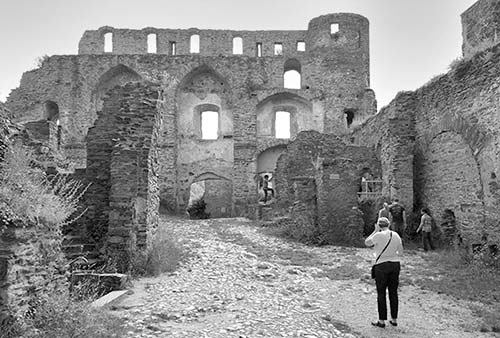
• Continue through the courtyard under the Erste Schildmauer (first shield wall) sign, turn left, and walk straight toward the two old wooden upright posts. Find the pyramid of stone catapult balls on your left just before you reach the posts.
5 Catapult Balls and Well: Catapult balls like these were too expensive not to recycle—they’d be retrieved after any battle. Across from the balls is a well (Brunnen)—essential for any castle during the age of sieges. The old posts are for the ceremonial baptizing of new members of the local trading league—one that has survived the centuries (now as a social club).
• Climb uphill to the castle’s highest point by walking along the cobbled path (look for the To the Tower sign) up past the 6 high battery (Hohe Batterie) to the castle’s best viewpoint—up where the German flag waves (signed Uhrturm).
7 Clock Tower Lookout: Enjoy a great view of the river, the castle, and the forest from this high point. Remember, the fortress once covered five times the land it does today. Notice how the other castles (across the river) don’t poke above the top of the Rhine canyon. That would make them easy for invading armies to see.
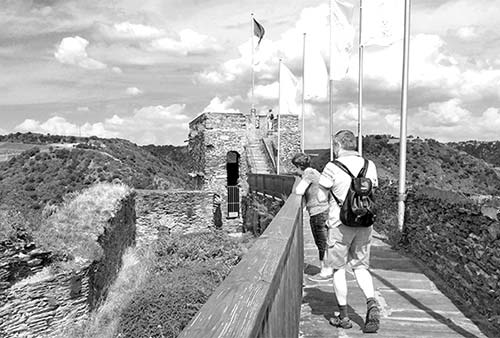
From this perch, survey the Rhine Valley, cut out of slate over millions of years by the river. The slate absorbs the heat of the sun, making the grapes grown here well suited for wine. Today the slate is mined to provide roofing. Imagine St. Goar himself settling here 1,500 years ago, establishing a place where boatsmen—thankful to have survived the treacherous Loreley—would stop and pray. Imagine the frozen river of winters past, when the ice would break up and boats would huddle in man-made harbors like the one below for protection. Consider the history of trade on this busy river—from the days when castles levied tolls on ships, to the days when boats would be hauled upstream with the help of riverside towpaths, to the 21st century when 300 ships a day move their cargo past St. Goar. And imagine this castle before the French destroyed it...when it was the mightiest structure on the river, filled with people and inspiring awe among all who passed.
• Return to the catapult balls, walk downhill and through the tunnel, and pause to look back up and see the original 13th-century core of the castle. Now go right toward the entrance, first veering down to see the...
8 Big Cellar: This grosser Keller was a big pantry. When the castle was smaller, this was the original moat—you can see the rough lower parts of the wall. The original floor was 13 feet deeper. The drawbridge rested upon the stone nubs on the left. When the castle expanded, the moat became this cellar. Halfway up the walls, square holes mark spots where timbers made a storage loft, perhaps filled with grain. In the back, an arch leads to the wine cellar (probably blocked off) where finer wine was kept. Part of a soldier’s pay was wine...table wine. This wine was kept in a single 180,000-liter stone barrel (that’s 47,550 gallons), which generally lasted about 18 months.
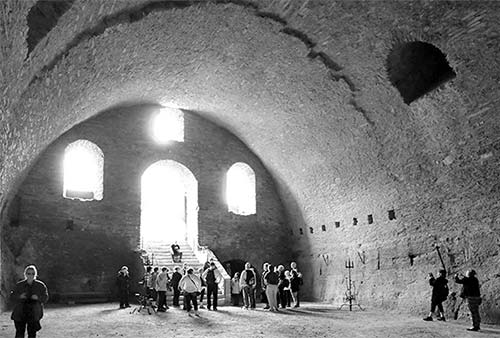
The count owned the surrounding farmland. Farmers got to keep 20 percent of their production. Later, in more liberal feudal times, the nobility let them keep 40 percent. Today, the German government leaves the workers with 60 percent...and provides a few more services.
• You’re free. Climb out, turn right, and leave. For coffee on a terrace with a great view, visit Schlosshotel Rheinfels, opposite the entrance.
Sleeping in St. Goar
For parking advice, see “Helpful Hints,” earlier.
$ Hotel am Markt, run by Herr and Frau Marx and their friendly staff, is a decent value with all the modern comforts. It features 15 rustic rooms in the main building (think antlers with a pastel flair), 10 classier rooms right next door, and a good restaurant. It’s a stone’s throw from the boat dock and train station (family rooms, some rooms with river view, closed Nov-March, Markt 1, +49 6741 1689, http://hotel-sankt-goar.de, dashotel@t-online.de).
$ Rhein Hotel, on the other side of the church from Hotel am Markt and run with enthusiasm by young and energetic Gil Velich, has 10 bright and stylish rooms in a spacious building (some rooms with river view and balconies, family rooms, pay laundry, closed mid-Nov-March, Heerstrasse 71, +49 6741 981 240, www.rheinhotel-st-goar.de, info@rheinhotel-st-goar.de).
$ Hotel an der Fähre is a simple place on the busy road at the end of town, immediately across from the ferry dock. It rents 12 cheap and colorful rooms (cash only, some view rooms, cheapest rooms with shared bath and no view, street noise but double-glazed windows, free public parking nearby, closed Nov-Feb, Heerstrasse 47, +49 6741 980 577, www.hotel-stgoar.de, info@hotel-stgoar.de, friendly Alessya). They also offer rental bikes by reservation.
$ Frau Kurz has been housing my readers since 1988. She and her daughter-in-law Jeanette rent out her entire downstairs to anyone who’d enjoy staying with their temporary German grandma. You’ll have a small but well-equipped kitchen all to yourself (no breakfast provided), and café-like seats outside (cash only, 2 or more nights preferred, free and easy parking, Ulmenhof 11, +49 6741 7570 or mobile +49 716 5657 5507, www.gaestehaus-kurz.de, fewo-kurz@kabelmail.de). If you’re walking, it’s a steep five-minute hike from the train station: Exit left from the station, take an immediate left under the tracks, and go partway up the zigzag stairs, turning right through an archway onto Ulmenhof; #11 is just past the tower. Jeanette also offers a $ apartment near the river.
Eating in St. Goar
$$ Hotel Restaurant am Markt serves tasty traditional meals with plenty of game and fish (specialties include marinated roast beef and homemade cheesecake) at fair prices with good atmosphere and service. Choose cozy indoor seating, or dine outside with a river and castle view (daily 10:00-21:00, closed Nov-March, Markt 1, +49 6741 1689).
$ Burgschänke is easy to miss on the ground floor of Schlosshotel Rheinfels (the hotel across from the castle entrance—enter through the souvenir shop). It offers the only reasonably priced lunches up at Rheinfels Castle, is family-friendly, and has a Rhine view from its fabulous outdoor terrace (Flammkuchen and regional dishes, generally open Wed-Sun 12:00-17:00, may stay open later for drinks and desserts, closed Mon-Tue, +49 6741 802 806).
The $$$$ Schlosshotel Rheinfels’ “Auf Scharffeneck” dining room is your Rhine splurge, with an incredible indoor view terrace in an elegant, dressy setting. Call to reserve for weekends or if you want a window table (daily 18:00-21:00, also open 12:00-14:00 on Sun-Tue and Nov-March, +49 6741 8020, www.schloss-rheinfels.de).
$$ Gasthaus Zur Krone is the local choice for traditional German food in a restaurant off the main drag (right next to the train station). There’s no river view, but it’s cozy and offers some outdoor seating (Thu-Tue 11:30-14:00 & 17:30-21:00, closed Wed and sometimes also Tue or Thu, cash only, next to the train station and church at Oberstrasse 38, +49 6741 1515).
$ Ristorante Alla Fontana, tucked away on a back lane and busy with locals, serves the best Italian food in town at great prices in a lovely dining room or on a leafy patio (Wed-Sun 12:00-14:00 & 17:30-21:00, closed Mon-Tue, cash only, dinner reservations smart, Pumpengasse 5, +49 6741 96117).
$$ Landgasthof Biergarten Rebstock is hidden on the far end of town on the banks of the Rhine. They serve schnitzel and plenty of beer and wine. A nice playground and minigolf course on either side keeps the kids busy (daily 11:00-21:00—weather permitting, closed Nov-March, Am Hafen 1, +49 6741 980 0337).
$ Café St. Goar is the perfect spot for a quick lunch or Kaffee und Kuchen. They sell open-face sandwiches, strudel, tiny cookies, and a variety of cakes to satisfy any appetite. Grab something for a picnic or enjoy seating on the pedestrian-only street out front (daily 8:00-18:00, closed Nov-March, Heerstrasse 95, +49 6741 1635).
Koblenz
The main town on this stretch of the Romantic Rhine is Koblenz—situated where the Mosel River flows into the Rhine. The word “Koblenz” comes from the Roman word for confluence—a reminder that 2,000 years ago, this was the northern border of the Roman Empire. The city has long been a strategic base. A transportation hub with a key bridge and a mighty fortress, it was heavily bombed in World War II. The city feels rebuilt today and has little of the charm that most are looking for when they visit the Rhineland. All I would do here is check out the modern center (Zentralplatz, with its Forum Confluentes and Rhineland museum), trek out to the Deutsches Eck (“German Corner”) for a little Deutschland patriotism, ride the cable car over the Rhine (from the Deutsches Eck to the castle), and tour the Ehrenbreitstein Fortress, if only for the views.
The TI is inside the Forum Confluentes cultural center on Zentralplatz (daily 10:00-18:00, +49 261 129 1610, www.koblenz-tourism.com).
Arrival in Koblenz: If you’re driving a car, go directly to the Deutsches Eck and park. If arriving by train, walk (or catch bus #1) from the station through the town center to the Deutsches Eck, with a stop at Zentralplatz on the way. K-D Rhine sightseeing boats stop right at the Deutsches Eck (2/day, 3.5 hours upstream to St. Goar, 2.5 hours downstream from St. Goar, www.k-d.com).
Sights in Koblenz
Zentralplatz and Forum Confluentes
The city’s once bombed-out center now sparkles with sleek modern architecture. On the main square, Zentralplatz, you’ll find the striking Forum Confluentes. This bright, modern cultural center houses the TI; the Romanticum, an interactive museum with fun Romantic-era portrayals of Rhine towns and exhibits on the Rhineland culture; and the Mittelrhein Museum, with art from medieval to modern. You can also catch an elevator ride to the roof terrace for sweeping city views (Romanticum—€6, daily 10:00-18:00, +49 261 129 1610, www.romanticum.de; Mittelrhein—€6, Tue-Sun 10:00-18:00, closed Mon, www.mittelrhein-museum.de; elevator—€1, daily 9:00-19:00; Zentralplatz 1). It’s a short walk from here to the Deutsches Eck.
Deutsches Eck
The actual tip of land where the two rivers meet is the legendary “Deutsches Eck”—the “German Corner.” For many Germans, this spot stirs their nationalistic spirit. While “Deutschland über alles” (“Germany above all”—a line from the German national anthem) is often associated with Hitler and German expansionism in the 20th century, the phrase actually refers to the fragmentation of German-speaking states before unity in 1871. The Song of Germany celebrated the notion of the little German states uniting in one German nation.
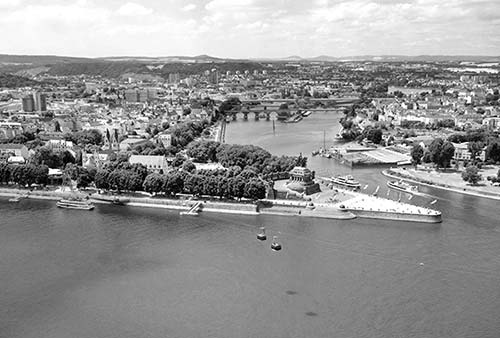
When Germany finally was united, it was the Johnny-come-lately of European superpowers and scrambled to establish its legitimacy. The allure of this strategic spot made it a natural staging ground to symbolize unity. Notice how the flags of the many German states all converge on the flag of a united Germany at the tip of the peninsula. While, historically, there was a lack of clarity about the French/German border (and under Napoleon, it was actually right here), today the German Corner is seen not as a border but as the heart of a great nation. Beyond the flag-lined plaza is a reconstructed memorial to Kaiser Wilhelm. Germans come here to feel good about their country while enjoying the organ grinders and buskers playing accordions in this park-like atmosphere.
Koblenz Cable Car
A cable car runs above the Rhine River, stretching a half-mile from the Deutsches Eck to the Ehrenbreitstein Fortress high above. As you glide over the river you’ll get fine views of the point where the Rhine and the Mosel rivers converge. This is the only convenient way to get from the city to the fortress.
Cost and Hours: €10 one-way, €14 round-trip, €18 round-trip combo-ticket with fortress entry; daily 10:00-19:00 or later—check website, Nov-March may be closed or run Sat-Sun only 9:30-17:30; +49 261 2016 5850, www.seilbahn-koblenz.de.
Ehrenbreitstein Fortress
While a castle has stood on this strategic point much longer, what you see today is not your classic Rhine castle standing tall, but a squat and sprawling, bombshell-hardened 19th-century fortress. The exhibit is poorly signposted, with little English describing a vast space that is not very inviting. As you enter you’ll get a map with 20 points of (little) interest. But the views are grand and it’s a chance to roam free in a castle.
Cost and Hours: €8, €18 combo-ticket with round-trip cable-car ride, daily 10:00-18:00, Nov-March until 17:00, +49 261 6675 4000, www.diefestungehrenbreitstein.de.