FRANKFURT
NEAR THE RIVER, ON THE NORTH BANK
ACROSS THE RIVER, ON THE SOUTH BANK
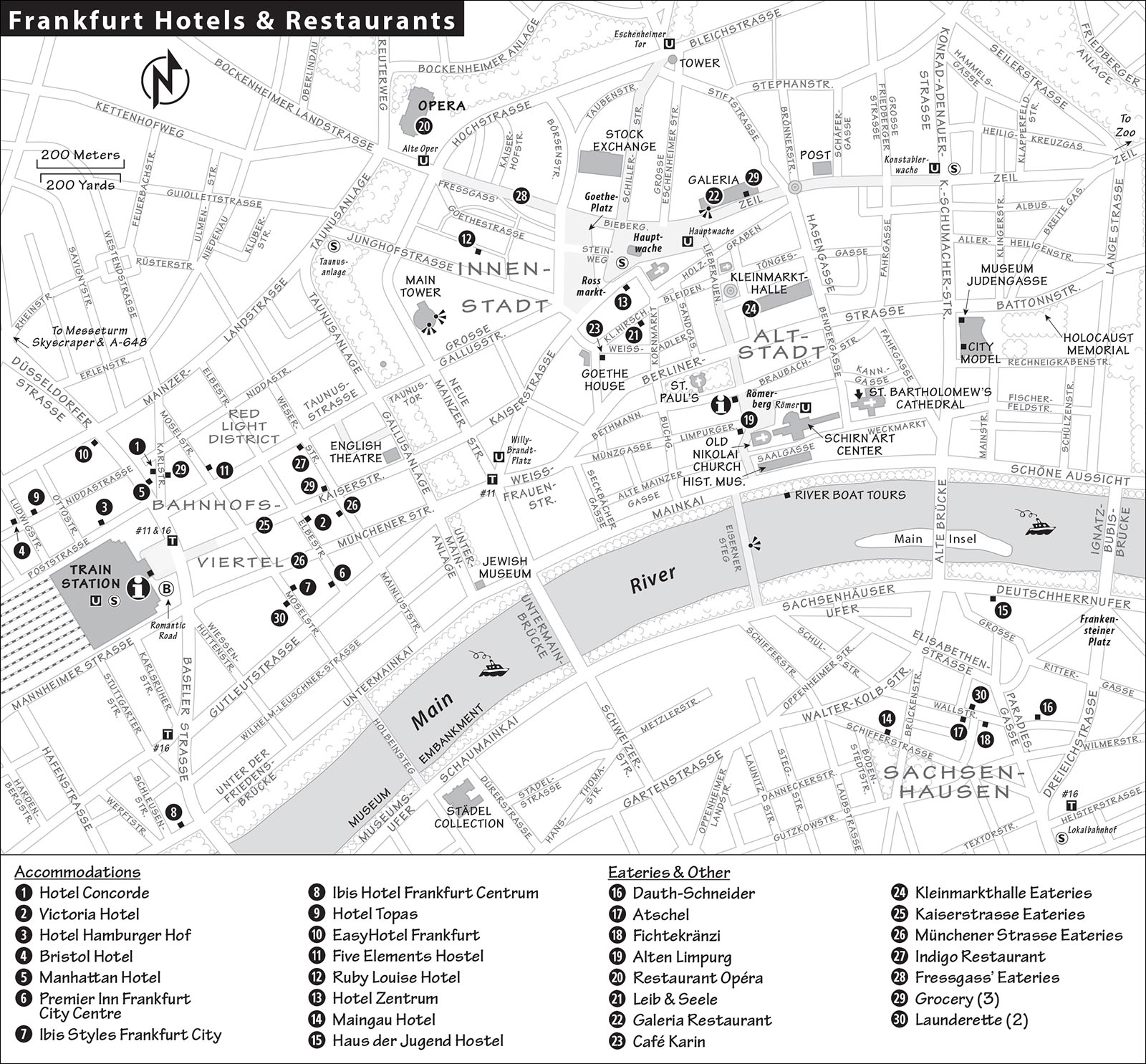
Map: Frankfurt Hotels & Restaurants
APPLE-WINE PUBS IN SACHSENHAUSEN
NEAR THE TRAIN STATION, ON AND NEAR KAISERSTRASSE
Frankfurt, while low on Old World charm, offers a good look at today’s no-nonsense, modern Germany. There’s so much more to this country than castles and old cobbled squares. Ever since the early Middle Ages, when—as the city’s name hints—this was a good place to ford the river, people have gathered here to trade. Frankfurt is a pragmatic city, and its decisions are famously based on what’s good for business. Destroyed in World War II? Make that an opportunity to rebuild for trade better than ever. And that’s what they did.
With trade came people from around the world. Cosmopolitan Frankfurt—nicknamed “Bankfurt”—is a business hub of the united Europe and home to the European Central Bank. Especially in the area around the train station, you’ll notice the fascinating multiethnic flavor of the city. A quarter of its 700,000 residents carry foreign passports, representing 200 different nationalities. Though Frankfurt is often avoided by tourists who consider it a sterile business and transportation hub, the city’s modern energy, fueled in part by the entrepreneurial spirit of its immigrant communities, makes it a unique and entertaining city. And if you visit on a Sunday, when Frankfurt takes the day off from its usual hustle and bustle, you’ll find a city cloaked in a village-like charm.
PLANNING YOUR TIME
You might fly into or out of Frankfurt am Main, or at least pass through, as this glossy city links the best wine-and-castles stretch of the Rhine to the north with the fairy-tale Romantic Road to the south. Even two or three hours in Frankfurt leaves you with some powerful impressions: The city’s main sights can be enjoyed in a half-day by using its train station (a 12-minute ride from the airport) as a springboard. At a minimum, ride up to the top of the Main Tower for commanding city views and wander through the pedestrian zone to the Old Town area (Römerberg). My self-guided walk provides a framework for your explorations. With more time or an overnight, Frankfurt has plenty of museums and other attractions to choose from.
Layover Visit: If you have a long layover at Frankfurt Airport, it’s easy enough to zip into the center for a little sightseeing on the S-Bahn (less than 20 minutes each way; at the ticket machine, buy the all-day transit pass, which covers your round-trip). If you have ample time, get off at the Hauptbahnhof stop—at the main train station—to do my entire city walk. For a shorter and more targeted visit, stay on the train one more stop to Hauptwache; this puts you right in the center of Frankfurt’s inviting people zone (see here). From here, you could do the last section of my city walk, which ends at the Eisener Steg bridge. For a quick return to the airport from the bridge, catch the S-Bahn at Hauptwache (a 10-minute walk away from the river). Once underground, find the S-Bahn platforms rather than the U-Bahn ones; take any S-8 or S-9 train in the direction of Wiesbaden).
Another quick and easy way to see the city on a layover is to take Frankfurt on Foot’s “Frankfurt Layover Tour” (includes pickup and drop-off at the airport, see “Tours in Frankfurt,” later).
Orientation to Frankfurt
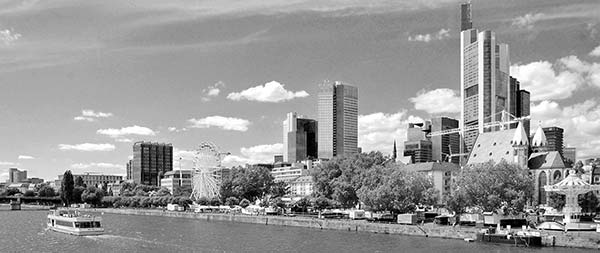
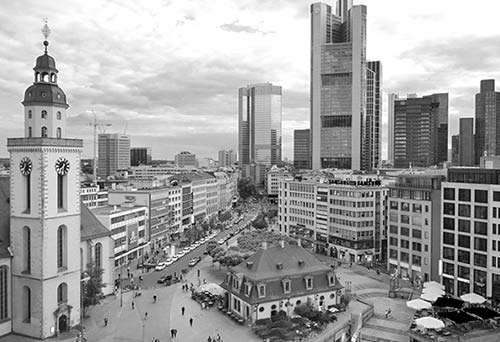
Frankfurt, with its forest of skyscrapers perched on the banks of the Main (pronounced “mine”) River, has been dubbed Germany’s “Mainhattan.” The city is Germany’s trade and banking capital, leading the country in high-rises (mostly bank headquarters)...and yet, a third of Frankfurt is green space.
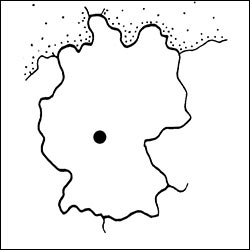
The convention center (Messe) and the red light district are near the train station. Just to the east is the skyscraper banking district and the shopping and pedestrian area around the distinctive Hauptwache building. Beyond that is what remains of Frankfurt’s Old Town, around Römerberg, the city’s central market square. A short walk across the river takes you to a different part of town: Frankfurt’s top museums line the south bank of the Main, and nearby is Sachsenhausen, a charming residential neighborhood and schmaltzy restaurant zone.
TOURIST INFORMATION
Frankfurt has several TIs. The handiest is just inside the train station’s main entrance (Mon-Fri 8:00-21:00, Sat-Sun 9:00-18:00, +49 69 247 455 400, www.frankfurt-tourismus.de). Another TI is on Römerberg square (Mon-Fri 9:30-17:30, Sat-Sun 10:00-16:00). At any TI, buy the city/subway map (the inexpensive basic version is fine). The TI also offers city bus tours and walking tours (see “Tours in Frankfurt,” later).
Discount Deals: Two passes sold at TIs are worth considering if you’ll be taking public transportation and visiting several sights. The Museumsufer Ticket covers 34 museums (€21, €32 family ticket; valid 2 consecutive days but can be used Sun and Tue since many are closed Mon). The Frankfurt Card gives you a transit pass (including connections to and from the airport), up to 50 percent off major museums, and 20 percent off the TI’s walking tours, which virtually pays for the pass (€11.50/1 day, €17/2 days; group rate for 2-5 people-€24/1 day, €34/2 days). A third pass, the RheinMainCard, is worthwhile only for travelers with time and interest for farther-flung destinations (€32, €52 group rate for 2-5 people valid 2 days).
ARRIVAL IN FRANKFURT
By Train: Frankfurt’s main train station (Hauptbahnhof) bustles with travelers. The TI is in the main hall just inside the front door on the left and lockers are along track 24. Pay WCs and showers are down the stairway by tracks 9 and 10. Inquire about train tickets in the Reisezentrum, off the main hall (long hours daily).
Getting out of the station can be a bit tricky. Use the underground passageway (Bahnhofspassage) and follow the signs, or better yet, exit straight out the main door located in the middle of the terminal to reach a crosswalk. The station is a 20-minute walk from the convention center (Messe), a three-minute subway ride or 20-minute walk from Römerberg, and a 12-minute train ride from the airport. A taxi stand is just outside the main entrance of the train station to your left.
By Car: Follow signs for Frankfurt, then Messe, and finally Hauptbahnhof (train station). The Hauptbahnhof garage (€35/day) is under the station, near most recommended hotels. For information on parking elsewhere in Frankfurt, visit www.parkhausfrankfurt.de.
By Plane: See “Frankfurt Connections,” at the end of this chapter.
HELPFUL HINTS
Museum Hours: Most museums are closed Monday. A few stay open late on Thursday.
Festivals and Events: Frankfurt keeps a busy and fun-loving calendar of events. When you’re here, be sure to check out what’s happening.
Laundry: Located near the train station, Miele Wash World is small and often crowded, with loud music from the next-door kiosk likely at night (Moselstrasse 17, by the corner of Münchener Strasse, signs in English). In Sachsenhausen, by the recommended Fichtekränzi restaurant, is a Wasch Treff (Wallstrasse 8). Both are open Monday-Saturday 6:00-23:00 (closed Sun). For locations, see the “Frankfurt Hotel and Restaurants” map, later.
Theater: The most active English-language theater on the Continent, English Theatre Frankfurt hosts companies from the UK and the US. The quality is good and the delightful theater is small, so it books up well in advance (Gallusanlage 7, closed July-Aug, +49 69 242 31620, www.english-theatre.de).
Helpful Website: For highlights of the best Frankfurt events and sights, get the inside scoop from veteran tour guides Jodean and David Ator at www.frankfurt-on-foot-cityguide.blogspot.com.
GETTING AROUND FRANKFURT
By Public Transportation: Frankfurt’s subway (U-Bahn) and suburban train (S-Bahn) network is easy to use, but trams are more convenient and give you a better look at the city. For transit information in English, see www.rmv.de.
For all forms of public transit, buy your tickets (Fahrkarten) from an RMV machine (carry cash, some machines don’t accept US credit cards). Tickets are issued with a validating stamp already on them, and are valid only immediately after they’re bought. Choose the British flag to see the menu in English. If you don’t see your destination listed, type “Frankfurt” first, along with the name of your stop. Choose a regular single ticket (€2.75), short ride ticket (€1.85—valid destinations listed on machines), all-day pass (€5.35 without the airport, €10.15 with), or all-day group ticket (up to 5 adults, €11.50 without the airport, €17.20 with). If you’ll be going to or from the airport, note that the one-day Frankfurt Card (described earlier, under “Tourist Information”) costs just a bit more than the all-day transit pass and includes sightseeing discounts. An individual one-way ticket to the airport costs €5.10 (no group rate).
By Taxi: A typical ride, such as from the train station to Römerberg square, costs about €7 (up to €10 in slow traffic). A ride to the airport from my recommended hotels is about €30. There is no Uber in Frankfurt.
Tours in Frankfurt
Hop-On, Hop-Off Bus Tours
Double-decker hop-on, hop-off buses give you an easy orientation to Frankfurt. Two bus companies offer one-hour tours, each with about 14 stops. There’s also a “Skyline Tour” that focuses on city architecture. For information and tickets, visit the TI (departures daily 10:00-17:00, about every 30 minutes from train station or near St. Paul’s Church, www.frankfurt-sightseeing.com or www.ets-frankfurt.de).
Walking Tours
Frankfurt on Foot’s 3.5-hour walks, led by longtime Frankfurt residents (and Ohio natives) Jodean Ator and her husband David, hit the major sights and make Frankfurt’s history meaningful (€17, basic walk leaves daily at 10:00 from Römer/Paulskirche tram stop—just show up, private walking tours-€55/hour, mobile +49 1520 846 4200, www.frankfurtonfoot.com, info@frankfurtonfoot.com). Their flexible “Frankfurt Layover Tour” is ideal for those with long Frankfurt Airport layovers and includes pickup and drop-off at the airport.
The TI offers one-hour walking tours of the historic center and the reconstructed DomRömer Quarter. Visit a TI or check their website for the schedule and consider reserving ahead (20 percent discount with Frankfurt Card, +49 69 247 455 400, www.frankfurt-tourismus.de, info@infofrankfurt.de).
Local Guide
Elisabeth Lücke loves her city and shares it very well (€75/hour, cash only, reserve in advance, +49 6196 45787, mobile +49 173 913 3157, www.elisabeth-luecke.de, elisabeth.luecke@t-online.de). She enjoys tailoring tours (for example, to the IG Farben building, a.k.a. the “Pentagon of Europe”) for military personnel once based around here.
River Boat Tours
These tours are relaxing but pretty boring (with no medieval castles in sight). You can go an hour in either direction or take a grand two-hour ride (departures from near the Eiserner Steg pedestrian bridge). You’ll see the impressive skyline, but a river ride in the Romantic Rhine gorge is far more interesting.
Frankfurt Walk
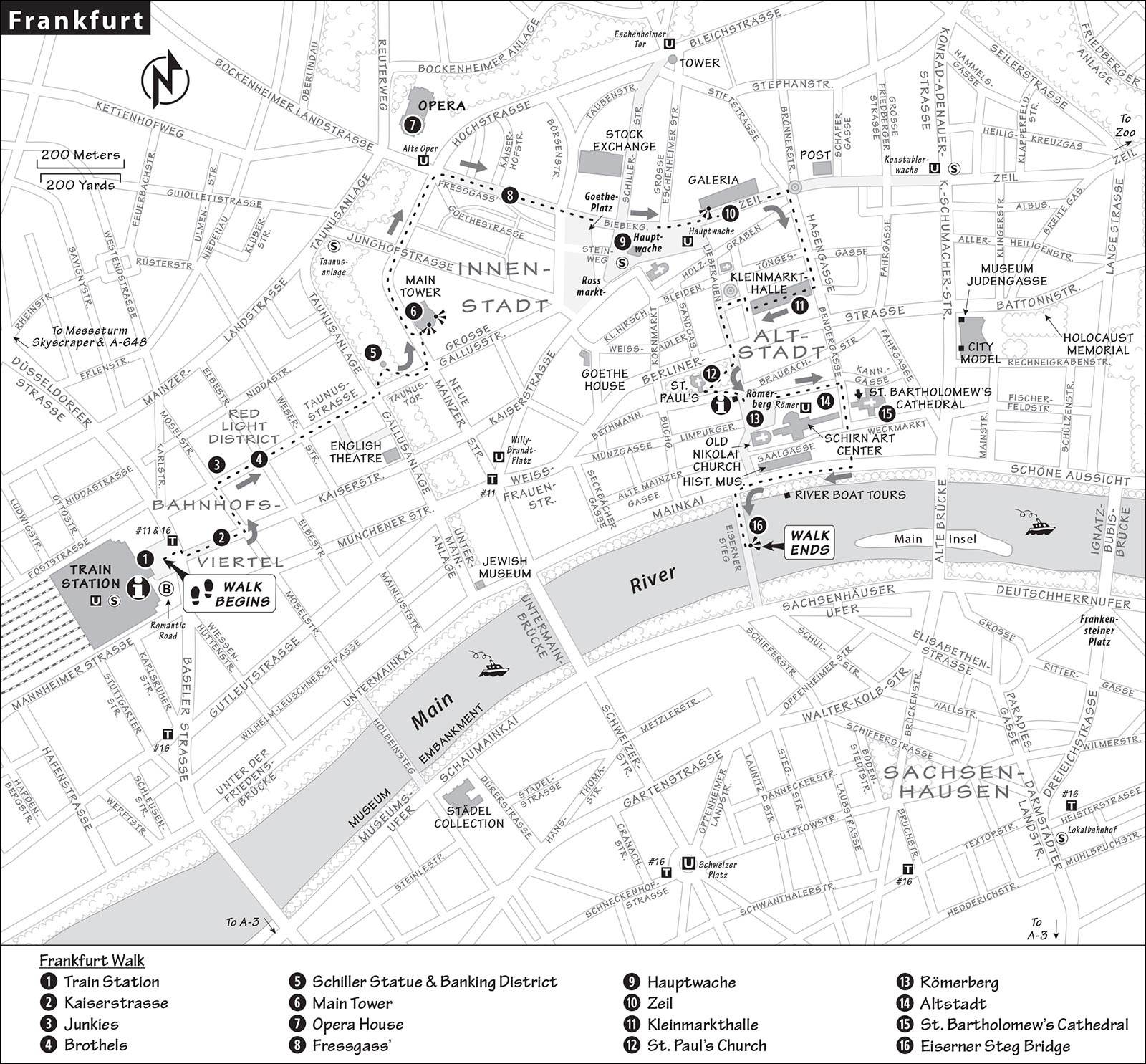
This self-guided sightseeing walk, worth ▲▲, shows you the new Frankfurt and the old, as well as its hard edges and softer side. Starting at the main train station (Hauptbahnhof), it takes you past junkies and brothels, up the Main Tower, through the modern shopping and eating districts, and into the lively square at the center of the Old Town (where you could continue on to the Jewish Holocaust Memorial), before finishing on a bridge overlooking the city and its river. Allow three leisurely hours to complete the full walk. Ideally, do the walk in the morning when the streets are relatively quiet, and you’ll finish near lots of great lunch options. To trace the route, see the “Frankfurt” map earlier in this chapter.
1 Train Station
Frankfurt has Germany’s busiest train station: 350,000 travelers make their way to 24 platforms to catch 1,800 trains every day. Hop a train and you can be in either Paris or Berlin in around four hours. While it was big news when it opened in the 1890s, it’s a dead-end terminus station, which, with today’s high-speed trains, makes it outdated. Complaining that it takes an extra 20 minutes to stop here, railway officials threatened to have the speedy ICE trains bypass Frankfurt altogether unless it dug a tunnel to allow for a faster pass-through stop. But this proved too expensive, and—while some trains stop only at the pass-through airport station—most fast trains begrudgingly serve downtown Frankfurt.
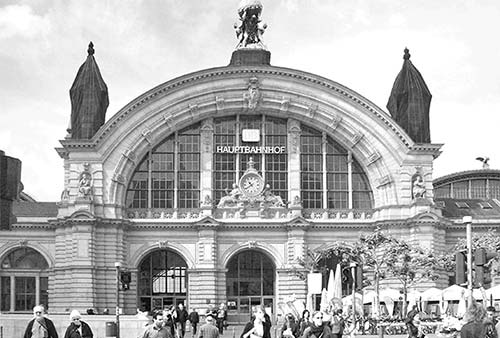
Leaving through the front door, walk directly away from the station to the traffic island facing the pedestrian Kaiserstrasse, and turn to look back at the building’s Neo-Renaissance facade—a style popular with Industrial Revolution-era architects. This classic late-19th-century glass-and-iron construction survived World War II. High above, a statue of Atlas carries the world—but only with some heavy-duty help: Green copper figures representing steam power and electricity pitch in. The 1890s were a confident age, when people believed that technology would solve the world’s problems.
• With your back to the station, look down...
2 Kaiserstrasse
This grand 19th-century boulevard features appropriately elegant facades that were designed to dress up the approach to what was a fine new station. Towering above and beyond the 100-year-old buildings are the skyscrapers of Frankfurt’s banking district. While city officials have been trying to spiff up Kaiserstrasse into a people-friendly eating zone, it still comes with the rough edges you find near any big-city European train station.
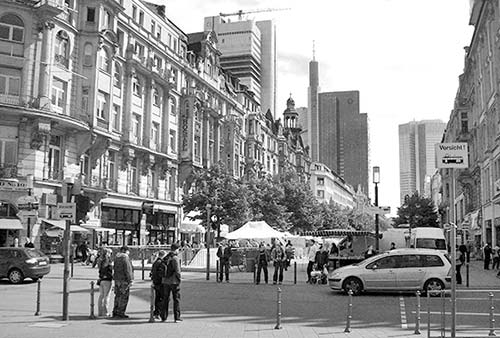
Warning and Alternate Route: This walk now goes into a neighborhood of hard-drug users and sex workers. If you use common sense, it’s not dangerous, but it can be unnerving. If you’d rather go directly to the Banking District and the Main Tower, simply walk straight down Kaiserstrasse four blocks to the park, turn left, and walk through the park to the Schiller statue (and skip ahead to 5).
• Walk down Kaiserstrasse, one block away from the station. If you’re game, jog left on Moselstrasse and walk a block to the corner of Taunusstrasse. This is where the city tries to contain and control its sex-and-drug scene. To the right, Taunusstrasse is lined half with brothels and half with bank towers. And across Taunusstrasse and farther down Moselstrasse is a heroin-maintenance clinic, known here as a “drug-consumption room.”
3 Junkies
A half-block up Moselstrasse, you’ll likely see a crowd congregating near one of several “junkie cafés” (no photos allowed). In the 1980s, Frankfurt was plagued by one of the largest open drug markets in Europe. Its parks (and police) were overwhelmed with needle addicts. Then Frankfurt decided to get creative, take the crime out of the equation, and switch to a pragmatic harm-reduction approach.
In 1992, Frankfurt began offering “pump rooms” to its hard-drug users. The idea: Provide a safe haven for addicts (mostly heroin, but also crack and methadone) to hygienically maintain their habit. Heroin addicts still buy their stuff on the street, but inject it here with clean needles, with medical help standing by, and a place to stay if needed. It’s strictly not for first-time users, and no dealing or sharing of drugs is allowed. These centers provide a safe and caring place for addicts to go to maintain their habit and get counseling and medical help.
These days, overdose deaths are down 75 percent in general, and there’s never been a death in a drug-consumption room. Most locals consider the program a success and have grown accustomed to dazed drug users congregating in neighborhoods like this one. While unsightly, the compassionate harm-reduction approach that much of Europe uses to deal with this problem saves lives. Meanwhile, the US continues to suffer about double the heroin-related deaths per capita as Europe.
• Now for the sex. Take a right on Taunusstrasse and walk to Elbestrasse.
4 Brothels
From Taunusstrasse, look (or detour) left down Elbestrasse, to see a row of high-rise brothels, or “eros towers.” With all the businessmen coming into town, Frankfurt found there was no effective way to outlaw sex work. So the city (like any German city over a certain population threshold) decided to funnel sex workers into what it calls a “tolerance area.”
About 20 five-story brothels fill original, late-19th-century apartment flats within a block of this spot. Legal since 2002, sex work is big business here. The women, who are mostly from Eastern Europe, Latin America, and Thailand (only about 2 percent are from Germany), essentially run their own little businesses. They charge around €20 for services and rent their rooms for about €130 a day. It’s said that they cover their rent by the end of the businessmen’s lunch break (look at the bank towers nearby). German sex workers get health care just like any other workers and pay taxes (on €14 billion of declared income each year).
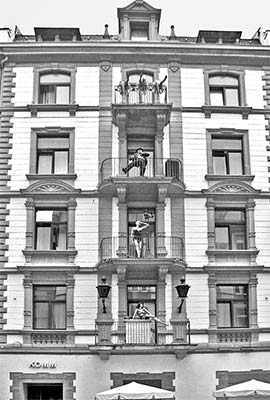
Crazy Sexy, at Elbestrasse 51, is the biggest of these brothels, with 180 rooms. The first three floors are for women. The fourth floor is for transsexual workers. (I was told, “Sex reassignment surgery is expensive, and many workers are making money to pay for their operation.”) The aggressive women at the neighboring strip shows can be unsettling.
Ever since the Middle Ages, Frankfurt’s sex work industry has gone hand-in-hand with its trade fairs. Today, sex work thrives with the Messe (convention center). Both hotels and sex workers double their prices during big trade fairs, and business varies with the theme of the trade show—the auto show is boom time and the butchers’ convention is famously hungry, but Frankfurt’s massive book fair is a bust.
To the right of Taunusstrasse, at Elbestrasse 31, is a strip joint called Pik-Dame. Old-timers are nostalgic about this lone remnant from “the good old days” in the years after World War II, when 30,000 US soldiers stationed in Frankfurt provided a stimulus for this neighborhood’s economy. When the troops left, the Russian mob moved in, replacing any old-time gentility with a criminal and thuggish edge. (Note that there’s another drug-consumption center across the street from Pik-Dame.)
At Elbestrasse 29, look for an inconspicuous, dark door, which leads to a cocktail bar, The Kinly. Like a Prohibition-era speakeasy, it has no signs, just a call button by the door. Press it, wait for the door to open, then descend the stairs into a cozy, softly lit salon right out of the 1920s (Mon-Sat 19:00-late, closed Sun).
• Enough sex and drugs. Back on Taunusstrasse, continue out of the red light district and into the banking district. When you cross Weserstrasse, the transition is abrupt: Suddenly you’re walking between glittering office towers (Deutsche Bahn—the German railway company—on the right, then HSBC on the left). It’s easy to see why this city (on the Main River) is nicknamed “Mainhattan.”
After the big towers, cross the street to the park. Bear left to find the statue of Schiller, standing on a pillar.
5 Schiller Statue and Banking District
Friedrich Schiller was a Romantic poet (and friend of Goethe). The park around him is part of a greenbelt that encircles the old center and marks the former site of Frankfurt’s medieval moat and fortifications. These walls (along with many castles on the Rhine) were destroyed by the French in 1806. Napoleon had just beaten the Austrians and Russians at Austerlitz. And, while he had the upper hand, he figured it was wise to preemptively obliterate any German fortifications that might haunt him if the Germans turned against France in the future.
The park is also the center of Frankfurt’s ▲ banking district. The post-WWII Marshall Plan was administered from here—requiring fancy money-handling. And the mighty deutsche mark was born in a 1930s-era building facing the park (in the third building on the left as you face Schiller—the low, boxy, Art Deco mansion, now a Deutsche Bundesbank headquarters). After World War II, Germany’s economy was in chaos. In 1948, the US gave it a complete currency transfer—like a blood transfusion—literally printing up the new deutsche marks and shipping them across the Atlantic to inject them from here directly into the German economy. As if catching water from a fountain, banks naturally grew up around this square.
But Frankfurt was “Bankfurt” long before World War II. This was the Rothschilds’ hometown. Born in Frankfurt’s Jewish ghetto in 1744, Mayer Rothschild went from being a pauper to the richest banker in the world. His five sons set up businesses in Rome, London, Paris, and Vienna, and in two generations the Rothschild banking dynasty was established. (Their former palace now houses Frankfurt’s Jewish Museum, described later, under “Sights in Frankfurt”). Today, locals call Frankfurt’s legion of bankers “penguins,” as they all dress the same. Tour guides here talk of banks as part of the cultural soil (the way French Riviera guides talk of the big yachts).
Beyond the statue of Schiller stand the twin towers of the Deutsche Bank (not to be confused with DB—Deutsche Bahn—which we passed earlier). This country’s #1 bank, its assets are greater than the annual budget of the German government. If money makes the world go round, the decisions that spin Germany are made in Frankfurt.
Make a 360-degree spin and survey all the bank towers. Notice the striking architecture. By law, no German worker can be kept out of natural light for more than four hours, so work environments are filled with windows. And, as you can see, Germans like their skyscrapers with windows that open.
• Looking right from Schiller, find the skyscraper with the red-and-white candy cane on top. That’s your destination—the Main Tower. To reach it, continue straight along Taunustor a block, then turn left on Neue Mainzer Strasse and look for the tower symbol on the doors on the right.
6 Main Tower
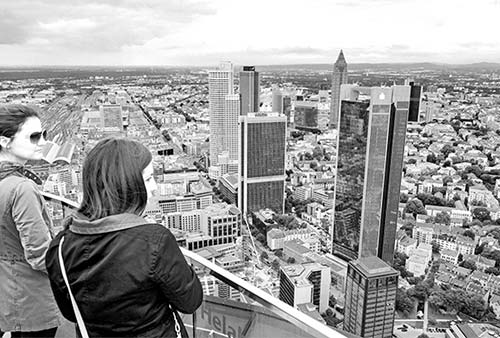
Finished in 2000, this ▲▲ tower houses the Helaba Bank and offers the best (and only public) open-air viewpoint from the top of a Frankfurt skyscraper. A 55-second, ear-popping elevator ride to the 54th floor (watch the meter on the wall as you ascend) and then 50 stairs take you to the rooftop, 650 feet above the city.
Cost and Hours: €9, 20 percent discount with Frankfurt Card; Sun-Thu 10:00-21:00, Fri-Sat until 23:00; closes earlier off-season and during bad weather; enter at Neue Mainzer Strasse 52, between Taunustor and Junghofstrasse, +49 69 3650 4878, www.maintower.de.
 Self-Guided Spin-Tour: Here, from Frankfurt’s ultimate viewpoint, survey the city by circling clockwise, starting with the biggest skyscraper (with the yellow emblem).
Designed by Norman Foster (of Berlin Reichstag and London City Hall fame), the Commerzbank building was finished in 1997. It’s 985 feet high, with nine winter gardens spiraling up its core and windows that open. It’s considered the first ecological skyscraper...radically “green” in its day. Just to the left is Römerberg—the Old Town center (the half-timbered houses huddled around the red-and-white church with a green spire; we’ll visit there soon).
The Museum Embankment (see “Sights in Frankfurt,” later) lines Schaumainkai on the far side of the Main River, just beyond the Taunus Tower.
The Rhine-Main airport, off in the distance (like a city in the forest), is the largest employment complex in Germany, with 70,000 workers. Frankfurt’s massive train station dominates the foreground. From the station, the grand Kaiserstrasse cuts through the city to Römerberg.
The Frankfurt fair (Messe), marked by the brown skyscraper with the pointy top, is a huge convention center—the size of 40 soccer fields. It sprawls behind the skyscraper that looks like a classical column sporting a visor-like capital. (The protruding lip of the capital is heated so that icicles don’t form, break off, and impale people on the street below.) Frankfurt’s fair originated in 1240, when the emperor promised all participating merchants safe passage. The glassy black twin towers of the Deutsche Bank in the foreground (nicknamed “Debit and Credit”) are typical of mid-1980s mirrored architecture.
The West End, with vast green spaces and the telecommunications tower, is Frankfurt’s priciest residential quarter. The city’s most enjoyable zone cuts from the West End to the right. Stretching from the classic-looking Opera House below are broad and people-filled boulevards made to order for eating and shopping. Find the “Beach Club” filling the rooftop of a parking garage with white tents, two pools, and colorful lounge chairs. This is a popular family zone by day and a chic club after dark.
From here, you can see how the city walls, demolished in 1806, left a string of green zones arcing out from the river. This defined the city limits in the 19th century.
Take a moment from this vantage point to trace the rest of this walk: from the Opera House, along the tree-lined eating and shopping boulevards to St. Paul’s Church and Römerberg. After side-tripping from Römerberg out to the cathedral, we’ll finish on Eiserner Steg, the iron pedestrian bridge over the Main River.
Now look east, farther out along the river, to the glistening twin towers (standing all alone). At 600 feet tall, these are the striking headquarters of the European Central Bank.
As you leave the Main Tower, step into the Helaba Bank lobby (next door over from base of elevator). A black-and-white mosaic filling the wall shows cultural superstars of 20th-century Frankfurt, from composer Paul Hindemith to industrialist and humanitarian Oskar Schindler to Anne Frank (see the key on the post nearby for a who’s who).
• Exit right from the Main Tower and continue walking along Neue Mainzer Strasse. Follow the road as it bends to the right, crossing Junghofstrasse. In a couple of blocks, a large square opens up on your left. Across the square is the Opera House.
Frankfurt’s Good-Living People Zone
7 Opera House (Alte Oper): Finished in 1880, Frankfurt’s opera house celebrated German high culture and the newly created nation. Mozart and Goethe flank the entrance, reminders that this is a house of both music and theater. On a hot day, people of all ages cool their heels in the refreshing fountain in the plaza out front. The original opera house was gutted in World War II. Over the objections of a mayor nicknamed “Dynamite Rudi,” the city rebuilt it in the original style, and it opened in 1981. Underneath is a U-Bahn station (Alte Oper).
• Facing the Opera, turn right down Frankfurt’s famous...
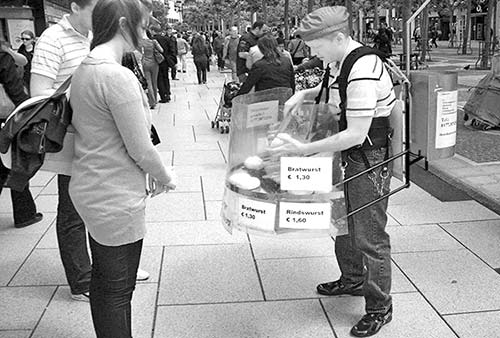
8 Fressgass’: The official names for this pedestrian street are Grosse Bockenheimer Strasse and Kalbächer Gasse...but everyone in Frankfurt calls it the Fressgass’, roughly “Feeding Street.” Herds of bank employees come here on their lunch breaks to fill their bellies before returning for another few hours of cud-chewing at their computers. It’s packed gable-to-gable with eateries and shoulder-to-shoulder with workers wolfing cheap sandwiches, plates of Asian food, and more—and offers great people-watching. You may even see roving Wurst vendors, strapped to portable weenie grills. Join in if you’re hungry—or wait for more eating options in a couple of blocks.
• Stow your guidebook and just wander along here for a few minutes, until you reach the next U-Bahn stop. It’s in the long, perpendicular square called Rathenauplatz (which locals call Goethe Platz for its central statue). Cross the square and continue straight—the pedestrian street is now called Biebergasse—another block to the...
9 Hauptwache: The small, red-and-white building—which has given its name to the square (and the subway station below it)—was built in 1730 to house the Frankfurt city militia. Now it’s a café. The square, entirely closed to traffic, is one of the city’s hubs.
• To the right, at the south side of the square, is the Protestant Katharinenkirche, which was destroyed in the bombing raids of March 1944 and rebuilt after the war. Straight ahead of you is a boulevard called the...
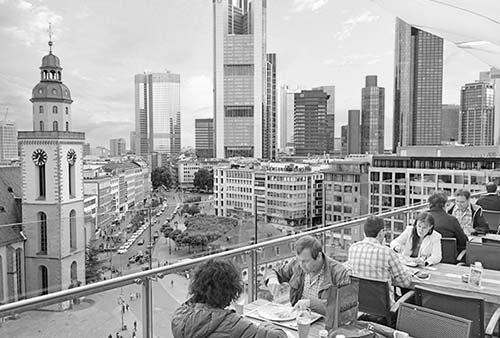
10 Zeil: This tree-lined pedestrian drag is Frankfurt’s main shopping street. Crowds swirl through the Galeria Kaufhof department store, the Zeil Galerie, and the MyZeil shopping center (the one with the glassy hole in its wall) along the left side of the street. MyZeil has a huge glass atrium shaped like two massive funnels—a mesmerizing sight on a rainy day. An escalator claiming to be the “longest in Germany” (behind the much shorter twin set by the door) leads straight to the fourth-floor food court.
Lunch and Views at Department Stores: The Galeria Kaufhof has a recommended rooftop cafeteria, Galeria Restaurant (good for lunch or just the views). There’s a supermarket with a snack stand and seating in the basement of the MyZeil shopping center (Mon-Sat 7:00-24:00, closed Sun).
• Continue down Zeil a block to the fountain at the next intersection. Turn right on Hasengasse. In the distance is the lacy red-brick spire of the cathedral. Halfway there, after about two blocks, find the low-key green entrance to Kleinmarkthalle on the right. Enter the market (pay WC downstairs at entry).
11 Kleinmarkthalle: This delightful, old-school market was saved from developers by local outcry, and to this day it’s a neighborhood favorite. Explore and sample your way through the ground floor. It’s an adventure in fine eating (with a line of simple eateries upstairs, too; see “Eating in Frankfurt,” later) and a delight for photographers. The far wall is filled with a fun piece of art offering a bird’s-eye view of Frankfurt over a charming montage of the many ways locals love their hometown.
• Head all the way through the Kleinmarkthalle and exit opposite where you entered. Angle right, and climb five steps into a square (Liebfrauenberg) with a red-brick fountain and the 14th-century Church of Our Lady (rebuilt after World War II). Turn left and head downhill on Neue Kräme, then cross Berliner Strasse to Paulsplatz.
12 St. Paul’s Church (Paulskirche)
To your right, the ▲ former church dominating the square is known as the “cradle of German democracy.” It was here, during the political upheaval of 1848, that the first freely elected National Assembly met and the first German Constitution was drafted, paving the way for a united Germany in 1871. Following its destruction by Allied bombs in 1944, the church became the first historic building in the city to be rebuilt. This was a symbolic statement from the German people that they wanted to be free (as they had demonstrated here in 1848), democratic...and no longer fascist. Around the outside of the building, you’ll see reliefs honoring people who contributed to the German nation, including Theodor Heuss, the first president, and John F. Kennedy, who spoke here on June 25, 1963.
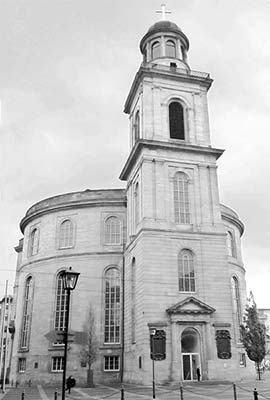
Step inside; the entrance is around to the left (free, daily 10:00-17:00). Displays described in English tell the story of 1848. Check out the circular mural—wrapped around the building’s core—from the 1980s. Called The March of Members of Parliament, it was controversial when unveiled. Commissioned to honor the political heroes of 1848, the portraits are cartoonish figures, with faces hinting of contemporary politicians. Political leaders seem to sneer at the working class, and two naked men who look like they’re having sex represent the forces of democracy and monarchy fighting within Germany. Upstairs is a 900-seat assembly hall with no decor except the flags of the 16 states of the Federal Republic of Germany.
• Exiting the church, cross diagonally to the right through the square. If you need a break, a variety of eateries offer inviting seating that’s perfect for some fun people-watching. Then, cross the next street and tram tracks and you’ll enter what’s left of Frankfurt’s Old Town.
13 Römerberg
Frankfurt’s ▲ market square was the birthplace of the city. This is the site of the first trade fairs (12th century), bank (1405), and stock exchange (1585). Now, crowds of tourists convene here. Römerberg’s central statue is the goddess of justice without her customary blindfold. She oversees the Town Hall, which itself oversees trade. The Town Hall (Römer) houses the Kaisersaal, or Imperial Hall, where Holy Roman Emperors celebrated their coronations. Today, the Römer houses the city council and mayor’s office. Marriages must be performed in a civil ceremony here to be legal, so you’ll see lots of brides and grooms celebrating outside. The cute row of half-timbered homes (rebuilt in 1983) opposite the Römer is typical of Frankfurt’s quaint old center before the square was completely destroyed in World War II.
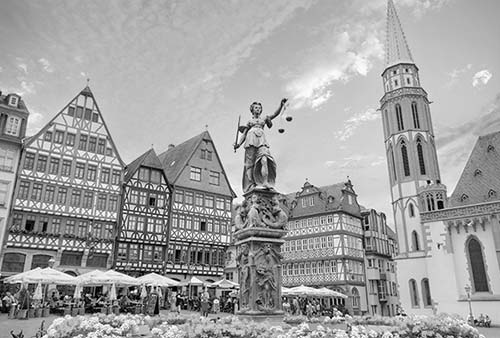
The Gothic red-and-white Old Nikolai Church (Alte Nikolaikirche, with fine stained glass from the 1920s by a local artist) dates from the 13th century and was restored after the war. Behind it, closer to the river, is the Frankfurt Historical Museum (see listing under “Sights in Frankfurt,” later).
Hosting everything from Christmas markets to violent demonstrations, this square is the beating heart of Frankfurt. In its center, the metal plaque that looks like a large manhole cover reminds us that a Nazi book-burning took place in the square on May 10, 1933. Around the edge of the plaque is a quote from the German poet Heinrich Heine, who presciently pointed out that it’s a short step from burning books to burning people.
• From the Town Hall, the river and the bridge where this walk ends are just two blocks away. But first, we’ll take a short detour. Facing Old Nikolai Church, head left down the lane at the top of the square. You’ll see the cathedral tower ahead, and soon the Schirn Art Center on your right. Walk to the small square with a fountain topped by a bearded bust (on your left). This is the...
14 Altstadt (“New Old Town”)
This “new” development (officially called the DomRömer Quarter)—70 years in the making—is a partial reconstruction of the half-timbered Old Town destroyed during World War II. Following the war, some locals wanted to rebuild the original buildings, while others wanted to modernize. The compromise was an ugly concrete building in typical 1970s style that remained until 2010, when reconstruction of this more modern version of the Old Town began.
The little square is a former poultry market, and atop the fountain is the bust of Friedrich Stoltze, a writer and poet who was born in the former Old Town. Notice the buildings’ eclectic mix of colors and styles, some with slate roofs, others with red sandstone facades, and others with doors made from 300-year-old oak. This mix of new and old architecture is a microcosm of today’s Frankfurt.
Before the war, this was a lively center of pubs, small businesses, and workshops. While today’s Altstadt feels a bit saccharin, the city hopes this mix of reconstructed and new buildings will return the square to something close to its former character. Feel free to take a quick stroll farther into these reconstructed backstreets before coming back to the fountain/statue.
Now continue past Stoltze, and past a colorful, half-timbered building on your right. Next to the colorful building is a modern structure with a Kaiserpfalz sign. Head into its open archways for a look at “Franconofurd”—Roman ruins that were revealed by the Old Town’s destruction.
• Back on our route, directly ahead is the big red...
15 St. Bartholomew’s Cathedral (Kaiserdom)
Holy Roman Emperors were elected at this Catholic church starting in 1152 and crowned here between 1562 and 1792. The cathedral was gutted by fire in 1867 and had to be rebuilt. It was seriously damaged in World War II, but repaired and reopened in 1953. Though the cathedral is free, you must pay to access two sights within the church: a museum (not particularly interesting) and a 328-step tower climb with city views at the top.
Cost and Hours: Cathedral—free, Mon-Thu and Sat 9:00-20:00, Fri and Sun from 13:30, www.dom-frankfurt.de; museum—€2, Wed-Fri 10:00-17:00, Sat-Sun from 11:00, closed Mon-Tue, enter from church vestibule, www.dommuseum-frankfurt.de; tower—€3, Tue-Fri 10:00-18:00, Sat-Sun from 11:00, closed Mon and in bad weather, shorter hours Nov-March; +49 69 7808 9255, www.domturm-frankfurt.de.
Visiting the Cathedral: Enter through the glass-and-metal doors of the vestibule. Note the painted white lines that imitate mortar between stones. This illusionist architecture was a popular technique for churches. Frescoes from the 15th century survive (flanking the high altar and ringing the choir). They show 27 scenes from the life of St. Bartholomew. The Electors Chapel (to the right of the altar) is where the electors convened to choose the Holy Roman Emperor in the Middle Ages. Everything of value that could be moved was taken out of the church before the WWII bombs came. The delightful sculpture in the Chapel of Sleeping Mary (to the left of the high altar), carved and painted in the 15th century, was too big to move—so it was fortified with sandbags. The altarpiece and stained glass next to it survived the bombing. As you wander, appreciate the colorful and extravagant tombstones embedded in the walls when the church’s cemetery was emptied.
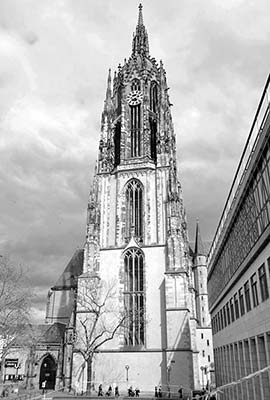
• Exit the cathedral where you entered and turn left so that you’re walking past the tower and towards some trees. Continue a few blocks to reach the river. At the river, turn right and walk along the pleasant park to the next bridge. Head out to the center of the bridge.
16 Eiserner Steg Bridge
This iron bridge, the city’s second oldest, dates to 1869. (The oldest is just upstream: the Alte Brücke, site of the first “Frank ford”—a fifth-century crossing.) From the middle of the bridge, survey the skyline and enjoy the lively scene along the riverbanks of Frankfurt. These grassy areas are some of the most pleasant parts of the city.
• Our walk is over. From here, you have several options. For a quick return to your starting point at the main train station (Hauptbahnhof), walk back to Römerberg and take the U-Bahn. Or, to continue on to the Jewish Holocaust Memorial and/or the Frankfurt City Model (both free and described later, under “Sights in Frankfurt”), head back along the river toward the Alte Brücke bridge, where you’ll make a left on Kurt Schumacher Strasse. Both sights are a few blocks up.
Sights in Frankfurt
NEAR RÖMERBERG
▲Frankfurt Historical Museum
This museum is more interesting than you might expect. It surveys 800 years of the city’s history across five galleries, with plenty of interactive exhibits. Though most of the exhibits are in a modern building, you can walk through the museum’s few historical structures, such as a small Gothic chapel and a medieval toll tower.
Cost and Hours: €8, includes downloadable audioguide; Tue-Sun 11:00-18:00, closed Mon; Saalhof 1, +49 69 2123 5154, www.historisches-museum-frankfurt.de.
Visiting the Museum: The first floor is the most intriguing: It features historical maps of Frankfurt throughout the centuries, illustrating how the city evolved (digital versions of the maps let you zoom in on landmarks). The large model of the old town (circa 1927) is a wistful reminder of what was obliterated in the war, while a nearby exhibit charts the debate on how to rebuild. Another clever exhibit tells Frankfurt’s story through 100 artifacts: everything from a Roman roof tile to a medieval key chain to a Nazi Christmas ornament. Look for the medieval “bridge rooster,” which made it into one of the Grimms’ tales.
The second floor’s theme is Weltstadt und Geldstadt (“world city and money city”). It explores Frankfurt’s political and financial importance in electing Holy Roman Emperors, sparking Germany’s 1848 revolution, and dominating banking in the European Union. Head up to the third floor for a quick look at the giant, cheeky model of the contemporary city: Housing estates are made of dominoes, and skyscrapers are teetering towers of gambling chips or rolled-up currency notes (no extra credit points for figuring out that symbolism).
▲Goethe House (Goethehaus)
Johann Wolfgang von Goethe (GUR-teh; 1749-1832), a scientist, minister, poet, lawyer, politician, and playwright, was a towering figure in the early Romantic Age; his two-part tragedy, Faust, is a masterpiece of world literature. His birthplace, now a fine museum, is furnished as it was in the mid-18th century, when the boy destined to become the “German Shakespeare” grew up here.
Borrow a laminated card at the bottom of the stairs for a refreshingly brief commentary on each of the 16 rooms. Since nothing’s roped off and there are no posted signs, it’s easy to picture real people living here. Goethe’s father dedicated his life and wealth to cultural pursuits, and his mother told young Johann Wolfgang fairy tales every night, stopping just before the ending so that the boy could exercise his own creativity. Goethe’s family gave him all the money he needed to travel and learn. His collection of 2,000 books was sold off in 1795. In recent decades, more than half of these have been located and repurchased by the museum (you’ll see them in the library). This building honors the man who inspired the Goethe-Institut, which is dedicated to keeping the German language strong.
Cost and Hours: €10; Tue-Sun 10:00-18:00, Thu until 21:00, closed Mon; English booklet has same info as free laminated cards—worthwhile only as a souvenir; 15-minute walk from Hauptbahnhof up Kaiserstrasse, turn right on Am Salzhaus to Grosser Hirschgraben 23; +49 69 138 800, www.frankfurter-goethe-haus.de.
Schirn Art Center (Schirn Kunsthalle)
This facility is one of Europe’s most respected homes of modern and contemporary art. Rotating exhibits pay homage to everything and everyone from Kandinsky and Kahlo to contemporary artists, movements, and topics.
Cost and Hours: €10-12 depending on exhibits; Tue-Sun 10:00-19:00, Wed-Thu until 22:00, closed Mon; Römerberg, +49 69 299 882 112, www.schirn.de.
NEAR THE RIVER, ON THE NORTH BANK
▲Jewish Museum (Jüdisches Museum)
Located along the river between Römerberg and the train station, and housed in the former Rothschild family mansion, this museum uses arts and crafts, historical documents, and everyday objects to explore Jewish life in Frankfurt from around 1800 to the present day. It’s an engaging, sometimes heartbreaking, and sometimes uplifting opportunity to learn about what was for centuries one of Germany’s most important Jewish communities.
Cost and Hours: €12, includes entrance to Museum Judengasse; Tue-Sun 10:00-17:00, closed Mon; Bertha Pappenheim Platz 1, +49 69 2123 5000, www.juedischesmuseum.de.
Visiting the Museum: From the gleaming white foyer, take the elevator to the third floor for the main exhibition. You’ll start a chronological path that begins—in the present—with the question, “How can one live as Jewish person in Germany after what happened in the 1930s and 40s?” Members of Frankfurt’s contemporary Jewish community (numbering around 7,000) provide answers through video testimonies. Next, you’ll trace the harrowing 20th century, covering the post-war decades and the wider society’s reckoning with the crimes of the Holocaust. In the “Destroyed Lives” section, possessions of people who were sent to concentration camps tell powerful stories. Objects include photo albums, a prisoner’s uniform from Dachau, a Tommy Dorsey record, and medals earned by a Jewish man who fought for Germany in World War I.
The second floor covers the topics of tradition and ritual, including practices around food and the Torah and Talmud. A highlight is the interactive video installation “Ask the Rabbi,” where you can ask several local rabbis a range of questions including, “When is the messiah coming?” and “What’s your favorite place in Frankfurt?” The first floor focuses on family and everyday life. You’ll learn about three prominent Jewish families: the Rothschilds and their rise to wealth and power; the Singers, who miraculously managed to survive the Nazi period; and the Franks, who lived in Frankfurt before moving to Amsterdam, where Anne wrote her famous diary. The museum does a wonderful job connecting these meaningful, individual stories with the broader context of the local community’s history.
Riverside Promenade
Just across the road from the Jewish Museum is a lovely riverside promenade—a perfect place to rest your feet and watch people and planes go by.
IN THE FORMER JEWISH GHETTO
This area is a short walk (or one tram stop) east of Römerberg and St. Bartholomew’s Cathedral. Though the Jewish Museum is the most informative sight for Frankfurt’s Jewish history, the Holocaust Memorial and the Museum Judengasse offer a more physical connection to where Frankfurt’s Jews historically lived and died.
▲Jewish Holocaust Memorial, Jewish Cemetery, and Museum Judengasse
This memorial marks the site of the old Jewish ghetto and where the city’s main Börneplatz Synagogue once stood. Commemorating 12,000 murdered Jews, it’s a powerful and evocative collection of images.
Cost and Hours: Wall of Names and cemetery—always free and viewable (key for cemetery available when museum is open); museum—€6, €12 combo-ticket with Jewish Museum, Tue 10:00-20:00, Wed-Sun 10:00-until 18:00, closed Mon; Battonnstrasse 47, +49 69 212 70790, www.museumjudengasse.de.
Visiting the Memorial: Museum Judengasse’s permanent exhibit focuses on Jewish life in Frankfurt, covering everything from work and school to the arts to relations between the community and Frankfurt’s government. The exhibit is built around and within a section of excavated ruins of Europe’s oldest Jewish ghetto, where more than 3,000 people once lived on a quarter-mile stretch of street. You’ll see artifacts found in the ruins. Interactive exhibits let you listen to evocative music and Jewish hymns.
Back outside, around the old Jewish cemetery is the Wall of Names, with a tiny tombstone for each Frankfurt Jew deported and murdered by the Nazis (with location and date of death, if known). Pebbles atop each tomb represent Jewish prayers. The memorial gives each victim the dignity of a tombstone and of being named, while a databank inside the adjacent Museum Judengasse keeps their memory alive with a record of everything known about each person. The markers are alphabetical by last name: Look for Anne Frank (Annelies Marie Frank) about halfway between the cemetery entrance and the end of the wall. After the Franks moved from Frankfurt to Amsterdam—and the Nazis discovered them in hiding—Anne and her sister were sent to Bergen-Belsen, where both died of typhus.
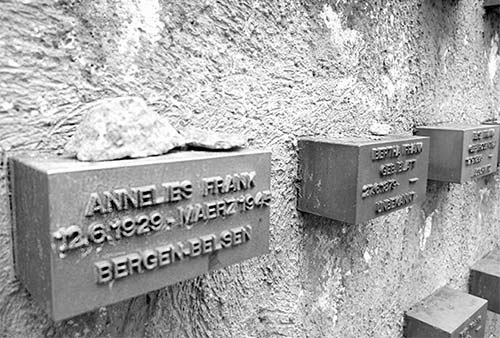
By peeking through the locked black-metal gate into the cemetery, you can see a few original tombstones that survived the Nazi rampage. In the tree-filled square is a stone tower, built with foundation stones from homes excavated from the Jewish ghetto. The gravel is designed to evoke train tracks and the deportation of so many people to concentration camps.
The paved section marks the footprint of the Börneplatz Synagogue, destroyed on November 9, 1938—a night traditionally known as Kristallnacht. (Because people’s lives were also destroyed on that night along with lots of windows and glass, the preferred name is “Pogrom Night.”) A plaque on the wall opposite recalls this terrible event. In the wake of World War II, American troops made Frankfurters memorialize each synagogue they destroyed with a plaque like this.
▲Frankfurt City Model
This ever-evolving model, unrelated to the Jewish story, is next to the Jewish Holocaust Memorial in the City Planning Office (Stadtplanungsamt), located in the same building as the Museum Judengasse. Enter through the frosted sliding doors and step left past the receptionist into an atrium to view a 30-by-20-foot layout on a 1:500 scale. Frankfurt’s inner-city skyscrapers are marked Planungsdezernat. Since 1960 this model has helped planners envision and track the development of the city and its many massive building projects—even seeing where shadows of new buildings will fall. Red buildings are those under construction (the city has plans for 20 more skyscrapers in the next decade).
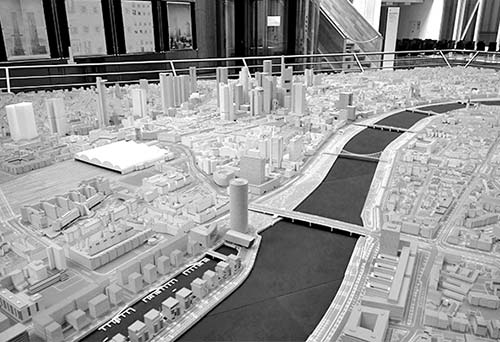
Cost and Hours: Free, Mon-Fri 8:30-18:00, closed Sat-Sun, Kurt-Schumacher-Strasse 10.
ACROSS THE RIVER, ON THE SOUTH BANK
▲Schaumainkai and Frankfurt’s Museum Embankment (Museumsufer)
The Schaumainkai riverside promenade (across the river from Römerberg over the Eiserner Steg pedestrian bridge, and then to the right) is great for an evening stroll or people-watching on any sunny day. Keep your eyes peeled for nude sunbathers. Every other Saturday, the museum strip street is closed off for a sprawling flea market, and in late August a weekend cultural festival brings food, art, and music to “museum row.”
Nine museums in striking buildings line the Main River along Schaumainkai. In the 1980s, Frankfurt decided that it wanted to buck its “Bankfurt” and “Krankfurt” (krank means “sick”) image. It went on a culture kick and devoted 11 percent of the city budget to arts and culture. The result: Frankfurt has become a city of art. These nine museums (covering topics such as architecture, film, world cultures, and great European masters—the Städel Collection) and a dozen others are all well described in the TI’s Museumsufer brochure. Of these, a visit to the Städel (listed next) is most worthwhile.
Cost and Hours: All museums here are covered by the Museumsufer Ticket (for details see “Tourist Information,” earlier in this chapter); most museums open Tue-Sun 10:00-17:00, later Wed or Thu, closed Mon; www.museumsufer.de.
Getting There: It’s easiest just to walk: From the Hauptbahnhof, it’s 15 minutes via the Holbeinsteg Bridge, or from the center, it’s a few minutes over the Eiserner Steg pedestrian bridge. Alternatively, from the Hauptbahnhof tram #15 goes to the Otto-Hahn-Platz stop, or take U-Bahn line #4 or #5 to Willy-Brandt-Platz stop, then transfer to U-Bahn line #1, #2, #3, or #8 to the Schweizer Platz stop.
▲Städel Museum
With an enormous yet approachable collection spanning Old Masters to modern day, this museum offers up a one-stop European art retrospective.
Cost and Hours: €14, open Tue-Sun 10:00-18:00, Thu until 21:00, closed Mon; audioguide-€4, on-site restaurant; Schaumainkai 63, +49 69 605 098 200, www.staedelmuseum.de.
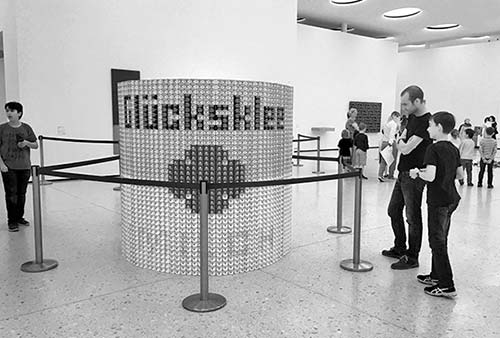
Visiting the Museum: Begin with Old Masters on the top floor, where you’ll find a huge Rembrandt canvas in Room 6—The Blinding of Samson—depicting Delilah gleefully making off with a handful of locks, scissors in hand, while one man handcuffs the now-powerless Samson and another gouges out one of his eyes.
The floor below has works by Renoir, Giacometti, Paul Klee, and Marc Chagall, as well as a female head sculpture by Picasso and his 1909 Cubist portrait of Fernande Olivier. Don’t miss the canvases by Max Beckmann, who lived in Frankfurt for nearly 20 years before the Nazis banned his work, classifying his art as “degenerate.” Frankfurt Main Station—looking not at all seedy—was done from memory while Beckmann lived in exile in Amsterdam. Look also for Dog Lying in the Snow by Franz Marc (who founded the Blue Rider group with Kandinsky—see here); it’s one of the museum’s most popular paintings.
On the museum’s lower level, you’ll find contemporary work, including some avant-garde installations.
Sleeping in Frankfurt
Sleeping in Frankfurt is a gamble: The city’s numerous trade fairs (Messe) send hotel prices skyrocketing—a €70 double can suddenly shoot up to €300. For an exact schedule, visit www.messefrankfurt.com (scroll down to “Messe Frankfurt Calendar”). During trade fairs, it’s best to skip Frankfurt altogether and stay in Würzburg, Bacharach, or St. Goar.
When trade fairs aren’t in town, room prices in most Frankfurt hotels fluctuate €10-50 with the day of the week. If you’ll be staying overnight in Frankfurt during a nonconvention summer weekend, you can land a great place relatively cheaply. Frankfurt hotels are business-oriented, so many are empty and desperate for guests from Friday night to Monday morning. Although the price categories listed are typical, varying demand may skew them higher or lower.
Keep overnights in Frankfurt to a minimum: Pleasant Rhine and Romantic Road towns are just a quick drive or train ride away, offering a mom-and-pop welcome that you won’t find here in the big city.
NEAR THE TRAIN STATION
The following places are within a few blocks of the train station and its fast and handy train to the airport (to sleep even closer to the airport, see “Sleeping at or near Frankfurt Airport,” later in this chapter). The Hamburger Hof, Bristol, and Topas hotels are on the north (and most sedate) side of the station. The Manhattan, Concorde, and EasyHotel are along the busy streets just to the northeast of the station. The Victoria, Premier Inn, Ibis Styles, and Five Elements hostel are in the multiethnic neighborhood east of the station. The Ibis Hotel Frankfurt Centrum is south of the station, close to the Main River and within walking distance of the Museum Embankment (Museumsufer). For locations, see the “Frankfurt Hotels & Restaurants” map.
All these listings are well run and feel safe and respectable. I like staying in this colorful and convenient neighborhood (which is slowly gentrifying). But the red light district is close by, with gritty clubs and hard-drug users. Don’t wander into seedy-feeling streets, and use care and common sense after dark.
$$ Hotel Concorde, across the street from the station and then a few doors down Karlstrasse in a restored 1890s building, offers 45 air-conditioned rooms and four-star comfort and professionalism, all at a reasonable price (breakfast extra, elevator, Karlstrasse 9, +49 69 242 4220, www.hotelconcorde.com, info@hotelconcorde.de, Karim is manager). Exit the station by track 24, cross the street and head right, walking past the Manhattan Hotel and around the corner to the Concorde. A REWE supermarket is across the street.
$$ Victoria Hotel, two blocks from the station along the grand Kaiserstrasse, has 73 rooms and feels a world apart from the red light district a block away (air-con, elevator, Kaiserstrasse 59, entrance on Elbestrasse, +49 69 273 060, www.victoriahotel.de, info@victoriahotel.de). From the station, go down the escalators to the underground passageway below the station and follow the Kaiserstrasse signs.
$ Hotel Hamburger Hof, right next to the train station but in a quiet and safe-feeling location, has a classy, shiny lobby and 62 modern rooms (some smallish). The side facing the station is cheerfully sunny, while rooms on the other side are quieter (air-con, elevator, Poststrasse 10, +49 69 2713 9690, www.hamburgerhof.com, info@hamburgerhof.com). Exit the station by track 24, cross the street, turn left, and walk to the end of the block.
$ Bristol Hotel is a swanky 145-room place that serves up style and flair, from its nod to Pacific Rim architecture to its spacious breakfast room and relaxing patio bar. It’s just two blocks from the station and enjoys quiet and respectable surroundings (air-con, elevator, huge breakfast buffet, Ludwigstrasse 15, +49 69 242 390, www.bristol-hotel.de, info@bristol-hotel.de). Exit the station by track 24, cross the street, turn left, then right on Ottostrasse, then left on Niddastrasse to Ludwigstrasse.
$ Manhattan Hotel, with 55 rooms and an energetic vibe, is a few doors from the station on a busy street. It’s a bit more stylish than your average budget choice (air-con, elevator, Düsseldorfer Strasse 10, +49 69 269 5970, www.manhattan-hotel.com, info@manhattan-hotel.com). Exit the station by track 24, cross the street, and go right until you see the hotel; to cross Düsseldorfer Strasse safely, walk up to the tram stop.
$ Premier Inn Frankfurt City Centre has 116 fresh rooms two blocks from the station, in a quiet location just off Münchener Strasse (air-con, elevator, Elbestrasse 7, +49 69 6677 8738, www.premierinn.de, frankfurt.citycentre@premierinn.com). From the front of the station, use the crosswalk by the tram stop and follow the tracks down Münchener Strasse two blocks to Elbestrasse and turn right.
$ Ibis Styles Frankfurt City is a small step up from the Ibis Hotel (next listing) and is centrally located just a few blocks from the station. Its 94 funky, colorful rooms help you forget that this is a popular chain hotel (air-con in some rooms, elevator, Moselstrasse 12, +49 69 6925 6110, www.ibis.com, H7561@accor.com). From the front of the station, use the crosswalk by the tram stop and follow the tracks down Münchener Strasse one block to Moselstrasse and turn right.
$ Ibis Hotel Frankfurt Centrum is a good value, with 233 rooms on a quiet riverside street away from the station (breakfast extra, elevator, pay parking, Speicherstrasse 4, +49 69 273 030, www.ibis.com, h1445@accor.com). Exit the station by track 1 and follow busy Baseler Strasse three blocks, then turn right before the river; it’s across the street from the green office tower and park.
$ Hotel Topas, a decent budget choice with 33 rooms, is a block north of the train station. Ask for one of the eight back-facing rooms, as they’re quieter and cooler in summer (elevator, Niddastrasse 88, +49 69 2380 5820, www.hoteltopas.de, frankfurt.citycentre@premierinn.com). From the station, follow the same directions as for the Bristol Hotel (listed earlier), two doors away.
$ EasyHotel Frankfurt’s tiny, no-frills rooms feel as if they were popped out of a plastic mold, right down to the ship’s head-style “bathroom pod.” Rates can be low if you book early, but are nonrefundable and you’ll be charged for add-ons that are normally included at most other hotels (air-con, pay Wi-Fi, pay TV, elevator, pay parking, no breakfast but 20 percent discount at bakery next door, Düsseldorfer Strasse 19, www.easyhotel.com). Exit the station by track 24 and follow Düsseldorfer Strasse two blocks to the Platz der Republik tram stop, which is directly in front of the hotel.
Hostel: A block from the train station, ¢ Five Elements is clean and modern and feels very safe inside. But because it’s smack in the middle of the red light district, families might feel more comfortable elsewhere. Here, too, prices skyrocket during conventions (breakfast extra, private rooms available, elevator, Moselstrasse 40, +49 69 2400 5885, www.5elementshostel.de, welcome@5elementshostel.de). From the station, exit the underground passage onto Taunusstrasse and go one block to the corner of Moselstrasse; the hostel is across the intersection to your left.
ELSEWHERE IN FRANKFURT
If you’re in Frankfurt for one night, stay near the station—but if you’re in town for a few days and want to feel like you belong, choose one of the following listings. Ruby Louise and Hotel Zentrum are close to the Hauptwache, and the Maingau Hotel and the hostel are in the Sachsenhausen district, with lots of local shops and cafés (see “Eating in Frankfurt,” later). For locations, see the “Frankfurt Hotels & Restaurants” map.
$$ Ruby Louise Hotel has a modern, “global hipster” aesthetic; even its reception is a combination lounge/bar with views over Frankfurt’s rooftops. The 215 rooms are lean, white, and quiet despite the super-central location (elevator, pay parking in nearby garage, Neue Rothofstrasse 3, +49 69 945 158 770, www.ruby-hotels.com, louise@ruby-hotels.com).
$$ Hotel Zentrum offers funky, industrial-chic style hidden on the upper floors of a downtown building. With 29 colorful, modern rooms, it’s in a great location near the Hauptwache (family rooms, elevator, free afternoon coffee and cake in lobby, Rossmarkt 7, +49 69 5050 0190, www.hotel-zentrum.de, info@hotel-zentrum.de, manager Sascha).
$ Maingau Hotel, located across the river in the Sachsenhausen district, is on a quiet residential street facing a neighborhood park. The 78 rooms are simple and bright. If you’re looking for a little tranquility in an authentic residential setting, stay here (elevator, pay parking in nearby garage, Schifferstrasse 38, +49 69 609 140, www.maingau.de, info@maingau.de). From the station, take the S-Bahn to the Lokalbahnhof stop; the hotel is a five-minute walk away.
Hostel: The ¢ Haus der Jugend, on a busy street right along the river, is the only place I list where prices don’t go up during conferences (membership required, private rooms available, lunch and dinner available, elevator, 2:00 curfew, Deutschherrnufer 12, +49 69 610 0150, www.jugendherberge-frankfurt.de, info@hellofrankfurt.de). From the station, take the S-Bahn to the Lokalbahnhof stop; the hotel is a 10-minute walk away.
Eating in Frankfurt
Instead of beer-garden ambience, Frankfurt entices visitors and locals to its Sachsenhausen district, across the river, where you’ll find lots of characteristic apple-wine pubs (and plenty of other options). This cobbled and cozy neighborhood is the city’s traditional eating-and-drinking zone—a great place to spend a warm summer evening.
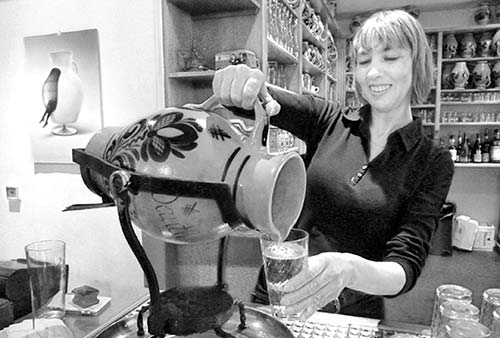
Apfelwein, drunk around here since Charlemagne’s time 1,200 years ago, became more popular in the 16th century, when local grapes were diseased. It enjoyed another boost two centuries later, when a climate change made grape-growing harder. Apple wine is about the strength of beer (5.5 percent alcohol), but like wine, it can be served spiced and warm in winter. This hard cider can be an acquired taste—good luck enjoying it. You’ll see locals, who’ve spent a lifetime learning to like it, grasping their apple wine in geripptes—characteristic hatched glasses (which go back to its early days, when this tax-free drink was slurped by greasy-fingered sausage munchers on the streets).
Sachsenhausen is also a good place to sample local cuisine. The culinary pride of Frankfurt is Grüne Sosse, a green sauce made of sour cream blended with seven herbs (parsley, chives, watercress, sorrel, borage, chervil, and burnet); it’s frequently served with beef, schnitzel, or halved hard-boiled eggs. Another widely available local specialty (for the adventurous) is Handkäse mit Musik (“hand cheese with music”—the “music” comes tomorrow), an aged, cylindrical ricotta-like cheese served with onions and vinegar. You can also satisfy your craving for Leiterchen here (“miniladders,” or spare ribs—surprisingly meaty and salty).
APPLE-WINE PUBS IN SACHSENHAUSEN
The three apple-wine pubs I’ve listed below all have indoor and outdoor seating in a woodsy, rustic setting. Not just for tourists, these characteristic places are truly popular with Frankfurters, too. To reach them, take the S-Bahn to the Lokalbahnhof stop. Or to walk from downtown (20 minutes), cross the river on the pedestrian-only Eiserner Steg bridge or Alte Brücke bridge. For locations, see the “Frankfurt Hotels & Restaurants” map, earlier.
$$ Dauth-Schneider has lots of tables outside on the shady, tree-covered square, a large indoor section, and a big and accessible menu. It’s my first choice for eating outside on a balmy evening (daily 11:30-24:00, Neuer Wall 5, +49 69 613 533). Families appreciate the big-city playground across the square from the outdoor tables.
$$ Atschel, across the street and a few doors down, is my Sachsenhausen choice for eating inside. They serve “Frankfurter Schnitzel” with green sauce and other local standards in a handsome dining room and cozy back garden (daily 12:00-24:00, kitchen closes at 23:00, cash only, Wallstrasse 7, +49 69 619 201).
$$ Fichtekränzi, across the alley from Atschel, is open evenings only. It offers the typical specialties and some lighter fare, both in its cozy, bench-filled beer hall and outside under the trees. The atmosphere is young and relaxed—expect to share a table and make some new friends (Mon-Sat 17:00-23:00, Sun from 16:00, cash only, Wallstrasse 5, +49 69 612 778).
Pub Crawl: Irish pubs and salsa bars clutter the pedestrian zone around Grosse Rittergasse and Frankensteiner Strasse; if you’re looking for a place to do a pub crawl, this is it.
DINING DOWNTOWN
$ Alten Limpurg, next to the Town Hall, is a simple option on Frankfurt’s charming, traffic-free, and historic market square. It has the cheapest menu on the square and is easy to spot: Look for the big sausages displayed out front. Choose from the comfy pub inside or order from the sausage window and enjoy sitting on the square (daily 9:00-24:00, Römerberg 17, +49 69 9288 3130).
$$$$ Restaurant Opéra is a great place for a dressy splurge, with white tablecloths and formal service both inside, under gilded arches and circa-1900 decor, or out on a terrace over the opera’s grand entry (Mon-Fri 12:00-15:00 & 18:00-22:00, Sat from 18:00, Sun from 11:00; reservations smart, Opernplatz 1, +49 69 5880 5330, www.kuffler.de/en/frankfurt/restaurant-opera). Enter through Café Rosso at street level, then take the elevator or stairs up to the third floor.
$$ Leib & Seele is a modern place a block toward the river from the Hauptwache. Its name means “body and soul,” and this local favorite serves lots of hearty and creative salads, serious vegetarian plates, and traditional dishes in a modern pub interior with fine outside tables (Mon-Fri 8:00-24:00, Sat-Sun from 11:00, Kornmarkt 11, +49 69 713 768 290).
$ Galeria Restaurant is a huge, sleek, modern cafeteria serving good buffet-style food (at restaurant prices), with nice city views from its top-floor perch. It’s super-efficient, with lots of healthy options, air conditioning, and sofas on the rooftop terrace for those just having a drink (Mon-Sat 9:30-20:00, closed Sun).
$ Café Karin, a local institution, serves one of the best breakfasts in town until 18:00 (including the yummy, homemade Bircher Muesli). Located right next to Goethe House, it’s also a convenient place for a coffee break (Mon-Sat 9:00-23:00, Sun 10:00-19:00, cash only, Grosser Hirschgraben 28, +49 69 295 217).
$ The Kleinmarkthalle is one of the most charming and inviting indoor market halls you’ll find anywhere in Germany, and a great place for a simple lunch. Strolling its ground floor, you can graze through a world of free samples (call that the first course). Once you’ve made your selection (fish, Italian, oyster bar), find a place to sit down at the far end opposite the entrance, or go upstairs (Mon-Fri 8:00-18:00, Sat until 16:00, closed Sun). Or assemble a picnic to eat on the adjacent square, Liebfrauenberg, near the fountain.
$$ Kleinmarkthalle Markt-Stubb (breakfast and lunch only) is the only real restaurant in the market hall. It’s upstairs at the east end and is a hit with local seniors for its traditional home cooking with fresh-from-market ingredients (Tue-Sat 9:00-16:00, closed Sun-Mon).
Kleinmarkthalle Weinterrasse is a lively wine garden upstairs at the market hall, serving every wine but apple to locals. It stays open for two hours after the market is closed (Mon-Fri 10:00-20:00, Sat until 18:00, closed Sun).
NEAR THE TRAIN STATION, ON AND NEAR KAISERSTRASSE
A grand boulevard connecting the train station with the old center, Kaiserstrasse is a venerable, linden-tree-lined, four-block stretch of imposing buildings (circa 1880) that once saw some seedy times (but the sex and drugs have moved a block or two to the north). It’s emerging as a fun eating-and-drinking zone—especially if you need a break from traditional German fare. The parallel Münchener Strasse is less upscale but up-and-coming, with some hip newer restaurants popular with locals (such as Maxie Eisen) and with a cheaper selection of international eateries. And the train station itself is a veritable mall of shops and restaurants with long hours.
I recommend strolling around first to enjoy the scene and survey your options (as things are steadily evolving upward in quality). Here are a few places to consider (starting nearest the station).
$$ Der Fette Bulle Hamburger Restaurant (the “Fat Bull”) is a trendy burger joint with a modern and fun interior and good seating on the street. If you’re in the mood for a fancy burger, this is the place (daily 11:30-23:00, Kaiserstrasse 73, +49 69 9075 7004).
$ Der Thai is good, quick, and inexpensive. Dine inside the small, modern interior or eat your food streetside (Mon-Fri 11:00-23:00, Sat-Sun from 12:00, Kaiserstrasse 38, +49 69 2695 7957).
$ Dean & David is a favorite for a fast, inexpensive, and healthy lunch with views of the skyscrapers of “Bankfurt.” It has a pleasant modern interior and streetside tables (Mon-Fri 10:00-15:00, closed Sat-Sun, Kaiserstrasse 33, +49 69 8008 8363).
$$ Merkez Kebab Haus is an old standby for Turkish food. A cut above the many kebab shops in the neighborhood, it has a wood-fired grill, an inviting ambience, and good service at a great price (try the wonderful sütlaç—rice pudding, Mon-Sat 8:00-late, Sun from 10:00, Münchener Strasse 33, +49 69 233 995).
$$ Maxie Eisen, named after a 1920s Chicago racketeer with German roots, is a bar and diner located on the light-flooded corner of Münchener Strasse and Weserstrasse. If you’re craving a pastrami or Reuben sandwich, you’ll find it here, along with other Jewish dishes like matzo ball and kreplach soups, plus delicious, seasoned fries (Mon-Sat 18:00-24:00, closed Sun, Münchener Strasse 18, +49 69 7675 8362).
$$ Babam’s Persian cuisine is so popular that tables spill into the street. Crowds come here for the saffron-scented and yogurt-accompanied grilled meats, salads, and rice dishes—though you can also get a takeaway sandwich wrapped in flatbread hot out of a traditional oven (daily 12:00-22:00, Münchener Strasse 11, +49 69 2400 4455).
$$ Indigo Restaurant, a block north of Kaiserstrasse at the corner of Weserstrasse and Taunusstrasse, is a bit closer to the red light district, but their Indian food is considered among the best in town. This is a good place for takeout (daily 12:00-14:30 & 17:30-23:30, Taunusstrasse 17, +49 69 2648 8878).
SUPERMARKETS
A small but well-stocked REWE is near the station, across the street from the recommended Hotel Concorde (Mon-Sat 7:00-22:00, closed Sun, Karlstrasse 4, use Kaiserstrasse exit from underground passageway). For a quick snack, a REWE To Go minimarket offers a salad bar and sandwich counter (Mon-Fri 6:00-24:00, Sat-Sun 8:00-22:00, Kaiserstrasse 48). A larger REWE is in the basement of the MyZeil shopping center near the Hauptwache, in the center of town (Mon-Sat 7:00-24:00, closed Sun). On Sundays (when many stores are closed), you’ll find a grocery store and pharmacy in the underground section of the train station (open until 20:00).
Frankfurt Connections
BY TRAIN
German Destinations: Rothenburg (hourly, 3 hours, transfer in Würzburg and Steinach; the tiny Steinach-Rothenburg train often leaves from track 5, shortly after the Würzburg train arrives), Würzburg (1-2/hour, 70 minutes, or 2 hours on cheaper RE trains), Nürnberg (1-2/hour, 2 hours), Munich (hourly, 3.5 hours), Baden-Baden (hourly, 1.5-2 hours, direct or transfer in Karlsruhe), Bacharach (hourly, 1.5-2 hours, transfer in Mainz or Bingen), Freiburg (hourly, 1.5-2 hours), Cochem (hourly, 2.5 hours, transfer in Koblenz), Cologne (direct ICE trains hourly, 1-1.5 hours; cheaper, less frequent IC trains take 2.5 hours and show you more of the Rhine), Erfurt (1-2/hour, 2.5 hours), Leipzig (hourly, 3 hours), Berlin (at least hourly, 4 hours), Hamburg (hourly, 4 hours). Train info: www.bahn.com.
International Destinations: Amsterdam (6/day direct, 4 hours; more with transfers, 5-7 hours), Bern (hourly, 4 hours, most with transfer in Basel), Zürich (hourly, 4 hours, most transfer in Basel), Brussels (6/day by direct ICE, 3 hours, reservation not required; more with transfers, 5 hours), Copenhagen (2/day, 9.5 hours, transfer in Hamburg, reservation required in summer), Paris (about hourly, 4-5 hours, many with 1 change, reservation required in France), Vienna (4/day direct, 6.5 hours), Prague (5/day, 6 hours, change to bus in Nürnberg).
BY ROMANTIC ROAD BUS
This once-weekly bus departs Sundays at 9:00 (generally May-Sept) from the Romantic Road Coach bus stop outside the Frankfurt train station. Exit the station through the main entrance and turn right; look for platforms A1-A3 with signs for Romantic Road or Romantische Strasse. For tickets and information, go to www.romantischestrasse.de (choose “Bus & train,” then “Romantic Road Bus”) or call +49 89 593 889 (Mon-Fri 11:00-17:00). Frankfurt to Rothenburg costs €49; Frankfurt to Munich is €75 (20 percent discount with rail pass). If you’re heading to Füssen and the King’s Castles instead of Munich, you’ll have to transfer to a train in the town of Donauwörth (and you must notify the bus company 36 hours in advance so they’ll stop). For details, see here.
BY PLANE
Frankfurt Airport
Frankfurt’s airport (Flughafen), just a few stops by S-Bahn from the city center, has its own long-distance train station, which makes it a snap to connect from a flight here to other German cities (code: FRA, www.frankfurt-airport.com).
There are two separate terminals (know your terminal—check your ticket or the airport website). Terminal 1, a multilevel maze of check-in counters and shops, is linked to the train station. Terminal 2 is small and quiet, with few services. A SkyLine train connects the two terminals in less than five minutes. For assistance, look for a staffed info desk or use a kiosk to make a free video call to an airport info person.
The airport has three pay baggage-storage desks (Gepäckaufbewahrung; the branch in Terminal 1B, level 1 is open 24 hours). Among the other services are a post office (in the Book+Press shop on level 0), a pharmacy (in Terminal 1B, level 2, and also in Terminal 2), a 24-hour medical clinic (located outside the 1C arrivals area), public showers (one in Terminal 2 and three in Terminal 1, €6, shampoo and towel included), and free Wi-Fi. A good-sized, fairly priced Tegut supermarket is handy for last-minute shopping (Terminal 1C, level 0; tricky to find: Go down the escalators from the underpass on level 1 between terminals 1B and 1C, or up the escalators from train platforms 1-3). There are customs desks in both terminals for VAT refunds (daily 7:00-21:00; after hours, ask the information desk to page a customs officer for you). You’ll even find several McDonald’s restaurants, one of which is allegedly among Europe’s largest. McWelcome to Germany.
Frankfurt Airport Train Station
The airport’s train station has two parts, both reachable from Terminal 1. Regional S-Bahn trains to downtown Frankfurt and nearby towns and suburbs depart from platforms 1-3. Long-distance trains leave from the slightly more distant Fernbahnhof, platforms 4-7.
Getting to Downtown Frankfurt: The airport is a 12-minute train ride on the S-Bahn from Frankfurt’s main train station, or Hauptbahnhof (4/hour, €5.10, ride included in €11.50 Frankfurt Card and €10.15 individual/€18.50 group version of all-day Tageskarte Frankfurt transit pass, but not in cheaper version of Tageskarte Frankfurt). Figure about €30 for a taxi from the airport to any of my recommended hotels.
Getting to Other Destinations by Train: Train travelers can validate rail passes or buy tickets at the Reisezentrum on the level above the long-distance train platforms. Handy ticket machines are easy to use and allow you to print a schedule even if you aren’t buying a ticket—great for those traveling with a rail pass. Destinations include Rothenburg (hourly, 3.5 hours, change in Würzburg and Steinach), Würzburg (1-2/hour, 1.5 hours), Nürnberg (1-2/hour, 2.5 hours), Munich (1-2/hour, 3.5 hours), Baden-Baden (roughly hourly, 1.5 hours, change in Karlsruhe and/or Mannheim), Cologne (1-2/hour, 1 hour; trains along Rhine go less often and take 2.5 hours), Bacharach (hourly, 1 hour, change in Mainz or Bingen, some depart from regional platforms), Berlin (1-2/hour, 4.5-5 hours, most with 1 change). There are also many international connections from here (such as Paris, London, Brussels, Amsterdam, Zürich, Bern, and Prague).
Sleeping at or near Frankfurt Airport
Because train connections to Frankfurt Airport are so good, if your flight doesn’t leave too early, you can sleep in another city and make it to the airport for your flight. From Cologne, Baden-Baden, Würzburg, or Bacharach, you can catch a late-morning or midday flight; you can often make it from Nürnberg, Rothenburg, Freiburg, the Mosel, and even Munich for an early afternoon flight. Plan ahead and leave room for delays; don’t take the last possible connection.
Thanks to these easy connections—and because downtown Frankfurt is less than 20 minutes away by frequent train—you’ll rarely have a flight so early to require an overnight by the airport. Drivers who do want to stay near the airport the night before returning a rental car can stay cheaply in Kelsterbach, just across the expressway from the airport, at the $ Ibis Frankfurt Airport Hotel (breakfast extra, Langer Kornweg 9a, +49 6107 9870, www.ibis.com). If for some reason you do need to overnight here, there’s a Sheraton and a Marriott in Terminal 1, and two Hiltons at the airport train station. Another clutch of hotels is around the Gateway Gardens S-Bahn station, one stop from the airport. Shop around for a good rate.
“Frankfurt” Hahn Airport
This smaller airport, misleadingly classified as a “Frankfurt” airport for marketing purposes, is a nearly two-hour drive away in the Mosel region. Hahn Airport is popular with low-cost carriers (such as Ryanair). To avoid confusion, double-check the three-letter airport code on your ticket (FRA for Frankfurt Airport, HHN for Frankfurt Hahn). Regular buses connect Frankfurt Hahn Airport to Bullay (for trains to Cochem), Trier, Mainz, Cologne, and Frankfurt (more info at www.hahn-airport.de).