Shopping in Munich
While the whole city is great for shopping, the most glamorous area is around Marienplatz. It’s fun to window shop, even if you have no plans to buy. Here are a few stores and streets to consider.
Bavarian Souvenirs
Servus Heimat’s amusing shop at the Munich City Museum is a good source of unusual gifts that remind Bavarians of their childhood. It’s kitsch, but with taste and humor. Ask for the inside scoop behind T-shirt logos, books, and quirky kitchen utensils (Tue-Fri 13:00-18:00, Sat-Sun from 12:00, closed Mon; tucked between the City Museum and the Stadt Café at St.-Jakobs-Platz 1, +49 89 2370 2380, www.servusheimat.com).
Books
The three-story Hugendubel bookstore on Karlsplatz has some English offerings (Mon-Sat 10:00-20:00, closed Sun, Karlsplatz 12, +49 89 3075 7575, www.hugendubel.de).
Dirndls and Lederhosen
For fine-quality (and very expensive) traditional clothing (Trachten in German), head to Loden-Frey Verkaufshaus. The third floor of this fine department store is dedicated to classic Bavarian wear (Mon-Sat 10:00-19:00, closed Sun, a block west of Marienplatz at Maffeistrasse 7, +49 89 210 390, www.loden-frey.com). For less expensive (but still good quality) traditional gear, visit Angermaier Trachten, near the Viktualienmarkt (Mon-Fri 11:00-19:00, Sat 10:00-17:00, closed Sun, Rosental 10, +49 89 2300 0199, www.trachten-angermaier.de). Gottseidank, across from St. Peter’s Church, sells dressy, up-to-date Bavarian sweaters and jackets, ideal for people who don’t want to look like they escaped from a slap-dancing troupe (Mon-Fri 10:30-18:30, Sat until 19:00, closed Sun, Petersplatz 8, www.gottseidank.com).
Toys
Obletter, a big toy store right on Karlsplatz, has some wooden toys (Holzspielzeuge) in its underground level and a fun section full of puppets (Mon-Sat 10:00-20:00, closed Sun, Karlsplatz 11, +49 89 5508 9510).
Window Shopping and Malls
Shoppers will want to stroll from Marienplatz down the pedestrianized Weinstrasse (to the left as you face the New Town Hall). Look for Fünf Höfe on your left, a delightful indoor/outdoor mall filled with Germany’s top shops (Mon-Fri 10:00-19:00, Sat until 18:00, closed Sun, https://fuenfhoefe.de). Named for its five courtyards, this is where tradition meets modern. Note how its Swiss architects play with light and color. Even if you’re not a shopper, wander through the Kunsthalle to appreciate the architecture, the elegant window displays, and the sight of Bavarians living very well.
Built by Maximilian II in the 1850s, the nearby Maximilianstrasse was designed for shoppers. Today it’s home to Munich’s most exclusive shops, and a ritzy dream come true for wealthy families from oil-rich Arab nations on shopping sprees.
Department Stores
Ludwig Beck, an upscale department store at Marienplatz, has been a local institution since 1861. With six floors of expensive designer clothing (plus some music, stationery, and cosmetics), this is the place to go for a €200 pair of jeans. Beck has long been to fabrics what Dallmayr is to fine food—too expensive a place to buy, but fun to browse (Mon-Sat 10:00-20:00, closed Sun). For more reasonable prices near Marienplatz, try Galeria Kaufhof (midrange; sells everything), or C&A down the street at Kaufingerstrasse 13 (cheap yet respectable; sells only clothing). Oberpollinger at Neuhauser Strasse 18 (just inside Karlstor) has clothing, cosmetics, and housewares, plus a top-floor cafeteria.
Lowbrow Tips
For that beer stein you promised to take home to your uncle, try the shops on the pedestrian zone by St. Michael’s Church and the gift shops that surround the Hofbräuhaus. If you’re looking for a used cell phone or exotic groceries, the area south of the train station fits the bill.
Nightlife in Munich
Here are a few nightlife alternatives to the beer-and-oompah scene.
Music and Dance
Ballet and opera fans can check the schedule at the Bayerisch Staatsoper, centrally located next door to the Residenz. These shows are popular, so book at least two months ahead—seats range from reasonable to very pricey (Max-Joseph-Platz 2, +49 89 2185 1920, www.staatsoper.de). The Hotel Bayerischer Hof’s nightclub has live music—major jazz acts plus pop/soul/disco—in a posh, dress-up, expensive setting (Promenadeplatz 2, +49 89 212 0994, www.bayerischerhof.de). Café am Beethovenplatz is another option for live classical, jazz, and swing music (see listing later, under “Eating in Munich”). For familiar Broadway-style musicals (usually in German), try the Deutsches Theater, conveniently located near my train-station hotels (Schwanthalerstrasse 13, +49 89 5523 4444, www.deutsches-theater.de).
The Film Museum at the Munich City Museum shows classics (including silent movies with live music) in their original language every evening except Monday (€4, St.-Jakobs-Platz 1, +49 89 2332 2348, www.muenchner-stadtmuseum.de).
Pubs
Giesinger Bräu is the new kid on the brewing block, vying to turn the top six Munich breweries into the top seven. It has a little stand-up only outpost (called Stehausschank), with hipster beer and a hipster crowd, facing the Viktualienmarkt (Tue-Thu 14:00-22:00, Fri-Sat from 11:00, across from Der Pschorr at Prälat-Zistl-Straße 4, www.giesinger-braeu.de).
Jodlerwirt (“Yodeling Innkeeper”) is a cellar pub billing itself as “the place where the world meets Bavaria” (Tue-Sat 17:00-late, closed Sun-Mon except during festivals, live music Thu-Sat, near the Old Town Hall, just off Marienplatz, at Tal 1, +49 89 221 249, www.jodler-wirt.com).
Kennedy’s Irish Pub is a high-energy music and sports bar at Sendlinger Tor with a big, noisy main room and a quieter, more intimate lounge. They have nightly music from 22:00 (see listing under “Eating in Munich,” later, Sendlinger-Tor-Platz 11, +49 89 5998 8460, www.kennedysmunich.de).
Gärtnerplatz is a good, untouristed area known for its nightlife—both gay and straight (a 30-minute walk due south of Marienplatz; bus #52 from Marienplatz, or U-1 or U-2 to Fraunhoferstrasse).
Sleeping in Munich
Unless you hit Munich during a fair, convention, or big holiday, you can sleep reasonably here: It’s possible to find a fine double with breakfast in a good basic hotel for €100. Student hotels around the main train station house anyone who’s young at heart for as low as €25. In hot weather, air-conditioning is a big plus, allowing you to close the windows at night and shut out street noise.
I’ve listed accommodations in two main areas: not far from the station, and in the old center, between Marienplatz and Sendlinger Tor. Most hotels here have complicated, slippery pricing schemes. During major conventions and events, prices increase from 20 percent to as much as 300 percent (worst at Oktoberfest; reserve well in advance). Sunday is very slow and usually comes with a huge discount if you ask.
To save money, or if the central area is booked solid, search online for a reliable chain hotel near an outlying U-Bahn, S-Bahn, or tram stop.
SOUTH OF THE TRAIN STATION
This multicultural area has Munich’s highest concentration of hotels, and prices are lower than in the old city center. Historically Munich’s red-light district, the blocks south of the station have gentrified quite a bit over the years. Pockets of vice remain—gambling, sex shows, and pawnshops. These are juxtaposed with straight-and-narrow businesses, colorful international eateries, and hotels that range from mediocre to excellent. Some find the area seedy after dark, but it’s truly sketchy only for those in search of trouble. The places I’ve listed below are solid and within a five-minute walk of the station. Still, hotels in the old center (listed later) will feel more comfortable to some.
$$$ Hotel Schiller5 is in sight of the train station and has good rooms with dark wood elegance that make the higher price feel worthwhile. Inside, you don’t notice the “Gold for Cash” shop and gambling hall to either side. Most of the 62 rooms come with a kitchenette (family rooms, air-con, elevator, coin-op laundry, pay parking—reserve, Schillerstrasse 5, +49 89 515 040, www.schiller5.com, info@schiller5.com).
$$$ Hotel Marc München—polished, modern, and with 80 rooms—is a good option if you want four-star comforts like a refined lobby and classy breakfast spread. It’s just a half-block from the station (RS%, air-con, elevator, pay parking, Senefelderstrasse 12, +49 89 559 820, www.hotel-marc.de, info@hotel-marc.de).
$$ Hotel Cocoon Hauptbahnhof has a rustic countryside/alpine theme. Ride the elevator like a personal gondola up to one of their 103 rooms (breakfast extra, air-con, bike rental, pay parking, Mittererstrasse 9, +49 89 5999 3905, www.cocoon-hotels.de, hauptbahnhof@cocoon-hotels.de). Don’t confuse this with the Hotel Cocoon Stachus, run by the same company at a different location.
$$ Arthotel has an arty lobby but 150 very normal rooms. From across the street, bus #58 runs direct to Königsplatz and the museum district (air-con, pay parking, Paul-Heyse-Strasse 10, +49 89 592 122, www.arthotelmunich.de, info@arthotelmunich.de).
$$ Hotel Europäischer Hof, across the street from the station, is a huge, impersonal hotel with 140 decent rooms. During cool weather, when you can keep the windows shut, the street-facing rooms are an acceptable option. The quieter, courtyard-facing rooms are more expensive and a lesser value (RS%, includes breakfast when you book directly, elevator, pay parking, Bayerstrasse 31, +49 89 551 510, www.heh.de, info@heh.de).
$$ Helvetia Hotel, also very close to the station, has 43 functional rooms, decorated with pop art by a Swiss artist—hence the name (breakfast extra, air-con, elevator, smoking rooms available, Schillerstrasse 6, +49 89 590 6850, www.helvetia-hotel.com, info@helvetia-hotel.com).
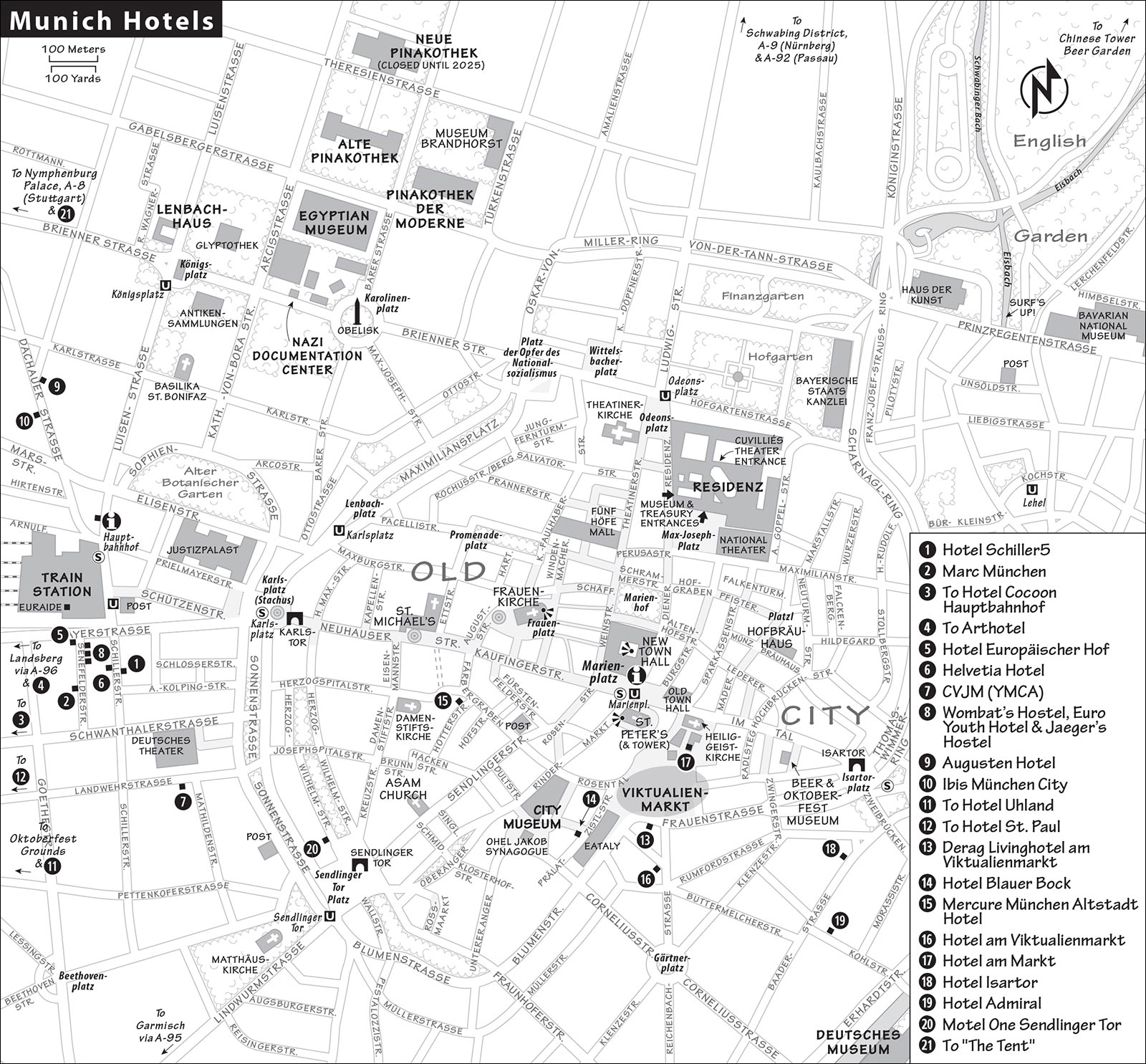
¢ The CVJM (YMCA), open to all ages, rents 87 beds in clean, slick, and simple rooms, each with its own bathroom. Doubles are head-to-head; triples are like doubles with a bunk over one of the beds (family rooms available, air-con, reserve at least 6 months ahead for Oktoberfest weekdays, a year ahead for Oktoberfest weekends; Landwehrstrasse 13, +49 89 552 1410, www.cvjm-muenchen.org, hotel@cvjm-muenchen.org).
“Hostel Row” on Senefelderstrasse, a Block from the Station
These hostels are casual and well run, with friendly and creative management, and all cater expertly to the needs of young beer-drinking backpackers enjoying Munich on a shoestring. With 900 cheap dorm beds, this is a spirited street. Each place has a lively bar that rages until the wee hours. All have 24-hour receptions, none has a kitchen, but each offers a reasonably priced buffet breakfast. Sleep cheap in dorms, or spend a little more for a private room.
¢ Wombat’s Hostel is perhaps the most hip and colorful. The dorms are fresh, modern, and equipped with their own bathrooms. The bright rooms facing the winter garden have huge windows (family rooms, laundry, Senefelderstrasse 1, +49 89 5998 9180, www.wombats-hostels.com/munich, office@wombats-munich.de).
¢ Euro Youth Hotel fills a rare pre-WWII building and has live music in its bar (Senefelderstrasse 5, +49 89 5990 8811, www.euro-youth-hotel.de, info@euro-youth-hotel.de, run by Alfio and Andy).
¢ Jaeger’s Hostel rounds out this trio, with all the fun and efficiency you’d hope for in a hostel—plus the only air-conditioning of the three. Popular with the young backpacker set, it also markets its singles and doubles to older travelers. This is the quietest hostel of the group. All rooms have en suite bathrooms, and the classy bar is a congenial gathering place (family rooms, Senefelderstrasse 3, +49 89 555 281, www.jaegershotel.de, office@jaegershotel.de).
NORTH OF THE TRAIN STATION
These two hotels are a five-minute walk north of the train station, by the Karlstrasse tram stop. The neighborhood here is slightly more gentrified than the south side of the station, but still has its share of vice.
$$ Augusten Hotel rents 62 modern rooms in a handsome corner building (Augustenstrasse 2, +49 89 516 8900, www.augustenhotel.com, info@augustenhotel.com).
$ The Ibis München City, an impersonal chain hotel across the street from the Augusten, has 213 predictable rooms; there’s a gambling parlor next door (air-con, Dachauer Strasse 21, +49 89 551 930, https://ibis.accor.com, h1450@accor.com).
NEAR THE OKTOBERFEST GROUNDS
As you cross Paul-Heyse-Strasse walking west from the train station, you leave the red-light action behind and enter a safe-feeling, manicured residential neighborhood. These hotels are near the Theresienwiese U-Bahn stop, within a block or two of the Oktoberfest grounds, about a 15-minute walk (or two-stop bus ride) from the train station.
$$$ Hotel Uhland is a stately mansion that rents 29 rooms with old-style character and modern bathrooms (family rooms, elevator, limited pay parking, Uhlandstrasse 1, +49 89 543 350, www.hotel-uhland.de, info@hotel-uhland.de). From the station, take bus #68 (direction: Silberhornstrasse) to Georg-Hirth-Platz, or walk 15 minutes: Out the station’s south exit, turn right along Bayerstrasse, go left on Paul-Heyse-Strasse three blocks to Georg-Hirth-Platz, then take a soft right on Uhlandstrasse.
$$ Hotel St. Paul, facing a quiet square, is a clean, simple, no-nonsense 40-room place to rest your head and comes with a cheery courtyard and the charming sound of bells from the nearby church. Rooms at the back do not have elevator access (St.-Paul-Strasse 7, +49 89 5440 7800, www.hotel-stpaul.de, info@hotel-stpaul.de).
IN THE OLD CENTER
The area south of Marienplatz, between Sendlinger Tor and Isartor, feels more genteel than the streets around the train station and is convenient for sightseeing. The listings below are all just a few stops from the station by direct tram or S-Bahn.
$$$$ Derag Livinghotel am Viktualienmarkt rents 83 rooms in two connected buildings. One building is elegant and tech-savvy, with great views over the Viktualienmarkt. The other has stylish rooms with kitchenettes but no views, and is geared toward longer-stay business guests, although short-term visitors are welcomed. Both buildings share the same homey breakfast room (breakfast extra, air-con, elevator, laundry facilities, parking discounts, Frauenstrasse 4, +49 89 885 6560, www.living-hotels.com, reservierung.muenchen@derag.de).
$$$$ Hotel Blauer Bock, formerly a dormitory for Benedictine monks, has been on the same corner near the Munich City Museum since 1841. Its 69 contemporary Bavarian rooms are classy, the breakfast is top-notch, and the location is great, with some views of the nearby Viktualienmarkt (elevator, pay parking—reserve, Sebastiansplatz 9, +49 89 231 780, www.hotelblauerbock.de, info@hotelblauerbock.de).
$$$ Mercure München Altstadt Hotel is reliable, with all the modern comforts in its 80 pricey business-class rooms, and is well located on a quiet street very close to the Marienplatz action—just a block south of the pedestrian zone. It’s a chain, and a bit bland, but has fine service (air-con, Hotterstrasse 4, +49 89 232 590, www.mercure-muenchen-altstadt.de, h3709@accor.com).
$$$ Hotel am Viktualienmarkt rents 26 rooms on a small side street a couple of blocks from the Viktualienmarkt. Everything is small but well designed—including the elevator and three good-value, tiny single rooms (family rooms, apartment, table fans, tram #16 or #17 from station to Reichenbachplatz, Utzschneiderstrasse 14, +49 89 231 1090, www.hotel-am-viktualienmarkt.de, reservierung@hotel-am-viktualienmarkt.de).
$$$ Hotel am Markt, right next to the Viktualienmarkt, has 30 simple, tastefully renovated rooms. Light sleepers might need earplugs—the neighboring church’s bells ring hourly (save money by skipping expensive breakfast, elevator, Heiliggeiststrasse 6, +49 89 225 014, www.hotel-am-markt.eu, service@hotel-am-markt.eu).
$$$ Hotel Isartor has 68 comfortable rooms on six floors of a blocky building, barely a hundred yards from Isartor and its S-Bahn stop. Half the rooms have air-conditioning, and some have a balcony—let reception know what’s important to you (Baaderstrasse 2, +49 89 216 3340, www.hotel-isartor.de, info@hotel-isartor.de).
$$$ Hotel Admiral, classy yet homey with 32 rooms, serves breakfast in its back garden in good weather. Back-facing rooms are smaller and quieter, with balconies (air-con, S-Bahn: Isartor, Kohlstrasse 9, +49 89 216 350, www.hotel-admiral.de, info@hotel-admiral.de).
$$ Motel One Sendlinger Tor, around the corner from the Sendlinger Tor tram and U-Bahn stop, is a huge, inexpensive but posh-feeling, 241-room chain hotel with rushed-but-pleasant staff in a fine location. The stylish, modern rooms are fairly tight and simple (no phones or minibars), and tend to sell out a few weeks in advance. Streetside rooms on upper floors have great views—I’d request one of these. When booking on their website, make sure to choose the Sendlinger Tor location—they have several other hotels in Munich (breakfast extra, air-con, pay parking, Herzog-Wilhelm-Strasse 28, +49 89 5177 7250, www.motel-one.com, muenchen-sendlingertor@motel-one.com).
AWAY FROM THE CENTER
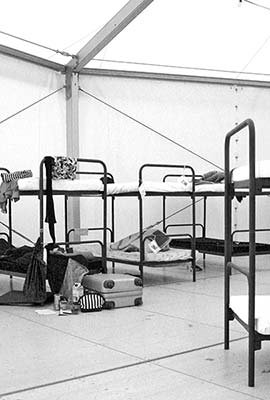
¢ The Tent—a venerable Munich institution officially known as the International Youth Camp Kapuzinerhölzl—offers 400 spots in three huge circus tents near Nymphenburg Palace. It never fills up, though you are encouraged to reserve online. Choose a mattress on a wooden floor or a bunk bed, or pitch your own tent. Blankets, hot showers, lockers (bring or buy a lock), and a kitchen are all included; breakfast is extra. A fun but noisy experience (a cross between a slumber party and Woodstock), it feels wholesome, but I wouldn’t bring kids. It’s really intended for young adults, with a cool table-tennis-and-Frisbee atmosphere throughout the day, nightly campfires, and no curfew, though silence is requested after 1:00 (open early June-early Oct only, prices a little higher during Oktoberfest, cash only, bikes-€12/day, catch tram #17 from train station for 18 minutes to Botanischer Garten, direction: Amalienburgstrasse, then go right down Franz-Schrank-Strasse—it’s behind the trees at the end of the street, +49 89 141 4300, www.the-tent.com, cu@the-tent.com).
Eating in Munich
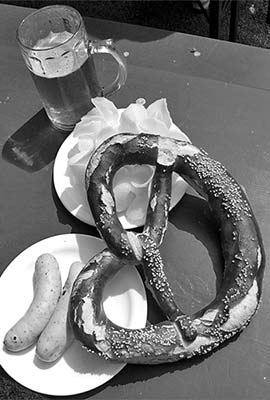
Munich’s cuisine is traditionally seasoned with beer. In beer halls, beer gardens, or at the Viktualienmarkt, try the most typical meal in town: Weisswurst (white-colored veal sausage—peel off the skin before eating, often available only until noon) with süsser Senf (sweet mustard), a salty Brezel (pretzel), and Weissbier (“white” wheat beer). Another traditional beer garden favorite is Obatzter, a soft cheese spread with paprika and often garlic or onions that’s eaten on bread. Brotzeit, literally “bread time,” gets you a wooden platter of cold cuts, cheese, and pickles and is a good option for a light dinner. A Steckerlfisch is a whole fish that’s seasoned and grilled on a stick. Also look for these Bavarian specialties: Fleischpflanzerl, a.k.a. Fleischklösse or Frikadellen (meatballs); Hendl or Brathähnchen (roasted chicken); Radi (radish that’s thinly spiral-cut and salted); Schweinerollbraten (pork belly); Schweinshax’n, or just Hax’n (pork knuckle); and spareribs. (For more on food in Germany, see the Practicalities chapter.)
I’m here for the beer-hall and beer-garden fun (my first several listings). But when the Wurst und Kraut get to be too much for you, Munich has plenty of good alternatives; I’ve listed my favorites later in this section.
Bavarian restaurants are smoke-free. The only ashtrays you’ll see throughout Bavaria are outside.
BEER HALLS, BEER GARDENS, AND BAVARIAN FOOD
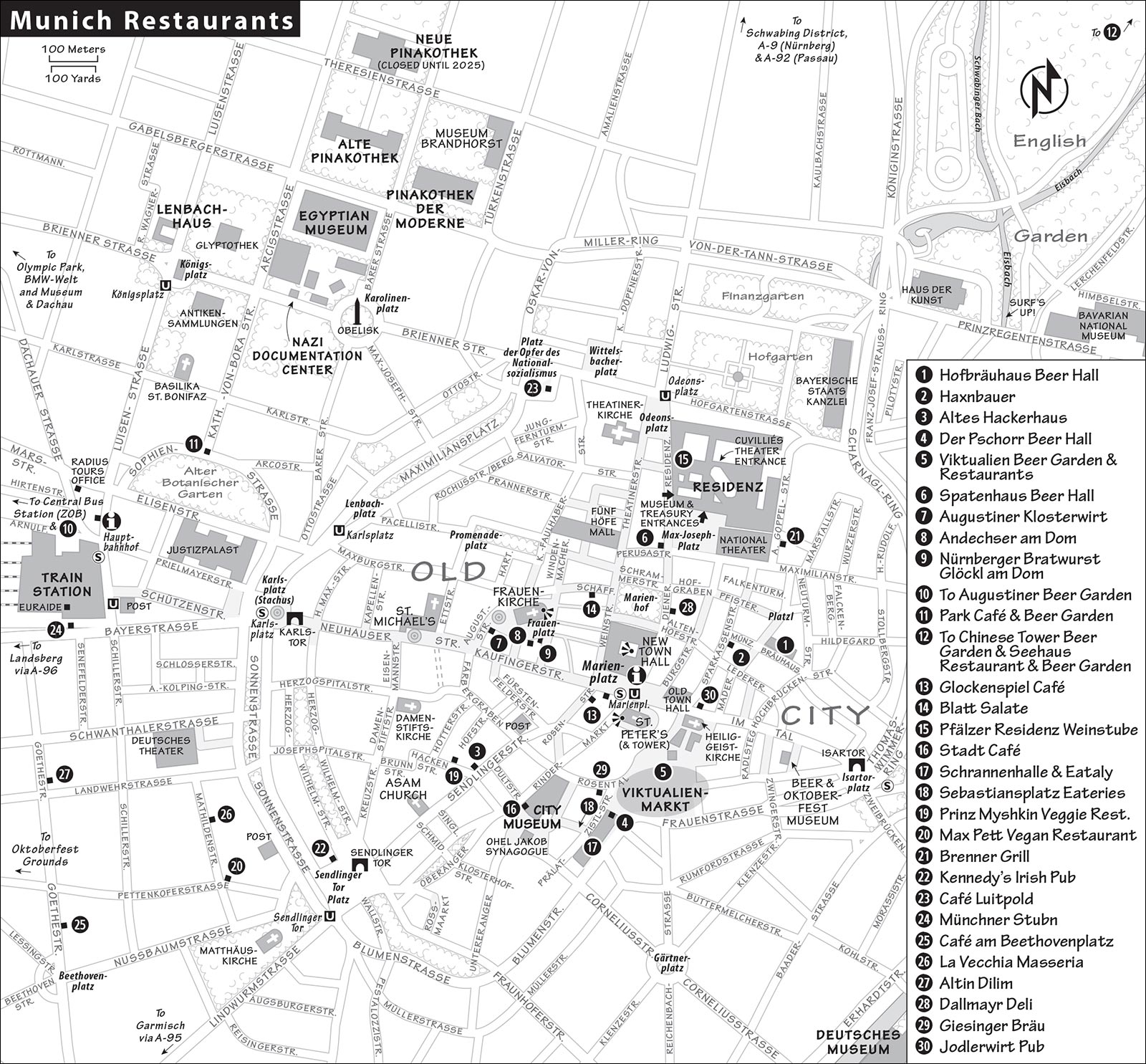
Nothing beats the Hofbräuhaus (the only beer hall in town where you’ll find oompah music) for those in search of the boisterous, clichéd image of the beer hall. Locals prefer the innumerable beer gardens. On a warm day, when you’re looking for the authentic outdoor beer-garden experience, your best options are the Augustiner (near the train station), the small beer garden at the Viktualienmarkt (near Marienplatz), or the sea of tables in the English Garden. Eating outside is made more pleasant by the Föhn (warm winds that come over the Alps from Italy), which gives this part of Germany 30 more days of sunshine than the North—and sometimes even an Italian ambience. (Many natives attribute the city’s huge increase in outdoor dining to global warming.)
For tips on eating in beer halls and beer gardens, see the sidebar in this book’s introductory chapter.
Near Marienplatz
$$ The Hofbräuhaus (HOAF-broy-house) is the world’s most famous beer hall. While it’s grotesquely touristy and filled with sloppy backpackers and tour groups, it’s still a lot of fun—and a Munich must. Even if you don’t eat here, check it out to see hundreds of tourists drinking beer in a Bavarian beer hall...across from a Hard Rock Café. Germans go for the entertainment—to sing “Country Roads,” see how Texas gals party, and watch tourists try to chug beer.
You can drop by anytime for a large or light meal (my favorite: €12 for nine small pork sausages with sauerkraut), or just for a drink. Even though tourists outnumber locals, the food here is decent. The Hofbräuhaus sells mostly beer by the Mass (one-liter mug)—and they claim to sell 10,000 of these liters every day. Choose from four zones: the rowdy main hall on the ground floor, a quieter courtyard under the stars, a dainty restaurant with mellow music (zither, oboe, harp) where the locals gather on the first floor up, or the giant festival hall (Festsaal, sometimes reserved for events) under a big barrel vault on the top floor.
The Hofbräuhaus main hall/restaurant offers regular live oompah music. This music-every-night atmosphere is irresistible, and the fat, shiny-leather bands get even church mice to stand up and conduct three-quarter time with breadsticks. The festival hall, notorious as the place where Hitler gave his first public speech in 1920, today is a vacuous venue where tour groups come for a nightly folk show. While kitschy, it’s a fun and tasty way to enjoy traditional live folk music and dance (main hall/restaurant open daily 9:00-late, music during lunch and dinner only—12:00-16:00 & 18:00-late; festival hall open nightly 19:00-22:00, free show with food or drink, same prices as the ground floor beer hall, reservations generally unnecessary; 5-minute walk from Marienplatz at Platzl 9, +49 89 290 136 100). For more on this Munich institution, see my “Munich City Walk,” earlier in this chapter.
$$$ Haxnbauer, stark and old-school, is a hit with German tourists for one reason: the best pork knuckle in town (half Schweinshaxe-€21, slightly less if you just get some slices). You’ll pay a little extra, but it’s clearly the place for what looks like a pork knee. Notice the rotisserie window luring customers inside—a.k.a. “dog TV” (daily 11:00-24:00, two blocks from Hofbräuhaus at Sparkassenstrasse 6, +49 89 216 6540).
$$$ Altes Hackerhaus is popular with locals and tourists for its traditional Bavarian fare served with a slightly fancier feel in one of the oldest buildings in town. It offers a small courtyard and a fun forest of characteristic nooks festooned with a veritable museum of family pictures and nostalgic treasures. Naturally, Hacker-Pschorr beer is popular, especially the Weisse (“small appetite” menu available, family-friendly, daily 10:30-24:00, Sendlinger Strasse 14, +49 89 260 5026).
$$$ Der Pschorr, a youthful, upscale beer hall occupying a former slaughterhouse, has a terrace overlooking the Viktualienmarkt and serves a popular local brew in chilled glasses. This place mixes modern concepts—no candles, industrial-strength conviviality—with traditional, classic dishes prepared with an organic “slow food” ethic. While serious about high-quality meat, they also offer vegetarian options. Classic wooden kegs are tapped with gusto every few minutes, letting patrons know their beer is good and fresh (seasonal specials, daily 10:00-23:00, Viktualienmarkt 15, at end of Schrannenhalle, +49 89 442 383 940).
$ Viktualien Beer Garden, at the center of the Viktualienmarkt, taps you into about the best budget eating in town. It’s just steps from Marienplatz (daily 10:00-22:00 in good weather). There’s table service wherever you see a tablecloth; to picnic, choose a table without one—but you must buy a drink from the counter. Countless stalls surround the beer garden and sell wurst, sandwiches, produce, and so on. This B.Y.O.F. tradition recalls a time when monastery beer gardens served beer but not food. This is a good spot to grab a typical Munich Weisswurst—and a beer.
$$$ Spatenhaus is the opera-goers’ classy beer hall, serving elegant food in a rustic, traditional setting since 1896—maybe it’s not even right to call it a “beer hall.” You can also eat outside, on the square facing the opera and palace. It’s pricey, but you won’t find better-quality Bavarian cuisine. The upstairs restaurant serves international cuisine to locals in a more formal dining room—reservations recommended (daily 9:30-23:00, on Max-Joseph-Platz opposite opera, Residenzstrasse 12, +49 89 290 7060, www.spatenhaus.de).
Brewery Restaurants at the Frauenkirche
These are each literally in the shadow of the cathedral and serve the same traditional fare and great beer at friendly prices. While none has the rollicking atmosphere of a sprawling beer hall, all have characteristic interiors and fine tables on the pedestrian lane that circles the church.
$$ Augustiner Klosterwirt is a branch of perhaps the most loved brewery in Munich, with a characteristic yet modern interior and delightful outdoor seating overlooking a fountain and facing the front of the Frauenkirche (daily until late, Augustinerstrasse 1, +49 089 5505 4466).
$$ Andechser am Dom sits at the rear of the twin-domed Frauenkirche. Charming Sepp runs this local favorite, serving Andechs beer brewed by monks and great food to appreciative regulars. Some customers are more famous than others—how many do you recognize from the photos blanketing the walls? Münchners favor the dark lager beer (ask for dunkles), but I love the light (helles). The Gourmetteller is a great sampler of their specialties, but you can’t go wrong with Rostbratwurst with kraut (daily 10:00-24:00, Frauenplatz 7, reserve during peak times, +49 89 2429 2920, www.andechser-am-dom.de).
$$ Nürnberger Bratwurst Glöckl am Dom is popular with tourists and offers a more traditional, fiercely Bavarian evening—including a waitstaff clad in lederhosen. Dine outside under the trees or in the dark, medieval, cozy interior. I eat here for the tasty little Nürnberger sausages—the size of your finger—so nice with kraut and a good beer (daily 10:00-24:00, Frauenplatz 9, +49 89 291 9450).
Near the Train Station
$$ Augustiner Beer Garden is a true under-the-leaves beer garden packed with Münchners. This sprawling haven is a delight on a nice summer evening. In fact, most Münchners consider Augustiner the best beer garden in town—which may be why it has 6,000 seats. There’s no music, it’s away from the tourists, and it serves up great beer, good traditional food, huge portions, reasonable prices, and perfect conviviality. Outdoors, there’s both $$ table service (closer to the entrance) and a $ self-service section (farther in), with counters for schnitzel, potato salad, and so on. It’s easy to make new friends at the communal picnic tables. Parents with kids can sit at tables adjoining a sizable playground. There’s also a real $$$ restaurant with more formal, more expensive dining (outdoor sections daily 11:00-24:00; almost across from the central bus station, a 10-minute walk from train station going away from the center—or take tram #16 or #17 to Hopfenstrasse, Arnulfstrasse 52; +49 89 594 393).
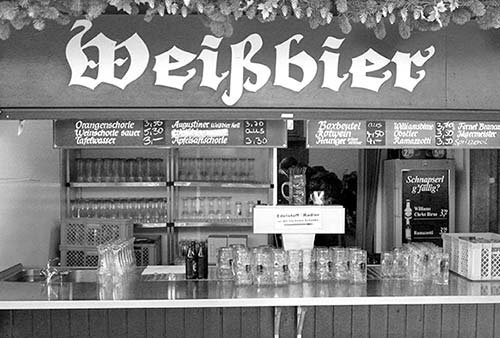
$$ Park Café Beer Garden is a nice hideaway (open summer afternoons and evenings only in good weather), tucked inside the Alter Botanischer Garden in the Park Café’s garden backyard. Order Bavarian food from self-service counters (don’t forget to reclaim your deposit at the counter for your plate and mug). The indoor $$$ Park Café restaurant, occupying what was the Nazi officers’ club in the 1930s, is modern, with a good-time bar menu and popular cocktails (daily 11:00-24:00, just north of the train station at Sophienstrasse 7, +49 89 5161 7980).
In the English Garden
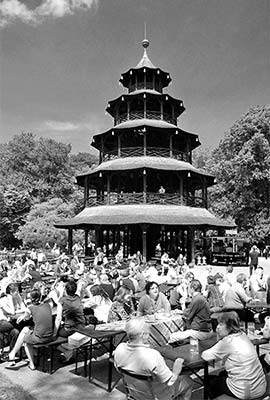
$$ The famed Chinese Tower beer garden (Biergarten am Chinesischen Turm), deep in the English Garden, is a great place for a balmy, relaxed evening. Grab a table; you’re welcome to B.Y.O. food, or buy from the cafeteria-style food counters with clear English descriptions. Don’t bother to phone ahead—they have 6,000 seats. This is a fine opportunity to try a Steckerlfisch, sold at a separate kiosk. When you’re done, bus your dishes and take your token and beer mug around back to redeem your deposit (in good weather Mon-Fri from 11:00, Sat-Sun from 10:00, usually live music, playground, Englischer Garten 3, +49 89 383 8730). To get here, take tram #16 from main train station or Sendlinger Tor to Tivolistrasse, or U-3 or U-6 to Giselastrasse and then bus #54 or #154 two stops to Chinesischer Turm.
$$$$ Seehaus Restaurant, deeper into the English Garden (and worth the effort to find), is a 10-minute walk past the Chinese Tower or a fun pedicab ride. It’s beloved among Münchners for its idyllic lakeside setting and excellent Mediterranean and Bavarian cooking, served in two separate restaurants. It’s dressy and a bit snobbish, and understandably filled with locals who fit the same description. Choose from classy indoor or lakeside seating (Mon-Sat 12:00-24:00, Sun until 22:00, reservations wise; take U-3 or U-6 to Münchner Freiheit and either walk 10 minutes or take bus #59 two stops to Osterwaldstrasse; Kleinhesselohe 3, +49 89 381 6130, www.kuffler.de).
$$ Seehaus Beer Garden, adjacent to the fancy Seehaus restaurant, offers the same waterfront atmosphere in a less expensive, casual setting with a more rollicking scene. Grab a tray—there’s all the normal wurst, kraut, pretzels, and fine beer at typical prices (daily 11:30-22:00 in good weather).
BEYOND BEER HALLS
Sometimes it seems that Munich lives on beer and wurst. But there are plenty of good alternatives.
On and near Marienplatz
$$$ Glockenspiel Café is good for a coffee or a meal with a bird’s-eye view down on the Marienplatz action—I’d come for the view more than the food. Locals like the open terrace without a view (drinks and meals from its international menu served anytime). Regardless of the weather, I grab a seat overlooking Marienplatz—but after 18:00, you must order dinner for view seating (Mon-Sat 9:00-24:00, Sun 10:00-19:00, ride elevator from Rosenstrasse entrance, opposite glockenspiel at Marienplatz 28, +49 89 264 256).
$$ Blatt Salate is a self-serve salad bar on a side street between the Frauenkirche and the New Town Hall; it’s a great little hideaway for a healthy, quick lunch—a yummy salad with fresh bread and a drink. Order cafeteria-style, then grab a table inside or out (vegetarian and meat salads and soups, Mon-Sat 11:00-19:00, closed Sun, Schäfflerstrasse 7, +49 89 2102 0281).
$$ Pfälzer Residenz Weinstube, a very traditional German dining hall actually in the Residenz complex, is dedicated to food and wine from the Rhineland (Palatine)—which, while not part of Bavaria, was ruled by the Wittelsbach family. Serving lots of small wine-friendly dishes and a big variety of German wines by the tiny glass, it’s ideal for wine lovers needing a break from beer (daily 10:30-24:00, Residenzstrasse 1, +49 89 225 628).
In or near the Viktualienmarkt
$ Die Münchner Suppenküche (“Munich Soup Kitchen”), a soup stand at the Viktualienmarkt, is a fine place for a small, cozy sit-down lunch at picnic tables under a closed-in awning. It’s self-service at the counter. The posted menu lists the soups of the day—I go for the goulash or the Bavarian potato soup (Mon-Sat 10:00-18:00, closed Sun, near corner of Reichenbachstrasse and Blumenstrasse, +49 89 260 9599).
$ Teltschik’s Wurststandl is the place in the market for a quick cheap meal featuring local sausages. Manuela doesn’t put up an English menu because she’d love to explain your options in person (Tue-Sat 10:00-15:00, closed Sun-Mon, stand #17—near corner of Reichenbachstrasse and Blumenstrasse, +49 0172 134 9664).
$ Caspar Plautz is all about baked potatoes (Kartoffeln), offering an enticing selection of both potatoes and fillings to take away or munch at tiny stand-up tables (Tue-Sat 8:00-17:00, warm lunch served 12:00-15:00, closed Sun-Mon, stand #38—across from Teltschik’s Wurststandl, +49 179 663 2748).
$$$ Poseidon am Viktualienmarkt, just outside the market, is a shiny little stainless-steel eatery with a fun and accessible menu and a passion for fresh seafood. They take no reservations: Choose between small stool tables inside or more comfortable seating under an awning outside. It’s table service, except you’re welcome to survey the enticing appetizer selection and put together a mixed plate (by weight) to kick things off (Mon-Sat 11:00-18:00, closed Sun, facing the market at Westenriederstrasse 13, +49 89 299 296).
$$ Stadt Café is a lively café serving a selection of sandwiches, daily plates, and vegetarian dishes complemented by a nice wine list and cakes. This informal, no-frills restaurant draws newspaper readers, stroller moms, and locals meeting for a drink after work. Dine in the quiet cobbled courtyard, inside, or outside facing the new synagogue (Tue-Sun 11:00-22:00, closed Mon, in same building as Munich City Museum, St.-Jakobs-Platz 1, +49 89 266 949).
$$ Eataly, inside Schrannenhalle, the former grain exchange just off Viktualienmarkt, is a sparkling, pricey food court full of Italian taste treats. It’s a foodie’s paradise—a variety of restaurants serve pizza, pasta, and main courses with Italian gusto. You can sit at your choice of bars to watch the cooking, and get pizza by the slice to go. While not cheap, it’s a festival of Italian food fun with great seating inside and out (café open Mon-Sat 8:00-20:00, closed Sun; restaurants open Mon-Sat 12:00-22:00, Viktualienmarkt 15, +49 89 248 817 711).
Eateries on Sebastiansplatz: Looking for a no-schnitzel-or-dumplings alternative? Sebastiansplatz is a long, pedestrianized square across from Eataly, between the Viktualienmarkt and the synagogue, lined with $$ bistros handy for a healthy and quick lunch. Options range from French to Italian to Asian to salads. You can eat out on the busy cobbled square or inside—just survey the scene and choose.
Vegetarian and Vegan Dining
$$$ Prinz Myshkin Vegetarian Restaurant is an upscale vegetarian eatery in the old center—a rare find in this wurst-loving corner of Europe. The decor is mod, the arched ceilings are cool but provide poor acoustics, and the outside seating is on a quiet street. Don’t miss the enticing appetizer selection on display as you enter. (They do a fine €15 mixed-appetizer plate.) They also have vegetarian sushi, pastas, Indian dishes, and their own baker, so they’re proud of their sweets (lunch specials, vegan plates, and a seasonal menu; daily 11:00-23:00, Hackenstrasse 2, +49 89 265 596).
$$$ Max Pett Vegan Restaurant is a youthful, top-end local favorite without a hint of hippie or tie-dye. With good seating inside and out, just a short walk from Sendlinger Tor, it’s great for a vegan meal (Tue-Sun 11:30-23:00, closed Mon, Pettenkoferstrasse 8, +49 89 5586 9119).
Other Memorable Options
$$$ Brenner Grill is just right for an upscale break from heavy Bavarian fare. Situated under timeless pillars and arches, yet mod and stylish as a New York City cocktail lounge, it’s also a fusion of northern Italian and southern German food culture (it’s named for Brenner Pass, what drivers know as the pass that connects Munich with Italy). It’s a sprawling, high-energy place with two big open grills, hundreds of local diners, and almost no tourists. Diners enjoy steak, fish, international dishes, and a popular pasta bar. Save room for what’s in the dessert case (long hours Mon-Sat, closed Sun, behind the National Theater at Maximilianstrasse 15, +49 89 452 2880).
$$ Kennedy’s Irish Pub, at Sendlinger Tor, is a hit with millennials for quality hamburgers, ribs, sandwiches, and nightly music from 22:00 (karaoke Mon, Wed, and Sat; live bands Tue and Thu-Fri). In addition to its boisterous main hall and cozier lounge, it offers outside tables under trees and a medieval gate (long hours daily, Sendlinger-Tor-Platz 11, +49 89 5998 8460, www.kennedysmunich.de).
$$ Café Luitpold is where Munich’s high society comes to sip its coffee and nibble on exquisite cakes. The café is proudly home to the original Luitpoldtorte (sponge cake with layers of marzipan and buttercream, covered in dark chocolate). Some say this is Munich’s answer to Vienna’s Sacher torte—though I prefer their strawberry-cream cake (Tue-Sat 8:00-23:00, Sun-Mon 9:00-19:00, Brienner Strasse 11, +49 89 242 8750).
Near the Train Station
$$$ Münchner Stubn, just across the street from the train station, is a rare traditional German find in a neighborhood full of international eateries and gut-bombs. The air-conditioned bright, woody-yet-modern interior with folkloric touches is worth a few extra euros. It’s a nice escape while waiting for a train. They offer traditional dishes with a modern twist, as well as pizza, salads, vegetarian dishes, and reasonably priced lunch specials (daily 11:30-24:00, Bayerstrasse 35, +49 89 551 113 330).
$$$ Café am Beethovenplatz feels like an old Vienna café with its inviting Art Nouveau interior and big grand piano. There’s also seating in its charming garden. While just a 10-minute walk from the station, it’s in a leafy and quiet residential neighborhood. Rudi serves a mix of Italian, Bavarian, and vegetarian fare, offers cheap lunch specials and homemade cakes, and hosts live jazz and classical music almost nightly (from 20:00). Popular with university students and the local business crowd, it feels both trendy and classy (daily 10:00-24:00, at Mariandl Hotel, Goethestrasse 51, +49 89 552 9100).
$$$ La Vecchia Masseria, between Sendlinger Tor and the train station hotels, serves Italian food in a cozy Tuscan farmhouse-style interior, or outside in a beautiful flowery courtyard. Pasta, pizzas, and seasonal, more expensive main courses are served by bustling waiters who likely speak more Italian than German...and no English (daily 11:30-23:30, garden dining until 22:00, reservations smart, Mathildenstrasse 3, +49 89 550 9090, www.lavecchiamasseria.de).
$$ Altin Dilim, a cafeteria-style Turkish restaurant, is a standout among the many hole-in-the-wall Middle Eastern places in the international area near the station. It feels like a trip to Istanbul—complete with a large selection, a handy pictorial menu that helps you order, interesting decor, and a local Turkish clientele. Pay at the counter (cheap döner kebabs, nice selection of baklava, good ayran yogurt drinks, daily 6:00-24:00, Goethestrasse 17, +49 89 9734 0869).
PICNICS
For a truly elegant picnic (costing as much as a restaurant meal), Dallmayr is the place to shop. The crown in their emblem reflects that even the royal family assembled its picnics at this historic delicatessen. Pretend you’re a Bavarian aristocrat—King Ludwig himself, even—and put together a royal spread to munch in the nearby Hofgarten (Mon-Sat 9:30-19:00, closed Sun, behind New Town Hall, Dienerstrasse 14, +49 89 213 5110). For more about this famous spot, see here.
Budget Picnic: To save money, browse at Dallmayr but buy at a supermarket (generally open Mon-Sat until 20:00, closed Sun). The discount Lidl and midrange Tegut have good-sized stores in the underground concourse at the train station (from the street, use the stairs down from Prielmayerstrasse 1, at the corner of Luisenstrasse). Another Lidl is at Schwanthalerstrasse 31, south of the station near my recommended hotels. In the old center, try the midrange Edeka at Sendlinger Strasse 10, a five-minute walk south of Marienplatz (go in the passage and look for the escalator that takes you up—it starts from inside a storefront). After 20:00 or on Sundays, your only option is an Edeka in the underground mall at the train station (daily until 23:00). Bakeries all around town sell tasty sandwiches made with good fresh bread.
Munich Connections
Munich is a super transportation hub (one reason it was the target of so many WWII bombs), with easy train and bus connections to most Bavarian destinations, as well as international trains.
BY TRAIN
For quick help at the main train station (Hauptbahnhof), look for DB info booths that answer brief questions. For help with ticket purchases, stop by the Reisezentrum (travel center) near track 11; for better English and more patience, use the EurAide desk in the Reisezentrum (see here). Train info: www.bahn.com.
From Munich to: Füssen (hourly, 2 hours, most with easy transfer in Buchloe), Reutte, Austria (easiest with change in Garmisch, hourly, 2.5 hours), Oberammergau (hourly, 2 hours, transfer in Murnau), Salzburg, Austria (2/hour, 1.5-2 hours), Berchtesgaden (hourly, 2.5 hours, transfer in Freilassing), Nürnberg (2 fast trains/hour, 1 hour; also slower, potentially cheaper trains), Würzburg (2/hour, 2 hours), Rothenburg (easiest with 2 changes in Treuchtlingen and Steinach, hourly, 3.5 hours), Frankfurt (hourly, 3.5 hours), Frankfurt Airport (hourly, 3.5 hours), Cologne (6/day direct, 6 hours, more with transfer), Leipzig (every 2 hours direct, 3.5 hours, more with transfer), Erfurt (hourly, 3 hours), Dresden (every 2 hours, 5 hours, transfer in Leipzig), Hamburg (hourly, 5.5 hours), Berlin (hourly, 4.5-5 hours), Vienna (at least hourly, 4-5 hours, most with transfer in Salzburg), Venice (2/day direct, 7 hours, more with transfer in Verona), Paris (every 2 hours with transfer in Stuttgart, 8 hours, reservation required in France), Prague (every 2 hours direct, 5.5 hours; or 5 hours by bus—see below), Zürich (4/day direct, 3.5 hours, or take the bus). Night trains run to Hamburg, Amsterdam, Milan, and Rome, and from a different station (München Ostbahnhof) to Venice. To Salzburg and Vienna, private Westbahn trains are an alternative to regular service—sometimes cheaper (https://westbahn.at).
Rail Pass Reminders: To use a rail pass for any train to Italy, your pass must include all countries on the train route (i.e., Austria or Switzerland), or you’ll have to buy the segment that’s not included. Trains to Italy via Innsbruck also require pass holders to make a reservation (not indicated in online schedules, and not required if you’re buying a point-to-point ticket instead of using a pass).
BY BUS
Munich’s central bus station (ZOB) is by the Hackerbrücke S-Bahn station, not far from the main train station (one S-Bahn stop, two tram stops on #16 or #17, or a 10-minute walk from the main train station; www.muenchen-zob.de). Ticket offices, eateries, shops, and the exit are on the level above the platforms.
Buses have become a viable travel option from major cities in Germany—they’re usually cheaper than the train and often no slower. Flixbus is the main operator (www.flixbus.com), and has a ticket office in the bus station, but it’s best to reserve online. Destinations include Nürnberg, Freiburg, Berlin, Vienna, Prague, Zürich, Milan, and cities in southeastern Europe.
Romantic Road Bus: Once or twice a week from mid-May to early September, the Romantic Road bus connects Munich north to Rothenburg, Würzburg, Frankfurt, and other destinations en route (www.romantischestrasse.de). This slower but more scenic alternative to the train includes a 45-minute stop at Harburg Castle, and you can also use it to day-trip to Dinkelsbühl. Buses leave from Karlsplatz 21 (same stop as Gray Line). For more information, see here.
BY PLANE
Munich Airport (Flughafen München) is 17 miles northeast of town (code: MUC, +49 89 97500, www.munich-airport.de). It has two large terminals: Lufthansa and its partners (including United) use Terminal 2, while the older Terminal 1 serves most other airlines. A shuttle bus lets connecting passengers transfer between terminals without exiting security. Outside security, it’s a 10-minute walk.
In between the two terminals is a shopping and services complex with a supermarket, eateries, ATMs, car rental, and, underneath, the airport’s handy S-Bahn station. (The roofed-over outdoor square in front of Terminal 2 hosts a Christmas market, with 50 market stalls and an ice-skating rink, in November and December.)
Getting Between the Airport and Downtown
Munich’s airport is an easy 50-minute ride from Marienplatz or the main train station on the S-1 or S-8 suburban train (both lines run every 20 minutes, from 4:00 to after midnight). From either terminal, ride the escalator down to the train platforms, buy a ticket from the machines (choose the “with validation” option to save having to stamp it), and look at the monitors to see which train will get you into the city most quickly.
Returning from the city to the airport, the S-8 is a bit easier, as the S-1 line has two branches and trains split at Neufahrn. If you ride the S-1 to the airport, be certain you’re in the part of the train that’s going to the Flughafen (airport)—signs and announcements help.
The airport is in public transport zone 5; an M-5 ticket costs €12.30 for one person and includes any transfers en route. But the M-5 all-day pass (€13.70) is worth getting if you’ll be making even one more public transport trip that day. Groups of two or more can buy the €25.70 all-day partner ticket (Partner-Tageskarte), which covers up to five adults for the day (see “Getting Around Munich,” earlier in this chapter, for details on tickets and passes). The trip is also free with a validated and dated rail pass.
Another alternative is the Lufthansa airport bus, which links the airport with the main train station (€11, €17.50 round-trip, 3/hour, 45 minutes, buses depart airport 6:30-22:30, depart train station 5:15-19:55, buy tickets on bus or online in advance; from inside the station, exit near track 26 and look for yellow Airport Bus signs; www.airportbus-muenchen.de). If you’re traveling alone, going round-trip, and not using other public transport the same day, the bus saves a few euros. Avoid taking a taxi from the airport—it’s a long, expensive drive. Take public transit to the city and then switch to a taxi if needed.
Day Trips from Munich
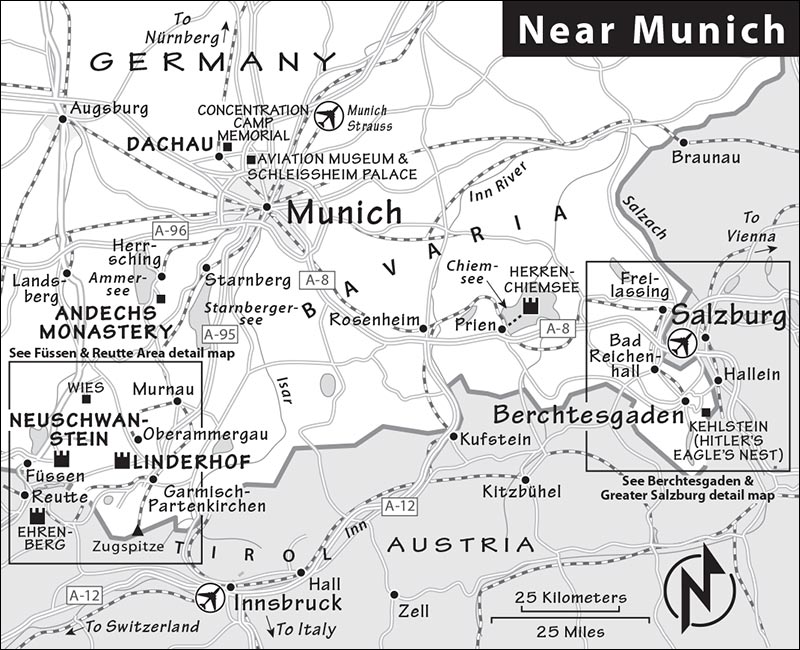
The Dachau Concentration Camp Memorial and Andechs Monastery are at opposite ends of the day-trip spectrum. Dachau, less than an hour by public transportation, makes for a serious, thought-provoking visit, while Andechs, doable by public transportation but easier by car, serves up some of my favorite beer in Germany in a serene rural setting. Other day-trip possibilities—including the King’s Castles, Nürnberg, and Salzburg—are summarized at the end of this section.
▲▲▲DACHAU CONCENTRATION CAMP MEMORIAL (Kz-Gedenkstätte Dachau)
Dachau was the first Nazi concentration camp (1933). Today, it’s an easily accessible memorial for travelers and an effective voice from our recent but grisly past, pleading, “Never again.” A visit to Dachau is a powerful and valuable experience and, when approached thoughtfully, well worth the trouble. Many visitors come away from here with more respect for history and the dangers of mixing fear, the promise of jobs, blind patriotism, and an evil government. You’ll likely see lots of high-school students here, as it’s a frequent field-trip destination (the school year in Bavaria runs until the end of July). It’s astonishing to think that only a few decades ago, Germans greeted each other with a robust “Sieg Heil!” Now, almost no Germans know the lyrics of their national anthem, and German flags are a rarity outside of major soccer matches.
Cost and Hours: Free, daily 9:00-17:00. Some areas of the camp may begin to close before 17:00—plan your visit to wrap up by 16:40 to allow time to walk back to the entrance. The museum discourages parents from bringing children under age 14 (+49 8131 669 970, www.kz-gedenkstaette-dachau.de).
Planning Your Time: Allow yourself about five hours—giving you about three hours at the camp, plus time for round-trip travel from central Munich. With limited time you could do the whole trip in as little as three and a half hours by concentrating on the museum and skipping the powerful but long walk to the memorials and crematorium.
Getting There on Your Own: The camp is a 45-minute trip from downtown Munich. To get there on public transit, take the S-2 (end station: Petershausen or Altomünster) from any of the central S-Bahn stops in Munich to Dachau (3/hour, 20-minute trip from Hauptbahnhof). Then, at Dachau station, go down the stairs and follow the crowds out to the bus platforms (note the bakery across the street if you need to buy lunch). Find the sign for KZ-Gedenkstätte/Concentration Camp Memorial Site and catch bus #726 (6/hour, 3/hour on Sun). Ride it seven minutes to the KZ-Gedenkstätte stop. (The return bus stop is across the street.) An M-1 public transit day ticket (Single-Tageskarte) covers the entire trip, both ways (€9.30 for one person, €17 group ticket for up to 5 adults). For more on transit ticket options, see “Getting Around Munich” at the beginning of this chapter.
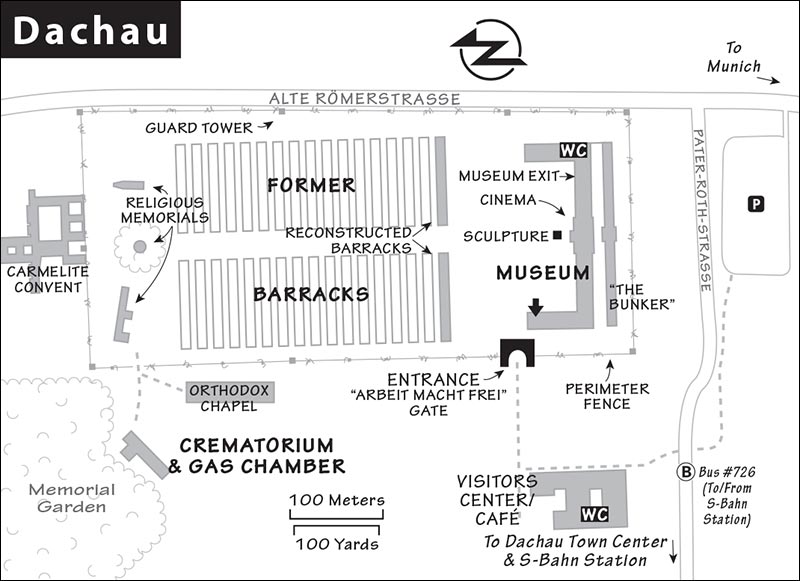
Drivers can put “Alte Römerstrasse 75” in Dachau into their navigation system to find the memorial. Parking costs €3 (cash only).
Getting There by Guided Tour: The camp is easy to see on your own. But if you’d prefer a guided visit, Radius Tours offers a great value, considering how good and passionate their guides are—and that you’re paying only about €25 for the guiding, once you factor in transportation costs. Allow roughly five hours total. It’s smart to reserve the day before, especially for morning tours (€35, RS%—select “student rate” when booking online; tours run daily year-round at 9:00, additional departures in summer, leaves from Dachauer Strasse 4 near Munich train station, +49 89 543 487 7740, www.radiustours.com).
The Town: The town of Dachau—quiet, tree-lined, and residential—is more pleasant than its unfortunate association with the camp on its outskirts, and it tries hard to encourage you to visit its old town and castle (www.dachau.de).
Visitors Center: Coming from the bus stop or parking lot, you’ll first see the visitors center, outside the camp wall. It doesn’t have any exhibits but does have a small cafeteria (sandwiches and simple hot meals), sheltered benches where you can eat a packed lunch, a bookstore with English-language books on Holocaust themes, and a WC (more WCs inside the camp). At the information desk, pick up the English pamphlet, rent an audioguide, or sign up for a tour. Also consider buying the excellent 200-page book with a CD (€18) that contains the same text and images that you’ll see in the museum.
Tours: The €4.50 audioguide covers the grounds and museum; its basic itinerary includes 1.5 hours of information (cash only, leave ID). It gives you a few extras (mainly short reminiscences by several camp survivors and members of the Allied forces who liberated the camp) but isn’t essential, as the camp is fully labeled in English (rental desk closes at 17:00 sharp). Two different guided walks in English are offered daily, starting from the visitors center (€4, at 11:00 and 13:00, 2.5 hours; limited to 30 people, fills fast—especially in summer, call or visit website to confirm times).
 Self-Guided Tour
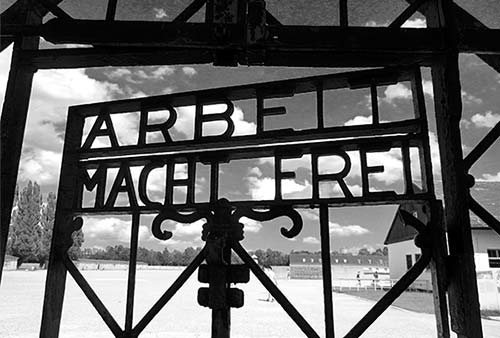
From the visitors center, you approach the main compound. You enter, like the inmates did, through the infamous iron gate that held the taunting slogan Arbeit macht frei (“Work makes you free”). The original sign was stolen in 2014 and replaced with a replica. Inside are the four key experiences: the museum, the bunker behind the museum, the restored barracks, and a pensive walk across the huge but now-empty camp to the memorials and crematorium at the far end.
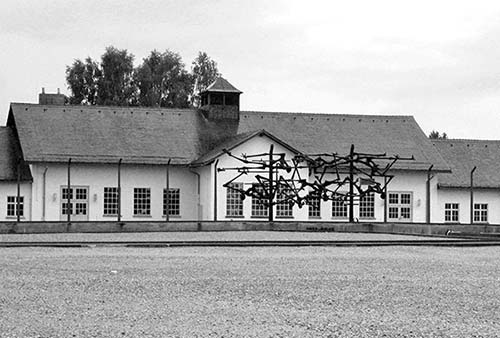
Enter the museum, housed in a former camp maintenance building. Just inside is a small bookshop that funds a nonprofit organization (founded by former prisoners) that researches and preserves the camp’s history. Immediately to the right of the door you entered, check showtimes for the museum’s powerful 40-minute documentary film (described later). The museum is organized chronologically, everything is thoughtfully described in English, and touch screens let you watch early newsreels.
The Camp Is Founded (Rooms 1-2)
On January 30, 1933, Adolf Hitler took power. Two months later, Dachau opened. It was a “concentration” camp, to gather together and isolate enemies of the state so they could not infect the rest of society. The camp was built well outside Dachau’s residential zone, surrounded by a mile-wide restricted area.
A map of the Nazi camp system shows that Dachau was just one of many such camps. Some were concentration camps (marked with a square, like Dachau). Others (marked with a triangle with a V) were extermination camps—Auschwitz, Sobibor—built with the express purpose of executing people on a mass scale. Nearby, photos and posters chronicle the rise of Hitler in the 1920s: the resentment bred by Germany’s defeat in World War I, the weak Weimar Republic, Hitler’s solution to Germany’s problems (blame the Jews), his failed Beer Hall Putsch, his participation in mainstream politics. No sooner did he take power than he suspended democracy and began squelching all opposition.
Life at the Camp (Rooms 3-7)
In 1933, the first prisoners passed through the Arbeit macht frei gates. They were classified and labeled with a badge (see the chart in Room 4) according to their “crime” against the state. Besides political activists (communists and leftist intellectuals), prisoners included homosexuals, Jehovah’s Witnesses, Roma and Sinti (“Gypsies”), so-called career criminals, “asocials,” and Germans who had tried to flee the country. A special badge—the yellow Star of David—was reserved for a group the Nazis particularly loathed: Jews.
The camp was run by the SS, the organization (headed by mastermind Heinrich Himmler) charged with Germany’s internal security. Dachau was a training center for future camp managers. Rudolf Höss, who worked at Dachau from 1934 to 1938, went on to become the first commandant of Auschwitz.
Life at Dachau was horrific. It was a work camp, where inmates were expected to pay for their “crimes” with slave labor. The camp was strictly regimented: a wake-up call at 4:00, an 11-hour workday, roll call at 5:15 and 19:00, lights out at 21:00. The work was hard, whether quarrying or hauling loads or constructing the very buildings you see today. The rations were meager. Rule-breakers were punished severely—all manner of torture took place here. The most common punishment was being forced to stand at attention until you collapsed.
On September 1, 1939, Germany invaded Poland, World War II began, and Dachau’s role changed.
Cinema
The 40-minute film is a sobering, graphic, and sometimes grisly account of the rise of Hitler and the atrocities of the camp (usually shown in English at 10:15, 11:45, and 14:00; not recommended for children under 14).
The War Years (Rooms 8-15)
Once the war began, conditions at Dachau deteriorated. The original camp had been designed to hold just under 3,000 inmates. In 1937 and 1938, the camp was expanded and the building that now houses the museum was built, as well as barracks intended to hold 6,000 prisoners. With the war, the prisoner population swelled, and the Nazis found other purposes for the camp. It was less a concentration camp for German dissidents and more a dumping ground for foreigners, POWs, and even 2,000 Catholic priests. From Dachau, Jewish prisoners were sent east to the gas chambers. Inmates were used as slave labor for the German war machine—many were shipped to nearby satellite camps to make armaments. Prisoners were used as human guinea pigs for war-related medical experiments of human tolerance for air pressure, hypothermia, and biological agents like malaria; the photos of these victims are especially painful to view.
As the Allies closed in on both fronts, Dachau was bursting with more than 30,000 prisoners jammed into its 34 barracks. In the winter of 1944-1945, disease broke out (including typhus and dysentery), and food ran short. Deaths in the camp increased dramatically—from 403 (October 1944) to 3,991 (February 1945). With coal for the crematorium running low, those who died were buried in mass graves outside the camp site. The Allies arrived on April 29. After 12 years of existence, Dachau was finally liberated, but more than 1,000 prisoners were so weak or sick that they died soon after.
Postscript
All told, about 40,000 people died at Dachau and its satellite camps between 1933 and 1945. (By comparison, more than a million were killed at Auschwitz in Poland.) But Dachau remains notorious because it was the Nazis’ first camp. Oddly, Dachau actually housed people longer after the war than during the war. First, it housed Nazi officials arrested by the Allies, as they awaited trial at Nürnberg for war crimes. From 1948 to 1964, the camp became cheap housing for ethnic Germans expelled from Eastern Europe, complete with a cinema, shops, and so on. The last of the barracks was torn down in 1964, and the museum opened the following year.
• Consider using the WC before leaving the museum building (there aren’t any bathrooms elsewhere within the camp walls). Find the side door, at the end of the exhibition, which leads out to the long, low bunker behind the museum building.
Bunker
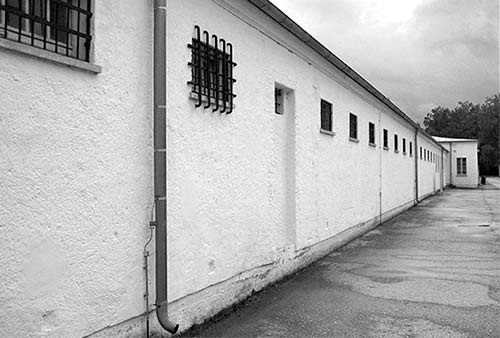
This was a cellblock for prominent “special prisoners,” such as failed Hitler assassins, German religious leaders, and politicians who challenged Nazism. Most of the 136 cells are empty, but exhibits in a few of them (near the entrance) profile the inmates and the SS guards who worked at Dachau, and allow you to listen to some inmates’ testimonies. Cell #2 was the interrogation room. Cell #9 was a “standing cell”—inmates were tortured here by being forced to stay on their feet for days at a time.
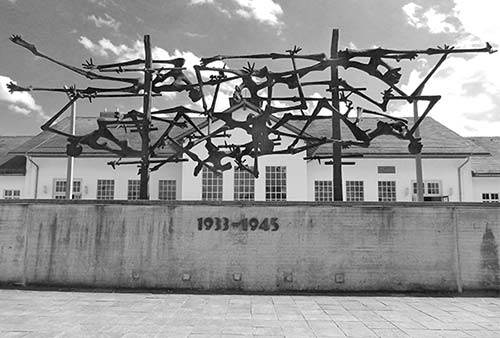
• Exit the bunker, and walk around past the Arbeit macht frei gate to the big square between the museum and the reconstructed barracks, which was used for roll call. In front of the museum, notice the powerful memorial to the victims, created in 1968 by Nandor Glid, a Jewish Holocaust survivor and artist, which includes humanity’s vow: Never Again. Cross the square to the farther of the two reconstructed...
Barracks
Take a quick look inside to get an idea of what sleeping and living conditions were like in the camp. There were 34 barracks, each measuring about 10 yards by 100 yards. When the camp was at its fullest, there was only about one square yard of living space per inmate. The original barracks were torn down in 1962.
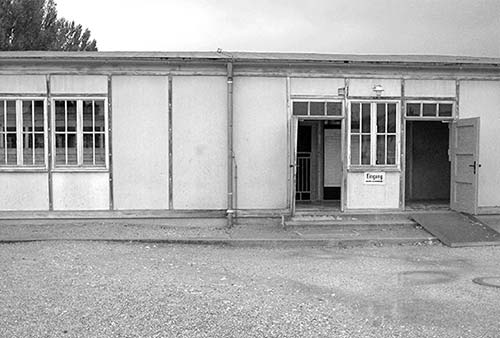
• Now walk between the two reconstructed barracks and down the tree-lined path past the gravel beds that mark the footprints of the other barracks. At the end of the camp, in space that once housed the camp vegetable garden, rabbit farm, and brothel, there are now three places of meditation and worship (Jewish to your right, Catholic straight ahead, and Protestant to your left). Beyond them, just outside the camp, is a Carmelite convent. Turn left toward the corner of the camp and find the small bridge leading (past a Russian Orthodox chapel) to the...
Camp Crematorium
A memorial garden surrounds the two camp crematorium buildings, which were used to burn the bodies of prisoners who had died or been killed. The newer, larger concrete crematorium was built to replace the smaller wooden one. One of its rooms is a gas chamber, which worked on the same principles as the much larger one at Auschwitz, and was originally disguised as a shower room (the fittings are gone now). It was never put to use at Dachau for mass murder, but survivors have testified that small groups were killed in it “experimentally.”
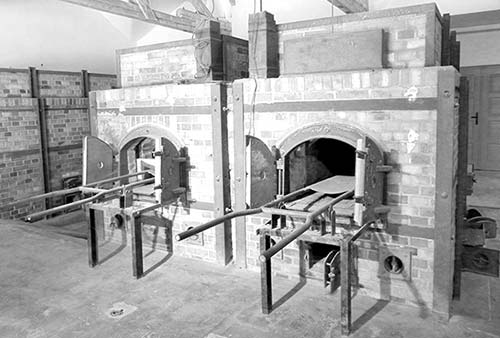
• Our tour is over. To return to Munich by public transit, retrace your steps to the bus stop, where bus #726 takes you back to the Dachau train station. Then catch the S-2 to downtown Munich (direction: Erding or Markt Schwaben). The ride back to Munich gives you ample time to process all you’ve seen and experienced on your visit.
▲ANDECHS MONASTERY
This Benedictine monastery crouches quietly with a big smile between two lakes just south of Munich. German abbeys and monasteries traditionally offer hospitality—food, drink, and manicured grounds. Andechs serves hearty cafeteria-quality food—and perhaps the best beer in Germany—in a rural Bavarian setting below a fine Baroque church. The cafeteria terrace offers first-class views and second-class prices. They’re known for their Haxe (pork knuckles). Don’t miss the stroll up to the church, where you can sit peacefully and ponder the striking contrasts a trip through Germany offers.
Cost and Hours: Beer garden open Mon-Fri 11:00-20:00, Sat-Sun from 10:00, church open until 18:00, +49 8152 376 261, www.andechs.de.
Getting There: Reaching Andechs from Munich without a car is doable with a little planning. The simplest route is the S-8 suburban train to the end of its run at Herrsching, then bus #951 to the monastery (10 minutes). Check schedules at www.bahn.com or www.mvv-muenchen.de to find a convenient connection (use Kloster Andechs as your destination; the trip takes 75 minutes from Munich station). Andechs is in public transit zone 4 (buy a M-4 day pass—€11.20 single or €20.70 group; see “Getting Around Munich” near the beginning of this chapter for ticket details). From Herrsching, you can also hike, bike, or catch a taxi for the three miles to the monastery.
▲▲▲THE KING’S CASTLES
Many travelers visit the spectacular Neuschwanstein and its companion castle Hohenschwangau, known as “The King’s Castles,” as a day trip from Munich (though overnighting nearby, usually in Füssen, is more enjoyable if you have the time). Below I outline options for planning a day trip to the castles from Munich; for specifics on the castle visit itself, see “The King’s Castles” in the next chapter.
On Your Own by Train and Bus: You can do this day trip on your own by train and bus from Munich for €26 per person or €34 per couple, plus the cost of castle admissions. It’s a 2-hour train ride, followed by a 10-minute bus ride to the base of the castles. Allow another 30-45 minutes to get up to the Neuschwanstein castle entrance.
First, reserve your castle ticket for Neuschwanstein, choosing an afternoon slot (generally after 13:00) that gives you ample time to arrive from Munich (see ticket details on here; www.hohenschwangau.de). If you also want to tour Hohenschwangau, try to book a time 1.5-2 hours after your Neuschwanstein tour starts (last Hohenschwangau tour is at 15:50).
Once you’ve reserved your castle entries, rather than buy point-to-point train tickets, get a Bayern-Ticket regional transit day pass. Not only is it cheaper, it also covers the bus between Füssen and the castles.
The Bayern-Ticket is good for one day of unlimited travel for up to five people anywhere in Bavaria (plus Salzburg) for a very low price (€26 for the first person plus €8 for each additional person, €2 more if bought at a ticket counter). It’s also valid on other public transport—both in Munich and in rural areas. You can buy the ticket online (www.bahn.com, look under “Regional Offers”); from ticket machines in stations or at public transit stops; at train station ticket counters; or at EurAide in Munich. Write your name(s) on the ticket in the space provided.
The catch is that on weekdays, the Bayern-Ticket is not valid before 9:00, and is valid only on slower “regional” trains—labeled on schedules as “BRB,” “RB,” “RE,” or “IRE.” For example, on weekdays the earliest train you can take to the castles with this ticket typically leaves Munich at 9:36, arriving direct in Füssen at 11:41. The connecting bus from Füssen station to the castles leaves at 12:05, arriving at 12:13 (check schedules in advance). So, if you take the 9:36 train, you can make the 13:30 castle tour. On weekends you can take trains and public transport before 9:00 (and catch an earlier castle tour).
You could pay full price to take an earlier weekday train to the castles, but it’ll cost nearly as much as an organized bus tour (see next), without the bus tour benefits. Rail pass-holders can use a pass day for the train to Füssen: Take whichever train you want, then pay €5 round-trip for the bus from Füssen to the castles, which doesn’t accept rail passes.
Be sure to check departure times for the last convenient bus-and-train connection from the castles back to Munich (it might be around 18:50, reaching Munich at 21:20).
With a Bus Tour: For a little more money, an organized bus tour is a very convenient way to get from Munich to the King’s Castles. You’re guaranteed a seat (in summer, public transit to Neuschwanstein is routinely standing room only), you’ll see more, your castle ticket is taken care of, and it’s nice to have company and help.
Gray Line Tours offers an 11-hour bus tour to Neuschwanstein that also includes Ludwig’s Linderhof Castle and 30 minutes in Oberammergau (€60, plus €30 for castle admission, reserve online, small RS% if you buy at the EurAide office in Munich and pay cash, departs Karlsplatz daily at 8:30, +49 89 5490 7560, www.munichdaytrips.com). This tour can sell out, especially in summer, so it’s wise to buy in advance.
Bus Bavaria (run by Mike’s Bike Tours) offers a private bus tour for active travelers with a focus on the outdoors—a bike ride, hike, and short swim near Neuschwanstein are included (€59, RS%, does not include castle admission; advance booking recommended, check website for current times; meet at Mike’s Bike Tours office near the Hofbräuhaus, Bräuhausstrasse 10—enter around corner on Hochbrückenstrasse, +49 89 2554 3987, www.mikesbiketours.com).
With a Group Tour by Public Transit: I’m less excited about group tours that escort you to Neuschwanstein via public transportation (one is run by Radius Tours). These cost about the same as bus tours but lack the bus’s guaranteed seating and comfort.
MORE DAY TRIPS FROM MUNICH
With the Bayern-Ticket (described above, on weekdays valid only after 9:00) or a rail-pass day, Bavaria’s efficient train network opens up many other possible day trips. (The Bayern-Ticket described earlier is just one of Germany’s many regional transit day passes; for more details, see the “Transportation” section of the Practicalities chapter.) Gray Line (www.munichdaytrips.com) and Radius Tours (www.radiustours.com) also run excursions to many day-trip options.
Nürnberg: Frequent ICE express trains zip to Nürnberg in a little over an hour (good for rail pass-holders), making this very historic city a viable day trip from Munich. Regional trains can take up to three hours, but one daily RE train leaves Munich just after 9:00 and speeds to Nürnberg in 1.75 hours, a good option with a Bayern-Ticket. If you’d like company, consider the Radius Tours all-day excursion that uses this train, or a Gray Line bus tour. For sightseeing details, see the Nürnberg chapter.
Salzburg: This Austrian city is an easy day trip and offers some exciting sightseeing. Fast trains from Munich get you there in around 1.5 hours. Regional trains take only a little longer and accept the Bayern-Ticket for travel all the way (Salzburg is the first stop over the border). You can also go for the day with a Radius Tours or Gray Line package. While near Salzburg, Berchtesgaden is too far away for a satisfying day trip from Munich. See the Salzburg chapter.
Rothenburg and the Romantic Road: Save Rothenburg for an overnight stay—the train ride from Munich to this charming walled town is too long for a worthwhile day trip, and bus tours are rushed. Of the Romantic Road towns, Nördlingen is the only one that makes a good day trip from Munich (2 hours by regional trains, change in Donauwörth, Bayern-Ticket valid). See the Rothenburg & the Romantic Road chapter.