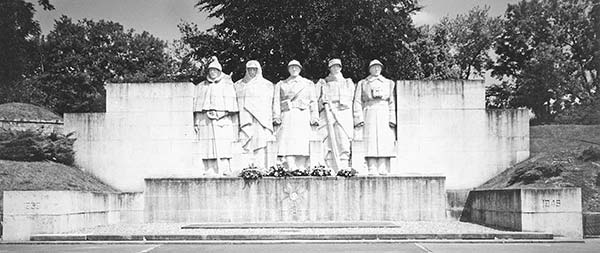
REIMS & VERDUN
Different as night and day, bubbly Reims and brooding Verdun offer worthwhile stops between Paris and Alsace. The administrative capital of the Champagne region, bustling, modern Reims greets travelers with cellar doors wide open. Here you’ll discover a lively center, a historic cathedral, a marvelous parkway and, of course, Champagne tasting. Too-often overlooked, humble Verdun is famous for the brutal WWI battles that surrounded the small city and pummeled its countryside, and offers an exceptional opportunity to learn about the Great War. High-speed TGV trains make these destinations accessible to all travelers.
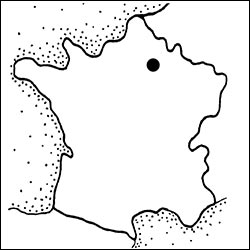
PLANNING YOUR TIME
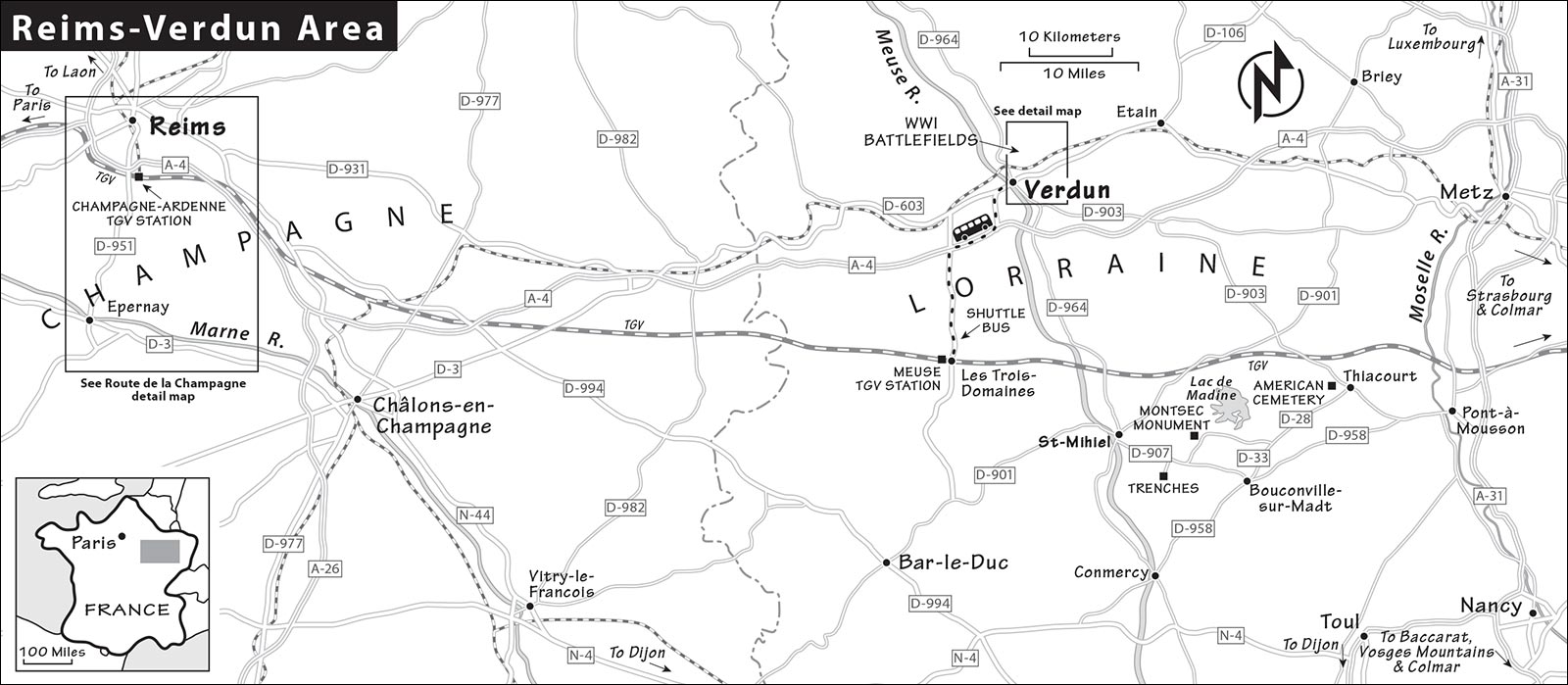
Organized travelers can see Reims and Verdun in a day and a half as they travel between Paris and Alsace (with an overnight in Reims). Plan on most of a day for Reims and at least a half-day for Verdun. It’s about 70 miles between the two, making a day trip from Reims to Verdun doable if you have a car (but challenging by train). Day-tripping by train from Paris to Reims is a breeze. A day trip from Paris is workable to Verdun, though you’ll need to be well organized (think about spending a night).
GETTING AROUND REIMS AND VERDUN
A car is sans doute the most efficient way to tour this region, though you’ll do fine without one in Reims: The town is easily walkable, and excellent public transportation links its major sights. But for touring Verdun battlefield sights, it’s best to rent a car—whether you choose to drive yourself or arrange for a private guide to accompany you.
Many find Reims a good place to pick up a rental car for a longer trip after leaving Paris. Train travelers from Paris will reach Reims before drivers get out of the city. Verdun is just off the A-4 autoroute (80 minutes by car from Reims, 3 hours from Paris, and 3 hours from Colmar).
Frequent high-speed TGV trains link central Paris and Reims in 45 minutes, and six daily TGV trains link Paris and Verdun in 2 hours. Several trains per day connect Charles de Gaulle Airport to Reims (via its Champagne-Ardenne train station) in about one hour and Verdun in 2-3 hours. Train connections between Reims and Verdun take 1.5-3 hours each way, with 1-3 transfers.
CHAMPAGNE’S CUISINE SCENE
Contrary to popular belief, Champagne is wine that can easily accompany an entire meal. Locals drink Champagne with everything here. And just as the Burgundians cook many of their meat and poultry dishes with their local red wine, the Champenois cook with bubbly (on menus you’ll see à la champenoise).
This is a “meaty” region: Most menus offer foie gras, raw tartares, loads of beef, and some dishes you may choose to avoid, such as rognons, ris de veau, tête de veau, pieds de porc, andouillette, and boudin noir (kidneys, sweetbreads, calf’s head, pig’s feet, tripe sausage, and blood sausage, respectively). Despite its bloody reputation, I find boudin noir delicious. La potée champenoise (also called La Joute) is like a pot-au-feu stew, made of smoked ham, chicken, sausage, and vegetables with lots of cabbage. Boudin blanc is a deliciously moist, white sausage made from pork or chicken, eggs, cream, and spices. Many salads and starters include jambon de Reims, the local smoked ham. Andouillette de Troyes is a tripe sausage that you can smell a block away. Ample rivers make for flavorful trout (truite) dishes. You may also find rooster cooked in the rare local red wine known as Bouzy Rouge (coq au vin de Bouzy).
Brie de Meaux cheese, made on Champagne’s border, is the most flavorful Brie, as it’s unpasteurized. Other local cheeses include Cendré de Champagne (similar to Brie but the size of a large Camembert, with a thin ash covering), Chaource (a young, creamy, and mild cheese in a cylindrical shape), and Langres (orange-colored rind, creamy and pungent, usually aged). All of these cheeses have edible rinds.
Biscuits roses de Reims (pink cookies) are on every bakery shelf in town. Traditionally dunked in Champagne, this ladyfinger-style treat also goes well with afternoon coffee or tea and is often used in local desserts, such as charlotte aux biscuits roses (trifle). Fruit-flavored brandies are a common way to end an evening.
Reims
With its Roman gate, Gothic cathedral, Champagne caves, and vibrant pedestrian zone, Reims feels both historic and youthful. And thanks to the TGV bullet train, it’s less than an hour’s ride from Paris.
Reims (pronounced like “rance”) has a turbulent history. Located in the region where Champagne first bubbled, Reims is where 33 French kings were crowned, where WWI devastation met miraculous reconstruction during the Art Deco age, and where the Germans officially surrendered in 1945, bringing World War II to a close in Europe. The town’s sights give you an entertaining peek at the entire story. Note that Reims has two train stations: Reims-Centre, in town, and Champagne-Ardenne TGV, about five miles away.
PLANNING YOUR TIME
You can see Reims’ essential sights in an easy day, either as a day trip from Paris or as a stop en route to or from Paris. Because some bullet trains connect Charles de Gaulle Airport directly with Reims, this can be a handy first- or last-night stop. Take a morning train from Paris and explore the cathedral and city center before lunch, then spend your afternoon below ground, in a cool, chalky Champagne cellar or cave (pronounced “kahv”). You can be back at your Parisian hotel by dinner.
To best experience contemporary Reims, explore the busy shopping streets between the cathedral and the Reims-Centre train station. Rue de Vesle, Rue Condorcet, and Place Drouet d’Erlon are most interesting. Try to visit Reims on a Wednesday, Friday, or Saturday, when the market erupts inside the dazzling Halles Boulingrin covered market hall, and surrounding streets are lively.
With a car, it’s well worth taking a few hours to joyride the Champagne road that leaves from Reims’ back step. You can pick up a rental car at either Reims train station (easier at Champagne-Ardennes) and visit the city before continuing on (store bags at the rental office or in the car at the train station’s secure parking).
Orientation to Reims
Reims’ hard-to-miss cathedral marks the city center and makes an easy orientation landmark. Most sights of interest are within a 15-minute walk from the Reims-Centre train station. City buses and taxis connect the harder-to-reach Champagne caves with the central train station and cathedral. The city is ambitiously renovating its downtown, converting large areas into pedestrian-friendly zones.
TOURIST INFORMATION
The main TI is one block away from the cathedral at 6 Rue Rockefeller (daily 9:00-18:00, Oct-Easter 8:00-12:00 & 13:00-17:00; +33 3 26 77 45 00, www.reims-tourisme.com [URL inactive]). A smaller TI is just outside the Reims-Centre train station (usually June-Sept only, daily 8:30-12:30 & 13:30-18:00).
At either TI, pick up free maps of the town center, bus and tram routes, and the Champagne caves. Ask at the cathedral TI about renting a multimedia guide (€6) for visiting the cathedral and city.
Either TI can call a taxi (about €12) to get you to any Champagne house that you book (though city buses are easy, too). TIs also have information on minivan excursions into the vineyards and Champagne villages (see “Reims’ Champagne Caves” on here; reservations may be required).
Sightseeing Pass: The TI sells a 24-hour Reims City Pass that serious sightseers will appreciate (€24). It starts when you do, ends 24 hours later, and covers the cathedral museum (Palais du Tau), Museum of the Surrender, Reims Cathedral tower tour, all public transit, and the Reims City Tour by bus. It also offers small discounts on Champagne tours (see details on TI website).
ARRIVAL IN REIMS
By Train: From Paris’ Gare de l’Est station, take the direct TGV to the Reims-Centre station (about hourly, 45 minutes). In Reims, the small TI is to your right as you exit; a taxi office is to your left (taxis wait in front of the station at busy times).
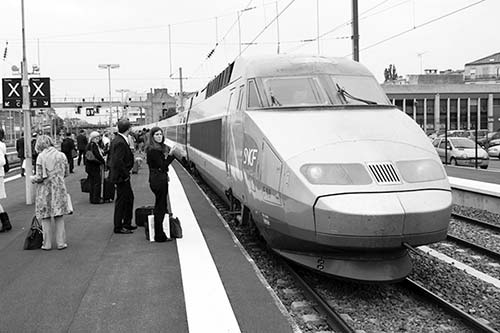
Trains also run directly from Charles de Gaulle Airport to the Champagne-Ardenne TGV station five miles away from Reims-Centre station (4/day, 45 minutes). Other TGV trains from Paris destined for Germany or Alsace also stop at Champagne-Ardenne. From there, take a local “milk-run” (TER) train to Reims-Centre (TER usually leaves 15 minutes after TGV arrival, 15 minutes to Reims-Centre station), or ride tram #B into the city center (3/hour, 20 minutes, direction: Neufchâtel; walk straight of the station and downhill a block to find the tram stop; see “Getting Around Reims” for ticket info).
By Car: Day-trippers should follow Cathédrale signs and park in metered spots near the cathedral or in the well-signed Parking Cathédrale structure. If you’re staying the night, for most of my recommended hotels you’ll take the Reims-Centre exit from the autoroute and park in the Erlon parking garage—enter from Boulevard du Général Leclerc.
HELPFUL HINTS
Department Store: Monoprix is inside the Espace Drouet d’Erlon shopping center (daily 9:00-20:00, groceries in basement level, 53 Place Drouet d’Erlon, follow FNAC signs).
Baggage Storage: Stash your bags a minute from the train station at the Ibis Reims Centre Hotel (turn left directly as you exit the station, small fee—use nannybag.com/en to register your bag, 28 Boulevard Joffre, +33 3 26 40 03 24).
Laundry: You’ll find launderettes at 59 Rue Chanzy, a 5-minute walk south of the cathedral, and a block farther out at 49 Avenue Gambetta (both open daily).
Bike Rental: Manu Loca Vélo delivers bikes within about 10 miles of Reims (reservations required, open daily, behind the train station at 4 Rue Gaston Boyer, +33 6 51 27 24 10, manulocavelo@hotmail.fr).
Taxi: Taxi offices are at the train station and at 40 Rue Carnot, next to the Opéra (www.taxireims.com). Or you can call +33 3 26 03 03 00.
Car Rental: All major rental companies have locations across from the Champagne-Ardenne TGV station (a short train or tram ride from the town center). In Reims, Avis is just outside the Reims-Centre train station at 20 Rue Pingat (+33 3 26 47 10 08 or +33 8 20 61 17 05; use the Clairmarais exit from the station, turn right, and walk 200 yards), Hertz is at 26 Boulevard Joffre (+33 3 26 47 98 78), and Europcar is at 76 Boulevard Lundy (+33 9 77 40 32 61). Rental agencies are usually open Mon-Sat 8:00-12:00 & 14:00-18:00; most are closed Sun and may close early Sat afternoon.
City Tours: Reims City Tour runs a one-hour circuit of the city by minibus (€13, 3-5/day in summer, fewer in winter, recorded commentary). Purchase tickets from the main TI or online. Tours depart from behind the cathedral (www.reims-citytour.com).
Champagne Tours: See here.
GETTING AROUND REIMS
By Bus or Tram: Reims has an integrated network of colorful Citura buses, trams, and an electric shuttle bus (www.citura.fr, French only, but excellent maps). You can buy tickets at easy-to-use ticket machines at key bus stops like the Opéra-Cathédrale stop, or from the driver, though they don’t make change; for trams, use the ticket machines at any tram stop (about €1.60/1 hour, €4.10/24 hours, €13/10 1-hour tickets that can be shared). Tickets are also available at the Citura office near the Opéra at 6 Rue Chanzy (Mon-Sat 7:30-19:30, closed Sun). Your one-hour ticket is valid for unlimited transfers between all buses and trams, even a round-trip on the same line. Each time you board, hold your ticket to the validation machine until you hear a beep.
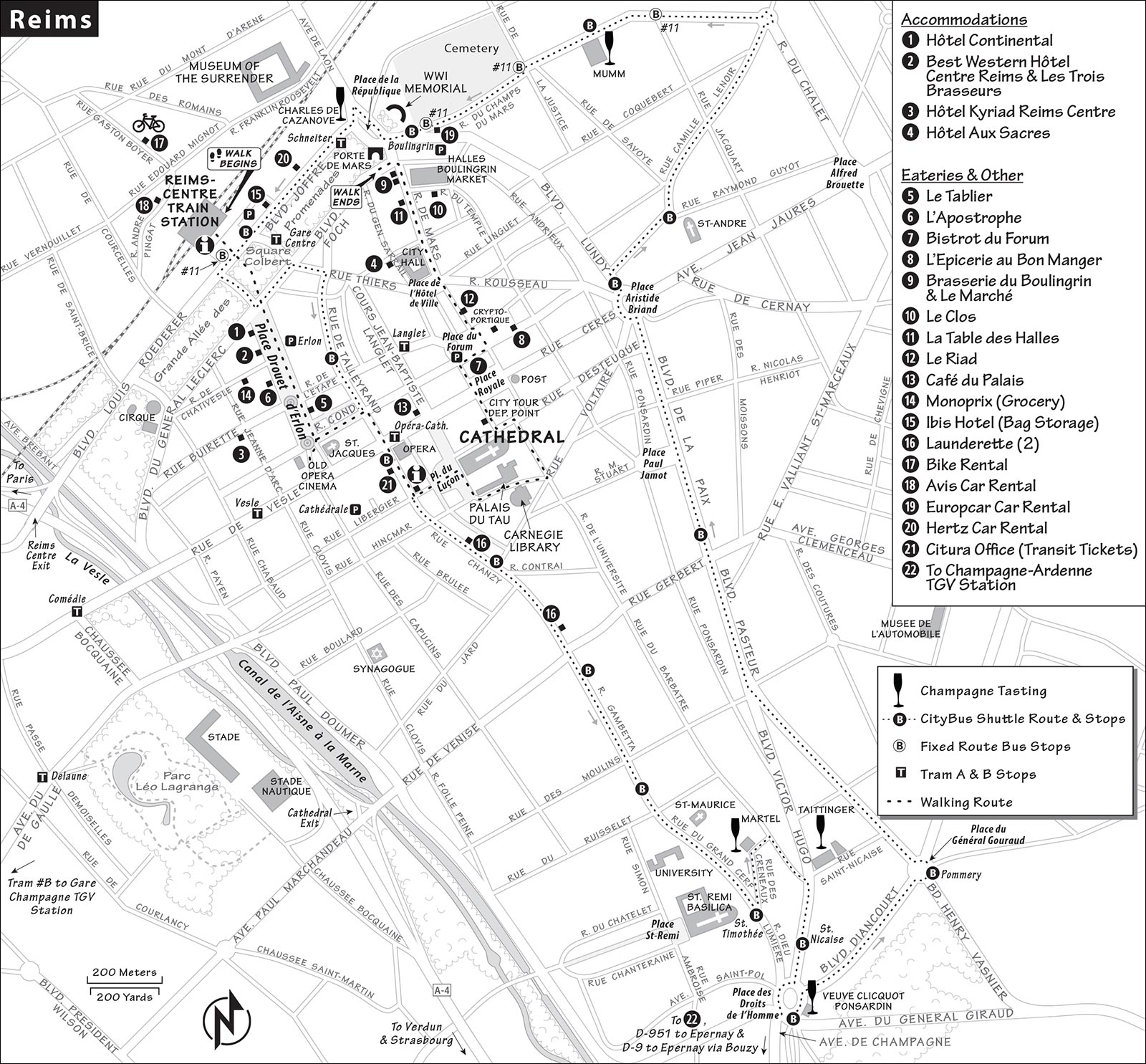
Two tram lines—#A and #B—connect Reims’ two train stations and serve several stops in town (about every 10 minutes, fewer on Sun). To get from either station to the cathedral, main TI, and town center, take a tram to the Opéra-Cathédrale stop.
The handy little CityBus electric shuttle makes a 30-minute loop from the Reims-Centre station to the cathedral and stops very close to several Champagne caves, including Martel, Taittinger, Veuve Clicquot, Pommery, and Mumm. The 15 stops it makes are shown on the “Reims” map, earlier. Wave at the driver to get the shuttle to stop (3/hour, Mon-Sat 9:00-19:00, no service Sun, free for up to 5 people with Erlon parking garage receipt).
Reims Blitz Walk
If you’re racing through Reims, here’s a quick walking plan that follows the order of its main sights. These highlights can be seen on foot in a three-hour sightseeing stroll from the Reims-Centre train station (including touring the cathedral interior). Add another two hours to visit a cellar, and another hour for any other museum visits. To trace the route, see the “Reims” map, earlier, or pick up a town map from the small TI outside the train station.
If you plan to visit the Museum of the Surrender, check their hours first as it may close during lunch (you can start there and do this walk in reverse—especially fun on a Wed, Fri, or Sat morning, when the market at Halles Boulingrin is in full swing).
• From the station (which retains its original 1860 facade), walk directly into the park out front.
Grand Allée des Promenades
Find the statue of hometown boy Jean-Baptiste Colbert, the finance minister of Louis XIV back in the 17th century. This park, or Grande Allée des Promenades, was originally a garden outside the city walls. In 1848, when it was clear that Reims didn’t need a protective wall, the fortifications were demolished to create a three-mile-long circular boulevard. Look at your town map to see the “left foot”-shaped outline left by the wall.
• From Colbert, angle to the right, cross what was the wall, and walk along...
Place Drouet d’Erlon
This long, pedestrianized street-like square marks the commercial center of town. It’s Reims’ “little Champs-Elysées.” Stroll two long blocks up to the square’s centerpiece: a fountain and column crowned by a glistening gold-winged figure of Victory. (The original Victory, from 1906, was melted down by the Nazis—this is a recent replacement.) The fountain—with four voluptuous women—celebrates the four major rivers of this district.
Fortunately, World War II left the city unscathed. But World War I devastated Reims. It was the biggest city on France’s Western Front, and it was hammered. Sixty-five percent of Reims was destroyed by shelling, and in 1918 only 70 buildings remained undamaged. The area around you was entirely rebuilt in the 1920s. Do a little spin tour to survey the facades. If it looks eclectic, that’s because the mayor at the time said to build any way you like—just build.
• Continue along the square to check out the building at #15, which is fake half-timbered (in concrete), and the Art Deco facade at #19.
Where Place Drouet d’Erlon ends (at a small fountain), pop into the Waida Pâtisserie at #5 for a pure, typical Art Deco interior. While at Waida, consider picking up a quiche and some pastries to enjoy on the cathedral square. They also sell biscuits roses de Reims—light, rose-colored egg-and-sugar cookies that have been made since 1756. They’re the locals’ favorite munchie to accompany a glass of Champagne—you’re supposed to dunk them, but I like them dry (many places that sell these treats offer free samples).
All around you’ll see the stylized features—geometric reliefs, motifs in ironwork, rounded corners, and simple concrete elegance—of Art Deco. A marvelous example, which also includes a dollop of Art Nouveau, lies a block ahead.
• Veer right at the ball-shaped fountain—the Fountain of Solidarity—and find the...
Old Opéra Cinema
This building, at 9 Rue de Thillois, is a good example of the wavy features and exuberant decorations that were common on buildings in Reims before World War I. The only hints that this was once a medieval town are the narrow lots that struggle to accommodate today’s buildings.
• From here, go back to the ball fountain and turn right onto Rue Condorcet, then right again on...
Rue de Talleyrand
One block ahead, watch for the Opera-Cathédrale electric CityBus stop, where you could catch a ride to a slew of Champagne caves (see “Reims’ Champagne Caves,” later).
• But for now, continue another block to Rue Rockefeller (and the main TI) and look left. Straight ahead is the you-can’t-miss-it...
Reims Cathedral
This soaring Gothic cathedral, worth ▲▲▲, is to France what Westminster Abbey is to England. And there’s a lot of history here. A self-assured Joan of Arc led a less-assured Charles VII to be crowned here in 1429. Thanks to Joan, the French rallied around their new king to push the English out of France and finally end the Hundred Years’ War. During the French Revolution, the cathedral was converted to a temple of reason (as was Paris’ Notre-Dame). After the restoration of the monarchy, the cathedral hosted the crowning of Charles X in 1825—the last coronation here. During World War I about 300 shells hit the cathedral, damaging statues and windows and destroying the roof, but the structure survived. Then, during the 1920s, it was completely rebuilt, thanks in large part to financial support from John D. Rockefeller Jr.
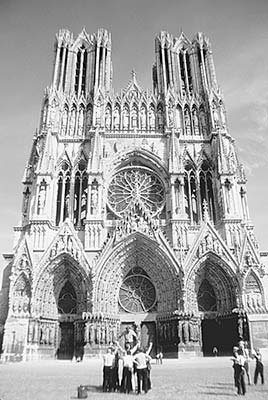
Luckily, World War II spared the church, and since then it has come to symbolize reconciliation. A French plaque set in the pavement just in front recalls the 1962 Mass of Reconciliation between France and Germany. A German version of the marker was added in 2012, commemorating 50 years of friendship and celebrating the belief that a war today between these two nations would be unthinkable.
Let’s pause here while you visit the cathedral. Turn to “Sights in Reims” on here for a self-guided tour explaining the cathedral’s remarkable exterior and interior, along with details on the tower climb and evening sound-and-light shows.
• Ready to continue? Facing the cathedral, the cathedral museum (housed in Palais du Tau) and Carnegie Library are to the right.
Palais du Tau
This former Archbishop’s Palace, named after the Greek letter T (tau) for its shape, houses artifacts from the cathedral next door and a pile of royal goodies. If you visit, you’ll look into the weathered eyes of original statues from the cathedral’s facade, and see precious tapestries, coronation jewels, and more. The museum is closed for renovation through 2024.
Cost and Hours: Closed through 2024, when open likely about €8, €11 combo-ticket includes cathedral tower; open Tue-Sun 9:30-18:30, Sept-April Tue-Sun 9:30-12:30 & 14:00-17:30, closed Mon year-round; good bookshop, +33 3 26 47 81 79, www.palais-du-tau.fr.
• Next to the Palais du Tau (across Rue Cardinal de Lorraine), find the Art Deco...
Carnegie Library (Bibliothèque Carnegie)
The legacy of the Carnegie Library network, funded generously by the 19th-century American millionaire Andrew Carnegie and his steel fortune (notice the American flag above the main entrance on the left), extends even to Reims. Carnegie believed knowledge could put an end to war, and he built several thousand such libraries around the world (he dedicated $200,000 for the one in Reims). Built in 1921 in the flurry of interwar reconstruction, this beautiful building still houses the city’s public library. Considering that admission is free and it’s near the cathedral, it’s worth ▲ and a quick look.
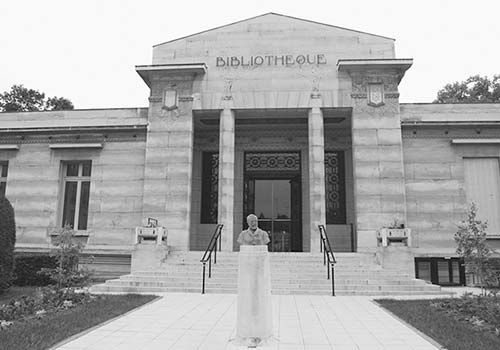
Cost and Hours: Free; Tue-Wed and Fri 10:00-13:00 & 14:00-19:00, Sat until 18:00, Thu 14:00-19:00 only, closed Sun-Mon; next to the Palais du Tau on Place Carnegie, +33 3 26 77 81 41. You’ll find good WCs downstairs.
Visiting the Library: You’re welcome to poke around but are asked not to enter the reading room. In the onyx-laden entry hall, small marble mosaics celebrate different fields of knowledge, and a chandelier hangs down like the sleek dress of a circa-1920s flapper. Peek through the reading room door (Salle de Lecture) to admire the stained-glass windows of this temple of thought. The gorgeous wood-paneled card-catalogue room takes older visitors back to their childhoods. Go ahead, finger the laboriously created typewritten files, and imagine the technology available back in 1928, the year the library was inaugurated.
• Turn left out of the library and walk behind the cathedral (offering great flying buttress views), pass through Place Royale (with a statue of Louis XV), and in a block enter...
Place du Forum
Reims’ main square recalls the forum, or market, that marked the center of the ancient city. Legend has it that Reims was founded by Remus (brother of Romulus), and so the tribe that lived here came to be called “Remes.” This old town of 50,000 people was the capital of the Roman province of Gaullia-Belgica, and had cobbled streets, covered walkways, and all the features of an important Roman city (baths, temples, arena, and a large forum). You can visit the Cryptoportique (entry is down the steps in the small garden), a first-century AD Roman gallery. About 10 feet below today’s street level, this cool retreat was once the cloister that defined a sacred temple zone in the middle of the Roman Forum (free, daily 14:00-18:00, closed Oct-May). The café-filled square is also a fine place to pause for a snack or for dining al fresco on warm summer evenings (see “Eating in Reims,” later).
• Leave Place du Forum on pedestrian-pleasing Rue de Tambour (which later becomes Rue de Mars), stopping to admire the sumptuous City Hall (Hôtel de Ville) before reaching the hard-to-miss...
Halles Boulingrin (Covered Market Hall)
Built in 1927, this jewel of Art Deco architecture underwent an estimated €31 million renovation in 2012. The vaulted roof consists of a mere 2.75 inches of reinforced concrete and rises 65 feet. Its splendid, bustling morning market spills over to include surrounding streets (open Sat 6:00-14:00, also Wed and Fri 7:00-13:00; tiny organic market Fri 16:00-20:00, closed other days, 50 Rue de Mars—an easy walk or tram ride from the Reims-Centre train station).
• From here we’ll enter the Grande Allée des Promenades parkway. Stop to admire the...
Porte de Mars
The only aboveground monument surviving from ancient Reims is this entry gate to the city (across from Parking Boulingrin). The Porte de Mars, built in the second century AD, was one of four principal entrances into the ancient Gallo-Roman town. Inspired by triumphal arches that Rome built to herald war victories, this one was constructed to celebrate the Pax Romana (the period of peace and stability after Rome had vanquished all its foes). Unlike most other structures here, the gate was undamaged in World War I, but it bears the marks of other eras, such as its integration into the medieval ramparts.
Across the street from the Porte de Mars, at the end of the parkway on Place de la République, stands a huge WWI memorial. Reims, the biggest city on the Western Front during the Great War, endured 1,051 days of shelling during those four years.
• Our walk is finished. From here it’s a 10-minute walk to the train station (follow the Grande Allée des Promenades).
Or, to continue to the next sight, cross Boulevard Joffre, walk past Charles de Cazanove Champagne and turn left on Avenue de Laon, cross over the train tracks, then turn left onto Rue du Président Franklin Roosevelt to find the...
Museum of the Surrender (Musée de la Reddition)
WWII buffs will enjoy visiting the place where US General Dwight Eisenhower and the Allies received the unconditional surrender of all German forces on May 7, 1945. The news was announced the next day, turning May 8 into Victory in Europe (V-E) Day. There’s an extensive collection of artifacts, but the most thrilling sight is the war room (or Signing Room), where Allied operations were managed. A visit here is worth ▲ for anyone interested in World War II.
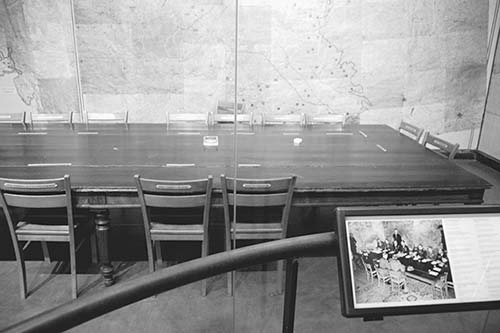
Cost and Hours: €5, Wed-Mon 10:00-18:00 (may close at lunchtime—check ahead), closed Tue, 12 Rue du Président Franklin Roosevelt, +33 3 26 47 84 19, www.musees-reims.fr.
Visiting the Museum: Start with the good 10-minute video in the theater on the main floor. Then climb upstairs to the museum and Signing Room. Imagine running the European Theater of Operations from here, as General Eisenhower did from February to May 1945 (after the Allies gained control of the air). The walls are covered with floor-to-ceiling maps showing troop positions, fuel supplies, where train lines were functioning, and so on. Progress was painstakingly marked and updated daily. The chairs around the table, with name tags in their original spots, show where the signatories sat.
Sights in Reims
▲Carnegie Library (Bibliothèque Carnegie)
Covered Market Hall (Halles Boulingrin)
▲Museum of the Surrender (Musée de la Reddition)
Caves Southeast of the Cathedral
On a targeted strike, Reims’ most important sights are its city center, cathedral, and Champagne caves. The “Reims Blitz Walk,” earlier, is a loop walk linking the train station, cathedral, and other city sights. Next you’ll find a self-guided tour of the cathedral and details on Champagne caves in town.
▲▲▲REIMS CATHEDRAL
The cathedral of Reims is a glorious example of Gothic architecture, and one of Europe’s greatest churches. It celebrated its 800th birthday in 2011. Clovis, the first Christian king of the Franks, was baptized at a church on this site in AD 496, establishing France’s Christian roots, which still hold firm today. Since Clovis’ baptism, Reims Cathedral has served as the place for the coronation of 26 French kings, giving it a more important role in France’s political history than Notre-Dame Cathedral in Paris.
Cost and Hours: Free, daily 7:30-19:15, helpful info boards in English (www.cathedrale-reims.com). You can rent multimedia guides nearby at the main TI, but my self-guided tour is enough detail for most.
Getting There: The cathedral is a 15-minute walk from the Reims-Centre station. Follow sortie signs for Place de la Gare, then follow the “Reims” map or my “Reims Blitz Walk,” earlier. You can also take the tram or catch the small electric CityBus from in front of the station (5-minute ride).
Cathedral Tower: An escorted one-hour French-only tour climbs the 250 steps of the tower to explore the rooftop and the elaborate wood framework that supports it, and includes a close-up look at the Gallery of Kings statuary (€8, €11 combo-ticket with cathedral museum at Palais du Tau; tours run Tue-Sun in summer, Sat-Sun only off-season; get hours and book tickets at Palais du Tau, where you’ll meet the escort—see listing, later; also possible to book online at www.palais-du-tau.fr).
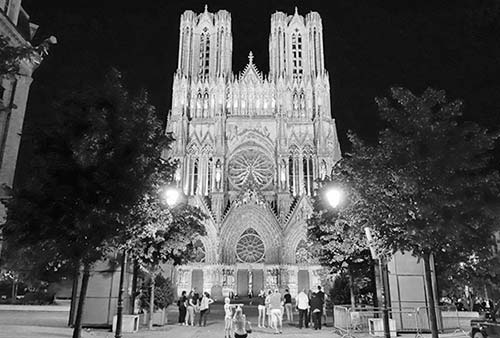
Cathedral Sound-and-Light Show (Rêve de Couleurs): For a memorable experience, join the crowd in front of the cathedral for a free, 25-minute sound-and-light show (weekend evenings late May-early Sept). The colorful lights and booming sound take you through the ages, evoking the building’s design and construction, the original appearance of the statuary, the coronations that occurred here, the faith of the community, and—during the centennial of the Great War—the shelling it absorbed during World War I. Sit directly in front of the cathedral or settle more comfortably into a seat at a café with a clear view through the trees. The show generally starts when it’s dark—between 21:30 and 23:00 (get schedule at TI).
 Self-Guided Tour
• Begin your visit from about 30 paces away, admiring the cathedral’s...
West Portal: This is perhaps the best west portal anywhere. Built under the direction of four different architects, it is remarkable for its unity and harmony. The church was started in about 1211 and mostly finished just 60 years later. The 260-foot-tall towers were added in the 1400s; the spires intended to top them were never installed for lack of money.
Like the cathedrals in Paris and Chartres, this church is dedicated to “Our Lady” (Notre Dame). Statues depicting the crowning of the Virgin take center stage on the facade. For eight centuries Catholics have prayed to the Mother of God, kneeling here to ask her to intervene with God on their behalf. In 1429, Joan of Arc received messages here from Mary encouraging her to rally French troops against the English at the Siege of Orléans (a statue of Joan from 1896 is over your left shoulder as you face the church).
An ornate facade like this comes with a cohesive and carefully designed message. Study the carving. A good percentage of the statues are original and date from around 1250. There are three main doors, each with a theme carved into the limestone.
On the left is the Passion (the events leading up to and including the Crucifixion). Among the local saints shown below is the famous Smiling Angel, whose jovial expression has served the city well as its marketing icon. The central space is dedicated to the Virgin Mary (crane your neck up), featuring the Coronation of Mary with scenes from her life below. And on the right is the Last Judgment, with scenes from the apocalypse. Above the great rose window are reliefs of David (with his dog) and Goliath. Notice the fire damage, from 1914, immediately around the rose window (fire melts limestone and can topple stone churches, as it almost did to Notre Dame de Paris in 2019).
Across the top is the Gallery of Kings, depicting 56 of France’s kings. They flank the country’s first Christian king, Clovis, who appears to be wearing a barrel—he’s actually kneeling prayerfully at a baptismal font. These anonymous statues, without egos, are unnamed kings whose spiritual mission is to lead their people to God.
• Before going inside, step around to the right side and study the...
Flying Buttresses: Consider the exoskeletal nature of the church’s structure. Braces on the outside—known as flying buttresses—soar up the sides of the church. These massive “beams” are critical to supporting the building, redirecting the weight of the roof outward (and into the ground), rather than downward on the supporting walls. With the support provided by the columns, arches, and buttresses, the walls—which no longer needed to be so solid and thick—became window holders.
The architects of Reims Cathedral were confident in their building practices. Gothic architects had learned by trial and error—many church roofs caved in as they tested their theories and strove to build ever higher. Work on Reims Cathedral began decades after the Notre-Dame cathedrals in Paris and Chartres, allowing architects to take advantage of what they’d learned from those magnificent earlier structures.
Contemplate the lives of the people in Reims who built this huge building in the 13th century. Construction on a scale like this required a wholesale community effort—all hands on deck. The builders of the Reims Cathedral gave it their all, in part because this was the church of France—where its kings were crowned. Most townsfolk who participated donated their money or their labor knowing that neither they, nor their children, would likely ever see it completed—such was their pride, dedication, and faith. Imagine the effort it took to raise the funds and manage the workforce. Master masons supervised, while the average Jean did much of the sweat work.
• Now, step inside and stand at the back of the nearly 500-foot-long...
Nave: The weight of the roof is supported by a few towering columns that seem to sprout crisscrossing pointed arches. This load-bearing skeleton of columns, arches, and buttresses allowed the church to grow higher. Sun pours through the stained glass, bathing visitors and worshippers in divine light.
Take a look at the wall of 52 statues stacked in rectangular blocks inside the door. (Cover the light from the door with this book to see better.) Imagine the 13th-century technology employed to carve each of these blocks in the nearby workshop and then install them so seamlessly here. These blocks continue the stories told by the statues on the outside.
Walk up the central aisle until you find a plaque in the floor marking the site of Clovis’ baptism in 496. Back then, a much smaller, early-Christian Roman church stood here. And back then you couldn’t enter a church until you were baptized. Baptisteries stood outside churches, like the one that welcomed Clovis into the Christian faith.
• Walk ahead to the...
Choir: The set of candlesticks and crucifix at the high altar were given to the church by Charles X on the occasion of his coronation in 1825. Look back at the west wall. The original windows were lost in World War I; these, rebuilt from photographs, date from the 1930s.
• Walk into the...
South Transept: The WWI-destroyed windows here were replaced in 1954 by the local Champagne makers. Looking much like original stained glass, the windows’ scenes portray the tending of vines (left), the harvest (center), and the time-honored double-fermentation process (right). Notice, around the edges, the churches representing all the grape-producing villages in the area.
Looking high above at the ceiling, you’ll see evidence of bomb damage from 1917, when the roof took direct hits and collapsed. (The lighter bricks show the repair job from the 1920s.) The gray/white “grisaille” windows in this transept were installed in the 1970s. Many of the darker, more richly colored medieval glass windows were replaced by clear glass in the 18th and 19th centuries (when tastes called for more light).
• Continue to the...
Apse (east end, behind the altar): The apse holds a luminous set of Marc Chagall stained-glass windows from 1974. Chagall’s expressive style lends itself to stained glass, and he enjoyed opportunities to adorn great churches with his windows.
Allow your eyes to adjust to the light to take in these scenes. The left window illustrates scenes from the Old Testament, with the Tree of Jesse (with Jesse himself sleeping at the bottom) reaching up to Mary with the Christ Child. In the central panels, the cohesion of the Old and New Testament scenes is emphasized by the ladder that connects one to the other. On the right, the Tree of Jesse—which is essentially a genealogical diagram of Christ’s lineage—is extended to symbolically include the royalty of France, thus affirming the divine power of the monarchs and stressing their responsibility to rule with wisdom and justice. Featured are Clovis (at the bottom, with his bishop), St. Louis IX (seen at the cathedral and then dispensing justice), Charles VII (on the right in green), and Joan of Arc, in blue, holding her sword (on the far right).
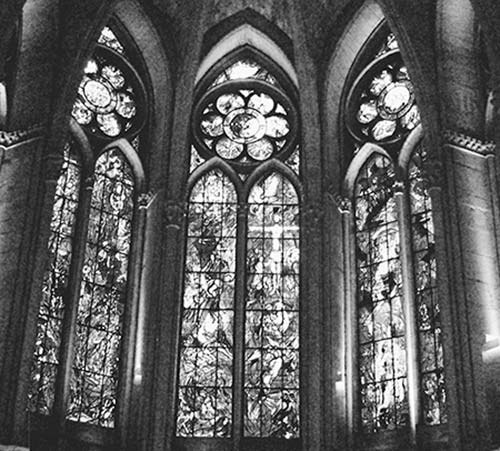
For the cathedral’s 800th anniversary, in 2011, six modern, abstract windows were installed on either side of the Chagall windows. Just to the left is a 1901 statue of Joan of Arc, her face carved from ivory.
• From here, directly behind the high altar, enjoy the best...
View of the Entire Nave: Seen from this distance, the west wall is an ensemble seemingly made entirely of glass. Look at the confidence of the design. Even the corners outside the rose window were glass, made without stone. The architects pulled out all the stops in this triumph of Gothic.
REIMS’ CHAMPAGNE CAVES
Reims, the capital of the Champagne region, offers many opportunities to visit its ▲▲ world-famous chalk Champagne cellars (caves). The oldest were dug by the Romans as they mined chalk and salt in the first century BC. Hundreds of years later, Champagne producers converted the caves—with their perfect and constant temperatures—into wine storage.
Which cave should you visit? Martel offers the most personal and best-value tour. Taittinger, Veuve Clicquot, and Mumm have impressive cellars (Mumm is also close to the city center and offers one of the best tours in Reims). Veuve Clicquot is popular with Americans and its tours fill up weeks in advance, but you can drop by for a tasting anytime. Charles de Cazanove is close to the train station and on the cheaper side (you get what you pay for). Wherever you go, bring a sweater, even in summer, as the caves are cool and clammy. I’ve listed the basic tour for each cave; most offer more elaborate tours and tastings...for a price.
How to Visit: All charge entry fees for tours that vary by the level of tasting you choose, most have several daily English tours, and most require a reservation (many allow drop-in visits to taste only). Call, email, or visit the cave website for the schedule and to secure a spot on a tour. You can also use this helpful all-in-one website to book a tour at any cave: www.champagne-booking.com. If all else fails, ask for help at the TI.
Getting to the Caves: Cazanove and Mumm are both in the city and reachable on foot. Without a car, the others involve a long 40-minute walk, a short ride on the CityBus (except on Sun—see the next listing for details), or a taxi ride (about €12 from either of Reims’ train stations to the farthest Champagne cave). To return, ask the staff at the caves to call a taxi for you. The meter starts running once they are called, so count on €5 extra for the return trip.
Champagne in the City Center
Charles de Cazanove
If you’re in a rush, Cazanove is closest to the train station and has a decent tasting. (Martel’s tour and tasting for same price is superior; see “Martel,” later.) There are no chalk caves and only some Champagne is made on-site (€25-36, includes a film and 45-minute tour with 3 tastings; daily 10:00-13:00 & 14:00-19:00, 8 Place de la République, +33 3 26 88 53 86, www.champagnedecazanove.com). To get there from the station, walk 10 minutes up Boulevard Joffre or take either tram in direction: Neufchâtel and get off at the first stop (Schneiter).
Mumm
Mumm (“moome”) is one of the easiest caves to visit, as it’s walkable from Reims-Centre train station. Reservations are essential, especially on weekends (book online). Choose which tasting you want when getting your ticket (the cheapest tasting is fine for most, though you can pay more for the same tour with extra “guided” tastings). You’ll see a quick promotional video explaining the Champagne-making process, then follow a guided walk through the industrial-size chalk cellars, where 25 million bottles are stored (Mumm is Champagne’s largest producer), and a museum of old Champagne-making tools and traditions. The tour ends with your tasting choice.
Cost and Hours: €30, includes one-hour tour followed by a glass of their Cordon Rouge; tours generally offered daily 9:30-11:30 & 14:00-16:30 (34 Rue du Champ de Mars—go to the end of the courtyard and follow Visites des Caves signs; +33 3 26 49 59 70, www.mumm.com).
Getting There: It’s a 15-minute walk from the Reims-Centre train station or from the cathedral. From the station, turn left on Boulevard Joffre and walk to Place de la République; pass through the square, and continue along on Rue du Champ de Mars (to the left of the Europcar office). You can also take the CityBus (though it’s the last stop on the one-way loop, so a 30-minute ride), or take either tram from the station in direction: Neufchâtel, get off at the first stop (Schneiter; near Place de la République), and walk 8 minutes.
Caves Southeast of the Cathedral
Taittinger and Martel, offering contrasting looks at two very different caves, are a few blocks apart, and can easily be combined in one visit. Veuve Clicquot Ponsardin is a bit farther out and owns that memorable name (book well in advance).
Getting There: From the town center, it’s a 30-minute walk to Taittinger and Martel. Starting from behind the cathedral’s south transept, walk straight down Rue de l’Université, then Rue du Barbâtre. Veuve Clicquot is another 10 minutes farther on foot (see map on here). If that’s too far, there’s a handy taxi stand at 40 Rue Carnot, next to the Opéra (about €12).
To reach these caves by bus, take the little CityBus from the train station or from the Opéra-Cathédrale stop (near the TI, one block in front of the cathedral) and use these stops: Martel (stop: St. Timothée), Taittinger (stop: St. Nicaise), Veuve Clicquot (stop: Droits de l’Homme), Pommery (stop: Pommery), Mumm (stop: Foujita). All caves are visible from their stops.
Taittinger
One of the biggest, slickest, and most renowned of Reims’ caves, Taittinger (tay-tan-zhay) runs morning and afternoon tours in English through their vast and historic cellars. After a 10-minute promo movie (hooray for Taittinger!), descend with your guide for 40 chilly minutes in a chalky underworld of caves, the deepest of which were dug by ancient Romans. You’ll tour part of the three miles of caves, see ruins of an abbey and a Roman chalk quarry, pass some of the three million bottles stored here, and learn all you need to know about the Champagne-making process from your well-informed guide. Popping corks signal that the tour’s done and the tasting’s begun.
Cost and Hours: €34, includes cellar tour, reserve ahead online; about 25 people per tour; open Tue-Sun 9:30-17:30, closed Mon; 9 Place St. Niçaise, +33 3 26 85 84 33, www.taittinger.fr.
Martel
This small operation with less extensive caves offers a homey contrast to Taittinger’s big-business style, and it’s a good deal. Call to set up a visit and expect a small group that might be yours alone. Friendly Emmanuel and Louis run the place with a relaxed manner. A visit includes a tour of their small cellars (which are peppered with rusted old winemaking tools), and a tasting in a casual living-room atmosphere.
Cost and Hours: €23 for three glasses, 30-minute tour and 30-minute tasting; tours in English daily at 11:30 and 16:00—reservations required; drop-in tastings anytime daily 10:00-13:00 & 14:00-18:00; 17 Rue des Créneaux, +33 3 26 82 70 67, www.champagnemartel.com.
Veuve Clicquot Ponsardin
Veuve Clicquot is inundated with American travelers, so book this one early. The tours are well done and explain how the widowed Madame Clicquot effectively marketed her family’s product to the US over 150 years ago—and why Americans today remain drawn to her famous yellow label (€35 for basic tour and a glass of champagne, vineyard visit also possible, Place des Droits de l’Homme, +33 3 26 89 53 90, www.veuve-clicquot.com). Or, just show up for a tasting (but no tour) and enjoy their pleasant outdoor café (Wed-Sun 9:30-17:00, closed Mon-Tue).
Champagne Sights Near Reims
Villages near Reims are home to thousands of small-scale producers of Champagne—unknown outside France and producing fine-quality Champagne without the high costs and flash associated with big brand-name houses in Reims and Epernay (figure about €15-30/bottle). These less famous producers harvest the grapes themselves and make wine only from their own grapes (identified as “récoltant manipulant” or just “RM” on bottles and elsewhere). Below I’ve outlined a drive linking the best Champagne villages, plus a visit to Moët et Chandon in the town of Epernay.
ROUTE DE LA CHAMPAGNE DRIVE
Drivers can joyride over the hills just south of Reims (the pretty Montagne de Reims area) and through the vineyards, experiencing the chalky soil and rolling landscape of vines that produce Champagne’s prestigious sparkling wines. This leisurely 50-mile loop drive takes about three hours, including stops.
Train riders can experience some of this countryside by taking the train toward Epernay and getting off at one of the wine villages (Rilly-la-Montagne is a good choice, offering several producers; trains run hourly, 12 minutes).
Planning Your Drive
The Reims TI has maps of the Route de la Champagne and a Discovery Guide for the Marne region. Roads are well marked: Brown Route Touristique de la Champagne signs lead along much of our route and take you to some great viewpoints. If you plan to picnic, you’ll find all you need in the sweet little town of Aÿ. There’s also a bakery and a small grocery in Bouzy (unpredictable hours).
Reservations: It takes a little work to line up visits to wine producers in this area, and you must reserve ahead to tour a cellar rather than just taste, but this usually pays off with a more intimate, rewarding cultural experience. The Reims TI can book visits (or you can do it on their website), or check in with Les Vignerons Indepéndents de Champagne (Independent Winemakers of Champagne) for a list of producers and information on booking visits (+33 3 26 59 55 22, www.vignerons-independants-champagne.com).
If you’re doing this drive without reservations, it’s easier on a weekend, when more places are open and more likely to welcome drop-in tasters.
With Less Time: If you’re pressed for time, you can still sample the vineyard scenery by driving just 15 minutes south from Reims, or by working parts of this route into your drive between Reims and your next destination (the best stop is Hautvillers).
Small-Group Tours: If you’d rather let someone else drive, scads of minivan tour operators are happy to get you into the vineyards. They offer a variety of experiences and generally charge about €190/person for all-day tours. These two outfits are reliable: France Bubble Tours (+33 2 47 79 40 20, www.france-bubbles-tours.com) and A la Francaise (+33 3 26 53 30 41, www.alafrancaise.fr [URL inactive]).
From Reims to Louvois
• From Reims, take A-4 (direction: Châlons-en-Champagne), then soon exit south to Cormontreuil on D-9, following signs to Louvois (first tasting opportunity).
You’ll pass through the usual commercial fringe before popping out into lovely scenery just 15 minutes after leaving Reims. If you toured Mumm’s cellars, you’ll notice their hilltop property with a windmill well off in the distance (on the left) as you climb the Montagne de Reims, where the best grapes are grown.
Louvois
Consider a stop at Guy de Chassey, where drop-ins are welcome to enjoy a tasting (assuming the place isn’t busy). Call or email ahead if you want to tour their property (Mon-Sat 10:00-12:00 & 14:00-17:00, closed Sun, closed Aug and mid-Dec-mid-March, on the roundabout as you enter town at 1 Place de la Demi-Lune, +33 3 26 57 04 45, www.champagne-guy-de-chassey.com).
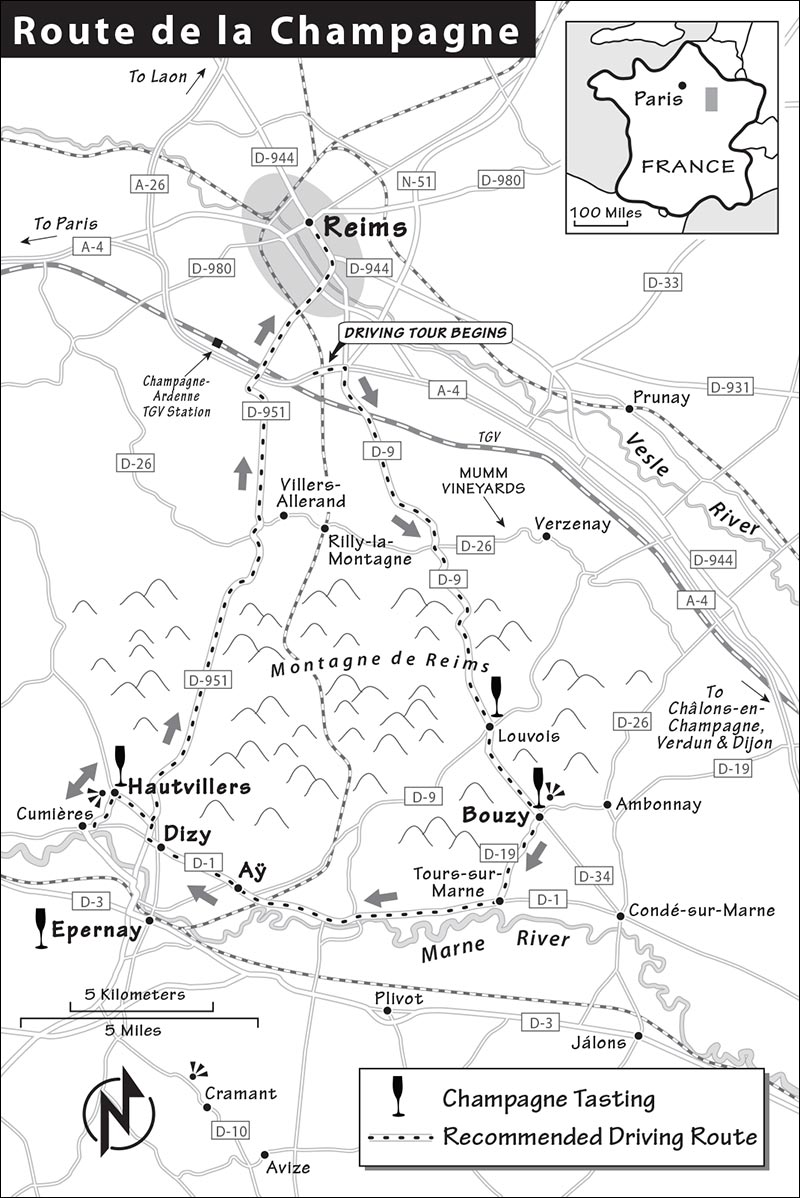
• Take D-34 out of town. A little after leaving Louvois, look for Route de la Champagne signs leading left along a vineyard lane into the appropriately named village of Bouzy. Take the short detour off to the point de vue for a fine view over the village and vines.
Bouzy
There are 30 producers of Champagne in little Bouzy alone, some of whom are famous for their Bouzy Rouge (a still red wine made only from pinot noir grapes, and not made every year). Most places require reservations to visit, but drop-ins are welcome for the fun tasting at Champagne Herbert Beaufort. You’ll likely be served by a family member. Arrive at 10:30 or 15:30 for visits to their cellars (free tastings; Mon-Fri 9:30-11:30 & 14:00-17:30, Sat 9:30-11:30 & 14:30-17:00, Sun 10:00-12:00 April-Sept, closed Sun Oct-April; first domaine on your left coming from Louvois on D-34 at 32 Rue de Tours, +33 3 26 57 01 34, www.champagnebeaufort.fr, beaufort-herbert@wanadoo.fr).
• From Bouzy, leave the vineyards following D-19 to Tours-sur-Marne, then turn right onto D-1 and carefully track signs to Aÿ.
Aÿ
This lively little town (pronounced “eye”) boasts of producing 100 percent grand cru Champagne from all its vineyards. Detour into the pleasant town center, and park near Hôtel de Ville. Within a few blocks you’ll find bakeries, charcuteries, cafés, and a good grocery store (which sells cold drinks).
• Back on D-1, drive into the next town—Dizy (what you get after too much Bouzy, Aÿ!)—and follow signs up the hill to Hautvillers. You’ll pass Moët et Chandon vineyards on your way.
Hautvillers
If you have time for only one stop, make it Hautvillers (“High Village”). This is the most attractive hamlet in the area, with strollable lanes, houses adorned with wrought-iron shop signs, and a seventh-century abbey church with the tombstone of the monk Dom Pérignon. Park near the Café Hautvillers, across from the little TI (+33 3 26 57 06 35, www.tourisme-hautvillers.com). From here it’s a nice walk to the town’s sights (all well signed).
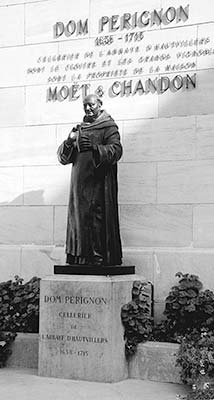
The abbey church is worth a wander (great WCs) for its wood-accented interior alone. According to the story, in about 1700, after much fiddling with double fermentation, it was here that Dom Pérignon stumbled onto the bubbly treat. On that happy day, he ran through the abbey, shouting, “Brothers, come quickly...I’m drinking stars!” Find his tombstone in front of the altar.
To taste your own stars, find Champagne G. Tribaut (300 yards from the café), and meet animated Valerie or her son, who love their work and the family’s product. Ask them about Ratafia, a local fortified wine served as an aperitif. You can linger over your glass of bubbly in the comfortable view reception room as you survey the sea of vineyards. It’s best to call or email a day ahead to let them know you’ll be stopping by (tasting fee-€5/glass or free if you buy 6 bottles; open Mon-Fri 9:00-12:00 & 13:30-17:30, Sat-Sun 9:00-18:00, closed Jan-Feb; +33 3 26 59 40 57, www.champagne-tribaut-hautvillers.com, contact@champagne-tribaut-hautvillers.com).
Another option is Au 36, a slick wine shop/tasting room that represents many producers. The passionate staff will help you understand the differences among grape varieties (€21 tastings with 3 contrasting Champagnes, good prices for purchase, meals available, daily 11:00-18:00, a block from Café Hautvillers at 36 Rue Dom Pérignon, +33 2 26 51 58 37).
For a spectacular picnic spot (with tables and benches) and sweeping views over vineyards and the Marne River, drive to the abbey church and follow Rue de l’Eglise past it for three minutes. Get out of the car and wander among the vineyards. That picture-perfect village down below is Cumières.
• Exit the town downhill, toward the river to Cumières, then turn left on D-1 and follow signs home to Reims (about 20 minutes back on the speedy D-951). You could also pass through Cumières and drive two miles into boring Epernay, home to Moët et Chandon.
True connoisseurs can continue along the Route Touristique de Champagne south of Epernay toward Vertus, along the chardonnay grape-filled Côte des Blancs.
CHAMPAGNE IN EPERNAY
Champagne purists may want to visit Epernay, about 16 miles from Reims (and also well connected to Paris—two daily local TER trains run through Epernay on the way to Reims). Epernay is most famously home to Moët et Chandon, which sits along Avenue de Champagne, the Rodeo Drive of grand Champagne houses. Otherwise, there is little reason to visit this unexceptional town.
Arrival in Epernay: Trains run between Reims-Centre train station and Epernay (about hourly, 35 minutes). From the station in Epernay, walk five minutes, cross the roundabout, and head straight up Rue Gambetta to Place de la République, and take a left to find Avenue de Champagne. Moët et Chandon is at #20, and the TI is at #7 (TI open Mon-Sat 10:00-13:00 & 14:00-18:00, Sun 10:30-13:00 & 14:00-16:30, off-season until 17:30 and closed Sun, +33 3 26 53 33 00, www.ot-epernay.fr [URL inactive]).
Tasting in Epernay: The granddaddy of Champagne companies, Moët et Chandon offers a classy reception room and a grandiose boutique (€40 for a 1.5-hour tour with 2 glasses, tours usually available but best to book ahead, kids 10-18 can join the tour for €10—but no tasting, under 10 free; €15 for tasting only; daily 9:30-17:30, closed weekends off-season, closed Jan; 20 Avenue de Champagne, +33 3 26 51 20 20, www.moet.com [URL inactive]).
Sleeping in Reims
These hotels all have air-conditioning and elevators.
$$$ Hôtel Continental**** has windows on the world from its prized location on Reims’ best pedestrian street. It’s a big, pricey place with rooms in all shapes and sizes and a very welcoming staff (RS%, good family options, fitness room, pay parking, 3-minute walk from Reims-Centre train station at 93 Place Drouet d’Erlon, +33 3 26 40 39 35, www.continental-hotel.fr, reservation@continental-hotel.fr).
$ Best Western Hôtel Centre Reims*** delivers crisp and modern comfort at fair rates in surprisingly quiet rooms, despite being right on the lively square (no real lounge area, family rooms, 75 Place Drouet d’Erlon, +33 3 26 47 39 03, www.hotel-centre-reims.fr, contact@hotel-centre-reims.fr).
$ Hôtel Kyriad Reims Centre*** has well-priced, simple rooms a block from the main pedestrian street with modern comforts and spacious public areas (some rooms in need of a little TLC, 29 Rue Buirette, +33 3 26 47 39 39, www.kyriad.com, reims.centre@kyriad.fr).
$ Hôtel Aux Sacres*** is an unpretentious little place in a fun location between the Boulingrin market hall and Place du Forum, with comfortable, colorful, and well-priced rooms (9 Rue du Général Sarrail, +33 3 26 47 50 80, https://hotel-reims.brithotel.fr).
Eating in Reims
Dining in Reims is as much about the area you eat in as the restaurant you choose. I’ve described areas to troll for dinner as well as a few specific restaurants. If you’re just looking for cheap picnic fixings, head to the grocery store at Monoprix (see “Helpful Hints,” earlier). If you only have a night here, the Brasserie du Boulingrin delivers the most authentic ambience and traditional experience.
PLACE DROUET D’ERLON
This bustling lineup of cafés and restaurants on Place Drouet d’Erlon serves mostly so-so meals but has great people-watching and café action. Linger over a drink at one of the cafés on the square, and then consider dining at one of these places: $ Le Tablier (the apron) at #30 is tops, with a broad range of choices offering consistently good quality and very fair prices (lots of outdoor seating, daily, +33 3 53 13 16 89); $$ L’Apostrophe at #59 dishes up all the French classics in a stylish interior or on the square (closed Mon, +33 3 26 79 19 89); and $$ Les Trois Brasseurs at #73 delivers a lively brew-pub-meets-bistro ambience and a huge range of choices with acceptable quality and a big outside terrace (daily, +33 3 26 47 86 28).
PLACE DU FORUM
Place du Forum attracts a young professional crowd at several bistros with good outdoor seating.
$$ Bistrot du Forum is an Old World, bare-bones, café-bistro place with small wooden tables on two floors, a cool zinc bar, and good terrace seating. They serve hearty salads, bruschetta-like tartines, and burgers, as well as traditional meat and fish dishes. You’ll also find a good selection of wines, beer, and Champagne (bien sûr) by the glass (long hours daily, 6 Place Forum, +33 3 26 47 56 58).
Just off the Place du Forum, on Rue Courmeaux, you’ll find $$ L’Epicerie au Bon Manger, a foodie refuge whose mantra is “In Good We Trust.” They have a handful of tables, stacks of organic local wines, smelly cheese, and charcuterie to go or to enjoy sitting down. It’s handy if you’re eating outside the rigid French lunch hours, because they serve nibbles all day (Wed-Sat 10:00-19:00, Thu-Fri until 22:00—worth booking ahead for dinner, closed Sun-Tue, 7 Rue Courmeaux, +33 3 26 03 45 29).
ELSEWHERE IN REIMS
Near the Halles Boulingrin Market: The pedestrian street Rue du Temple, along the south side of the covered market hall, is filled with cafés and brasseries—all with inviting outdoor terraces and a pleasant atmosphere. Peruse the options and consider these good places: $$ Brasserie du Boulingrin is a grand old Reims institution and a good choice, serving traditional French cuisine (including fresh oysters and seafood platters) at reasonable prices (closed Sun; 10-minute walk from the Reims-Centre train station at 31 Rue de Mars, next to the market hall, +33 3 26 40 96 22). $ Le Marché is the yin to Brasserie du Boulingrin’s yang, serving inexpensive, nontraditional fare in a lighthearted room with a young staff and vibe (good beer selection, closed Sun-Mon, 23 Rue de Mars, +33 3 26 87 15 83).
The adjacent street, Rue du Temple, is filled with lively brew pubs. Consider a glass of Champagne, wine, or beer in the funky courtyard of the Le Clos wine/beer bar at #25 (18:00 until late, closed Sun-Mon, live music some evenings, +33 3 26 07 74 69).
$$$ La Table des Halles serves elaborately prepared French cuisine with flair in a tasteful, modern room (limited outdoor seating, closed Sun-Mon, 23 Rue de Mars, + 33 3 26 35 25 96). And $$ Le Riad is the place in Reims to go for excellent Moroccan cuisine served in a stylish dining room (daily, 12 Rue de Tambour, +33 3 26 89 60 26).
Near the Opéra: $$ Café du Palais is appreciated by locals who enjoy a meal or sipping a coffee or wine while wrapped in 1930s ambience. This fun café-bistro stands across from the Opéra and feels like an art gallery on the inside with a vintage glass ceiling in the rear. This is a fun stop even just for a glass of wine (serves hot food during lunch hours and snacks the rest of the day, Tue-Sat 9:00-21:00, closed Sun-Mon, 14 Place Myron Herrick, +33 3 26 47 52 54).
Reims Connections
Reims has two train stations—Reims-Centre (for the city center) and Champagne-Ardenne (a TGV station 5 miles from the center of Reims). Many TGV trains (particularly those heading east from Reims) require a connection at the Champagne-Ardenne station (with frequent local TER trains or trams from Reims-Centre). For more on Reims’ train stations, see “Arrival in Reims” on here.
From Reims-Centre Station by Train to: Paris Gare de l’Est (hourly by TGV, 45 minutes, some with change at Champagne-Ardenne), Epernay (about hourly, 35 minutes), Verdun (hourly, 1.5-3 hours, 1-2 changes, some via TGV with change at Champagne—Ardenne), Strasbourg (hourly by TGV, 2-3 hours, change at Champagne-Ardenne), Colmar (10/day by TGV, 3 hours, change at Champagne-Ardenne, most also change in Strasbourg).
Verdun
While World War I was fought a hundred years ago, and there are no more survivors to tell its story, the WWI sights and memorials scattered around Europe do their best to keep the devastation from fading from memory.
Perhaps the most powerful WWI sightseeing experience a traveler can have is at the battlefields of Verdun, where, in 1916, roughly 300,000 lives were lost in what is called the Battle of 300 Days and Nights. Today, the lunar landscape left by WWI battles is buried under thick forests—all new growth. But there are plenty of rusty remnants of the battle and memorials to the carnage left to be experienced.
A string of battlefields lines an eight-mile stretch of road outside the town of Verdun. From here (with a tour, rental car, or taxi) you can ride through the eerie moguls left by the incessant shelling, pause at melted-sugar-cube forts, ponder plaques marking spots where towns once existed, and visit a vast cemetery. In as little as three hours you can see the most important sites and appreciate the horrific scale of the battles.
TOURIST INFORMATION
Verdun’s TI is east of the town center (just across the river—cross at Pont Chaussée, on Place de la Nation; Mon-Sat 9:00-12:30 & 13:30-18:00, Sun 10:00-12:30 & 13:30-17:00; Oct-March Mon-Sat until 17:00, Sun 9:00-13:00; +33 3 29 86 14 18, en.tourisme-verdun.com, contact@tourisme-verdun.com). The TI has excellent information and books in English about the battlefields, and rents e-bikes for a good price. The pleasant park nearby provides a good picnic setting.
ARRIVAL IN VERDUN
By Train: Verdun is served by two train stations: the Meuse TGV station (18 miles from Verdun) and the Verdun station (within walking distance of town).
TGV trains from Paris’ Gare de l’Est and destinations from the east serve the Meuse TGV station. The high-speed TGV service puts Verdun within 1.5 hours of Paris and 2 hours of Strasbourg. A 30-minute shuttle bus connects the Meuse TGV station with Verdun’s main station (free with ticket to Verdun or a rail pass, leaves shortly after TGV train arrives).
Verdun’s main train station is 15 minutes by foot from the TI. To reach the town center and TI, exit the station, cross the parking lot and the roundabout, and keep straight down Avenue Garibaldi, then follow Centre-Ville signs on Rue St. Paul. Turn left on the first traffic-free street in the old center (Rue Chaussée) and cross the river to the TI. Shuttles back to the Meuse TGV station depart 75 yards to the right when facing Verdun’s main station.
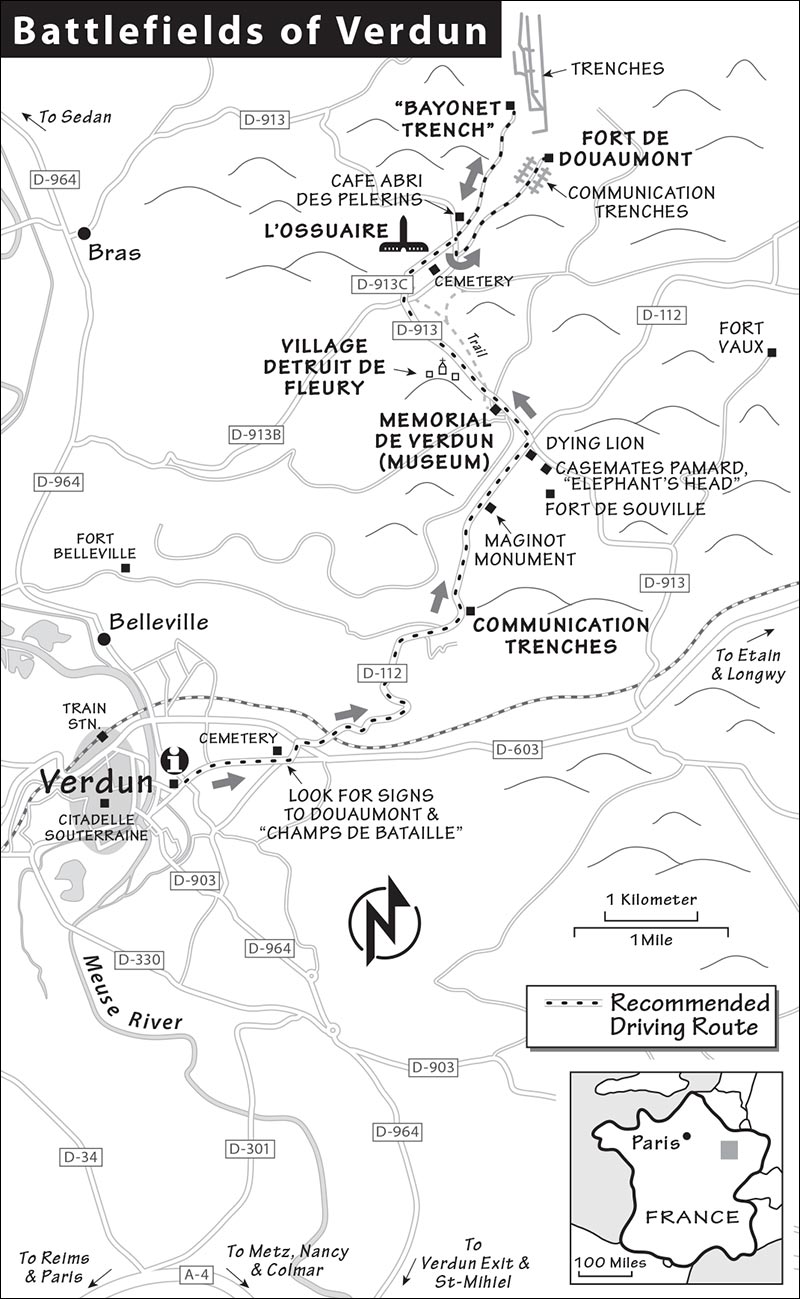
By Car: Drivers can bypass the town center and head straight for the TI and/or the battlefields. To find the TI, follow signs to Centre-Ville, then Office de Tourisme. To reach the battlefields, follow signs reading Verdun Centre-Ville, then signs toward Longwy, then find signs to Douaumont and Champs de Bataille (battlefields) on D-112, then D-913. The sites covered here fall in a line along this drive (just follow signs to Fort de Douaumont and Ossuaire). The map in this book is adequate for this drive.
Orientation to Verdun Town
While the Battle of Verdun took place in the hills outside town, the quiet town of Verdun is worth a stroll—except on Sundays and Mondays, when most shops and businesses are closed. It’s a handy if quiet base for exploring the battlefield sites.
Verdun’s strategic location has left it with a hard-fought history. Locals call it “the most decorated town in France”; the number of war memorials would suggest they’re right. It’s a monochrome place, with bullet holes still pocking its stony buildings. And it’s small, with only 16,000 people—4,000 fewer than at the start of World War I. Most of the action lies along the Meuse River on the broad esplanade of Quai de Londres, where you’ll find a commotion of cafés, restaurants, and recreation boats mostly from the Low Countries and Germany (enjoying a system of former industrial canals).
The town’s mighty 14th-century gate squats on the river (near the TI), looking warily east. The city’s state-of-the-art (in the 17th century) fortifications still seem poised to repel German armies. Just across the river, a thicker wall—built in 1871 in anticipation of an attack—supports a mammoth monument to the French victims of German invaders in both world wars.
Verdun’s old town is crowned by its Victory Monument, high above the river, with cascading flowers connecting it to the pedestrian heart of town. The monument’s centerpiece, a towering warrior, plants his sword in the ground in a declaration of peace. He’s flanked by twin cannons—made by the French for the Russians but ultimately used by the Germans against the French at Verdun. While the monument originally honored French and Allied troops, today it honors Germans as well. Now that a century has passed, the German flag flies next to French and European Union flags. The varied sites of the Verdun battlefields have risen above national bias, memorializing all victims of that senseless war, and celebrating peace.
Verdun has a special place in the hearts of the French, as nearly every soldier in World War I was cycled in and out of this killing field. In 1916 Verdun was the departure point for soldiers heading to the battlefields (as it is today for visitors). The Citadelle Souterraine was the site where French soldiers assembled and had their last good bed, meal, and shower before heading into the shelling zone. The citadel, with 2.5 miles of tunnels cut into a rock, was a teeming military city. How big? Its bakery cranked out 23,000 rations of bread every day. Today, it tries to give the public a glimpse at life on the front with a 30-minute ride on a Disneyesque wagon with virtual-reality headsets (€15, daily 9:00-18:00). While interesting, if your time if limited, it’s better spent at other battlefield sites.
Eating and Sleeping in Verdun: A good selection of eateries lines the river on Quai de Londres. $ Bolzon Charcuterie on the pedestrian-only Rue Chaussée (#21, closed Sun) has good salads, quiche, and dishes to go. Eating options are limited at the battlefields—consider assembling a picnic in Verdun or at an autoroute minimart.
Verdun makes an inexpensive and handy overnight stop. $ Hotel de Montaulbain*** is a good place in the heart of the old town with modern rooms at good rates (air-con on top—third—floor only, 4 Rue de la Vieille Prison, +33 6 13 56 47 08, www.hoteldemontaulbain.fr, contact@hoteldemontaulbain.fr).
Verdun Connections
High-speed TGV trains serve the Verdun area from the Meuse TGV station, 30 minutes south of Verdun. Regular but slower trains and buses also run to Verdun’s central station. For TGV connections listed next, allow an additional 30 minutes to ride a shuttle bus from Verdun’s train station (included with ticket to Verdun or rail pass).
From Verdun by Train to: Paris Gare de l’Est (6/day direct via TGV then bus, 2 hours), Strasbourg (10/day, 2-4 hours, 1-2 transfers, fastest trips by TGV and bus), Colmar (10/day, 3-5 hours, 2-3 changes, fastest trips by TGV), Reims-Centre (hourly, 1.5-3 hours, 1-2 changes; some by TGV and require a change at Champagne-Ardenne).
Battlefields of Verdun
Verdun’s battlefields are littered with monuments and ruined forts. For most travelers, a half-day is enough. We’ll concentrate on the three most important sights: the Verdun Memorial Museum, Douaumont Ossuary, and Fort Douaumont. If you plan to visit more than one fee site, ask about money-saving combo-tickets.
Information: Verdun’s many WWI sites and memorials are well equipped to make your visit meaningful and rewarding. Most are adequately described in English (some provide audioguides) and top-quality guides stand by to ensure that you know where to go and what you’re looking at.
The Verdun TI and all sights sell books in English. At the TI, the simple but adequate booklet Verdun du Ciel provides helpful details. Serious students will read ahead, and there’s no shortage of literature about the Battle of Verdun. Alistair Horne’s The Price of Glory sorts through the complex issues and offers perspectives from both sides of the conflict.
Eating: There are only two places to eat along this route. One is the rooftop café at Verdun Memorial Museum; the other is a café-restaurant near the Ossuary (described next). Consider picking up supplies in Verdun and using the picnic area near the trenches at Fort Souville (see later).
GETTING AROUND THE BATTLEFIELDS
The most interesting battlefield sites lie along an easy eight-mile stretch of road from the town of Verdun. The Verdun TI offers a very limited number of bus tours to the battlefields, but most are in French only. Most will find renting a car, taking a taxi, or hiring a guide a far better option to lace these sights together.
By Car: Cheap car rental is available a block from the Verdun train station at AS Location (Mon-Fri 8:30-12:00 & 14:00-18:00, sometimes open Sat, closed Sun, 22 Rue Louis Maury, +33 3 29 86 58 58, www.as-location-verdun.fr). I’ve included basic route tips in my “Verdun Battlefield Drive,” later.
By Bike: The TI rents e-bikes, making the level 16-mile round-trip to key sites manageable (see “Tourist Information,” earlier).
By Taxi: Taxi rates are about €30/hour (credit cards accepted). For roughly €40 round-trip, taxis can drop a carload at one location and pick up at another (paths connect the sights). Ask to be dropped at Fort de Douaumont and picked up five hours later at the Mémorial de Verdun, having visited L’Ossuaire and eating lunch en route (figure about an hour of level walking). With less time, ask to be dropped off at L’Ossuaire and picked up 2.5 hours later at Mémorial de Verdun). Taxis normally meet trains at the station; otherwise they park at the TI (see http://taxi-verdun.com, +33 6 81 95 26 98).
By Private Guide: Hiring one of these guides will considerably enrich your understanding of events at Verdun (both charge €200/half-day, €350/day): Ingrid Ferrand (www.verdun-fuehrungen-macht-ingrid.com, ingridferrand234@gmail.com, +33 7 71 66 79 74) and Florence Lamousse (www.lorrainetouristique.com [URL inactive], florence.lamousse@lorrainetouristique.com, +33 6 89 22 10 43).
BACKGROUND
After the annexation of Alsace and Lorraine following the German victory in the Franco-Prussian War in 1871, Verdun found itself just 25 miles from the German border. This was too close for comfort for the French, who invested mightily in new fortifications ringing Verdun, hoping to discourage German thoughts of invasion. It was as if the French knew they’d be seeing German soldiers again before too long.
The plan failed. World War I erupted in August 1914, and after a lengthy stalemate, in 1916 the Germans elected to strike a powerful knockout punch at the heart of the French defense, to demoralize them and force a quick surrender. They chose Verdun as their target. By defeating the best of the French defenses, the Germans would cripple the French military and morale. The French chose to fight to the bitter end. Three hundred days of nonstop warfare ensued. France eventually prevailed, but at a terrible cost. This is as far as Germany ever got.
World War I introduced modern technology to the age-old business of war. Tanks, chemical weapons, monstrous cannons, rapid communication, and airplanes made their debut, conspiring to kill nearly 10 million people in just four years. This senseless war started with little provocation, raged on with few decisive battles, and ended with nothing resolved, a situation that sowed the seeds of World War II.
The Battle of Verdun was fought from February through December of 1916. This was one chapter in a horrific battle of attrition in which Germany and France decided to wage a fierce fight, knowing they would suffer unprecedented losses. Each side calculated that the other would drop first.
During the “Hell of Verdun” (hell for troops and hell for locals), Germany and France dropped 60 million artillery shells on each other. An estimated 95 percent of the deaths at Verdun were from artillery shrapnel. Shells were fired from as far away as nine miles, with poor accuracy. Death by friendly fire was all too common.
Today, soft, forested lands hide the memories of World War I’s longest battle. Millions of live munitions are still scattered in vast cordoned-off areas. Until recently, it was not unusual for French farmers or hikers to be injured by until-now unexploded mines and shells. It’s difficult to imagine today’s lush terrain as it was just a few generations ago...a gray, treeless, crater-filled landscape, smothered in mud and littered with shattered weaponry and body parts as far as the eye could see. But as you visit, it’s good to try.
Verdun Battlefield Drive
Everything described here is along (or just off) the same road. As Fort Douaumont is the most distant stop, follow signs for Douaumont. With the simple map in this book, you should have no problem. Your major stops: the museum, the cemetery/ossuary, and the pulverized fort.
• Leave Verdun on D-603 (direction: Longwy), and then take a left on D-112. Departing Verdun, on the first left-side corner you see six field cannons—German guns made by Skoda that were state of the art in 1914. (Renault, Peugeot, Skoda—seemingly all industry was geared toward machines of destruction.) Behind those guns are 5,000 gravestones—most dated 1916. Following signs to Champs de Bataille, you enter a lumpy forest that has grown over what was once smooth and fertile farmland.
Communication Trenches near Fort Souville (Massif Fortifié de Souville)
At this parking and picnic area, find a curving trench and craters, similar to those that mark so much of the land here. A few communication trenches like this remain—they protected reinforcements and supplies being shuttled to the front, and sheltered the wounded being brought back. But the actual trenches defining the front in this area were obliterated during the battles or have since been filled in. The nearby Fort Souville is not safe to visit.
Monument to Maginot
André Maginot served as France’s minister of war in the 1920s and ’30s, when the line of fortifications that later came to bear his name was built. The Maginot Line, which stretches from Belgium to Switzerland, was a series of underground forts and tunnels built after World War I in anticipation of World War II and another German attack. The Germans solved the problem presented by this formidable line of French defense by going around it through Belgium. The monument (showing a wounded Maginot being carried to safety) is here because André Maginot’s family was from this region, and he was wounded near Verdun.
Monument to the Dying Lion
At the intersection with D-913, a statue of a dying lion marks the place where, after giving it their all, the German forces were stopped. The German military commanders had hoped for a quick victory at Verdun so troops could be sent to fight the British in the Somme offensive. The war was dragging on, hunger was setting in among the German citizenry, and the German leadership feared a revolt. They needed a boost—but the offensive failed. This was a site of massive artillery barrages: Imagine no trees here, only a brown lunar-like terrain with countless craters 20 feet deep. A short detour (turn right on D-913 at the intersection) leads to a spot signed Casemates Pamard, which is an armored machine gun nest nicknamed “Elephant’s Head” for the way the 1917 structure looks. (Access was only by tunnel from the nearby Fort Souville.)
• Return to the intersection, and continue straight ahead on D-913 (following signs to Ossuaire and Douaumont). Along the way you’ll pass the...
▲▲Verdun Memorial Museum (Mémorial de Verdun)
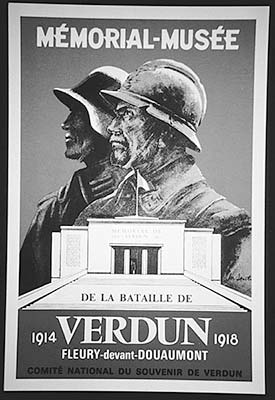
This museum delivers gripping exhibits on the 300 days of the Battle of Verdun, with lots of information in English. Allow a minimum of one hour to visit.
Cost and Hours: €12, €14.50 combo-ticket includes one other monument—choose Fort Douaumont, €17 ticket includes two more; daily 9:30-18:30, until 17:00 in winter, closed Jan; last entry one hour before closing; rooftop snack bar, +33 3 29 88 19 16, http://memorial-verdun.fr.
Visiting the Museum: The ground floor sets the scene with videos and exhibits that draw you into the battle. Start 10 steps past the turnstile at a small screen for a breathtaking five-minute review of “why WWI.” The museum is rich in artifacts and pairs both German and French exhibits. Displays help you imagine the experiences of men on the front line. You’ll see soldiers’ personal effects, uniforms, guns, airplanes, stacks of artillery shells, trucks, and more. A battlefield replica lies below you, visible through the glass floor, complete with mud, shells, trenches, and WWI military equipment. You’ll learn about shrapnel, medical help in the trenches, and leaps in technology (from X-ray machines to machine guns shooting through airplane propeller blades). It was the end of horses and the start of ergonomic helmets. Sitting under a wall of faces, page through letters to loved ones sent from the trenches.
The upper floor continues with exhibits providing a broader context for the Battle of Verdun and World War I, from trench art to the role of women in World War I to propaganda. You can’t help but see how, before 1914, propaganda, nationalism, and isolation from other cultures (lack of travel) was a tragically explosive mix. Your visit finishes on the top floor with a terrace overlooking the actual battlefields and a virtual reality experience allowing you to imagine how the scene appeared during the battle.
From this museum, it’s a chilling 10-minute walk through the wooded yet bomb-pitted terrain to the destroyed village of Fleury, and a 20-minute walk on a trail to the cemetery at the base of the ossuary (trail starts across the road from the museum).
Destroyed Village of Fleury (Village Détruit de Fleury)
Thirty villages caught in the hell of Verdun were destroyed. Nine—like Fleury—were never rebuilt. Though gone, these villages (signposted as Villages Détruites) have not been forgotten: A ceremonial mayor represents each village and works to preserve its memory.
Photos at the roadside pullout show Fleury before and after its destruction. Stroll through the cratered former townscape. The rebuilt church stands where the village church once did. Plaques locate the butcher, the baker, and so on. There’s also a memorial to two French officers who were executed by the French military because, by leaving the battlefield briefly to take a wounded soldier to safety, they disobeyed the order to “stand your ground until the last drop of blood.” Ponder the land around you. Not one square meter was left flat or unbombed.
• Drive on, following signs to the tall, missile-like building surrounded by a sea of small white crosses.
▲Douaumont Ossuary (L’Ossuaire de Douaumont)
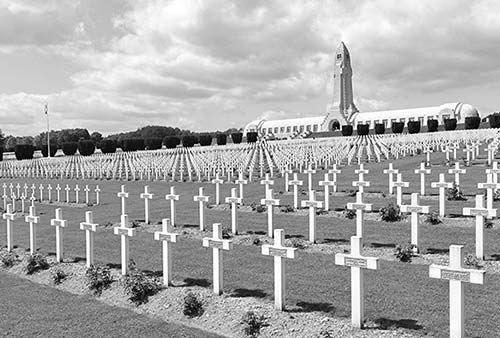
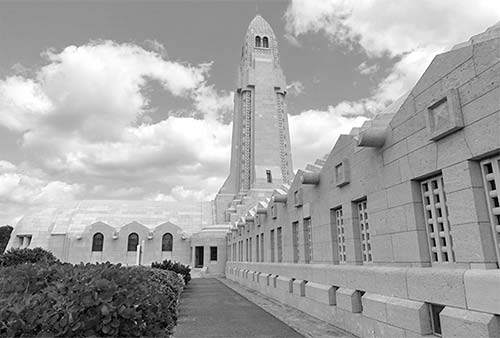
This is the tomb of countless unknown French and German soldiers who perished in the muddy trenches and fields of Verdun. In the years after the war, a local bishop wandered through fields of bones—the bones of an estimated 100,000 French soldiers and even more German soldiers. Concluding there needed to be a respectful final resting place, he began the project in 1920. It was finished in 1932. The unusual artillery shell-shaped tower and cross design of this building symbolizes war...and peace (imagine a sword plunged into the ground up to its hilt). Over time, fewer visitors come as pilgrims and more as tourists. Yet even someone who’s given little thought to the human cost of this battle of attrition will be deeply moved by this somber place.
Cost and Hours: Free entry, €6 for film and tower; Mon-Fri 9:00-18:00, Sat-Sun 10:00-18:00; closes at 17:30 off-season, closed Jan; +33 3 29 84 54 81, www.verdun-douaumont.com [URL inactive].
Eating: The nearby $$ Café Abri des Pèlerins is the only real restaurant among all these Verdun monuments. Thankfully, it serves excellent-value lunches (daily 10:00-18:00, 300 yards beyond the Ossuary on the road to Douaumont, 1 Place Monseigneur Ginisty, +33 3 29 85 50 58).
Visiting the Ossuary: Look through the low windows in the back of the building at the bones of countless unidentified soldiers. From there, steps lead down to the shop and theater where you can see the excellent 20-minute film (shows on the half-hour; English speakers get headphones) and hike 200 steps up the tower (skippable). Appropriate attire is required, and men are asked to remove their hats.
The Mémorial Ossuaire is a humbling, moving tribute to the soldiers who believed the propaganda that this “Great War” would be the war to end all wars. The building has 22 sections with 46 granite graves, each holding remains from different sectors of the battlefields. Those who donated to the construction (in the 1920s) got a plaque for their loved one: the soldier’s name, rank, regiment, and dates of birth and death. In the chapel, stained-glass windows (circa 1920) honor priests, nurses, stretcher bearers, and mothers—all of whom contributed and suffered.
Outside, in front, walk through the cemetery and reflect on a war that ruined an entire generation, leaving more than 70 percent of all French soldiers dead, wounded, or missing. Rows of 16,000 Christian crosses and Muslim headstones (the latter gathered together and oriented toward Mecca), all with red roses, decorate the cemetery.
Very near the main cemetery you’ll find memorials to the Muslim and Jewish victims of Verdun. The Muslim memorial (situated below and across the street from the cemetery) recalls the 600,000 “colonial soldiers” (mostly from North Africa) who fought for France. These men, often thrown into the most suicidal missions, were considered instrumental in France’s ultimate victory at Verdun (a fact overlooked by anti-immigration, right-wing politicians in France today).
French Jews also fought and died in great numbers. The Jewish memorial (which you’ll pass as you drive out of the ossuary) survived World War II. That’s because the Nazi governor of this part of France, who had fought at Verdun and respected soldiers of any faith, covered it up.
• Leaving the ossuary parking lot, follow signs to the...
Bayonet Trench (Tranchée des Baïonnettes)
There is a legend that an entire company of French troops was buried in their trench by an artillery bombardment—leaving only their bayonets sticking above the ground to mark their standing graves. The memorial to this “bayonet trench” is a few hundred yards beyond the ossuary. The bulky concrete monument, donated by the US and free to enter (notice the inscription reading “Leurs frères d’Amérique,” meaning “Brothers from America”) opened in 1920, and was the first such monument at Verdun.
In fact, most of the Third Company of the 137th Infantry Regiment likely died in battle—still tragic, just not quite as vivid as the myth. The notion of the bayonet trench could have come from the German habit of making “gun graves”—burying dead French soldiers with their guns sticking up so that their bodies could be found later and given a proper burial. Walking around this monument provides a thought-provoking opportunity to wander into the silent and crater-filled forest that now blankets the battlefields of Verdun.
• Backtrack toward the ossuary and follow signs to Fort de Douaumont. Between the ossuary and the fort, on either side of the road, you’ll pass what remains of the London Communication Trench. This served as a means of communication and resupply for Fort Douaumont. As you explore, be careful of rusty rebar spiking up randomly.
▲Fort Douaumont (Fort de Douaumont)
This was the most important stronghold among 38 hilltop fortifications built to protect Verdun after Germany’s 1871 annexation of Alsace and the Moselle region of Lorraine. First constructed in 1882, it was built atop and into the hillside and ultimately served as a strategic command center for both sides at various times. Soldiers were protected by a thick layer of sand (to absorb explosions) and a wall of concrete five to seven feet thick. Inside, there are two miles of cold, damp passageways.
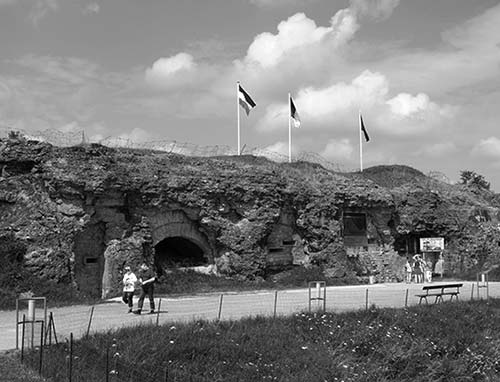
Cost and Hours: €4, includes excellent 45-minute audioguide; daily May-June and Sept-Oct 10:00-18:30, July-Aug until 19:00, shorter hours off-season, closed Jan; +33 3 55 25 01 16.
Visiting the Fort: Experiencing these drippy, dark corridors will add to your sympathy for the soldiers who lived here like moles. Climb to the bombed-out top of the fort and check out the round, iron-gun emplacements that could rise and revolve. The massive central gun turret was state of the art in 1905, antiquated in 1915, and essentially useless when the war arrived in 1916. Speaking of useless, the fort had been abandoned by the French in 1915, assuming it was no match for Germany’s powerful artillery—the Germans entered it unopposed in February 1916, just three days into the battle of Verdun. From the top, look out at fields leading to Germany.
Notice again the beautiful sight of a German flag waving with the French and European flags as if to exclaim, “We won’t do this again.” Say what you like about the European Union, its great accomplishment has been to weave together the economies of France and Germany, uniting them and effecting a shared empathy. In 1914, Germans and French could kill each other indiscriminately because most Frenchmen had never met a German, and vice versa. Today, thanks largely to the EU, it’s a different world, with a solid foundation for European peace.
OTHER WWI BATTLEFIELDS AND MEMORIALS
To see the place where US Army General John Pershing’s troops fought, take a side trip 45 minutes south to St-Mihiel. Here you’ll find full-scale battle trenches (the French used sandbags, the Germans used concrete) and appreciate how close the opposing sides were. Nearby you can visit the American Cemetery and Memorial, and a bit farther on, the Montsec Monument, with a fine tribute to American soldiers and good views over the battlefields. The Verdun TI can provide maps, directions, and other information for this trip.
Countless WWI sites and memorials stretch all along the Western Front from Flanders (near the English Channel) to Hartmannswillerkopf (near the Swiss border) and welcome the public. In this book I’ve laid out what I consider the most interesting and powerful single day of WWI sightseeing at Verdun, but travelers with more interest and time can make an entire tour out of visiting these WWI sites.