PARIS
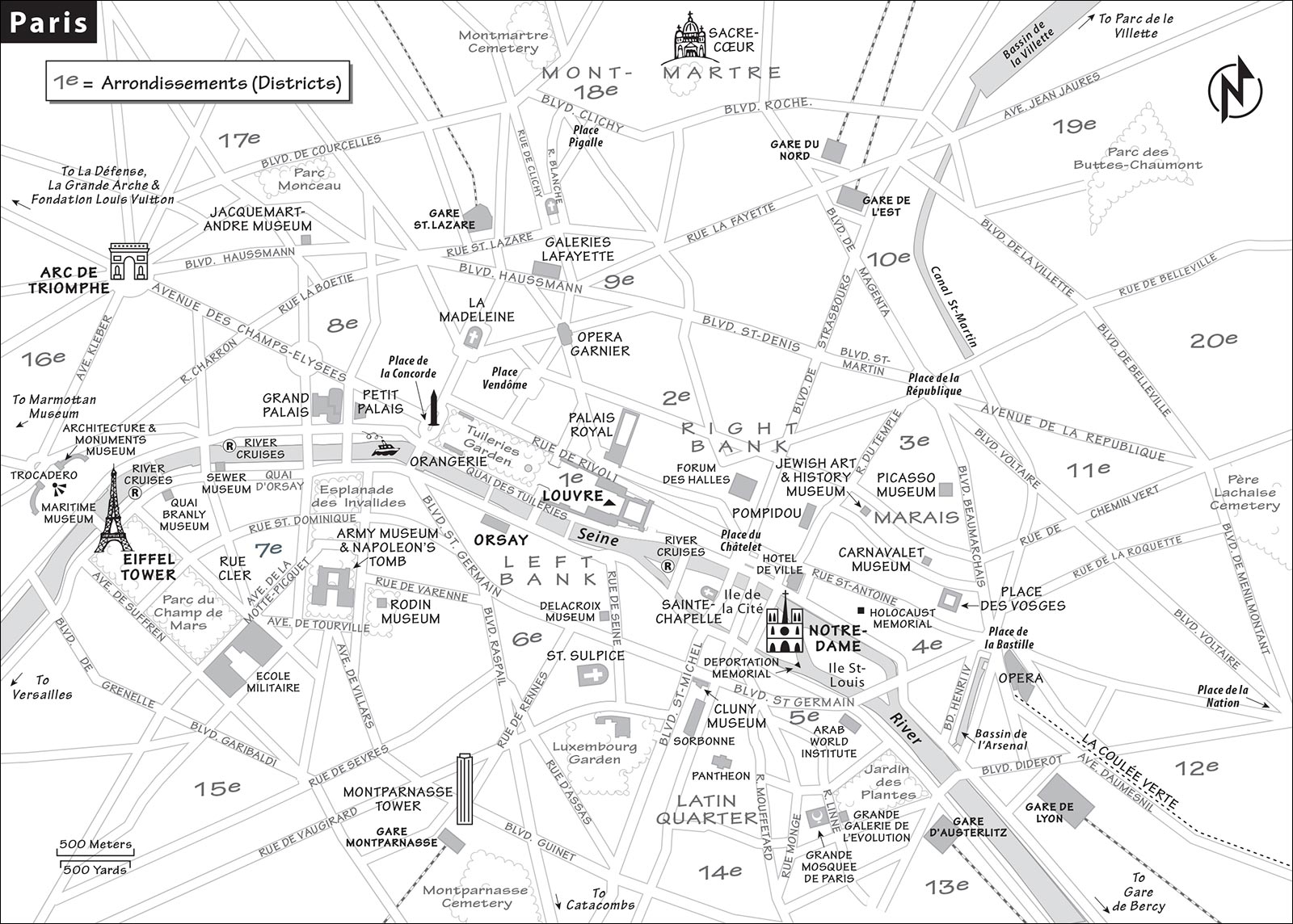
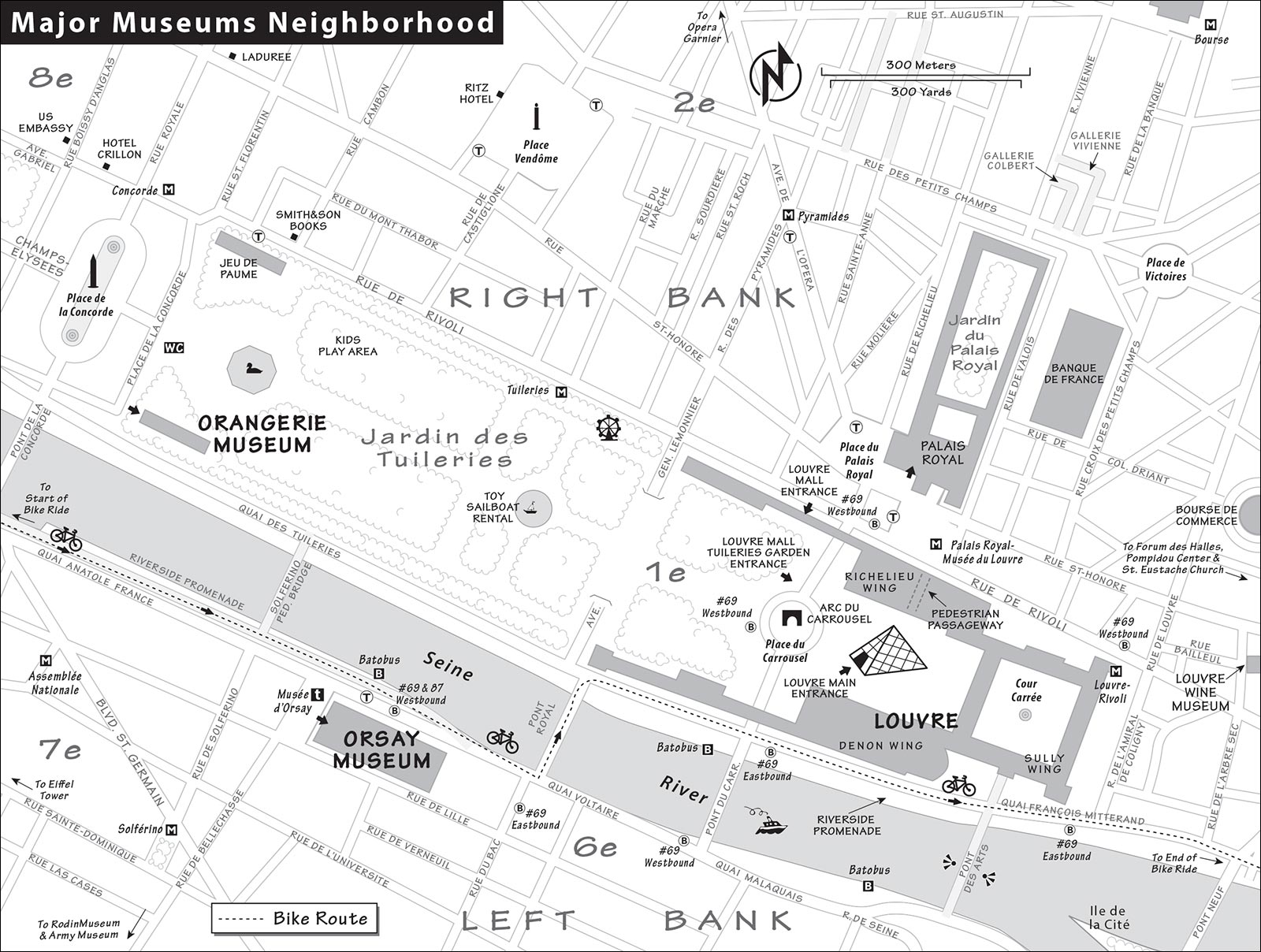
Map: Major Museums Neighborhood
Map: Orsay Museum—Ground Floor
Map: Post-Impressionism—Level 5
Map: Restaurants on the Left Bank
IN MONTMARTRE, NEAR SACRE-CŒUR
Map: Charles de Gaulle Airport
Paris—the City of Light—has been a beacon of culture for centuries. As a world capital of art, fashion, food, literature, and ideas, it stands as a symbol of all the fine things human civilization can offer.
Paris offers sweeping boulevards, riverside book stalls, world-class art galleries, and farmers markets. Enjoy cutting-edge architecture, medieval tapestries, Gothic cathedrals, and an efficient Métro system that whisks you wherever you want to go. Sip un café crème with intellectuals at a sidewalk café, then step into an Impressionist painting in a tree-lined park.
Paris’ sights are incomparable. Visit Mona Lisa and Venus de Milo at the Louvre, and marvel at the buoyant art of Monet and Renoir at the Orsay. Cruise the Seine, pay homage to beloved Notre-Dame Cathedral (still recovering from a devastating fire), zip to the top of the Eiffel Tower, and saunter down Avenue des Champs-Elysées. Save some after-dark energy for one of the world’s most romantic cities.
PLANNING YOUR TIME
If you have only one day, just do Day 1; for two days, add Day 2, and so on. When deciding where to plug in Versailles (see next chapter), remember that the main palace is closed on Mondays.
Day 1: Follow my Historic Paris Walk. In the afternoon, tour the Louvre. If you appreciate medieval art, visit the Cluny Museum. Enjoy a twilight ride up the Eiffel Tower and the Place du Trocadéro scene at its feet.
Day 2: Stroll the Champs-Elysées from the Arc de Triomphe to the Tuileries Garden. Tour the Orsay Museum. Take a nighttime tour by taxi/Uber, bus, or retro-chic Deux Chevaux car.
Day 3: Take the train to Versailles and tour the Château, then either sample the Gardens or return to Paris for more sightseeing. In the evening, cruise the Seine River or have dinner on Ile St. Louis, then take a floodlit walk by Notre-Dame.
Day 4: Browse the morning market in the Rue Cler neighborhood, and spend the afternoon sightseeing at the Rodin Museum and the Army Museum and Napoleon’s Tomb.
Day 5: Ride scenic bus #69 to the Marais and tour this neighborhood, including the Carnavalet Museum and Pompidou Center. In the afternoon, visit the Opéra Garnier, and end your day with rooftop views at the Galeries Lafayette or Printemps department stores.
Day 6: Visit arty Montmartre and the Sacré-Cœur Basilica. Have lunch in Montmartre. Continue your Impressionist theme by touring the Orangerie.
Day 7: See more in Paris (such as Left Bank shopping, Père Lachaise Cemetery, Marmottan Museum), or day-trip to Chartres or Giverny.
Orientation to Paris
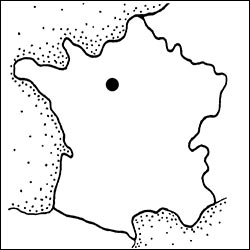
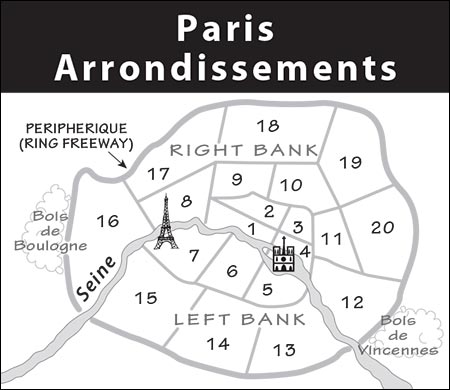
Paris is made up of 20 arrondissements (administrative districts) that spiral out from the center like an escargot shell. If your hotel’s zip code is 75007, you know (from the last two digits) that it’s in the 7th arrondissement. The city is peppered with Métro stops, and most Parisians locate addresses by the closest stop. So in Parisian jargon, the Eiffel Tower is on la Rive Gauche (the Left Bank) in the 7ème (7th arrondissement), zip code 75007, Mo: Trocadéro (the nearest Métro stop).
Historic Core: This area centers on the Ile de la Cité (“Island of the City”), located in the middle of the Seine. On this small island, you’ll find Paris’ oldest sights, from Roman ruins to the medieval Notre-Dame and Sainte-Chapelle churches.
Major Museums Neighborhood: Located just west of the historic core, this is where you’ll find the art-filled Louvre, Orsay, and Orangerie museums and Tuileries Garden.
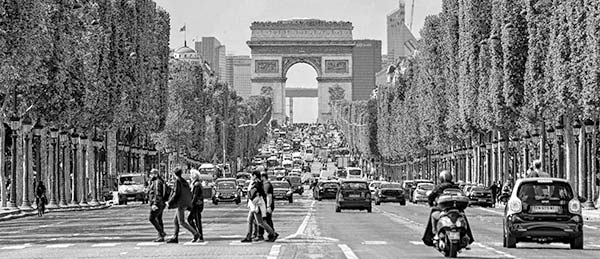
Champs-Elysées: The greatest of the many grand 19th-century boulevards on the Right Bank, the Champs-Elysées runs northwest from Place de la Concorde to the Arc de Triomphe.
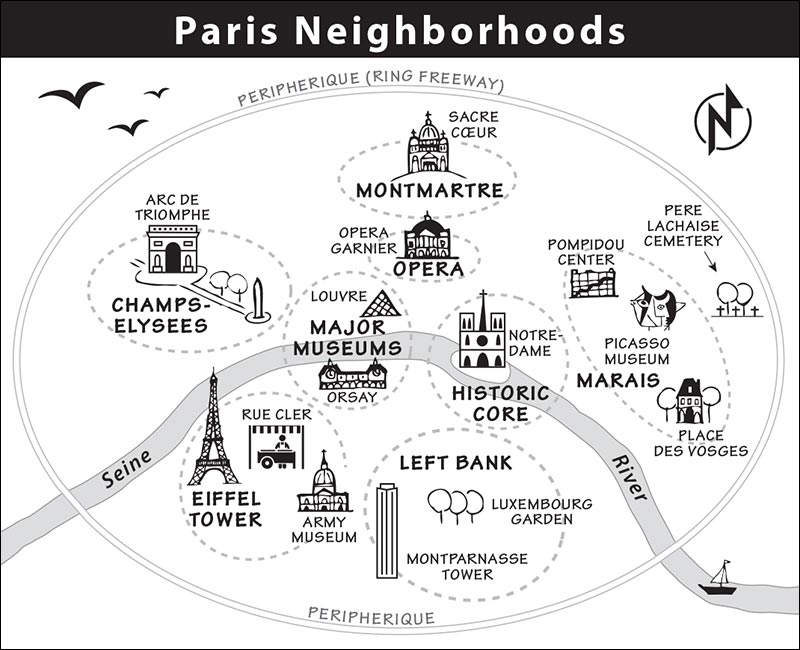
Eiffel Tower Neighborhood: Dominated by the Eiffel Tower, this area also boasts the colorful Rue Cler market street, Army Museum and Napoleon’s Tomb, and Rodin Museum.
Opéra Neighborhood: Surrounding the Opéra Garnier, this classy area on the Right Bank is home to a series of impressive boulevards and sights. Along with elegant sights such as the Opéra Garnier, the neighborhood also offers high-end shopping.
Left Bank: Anchored by the large Luxembourg Garden, the Left Bank is the traditional neighborhood of Paris’ intellectual, artistic, and café life.
Marais: Stretching eastward from the Pompidou Center to the Bastille along Rue de Rivoli/Rue St. Antoine, this neighborhood is home to the delightful Place des Vosges, artistic sights (Pompidou Center, Picasso Museum), and avant-garde boutiques.
Montmartre: This hill, topped by the bulbous white domes of Sacré-Cœur Basilica, hovers on the northern fringes of your Paris map.
TOURIST INFORMATION
Paris’ “TIs” (www.parisinfo.com) can provide useful information. For a small fee, they sell individual tickets to sights and likely also Museum Passes (until the passes become digital-only). TIs also sell tickets to local concerts and events.
The main TI is located at the Hôtel de Ville (daily 10:00-18:00, 29 Rue de Rivoli, on the north side of the building). You’ll find smaller TIs at Gare du Nord (Mon-Sat 8:00-18:00, closed Sun) and at the Puces St. Ouen flea market (Fri-Mon 9:45-13:00 & 14:00-18:00, closed Tue-Thu, 124 Rue des Rosiers). Both airports have handy TIs with long hours.
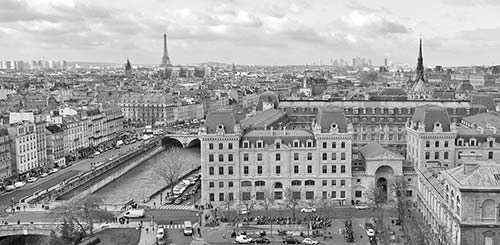
Event Listings: The weekly L’Officiel des Spectacles (available at www.offi.fr or any newsstand) has easy-to-decipher listings of the most up-to-date museum hours, art exhibits, concerts, festivals, plays, movies, and nightclubs. The Paris Voice, with snappy English-language reviews of concerts, plays, and current events, is available online only (www.parisvoice.com).
ARRIVAL IN PARIS
For a comprehensive rundown of the city’s train stations, airports, and options for parking, see “Paris Connections” at the end of this chapter.
HELPFUL HINTS
Theft Alert: Paris is safe in terms of violent crime but is filled with thieves and scammers who target tourists. Some are aggressive—particularly with phone theft. Keep your phone out of sight on Métro rides and in crowded places. Thieves thrive near famous monuments, at ticket lines, and on Métro and train lines that serve airports and high-profile tourist sights. Look out for groups of young people who swarm around you (be forceful and walk away).
It’s also smart to wear a money belt. Put your wallet in your front pocket, loop your day bag over your shoulders, and keep a tight hold on your purse or shopping bag.
Muggings are rare, but they occur. If you’re out late, avoid dark riverfront embankments and any place with dim lighting and few pedestrians.
Tourist Scams: Be aware of the latest tricks, such as the “found ring” scam (a con artist pretends to find a “pure gold” ring on the ground and offers to sell it to you) or the “friendship bracelet” scam (a vendor asks you to help with a demo, makes a bracelet on your arm that seems like it can’t easily be removed, and then asks you to pay for it).
Distractions by a stranger can be a smokescreen for theft. As you try to wriggle away from the pushy stranger, an accomplice picks your pocket. Be wary of a “salesman” monopolizing your attention, an “activist” asking you to sign a petition (and then bullying you into a contribution), someone posing as a deaf person to show you a small note to read, or a sidewalk hawker inviting you to play shell games (their accomplices are likely lurking nearby).
At airports and train stations, be wary of strangers offering help with ticket kiosks (look for a uniformed employee) or offering a ride. To all these scammers, simply say “no” firmly and step away purposefully.
Pedestrian Safety: Parisian drivers are notorious for ignoring pedestrians. Don’t assume you have the right of way, even in a crosswalk. Bikes commonly go against traffic, so always look both ways, even on one-way streets.
Medical Help: There are many English-speaking resources for medical help in Paris, including doctors who will visit your hotel. Try the American Hospital (63 Boulevard Victor Hugo, in Neuilly suburb, +33 1 46 41 25 25, www.american-hospital.org) or SOS Médicins (SOS Doctors, +33 1 47 07 77 77, www.sosmedecins-france.fr).
Smart Sightseeing: Key Paris sights sell tickets in advance online, saving you time by not having to wait in ticket-buying lines. At some sights, you are required to book ahead, including the Louvre, Sainte-Chapelle, and Versailles; for others, like the Orangerie and the Catacombs, it’s advisable. A Paris Museum Pass can help you skip the line at some sights (and can be purchased in advance). For more on these options, see “Sightseeing Strategies,” later.
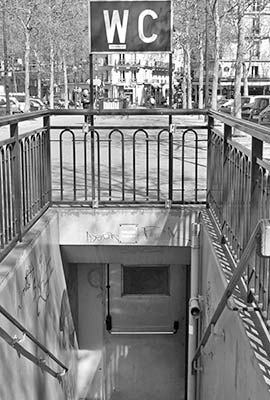
Public WCs: Some public toilets are free, but you get what you pay for. If it’s a pay toilet, the price will be clearly indicated, and the facility should be clean (thank the person who cleans). If there’s an attendant, it’s polite and sometimes required to leave a tip of €0.20-0.50. Booth-like toilets along the sidewalks provide both relief and a memory (don’t leave small children inside unattended). Bold travelers can walk into any sidewalk café like they own the place and find the WC. Or do as the locals do—order a shot of espresso (un café) while standing at the café bar (then use the WC with a clear conscience). Keep toilet paper or tissues with you, as some WCs are poorly stocked.
Tobacco Stands (Tabacs): These little kiosks—often just a counter inside a café—are handy and very local. Many sell public-transit passes, postage stamps (though not all sell international postage), and...oh yeah, cigarettes. To find a kiosk, just look for a Tabac sign and the red cylinder-shaped symbol above certain cafés.
Winter Activities: The City of Light sparkles year-round. For what to do and see in winter months, see www.ricksteves.com/pariswinter.
GETTING AROUND PARIS
Paris is easy to navigate. Your choices are Métro (in-city subway), regional train (commonly called RER—rapid transit tied into the Métro system), longer-distance suburban trains called Transilien, public bus, and taxi or Uber. Several tram (light rail) lines run at street level, accepting the same passes as the bus and Métro, but most travelers will find little use for them. Also consider the hop-on, hop-off bus and boat tours (described under “Tours in Paris,” later).
Public Transit Information: The Métro, RER trains, and public bus systems, all administered by RATP, share one helpful website: www.ratp.fr [URL inactive]. The free RATP app (Bonjour RATP) has a real-time journey planner, lets you buy and top up tickets and passes, can help you locate the best Métro station exit, and can tell you when the next bus will arrive (in English).
Public-Transit Cards and Passes
The following ticket options cover transit on the Métro, public buses, and RER trains. Transit users will need to choose one of these two good options:
Navigo Easy Card: This reloadable card is the easiest option for most tourists. You can add funds to your Navigo Easy card and pay as you ride (one-time €2 fee, €1.90/ride, less for children under 10), or load the card with a 10-ride pass or day pass.
If your rides will be limited to central Paris (Zones 1-2), the 10-ride pass (“Navigo avec un carnet”) is a good deal at €16.90. Frequent riders may want to consider a day pass (Navigo Jour), which expires at midnight and costs €8.50 for Zones 1-2. To reach destinations outside Zones 1-2, you can add zones to your day pass (€14 for Zones 1-4, covers regional destinations like Versailles; €20.10 for Zones 1-5, covers airports and farther-flung destinations).
A Navigo Easy card can be shared between travelers, but not for the same journey (in other words, you can’t hand the card to your travel partner across the turnstile). Each ride with an Easy card is good for 1.5 hours (in one direction, not round-trips) on buses and the Métro, but you can’t transfer from one to the other on the same fare (it’ll take two fares).
To use your Navigo Easy card at the Métro turnstile, touch the card to the purple pad, wait for the green validation light and the “ding,” and you’re on your way.
Navigo Découverte Pass: This chip-embedded pass comes in weekly or monthly versions. The weekly version is a particularly good value and generally pays for itself after four days of typical sightseeing. It costs about €30 and covers all forms of transit from Monday to Sunday (expires on Sunday at midnight, even if you buy it on, say, a Thursday). It’s good for all zones in the Paris region, which means that you can travel anywhere within the city center, out to Versailles, and to Charles de Gaulle and Orly airports (except on Orlyval trains). This is a sensational value if you’re making regional trips. The card requires a one-time €5 fee to purchase and a color photo (can be taken for €5 at photo booths in major Métro stations; otherwise bring a passport-sized photo of yourself).
Buying and Loading a Navigo Card/Pass: You can buy your Navigo Easy card or Découverte pass at any staffed Métro station and at many tabacs. RER stations linking Paris and many regional destinations (including airports) sell the Découverte pass.
You can also buy digital tickets on the Bonjour RATP app. The app lets you top up your Navigo Easy card, but it’s just as easy to use the machines inside Métro stations. Smaller Métro stations may not have staff on hand to sell new cards (find a nearby tabac), but all stations have machines to reload a Navigo Easy card. Some machines accept only credit cards and coins, though key stations have machines that take small bills of €20 or less.
By Métro
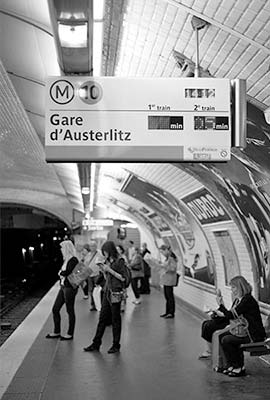
In Paris, you’re never more than a 10-minute walk from a Métro station. Europe’s best subway system allows you to hop from sight to sight quickly and cheaply (runs 5:30-1:00 in the morning, Fri-Sat until 2:00 in the morning). Learn to use it.
Using the Métro System: To get to your destination, determine the closest “Mo” stop and which line or lines will get you there. Lines are color-coded and numbered. You can tell their direction by the end-of-the-line stops. For example, the La Défense/Château de Vincennes line, also known as line 1 (yellow), runs between La Défense on its west end and Vincennes on its east end. Once in the Métro station, you’ll see the color-coded line numbers and/or blue-and-white signs directing you to the train going in your direction (e.g., direction: La Défense). Scan your Navigo card at the turnstile. Fare inspectors regularly check for cheaters, accept absolutely no excuses, and have portable credit card machines to fine you €60 on the spot.
• Download the Bonjour RATP app for real-time transit info.
• Buy a Navigo Easy card, Navigo Jour day pass, or Navigo Découverte pass. These are good on city buses, the Métro, and RER trains. You can also ride RER or Transilien commuter trains to several regional destinations with the Découverte pass, or with an Easy card or Navigo Jour day pass that covers up to zones 4 and 5.
• Scan your card at the turnstile or on the bus: Touch it to the purple pad and wait for the green validation light.
• Beware of pickpockets.
• Find your train by its end-of-the-line stop.
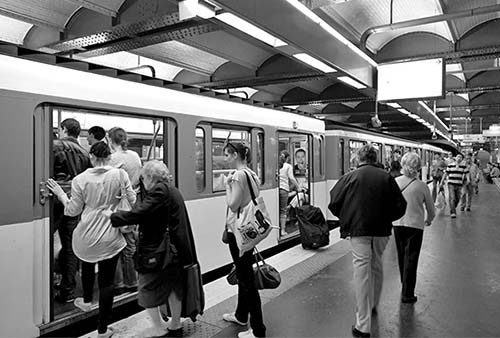
• Safeguard your belongings; avoid standing near the train doors with luggage.
• At a stop, the door may open automatically. If it doesn’t, open the door by either pushing a square button (green or black) or lifting a metal latch.
• Transfers (correspondances) between the Métro and RER trains are free (but not between Métro/RER trains and buses).
Transfers are free and can be made wherever lines cross, provided you do so within 1.5 hours and don’t exit the station. When you transfer, follow the appropriately colored line number and end-of-the-line stop to find your next train, or look for Correspondance (Connection) signs that lead to your next line.
When you reach your destination, blue-and-white Sortie signs point you to the exit. Before leaving the station, check the helpful Plan du quartier (map of the neighborhood) to get your bearings.
Métro Resources: Métro maps are in this book, free at Métro stations, online at www.ratp.fr [URL inactive], and included on freebie Paris maps at your hotel.
Beware of Pickpockets: Thieves dig public transit. You’ll hear regular announcements in the Métro to beware of les pickpockets (mobile phones are the most popular target). Keep nothing of value in your pockets, tuck your phone out of sight, and take care when buying tickets (watch your back).
By Regional Train (RER)
RER regional trains are an arm of the Métro, serving outlying destinations such as Versailles and Paris airports. These routes are indicated by thick lines on your subway map and identified by the letters A-K. Throughout this book, I refer to this train system as “RER.”
Within the city center, the RER works like the Métro; it can even be speedier if it serves your destination directly, because it makes fewer stops. Unlike the Métro, not every RER train stops at every station along the way; check the sign or screen over the platform to see if your destination is listed as a stop (“toutes les gares” means it makes all stops along the way).
Métro passes are good on the RER; you can transfer between the Métro and RER systems with the same Navigo card or pass. But to travel outside the city (to Versailles or the airport, for example), you’ll need to have a Navigo Découverte pass or Easy card Navigo Jour day pass (zones 1-5), or buy a separate ticket.
By Transilien Train
These commuter trains, part of the national rail service SNCF, run from major train stations and serve longer distance, suburban destinations like Versailles with faster service than via RER. Any Navigo card or pass that covers five zones will work for these destinations. See Transilien.com for more info.
By City Bus
Paris’ excellent bus system is worth figuring out. Buses require less walking and fewer stairways than the Métro, and you can see Paris unfold as you travel.
Bus Stops: Stops are everywhere, and most come with a good city bus map, route maps for each bus that stops there, a frequency chart and schedule, live displays showing the time the next bus will arrive, a plan du quartier map of the immediate neighborhood, and a soirées map explaining night service, if available (there are even phone chargers at some locations). Bus-system maps are also available in most Métro stations.
Using the Bus System: Buses use the same Navigo cards and passes as the Métro and RER. Buy your Navigo Easy card before boarding the bus (available at staffed Métro stations and many tabacs). Note that it may no longer be possible to buy single-ride tickets from the driver.
When a bus approaches, wave to the driver to indicate that you want to be picked up. Board through the front door. Scan your Navigo card on the purple touchpad, then keep track of which stop is coming up next by following the onboard stop display and route diagrams or listening to recorded announcements. When you’re ready to get off, push the red button to signal you want a stop, then exit through the central or rear door.
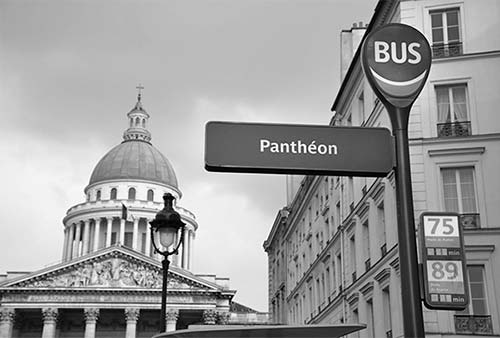
More Bus Tips: Avoid rush hour (Mon-Fri 8:00-9:30 & 17:30-19:30), when buses are jammed and traffic doesn’t move. Navigo Easy card holders can transfer from one bus to another on the same fare (within 1.5 hours). However, you can’t do a round-trip or hop on and off on the same line using the same fare. You can use the same fare to transfer between buses and trams, but you can’t transfer between the bus and Métro/RER regional train systems (it’ll take two fares). Before you board the bus, check the screen on the front: If the line number appears with a slash, it means the bus does not go to the end of line (called service partiel).
By Uber
Uber works in Paris like it does at home. Prices are roughly the same as taxis (and sometimes more due to dynamic pricing), but you can generally get an Uber within five minutes wherever you are, you don’t have to track down a taxi stand, and you can message the driver if you don’t see the car (most speak some English). Uber is less appealing during rush hour, when taxis can use taxi/bus lanes while Uber drivers sit in traffic, and for transfers from Paris’ airports to the city center (taxis have flat rates and designated pick-up areas; Uber uses dynamic pricing and you’ll need to arrange a pick-up point).
By Taxi
Parisian taxis are reasonable, especially for couples and families. Fares and supplements (described in English on the rear windows) are straightforward and tightly regulated. Cabbies are legally required to accept four passengers, though they don’t always like it. If you have five in your group, you can book a larger taxi in advance (your hotelier can call), or try your luck at a taxi stand. A surcharge may be applied for a fifth rider.
Rates: The meter starts at €2.60 with a minimum charge of €7.30. A typical 20-minute ride (such as Bastille to the Eiffel Tower) costs about €25 (versus about €2/person on the Métro or bus). While drivers should accept credit cards, they prefer cash, and some will claim that their credit card machine isn’t working. Taxi drivers charge higher rates at rush hour, at night, all day Sunday, and for extra passengers. To tip, round up to the next euro (at least €0.50). The A, B, or C lights on a taxi’s rooftop sign correspond to hourly rates, which vary with the time of day and day of the week. Tired travelers need not bother with the subtle differences in fares—if you need a cab, take it.
How to Catch un Taxi: You can try waving down a taxi, but it’s often easier to ask someone for the nearest taxi stand (“Où est une station de taxi?”; oo ay ewn stah-see-ohn duh tahk-see). Taxi stands are indicated by a circled “T” on good city maps and on many maps in this book. To order a taxi in English, call the reservation line for the G7 cab company (+33 1 41 27 66 99), or ask your hotelier or server to call for you. When you summon a taxi by phone, a set fee of €4 is applied for an immediate booking or €7 for reserving in advance (this fee will appear on the meter when they pick you up). You can also book a taxi using the cab company’s app, which provides approximate wait times (surcharge similar to booking by phone). To download an app, search for either “Taxi G7” or “Taxis Bleus” (the two major companies, both available in English; when entering your mobile number, use “+1” before the area code for a US/Canadian phone number).
If you need to catch an early morning train or flight, book a taxi the day before.
By Bike
Paris is surprisingly easy by bicycle. The city is flat, and riders have access to more than 370 miles of bike lanes and many of the priority lanes for buses and taxis (be careful on these).
Bike Routes: Though I wouldn’t use bikes to get around routinely (traffic is a bit too intense), they’re perfect for a joyride away from busy streets, especially on the riverside promenades. A four-mile car-free stretch runs along the Seine through the heart of the city, from near the Eiffel Tower to below Place de la Bastille; the round-trip ride makes a wonderful experience of about an hour or so (see “Eiffel Tower & Nearby” map on here for the beginning of the route). It could be much longer if you succumb to the temptations of the lounge chairs, hammocks, outdoor cafés, and simple delights of riverside Parisian life.
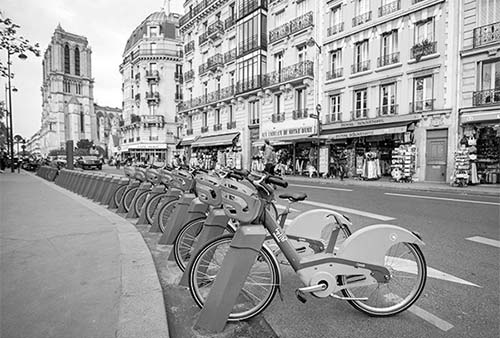
Bike-rental shops also have good route suggestions. TIs have a helpful “Paris à Vélo” map, which shows all dedicated bike paths. For information on bike tours, see “Tours in Paris,” later.
Bike Rentals: You can rent from a shop or use the city-operated Vélib’ bikes. Bike About Tours is your best bet for bike rental, with good information and kid-friendly solutions such as baby seats, tandem attachments, and kid-sized bikes. Their office/café, Le Peloton, offers bikes, tours, and artisan coffee (daily 9:30-17:30, shop/café near Hôtel de Ville at 17 Rue du Pont Louis Philippe—see map on here, Mo: St-Paul, +33 6 18 80 84 92, www.bikeabouttours.com).
Fat Tire Tours has a limited supply of bikes for rent, so call ahead to check availability (RS%—€2/day rental discount with this book, 2-discount maximum; daily 9:00-18:30, bike rental only after 11:00 as priority is given to those taking a tour, near the Eiffel Tower at 24 Rue Edgar Faure—see map on here, Mo: Dupleix or La Motte-Picquet-Grenelle, +33 1 82 88 80 96, www.fattiretours.com/paris).
The city’s Vélib’ bike program (from vélo + libre = “bike freedom”) scatters thousands of bikes at racks across town for use by locals and tourists alike. This is a great option for one-way trips or rentals of a few hours or less. Though you can head straight to a ticket machine at the bike racks, it’s easy to create an account and reserve bikes on the easy-to-use Vélib’ app or at Velib-Metropole.fr [URL inactive]. You’ll pay €3 for 45 minutes (regular or electric bike); every 30 minutes after that costs €1 for a regular bike or €2 for electric. Longer passes (24 hours or 3 days) are available. The Vélib’ app uses GPS to track nearby rack locations and shows which have available bikes and spaces.
You can also rent bikes with the easy-to-use Lime Bike app.
Tours in Paris
 To sightsee on your own, download my free audio tours that illuminate some of Paris’ top sights and neighborhoods, including Historic Paris and Rue Cler walks, and tours of the Louvre Museum, Orsay Museum, Père Lachaise Cemetery, and Versailles Palace (for details, see the sidebar on here). Some tour companies offer a discount when you show this book (indicated in these listings with the abbreviation “RS%”).
BY BUS
Paris has a variety of bus tours, but the cheapest way to see the city by bus is simply to hop on city bus #69 (see sidebar, earlier).
Hop-On, Hop-Off Bus Tours
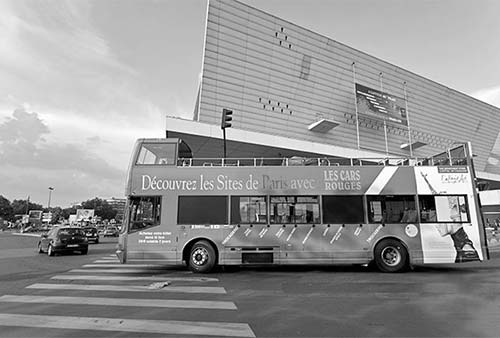
Several companies offer double-decker bus services connecting Paris’ main sights, giving you an easy once-over of the city with a basic recorded commentary. Buses normally run about 9:30-19:00 in high season (with later nighttime tours too). You can hop off at any stop, tour a sight, then hop on a later bus. It’s dang scenic—if you get a top-deck seat and the weather’s decent. But because of traffic and stops, these buses are sloooow. (Busy sightseers will do better using the Métro.) On the plus side, because the buses move so slowly, you have time to read my sight descriptions, making this a decent orientation tour—and there’s free Wi-Fi on board. Buy tickets from the driver or online.
TootBus has several ticket options with reasonably frequent service on a well-designed, 10-stop route covering central Paris. You can catch the bus at just about any major sight (look for the TootBus icon on public transit bus shelters and signs). Tickets are valid only for the days you purchase them, so get started early (€35-€44 for 1-3 days, €29 for 2-hour “express tour,” www.tootbus.com).
Big Bus Paris runs a fleet of buses around Paris with recorded narration—or use their better free app for sight descriptions (€38 for 1 day, €49 with river cruise, €59 for 2 days with river cruise, €19-30 for kids 4-12, www.bigbustours.com).
BY BOAT
Seine Cruises
Several companies run one-hour boat cruises on the Seine. A typical cruise loops back and forth between the Eiffel Tower and Pont d’Austerlitz, and drops you off where you started. For a fun experience, cruise at twilight or after dark. The first three companies run daily year-round (April-Oct 10:00-22:30, 2-3/hour; Nov-March shorter hours, runs hourly). Check their websites for discounts.
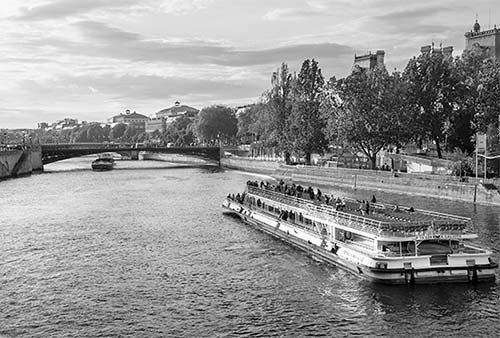
Bateaux-Mouches cruises depart from Pont de l’Alma’s right bank and have the biggest open-top, double-decker boats (higher up means better views). But this company caters to tour groups, making their boats jammed and noisy (€15, kids 4-12-€6, +33 1 42 25 96 10, www.bateaux-mouches.fr).
Bateaux Parisiens has smaller boats with audioguides, fewer crowds, and only one deck. Skip this cruise if the boat lacks an outdoor deck. It leaves from right in front of the Eiffel Tower (€17, kids 3-12-€7.50, +33 1 76 64 14 45, www.bateauxparisiens.com).
Vedettes de Paris boats also anchor below the Eiffel Tower and offer good outdoor seating on most of their boats plus a small bar onboard. Their round-trip allows a stopover to explore the Notre-Dame area and catch the next boat back (€20, +33 1 44 18 19 50, www.vedettesdeparis.fr).
Vedettes du Pont Neuf offers essentially the same one-hour tour as the other companies with smaller boats; it starts and ends at Pont Neuf. The boats feature a live guide whose delivery (in English and French) may be as stiff as a recorded narration (€13, kids 4-12-€6, tip requested, nearly 2/hour, daily 10:30-22:30, other cruises available—check online, +33 1 46 33 98 38, www.vedettesdupontneuf.com).
Canauxrama runs a variety of relaxing cruises (with live commentary) on the Seine or along the tranquil Canal St. Martin (€20, check online for routes, +33 1 42 39 15 00, www.canauxrama.com).
Hop-On, Hop-Off Boat Tour
Batobus allows you to get on and off as often as you like at any of eight popular stops along the Seine. Boats make a continuous circuit and stop in this order: Eiffel Tower, Invalides, Orsay Museum, St. Germain-des-Prés, Notre-Dame, Jardin des Plantes, Hôtel de Ville, the Louvre, and Pont Alexandre III, near the Champs-Elysées (1 day-€19, 2 days-€21, boats run every 15 minutes 10:00-21:30 in April-Aug, every 20 minutes and shorter hours in off-season, 45 minutes one-way, 1.5-hour round-trip, www.batobus.com). This is fun as a scenic, floating alternative to the Métro, but if you just want a guided boat tour, the Seine cruises described above are a better choice.
ON FOOT
Walking Tours
For food-oriented walking tours, see here.
Paris Walks offers a variety of thoughtful and entertaining two-hour walks, led by British and American guides (€15-25, generally 2/day, morning and afternoon—must reserve in advance, best by email; private tours available, family-friendly and Louvre tours are a specialty, check current offerings online, +33 1 48 09 21 40, www.paris-walks.com, paris@paris-walks.com). Besides neighborhood walks, tour themes span the Occupation and Resistance, the Revolution, and Hemingway’s Paris. For specialty tours—such as the Louvre, Orsay, fashion, or chocolate—you’ll prepay when you reserve (deposits are nonrefundable).
Context Travel offers private and small-group walking tours for travelers serious about learning. Led by historians, architects, and academics, tours range from traditional topics (French art history in the Louvre, Gothic architecture of Notre-Dame, etc.) to neighborhood explorations. They also run small-group excursions to Normandy, Versailles, Giverny, and other regions in France. Book in advance—group sizes are limited (Paris walking tours from €130/person, does not include sight admissions, generally 3 hours, US +1 800 691 6036, www.contexttravel.com, info@contexttravel.com).
Fat Tire Tours offers high-on-fun and casual walking tours, including neighborhood walks and themed walks (French Revolution and more). Their “Skip the Line” tours get you into major sights (such as Versailles) but are most worthwhile for the Eiffel Tower and Catacombs. Reservations are required and can be made online, by phone, or in person at their office near the Eiffel Tower (from €25/person for walking tours, from €52/person for “Skip the Line” tours; RS%—€2 off/person, 2-discount maximum; for contact details, see Fat Tire listing earlier, under “Getting Around Paris—By Bike”).
Paris Muse Tours offers guided scavenger hunt-like tours to explore historic areas and sights. Imagine yourself as a detective at the Louvre or a 19th-century art writer at the Orsay, or solve a real-life French Revolution murder mystery on the streets of Paris (€200-450 depending on group size, up to 8 people, 2.5 hours, +33 6 73 77 33 52, https://parismuse.com).
Local Guides
For many, Paris merits hiring a Parisian as a personal guide (€240-300 half-day, €400-500 full day). Thierry Gauduchon is a terrific guide and a gifted teacher (+33 6 19 07 30 77, tgauduchon@gmail.com). Elisabeth Van Hest is another likable and very capable guide (+33 1 43 41 47 31, mobile +33 6 77 80 19 89, elisa.guide@gmail.com). Vincent Cabaret is a fun guide for Paris’ city center, day trips (he’s particularly terrific for Versailles), and beyond (+33 6 82 19 67 23, vincentcabaret@ymail.com). Sylvie Moreau also leads good tours (+33 1 74 30 27 46 or +33 6 87 02 80 67, sylvie.ja.moreau@gmail.com). Arnaud Servignat is a top guide who has taught me much about Paris (also does minivan tours of the countryside around Paris, +33 6 68 80 29 05, www.french-guide.com, arnotour@icloud.com). Joelle Valette-Coat is an effective teacher who takes her art seriously (+33 1 46 06 74 95 or +33 6 86 28 32 20, jvalettecoat@hotmail.com).
ON WHEELS
Bike Tours
Bike About Tours offers easygoing 3.5-hour bike tours through Paris backstreets and past the Louvre, Eiffel Tower, and other classics (€45, RS%—10 percent discount, 12-person maximum group size—reserve online to guarantee a spot or show up and take your chances; for contact info see listing earlier, under “Getting Around Paris—By Bike”).
Over at Fat Tire Tours, a gang of Anglophone expats offers an extensive program of three-hour bike tours of Paris day and night (from €39/person, RS%—€4 off/person, 2-discount maximum, reservations recommended but not required, tours leave daily rain or shine). You’ll pedal with a pack of up to 16 riders, mostly in parks and along bike lanes, with a lunch stop in the Tuileries Garden. Livelier night tours follow a route past floodlit monuments and include a boat cruise on the Seine. (For contact info, see listing earlier, under “Getting Around Paris—By Bike”.) They also run bike tours to Versailles and Giverny.
Boutique Bike Tours is a small, well-run outfit leading good bike tours of Paris (day and night) and Versailles (+33 6 12 61 00 90, www.boutiquebiketours.com).
EXCURSIONS FROM PARIS
You’ll never run out of things to do in Paris, but the outlying areas may lure you out of the city. The grand châteaux at Versailles, Vaux-le-Vicomte, and Fontainebleau; the cathedral at Chartres; Monet’s garden at Giverny; and the artist town of Auvers-sur-Oise are all within reach as day trips. Go on your own, with a bus or minivan tour, or with a local guide: Most of the guides listed earlier will do excursion tours from Paris using your rental car.
The following companies offer convenient transportation and a smidgen of guiding to destinations outside Paris.
Paris Webservices, a reliable outfit, offers private group day trips to Giverny, Auvers-sur-Oise, and Versailles with well-trained, English-speaking chauffeur/guides in cushy minivans (figure €95-140/person for groups of 4 or more, RS%—use code RICK-24-STEVES, +33 9 52 06 02 59, 18 Rue José Maria de Héredia, www.pariswebservices.com).
Paris City Vision runs bus tours to several popular regional destinations (3 Place des Pyramides, Mo: Pyramides, www.pariscityvision.com). Their full-size bus tours are multilingual, mass-marketed, and mediocre at best, but can be worthwhile simply for the ease of transportation to the sights (about €50-170, destinations include Versailles, Giverny, Mont St-Michel, D-Day Beaches, and more).
Sightseeing Strategies
ADVANCE TICKETS
Most sights of any importance in Paris sell tickets online for no additional cost—though some charge a small booking fee. At the Louvre, Sainte-Chapelle, and Versailles, you won’t get in without a timed-entry ticket bought in advance. And, even though advance tickets are not technically required for the Eiffel Tower, Orangerie, Catacombs, and the Orsay, I recommend booking ahead to assure you get your preferred date and time. At some sights, you can drop in and take your chances (but I wouldn’t—unless it’s off-season).
Even where advance tickets are not required, buying ahead lets you avoid slow ticket-buying lines (though you’ll still likely have to wait in a security line). Combine this strategy with a Paris Museum Pass (described next), and you’ll save both time and money at most sights.
You can also buy advance tickets for activities and cultural events such as the Bateaux-Mouches river cruises, Sainte-Chapelle concerts, and performances at the Opéra Garnier.
Booking Tickets in Advance
Buy your ticket online, keep the digital ticket easily accessible on your phone, and bypass any ticket-buying lines when you get to the sight.
Try to book directly on the sight’s official website. The process can be cumbersome, as you may need to create an account and go through several steps. If the website shows no availability, it’s worth trying a third-party seller like FNAC (see “Last-Ditch Ticket Tips,” later).
You’ll select your preferred date and entry time (usually with a 30-minute window to enter), then make the purchase with your credit card. If you have a Paris Museum Pass and are reserving a sight covered by the pass, look for the pass-holder option (sometimes called free ticket option), which lets you book an entry time for free. Some sights (like the Louvre) have limited allocations for pass holders, so their websites may still show entry times available for ticket purchases but none for pass holders.
Once you’ve booked, you’ll receive an email—usually with a QR code—that acts as your digital ticket. (If you don’t get the email, check your junk folder.) When you arrive at the sight, look for a line marked “ticket holders” (avec billet).
PARIS MUSEUM PASS
The Paris Museum Pass admits you to many of Paris’ most important sights over two, four, or six consecutive days (2 days-€55, 4 days-€70, 6 days-€85; no youth or senior discounts, but many museums offer free admission to those under age 18—see “Families,” below). The pass pays for itself with four key admissions in two days (for example, the Arc de Triomphe, Orsay, Sainte-Chapelle, and Versailles). Because the Louvre limits pass-holder ticket allocations, reserving an entry time there can be difficult.
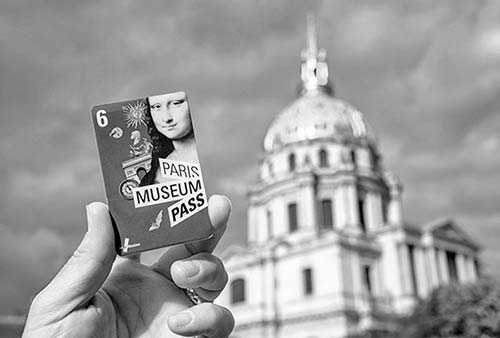
Pertinent details about the pass are outlined here. For more info, and to purchase the pass, visit www.parismuseumpass.com.
Buying the Pass
If you buy the pass online, you can download and print a hard copy to show as you enter museums, or keep it on your phone. The pass may be digital-only by the time you read this; paper passes are being sold—until the stock runs out—at participating museums, monuments, and TIs (including those at Paris airports).
Families: The pass isn’t worth buying for children and teens, as most museums are free or discounted for those under age 18 (teenagers may need to show ID as proof of age). If parents have a Museum Pass, kids can usually skip the ticket lines as well. A few places may require everyone—even pass holders—to stand in line to collect your child’s free ticket.
What the Paris Museum Pass Covers
To determine whether the pass is a good value for your trip, tally up ticket prices for what you want to see and compare against the cost of the pass. The pass covers many of the biggies (Orsay, Saint-Chapelle, Arc de Triomphe, Versailles, Army Museum, and more). But some notable sights are not covered, including the Eiffel Tower, Montparnasse Tower, Marmottan Museum, Opéra Garnier, Sewer Museum, Catacombs, and Sacré-Cœur’s dome. Though the Louvre is covered, it may be hard to get a pass-holder reservation. See the website for complete details.
Using the Pass
At covered sights where reservations are required—such as Versailles—even with the pass you must book a free timed entry online in advance (see “Booking Tickets in Advance,” earlier).
Plan carefully to make the most of your pass. Start using it only when you’re ready to tackle the covered sights on consecutive days. The pass, which allows one entry per sight, is activated at the time of first use and is time-based. For example, a two-day pass gives you 48 hours of use from the time you activate it (so if your first entry is at 13:00, you get 48 hours from 13:00). Make sure the sights you want to visit will be open when you want to go (many museums are closed Mon or Tue).
The pass provides the best value on days when sights close later, letting you extend your sightseeing day. Take advantage of late hours on selected evenings or times of year at sights like the Arc de Triomphe, Pompidou, Orsay, and Cluny.
You can’t skip security lines, though at a few sights (such as the Orsay Museum and Arc de Triomphe) pass holders enjoy “priority lines.” Once you pass security, look for signs designating the entrance for reserved ticket holders.
LAST-DITCH TICKET TIPS
If you can’t get an online reservation for the date you want, you can buy skip-the-line “coupe-file” tickets (pronounced “koop feel”) through third-party vendors—sometimes for a high fee. You’ll find coupe-file tickets at TIs, FNAC department stores (common, ask your hotelier about the nearest one, www.fnactickets.com), and travel-service companies such as Fat Tire Tours (see here). Compare your options: Some allow you to skip the ticket-buying line, while others provide a “guide” to escort you into the sight (small fee at TIs, 10-20 percent surcharge elsewhere).
Historic Paris Walk
Virtual Tour of Notre-Dame’s Interior
4 Deportation Memorial (Mémorial de la Déportation)
9 Cité “Métropolitain” Métro Stop
10 Conciergerie
12 Riverside Promenades and Paris Plages
Paris has been the cultural capital of Europe for centuries. We’ll start where it did, on Ile de la Cité, with a foray onto the Left Bank, on a walk that laces together 80 generations of history—from Celtic fishing village to Roman city, bustling medieval capital, birthplace of the Revolution, bohemian haunt of the 1920s café scene, and the working world of modern Paris. Along the way, we’ll marvel at two of Paris’ greatest sights—Notre-Dame and Sainte-Chapelle. Expect changes in the area around Notre-Dame as the cathedral undergoes reconstruction in the wake of the 2019 fire. (This information is distilled from the Historic Paris Walk chapter in Rick Steves Paris, by Rick Steves, Steve Smith, and Gene Openshaw.)
Length of This Walk: Allow 2 hours to do justice to this three-mile walk (allow 4 hours if you go into Sainte-Chapelle and the Conciergerie). This is the most historically important walk you’ll do in Paris, so don’t rush it. Take breaks at any number of appealing cafés and bistros along the way.
Getting There: The closest Métro stop is Cité (actually on the island).
Paris Museum Pass: Some sights on this walk are covered by the time- and money-saving Paris Museum Pass (see “Sightseeing Strategies,” earlier).
Avoiding Crowds: This area is most crowded from midmorning to midafternoon, especially on Tue (when the Louvre is closed) and on weekends. Generally, come early or as late in the day as possible (while still leaving enough time to visit all the sights).
Sainte-Chapelle has limited space, and bottlenecks to get in are the norm (book an entry time in advance). Its security lines are shortest first thing in the morning, so try for an early reservation. Lacking a reservation, arrive by 9:00 to inquire about available entry times, or arrive late and cross your fingers.
Tours: Download my free Paris Historic Walk audio tour.
 SELF-GUIDED WALK
• Start in front of Notre-Dame Cathedral, the physical and historic bull’s-eye of your Paris map. You’re standing near the center of France: The small bronze plaque called “Point Zero” (embedded in the ground, 30 yards in front of the church—may not be visible) is the point from which all distances from Paris are measured. Before focusing on Notre-Dame, consider stopping in at two sights across the square from the cathedral.
Sights near Notre-Dame
Much of the history of Paris still lies buried in front of the cathedral. Some has been unearthed and put on display in the ▲ Archaeological Crypt, with Roman ruins from Emperor Augustus’ reign (€9, covered by Museum Pass, Tue-Sun 10:00-18:00, closed Mon, enter 100 yards in front of cathedral, www.crypte.paris.fr). Behind the crypt, the ▲▲ Espace Notre-Dame offers two activities: an exhibit on the restoration project and an excellent virtual reality experience called Eternelle Notre-Dame, which takes you from the construction of the church to its near demise (exhibit-free, 45-minute virtual reality experience-€35, both open Tue-Sun 10:00-20:00, closed Mon, entrance is 30 yards behind the Paris Archaeological Crypt as you face Notre-Dame, www.eternellenotredame.com).
• Now turn your attention to the church.
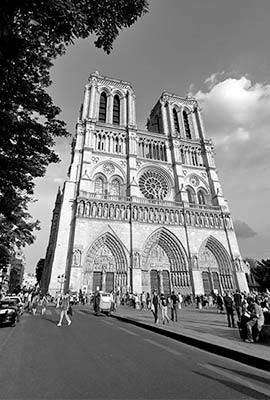
1 Notre-Dame Facade
This 860-year-old cathedral, packed with history, is recovering from a devastating fire in 2019 (though thankfully, much of what made the church’s interior famous was salvaged). While the interior and some of the surrounding areas are closed (interior may reopen later in 2024—check locally), you can still appreciate its monumental exterior. With a pair of 200-foot-tall bell towers, a facade studded with ornate statuary, beautiful stained-glass rose windows, famous gargoyles, a picture-perfect Seine-side location, and textbook flying buttresses, there’s a good reason that this is France’s most famous church—and worth ▲▲▲.
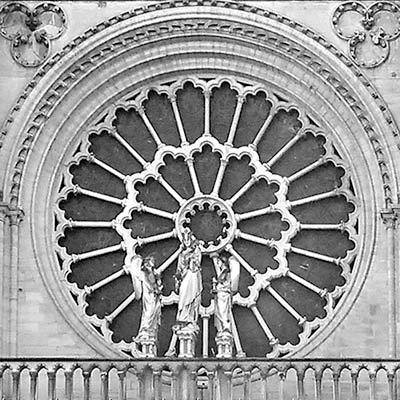
Find the circular window in the center of the facade, which frames a statue of a woman holding a baby. For centuries, the main figure in the Christian pantheon has been Mary, the mother of Jesus. Catholics petition her in times of trouble to gain comfort, and to ask her to convince God to be compassionate with them. This church is dedicated to “Our Lady” (Notre Dame), and there she is, cradling God, right in the heart of the facade, surrounded by the halo of the rose window. Though the church is massive and imposing, it has always stood for the grace and compassion of Mary, the “mother of God.”
Imagine the faith of the people who built this cathedral. They broke ground in 1163 with the hope that someday their great-great-great-great-great-great grandchildren might attend the dedication Mass, which finally took place two centuries later, in 1345. Look up the 200-foot-tall bell towers and imagine a tiny medieval community mustering the money and energy for construction. Master masons supervised, but the people did much of the grunt work themselves for free—hauling the huge stones from distant quarries, digging a 30-foot-deep trench to lay the foundation, and treading like rats on a wheel designed to lift the stones up, one by one. This kind of backbreaking, arduous manual labor created the real hunchbacks of Notre-Dame.
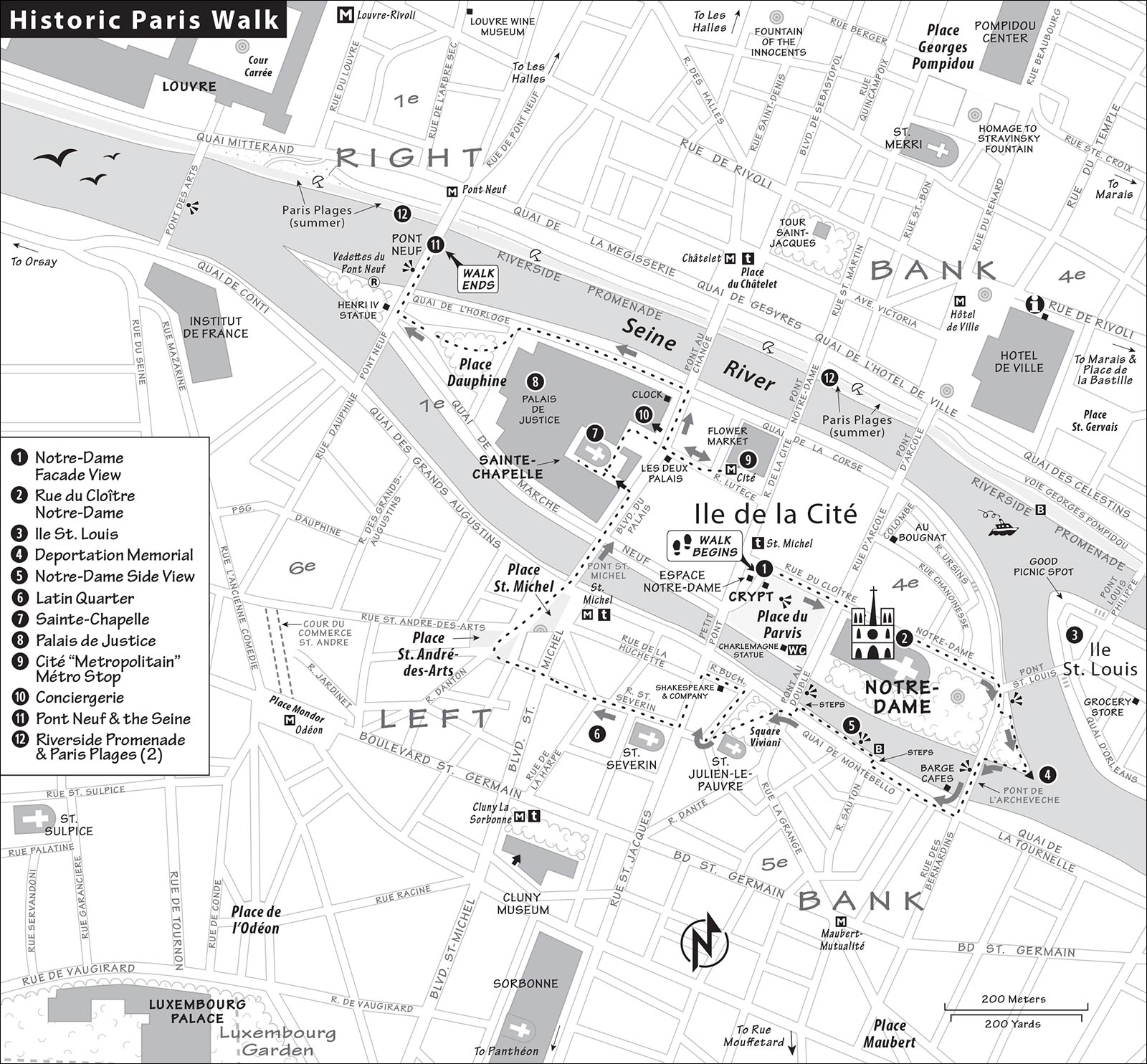
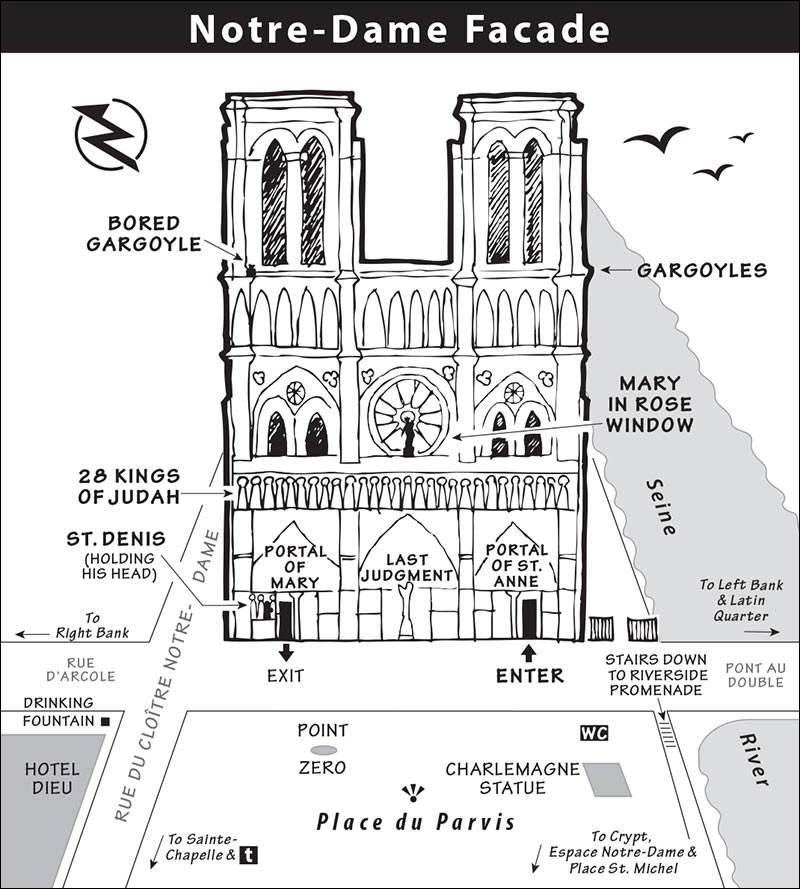
• Looking two-thirds of the way up Notre-Dame’s left tower, you might spot Paris’ most photographed gargoyle. Propped on his elbows on the balcony rail, he watches all the tourists below.
Now, approach closer to the cathedral (as best you can with the construction barriers) to view the statues adorning the church’s left portal. The left doorway is a man with a misplaced head—that’s St. Denis, the city’s first bishop and patron saint. He stands among statues of other early Christians who helped turn pagan Paris into Christian Paris.
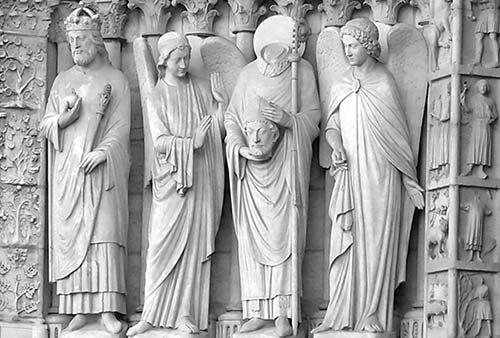
Sometime in the third century, Denis came here from Italy to convert the Parisii. He settled here on the Ile de la Cité, back when there was a Roman temple on this spot and Christianity was suspect. Denis proved so successful at winning converts that the Romans’ pagan priests beheaded him as a warning to those forsaking the Roman gods. But those early Christians were hard to keep down. The man who would become St. Denis got up, tucked his head under his arm, headed north, paused at a fountain to wash it off, and continued until he found just the right place to meet his maker: Montmartre. The Parisians were convinced by this miracle, Christianity gained ground, and a church soon replaced the pagan temple.
Above the doorway arches and scaffolding, you should be able to see a row of 28 statues, known as the Kings of Judah. In the days of the French Revolution (1789-1799), these biblical kings were mistaken for the hated French kings, and Notre-Dame represented the oppressive Catholic hierarchy. The citizens stormed the church, crying, “Off with their heads!” Plop—they lopped off the crowned heads of these kings with glee, creating a row of St. Denises that weren’t repaired for decades.
• Remember that Notre-Dame has been a place of worship for nearly a thousand years. By late 2024, the church’s interior may be open to visitors again. If still closed during your visit, shut your eyes and imagine the church in all its glory. Mentally “step inside” the church to take a...
Virtual Tour of Notre-Dame’s Interior
“Enter” the church like a simple bareheaded peasant of old. Imagine stepping into a dark, earthly cavern lit with an unearthly light from the stained-glass windows. The priest intones the words of the Mass that echo through the hall. Your eyes follow the slender columns up 10 stories to the praying-hands arches of the ceiling. Walk up the long central nave lined with columns and flanked by side aisles. The place is huge—it can hold up to 10,000 faithful for a service.
When you reach the altar, you’re at the center of this cross-shaped church, where the faithful receive the bread and wine of Communion. This was the holy spot for Romans, Christians...and even atheists. When the Revolutionaries stormed the church, they gutted it and turned it into a “Temple of Reason,” complete with a woman dressed like Lady Liberty holding court at the altar.
If you were able to browse around the church, you’d see it’s become a kind of Smithsonian for artifacts near and dear to the hearts of the Parisian people. There’s the venerated Crown of Thorns that supposedly Jesus wore (kept safely in the Treasury). There’s the gilded and enameled reliquary dedicated to St. Geneviève (fifth century), whose prayers saved Paris from Attila the Hun. A painting honors the scholar Thomas Aquinas (1225-1274), who studied at the University of Paris while writing his landmark theological works fusing faith and reason. There’s a statue of Joan of Arc, the teenager who rallied her country to drive English invaders from Paris. (Though she was executed, the former “witch” was later beatified—right here in Notre-Dame.)
The oldest feature inside the church is the blue and purple rose-shaped window in the north transept—still with its original medieval glass.
• Back to reality. Let’s circle around the left (north) side of the church, walking down the street called...
2 Rue du Cloître Notre-Dame
As you head toward the back of the church, you’ll pass fascinating information panels describing the fire and its aftermath, the recovered rooster from the steeple’s top, and the restoration process. You’ll also get up-close views of the building. Notice gaps where stained-glass windows were removed—each panel is being tested for lead to ensure they’re safe for restoration work to begin. Get close to a flying buttress, now supported by wooden structures.
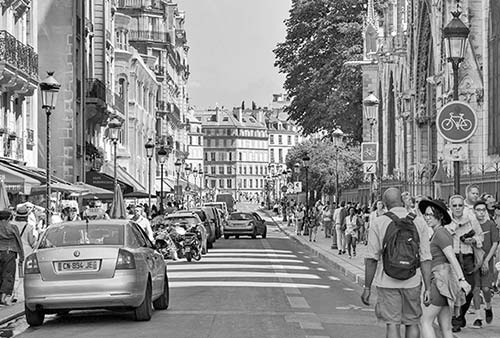
• Keep going past the church and the area behind it, then pause for a moment on the arched pedestrian-only bridge, Pont St. Louis, for a look at...
3 Ile St. Louis
If Ile de la Cité is a tugboat laden with the history of Paris, it’s towing this classy little residential dinghy, laden only with high-rent apartments, boutiques, characteristic restaurants, and famous ice cream shops.
Ile St. Louis wasn’t developed until the 17th century, much later than Ile de la Cité. What was a swampy mess is now harmonious Parisian architecture and one of Paris’ most exclusive neighborhoods.
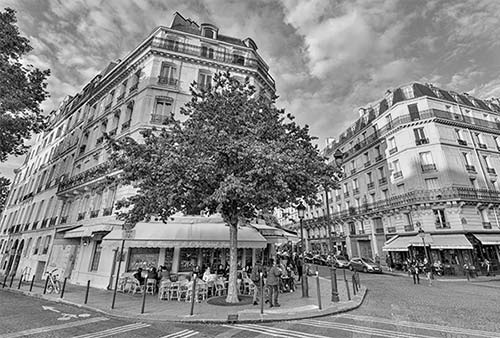
Now look upstream (east) to the bridge (Pont Tournelle) that links Ile St. Louis with the Left Bank (which is now on your right). Where the bridge meets the Left Bank, you’ll find one of Paris’ most exclusive restaurants, La Tour d’Argent (with a flag flying from the rooftop). Because the top floor has floor-to-ceiling windows, your evening meal comes with glittering views—and a golden price (€200 minimum). But, you get a photo of yourself dining elegantly with Notre-Dame in the background (not quite so elegant while covered in scaffolding).
Ile St. Louis is a lovely place for an evening stroll. If you won’t have time to come back later, consider taking a brief detour across the pedestrian bridge, Pont St. Louis, to explore this little island.
• Let’s head toward the Left Bank. Do an about-face and start walking south (with the backside of Notre-Dame on your right). Enter the little grassy park to your left, where (behind a tall green hedge) you’ll find the...
4 Deportation Memorial (Mémorial de la Déportation)
This ▲ memorial to the 200,000 French victims of the Nazi concentration camps (1940-1945) draws you into their experience. France was quickly overrun by Nazi Germany, and Paris spent the war years under Nazi occupation. Jews and dissidents were rounded up and deported—many never returned.
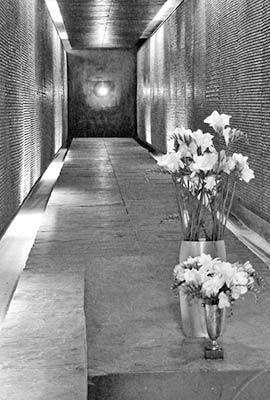
Cost and Hours: Free, daily 10:00-19:00, Oct-March until 17:00, free 45-minute audioguide and guided tours may be available; at the east tip of Ile de la Cité, behind Notre-Dame and near Ile St. Louis (Mo: Cité); +33 6 14 67 54 98.
Visiting the Memorial: As you descend the steps, the city around you disappears. Surrounded by walls, you have become a prisoner. Your only freedom is your view of the sky and the tiny glimpse of the river below. Enter the dark, single-file chamber up ahead. Inside, the circular plaque in the floor reads, “They went to the end of the earth and did not return.”
The hallway stretching in front of you is lined with 200,000 lighted crystals, one for each French citizen who died. Flickering at the far end is the eternal flame of hope. The tomb of the unknown deportee lies at your feet. Above, the inscription reads, “Dedicated to the living memory of the 200,000 French deportees shrouded by the night and the fog, exterminated in the Nazi concentration camps.” The side rooms are filled with triangles—reminiscent of the identification patches inmates were forced to wear—each bearing the name of a concentration camp.
Above the exit as you leave is the message you’ll find at many other Holocaust sites: “Forgive, but never forget.”
• Return to ground level. Exit the garden, turn left, and cross the bridge (Pont de l’Archevêché). When you reach the Left Bank, turn right along the river and work your way along the south side of Notre-Dame. Find stairs leading down to the river—good for losing crowds and for a terrific...
5 Notre-Dame Side View
From this side, you can really appreciate both the church architecture and the devastation wrought by the 2019 fire. Before the fire, you’d have seen a green lead-covered roof topped with its 300-foot steeple, and several statues adorning its base.
Those are gone completely, as is the lead roof and all windows—save for the three massive rose windows (now covered for protection). But what’s surprising is how much of the church survived. That’s a testament to the medieval architects who designed this amazing structure. Their great technological innovation is what we’ve come to call the Gothic style.
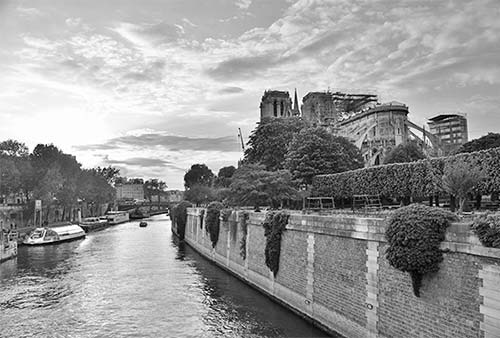
In a glance, you can spot many of the elements of Gothic: pointed arches, the lacy stone tracery of the windows, pinnacles, statues on rooftops, and pointed steeples covered with the prickly “flames” (Flamboyant Gothic) of the Holy Spirit. Most distinctive of all are the flying buttresses. These 50-foot stone “beams” that stick out of the church were the key to the complex Gothic architecture. The pointed arches built inside the church cause the weight of the roof to push outward rather than downward. The “flying” buttresses support the roof by pushing back inward. Gothic architects were masters at playing architectural forces against each other to build loftier and loftier churches, opening the walls for stained-glass windows. The Gothic style was born here in Paris.
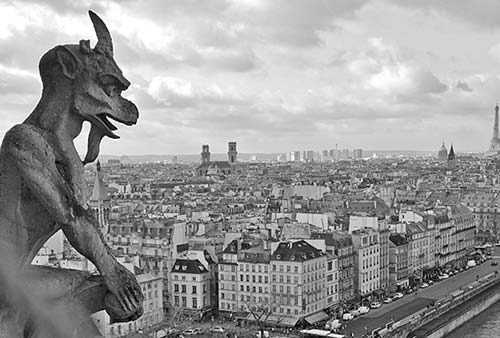
Picture Quasimodo (the fictional hunchback) limping around along the railed balcony at the base of the roof among the “gargoyles.” These grotesque beasts sticking out from pillars and buttresses represent souls caught between heaven and earth. They also function as rainspouts (from the same French root word as “gargle”) when there are no evil spirits to battle.
• Continue walking along the river until you reach the next bridge, Pont au Double. Head back up the stairs, veer left across the street, and find a small park called Square Viviani. Angle across the square and pass by Paris’ oldest inhabitant—an acacia tree nicknamed Robinier, after the guy who planted it in 1602. Just beyond the tree you’ll find the small rough-stone church of St. Julien-le-Pauvre. Leave the park, and return toward the river. Turn left on Rue de la Bûcherie, which leads to Shakespeare and Company, an atmospheric reincarnation of the original 1920s bookshop and a good spot to page through books.
When you’re done browsing, continue to Rue du Petit-Pont and turn left. A block south of the Seine, turn right at the Gothic church of St. Séverin and walk (along Rue St. Séverin) into the...
6 Latin Quarter
The touristy fame of this Left Bank neighborhood (worth ▲) relates to its intriguing, artsy, bohemian character. Although it may look more like the Greek Quarter today (cheap gyros abound), this area is named for the language you’d have heard on these streets in the Middle Ages. The University of Paris (founded 1215), one of the leading educational institutions of medieval Europe, was (and still is) nearby.
This was perhaps Europe’s leading university district in the Middle Ages, when Latin was the language of higher education. The neighborhood’s main boulevards (St. Michel and St. Germain) are lined with cafés—once the haunts of great poets and philosophers, now the hangouts of tired tourists. Exploring a few blocks up or downriver reveals the pulse of what survives of Paris’ classic Left Bank. For colorful wandering and café-sitting, afternoons and evenings are best.
Walking along Rue St. Séverin, you can still see the shadow of the medieval sewer system. The street slopes into a central channel of bricks. In the days before plumbing and toilets, when people still went to the river or neighborhood wells for their water, flushing meant throwing it out the window. At certain times of day, maids on the fourth floor would holler, “Garde de l’eau!” (“Watch out for the water!”) and heave it into the streets, where it would eventually wash down into the Seine.
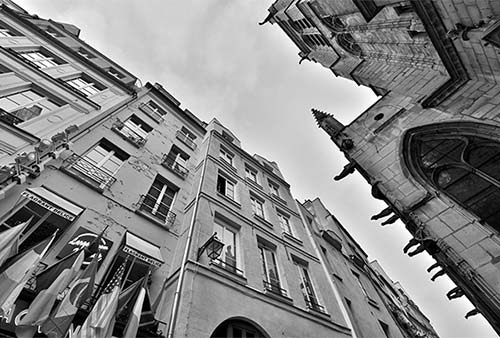
As you wander, remember that before Napoleon III commissioned Baron Haussmann to modernize the city with grand boulevards (19th century), Paris was just like this—a medieval tangle. The diverse feel of this area is nothing new—it’s been a melting pot and university district for almost 800 years.
Consider a visit to the Cluny Museum for its medieval art and unicorn tapestries (see “Sights in Paris” later). The Sorbonne—the University of Paris’ humanities department—is also nearby; you may catch a glimpse of its famous dome (a few blocks south of the river between Boulevard St. Michel and Rue St. Jacques).
Continue along Rue St. Séverin until you hit the tree-filled Place St. André-des-Arts, lined with cafés. Adjoining this square toward the river is the triangular Place St. Michel, with a Métro stop and a statue of St. Michael killing a devil. This is the traditional core of the Left Bank’s artsy, liberal, hippie, bohemian district of poets, philosophers, winos, and baba cools (neo-hippies).
In less commercial times, Place St. Michel was a gathering point for the city’s malcontents and misfits. In 1830, 1848, and again in 1871, the citizens took the streets from the government troops, set up barricades Les Miz-style, and fought against royalist oppression. During World War II, the locals rose up against their Nazi oppressors (read the plaques under the dragons at the foot of the St. Michel fountain).
• From Place St. Michel, look across the river and find the prickly steeple of the Sainte-Chapelle church. Head toward it. Cross the river on Pont St. Michel and continue north along the Boulevard du Palais. On your left, you’ll see the doorway to...
7 Sainte-Chapelle
This triumph of Gothic church architecture is a cathedral of glass like no other. It was speedily built between 1242 and 1248 for King Louis IX—the only French king who is now a saint—to house the supposed Crown of Thorns (later moved to Notre-Dame’s treasury and now in safekeeping since the fire). The building’s architectural harmony is due to the fact that it was completed under the direction of one architect and in only six years—unheard of in Gothic times. Recall that Notre-Dame’s construction took more than 200 years.
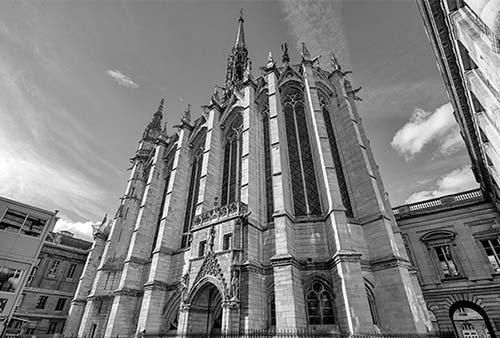
Cost and Hours: €11.50 for timed-entry ticket, €18.50 combo-ticket with Conciergerie, free for kids under age 18, covered by Museum Pass, reserve online in advance to ensure entry (limited tickets may be available in person); daily 9:00-19:00, Oct-March until 17:00; audioguide-€3, evening concerts—see here, 4 Boulevard du Palais, Mo: Cité, +33 1 53 40 60 80, www.sainte-chapelle.fr.
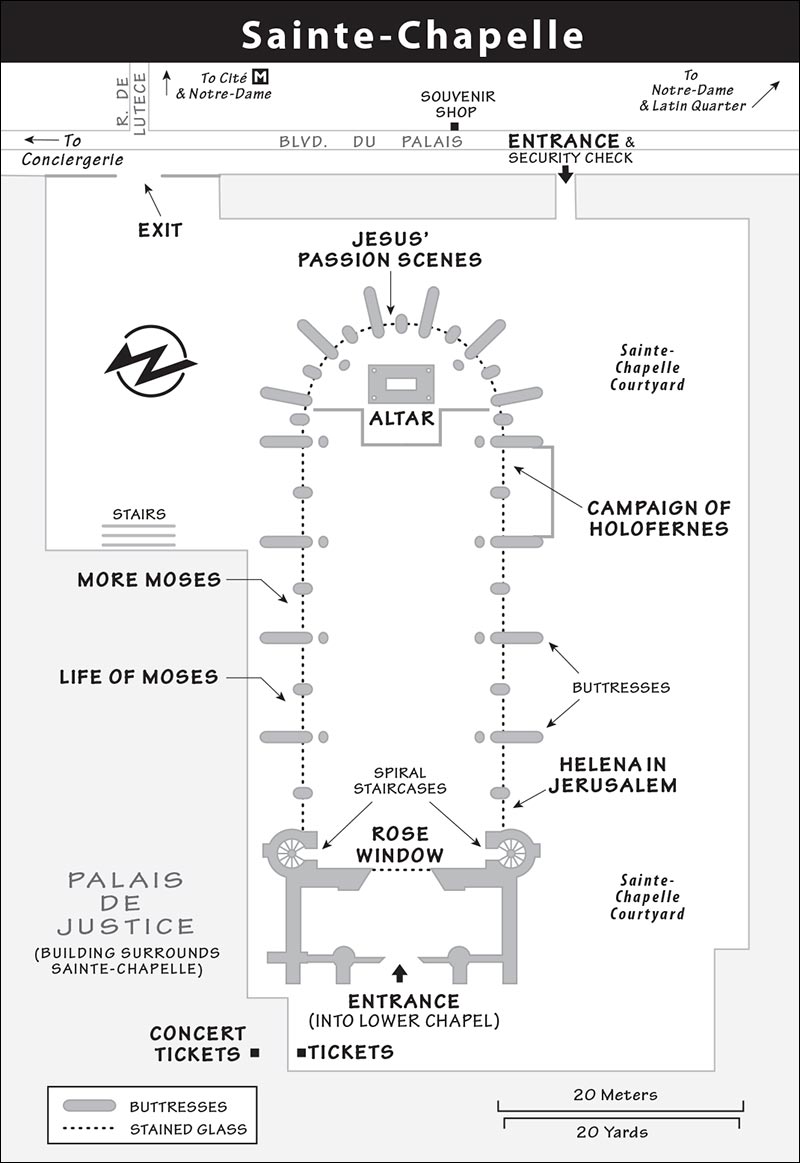
Visiting the Church: Though the inside is beautiful, the exterior is basically functional. The muscular buttresses hold up the stone roof, so the walls are essentially there to display stained glass. The lacy spire is Neo-Gothic—added in the 19th century. Inside, the layout clearly shows an ancien régime approach to worship. The low-ceilinged basement was for staff and other common folks—worshipping under a sky filled with painted fleurs-de-lis, a symbol of the king. Royal Christians worshipped upstairs. The paint job, a 19th-century restoration, helps you imagine how grand this small, painted, jeweled chapel was. (Imagine Notre-Dame painted like this.) Each capital is playfully carved with a different plant’s leaves.
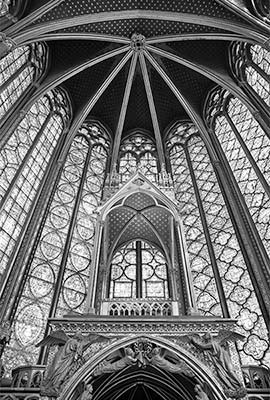
You’ll climb a spiral staircase to the upper level, the Chapelle Haute. Fiat lux—“Let there be light.” From the first page of the Bible, it’s clear: Light is divine. Light shines through stained glass like God’s grace shining down to earth. Gothic architects used their new technology to turn dark stone buildings into lanterns of light. The glory of Gothic shines brighter here than in any other church.
There are 15 separate panels of stained glass (6,500 square feet—two-thirds of it is 13th-century original), with more than 1,100 different scenes, mostly from the Bible. These cover the entire Christian history of the world, from the Creation in Genesis (first window on the left, as you face the altar), to the coming of Christ (over the altar), to the end of the world (the round “rose”-shaped window at the rear of the church). The whole effect is overwhelming.
The altar was raised up high to better display the Crown of Thorns, the relic around which this chapel was built. King Louis IX, convinced he’d found the real McCoy, spent roughly the equivalent of €500 million for the Crown, €370 million for the gem-studded shrine to display it in (later destroyed in the French Revolution), and a mere €150 million to build Sainte-Chapelle to house it.
• Exit Sainte-Chapelle. As you leave the complex, you’ll pass by the...
8 Palais de Justice
Sainte-Chapelle sits within a huge complex of buildings that has housed the local government since ancient Roman times. It was the site of the original Gothic palace of the early kings of France. The only surviving medieval parts are Sainte-Chapelle and the Conciergerie prison.
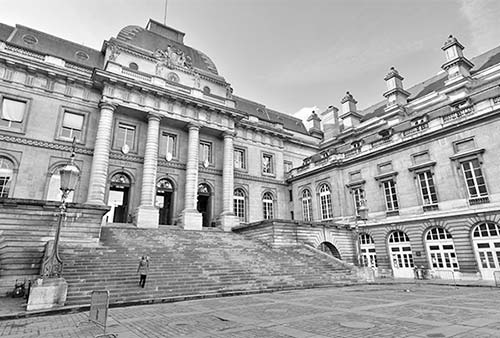
Most of the site is now covered by the giant Palais de Justice, built in 1776, home of the French Supreme Court. The motto Liberté, Egalité, Fraternité over the doors is a reminder that this was also the headquarters of the Revolutionary government. Here they doled out justice, condemning many to imprisonment in the Conciergerie downstairs—or to the guillotine.
• Now pass through the big iron gate to the noisy Boulevard du Palais. Cross the street to the wide, pedestrian-only Rue de Lutèce and walk about halfway down.
9 Cité “Métropolitain” Métro Stop
Of the 141 original early-20th-century subway entrances, this is one of only a few survivors—now preserved as a national art treasure. (New York’s Museum of Modern Art even exhibits one.) It marks Paris at its peak in 1900—on the cutting edge of Modernism, but with an eye for beauty. The curvy, plantlike ironwork is a textbook example of Art Nouveau, the style that rebelled against the erector-set squareness of the Industrial Age. Other similar Métro stations in Paris are Abbesses and Porte Dauphine.
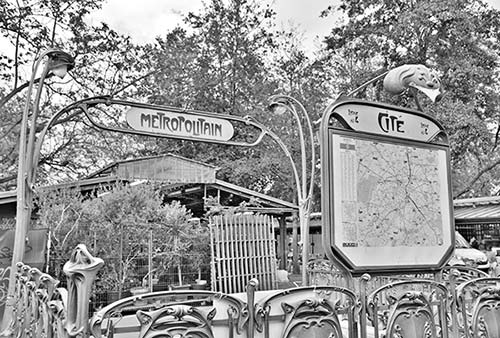
The flower and plant market on Place Louis Lépine is a pleasant detour. On Sundays this square flutters with a busy bird market.
• Pause here to admire the view. Sainte-Chapelle is a pearl in an ugly architectural oyster. Double back to the Palais de Justice, turn right onto Boulevard du Palais, and enter the Conciergerie.
10 Conciergerie
Though barren inside, this former prison echoes with history. The Conciergerie was the last stop for 2,780 victims of the guillotine, including France’s last ancien régime queen, Marie-Antoinette. Before then, kings had used the building to torture and execute failed assassins. (One of its towers along the river was called “The Babbler,” named for the pain-induced sounds that leaked from it.) When the Revolution (1789) toppled the king, the progressive Revolutionaries proudly unveiled a modern and more humane way to execute people—the guillotine. The Conciergerie was the epicenter of the Reign of Terror—the year-long period of the Revolution (1793-1794) during which Revolutionary fervor spiraled out of control and thousands were killed. It was here at the Conciergerie that “enemies of the Revolution” were imprisoned, tried, sentenced, and marched off to Place de la Concorde for decapitation.
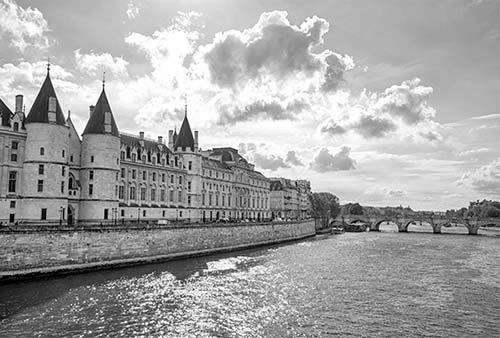
Cost and Hours: €11.50 (timed-entry tickets available but not necessary), €18.50 combo-ticket with Sainte-Chapelle, covered by Museum Pass; daily 9:30-18:00, free multimedia guide, 2 Boulevard du Palais, Mo: Cité, +33 1 53 40 60 80, www.paris-conciergerie.fr.
Visiting the Conciergerie: Pick up a free brochure (with a map) and breeze through the one-way, well-described circuit. You’ll start in the spacious, low-ceilinged Hall of Men-at-Arms (Room 1), originally a guards’ dining room warmed by four big fireplaces (look up the chimneys). During the Reign of Terror, this large hall served as a holding tank for the poorest prisoners. Then they were taken upstairs (in an area closed to visitors), where the Revolutionary tribunals grilled scared prisoners on their political correctness.
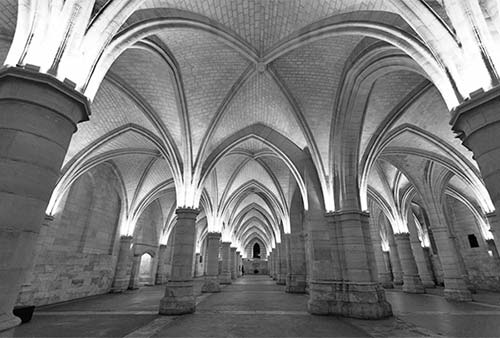
Continue to the raised area at the far end of the room (Room 4, today’s bookstore). This was the walkway of the executioner, who was known affectionately as “Monsieur de Paris.”
Upstairs is a memorial room with the names of the 2,780 citizens condemned to death by the guillotine, including ex-King Louis XVI, Charlotte Corday (who murdered the Revolutionary writer Jean-Paul Marat in his bathtub), and—oh, the irony—Maximilien de Robespierre, the head rabble-rouser of the Revolution, who himself sent so many to the guillotine. But the most famous execution took place on October 16, 1793, when Marie-Antoinette was awakened at 4:00 in the morning and led away. She walked the corridor, stepped onto the cart, and was slowly carried to Place de la Concorde, where she had her date with Monsieur de Paris.
• Back outside, turn left on Boulevard du Palais. On the corner is the city’s oldest public clock. The mechanism of the present clock is from 1334, and even though the case is Baroque, it keeps on ticking.
Turn left onto Quai de l’Horloge and walk along the river, past the “Babbler” tower. The bridge up ahead is Pont Neuf, where we’ll end this walk. At the first corner, veer left into a sleepy triangular square called Place Dauphine. It’s amazing to find such coziness in the heart of Paris. From the equestrian statue of Henry IV, turn right onto the bridge. Pause at the little nook halfway across.
11 Pont Neuf and the Seine
This “new bridge” is now Paris’ oldest. Built during Henry IV’s reign (about 1600), its arches span the widest part of the river. Unlike other bridges, this one never had houses or buildings growing on it. The turrets were originally for vendors and street entertainers. In the days of Henry IV, who promised his peasants “a chicken in every pot every Sunday,” this would have been a lively scene. From the bridge, look downstream (west) to see the next bridge, the pedestrian-only Pont des Arts. Ahead on the Right Bank is the long Louvre museum. Beyond that, on the Left Bank, is the Orsay. And what’s that tall tower in the distance?
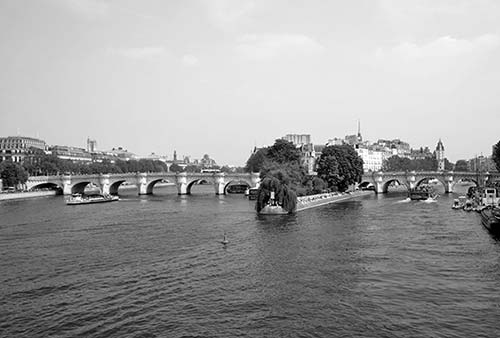
•Our walk is finished. You can take a boat tour of the Seine that leaves from the island (Vedettes du Pont Neuf; see here), continue to the Louvre, or head to the...
12 Riverside Promenades and Paris Plages
Paris has reclaimed sections of the Seine’s embankment in a fun-loving project stretching several miles. These traffic-free areas (worth ▲▲) are a new world for strolling, biking, having fun with the kids, dining (in pop-up drinking and eating establishments or at extravagant picnics complete with tablecloths and Champagne), or simply dangling one’s feet over the water and being in the moment. One section runs along the Left Bank of the Seine between Pont de l’Alma (near the Eiffel Tower) and the Orsay Museum, and another runs along the Right Bank between the Louvre and Place de la Bastille. In balmy weather, the embankment takes on a special energy.
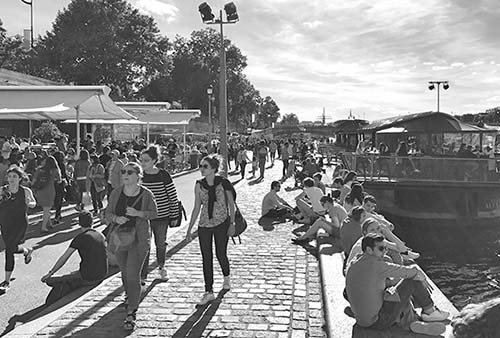
Each summer, the Paris city government trucks in potted palm trees, hammocks, and lounge chairs to create colorful urban beaches—the Paris Plages. You’ll also find “beach cafés,” climbing walls, prefab pools, trampolines, a library, beach volleyball, badminton, and Frisbee areas.
Cost and Hours: Free, promenades always open, plages run mid-July-mid-Aug daily 8:00-24:00, on Right Bank of Seine, just north of Ile de la Cité, between Pont des Arts and Pont de Sully.
Sights in Paris
Map: Major Museums Neighborhood
▲▲▲Orsay Museum (Musée d’Orsay)
Map: Orsay Museum—Ground Floor
Map: Post-Impressionism—Level 5
▲▲Orangerie Museum (Musée de l’Orangerie)
▲▲▲Eiffel Tower (La Tour Eiffel)
▲Paris Sewer Museum (Les Egouts de Paris)
▲▲Rue Cler
▲▲Army Museum and Napoleon’s Tomb (Musée de l’Armée)
▲▲Marmottan Museum (Musée Marmottan Monet)
▲▲Cluny Museum (Musée National du Moyen Age)
▲Luxembourg Garden (Jardin du Luxembourg)
▲Petit Palais (and Musée des Beaux-Arts)
▲▲Opéra Garnier (Opéra National de Paris—Palais Garnier)
MARAIS NEIGHBORHOOD AND NEARBY
▲▲Carnavalet Museum (Musée Carnavalet)
▲Picasso Museum (Musée Picasso)
▲Jewish Art and History Museum (Musée d’Art et Histoire du Judaïsme)
Holocaust Memorial (Mémorial de la Shoah)
▲▲Pompidou Center (Centre Pompidou)
▲▲Père Lachaise Cemetery (Cimitère du Père Lachaise)
▲Montmartre Museum (Musée de Montmartre)
MAJOR MUSEUMS NEIGHBORHOOD
Paris’ grandest park, the Tuileries Garden, was once the private property of kings and queens. Today it links the Louvre, Orangerie, and Orsay museums with the Place de la Concorde and the Champs-Elysées.
▲▲▲Louvre (Musée du Louvre)
This is Europe’s oldest, biggest, greatest, and second-most-crowded museum (after the Vatican). Housed in a U-shaped, 16th-century palace (accentuated by a 20th-century glass pyramid), the Louvre is Paris’ top museum and one of its key landmarks. It’s home to Mona Lisa, Venus de Milo, and hall after hall of Greek and Roman masterpieces, medieval jewels, Michelangelo statues, and paintings by the greatest artists from the Renaissance to the Romantics.
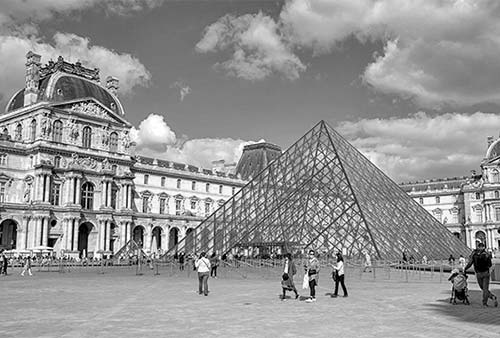
Touring the Louvre can be overwhelming, so be selective. Focus on the Denon wing, with Greek sculptures, Italian paintings (by Raphael and Leonardo), and—of course—French paintings (Neoclassical and Romantic), and the adjoining Sully wing, with Egyptian artifacts and more French paintings. For extra credit, tackle the Richelieu wing, displaying works from ancient Mesopotamia, as well as French, Dutch, and Northern art.
Cost and Hours: €22 for timed-entry ticket—book online in advance, includes special exhibits, covered by Museum Pass (but pass holders must reserve a time slot long in advance); €15 timed-entry tickets are rarely available at the door—and you’ll wait in a long line; open Wed-Mon 9:00-18:00, until 21:45 on Fri (and possibly on Wed—check online), closed Tue, last entry 45 minutes before closing.
Information: +33 1 40 20 53 17, recorded info +33 1 40 20 51 51, www.louvre.fr.
Reserved Entry Time Required: The Louvre requires all visitors—including Museum Pass holders—to reserve a time slot for their visit. Book online as far ahead as you can. Reservations for Museum Pass holders are limited—book your pass entry at least 6 weeks in advance in high season, or buy an easier-to-get timed-entry ticket on the Louvre’s website.
You can enter at the pyramid up to 30 minutes before your assigned time. Tickets are good all day, but reentry is not allowed (don’t leave the security check area as you travel between museum wings).
Buying Tickets at the Louvre: If you arrive sans reservation (bad idea), in very quiet times it may be possible (but unlikely) to buy a timed-entry ticket at the door. When available, these tickets are sold from self-service machines in a side room under the pyramid.
When to Go: Crowds can be miserable on Sun, Mon (the worst day), Wed, and in the morning (arrive 30 minutes before opening to secure a good place in line). Evening visits (when available) are quieter, and the glass pyramid glows after dark.
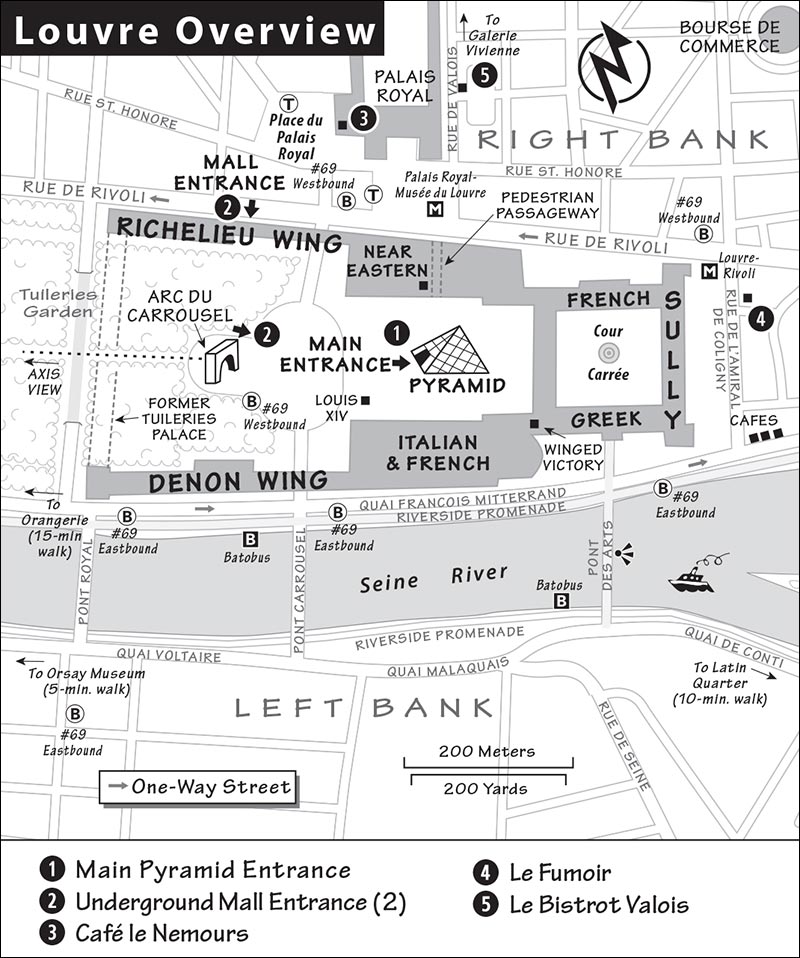
Getting There: Métro stop Palais Royal-Musée du Louvre is the closest. From the station, you can either exit above ground to go in the pyramid entrance or stay underground to use the Carrousel du Louvre entrance. Eastbound bus #69 stops along the Seine River; the best stop is labeled Quai François Mitterrand. Westbound #69 stops in front of the pyramid (see the “Louvre Overview” map for stop locations). You’ll find a taxi stand on Rue de Rivoli, next to the Palais Royal-Musée du Louvre Métro station.
Getting In: There are two entrances. Everyone must pass through security at the entrances.
Main Pyramid Entrance: There is no grander entry than through the main entrance at the pyramid in the central courtyard. With your timed-entry ticket, you’ll get in more quickly (find the line that corresponds to your ticket type). Avoid the long line for those hoping to get a same-day reservation.
Underground Mall Entrance: The less crowded underground entrance is accessed through the Carrousel du Louvre shopping mall. Enter the mall at 99 Rue de Rivoli (the door with the shiny metal awning), directly from the Métro stop Palais Royal-Musée du Louvre (stepping off the train, exit to Musée du Louvre-Le Carrousel du Louvre), or via the Tuileries Garden entrance close to the arch. Once inside the mall, continue toward the inverted pyramid next to the Louvre’s security entrance.
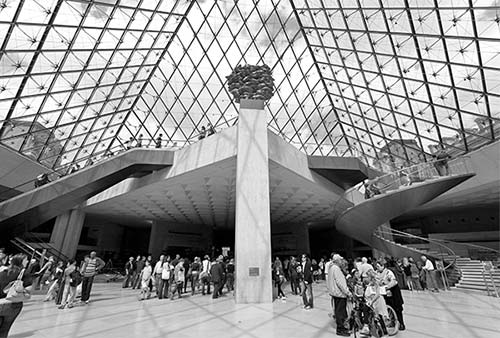
Tours: Ninety-minute English-language guided tours leave from inside the Accueil des Groupes area, under the pyramid, normally at 11:00 (and possibly at 14:00 in peak season); book in advance online, €12 plus admission. Multimedia guides (€5) provide commentary on about 700 masterpieces.
Download my free Louvre Museum audio tour.
Baggage Check: It’s free to store your bag in slick self-service lockers under the pyramid. No bags bigger than a small day bag are allowed in the galleries.
Services: WCs are located under the pyramid. Once you’re in the galleries, WCs are scarce.
Eating near the Louvre: Try venerable, Art-Deco $$ Café le Nemours; $$$ Le Fumoir (good-value two-course lunch menu); or cheery, traditional $$ Le Bistrot Valois (for restaurant locations, see the “Louvre Overview” map). Picnics are painting-perfect in the adjacent Palais Royal gardens, a block north of the museum (enter from Place du Palais Royal).
Self-Guided Tour
With more than 30,000 works of art on display, the Louvre is a full inventory of Western civilization. To cover it all in one visit is impossible. Let’s focus on the Louvre’s specialties—Greek sculpture, Italian painting, and French painting.
• We’ll start in the Sully wing, in Salle 345. To get there from the pyramid entrance, first enter the Denon wing, ascend several flights of escalators, and follow the crowds—then get out your map or ask for directions to the Venus de Milo.
The Greeks
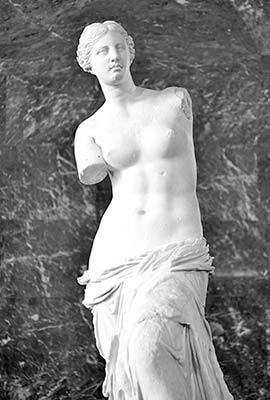
Venus de Milo, a.k.a. Aphrodite, late second century BC: The Greeks pictured their gods in human form (meaning humans are godlike), telling us they had an optimistic view of the human race. Venus’ well-proportioned body captures the balance and orderliness of the Greek universe.
Venus rests on her right foot, then lifts her left leg, setting her whole body in motion. The twisting pose (called contrapposto, or “counterpoise”) gives a balanced S-curve to her body (especially noticeable from the back view) that golden age Greeks and succeeding generations found beautiful. Most “Greek” statues are actually later Roman copies. This is a rare Greek original.
• Now head to Salle 347, behind Venus de Milo.
Parthenon Friezes, mid-fifth century BC: These stone fragments once decorated the exterior of the greatest Athenian temple, the Parthenon (see the scale model). Built at the peak of the Greek golden age, the temple glorified the city’s divine protector, Athena, and the superiority of the Athenians, who were feeling especially cocky, having just crushed their archrivals, the Persians. A model of the Parthenon shows where the frieze panels might have hung.
• About 50 yards away, find a grand staircase. Climb it to the first floor and the...
Winged Victory of Samothrace (Victoire de Samothrace), c. 190 BC: This woman with wings, poised on the prow of a ship, once stood on an island hilltop to commemorate a naval victory. Her clothes are windblown and sea-sprayed, clinging to her body. Originally, her right arm was stretched high, celebrating the victory like a Super Bowl champion, waving a “we’re number one” finger.
As Victory strides forward, the wind blows her and her wings back. Her feet are firmly on the ground, but her wings (and missing arms) stretch upward. She is a pillar of vertical strength, while the clothes curve and whip around her. These opposing forces create a feeling of great energy, making her the lightest two-ton piece of rock in captivity.
• Facing Winged Victory, turn right (entering the Denon wing), and proceed to the large Salle 708.
The Medieval World (1200-1500)
Cimabue, The Madonna and Child in Majesty Surrounded by Angels (La Vierge et l’Enfant en Majesté Entourés de Six Anges), c. 1280: During the Age of Faith (1200s), almost every church in Europe had a painting like this one (it may be out for restoration). Mary was a cult figure, adored and prayed to by the faithful for bringing Baby Jesus into the world. These holy figures are laid flat on a gold background like cardboard cutouts, existing in a golden never-never land, as though the faithful couldn’t imagine them as flesh-and-blood humans inhabiting our dark and sinful earth.
Giotto, St. Francis of Assisi Receiving the Stigmata (Saint François d’Assise Recevant les Stigmates), c. 1295-1300: Francis of Assisi (c. 1181-1226), a wandering Italian monk of renowned goodness, kneels on a rocky Italian hillside, pondering the pain of Christ’s torture and execution. Suddenly, he looks up, startled, to see Christ himself, with six wings, hovering above. Christ shoots lasers from his wounds to the hands, feet, and side of the empathetic monk, marking him with the stigmata. Francis’ humble love of man and nature inspired artists like Giotto to portray real human beings with real emotions, living in a physical world of beauty.
• Room 708 spills into the long Grand Gallery. Find the following paintings in the gallery, as you make your way to the Mona Lisa (midway down the gallery, in the adjoining Salle 711—just follow the signs and the people).
Italian Renaissance (1400-1600)
Leonardo da Vinci, The Virgin and Child with St. Anne (La Vierge à l’Enfant Jésus avec Sainte-Anne), c. 1510: Three generations—grandmother, mother, and child—are arranged in a pyramid, with Anne’s face as the peak and the lamb as the lower right corner. This balanced structure is as orderly as the geometrically perfect universe created by the Renaissance god. But there’s a psychological kidney punch in this happy painting. Jesus, the picture of childish joy, is innocently playing with a lamb—the symbol of his inevitable sacrificial death.
The Louvre has the greatest collection of Leonardos in the world—five of them. Look for the neighboring Virgin of the Rocks and John the Baptist. Leonardo was the consummate Renaissance Man; a musician, sculptor, engineer, scientist, and sometime painter, he combined knowledge from all these areas to create beauty.
Raphael, La Belle Jardinière, c. 1507: Raphael perfected the style Leonardo pioneered. This configuration of Madonna, Child, and John the Baptist is also a balanced pyramid with hazy grace and beauty. The interplay of gestures and gazes gives the masterpiece both intimacy and cohesiveness, while Raphael’s blended brushstrokes varnish the work with an iridescent smoothness. With Raphael, the Greek ideal of beauty—reborn in the Renaissance—reached its peak.
Leonardo da Vinci, Mona Lisa, a.k.a. La Joconde, 1503-1506: Leonardo was already an old man when François I invited him to France. Determined to pack light, he took only a few paintings with him. One was a portrait of Lisa del Giocondo, the wife of a wealthy Florentine merchant. François immediately fell in love with the painting, making it the centerpiece of the small collection of Italian masterpieces that would, in three centuries, become the Louvre.
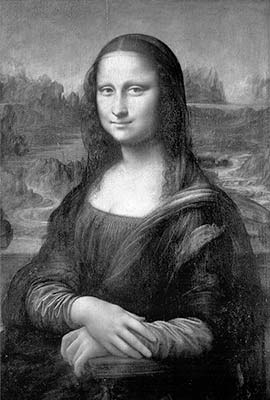
Mona’s famous smile attracts you first. Leonardo used a hazy technique called sfumato, blurring the edges of her mysterious smile. Now look past the smile to some of the subtle Renaissance elements that make this painting work. The body is surprisingly massive and statue-like, a perfectly balanced pyramid. Her arm rests lightly on the armrest of a chair, as if she’s sitting in a window looking out at us. The typical Leonardo landscape shows distance by getting hazier and hazier.
The overall mood is one of balance and serenity, but there’s also an element of mystery. Mona’s smile and long-distance beauty are subtle and elusive, tempting but always just out of reach.
• Before leaving Mona, step back and just observe the paparazzi scene. The huge canvas opposite Mona is...
Paolo Veronese, The Marriage at Cana (Les Noces de Cana), 1562-1563: Venetian artists like Veronese painted the good life of rich, happy-go-lucky Venetian merchants. In a spacious setting of Renaissance architecture, colorful lords and ladies, decked out in their fanciest duds, feast on a great spread of food and drink. But believe it or not, this is a religious work showing the wedding celebration in which Jesus turned water into wine. With true Renaissance optimism, Venetians pictured Christ as a party animal, someone who loved the created world as much as they did.
• Exit behind Mona into the Salle Denon (Room 701). Turn right into the Neoclassical room (Salle Daru, Room 702) and kneel before the largest canvas in the Louvre.
French Painting (1780-1850)
Jacques-Louis David, The Coronation of Emperor Napoleon (Sacre de l’Empereur Napoléon), 1806-1807: Napoleon holds aloft an imperial crown. This common-born son of immigrants is about to be crowned emperor of a “New Rome.” He has just made his wife, Josephine, the empress, and she kneels at his feet. Seated behind Napoleon is the pope, who journeyed from Rome to place the imperial crown on his head. But Napoleon feels that no one is worthy of the task. At the last moment, he shrugs the pope aside.
The setting for the coronation was the ultra-Gothic Notre-Dame Cathedral. But Napoleon wanted a location that would reflect the glories of Greece and the grandeur of Rome. So, interior decorators erected stage sets of Greek columns and Roman arches.
Jean-Auguste-Dominique Ingres, La Grande Odalisque, 1814: Take Venus de Milo, turn her around, lay her down, and stick a hash pipe next to her, and you have the Grande Odalisque. OK, maybe you’d have to add a vertebra or two.
Using clean, polished, sculptural lines, Ingres exaggerates the S-curve of a standing Greek nude. As in the Venus de Milo, rough folds of cloth set off her smooth skin. Ingres gave the face, too, a touch of Venus’ idealized features, taking nature and improving on it. Contrast the cool colors of this statue-like nude with Titian’s golden girls. Ingres preserves Venus’ backside for posterior—I mean, posterity.
Théodore Géricault, The Raft of the Medusa (Le Radeau de la Méduse), 1819: Clinging to a raft is a tangle of bodies and lunatics sprawled over each other. The scene writhes with agitated, ominous motion—the ripple of muscles, churning clouds, and choppy seas. The bodies rise up in a pyramid of hope, culminating in a flag wave. They signal frantically, trying to catch the attention of the tiny ship on the horizon, their last desperate hope...which did finally save them. Géricault uses rippling movement and powerful colors to catch us up in the excitement.
This painting was based on the actual sinking of the ship Medusa off the coast of Africa in 1816. About 150 people packed onto the raft. After floating on the open seas for 12 days—suffering hardship and hunger, even resorting to cannibalism—only 15 survived.
Eugène Delacroix, Liberty Leading the People (La Liberté Guidant le Peuple), 1831: The year is 1830. Parisians take to the streets, Les Miz-style, to fight royalist oppressors. Leading them on through the smoke and over the dead and dying is the figure of Liberty, a strong woman waving the French flag. Does this symbol of victory look familiar? It’s the Winged Victory, wingless and topless.
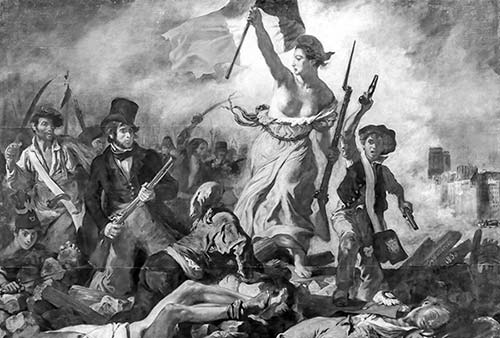
To stir our emotions, Delacroix uses only three major colors—the red, white, and blue of the French flag. France is the symbol of modern democracy, and this painting has long stirred its citizens’ passion for liberty. This symbol of freedom is a fitting tribute to the Louvre, the first museum ever opened to the common rabble of humanity.
• Exit the room at the far end (past the Café Mollien) and go downstairs, where you’ll bump into...
More Italian Renaissance
Michelangelo, Slaves (Esclaves), 1513-1515: These two statues by the earth’s greatest sculptor are a bridge between the ancient and modern worlds. Michelangelo, like his fellow Renaissance artists, learned from the Greeks. The perfect anatomy, twisting poses, and idealized faces appear as if they could have been created 2,000 years earlier.
The Dying Slave twists listlessly against his T-shirt-like bonds, revealing his smooth skin. This is probably the most sensual nude that Michelangelo, the master of the male body, ever created.
The Rebellious Slave fights against his bondage. His shoulders rotate one way, his head and leg turn the other. He seems to be trying to release himself from the rock he’s made of. Michelangelo said that his purpose was to carve away the marble to reveal the figures God put inside.
• Tour over! But, of course, there’s so much more. After a break, consider a stroll through a few rooms of the Richelieu wing, which contain some of the Louvre’s most ancient pieces.
Nearby: Across from the Louvre are the lovely courtyards of the stately Palais Royal. Its courtyards are free and always open (directly north of the Louvre on Rue de Rivoli). Enter through a whimsical courtyard filled with stubby, striped columns and playful fountains, then pass into another, perfectly Parisian garden. Bring a picnic and create your own quiet break, or have a drink at one of the outdoor cafés at the courtyard’s northern end. This is Paris.
Exiting the courtyard at the side facing away from the Seine brings you to the Galeries Colbert and Vivienne, attractive examples of shopping arcades from the early 1800s.
▲▲▲Orsay Museum (Musée d’Orsay)
The Musée d’Orsay houses French art of the 1800s and early 1900s (specifically, 1848-1914), picking up where the Louvre’s art collection leaves off. For us, that means Impressionism, the art of sun-dappled fields, bright colors, and crowded Parisian cafés. The Orsay houses the best general collection anywhere of Manet, Monet, Renoir, Degas, Van Gogh, Cézanne, and Gauguin.
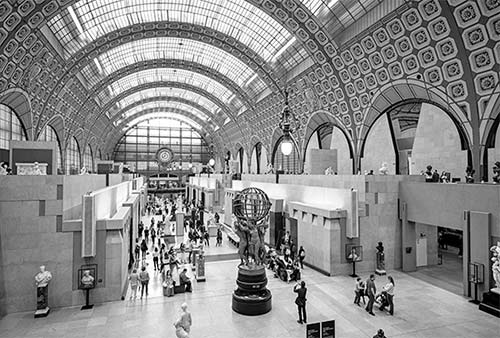
Cost and Hours: €16, free on first Sun of month (but timed-entry ticket required), covered by Museum Pass, combo-tickets with Orangerie Museum (€20) or Rodin Museum (€24)—visit these less-crowded sights first to purchase combo-ticket; keep Orsay ticket for discount at Opéra Garnier (within 5 days of Orsay visit). Museum open Tue-Sun 9:30-18:00, Thu until 21:45, closed Mon, last entry one hour before closing (45 minutes before on Thu), top-floor Impressionist galleries start shutting 45 minutes before closing.
Information: +33 1 40 49 48 14, www.musee-orsay.fr.
When to Go: For shorter lines and fewer crowds, visit on Wed, Fri, or Thu evening (when the museum is open late). You’ll battle the biggest hordes on Sun, as well as on Tue, when the Louvre is closed.
Avoiding Lines: While everyone must wait to go through security, avoid the long ticket-buying lines with a Museum Pass, a combo-ticket, or by purchasing tickets in advance on the Orsay website; any of these entitle you to use a separate entrance.
You can also buy tickets and possibly Museum Passes (no mark-up; tickets valid 3 months) at the newspaper kiosk just outside the Orsay entrance (along Rue de la Légion d’Honneur).
Getting There: The museum sits at 1 Rue de la Légion d’Honneur, above the Musée d’Orsay RER/Train-C stop. The Solférino Métro stop is three blocks southeast of the Orsay. Bus #69 from the Marais neighborhood stops at the museum on the river side (Quai Anatole France); from the Rue Cler area, it stops behind the museum on Rue du Bac. From the Louvre, catch bus #69 along Rue de Rivoli. Bus #87, running west from the Marais, shares a riverside stop with bus #69; the return stop eastbound is along Rue du Bac.
From the Louvre or Orangerie museums, the Orsay is a lovely walk through the Tuileries Garden and across the river on the pedestrian bridge.
Getting In: The Orsay’s entrance will be under renovation at least until mid-2025, so expect some changes. As you face the entrance, ticket holders enter on the left (Entrance A). Ticket purchasers and Museum Pass holders enter to the right, where there’s a separate line for each (Entrance C). Security checks slow down all entrances.
Tours: Audioguides cost €6. English-language guided tours are available; confirm times and book online—usually Tue-Sat at 11:00 (€10/1.5 hours, may also run at 14:30).
Download my free Orsay Museum audio tour.
Self-Guided Tour
This former train station, the Gare d’Orsay, barely escaped the wrecking ball in the 1970s, when the French realized it’d be a great place to house the enormous collections of 19th-century art scattered throughout the city.
Stretching before you on the ground floor is conservative art of the Academy and Salon, with some early rebels mixed in. We’ll ride escalators to the top floor, where we’ll enjoy the Impressionists and Post-Impressionists (if you’re pressed for time, go directly there). Then, we’ll descend to the mezzanine level for a wander through Rodin’s statues. Ready? Bien.
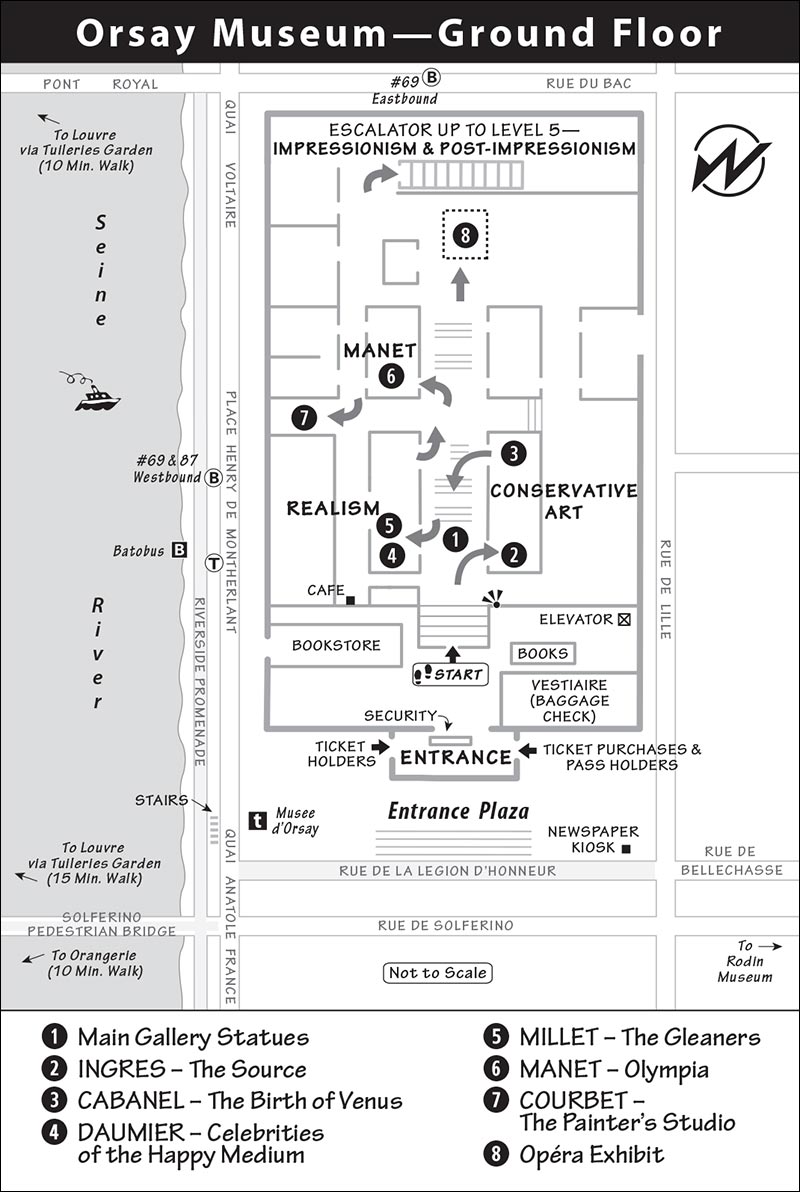
Remember that the museum rotates its large collection often, so find the latest arrangement on your current Orsay map and be ready to go with the flow.
Conservative Art
In the Orsay’s first few rooms, you’re surrounded by visions of idealized beauty—nude women in languid poses, Greek mythological figures, and anatomically perfect statues. This was the art adored by French academics and the middle-class (bourgeois) public.
Jean-Auguste-Dominique Ingres championed a Neoclassical style. His The Source (1856) is virtually a Greek statue on canvas—like Venus de Milo, she’s a balance of opposite motions. Her skin is porcelain-smooth, painted with seamless brushstrokes. Famous in its day, The Source influenced many artists whose classical statues and paintings are in this museum.
Alexandre Cabanel lays Ingres’ Source on her back. His Birth of Venus (1863) is a perfect fantasy, an orgasm of beauty. The Love Goddess stretches back seductively, recently birthed from the ephemeral foam of the waves. French folk would literally swoon in ecstasy before this work of art.
Realism
The French Realists rejected idealized classicism and began painting what they saw in the world around them. For Honoré Daumier, that meant looking at the stuffy bourgeois establishment that controlled the official art Academy and its formal exhibition, the Salon. In the 36 bustlets of Celebrities of the Happy Medium (1835), Daumier, trained as a political cartoonist, exaggerates each subject’s most distinct characteristic to capture with vicious precision the pomposity and self-righteousness of these self-appointed arbiters of taste (most were members of the French parliament).
Jean-François Millet’s The Gleaners (1867) shows us three poor women picking up the meager leftovers after a field has already been harvested for the landowner. He captures the innate dignity of these stocky, tanned women who bend their backs quietly in a large field for their small reward. This is “realism” in two senses. It’s painted “realistically,” not prettified. And it’s the “real” world—not the fantasy world of Greek myth, but the harsh life of the working poor.
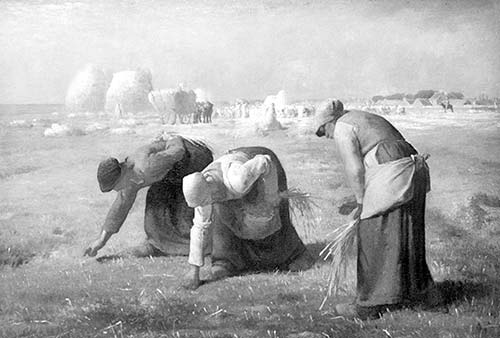
For a Realist’s take on the traditional Venus, find Edouard Manet’s Olympia (1863). Compare this uncompromising nude with Cabanel’s idealized, pastel, Vaseline-on-the-lens beauty in The Birth of Venus. In Olympia, sharp outlines and harsh, contrasting colors are new and shocking. The woman’s stare is shockingly defiant, as if to say, “Next.” Manet replaced soft-core porn with hard-core art.
Gustave Courbet’s The Painter’s Studio (1855) takes us backstage, showing us the gritty reality behind the creation of pretty pictures. We see Courbet himself in his studio, working diligently on a realistic landscape, oblivious to the confusion around him. Milling around are ordinary citizens, not Greek heroes.
At the far end of the gallery, you’ll find the Opéra Exhibit—a glass floor over a model of Paris and the 19th-century Opéra Garnier, with its green-domed roof at the center. The Opéra, which opened in 1875, was the symbol of the belle époque, or “beautiful age,” when Paris was a global center of prosperity, new technology, opera, ballet, painting, and joie de vivre.
Impressionism
The Impressionist and Post-Impressionist collections are scattered chronologically throughout the galleries on level 5.
The Impressionist painters rejected camera-like detail for a quick style more suited to capturing the passing moment. Feeling stifled by the rigid rules and stuffy atmosphere of the Academy, the Impressionists grabbed their berets and went on excursions to the country. There they set up their easels (and newly invented tubes of premixed paint) on riverbanks and hillsides, or they sketched in cafés and dance halls. Gods, goddesses, nymphs, and fantasy scenes were out; common people and rural landscapes were in.
The quick style and everyday subjects were ridiculed and called childish by the “experts.” Rejected by the Salon (the official Academy exhibit), the Impressionists staged their own exhibition in 1874. They brashly took their name from an insult thrown at them by a critic who laughed at one of Monet’s “impressions” of a sunrise. During the next decade, they exhibited their own work independently. The public, opposed at first, was slowly won over by the simplicity, the color, and the vibrancy of Impressionist art.
Edouard Manet’s Luncheon on the Grass (Le Déjeuner sur l’Herbe, 1863) shows the new movement starting to bud. Notice the background: the messy brushwork of trees and leaves, the play of light on the pond, and the light that filters through the trees onto the woman who stoops in the haze. Also note the strong contrast of colors (white skin, black clothes, green grass). Let the Impressionist revolution begin!
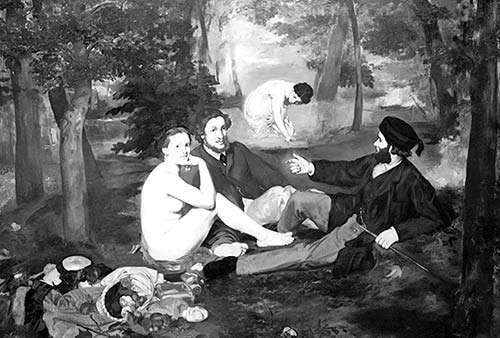
Next up is Claude Monet, one of the fathers of Impressionism. In the 1860s, Monet (along with Renoir) began painting landscapes in the open air. He studied optics and pigments to know just the right colors he needed to reproduce the shimmering quality of reflected light. The key was to work quickly—at that “golden hour” when the light was just right. Then he’d create a fleeting “impression” of the scene.
Monet is known for his series of paintings on the same subject, and you may see several of his canvases of the cathedral in Rouen. In 1893, Monet rented a room across from the cathedral, set up his easel...and waited. He wanted to catch “a series of differing impressions” of the cathedral facade at various times of day and year. In all, he did 30 paintings of the cathedral.
Pierre-Auguste Renoir started out as a painter of landscapes, along with Monet, but later veered from the Impressionists’ philosophy toward painted images that were unabashedly “pretty.” As Renoir himself said, “There are enough ugly things in life.”
His best-known work is Dance at the Moulin de la Galette (Bal du Moulin de la Galette, 1876). Like a photographer who uses a slow shutter speed to show motion, Renoir painted a waltzing blur, capturing the working-class folk who would dress up on Sunday afternoons and head for Montmartre to dance, drink, and eat little crêpes (galettes) till dark. The sunlight filtering through the trees creates a kaleidoscope of colors, like the 19th-century equivalent of a mirror ball throwing darts of light onto the dancers. While the dance hall is long gone, you can still see the windmill and original entrance to the Moulin de la Galette (now a recommended restaurant) in Montmartre.
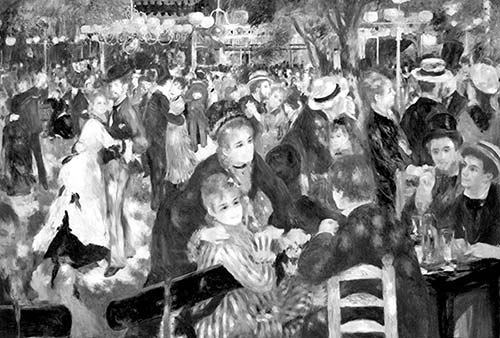
Edgar Degas blends classical lines and Realist subjects with Impressionist color, spontaneity, and everyday scenes from urban Paris. He loved the unposed “snapshot” effect, catching his models off guard. Dance students, women at work, and café habitués are approached from odd angles that aren’t always ideal but make the scenes seem more real. He gives us the backstage view of life, as in his behind-the-scenes look at bored, tired, restless dancers in The Dance Class (La Classe de Danse, c. 1873-1875). In a Café (Dans un Café, 1875-1876) shows a weary lady of the evening meeting morning with a last, lonely, nail-in-the-coffin drink in the glaring light of a café.
Paul Cézanne brought painting into the 20th century. Unlike the Impressionists, who painted what they saw, Cézanne reworked reality. He simplified it into basic geometric forms—circular apples, rectangular boulders, cone-shaped trees, triangular groups of people (see The Card Players, Les Joueurs de Cartes, 1890-1895). Because of his groundbreaking style, he is often called the first modern painter.
Where the Impressionists built a figure from a mosaic of individual brushstrokes, Cézanne used blocks of paint to create a more solid, geometrical shape. These chunks are like little “cubes.” It’s no coincidence that his experiments in reducing forms to their geometric basics inspired the...Cubists.
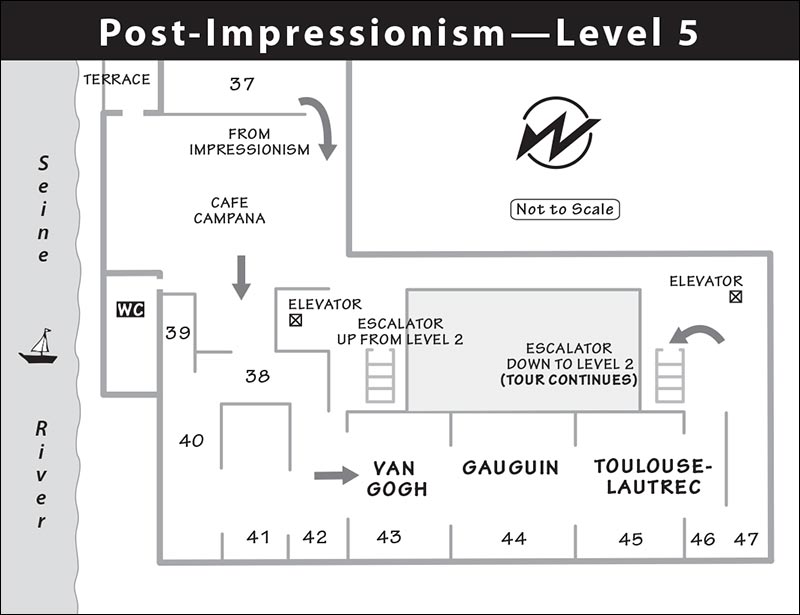
Post-Impressionism
The Impressionists were like a tribe. They spoke the same artistic language. But, after that, more than ever, artists went in different directions, creating art that was uniquely their own. Van Gogh, Gauguin, and Toulouse-Lautrec are fine examples of these Post-Impressionists, and their paintings line the walls of the next string of rooms (behind the café).
Like Michelangelo, Beethoven, and a select handful of others, Vincent van Gogh put so much of himself into his work that art and life became one. In the Orsay’s collection of paintings, you’ll see both Van Gogh’s painting style and his life unfold.
Encouraged by his art-dealer brother, Van Gogh moved from his native Holland to Paris. He met Monet, drank with Gauguin and Toulouse-Lautrec, and soaked up the Impressionist style. (For example, see how he might build a bristling brown beard using thick strokes of red, yellow, and green side by side.)
But the social life of Paris became too much for the solitary Van Gogh, and he moved to the south of France. At first, in the glow of the bright spring sunshine, he had a period of incredible creativity and happiness.
But being alone in a strange country began to wear on him. A painting of his rented bedroom in Arles shows a cramped, bare-bones place (Van Gogh’s Bedroom in Arles, La Chambre de Van Gogh à Arles, 1889). He invited his friend Gauguin to join him, but after two months together arguing passionately about art, nerves got raw. Van Gogh threatened Gauguin with a razor, which drove his friend back to Paris. In crazed despair, Van Gogh cut off a piece of his own ear.
Vincent sought help at a mental hospital. The paintings he finished in the peace of the hospital are more meditative—there are fewer bright landscapes and more closed-in scenes with deeper, almost surreal colors.
His final self-portrait shows a man engulfed in a confused background of brushstrokes that swirl and rave (Self-Portrait, Portrait de l’Artiste, 1889). But amid this rippling sea of mystery floats a still, detached island of a face. Perhaps his troubled eyes know that in only a few months, he’ll take a pistol and put a bullet through his chest.
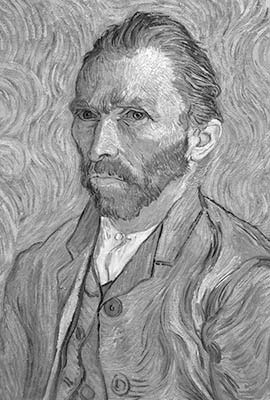
Nearby are the paintings of Paul Gauguin, who got the travel bug early in childhood and grew up wanting to be a sailor. Instead, he became a stockbroker. At the age of 35, he got fed up with it all, quit his job, abandoned his wife and family, and took refuge in art. (Look for his self-portrait with the travel-dreams background.) Gauguin traveled to the South Seas in search of the exotic, finally settling on Tahiti. There he found his Garden of Eden.
Gauguin’s best-known works capture an idyllic Tahitian landscape peopled by exotic women engaged in simple tasks and making music (Arearea, 1892). The style is intentionally “primitive,” collapsing the three-dimensional landscape into a two-dimensional pattern of bright colors. Gauguin wanted this simple work to communicate to his “civilized” colleagues back home that he’d found the paradise he’d always envisioned.
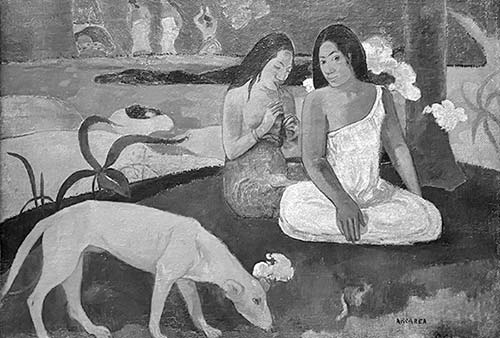
The next section features paintings by Henri de Toulouse-Lautrec, who found his travel thrills closer to home, in the Paris underworld. Every night, the artist put on his bowler hat and visited the Moulin Rouge to draw the crowds, the can-can dancers, and the backstage action. His painting style captures realist scenes with strong, curvaceous outlines. In Jane Avril Dancing (Jane Avril Dansant, 1891), he depicts the slim, graceful, elegant, and melancholy dancer. Her legs keep dancing while her mind is far away.
French Sculpture
On level 2, you’ll enjoy the works of great French sculptors, including Auguste Rodin. Born of working-class roots and largely self-taught, Rodin combined classical solidity with Impressionist surfaces to become the greatest sculptor since Michelangelo.
His muscular, forcefully striding Walking Man (L’Homme Qui Marche, 1905) could be a symbol of the Renaissance Man with his classical power. The statue’s surface is alive, rippling with frosting-like gouges. This rough, “unfinished” look reflects light like the rough Impressionist brushwork. And that makes the statue come to life, never quite at rest in the viewer’s eye.
Rodin’s inspiration for St. John the Baptist (Saint Jean-Baptiste, 1878) was a shaggy peasant looking for work as a model. Coarse and hairy, with both feet planted firmly in mid-stride, this sculpture challenged the traditional poses expected from a 19th-century artist. Movement and spontaneity mattered more to Rodin than mimicking classical stances.
Rodin’s sculptures capture the groundbreaking spirit of much of the art in the Orsay Museum. With a stable base of 19th-century stone, he helped launch art into the 20th century.
▲▲Orangerie Museum (Musée de l’Orangerie)
Located in the Tuileries Garden and drenched by natural light from skylights, the Orangerie (oh-rahn-zhuh-ree) is the closest you’ll come to stepping into an Impressionist painting. Start with the museum’s claim to fame: Monet’s Water Lilies. Then head downstairs to enjoy the manageable collection of select works by Utrillo, Cézanne, Renoir, Matisse, and Picasso.
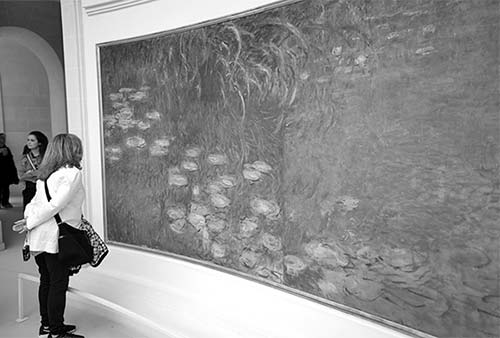
Cost and Hours: €12.50, timed-entry ticket highly recommended (buy online in advance), free for those under age 18, free on first Sun of the month (but timed-entry ticket required), €20 combo-ticket with Orsay Museum (not sold online—book a free timed-entry ticket on Orangerie website, then purchase combo-ticket at the museum), covered by Museum Pass; Wed-Mon 9:00-18:00, closed Tue; audioguide-€5, English guided tours available-€6, located in Tuileries Garden near Place de la Concorde (Mo: Concorde), 15-minute stroll from the Orsay, +33 1 44 77 80 07, www.musee-orangerie.fr.
Visiting the Museum: Like Beethoven going deaf, a nearly blind Claude Monet (1840-1926) wrote his final symphonies on a monumental scale. Even as he struggled with cataracts, he planned a series of huge six-foot-tall canvases of water lilies to hang in special rooms at the Orangerie.
These eight mammoth curved panels immerse you in Monet’s garden. We’re looking at the pond in his garden at Giverny—dotted with water lilies, surrounded by foliage, and dappled by the reflections of the sky, clouds, and trees on the surface. But the true subject of these works is the play of reflected light off the surface of the pond.
Working at his home in Giverny, Monet built a special studio with skylights and wheeled easels to accommodate the huge canvases. For 12 years (1914-1926), he worked on these paintings obsessively. Monet completed all the planned canvases, but he didn’t live to see them installed here. In 1927, the year after his death, these rooms were completed and the canvases put in place. Some call this the first “art installation”—art displayed in a space specially designed for it.
In the underground gallery are select works—Impressionist, Fauvist, and Cubist—amassed by the Parisian art dealer Paul Guillaume. His collection is a snapshot of what was hot in the world of art, circa 1920. The Impressionists had become old-school, though their paintings—now classics—commanded a fortune. The bohemian Fauvists and Cubists, who invented modern art, refused to be categorized, and their work in the 1920s branched out in dozens of new directions. Browse the rooms and watch the various “isms” unfold. You’ll get a taste of Picasso’s many styles, Modigliani’s primitive heads, Derain’s quirky still lifes, Matisse’s “flatness,” and Rousseau’s charming childlike world. The collection is small enough to enjoy in a short visit, but complete enough to show the bridge from Impressionism to Modernism. And it’s all beautiful.
EIFFEL TOWER AND NEARBY
▲▲▲Eiffel Tower (La Tour Eiffel)
Built on the 100th anniversary of the French Revolution (and in the spirit of the Industrial Revolution), the tower was the centerpiece of a World Expo designed to show off what people could build in 1889. For decades it was the tallest structure the world had ever known, and though it’s since been eclipsed, it’s still the most visited monument. Ride the elevators to the top of its 1,063 feet for expansive views that stretch for miles. Then descend to the two lower levels, where the views are arguably even better, since the monuments are more recognizable.
Cost and Hours: €28.30 to ride all the way to the top, €18.10 for just the two lower levels, €11.30 to climb the stairs to the first or second level, €21.50 to climb the stairs to the second level and take the elevator to the summit, 50 percent cheaper for those under 25, 75 percent cheaper for those under 12, book online in advance (see below), not covered by Museum Pass; open daily mid-June-Aug 9:00-24:45, Sept-mid-June 9:30-23:45, last ascent to top by elevator at 22:30 and to lower levels at 23:00 all year (stairs same except Sept-mid-June last ascent 18:30); cafés and great view restaurants, Mo: Bir-Hakeim or Trocadéro, RER-C: Champ de Mars-Tour Eiffel (all a 10-minute walk away). Recorded information +33 8 92 70 12 39, www.toureiffel.paris.
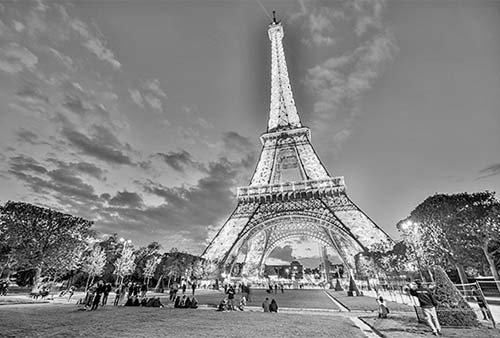
Reservations Smart: Make a reservation well in advance of your visit—or be ready to wait in long lines. At TourEiffel.paris, you can book a time slot for your ascent; this allows you to skip the long initial entry line. Tickets go on sale about 60 days in advance and sell out quickly for visits from April through September, so don’t dally.
Background
The first visitor to the Paris World’s Fair in 1889 walked beneath the “arch” formed by the newly built Eiffel Tower and entered the fairgrounds. This event celebrated both the centennial of the French Revolution and France’s position as a global superpower. Bridge builder Gustave Eiffel (1832-1923) won the contest to build the fair’s centerpiece by beating out rival proposals such as a giant guillotine.
The tower was nothing but a showpiece, with no functional purpose except to demonstrate to the world that France had the wealth, knowledge, and can-do spirit to erect a structure far taller than anything the world had ever seen. The original plan was to dismantle the tower as quickly as it was built after the celebration ended, but it was kept by popular demand.
Visiting the Tower
There are three observation platforms, at roughly 200, 400, and 900 feet. If you want to see the entire tower, from top to bottom, then see it...from top to bottom. There isn’t a single elevator straight to the top (le sommet). To get there, you’ll first ride an elevator (or hike up the stairs) to the second level. (For the hardy, there are 360 stairs to the first level and another 360 to the second.)
Once on the second level, immediately line up for the next elevator, to the top (Le Sommet/The Summit). Enjoy the views, then ride back down to the second level. When you’re ready, head to the first level via the stairs (no line and can take as little as five minutes) or take the elevator down. Explore the shops and exhibits on the first level. To leave, you can line up for the elevator, but it’s probably faster and certainly more memorable to take the stairs back down to earth.
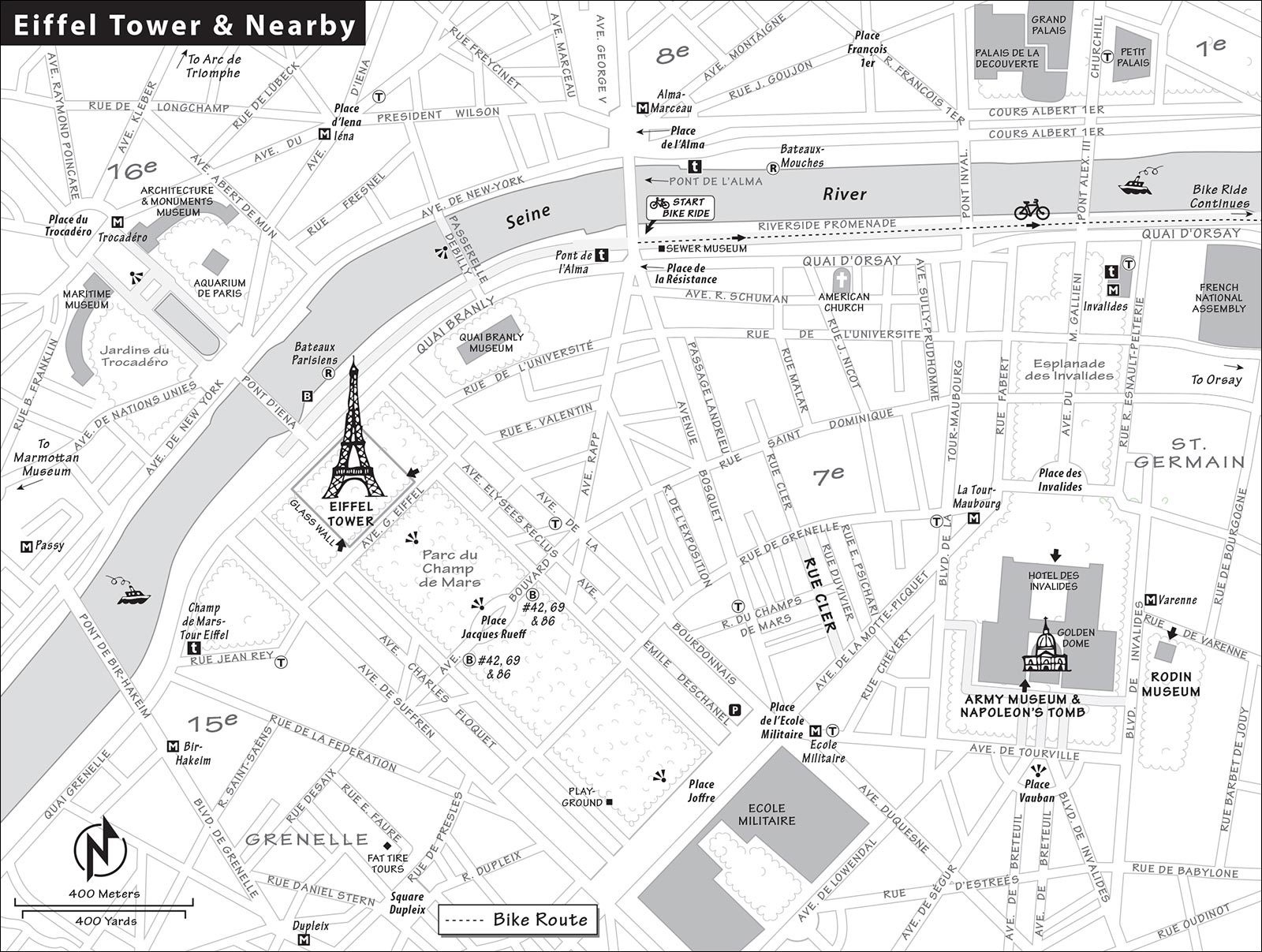
Top Level: You’ll find wind and grand, sweeping views on the tiny top level. The city lies before you (pick out sights with the help of the panoramic maps). On a good day, you can see for 40 miles. Do a 360-degree tour of Paris.
Second Level: The second level has the best views because you’re closer to the sights, and the monuments are more recognizable. On this level you’ll find souvenir shops, WCs, and a small stand-up café. The world-class Le Jules Verne restaurant is on this level, but you won’t see it; access is by a private elevator.
First Level: Here are more great views, all well described by the tower’s panoramic displays. There’s a small concert hall, a good restaurant, a few cafés (one with fun outdoor seating), shops, and a little theater. In winter, part of the first level is often set up to host an ice-skating rink.
Back on the Ground: Welcome back to earth. For a final look at the Tower, stroll across the river to Place du Trocadéro or to the end of the Champ de Mars and look back for great views. However impressive it may be by day, the tower is an awesome thing to behold at twilight, when it becomes engorged with light, and virile Paris lies back and lets night be on top. When darkness fully envelops the city, the tower seems to climax with a spectacular light show at the top of each hour...for five glorious minutes.
Near the Eiffel Tower
▲Paris Sewer Museum (Les Egouts de Paris)
Discover what happens after you flush. This quick, interesting, and slightly stinky visit (a perfumed hanky helps) takes you along a few hundred yards of water tunnels in the world’s first underground sewer system. Sens de la Visite (“direction of visit”) signs and numbered stops guide you along open sewers and through exhibits that trace the evolution of this amazing network of sewers and explain the history of water distribution and collection in Paris, from Roman times to the present.
Cost and Hours: €9, free entry for those under 18, not covered by Museum Pass; Tue-Sun 10:00-17:00, closed Mon, last entry one hour before closing; located where Pont de l’Alma greets the Left Bank—on the right side of the bridge as you face the river, Mo: Alma-Marceau, RER/Train-C: Pont de l’Alma, +33 1 53 68 27 81, www.musee-egouts.paris.fr/en [URL inactive].
▲▲Rue Cler
Paris is always changing, but a stroll down this market street introduces you to a thriving, traditional Parisian neighborhood and offers insights into the local culture. Although this is a wealthy district, Rue Cler retains the workaday charm still found in most neighborhoods throughout Paris. The shops lining the street are filled with the freshest produce, the stinkiest cheese, the tastiest chocolate, and the finest wines (markets generally open Tue-Sat 8:30-13:00 & 15:00-19:30, Sun 8:30-12:00, dead Sun afternoon and Mon).
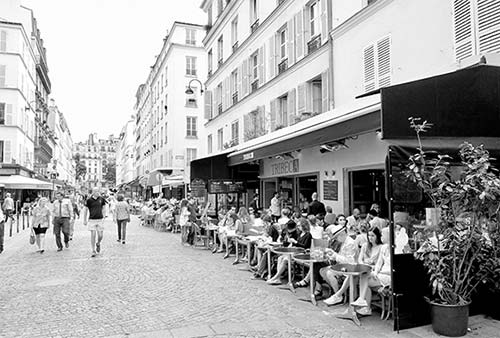
For a self-guided walk, download my free Rue Cler audio tour.
▲▲Army Museum and Napoleon’s Tomb (Musée de l’Armée)
The complex of Les Invalides—a former veterans’ hospital built by Louis XIV—has various military collections, together called the Army Museum. You’ll see medieval armor, Napoleon’s horse stuffed and mounted, Louis XIV-era uniforms and weapons, and much more. The best part is the section dedicated to the two world wars, especially World War II. Visiting the different sections, you can watch the art of war unfold, from stone axes to Axis powers. What’s more, Napoleon himself is entombed beneath the church’s golden dome.
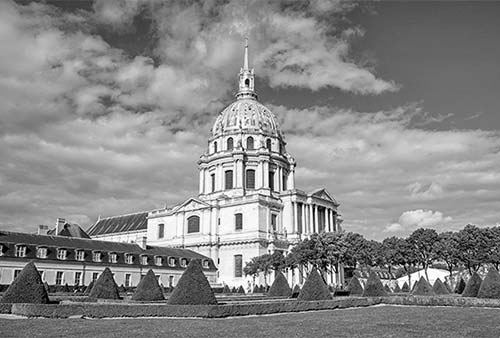
Cost and Hours: €15, free for military personnel in uniform, free for kids but they must wait in line for ticket, covered by Museum Pass; daily 10:00-18:00, Napoleon’s Tomb until 22:00 on the first Fri of the month (€10 entry after 18:00); multimedia guide-€5, cafeteria, +33 1 44 42 38 77, www.musee-armee.fr. A sound-and-light show runs at Les Invalides on summer nights.
Getting There: The Hôtel des Invalides is at 129 Rue de Grenelle, a 10-minute walk from Rue Cler (Mo: La Tour-Maubourg, Varenne, or Invalides). You can take bus #69 (from the Marais and Rue Cler) or bus #6 from the St. Germain-des-Prés area. Buses #82 or #92 also take you there.
Visiting the Museum: Pick up the free and helpful map/guide. At the center of the complex, Napoleon Bonaparte lies majestically dead inside several coffins under a grand dome—a goose-bumping pilgrimage for historians. The dome overhead glitters with 26 pounds of thinly pounded gold leaf.
Your visit continues through an impressive range of museums filled with medieval armor, cannons and muskets, Louis XIV-era uniforms and weapons, and Napoleon’s horse—stuffed and mounted.
The best section is dedicated to the two World Wars. Walk through displays well described in English on the trench warfare of World War I, the victory parades, France’s horrendous losses, and the humiliating Treaty of Versailles that led to World War II.
The WWII rooms use black-and-white photos, maps, videos, and a few artifacts to trace Hitler’s rise, the Blitzkrieg that overran France, America’s entry into the war, D-Day, the concentration camps, the atomic bomb, the war in the Pacific, and the eventual Allied victory. There’s special insight into France’s role (the French Resistance), and how it was Charles de Gaulle who actually won the war.
▲▲Rodin Museum (Musée Rodin)
This user-friendly museum with gardens is filled with passionate works by Auguste Rodin (1840-1917), the greatest sculptor since Michelangelo. You’ll see The Kiss, The Thinker, The Gates of Hell, and many more, well displayed in the mansion where the sculptor lived and worked.
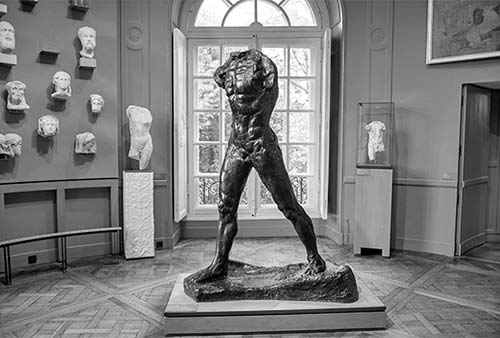
Cost and Hours: €13, free for those under age 18, free on first Sun of the month Oct-March, €24 combo-ticket with Orsay Museum (smart to buy at this less-crowded sight), both museum and garden covered by Museum Pass; Tue-Sun 10:00-18:30, closed Mon, Oct-March garden closes at dusk; audioguide-€6, mandatory baggage check, self-service café in garden, 77 Rue de Varenne, Mo: Varenne, +33 1 44 18 61 10, www.musee-rodin.fr.
Visiting the Museum: Auguste Rodin (1840-1917) was a modern Michelangelo, sculpting human figures on an epic scale, revealing through their bodies his deepest thoughts and feelings. Like many of Michelangelo’s unfinished works, Rodin’s statues rise from the raw stone around them, driven by the life force. With missing limbs and scarred skin, these classics make ugliness noble. Rodin’s people are always moving restlessly. Even the famous Thinker is moving; while he’s plopped down solidly, his mind is a million miles away.
Exhibits trace Rodin’s artistic development, explain how his bronze statues were cast, and show some of the studies he created to work up to his masterpiece, the unfinished Gates of Hell. Learn about Rodin’s tumultuous relationship with his apprentice and lover, Camille Claudel. Mull over what makes his sculptures some of the most evocative since the Renaissance. Be sure to stroll the beautiful gardens, which are ideal for artistic reflection. They’re packed with many of Rodin’s greatest works, including the iconic Thinker and the massive Gates of Hell, the defining project of the artist’s career.
▲▲Marmottan Museum (Musée Marmottan Monet)
In this private, intimate, and untouristy museum, you’ll find the best collection anywhere of works by Impressionist headliner Claude Monet. Follow Monet’s life through scores of works, from simple sketches to the Impression, Sunrise painting that gave his artistic movement its start—and a name. The museum also displays some of the enjoyable large-scale canvases featuring the water lilies from his garden at Giverny.
Cost and Hours: €14.50, not covered by Museum Pass, €25 combo-ticket with Monet’s garden and house at Giverny (see here; lets you skip the line at Giverny); Tue-Sun 10:00-18:00, Thu until 21:00, closed Mon; audioguide-€4 (includes temporary exhibits), 2 Rue Louis-Boilly, Mo: La Muette, +33 1 44 96 50 33, www.marmottan.fr.
Visiting the Museum: The 19th-century Marmottan mansion, formerly a hunting lodge, has three pleasant, manageable floors, all worth perusing. The ground floor has several rooms of period furnishings and notable paintings by French artists. Temporary exhibits are usually displayed in a gallery on this floor. Upstairs are illuminated manuscripts and some works by Monet’s fellow Impressionists—Edgar Degas, Camille Pissarro, Paul Gauguin, Pierre-Auguste Renoir, Edouard Manet, and especially Berthe Morisot.
Monet’s works—the core of the collection—are in the basement. Descending the stairs, you’re immediately plunged into the colorful and messy world of the artist. You’ll see some 50 paintings spanning his lifetime (1840-1926). They’re generally (and very roughly) arranged in chronological order—from Monet’s youthful discovery of Impressionism, to his mature “series” paintings, to his last great water lilies from Giverny.
LEFT BANK
Opposite Notre-Dame, on the left bank of the Seine, is the Latin Quarter. (For more about this neighborhood, see the “Historic Paris Walk,” earlier.)
▲▲Cluny Museum (Musée National du Moyen Age)
This easy-to-visit treasure trove of Middle Ages art delivers close-up looks at stained glass, Notre-Dame carvings, fine goldsmithing and jewelry, and rooms of tapestries. Highlights include several rare 800-year-old stained-glass windows from Sainte-Chapelle, the 21 stone heads that once sat atop statues decorating the front of Notre-Dame, and the exquisite series of six Lady and the Unicorn tapestries. The museum also includes the well-preserved remains of a Roman bathhouse.
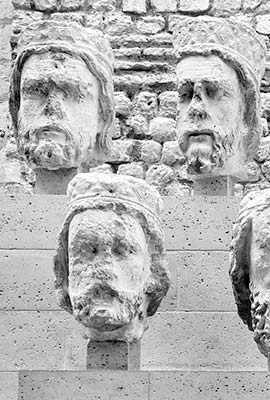
Cost and Hours: €12, free on first Sun of the month, covered by Museum Pass; Tue-Sun 9:30-18:15, first and third Thu of the month until 21:00, closed Mon, last entry 45 minutes before closing; near corner of Boulevards St. Michel and St. Germain at 6 Place Paul Painlevé; Mo: Cluny La Sorbonne, St-Michel, or Odéon; +33 1 53 73 78 10, www.musee-moyenage.fr.
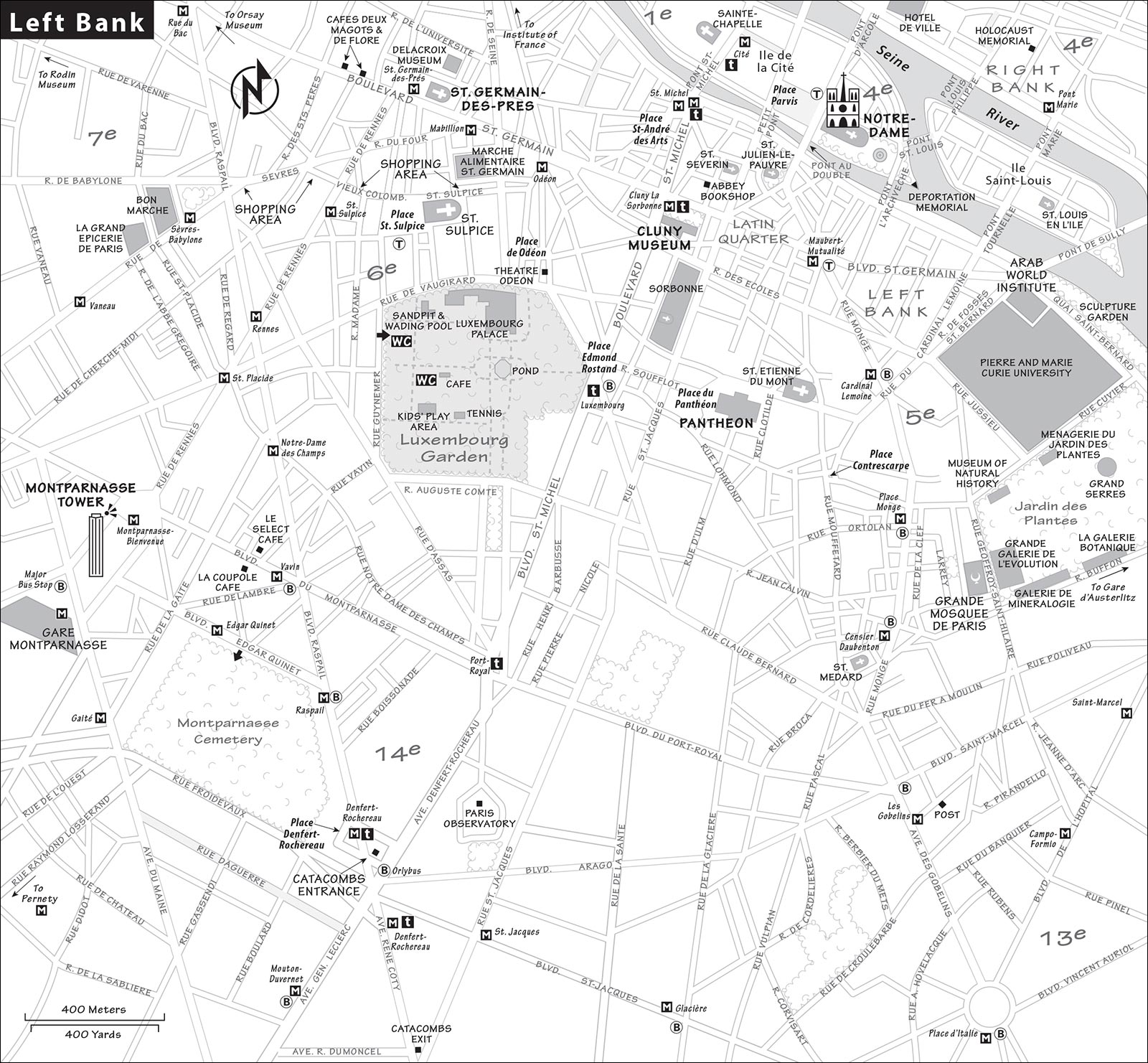
Visiting the Museum: Thanks to the museum’s clear layout and signage, it’s easy to navigate through the rooms numerically (your ticket includes a good map).
Around the year 1200, Parisians were emerging from the Early Middle Ages. They’d survived their Y1K crisis, trade was booming, a university was founded (today’s Sorbonne), and Paris was becoming a major European capital. The High Middle Ages produced art that was less about grim crucifixions and more a celebration of the beauty of the world. You’ll see surprisingly joyful tapestries, golden altarpieces, exquisite metalwork, and statues with a budding realism.
The museum’s collection of objects from c. 500-1000 makes it clear that Roman art and learning lived on even after the empire’s fall. Columns and capitals evoke the Roman-esque grandeur of early-Christian churches. Statues of the Virgin Mary, decorative flourishes from church buildings, and exquisitely carved miniature altarpieces in ivory reveal Roman style and artistic techniques.
As Europeans rediscovered the beauty of the world around them, a new sensuality crept into their artwork. A marvelous celebration of the senses—and the high point of the Cluny’s collection—is the tapestry set known as The Lady and the Unicorn. Designed by an unknown (but probably French) artist before 1500, these six tapestries were woven in Belgium from wool and silk. Loaded with symbols—some serious, some playful—the series depicts a delicate, as-medieval-as-can-be noble lady introducing a delighted unicorn to the senses of taste, hearing, sight, smell, and touch.
Allow time to explore the Roman bathhouse (lower level). Its 40-foot-high ceiling is the largest surviving Roman vault in France, and it took the French another 1,000 years to improve on that crisscross-arch technology. The sheer size of this room—constructed in AD 200, when Rome was at its peak—gives an idea of the epic scale on which the Romans built.
▲St. Sulpice Church
St. Sulpice’s impressive Neoclassical arcaded facade, with two round, half-finished towers, is modeled on St. Paul’s in London. It has a remarkable organ and offers Sunday-morning recitals.
Cost and Hours: Free, daily 8:00-19:30, Mass Sun at 11:00, Mo: St-Sulpice or Mabillon. See www.aross.fr/en for info on special concerts.
Sunday Organ Recitals: You can hear the organ played before Sunday Mass (roughly 10:00-10:45) and at 18:30; come appropriately dressed.
Visiting the Church: Enter the church and circle counterclockwise, making a few stops. In the first chapel on the right, find Delacroix’s three murals (on the chapel’s ceiling and walls) of fighting angels, completed during his final years while he was battling a lengthy illness. They sum up his long career, from Renaissance/Baroque roots to furious Romanticism to proto-Impressionism.
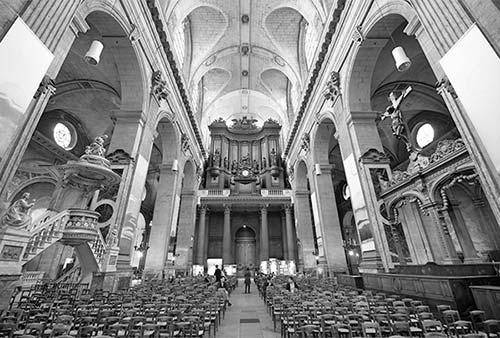
Walking up the right side of the church, pause at the fourth chapel, with a statue of Joan of Arc and wall plaques listing hundreds upon hundreds of names. These are France’s WWI dead—from this congregation alone.
Continue around the church. On the wall of the north transept is an Egyptian-style obelisk used as a gnomon, or part of a sundial. At Christmas Mass, the sun shines into the church through a tiny hole—opposite the obelisk, high up on the south wall (in the upper-right windowpane). The sunbeam strikes a mark on the obelisk that indicates the winter solstice. In the final chapel before the exit, there’s a copy of the Shroud of Turin, the famed burial cloth purported to have wrapped the body of Christ.
▲Luxembourg Garden (Jardin du Luxembourg)
This lovely 60-acre garden is an Impressionist painting brought to life. Slip into a green chair pondside, enjoy the radiant flower beds, go jogging, play tennis or basketball, sail a toy sailboat, or take in a chess game or puppet show. Some of the park’s prettiest (and quietest) sections lie around its perimeter (free, daily dawn until dusk, Mo: Odéon, RER/Train-B: Luxembourg).
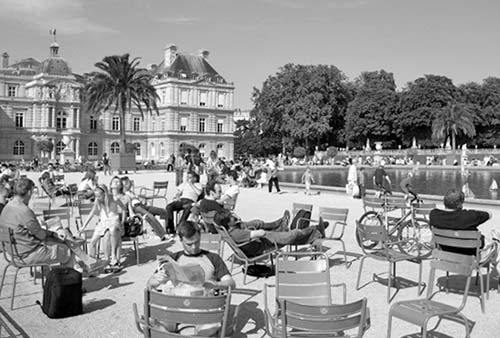
▲Panthéon
This state capitol-style Neoclassical monument celebrates France’s illustrious history and people, balances a Foucault pendulum, and is the final resting place of many French VIPs.
In 1744, an ailing King Louis XV was miraculously healed by St. Geneviève, the city’s patron saint, and he thanked her by replacing her ruined church with a more fitting tribute. By the time the church was completed (1791), however, the secular-minded Revolution was in full swing, and the church was converted into a secular mausoleum honoring the champions of French liberty and a panoply of other greats, among them Voltaire, Rousseau, Victor Hugo (Les Misérables), Alexandre Dumas (The Three Musketeers), Louis Braille, and Marie Curie. The building is a fitting monument to those who forged France’s freedom and defended freedom of thought. The audioguide is worthwhile for a longer description of the many painted scenes that decorate the interior.
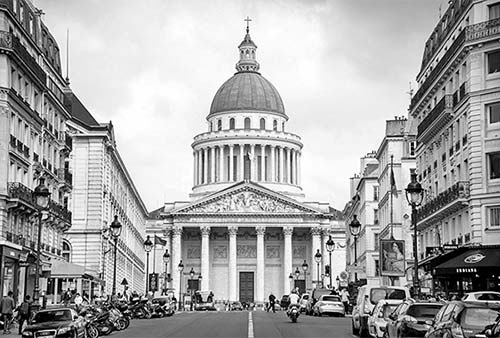
Cost and Hours: €11.50, free for those under age 18, covered by Museum Pass, separate fee for dome climb (see below); daily 10:00-18:30, Oct-March until 18:00, last entry 45 minutes before closing; audioguide-€3, Mo: Cardinal Lemoine, +33 1 44 32 18 00, www.paris-pantheon.fr.
Dome Climb: From April through October you can climb 203 steps to the colonnade at the base of the dome for views of the interior and a 360-degree view of the city. Buy your “panorama” ticket as you enter the Panthéon or online (€3.50 for dome climb, not covered by Museum Pass, last entry at 16:30, visiting in the morning helps avoid ticket lines).
Montparnasse Tower
This sadly out-of-place 59-story superscraper does have its virtues: If you can’t make it up the Eiffel Tower, the sensational views from this tower are cheaper, far easier to access (a 40-second elevator ride), and make for a fair consolation prize.
Cost and Hours: €15 for tower, RS%—30 percent discount (2 people per book), not covered by Museum Pass; daily 9:30-23:30, Oct-March 10:00-22:30; entrance on Rue de l’Arrivée, Mo: Montparnasse-Bienvenüe—from the Métro, stay inside the station and follow signs to exit #1, +33 1 45 38 52 56, www.tourmontparnasse56.com.
▲Catacombs
In 1785, health-conscious Parisians looking to relieve congestion and improve the city’s sanitary conditions emptied the church cemeteries and moved the bones here, to former limestone quarries.
You’ll spiral down 60 feet below the street and walk a one-mile route through tunnels containing the anonymous bones of six million permanent Parisians. You’ll land in a room with English posters describing 45 million years of ancient geology, then shuffle along passageways of artfully arranged, skull-studded tibiae, and admire 300-year-old sculptures cut into the walls of the catacombs. Once inside, allow an hour if you dawdle.
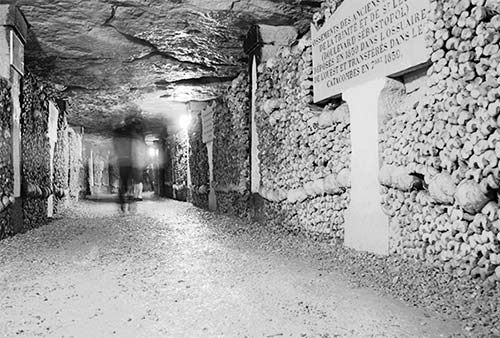
Cost and Hours: €29 for timed-entry ticket, book online in advance, includes audioguide, not covered by Museum Pass; ticket office open Tue-Sun 9:45-19:30, closed Mon; €18 same-day tickets sometimes available online or, if you’re very lucky, at the door; +33 1 43 22 47 63, www.catacombes.paris.fr.
Getting There: It’s at 1 Place Denfert-Rochereau. Take the Métro to Denfert-Rochereau and follow Sortie 1; it’s right across the street as you exit.
CHAMPS-ELYSEES AND NEARBY
▲▲▲Champs-Elysées
This famous boulevard is Paris’ backbone, with its greatest concentration of traffic (although it’s delightfully traffic-free on the first Sun of the month). From the Arc de Triomphe down Avenue des Champs-Elysées, all of France seems to converge on Place de la Concorde, the city’s largest square. And though the Champs-Elysées has become as international as it is Parisian, a walk down the two-mile boulevard is still a must.
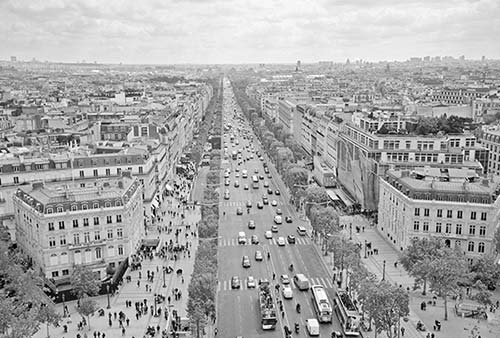
In 1667, Louis XIV opened the first section of the street, and it soon became the place to cruise in your carriage. (It still is today.) By the 1920s, this boulevard was pure elegance—fancy residences, rich hotels, and cafés. Today it’s home to big business, celebrity cafés, glitzy nightclubs, high-fashion shopping, and international people-watching. People gather here to celebrate Bastille Day (July 14), World Cup triumphs, and the finale of the Tour de France.
Self-Guided Walk: Start at the Arc de Triomphe (Mo: Charles de Gaulle-Etoile; if you’re planning to tour the Arc, do it before starting this walk) and head downhill on the north (sunnier) side. The arrival of McDonald’s (at #140) in the 1970s was an unthinkable horror, but these days dining chez MacDo has become typically Parisian, and this branch is among the most profitable in the world.
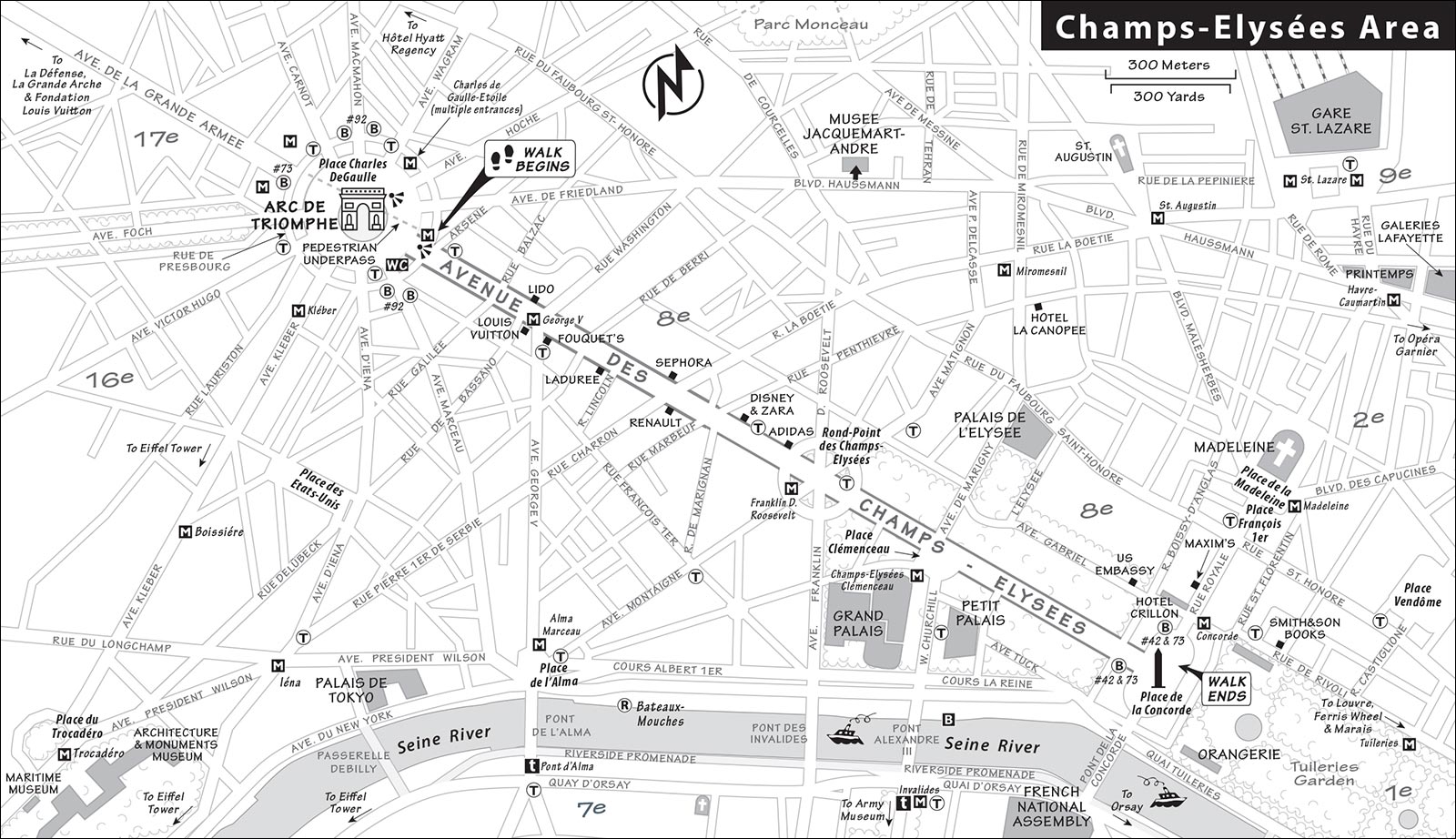
The flagship store of Louis Vuitton (#101), the famous producer of leather bags, may be the largest single-brand luxury store in the world. Fouquet’s café-restaurant (#99), under the red awning, is the place to enjoy a slow (if pricey) coffee on the Champs-Elysées. Ladurée café (farther along at #75) is also classy but has a welcoming and affordable takeout bakery.
Continuing on, you pass international-brand stores, such as Sephora, Disney, Lululemon, and Foot Locker. Car buffs should walk down to #33 and park themselves at the Renault store. Though the exhibits change regularly, there’s always something hot to entertain car aficionados.
You can end your walk at the round Rond-Point intersection or continue to obelisk-studded Place de la Concorde, Paris’ largest square.
▲▲Arc de Triomphe
Napoleon had the magnificent Arc de Triomphe commissioned to commemorate his victory at the 1805 battle of Austerlitz. The foot of the arch is a stage on which the last two centuries of Parisian history have played out—from the funeral of Napoleon to the goose-stepping arrival of the Nazis to the triumphant return of Charles de Gaulle after the Allied liberation. Examine the carvings on the pillars, featuring a mighty Napoleon and excitable Lady Liberty. Pay your respects at the Tomb of the Unknown Soldier. Then climb the 284 steps to the observation deck up top, with sweeping skyline panoramas and a mesmerizing view down onto the traffic that swirls around the arch.
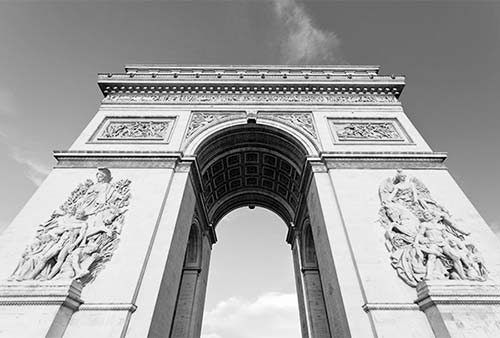
Cost and Hours: Free to view exterior; steps to rooftop—€13, timed-entry tickets available online, free for those under age 18, free on first Sun of the month Nov-March, covered by Museum Pass (reservation not necessary), pass holders and timed-entry ticket holders can skip the lines; daily 10:00-23:00, Oct-March until 22:30, last entry 45 minutes before closing; Place Charles de Gaulle, use underpass to reach arch, Mo: Charles de Gaulle-Etoile, +33 1 55 37 73 77, www.paris-arc-de-triomphe.fr.
Avoiding Lines: With a timed-entry ticket or Museum Pass, you’ll bypass two slow-moving lines: the underground ticket line and the line for access to the stairs up the Arc (look for the Priority Access sign just after emerging from the tunnel). The elevator is only for people with disabilities and runs only to the museum level, not to the top, which requires a 47-step climb (they are less strict for the elevator down). The Arc is quieter first thing and after 17:00—come for sunset.
▲Petit Palais (and Musée des Beaux-Arts)
This free, easy-to-navigate museum displays a broad collection of paintings and sculpture from the 1600s to the 1900s on its ground floor, and an easy-to-appreciate collection of art from Greek antiquities to Art Nouveau. Though it houses mostly second-tier art, there are a few diamonds in the rough (including works by Rembrandt, Courbet, Cézanne, Sisley, Pissarro, Degas, and Monet). The impressive building was constructed, along with the Grand Palais and Pont Alexandre III, for the 1900 Paris Exhibition (World’s Fair). The museum’s classy café alone merits the detour—and if it’s raining and your Museum Pass has expired, or you just need a clean WC, the Petit Palais is a worthwhile stop.
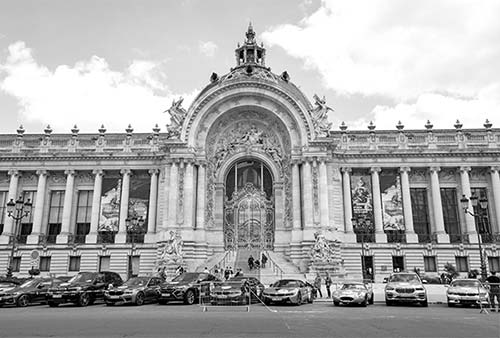
Cost and Hours: Free; Tue-Sun 10:00-18:00, Fri until 21:00 for special exhibits (fee), closed Mon; across from Grand Palais on Avenue Winston Churchill, a looooong block west of Place de la Concorde, Mo: Champs-Elysées Clemenceau; lovely café, +33 1 53 43 40 00, www.petitpalais.paris.fr.
OPERA NEIGHBORHOOD
The glittering Garnier opera house anchors this neighborhood of broad boulevards and grand architecture. This area is also nirvana for high-end shoppers, with the opulent Galeries Lafayette and Printemps stores, and the sumptuous shops that line Place Vendôme and Place de la Madeleine (see “Shopping in Paris,” later, for a shopping walk of this area).
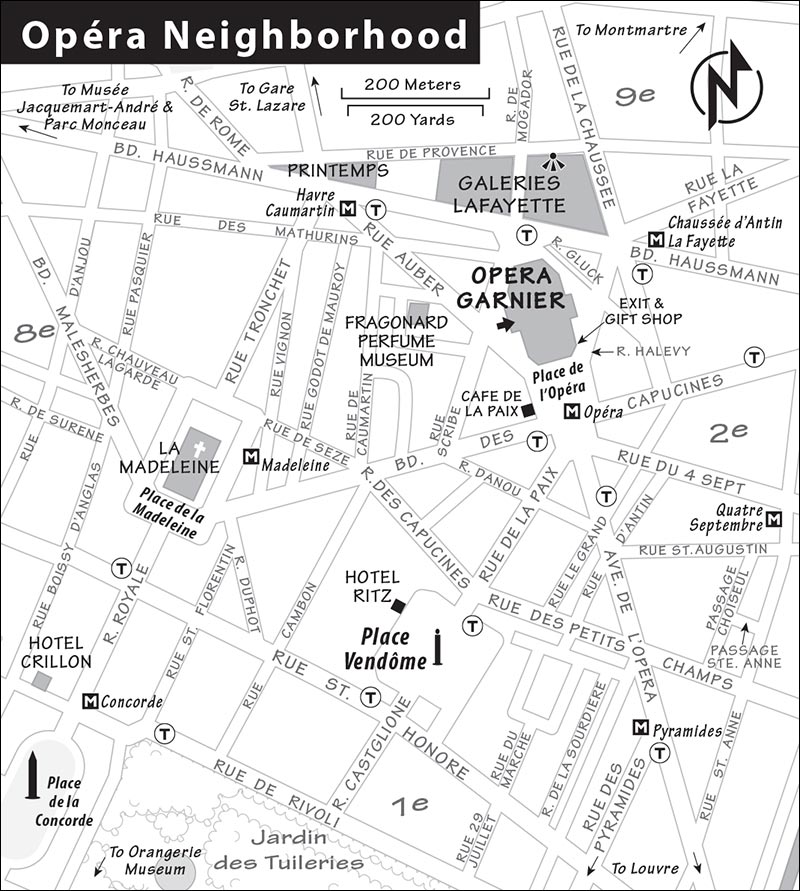
▲▲Opéra Garnier (Opéra National de Paris—Palais Garnier)
A gleaming grand theater of the belle époque, the Palais Garnier was built for Napoleon III and finished in 1875. From Avenue de l’Opéra, once lined with Paris’ most fashionable haunts, the facade suggests “all power to the wealthy.”
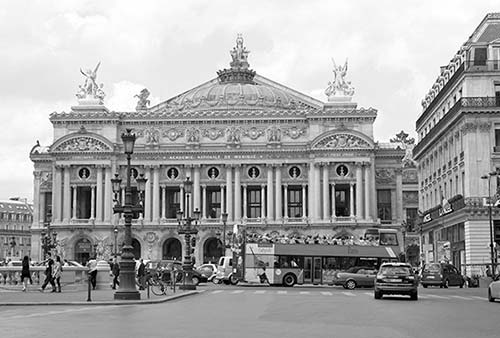
To see the interior, you have several choices: Take a guided tour (a good value), explore the public areas on your own (using the audioguide), or attend a performance. The auditorium is sometimes off-limits due to performances and rehearsals. Highlights of the interior include the Grand Staircase, the various chandeliered reception halls, the 2,000-seat auditorium, and a few exhibits on the building and opera.
Cost and Hours: €14, €4 off if you show your Orsay Museum ticket (within 5 days of Orsay visit), not covered by Museum Pass; generally daily 10:00-17:00, ticket office closes at 16:15, may be closed some afternoons for rehearsals and during performances; at the corner of Rue Scribe and Rue Auber, Mo: Opéra, RER/Train-A: Auber, www.operadeparis.fr/en/visits/palais-garnier.
Crowd Control: The Opera gets slammed in the mornings as several guided tours depart between 10:00 and 11:30. It’s quietest after noon.
Tours: The €6.50 multimedia guide gives an in-depth tour. Guided tours in English usually run daily every half-hour between 10:00 and 11:30, and again at 15:30; arrive 30 minutes early for security screening (€20.50, after-hours tours-€22, tours include entry, reserve at www.manatour.fr).
Visiting the Opéra: First, take in the view of the facade from the traffic island of the Opéra Métro. The building is huge. Its massive foundations straddle an underground lake (inspiring the mysterious world of The Phantom of the Opera). It’s the masterpiece of architect Charles Garnier, who oversaw every element, from laying the foundations to what color the wallpaper should be.
The tourist entrance is around the left side of the building, through what was once the rich patrons’ entrance (they could drive their carriages right up the ramps and slip in).
Enter, buy your ticket, and make your way (up a short staircase) to the foot of the Grand Staircase. This was the Opera House’s real “stage,” for the evening’s real show: the grand spectacle of elite Parisians—out to see and be seen—strutting their elegant stuff. Mentally populate the space with fin de siècle ladies in flowing satin gowns and white-gloved gentlemen in top hats and tuxes.
At the top of the stairs you’ll find the numbered doors of the box seats, where the rich people watched the opera. The famous box #5 honors the (fictional) Phantom of the Opera, who always sat here. The novel and musical are based on two historical facts: the building’s underground cistern, and a real incident in which the theater’s chandelier fell and killed someone.
Now enter an open box and take in the view of the amphitheater. The red-velvet performance hall seats 2,000. Admire Marc Chagall’s colorful ceiling (1964) playfully dancing around the seven-ton chandelier. Note the box seats next to the stage—the most expensive in the house, with an obstructed view of the stage—but just right if you’re here only to be seen.
The opulent, chandeliered reception rooms are where operagoers gathered for drinks and socializing during intermission. These include the domed Rotonde du Glacier, with a ceiling painting of Bacchus and his revelers, and the Grand Foyer, a long, high-ceilinged Hall-of-Mirrors-esque space that was the main gathering place at intermission. Finish in the museum, with a long hallway of exhibits, including a cutaway model of the stage; paintings of famous singers, dancers, composers, and set designers; and a depiction of the original ceiling painting that graced the auditorium before Chagall came along.
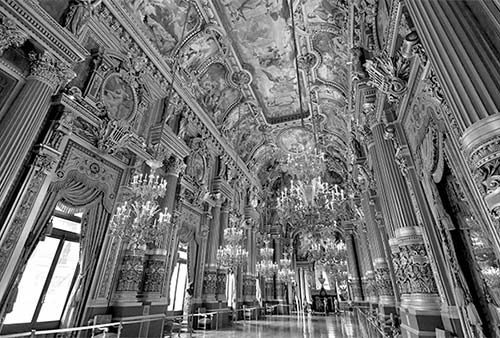
Nearby: The illustrious Café de la Paix faces the Opera’s front and has been a meeting spot for the local glitterati for generations. If you can afford the coffee, this spot offers a delightful break.
MARAIS NEIGHBORHOOD AND NEARBY
Naturally, when in Paris you want to see the big sights—but to experience the city, you also need to visit a vital neighborhood. The Marais fits the bill, with trendy boutiques and art galleries, with-it cafés, narrow streets, leafy squares, Jewish bakeries, aristocratic mansions, and fun nightlife—and it’s filled with real Parisians. It’s the perfect setting to appreciate the flair of this great city.
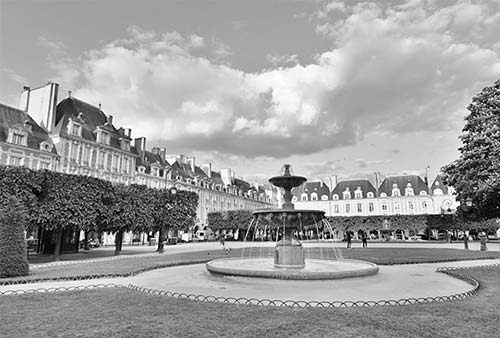
The Marais extends along the Right Bank of the Seine, from the Bastille to the Pompidou Center. The main east-west axis is formed by Rue St. Antoine, Rue des Rosiers (the heart of Paris’ Jewish community), and Rue Ste. Croix de la Bretonnerie. The centerpiece of the neighborhood is the stately Place des Vosges.
For a map of this area, see here.
Place des Vosges and West
▲▲Place des Vosges
Henry IV built this centerpiece of the Marais in 1605 and called it “Place Royale.” As he’d hoped, it turned the Marais into Paris’ most exclusive neighborhood. Walk to the center, where Louis XIII, on horseback, gestures, “Look at this wonderful square my dad built.” He’s surrounded by locals enjoying their community park.
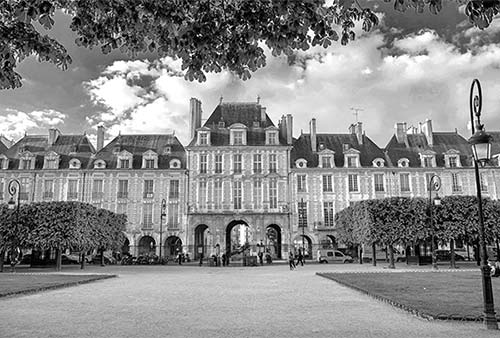
The insightful writer Victor Hugo lived at #6 (at the southeast corner of the square, marked by a French flag) from 1832 to 1848. This was when he wrote much of his most important work, including his biggest hit, Les Misérables. Inside this free museum you can wander through eight plush rooms, take in a fine view of the square, and enjoy a charming garden café and good WCs.
Sample the flashy art galleries ringing the square (the best ones are behind Louis), and take a peek into the courtyard of the Hôtel le Pavillon de la Reine (#28) for a glimpse into refined living. Or consider a pleasant break at one of the recommended eateries on the square.
▲▲Carnavalet Museum (Musée Carnavalet)
Housed in three floors of an elegant mansion, this museum delves into the history of Paris—all wonderfully explained with English descriptions, making it quite user-friendly (once you figure out the confusing floorplan).
You’ll get a good overview of everything—from Louis XIV-period rooms, to Napoleon, to the belle époque. I’d focus on the museum’s highlight: the French Revolution and the 19th century. A thoughtful visit here gives valuable context to what you’ll see throughout the rest of your Paris sightseeing.
Cost and Hours: Free, Tue-Sun 10:00-18:00, closed Mon, 16 Rue des Francs Bourgeois, Mo: St-Paul, www.carnavalet.paris.fr. The museum has a good recommended courtyard café (see here).
Visiting the Museum: I find the following exhibits most important and interesting. On the top floor is the chronological “The French Revolution to the 21st Century.” Each room starts with a concise historic recap, with displays that are both fascinating and well-described. You’ll see the roots of revolution, divine monarchs and angry masses, the Bastille prison, royals who lost their heads, revolutionary heroes, the Reign of Terror, and Napoleon.
“Paris 1852 to Today” illustrates the foundations of the Paris we know and love today. The exhibit starts with Baron Haussmann and his late-19th-century redesign of the city, then traces the fin de siècle and beyond: can-can dancers, the Eiffel Tower, hot-air balloons, the belle époque, Art Nouveau, and the Impressionists.
Cap your visit with some ancient history in a medieval cellar. You’ll find artifacts, art, and carvings from megalithic Paris (4000 BC); learn about the ancient Roman city of Lutetia (which became Paris); and contemplate medieval life in this great city.
▲Picasso Museum (Musée Picasso)
Whatever you think about Picasso the man, as an artist he was unmatched in the 20th century for his daring and productivity. This museum rotates its huge collection of Picasso works to host an ever-changing calendar of Picasso-themed exhibits.
Cost and Hours: €14, covered by Museum Pass, free on first Sun of month; open Tue-Fri 10:30-18:00, Sat-Sun from 9:30, closed Mon, last entry 45 minutes before closing; 5 Rue de Thorigny, Mo: St-Sébastien-Froissart, St-Paul, or Chemin Vert, +33 1 42 71 25 21, www.museepicassoparis.fr.
▲Jewish Art and History Museum (Musée d’Art et Histoire du Judaïsme)
This is a fine museum of historical artifacts and rare ritual objects spanning the Jewish people’s long cultural heritage. It emphasizes the cultural unity maintained by this continually dispersed population. You’ll learn about Jewish traditions and see exquisite costumes and objects central to daily life and religious practices. Novices may find the displays beautiful and thought-provoking but not especially meaningful. Those with a background in Judaism or who take the time with the thoughtful audioguide and posted information will be rewarded.
Cost and Hours: €10, includes audioguide, covered by Museum Pass, free on first Sat of month Oct-June; Tue-Fri 11:00-18:00, Sat-Sun from 10:00, open later during special exhibits—Wed until 21:00 and Sat-Sun until 19:00, closed Mon year-round, last entry 45 minutes before closing; 71 Rue du Temple, Mo: Rambuteau or Hôtel de Ville a few blocks farther away, RER/Train-B: Châtelet-Les Halles; +33 1 53 01 86 60, www.mahj.org.
Holocaust Memorial (Mémorial de la Shoah)
This sight, commemorating the lives of the more than 76,000 Jews deported from France in World War II, has several facets: a WWII deportation memorial, a museum on the Holocaust, and a Jewish resource center. Displaying original deportation records, the museum takes you through the history of Jews in Europe and France, from medieval pogroms to the Nazi era. But its focal point is underground, where victims’ ashes are buried.
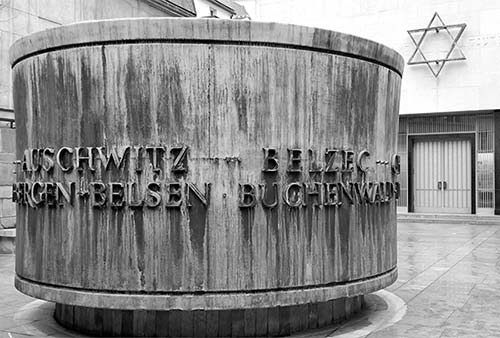
Cost and Hours: Free, Sun-Fri 10:00-18:00, Thu until 22:00, closed Sat and certain Jewish holidays, 17 Rue Geoffroy l’Asnier, +33 1 42 77 44 72, www.memorialdelashoah.org.
▲▲Pompidou Center (Centre Pompidou)
One of Europe’s greatest collections of far-out modern art is housed in the Musée National d’Art Moderne (note that it’s due to close in late 2025 for a multiyear renovation). While this sprawling arts center is huge, most visitors focus on the fourth and fifth floors of this colorful exoskeletal building. Created ahead of its time, the modern and contemporary art in this collection is still waiting for the world to catch up.
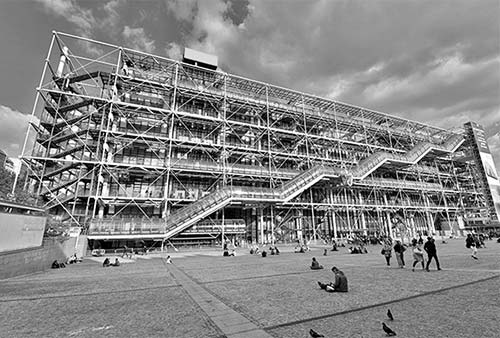
The Pompidou Center and the square that fronts it are lively, with lots of people, street theater, and activity inside and out—a perpetual street fair. Kids of any age enjoy the fun, colorful fountain (an homage to composer Igor Stravinsky) next to the Pompidou Center. The free exterior escalators lead to a great city view from the sixth floor.
Cost and Hours: €15, €12 for those 18-25, free for kids 17 and under, free escalator to sixth-floor view, free on first Sun of the month—book a time slot; Museum Pass covers permanent collection (plus occasional special exhibits); permanent collection open Wed-Mon 11:00-21:00, closed Tue, ticket counters close at 20:00; rest of the building open until 22:00 (Thu until 23:00); arrive after 17:00 to avoid crowds (mainly for special exhibits); café on mezzanine, pricey view restaurant on level 6, Mo: Rambuteau or Hôtel de Ville, +33 1 44 78 12 33, www.centrepompidou.fr.
Visiting the Museum: The Pompidou’s “permanent” collection...isn’t. But while the artwork changes amid regular reinstallations (expect some room closures), the museum generally keeps the artists and various styles in a set order. See the classics (Picasso, Matisse, etc.) but be sure to leave time to browse the thought-provoking and fun art of more recent artists on the fourth floor.
You’ll find this general scheme (but confirm as you enter): ground floor—all services, basement—photography exhibits and always free, floors 1 and 6—temporary exhibits labeled galleries 3-4 and 1-2, and floors 4 and 5—the Musée National d’Art Moderne: Collection Permanente (labeled Musée on signs).
As you tour the Pompidou, remember that most of these artists, including foreigners, spent their formative years in Paris. In the 1910s, funky Montmartre was the mecca of Modernism—the era of Picasso, Braque, and Matisse. In the 1920s, the center shifted to the grand cafés of Montparnasse, where painters mingled with American expats such as Ernest Hemingway and Gertrude Stein. During World War II, it was Jean-Paul Sartre’s Existentialist scene around St. Germain-des-Prés. After World War II, the global art focus moved to New York, but by the late 20th century, Paris had reemerged as a cultural touchstone for the world of modern art.
East of Place des Vosges
▲▲Père Lachaise Cemetery (Cimetière du Père Lachaise)
Littered with the tombstones of many of the city’s most illustrious dead, this is your best one-stop look at Paris’ fascinating, romantic past residents. More like a small city, the cemetery is big and confusing, but holds the graves of Frédéric Chopin, Molière, Edith Piaf, Oscar Wilde, Gertrude Stein, Jim Morrison, Héloïse and Abélard, and many more.
Cost and Hours: Free, Mon-Fri 8:00-18:00, Sat from 8:30, Sun from 9:00, closes at 17:30 in winter; two blocks from Mo: Gambetta (do not go to Mo: Père Lachaise) and two blocks from bus #69’s last stop; +33 1 55 25 82 10, searchable map available at unofficial website: www.pere-lachaise.com [URL inactive].
Tours: Download my free audio tour for a tomb-by-tomb tour of the most illustrious of these permanent Parisians.
Visiting the Cemetery: Enclosed by a massive wall and lined with 5,000 trees, the peaceful, car-free lanes and dirt paths of Père Lachaise cemetery encourage parklike meandering. Named for Father (Père) La Chaise, whose job was listening to Louis XIV’s sins, the cemetery is relatively new, having opened in 1804 to accommodate Paris’ expansion. Today, this 100-acre city of the dead (pop. 70,000) still accepts new residents, but real estate prices are sky high (a 21-square-foot plot costs more than €14,000).
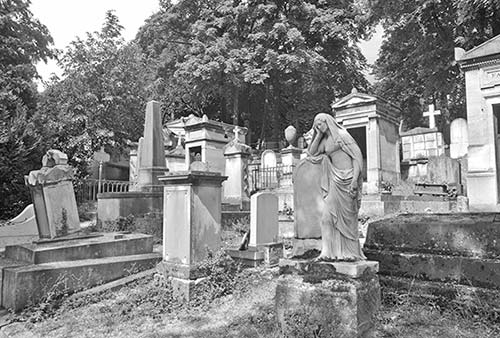
This cemetery, with thousands of graves and tombs crammed every which way, has only a few pedestrian pathways to help you navigate. The map available from florists near the entrance might also help guide you.
I recommend taking a one-way tour through the cemetery: Start from the convenient Métro/bus stops at Place Gambetta, connect a handful of graves from some of this necropolis’ best-known residents, and take a last bow at either the Père Lachaise or Philippe Auguste Métro stops, or a nearby bus #69 stop.
MONTMARTRE
Paris’ highest hill, rated ▲▲ and topped by Sacré-Cœur Basilica, is best known as the home of cabaret nightlife and bohemian artists. Struggling painters, poets, dreamers, and drunkards came here for cheap rent, untaxed booze, rustic landscapes, and views of the underwear of high-kicking cancan girls at the Moulin Rouge. These days, the hill is equal parts charm and kitsch—still vaguely village-like but mobbed with tourists and pickpockets—especially on sunny weekends. Come for a bit of history, a getaway from Paris’ noisy boulevards, and the view (to beat the crowds, it’s best on a weekday or by 9:30 on a weekend). For restaurant recommendations in this area, see here.
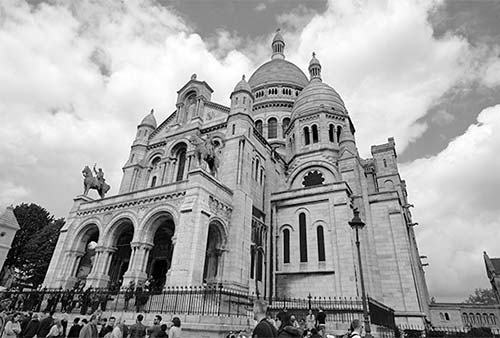
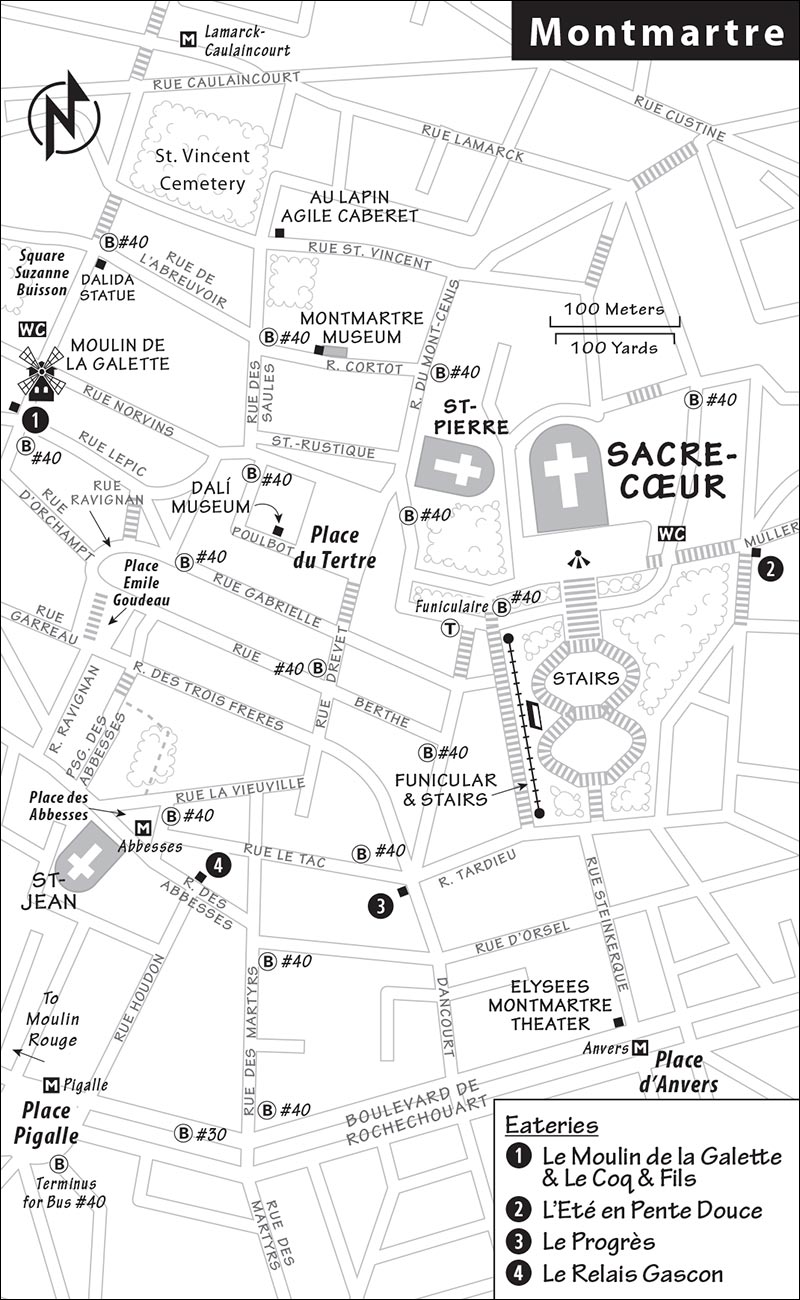
▲Sacré-Cœur
You’ll spot Sacré-Cœur (Sacred Heart), the onion-domed white basilica atop Montmartre, from most viewpoints in Paris. Though it looks ancient, the impressive and iconic basilica is less than 150 years old (built 1875-1919). With a climbable dome, Sacré-Cœur sits atop Paris’ highest natural point (430 feet).
After the disastrous Franco-Prussian war and subsequent bloodshed between the monarchist French government and Parisian insurgents (Communards), France was humbled and devastated. This basilica was built by Roman Catholics as penance for years of rebellion violence centered in the Montmartre area. The exterior of the basilica is laced with gypsum, which gives it its bleached-bone pallor. Inside, you’ll enjoy wonderful mosaics, a statue of St. Thérèse, a scale model of the church, and three stained-glass windows dedicated to Joan of Arc. Pause near the Stations of the Cross mosaic to give St. Peter’s bronze foot a rub, or for a panoramic view of Paris, climb 260 feet up the tight spiral stairs to the top of the dome.
Cost and Hours: Church—free, daily 6:30-22:30; dome—€7, not covered by Museum Pass, daily 10:00-18:00, June-Sept until 19:00, Jan-Feb until 17:00; modest dress required, +33 1 53 41 89 00, www.sacre-coeur-montmartre.com.
Getting There: You can take the Métro to the Anvers stop (to avoid the stairs up to Sacré-Cœur, use your Navigo transit pass and ride up on the funicular). Or, from Place Pigalle, you can take bus #40, which drops you right by Sacré-Cœur (Funiculaire stop, costs one Métro ticket, 4/hour). A taxi from near the Seine saves time and avoids sweat (about €20, €25 at night).
▲Montmartre Museum (Musée de Montmartre)
This 17th-century home re-creates the traditional cancan-and-cabaret Montmartre scene, with paintings, posters, photos, music, videos, and memorabilia. It offers the best look at the history of Montmartre and the amazing period from 1870 to 1910 when so much artistic action was percolating in this neighborhood, plus a chance to see the studio of Maurice Utrillo.
Cost and Hours: €15, not covered by Museum Pass; daily 10:00-19:00, Dec-March until 18:00, last entry 45 minutes before closing; 12 Rue Cortot, +33 1 49 25 89 39, www.museedemontmartre.fr.
Pigalle
Paris’ red light district, the infamous “Pig Alley” to WWII servicemen, is at the foot of Butte Montmartre. Oh là là. It’s more racy than dangerous. Walk from Place Pigalle to Place Blanche, teasing desperate barkers and fast-talking temptresses. In bars, a €150 bottle of (what would otherwise be) cheap Champagne comes with a friend. Stick to the bigger streets, hang on to your wallet, and exercise good judgment. Cancan can cost a fortune, as can con artists in topless bars. After dark, countless tour buses line the streets, reminding us that tour guides make big bucks by bringing their groups to touristy nightclubs like the famous Moulin Rouge (Mo: Pigalle or Abbesses).