PROVENCE
Arles • Avignon • Pont du Gard • Les Baux • St-Rémy-de-Provence • Orange • Côtes du Rhône Villages • Hill Towns of the Luberon
Map: Public Transportation in Provence
Map: Arles Hotels & Restaurants
Map: Avignon Hotels & Restaurants
Sleeping and Eating in Les Baux
Orientation to St-Rémy-de-Provence
Sleeping in St-Rémy-de-Provence
Orientation to Vaison-la-Romaine
Côtes du Rhône Wine Road Drive
Map: Côtes du Rhône Driving Tour
Sleeping in and near Isle-sur-la-Sorgue
Sleeping in and near Roussillon
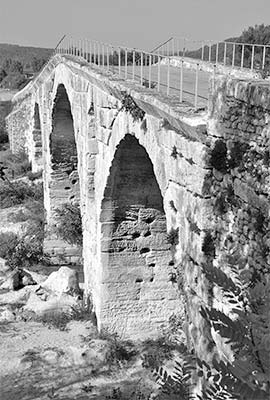
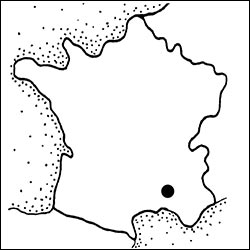
The magnificent region of Provence is shaped like a giant wedge of quiche. From its sunburned crust, fanning out along the Mediterranean coast from the Camargue to Marseille, it stretches north along the Rhône Valley to Orange. The Romans were here in force and left lots of ruins—some of the best anywhere (the region’s name comes from its status as the first Roman province). Seven popes, artists such as Vincent van Gogh and Paul Cézanne, astrologer/physician Nostradamus, and author Peter Mayle all enjoyed their years in Provence. This region features a splendid recipe of arid climate, oceans of vineyards, stunning scenery, lively cities, and adorable hill-capping villages.
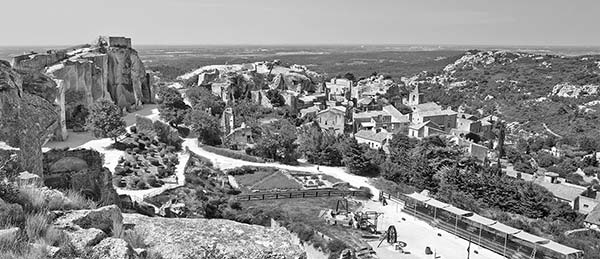
Explore the ghost town that is ancient Les Baux, and see France’s greatest Roman ruins—the Pont du Gard aqueduct and the theater in Orange. Admire the skill of ball-tossing boules players in small squares in every Provençal village and city. Spend a few Van Gogh-inspired starry, starry nights in Arles or St-Rémy-de-Provence. Youthful but classy Avignon bustles in the shadow of its brooding Palace of the Popes. It’s a short hop from Arles or Avignon into the splendid scenery and villages of the Côtes du Rhône and Luberon regions.
PLANNING YOUR TIME
Make Arles or Avignon your sightseeing base—particularly without a car. Italophiles prefer compact Arles, while poodles pick sophisticated Avignon. Arles has a blue-collar quality; the entire city feels like Van Gogh’s bedroom. Avignon—double the size of Arles—feels more upscale and classy, with more nightlife and shopping; it makes a good base for nondrivers thanks to its convenient public-transit options. For drivers who prefer a small-town base, St-Rémy-de-Provence is well situated. To measure the pulse of rural Provence, spend at least one night in a countryside village such as Vaison-la-Romaine or Roussillon. These villages can be terminally quiet from mid-October to Easter.
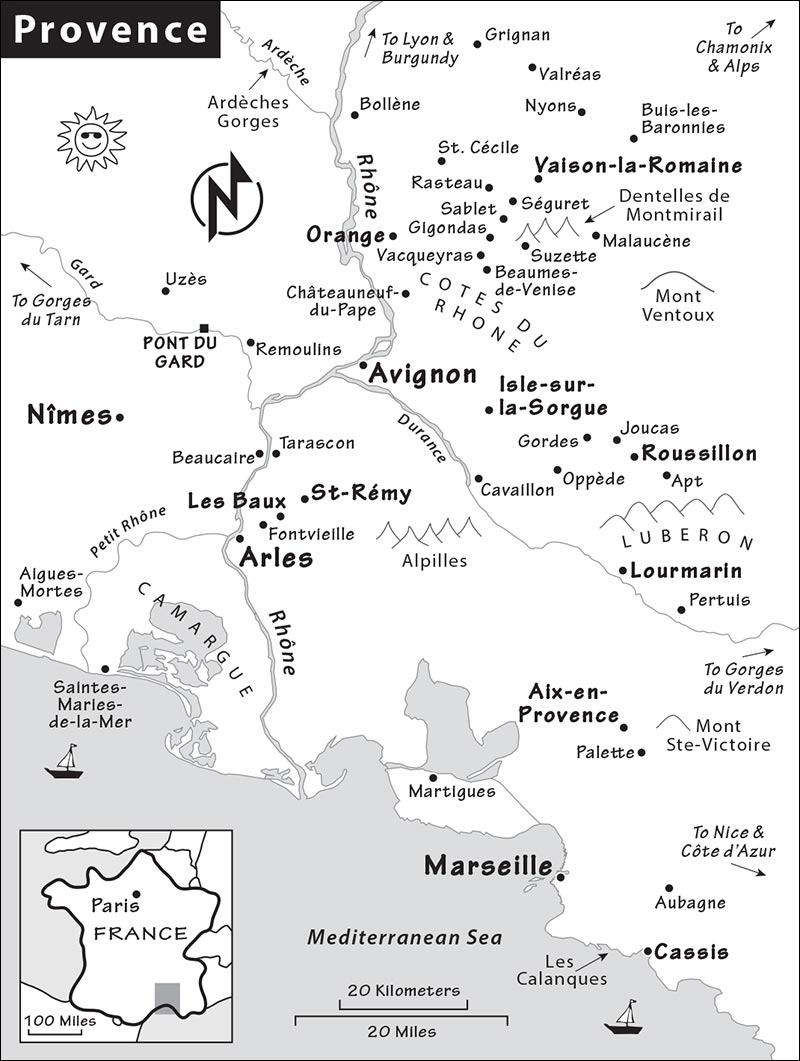
When budgeting your time, plan a full day for sightseeing in Arles and Les Baux (for example, spend most of the day in Arles—best on Wed or Sat, when it’s market day—and visit Les Baux in the late afternoon or early evening), a half-day for Avignon, and a day or two for the villages and sights in the countryside.
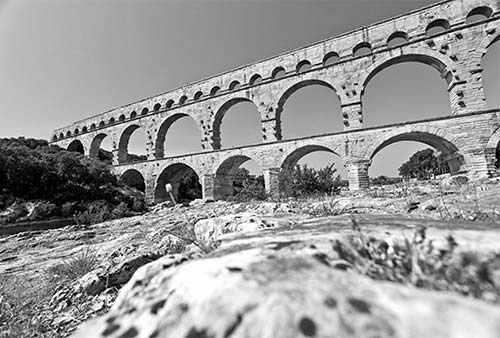
Pont du Gard is a short hop west of Avignon and on the way to/from Languedoc-Roussillon for drivers. Les Baux works well by car from Avignon and better from Arles, and in high season by bus from Arles. The town of Orange ties in tidily with a trip to the Côtes du Rhône villages. The Côtes du Rhône is ideal for wine connoisseurs and an easy stop for those heading to or from the north, as is Vaison-la-Romaine. Isle-sur-la-Sorgue (the most accessible small town by train) is conveniently located between Avignon and the Luberon.
GETTING AROUND PROVENCE
By Bus or Train: Public transit is good between cities and decent to some towns, but marginal at best to the smaller villages. Frequent trains link Avignon, Arles, and Nîmes (no more than an hour between each). Avignon has good train connections with Orange and decent service to Isle-sur-la-Sorgue.
Buses connect many smaller towns, though service can be sporadic. From Arles you can catch a bus to Les Baux (July-Aug only), Stes-Maries-de-la-Mer (in the Camargue), or St-Rémy. From Avignon, you can bus to Pont du Gard, St-Rémy, Isle-sur-la-Sorgue, and to some Côtes du Rhône villages.
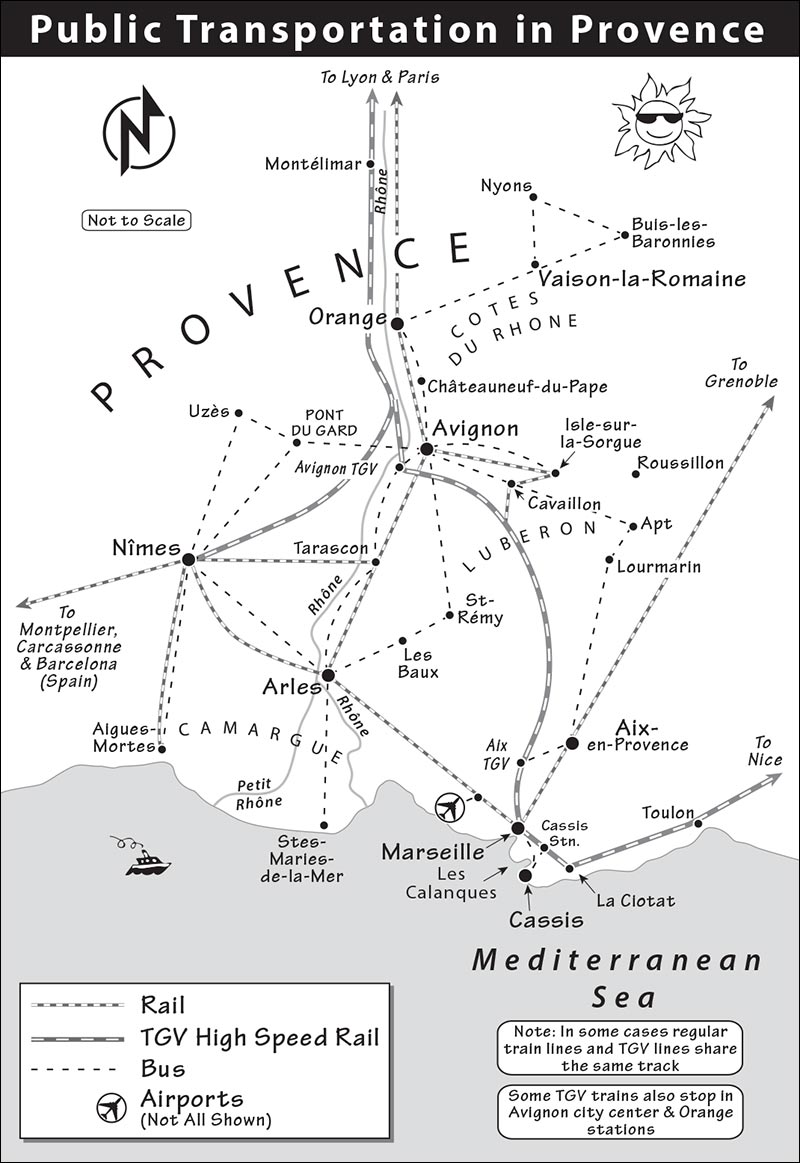
While a tour of the Côtes du Rhône or Luberon is best on your own by car, a variety of minivan tours and basic bus excursions are available. TIs in Arles and Avignon have information on bus excursions to regional sights that are hard to reach sans car; see “Tours in Provence.”
By Car: The region is made to order for a car, though travel time between some sights will surprise you—thanks, in part, to narrow roads and endless roundabouts (for example, figure an hour from Les Baux to Pont du Gard, and 90 minutes from Arles to Vaison-la-Romaine). Michelin map #527 (1:275,000 scale) covers this area perfectly. Michelin maps #332 (Luberon and Côtes du Rhône) and #340 (Arles area) are also worth considering. Be wary of thieves: Park only in well-monitored spaces and leave nothing valuable in your car. Drivers are smart to offload bags at hotels before sightseeing.
By Bike: Wind, heat, and hilly terrain make this region a challenge for many to bike. I list bike rental options in most cities (including electric bikes). Telecycles will deliver your bike to hotels within about 12 miles of St-Rémy (+33 6 11 64 04 69, www.telecycles-location.com). Check also with Sun-e-Bike for handy e-bike rentals throughout Provence (www.sun-e-bike.com).
TOURS IN PROVENCE
Tours with a Wine Focus
Wine Safari
Dutchman Mike Rijken runs a one-man show, taking travelers through the region he adopted 25 years ago. His English is fluent, and though his focus is on wine and wine villages, Mike knows the region thoroughly and is a good teacher of its history (per person: from €80/half-day, €140/day, 2-6-person groups; pickups possible in Arles, Avignon, Lyon, Marseille, or Aix-en-Provence; +33 4 32 70 10 15, mobile +33 6 19 29 50 81, www.winesafari.net, mikeswinesafari@orange.fr).
Le Vin à la Bouche
Charming Céline Viany—a sommelier and easy-to-be-with tour guide—is an expert on her region and its chief product (from €380/half-day or €420/day for 2 people, price depends on pickup location and number of clients, +33 4 90 46 90 80, mobile +33 6 76 59 56 30, www.levinalabouche.com, contact@degustation-levinalabouche.com).
Wine Uncovered
Passionate Englishman Olivier Hickman takes small groups on focused tours of selected wineries in Châteauneuf-du-Pape and in the villages near Vaison-la-Romaine. Olivier knows his subject matter inside and out. His in-depth tastings include a half-day tour of two or three wineries (€45-85/person for half-day to full-day tours, prices subject to minimum tour fees, +33 6 75 10 10 01, www.wine-uncovered.com, olivier.hickman@orange.fr).
Travel in Provence
Sophie Bergeron, native to the Côtes du Rhône, knows her region well. A natural at guiding, she is a skilled teacher who wants to make the most of your time in Provence. She can help organize your trip and guide you from monuments to villages to vineyards (travelinprovencewithsophie@gmail.com).
The game of boules—also called pétanque—is the horseshoes of France. Invented here in the early 1900s, it’s a social yet serious sport, and endlessly entertaining to watch—even more so if you understand the rules.
The game is played with heavy metal balls and a small wooden target ball called a cochonnet (piglet). Whoever gets his boule closest to the cochonnet is awarded points. Teams commonly have specialist players: a pointeur and a tireur. The pointeur’s goal is to lob his balls as close to the target as he can. The tireur’s job is to blast away opponents’ boules.
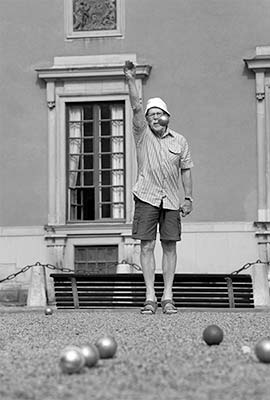
In teams of two, each player gets three boules. The starting team traces a small circle in the dirt (in which players must stand when launching their boules) and tosses the cochonnet about 30 feet to establish the target. The boule must be thrown underhand, and can be rolled, launched sky-high, or rocketed at its target. The first pointeur shoots, then the opposing pointeur shoots until his boule gets closer. Once the second team lands a boule nearest the cochonnet, the first team goes again. If the other team’s boule is very near the cochonnet, the tireur will likely attempt to knock it away.
Once all boules have been launched, the tally is taken. The team with a boule closest to the cochonnet wins the round, and they receive a point for each boule closer to the target than their opponents’ nearest boule. The first team to get to 13 points wins. A regulation boules field is 10 feet by 43 feet, but the game is played everywhere—just scratch a throwing circle in the sand, toss the cochonnet, and you’re off.
Tours du Rhône
Low-key but wine-smart American Doug Graves, who owns a small wine domaine in the Côtes du Rhône, runs custom tours of Châteauneuf-du-Pape, the villages of the Côtes du Rhône, and the Luberon Valley (per person: €150/day, includes lunch; +33 6 37 16 04 56, www.toursdurhone.com, doug@masdelalionne.com).
Provence & Wine
Sommelier Romain Gouvernet is a smart and sincere wine guide concentrating on Châteauneuf-du-Pape and the Luberon. Ask about his evening wine tours and his tasting room in Châteauneuf-du-Pape (per person: €165/day; +33 6 86 49 56 76, www.provenceandwine.com, provenceandwine@gmail.com).
Cultural and Historical Tours
Imagine Tours
This organization offers personalized cultural excursions that highlight the “true heart of Provence and Occitania.” Itineraries are adapted to your interests, and your guide can meet you at your hotel or the departure point of your choice (€190/half-day, €315/day, prices for up to 4 people starting from near Avignon or Arles, +33 6 89 22 19 87, www.imagine-tours.net, imagine.tours@gmail.com). They can also help plan your itinerary, book hotel rooms, or address other travel issues.
THE ROMANS IN PROVENCE
Provence is littered with Roman ruins. Many scholars claim the best-preserved ancient Roman buildings are not in Italy, but in France. These ancient stones will be an important part of your sightseeing agenda in this region, so it’s worth learning about how they came to be.
Classical Rome endured from about 500 BC through AD 500—spending about 500 years growing, 200 years peaking, and 300 years declining. Julius Caesar conquered Gaul—which included Provence—during the Gallic Wars (58-51 BC), then crossed the Rubicon River in 49 BC to incite civil war within the Roman Republic. He erected a temple to Jupiter on the future site of Paris’ Notre-Dame Cathedral.
The concept of one-man rule lived on with his grandnephew, Octavian, who eliminated his rivals and united Rome’s warring factions. He took the title “Augustus” and became the first in a line of emperors who would control Rome for the next 500 years—ruling like a king, with the backing of the army and the rubber-stamp approval of the Senate. Rome morphed from a republic into an empire. At its peak, “Rome” didn’t just refer to the city, but to the entire civilized Western world.
Provence, with its strategic location, benefited greatly from Rome’s global economy and grew to become an important part of its worldwide empire. After Julius Caesar conquered Gaul, Emperor Augustus set out to Romanize it, building and renovating cities in the image of Rome. Most cities had a theater (some had several), baths, and aqueducts; the most important cities had sports arenas. The Romans also erected an elaborate infrastructure of roads, post offices, schools (teaching in Latin), police stations, and water-supply systems.
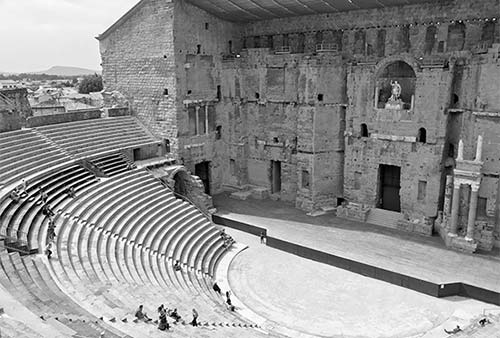
Aqueducts brought fresh water for drinking, filling the baths, and delighting the citizens with bubbling fountains. Men flocked to the stadiums in Arles and Nîmes to bet on gladiator games; eager couples attended elaborate plays at theaters in Orange, Arles, and Vaison-la-Romaine. Marketplaces brimmed with exotic fruits, vegetables, and animals from the far reaches of the empire. Some cities in Provence were more urban 2,000 years ago than they are today. For instance, experts believe that Roman Arles had a population of between 70,000 and 100,000—almost double today’s size. Think about that when you visit.
PROVENCE’S CUISINE SCENE
The almost extravagant use (by French standards) of garlic, olive oil, herbs, and tomatoes makes Provence’s cuisine France’s liveliest. To sample it, order anything à la provençale. Among the area’s spicy specialties are ratatouille (a mixture of vegetables in a thick, herb-flavored tomato sauce), aioli (a rich, garlicky mayonnaise spread over vegetables, potatoes, fish, or whatever), tapenade (a paste of pureed olives, capers, anchovies, herbs, and sometimes tuna), soupe au pistou (thin yet flavorful vegetable soup with a sauce—called pistou—of basil, garlic, and cheese), and soupe à l’ail (garlic soup, called aigo bouido in the local dialect). Look for riz de Camargue (the reddish, chewy, nutty-tasting rice that has taken over the Camargue area) and taureau (bull’s meat). The native goat cheeses are banon de banon or banon à la feuille (dipped in brandy and wrapped in chestnut leaves) and spicy picodon. Don’t miss the region’s prized Cavaillon melons (cantaloupes) or its delicious cherries and apricots, which are often turned into jams and candied fruits.
Wines of Provence: Provence also produces some of France’s great wines at relatively reasonable prices. Look for wines from Gigondas, Rasteau, Cairanne, Beaumes-de-Venise, Vacqueyras, and Châteauneuf-du-Pape. For the cheapest but still tasty wines, look for labels showing Côtes du Rhône Villages or Côtes de Provence. If you like rosé, you win. Rosés from Tavel are considered among the best in Provence. For reds, splurge for Châteauneuf-du-Pape or Gigondas, and for a fine aperitif wine or a dessert wine, try the Muscat from Beaumes-de-Venise.
PROVENCE MARKET DAYS
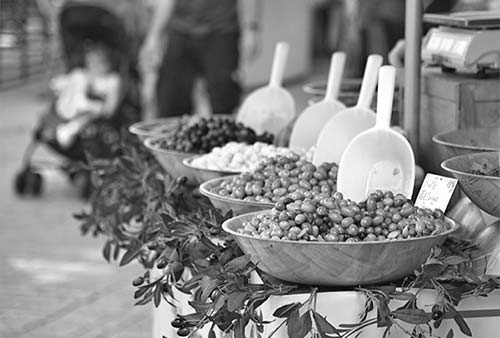
Provençal market days offer France’s most colorful and tantalizing outdoor shopping. The best markets are on Tuesday in Vaison-la-Romaine, Wednesday in St-Rémy, Thursday in Orange, Friday in Bonnieux, Saturday in Arles, and, best of all, Sunday in Isle-sur-la-Sorgue. Crowds and parking problems abound at these popular events—arrive by 9:00, or, even better, sleep in the town the night before.
Arles
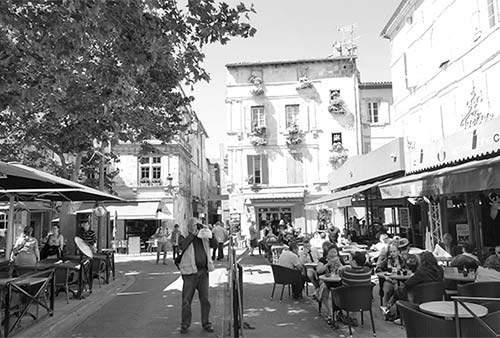
Arles (pronounced “arl”) is a down-to-earth slice of urban Provence, with evocative Roman ruins, an eclectic assortment of museums, made-for-ice-cream pedestrian zones, and squares that play hide-and-seek with visitors.
Back in Roman times, the city earned the imperial nod by helping Julius Caesar defeat his archrival Pompey at Marseille, and it grew into a key port. Site of the first bridge over the Rhône River, Arles was a favorite stop on the Roman road from Italy to Spain, the Via Domitia. After reigning as the seat of an important archbishop and as a trading center for centuries, the city became a sleepy afterthought of little importance in the 1700s. Vincent van Gogh settled here in the late 1800s, but left only a chunk of his ear. American bombers destroyed much of Arles in World War II as the townsfolk hid out in its underground Roman galleries.
Until recently, Arles felt like a backwater. A city in search of an economy, workaday Arles seemed unpolished and a touch gritty compared to nearby Avignon. That aspect remains part of Arles’ charm, but it’s impressive to see how this city is transforming itself while still displaying a genuine joie de vivre.
PLANNING YOUR TIME
For a helpful overview to your Arles sightseeing, start at the Ancient History Museum, then enjoy the city-center sights, linked by my Arles City Walk. Following the walk, visit the Arlaten Folk Museum. For cost-efficient sightseeing, get one of the city’s sightseeing passes, which cover the ancient monuments and the Ancient History Museum.
Orientation to Arles
Arles turns its back on Paris and embraces its slow-paced, southern roots. And although the town is built along the Rhône, it largely ignores the river. Landmarks hide in Arles’ medieval tangle of narrow, winding streets. Helpful street-corner signs point you toward sights and hotels.
TOURIST INFORMATION
The TI is on the ring road Boulevard des Lices, at Esplanade Charles de Gaulle (daily 9:00-18:00; off-season Mon-Sat until 17:00, Sun 10:00-13:00; +33 4 90 18 41 20, www.arlestourisme.com). Ask about the worthwhile city sightseeing passes (see “Helpful Hints,” later) and find out if “bullgames” are scheduled in Arles or nearby (Provence’s more humane version of bullfights—see “Experiences in Arles,” later). You can download a selection of nine themed self-guided walks of Arles or purchase an inexpensive print copy of them.
ARRIVAL IN ARLES
By Train: The train station is on the river, an easy 10-minute walk from the town center.
To reach the town center on foot from the train station, turn left out of the station and walk a level 10 minutes. Or you can hire a pedicab to the center (see “Helpful Hints”). Taxis usually wait in front of the station (if there’s not a taxi waiting, call +33 4 84 84 58 58). Though the rides are short, allow €12 to any of my recommended hotels.
By Bus: There are two key bus stops in Arles: at the train station and near the TI on Boulevard Georges Clemenceau. For destinations served by each stop, see “Arles Connections,” later.
By Car: Avoid driving in Arles’ historic center. Enter on foot after stowing your car at Arles’ only parking garage, Parking des Lices, near the TI on Boulevard des Lices (about €2/hour, €20/24 hours, €5/overnight—arrive after 20:00 and leave by 8:00). All my recommended hotels are within a 10-minute walk of this garage. Some hotels have parking deals for a nearby lot (ask before you arrive).
Lots and curbside parking spots in Arles center are metered 9:00-19:00 every day (except Sun Oct-April). You’ll find metered lots along the city wall at Place Lamartine (except Tue and Fri nights, when parking is restricted).
HELPFUL HINTS
Book Ahead: In the summer, it’s best to book your free entry of the Frank Gehry-designed Tower at LUMA Arles online in advance.
Sightseeing Tips: Arles has a smart ticket-and-hours plan for its sightseeing. Ancient monuments, such as the Roman Arena and Classical Theater, share the same hours (daily 9:00-19:00, April and Oct until 18:00, Nov-March 10:30-16:30).
A €9 entry fee gets you access to all of Arles’ monuments. The good-value Pass Liberté (€15) covers any four monuments and one museum of your choice (I recommend the Ancient History Museum). The Pass Avantage (€19) covers all monuments and most museums and is worthwhile if you plan to visit two or more eligible museums. (Note that the Arlaten Folk Museum is not covered by either pass...yet.) You can buy passes at the TI or any included sight.
Market Days: The big markets are on Wednesdays and Saturdays; see “Experiences in Arles,” later.
Grocery Stores: See the “Arles” map for central grocery stores.
Baggage Storage/Bike Rental/Pedicabs: Right across from the train station (and at the main bus stop), Taco & Co stores luggage, rents bikes, and offers pedal-cab (pedicab) service into the city center (daily 9:00-18:00, until 17:00 and closed Sun off-season; +33 4 82 75 73 45, www.tacoandco.fr). The recommended Hôtel Régence will store your bags and rents bikes (one-way rentals within Provence possible, daily 7:30-22:00, closed in winter, 5 Rue Marius Jouveau).
Laundry: The best launderette in Arles is at 17 Rue Gambetta (open long hours daily).
Car Rental: Conveniently located Europcar is a 10-minute walk from Place Lamartine (61 Avenue de Stalingrad, +33 4 90 93 23 24), while Hertz is closer to Place Voltaire (10 Boulevard Emile Combes, +33 4 90 96 75 23).
Local Guides: All guides listed here charge about €200 for three hours, €400 all day. Charming Agnes Barrier, who knows Arles and nearby sights intimately, leads tours covering Van Gogh and Roman history (+33 3 6 11 23 03 73, agnes.barrier@hotmail.fr). Anne Gastinel is also local and a fine guide (+33 6 81 25 60 72, anne.gastinel@sfr.fr). Sylvie Pagnard gives good walking and driving tours in and around Arles (extra if she drives, +33 6 03 21 37 33, sylviepagnard@gmail.com). Nina Seffusatti is a very capable and agreeable guide (+33 6 14 80 30 37, nina.seffusatti@wanadoo.fr).
GETTING AROUND ARLES
In this flat city, everything’s within walking distance. Only the Ancient History Museum (a scenic 25-minute stroll on the riverside promenade) is out far enough to consider a bus or taxi ride. Or ride the Navia minibus shuttle (line A), which runs mostly along Boulevards des Lices and Georges Clemenceau, and connects the LUMA complex, TI, and Ancient History Museum (€1/ride, 3-4/hour Mon-Sat, 2/hour Sun, daily 7:45-19:00, see “Arles” map for stop locations).
Arles City Walk
2 Starry Night over the Rhône Easel
4 Old Town
8 L’Entrée du Jardin Public Easel
9 Classical Theater (Théâtre Antique)
10 Republic Square (Place de la République)
11 Cryptoporticos (Cryptoportiques)
18 Forum Square (Place du Forum) and Café Terrace at Night Easel
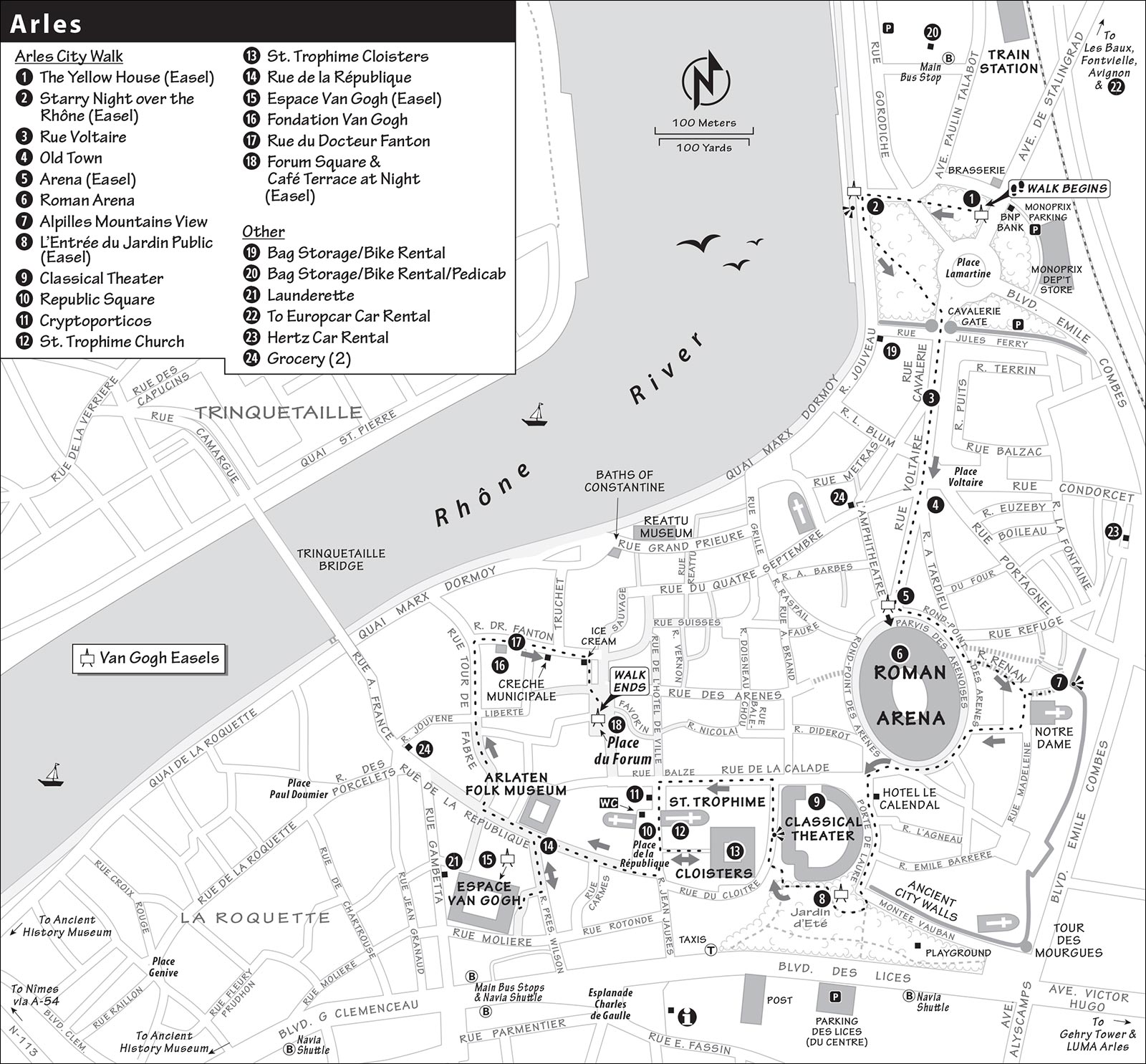
The joy of Arles is how its compact core mixes ancient sights and Van Gogh memories with a lively contemporary scene that is easily covered on foot. All dimensions of the city come together in this self-guided walk.
Length of This Walk: If you enter the sights described (which I recommend, even if briefly), this walk will take most of a day or two partial days.
Sightseeing Tips: Most sights on this walk are covered by the city’s sightseeing passes—sold at the TI and included sights. To better understand the ancient sites along this route, visit the Ancient History Museum before taking this walk (see “More Sights in Arles,” later).
BACKGROUND
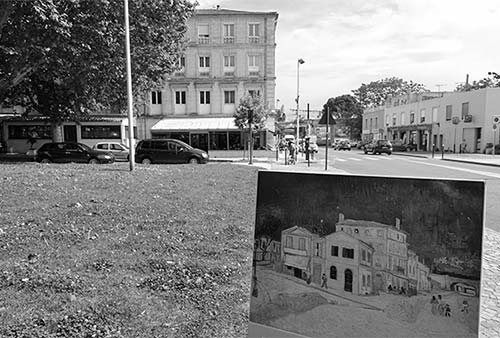
The life and artistic times of Dutch artist Vincent van Gogh form a big part of Arles’ draw, and the city does a good job of highlighting the connection with its Van Gogh Trail. Throughout town, about a dozen steel-and-concrete panels, or “easels,” provide then-and-now comparisons, depicting Van Gogh’s paintings alongside the current view of that painting’s subject. Bright yellow bands across the bottom of the easels make them easier to identify.
In the dead of winter in 1888, 35-year-old Van Gogh left big-city Paris for Provence, hoping to jump-start his floundering career and social life. He was as inspired as he was lonely. Coming from the gray skies and flat lands of the north, Vincent was bowled over by everything Provençal—the sun, bright colors, rugged landscape, and raw people. For the next two years he painted furiously, cranking out a masterpiece every few days.
Of the 200-plus paintings that Van Gogh made in the south, none permanently resides in the city that so moved him. (But there is always at least one here on loan, displayed at the Fondation Van Gogh gallery, which we’ll visit on this stroll.) Walking the same streets he knew and seeing the places he painted, you can understand how Arles sparked his creativity.
 SELF-GUIDED WALK
• Start outside the city walls on Place Lamartine, across the big roundabout from the medieval gate, and stand with the big Monoprix store and BNP bank across the street to your right. A four-foot-tall easel shows Van Gogh’s painting.
1 The Yellow House Easel
Vincent arrived in Arles on February 20, 1888, to a foot of snow. He rented a small house here on the north side of Place Lamartine. The house was destroyed in 1944 by an errant bridge-seeking bomb, but the four-story building behind it still stands (find it in the painting). The house (which stood where the street runs today) had four rooms, including a small studio and the cramped trapezoid-shaped bedroom made famous in his paintings. It was painted yellow inside and out, and Vincent named it...“The Yellow House.” In the distance, the painting shows the same bridges you see today.
In those days, a short walk from Place Lamartine led to open fields. Donning his straw hat, Vincent set up his easel outdoors and painted quickly, capturing what he saw and felt—the blossoming fruit trees, gnarled olive trees, peasants sowing and reaping, jagged peaks, and windblown fields, all lit by a brilliant sun that drove him to use ever-brighter paints.
• With your back to the Monoprix store, walk toward the river.
You’ll soon pass an eight-foot-tall stone monument in honor of two WWII American pilots killed in action during the liberation of Arles (on the right), a tall streetside sign celebrating Arles’ nine sister cities (on the left), and a big concrete middle school (Collège Frédéric Mistral) on your right.

At the river, find the easel on the wall where ramps lead down. The Roman bridge stood here (look for a few stones directly across), and just upstream are the remains of a modern bridge bombed by the Allies in World War II.
• Now, turn your attention to the...
2 Starry Night over the Rhône Easel
One night, Vincent set up his easel along the river and painted the stars boiling above the city skyline. Vincent looked to the night sky for the divine and was the first to paint outside after dark, adapting his straw hat to hold candles (which must have blown the minds of locals back then). As his paintings progressed, the stars became larger and more animated (like Vincent himself). The lone couple in the painting pops up again and again in his work. (Note: This painting is not the Starry Night you’re probably thinking of—that one was painted later, in St-Rémy.)
• With your back to the river, angle right through the scruffy park of plane trees (a kind of sycamore). Continue into town between the stumpy 14th-century stone towers where the city gates once stood. Walk a block up Rue de la Cavalerie to the decorative (if dry) fountain with the colorful old mosaic.
3 Rue Voltaire
Van Gogh first walked into town down this street in 1888. When he saw this fountain, it was just a year old. Its mosaic celebrates the high culture of Provence (she’s the winged woman who obviously loves music and reading). But this neighborhood was Arles’ 19th-century red light district, and the far-from-home Dutchman spent many lonely nights in its bars and brothels. Though it’s no longer the rough area it was in Van Gogh’s day, this street still has a certain raw local color with humble shops, bars, and bakeries.
• Stay straight, passing the mosaic on your right, and keep walking to Place Voltaire, a center of this working-class neighborhood. Stop at the top end of the square under the plane tree in front of Brasserie le Pitchounet.
4 Old Town
Take a slow 360-degree spin tour to enjoy the rough elegance of this setting. Pretend you’re a one-eared painter looking for a place to set up your easel. The stony beige arches of the ancient Roman Arena ahead mark your destination. As you hike up Rue Voltaire, notice the shutters, which add so much to Arles’ character. The old town is strictly protected: These traditional shutters come in a variety of styles and cannot be changed. But the owners can personalize their homes with vibrant colors.
• Keep straight up Rue Voltaire, climb to the Roman Arena, and find the Arena easel at the top of the stairs, to the right.
5 Arena Easel
All summer long, fueled by sun and alcohol, Vincent painted the town. He loved the bullfights in the arena and sketched the colorful surge of the crowds, spending more time studying the people than watching the bullfights (notice how the bull is barely visible). Vincent had little interest in Arles’ antiquity—it was people and nature that fascinated him.
• At this point you can take a break from your town walk and visit the Roman Arena, or read about it as you circle clockwise to the left.
6 Roman Arena (Amphithéâtre)
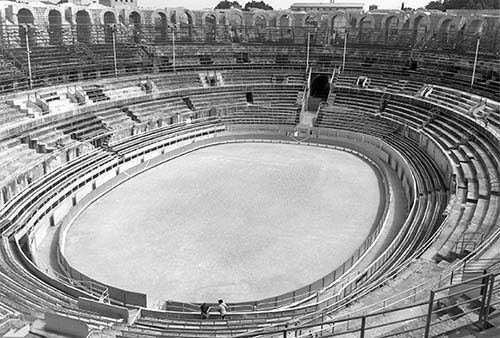
This well-preserved arena is worth ▲▲ and is still in use today. Two millennia ago, gladiators fought wild animals to the delight of 20,000 screaming fans. Now local daredevils battle wild animals here—“bullgame” posters around the arena advertise upcoming spectacles (see “Experiences in Arles,” later). Don’t miss the tower climb for fantastic views over Arles, the arena, and the Rhône River.
Cost and Hours: €9 combo-ticket with Classical Theater; daily 9:00-19:00, April and Oct until 18:00, Nov-March 10:30-16:30, Rond-point des Arènes, +33 4 90 49 36 86, www.arenes-arles.com.
Visiting the Arena: After passing the ticket kiosk, find the display under the third arch (with limited English). Stay on the outer walkway and climb the steps under the arch that lead to the base of metal bleachers. From here you have access to the higher parts of the arena and the tippy-top tower with killer views (to the right). Find a seat with a view of the arena.
Thirty-four rows of stone bleachers extended all the way to the top of those vacant arches that circle the arena. All arches were numbered to help fans find their seats. The many passageways you’ll see (called vomitoires) allowed for rapid dispersal after the games—fights would break out among frenzied fans if they couldn’t leave quickly.
The arena takes its name from the central floor where the action took place—“arena” derives from the Latin word for sand, which was spread across the floor to absorb the blood and noise. Wild animals were caged in passages and storage areas underneath the floor and hoisted up on an elevator to make surprise appearances. The standard fight was as real as professional wrestling is today—mostly just crowd-pleasing theater.
After Rome fell and stability was replaced by Dark Ages chaos, this huge structure was put to good use: Throughout medieval times and until the early 1800s, the stadium became a fortified town with towers added, arches bricked up, and 200 humble homes crammed within its circular defenses. Parts of three of the medieval towers survive.
Find your way to the outside corridor that circles the top level of the arena. As you stroll, savor the fine stonework and views.
• Exit the arena and turn right. A quarter of the way around, turn left by the café. Start up the cute stepped lane to the left (Rue Renan). Take three steps and turn around to study the arena.
The big stones are Roman; the little medieval stones—more like rubble—filling the two upper-level archways are a reminder of the arena’s time as a fortified town in the Middle Ages. You can even see rooflines and beam holes where the Roman structure provided a solid foundation.
• Hike up the pretty, stepped lane through the parking lot, keeping to the left of the stark and stony church to the highest point in Arles. Take in the countryside view.
7 Alpilles Mountains View
This view pretty much matches what Vincent van Gogh, an avid walker, would have seen. Imagine him hauling his easel into those fields under intense sun, leaning against a ferocious wind, struggling to keep his hat on.
Vincent carried his easel as far as the medieval Abbey of Montmajour, that bulky structure on the hill in the distance. The St. Paul Hospital, where he was eventually treated in St-Rémy, is on the other side of the Alpilles mountains (which look more like hills to me), several miles beyond Montmajour.
• Turn around, then cross in front of the church to return to the arena and continue circling it clockwise. In a few blocks you’ll see where the arena was rebuilt after bombing during World War II. Turn left on Rue de Porte de Laure. If you’re ready for a break, the recommended Hôtel le Calendal (on the left) has a handy self-service bar with drinks, great little sandwiches, and a welcoming garden out back. (You’ll also pass the ancient Classical Theater to the right, which we’ll visit later.)
After a couple of charming blocks, veer right, down the curved staircase into the park. At the bottom of the stairs continue toward the busy street for about 20 steps, then turn right (through the gate and into the park) and find the...
8 L’Entrée du Jardin Public Easel
Vincent spent many a sunny day painting in the leafy Jardin d’Eté. In a letter to his sister, Vincent wrote, “I don’t know whether you can understand that one may make a poem by arranging colors...In a similar manner, the bizarre lines, purposely selected and multiplied, meandering through the painting, may not present a literal image of the garden, but rather an image in our minds—as if in a dream.”
• Continue through the park—following the first path to the right—toward the three-story surviving tower of the Classical Theater. Near the ancient tower, turn left and follow the white metal fence, enjoying peeks at “le jardin” of stone—a collection of ancient carved bits of a once-grand Roman theater. Go up two sets of steps, turn right at the top, and stroll to the…
9 Classical Theater (Théâtre Antique)
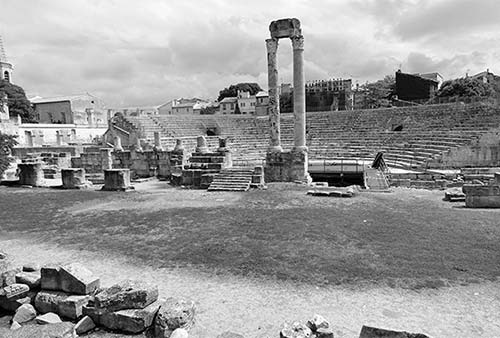
This first-century BC Roman theater once seated 10,000...just like the theater in nearby Orange. But unlike Orange, here in Arles there was no hillside to provide structural support. Instead, this elegant, three-level structure had 27 buttress arches radiating out behind the seats.
Cost and Hours: €9 combo-ticket with Roman Arena, same hours as arena. A WC is just behind the ticket office.
Visiting the Theater: Start with the excellent 10-minute video on your right as you enter, making it easier to imagine the scattered stones back in place. Then walk into the theater and pull up a stone seat in a center aisle. Imagine how, for 500 years, ancient Romans gathered here for entertainment. The original structure was far higher, with 33 rows of seats covering three levels to accommodate demand. Precious little of the original theater survives—much of the seating you see today was rebuilt in the late 1800s. The theater remains in use today, with seating for 2,000 spectators.
Two lonely Corinthian columns are all that remain of a three-story stage wall that once featured more than 100 columns and statues painted in vibrant colors (a model in the Ancient History Museum shows the complete theater).
• Walk straight out of the theater and continue down a long block on Rue de la Calade. Take the first left into a big square.
10 Republic Square (Place de la République)
This square used to be called “Place Royale”...until the French Revolution. The obelisk was the former centerpiece of Arles’ Roman Circus (outside of town). The lions at its base are the symbol of the city, whose slogan is (roughly) “the gentle lion.” Observe the age-old scene: tourists, peasants, shoppers, pilgrims, children, and street musicians. The City Hall (Hôtel de Ville) has a stately facade, built in the same generation as Versailles. Where there’s a City Hall, there’s always a free WC (if you win the Revolution, you can pee for free at the mayor’s home).
• Today’s City Hall sits upon an ancient city center. Inside, admire the engineering of the ceiling and find the entrance to an ancient cryptoportico (foundation).
11 Cryptoporticos (Cryptoportiques)
This dark, drippy underworld of Roman arches was constructed to support the upper half of Forum Square (necessary for a big, level square in a town built on a slope). Two thousand years ago, most of this gallery of arches was at or above street level; modern Arles has buried about 20 feet of its history over the millennia. Through the tiny windows high up you would have seen the sandals of Romans on their way to the forum. Other than dark arches, broken bits of forum littering the dirt floor, and info panels in French only, there’s not much down here beyond ancient memories (€5, same hours as arena).
• The highlight of Place de la République is...
12 St. Trophime Church
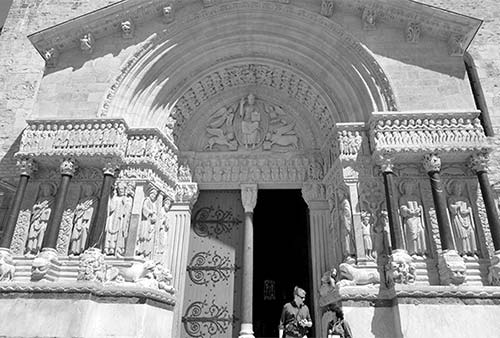
Named after a third-century bishop of Arles, this church, worth ▲▲, sports the finest Romanesque main entrance I’ve seen anywhere. The Romanesque and Gothic interior—with tapestries, relics, and a rare painting from the French Revolution when this was a “Temple of Reason”—is worth a visit.
Cost and Hours: Free, daily 9:00-12:00 & 14:00-18:00.
Exterior: Like a Roman triumphal arch, the church facade trumpets the promise (or dread) of Judgment Day. The tympanum (the semicircular area above the door) is filled with Christian symbolism. Christ sits in majesty, surrounded by symbols of the four evangelists: Matthew (the winged man), Mark (the winged lion), Luke (the ox), and John (the eagle). The 12 apostles are lined up below Jesus. It’s Judgment Day...some are saved and others aren’t. Notice the condemned (off to the right)—a chain gang doing a sad bunny-hop over the fires of hell. For them, the tune trumpeted by the three angels above Christ is not a happy one. Below the chain gang, St. Stephen is being stoned to death, with his soul leaving through his mouth and instantly being welcomed by angels. To St. Stephen’s right, lock eyes with St. James the Minor and St. Philip. Study the exquisite detail. In an illiterate world, long before the vivid images of our time, this facade was colorfully painted, like a neon billboard over the town square. It’s full of meaning, and a medieval pilgrim understood it all.
Interior: Just inside the door on the right wall, the chart in the large glass frame locates the interior highlights and helps explain the carvings you just saw on the tympanum. The tall 12th-century Romanesque nave is decorated by a set of tapestries (typical in the Middle Ages) showing scenes from the life of Mary (17th century, from the French town of Aubusson).
For 800 years, this church has been a stop on the ancient pilgrimage route to Santiago de Compostela in northwest Spain...and it still is today. You may notice the modern-day pilgrimages advertised on the far right near the church’s entry.
• To reach the adjacent peaceful cloister, leave the church, turn left, then left again through a courtyard.
13 St. Trophime Cloisters
See these for free if you have an Arles sightseeing pass (otherwise €6, same hours as arena). The cloisters’ many small columns were scavenged from the ancient Roman theater and used to create an oasis of peace that you can feel today in Arles’ center. Read the English info posted opposite the ticket window, then push the door open to find the cloisters. Study the difference between the Byzantine figures in the capitals under the rounded Romanesque arches (12th century), and the more modern figures under the pointed Gothic arches (14th century). A fine vaulted hall shows an instructive video, and another hall (upstairs) offers a chance to walk outside along an angled rooftop designed to catch rainwater: Notice the slanted gutter that channeled the water into a cistern and the heavy roof slabs covering the hall below.
• Cross Place de la République and turn right to stroll a delightful pedestrian street.
14 Rue de la République
Rue de la République is Arles’ primary shopping street. Walk downhill, enjoying the scene and popping into shops that catch your interest.
Near the top of the street, find the Maison Soulier Bakery behind the green facade (not to be confused with the nearby ice cream joint of the same name). Inside you’ll be tempted by fougasse (bread studded with herbs, olives, and bacon bits), sablés Provençal (cookies made with honey and almonds), tarte lavande (a sweet almond lavender tart), and big crispy meringues (the egg-white and sugar answer to cotton candy—a cheap favorite of local kids). They also have sandwiches and salads if you feel like a picnic on the square. A few doors down are Restaurant Les Maisons Rabanel (left down the small alley), L’Occitane en Provence (local perfumes), Puyricard Chocolate (with enticing treats and calisson, a sweet almond delight), as well as local design and antique shops. The fragile spiral columns on the left (just before the tourist-pleasing Lavender Boutique on the corner) show what 400 years of weather can do to decorative stonework. The big Arlaten Folk Museum is up on the right and is well worth a visit now or later (see listing under “More Sights in Arles”).
• Take a left onto Rue Président Wilson. After a block, turn right and find your way into the Hôtel Dieu courtyard, a hospital made famous by one of its patients: Vincent van Gogh.
15 Espace Van Gogh Easel
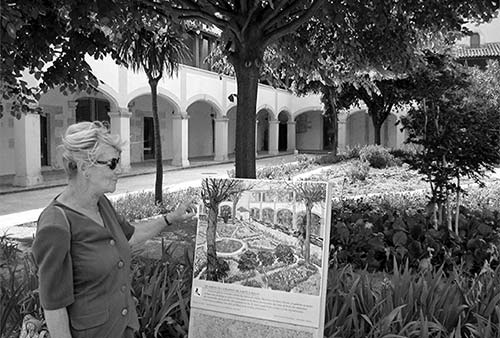
In December 1888, shortly after his famous ear-cutting incident, Vincent was admitted into the local hospital—today’s Espace Van Gogh cultural center (free; there’s a handy WC inside). It surrounds a flowery courtyard that the artist loved and painted when he was being treated for blood loss, hallucinations, and severe depression that left him bedridden for a month. The citizens of Arles circulated a petition demanding that the mad Dutchman be kept under medical supervision. Félix Rey, Vincent’s kind doctor, worked out a compromise: The artist could leave during the day so that he could continue painting, but he had to sleep at the hospital at night. Look through the postcards sold in the courtyard to enjoy a tour of Arles through the eyes of Vincent. Find a painting of Vincent’s ward—that’s right here—showing nuns attending to patients in a gray hall.
• Return uphill to Rue de la République. Take a left and continue two blocks downhill. Take the second right up Rue Tour de Fabre and follow signs toward Fondation Van Gogh. After a few steps, you’ll pass La Main Qui Pense (The Hand That Thinks) pottery shop and workshop, where talented Cécile Cayrol is busy creating and teaching.
A couple of blocks farther down, turn right onto (unsigned) Rue du Docteur Fanton—look for the modern, movable walls on the right that lead to…
16 Fondation Van Gogh
This art foundation, worth ▲, delivers a refreshing stop for modern-art lovers and Van Gogh fans, with temporary exhibits in which contemporary artists pay homage to Vincent with thought-provoking interpretations of his works. You’ll see at least one original work by Van Gogh and several more in high season. The gift shop has souvenirs, prints, and postcards.
Cost and Hours: €10, €12 combo-ticket with Réattu Museum (works by local artist); daily 10:00-19:00, until 18:00 and closed Mon off-season—check website for current hours and what’s on; audioguide (€4) may be available, 35 Rue du Docteur Fanton, +33 4 90 49 94 04, www.fondation-vincentvangogh-arles.org.
• Continue on Rue du Docteur Fanton.
17 Rue du Docteur Fanton
On the right of this pleasing street, look for the Crèche Municipale. Open workdays, this is a free government-funded daycare where parents can drop off their infants up to two years old. The notion: No worker should face financial hardship to receive quality childcare. At the next corner is the recommended Soleileïs, Arles’ top ice cream shop.
After the ice cream shop, turn right and step into Bar El Paseo at 4 Rue des Thermes. This little restaurant is run by the Leal family, famous for its “dynasty” of bullfighters and proud of its bullfighting lore. They’ve lovingly wallpapered the place with photos and bullfighting memorabilia. The main museum-like room is full of bull—including the mounted heads of three big ones who died in the local arena and a big black-and-white photo of Arles’ arena packed to capacity. You’re welcome to look around...and even more welcome to buy a glass of Spanish Rioja wine or sangria.
• A few steps farther is...
18 Forum Square (Place du Forum) and Café Terrace at Night Easel
Named for the Roman forum that once stood here, Forum Square, worth ▲, was the political and religious center of Roman Arles. Still lively, this café-crammed square is a local watering hole and popular for a pastis (anise-based aperitif). The bistros on the square can put together a passable salad or plat du jour—and when you sprinkle on the ambience, that’s €15 well spent.
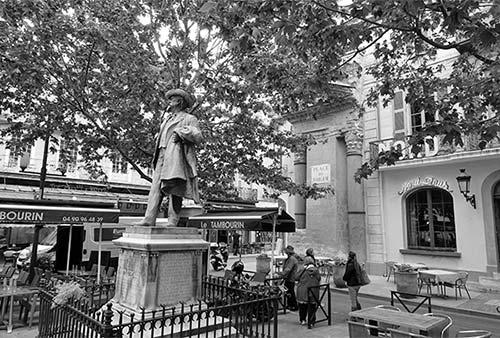
The statue on the square is of Frédéric Mistral (1830-1914). This popular poet, who wrote in the local dialect rather than in French, was a champion of Provençal culture. After receiving the Nobel Prize in Literature in 1904, Mistral used his prize money to preserve and display the folk identity of Provence. He founded a regional folk museum (the Arlaten Folk Museum) at a time when France was rapidly centralizing and regions like Provence were losing their unique identities.
• Facing the brightly painted yellow café, find your final Van Gogh painting reproduced on the café’s exterior; or walk a few steps left to find the easel—Café Terrace at Night.
In October 1888, lonely Vincent—who dreamed of making Arles a magnet for fellow artists—persuaded his friend Paul Gauguin to join him. He decorated Gauguin’s room with several humble canvases of sunflowers (now some of the world’s priciest paintings), knowing that Gauguin had admired a similar painting he’d done in Paris. At first, the two got along well. They spent days side by side, rendering the same subjects in their two distinct styles. At night they hit the bars and brothels. Van Gogh’s well-known Café Terrace at Night captures the glow of an absinthe buzz at Café la Nuit on Place du Forum.
After two months together, the two artists clashed over art and personality differences (Vincent was a slob around the house, whereas Gauguin was meticulous). The night of December 23, they were drinking absinthe at the café when Vincent suddenly went ballistic. He threw his glass at Gauguin. Gauguin left. Walking home, Gauguin heard footsteps behind him and turned to see Vincent coming at him, brandishing a razor. Gauguin quickly fled town. The local paper reported what happened next: “At 11:30 p.m., Vincent van Gogh, painter from Holland, appeared at the brothel at no. 1, asked for Rachel, and gave her his cut-off earlobe, saying, ‘Treasure this precious object.’ Then he vanished.” He woke up the next morning at home with his head wrapped in a bloody towel and his earlobe missing.
The bright-yellow café—called Café la Nuit—was the subject of one of Vincent van Gogh’s most famous works in Arles. Although his painting showed the café in a brilliant yellow from the glow of gas lamps, the facade was bare limestone, just like the other cafés on this square. The café is now a tourist trap that its current owners painted to match Van Gogh’s version...and to cash in on the Vincent-crazed hordes who pay too much to eat or drink here.
• With this walk, you have seen the best of Arles. The Arlaten Folk Museum is a short walk away (described next), as are the Réattu Museum (works by a hometown artist) and the Baths of Constantine (early-fourth-century Roman baths). Or enjoy a drink on the Place du Forum and savor the joy of experiencing the essence of Provence.
More Sights in Arles
Many of Arles’ city-center sights (such as the Roman Arena and St. Trophime church) are covered on my self-guided walk. The important sights listed here will add to your understanding of Arles’ history and contemporary life.
IN THE CENTER
▲▲Arlaten Folk Museum (Museon Arlaten)
Set in a 15th-century manor home, the Arlaten Folk Museum is the leading museum in Provence for traditional culture and folklore.
Cost and Hours: €8, not covered by sightseeing passes; free first Sun of the month, Tue-Sun 9:30-18:00, closed Mon; +33 4 13 31 51 99, www.museonarlaten.fr.
Visiting the Museum: Pick up the helpful pamphlet or scan the QR code for more information, then enter the courtyard and pause at the curved wall remnants of the Roman Forum. Your visit starts with a room devoted to ancient Provence and the museum’s original inspiration, then continues with well-devised displays of every aspect of life in Provence, mostly from the 19th century to present. Effective English explanations, presented through touchpad screens, detailed wall postings, and short videos, provide more info than you probably have time for.
Climb the glassy stairway above exposed ruins from the Roman forum (or take the elevator—the museum covers three floors) and find rooms with life-size mannequins showing slice-of-life scenes, lots of traditional dress, tools, musical instruments (including a hurdy gurdy), and more. You’ll discover the importance of the Rhône River and the Camargue to the area’s economy and culture, and learn about major celebrations and legends—such as the 15th-century tale of the tarasque, a turtle-like monster (I know, weird) that lived on the riverbank and terrorized locals. It was eventually vanquished by a woman, and is now celebrated at an annual festival. The museum tracks changes in the region after World War II (there’s a small display about Vichy France) and ends with a look at Provence today.
ON THE OUTSKIRTS
▲▲Ancient History Museum (Musée Départemental Arles Antique)
This museum, just west of central Arles along the river, provides valuable background on Arles’ Roman history: Visit it before the other city sights if you can (drivers should consider stopping on the way into town).
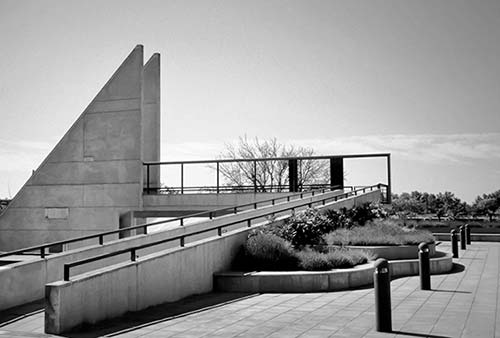
Located on the site of the Roman chariot racecourse (the arc of which defines today’s parking lot), this manageable, one-floor museum is filled with models, mosaics, original sculptures, and more that re-create the Roman city, making workaday life and culture easier to imagine. While the museum’s posted descriptions of most of its treasures are only in French, the audioguide does a fine job describing the exhibits in English. For a deeper understanding of Provence’s ancient roots, read “The Romans in Provence,” earlier.
Cost and Hours: €8, audioguide-€2, free first Sun of the month; open Wed-Mon 10:00-18:00, closed Tue; Presqu’île du Cirque Romain, +33 4 13 31 51 03, www.arlesantique.fr/en.
Getting There: Drivers will see signs for the museum at the city’s western end. To reach the museum from the city center sans car, take the Navia minibus shuttle (line A, see “Getting Around Arles,” earlier). The museum is about a 25-minute level walk from the city center: Turn left at the river and take the riverside promenade under two bridges to the big, modern blue building. A taxi ride costs about €13 from Arles’ center.
Visiting the Museum: The permanent collection is housed in a large hall flooded with natural light. Highlights include models of the ancient city and its major landmarks, a 2,000-year-old Roman boat, statues, mosaics, and sarcophagi. Here’s what you’ll see:
A wall map of the region during the Roman era greets visitors and shows the geographic importance of Arles: Three important Roman trade routes—vias Domitia, Grippa, and Aurelia—all converged on or near Arles.
After a small exhibit on pre-Roman Arles, you’ll come to fascinating models of the Roman city and impressive Roman structures in (and near) Arles. The models breathe life into the buildings, showing how they looked 2,000 years ago.
Start with the model of Roman Arles. Find the forum—it remains the center of town, although only two columns survive. The next model shows the grandeur of the forum in greater detail.
At the museum’s center stands the original statue of Caesar Augustus, which once graced Arles’ ancient theater’s magnificent stage wall. To the left of Caesar is a model of Arles’ theater in all its glory, and to the left of that, find models of the floating wooden bridge over the widest, slowest part of the river—giving Arles a strategic advantage. Moving clockwise, see the hydraulic mill of Barbegal with its 16 waterwheels cascading water down a hillside and the arena with its movable cover to shelter spectators from sun or rain.
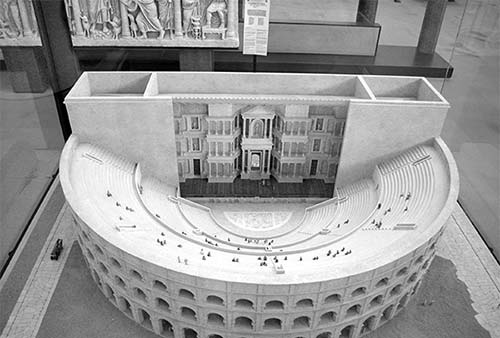
Step down into the hall to Caesar’s right and find the large model of the chariot racecourse. Part of the original racecourse was just outside the windows, and although long gone, it likely resembled Rome’s Circus Maximus. The rest of this hall is dedicated to the museum’s most exciting exhibit: a Gallo-Roman vessel and much of its cargo. This almost 100-foot-long Roman barge was raised from the Rhône in 2010, along with some 280 amphorae and 3,000 ceramic artifacts. It was typical of flat-bottomed barges used to shuttle goods between Arles and ports along the Mediterranean (vessels were towed upriver). This one hauled limestone slabs and big rocks—no wonder it sank. A worthwhile 20-minute video about the barge’s recovery (with English subtitles) plays continuously in a tiny theater at the end of the hall.
Elsewhere in the museum, you’ll see displays of amphorae, metals, and other materials that barges like this carried. You’ll also see well-crafted pottery, jewels, and mosaic floors that illustrate how Roman Arles was a city of art and culture. The many statues are all original, except for the greatest—the Venus of Arles, which Louis XIV took a liking to and had moved to Versailles.
▲Frank Gehry Tower and LUMA Arles
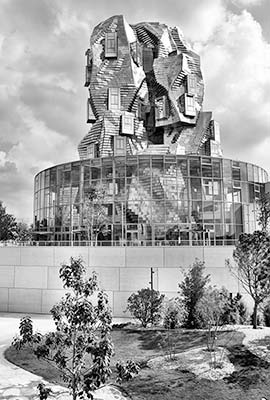
A 10-minute walk east of the TI, a striking Frank Gehry-designed aluminum tower soars 180 feet over Arles. It’s the centerpiece of the LUMA Arles complex, which provides space for artists and includes a vast park holding warehouses converted to exhibition halls and cafés. The LUMA Foundation supports artists of all kinds, from sculptors to photographers to writers. It’s easy, free, and well worth the time to visit the tower (with views and exhibits) and the pleasing park at its base.
Cost and Hours: Tower—free, Wed-Mon 10:00-18:00, closed Tue, last entry at 16:30, best to book ahead in summer, 35 Avenue Victor Hugo; park—free, daily 7:00-20:30, Chemin des Minimes; +33 4 90 47 76 17, www.luma-arles.org. The tower and park are served by the Navia minibus shuttle (line A, stop: Victor Hugo).
NEAR ARLES
The Camargue
Knocking on Arles’ doorstep, the Camargue region, occupying the vast delta of the Rhône River, is one of Europe’s most important wetlands. This marshy area exists where the Rhône splits into two branches just before flowing into the Mediterranean. Over the millennia, a steady flow of sediment has been deposited at the mouth of the rivers—thoroughly landlocking villages that once had waterfront property.
Today the Camargue Regional Nature Park is a protected “wild” area, where pink flamingos, wild bulls, nasty boars, nastier mosquitoes (in every season but winter—come prepared), and the famous white horses wander freely through lagoons and tall grass. The dark bulls are harder to spot than the white horses and flamingos, so go slow and make use of the viewing platforms.
The best time to visit is in spring, when the flamingos are out in full force (the worst time is summer, when birds are fewest and mosquitoes are everywhere).
Getting There: From Arles, the Camargue is about an hour by car.
If you don’t have a car, jeep safaris are offered from Arles (ask at TI). Hiking is not good in the Camargue, as there are few decent trails. The best biking is across the Digue (dike) to Phare de la Gacholle.
Camargue Scenic Drive: My favorite route is toward Salin de Giraud (see map): Leave Arles driving clockwise on its ring road, then find signs to Stes-Maries-de-la-Mer and join D-570. Skip the D-36 turnoff to Salin de Giraud (you’ll return along this route). After about four miles, enthusiasts can consider a stop at the Camargue Museum (folk museum with a two-mile nature trail, open daily). Next, continue along D-570 past swampy rice fields, then turn left on D-37 and follow it as it skirts the Etang de Vaccarès lagoon, with opportunities to get out of the car for views and to smell the marshes (look for viewing stands, but any dirt turnoff works). Turn right off D-37 onto the tiny road at Villeneuve, following signs for C-134 to La Capelière and La Fiélouse (poorly marked—it’s where D-36b leads back to Arles). The drive along C-134 is the highlight of the Camargue for me.
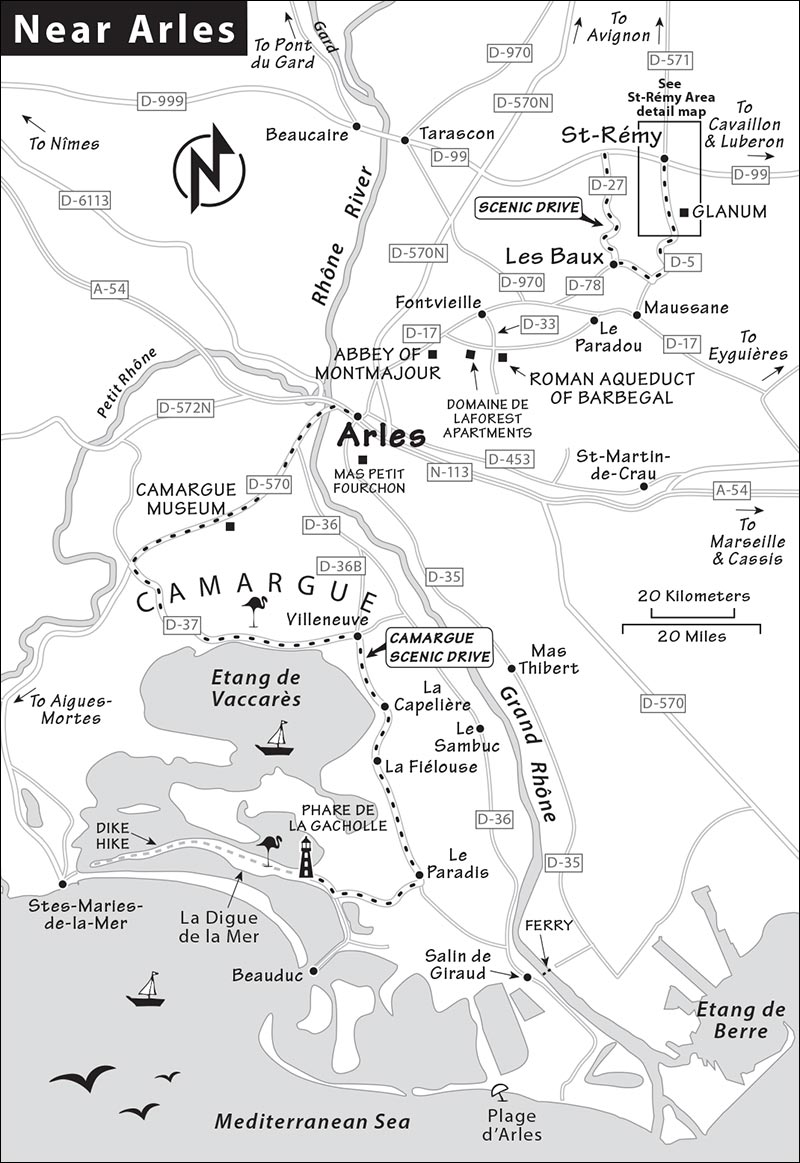
Make time for a stop at La Capelière (headquarters for Camargue birders), where you can pick up a good map, ask the staff questions, and enjoy an exhibit (small fee) and worthwhile one-mile walking trail with some English information posted (daily 9:30-13:00 & 14:00-17:30, Oct-March until 16:30 and closed Tue). Birders can check the register to see what birds have been spotted recently.
The best part of this drive (particularly in spring) is the next stretch to and around La Digue de la Mer, about six scenic miles past La Capelière. You’re most likely to see flamingos along this section and witness the memorable sight of platoons of flamingos in flight. At La Digue de la Mer, get out of your car and walk a few hundred yards past the pavement’s end, where the dirt road curves left, to reach a good spot. This is a critical reproduction area for flamingos (about 13,000 couples produce 5,000 offspring annually).
From here, most will want to retrace their route back to Villeneuve, then continue straight onto D-36b, which leads back to Arles.
Experiences in Arles
▲▲Markets
On Wednesday and Saturday mornings, Arles’ ring road erupts into an open-air festival of fish, flowers, produce...and everything Provençal. The main event is on Saturday, with vendors jamming the ring road from Boulevard Emile Combes to the east, along Boulevard des Lices near the TI (the heart of the market), and continuing down Boulevard Georges Clemenceau to the west. Wednesday’s market runs only along Boulevard Emile Combes, between Place Lamartine and Avenue Victor Hugo. On the first Wednesday of the month, a flea market doubles the size of the usual Wednesday market along Boulevard des Lices near the TI.
Both markets are open until about 12:30.
▲▲Bullgames (Courses Camarguaises)
Provençal “bullgames” are held in Arles and in neighboring towns. Those in Arles occupy the same seats that fans have used for 2,000 years and deliver the city’s most memorable experience—the courses camarguaises in the ancient arena. The nonviolent bullgames are more sporting than bloody bullfights (though traditional Spanish-style bullfights still take place on occasion). The bulls of Arles (who, locals insist, “die of old age”) are promoted in posters even more boldly than their human foes. In the bullgame, a ribbon (cocarde) is laced between the bull’s horns. The razeteur, dressed in white and carrying a special hook, has 15 minutes to snare the ribbon. Local businessmen encourage a razeteur by shouting out how much money they’ll pay for the cocarde. If the bull pulls a good stunt, the band plays the famous “Toreador” song from Carmen. Local media report on the games, including how many Carmens the bull earned.
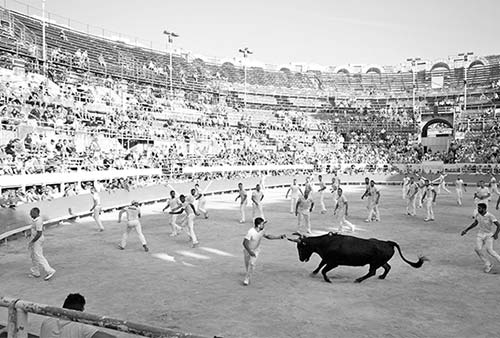
Three classes of bullgames—determined by the experience of the razeteurs—are advertised in posters: The Course de Protection is for rookies. The Trophée de l’Avenir comes with more experience. And the Trophée des As features top professionals. During Easter (Féria de Pâques) and the fall rice-harvest festival (Féria du Riz), the arena hosts traditional Spanish bullfights (look for corrida) with outfits, swords, spikes, and the whole gory shebang. (Nearby villages stage courses camarguaises in small wooden bullrings nearly every weekend; TIs have the latest schedule.)
Bullgame tickets usually run €14-22; bullfights are pricier (€38-250). Schedules for bullgames vary (usually July-Aug on Wed and Fri)—ask at the TI or check www.arenes-arles.com.
Sleeping in Arles
Hotels are a great value here—all those listed here have elevators and air-con unless otherwise noted.
$$ Hôtel le Calendal*** is a service-with-a-smile place ideally located between the Roman Arena and Classical Theater. The hotel opens to the street with airy lounges and a palm-shaded courtyard, providing an enjoyable refuge. You’ll find snacks and drinks in the café/sandwich bar (daily 8:00-20:00) and an upstairs terrace with great views into the Roman theater. The soothing rooms come in all shapes and sizes (some with balcony, family rooms, elevator for some rooms, free spa for adults, ask about parking deals, just above arena at 5 Rue Porte de Laure, +33 4 90 96 11 89, www.lecalendal.com, contact@lecalendal.com).
$ Hôtel du Musée** is a quiet, affordable manor-home hideaway tucked deep in Arles (if driving, call the hotel from the street—they’ll open the barrier so you can drive in to drop off your bags). This delightful place comes with 29 tasteful rooms (most with high ceilings), flowery courtyards, and comfortable lounges. Lighthearted Claude and English-speaking Laurence are good hosts (family rooms, no elevator, pay parking garage, follow Réattu Museum signs to 11 Rue du Grand Prieuré, +33 4 90 93 88 88, www.hoteldumusee.com, contact@hoteldumusee.com).
$ Hôtel de la Muette*** is an intimate hotel tucked away in a quiet corner of Arles, run by gentle Sylvie and Julie. Its handsome rooms and bathrooms come with tiled floors, wood furnishings, and stone walls (family rooms, no elevator, book well ahead for its tiny pay private garage, 15 Rue des Suisses, +33 4 90 96 15 39, www.hotel-muette.com, info@hotel-muette.com).
$ Brit Hôtel Acacias*** sits just off Place Lamartine and inside the old city walls. It’s a basic modern hotel with a mix of room sizes—it’s worth paying extra for the larger “club rooms” (double rooms only, book ahead for its pay parking garage, 2 Rue de la Cavalerie, +33 4 90 96 37 88, https://hotel-arles.brithotel.fr, arles@brithotel.fr).
¢ Hôtel Régence** is a top budget deal with a riverfront location, comfortable Provençal rooms, and easy parking. Of all the hotels I list, this one is the closest to the train station—a 10-minute walk (RS%—use code: ricksteves, family rooms, choose river-view or quieter courtyard rooms, no elevator; from Place Lamartine, turn right after passing between towers to reach 5 Rue Marius Jouveau; +33 4 90 96 39 85, www.hotel-regence.com, contact@hotel-regence.com). Valérie and Eric speak English.
NEAR ARLES
Many drivers, particularly those with families, prefer staying outside Arles in the peaceful countryside, with easy access to the area’s sights. For locations of both accommodations, see the “Near Arles” map.
$$ Mas Petit Fourchon is a grand farmhouse with country-classy and spacious rooms on a sprawling property a few minutes from Arles. Adorable owner Pascale loves speaking English. Here you get the largest bathrooms I’ve seen in Provence and acres of room to roam—with two lovable dogs, a few alpaca, and several horses (includes good breakfast, no elevator, big heated pool, 1070 Chemin de Nadal in the Fourchon suburb; take exit 6 from N-113 toward l’hôpital, turn right just after passing the hospital and follow signs; +33 4 90 96 16 35, www.petitfourchon.com, info@petitfourchon.com).
$ Domaine de Laforest, a few minutes’ drive below Fontvieille, near the aqueduct of Barbegal, is a 320-acre spread engulfed by vineyards, rice fields, and swaying trees. Sylvie rents eight well-equipped and comfortable two-bedroom apartments with great weekly rates (may be rentable for fewer days, washing machines, pool, big lawn, swings, 1000 Route de l’Aqueduc Romain, D82, +33 6 23 73 44 59, www.domaine-laforest.com, contact@domaine-laforest.com).
Eating in Arles
FINE DINING
One of France’s most recognized chefs, Jean-Luc Rabanel runs two very different restaurants 50 yards from Place de la République, sitting side by side at 7 Rue des Carmes. $$$$ Maisons Rabanel is a top-end place (contemporary tasting menus only, €95-185). Next door is $$$ Greeniotage, with much the same quality, less pretense, and a €65 three-course menu (both restaurants closed Mon-Tue, +33 4 90 91 07 69, www.rabanel.com, contact@rabanel.com).
$$$ L’Oriel, a block off Place du Forum, serves beautifully presented and inventive dishes to discerning diners in a romantic yet down-to-earth setting (closed Sun-Mon, 6 Rue du Forum, +33 4 90 49 49 21, http://restaurantoriel.com).
GOOD MIDRANGE BETS
$$-$$$ Le Criquet is a sweet little place two blocks above the arena, serving well-presented and delicious Provençal classics with joy at fair prices. Sisters Lili and Charlotte serve while mama and son-in-law run the kitchen. Their mouth-watering €32 bourride is the house specialty: a creamy fish soup thickened with aioli and lots of garlic and stuffed with mussels, clams, calamari, and more. The octopus salad is a treat, as is the lamb—but every dish is tasty here. They have two dining rooms (I prefer downstairs) and a petite terrace (closed Sun-Mon, 21 Rue Porte de Laure, +33 4 90 96 80 51).
$$ La Gueule du Loup (“The Wolf’s Mouth”) is a top choice for carefully prepared local dishes in a welcoming setting. You’ll find a few skinny tables outside, fun seating near the open kitchen on the ground floor, and more refined seating upstairs (smart to book a bit ahead, closed Wed-Thu, 39 Rue des Arènes, +33 4 90 96 96 69, www.restaurant-lagueuleduloup.fr).
$$ Le Mistral cooks classic French dishes and regional specialties served by hands-on owner Julien and his able assistant, Benjamin. There’s good seating inside, though I prefer dining on the square under tall trees. Try the octopus as your main course (daily, a few blocks below the arena at 18 Place Voltaire, +33 4 90 96 35 01).
$$ Le Galoubet is a popular local spot, blending a warm interior, traditional French cuisine, and gregarious service thanks to owner Frank. His onglet (steak) with morel sauce is tops, as are his fries and desserts. If it’s cold, a roaring fire keeps you toasty (closed Sun-Mon, 18 Rue du Docteur Fanton, +33 4 90 93 18 11).
DINING WELL ON THE CHEAP
$ La Bohême serves Mediterranean cuisine in a pleasing, barrel-vaulted room at great prices. Come here if you crave vegetables—friendly Nikolas offers inexpensive vegetarian fare (closed Sun-Mon, three-course menu about €25, two courses about €20, vegetarian menu about €18, à la carte available, 6 Rue Balze, +33 4 90 18 58 92).
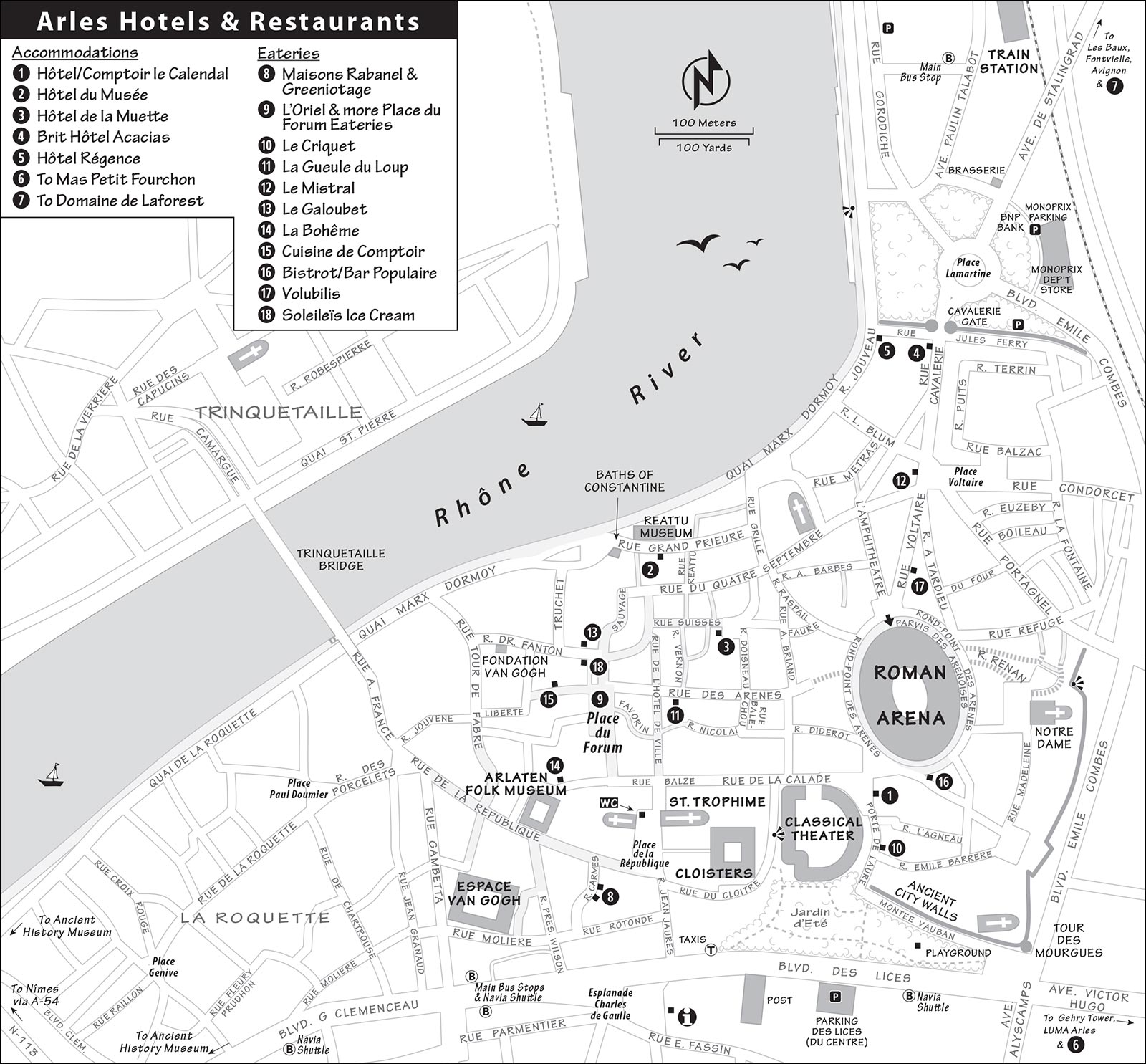
$ Cuisine de Comptoir is the Provençal answer to a pizzeria, offering light and cheap meals. For €14, you get a tartine—a cross between pizza and bruschetta with a fun array of toppings served on Poilâne bread—along with soup or salad. It’s run by Vincent and his charming wife, with both indoor and outdoor seating (closed Sun-Mon, off lower end of Place du Forum at 10 Rue de la Liberté, +33 4 90 96 86 28).
$ Bistrot/Bar Populaire owns the best seating across from the arena (ideal when it’s lit after dark) and serves good café fare at affordable prices (closed Sat-Sun, 1 Rue Girard le Bleu, +33 9 52 52 34 13).
$ Volubilis is an endearing little spot serving Moroccan cuisine at good prices, including well-prepared tagine and couscous. The restaurant covers two floors inside and has a tiny deck outside (daily, just below the arena at 53 Rue Voltaire, +33 6 66 53 78 41).
$ Le Comptoir du Calendal, in the recommended Hôtel le Calendal, serves light, seasonal fare curbside overlooking the theater, in its lovely courtyard, on the front terrace, or inside the café. They offer tasty and cheap little sandwiches and salads, along with a small selection of plats—the salmon gratin is delicious (daily, 5 Rue Porte de Laure, +33 4 90 96 11 89).
DINING ON PLACE DU FORUM
The most lively square in town is also the most touristy. While you’d swear that Van Gogh sipped his pastis here, these days he’d avoid it. Still, if you want to enjoy mostly forgettable food in a fun atmosphere under a starry, starry night, Place du Forum is a good choice.
For Dinner on the Square: Your best bet for a good $$$ meal is at Bar à l’Huitre, the classiest place on the square, serving fine seafood with a focus on oysters (daily). $$ Le Tambourin at the top of the square is another good choice (dinner salads and more, closed Sun). $ Le Comptoir d’Italie serves basic Italian grub, pizzas, and salads. Café La Nuit may have the best street appeal, but it’s a tourist trap designed to hook those with Vincent fantasies.
Before-Dinner Drink or Dessert: You can also enjoy the ambience of Place du Forum for just an aperitif or dessert. Any bar can serve you a pastis—a très local ritual. This anise-based aperitif is served straight with ice, along with a carafe of water—dilute to taste. While here, immerse yourself in Arles’ lore with a drink at The Grand Hôtel Nord-Pinus Bar, a once popular watering hole for toreadors and greats from Ernest Hemingway to Jean Cocteau to Ingrid Bergman (14 Place du Forum).
Glacier Arelatis, the ice cream shop on the square, has a handful of tables with a front-row seat to the Provençal ambience. Or seek out Soleileïs a few blocks away, where Marijtje scoops up fine ice cream made with organic milk, fresh fruit, all-natural ingredients, and creative flavors that fit the season. There’s also a shelf of English books for exchange (daily 14:00-18:30, closed in winter, 9 Rue du Docteur Fanton).
Arles Connections
BY TRAIN
Note that Intercité trains in and out of Arles require a reservation. These include connections with Nice to the east and Bordeaux to the west (including intermediary stops). Ask at the station.
Compare train and bus schedules: For some nearby destinations, the bus may be the better choice, and it’s usually cheaper.
From Arles by Train to: Paris (hourly, 4 hours, transfer in Avignon or Nîmes), Avignon Centre-Ville (hourly, 15 minutes), Orange (6/day direct, 45-60 minutes, more with transfer in Avignon), Marseille (1-2/hour, 1 hour), Carcassonne (2/day direct, 2.5 hours, more with transfer in Narbonne—3-4 hours, direct trains may require reservations), Beaune (hourly, 4-5 hours, transfer in Lyon and Avignon or Nîmes), Nice (hourly, 4 hours, most require transfer in Marseille).
BY BUS
Travel by bus is a bargain here as most trips cost about €2. There are two key bus stops in Arles. The stop at the train station serves buses connecting Arles with destinations to the north and east, including Avignon, Les Baux, and St-Rémy-de-Provence. The stop on Boulevard Georges Clemenceau (see the “Arles” map) serves buses heading west and south to destinations such as Nîmes, Stes-Maries-de-la-Mer, and Aigues-Mortes. Some routes use both stops.
From Arles by Bus to Les Baux and St-Rémy: Verify Les Baux bus schedules at the TI. Zou bus #707 connects Arles to St-Rémy-de-Provence via Les Baux (6/day, daily July-Aug, none off-season; 35 minutes to Les Baux, 50 minutes to St-Rémy). Bus #704 also goes to St-Rémy (but not via Les Baux) and runs all year (5/day Mon-Fri, 3/day Sat, none on Sun, 1 hour, timetables at https://zou.maregionsud.fr or www.rome2rio.com).
Avignon
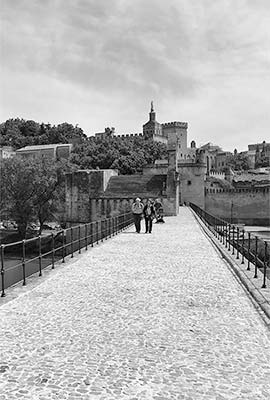
Famous for its nursery rhyme, medieval bridge, and brooding Palace of the Popes, contemporary Avignon (ah-veen-yohn) bustles and prospers behind its mighty walls. For nearly 100 years (1309-1403) Avignon was the capital of Christendom, home to seven popes. (And then, for a difficult period—during the Great Schism when there were two competing popes—Avignon was “the other Rome.”) During this time, it grew from a quiet village into a thriving city. Today, with its large student population, fashionable shops, and extensive traffic-free areas, Avignon is an intriguing blend of medieval history, youthful energy, and urban sophistication. Street performers entertain international throngs who fill Avignon’s ubiquitous cafés and trendy boutiques. And each July the city goes pedal to the metal during its huge theater festival (with about 2,000 performances, big crowds, higher prices, and hotels booked up long in advance).
Orientation to Avignon
Cours Jean Jaurès, which turns into Rue de la République, runs straight from the Centre-Ville train station to Place de l’Horloge and the Palace of the Popes, splitting Avignon in two. The larger eastern half is where the action is. Climb to the Jardin du Rochers des Doms for the town’s best view, tour the pope’s immense palace, lose yourself in Avignon’s back streets (following my self-guided “Discovering Avignon’s Back Streets Walk”), and go organic in its vibrant market hall.
TOURIST INFORMATION
The TI is located on the main street linking the Centre-Ville train station to the old town (Mon-Sat 9:00-18:00, Sun 10:00-17:00, shorter weekend hours in winter, 41 Cours Jean Jaurès, +33 4 32 74 32 74, www.avignon-tourisme.com).
At the TI, pick up a map with several good (but tricky to follow) walking tours and ask about guided English tours on varying themes (listed on their website).
Get information about the free Baladine and City Zen minibus routes that loop through the old city (see “Helpful Hints,” later) and ask for bike maps for good rides in the area, including the Ile de la Barthelasse.
ARRIVAL IN AVIGNON
By Train
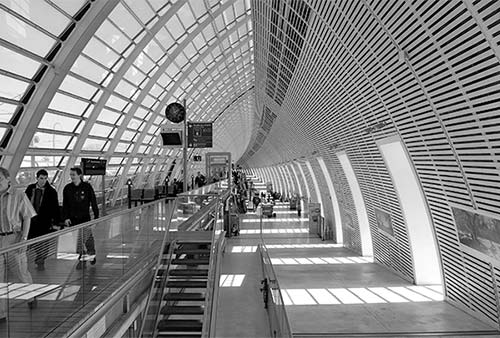
Avignon has two train stations: Centre-Ville and TGV (linked to downtown by shuttle trains). Some TGV trains stop at Centre-Ville—verify your station in advance.
The Centre-Ville station (Gare Avignon Centre-Ville) gets all non-TGV trains (and a few TGV trains). Baggage storage is close by (see “Helpful Hints,” later).
The TGV station (Gare TGV), on the outskirts of town, has easy car rental but no baggage storage. Car rental, buses, and taxis are outside the north exit (sortie nord). To reach the city center, take the shuttle train from platform A or B to the Centre-Ville station (€1.80, included with rail pass, 2/hour, 5 minutes, buy ticket from machine on platform or at billeterie in main hall). A taxi ride between the TGV station and downtown Avignon costs about €22 (more at night and on Sun). Buses to nearby towns stop in front of the station across from the car rental offices.
By Bus
The busy bus station (gare routière) is 100 yards to the right as you exit the Centre-Ville train station, beyond and below Hôtel Ibis (helpful info desk open Mon-Sat 7:00-19:30, closed Sun, +33 4 90 82 07 35).
By Car
Avignon is essentially traffic-free in the old center. There are several safe underground parking lots clearly signposted. For those day-tripping in and wanting the most central garage, follow signs to Centre, then to the Centre Historique and then P Palais des Papes (from where, after parking, you’ll climb the stairs and arrive at the pope’s doorstep, about €12/half-day, €20/24 hours).
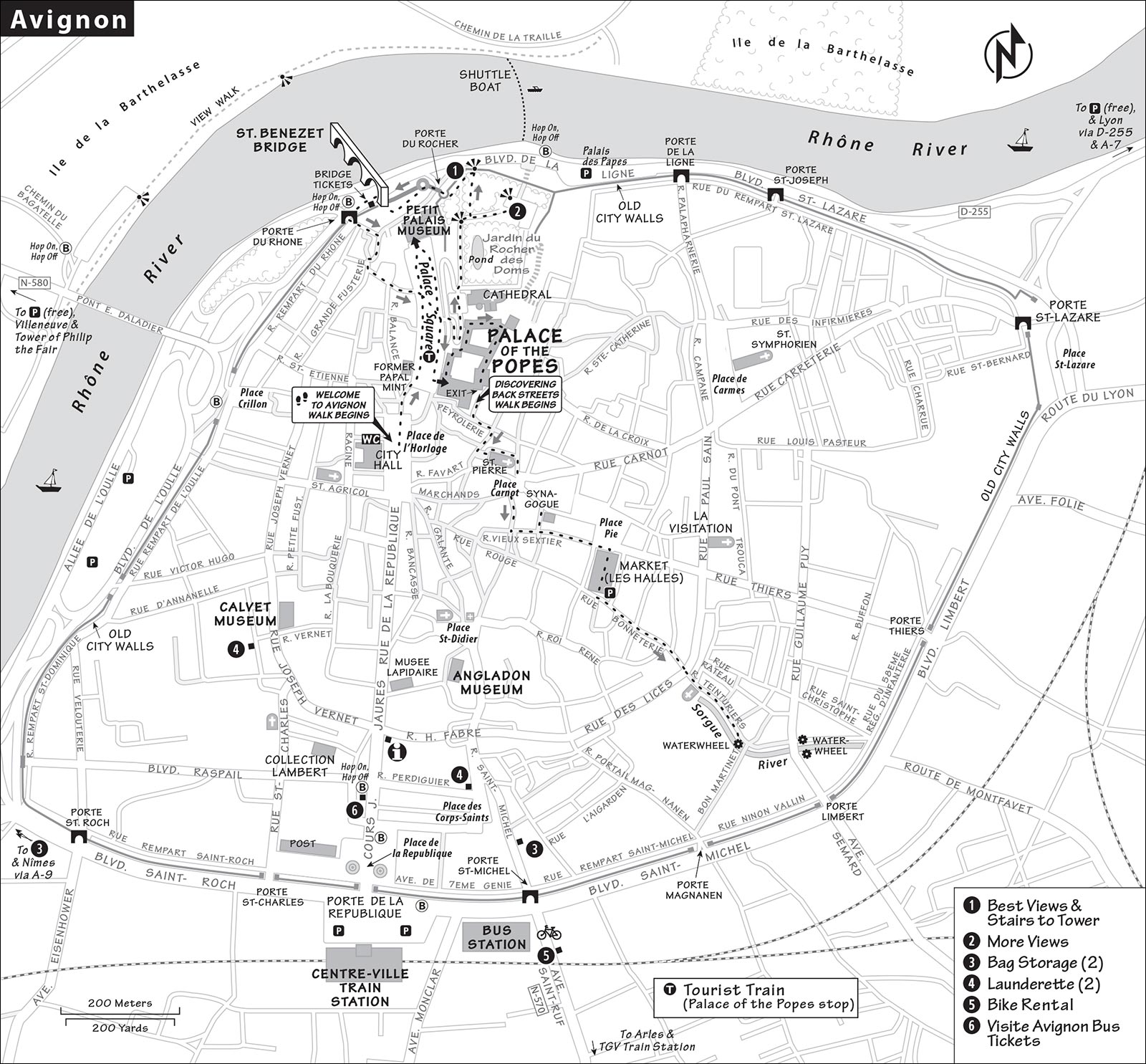
You can also park for free at the edge of town at lots with complimentary shuttle buses to the center (no shuttles on Sunday; see the “Avignon” map). Follow P Gratuit signs for Parking Ile Piot, across Pont Daladier on Ile de la Barthelasse, with shuttles to Place Crillon; or to Parking des Italiens, along the river east of the Palace of the Popes, with shuttles to Place Pie (allow 30 minutes to walk from either parking lot to the center).
Street parking is €1-3/hour for a maximum of four hours Mon-Sat 9:00-19:00 (free 19:00-9:00 and all day Sun).
No matter where you park, leave nothing of value in your car.
HELPFUL HINTS
Book Ahead for Summer: During the July theater festival, rooms are almost impossible to come by—reserve early or stay in Arles or St-Rémy. For June-September visits, book timed-entry tickets for the Palace of the Popes online in advance.
Local Help: David at Imagine Tours, a nonprofit group to promote this region, can help with hotel emergencies and special-event tickets (+33 6 89 22 19 87, www.imagine-tours.net, imagine.tours@gmail.com).
Baggage Storage: Across the ring road from the bus station and inside the walls, find Conciergerie-Bagagerie (€4/day, daily 8:00-20:00, shorter hours and closed for lunch in off-season, 35 Rue St-Michel, +33 6 29 21 31 36, www.bs-conciergerie-bagagerie-avignon.fr). Turn left out of the train station and walk 10 minutes to find Hôtel Ibis Budget, across from Porte St-Roch (€2/day, 24/7 storage, 8 Boulevard St-Dominique).
Laundry: At La Blanchisseuse, you might be able to drop off your laundry in the morning and pick it up later the same day or do it yourself if the attendant is not present (daily 7:00-21:00, several blocks west of the TI at 24 Rue Lanterne, +33 4 90 85 58 80). The launderette at 66 Place des Corps-Saints, where Rue Agricol Perdiguier ends, is handy to most hotels (cash only, daily 7:00-20:00).
Grocery Stores: Carrefour City is central (2 blocks from TI, toward Place de l’Horloge on Rue de la République). A second Carrefour City is near Les Halles at 19 Rue Florence (both open long hours daily).
Bike Rental: Rent pedal and electric bikes and scooters near the train station at Provence Bike (generally open Mon-Sat 9:00-18:00, closed Sun, also closed midday in April and Sept-Oct, closed in winter, 7 Avenue St-Ruf, +33 4 90 27 92 61, www.provence-bike.com), or ask at the TI about other options. You’ll enjoy riding on the Ile de la Barthelasse (the TI has bike maps).
Taxi: Call +33 4 90 82 20 20.
Car Rental: The TGV station has counters for all the big companies.
Shuttle Vans: Wave down a free Baladine electric minivan along its loop route through Avignon, or use free City Zen minibuses with fixed stops (4/hour for either). City Zen minibuses also link remote parking lots with the city center. The TI has route maps.
Shuttle Boat: A free shuttle boat, the Navette Fluviale, plies back and forth across the river from near St. Bénezet Bridge (3/hour, daily April-June and Sept 10:00-12:15 & 14:00-18:00, July-Aug 11:00-20:45; Oct-March weekends and Wed afternoons only). It drops you on the peaceful Ile de la Barthelasse, with grassy walks and bike rides with memorable city views.
Commanding City Views: For great views of Avignon and the river, walk or drive across Daladier Bridge, or ferry across the Rhône on the Navette Fluviale (described above). I’d take the boat across the river, walk the view path to Daladier Bridge, and then cross back over the bridge (45-minute walk).
Tours in Avignon
Local Guides
Isabelle Magny is a fine local guide for the city and region (€160/half-day, €330/day, no car, +33 6 11 82 17 92, isabellemagny@sfr.fr). Nina Seffusatti is equally talented (same prices as Isabelle, +33 6 14 80 30 37, nina.seffusatti@wanadoo.fr). Sylvie Pagnard is another good choice; she also does regional tours of Provence and Languedoc (€200/3 hours, €390/8 hours, extra if she drives, +33 6 03 21 37 33, sylviepagnard@gmail.com).
Food Tour
The Avignon Gourmet Walking Tour is a terrific experience if you like to eat. Avignon native Julien meets small groups at the TI for a well-designed three- to four-hour, eight-stop walk (Tue-Sat at 9:00 and 15:30). His morning tour finishes in the market hall while his afternoon tour highlights Avignon sweets (€55-75/person, 2-10 people per group, book in advance online, customized tours available, +33 6 62 89 55 44, www.avignongourmetours.com).
Hop-On, Hop-Off Bus and Tourist Train Tours
Visite Avignon runs two helpful loop tours. Its one-hour loop on an open-top double-decker bus crosses the river onto Ile de la Barthelasse, travels into Villeneuve-les-Avignon, and goes around the old city. One of the five stops gets you to within a 10-minute walk of the Tower of Philip the Fair (€12, departs hourly April-Sept, main stop and ticket office/boutique near the TI at 40 Cours Jean Jaurès, www.visiteavignon.com). The petit train leaves regularly (generally on the half hour) from in front of the Palace of the Popes and offers a decent overview of the city, including the Jardin du Rochers des Doms and St. Bénezet Bridge (€9.50, can buy tickets from the driver—cash only—or at the boutique listed above, 2/hour, 45 minutes, recorded English commentary, mid-March-Oct daily 10:00-18:00, July-Aug until 20:00).
Walks in Avignon
For an excellent city overview, combine these two self-guided walks. “Welcome to Avignon” covers the major sights, while “Discovering Avignon’s Back Streets” leads you along lanes less taken, delving beyond the surface of this historic city.
WELCOME TO AVIGNON WALK
Start this ▲▲ walk where the Romans did, on Place de l’Horloge, in front of City Hall (Hôtel de Ville).
Place de l’Horloge
In ancient Roman times this was the forum, and in medieval times it was the market square. The square is named for the clock tower (now hiding behind the more recently built City Hall) that, in its day, was a humanist statement. In medieval France, the only bells in town rang from the church tower to indicate not the hours but the calls to prayer. With the dawn of the modern age, secular clock towers like this rang out the hours as people organized their lives independent of the Church.
Taking humanism a step further, the City Hall, built after the French Revolution, obstructed the view of the old clock tower while celebrating a new era. The slogan “liberty, equality, and brotherhood” is a reminder that the people supersede the king and the Church. And today, judging from the square’s jammed cafés and restaurants, it is indeed the people who rule.
The square’s present popularity arrived with the trains in 1854. Facing City Hall, look left down the main drag, Rue de la République. When the trains came to Avignon, proud city fathers wanted a direct, impressive way to link the new station to the heart of the city—so they destroyed existing homes to create Rue de la République and widened Place de l’Horloge.
• Walk slightly uphill past the neo-Renaissance facade of the theater and the carousel (public WCs behind). Look back to see the top of the late Gothic bell tower. Then veer right at the Hôtel de Palais des Papes and continue into...
Palace Square (Place du Palais)
Take in the scene. This grand square is lined with the Palace of the Popes, the Petit Palais, and the cathedral. In the 1300s the entire headquarters of the Roman Catholic Church was moved to Avignon. The Church purchased the city of Avignon and gave it a complete makeover. Along with clearing out vast spaces like this square and building a three-acre palace, the Church erected more than three miles of protective wall (with 39 towers), “appropriate” housing for cardinals (read: mansions), and residences for its entire bureaucracy. The city was Europe’s largest construction zone. Avignon’s population grew from 6,000 to 25,000 in short order. (Today, only 13,000 people live within the walls.) The limits of pre-papal Avignon are outlined on your city map: Rues Joseph Vernet, Henri Fabre, des Lices, and Philonarde all follow the route of the city’s earlier defensive wall (about half the diameter of today’s wall).
The imposing facade behind you, across the square from the Palace of the Popes’ main entry, was “the papal mint,” which served as the finance department for the Holy See (today it’s a hotel). The Petit Palais (Little Palace) seals the uphill end of the square and was built for a cardinal; today it houses medieval paintings. Avignon’s 12th-century Romanesque cathedral, just to the left of the Palace of the Popes, has been the seat of the local bishop for more than a thousand years.
• At this point, you could visit the massive Palace of the Popes (described later). However, it works better to visit it at the end of this walk, then continue directly to my “Discovering Avignon’s Back Streets Walk.”
Now is a good time to take in the...
Petit Palais Museum (Musée du Petit Palais)
This former cardinal’s palace now displays the Church’s small art collection. Though there’s no English information, a quick visit here before going to the Palace of the Popes helps furnish and populate that otherwise barren building. You’ll see bits of statues and tombs—an inventory of the destruction of exquisite Church art that was wrought by the French Revolution (which tackled established French society with fervor). Then you’ll see many rooms filled with religious Italian paintings, organized in chronological order from early Gothic to late Renaissance. Room 10 holds two paintings by Botticelli.
Cost and Hours: Free, Wed-Mon 10:00-13:00 & 14:00-18:00, closed Tue, at north end of Palace Square, +33 4 90 86 44 58, www.petit-palais.org.
• From Palace Square, head up to the cathedral and enjoy the viewpoint overlooking the square from its front porch. Now backtrack a bit, turn left, and climb the ramp to the top of a rocky hill.
Jardin du Rocher des Doms
The Jardin du Rocher des Doms, worth ▲, is home to an inviting café, a pond, and fine views. At the far side (the top end with the green fence) is a viewpoint high above the river from where you can see Avignon’s beloved broken bridge.
Enjoy the view from this bluff. On a clear day, the tallest peak you see (far to the right), with its white limestone cap, is Mont Ventoux (“Windy Mountain”). Below and just to the right, you’ll spot free passenger ferries shuttling across the river. The island in the river is the Ile de la Barthelasse, a lush nature preserve where Avignon can breathe. In the distance to the left is the TGV rail bridge.
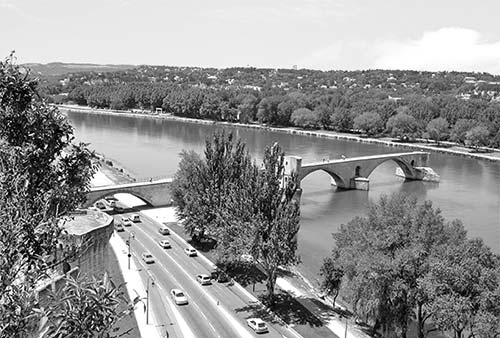
Medieval Avignon was administered by the Vatican and independent of the rest of France. The Rhône River marked the border of Vatican territory in medieval times. Fort St. André—across the river on the hill—was in the kingdom of France. Avignon’s famous bridge was a key border crossing, with towers on either end—one was French, and the other was the pope’s.
Cost and Hours: Free, park gates open daily 7:30-20:00, June-July until 22:00, Oct-March until 18:00.
• Take the walkway down to the left (passing the popes’ vineyard) and find the stairs leading down to the tower. You’ll catch glimpses of the...
Ramparts
The only bit of the rampart you can walk on is accessed from St. Bénezet Bridge (accessible only with your ticket to the bridge). Just after the papacy took control of Avignon, the walls were extended to take in the convents and monasteries that had been outside the city. What you see today was partially restored in the 19th century.
• When you come out of the tower on street level, turn left to walk inside the city wall to the entry to the old bridge (Pont St-Bénezet).
St. Bénezet Bridge (Pont St-Bénezet)
This bridge, whose construction and location were inspired by a shepherd’s religious vision, is the “Pont d’Avignon” of nursery-rhyme fame (and worth ▲). The ditty dates to the 15th century: Sur le Pont d’Avignon, on y danse, on y danse, sur le Pont d’Avignon, on y danse tous en rond (“On the bridge of Avignon, we will dance, we will dance, on the bridge of Avignon, we will dance all in a circle”).
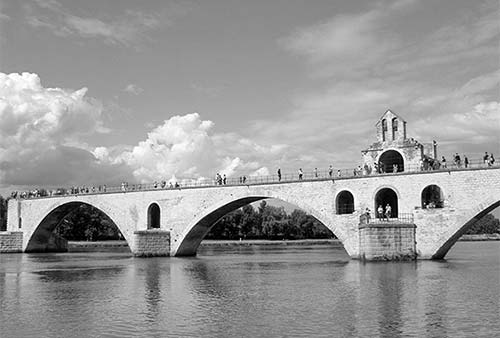
And the bridge was a big deal even outside its kiddie-tune fame. Built between 1171 and 1185, it was strategic—one of only three bridges crossing the mighty Rhône in the Middle Ages, important to pilgrims, merchants, and armies. It was damaged several times by floods but always rebuilt. In the winter of 1668 most of it was knocked out for the last time by a disastrous icy flood. The townsfolk decided not to rebuild this time, and for more than a century, Avignon had no bridge across the Rhône. While only four arches survive today, the original bridge was huge: Imagine a 22-arch, half-mile-long bridge extending from Vatican territory across the island to the lonely Tower of Philip the Fair, which marked the beginning of France (see displays of the bridge’s original length).
Cost and Hours: €5, includes audioguide, €14.50 combo-ticket with Palace of the Popes, €17 combo-ticket with Palace of the Popes and Papal Garden; daily 10:00-18:00, July-Aug until 19:00, Nov-March until 17:00, +33 4 90 27 51 16.
• To get to the Palace of the Popes from here, walk to the right up Rue Ferruce, wiggle straight, take the first left, and follow the signs uphill to the...
Palace of the Popes (Palais des Papes)
In 1309 a French pope was elected (Pope Clément V). His Holiness decided that dangerous Italy was no place for a pope, so he moved the whole operation to Avignon for a secure rule under a supportive French king. The Catholic Church literally bought Avignon (then a two-bit town) and built the Palace of the Popes, where the popes resided until 1403 and where a visit today is worth ▲. Eventually, Italians demanded a Roman pope, so from 1378 on, there were twin popes—one in Rome and one in Avignon—causing a schism in the Catholic Church that wasn’t fully resolved until 1417.
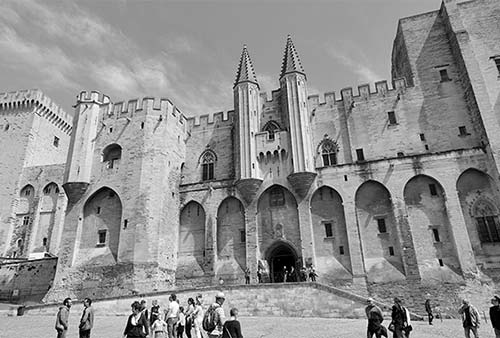
This largest surviving Gothic palace in Europe was built to accommodate 500 people as the administrative center of the Holy See and home of the pope. Seven popes ruled from here, making this the center of Christianity for nearly 100 years. The last pope checked out in 1403, but the Church owned Avignon until the French Revolution in 1791. Avignon residents, many of whom had come from Rome, spoke Italian for a century after the pope left, making the town a cultural oddity within France.
Cost and Hours: €12, includes multimedia HistoPad; €14.50 combo-ticket with St. Bénezet Bridge, €17 combo-ticket with bridge and Papal Garden (skippable); advance timed-entry reservations strongly recommended June-Sept; daily 10:00-18:00, July-Aug 9:30-19:00, Nov-March 10:00-17:00, last entry one hour before closing; +33 4 90 27 50 00, www.palais-des-papes.com.
Visiting the Palace: The palace was built stark and strong, before the popes knew how long they’d be staying (and before the affluence and fanciness of the Renaissance and Baroque ages). This was the most fortified palace of the time (remember, the pope left Rome to be more secure). With 10-foot-thick walls, it was a symbol of power. The palace is empty today as nothing portable survived both the pope’s return to Rome and the French Revolution.
Visitors follow a tangled one-way route with lots of ups and downs on big staircases through rooms equipped with an iPad called “The HistoPad,” an effort to bring these old papal spaces to life (free with entry). There’s a lot of history here—but zero English outside your HistoPad. The artifacts are sparse and wall frescos are often faint: Without interpretation, it’s mostly meaningless, but the HistoPad helps (with no sound, it takes some patience to master, but roving staff are happy to help). Nine posts during the tour activate a time-tunnel effect, taking you back to the 14th century as you furnish the rooms by pointing your iPad. While in this mode, you can click on various points in the room for more info, which I found most helpful.
The Chambre du Pape (pope’s bedroom), and the Chambre du Cerf (deer room) give some sense of the palace’s one-time splendor. Your tour ends in the one big “chapel” (twice the size of the adjacent cathedral), which, while simple, is majestic in its pure French Gothic lines. After the chapel you can climb 54 steps to the Tour de la Gâche for good views over Avignon and get close to golden Mary who crowns the adjacent cathedral, or follow Sortie signs to exit.
• You’ll exit at the rear of the palace, where my next walk begins. Or, to return to Palace Square, make two rights after exiting the palace.
DISCOVERING AVIGNON’S BACK STREETS WALK
This easy, level, 30-minute walk is worth ▲▲. We’ll begin in the small square (Place de la Mirande) behind the Palace of the Popes. If you’ve toured the palace, this is where you exit. Otherwise, from the front of the palace, follow the narrow, cobbled Rue de la Peyrolerie—carved out of the rock—around the palace on the right side as you face it.
• Our walk begins at the...
Hôtel La Mirande: Find the atrium lounge, check out the queenly garden, and consider a coffee break amid the understated luxury (€15 afternoon tea served daily 15:00-18:00, see “Eating in Avignon,” later).
• Turn left out of the hotel and left again on Rue de la Peyrolerie, then take your first right on Rue des Ciseaux d’Or. On the small square ahead you’ll find the...
Church of St. Pierre: The original walnut doors were carved in 1551, when tales of New World discoveries raced across Europe. (Notice the Native American headdress, top center of left-side door.) The fine Annunciation (eye level on right-side door) shows Gabriel giving Mary the exciting news in impressive Renaissance 3-D. The niches on the facade are empty except for one mismatched Mary and Child filling the center niche. (The original was ransacked by the Revolution.) The church’s interior—with its art amped up as a Counter-Reformation answer to the Protestant threat—holds a beautiful Baroque altar.
• Facing the church door, turn left near the recommended L’Epicerie restaurant, then follow the alley, which leads into...
Place des Châtaignes: The cloister of St. Pierre (with recommended eateries) is named for the chestnut (châtaigne) trees that once stood here. The practical atheists of the French Revolution destroyed the cloister, leaving only faint traces of the arches along the church side of the square.
• Continue clockwise around the church to the pretty intersection; look up to appreciate the classy facades of the buildings around you. At the start of little Rue des Fourbisseurs at the right corner, find the big...
15th-Century Building: With its original beamed eaves showing, this is a rare vestige from the Middle Ages. Notice how this building widens the higher it gets. A medieval loophole based taxes on ground-floor square footage—everything above was tax-free. Walking down Rue des Fourbisseurs, notice how the top floors almost touch. Fire was a constant danger in the Middle Ages, as flames leapt easily from one home to the next. Because of fires, this is the only 15th-century home surviving in town.
• Walk down Rue des Fourbisseurs past lots of shops and turn left onto the traffic-free Rue du Vieux Sextier; another left under the first arch leads in 10 yards to one of France’s oldest synagogues.
Synagogue: Jews first arrived in Avignon with the Diaspora (exile after the Romans destroyed their great temple) in the first century. Although the original synagogue dates from the 1220s, in the mid-19th century it was rebuilt in a Neoclassical Greek-temple style by a non-Jewish architect. The only synagogue under a rotunda, it’s an intimate, classy place (free, Mon-Fri 10:00-12:00, ring doorbell, closed Sat-Sun and holidays, 2 Place Jerusalem).
• Retrace your steps to Rue du Vieux Sextier and turn left. Continue to the big square (across the busy street) and find the big, boxy market building with the vertical (hydroponic) garden growing out its front wall.
Market (Les Halles): In 1970, the town’s open-air market was replaced by this modern one. Its jungle-like hydroponic green wall reflects the changes of seasons and softens its otherwise stark exterior (Tue-Sun until 13:30, closed Mon). Step inside for a sensual experience of organic breads, olives, and festival-of-mold cheeses. This is a terrific place for lunch, especially a big plate of mixed seafood with a glass of white wine.
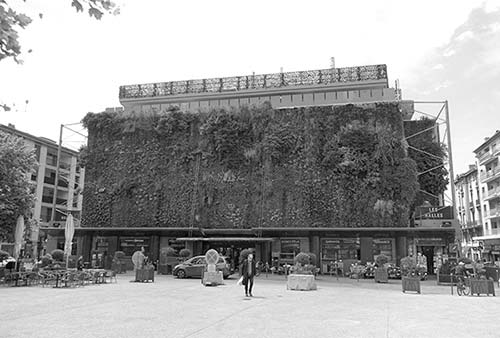
• Walk through the market and exit out the back door, then turn left on Rue de la Bonneterie, lined with triple-A shops (alternative, arty, and artisan). Track the street for five minutes to the plane trees, where it becomes...
Rue des Teinturiers: This “Street of the Dyers” is a bohemian-friendly, tree- and stream-lined lane, home to earthy cafés and galleries. This was the cloth industry’s dyeing and textile center in the 1800s. Those stylish Provençal fabrics and patterns you see for sale everywhere were first made here, based on printed fabrics originally imported from India.
About three small bridges down, you’ll pass the Grey Penitents chapel on the right. The upper facade shows the GPs, who dressed up in robes and pointy hoods to do their anonymous good deeds back in the 13th century. As you stroll on, you’ll see the work of amateur sculptors, who have carved whimsical car barriers out of limestone. Fun, popular-with-locals restaurants line this atmospheric street.
• Farther down Rue des Teinturiers, you’ll come to the...
Waterwheel: Starting in about 1800, waterwheels powered the town’s industries. The little cogwheel above the big one could be shoved into place, kicking another machine into gear behind the wall.
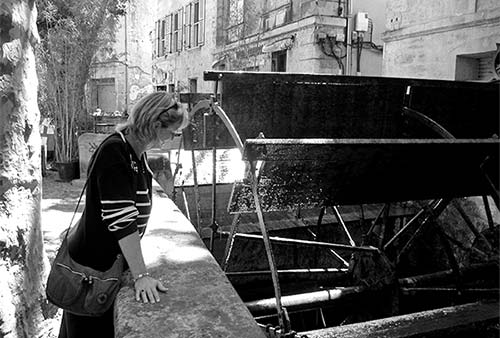
• Our walk is done. To return to the center of town, double back on Rue des Teinturiers and turn left on Rue des Lices, which traces the first medieval wall. Eventually you’ll return to Rue de la République, Avignon’s main drag.
More Sights in Avignon
Most of Avignon’s top sights are covered earlier by my self-guided walks. With more time, consider these options.
Angladon Museum (Musée Angladon)
Visiting this museum is like being invited into the elegant home of a rich and passionate art collector. It houses a small but enjoyable collection of art from Post-Impressionists to Cubists (including Paul Cézanne, Vincent van Gogh, Edgar Degas, André Dérain, Alfred Sisley, and Pablo Picasso), with re-created art studios and furnishings from many periods. It’s a quiet place with a few superb paintings and good temporary exhibits.
Cost and Hours: €8, Tue-Sun 13:00-18:00, closed Mon year-round and on Sun in winter, last entry 45 minutes before closing, 5 Rue Laboureur, +33 4 90 82 29 03, www.angladon.com.
Calvet Museum (Musée Calvet)
This fine-arts museum, ignored by most, displays an impressive collection highlighting French Baroque works and Northern masters such as Hieronymus Bosch and Pieter Bruegel. You’ll find a few gems upstairs: a painting each by Manet, Sisley, Géricault, and David. On the ground floor is a room dedicated to more modern artists, with works by Soutine, Bonnard, and Vlaminck. The Calvet Museum’s antiquities collection, Le Musée Lapidaire, is hosted in a church a few blocks away at 27 Rue de la République.
Cost and Hours: Free, includes audioguide and Le Musée Lapidaire, Wed-Mon 10:00-13:00 & 14:00-18:00, closed Tue, in the western half of town at 65 Rue Joseph Vernet, +33 4 90 86 33 84, www.musee-calvet.org.
Collection Lambert
This modern art museum, situated in a grand 18th-century mansion, features works from the 1960s to the present. It came from the famous art dealer Yvon Lambert, who was determined to make well-known contemporary art accessible outside Paris. The recommended Le Violette restaurant in the courtyard is worth the visit alone (see here).
Cost and Hours: €10, July-Aug daily 11:00-19:00, Sept-June Tue-Sun 11:00-18:00, closed Mon, 5 Rue Violette, +33 4 90 16 56 21, www.collectionlambert.com.
NEAR AVIGNON
▲Tower of Philip the Fair (Tour Philippe-le-Bel)
Built to protect access to St. Bénezet Bridge in 1307, this hulking tower, located in nearby Villeneuve-lès-Avignon, offers a terrific view over Avignon and the Rhône basin.
Cost and Hours: €4.50; Tue-Sun 10:00-12:30 & 14:00-18:00, Nov-April 14:00-17:00, closed all of Dec-Jan and Mon year-round.
Getting There: To reach the tower from Avignon, drive five minutes (cross Daladier Bridge, follow signs to Villeneuve-lès-Avignon), or take bus #5 (3/hour, bus stops just outside Place Crillon at Porte De l’Oulle, or from close to the train station—for stop locations, see the “Avignon” map, earlier).
Sleeping in Avignon
Hotel values are better in Arles. Avignon is crazy during its July festival—you must book long ahead and pay inflated prices. Drivers should ask about parking discounts through hotels. All hotels have elevators and air-conditioning unless otherwise noted.
NEAR CENTRE-VILLE STATION
These listings are a 5- to 10-minute walk from the Centre-Ville train station.
$$$ Hôtel de Cambis**** rents 41 very comfy and stylish rooms with high ceilings. Room colors vary with the wines they represent, and the breakfast room and lounge are as stylish as the rooms (89 Rue Joseph Vernet, +33 4 90 14 62 73, www.hoteldecambis.com, welcome@hoteldecambis.com).
$$ Hôtel Bristol**** is a big, professionally run place on the main drag, offering predictable “American” comforts at fair rates. Enjoy spacious public spaces, large rooms, big elevators, and a generous buffet breakfast (family rooms, 44 Cours Jean Jaurès, +33 4 90 16 48 48, www.bristol-avignon.com, contact@bristol-avignon.com).
$ Hôtel Ibis Centre Gare*** offers tight-but-tasteful comfort and quiet near the central train and bus stations (42 Boulevard St. Roch, +33 4 90 85 38 38, www.ibis.com, h0944@accor.com).
$ Hôtel Colbert** is on a quiet lane, with a dozen spacious rooms gathered on four floors around a skinny spiral staircase (no elevator). Patrice decorates each room as if it were his own, with a colorful (occasionally erotic) flair. There’s a sweet little patio (some tight bathrooms, rooms off the patio can be musty, closed Nov-March, 7 Rue Agricol Perdiguier, +33 4 90 86 20 20, www.lecolbert-hotel.com, contact@avignon-hotel-colbert.com).
$ Hôtel Boquier** offers 13 quiet, good-value, and homey rooms under wood beams in a central location with lovable cats (family rooms, steep and narrow stairways to some rooms, no elevator, good deal pay parking nearby, near the TI at 6 Rue du Portail Boquier, +33 4 90 82 34 43, www.hotel-boquier.com, contact@hotel-boquier.com).
IN THE CENTER, NEAR PLACE DE L’HORLOGE
$$$$ Hôtel d’Europe,***** one of Avignon’s most prestigious addresses, lets peasants sleep affordably—but only if they land one of the six reasonable “classique” rooms. With formal staff, spacious lounges, and a shady courtyard, the hotel has a handsome setting near the river (pay garage parking, near Daladier Bridge at 12 Place Crillon, +33 4 90 14 76 76, www.heurope.com, reservations@heurope.com). Readers seeking top comfort should compare this hotel with Hôtel la Mirande, next.
$$$$ Hôtel la Mirande***** pampers its guests with traditional luxury in a quiet, central location behind the Palace of the Popes. The formal staff delivers service with a smile, public spaces are comfy, and the rooms are exquisitely decorated (4 Place de l’Amirande, +33 4 90 14 20 20, www.la-mirande.fr, mirande@la-mirande.fr). The hotel also houses a well-respected restaurant, listed later.
$$$ Hôtel Mercure Palais des Papes,**** about a block from the Palace of the Popes, has a modern exterior and 86 big, smartly designed rooms, some with small balconies (about half the rooms have views over Place de l’Horloge, others are quieter with views over the Palace of the Popes, 1 Rue Jean Vilar, +33 4 90 80 93 00, www.mercure.com, h1952@accor.com).
$$$ Hôtel Pont d’Avignon,**** buried inside the walls near St. Bénezet Bridge, is part of the same chain as Hôtel Mercure Palais des Papes, with the same prices for its 87 rooms. There’s an airy atrium breakfast room that doubles as a bar-restaurant and a small garden terrace (direct access to a garage makes parking easier than at the other Mercure hotel, parking deals, on Rue Ferruce, +33 4 90 80 93 93, www.mercure.com, h0549@accor.com).
$$ Hôtel de l’Horloge**** is as central as it gets—on Place de l’Horloge. It rents 66 comfortable rooms, some with terraces and views of the city and the Palace of the Popes (1 Rue Félicien David, +33 4 90 16 42 00, www.hotel-avignon-horloge.com, hotel.horloge@hoa-hotels.com).
$$ Aux Augustins Rooms,*** run by Sabine and Patrick, include 22 contemporary, well-furnished rooms and studios with kitchenettes. This place is less central but comes with hands-on owners, large rooms, showers only, and a nice courtyard with lovely stonework dating from its time as a medieval monastery (16 Rue Carreterie, +33 4 84 51 01 44, +33 6 61 52 61 62). For a fee, they will pick you up at the TGV station or at the Marseille airport (www.autourdupetitparadis.com, contact@autourdupetitparadis.com).
$$ Hôtel Médiéval,** burrowed deep in the old center a few blocks from the Church of St. Pierre, was built as a cardinal’s home. This stone mansion’s grand staircase leads to 34 comfortable, newly renovated rooms (5 blocks east of Place de l’Horloge, behind Church of St. Pierre at 15 Rue Petite Saunerie, +33 4 90 86 11 06, www.hotelmedieval.com, reception@hotelmedieval.com).
¢ Hôtel Mignon* is a sweet and homey one-star place with two-star rooms, tiny bathrooms, and an attentive owner who loves lavender (no elevator, 12 Rue Joseph Vernet, +33 4 90 82 17 30, www.hotel-mignon.com, contact@hotel-mignon.com).
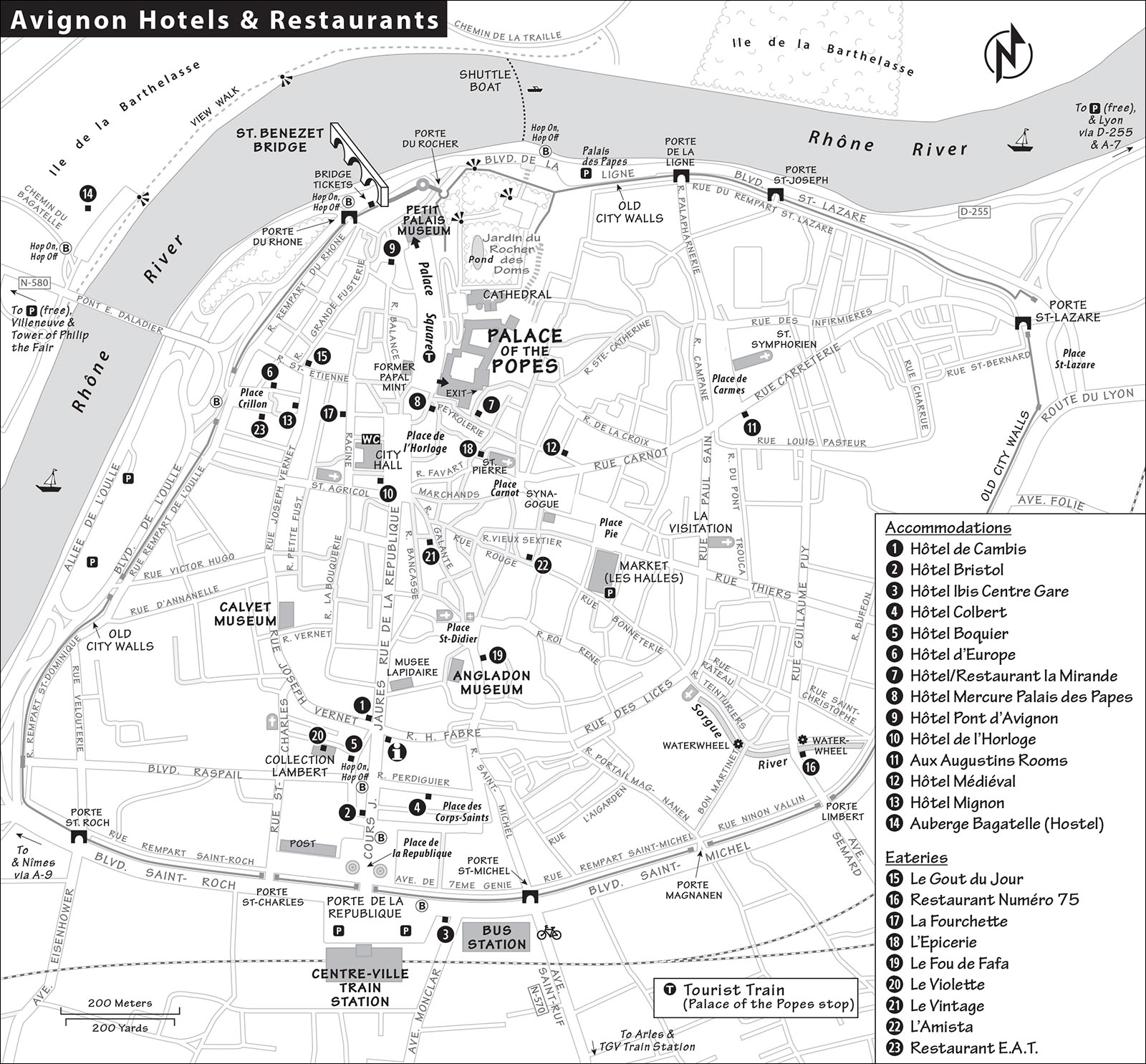
ON THE OUTSKIRTS
Auberge Bagatelle offers dirt-cheap beds in two buildings—a good $ budget hotel and a ¢ youth hostel—and has a young and lively vibe, café, grocery store, launderette, great views of Avignon, and campers for neighbors (cheaper rooms with shared bath, family rooms, across Daladier Bridge on Ile de la Barthelasse, bus #5, +33 4 90 86 71 35, www.aubergebagatelle.com, auberge.bagatelle@wanadoo.fr).
Eating in Avignon
Avignon offers a good range of restaurants and settings, from lively squares to atmospheric streets. Skip the spots on Place de l’Horloge and enjoy better value and atmosphere elsewhere.
FINE DINING WORTH THE SPLURGE
$$$$ La Mirande, inside the recommended five-star hotel just behind the Pope’s Palace, transports you into a historic and aristocratic world. What was once a cardinal’s palace today is a romantic oasis where you’ll dine in 18th-century splendor with elegant service and presentation. Dress as nicely as you can (dine inside or in the queenly garden, closed Mon-Wed, €90 lunch menu, €150-190 dinner menus, 4 Place de l’Amirande, +33 4 90 14 20 20, www.la-mirande.fr).
$$$ Le Gout du Jour is a softly lit romantic place on a quiet lane with indoor seating only. You’ll dine very well on Provençal cuisine (closed Tue-Wed, 20 Rue Saint-Etienne, +33 4 32 76 32 16, http://legoutdujour84.com).
$$ Restaurant Numéro 75 fills the well-worn Pernod mansion (of pastis liquor fame) with a romantic, chandeliered, Old World dining room (with modern touches) that extends to a leafy, graveled courtyard. They serve delightful lunch salads, fish is a forte, and the French cuisine is beautifully presented (closed Sun-Mon, 75 Rue Guillaume Puy, +33 4 90 27 16 00, www.numero-75.com).
$$ La Fourchette is an inviting, dressy place graced with warm colors and spacious indoor-only seating. The cuisine mixes traditional French with Provençal (closed Sat-Sun, 17 Rue Racine, +33 4 90 85 20 93, www.la-fourchette.net).
DINING WELL IN THE OLD CENTER ON A MODERATE BUDGET
$$ L’Epicerie sits alone under green awnings on romantic Place St-Pierre and is ideal for dinner outside or in the small but cozy interior. It has an accessible menu with Mediterranean dishes and big, splittable assiettes (sample plates), each with a theme (daily, 10 Place St-Pierre, +33 4 90 82 74 22, Magda speaks English).
$$ Le Fou de Fafa is a warm, 12-table place where delightful Antonia serves while her husband cooks (by reservation only, closed Sun-Mon, 17 Rue des Trois Faucons, +33 4 32 76 35 13, www.restaurantfoudefafa.com).
$$ Le Violette, in the peaceful courtyard of the Collection Lambert modern art museum, serves fresh modern cuisine and is gorgeous when lit by the museum rooms at night (July-Aug daily, Sept-June closed Sun-Mon, 5 Rue Violette, +33 4 90 85 36 42).
$ Le Vintage is where wine bar meets bistro in a relaxed setting with fun seating inside and out, good menu values, and a range of choices for local wines and dishes (daily, 10 Rue Galante, +33 4 86 65 48 54).
$$ L’Amista (“the spot to meet friends”) is a cozy, youthful, and welcoming place on a quiet lane with indoor and outdoor seating. Run by Delphine, it offers a fun Provençal/Spanish-inspired menu that always includes vegetarian options. Tapas-style plates are great for sharing (closed Sun-Mon off-season, 23 Rue Bonneterie, +33 6 19 24 15 47).
$$ Restaurant E.A.T., whose name stands for “Estaminet, Arômes et Tentations” (a small restaurant with aroma and temptations), is just off Place Crillon. It’s locally popular, serving eclectic and fun options in a modern interior (closed Wed and Sun, 8 Rue Mazan, +33 4 90 83 46 74, www.restaurant-eat.com).
Avignon Connections
BY TRAIN
There are two train stations in Avignon: the suburban TGV station and the Centre-Ville station in the city center (shuttle trains connect the stations, buy ticket from machine on platforms or at a counter, included with rail pass, under $2, 2/hour, 5 minutes). TGV trains usually serve the TGV station only, though a few depart from Centre-Ville station (check your ticket). The TGV station has a broad choice of car rental agencies; only Avis is at Centre-Ville station. Some cities are served by slower local trains from Centre-Ville station as well as by faster TGV trains from the TGV station; I’ve listed the most convenient stations for each trip.
From Avignon’s Centre-Ville Station to: Arles (hourly, 16 minutes), Orange (hourly, 20 minutes), Isle-sur-la-Sorgue (10/day on weekdays, 7/day on weekends, 30 minutes), Lyon (hourly, 1.5-2.5 hours; faster from TGV station), Carcassonne (10/day, most with transfer in Narbonne or Nîmes, 3 hours).
From Avignon’s TGV Station to: Nice (hourly, most by TGV, 4 hours, many require transfer in Marseille), Marseille (1-2/hour, 35 minutes), Lyon (hourly, 70 minutes, slower from Centre-Ville station), Paris’ Gare de Lyon (hourly direct, 2.5 hours), Paris’ Charles de Gaulle airport (4/day direct, 3 hours, more with transfer in Lyon or Paris).
BY BUS
The bus station (gare routière) is just past and below Hôtel Ibis, to the right as you exit the train station. Nearly all buses leave from this station (a few leave from the ring road outside the station—ask, buy tickets on bus or at bus station). Service is reduced or nonexistent on Sundays and holidays. Check your departure time beforehand, and make sure to verify your destination with the driver.
From Avignon to Pont du Gard: For details on taking the bus to the famous aqueduct, see the “Getting There” section for Pont du Gard.
From Avignon by Bus to Other Regional Destinations: These lines all depart from Avignon’s main bus station—St-Rémy-de-Provence (hourly Mon-Fri, 6/day Sat-Sun, 30 minutes), Orange (hourly Mon-Sat, 3/day Sun, 1 hour, faster by train), Isle-sur-la-Sorgue (hourly Mon-Sat, 2/day Sun, 40 minutes, also possible by train). For the Côtes du Rhône area, buses leave from Orange to Vaison-la-Romaine and other towns (faster to take the train to Orange and transfer to a bus there; see “Orange Connections” on here for details).
Pont du Gard
Throughout the ancient world, aqueducts were like flags of stone that heralded the greatness of Rome. A visit to this impressively preserved sight still works to proclaim the wonders of that age.
In the first century AD, the Romans built a 30-mile aqueduct that ran to Nîmes, one of ancient Europe’s largest cities. While most of it ran on or below the ground, at Pont du Gard the aqueduct spans a canyon on a massive bridge over the Gardon River—one of the most remarkable surviving Roman ruins anywhere. The aqueduct supported a small canal that dropped one inch for every 350 feet, supplying the city of Nîmes with nine million gallons of water per day (about 100 gallons per second).
Allow a full four hours for visiting Pont du Gard, including transportation time from Avignon.
GETTING THERE
The famous aqueduct is between Remoulins and Vers-Pont du Gard on D-981, 17 miles from Nîmes and 13 miles from Avignon.
By Car: Pont du Gard is a 30-minute drive due west of Avignon (follow N-100 from Avignon, tracking signs to Nîmes and Remoulins, then Pont du Gard and Rive Gauche), and 45 minutes northwest of Arles (via Tarascon on D-15). If going to Arles from Pont du Gard, follow signs to Nîmes (not Avignon), then D-15, or faster A-54 (autoroute) to Arles. At Pont du Gard, park on the left bank (rive gauche). Parking is €9.
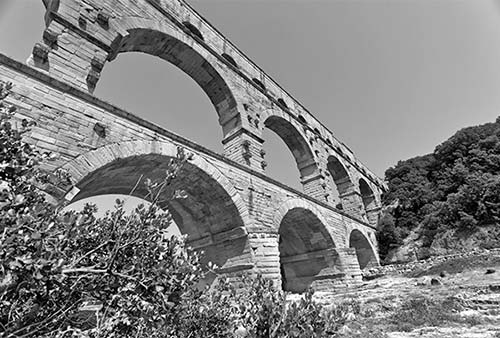
By Bus: Buses run to stops near the Pont du Gard (on the left bank side) from Avignon, Nîmes, and Uzès. It’s a good 15-minute walk to the sight from the bus stop. To reach Pont du Gard from Avignon, take bus #115 on the Alès-Avignon line (4/day Mon-Fri, 3/day Sat-Sun, 40 minutes; check schedules at bus station, TI, or at Rome2rio.com).
Buses stop at the traffic roundabout (stop name: Rond Point Pont du Gard; see “Pont du Gard” map). If leaving by bus, make sure you’re waiting on the correct side of the traffic circle (stops have schedules posted), and wave your hand to signal the bus to stop for you—otherwise, it may drive on by. When taking any bus in any direction, arrive at stops at least five minutes early, pay the driver (coins or small bills), and verify your stop and direction with the driver.
By Taxi: From Avignon, it’s about €65 for a taxi to Pont du Gard (+33 4 90 82 20 20). Consider splurging on a taxi to the aqueduct in the morning, then take the early afternoon bus back.
ORIENTATION TO PONT DU GARD
There are two riversides at Pont du Gard: the left bank (rive gauche) and right bank (rive droite). On the left bank, you’ll find parking, the museums, ticket booth, TI, WCs, and shops—all built into a modern plaza. Both sides have eating options (see here). You’ll see the aqueduct in two parts: first the informative museum complex, then the actual ancient bridge spanning the river gorge.
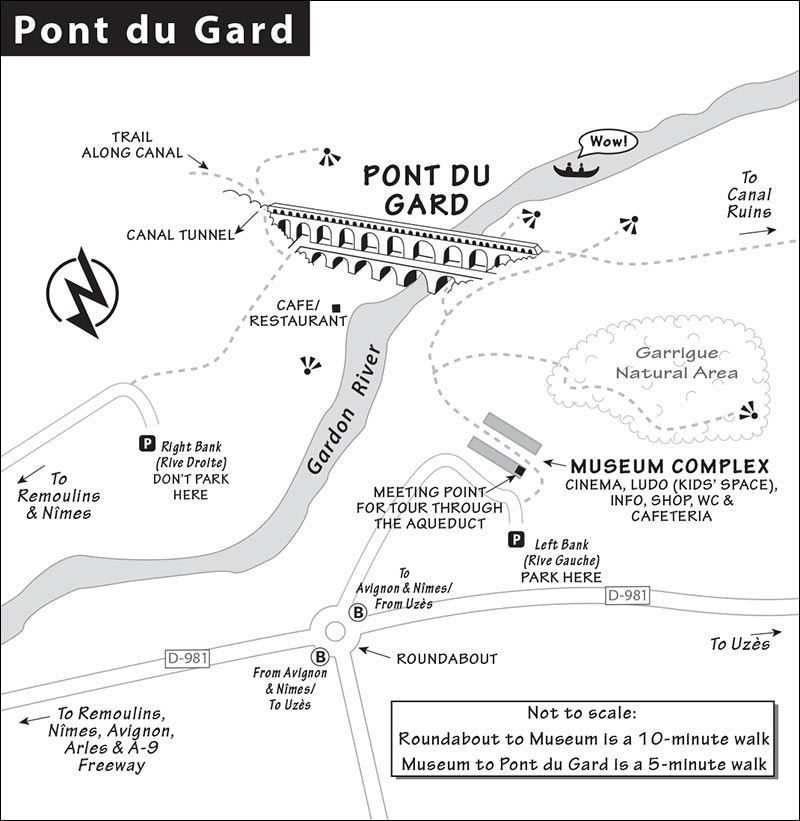
Cost: €6.50, free for those under 18, includes access to the aqueduct, museum, film, and outdoor garrigue nature area; add €15 (€6 for those under 18) for tour that includes walking through the top channel of the aqueduct (see below).
Hours: The Pont du Gard site is open daily 8:00-24:00. The museum is open Tue-Sun 9:00-18:30, Mon from 12:00, July-Aug until 19:30, shorter hours off-season. Check the website for specifics.
Information: +33 4 66 37 50 99, www.pontdugard.fr.
Pont du Gard After Hours: From mid-June to mid-Sept, a sound-and-light show is projected on the monument at or after 22:30. The parking lot is staffed and guarded until 24:00. Seeing Pont du Gard in the evening is dramatic. The light show is projected from the north, so those in the picnic area and at the right bank restaurant enjoy a good view.
Walking Tour of the Pont Du Gard: A one-hour tour of the sight costs €15 and includes going through a small section of the 4-foot-wide, 6-foot-high, 900-foot-long water channel at the very top of the aqueduct, where you’ll walk the route of the water high above the river below. Guides range in quality and lead groups of up to 30 people (English tours available, reserve online well ahead).
Eating: There’s a convenient cafeteria on the left bank with inexpensive salads and sandwiches. The right bank has a shop with salads and sandwiches and a full restaurant where you can eat under the shade of leafy trees with a view of the aqueduct.
Canoe Rental: Floating under Pont du Gard by canoe or kayak is an unforgettable experience. Collias Canoes will pick you up at Pont du Gard (or elsewhere, if prearranged) and shuttle you to the town of Collias. You’ll float down the river to the nearby town of Remoulins, where they’ll pick you up and take you back to Pont du Gard (€25, €13 for kids under 12, figure 2 hours—though you can take as long as you like, reserve the day before in July-Aug, +33 4 66 22 87 20, www.canoe-collias.com).
Plan Ahead for Swimming and Hiking: Pont du Gard is perhaps best enjoyed on your back and in the water—bring along a swimsuit and flip-flops for the rocks. (Local guides warn that the bridge can create whirlpools and be dangerous to swim under.) The best Pont du Gard viewpoints are up steep hills with uneven footing—bring good shoes, too.
SIGHTS AT PONT DU GARD
▲Museum
In this state-of-the-art museum (well presented in English), you’ll enter to the sound of water and understand the critical role fresh water played in the Roman “art of living.” You’ll see copies of lead pipes, faucets, and siphons; walk through a mock rock quarry; and learn how they moved those huge rocks into place and how those massive arches were made. A wooden model shows how Roman engineers determined the proper slope. While actual artifacts from the aqueduct are few, the exhibit shows the immensity of the undertaking as well as the payoff. Imagine the jubilation when this extravagant supply of water finally tumbled into Nîmes. A relaxing highlight is the scenic video of a helicopter ride along the entire 30-mile course of the aqueduct, from its start at Uzès all the way to the Castellum in Nîmes.
▲▲▲Viewing the Aqueduct
A broad walkway from the museum complex leads in 10 minutes to the aqueduct. Until a few years ago, this was an actual road—adjacent to the aqueduct—that had spanned the river since 1743. Before crossing the bridge, walk to a terrific riverside viewpoint by continuing under the aqueduct on a stony path, then find two staircases about 50 yards apart with big steps leading down to an unobstructed view of the world’s second-highest standing Roman structure. (Rome’s Colosseum is only 6 feet taller.)
This was the biggest bridge in the whole 30-mile-long aqueduct. The arches are twice the width of standard aqueducts, and the center arch is the largest the Romans ever built (though it’s hard to tell the difference from other arches). That arch is 80 feet across (the width of the river). The bridge is about 160 feet high and was originally about 1,200 feet long.
Though the distance from the source (in Uzès, on the museum side of the site) to Nîmes was only 12 miles as the eagle flew, engineers chose the most economical route, winding and zigzagging 30 miles. The water made the trip in 24 hours with a drop of only 40 feet. Ninety percent of the aqueduct is on or under the ground, but a few river canyons like this required bridges. A stone lid hides a four-foot-wide, six-foot-tall chamber lined with waterproof mortar that carried the stream for more than 400 years. For 150 years, this system provided Nîmes with good drinking water. Expert as the Romans were, they miscalculated the backup caused by a downstream corner, and had to add the thin extra layer you can see just under the lid to make the channel deeper.
The stones that jut out—giving the aqueduct a rough, unfinished appearance—supported the original scaffolding. The protuberances were left, rather than cut off, in anticipation of future repair needs. The lips under the arches supported wooden templates that allowed the stones in the round arches to rest on something until the all-important keystone was dropped into place. Each stone weighs from two to six tons. The structure stands with no mortar (except at the very top, where the water flowed)—taking full advantage of the innovative Roman arch, made strong by gravity.
Cross to the right bank for a closer look and the best views. Walk under the aqueduct and, with the river to your right, follow a wide path for great angles on the river and aqueduct. Walk back under the aqueduct and find steps leading up a short, steep trail (marked View Point/Belvédère). Follow the short-but-rugged trail with the river to your right to several superb lookouts above the aqueduct.
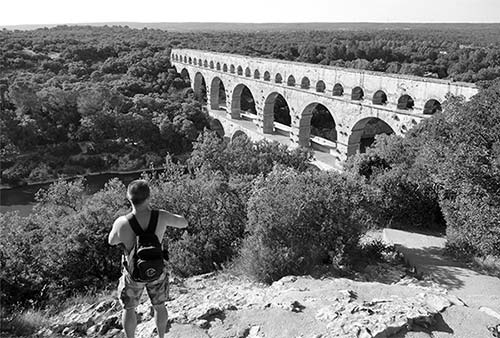
Back on the museum side, steps lead up to the top of the left bank side of the aqueduct, where tours enter the water channel. From here you can follow the canal path along a trail (marked with red-and-white horizontal lines) to find small bits of the Roman canal (spur trails off this path lead to more panoramic views). Hikers can continue along the path, following the red-and-white markings that lead through a forest, after which you’ll come across more remains of the canal (much of which are covered by vegetation). There’s not much left to see because of medieval cannibalization—frugal builders couldn’t resist the precut stones as they constructed area churches. The path continues for about 15 miles, but there’s little reason to go farther.
Les Baux
Tucked between Arles and Avignon, the hilltop town of Les Baux and its medieval citadel crown the rugged Alpilles (ahl-pee) mountains. Here, you can feel the struggles of a strong community that lived a rough-and-tumble life—thankful more for their top-notch fortifications than for their dramatic views. It’s mobbed with tourists most of the day, but Les Baux rewards those who arrive by 9:00 or after 17:30. (Although the hilltop citadel’s entry closes at the end of the day, once you’re inside, you’re welcome to live out your medieval fantasies all night long, even with a picnic.) Sunsets are dramatic, the castle is brilliantly illuminated after dark, and nights in Les Baux are ghost-town peaceful. Expect lots of uphill walking, high steps, and very uneven footing (good shoes help).
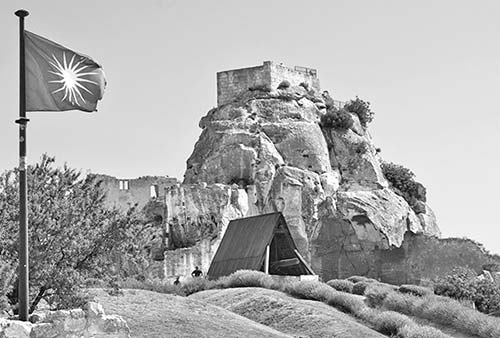
GETTING THERE
By Car: Les Baux is a 20-minute drive from Arles (40 minutes from Avignon). From Arles, follow signs for Avignon, then Les Baux. From Avignon, follow signs to Arles, then St-Remy-de-Provence, then Les Baux. Drivers can combine Les Baux with St-Rémy (20 minutes away).
On arrival in Les Baux, drivers pay to park near the village or several blocks below. Parking is squirreled along roads as you approach and over the hill on the backside when coming from Arles. Most spaces require a decent hike uphill to reach the village (€6 for two hours, €0.50/hour after that, meters take coins and credit cards).
By Bus: From Arles, Zou bus #707 runs to Les Baux July-Aug only (about 6/day, 35 minutes, none off-season; via Abbey of Montmajour, Fontvieille, and Le Paradou; destination: St-Rémy; timetables at https://zou.maregionsud.fr or www.rome2rio.com). Confirm bus schedules at the TI.
From Avignon, ride Zou bus #707 to Les Baux (about 6/day, 1 hour).
By Taxi: Figure €45 for a taxi one-way to Les Baux from Arles, €75 from Avignon, and €25 from St-Rémy (+33 6 13 07 55 00, www.taxibaux.com).
By Minivan Tour: The best option for many is a minivan tour, which can be both efficient and economical (easiest from Avignon; see here).
Orientation to Les Baux
Les Baux is actually two visits in one: castle ruins perched on an almost lunar landscape and a medieval town below. Savor the castle, then tour—or blitz—the lower town’s polished-stone gauntlet of boutiques. While the town, which lives entirely off tourism, is packed with shops, cafés, and tourist knickknacks, the castle above stays manageable as crowds are dispersed over a big area. The town’s main drag leads directly to the castle—just keep going uphill (a 10-minute walk).
Tourist Information: The TI is immediately on the left as you enter the village (daily 9:00-18:00, shorter hours and closed Sun in off-season). The big map outside can help you get oriented. When the TI is open, staff can call a cab for you.
Sights in and near Les Baux
▲▲▲Castle Ruins (Chateau des Baux)
The sun-bleached ruins of the stone fortress of Les Baux are carved into, out of, and on top of a rock 650 feet above the valley floor. Many of the ancient walls of this striking castle still stand as a testament to the proud past of this once-feisty village.
Cost: €8, €18 Pass Baux-de-Provence combo-ticket with Carrières de Lumières, entry fees include excellent audioguide. You may be charged €2 extra on some summer days if there are special activities (see “Entertainment,” next).
Hours: Daily 9:00-19:00, Oct and March until 18:00, Nov-Feb 10:00-17:00, www.chateau-baux-provence.com. If you’re inside the castle when the entry closes, you can stay as long as you like.
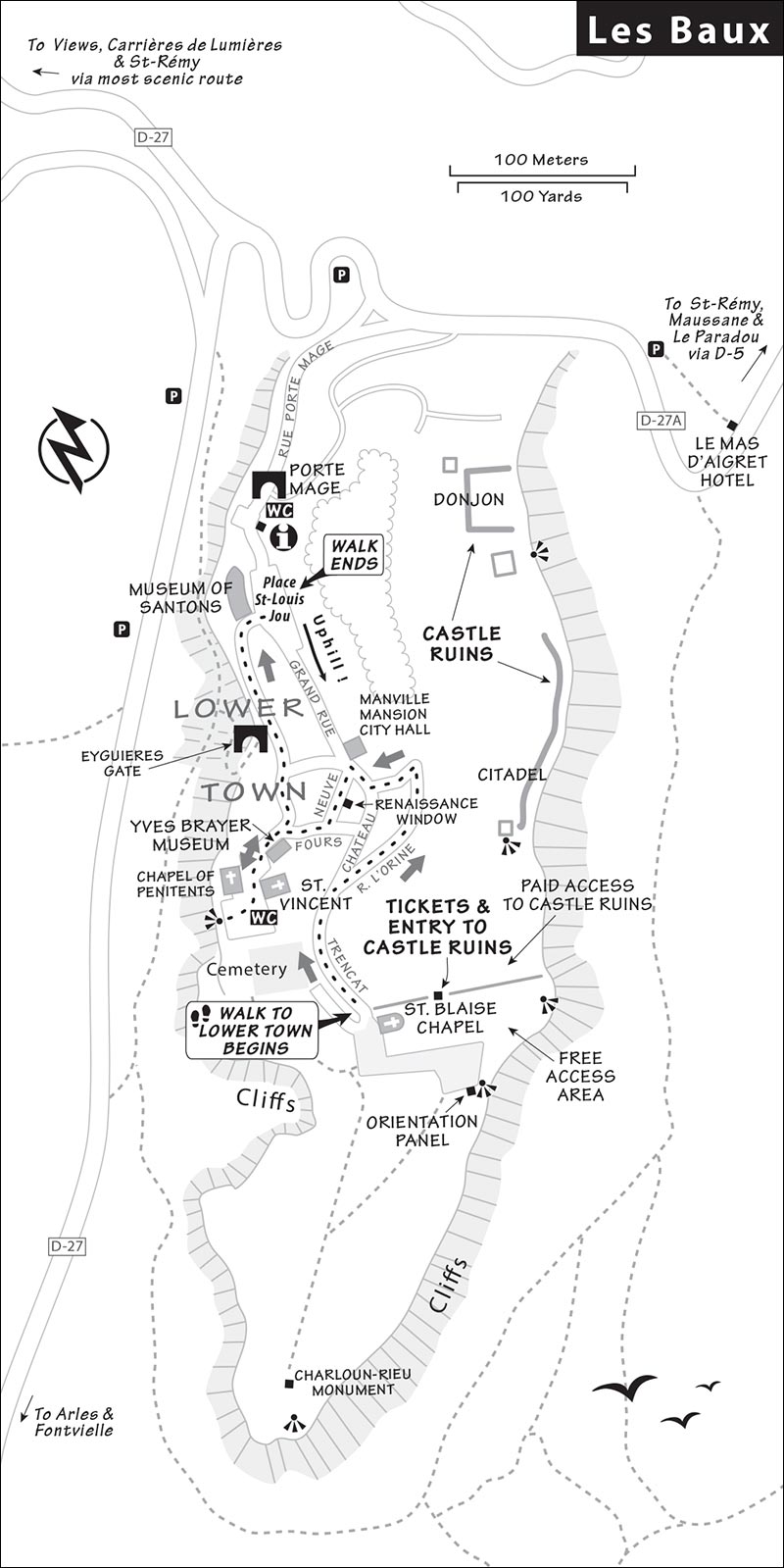
Entertainment: In summer and on holiday weekends, the castle may offer medieval pageantry, tournaments, demonstrations of catapults and crossbows, and jousting matches. Pick up a schedule as you enter (or check online).
Picnicking: While no food or drink is sold inside the castle grounds, you’re welcome to bring your own and use one of several picnic tables (the best view table is at the edge near the siege weaponry). Sunset dinner picnics are memorable.
Background: Imagine the importance of this citadel in the Middle Ages, when the Lords of Baux were notorious warriors who could trace their lineage back to one of the “three kings” of Christmas-carol fame, Balthazar. In the 11th century, Les Baux was a powerhouse in southern France, controlling about 80 towns. The Lords of Baux fought the counts of Barcelona for control of Provence...and eventually lost. But while in power, these guys were mean. One ruler enjoyed forcing unransomed prisoners to jump off his castle walls.
In 1426, Les Baux was incorporated into Provence and France. Not accustomed to playing second fiddle, Les Baux struggled with the French king, who responded by destroying the fortress in 1483. Later, Les Baux regained some importance and emerged as a center of Protestantism. Arguing with Rome was a high-stakes game in the 17th century, and Les Baux’s association with the Huguenots brought destruction again in 1632 when Cardinal Richelieu (under King Louis XIII) demolished the castle. Louis rubbed salt in the wound by billing Les Baux’s residents for his demolition expenses. The once-powerful town of 4,000 was forever crushed.
Visiting the Castle: Before buying your ticket, get your bearings using the panel on the far side of the rocky plateau. This would be one dilly of a place to lay siege to, and wait—are those other castles in the distance growing out of the rocks?
Buy your ticket and pick up your included audioguide (or download the app on your phone). As you wander, key in the number for any of the 20 narrated stops that interest you.
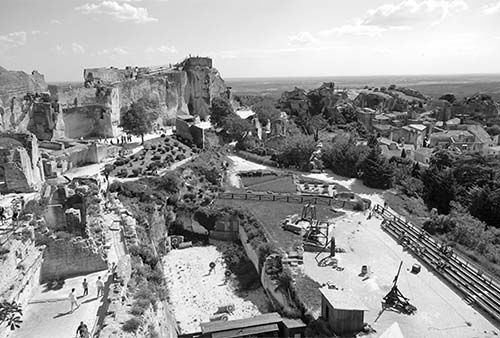
The sight is well presented (but made for twisting an ankle or slipping on the smooth rock—watch your steps). As you walk on the windblown spur (baux in French), you’ll pass kid-thrilling medieval siege weaponry (go ahead, try the battering ram). Good displays in English and posted images in key locations help reconstruct the place. Imagine 4,000 people living up here. Notice the water-catchment system (channels cut into stone walkways that caught rainwater and drained it into cisterns—necessary during a siege) and find the reservoir cut into the rock below the castle’s highest point. Look for the small chapel and find post holes throughout the stone walls that reveal where beams once supported floors.
For the most sensational views, climb big steps to the blustery top of the citadel—hold tight if the mistral wind is blowing.
▲Lower Town Walk
After your castle visit, you can shop and eat your way back through the lower town (trace the route on the “Les Baux” map). Along the way, you’ll pass the 15th-century Manville Mansion City Hall (art exhibits), a 1571 Renaissance window frame (probably from a place of Huguenot worship), the enjoyable Yves Brayer Museum (local 20th-century artist), the 12th-century Romanesque St. Vincent Church, the Chapel of Penitents (elaborate Nativity mural), and the free and fun Museum of Santons (popular folk figurines).
NEAR LES BAUX
▲▲Carrières de Lumières (Quarries of Light)
A 15-minute walk from Les Baux, this colossal quarry-cave with immense vertical walls offers a mesmerizing multimedia experience. Enter a darkened world filled with floor-to-ceiling images and booming music. Wander through a complex of cathedral-like aisles, transepts, and choirs (no seating provided) as you experience the spectacle. There’s no storyline to follow, but information panels by the café give some background.
The sight may be closed during your visit—check online. Also check current listings on the website to be sure to get the show you want; some cater more to kids than to adults. Shows last about 40 minutes each and run continuously. If you’d like an intermission, you can exit the “show” into a part of the quarry that opens to the sky and take a break at the café before reentering. Dress warmly, as the cave is cool.
Cost and Hours: €14.50, €18 Pass Baux-de-Provence combo-ticket with the castle, reservations recommended for non-passholders in high season; daily 9:30-19:30, Nov-March 10:00-18:00, last entry one hour before closing; +33 4 90 54 47 37, www.carrieres-lumieres.com.
Sleeping and Eating in Les Baux
Sleeping: If you want to beat the crowds by arriving early or lingering later, consider $$ Le Mas d’Aigret,*** a 10-minute walk east of Les Baux on the road to St-Rémy (D-27). From this comfy refuge, you can gaze up at the castle walls rising beyond the heated swimming pool or enjoy great views from the groomed terraces or your private deck. The rooms are tastefully appointed—10 have decks or terraces; meals on the terrace with views to Les Baux are memorable (convenient half-pension dinner and breakfast option, air-con, pétanque courts, +33 4 90 54 20 00, www.masdaigret.com, contact@masdaigret.com).
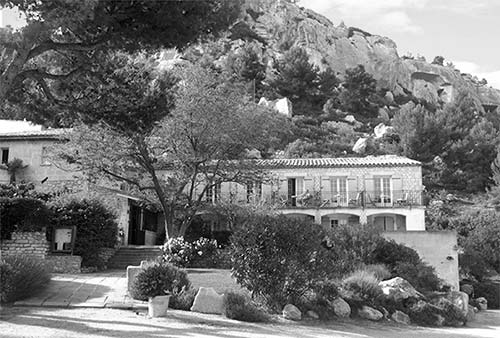
Eating: There are a few worthwhile places in the untouristed village of Maussane, a few scenic minutes’ drive south of Les Baux (and 15 minutes from Arles). Place de la Fontaine, the town’s central square, makes a good stop for café fare. $ Pizza Brun has tasty wood-fired pizza to take out or enjoy at the fun seating indoors and out (closed Mon, 1 Rue Edouard Foscalina; with your back to Place de la Fontaine, walk to the right for about 10 minutes and look for colored tables in an alleyway; +33 4 90 54 40 73).
St-Rémy-de-Provence
Sophisticated and sassy, St-Rémy (sahn ray-mee) gave birth to Nostradamus and cared for a distraught artist. Today, this well-heeled and handsome town caters to shoppers, café lingerers, and Van Gogh fans. A few minutes from the town center, you can visit the once-thriving Roman city called Glanum and the psychiatric ward where Vincent van Gogh was sent after lopping off his earlobe. Best of all is the chance to elbow your way through St-Rémy’s raucous Wednesday morning market. A ring road hems in a fun-filled pedestrian-friendly center that’s fully loaded with fine foods, beauticians, art galleries, and the latest Provençal fashions.
GETTING THERE
By Car: From Les Baux, St-Rémy is a beautiful 20-minute drive over the hills and through the woods. Roads D-5 and D-27 each provide scenic routes between these towns, making a loop drive between them worthwhile (the most scenic approach is on D-27).
Parking in St-Rémy is tricky; you can try to land a spot along the ring road, but it’s easiest at the metered lot by the TI. Or park for free but less centrally by the cemetery (see the “St-Rémy Area” map).
By Bus: From Arles take bus #704 (3-5/day Mon-Sat, none on Sun, 45 minutes) or bus #707 (6/day, daily July-Aug only, none during other months, 50 minutes). It’s 30 minutes from Avignon on bus #707 (hourly Mon-Fri, 6/day Sat-Sun). If arriving in St-Rémy by bus, get off on the ring road at the République stop. The TI is a few blocks away (take a left off the bus, then turn right on Avenue Pasteur).
By Taxi: From Les Baux, allow €25 one-way; from Arles figure €80, and from Avignon, count on €60 (+33 6 14 81 34 85 or +33 6 25 17 00 73).
Orientation to St-Rémy-de-Provence
Tourist Information: The TI is two blocks toward Les Baux from the ring road (Mon-Sat 9:00-12:00 & 14:00-18:30, Sun 10:00-12:30, closed for lunch and on Sun in off-season, +33 4 90 92 05 22, www.alpillesenprovence.com). Pick up bus schedules, hiking trail maps, and a town map that includes Van Gogh’s favorite painting locations with easels showing copies of the paintings he produced (the Starry Night panel is just outside the TI).
Helpful Hints: St-Rémy’s Wednesday market swallows Place de République with clothing, fabric, and bric-a-brac, and spreads along the town’s traffic-free lanes selling anything Provençal. You’ll find produce on picturesque Place Pelisser (by City Hall). Arrive by 9:00 to snag a decent parking spot. The market wraps up by about 12:30.
Rent all types of bikes (including e-bikes) at Sun-e-Bike (2 Rue Camille Pelletan, +33 4 32 62 08 39, www.sun-e-bike.com, stremy@sun-e-bike.com).
Sights in St-Rémy-de-Provence
St-Rémy’s key sights—the ruins at Glanum and the hospital where Vincent van Gogh was treated—are an unappealing 20-minute walk south of the TI. If driving, park for free at the St. Paul Monastery and walk a few minutes to Glanum from there (or pay to park at Glanum; leave nothing of value in your car). Nearby paths lead to concrete easels with copies of Van Gogh paintings.
▲St. Paul Monastery and Hospital (Le Monastère St. Paul de Mausole)
The still-functioning psychiatric hospital (Clinique St. Paul) that treated Vincent van Gogh from 1889 to 1890 is a popular pilgrimage for Van Gogh fans. Here you’ll enter Vincent’s temporarily peaceful world: a small chapel, intimate cloisters, a re-creation of his room, and a small lavender field with several large displays featuring copies of his paintings. Plans are afoot to expand the sight with more displays designed to re-create Van Gogh’s experience here.
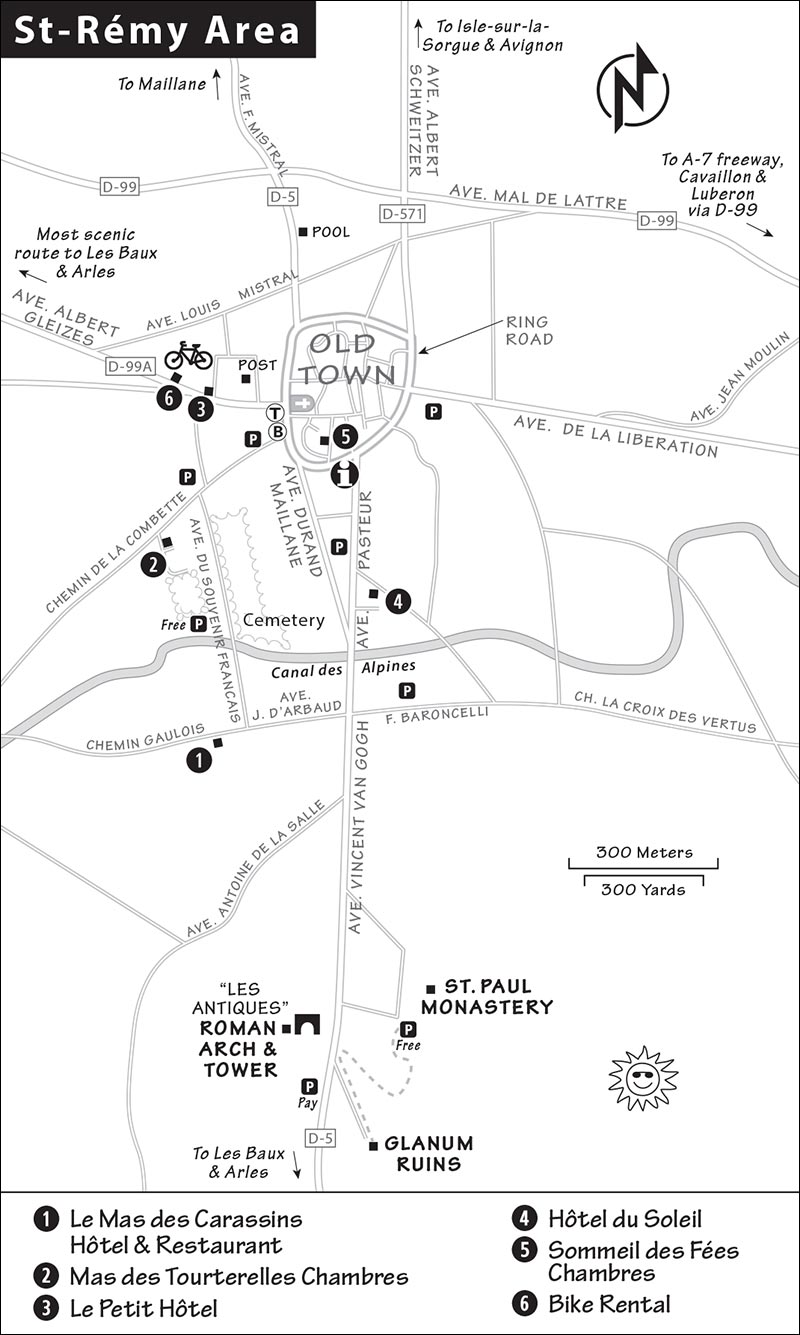
Cost and Hours: €7; daily 9:30-19:00, Oct-March 10:15-12:00 & 13:00-17:15, closed Jan; +33 4 90 92 77 00, www.saintpauldemausole.fr.
Visiting the Hospital: Inside, read the thoughtful and thorough English explanations about Van Gogh’s tortured life. Amazingly, in his 53 weeks here, Van Gogh completed 143 paintings and more than 100 drawings. His room shows how bare-bones accommodations were here; the adjacent room with two baths was designed to calm patients, with ice-cold baths and a cover that locked them in.
In and around the complex, you’ll see copies of his works—some positioned right where he painted them. Several are located through the gift shop in a lavender garden. Stand among flame-like cypress trees, gazing over the Alpilles mountains, and realize you’re in the midst of some of Van Gogh’s most famous works.
You’ll also find memories here of another troubled artist, Camille Claudel (1864-1943), whose parents had her committed to a nearby mental ward after her anguished affair with sculptor Auguste Rodin. You’ll see a re-creation of the clinic’s kitchen just before entering the area holding Van Gogh’s room.
▲Glanum Ruins
These crumbling stones are the foundations of a Roman market town located at the crossroads of two ancient trade routes between Italy and Spain. While the ruins are, well...ruined, their setting at the base of the rocky Alpilles is splendid. It’s also unshaded and can be very hot (making it easier to enjoy early or late).
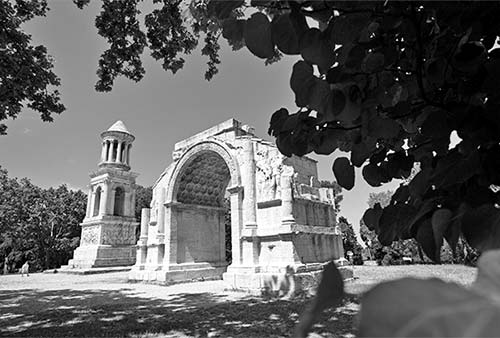
A stubby Roman arch and tall tower stand across the road from the site as proud reminders of the town’s glory days. These lonely monuments marked the entry to Glanum 2,000 years ago. The plump triumphal arch was designed to impress visitors with scenes of Rome’s power. The adjacent three-level tower was built as a mausoleum by one of Glanum’s most distinguished families.
Cost and Hours: €8; €3 audioguide, daily 9:30-18:00, Oct-March Tue-Sun 10:00-17:00, closed Mon; parking-€3/day, +33 4 90 92 23 79.
Visiting the Ruins: Start at the helpful little museum at the entrance, with good English explanations of key buildings and the excavation process, as well as a model of Glanum in its prime. The English flier and information panels scattered about the site provide context to the ruins you’ll see, though the audioguide is essential to get a real sense of this place. Serious students of ancient Rome will want to spring for the well-done Glanum book sold at the counter.
The Roman site was founded in 27 BC and occupied for about 30 years. About 2,500 people lived in Glanum at its zenith (the Roman city was about seven times bigger than the ruins you see today). And though this was an important town, with grand villas, temples, a basilica, a forum, a wooden dam, and aqueducts, it was not important enough to justify an arena or a theater (such as those in Arles, Nîmes, and Orange). Stroll up Glanum’s main street and see remains of a market hall, a forum, thermal baths, reservoirs, and more. The view from the belvedere easily justifies the uphill effort. These ruins highlight the range and prosperity of the Roman Empire.
Sleeping in St-Rémy-de-Provence
Unless otherwise noted, the following hotels have easy parking and air-conditioning; none have elevators as most have just two floors.
$$$ Le Mas des Carassins,*** a 15-minute walk from the center, is well run by Michel and Pierre. Luxury is affordable here, with two generously sized pools, ample outdoor lounging spaces, big gardens, and everything just so. The 22 rooms are split between the more traditional main building (which I prefer) and the newer annex, which comes with larger rooms and more modern decor (good breakfast, table tennis, great dinner option—see next page, 1 Chemin Gaulois, +33 4 90 92 15 48, www.masdescarassins.com, info@masdescarassins.com).
$$ Mas des Tourterelles Chambres, a characteristic and large Provençal home, is a 10-minute walk from the town center. While the garden could use a little TLC, it’s a fine getaway with six spotless and bright rooms and three apartments. There’s also a pool and small garden with outdoor picnic facilities, including a fridge (2-night minimum in high season, air-con in top-floor rooms—others don’t need it, 21 Chemin de la Combette, +33 9 54 64 83 30, www.masdestourterelles.com, contact@masdestourterelles.com). Turn right at the top of Place de la République onto Chemin de la Combette; after 400 yards look for the brown sign down a lane on the left (just after the second speed bump).
$$ Le Petit Hôtel is an intimate and homey little place with charming staff, a swimming pool, and nine comfortable rooms painted in warm colors with traditional-meets-artsy decor (18 Avenue Fauconnet, +33 4 90 95 09 25, www.lepetithotel.fr, reservations@lepetithotel.fr).
$$ Hôtel du Soleil,** a 10-minute walk from St-Rémy’s center, is a sharp hotel with fresh white stone and beige decor throughout. Its spotless rooms cluster around a courtyard/parking area and pool (five rooms have small terraces, a block above the TI at 35 Avenue Pasteur, +33 4 90 92 00 63, www.hotelsoleil.com, hotelsoleil@orange.fr).
$ Sommeil des Fées Chambres rents five simple, clean, and comfortable rooms in the center of St-Rémy. They also run a good restaurant, La Cuisine des Anges, described later (4 Rue du 8 Mai 1945, +33 4 90 92 17 66 or +33 6 82 31 33 53, www.angesetfees-stremy.com).
Eating in St-Rémy-de-Provence
$$$ Le Mas des Carassins offers a four- or five-course food experience worth booking ahead. One menu is prepared each night and served in a country-classy setting inside or out. Service is friendly, kids are welcome, and the cuisine is utterly delicious. Review their website to see what’s cooking before booking a table (see hotel listing earlier).
$$ Bar-Tabac des Alpilles is a great choice for lunch or dinner thanks to a fun-loving staff, hands-on owner Patrick, good ambience inside and out, and delicious food. It’s popular with locals, and serves the best leg of lamb I’ve tasted. The menu offers just enough choice, including good salads and several choices of plats. Dinner has two seatings, at about 19:15 and 21:00; it’s best to book at least a day ahead for dinner (daily except closed Tue for dinner, 21 Boulevard Victor Hugo, +33 4 90 92 02 17).
$ Crêperie Lou Planet, on lovely Place Favier, is welcoming, cheap, and peaceful, with outdoor seating in summer, tasty crêpes, nice salads, and inexpensive, good house wine (daily April-Sept, behind Hôtel de Ville, next to Musée des Alpilles).
$ La Maison Mistral, also known as Bistrot les Pieds dans l’Eau, sits between the TI and ring road with loads of good outdoor-only seating. Expect big, delicious shareable plates at good prices (daily, 22 Boulevard Victor Hugo, +33 4 90 90 74 49).
$$ La Cuisine des Anges is a relaxed place serving homemade dishes with a Mediterranean accent in a charming courtyard or simple dining room (closed Sun-Mon, 4 Rue du 8 Mai 1945, +33 4 90 92 17 66).
$$ Café de la Place, on Place de la République behind the parking lot, is a hit with St-Rémy’s young people (as well as aging travel writers). Come for a coffee, a drink, or a good meal of classic café fare (big terrasse, open daily, +33 4 90 92 02 13).
$ La Terrasse is a cheery spot, popular with locals, that’s all about tasty wood-fired pizza (closed Mon-Tue, 11 Rue de la Commune, +33 4 90 90 26 49).
$$$ L’Aile ou la Cuisse is St-Rémy’s vintage bistro, with a snazzy interior and a tradition of serving fine cuisine (closed Mon-Tue, 5 Rue de la Commune, +33 4 32 62 00 25).
Orange
Orange (oh-rahnzh) is notable for its grand Roman arch and exceptional Roman Theater. Called “Arausio” in Roman times, Orange was a thriving city in those days—strategically situated on the Via Agrippa, connecting the important Roman cities of Lyon and Arles. It was founded as a comfortable place for Roman army officers to enjoy their retirement. Did the emperor want thousands of well-trained, relatively young guys hanging around Rome? I don’t think so. What to do? “How about a nice place in the south of France...?”
Today’s Orange is a busy, workaday city with a gritty charm that reminds me of Arles. Leafy café-lined squares, a handful of traffic-free streets, a fine Hôtel de Ville (City Hall), and that theater all give the town some serious street appeal. For some, Orange works well as a base, with its quick access to the Côtes du Rhône wine villages by car (slower but OK by bus) and quick rail access to Avignon (which even drivers should consider).
Orientation to Orange
TOURIST INFORMATION
The TI is located next to the fountain and parking area at 5 Cours Aristide Briand (Mon-Sat 9:00-12:30 & 14:00-18:00; no lunch break and also open Sun morning July-Aug; shorter hours and closed Sun in off-season; +33 4 90 34 70 88, www.orange-tourisme.fr).
Market Day: Thursday is market day, and it’s a big deal here, with all the town’s streets and squares crammed with produce and local goods for sale until 12:30. I like this market because it focuses on locals’ needs and not touristy kitsch.
ARRIVAL IN ORANGE
By Train: Orange’s train station is a level 15-minute walk from the Roman Theater (or under €10 by taxi, +33 6 66 71 58 02). The recommended Logis Hôtel de Provence will store your bags (€5, across from the station). To walk into town, head straight out of the station (down Avenue Frédéric Mistral), merge left onto Orange’s main shopping street (Rue de la République), then turn left on Rue Caristie; you’ll run into the Roman Theater’s massive stage wall.
By Bus: All buses stop at Cours Pourtoules (at the Théâtre parking lot), two blocks from the Roman Theater; the bus to Vaison-la-Romaine also stops on Avenue Frédéric Mistral, a few blocks from the train station toward the center.
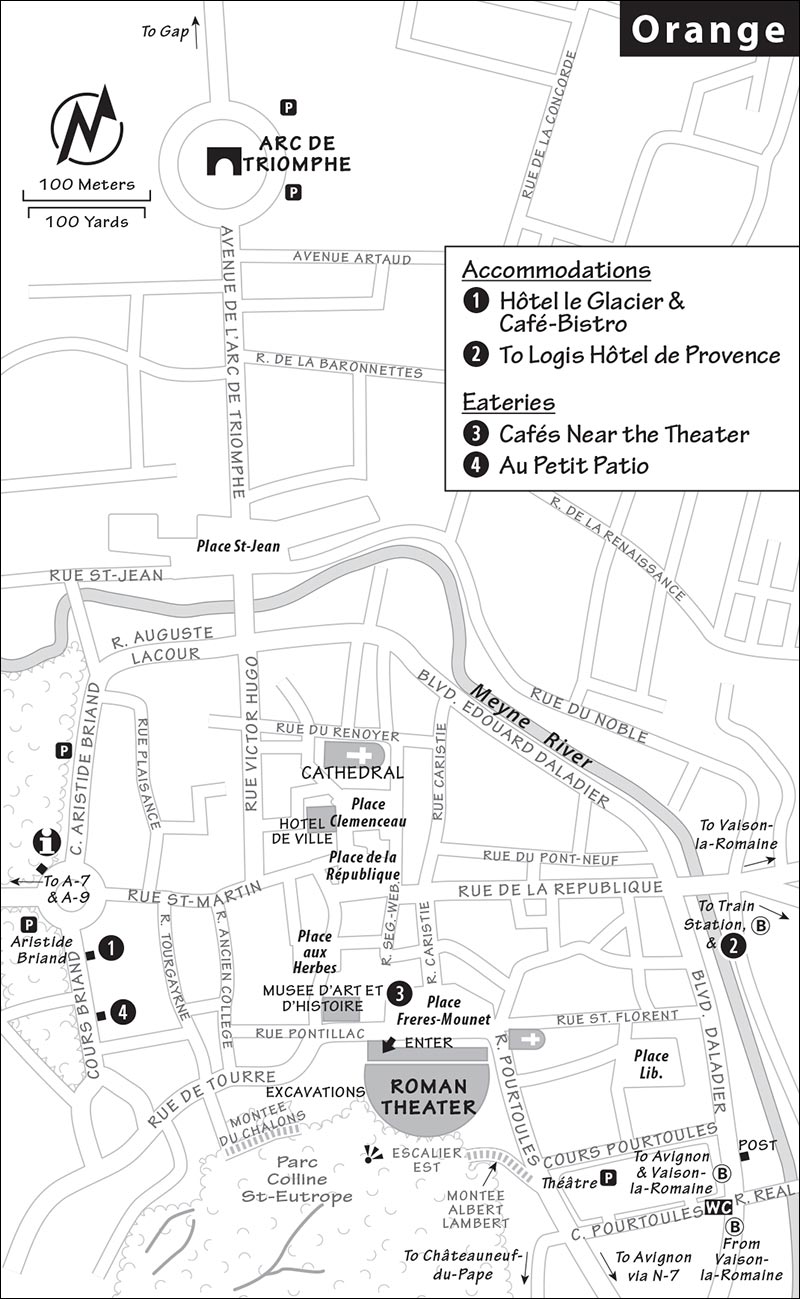
By Car: Follow Centre-Ville signs, then Office du Tourisme or Théâtre Antique signs; park as close to the Roman Theater’s huge wall as you can. If coming from the autoroute take sortie 21, then park near the TI on Cours Aristide Briand. If coming from Avignon on D-907, park where you see Parking Théâtre signs. If arriving on a Thursday morning—market day—expect lots of traffic and scarce parking. Your best bet is to park along the road leading to the train station or near the Roman arch (both a 15-minute walk to the center). Parking by the Roman arch is free; all parking in Orange’s center is metered (leave nothing visible in parked cars).
Sights in Orange
▲▲▲Roman Theater (Théâtre Antique)
Orange’s ancient theater is the best preserved in existence and the only such theater in Europe with its (awesome) acoustic wall still standing. Built in the first century AD, the huge theater celebrated the glory of the empire and cemented Rome’s presence in Provence. Strolling along the outside of its massive wall is an impressive experience today—imagine how it must have intimidated visitors 2,000 years ago.
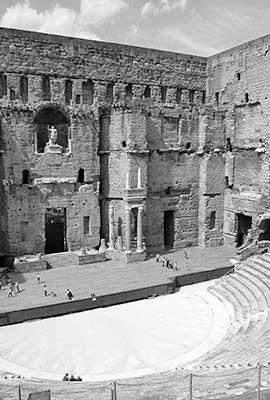
Cost and Hours: €11.50, drops to €9.50 30 minutes before closing, includes good audioguide (not available within 30 minutes of closing) and entry to the small museum across the street; daily 9:00-18:00, June-Aug until 19:00, shorter hours Oct-March, closing times can change for evening performances or rehearsals; +33 4 90 51 17 60, www.theatre-antique.com.
Cheap Trick: Vagabonds wanting a partial but free view of the theater (or others wanting a bird’s-eye view) can find it in the Parc de la Colline St-Eutrope. Walk around to the left of the theater (see the “Orange” map), and find the steps to the right, just after the tabac. Climb the steps, keep left at the first fork, and continue for about 150 yards, then take the steps to the right to the top. From here, follow the Point de Vue sign to the right. Benches and grassy areas make this a good picnic spot (no WCs), and you can scamper about for views of the theater from different angles.
Visiting the Theater: As you enter, to the right you’ll see a huge dig devoted to the Temple to the Cult of the Emperor (English explanations posted), and up the steps, La Grotte d’Auguste restaurant. But we’ll turn left, into the theater.
Climb the steep stairs to appreciate the massive acoustical theater wall, one of the greatest surviving examples of Roman architecture. About two-thirds of the way up, a gallery leads behind the seats and into several rooms with displays about the construction of the theater, the performances that took place here, and the actors who performed (only men were used as actors). Find a seat and imagine how 2,000 years ago, Orange residents enjoyed grand spectacles with high-tech sound and lighting effects—simulated thunder, lightning, rain, and more.
From the center of the acoustic wall, a grandiose Caesar overlooks everything, reminding attendees of who’s in charge. If it seems like you’ve seen this statue before, you probably have. Countless identical sculptures were mass-produced in Rome and shipped throughout the empire to grace buildings like this for propaganda purposes. To save money on shipping and handling, only the heads of these statues were changed with each new ruler. The permanent body wears a breastplate emblazoned with the imperial griffin (body of a lion, head and wings of an eagle) that only the emperor could wear. When a new emperor came to power, new heads were made in Rome and shipped off throughout the empire to replace the pop-off heads on these statues. (Imagine Joe Biden’s head on Donald Trump’s body—on second thought...)
The horn has blown. It’s time to find your seat: row 2, number 30. Sitting down, you’re comforted by the “EQ GIII” carved into the seat (Equitas Gradus #3...three rows for the Equestrian order). You’re not comforted by the hard limestone bench (thinking it’ll probably last 2,000 years). The theater is filled with people. Thankfully, you mix only with your class, the nouveau riche—merchants, tradespeople, and city big shots. The people seated above you are the working class, and way up in the “chicken roost” section are slaves, beggars, and sex workers. Scanning the orchestra section (where the super-rich sit on real chairs), you notice the town dignitaries hosting some visiting VIPs.
OK, time to worship. Around the stage, they’re parading a bust of the emperor from its sacred home in the adjacent temple. Next is the ritual animal sacrifice called la pompa (so fancy, future generations will use that word for anything full of such...pomp). Finally, you settle in for an all-day series of spectacles and dramatic entertainment. All eyes are on the big stage door in the middle—where the Emma Stones and Samuel L. Jacksons of the day will appear. (Lesser actors use the side doors.)
With an audience of 10,000 and no amplification, acoustics were critical. A partial roof made of wood was originally suspended over the stage, somewhat like the glass and iron roof you see today (installed to protect the stage wall). The original was designed not to protect the stage from the weather but to project the voices of the actors into the crowd (see if you can eavesdrop on people by the stage). For further help, actors wore masks with leather caricature mouths that functioned as megaphones. The theater’s side walls originally rose as high as the stage wall and supported a retractable awning (called a velarium) that gave the audience some protection from the sun or rain. (When you leave the theater, look up to the stage wall from the outside and notice the supports for poles that held the velarium in place, like the masts and sails of a ship.)
The Roman Theater was all part of the “give them bread and circuses” approach to winning the support of the masses. Its spectacles grew from 65 days of games per year when the theater was first built (and when Rome was at its height) to about 180 days each year by the time Rome finally fell. Those actors were busy.
Nearby: Pop into the Musée d’Art et d’Histoire across the street (covered by theater ticket, otherwise €6, free audioguide, same hours as theater) to see a few theater details and a rare Roman land register, ordered by Emperor Vespasian in AD 79. Carved on marble, this was an official record of property ownership—each square represented a 120-acre plot of land. The fine mosaics and carvings displayed here humanize what are otherwise stony ancient ruins.
▲Roman “Arc de Triomphe”
This 60-foot-tall arch is in the center of a large traffic circle, a level 15-minute walk north of the theater. Technically the only real Roman arches of triumph are in Rome’s Forum—they were built to commemorate various emperors’ victories. But this arch was the model for those in Rome, preceding the famous arches of Septimius Severus and Constantine. It was erected in about AD 19 to commemorate the Roman general Germanicus and one of the bloodiest battles in the conquest of Gaul. (Around the arch, you’ll find easy free parking and a picnic site.)
Sleeping and Eating in Orange
Sleeping: $ Hôtel le Glacier,*** across from the TI, is run by English-speaking and affable Philippe. It’s a good value, with easy parking, a comfortable lobby with a bar, and well-designed rooms (book direct for a free upgrade when available, elevator, air-con, a few parking spaces, 46 Cours Aristide Briand, +33 4 90 34 02 01, www.le-glacier.com, contact@le-glacier.com). The hotel also has a café-bistro with fair prices and a good selection.
¢ Logis Hôtel de Provence,** across from the train station, is a great value with simple but comfortable rooms, tight bathrooms, a pleasant café and restaurant, and a small pool (60 Avenue Frédéric Mistral, +33 4 90 60 58 63, www.hotelprovence-orange.fr, hoteldeprovence@orange.fr).
Eating: Orange has several inviting squares with ample eating choices in all price ranges. A few cafés/restaurants are across from the theater; this is where I like to eat while gazing at the stage wall. You’ll find more choices by wandering the lanes toward the Hôtel de Ville. For a more refined meal, $$$ Au Petit Patio delivers elegant dining and fine cuisine, which is best enjoyed on its lovely namesake patio (closed Wed-Thu for dinner and all day Sun, 58 Cours Aristide Briand, +33 4 90 29 69 27).
Orange Connections
From Orange by Train to: Avignon (hourly, 20 minutes), Arles (6/day direct, 35-60 minutes, more frequent with transfer in Avignon), Lyon (hourly, 2 hours, some require transfer).
By Bus to: Vaison-la-Romaine (bus #904, 6/day Mon-Sat, 2/day Sun, 1 hour; bus continues to Sablet and Séguret), Avignon (bus #902, hourly Mon- Sat, 3/day Sun, 1 hour). For all bus service, check Rome2rio.com.
Buses to Vaison-la-Romaine and other wine villages depart from near the train station and from Cours Pourtoules (see “Orange” map). Because of occasional route changes, the bus to Vaison-la-Romaine may depart across from the bus shelter (look for blue bus icon or verify with any bus driver at the shelter).
Côtes du Rhône Villages
The sunny Côtes du Rhône wine road—one of France’s most engaging—starts at Avignon’s doorstep and winds north along a mountainous landscape carpeted with vines, studded with warm stone villages, and wrapped in fields of fragrant lavender, all presided over by wind-scarred Mont Ventoux. The wines of the Côtes du Rhône (grown on the côtes, or hillsides, of the Rhône River valley) are easy on the palate and on your budget, as are the area’s good-value restaurants. But this hospitable area offers lots more than wine—its hill-capping villages inspire travel posters, its Roman ruins add historical perspective, and the locals seem as excited about their region as you are.
PLANNING YOUR TIME
If you’re sleeping in this area, Vaison-la-Romaine is a handy home base, with reasonable bus connections to Avignon and Orange, bike rental, and a mini Pompeii in the town center. Follow my driving tour to get off the beaten path and explore some of the region’s most exceptional scenery. Or pedal along peaceful roads to nearby towns. The vineyards’ centerpiece, the Dentelles de Montmirail mountains, are laced with hiking trails.
To explore this area, allow two nights for a decent dabble. Drivers should head for the hills (read this section’s self-guided driving tour before deciding where to stay). If you’re without wheels, Vaison-la-Romaine or (easier) Orange make the only practical home bases (good biking, hiking, and minivan tours are available from Vaison-la-Romaine).
GETTING AROUND THE COTES DU RHONE
By Car: Pick up Michelin maps #332 or #527. Landmarks like the Dentelles de Montmirail mountains and Mont Ventoux help you get your bearings. I’ve described my favorite driving route in this region (“Côtes du Rhône Wine Road Drive”) near the end of this section.
By Bus: From Orange, buses run to Vaison-la-Romaine (and neighboring Séguret) from Avignon and Orange (6/day Mon-Sat, 2/day Sun). It’s much faster to take the train to Orange, then transfer to the bus near the train station to reach these villages. There’s scant service between Orange and several of the wine villages described in this section. All routes provide scenic rides through this area.
By Train: Trains from Avignon (hourly, 20 minutes) will get you as far as Orange (and bus connections).
By Tour: There’s no shortage of people willing to take you for a ride through this marvelous region—so buyer beware. For my recommendations on tours and local guides, see “Tours in Provence” on here.
Vaison-la-Romaine
With quick access to vineyards, villages, and Mont Ventoux, this lively little town of 6,000 makes a good base for exploring the Côtes du Rhône region. You get two villages for the price of one: Vaison-la-Romaine’s “modern” lower city has Roman ruins, a lone pedestrian street, and the lively, café-lined main square—Place Montfort. The car-free medieval hill town looms above, with meandering cobbled lanes, a handful of cafés and art galleries, and a ruined castle.
Orientation to Vaison-la-Romaine
The city is split in two by the Ouvèze River. A Roman-era bridge connects the lower town (Ville-Basse) with the hill-capping medieval upper town (Ville-Haute).
TOURIST INFORMATION
The TI is in the lower city, between the two Roman ruin sites, at Place du Chanoine Sautel (July-Aug daily 9:00-18:45 except closed midday on weekends; Sept-June Mon-Sat 9:30-12:30 & 14:30-17:45, Sun 9:30-12:30—except closed Sun mid-Oct-March; +33 4 90 36 02 11, www.vaison-ventoux-tourisme.com). Say bonjour to the charmante and ever-so-patient staff, ask about festivals and other events, and pick up information on walks and bike rides.
ARRIVAL IN VAISON-LA-ROMAINE
By Bus: For most, taking the train from Avignon to Orange and then the bus to Vaison-la-Romaine is the best way to get here. Bus stops are near the Cave la Romaine winery on the edge of the lower town. Tell the driver you want the stop for the Office de Tourisme. When you get off the bus, walk five minutes down Avenue Général de Gaulle to reach the TI and recommended hotels.
By Car: Avoid Vaison la Romaine Sud signs when arriving from the south. In Vaison, follow signs to Centre-Ville, then Office de Tourisme, and park in or near the big lot across from the TI. Parking is free in Vaison-la-Romaine.
HELPFUL HINTS
Market Day: Sleep in Vaison-la-Romaine on Monday night and you’ll wake to an amazing Tuesday market. If you spend a Monday night, ask your hotelier where you can park—avoid parking at market sites and where signs indicate Stationnement Interdit le Mardi, or you won’t find your car where you left it.
Supermarket: A handy Casino is on Place Montfort in the thick of the cafés (Mon-Sat until 19:00, closed Sun).
Laundry: The friendly owners at Laverie la Lavandière will do your laundry while you sightsee (Cours Taulignan, near Avenue Victor Hugo, Mon-Sat 9:00-12:00 & 15:00-18:00, closed Sun).
Bike Rental: The TI has a list. Sun-e-bike is the most central, with electric and regular bikes (160 Avenue René Cassin, +33 9 54 94 99 14, www.sun-e-bike.com).
Taxi: Call +33 4 90 36 00 04 or +33 4 90 46 89 42.
Car Rental: You can rent cars by the day at the Super U Supermarket, though they must be returned there and supply is limited.
Local Guide: Scottish by birth, attorney by profession, and yoga instructor by passion, Janet Henderson offers enthusiastic and educational walks of Vaison-la-Romaine that bring those Roman ruins and medieval buildings to life (€35/person, minimum 3 people or €120, allow 2.5 hours, +33 6 42 24 65 56, www.provencehistorytours.com, Janet.henderson@orange.fr).
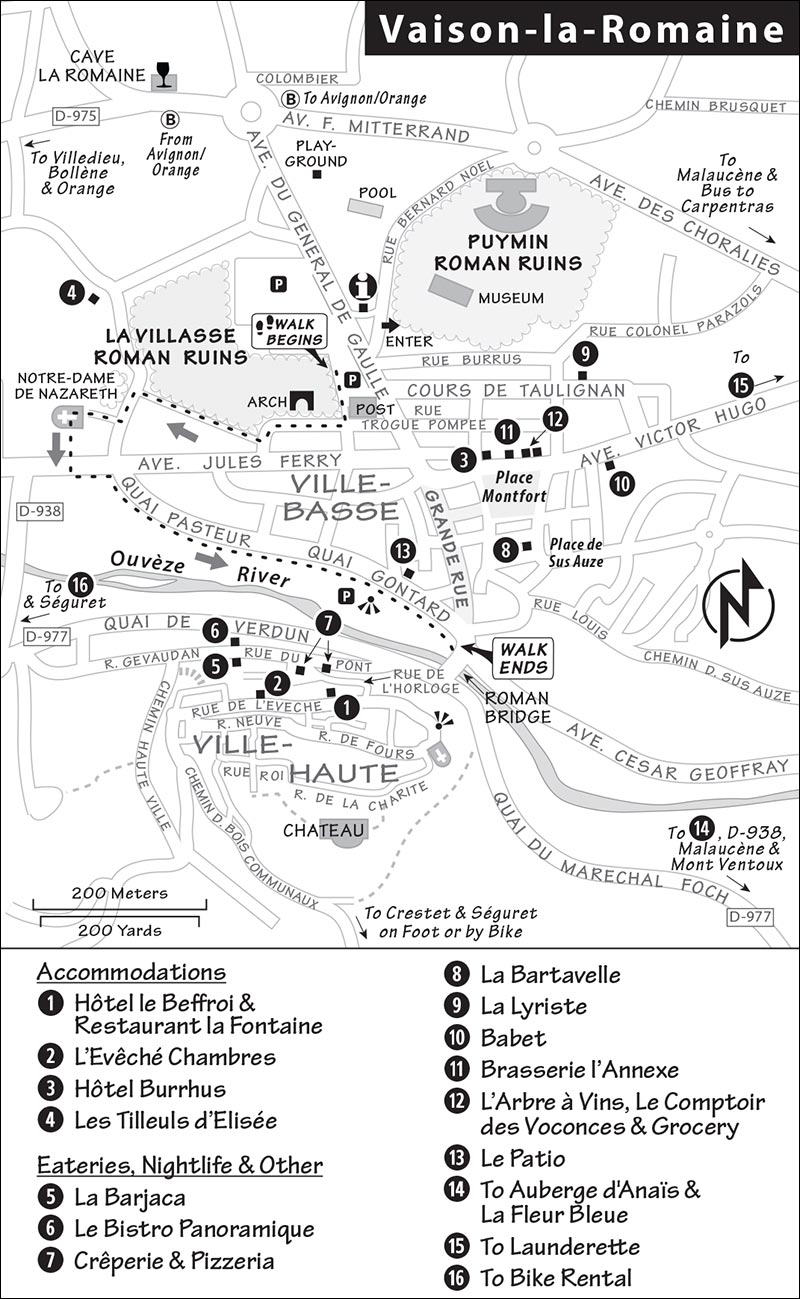
Tourist Train: The Petit Train stops in front of the TI and does a 35-minute loop around the town (€6, free for kids under 12, daily July-Aug 10:00-17:00, Sept-June from 14:00).
After-Dinner Fun: You won’t party late in this quiet town, but there are a few fun places to consider. Place Montfort has most of the action: Brasserie L’Annexe has the warmest interior, Le Comptoir des Voconces is a happening hangout with a pub-like ambience, and L’Arbre à Vins draws wine-sipping types (all described later). Below the Roman bridge, Le Patio has cool wine-bar action at the back of its restaurant (closed Wed-Thu and Sun, 4 Rue de Ventoux).
Sights in Vaison-la-Romaine
Vaison’s top sights are its Gallo-Roman ruins—Puymin and La Villasse. A bonus is the Roman bridge, spanning the Ouvèze River, that connects the lower town with the medieval upper town. Pick up the detailed city map from the tourist office before you begin.
Roman Ruins
A modern road splits the town’s Gallo-Roman ruins into two well-presented sites, Puymin and La Villasse. The Puymin side has more to see and gives a good introduction to these ruins, thanks to its small museum offering insight into life during the Roman Empire.
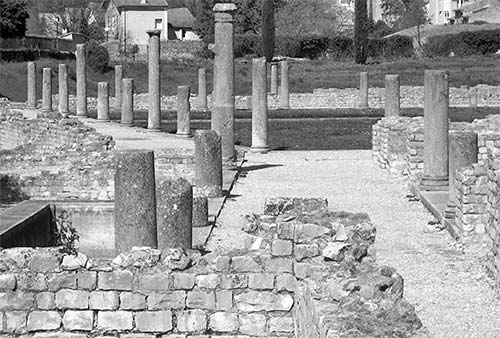
Cost and Hours: €9 ticket admits you to both sites; daily 9:30-18:00, Oct-March 9:30-12:00 & 14:00-17:00, closed Jan; good audioguide-€2, +33 4 90 36 50 48, www.vaison-la-romaine.com.
Puymin Ruins: To best appreciate the ruins, start at the little museum (up the small hill) and pick up the audioguide that covers the worthwhile museum exhibits, the theater, and the ruins below (museum exhibits also well explained in a free English loaner booklet). Museum artifacts include lead water pipes, well-preserved mosaic floors, Roman nails and tools, and a few models of ancient buildings. Don’t miss the 12-minute film (plays in English every other showing) that takes you inside the homes and daily lives of wealthy Vaison residents some 2,000 years ago.
Near the entry, find the faint remains of a colorful frescoed wall and mosaic floors, as well as a few wells, used before Vaison’s two aqueducts were built. A five-minute walk behind the museum leads to a largely rebuilt (but still used) 6,000-seat theater—just enough seats for the whole town, then and now. Back toward the entry are the modest ruins of sprawling mansions, latrines, an oven, and a storage tank for grains.
La Villasse Ruins: When the Romans conquered Provence in the second century BC, the people of Vaison-la-Romaine sided with their vanquishers, earning themselves a preferred “federated” relationship with Rome (rather than being a simple colony). Rome invested heavily in Vaison, and this, along with a healthy farming economy (olives and vineyards) and good weather, made it a most prosperous place...as a close look at these sprawling ruins demonstrates. Emperor Augustus, who ruled the empire at the time, worked to build cities in the image of Rome.
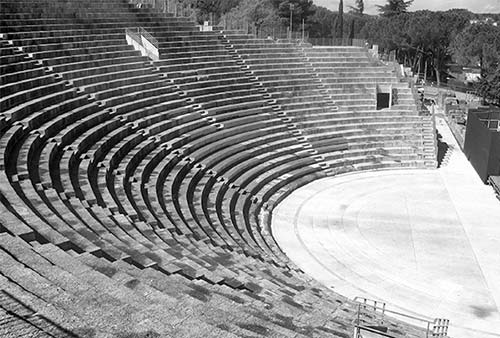
About 6,000 people called Vaison-la-Romaine home 2,000 years ago. The Roman town extended from where you’re standing to the Ouvèze River (to the left, or south). The ruins below you buzzed with shoppers, merchants, slaves, and wealthy homeowners. The ancient forum (not excavated) lies between you and the river. Vaison was a river port, boasting aqueducts, a big theater, baths, a forum, busy shopping streets, and the trophy homes of wealthy businessmen. Trade thrived in Vaison-la-Romaine thanks to an extensive system of roads connecting it to other cities, a stable economy, and a common currency.
When the barbarians arrived in the fifth century AD, the Romans were booted out, and the townspeople fled from their unprotected neighborhoods—which had no defensive walls—into the hills. The town’s population has only recently recovered from those barbaric times, with the number of residents again reaching Roman-era levels.
If you have a ticket, you can walk through the Villasse ruins, though you can see everything from the sidewalks that run along the perimeter—which is our plan. What you can see of both Puymin and Villasse is only about 10 percent of the Roman town’s extent—most is still buried under today’s city.
The nearby bronze “Claude” statue honors Emperor Claudius, who in AD 48 integrated the Gauls into the Roman Empire by declaring them eligible to sit in the Roman Senate. He’s shown on a throne with one hand holding a ball representing the world with an eagle on top, and the other holding a lightning bolt.
Make your way behind the post office down to the corner and turn right at the first street (Rue Trogue Pompée). The ruins stretch behind the stone and green-metal fence that runs the length of this street. Stop in about 30 steps, just before reaching the tall arch, and spot the rusted wire mesh below that covers parts of a Roman sewer that was used until the 1900s. Moving along, that tall arch was the centerpiece of a public Roman bath and fitness center. Notice the public latrines next door. The stone channel in front of the toilets had running water that men used to rinse the public sponge (usually attached to a stick—before the invention of toilet paper).
The stone-paved street running perpendicularly below you was a gallery with two floors of shops offering shelter from the sun. Shoppers bought their goods from clerks at counters lining the gallery. The columns and remnants on the left side are what’s left of two mega-homes. You won’t see the homes of poorer folks, as they were built from cheap materials that didn’t wear well.
Continue straight along the pedestrian walkway that hugs the ruins. Stop in about 20 yards after passing the terra-cotta roof structure. This was the Maison aux Animaux Sauvages, where wild animals were kept (as in a zoo) before doing battle with gladiators in Vaison’s theater. Lean over the railing and peer right, just after the terra-cotta roof, to see a faded but original floor mosaic. The big grassy space behind the mosaic with stubs of columns around it was the Palestra, an area for exercise (swimming, weightlifting, massages, and more). The last ruins you pass before leaving the site are from the sprawling 20,000 square foot trophy home, the House of the Dolphin.
Roman Bridge
The Romans cut this sturdy, no-nonsense vault into the canyon rock 2,000 years ago. Until the 20th century, this was the only way to cross the Ouvèze River. A vicious 1992 flood crested well above the bridge, and locals still talk of how water flowed through the windows and doors of the buildings on your left. The flood destroyed several other modern bridges downstream but couldn’t budge the 55-foot Roman arch supporting the bridge.
Read the information panel on the left side of the bridge, then find the small dark plaque (crue du 22 09 92) on the wall to the right, showing the high-water mark of the record flood that killed 30 people.
Upper Town (Ville-Haute)
To reach the upper town, hike across the Roman bridge and up to the right (passing a WWI memorial), looping around and through the medieval gate, under the lone tower. When Vaison’s ruling prince-bishop came under attack by the count of Toulouse in the 12th century, he built a castle (now closed) on the top of this rocky outcrop (about 1195). Over time, the townspeople followed, vacating the lower town and building their homes behind the upper town’s fortified wall—where they stayed until after the French Revolution.
Although there’s nothing of particular importance left to see in the medieval town, the cobbled lanes and enchanting fountains make you want to break out a sketchpad. Look for occasional English information plaques as you meander.
Wine Tasting
Cave la Romaine, a five-minute walk up Avenue Général de Gaulle from the TI, offers a big variety of good-value wines from nearby villages in a pleasant, well-organized tasting room (free tastes, Mon-Sat 9:00-12:30 & 14:00-18:30, Sun 9:00-13:00 except closed Sun Oct-April, 95 Chemin de Saumelongue, +33 4 90 36 55 90, www.cave-la-romaine.com).
▲Hiking and Biking
Stop at the TI for detailed information on hikes into the hills above Vaison-la-Romaine. Consider hiking one way and taking a taxi back (best to arrange pickup in advance—ask your hotelier). The TI also has details on several manageable bike routes, with good directions in English, as well as information on mountain-biking trails (also available at bike shops).
It’s about 1.5 hours to the quiet hill town of Crestet on foot, faster by mountain bike. To find the trail, bike, drive, or walk on Chemin des Bois Communaux, the road behind the castle in the upper town (with the rock base and castle on your left), continue onto Chemin des Fontaines (blue signs), and stay the course as far as you like (follow yellow Crestet signs). Cars are not allowed on the road after about a mile.
You can hike the five-mile route to Séguret, but it is better by bike as it’s on a paved lane (allow two hours on foot). Take the same road above Vaison-la-Romaine (described above) and look for a yellow sign (Sablet/Coste Belle) to the right and stay straight. Bikers should loop back to Vaison via the D-88 and D-977. Walkers might consider doing the first half-mile for nice views over Vaison and its castle.
If the air’s calm, the five-mile ride to cute little Villedieu is a delight. The bike route is signed along small roads; from Vaison-la-Romaine, find the road to Villedieu at the roundabout by Cave la Romaine (see “Vaison-la-Romaine” map).
Sleeping in Vaison-la-Romaine
Hotels in Vaison-la-Romaine are a good value and are split between the upper medieval village (with all the steps) and the lower main town (with all the services). Those in the upper village (Ville-Haute) are quieter, cozier, cooler, and give you the feeling of sleeping in a hill town (some come with views), with all the services of a real town just steps away. For air-conditioned rooms, look in the lower town.
IN THE UPPER TOWN
$$ Hôtel le Beffroi*** hides deep in the upper town, just above the town bell tower. The hotel offers 16th-century lodgings with red-tile floors, stone stairways, and nary a level surface. The rooms—split between two buildings a few doors apart—are Old World comfy and funky, and some have views. You’ll enjoy antique-filled public spaces, a scenic garden, a small pool with more views, and a helpful staff at reception (several good family rooms, closed mid-Jan-March, Rue de l’Evêché, +33 4 90 36 04 71, www.le-beffroi.com, hotel@le-beffroi.com). The hotel has a $$ restaurant with pleasant outdoor seating in fine weather (see “Eating in Vaison-la-Romaine,” later).
$ L’Evêché Chambres, a few doors away from Hôtel le Beffroi, is a five-room melt-in-your-chair B&B. The charming owners (the Verdiers) have a fine sense of interior design and are passionate about books, making this place feel like a cross between a library and an art gallery (the solanum suite is worth every euro). Expect many steps for some rooms and some tricky footing (Rue de l’Evêché, +33 4 90 36 13 46, eveche.free.fr, eveche@aol.com).
IN THE LOWER TOWN
$ Hôtel Burrhus** is at once a treehouse, contemporary art gallery, and quirky, bare-bones, budget hotel. There’s no elevator and many stairs, but it’s a central, easygoing place, with a terrific terrace over Place Montfort and mostly big rooms (for maximum quiet, request a back room). Its floor plan will confound even the ablest navigator (air-con, 1 Place Montfort, +33 4 90 36 00 11, http://burrhus.com, info@burrhus.com).
$ Les Tilleuls d’Elisée is a terrific chambres d’hôte set in an orchard of olive and linden trees near the Notre-Dame de Nazareth Cathedral. Anne runs this comfortable five-room place with grace and good rates. Relax and sample the local wine in the garden with views to the upper town (includes breakfast, air-con, 1 Avenue Jules Mazen, +33 4 90 35 63 04, www.vaisonchambres.info, anne.viau@vaisonchambres.info).
NEAR VAISON-LA-ROMAINE
$$ Auberge d’Anaïs, a short hop from Vaison-la-Romaine, is a peaceful seven-room hotel-restaurant refuge and a good deal (see the restaurant listing next). The comfortable rooms come with vineyards out your window, a big pool, and a cool lounge area (includes breakfast, air-con, +33 4 90 36 20 06, www.aubergeanais.com, auberge.anais@gmail.com). Heading east of Vaison-la-Romaine, follow signs to Carpentras, then St-Marcellin-lès-Vaison. Signs will guide you from there.
Eating in Vaison-la-Romaine
Vaison-la-Romaine offers a handful of good dining experiences—arrive by 19:30 in summer or reserve ahead, particularly on weekends. And while you can eat very well on a moderate budget in Vaison, it’s well worth venturing to nearby Côtes du Rhône villages to eat. I’ve listed three nearby places; for recommendations farther afield, see the “Côtes du Rhône Wine Road Drive,” later. Wherever you dine, begin with a fresh glass of muscat from the nearby village of Beaumes-de-Venise.
IN THE UPPER TOWN
$$$ Restaurant la Fontaine, located at the recommended Hôtel le Beffroi, serves traditional cuisine of average quality in the lovely hotel gardens when the weather agrees, and in the pleasant dining room when it doesn’t. If they’re serving in the garden, you won’t find a better setting in Vaison (closed Wed, +33 4 90 36 04 71).
Les Maisons Du’O offers two refined dining experiences, each with fixed-price menus featuring creative and beautifully presented Franco-Provençal cuisine (book ahead, Rue Gaston Gévaudan, +33 4 90 28 84 08, www.maisonsduo.com). $$$ La Barjaca serves gastronomique cuisine in a daringly modern setting. Allow €90 for a five-course menu (open Thu-Sat only). Across a small lane, $$ Le Bistro Panoramique is the more affordable (and more appealing) of the two, with menus from about €40. Stylish yet relaxed, it hangs over the lower town with floor-to-ceiling windows (closed Sun-Mon). $ You’ll find a simple crêperie with a view deck and a decent pizzeria on the main street leading up to the old town. Both have indoor and outdoor seating, some views over the river, and cheap, basic food (good for families).
IN THE LOWER TOWN
$$ La Bartavelle, run by friendly Berangère, is a fine place to savor affordable and traditional French cuisine, with tourist-friendly mix-and-match choices of local options served in a stylish interior or at courtyard tables. The €31 menu gets you four courses, including a great cheese tray; the €24 menu offers top-end main-course selections and dessert (closed Mon year-round and Sun evening off-season, excellent foie gras and seafood plate—assiette de pêcheur, outside terrace, air-con, 15 Rue Camille Pelletan, +33 4 90 36 02 16, www.restaurant-bartavelle.com).
$$ La Lyriste is an unpretentious and authentic place to experience true Provençal cuisine, with Sandra taking your orders and her husband Frank doing the cooking. Choose between the nice terrace outside or the pleasant indoor seating (closed Mon, 45 Cours Taulignan, +33 4 90 36 04 67).
$$ Babet, the talk of Vaison, is run by a young couple who are eager to please. Book a bit ahead (use the email), and you won’t regret it. The cuisine is fresh, inventive, and beautifully presented. Lucas cooks while Thaïs manages the service (closed Wed-Thu, 10 Avenue Victor Hugo, +33 4 90 62 94 22, www.babetrestaurant.fr, babet.restaurant@gmail.com).
Cafés on Place Montfort: Come here for classic café fare and to observe the daily flow of life in Vaison-la-Romaine. Outdoor tables are ideal but can come with smokers. The popular $$ Brasserie l’Annexe is best, with a good selection of fine quality dishes ranging from big salads to tempting plats du jour (open daily).
$ L’Arbre à Vins is a cheery wine bar run by happy-go-lucky Laurent and Matthieu, with a convivial setting inside and out. You’ll find wines from throughout France with, bien sûr, a focus on ones from the region. There’s a good selection of affordable wines by the glass and a small menu of fun dishes that can make a meal (closed Mon in Oct-April, +33 6 67 32 75 86).
NEAR VAISON-LA-ROMAINE
$$ Auberge d’Anaïs, at the end of a short dirt road 10 minutes from Vaison-la-Romaine, is a fun Provençal experience, ideal for a relaxing lunch or dinner en plein air (but cozy inside in bad weather). Outdoor tables gather under cheery lights with in-your-face vineyards and classic Provençal cuisine. Ask for a table sur la terrasse (closed Mon, +33 4 90 36 20 06). Heading east from Vaison-la-Romaine, follow signs to Carpentras, then St-Marcellin-lès-Vaison. Signs will guide you from there.
$$ La Fleur Bleue is a find, serving fresh and local cuisine in a charming blue-shuttered farmhouse with wonderful outside and indoor seating. It’s Dutch owned, so English is no issue (open for lunch Wed-Fri and dinner Tue-Sat, reservations smart, Chemin du Sublon, a mile from Crestet on the road toward Malaucène, +33 6 15 57 49 27, www.lafleurbleue.fr).
Vaison-la-Romaine Connections
The most central bus stop is a few blocks up Avenue Général de Gaulle from the TI near the main winery, Cave la Romaine. Buses to Orange and Avignon stop on the winery side. Buses to Nyons, Crestet, and Carpentras depart from the bus station farther east on that road. See the “Vaison-la-Romaine” map for stop locations.
From Vaison-la-Romaine by Bus to: Orange (bus #904, 6/day Mon-Sat, 2/day Sun, 1 hour), Avignon (#904 to Orange, transfer to #2, 6/day Mon-Sat, 2/day Sun, 1.5 hours—train from Orange is faster and bus stops at the train station), Crestet/Malaucène (bus #911, 5/day Mon-Fri, 3/day Sat, none on Sun, 10-20 minutes).
Côtes du Rhône Wine Road Drive
SEGURET-GIGONDAS LOOP
This driving tour provides a crash course in Rhône Valley wine, an excuse to meet the locals who make the stuff, and breathtaking scenery—especially late in the day, when the famous Provençal sunlight causes colors to absolutely pop. Allow at least a half-day for this 35-mile loop drive, which starts in the village of Séguret, skirts Vaison-la-Romaine, and then winds clockwise around the Dentelles de Montmirail, visiting the mountaintop village of Crestet, adorable little Suzette, and the renowned wine villages of Beaumes-de-Venise and Gigondas. (You can, of course, start anywhere along this circular route.)
Even if wine isn’t your thing, do this scenic drive. This region is not only about wine; you’ll pass orchards of apricots, figs, and cherries, as well as fields of table grapes and lavender. As you drive, notice how some vineyards grow at angles—they’re planted this way to compensate for the strong effect of the mistral wind.
Planning Your Drive: Consider getting the first two stops done earlier in the day (most wineries are closed 12:00-14:00; call ahead if possible), have lunch along the route, then complete the loop in the afternoon. Note that some wineries are closed on Sundays, holidays, and during the harvest (mid-Sept), so check ahead. This area is picnic-friendly, but there are few shops along the way—stock up before you leave.
By bike, or for a more scenic drive from Vaison-la-Romaine to Séguret, cross to the Ville-Haute side of the river, then follow D-977 signs downriver to Séguret (park in lots P-2 or P-3). Theft is a problem in this beautiful area—leave nothing in your car.
Wineries: Remember that the wineries you’ll visit are serious about their wines. At private wineries, tastings are not happy-go-lucky chances to knock back a few glasses and buy a T-shirt with the property’s label on it. Show genuine interest in the wine and buy some if you like it.
Eating: Drivers on this route can enjoy a wealth of country-Provençal dining opportunities in rustic settings. The restaurants listed have some outdoor seating and should be considered for lunch or dinner.
1 Séguret
Blending into the hillside with a smattering of shops, two cafés, made-to-stroll lanes, and a natural spring, this hamlet is understandably popular. Séguret makes for a fine coffee or ice cream stop and has a good café-restaurant.
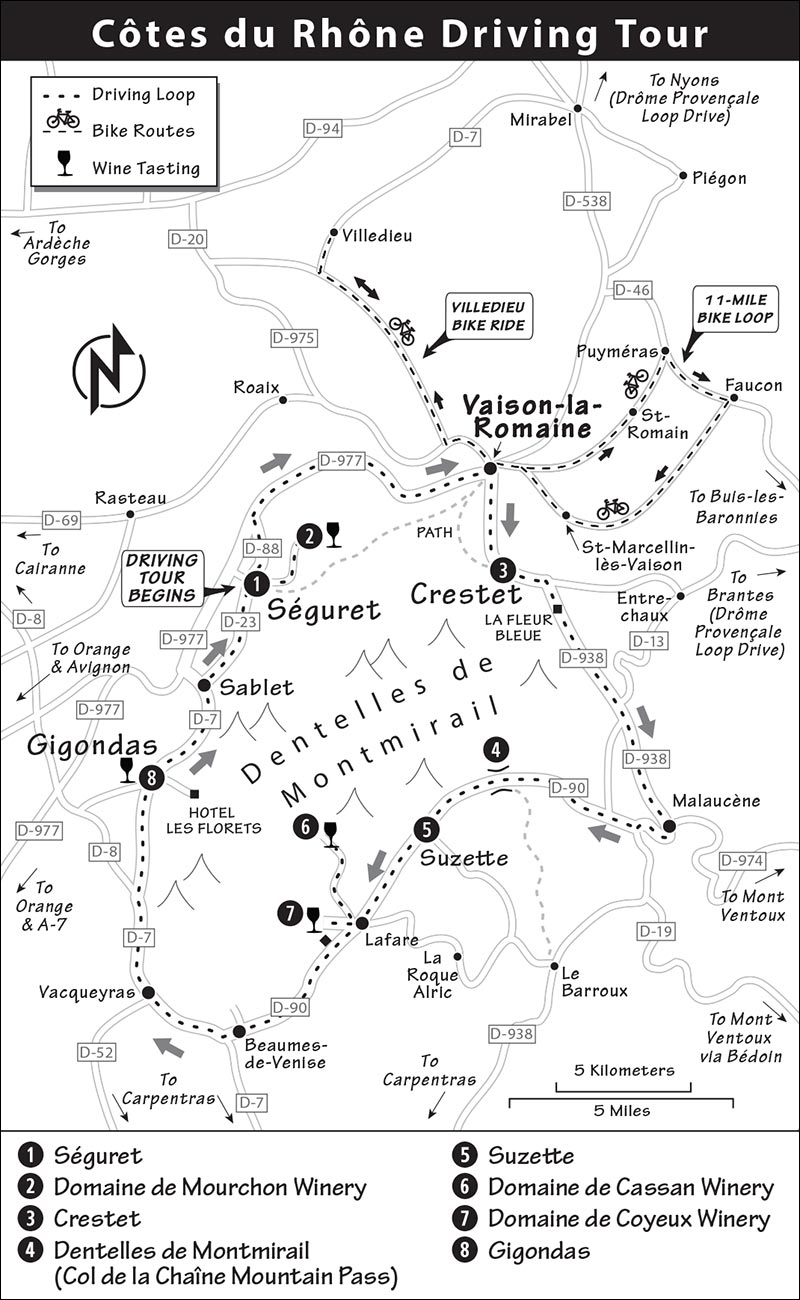
Séguret’s name comes from the Latin word securitas (meaning “security”). The town’s long, bulky entry arch came with a massive gate, which drilled in the message of the village’s name. In the Middle Ages, Séguret was patrolled 24/7—they never took their securitas for granted. Find the drawing inside the arch of the medieval town with its high-flying castle. A castle once protected Séguret, but all that’s left today is a tower that you can barely make out (though trails provide access).
Walk through the arch and up a block. To appreciate how the homes’ outer walls provided security in those days, drop down the first passage on your right (near the fountain). These tunnel-like exit passages, or poternes, were needed in periods of peace to allow the town to expand below. Find La Maison d’Eglantine tucked in here, serving delicious cakes, coffee, and tea in a cozy room with views (open afternoons only).
Moving along, you could follow Calade de l’Eglise up to the unusual 12th-century St. Denis church for views (the circular village you see below is Sablet). We’ll veer right and down instead, aiming for the santon shop (worth a peek for its displays). At Christmas, this entire village transforms itself into one big crèche scene. From here, drop down and return to your car past the recommended Restaurant/Café Côté Terrasse.
Sleeping and Eating: Sure, it’s a hotel, but winemaking is also part of the business at $$ Domaine de Cabasse,*** a lovely spread flanked by vineyards at the foot of Séguret (with views and a walking path to the village). Each of the 23 rooms has tasteful decor, air-conditioning, and views over vines; all the first-floor rooms have balconies or decks (elevator, big heated pool, discount for 2-3 night stay if reserved directly with hotel; on D-23 between Sablet and Séguret, entry gate opens automatically...and slowly, +33 4 90 46 91 12, www.cabasse.fr, hotel@cabasse.fr). It’s worth booking this place well ahead.
$$ Le Bouquet de Séguret Chambres d’Hôte is a perfectly Provençal refuge perched just below Séguret, with vineyard and village views. Outgoing Dutch owners Jos and Ingrid speak fluent English and spoil their guests with optional home-cooked dinners, pools, a pétanque court, and afternoon wine fun. They also rent several good apartments (gîtes) with full kitchens (3- to 5-night minimum). It’s near Domaine de Cabasse (252 Route de Sablet, +33 4 90 28 13 83, www.lebouquetdeseguret.com, info@lebouquetdeseguret.com).
With a splendid setting in the center of the village, $$ Restaurant/Café Côté Terrasse offers all-day café service as well as lunch and dinner. They cheerfully serve big portions of straightforward brasserie fare at reasonable prices, either on the terrace or in the modern interior (daily in high season from 10:00, Rue des Poternes, +33 4 90 28 03 48).
$$$ Le Mesclun sits right next door, offering a step up in cuisine and prices, a terrific rear terrace, and three intimate dining rooms (closed Wed, +33 4 90 46 93 43).
• Signs near Séguret’s upper parking lots lead you up, up, and away to our next stop, the nearby Domaine de Mourchon (leave breadcrumbs or track your route up to find your way back down).
2 Domaine de Mourchon Winery
This high-flying winery blends state-of-the-art technology with traditional winemaking methods (a shiny ring of stainless-steel vats holds grapes grown on land plowed by horses). The wines have won the respect of international critics. Take advantage of the amazing deal they’ve arranged to deliver wine stateside for nearly the same price you’d pay at the winery. Free and informative English tours of the vineyards are usually offered on Wednesdays at 17:00, followed by a tasting, though you’re welcome to taste anytime they’re open. Ask about the lunch picnic basket served on their panoramic view terrace and check their website for accommodation rental (Mon-Sat 9:00-18:00, Sun by appointment only; from Easter-Oct, call to verify; +33 4 90 46 70 30, www.domainedemourchon.com).
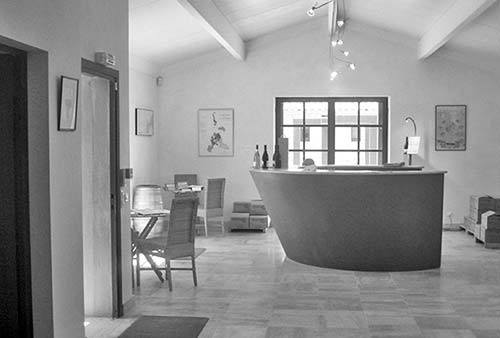
• Next, drop back down to Séguret, head toward Vaison-la-Romaine, and once past the city follow signs for Carpentras/Malaucène. After passing through “lower” Crestet on the main highway, look for signs for a side road leading up to Le Village. Drivers can park at the second lot on the approach to the town, then hike up through the village, or—if traffic is light—bypass the lower lots to keep driving toward Place du Château at the top of town.
3 Crestet
This quiet village was founded after the fall of the Roman Empire, when people banded together in high places like this for protection from marauding barbarians, so it followed the usual hill-town evolution. The outer walls of the village did double duty as ramparts and house walls. The castle above (from about 850) provided a final safe haven when the village was attacked.
Wander the peaceful lanes and appreciate the amount of work it took to put these stones in place. Notice the elaborate water channels. Crestet was served by 18 cisterns in the Middle Ages. Imagine hundreds of people living here with animals roaming everywhere. The bulky Romanesque church is built into the hillside; if it’s open, peek in to see the unusual stained-glass window behind the altar.
Eating: The café-restaurant $$ La Terrasse serves basic omelets, salads, crêpes, and plats from what must be Provence’s greatest view tables. Stop for a coffee or drink and enjoy the panorama (daily, closed in bad weather and Dec-March, +33 4 90 28 76 42).
Nearby: A memorable lunch stop on our route, about a mile past Crestet, is $$ La Fleur Bleue (see “Near Vaison-la-Romaine,” earlier).
• Drivers should carry on and reconnect with the road below, following signs to Malaucène. Entering Malaucène, turn right on D-90 (direction: Suzette) just before the gas station. After a few minutes you’ll approach a pass. After passing two scenic picnic areas, look for signs on the left to Col de la Chaîne (Chain Pass).
4 Dentelles de Montmirail (Col de la Chaîne Mountain Pass)
Get out of your car at the pass (elevation: about 1,500 feet) and enjoy the breezy views. The peaks in the distance—thrusting up like the back of a stegosaurus or a bad haircut (you decide)—are the Dentelles de Montmirail, a small range running just nine miles basically north to south and reaching 2,400 feet in elevation. This region’s land is constantly shifting. Those rocky tops were the result of a gradual uplifting of the land, which was then blown bald by the angry mistral wind. The village below the peaks is Suzette (you’ll be there soon).
• Time to push on. With the medieval castle of Le Barroux topping the horizon in the distance (off to the left) and lavender fields below, drive on to little...
5 Suzette
Tiny Suzette floats on its hilltop, with a small 12th-century chapel, wine tastings, a handful of residents, and the gaggle of houses where they live. Park in Suzette’s lot, then find the big orientation board above the lot. Look out to the broad shoulders of Mont Ventoux. At 6,000 feet, it always seems to have some clouds hanging around. If it’s clear, the top looks like it’s snow-covered; if you drive up there, you’ll see it’s actually white stone.
Back across the road from the orientation table is a simple tasting room for Château Redortier wines (unreliable hours, but well-explained wine list provided). Good picnic tables lie just past Suzette on our route.
• Continue from Suzette in the direction of Beaumes-de-Venise. Descend into the lush little village of Lafare, take a very sharp right and follow Dentelles de Montmirail signs until you reach...
6 Domaine de Cassan Winery
This picturesque family-run winery makes delicious wines and sells them at affordable prices; the Saint-Christophe red is a particularly good value (free tastings, Mon-Sat 10:00-12:00 & 14:00-18:00, closed Sun, +33 4 90 62 96 12, www.domainedecassan.fr).
• Another scenic wine-tasting opportunity is back on our route, just after leaving the village of Lafare, at...
7 Domaine de Coyeux Winery
A private road winds up and up to this impossibly beautiful setting. Olive trees frame the final approach, and the smart tasting room and terrace tables are made for savoring the view and wine. The owners and staff take your interest in their wines seriously—skip it if you only want a quick taste or are not interested in buying. These wines have earned their good reputation, and some are now available in the US (winery generally open daily 10:00-13:00 & 14:00-18:00, no midday closure July-Aug; +33 4 90 12 42 42, www.domainedecoyeux.com, some English spoken).
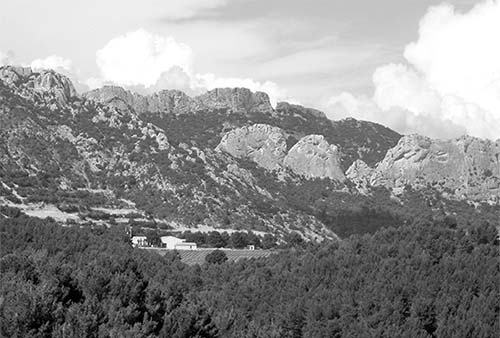
An excellent stopping place for lunch or dinner is $$ Côté Vignes, soon after the turnoff to Domaine de Coyeux. This lighthearted wood-fired-everything restaurant has terrific outdoor tables, a fun interior dining atmosphere, and charming host Corinne. Try the Camembert cheese flambé with lettuce, potatoes, and ham (salads, good pizza and plats, closed Mon off-season, +33 4 90 65 07 16).
• Drive on toward Beaumes-de-Venise. Navigate through town following signs for Centre-Ville, then for Vacqueyras (a famous wine village with a Thursday market), and then signs for Gigondas and Vaison par la route touristique (D-7). A small road leads right into Gigondas’ town center.
8 Gigondas
This upscale village produces some of the region’s best reds and is ideally situated for hiking, mountain biking, and driving into the mountains. Follow signs to the village center and park in the second lot beyond the TI (the first lot is for locals). The TI has lists of wineries and chambres d’hôtes, and tips for good hikes or drives (Mon-Sat 10:00-12:30 & 14:30-18:00, closed Sun, 5 Rue du Portail, +33 4 90 65 85 46, www.gigondas-dm.com). Caveau du Gigondas is a fine place to taste wines from over 75 producers (daily 10:00-12:00 & 14:00-18:30).
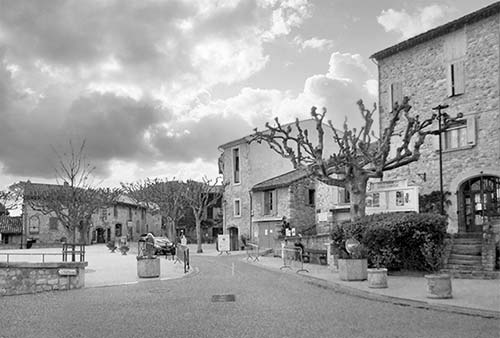
Take a short walk up through the village lanes to find good viewing platforms over the heart of the Côtes du Rhône vineyards. With your back to Du Verre à l’Assiette restaurant, walk uphill, veering right just after the Nez Bar à Vins, then make a quick left uphill (climb to the church for the best views).
Sleeping and Eating: With good ambience inside and out, $ Nez Bar à Vins is a cool-if-trendy place to enjoy a glass of wine and light appetizers; you’ll find it along a pedestrian lane a block up from the main square (closed Sat-Sun, Place du Rouvis, +33 4 90 28 99 59).
$$ Hôtel les Florets*** is a half-mile above Gigondas, buried in the foothills of the Dentelles de Montmirail. It has tastefully designed rooms, a dreamy terrace, a pool, and hiking trails into the mountains (no air-con, annex rooms by pool have front patios, +33 4 90 65 85 01, www.hotel-lesflorets.com, accueil@hotel-lesflorets.com). Their family-run $$$ restaurant is a memorable experience if you dine on the magnificent terrace. Although the weighty wine list is literally encyclopedic, the menu offers just two choices per course and changes regularly (check the options before committing). English-speaking Thierry and his son Xavier serve their guests with class (closed Wed, also closed Thu for lunch).
• From Gigondas, follow signs to the circular wine village of Sablet—with generally inexpensive wine—then return to Séguret, where our tour ends.
Hill Towns of the Luberon
Just 30 miles east of Avignon, the Luberon region hides some of France’s most captivating hill towns and sensuous landscapes. Those intrigued by Peter Mayle’s best-selling A Year in Provence love joyriding through the region, connecting I-could-live-here villages, crumbled castles, and meditative abbeys. Mayle’s book describes the ruddy local culture from an Englishman’s perspective as he buys a stone farmhouse, fixes it up, and adopts the region as his new home. A Year in Provence is a great read while you’re here—or, better, get it as an audiobook and listen while you drive.
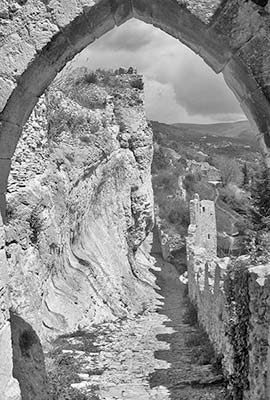
The Luberon terrain in general (much of which is a French regional natural park) is as enticing as its villages. Gnarled vineyards and wind-sculpted trees separate tidy stone structures from abandoned buildings—little more than rock piles—that challenge city slickers to fix them up. Mountains of limestone bend along vast ridges, while colorful hot-air balloons survey the scene from above.
There are no obligatory museums, monuments, or vineyards in the Luberon. Treat this area like a vacation from your vacation. Brake for views, and ditch your car to take a walk. Get on a first-name basis with a village café.
What follows is a rundown of my favorite villages and stops in this beautiful area. The D-900 highway cuts the Luberon in half like an arrow. The villages I describe sit just north and south of it.
GETTING AROUND THE LUBERON
By Car: A car or bike is essential to get a good feel for this beautiful area. Luberon roads are scenic and narrow. With no major landmarks, it’s easy to get lost—but that’s not a bad thing. Consider buying Michelin map #332 or #527 to help navigate, and look for free maps available at local TIs. Popular towns charge a small fee to park. Expect headaches parking in Isle-sur-la-Sorgue during its market days.
By Bus: Isle-sur-la-Sorgue is connected with Avignon’s town center by bus #906 (hourly Mon-Sat, 2/day Sun, 40 minutes, central stop—called Robert Vasse—is near the post office in Isle-sur-la-Sorgue, ask for schedule at TI or check Rome2rio.com). Buses also connect Isle-sur-la-Sorgue with the Marseille airport (4/day direct, 2 hours). Without a car or minivan tour, skip the more famous hill towns of the Luberon.
By Train: Trains get you to Isle-sur-la-Sorgue (station called L’Isle-Fontaine de Vaucluse) from Avignon (10/day on weekdays, 7/day on weekends, 30 minutes) or from Marseille (12/day, 1.5-3 hours). If you’re day-tripping by train, check return times before leaving the station.
By Minivan Tour: For tour companies and local guides for this marvelous region, see “Tours in Provence” on here).
By Taxi: Contact Luberon Taxi (based in Maubec off D-3, +33 6 08 49 40 57, www.luberontaxi.com).
By Bike: Isle-sur-la-Sorgue makes a good base for biking, with level terrain and good rental options. Hardy bikers can ride from Isle-sur-la-Sorgue to Gordes, then to Roussillon, connecting other villages in a full-day loop ride (30 miles round-trip to Roussillon and back, with lots of hills). Several appealing villages are closer to Isle-sur-la-Sorgue and offer easier biking options. Sun-e-Bike rents electric bikes and has a network of partners with spare batteries scattered across the Luberon, extending the range of your e-bike trip. They can also arrange bike tours and shuttle your bags between hotels (1 Avenue Clovis Hugues in Bonnieux, +33 4 90 74 09 96, www.sun-e-bike.com).
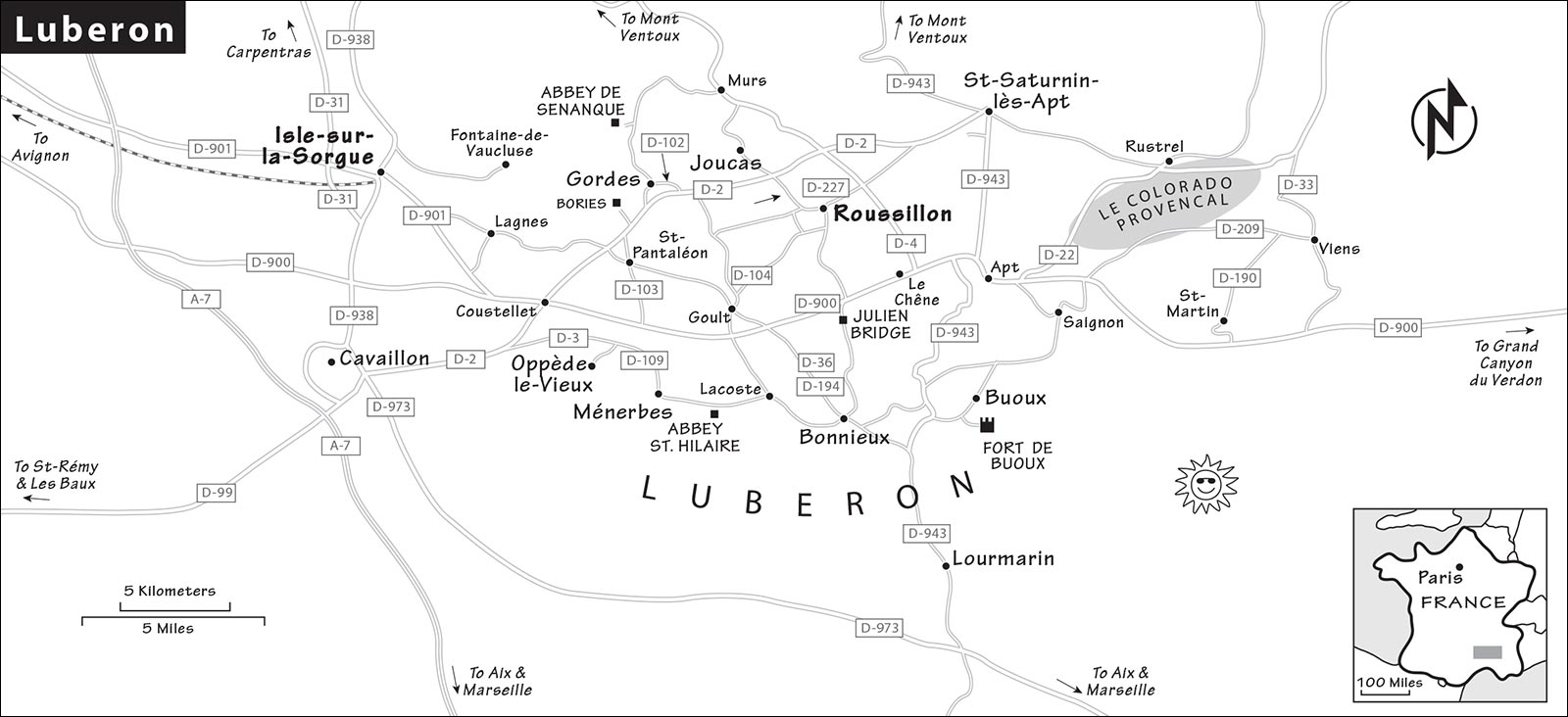
Isle-sur-la-Sorgue
This sturdy market town—literally, “Island on the Sorgue River”—sits within a split in its crisp, happy little river at the foot of the Luberon. It’s a workaday town that feels refreshingly real after so many adorable villages.
Although Isle-sur-la-Sorgue is renowned for its market days (Sun and Thu), it’s an otherwise pleasant town with no important sights and a steady trickle of tourism. It’s lively on weekends but calm most weeknights. The town revolves around its river and streams, the church square, and two pedestrian-only streets, Rue de la République and Rue Carnot.
The TI has an essential town map, hiking information (ask about trails accessible by short drives), biking itineraries, and a line on rooms in private homes, all of which are outside town (Mon-Sat 9:30-12:30 & 14:00-18:00, Oct-March until 17:30, Sun 9:30-12:30 year-round; in the town center right behind the church at 13 Place Ferdinand Buisson, +33 4 90 38 04 78, www.oti-delasorgue.fr).
Visiting Isle-sur-la-Sorge: In Isle-sur-la-Sorgue—called the “Venice of Provence”—the Sorgue River’s extraordinarily clear and shallow flow divides like cells, producing water, water everywhere. The river has long nourished the region’s economy, but today, antique shops keep the town afloat. Navigate by the town’s splintered streams and nine mossy waterwheels, which, while still turning, power only memories of the town’s wool and silk industries. At its peak, Isle-sur-la-Sorgue had 70 waterwheels; in the 1800s, the town competed with Avignon as Provence’s cloth-dyeing and textile center.
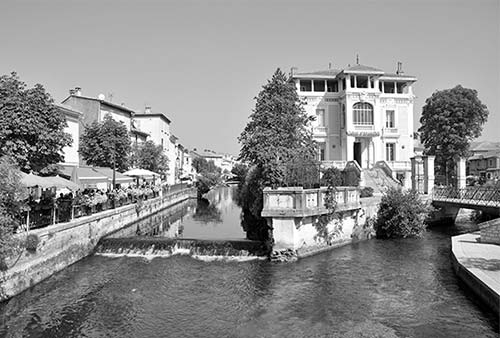
Find Le Bassin, the pond where the Sorgue River crashes into the town and separates into many branches (carefully placed lights make this a beautiful sight after dark). With its source (a spring) a mere five miles away, the Sorgue River never floods and has a constant flow and temperature in all seasons. Despite its exposed (flat) location, Isle-sur-la-Sorgue prospered in the Middle Ages, thanks to the natural protection this river provided.
For a riverfront stroll, follow the main river upstream, along the bike/pedestrian lane, as far as you like. The road meanders about a mile, following the serene course of the river, past waterfront homes and beneath swaying trees. It ends at the Hôtel le Pescador and a riverfront café (good place for a coffee or lunch).
In the town’s center, peek into the 12th-century Notre-Dame des Anges church with its colorful Baroque interior (closed 12:00-15:15). The town erupts into a carnival-like market frenzy each Sunday and Thursday, with hardy crafts and local produce. The Sunday market is astounding and famous for its antiques; the Thursday market is still impressive but focused more on produce and bric-a-brac than antiques.
Sleeping in and near Isle-sur-la-Sorgue
$$$ La Prévôté*** has the town’s highest-priced digs. Its five meticulously decorated rooms—with high ceilings, a few exposed beams, and carefully selected furnishings—are located above a classy and recommended restaurant. Antonia manages the hotel while her husband oversees the kitchen (includes breakfast, limited check-in/check-out times, no elevator, rooftop deck with hot tub, no parking, one block from the church at 4 Rue J. J. Rousseau, +33 4 90 38 57 29, www.la-prevote.fr, contact@la-prevote.fr).
$ Hôtel les Névons,*** two blocks from the town center (behind the post office), is concrete motel-modern outside, with well-priced and comfortable-enough rooms within, and a roof deck with a small pool (family rooms, air-con, elevator, free and safe parking, 205 Chemin des Névons, +33 4 90 20 72 00, www.hotel-les-nevons.com, contact@hotel-les-nevons.fr).
$ Le Pont des Aubes is a nifty option, with six rooms for two people, each with full kitchens. Rooms are comfortable with modest bathrooms and face a large yard fronting the Sorgue River. It’s a short hop to the town center by car or 15 minutes on foot. Sincere Martine is your host (3-night minimum, longer in high season, arrange arrival time in advance, 189 Route d’Apt, +33 4 90 38 13 75, www.lepontdesaubes.com, lepontdesaubes@yahoo.fr).
Eating in Isle-sur-la-Sorgue
Cheap and mediocre restaurants are a dime a dozen in Isle-sur-la-Sorgue. You’ll see several brasseries on the river, good for views and basic café fare. To assemble a riverside picnic, head to Rue de la République, which has bakeries, butchers, a traiteur (deli), cheesemongers, a wine shop, and a grocery store.
Begin your dinner with a glass of wine at the cozy wine and cheese shop $ Chez Stéphane. Or for a light meal, order a selection of cheeses from Stéphane (great to share) with your wine and call it good (a few tables are outside or find the cozy zinc counter hiding in back; closed Sun evening and all day Mon, 12 Rue de la République, +33 4 90 20 70 25).
$$ Le Nego is a relaxed place with generous outdoor seating and a large selection of reasonably priced, regional fare that works well for riverfront dining (daily, 12 Quai Jean Jaurès, +33 4 90 20 88 83).
$$$ La Balade des Saveurs is a refreshing change from the many run-of-the-mill riverfront places. Here, the owners deliver fresh, well-presented Provençal and traditional French cuisine at riverside tables or in their elegantly sky-lit interior (closed Mon-Tue, 3 Quai Jean Jaurès, +33 4 90 95 27 85, www.balade-des-saveurs.com).
$$$$ La Prévôté is the place in town to do it up in elegant French style. Its lovely dining room is country-classy but not stuffy, and the cuisine blends traditional French with regional specialties. A stream runs under the restaurant, visible through glass windows (€65 five-course menu, closed Mon-Tue, on narrow street that runs along left side of church as you face it, 4 Rue J. J. Rousseau, +33 4 90 38 57 29, www.la-prevote.fr).
$ Suzette Crêperie serves tasty crêpes and a limited choice of other dishes at riverside tables or in their cozy interior. With friendly owners, it’s the cheapest place to get a decent meal on the river (closed Sun evening and all day Mon-Tue, 6 Quai Jean Jaurès, +33 4 65 81 72 18).
Roussillon
With all the trendy charm of Santa Fe on a hilltop, photogenic Roussillon requires serious camera and café time. An enormous deposit of ochre, which gives the earth and its buildings that distinctive reddish color, provided this village with its economic base until shortly after World War II. This place is popular; visit early while the rising sun highlights the ochre cliffs, or come late and stay for dinner.
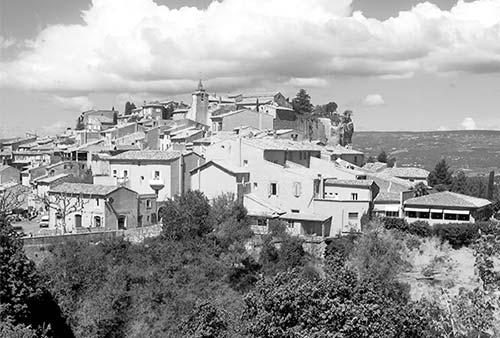
The little TI is in the center, across from the Omma restaurant and hotel. Walkers should get info on trails from Roussillon to nearby villages (TI hours are unreliable, usually Mon-Sat 8:30-12:30 & 14:00-18:00, Nov-March 14:00-17:30 only, closed Sun year-round, Place de la Poste, +33 4 90 05 60 25, http://otroussillon.pagesperso-orange.fr).
Parking areas are available at every entry to the village (free if you’re staying overnight and have arranged it with your hotel). Parking des Ocres (also called “P2”) is the largest lot on the hill and closest to the action. Day-trippers should head straight here, as spots are more available and the view of Roussillon is striking. Leave nothing of value visible in your car.
Parking Sablons is next to the recommended Maison des Ocres. Parking St-Michel is below the town on the way to Joucas and Gordes.
Visiting Roussillon: Go to the town’s center, cross the cute square, and then climb under the bell tower and past the church to the top of the village. Find the orientation table and the viewpoint. During the Middle Ages, a castle occupied this space on the top of the appropriately named Red Mountain (Mont Rouge), and watched over the village below.
Stroll back to the pretty 11th-century Church of St. Michel. Duck in and appreciate the natural air-conditioning and the well-worn center aisle, and then continue down to the village. Linger over un café, or—if it’s later in the day—un pastis, in the picturesque village square (Place de la Mairie). Watch the stream of shoppers. Is anyone playing boules at the opposite end? You could paint the entire town without ever leaving the red-and-orange corner of your palette. Many do. While Roussillon receives scads of day-trippers, mornings and evenings are romantically peaceful on this square.
Roussillon was Europe’s capital for ochre production until World War II. A stroll to the south end of town, beyond the Parking des Ocres, shows you why: Roussillon sits on the world’s largest known ochre deposit. The ▲▲ Ochre Cliffs Trail (Le Sentier des Ocres) offers two radiant orange paths that lead around the richly colored, Bryce Canyon-like cliffs—allow 35 minutes for the shorter path and 55 minutes for the longer one (€4; May-June and Sept 9:30-18:30, July-Aug 9:00-19:30, shorter hours off-season, closed Jan).
For a good introduction to the history and uses of ochre, visit the ▲ Ecomuseum of Ochre (Écomusée de l’Ocre), an intriguing reconstructed ochre factory. Grab a pamphlet to follow the well-done self-guided tour, which shows how ochre is converted from an ore to a pigment—allow 45 minutes (€8, daily 10:00-13:00 & 14:00-18:00, July-Aug until 19:00, shorter hours and closed some days in winter—check online, about a half-mile below Roussillon toward Apt on D-104, +33 4 90 05 66 69, www.okhra.com).
Sleeping in and near Roussillon
Parking is free if you sleep in Roussillon; arrange it with your hotelier.
$$$ Omma*** delivers Roussillon’s plushest accommodations with nine lovely rooms located dead-center in the village (some view rooms, air-con, parking options, good restaurant, across from the TI on Place de la Poste, +33 4 90 05 60 13, https://www.leclosdelaglycine.fr, contact@leclosdelaglycine.fr).
$$ Maison des Ocres,*** well located on the edge of the village center at the Sablons parking area, is a welcoming and stylish place with a spacious lounge, well-configured rooms (many with decks or balconies), a few good family rooms, a charming bistro serving excellent dinners for guests (closed Sun), good breakfast, and a pool (private parking, Route de Gordes, +33 4 90 05 60 50, www.lamaisondesocres-hotel.com, contact@lamaisondesocres-hotel.com). Coming from Gordes and Joucas, it’s the first building you pass in Roussillon.
$$$ Hôtel la Clé des Champs,*** more like an elegant bed and breakfast, is a lovely nine-room Provençal splurge warmly run by René and Armelle in a peaceful, rural setting. Carefully appointed rooms, each with a private terrace, are clustered about a heated pool. There’s a hammam and hot tub, and “gourmet-plate” dinners are available most days (between Roussillon and Joucas, off D-2 on Chemin du Garrigon, +33 4 90 05 63 22, www.hotelcledeschamps.com, contact@hotelcledeschamps.com).
$$$ La Ferme de la Huppe is a romantic place with 10 low-slung stone bungalows clustered around a courtyard, each beautifully appointed. There’s a stylish pool and a dressy restaurant with poolside dining when the weather agrees (on the D-156 Route de Goult, +33 4 90 72 12 25, www.lafermedelahuppe.com, info@lafermedelahuppe.com).
$$ Hôtel les Sables d’Ocre** offers 22 spotless, motel-esque rooms, a big pool, the greenest grass around, air-conditioning, minifridges, and fair rates (a half-mile from Roussillon toward Apt at intersection of D-108 and D-104, +33 4 90 05 55 55, www.sablesdocre.com, contact@sablesdocre.fr).
$ Le Clos des Cigales is a good forested refuge run by friendly Philippe. Of their five blue-shuttered, stylish bungalows, two are doubles and three are two-room family-friendly suites with tiny kitchenettes; all have private patios facing a big pool (family rooms, includes breakfast, table tennis, hammock, 5 minutes from Roussillon toward Goult on D-104, +33 4 90 05 73 72, www.leclosdescigales.com, philippe.lherbeil@wanadoo.fr).
Located in the center of lovely little Joucas, $ Le Joucas** has comfortable, good-value rooms and is kid-friendly, with a big pool and a sports field/play area next door. Ask for a south-facing room (coté sud) for the best views. All rooms have showers, air-conditioning, and minifridges (above park at village entrance, +33 4 90 05 78 01, www.lescommandeurs.com, hostellerie@lescommandeurs.com). The traditional $$ restaurant offers Provençal cuisine at fair prices (closed Wed).
Eating in Roussillon
A good place to splurge is at $$$$ Omma, at the recommended hotel of the same name. You can enjoy a fine meal on the terrace or at an interior window table with point-blank views over the ochre cliffs (closed Wed and Sun in off-season, Place de la Poste, +33 4 90 05 60 13).
$$$ Le Piquebaure—perched at the north side of town, a 10-minute walk from the center—delivers the best affordable “gourmet cuisine” in Roussillon. Regional dishes are beautifully presented. Eat in the stylish interior or on the covered terrace (closed Tue, 266 Avenue Dame Sirmonde, + 33 7 85 36 73 63).
$ Le Bistrot de Roussillon is ideally situated on Roussillon’s delightful square and serves simple café fare at good prices. Enjoy your meal at outdoor tables on the square (my favorite), inside the pleasant dining room, or on a small terrace out back with views to the ochre cliffs (open daily for lunch, may be open for dinner in high season, Place de la Mairie, +33 4 90 05 74 45).
$ La Grappe de Raisin is a simple place with a sweet upstairs terrace and fairly priced Provençal cuisine (daily, near the TI on Rue de la Poste, +33 4 90 71 38 06).
More Luberon Towns and Sights
I’d make a loop out of these villages and sights, doing them in the order described. If you’re sleeping in or near Roussillon, start there (mornings are peaceful) then follow signs to Gordes, then Lacoste, Bonnieux, and so on (making a counterclockwise loop through the Luberon). If you’re staying elsewhere (like Isle-sur-la-Sorge), start with Gordes, then Lacoste (ending with Roussillon). Bonnieux looks best from a distance, but it’s a good place for lunch or to stay overnight. The route is well signed.
Gordes
The Luberon’s most impressively situated hill town is worth a quick stop to admire its setting. As you approach Gordes, veer right when you see the viewpoint icon. Get out, stroll along the road, and admire the sensational view. In the 1960s Gordes was a ghost town of derelict buildings with no economy. Today it’s renovated top to bottom and filled with people who live in a world without calluses. Many Parisian big shots and moneyed foreigners invested heavily, restoring dream homes and putting property values and café prices out of sight for locals. Beyond its stunning views, the village has pretty lanes lined with trendy boutiques and restaurants but little else of interest.
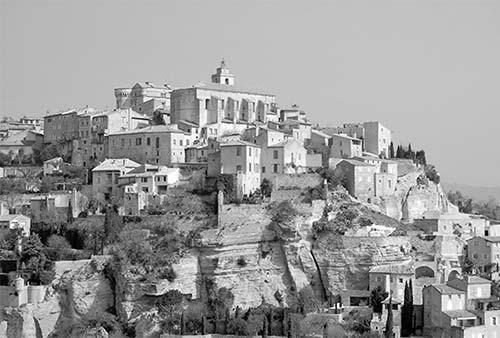
Abbey Notre-Dame de Sénanque
This still-functioning and beautifully situated Cistercian abbey was built in 1148 as a back-to-basics reaction to the excesses of Benedictine abbeys. Come first thing and stop at a pullout for a bird’s-eye view as you descend from Gordes, then wander the abbey’s perimeter. The abbey church (may be closed for renovation) is usually open and free (except during Mass, but you’re welcome to attend) and highlights the utter simplicity sought by these monks. In late June through much of July, the five hectares of lavender fields that surround the abbey make for breathtaking pictures and draw loads of visitors.
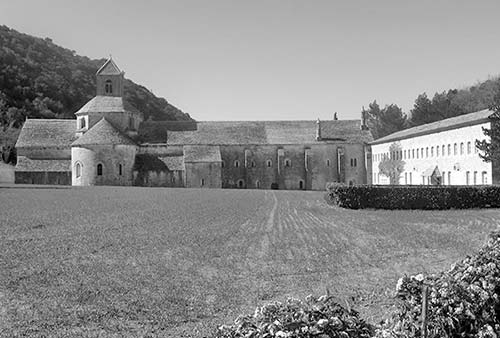
Abbey interior areas that you can visit include Sénanque’s church (when open), the small cloisters, the refectory, and a chauffoir, a small heated room where monks could copy books year-round.
Cost and Hours: €8.50, includes multimedia guide, visits allowed Mon-Sat 9:30-11:00 & 13:00-17:00, Sun 14:00-17:30, +33 4 90 72 05 72, www.senanque.fr, visites@ndsenanque.net. Modest dress is required for entry—shoulders and knees must be covered.
Lacoste
Little Lacoste slumbers across the valley from Bonnieux in the shadow of its looming castle. Wander its pretty lanes to the base of the castle for views and stop for a meal at $ Café de France, with outdoor tables overlooking Bonnieux (reasonably priced omelets, quiche, and plats; daily, lunch only off-season, +33 4 90 75 82 25).
Bonnieux
Spectacular from a distance, this town lacks a pedestrian center, though the Friday-morning market briefly creates one. It’s a welcoming place that doesn’t get buried with tourists and is convenient for exploring the area. The main reason to visit here is to enjoy the views from a well-positioned restaurant such as $$ Restaurant Panoramique (at the Hôtel Jules Caesar), which delivers grand views and tasty Provençal cuisine at fair prices (daily, Place de la Liberté, +33 4 90 75 96 35); or $ Les Terrasses, serving basic café cuisine (pizza, etc.) on a sensational view terrace at the top of the village (closed Mon-Tue, Cours Elzéar Pin, +33 4 90 75 99 77).
Julien Bridge (Pont Julien)
Due south of Roussillon, just below D-900 (see “Luberon” map, earlier), this delicate, three-arched bridge, named for Julius Caesar, survives as a testimony to Roman engineers—and to the importance of this rural area 2,000 years ago. It’s the only surviving bridge on what was the main road from northern Italy to Provence—the primary route used by Roman armies. The 215-foot-long Roman bridge was under construction from 27 BC to AD 14. Mortar had not yet been invented, so (as with Pont du Gard) the stones were carefully set in place. Amazingly, the bridge survives today, having outlived Roman marches, hundreds of floods, and decades of automobile traffic. A new bridge finally rerouted traffic from this beautiful structure in 2005.