ALSACE
Colmar • Route du Vin • Strasbourg
Towns and Sights Along the Route du Vin
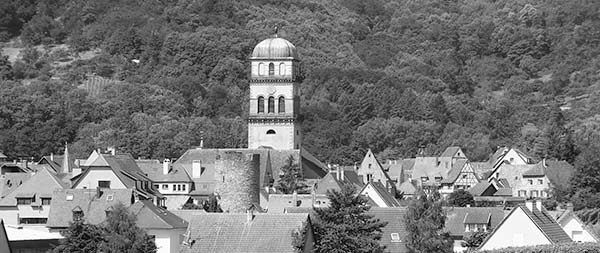
The province of Alsace stands like a flower-child referee between Germany and France. Bounded by the Rhine River on the east and the Vosges Mountains on the west, this is a green region of Hansel-and-Gretel villages, ambitious vineyards, and vibrant cities. Food and wine are the primary industry, topic of conversation, and perfect excuse for countless festivals.
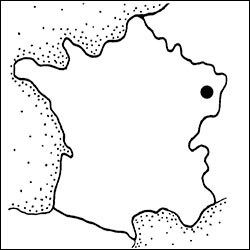
Alsace has changed hands between Germany and France several times because of its location, natural wealth, and naked vulnerability—and the fact that Germany considered the mountains the natural border, while the French saw the Rhine as the dividing line.
On a grander scale, Alsace is Europe’s cultural divide, with Germanic nations to the north and Romantic ones to the south. The region is a fault line marking the place where cultural tectonic plates collide—it’s no wonder the region has been scarred by a history of war.
Through the Middle Ages, Alsace was part of the Holy Roman Empire when German culture and language ruled. After the devastation of the Thirty Years’ War (1618-1648), Alsace started to become integrated into France—revolutionaries took full control in 1792. But in 1871, after France’s defeat in the Franco-Prussian War, Alsace “returned” to Germany. Almost five decades later, Germany lost World War I—and Alsace “returned” to France. Except for a miserable stint as part of the Nazi realm from 1940 to 1945, Alsace has been French ever since, and it plans to stay that way.
Having been a political pawn for 1,000 years, Alsace has a hybrid culture: Locals who curse do so bilingually, and the local cuisine features sauerkraut with fine wine sauces. In recent years, Alsace and its sister German region just across the border have been growing further apart linguistically—but closer commercially. People routinely cross the border to shop and work. And while Alsace’s Germanic-based dialect is fading, schools on the German side are encouraged to teach French as the second language and vice versa. Street names are commonly shown in both French and Alsatian.
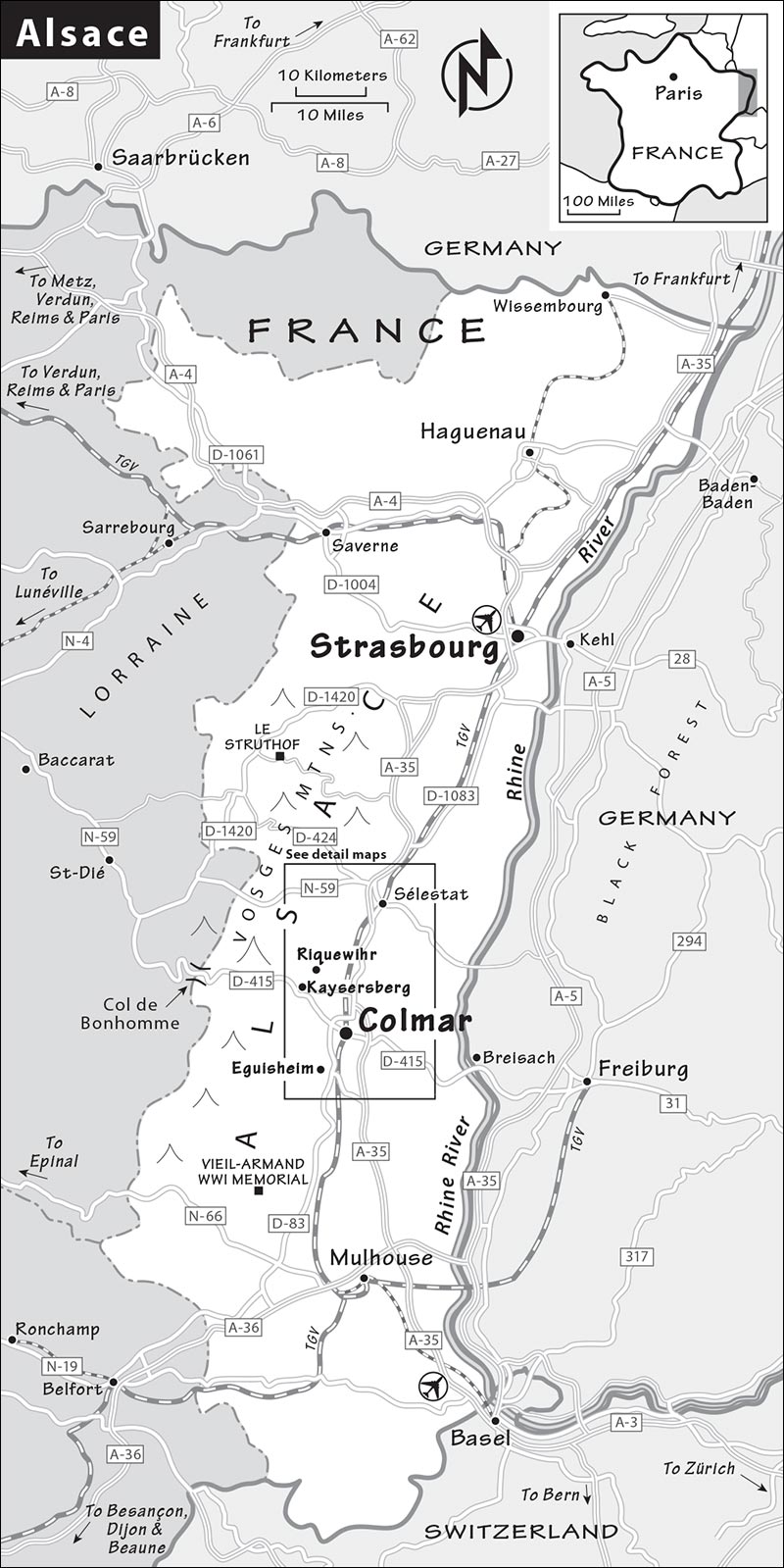
Of the 1.8 million people living in Alsace, about 278,000 live in Strasbourg (its biggest city) and 70,000 live in Colmar. Colmar is one of Europe’s most enchanting cities—with a small-town warmth and world-class art. Strasbourg is a big-city version of Colmar, worth a stop for its venerable cathedral and to feel its high-powered and trendy bustle. The small villages that dot the wine road between them are like petite Colmars and provide a delightful and charming escape from the two cities.
PLANNING YOUR TIME
The ideal plan: Make Colmar your home base and spend two or three days in the region. I’d spend a day each in Colmar, the villages of the Route du Vin, and Strasbourg. If you have a car and sleep better in small towns, think about basing yourself in Eguisheim. Urban Strasbourg, with its soaring cathedral and vigorous center, is a headache for drivers but a quick 30-minute train ride from Colmar—do it by train as a day trip from Colmar or as a stopover on your way in or out of the region. If you have only one day, get an early start for a morning along the Route du Vin, when it’s quieter, and enjoy an afternoon and evening in Colmar.
The somber WWI battlefields of Verdun and the bubbly vigor of Reims in northern France (see next chapter) are closer to Paris than to Alsace and follow logically if your next destination is Paris. High-speed TGV trains link Paris with Reims, Verdun, Strasbourg, Colmar, and destinations farther east, bringing the Alsace within two hours of Paris and giving train travelers easy access to Reims or Verdun en route between Paris and Alsace.
GETTING AROUND ALSACE
Frequent trains make the trip between Colmar and Strasbourg a snap (2/hour, 35 minutes). Distances are short and driving is easy—though a good map helps. Connecting Colmar with neighboring villages is doable using the region’s sparse bus service or on a bike. Minivan excursions are handy for those without cars and depart from Colmar or Strasbourg. Taking a taxi between towns is another worthwhile option (distances are short, so prices are manageable). Once in the Route du Vin villages, you can hike or rent bikes to explore further.
ALSACE’S CUISINE SCENE
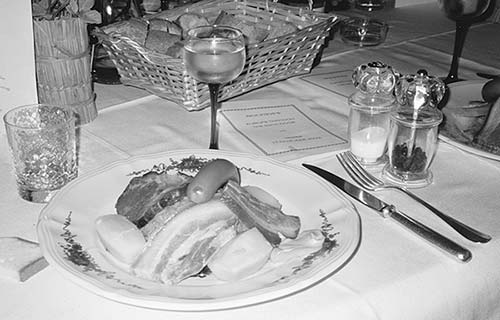
Alsatian cuisine is a major tourist attraction in itself. You vill not escape the German influence: sausages, potatoes, onions, and sauerkraut. Look for choucroute garnie (sauerkraut and sausage), the more traditionally Alsatian Baeckeoffe (see sidebar), Rösti (an oven-baked potato-and-cheese dish), Spätzle (soft egg noodles), quenelles (dumplings made of pork, beef, or fish), fresh trout, and foie gras. For lighter fare, try the poulet au Riesling, chicken cooked slowly in Riesling wine (coq au Riesling is the same dish done with rooster). At lunch, or for a lighter dinner, try a tarte à l’oignon (like an onion quiche) or tarte flambée (like a thin-crust pizza with onion and bacon bits). If you’re picnicking, buy some stinky Munster cheese. Dessert specialties are tarte alsacienne (fruit tart) and Kugelhopf glacé (a light cake mixed with raisins, almonds, dried fruit, and cherry liqueur).
ALSATIAN WINES
Thanks to Alsace’s Franco-Germanic culture, its wines are a kind of hybrid. The bottle shape, the grapes, and much of the wine terminology are inherited from its German past, though wines made today are distinctly French in style (generally drier than their German sisters). Alsatian wines are named for their grapes—unlike in Burgundy or Provence, where wines are commonly named after villages, or in Bordeaux, where wines are often named after châteaux. White wines rule in Alsace. Sample at least a few of the four “noble grapes” of the Alsace: riesling, gewürztraminer, pinot gris, or muscat. You’ll also see a local version of Champagne, called Crémant d’Alsace, and a variety of eaux-de-vie (strong fruit-flavored brandies). For more information, see the “Wines of the Alsace” sidebar on here.
Colmar
Colmar feels made for wonderstruck tourists—its essentially traffic-free city center is a fantasy of steeply pitched roofs, pastel stucco, and antique timbers housing a few heavyweight sights in a comfortable, midsize-town package. Historic beauty was usually a poor excuse for being spared the ravages of World War II, but it worked for Colmar. The American and British military were careful not to bomb the half-timbered old burghers’ houses, characteristic tiled roofs, and cobbled lanes of Alsace’s most beautiful city. The town’s distinctly French shutters combined with the ye-olde German half-timbering gives Colmar an intriguing ambience.
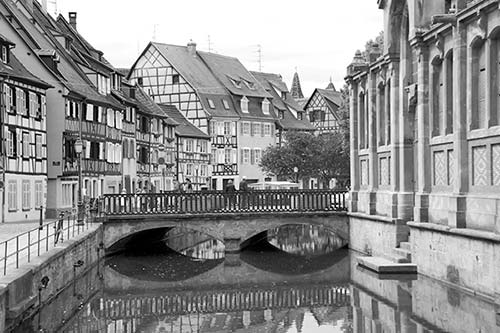
Today, Colmar is alive with colorful buildings, impressive art treasures, and German tourists. Antique shops welcome browsers, homeowners fuss over their geraniums, and locals seem genuinely proud of their clean and beautiful city.
Orientation to Colmar
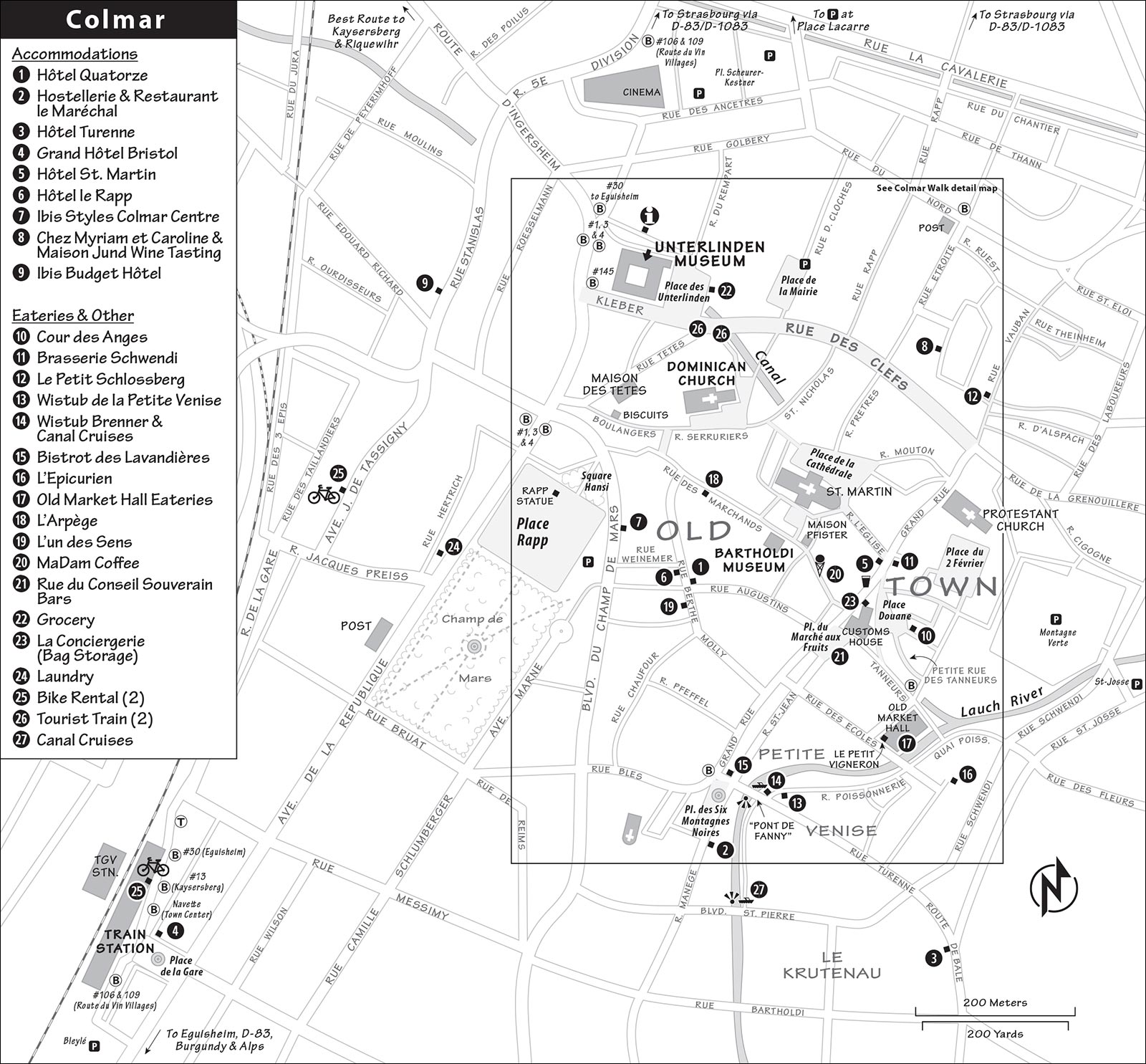
There isn’t a straight street in Colmar’s historic center—count on getting lost. Thankfully, most streets are pedestrian-only, and it’s a lovely town to be lost in. Navigate by church steeples and the helpful signs that seem to pop up whenever you need them. For tourists, the town center is Place des Unterlinden (a 20-minute walk from the train station), where you’ll find Colmar’s most important museum, the TI, and a big Monoprix supermarket/department store. City buses and tourist trains depart nearby.
TOURIST INFORMATION
The efficient TI is across from the Unterlinden Museum on Place des Unterlinden (Mon-Sat 9:00-18:00, Sun 10:00-13:00, +33 3 89 20 68 92, www.tourisme-colmar.com). Get information about concerts and festivals in Colmar and in nearby villages, and ask about Folklore Evenings held on summer Tuesdays (described later, under “Nightlife in Colmar”). The TI has a good city map and basic bike map, but skip their Colmar City Pass. Route du Vin travelers should pick up the free Route du Vin map and get details on bike rental, bus schedules, and where to catch the bus to Route du Vin villages.
ARRIVAL IN COLMAR
By Train and Bus: The old and new (TGV) parts of Colmar’s train station are connected by an underground passageway. Follow Sortie/Avenue de la République signs to exit the station. Day-trippers can check their bags at La Conciergerie in the city center (see “Helpful Hints”).
The old part of the train station was built during Prussian rule using the same plans as the station in Danzig (now Gdańsk, Poland). Check out the 1991 window that shows two local maidens about to be run over by a train and rescued by an artist. Opposite, he’s shown painting their portraits.
Connecting to the Town Center: A free electric bus (Navette Cœur de Ville) shuttles riders from the station on a one-way loop route through Colmar, stopping at Place Rapp and near the Unterlinden Museum and TI, the Old Market Hall, and Petite Venise (4/hour Mon-Sat, none on Sun).
It’s a 15-minute walk from the station into town: Exit straight out of the old station past Hôtel Bristol, turn left on Avenue de la République, and keep walking. Or hop on the free electric bus or any Trace bus from the station (immediately to the left at the station) and ride to the Champ de Mars stop (Place Rapp) or the Théâtre stop, next to the Unterlinden Museum (€1.50, see the “Colmar” map). Taxis wait curbside to the left of the exit and charge about €10 for any downtown ride.
Connecting to Route du Vin Villages: Buses to the villages arrive and depart from the front of the old station and from stops closer to the city center. As you exit the station, bus #13 to Kaysersberg and #30 to Eguisheim leave from the far left, and stops for buses #106 and #109 to Riquewihr and Ribeauvillé are to the far right (see “Alsace’s Route du Vin,” later).
By Car: Follow signs for Centre-Ville, then Place Rapp or Montagne Verte (near Hôtel St. Martin), where there are huge underground parking garages. The city subsidizes parking at Parkings St-Josse and Scheurer-Kestner (both central) and Bleylé (at the train station) for about €5/day. Ask your hotel for details: They may have private spots or get deals at other pay lots. Parking is metered along streets and in lots in the city center, but free from 19:00-9:00 and all day on Sunday.
When entering or leaving on the Strasbourg side of town (north), look for the big Statue of Liberty replica—designed to commemorate the 100th anniversary of the death of sculptor Frédéric-Auguste Bartholdi. At two traffic circles closer to Colmar (look for a red devil sculpture in the middle) are the imposing army barracks built by the Germans after annexing the region in 1871.
HELPFUL HINTS
Closed Day: Colmar’s top sight, the Unterlinden Museum, is closed on Tuesday.
Market Days: Markets take place in the vintage market hall (marché couvert; Tue-Sat generally 8:00-18:00, Sun 10:00-14:00, no market Mon). Textiles are on sale Thursdays on Place de la Cathédrale (all day) and Saturdays on Place des Dominicains (afternoons only). A flea market happens Fridays in summer on Place des Dominicains. The Saturday morning market on Place St. Joseph is where locals go for fresh produce and cheese (over the train tracks, 15 minutes on foot from the center).
Department/Grocery Store: The big Monoprix, with a supermarket, is across from the Unterlinden Museum (Mon-Sat 8:00-20:00, closed Sun). A small Petit Casino supermarket stands across from the recommended Hôtel St. Martin (generally Mon-Sat 8:30-19:00, closed Sun).
Crowds and Festivals: Colmar is busiest from May through September, especially on weekends, and during the Christmas season (www.noel-colmar.com). A popular music festival fills hotels the first two weeks of July (www.festival-colmar.com), and the local wine festival keeps things flowing nicely in July and August.
Wine Tasting in Colmar: For a fun in-town tasting experience, visit Maison Jund. Winemakers André and Myriam Jund and family own 44 acres of vineyards and grow all seven of the Alsatian grapes. Son Sébastien and his sister-in-law Caroline host the tastings in excellent English. Allow one hour (about €10, call for appointment, 12 Rue de l’Ange, +33 3 89 41 58 72, www.martinjund.com). They also run a recommended guesthouse.
Baggage Storage: The folks at centrally located La Conciergerie will stash your bags (50 Grande Rue, +33 6 38 18 94 24).
Laundry: 5àsec, across the street from the Champ de Mars park, offers wash, dry, and fold service (32 Avenue de la République, Mon-Sat 8:30-19:00, closed Sun, +33 3 89 41 75 73). The TI has a list of other central launderettes (none are self-serve).
Bike Rental: Colmar Vélodocteurs rents standard bikes and e-bikes at the train station (€150 deposit and ID required, behind bike racks on the left as you leave the old station, closed at lunch Mon-Fri, +33 3 89 41 37 90, www.velodocteurs.com). Closer to the center, rent at Lulu Cycles (closed at lunch and all day Sun-Mon, 28 Avenue Jean de Lattre de Tassigny, +33 3 89 41 42 66, www.lulucycles.com). I prefer renting a bike along the Route du Vin in Eguisheim, Kaysersberg, or Ribeauvillé.
Taxis: The minimum Colmar fare of about €10 gets you anywhere in town. Fares to nearby villages are reasonable—it’s just €16 for a cab to Eguisheim. Find a taxi at the train station (to your left as you walk out, past the Trace buses), call +33 6 79 50 99 96 or +33 3 89 23 10 33, or try William (+33 6 14 47 21 80) or Michele (+33 6 72 94 65 55).
Car Rental: Avis is the only rental office at the train station (+33 3 89 23 16 89). The TI has a list of other options. Warning: Some car rental offices are located well outside the city center; verify the location before booking.
Free Shuttle Bus: Look for the free electric Navette Cœur de Ville circling the old town (see “Arrival in Colmar”).
Tours in Colmar
Local Guides
Colmar offers no scheduled city walks in English, but private English-speaking guides are available through the TI if you book in advance (about €190/3 hours, +33 3 89 20 68 95, guide@tourisme-colmar.com). Muriel Brun works independently and is a fine teacher of all things Alsatian (+33 3 89 79 70 92, muriel.h.brun@calixo.net).
Tourist Train
Colmar has two competing choo-choo trains (green and white) that jostle along the cobbles of the old part of town, offering visitors a relaxing, barely narrated half-hour tour under a glass roof (both charge €8 and run 2/hour, daily 9:00-18:30). The trains leave across from the Unterlinden Museum, follow similar routes, and offer discounts for kids.
In the summer, horse-drawn carriages are also an option.
Canal Cruise
Little flat-bottomed boats glide silently on a straight stretch of the city’s canal, making a simple 25-minute lap back and forth with little or no narration (€8, departures every 10 minutes, daily 9:45-12:00 & 13:30-18:15). You’ll pack onto the boat with eight or more passengers and glide peacefully—powered by a silent electric motor—through a lush garden world under willows. Try to sit in front for an unobstructed view. Boats depart from stops in Petite Venise (those leaving from the bridge at St. Pierre offer a better tour, +33 3 89 41 01 94).
Colmar Old Town Walk
9 Maison Pfister (Pfister House)
10 Meter Man
15 Maison des Têtes (“House of Heads”)
This self-guided walk—good by day, romantic by night—is a handy way to link the city’s three worthwhile sights (Little Venice, the Unterlinden Museum, and the Dominican Church). Supplement my commentary by reading the sidewalk information plaques that describe points of interest along the way. Allow an hour for this walk at a leisurely pace (longer if you enter sights). Colmar is particularly pretty after dark on Fridays and Saturdays and during festivals, when the lighting is changed to give different intensities and colors—and to impress visiting VIPs.
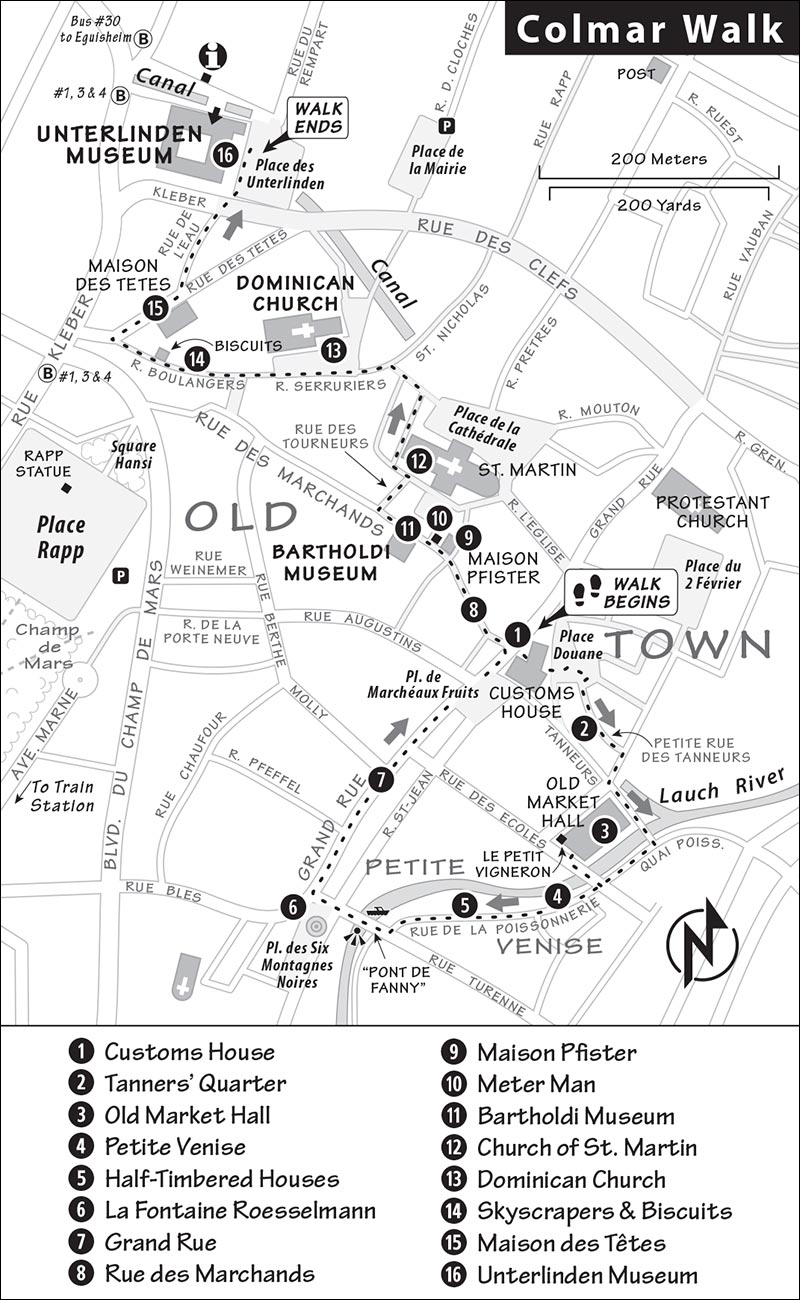
• Start in front of the Customs House (where Rue des Marchands hits Grand Rue). Face the old...
1 Customs House (Koïfhus)
Colmar is so attractive today because of its trading wealth—and that’s what its Customs House was all about. The city was an economic powerhouse in the 15th, 16th, and 17th centuries because of its privileged trading status.
In the Middle Ages, most of Europe was fragmented into chaotic little princedoms and dukedoms. Merchant-dominated cities were natural proponents of the formation of large nation-states (proto-globalization), and they banded together for free trade and mutual defense. Rather than being ruled by some duke or prince, these “trading leagues” worked directly with the emperor.
The Hanseatic League was the super-league of northern Europe. Prosperous Colmar was a leading member of a similar but much smaller league of 10 Alsatian cities called the Decapolis (founded 1354).
Looking up at the Customs House, imagine how this “Alsatian Big Ten” enjoyed special tax and trade privileges, including the right to build fortified walls and run their internal affairs. As “Imperial” cities, they were ruled directly by the Holy Roman Emperor rather than by one of his lesser princes. By banding together, they negotiated to protect this special status and won the Holy Roman Emperor’s promise not to sell them to some other, likely more aggressive, prince. The towns of the Decapolis enjoyed this status until the 17th century.
This street—Rue des Marchands—is literally “Merchants Street,” and throughout the town you’ll notice how street names bear witness to the historic importance and power of merchants in Colmar. Thirty yards in front of the Customs House, find the carved plaque in the wall at #23. This is a “stone of banishment,” declaring that the town’s merchants kicked a noble family out of Colmar, and that the family could never live here again.
Step up closer to the Customs House. Delegates of the Decapolis would meet here to sort out trade issues, much like the European Union does in nearby Strasbourg today. In Colmar’s heyday, this was where the action was. Notice the fancy green and yellow roof tiles. Note also the plaque above the door to the right with the double eagle of the Holy Roman Emperor—a sign that this was an Imperial city.
Walk under the archway to Place de l’Ancienne Douane and face the Frédéric-Auguste Bartholdi statue of General Lazarus von Schwendi—arm raised (Statue of Liberty-style) and clutching a bundle of local pinot gris grapes. He’s the man who brought that grape from Hungary to Alsace. Today, pinot gris accounts for more than 15 percent of wine production here.
From here, do a 360-degree spin to appreciate a gaggle of gables. This was the center of business activity in Colmar, with trade routes radiating to several major European cities. All goods that entered the city were taxed here. Today, it’s the festive site of outdoor cafés and, on many summer evenings, fun wine tastings (open to all). Through much of the summer, local vintners each get 10 days to share their wine here at the site of the town’s medieval wine fair.
• Follow the statue’s left elbow and walk down Petite Rue des Tanneurs (not the larger “Rue des Tanneurs”). The half-timbered commotion of higgledy-piggledy rooftops on the downhill side of the fountain marks the...
2 Tanners’ Quarter
These 17th- and 18th-century rooftops competed for space in the sun to dry their freshly tanned hides, while the nearby river channel flushed the waste products. When the industry moved out of town, the neighborhood became a slum. It was restored in the 1970s—Colmar was a trendsetter in the government-funded renovation of depressed old quarters. Residents had to play along or move out. At the street’s end, carry on a few steps, and then turn back. Notice the openings just below the roofs where hides would be hung out to dry. Stinky tanners’ quarters were always at the edge of town. You’ve stepped outside the old center and are looking back at the city’s first defensive wall. The oldest and lowest stones you see in the buildings are from 1230, now built into the row of houses; later walls encircled the city farther out.
• Walk with the old walls on your right to the first street, Rue des Tanneurs. Turn left (at the Old Market Hall), then cross the bridge for an iconic Colmar view. Turn right onto Quai de la Poissonnerie and walk to the next bridge, where you’ll recross the river to enter the market hall on its far side.
3 Old Market Hall
Locals have shopped at Colmar’s historic market since 1865 for fish, produce, and other products (originally delivered by flat-bottomed boat). You’ll find picnic fixings and produce, sandwiches and bakery items, wine tastings, and clean WCs. Several stands are run like cafés, and there’s even a bar (generally Tue-Sat 8:00-18:00, Sun 10:00-14:00, closed Mon). Outside, on the market hall’s northwest corner at Rue des Ecoles, find the fountain with a copy of Bartholdi’s joyful sculpture, Le Petit Vigneron (Young Wine Maker of Alsace).
• Return to the flower-bedecked Rue des Ecoles bridge and turn right on Rue de la Poissonnerie. Follow the flower-box-lined canal leading into...
4 Petite Venise
This neighborhood, a collection of Colmar’s most colorful houses lining the small canal, is popular with tourists during the day. But at night it’s romantic, with fewer crowds. It lies between the town’s first wall (built to defend against arrows) and a later wall (built in the age of gunpowder). Medieval towns needed water. If they weren’t on a river, they’d often redirect parts of nearby rivers to power their mills and quench their thirst. Colmar’s river was canalized this way for medieval industry—to provide water for the tanners, to allow farmers to barge their goods into town (see the steps leading from docks into the market hall), and so on.
• As you stroll, notice the picturesque...
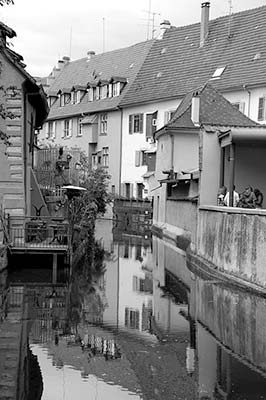
5 Half-Timbered Houses
The pastel colors on these buildings date from this generation—designed to pump up the cuteness of Colmar for tourists. But the houses themselves are historic and real as can be. See the sidebar to learn more about this unique architectural style.
Enjoy the creaky houses toward the end of Rue de la Poissonnerie, as the lane narrows into a sort of alleyway. When you emerge, on your right is “Pont de Fanny,” a bridge so popular with tourists for its fine views that you see lots of fannies lined up along the railing. Walk to the center of the bridge and add yours to the scene. Look for examples of the flat-bottomed gondolas used to transport goods on the small river. Today, they give tourists sleepy, scenic canal tours (see “Tours in Colmar,” earlier).
• Cross the bridge, walk a short block, and find a fountain in the square to your left.
6 La Fontaine Roesselmann
Another Bartholdi work, this fountain was commissioned to honor Jean Roesselmann, a 13th-century town provost who died defending his beloved city when the bishop of Strasbourg tried unsuccessfully to seize it.
• Take the second right leading from the square onto...
7 Grand Rue
Walk for several blocks to the Customs House, where this walk began. As you stroll, enjoy the Alsatian architecture and be thankful that WWII bombs spared this town. (Freiburg, about this size, just over the border in Germany, was 80 percent destroyed and consequently has very little of this Old World charm.)
With your back to the Customs House, look uphill along 8 Rue des Marchands—one of the most beautiful intersections in town. (The ruler of Malaysia was so charmed by this street that he had it re-created in Kuala Lumpur.)
• Walk uphill on Rue des Marchands for a couple of blocks, and you’ll come face-to-face with the...
9 Maison Pfister (Pfister House)
This richly decorated merchant’s house dates from 1537. Here the owner displayed his wealth for all to enjoy (and to envy). The external spiral-staircase turret (with slanted windows), a fine loggia on the top floor, and the bay windows (called oriels) were pricey add-ons. The painted walls indicate this guy was one of those big-city liberal elites with a taste for Renaissance humanism.
The wine shop on the ground floor sells fine wines, but they’re actually most proud of their locally made whisky. The staff enjoys offering tastings, so go ahead, take a hit and see what you think—ask, “Goûter un whisky Alsatian?” (goo-tay unh wee-ski al-sah-see-unh?)
Now that you’re in a happy mood, stand outside facing the Pfister House for a little review. Find the four main styles of Colmar architecture: Gothic (move to the right to see a part of the church), medieval half-timbered structures, Renaissance (that’s Mr. Pfister’s place), and (across the lane on your right) the urbane and elegant shutters and ironwork of Paris from the 19th century.
• As you move past the spiral staircase, check out the attached building (at #9).
10 Meter Man
The man carved into the side of this building was a drapemaker; he’s shown holding a bar, Colmar’s local measure of about one meter (almost equal to a yard). In the Middle Ages, it was common for cities to have their own units of length; it’s one reason that merchants supported the “globalization” efforts of their time to standardize measuring systems.
The building shows off the classic half-timbered design—the beams (upright, cross, angular supports) are grouped in what’s called (and looks like) “a man.” Typical houses are built with a man in the middle flanked by two “half men.”
Two doors farther up the street on the left is the 11 Bartholdi Museum, located in the home of the famous sculptor Frédéric-Auguste Bartholdi, creator of the Statue of Liberty. If it’s open, step into the courtyard and admire the bronze statue called The Grand Pillars of the World (for more on the museum, see here).
Next door (at #28) is a friendly café with a charming Art Nouveau facade and a delicate interior.
• A passage opposite the Bartholdi Museum leads you through the old guards’ house to the...
12 Church of St. Martin
The city’s cathedral-like church replaced a smaller Romanesque church that stood here earlier. It was erected in 1235 after Colmar became an Imperial city and needed a bigger place of worship. Colmar’s ruler at the time was Burgundian, so the church has a Burgundian-style tiled roof. Walk to your right to see the stork nest atop the church’s apse. Two storks have made this nest their home, and locals have named the pair Martin and Martine.
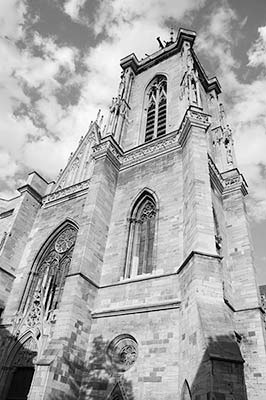
The side door still has the round Romanesque tympanum, starring St. Martin, from the earlier church. Notice how it fits into the pointed Gothic arch. This was the lepers’ door—marked by the four totem-like rows of grotesque faces and bodies. They could “go to church” but had to stay outside, away from other parishioners.
Walk left, under three expressive gargoyles, to the west portal. Facing the front of the church, notice that the relief over the main door depicts not your typical Last Judgment scene, but the Three Kings who visited Baby Jesus. The Magi, whose remains are nearby in the Rhine city of Cologne, Germany, are popular in this region. The church’s beautiful Vosges-stone exterior radiates color in the early evening. The dark interior holds a few finely carved and beautifully painted altarpieces.
• Continue past the church, go left around Jupiler Café, and wander up the pedestrian-only Rue des Serruriers (“Locksmiths Street”) to the...
13 Dominican Church
Compare the Church of St. Martin’s ornate exterior with this simple Dominican structure. While both churches were built at the same time, each makes different statements. The “High Church” of the 13th century was fancy and corrupt. The Dominican order was all about austerity. It was a time of crisis in the Roman Catholic Church. Monastic orders (as well as heretical movements like the Cathars in southern France) preached a simpler faith and way of life. In the style of St. Dominic and St. Francis, they tried to get Rome back on a Christ-like track. This church houses the exquisite Virgin in the Rosebush by Martin Schongauer (described on here). If the church is open, pop in to see this exquisite painting; it takes just a few minutes and is a highlight of the town.
• Continue straight past the Dominican Church, where Rue des Serruriers becomes Rue des Boulangers—“Bakers Street.” Stop at #16.
14 Skyscrapers and Biscuits
The towering green-and-brown house, dating from the 16th century, was one of Colmar’s tallest buildings from that age. Notice how it contrasts with the string of buildings to the right, which are lower, French-style structures—likely built after a fire cleared out older, higher buildings.
As this is Bakers Street, check out the one right here at #16. Maison Alsacienne de Biscuiterie sells traditional biscuits (cookies), including boxed Christmas delights year-round. Macarons and biscuits are sold by weight.
• Turn right on Rue des Têtes (notice the beautiful swan sign over the pharmacie at the corner). Walk a block to the fancy old house festooned with heads (on the right) and cross the street to view its facade.
15 Maison des Têtes (“House of Heads”)
Colmar’s other famous merchant’s house, built in 1609 by a big-shot winemaker (see the grapes hanging from the wrought-iron sign and the happy man at the tip-top), is playfully decorated with about 100 faces and masks. On the ground floor, the guy showing his bellybutton in the window’s center has pig’s feet.
Look four doors to the right to see an old bakery sign (above the big pretzel), which shows the boulangerie basics in Alsace: croissant, Kugelhopf, and baguette. Notice the colors of the French flag indicating that this house supported French rule.
Behind you, study the early-20th-century store sign trumpeting the tasty wonders of a butcher who once occupied this spot (with the traditional maiden with her goose about to be force-fed).
• Continue another block to a peaceful square where a canal runs under linden trees. Our walk is over. The venerable church and convent on your left house Colmar’s top attraction, the 16 Unterlinden Museum (entrance is on the right side of the building, across from the TI).
Sights in Colmar
▲▲▲Unterlinden Museum
This museum is Colmar’s touristic claim to fame. Its extensive yet manageable collection ranges from Roman Colmar to medieval winemaking exhibits to Monet and Renoir, and from traditional wedding dresses to paintings that give vivid insight into the High Middle Ages. But its highlight is one of the most unforgettable masterpieces of medieval Europe: Matthias Grünewald’s gloriously displayed Isenheim Altarpiece.
Cost and Hours: €13, Wed-Mon 9:00-18:00, closed Tue, good audioguide-€2; excellent English descriptions posted in most rooms, including handheld sheets; 1 Rue des Unterlinden, +33 3 89 20 15 50, www.musee-unterlinden.com.
 Self-Guided Tour
The museum has three parts: the 13th-century convent cloisters and chapel (where you’ll spend most of your time), the underground galleries, and the Ackerhof wing (modern art and temporary exhibits).
• After showing your ticket, step into the...
Cloister (Cloître): This soothing space was the largest 13th-century cloister in Alsace. Because the nuns didn’t leave the convent, this cloister was the one place they could feel the air and see the sky. This Dominican convent, founded by (and for) noblewomen in 1230, functioned until the French Revolution, when the building became a garrison.
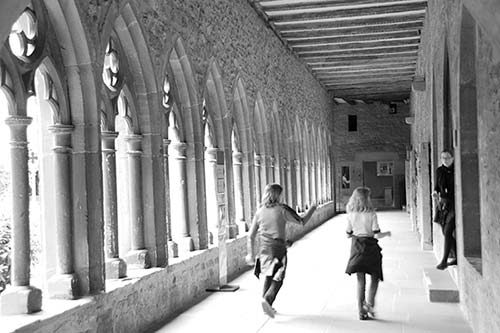
• Rooms with museum exhibits branch off from the cloister.
Medieval and Renaissance Art: Keep straight to find the first room (signed #3, filled with medieval paintings of Bible scenes), which leads to a room dedicated to Martin Schongauer, a local artist who painted multipaneled altarpieces and became famous as an engraver. His most famous work—the Virgin in the Rosebush—is displayed in Colmar’s Dominican Church, but the Unterlinden Museum claims the largest collection of his paintings.
As you enjoy the medieval and Renaissance art displayed in this part of the museum, remember that Alsace was historically German and part of the upper Rhine River Valley. You’ll see many wood statues, some of which are painted bright colors. The Three Kings (of Bethlehem fame) are prominently featured throughout in art from this region because their remains are believed to have ended up in Cologne’s cathedral (nearby, on the Rhine). You’ll also find small photos of engravings, illustrating how painters were influenced by other artists’ engravings (such as Schongauer’s). Most German painters of the time were also engravers (that’s how they made money—engraving versions of their art that could be duplicated to maximize sales).
• In the next room, find the small...
15th-Century Stained-Glass Windows: Note the fine details painted into the glass, originally intended “for God’s eyes only”—they were too tiny for worshippers to see from the floor below. The glass is a jigsaw puzzle connected by lead. Around here, glass this old is rare—most of it was destroyed by rampaging Protestants in the religious wars following the Reformation.
• Work your way through a room filled with wood carvings, including a fine polychrome statue of St-Jacques, then run headlong into Grünewald’s gripping...
Isenheim Altarpiece (c. 1515): This remarkable work is a polyptych—a series of two-sided paintings on hinges that pivot like shutters. As the church calendar progressed, priests would change which parts of the altarpiece were visible to the congregation by opening or closing these panels. (The museum has disassembled the altarpiece so that visitors can view all the individual panels. To understand how the altarpiece was originally put together, see the models on the side walls.)
Designed to help people in a medieval hospital endure horrible skin diseases (specifically St. Anthony’s Fire, later called rye ergotism)—long before the age of painkillers—this altarpiece is one of the most powerful paintings ever produced. Germans know it like Americans know the Mona Lisa.
• Invest the time here to study each panel (and if you have the museum’s audioguide, listen to each one described).
Panel 1, Crucifixion: Stand in front of this panel as if you were a medieval peasant, and feel the agony and suffering of the Crucifixion. It’s an intimate drama. Jesus’ suffering and death are drilled home: The horizontal crossbar bends not so much from Jesus’ weight as from his agony. His stretched, extended arms are pulled from their sockets, his fingers grotesquely contorted in pain—reminding the faithful that Jesus suffered for them. His mangled feet are swollen with blood. In turn, the intended viewers—the hospital’s patients—would have felt that Jesus understood their distress, because he looks like he has a skin disease (though the marks on his body represent lash marks from whipping).
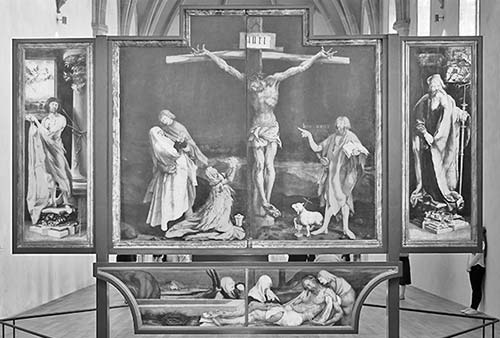
Study the faces and the Christian symbolism. The composition of the trio on the left is as sorrowful as it is powerful. John the Evangelist supports a swooning, white-faced Mary; she’s wrapped in the white shroud that will cover Jesus’ body in the tomb. Mary Magdalene, overcome by anguish, is on her knees. On the right, John the Baptist is shown with a little lamb—the symbol of Jesus’ sacrifice.
The outer panels feature two saints who helped the sick: St. Sebastian (on the left, called upon by those with the plague) and St. Anthony (on the right, called upon by those with ergot poisoning from rotten rye).
The predella (the horizontal painting below) shows the Lamentation over Jesus. His mourners wring their hands in sorrow. Jesus’ fingernails are black—as is the case with any corpse—and the cruel crown of thorns now rests at his feet.
• Walk around to the other side of this panel.
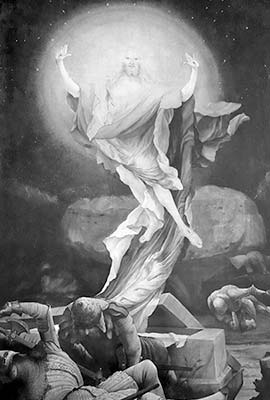
Panels 2-3, Resurrection and Annunciation: The Resurrection scene on the left is unique in art history. (Grünewald was a mysterious genius—an artistic loner who had no master and no students.) Jesus rockets out of the tomb as man is transformed into God. As if proclaiming once again, “I am the Light,” he is radiant. His shroud is the color of light: Roy G. Biv. Within the rainbow is the “resurrection of the flesh.” Jesus’ perfect white flesh would have offered hope to the patients who meditated on this. The happy finale is a psychedelic explosion of Resurrection joy.
The right panel depicts the Annunciation. The angel (accompanied by a translucent dove—barely visible—representing the Holy Spirit) is telling Mary she’ll give birth to the son of God. The normally sanguine Mary looks unsettled. She’s shown reading the Bible passage that tells of this event.
• Now turn around to see...
Panels 3-4, Nativity and Concert of Angels: Grünewald set his nativity scene (on the right) in the Rhineland, in a landscape that would have been familiar to him and the viewers of his artwork. The tender, loving, and much-adored Mary cradles (an unusually oversized) Baby Jesus—true to the Dominican belief that she was the intercessor for all in heaven. The infant plays with a rosary—a newly popular device in the late 15th century for organizing one’s prayers. Two angels tell shepherds of the birth while God, high above, oversees the victory of good over evil. The heavenly jam session (on the left) is the Concert of Angels.
• Walk around to view the reverse side.
Panels 4-5, Temptation of St. Anthony and St. Anthony Visits St. Paul: Looking at these last panels, zoom in on the agonizing Temptation of St. Anthony (on the left). Anthony is being ravaged by demons who look like the cast of an animated horror film. The figure in the lower left corner embodies the condition of those seeking treatment for St. Anthony’s Fire. His left arm has rotted to a stump, and his skin is a torturous mess. God the Father appears high above, as if coming to the rescue, consistent with a Christian message of hope. The scene on the right is set in the desert of Thebes; Anthony visits St. Paul, the hermit (wearing a spiffy palm-frond cloak), amid trees covered in lichen.
• Finally, turn around to see the sculpted part of the altarpiece.
Panel 6, St. Anthony on His Throne: Carved in wood by Nikolaus Hagenauer, St. Anthony sits on his throne like a king, flanked by church fathers St. Augustine (left) and St. Jerome (right). Small mortals bring gifts—a chicken and a pig. Below, Jesus shares a last supper with his 12 apostles.
• As you face Anthony, the door to your left leads out, then up the stairs to an exhibit of...
Decorative and Folk Art: This exhibit circles the cloister from one floor above and deserves a look. You’ll see wrought-iron signs, cast-iron ovens, massive church bells, and chests with intricate locking systems. There are also ornate armoires, medieval armor, muskets, pottery, kitchen tools, and antique jewelry boxes.
• Double back down to the room next to the museum entry, find the spiral stairs, and go down one floor to find...
Gallo-Roman Archaeology and Gothic Art: Follow Archéologie signs to find a room dedicated to the Mosaic of Bergheim, a portion of a luxurious mosaic from a third-century Roman villa in the town of Bergheim, which was discovered and moved here in 1848. It’s surrounded by Gallo-Roman carvings from the same age.
The next two rooms display 14th-century Gothic statues and capitals from Colmar’s Church of St. Martin and other area churches. Study the exquisite Romanesque detail of the capitals and the faces of the statues. Notice how some faces look eerily realistic, while others seem very stylized. Even though they endured the elements outdoors for more than 500 years, it’s still clear that they were sculpted with loving attention to detail. The masons knew their fine stonework would not be seen from below—it was, again, “for God’s eyes only.” The reddish stone is quarried from the Vosges Mountains, giving these works their unusual coloring. Notice the faint remnants of paint still visible on some statues—then imagine all these works brightly painted.
• In the next rooms you’ll see a painting by Lucas Cranach and more stained-glass windows. Next, turn right and enter the...
Alsatian Cellar (Cave Alsacienne): Open the door into this dark, shrine-like wine room containing 17th-century oak presses (once turned by animals) and finely decorated casks. Wine revenue was used to care for Colmar’s poor. Nuns owned many of the best vineyards around, and production was excellent. So was consumption. Find the cask with Bacchus and his big tummy straddling a keg. The quote from 1781 reads: “My belly’s full of juice. It makes me strong. But drink too much and you lose dignity and health.”
• Find your way back to the spiral stairs and walk down another level to find...
The Rest of the Museum: Follow signs reading Arts 19e-20e siècles to find a gallery showcasing 19th- and 20th-century paintings, including a few works by Monet, Renoir, Leger, Bonnard, and Dubuffet. One floor up a spiral stairway near this gallery is the museum’s small modern art collection, including a work by Picasso and a mesmerizing tapestry of his Guernica painting by Jacqueline de la Baume Dürrbach. Picasso recommended that she be commissioned to make this tapestry; art collector Nelson Rockefeller agreed. The Ackerhof and Piscine sections house more modern art and temporary exhibits.
Other Sights in Colmar
▲▲Dominican Church (Eglise des Dominicains)
This beautiful Gothic church is simple—in keeping with the austerity integral to the Dominican style of Christianity. It’s plain on the outside and stripped-down on the inside. Instead of gazing at art, worshippers would focus on the word of God preached from the pulpit.
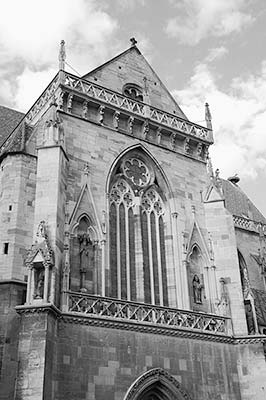
Cost and Hours: €2; Tue and Thu-Sun 10:00-13:00 & 15:00-18:00, closed Mon, Wed, and Jan-March; +33 3 89 41 27 20.
Visiting the Church: A mesmerizing medieval masterpiece—Martin Schongauer’s angelically beautiful Virgin in the Rosebush (1473), which looks as if it were painted yesterday—captivates visitors. Here, graceful Mary is shown as a loving and welcoming mother. Jesus clings to her, reminding the viewer of the warmth of his relationship with Mary. The Latin on her halo reads, “Pick me also for your child, O very Holy Virgin.” Rather than telling a particular Bible story, this is a general scene, designed to meet the personal devotional needs of any worshipper.
Nature is not a backdrop; Mary and Jesus are encircled by it. Schongauer’s robins, sparrows, and goldfinches bring extra life to an already impressively natural rosebush. The white rose (over Mary’s right shoulder) anticipates Jesus’ crucifixion. Angels hold Mary’s heavenly crown high above. The frame, with its angelic orchestra, dates only from 1900 and feels to me a bit over-the-top...as Neo-Gothic tends to be.
The painting was located in the Church of St. Martin until 1972, when it was stolen. It was recovered, then moved to the better-protected Dominican Church. Detailed English explanations are in the nave to the right of the painting as you face it. The contrast provided by the simple Dominican setting heightens the elegance of this Gothic masterpiece.
As for the rest of the church, the columns are thin, allowing more light to enter and more worshippers to see the speaker, even if the place is packed. The windows are precious 14th-century originals depicting black-clad Dominican monks busy preaching. Notice how windows face the sun on the south side, while the north side is walled against the cloister. If you look at the columns in the rear of the nave, you can see how 14th-century Colmar’s street level was about two feet below today’s.
▲Bartholdi Museum
This little museum recalls the life and work of the local boy who gained fame by sculpting America’s much-loved Statue of Liberty. Frédéric-Auguste Bartholdi (1834-1904) was a dynamic painter/photographer/sculptor with a passion for the defense of liberty and freedom. Although Colmar was his home, he spent most of his career in Paris, refusing to move back here while Alsace was German. While Lady Liberty is his most famous work, you’ll see several enjoyable Bartholdi statues gracing Colmar’s squares.
The entry courtyard is free and dominated by a bronze statue, Les Grands Soutiens du Monde (The Great Pillars of the World). It was cast in 1902—two years before Bartholdi died—and shares his personal philosophy. The world is supported by three figures representing patriotism, hard work, and justice. Mr. Hard Work holds a stack of books, symbolizing intellectual endeavors, and a hammer, a sign for physical labor. Ms. Justice has her scales. And Mr. Patriotism holds a flag and a sword—sheathed but ready to be used if necessary. All have one foot stepping forward: ahead for progress, the spirit of the Industrial Age.
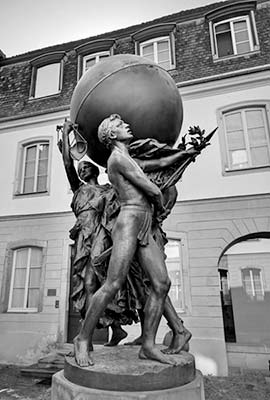
Cost and Hours: €5; Tue-Sun 10:00-12:00 & 14:00-18:00, closed Jan and Mon year-round; audioguide-€2, in heart of old town at 30 Rue des Marchands, +33 3 89 41 90 60, www.musee-bartholdi.fr.
Visiting the Museum: The English handout near the ticket desk gives ample background about the artist, and English info panels are in most rooms. As you tour the museum, notice how Bartholdi’s patriotic pieces tend to have one arm raised—Vive la France...God bless America...Freedom!
Ground Floor: You’ll see exhibits covering Bartholdi’s works commissioned in Alsatian cities (including nine for Colmar), commonly dedicated to city bigwigs and military heroes. The highlight is the Young Wine Maker of Alsace, who, guzzling from his small cask, offers a fun contrast to Bartholdi’s more staid subjects (see the full-size and smaller versions). The last room gives historical context about the loss of Alsace following the 1870 war. Backtrack to the entrance and the main staircase to the first floor.
First Floor: Climbing the stairs, you’ll pass a portrait of the artist at the first landing. Rooms to the left re-create Bartholdi’s high-society flat in Paris. The dining room is lined with portraits of his aristocratic family. In the far corner room, find a beautiful portrait of Bartholdi by Jean Benner and a painting of Bartholdi’s mother, who sits on a red chair, by Ary Scheffer. Bartholdi is depicted facing his mother, with whom he was very close: He wrote her daily letters while working in New York. Many see his mother’s face in the Statue of Liberty.
In the long hallway leading past the staircase, a room dedicated to Bartholdi’s most famous French work, the Lion of Belfort, celebrates the Alsatian town that fought so fiercely in 1871 that it was never annexed into Germany. Photos show the red sandstone lion sitting regally below the mighty Vauban fortress of Belfort—a symbol of French spirit standing strong against Germany. Small models give a sense of its gargantuan scale. (If you’re linking Burgundy with Alsace by car, you’ll pass the city of Belfort and see signs directing you to the Lion.)
The rest of the floor shows off Bartholdi’s other French works. Small wax models let you trace his creative process. Get close to the Martyr Moderne and feel his pain. The last room shows sculptures of important figures in French history—the statue of Vercingétorix is wild and mesmerizing.
Second Floor: The next (and top) floor is dedicated to Bartholdi’s American works—the paintings, photos, and statues that Bartholdi made during his many travels to the States. You’ll see statues of Columbus pointing as if he knew where he was going, and Lafayette (who was only 19 years old when he came to America’s aid) with George Washington.
One room is dedicated to the evolution and completion of Bartholdi’s dream of a Statue of Liberty. The sculptor devoted years of his life to realizing the vision of a statue of liberty for America that would stand in New York City’s harbor. Fascinating photos show the Eiffel-designed core in Bartholdi’s French workshop, the frame being covered with plaster, and then the hand-hammered copper plating, which was ultimately riveted to the frame. The statue was created in Paris, then dismantled and shipped to New York in 1886...10 years late. The big ear in the exhibit is half-size.
Though the statue was a gift from France, the US had to come up with the cash to build a pedestal. This was a tough sell, but Bartholdi was determined to see his statue erected. On 10 trips to the US, he worked to raise funds and lobbied for construction, bringing with him a painting (shown here) and a full-size model of the torch—which the statue would ultimately hold. (Lucky for Bartholdi and his cause, his cousin was the French ambassador to the US.)
Eventually, the project came together—the pedestal was built, and the Statue of Liberty has welcomed waves of immigrants into New York ever since. Thank you, Frédéric-Auguste Bartholdi.
Nightlife in Colmar
No one would come to Colmar solely for its nightlife. But if you’re out after dinner, there are a few good old town options.
Floodlit Town Stroll: Colmar puts lots of creative energy into its floodlit cityscapes, making evening strolls memorable. You could retrace the route of this chapter’s guided walk simply to enjoy the lights and architecture.
Wine Festival Stalls: Every July and August, five local vintners take 10 days each to show off local wines at a small wine festival. It’s held under the historic arches of the Customs House (daily 12:00-23:00, self-service, no food, great prices for nice wine).
Folk Dance Tuesdays: To give your wine tasting a little color, on most Tuesdays from mid-June to early September, look for Alsatian folk dancing at the town’s Folklore Evening (Soirée Folklorique, starts at 20:00, verify dates at TI).
Bar Scene: Rue du Conseil Souverain (stretching from the Customs House to the “Pont de Fanny”) has a fun run of watering holes where you can enjoy mellow outdoor seating with the locals on balmy evenings or interiors of your choice when it’s cold. Les Incorruptibles attracts younger locals, with an occasional DJ on weekends, some Alsatian edginess, and gourmet Belgian beers (1 Rue des Ecoles). Pub James’On has a big, pubby-warm interior and draws a marginally more mature crowd (2 Rue du Conseil Souverain). Sport’s Café is a Red Bull-and-foosball spot—the place to be if you want to watch a big sporting event on a big-screen TV with a gang of French enthusiasts (3 Rue du Conseil Souverain).
Sleeping in Colmar
Hotels are a reasonable value in Colmar. They’re busy on weekends in May, June, September, and October, and every day in July and August. Hotels have air-conditioning, buffet breakfasts, and elevators unless otherwise noted. If you have trouble finding a bed, ask the TI for help or look in a nearby village, where small hotels and bed-and-breakfasts are plentiful (see my recommendations in nearby Eguisheim, later).
$$$ Hôtel Quatorze**** is a high-end boutique hotel blending sleek, daringly modern design and a central location. It offers 13 rooms tucked behind a quiet patio (14 Rue des Augustins, +33 3 89 20 45 20, www.hotelquatorze.com, info@hotelquatorze.com).
$$$ Hostellerie le Maréchal,**** in the heart of La Petite Venise, holds Colmar’s most charming rooms. While some are on the small side, the setting is romantic, the decor is warm, and the service is professional (pay parking garage, 4 Place des Six Montagnes Noires, +33 3 89 41 60 32, www.hotel-le-marechal.com, info@le-marechal.com). The hotel is famous for the quality of its well-respected $$$$ restaurant; many French clients travel to dine here (€50-100 menus, reserve ahead).
$$ Hôtel Turenne*** is less central (a 10-minute walk from the city center) and greets you with a vast lobby and top service. Its 90 quite comfortable rooms are split between an older, more traditional wing (cheaper) and a new wing with more modern rooms. All rooms are well appointed and come with access to a spa (family rooms, pay parking—book ahead, 10 Route de Bâle, +33 3 89 21 58 58, www.turenne.com, infos@turenne.com).
$$ Grand Hôtel Bristol,**** near the train station, has little personality, but works if you want American-style comfort with a spa and fitness room (7 Place de la Gare, +33 3 89 23 59 59, www.grand-hotel-bristol.com, reservation@grand-hotel-bristol.com).
$$ Hôtel St. Martin,*** ideally situated near the old Customs House, is a family-run place that began in 1361 as a coaching inn. It has 40 mostly traditionally Alsatian rooms woven into its antique frame and joined together by a small courtyard (some rooms have no elevator access, family rooms, public parking nearby at Parking St-Josse, 38 Grand Rue, +33 3 89 24 11 51, www.hotel-saint-martin.com, colmar@hotel-saint-martin.com).
$$ Hôtel le Rapp,*** conveniently located off Place Rapp and near a big park, offers rooms for many budgets and a full-service bar. The cheapest rooms are tight but smartly configured; the bigger rooms are tasteful, usually with king-size beds. There’s also a small basement pool, a sauna, and a Turkish bath (family rooms, 1 Rue Weinemer, +33 3 89 41 62 10, www.rapp-hotel.com, rapp-hotel@calixo.net).
$$ Ibis Styles Colmar Centre faces Place Rapp and is well located with predictable, modern comfort (11 Boulevard du Champ de Mars, +33 3 89 23 26 25, https://all.accor.com, h7005@accor.com).
$ Chez Myriam et Caroline holds my favorite budget beds in Colmar. This ramshackle yet historic half-timbered house—the home of likeable winemakers André and Myriam and their grown kids—feels like a medieval treehouse soaked in wine and filled with flowers. The rooms are simple but spacious and plenty comfortable. Some have air-conditioning and many have kitchenettes (includes breakfast, big family apartments, fun tasting room—see “Helpful Hints” earlier, no elevator, 12 Rue de l’Ange, +33 3 89 41 58 72, www.location.alsace, location.alsace68@gmail.com). Leave your car at Parking de la Montagne Verte. There is no real reception—though good-natured Myriam or her daughter Caroline will likely be around (call if arriving after 20:00).
¢ Ibis Budget Hôtel offers bright, efficient, cookie-cutter rooms with three beds—one bed is a bunk—and ship-cabin bathrooms (secure pay parking, 10-minute walk from city center at 15 Rue Stanislas, +33 8 92 68 09 31, https://ibis.accorhotels.com, h5079@accor.com).
Eating in Colmar
Colmar is full of good restaurants offering traditional Alsatian or creative French menus for €20-35. Worth careful consideration (and reservations) are L’Arpège (fun and foodie), Wistub de la Petite Venise (romantic Alsatian), Cour des Anges (Bohemian-mellow), and L’un des Sens (peaceful wine bar with tapas). If you haven’t booked ahead, arrive right when places open for your best chance to land a table.
IN THE OLD CITY CENTER
The venerable Customs House, with a canal cutting right behind it on Place de l’Ancienne Douane, marks the touristic and historic center of Colmar. Dine here under the stars on a balmy evening to enjoy the floodlit scene of half-timbered buildings and strolling musicians. While you’ll be sitting side by side in a mosh pit of tourists, it’s hard to beat the location and fun vibe.
$$ Cour des Anges is an easygoing though a bit pricey place serving organic, locally grown products to discerning regulars in a quiet Alsatian courtyard or cozy interior just steps away from the tourist mobs. Order family-style here to maximize the experience—sharing salads, homemade tarte flambée, and more (closed Sun-Mon, 4 Place de l’Ancienne Douane, +33 3 89 24 98 02).
$ Brasserie Schwendi has fun, German pub energy inside with six beers on tap and hustling waiters. The big terrace with tight, regimented seating fills up on warm evenings. Choose from a dozen filling, robust Swiss Rösti plates or tarte flambée—I like the strasbourgeoise flambée (daily, facing the Customs House at 23 Grand Rue, +33 3 89 23 66 26).
$$ Le Petit Schlossberg, a few blocks away from the tourist beat, offers a reliable choice of traditional Alsatian, French, and Italian plats at a good value. There’s good outside seating, while the interior ambience matches its eclectic menu (closed Wed-Thu, 2 Rue de l’Ange, +33 3 89 41 07 43).
IN PETITE VENISE
$$ Wistub de la Petite Venise’s caring owners Virginie and Julien buck the touristy trend, combining a wood-warm, chalet ambience with the energy of an open kitchen. The limited menu, heavy on the meaty classics, is reliably tasty. Chef Julien is particularly proud of his jambonneau, choucroute, and foie gras (no outside seating, closed Wed, 4 Rue de la Poissonnerie, +33 3 89 41 72 59).
$$ Wistub Brenner offers quality, seasonal specialties and attentive service in a good atmosphere. Book ahead or arrive early for a table on the fun terrace. Their formula is freedom: You can choose any first course to go along with any main course on their €33 menu deal (daily, 1 Rue Turenne, +33 3 89 41 42 33).
$$ Bistrot des Lavandières is a welcoming place dishing up copious dinner salads and main courses and good-value fixed-price menus. There’s comfy outdoor and indoor seating (book ahead for an outdoor table, daily, 12 Rue St-Jean, +33 3 89 24 19 22).
$$ L’Epicurien is a local find serving a range of dishes featuring regional and French fare with absolutely no English but big smiles (book ahead or arrive at 19:00, great foie gras, closed Sun-Mon, 11 Rue Wickram, +33 3 89 41 14 50).
Lunch in Petite Venise: For the best selection of quick, inexpensive, and memorable lunch options, grab a bite in the $ Old Market Hall in Petite Venise. There is a handful of enticing little eateries to choose from, and the fun atmosphere can’t be beat (Tue-Sun, closed Mon). You can also get a dish to go or a picnic and find a nice canalside perch just outside.
OTHER MEMORABLE DINING OPTIONS
$$$ L’Arpège offers a special experience, like eating in a Monet painting where each waiter’s mission is to be sure you leave evangelical about Chef Jean-Martin’s cooking. He gives classic French dishes a creative modern twist with seasonal and organic ingredients, always respects the vegetarians with a serious dish, and finishes with a delightful dessert. Inside, you’ll enjoy candlelight and sleek rocking chairs. Outside, you dine in a homey and beautifully lit garden. It’s romantic either way (reservations essential, open for dinner Wed-Sat and lunch Tue-Sat, closed Sun-Mon, 24 Rue des Marchands, +33 3 89 24 29 64, www.larpegebio.com).
$ L’un des Sens is your Midnight in Paris rendezvous—a cool little wine bar three blocks from the nearest tourist offering. You’ll discover a laid-back interior and a leafy courtyard with rickety little tables. It’s ideal for savoring French wines with a shared tapas-style meal featuring local meats, cheeses, and some homemade hot dishes. Three small portions is about right for a couple (closed Sun-Mon, 18 Rue Berthe Molly, +33 3 89 24 04 37, www.lun-des-sens.alsace, helpful Manon speaks English and serves while Leslie does the food prep).
Sweets: MaDam Coffee sells fine sorbet and sweets; you can eat at an outdoor table or get it to go (daily, near Maison Pfister at 13 Rue des Marchands).
Colmar Connections
From Colmar by Train to: Strasbourg (about 2/hour, 35 minutes), Reims (TGV to Champagne—Ardenne station: hourly, 3 hours, most change in Strasbourg); Verdun (hourly, 3-5 hours, 2-3 changes, trips by TGV require 30-minute bus ride from Gare de Meuse); Beaune (hourly, 2-3 hours, fastest by TGV via Mulhouse, reserve ahead, possible changes in Mulhouse or Belfort and Dijon); Paris’ Gare de l’Est (hourly with TGV, 2.5 hours, 3 direct, others change in Strasbourg); Amboise (hourly, 5-6 hours, most with transfer in Strasbourg and Paris); Basel, Switzerland (hourly, 45 minutes); Karlsruhe, Germany (hourly, 2-3 hours, most with change in Strasbourg; from Karlsruhe, it’s 1.5 hours to Frankfurt, 3 hours to Munich).
Alsace’s Route du Vin
Alsace’s Route du Vin (Wine Road) is an asphalt ribbon that ties 90 miles of vineyards, villages, and medieval fortress ruins into an understandably popular tourist package. With France’s driest climate, this sunny stretch of vine-covered land has made for good wine since Roman days. Colmar and Eguisheim are well located for exploring the 30,000 acres of vineyards blanketing the hills from Marlenheim to Thann.
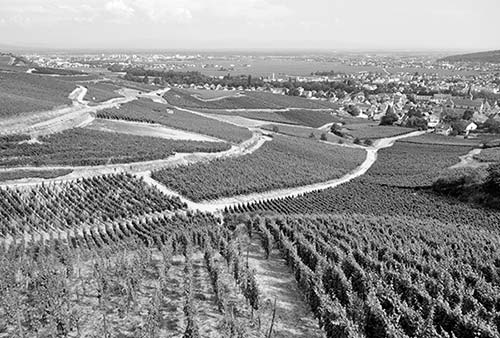
This is France’s smallest wine region. It’s long (75 miles) and skinny (a mile wide on average), with vineyards strategically planted between the flood line of the marshy plains and the frost line of the higher ground. Everyone scrambles for the finest land. Medieval towns grew low into regular farmland rather than higher into the pricier vineyard land. Local folk wisdom reminded young brides to marry into a family that grew grapes. The region’s 50 grand cru vineyards (the highest quality) get the privilege of putting up their names on big signs along the hillsides.
The towns with evocative castle ruins are strategically located at the ends of valleys. Their names can reveal their histories—towns ending with “heim” and “wihr” were born as farmsteads (Eguisheim was Egui’s farm, and I guess Riquewihr was the farm of a guy named Rick).
Peppering the landscape are Route du Vin villages, full of quaint half-timbered architecture corralled within medieval walls (for a practical review of what to look for as you wander through these towns, see the “Half-Timbered Houses of Alsace” sidebar, earlier). These villages take their flowers seriously. The Ville Fleurie flower competition revs up village pride through an annual contest designed to improve the beauty of the villages. Winners are awarded one to four flower petals; these ratings are posted on signs as you enter the village. While this contest takes place throughout France, it seems particularly important in Alsace.
As you tour the Route du Vin, you’ll see stork nests on church spires and city halls, thanks to a campaign to reintroduce the birds to this area. (Those nests can weigh over 1,000 pounds, posing a danger if they fall and forcing villagers to shore them up.) Storks make a noise something like that of a woodpecker. If you hear such a sound, look up: Nests can be on top of any tall building. Look also for Crucifixion monuments scattered about the vineyards—intended to get a little divine intervention for a good harvest.
PLANNING YOUR TIME
If you have only a day, focus on towns within easy striking range of Colmar. While some of the towns are amazingly preserved from centuries past, others were entirely rebuilt after World War II. Among the villages that emerged from World War II unscathed are the four I cover most extensively in this chapter: Eguisheim, Kaysersberg, Riquewihr, and Bergheim.
A sampling of two of the touristy villages is enough for most (visit them early to minimize crowds), then add a less-touristed place (like Bergheim or Turckheim, each of which can be seen in under an hour). Driving distances between villages are short. If taking a minibus tour, you can see a representative sampling in a half-day or cover the highlights of the entire region in a full day (including a few wine tastings). Electric bikes get you into the countryside painlessly (best rented in Kaysersberg or Eguisheim), buses can take you there with careful planning, and taxis can always take you home.
Towns are most alive during their weekly morning farmers markets (Mon—Kaysersberg and Bergheim; Fri—Turckheim; Sat—Ribeauvillé and Colmar). Riquewihr and Eguisheim have no market days.
GETTING AROUND THE ROUTE DU VIN
By Car
Drivers can pick up a detailed map of the Route du Vin at any area TI. To reach the Route du Vin north of Colmar, leave Colmar following signs to Ingersheim. Look for Route du Vin signs. For the quickest way to Eguisheim from Colmar, head for the train station and take D-30 and then D-83 south toward Belfort. In general, it’s better to navigate by town names than by road numbers.
Many drivers discreetly use some of the scenic wine-service lanes known as sentiers viticoles. If you do, drive at a snail’s pace. I’ve recommended my favorite segments.
By Train or Bus
The only Route du Vin village accessible by train from Colmar is pleasant little Turckheim (hourly, 10 minutes).
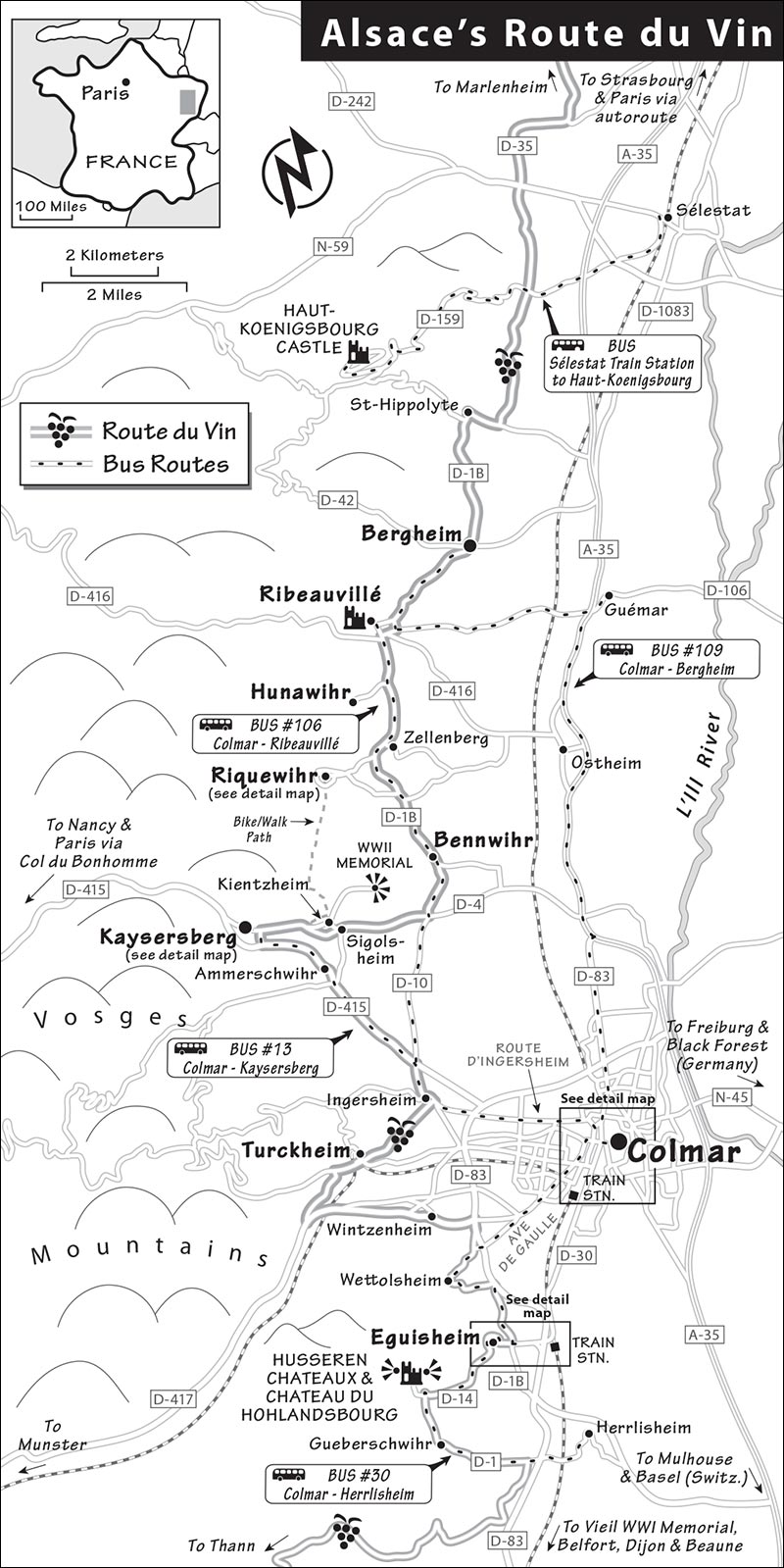
Several bus companies connect Colmar with villages along the Route du Vin daily except Sunday, but deciphering schedules and locating bus stops in Colmar is tricky. I have outlined the basics, but things can change; confirm bus schedules and stop locations at any TI or on the helpful website Fluo.eu/en. Schedules are posted at some stops. The “Alsace’s Route du Vin” map on here shows several bus routes.
Buses to Route du Vin villages stop at Colmar’s train station (see here) and in Colmar’s city center near the Unterlinden Museum (at or near the Théâtre stop—with shelters labeled Quai, each identified with a letter, no schedule posted at these stops—or a few blocks away by the cinema). The TI can show you the exact locations of these bus stops.
Here’s a rundown of service to key Route du Vin villages from Colmar:
Kaysersberg has reasonable service (Kunegel bus #13, direction: Le Bonhomme, 7/day, 30 minutes, Théâtre stop Quai G—no schedule posted). At the Colmar train station, find Quai E, to the left as you leave the station.
Riquewihr, Hunawihr, and Ribeauvillé have decent service (bus #106, roughly 6/day, 30 minutes to Riquewhir, 45 to Ribeauvillé, big midday service gaps in summer). Buses leave from the train station (to the right as you exit) and from the bus stop near the Scheurer-Kestner parking lot, behind the cinema on Rue de la 5ème Division (direction: Illhaeusern).
Bergheim and Ribeauvillé are served by bus #109 (roughly 4/day, 40 minutes, direction: St-Hippolyte, same bus stops as #106).
Eguisheim has lousy bus service. One bus leaves Colmar at noon (Mon-Sat, 15 minutes). Look for bus #30 (direction: Herrlisheim, leaves from Théâtre stop Quai F—no schedule posted, or from the train station, to the left as you exit on Quai F). Take this bus there and a taxi back (about €16). Eguisheim is so close that many get there by bike (see below).
Château du Haut-Kœnigsbourg has handy shuttle bus service from the Sélestat train station (explained on here).
By Taxi
Allow €16 from Colmar to Eguisheim and €35 from Colmar or Eguisheim to Kaysersberg or Riquewihr. For a group of four with limited time, this is a smart option. For recommendations, see here.
By Minivan Tour
These companies offer private group tours as well as shared tours. Prices are per person.
Ophorus Tours offers well-run trips from Colmar and Strasbourg to villages along the Route du Vin that include good wine tastings, informative walking tours, and time to wander (€150/full day, €100/half-day, +33 5 56 15 26 09, www.ophorus.com). L’Alsaciette runs tours departing from Colmar with a focus on food and wine (from €170/full day, €90/half-day, +33 7 71 74 45 80, www.alsaciette.com, contact-reservation@alsaciette.com).
With a Private Driver or Guide
Mariano Ruiz is a reliable driver who speaks English and can take you around the Route du Vin (+33 6 50 70 06 33, ruizcuenca.mariano@gmail.com).
Muriel Brun is an excellent guide for the Route du Vin if you have your own car (see here).
By Bike
Alsace is among France’s best biking regions. The Route du Vin has an abundance of well-marked trails and sentiers viticole (wine-service roads) that run up and down the slopes, offering memorable views and few cars but lots of sweat (rent an e-bike). Colmar’s TI has a general bike map, and bike rental shops know all the routes. Bikers can rent e-bikes in Colmar, Eguisheim, Kaysersberg, Riquewhir, or Ribeauvillé. Each make great starting points (though riding out of Colmar means passing through some urban sprawl).
Romans planted the first grapevines in Alsace more than 2,000 years ago. Wine and Rhine worked together to form the backbone of the region’s medieval economy. Barrels of wine were shipped on the nearby Rhine River to international destinations (Scandinavia, the Low Countries, and Britain were big buyers). This created enormous wealth for Alsatians; their investments financed many of the beautiful buildings and villages we see today. Until the 17th century, Alsace produced more (and better) wine than any other region in the Holy Roman Empire. The Thirty Years’ War, French Revolution, and Franco-Prussian War buried Alsace’s wine dominance. Two world wars didn’t help. Today, Alsace is working to get its foot back in the door of international wine markets—where the big money is.
To help earn this recognition, they eagerly welcome visitors. Most Route du Vin towns have wineries that give tours (some charge a fee), and scores of small producers open their courtyards with free and fun tastings. The cooperatives at Eguisheim, Bennwihr, Hunawihr, and Ribeauvillé, created after the destruction of World War II, provide a good look at modern and efficient methods of production. Before you set off, review “French Wine-Tasting 101” in the Practicalities chapter.
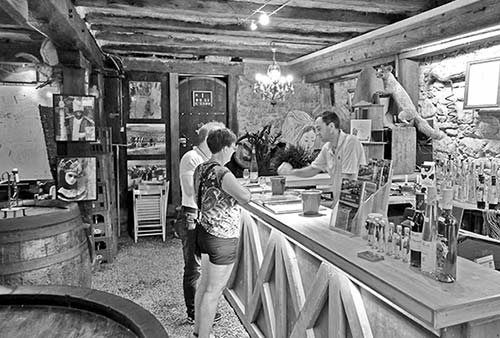
The simplest wines are blended from several grapes and usually called Edelzwicker. Despite being cheapest, these wines can be delicious and offer very good value.
Here are the key grapes to look for; the first four are the “noble grapes” of the Alsace:
Riesling is the king of Alsatian grapes. It’s more robust than sylvaner, but far drier than the German style. The name comes from the German word that describes its slightly smoky smell, with a note of goût petrol (“gasoline taste”).
Pinot gris is more full-bodied, spicier, and distinctly different than other pinot gris wines you may have tried.
Muscat is best as a before-dinner wine. Compared with other French muscat wines, the Alsatian version is dry, usually with a strong floral taste.
Gewürztraminer is “the lady’s wine.” Its bouquet is like a rosebush, its taste is fruity, and its aftertaste is spicy—as its name implies (gewürtz means “spice” in German). Drink this with pâtés and local cheeses.
Pinot noir, the local red wine, is light and fruity. While a few good exceptions exist, if you want a red wine with body, look beyond Alsace. Pinot noir is generally served chilled.
Sylvaner—fresh and light, fruity and cheap—is a good wine for a hot day.
Pinot blanc is easy to drink, as it’s a middle-of-the-road but refreshing wine. It’s neither too fruity or sweet nor too strong or dry—it’s also not too memorable.
Crémant d’Alsace, the Alsatian sparkling wine, is good—and much cheaper than Champagne. You’ll also see eaux-de-vie, powerful fruit-flavored brandies—try the framboise (raspberry) flavor.
Tasting in villages along the Route du Vin is a fun experience. As you explore, look for the word degustation. It’s usually free and informal. Just step up to the bar, enjoy a little small talk, and ask to taste. Vintners generally want you to follow a logical progression, and while they prefer that you buy a bottle or two—around €6-15 each—it’s OK to just taste (hopefully while showing genuine interest in their wines). Make a goal of getting to know the various grapes and which you like best. Don’t hesitate to use the spittoons. A smart taster can sample plenty of wine without getting tipsy. (If you’re bent on getting tipsy, finish things off with a taste of the local brandies, the eaux-de-vie.) In case you really get “Alsauced,” the French term for headache is mal à la tête.
Riding the 15-mile round-trip between Ribeauvillé and Kaysersberg via Hunawihr and Riquewihr along the upper sentier viticole yields sensational views but very hilly terrain (you can reduce some of the climbing by following lower wine-service lanes).
A bike path runs south from Colmar to Eguisheim following the river for a stretch (described on bike map available at Colmar’s TI). One of the most beautiful wine-service lanes in Alsace runs south from Eguisheim through Husseren to Gueberschwihr. You can also rent a bike in Colmar and take it on the train to little Turckheim and start from there.
Bike tours work well, too. Service-oriented Alsa Cyclo in Eguisheim runs tours using e-bikes (see here).
On Foot
Hikers can stroll along sentier viticole service roads and paths into vineyards from each town on short loop trails (each TI has brochures), or connect the villages on longer walks. Consider taking a bus or taxi from Colmar to one village and hiking to another, then taking a bus or taxi back to Colmar (Riquewihr and Kaysersberg make good combinations—see details on here). Hikers can also climb high to the ruined castles of the Vosges Mountains (Ribeauvillé is the best starting point).
Towns and Sights Along the Route du Vin
Vieil-Armand WWI Memorial (Hartmannswillerkopf)
These sights are listed in the order you’ll encounter them starting from Colmar.
SOUTH OF COLMAR
Eguisheim
This is the region’s most charming village (described later).
Gueberschwihr
This sweet little village 15 minutes south of Colmar sees almost no tourists and offers an excellent wine-tasting experience at Domaine Ernest Burn, where sincere Simone takes you on a tasting tour of their well-respected wines in an atmospheric tasting room (daily, best to call ahead, 8 Rue Basse, +33 3 89 49 20 68, www.domaine-burn.fr [URL inactive]). Follow the gorgeous wine lane due north from Gueberschwihr’s center to Eguisheim through Husseren.
Vieil-Armand WWI Memorial (Hartmannswillerkopf)
This powerful memorial evokes the slaughter of the Western Front in World War I, when Germany and France bashed heads for years in a war of attrition. It’s up a windy road above Cernay (20 miles south of Colmar). From the parking lot, walk 10 minutes to the vast cemetery, and walk 30 more minutes through trenches to a hilltop with a grand Alsatian view. Here you’ll find a stirring memorial statue of French soldiers storming the trenches in 1915-1916—facing near-certain death—and rows of simple crosses marking the graves of those who lost their lives here.
NORTHWEST OF COLMAR
Turckheim
With a picturesque square and a garden-filled moat, this quiet town is refreshingly untouristy. It’s an ideal destination for nondrivers, with quick trains from Colmar. Bikers can rent at the Colmar train station, take their bike on the train, and start from Turckheim to avoid riding through Colmar’s suburbs. Drivers will find easy parking by Turckheim’s train station.
Turckheim’s 13th-century walls are some of the oldest in the region. Drivers and train riders enter Turckheim through its walls at the France Gate, where—once upon a time—all foreign commerce entered. Just inside the wall you’ll see the TI, offering a helpful town map with a suggested stroll (Rue Wickram, +33 3 89 27 38 44, www.turckheim.com). Turckheim’s main drag (Grand Rue) runs east from here and makes for a nice wander among bakeries and restaurants.
Turckheim has a rich history and has long been famous for its wines. It gained town status in 1312, became a member of the Decapolis league of cities in 1354, and was devastated in the Thirty Years’ War. In the 18th century it was rebuilt, thanks to the energy of Swiss immigrants. Reviving an old tradition, from May to October there’s a town crier’s tour each evening at 22:00 (in Alsatian and French).
Turckheim’s “Colmar Pocket” Museum (Musée Mémorial des Combats de la Poche de Colmar) uses a sizeable collection of artifacts to chronicle the American push to take Alsace from the Nazis. It’s a hit with WWII buffs and me (€5, includes good detailed audioguide—or download the free app; daily 14:00-18:00, Sat-Sun also 10:00-12:00, shorter hours off-season, closed Nov-March; 25 Rue du Conseil, +33 3 89 80 86 66, https://musee.turckheim-alsace.com).
Kaysersberg
This is the most historic town after Colmar. It has an intriguing medieval center, Dr. Albert Schweitzer’s house, and plenty of hiking opportunities (described on here).
Bennwihr
After this town was completely destroyed during World War II, the only object left standing was the compelling statue of two girls depicting Alsace and Lorraine (outside its modern church). The war memorials next to the statue list the names of those who died in both world wars. During World War II, 130,000 Alsatian men ages 17 to 37 were forced into military service under the German army (after fighting against them). Most were sent to the deadly Russian front.
Riquewihr
This adorable town is the most touristed on the Route du Vin—and understandably so. If you find crowds tiresome, Riquewihr is exhausting (described on here).
Hunawihr
This bit of wine-soaked Alsatian cuteness is far less visited than its more famous neighbors and features a 16th-century fortified church that today is shared by both Catholics and Protestants (the Catholics are buried next to the church; the Protestants are buried outside the church wall). Park at the village washbasin (lavoir) and follow the path between vines up to the church, then loop back through the village. Kids enjoy Hunawihr’s small nature-conservation park, NaturOparc, where they’ll spot otters (loutre), over 100 storks (cigogne), and more (€12, cheaper for kids, see website for weekly hours, closed Nov-March, +33 3 89 73 72 62, https://naturoparc.fr). A nearby butterfly exhibit (Le Jardin des Papillons) houses thousands of the delicate insects from around the world (€9, daily 10:00-18:00, until 17:00 in Oct, closed Nov-Easter, +33 3 89 73 33 33, www.jardinsdespapillons.fr).
Ribeauvillé
This town, less visited by Americans, is well situated for hiking and biking. It’s a linear place with a long pedestrian street (Grand Rue). A steep but manageable four-mile loop trail leads from the top of town into the Vosges Mountains to three castle ruins and is good for hikers looking for a walk in the woods and sweeping views (allow 3 hours for the entire hike). Follow Grand Rue uphill to the Hôtel aux Trois Châteaux and find the cobbled lane leading up from there. St. Ulrich is the most interesting of the three ruins (allow 2 hours round-trip, or just climb 10 minutes for a view over the town—get info and map at TI at 1 Grand Rue, +33 3 89 73 23 23, www.ribeauville-riquewihr.com [URL inactive]). It’s a short, sweet, and very hilly bike loop from Ribeauvillé to Hunawihr and Riquewihr (can be extended to Kaysersberg). You can rent a bike at Ribo’Cycles (closed Sun-Mon, 17 Rue de Landau, +33 3 89 73 72 94).
Bergheim
With a well-preserved gate and charming architecture, sleepy Bergheim is happily untouristed. It’s my vote for the best nontouristy stop on the Route du Vin (described on here).
▲Château du Haut-Kœnigsbourg
This granddaddy of Alsatian castles stands atop a rocky spur of the Vosges Mountains, 2,500 feet above the flat Rhine plain. From here you’ll get an eagle’s-nest perspective over the Vosges and villages below. Be aware that the castle is hammered with visitors in high season, particularly on weekends, and you’ll walk up and down lots of steps.
Cost and Hours: €9; Tue-Sun 9:30-17:45, Mon from 10:30; June-Aug until 18:45, Nov-Feb shorter hours and closed at lunch; audioguide-€5, about 15 minutes north of Ribeauvillé, above St-Hippolyte, +33 3 69 33 25 00, www.haut-koenigsbourg.fr.
Tours: An English leaflet and posted descriptions give a reasonable overview of key rooms and history, but the one-hour audioguide is a smart investment.
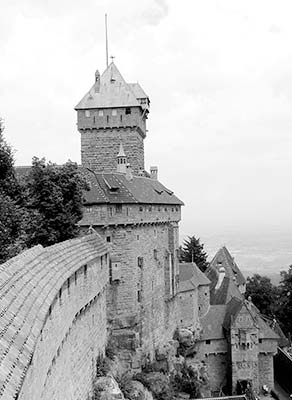
Getting There: An hourly shuttle bus usually runs to the castle from the Sélestat train station (verify in advance, €2.50, mid-April-mid-Sept daily 9:00-16:00, weekends only off-season, none Jan-Feb, 30 minutes, timed with trains, call château for schedule or check their website). Your shuttle ticket saves you €2 on the château entry fee. Parking can be a zoo in the summer—it’s limited to curbside spaces. Unless you arrive early, expect to park along the road well below or past the castle.
Visiting the Castle: While the elaborate castle was rebuilt barely 100 years ago, it’s a romantic’s dream, dramatically situated along its sky-high ridge. Its exhibits give helpful insight into this 15th-century mountain fortress.
Started in 1147 as an Imperial castle in the extensive network that served the Holy Roman Empire, Haut-Kœnigsbourg was designed to protect valuable trade routes. High on this rock, water was a constant struggle and its Achilles’ heel. Big as it is, the castle generally housed a garrison of no more than 40. It was under constant siege and eventually destroyed by rampaging Swedes in the 17th century. The castle sat in ruins until the early 1900s, when an ambitious restoration campaign began (a model in the castle storeroom shows the castle before its renovation).
Today’s castle—well furnished by medieval standards—highlights Germanic influence in Alsatian history with decorations and weapons from the 15th to 17th century. Don’t miss the top-floor Grand Bastion with its elaborate wooden roof structure and models showing its construction. There are cannons and magnificent views in all directions.
Eguisheim
Just a few miles south of Colmar’s suburbs, this circular, flower-festooned little wine town (pop. 1,500, 33 wineries), often busy with tourists, is a delight. Come here first thing to experience the village at its peaceful best (or spend the night). In 2013 it was named France’s favorite town, adding to its touristic fame. Eguisheim (“ay-gush-I’m”) is ideal for a relaxing lunch and vineyard walks. If you have a car, it makes a good small-town base for exploring Alsace. It’s also a cinch to day-trip here by car (easy parking; Parking de la Mairie is most central) or taxi (€16 from Colmar) and manageable by bike (see “Getting Around the Route du Vin—By Bike,” earlier), but barely accessible by bus.
Orientation to Eguisheim
The TI has information on bus schedules, festivals, and vineyard walks (generally Mon-Sat 9:30-12:30 & 14:00-18:00, Sun 10:00-13:00, shorter hours and closed Sun off-season, 22 Grand Rue, +33 3 89 23 40 33, www.tourisme-eguisheim-rouffach.com). They’re happy to call a taxi for you. A handy WC sits behind the TI.
Eguisheim’s bus stop is at the upper end of the village, close to Place Charles de Gaulle (same stop for both directions). The Petit Train leaves from Parking de la Mairie, two blocks south of the TI, and runs a scenic route through Eguisheim and into the vineyards (€8, hourly, 35 minutes).
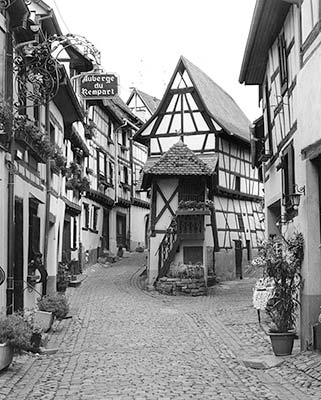
Alsa Cyclo Tours is a good outfit that rents top-quality bikes with GPS and recorded directions in English (April-Oct, closed Mon, just off the main square at 3 Rue de Pairis, +33 3 69 45 92 70, https://alsacyclotours.alsace). They also offer bike tours from Colmar (€49-125 for 2-6 hours with a guide, includes e-bike).
Eguisheim Walk
Draw a circle and then cut a line straight through it. That’s your plan with this inviting little town. The main drag (Grand Rue) cuts through the middle, with gates at either end and a stately town square in the center. And while Eguisheim’s town wall is long gone, it left a circular lane (Rue du Rempart—Nord and Sud) lined with gingerbread-cute houses. (For more on this type of architecture, see the “Half-Timbered Houses of Alsace” sidebar in the “Colmar” section, earlier.) Rue du Rempart Sud is more picturesque than Rue du Rempart Nord, but the Nord ramparts feel more real and lived in. I’d walk the entire circle.
• Start your self-guided walk near the TI and circle the former ramparts clockwise, walking up Rue du Rempart Sud (just after the Auberge du Rempart hotel).
Rue du Rempart Sud: Be on the lookout for small information plaques as you stroll. The most enchanting and higgledy-piggledy view in town is right at the start of the loop (at the tight Y in the road; go left and uphill). You’ll see that what was once the wall is now lined with 16th- and 17th-century houses—a cancan of half-timbered charm. You’re actually walking a lane between the back of fine homes (on the left) and their barns (on the right).
Look for emblems of daily life: Hearts cut into shutters once meant there was a fair maiden in that household looking for a man. The holes peppering exposed beams were from nails used to hold a plaster covering (like at #27). You’ll see religious and magical symbols (at #35), dates of construction with initials of owners on lintel stones, little hatch doors leading to wine or coal cellars, and so on. Everything looks sharp because the government subsidizes the work locals do to maintain their exteriors.
Along the way, you may bump into Chez Christophe’s saucisson-and-cheese stand (across from #49) with plenty of tasty samples (try the Munster cheese—made in the town of Munster just up the valley). For a sweeter experience, try the different flavors of pain d’epices Alsacien (spice bread) across from #89, a bit farther.
Rue du Rempart Nord: The loop takes a decidedly hip turn along its northern half as you pass an art gallery, a cool coffee shop, and a trendy bar. The second half also comes with lots of fixer-uppers and fewer tourists.
As you explore the town, you may come upon some of its 20 “tithe courtyards.” Farmers who worked on land owned by the Church came to these courtyards to pay their tithes (10 percent of their production). With so many of these courtyards, it’s safe to conclude that this was great farm country.
• When you’ve finished the loop, walk up Grand Rue to Eguisheim’s main square...
Place du Château Saint-Léon: The square is lined with fine houses; many were mansions for the managers of wealthy estates and vineyards owned by absentee landowners.
Fountains like the one here were important meeting points back when women would gather here to collect water, wash, and share gossip. The fountain sports a statue of St. Leo IX—the only Alsatian pope. Leo was likely born here in 1002. A bishop at just 24, he was famed for his pastoral qualities, tending the sick and poor and working to reform the Church (which had grown corrupt). After he was elected in 1048, Leo’s pontificate lasted just five years.
Above the fountain stands the town “castle” (now a private mansion built on the historic site of the castle) and the Chapel of St. Leo IX. The octagonal footprint of the castle survives from the 13th century. There’s been some kind of castle here for a thousand years—the first was the fortress of a local duke. After the French Revolution, the castle was state-owned, and, as often happened during that no-nonsense age, the state sold and dismantled it. But a local bishop later built a chapel on this spot.
• As you approach the church, you can see a stork nest on the bell tower and a statue of St. Leo IX above the doorway.
Chapel of St. Leo IX: This chapel honors Eguisheim’s hometown saint. Built in the Neo-Romanesque style popular in the 19th century and consecrated in 1894, it’s of little historic importance. But it’s beautiful inside and worth a peek to see how a Romanesque church may have been painted. Inside, the paintings, stained glass, and carvings are all in the Romanesque Revival style. After the paganism of the French Revolution, romantics in the late 1800s used this style to signal a spiritual revival—a new golden age of Christianity.
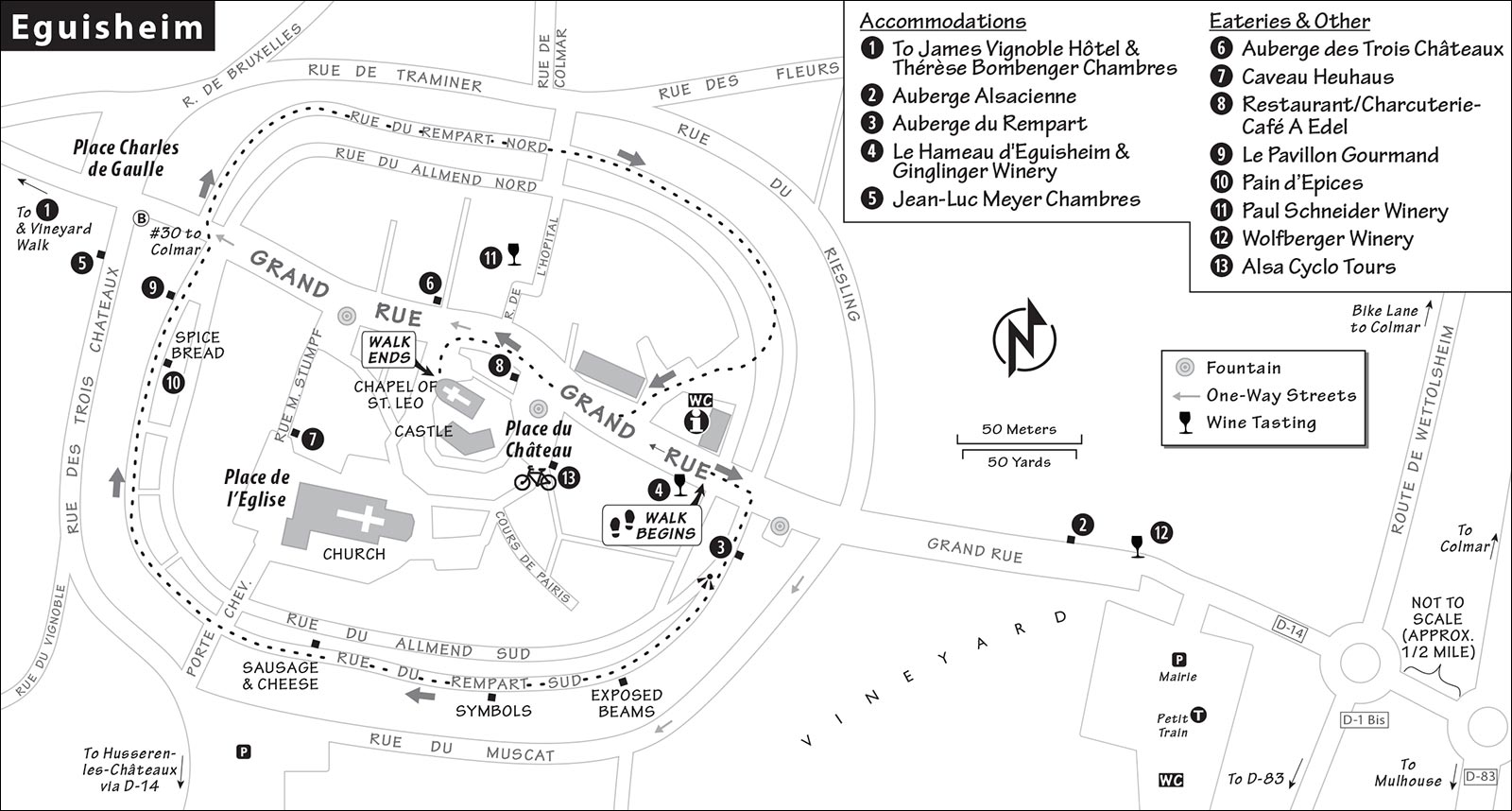
Linger awhile to soak it all in (drop a 50-cent coin into the box by the church entry for light). Flanking the altar, two fine stained-glass angels majestically spread their wings. To the right of the altar is a reliquary with a piece of Leo’s jaw. To the left is a statue of Leo.
• Your Eguisheim walk is done—time to taste some of the wine that made all this small-town beauty possible.
Sights in Eguisheim
Wine Tasting
Don’t leave without visiting one of Eguisheim’s many cozy wineries.
Pierre Henri Ginglinger is an organic winery offering fine wines and a café-like tasting room across from the TI (daily, 33 Grand Rue, +33 3 89 41 32 55, www.vins-ginglinger.com).
Paul Schneider’s independent winery, located in a one-time hospice, is still family-run after three generations. You can buy a glass of their wine (about €5) or pay €12 to sample a good mix of wines in the traditionally furnished tasting room. Ask English-fluent Claire Schneider to explain the abstract paintings on the walls (also found on the labels of their Grands Crus)—they give a modern twist to some old Alsatian traditions. Drop in to taste but call ahead for a short tour of the two cellars where they produce 100,000 bottles a year (daily 9:00-12:00 & 14:00-18:30, 1 Rue de l’Hôpital, +33 3 89 41 50 07, www.vins-paul-schneider.fr).
Wolfberger Winery is a big and slick corporate alternative to the others listed here. Located at the lower end of town, it offers a history and smell exhibition, a big shopping section, and a welcoming bar with a helpful staff eager to introduce you to their wine one tiny tasting glass at a time (tastings Mon-Fri 8:00-12:00 & 14:00-18:00, Sat-Sun from 10:00, 6 Grand Rue, +33 3 89 22 20 24, www.wolfberger.com).
Views over Eguisheim
If you have a car, you can follow signs up for Husseren and then for Route Les Cinq Châteaux. Park at the big Trois Châteaux parking lot; from there, it’s a five-minute walk to the ruined castle towers for a good view of the Vosges Mountains above and vineyards below. For even better views, you can drive to Château du Hohlandsbourg and ramble its ramparts (€7, check website for weekly hours, closed mid-Nov-March and Mon off-season, www.chateau-hohlandsbourg.com).
By mountain bike or on foot, find any path through the vineyards above Eguisheim for great views (the TI has a free map).
Sleeping in Eguisheim
Sleeping here is a good value. Hotels have air-conditioning unless noted.
$$ James Vignoble Hôtel**** offers 31 cushy rooms with top comfort, indoor and outdoor pools, and a sauna. The 10-minute walk from the town center is worth it for the vineyard views from your window or private terrace (family rooms, some rooms have patios or balconies, view breakfast room over pool and outside tables where you can touch the vines, pay parking, 6 Rue des Trois Pierres, +33 3 89 41 46 88, www.jameshotel-vignoble.com, reservation@jameshotel-vignoble.com).
$ Auberge Alsacienne,*** conveniently located near the lower parking area, has reasonably priced, sharp, and modern rooms in a picturesque building with a well-respected restaurant serving lunch only (no air-con, pay parking, 12 Grand Rue, +33 3 89 41 50 20, www.auberge-alsacienne.net, contact@auberge-alsacienne.net).
$ Auberge du Rempart is laid-back and a solid value: bright, airy rooms, big beds, and surprisingly elaborate decor above a café/restaurant in the town. Rooms get some noise from the restaurant on warm nights (great family suite, near TI at 3 Rue du Rempart Sud, +33 3 89 41 16 87, www.auberge-du-rempart.com, contact@auberge-du-rempart.com). The reception desk in the restaurant is usually open only during lunch and after 18:00.
CHAMBRES D’HOTES
$ Le Hameau d’Eguisheim, on the grounds of the Pierre Henri Ginglinger winery (convenient tastings), offers five big, bright, tastefully decorated rooms that include breakfast. Stéphanie has transformed the 17th-century place into a cozy abode with a nice upstairs terrace (2-night minimum, no air-con, 33 Grand Rue, +33 3 89 24 18 66, www.hameau-eguisheim.com, contact@hameau-eguisheim.com). She also rents several studios for up to five people (3-night minimum, fully equipped kitchen but no breakfast).
$ Winemaker Jean-Luc Meyer rents modern and well-appointed rooms, some with balconies (breakfast included, easy parking). They also rent apartments for 2 to 12 people (2-night minimum, no breakfast, air-con in some rooms, good family options, 4 Rue des Trois Châteaux, +33 3 89 24 53 66, www.vins-meyer-eguisheim.com, info@vins-meyer-eguisheim.com).
¢ Thérèse Bombenger is sweet, speaks some English, and has a contemporary French home just above Eguisheim with three rooms and nice views into the vineyards and over town (includes breakfast, communal fridge and microwave, across from James Vignoble Hôtel at 3 Rue des Trois Pierres, +33 3 89 23 71 19, +33 6 61 94 31 09, bommarietherese@gmail.com). She’ll pick you up at the station in Colmar if scheduled in advance and will do your laundry if you ask nicely.
Eating in Eguisheim
$$ Auberge des Trois Châteaux, straight out of Hansel and Gretel, has a cozy ambience and is the place in town for traditional Alsatian dinner (affordable plats du jour, closed Tue-Wed, 26 Grand Rue, +33 3 89 23 11 22).
$$ Caveau Heuhaus is a fun, old-time place just a few steps off the main drag. It serves a delicious tarte flambée and plats (closed Tue, 7 Rue Monseigneur Stumpf, +33 9 77 43 09 95).
$ Restaurant/Charcuterie-Café A Edel has inviting sit-down lunches, tarte flambée and quiche served with small salads, and good to-go selections. Eat in or get all you need for a fun picnic (Thu-Mon until 18:00, closed Tue-Wed, 2 Place du Château St. Léon IX, +33 3 89 41 22 40).
$$ Le Pavillon Gourmand is dressy, serving gourmet French and Alsatian cuisine from lamb to duck to pork, all with modern touches. Eat in a smart dining room or outside on the streetfront terrace (closed Tue-Wed, 101 Rue du Rempart Sud, +33 3 89 24 36 88).
Kaysersberg
The domain of Germanic princes for much of its history, Kaysersberg (“Emperor’s Mountain”) was of strategic importance, thanks to its location guarding the important route over the Vosges Mountains that links Colmar with the rest of France. Today, philosopher-physician Albert Schweitzer’s hometown offers a cute jumble of 15th-century homes under a romantically ruined castle with easy vineyard trails at its doorstep and plenty of tourists. Reasonable bus service from Colmar makes Kaysersberg a convenient day trip (bus #13, direction: Le Bonhomme, 7/day, 30 minutes, schedule at Colmar TI or www.fluo.eu/en).
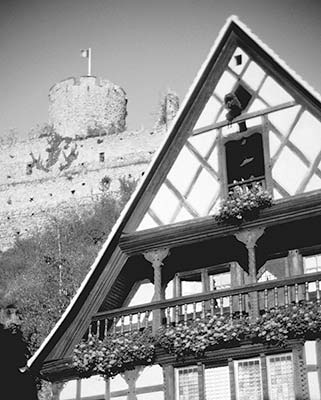
Orientation to Kaysersberg
The TI is two blocks from the town’s main entry, inside Hôtel de Ville at 39 Rue du Général de Gaulle (Mon-Sat 9:00-12:30 & 14:00-16:00, shorter hours off-season, closed Sun except July-Aug, +33 3 89 78 22 78, www.kaysersberg.com). Pick up town and valley maps, bus schedules, and bike rental info; avid hikers can buy a map of trails between wine villages (see “Walking/Biking Trails from Kaysersberg,” later).
Buses from Colmar serve the Rocade Verte stop at a parking lot on the village’s south side, just outside the town walls. Drivers find pay lots along the town’s ring road. Porte Basse Parking works best, but all lots are a quick and easy walk to the center.
Find WCs next to the TI and across from the Schweitzer Museum. Alsa Cyclo Tours rents top-quality bikes (closed Wed, 31 Rue du Général de Gaulle, +33 3 69 45 98 40, https://alsacyclotours.alsace).
Kaysersberg Walk
• Start your self-guided town stroll in the center of Kaysersberg at the main square, Place de la Mairie.
From the Main Square to the Church: Face the Hôtel de Ville (City Hall) and walk left along the main drag, Rue du Général de Gaulle. After a few steps, you’ll find a round arch from 1604 on the right. Walking through it, you’ll go past a former gunpowder storehouse—now a hall used for free art exhibits (TI access from here, too). Enjoy the art, then continue into a typical Alsatian courtyard with a wooden gallery, cascades of geraniums, and a public WC. The painting from 1993 celebrates the 700th anniversary of Kaysersberg’s status as an Imperial city. In 1293, the Holy Roman Emperor gave Kaysersberg trade and tax status and the right to build strong city walls (making the townsfolk very happy, as you can see in the painting). Later, in 1354, the town was a founding member of the Decapolis partnership of 10 Alsatian cities.
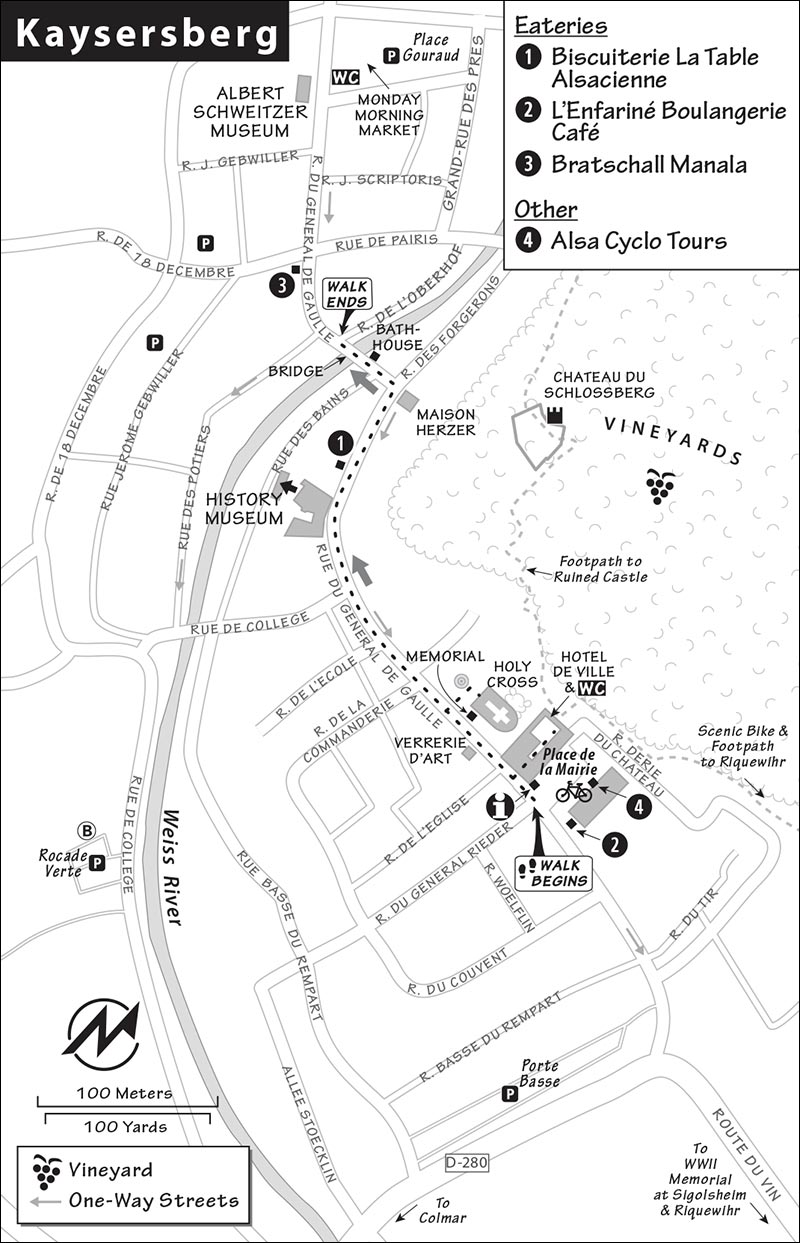
Return to the street, turn right, and continue up Rue du Général de Gaulle. The neighboring region of Lorraine is known for its handmade glass, and at Verrerie d’Art de Kaysersberg (across from the church), you can see glassblowers at work and browse their showroom (Mon-Sat 10:00-12:30 & 14:00-18:00).
Opposite the glassworks (on the side of the church), read some of the names on the war memorial—that’s a lot of war dead for a small town. We’re in France now, but all this fighting was done for Germany. In World War I, they fought on the Western Front. After Hitler annexed Alsace in World War II, local boys were sent to Russia and Poland (far from home, so they could kill the enemy with less guilt and couldn’t desert). Notice also the noncombatant victims (victimes civiles): Some were sent to death camps, and others died in bombing raids. In 1944, Allied bombers destroyed 45 percent of Kaysersberg—and that included many of its citizens.
• Now turn your attention to the church.
Church of the Holy Cross: In front of the church stands a fountain featuring the Roman Emperor Constantine—holding a cross and honored here because he was the first Christian emperor. Up on the simple Romanesque facade of the church is his mom, Helen (also holding a cross). She converted her son to Christianity and, according to Church lore, brought pieces of the True Cross to Rome from Jerusalem.
The church dates from the 13th and 14th centuries. Gothic was in high gear elsewhere, but back then Alsace was about a hundred years behind the artistic curve. Look at the tympanum (carved relief over the door, surviving from the 13th century) and notice how crude and naive it is. The carved red sandstone figures remind me of Archaic Greek statues.
Step inside (free, daily 9:00-18:00). The nave is Romanesque, but the side aisles, dating from the 15th century when the church was expanded, are more Gothic. The medieval stained glass was destroyed in 1944; what you see is modern. The moving statue of a crucified Christ is carved out of linden wood and painted. Notice the attempt to manage the perspective by making Jesus’ legs shorter than they actually would have been.
Walk up close to the altarpiece (from 1518) and study the finely carved Passion of Christ. These scenes show the events of Jesus’ last week—from entering Jerusalem (on the left) to the Resurrection (on the right). The carvings are high relief in the center but low relief in the wings so it will all fit when closed.
As you leave, look beneath the window in the transept (on the right) and check out the wooden statue of the Deposition, showing Christ after his death by crucifixion. That small metal chest below held the communion bread back in the 16th century.
• Continue walking along this busy street to #62, the...
Kaysersberg History Museum: This museum has a lovely courtyard restaurant but a forgettable three-room exhibit of religious and domestic artifacts—without a word of English (free, open July-Aug only). The nearby Biscuiterie La Table Alsacienne, tempting visitors with all the traditional baked goods, is more interesting (daily).
• Continue along the main drag to #101, on the right.
Maison Herzer: The huge house standing near the bridge dates from 1592 and was an old inn and bathhouse. Its finely restored ornamentation includes fun faces (could be the owners) and a gargoyle-supported pulley high above to lift hay to the attic. Look down the picturesque lane to its left and notice how some buildings have settled in the soft ground.
• Just before the bridge, walk a few steps upstream to see where the town’s canal starts—an example of the importance of waterpower in the Middle Ages.
Kaysersberg’s Bridge: The bridge was fortified on the upstream side to stop enemy boats from entering town. Look downstream; the helter-skelter roofs were for drying the hides of a tannery. On this 16th-century bridge, find the emblems of the Holy Roman Empire (double eagle) and of Kaysersberg (two bags with a belt to tie goods to the trader’s horse). These signs—plus the saint-in-a-cage at the end of the bridge (Constantine with the Holy Cross and Christ)—meant this bridge offered both political and religious protection for people coming and going.
At the end of World War II, as the Nazis were preparing to retreat, they planned to destroy the bridge. Locals reasoned with the commander, agreeing to dig an antitank ditch just beyond the bridge—and the symbol of the town was saved.
Cross the bridge and look back above the bathhouse with its stork nest. (Storks are choosy and often don’t like man-made nest cages like this one.) High on the ridge is the town’s 12th-century castle and city wall. Consider again the strategic importance of this place, in its day the last fortified point between a German realm and a French invasion.
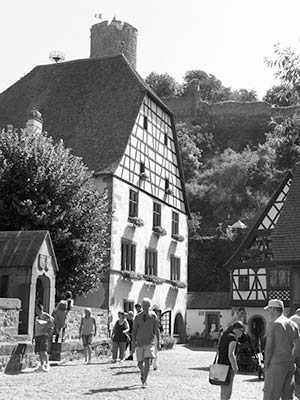
• Your walk is finished. The castle is an easy climb away, and the Albert Schweitzer Museum is 200 yards beyond the bridge at the top of the town.
SIGHTS IN KAYSERSBERG
Albert Schweitzer Museum (Centre Schweitzer)
The home of Dr. Albert Schweitzer, an interactive museum dedicated to world peace, may reopen in time for your visit following a lengthy renovation. Schweitzer was a Renaissance man who opened people’s eyes to conditions in the Third World (see website for hours and price, 126 Rue du Général de Gaulle, +33 3 89 78 11 11, www.ville-kaysersberg.fr/visite-decouverte/le-centre-schweitzer).
Walking/Biking Trails from Kaysersberg
Trails start near the TI. To find them, turn left out of the TI and walk out of the walls under the arch. Look for signs leading to a worthwhile 10-minute climb to the ruined castle (free, always open, great views, 113 steps up a dark stairway to the top of the tower). Loop back down behind the castle and enter the town near its 16th-century bridge. Wandering into the vineyards brings more views. Avoid trails leading from here to Riquewihr (a better trail is described next).
For a scenic 1.5-hour hike—or 40-minute bike ride—over vine-covered hills to Riquewihr, turn right on the main trail (near the TI). Everyone starts on a bike path (piste cyclable) toward Kientzheim (well marked with green crosses and bike icons). Hikers follow the green crosses left after about five minutes and join a hiking trail. Bikers follow the bike icons through Kientzheim, then join the sentier viticole bike path as it turns left and climbs through vineyards to wonderful views and on to Riquewihr.
NEAR KAYSERSBERG
World War II Sights
The Second World War careened wildly back and forth through this region. Some towns were entirely destroyed. Others made it through unscathed. Towns with gray rather than red-tiled roofs were rebuilt after 1945. Kientzheim has an American-made tank parked in its front yard, a wine museum in its castle grounds, and a network of tiny streams trickling down its streets (as was commonplace around here before World War II). The towns of Sigolsheim (which was the scene of fierce fighting—note its sterile, rebuilt Romanesque church) and nearby Bennwihr are modern, as they were taken and lost numerous times by the Allies and Nazis and completely ruined.
The hill just north of Kaysersberg houses a World War II Memorial and is still called “Bloody Hill” by locals (as it was nicknamed by German troops). From Kaysersberg, follow signs to Kientzheim and on to Sigolsheim, then follow Nécropole signs to find a spectacular setting (best at sunset), with a monument to the American divisions that helped liberate Alsace in World War II (find the American flag). Up the lane, a beautiful cemetery is the final resting place of 1,600 men who fought in the French army (many gravestones are Muslim, for soldiers from France’s North African colonies—Morocco, Algeria, and Tunisia). From this commanding viewpoint you can survey the entire southern section of the Route du Vin and into Germany. The castle hanging high to the north is the Château du Haut-Kœnigsbourg (described earlier).
Eating in Kaysersberg
If you’re hungry, $ L’Enfariné Boulangerie Café is good for a quiet, light lunch or a coffee break with no tourists around. Try their simple, delicious quiches and toasted sandwiches (gluten-free options, closed Mon, a block from the TI at 29 Rue du Général de Gaulle, +33 3 89 47 63 58). At the other end of town (near the Schweitzer Museum), dig into classic Alsatian fare or just enjoy coffee or dessert at $ Bratschall Manala (closed Mon-Tue, service inside or out, 104 Rue du Général de Gaulle, +33 3 89 47 38 49). A fun Monday-morning market happens across from the Schweitzer Museum, and a smaller food-and-drink market is at Rue du Général Rieder (south of the TI) on Friday evenings (16:30-19:00).
Riquewihr
This little village, wrapped in vineyards, is so picturesque today thanks to wine exports that brought prosperity to its citizens centuries ago. Its old-time wealth is evident by its many stone houses—more here than in any other village in Alsace. The village is a touristic fruitcake of shops, cafés, galleries, cobblestones, and flowers. Arrive early or visit very late, as midday crowds (many from river cruise ships) can trample its ample charms.
Orientation to Riquewihr
Buses stop at the lower end of town; drivers pay to park in spaces along the ring road or at lots all around the town. Wherever you park, find the Hôtel de Ville’s archway at the town’s lower end (where my short walk starts); the main drag runs uphill from here. The TI is halfway up at 2 Rue de la 1ère Armée (Mon-Sat 9:30-12:00 & 14:00-18:00, Sun 10:00-13:00, shorter hours off-season, +33 3 89 73 23 23, www.ribeauville-riquewihr.com [URL inactive]). A WC is behind the TI. For a taxi, call +33 6 46 84 40 05. Market day is Friday morning (near the Hôtel de Ville). You can rent bikes through the TI at Le Vélo Libre (2 Rue de la 1ère Armée, www.levelolibre.fr).
Riquewihr Walk and Wine Crawl
• Start this self-guided walk at the bottom of town, in front of the Hôtel de Ville. We’ll walk straight up the Rue du Général de Gaulle and emerge at the other end of town.
Notice the four flags: Europe, France, Alsace, and the village. In this bubbling town of 1,300 people, you realize that without wine and tourism, this place would have no economy. After passing under the arch, find the historic map and engraving (left) that help you imagine Riquewihr in 1644 and appreciate its double wall and moat.
Strolling up Riquewihr’s main street, Rue du Général de Gaulle, savor the architecture. (For help appreciating the half-timbered houses, see the “Half-Timbered Houses of Alsace” sidebar in the “Colmar” section, earlier.) Iron signs, designed to help illiterate shoppers know what’s for sale, date from the 15th century. Gird yourself, as on this walk you’ll also drop into three very different Alsatian wineries. All offer free tastings (hoping that you’ll buy something) and English-speaking staff.
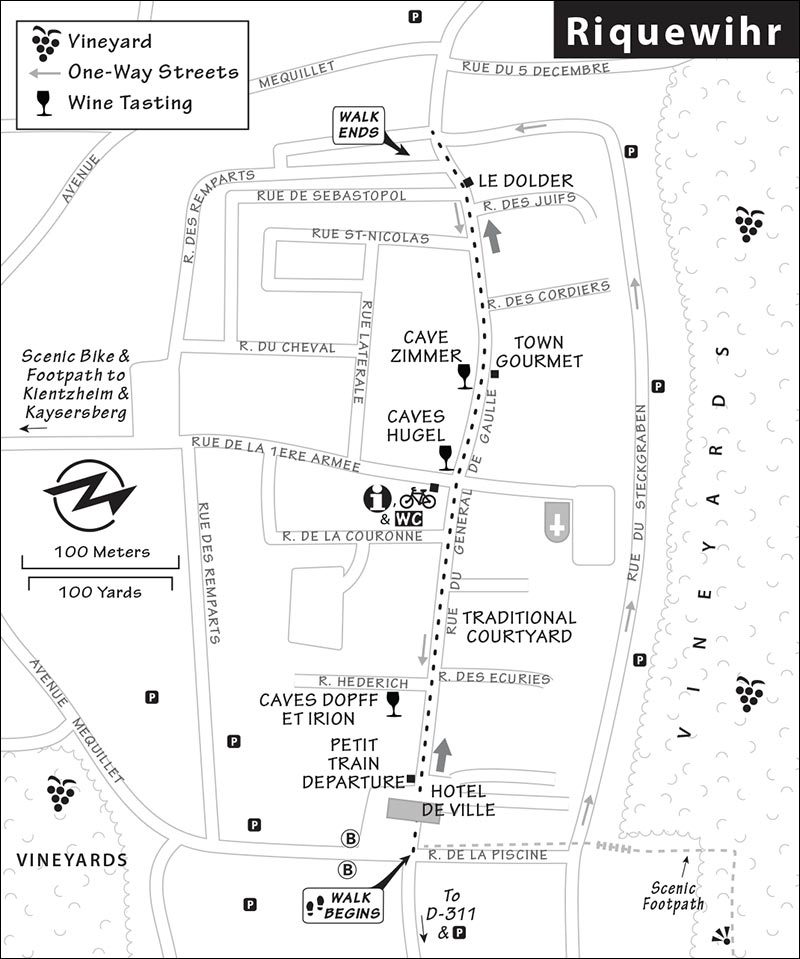
On the first corner above the Hôtel de Ville, a degustation sign marks a stone stairway leading down into the tasting cellar of Caves Dopff et Irion. They provide a spacious, user-friendly wine-tasting experience and a special counter for eaux-de-vie tastings (daily in season, 10:00-18:00).
• Back in daylight, continue your walk.
The beautiful vineyards around the village belonged to absentee princes. The impressive mansions you’ll see were the domains of men who managed the estate of a feudal lord and, in return, got a cut of the production. At #14 you can see what would have been considered a skyscraper in the 16th century—the highest half-timbered building in Alsace when it was built. Gaze left to see the massive stork nest atop #16. At #18, notice the broad arches for wagonloads of grapes. Venture into the courtyard (filled with restaurant tables; lookie-loos are welcome) with its traditional Alsatian galleries. At the entry is a collection of 200-year-old iron stove plates. Decorated with old German texts, these were placed behind the fire to protect the back wall and reflect heat out. In the far back corner, just past the old well, you’ll find the mammoth 1817 wine press that drained juice directly into the cellar.
• At the town’s main intersection (TI to the left), a street leads to two churches (Protestant to the right, Catholic to the left, neither of sightseeing interest).
Survey the scene with surviving 16th-century architecture all around. Before the age of private plumbing, public fountains were scattered through town. Notice the fine wood carvings decorating the corners and the iron sign advertising the vintner, Hugel, with the harvest team ready to bring in the grapes. It’s time for a tasting at Caves Hugel. This fine winemaker has an intimate tasting room overlooking the main drag (daily 9:00-12:00 & 13:00-18:00, classy English flier). You’ll feel (and taste) the pride of 13 generations of family tradition.
• To continue your wine education, head up to #29, on the left, for another tasting.
Through a round arch, stone steps lead into the 16th-century cellar of Cave Zimmer (pleasant courtyard café outside). While the business is too small to export to the US, the Zimmer family, with a tradition dating back to 1848, is happy to let you taste their work (small fee unless you purchase wine, daily 10:00-19:00, 42 Rue du Général de Gaulle).
• Staggering farther up the main street, you’ll see an iron sign for the town gourmet.
The word “gourmet” originated here in France, where each town in winemaking regions had an official wine judge, appraiser, and middleman. The gourmet was instrumental in connecting the vintner with the thirsty market. He facilitated sales and set prices. To judge the wine, he needed to have fine food to complement the tasting. The town appointed the gourmet, and the position—quite lucrative, as you can see by this grand house—was then handed down from father to son. While the traditional function of the gourmet died out in the 1930s, the concept of the person with the best food in town—the gourmet—survives to this day. Wander through the gourmet’s courtyards. Notice the nails on timbers designed to hold stucco.
After two more blocks of Riquewihr townscapes, you’ll come to one of the most impressive guard towers in Alsace—Le Dolder, from 1291. The Dolder Museum inside the tower has small rooms covering its history—but doesn’t merit the climb or the small entry fee.
• Walk under two guard towers and turn left outside the walls to stroll along the beautifully preserved ramparts.
In Alsace, older towns were fortified with walls built to withstand arrows. When they grew bigger—and war technology advanced to gunpowder and cannons—the townspeople built a stouter wall outside the original wall. In this case, it left an area in the middle for “newer” 18th-century houses. Notice how homes were built on top of the defensive walls. Loop back into town after passing the old wine press and find adorable Rue des Remparts—and explore.
Sights in Riquewihr
Tourist Train
At the town entry, you’ll see the petit train that choo-choos through the town and then along a scenic path above Riquewihr into the vineyards with picture-perfect views (€8, departs hourly April-Oct, 30 minutes).
Wine Tasting
The vines surrounding Riquewihr produce some of Alsace’s most prestigious wines. The village is lined with good places to sample them. Among the many options in town, I like Caves Dopff et Irion, Caves Hugel, and Cave Zimmer (all described earlier in my town walk).
Scenic Routes from Riquewihr
A footpath with grand views leads from just outside the town’s lower end. Follow the road a few blocks to the right as you face Hôtel de Ville. Hike up a stepped path for about 75 yards, then turn right on the trail to find views over Riquewihr and a bench to enjoy them from. Another 100 level yards lead to a paved lane (go left and up) and terrific views of hilltop Zellenberg and vineyards to the north. For the same views with a car, take D-311 from the roundabout at the town’s lower end toward Ribeauvillé. Drive just a short block and find the metal signs on the left (sentier viticole) and follow the small lanes up to wonderful views.
On the town’s south side, another sentier viticole leads to Kientzheim (then Kaysersberg). Start from the TI and head out Rue de la 1ère Armée, then follow bike icons to Kientzheim on this beautiful walk or bike ride. The lane rises, then drops into the village—revealing views all the way (allow 90 minutes to hike at a steady pace to Kaysersberg, 40 minutes by bike). Drivers are not allowed on this path.
Bergheim
While cutesy towns draw the crowds, Bergheim is a quiet Route du Vin village. And it’s quick and easy: There’s free parking all around the town, but the lot at the southern end is most convenient (with a WC, the stop for bus #109, and the start of my self-guided walk). Strolling through Bergheim, you’ll pass a handful of quiet cafés and a smattering of other businesses and shops (including a small grocery). There’s no TI, but there’s little need for one.
Bergheim Walk
On this 30-minute loop stroll, you’ll walk through the wall, down Grand Rue, past the City Hall, and along some smaller lanes back to where you started.
Start your walk at the southern parking lot with three big plane trees (easy to find when coming from Riquewihr or Ribeauvillé). Stroll across to the small flowery park (picnic tables at the ready) and marvel at the massive trunk of an ancient linden tree, then turn around and head into the village.
Bergheim never sprawled beyond its 14th-century walls, thanks to the higher land value of the surrounding vineyards. Study the design of the towering gate: Night watchmen surveyed the town for fires from the bell tower high above. The carved relief on the left recalls how this town—empowered, unusually, by Holy Roman Emperor Leopold II to grant asylum—provided sanctuary for people running from the law from 1530 to 1667. A total of 744 characters—like this guy happily mooning those pursuing him—took refuge in Bergheim.
Bergheim’s main drag, the Grand Rue, is lined by a narrow little canal for the first block. Notice the small iron gate 50 yards down. When lowered, the canal filled with water so that the laundry women could do their chores. The canal flows under the old laundry building, today the Auberge des Lavandières.
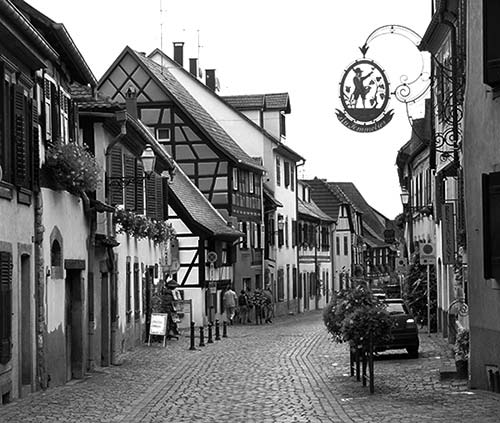
As you stroll, look for buildings with gates and courtyards ideal for horse carriages. Notice the fine half-timbered houses and the old iron hanging signs (look for sommelier, the local wine steward). This town, unlike its more touristy neighbors, still has a healthy economy that’s not tourist-dependent—with enough locals to keep a newsstand in business, a small grocery store, two hairdressers, and cars rather than tour groups on its streets.
It’s hard to grasp how old these places are. A highlight of the Unterlinden Museum in Colmar is the “Mosaic of Bergheim,” which once decorated the floor of a third-century Roman mansion in this town. If you were to dig beneath your feet, you’d find the remains of an ancient Roman town.
Bergheim’s nondescript church at its northern end comes with a stork nest on top, a lush garden, and an insect hotel (for pollination).
Stepping outside the town walls, look to the left to see the fortifications: inner walls (14th century) and outer walls (16th century). The inner wall was tall and skinny (handy for warding off arrows) and the outer wall was more squat and stout (better for protecting against cannon fire). The area in between was a moat; now it’s a handy place for gardens and car parking.
Continue a few steps outside the walls to visit the war memorial, dedicated not to heroes who died for their country but to the “victims of war.” Alsace was part of Germany during World War I. And in World War II, many Alsatians were also forced to fight for the Nazis, who sent them to the Eastern Front. Look for the “Tambow” plaque, memorializing a Russian POW camp where 5,000 to 10,000 Alsatian men died and the rest were kept captive until 1947.
Double back into town, and after a block turn right at the stop sign. Follow the street’s curve left and pop out onto Place du Dr. Pierre Walter in front of the City Hall, a delightful spot where the town’s Monday market is held (until 12:00). You’ll see the strikingly untouristy Eglantine Shop (artisanal jams and herbs), a nice wine-café for lunch, and a photogenic line of pastel half-timbered homes. The skinny pink one is just a single window wide. To finish your town loop, continue back toward the gate you entered through, noticing a fun balcony to the right that’s bedecked with flowers (and witches blowing in the breeze). A few blocks beyond that is the tower’s happy sanctuary seeker, still mooning all who pass.
From the roundabout by the southern lot, white signs lead to the solitary and peaceful German Military Cemetery (Deutscher Soldatenfriedhof). It’s a scenic five-minute drive to the parking lot and a five-minute steep hike from there. You reach a sad bluff blanketed with the tombs of 5,309 German soldiers who died in 1944 and 1945, three names per tombstone, nearly all very young. Almost no one goes here, but I find it thought-provoking to walk among these tombstones with a view of the Alsatian landscape they fought over.
Strasbourg
Strasbourg is France’s seventh-largest city (with 275,000 people) and your best chance to experience urban Alsace. It feels like a giant Colmar, with rivers, streetcars, and bikes galore. Long a humanist and intellectual center, today it has big-city energy and plenty to keep tourists busy. Walking its people-friendly streets, you’ll find generous space devoted to pedestrians and bikes, sleek trams, meandering waterways, and a mix of university students, Eurocrats, and street people. Located on the Franco-German border and with a name that means the “city of streets,” it’s the ultimate European crossroads.
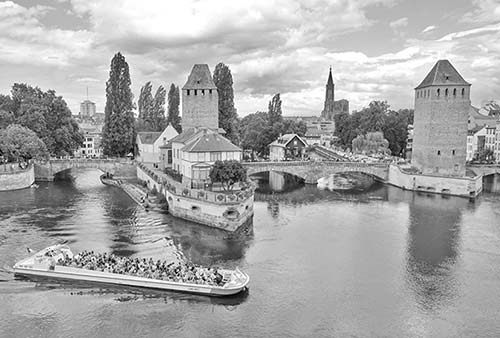
PLANNING YOUR TIME
Strasbourg makes a good day trip from Colmar and a fine overnight stop. And, thanks to high-speed TGV-train service, it’s also a handy stop for train travelers en route to or from Paris (baggage storage available). The city has four sights worthy of your time: an amazing cathedral, the Strasbourg Historical Museum, the Alsatian Museum, and the characteristic Petite France (Little France) quarter. While you could easily enjoy an entire day here, for a day trip from Colmar (for example), you’ll want five hours to appreciate the highlights.
Orientation to Strasbourg
TOURIST INFORMATION
Strasbourg’s TI faces the cathedral (daily 9:00-18:00, closes at 19:00 in summer and 17:00 in winter, 17 Place de la Cathédrale, +33 3 88 52 28 28, www.visitstrasbourg.fr, info@otstrasbourg.fr). You can learn about special events (like the summer light show at the cathedral), buy the city map (which describes a decent walking tour that supplements the one in this chapter), or rent an audioguide (€5.50) for a 1.5-hour tour that covers the cathedral and old city in more detail. The TI also has bike maps for the city and surrounding areas.
ARRIVAL IN STRASBOURG
By Train: TGV and local trains serve Strasbourg’s gleaming train station. Baggage storage is available (platform 1, daily 7:00-21:00). WCs are across from the stairs to platform 2. Ticket offices are on the north (nord) side. First-class rail-pass holders have access to the Salon Grand Voyageur lounge (see “Strasbourg Connections” at the end of this chapter for more).
To walk to the cathedral in 15 urban minutes, exit straight out of the station, cross the big square (Place de la Gare), walk up Rue du Maire Kuss (passing just left of Hôtel Vendôme), keep straight as it merges into pedestrian-friendly Rue du 22 Novembre, skirt Place Kléber and turn right onto Rue Grades Arcades, then turn left after the merry-go-round to find the cathedral and TI.
To get from the train station to the city center by public transportation, catch the tram under the station (€2.10, €3.50 round-trip, €4.60 day pass; buy from machines on platforms, then validate in skinny machines). Take tram #A (direction: Illkirch Graffenstaden) or tram #D (direction: Port du Rhin/Kehl Rathaus) three stops to Langross-Grand Rue, two blocks from the cathedral. (You can return to the station, Gare Centrale, from the same stop.)
By Car: You’re far better off day-tripping in by train. If you must drive into the city, take sortie #4 from A-35 and follow Centre-Ville and Cathédrale signs. Park at metered street spaces or in a central lot signed as Petite France, Gare Centrale, or Cathédrale.
For less money and stress, park outside of town and take the tram in. Parking lots with tram connections to Strasbourg’s center ring the city (€4.20/day, includes round-trip tram tickets for up to 7 people, www.cts-strasbourg.eu/fr/se-deplacer/Parkings-relais). Validate your parking ticket at the tram platform scanner both going and returning. For many, Elsau P+R is convenient; use sortie #4 from A-35 (take green-line “F” tram in direction: Centre-Ville, exit at Homme de Fer stop).
By Plane: The user-friendly Strasbourg-Entzheim airport (code: SXB, www.strasbourg.aeroport.fr), with frequent, often inexpensive flights to Paris, is connected by train to the main rail station (about €3.50, 10-minute trip).
HELPFUL HINTS
Quiet Transportation: Beware of quiet trams and bicycles—look both ways before crossing streets.
Museums, Passes, and Discounted Entry: It’s €7.50 apiece to enter each museum described in this section (free the first Sunday of the month). A €16 day pass is good for all museums. Anyone age 60 or older gets half-off any museum entry and the day pass.
Laundry: A handy launderette is at 15 Rue des Veaux, near some recommended hotels (daily 7:00-21:00).
Bike Rental: Vélhop is at the train station, one level below street level, with a helpful office that makes renting easy (daily, +33 3 67 70 70 70, https://velhop.strasbourg.eu). The city is very bike-friendly.
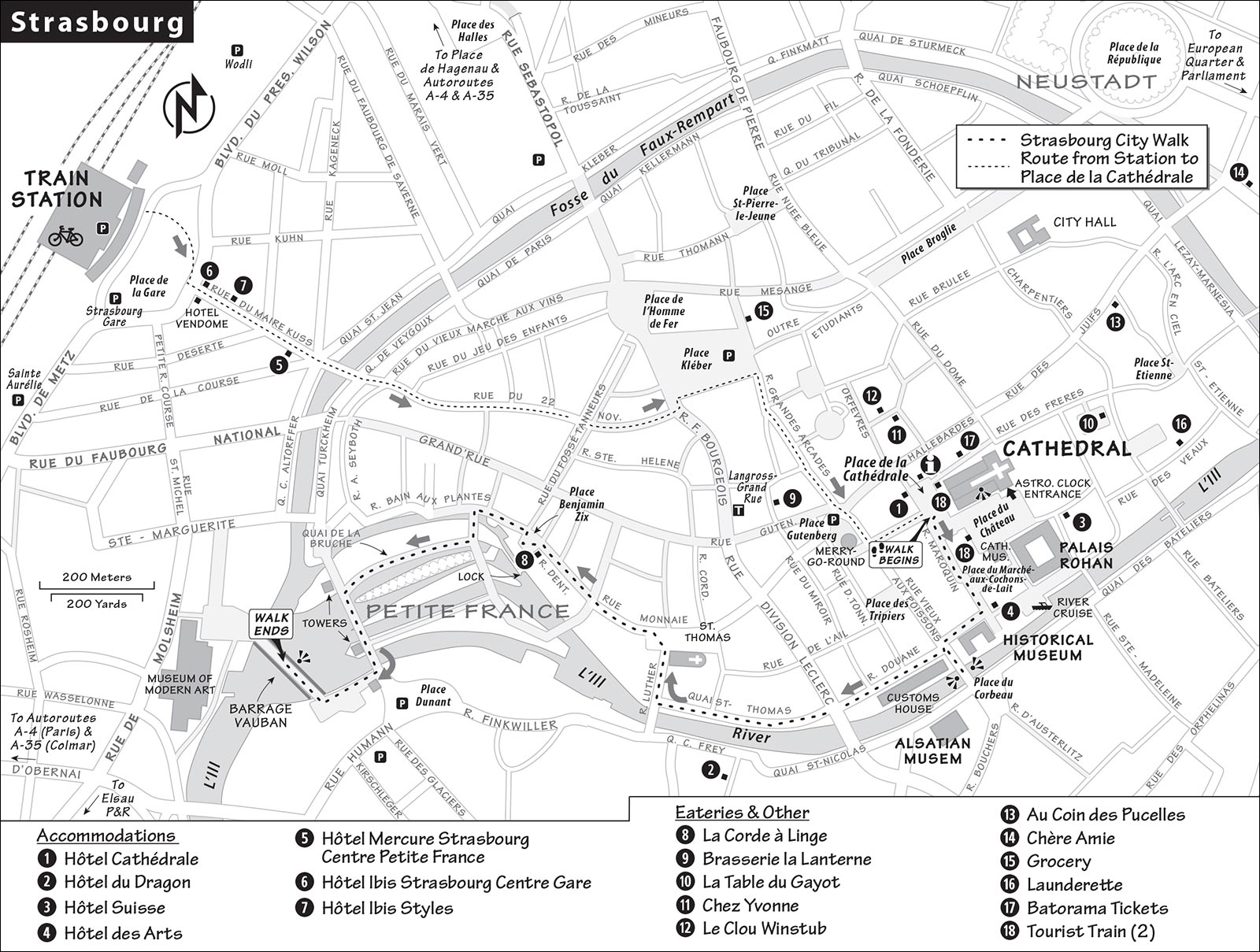
Taxi: Call +33 3 88 27 13 13 or +33 6 80 43 22 25.
Car Rental: All major companies are at or near the train station.
Route du Vin Tour: See here for recommended minivan tours of the Route du Vin.
Local Guide: Charming and smart Audrey Riehm works with a team of top-quality private guides (€250/half-day, www.book-a-guide.fr).
Free City Tours: An earnest guide team offers free, 1.75-hour city walks that, while informative, are works in progress. Look for the Free Tour sign in front of the cathedral and expect to reward your guide with a tip (Sat-Sun only, departs at 11:00, www.strasburg-tours.com).
Tourist Train: Strasbourg has two Petit Trains. One does a scenic loop around the city’s historic core, starting at the TI and running from the cathedral to the Barrage Vauban dam and back (€8, 40-minute loop, daily Feb-Nov generally 10:00-18:00); the other starts 50 yards outside the cathedral’s right transept and does a loop through the German-built Neustadt neighborhood (€8, 45-minute loop, daily April-Oct generally 10:00-18:00).
Sights in Strasbourg
I’ve linked Strasbourg’s four most important sights (the cathedral, Historical Museum, Alsatian Museum, and La Petite France neighborhood) with walking directions; visiting all four sights should take about four hours.
• Start on the square in front of the cathedral, far enough back to take it all in; or, better, grab a café table and savor the scene from your chair.
Place de la Cathédrale
Since Roman times, this square around the cathedral has been the heart of the city—the stage upon which Strasbourg’s life plays out. Appreciate the architecture all around you—steeply sloping roofs with openings to air their attics line the square behind you. The dark half-timbered building to your left, next to the TI, was the home of a wealthy merchant (built in 1571) and symbolizes the virtues of capitalism that Strasbourg has long revered. Goods were sold under the ground-floor arches; owners lived above. Today, it’s a mediocre restaurant with a who’s-who-in-France clientele (photos of the famous patrons line the stairway inside), who must prefer ambience over cuisine.
Strasbourg made its medieval mark as a trading center and never looked back, milking its position at the crossroads of Europe and its access to the important Rhine River to charge tolls for the movement of goods. With all that trade wealth, it could build a glorious cathedral.
Strasbourg’s location drew all kinds of people to the city (just like today), making it susceptible to new ideas. Just as the city flipped from German to French and back, it also flipped from Catholic to Protestant and back. As at Wittenberg, Martin Luther’s theses were posted on the cathedral’s main doors during the Reformation, and after the wars of religion, this cathedral was Protestant for more than 100 years. Then Louis XIV returned it to Catholicism in 1681.
▲▲▲Strasbourg Cathedral (Cathédrale de Notre-Dame)
If this church, with its cloud-piercing spire and deep red sandstone, drops your jaw today, imagine its impact on medieval tourists. The cathedral somehow survived the French Revolution, the Franco-Prussian War, World War I, and World War II. Today, it’s the big draw of the city; a steady stream of visitors goes through a security check and flows like a river through the building. Don’t be swept by the crowds—the interior is worth savoring slowly.
Cost and Hours: Free, daily 8:30-11:15 & 12:45-17:45 except no midday closure on Sun. The midday closing is for a skippable viewing of the astronomical clock (described next).
Narthex Climb: For €8, you can climb 330 steps to the top of the narthex for an amazing view over Strasbourg, Alsace, the Rhine, and the Black Forest (access from outside, on the right side of cathedral; daily 9:30-19:15, Oct-March 10:00-17:15, closed for lunch 13:00-13:30).
Visiting the Cathedral: Start with the exterior. The delicate Gothic style of the cathedral (begun in 1015, finished in 1439) is the work of a succession of about 50 master builders. An earlier church burned down in the 12th century, and Strasbourg was so wealthy that it rebuilt très fancy—with a lacy, innovative, see-through design—and tall (at 466 feet, it was the world’s tallest spire until the mid-1800s). A matching second tower was planned but was never built due to concern over stress on the foundations.
The dark-red stone differentiates this cathedral from other great Gothic churches in France. The stones, which date mostly from the 13th and 14th centuries, were quarried from the northern part of the Vosges Mountains. You’ll see this stone on fine buildings throughout Strasbourg (which contrasts with the softer, yellower stone of Colmar’s churches). Study the intricate carvings on the facade. Look for the sculpture over the lower section of the left portal (calm yet vicious, spear-toting Virtues getting revenge on those nasty Vices).
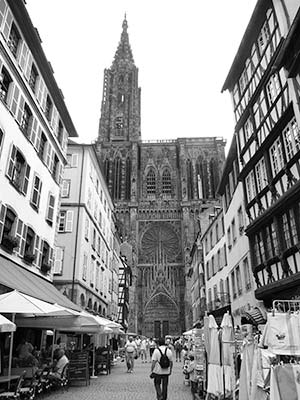
• Enter and walk down the center.
Interior: The nave is notable for its width and height. An exquisite, gold-leafed organ hangs high above. Admire the elaborately carved stone pulpit on the left, a Flamboyant Gothic masterpiece from the 1400s.
The cathedral’s marvelous stained glass, of which 80 percent is original, survives from the 12th to 15th century. Scenes on the nave’s lower left show various rulers of Strasbourg (notice how realistic their faces look), while those on the right depict Bible stories. The rose window is 36 feet wide. Its golden wheat symbolizes the fertile land of Alsace. The cathedral’s windows traveled a lot during World War II: hidden by the French in southwestern France first, then carted to northern Germany by the Nazis, and finally saved and returned by the Monuments Men (British and American troops dedicated to returning art to its rightful place after 1945).
Walk toward the choir and gaze into the Byzantine-like scene with 14th-century paintings still lining the apse. The central window was replaced after World War II, funded by the European Union. Notice the “brought to you by” EU flag above Mary and Jesus (binoculars help).
Walk to the right side of the apse (near the clock) to see another innovative-at-the-time feature, the eight-sided “pillar of the angels.” This column is the most original representation of the Last Judgment I’ve seen and is pretty wild for the 14th century. It’s structural yet so decorative, with exquisite carving and expressive faces showing the evangelists and angels with Christ above all.
The intricate astronomical clock from the 1500s—with more features than my phone—was a wonder of its age. It worked like clockwork for generations...until it broke in the 1700s. The workings weren’t replaced until 1842, but—with the help of its “Ecclesiastical Computer” (lower left) that recalibrates the entire thing each year—it’s been back at it ever since. Every quarter-hour, people gather for a tiny show (the bell rings and a stage of life—young or old—parades past the grim reaper).
• Pass through a side chapel before leaving the church, which is cleared out every day but Sunday between 11:15 and 12:45 for a boring presentation of the clock.
Clock Presentation: Visitors can buy a €4 ticket from 9:30 to 11:00 at the souvenir stand just inside the cathedral on the right, or line up at 11:30 on the far-right outside entrance for leftover spots (where those with tickets also enter). You’ll then crowd into the church and see a 20-minute movie (with English) that explains the clock’s workings. Then, at 12:30, you’ll witness the clock do its full routine—the biggest of the day. (Unless you’re really into clocks, I’d skip this.)
• Next door to the cathedral on Place du Château, you’ll find four museums housed in two buildings. These will appeal mostly to aficionados with particular interests or those who have a full day in Strasbourg.
City Museums
The four Strasbourg city museums on Place du Château, described next, plus the more interesting Strasbourg Historical Museum and the Alsatian Museum, share the same entry fee and general hours (€7.50 each, €16 day pass covers all six, €20/3 days, 50 percent discount for tickets and passes for anyone over age 60, free audioguide at most museums; Wed-Mon 10:00-18:00, closed Tue—except Strasbourg Historical and Cathedral Museums, see below; https://en.musees.strasbourg.eu).
Palais Rohan, a stately former palace on Place du Château, contains three museums: The Archaeological Museum presents Alsatian civilization through the millennia (skip the long-winded audioguide, good panels in English), the Museum of Decorative Arts feels like a mini-Versailles in the heart of Strasbourg (pick up the English booklet), and the Museum of Fine Arts holds a well-displayed collection of paintings from the Middle Ages to the Baroque period (no English posted in rooms). Next door, the Museum of the Cathedral (Musée de l’Œuvre Notre-Dame) has plenty of church artifacts, mostly from the cathedral (English information posted).
• Let’s move on and explore other parts of the city. Facing the cathedral, go right down Rue du Maroquin, enjoying the fine old buildings. Turn right on Place de la Grande Boucherie and go one block to find the Strasbourg Historical Museum.
▲▲Strasbourg Historical Museum
This wonderful museum takes you on a sweep through the city’s complex and fascinating history, with artifacts and good English descriptions (fine audioguide, BYO headphones or buy them cheap here).
You’ll learn the impact of becoming a free Imperial city—how Strasbourg was fortified with concentric walls and 80 towers, which were then destroyed by Louis XIV as he centralized France in the 1680s. There’s an exhibit about Johannes Gutenberg, who worked here from 1434 to 1444, a section about the French Revolution, and a description of how the Prussians rebuilt the city after destroying much of it in 1870, ushering in its glory days (1880-1914). There’s a sad section about the Nazi years and a happy finale with Strasbourg’s leadership role in the EU (open Tue-Sun 10:00-13:00 & 14:00-18:00, closed Mon, 2 Rue du Vieux-Marché-aux-Poissons, +33 3 68 98 50 00).
• From the history museum, walk to the center of the Pont du Corbeau and survey the city from this historic Ill River crossing. The history museum fills a former slaughterhouse. Across the street, along the river, is the very long 14th-century Customs House where taxes were paid on all river trade. Look back at the lacy spire of the cathedral in the distance. River cruises depart a block behind and to your right (see “Activities in Strasbourg,” later); across the bridge is the...
▲Alsatian Museum
One of Strasbourg’s oldest and most traditional houses hosts this extensive and well-presented collection of Alsatian folk art (no audioguide). Thanks to its many artifacts and posted English explanations, you’ll learn much about Alsatian life and traditions. Rooms you’d find in traditional homes are beautifully re-created here (wrapped around a fine old courtyard), and models explain the ins and outs of half-timbered construction. You’ll see tools, pottery, elaborate furnishings, toys, and folk costumes from Alsatian culture through the centuries. There’s also a room devoted to Jewish culture in Alsace (closed Tue and 13:00-14:00 on weekdays, 23 Quai St-Nicolas, +33 3 88 52 50 00).
• Backtrack across the bridge, turn left, and continue along the river past the Customs House. At the second bridge, turn right and follow Rue Martin Luther to the big, blocky church.
St. Thomas Church
The big, bold red sandstone blocks seem to boast: This is the biggest Protestant church in France. While the architecture is medieval, the Catholic ornamentation was swept away when the Reformation hit in 1529, and it’s been Protestant ever since. Today, the church is known for its fine acoustics, prestigious 1741 Silbermann organ (which was played by Mozart), and frequent concerts (open daily 10:00-18:00, 11 Rue Martin Luther).
• Turn left through Place Saint-Thomas, say bonjour to Monsieur Schweitzer, and follow the pedestrian Rue de la Monnaie (“Street of Money”) into the old commercial zone. Wander down the lane until you reach the lively riverside Place Benjamin Zix.
▲Petite France
Strasbourg’s popular Petite France (“Little France”) quarter is where the river splits into several canals with weirs, a lock, and a swing bridge—all reminders of a time when trade came by river and watermills powered local industry. This was the craft guild’s district of town, busy with tanners, millers, and fishermen. Many of the charming 16th- and 17th-century half-timbered buildings have open lofts used for drying hides.
The district’s nickname predates all this industry. In the 1400s there was a hospice here for people suffering from what Germans called “the French Disease” (syphilis). The district was slated for redevelopment but was saved by a progressive French minister of culture in the 1970s. Today, these fine buildings are protected and give us a sense of this pre-electricity world. Place Benjamin Zix is a Hansel-and-Gretel fantasy—a delight even with hordes of visitors. And the canalside parks farther out provide a peaceful refuge.
• Follow the water from Place Benjamin Zix, turn left on Rue des Moulins and cross the canal on the small bridge, then make a quick right and walk through the park to its far end. From there, across the road and the water, you’ll see the...
Barrage Vauban
This big dam was built in 1690 over the River Ill as part of Strasbourg’s defenses. Known as “the Great Lock,” it could flood the land south of the city during times of attack, mucking up the enemy’s plans. It was used to create just such a flood in 1870 when the Prussians attacked. Today, it’s just a scenic viewpoint and a reminder to be thankful for peace in Europe.
• Turn left on the road (Ponts Couverts) and cross two bridges to the river’s far bank. Turn right and walk to the Barrage, where you can take steps or a lift to the top of the dam (good WCs).
From atop the Barrage Vauban you get a brilliant perspective of four guard towers that protected the six waterways leading into Strasbourg’s old city (one hides behind trees to the left). That glassy building behind you is Strasbourg’s Museum of Modern Art. Both ends of the dam also have steps leading down to street level. From here it’s a 15-minute walk back to the train station (see the “Strasbourg” map).
Activities in Strasbourg
Ill River Cruise
To see the cityscape from the water, take a loop cruise around Strasbourg on the Ill River. Batorama’s glass-topped boats are air-conditioned and sufficiently comfortable—both sides have great views. You’ll pass through two locks as you circle the old city clockwise. A highlight is cruising by the European Parliament buildings and the European Court of Human Rights. Buy tickets online, at their shop next to the TI at 18 Place de la Cathédrale, or from machines at the boat docks (buy early in the day for the best choice of departure times).
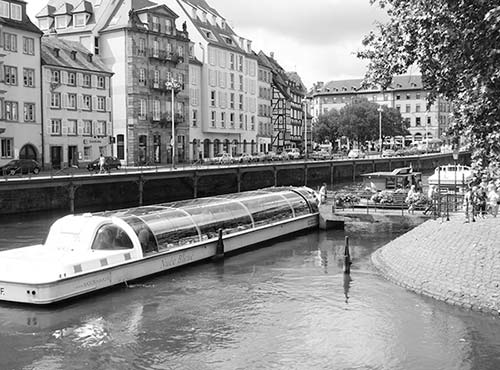
Cost and Hours: €15, 70 minutes, good audioguide included; April-Oct daily 9:45-19:30, until later in high season, shorter hours off-season, dock is outside cathedral’s right transept—where Rue Rohan meets the river, +33 3 69 74 44 04, www.batorama.com.
Traditional Music and Dancing
On Sunday mornings from late July to late August, look for Alsatian folk dancing on Place Gutenberg. During the same season on Monday, Tuesday, and Wednesday evenings, listen to traditional music on squares around town (Mon-Place des Tripiers, Tue-La Petite France on Place Benjamin Zix, Wed-Place du Marché-aux-Cochons-de-Lait).
Cathedral Lights
Strasbourg’s cathedral is bathed in colorful light after dark every day during summer months. The lighting program varies by year but generally runs from July to late August and is free to enjoy.
Christmas Market
From the last Saturday of November until late December, the city bustles and sparkles with its delightful Christkindelsmärik, held on several squares in the old town (hotel rates climb, and rooms book up well in advance).
Sleeping in Strasbourg
Strasbourg is quieter in the summer (July-Aug), when 4,000 Eurocrats leave town and hotel prices fall—and slammed when the parliament is in session, throughout December (thanks to the Christmas market), and during major conferences. All listed hotels have elevators and air-conditioning unless otherwise noted.
HOTELS IN THE CITY CENTER
$$$ Hôtel Cathédrale*** is pricey and a little tired, with a Jack-and-the-beanstalk spiral stairway to the elevator on the first floor. But this modern-yet-atmospheric place lets you stare at the cathedral point-blank from your room—for a price (rooms without views reasonably priced, 12 Place de la Cathédrale, +33 3 88 22 12 12, www.hotel-cathedrale.fr, booking@hotel-cathedrale.fr).
$$ Hôtel du Dragon**** is a tasteful, modern, well-run, and spotless business-class place, a bit away from the touristic core, with an outdoor patio and good rates (family rooms and apartments, 12 Rue du Dragon, +33 3 88 35 79 80, www.dragon.fr, sleep@dragon.fr).
$ Hôtel Suisse,*** across from the cathedral’s right transept, is welcoming, central, and a good value, with sharp rooms and a delightful front terrace (cozy lounge-café, family rooms, no air-con, 2 Rue de la Râpe, +33 3 88 35 22 11, www.hotel-suisse.com, info@hotel-suisse.com, engaging owner Edith).
$ Hôtel des Arts,** located in the thick of things above a busy café, is a simple, sparse, but good budget option. It has tight bathrooms and smaller beds and is just comfortable enough. Rooms in front can be noisy (no elevator, 10 Place du Marché-aux-Cochons-de-Lait, +33 3 88 37 98 37, www.hotel-arts.com, reservation@hotel-arts.com).
HOTELS NEAR THE TRAIN STATION
$$ Hôtel Mercure Strasbourg Centre Petite France*** has all the comforts a few blocks from the train station-area seediness toward the cathedral (3 Rue du Maire Kuss, +33 3 88 32 80 80, https://all.accor.com, h1813@accor.com).
Several Ibis hotels line up near the station. $ Hôtel Ibis Strasbourg Centre Gare faces the train station and delivers its usual comfort and amenities at usually fair rates (10 Place de la Gare, +33 3 88 23 98 98, https://ibis.accorhotels.com, h3018@accor.com). $ Hôtel Ibis Styles*** sits a block up Rue Maire Kuss, offering a step up in comfort (14 Rue du Maire Kuss, +33 3 88 22 60 40, https://ibis.accorhotels.com, h6850@accor.com).
Eating in Strasbourg
Atmospheric winstubs (wine bars) serving affordable salads and tarte flambée are a snap to find. If the weather’s nice, I’d head for Petite France and choose ambience over cuisine—dine outside at the café/winstub that appeals. Stock up on picnic supplies at the Monoprix (Mon-Sat 8:00-20:30) on Place Kléber or at gourmet Alsatian specialty shops on Rue des Orfèvres and take them to the park near Barrage Vauban.
IN AND NEAR LA PETITE FRANCE
$ La Corde à Linge (The Clothesline), right on Place Benjamin Zix, is a good choice for outdoor seating and price (big salads, burgers, and several intriguing Spätzle plats, daily until late, +33 3 88 22 15 17).
$ Brasserie la Lanterne, between Petite France and the cathedral, is a down-and-dirty Alsatian microbrewery filled with students and young, hip locals. This place is known for its home brews and cheap cuisine (including tarte flambée) and makes me want to plot a revolution (daily until late, no lunch Sun-Mon, near Place Kléber at 5 Rue de la Lanterne, +33 3 88 32 10 10).
NEAR THE CATHEDRAL
For a full-blown dining experience, skip the touristy restaurants on the cathedral square and along Rue du Maroquin. Consider these nearby places instead.
For outdoor dining with ambience (ideal for lunch or dinner) head behind the cathedral a few blocks to Place du Marché Gayot, where relaxed places line the atmospheric square. $$ La Table du Gayot at #8 is a top choice with a good variety of well-priced salads, lots of steak choices, and classic French plats (closed Wed, no dinner Sun, +33 3 88 36 30 27).
The next two places are one block behind the TI:
$$ Chez Yvonne (marked S’Burjerstuewel above windows), right out of a Bruegel painting, has a tradition of quality cuisine at fair prices. Try the coq au Riesling or choucroute garnie or the salade alsacienne (reservations smart, dinner served from 18:00, indoor tables only, closed Sun-Mon, 10 Rue du Sanglier, +33 3 88 32 84 15, www.restaurant-chez-yvonne.net).
$$ Le Clou Winstub, half a block left down Rue du Chaudron at #3, is très cozy and as Alsatian-traditional as it gets (daily, dinner served indoors only from 18:00, +33 3 88 32 11 67).
$$ Au Coin des Pucelles is an institution for discerning locals and tourists tired of Alsatian cuisine. The kind owners welcome diners at shared tables in a warm atmosphere and serve French cuisine fresh from the market (daily, reservations highly recommended, 12 Rue des Pucelles, +33 3 88 35 35 14).
$$ Chère Amie is a trendy and daringly modern brasserie featuring seafood, dinner salads, and plenty of meat dishes, all at good prices (daily until late, a 10-minute walk from the cathedral in Neustadt area at 5 Avenue de la Marseillaise, +33 3 67 68 70 70).
Strasbourg Connections
Strasbourg makes a good side trip from Colmar or a stop on the way to or from Paris. If you have time to kill at the station and have a first-class rail pass, find the Salon Grand Voyageur by track 1 (near the Consigne Baggage) and enjoy a peaceful lounge with free filtered water, coffee, and good WCs.
From Strasbourg by Train to: Colmar (2/hour, 35 minutes); Reims (via TGV with change at Champagne-Ardenne, hourly, 2-3 hours); Verdun (hourly, 2-4 hours, 1-2 transfers, last connection usually by bus); Paris’ Gare de l’Est (hourly with TGV, 2 hours); Lyon (5/day direct, 4 hours, more with transfer); Baden-Baden, Germany (hourly, 1 hour, one transfer); Karlsruhe, Germany (TGV: 4/day direct, 40 minutes; otherwise hourly, 1 hour, with 1 transfer); Frankfurt Airport (hourly, 2.5 hours, 1-2 transfers); Munich, Germany (almost hourly, 4-5 hours, most with 1-2 transfers); Basel, Switzerland (regional train: 2/hour, 1.5 hours).