LYON
Lyon • The Rhône Valley
ON OR NEAR PLACE DES CELESTINS
OTHER PLACES ON THE PRESQU’ILE
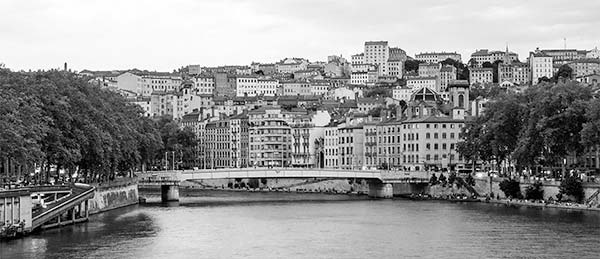
Straddling the mighty Rhône and Saône rivers between Burgundy and Provence, Lyon has been among France’s leading cities since Roman times. In spite of its workaday, business-first facade, Lyon is France’s most historic and culturally important city after Paris. You’ll experience two different-as-night-and-day cities: the Old World cobbled alleys, pastel Renaissance mansions, and colorful shops of Vieux Lyon; and the more staid but classy, Paris-like buildings and shopping streets of the Presqu’île. Once you’re settled, this big city feels relaxed, welcoming, and mostly untouristy. It seems everyone’s enjoying the place—and that they’re all French.
PLANNING YOUR TIME
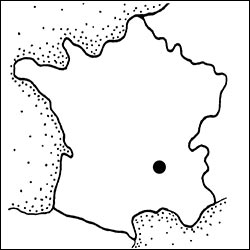
Just two hours by frequent TGV InOui train from Paris, 70 minutes south of Beaune, and two hours north of Avignon, Lyon is France’s best-kept urban secret. Lyon deserves two nights and a full day. With frequent and fast service to Paris, Provence, Burgundy, and the Alps, the city makes a handy overnight stop for train travelers. Those who spend the night can experience its renowned cuisine (at appetizing prices) and enjoy one of Europe’s most beautifully floodlit cities.
For a full day of sightseeing, take a funicular up to Fourvière Hill, visit the Notre-Dame Basilica, and tour the Lugdunum Gallo-Roman Museum and ancient Roman theaters. Ride the other funicular back down to Vieux Lyon and have a French (read: slow) lunch, then explore the old town and its hidden passageways. Finish your day touring the Museum of Fine Arts, Resistance Center, or Lumière Museum (covering the history of early filmmaking). Most of Lyon’s important sights are closed on Monday and/or Tuesday. Dine well in the evening (book ahead if possible; your hotelier can help) and cap your day enjoying a stroll through the best-lit city in France.
LYON’S CUISINE SCENE
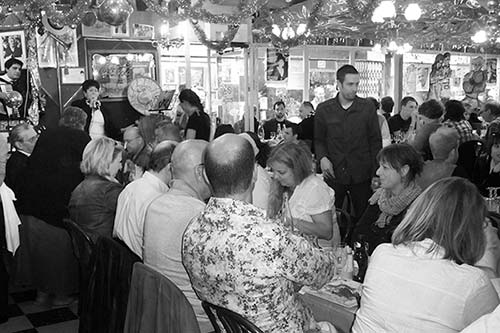
In Lyon, how well you eat determines how well you live. The best restaurants are all the buzz—a favorite conversation topic likely to generate heated debate. Here, great chefs are more famous than professional soccer players. (Paul Bocuse, who died in 2018, was the chef MVP.) With an abundance of cozy restaurants in every price range, it’s hard to go wrong—unless you order tripe (cow intestines, also known as tablier de sapeur), foie de veau (calf’s liver), or tête de veau (calf’s head). Beware: These questionable dishes are common in small bistros (bouchons). Look instead for these classics: St. Marcellin cheese, salade lyonnaise (croutons, fried bits of ham, and a poached egg on a bed of lettuce), green lentils (lentilles) served on a salad or with sausages, quenelles de brochet (fish dumplings in a creamy sauce), and filet de sandre (local whitefish).
LYON-AREA WINES
Fresh Gamay Beaujolais grapes, which grow in vineyards just north of Lyon, produce a fruity, easy-to-drink red wine. Beaujolais vines are grown on granite rock slopes, yielding wines with a distinct flavor. While the trend is toward finer wines—and there are several premier crus producing seriously good wines—the area is still most famous for its simple Beaujolais Nouveau wines, opened just six weeks after bottling. The arrival of the new Beaujolais is cause for lighthearted celebration and mischief in this otherwise hard-to-impress country. At midnight on the third Thursday of November, the first bottles are opened to great fanfare, road rallies carry the new wine to destinations throughout France, and cafés everywhere post signs announcing its arrival.
Big, luscious reds made from mostly syrah grapes grow on steep slopes to the city’s south. Look for Saint-Joseph and (my favorite) Crozes-Hermitage wines. In the village of Condrieu, only viognier grapes are allowed to grow; they produce a rich and perfumy white wine.
Orientation to Lyon
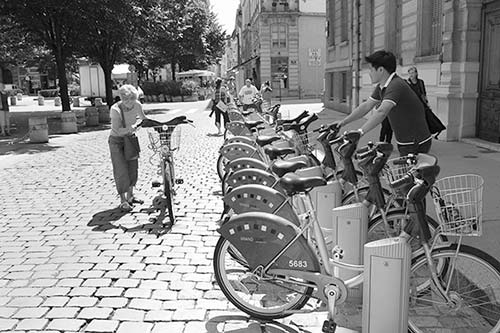
Despite being France’s third-largest city (after Paris and Marseille), with about 1.5 million inhabitants in its metropolitan area, the traveler’s Lyon (home to 485,000 people) is peaceful and manageable. Traffic noise is replaced by pedestrian friendliness in the old center—listen to how quiet this big city is. Notice the emphasis on environmentally friendly transport: Electric buses have replaced diesel buses in the historic core, bike lanes run everywhere, and pedal taxis (called cyclopolitains, seek-loh-poh-lee-tan) are popular for short trips. Lyon’s network of more than 5,000 city-owned rental bikes was in place years before Paris started its program.
The people of Lyon are happy to remind visitors that their city may not be the capital of France, but it is the ancient Gallo-Roman capital, the city that introduced Christianity to France, the Renaissance capital (with the finest surviving Renaissance district), the capital of Nazi resistance during World War II, and a cuisine capital. And, while Paris may call itself the “City of Light,” Lyon is a leader in artistic urban lighting—as you’ll see in the evening.
You’ll hear the term “Gallo-Roman” a lot here. The Romans conquered the Gauls (the dominant proto-French tribe) and incorporated them into their culture as they established their vast empire. For several centuries, this substantial part of the Roman empire was a Gaulish, or Gallo-Roman, civilization.
The city evolved as it grew, starting on the hill in Gallo-Roman times, moving to a fortified town on the banks of the Saône River with the fall of Rome and through the Renaissance, then filling the Presqu’île (peninsula; pron. press-keel) between the two rivers in the 19th century, before sprawling east of the Rhône in modern times.
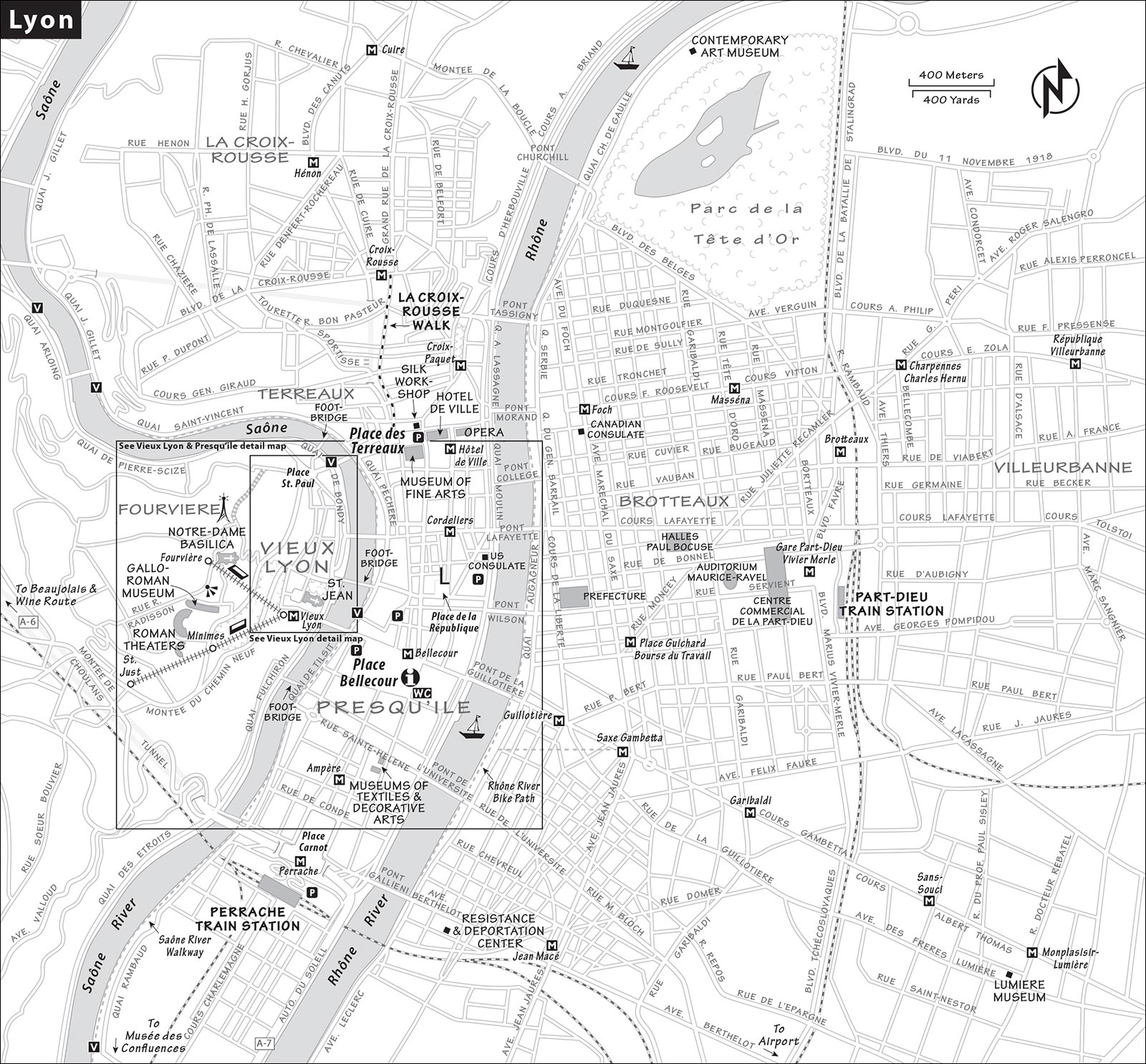
Today Lyon provides the organized traveler with a full day of activities. Much of your sightseeing can be enjoyed on foot from any of my recommended hotels, though it’s smart to make use of trams, funiculars, and the Métro. Lyon’s sights are concentrated in three areas: Fourvière Hill, with its white Notre-Dame Basilica glimmering over the city; historic Vieux Lyon, which hunkers below Fourvière Hill on the bank of the Saône River; and the Presqu’île (home to my recommended hotels), lassoed by the Saône and Rhône rivers. Huge Place Bellecour, which lies in the middle of the Presqu’île, seems oversized and searching for a reason to be...so big (unless it’s hosting an event).
TOURIST INFORMATION
Stop at the well-equipped TI for a city map (with good enlargements of central Lyon and Vieux Lyon; hotels have similar maps), and an event schedule (daily 9:30-18:00, corner of Place Bellecour, free public WCs behind the TI building, +33 4 72 77 69 69, www.lyon-france.com). The TI sells the worthwhile-for-many Lyon City Card that covers public transit and many sights (described under “Sights in Lyon,” later) and offers an app for touring Lyon (see “Tours in Lyon,” later). The TI also has a brochure on the Beaujolais wine road north of Lyon.
ARRIVAL IN LYON
By Train: Pay attention to wallets, day packs, and purses—you’re in a big city with the usual urban challenges.
Lyon has two train stations—Part-Dieu and Lyon-Perrache. Many trains stop at both, and some through trains connect the two stations. Both stations are well served by Métro, bus, tram, and taxi (figure €20 to taxi from either station to my recommended hotels near Place Bellecour), and both have the standard car-rental companies. Only Part-Dieu has baggage storage (daily 6:15-23:00). The 24-hour transit ticket is a great value—buy it upon arrival at either station if you plan to do much sightseeing that day (unless you plan to get a Lyon City Card). For more on public transportation, see “Getting Around Lyon,” later.
Arriving at Part-Dieu Station: This is where most visitors arrive. There are two main exits from the station: Centre-Ville and Villeurbane. Bag check is near the Villeurbane exit. To reach Place Bellecour in the city center (close to most hotels and the TI), exit by following Sortie Centre-Ville signs, keep right, then enter the Métro station and buy your ticket from the machine. Take blue Métro line B toward Gare d’Oullins, then transfer at Saxe-Gambetta to line D/Gare de Vaise and get off at Bellecour. At Bellecour, follow Sortie Rue République signs.
The other main exit, signed as Sortie Villeurbane, leads to taxis and the handy airport train (the Rhône Express, described under “By Plane”).
Arriving at Perrache Station: This station is within a 20-minute walk of Place Bellecour. Follow green Place Carnot signs out of the station, then cross Place Carnot and walk up pedestrian Rue Victor Hugo to reach the TI and most of my recommended hotels. Or take the Métro (direction: Vaulx-en-Velin) two stops to Bellecour and follow Sortie Rue République signs.
By Car: The city center has good signage and is manageable to navigate, though you’ll hit traffic on close-in freeways. Follow Centre-Ville and Presqu’île signs, and then follow Office de Tourisme and Place Bellecour signs. Get advice from your hotel, or park near Place Bellecour at Parking des Célestins or Parking Antonin Poncet (a yellow P indicates a parking lot). The TI’s map identifies all public parking lots. Garages near Perrache station are cheaper than those near Bellecour.
By Plane: Lyon’s sleek little airport, St-Exupéry, is 15 miles from the city center, and is a breeze to navigate (ATMs, English information booths, code: LYS, www.lyonaeroports.com). It has air and rail connections to major European cities, including several direct flights per day to Paris’ Charles de Gaulle Airport and direct TGV InOui service to many French cities. Car rental is a snap. Four Rhône Express shuttles per hour make the 30-minute trip from the airport (follow red tram car icons) to Lyon’s Part-Dieu train station (€16.50 one-way, €29 round-trip, cheaper online at www.rhonexpress.fr/en than from ticket machine). Allow €65 for a taxi or Uber if you have baggage.
HELPFUL HINTS
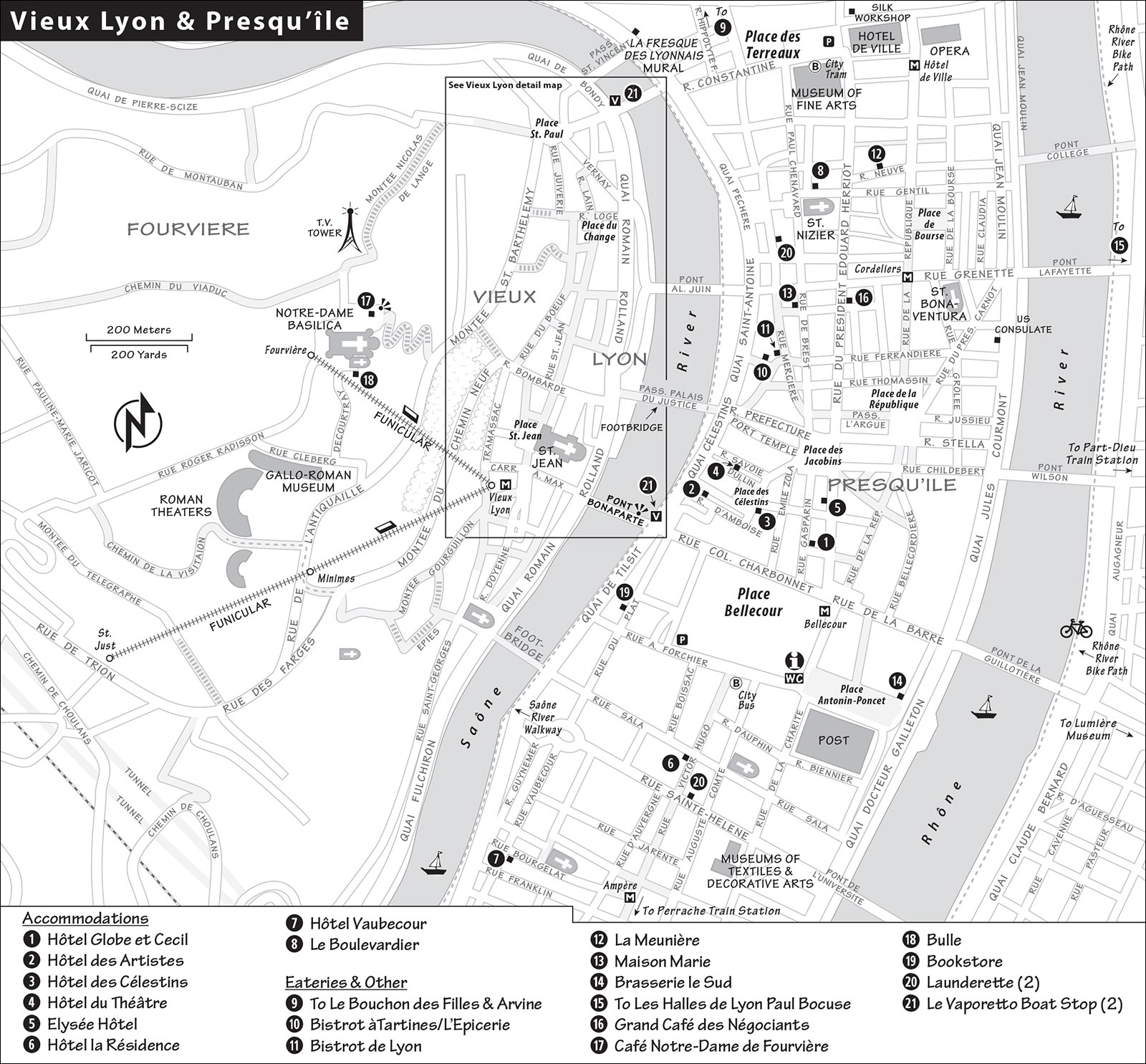
City Murals: Lyon is famous for its colorful and monumental wall murals. You’ll find them in many neighborhoods (marked on maps available at TI and hotels; keep your eyes up). The most impressive mural, La Fresque des Lyonnais, depicts 30 local historical figures and is located near the St. Vincent footbridge (see the “Vieux Lyon & Presqu’île” map, later); other locations include Fourvière Hill near the Notre-Dame Basilica (Les Fresques de la Sarra), the Croix-Rousse neighborhood (Mur Peint des Canuts, Europe’s largest mural), and several in the Presqu’île area. If visiting Les Halles de Lyon market hall, look for Thank you Monsieur Paul, honoring Lyon’s beloved chef, the late Paul Bocuse.
Market Days: A small market stretches along the Saône River near the Passerelle du Palais de Justice bridge (daily until 12:30, bigger Sat-Sun). Tuesday through Sunday, it’s produce; Monday, it’s textiles. On Sunday morning, a crafts and contemporary art market is on the other side of the bridge near the Court of Justice. Another good morning produce market takes place on Boulevard de la Croix-Rousse (Tue-Sun until 12:30, biggest on Sun, see here).
Festivals and Events: Lyon celebrates the Virgin Mary with candlelit windows and dazzling light shows on buildings and in squares during the Festival of Lights each year in early December (www.fetedeslumieres.lyon.fr). Les Nuits de Fourvière—with dance, music, and theater—takes place from early June to early August in the Roman theaters (www.nuitsdefourviere.com).
Useful Website: For helpful information in English about visiting Lyon, check out www.angloinfo.com/lyon.
Bookstore: Raconte Moi La Terre is a traveler’s bookstore (no books in English) and resource center with a café (Mon-Sat 10:00-19:00, closed Sun, air-con, 14 Rue du Plat—see “Vieux Lyon & Presqu’îl” map on here, Métro: Bellecour, +33 4 78 92 60 22, www.racontemoilaterre.com).
Laundry: A launderette is at 7 Rue Mercière on the Presqu’île, near the Alphonse Juin bridge; another is between Place Bellecour and Perrache station, a few steps off Rue Victor Hugo at 19 Rue Ste. Hélène. Both have long hours daily (see map on here for locations).
Driver: Design your own half-day or full-day tour with a car and driver (+33 6 65 38 75 08, www.lugdunum-ips.com).
Children’s Activities: The Parc de la Tête d’Or is vast, with rowboat rentals, a miniature golf course, pony rides, a free zoo and botanical gardens, and easy access to the riverside bike path (across Rhône River from the Croix-Rousse neighborhood, Métro: Masséna, www.loisirs-parcdelatetedor.com).
GETTING AROUND LYON
By Public Transit
Lyon has an excellent public transit system, with seven modern tram lines (T1-T6 and the Rhône Express line to the airport), four underground Métro lines (A-D), an extensive bus system, and two funiculars to get you up that hill.
The Métro system is not quite as intuitive and well signed as in Paris; station entrances are harder to recognize from street level, and some entrances are only for trains headed in one direction. You’ll also need more time to navigate inside stations as signage can be frustrating. Study the wall maps to find your direction; ask a local if you’re not certain. Yellow signs lead to transfers, and green signs lead to exits (Sortie). On the other hand, it’s more relaxed than in Paris—it’s less crowded and service is less frequent so drivers linger longer at stops.
Tickets: A ticket is valid for one hour and allows you to transfer between Métro, tram, and bus lines and ride round-trip, but you must revalidate your ticket whenever boarding (1 hour-€1.90, 24 hours-€6.50, 10 rides-€19, evening pass valid after 19:00-€3, round-trip funicular-€3.50, other tickets cover funicular). The 24-hour ticket starts with the first use and is a great deal (even if you only use the funicular and visit one of the outlying museums—Resistance Center or Lumière Museum). Also remember that the Lyon City Card (described later, under “Sights in Lyon”) covers transit.
At the ticket machines, use the black roller to selectionner your ticket and firmly push the top button twice to confirmer your request. Pay with coins or a credit card. In the Métro, insert your ticket in the turnstile, then reclaim it.
By Taxi or Uber
Lyon is not a good taxi town; locals are accustomed to walking and using the excellent tram and subway system. You generally don’t hail cabs in the street; there are just a few taxi stands, and the minimum fare is €7.30 (call Taxi Lyon at +33 6 82 55 69 34). Uber works here, but not as efficiently as in Paris.
By Bike
While you wouldn’t really sightsee by bike, fine riverside bike paths and big parks make Lyon a fun place for a joyride. You can rent electric bikes at Comhic (no standard bikes; daily 9:30-18:00, in Vieux Lyon at 7 Quai Romain Rolland—see the “Vieux Lyon” map on here; +33 4 72 65 43 86, www.comhic.com). The TI can recommend other bike-rental shops.
You can also use handy, city-owned Vélo’v Bikes: Purchase a day ticket (€4/24 hours; buy at machines, online, or—easiest—with the app, www.velov.grandlyon.com). You can pick up a bike at one location and leave it at another. The first 30 minutes are free, then the cost rises quickly to encourage short-term use. For €5 extra with any Lyon City Card, you can use Vélo’v bikes for 72 hours (the first hour of each ride is free).
Tours in Lyon
On Foot
TI Offerings: The TI offers live guided walks of Vieux Lyon, usually daily at 14:30 from July through early September and on weekends year-round (€10/1 hour, €13/2 hours, a few in English, confirm times with TI or sign up online, www.visiterlyon.com). The TI also offers self-guided walking tours of Lyon through an app (€10/tour). The Lyon City Card covers either option.
Private Guide: Talented guide Virginie Moré leads tours for my company, helps update this guidebook, and offers excellent private tours. She lives an hour away in southern Burgundy—consider a few-day stay at her B&B to discover nearby villages (tours from €420/day, +33 6 52 90 88 61, www.virginiemoretravel.com; see B&B info at the end of this chapter).
“Free” (Tip-Based) Walks: Hardworking Nicolas (a.k.a. Nico) and his fellow guides lead fun and informative 2.5-hour town walks from the Presqu’île to Vieux Lyon, and up to the Croix-Rousse district. While the walks are advertised as free, a generous tip is expected if you enjoyed the experience (usually daily at 10:30, meet at Place des Terreaux by the fountains—your guide will be wearing a yellow T-shirt, check online to verify schedule and book a spot; +33 7 69 61 34 29, www.lyonexplorer.com).
By Bus
Lyon City Tours: This company offers two options for exploring (+33 4 78 56 32 39, www.lyoncitytour.fr). The Lyon City Bus is a hop-on, hop-off tour with 12 stops covering Presqu’île, Fourvière Hill, stretches of the Saône River, and the Confluence area (€22, daily 10:00-18:00, 1/hour, loop takes nearly 2 hours). The red Lyon City Tram runs a one-hour loop from Place des Terreaux to the Croix-Rousse district and back (€10, daily 10:15-17:30, 5/day).
Wine Tours and Sightseeing Excursions: Kanpai Tours runs minivan trips to the Beaujolais and northern Rhône Valley wine regions near Lyon (€95/half-day, €130/day for individuals, €500-800/day for private groups up to 8, +33 6 84 52 14 99, www.kanpai-tourisme.com).
By Boat
For a short cruise on the Saône River with nice views of Vieux Lyon, you could hop aboard Le Vaporetto, though service can be infrequent in summer—skip it if there’s a long wait. This shuttle boat makes a 30-minute trip between Vieux Lyon and the Confluence shopping mall, with a stop at Pont Bonaparte along the way. A good plan is to take the boat one way and the tram the other (€5 one-way, covered by Lyon City Card; July-Aug daily 13:30-18:00, otherwise Wed-Sun only, no service Jan-Feb; check schedule at stops and online, busy on weekends and in summer, www.vaporettolyon.com). For stops, see the “Vieux Lyon & Presqu’îl” map on here.
Pont Bonaparte Spin Tour
This central bridge, just a block from Place Bellecour, is made to order for a day-or-night self-guided spin tour.
• Stand on the bridge and face the golden statue of the Virgin Mary marking the Notre-Dame Basilica on Fourvière Hill. (It’s actually capping the smaller chapel, which predates the church by 500 years.) The basilica is named for the Roman Forum (fourvière) upon which it sits. Now begin to look clockwise.
The Metallic Tower (a pint-sized version of Paris’ Eiffel Tower) is called La Tour Métallique. It was finished five years after the Eiffel Tower, in 1894, as part of a local world’s fair. Originally an observation tower, today it functions only as a TV tower. The husky, twin-towered church on the riverbank below (St. Jean Cathedral) marks the center of the old town. A block upstream, the Neoclassical columns are part of the Court of Justice (where Klaus Barbie, head of the local Gestapo—a.k.a. “the Butcher of Lyon”—was sentenced to life in prison). Way upstream, the hill covered with tall, pastel-colored houses is the Croix-Rousse district, former home of the city’s huge silk industry. With the invention of the Jacquard looms (1805), which required 12-foot-tall ceilings, new factory buildings were needed and the new weaving center grew up on this hill. In 1850, in good Industrial Revolution style, it was churning with 30,000 looms.
You are standing over the Saône River, which, along with the Rhône, makes up Lyon’s duo of power rivers. The Saône drains the southern area of the Vosges Mountains in Alsace and runs for about 300 miles before joining the Rhône (barely south of here), which flows to the Mediterranean. The Place Bellecour side of the river (behind you) is the district of Presqu’île. This strip of land is sandwiched by the two rivers and is home to Lyon’s Opera House, City Hall, theater, top-end shopping, banks, and all my recommended hotels. A morning market sets up daily under the trees (upriver, just beyond the red bridge). The simple riverfront cafés (buvettes) are ideal for a drink with a view (best at night).
Speaking of bridges, most of Lyon’s bridges—including the one you’re standing on—were destroyed by the Nazis as they checked out in 1944. Looking downstream, the stately mansions of Lyon’s well-established families line the left side of the river. Across the river, still downstream, the 19th-century Neo-Gothic St. Georges Church marks the neighborhood of the first silk weavers. The ridge behind St. Georges is dominated by a big building—once a seminary for priests, now a state high school—and leads us back to Mary.
• Walk across the bridge and continue two blocks to find the funicular station and ride up Fourvière Hill to the basilica (catch the one marked Fourvière, not St. Just). Sit up front and admire the funicular’s funky old technology (Métro/tram tickets valid). Or you can skip Fourvière Hill and go directly into the old town (Vieux Lyon) by turning right at St. Jean Cathedral.
Sights in Lyon
▲Notre-Dame Basilica (Basilique Notre-Dame de Fourvière)
City View from the Lugdunum Gallo-Roman Museum Rooftop
▲▲Lugdunum Gallo-Roman Museum and Roman Theaters (Lugdunum-Musée and Théâtres)
▲Museum of Fine Arts (Musée des Beaux-Arts)
Shopping and Eating on the Presqu’île
▲Resistance and Deportation History Center (Centre d’Histoire de la Résistance et de la Déportation)
▲Lumière Museum (Musée Lumière)
Those planning a busy, full day of sightseeing should invest in the Lyon City Card (€29/1 day, multiday options also available, cheaper online and for kids under age 16, sold at TI and most participating museums, https://lyoncitycard.com). This pass covers 24 Lyon museums plus buses, trams, funiculars, the Métro, and the river shuttle boat Le Vaporetto. It also covers a river cruise (April-Oct) and a walking tour with a live guide (or through the TI’s app), and provides discounts on other activities (such as Les Nuits de Fourvière festival).
FOURVIERE HILL
On Fourvière Hill, you can tour the basilica, enjoy a panoramic city view, visit the Roman theaters and Lugdunum Gallo-Roman Museum, then catch another funicular back down and explore the old town. I’ve strung the key sights together in a short walking route.
▲Notre-Dame Basilica (Basilique Notre-Dame de Fourvière)
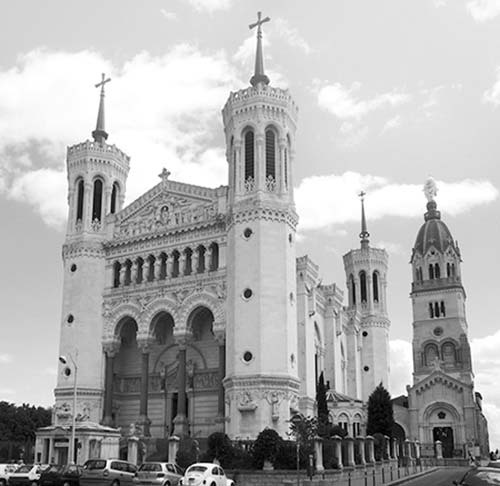
This ornate, gleaming church fills your view as you exit the funicular. In about the year 1870, the bishop of Lyon vowed to build a worthy tribute to the Virgin Mary if the Prussians spared his city. They did, so construction started in earnest, with more than 2,000 workers on site (similar divine deal-making led to the construction of the basilica of Sacré-Cœur in Paris). Building began in 1872, and the church was ready for worship just in time for the outbreak of the next war, World War I.
Cost and Hours: Free, daily 8:00-19:00.
Church Services: Mass in basilica usually daily at 7:15, 11:00, and 17:30 plus Sun at 9:30.
Rooftop Tours: The lengthy rooftop tour takes you to the attic and rooftop for splendid views over the city (€10, 1.5 hours, French only, 3-4 tours run daily June-Sept 11:00-16:00; April-May and Oct-Nov Wed and Sat-Sun only; no tours Dec-March; 345 steps). Check the schedule and reserve online at www.fourviere.org or at the TI. You can also book at the basilica just before the scheduled tour, but since space is limited to 18 people, it’s wise to book in advance. There’s a ticket office around to the left of the church as you face it, where you’ll check in or get more information.
Visiting the Basilica: Before entering, view the fancy facade, the older chapel on the right (supporting the statue of Mary), and the top of the Eiffel-like TV tower on the left.
Climb the steps and enter. Notice that everything—floor, walls, ceiling—is covered with elaborate mosaics. Scenes glittering on the walls tell stories of the Virgin (in Church history on the left, and in French history on the right). You won’t find a more Mary-centered church. It’s all about our lady—Notre Dame. Amble slowly down the center aisle, enjoy the dazzling neo-Byzantine (late 1800s) decor, and examine these main scenes lining the nave on the left and right:
First Scene (left): In 431, the Council of Ephesus declared Mary to be the “Mother of God.”
First Scene (right): The artist imagines Lugdunum (Lyon)—the biggest city in Roman Gaul, with 50,000 inhabitants—as the first Christian missionaries arrive. The first Christian martyrs in France (killed in AD 177) dance across heaven with palm branches.
Second Scene (left): In 1571, at the pivotal sea battle of Lepanto, Mary provides the necessary miracle as the outnumbered Christian forces beat the Ottomans.
Second Scene (right): Joan of Arc appears in three dramatic scenes. From right to left, she hears messages from Mary, she rallies the French against the English at the Siege of Orléans in 1429 (Joan, with the bright halo, pops on her horse; the timid French King Charles VII—whom Joan inspired to take a stand and fight the English—is buried in the crowd), and Joan is ultimately burned at the stake in Rouen at age 19 (1431).
Third Scene (left): In 1854, Pope Pius I proclaims the dogma of the Immaculate Conception in St. Peter’s Square (establishing the belief among Catholics that Mary was conceived without the “Original Sin” of apple-eating Adam and Eve). To the left of the Pope, angels carry the tower of Fourvière Church; to the right is the image of the Virgin of Lourdes (who miraculously appeared in 1858).
Third Scene (right): Dashing King Louis XIII offers the crown of France heavenward to the Virgin Mary. (The empty cradle between the king and queen hints that while he had Mary on the line, he asked, “Could I please have a son?” Louis XIV was born shortly thereafter.) Above marches a parade of pious French kings and emperors, from Clovis and Charlemagne to Napoleon (on the far right—with the white cross and red coat). Below are the great Marian churches of France (left to right): Chartres; Paris’ Sacré-Cœur, Notre-Dame, and Val-de-Grâce; Reims (where most royalty was crowned); and this church.
These six scenes in mosaic all lead to the altar where Mary reigns as Queen of Heaven.
Lower Church and Adjacent Chapel: Exit under Joan of Arc and descend (passing Hail Marys in a couple dozen languages as you climb down 65 stairs) to the crypt directly below. There you’ll find a lower church, dedicated to Mary’s earthly husband, Joseph. Priorities here are painfully clear: Money ran out for Joseph’s church (though the Baroque altar still dazzles). Strolling around Joseph’s church you’ll see models of beloved Marys from around the world (to welcome the many pilgrims), walls lined with plaques thanking Mary for prayers answered, and a rare altar featuring Joseph.
Return up the same stairs, leave the basilica, and step into the adjacent 16th-century chapel to the Virgin (pull the door). Back outside, glance up to see the glorious statue of Mary that overlooks Lyon.
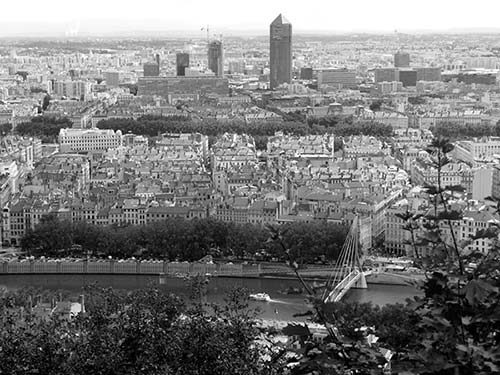
City View: Exiting the basilica, explore both sides of the exterior for commanding views of Lyon. Below you lies the old town with its Renaissance roofs sporting uniform chimneys. The peninsula between the two rivers is the Presqu’île, with its elegant and uniform 19th-century architecture.
You can see parts of both rivers and north from the Croix-Rousse district south to Pont Bonaparte, with greater Lyon spread out before you in the distance. The black barrel-vaulted structure to the left is the Opera House, and the rose-colored skyscraper in the distance is called, appropriately, “Le Crayon” (The Pencil). The skyline’s latest addition and tallest building is the tower nicknamed “La Gomme” (The Eraser). The big green space filling the bend in the river beyond the Opera House is Lyon’s massive park (La Tête d’Or). On a clear afternoon, you’ll get a glimpse of Mont Blanc (the highest point in western Europe, just left of the pencil-shaped skyscraper).
Consider a tempting pastry break on the breezy terrace of Café Notre-Dame de Fourvière (on the left side of the basilica as you face it; daily 10:00-19:00). On the right side lies $$$ Bulle, an upscale bistro (open until 19:00, closed Sun-Mon, +33 4 30 30 32 16, www.bullerestaurantfourviere.fr). For locations, see the “Vieux Lyon & Presqu’île” map, later.
• To get to the Roman theaters and Gallo-Roman Museum, walk back to the funicular station and go left down Rue Roger Radisson. The museum hides in the concrete bunker down the steps, where Rue Roger Radisson meets Rue Cléberg. Before entering the museum, get an overview of the site by taking a few steps left down Rue Cléberg to find a ramp leading to the museum’s rooftop (open the gate).
City View from the Lugdunum Gallo-Roman Museum Rooftop
From the rooftop, spot the two ancient theaters. Fourvière Hill was the center of Roman Lyon. Founded as Lugdunum in AD 43, this city held an estimated 50,000 people—four times the population of Roman Paris by the first century. Lyon was a critical transportation hub for the administration of Roman Gaul (and much of what became modern-day France—a lot like today).
The city became the central metropolis of the Three Gauls—the integrated Roman provinces of Aquitania (Aquitaine), Belgica (Belgium), and Lugdunensis (Lyon region)—and Emperors Claudius and Caracalla were both born here in Lyon (for more on the Romans, see “The Romans in Provence” on here). In the third century, Lugdunum’s need for water grew, and the aqueduct system became inadequate. Inhabitants abandoned the high town and, using the original town as a kind of quarry, rebuilt down below along the riverbank.
▲▲Lugdunum Gallo-Roman Museum and Roman Theaters (Lugdunum-Musée and Théâtres)
The manageable and worthwhile Gallo-Roman museum, built on the hillside with views of the two Roman theaters, makes clear Lyon’s importance in Roman times.
Cost and Hours: Museum—€4, includes well-produced audioguide, €7 if special exhibits are on, free first Sun of the month, open Tue-Fri 11:00-18:00, Sat-Sun from 10:00, closed Mon; theaters—free, daily 7:00-19:00, May-Sept until 21:00 except during Les Nuits de Fourvière festival (see below), when they can close as early as 17:00; 17 Rue Cléberg, +33 4 72 38 49 30, http://lugdunum.grandlyon.com.
Les Nuits de Fourvière: From early June through early August, the Roman theaters host an open-air festival of concerts, theater, dance, and film. Check programs and purchase tickets at the TI or online (popular concerts can sell out by mid-March).
Visiting the Museum and Theaters: Visit the museum first, then tour the theaters. The route described here gives an overview of the museum’s highlights, which take on more meaning with the excellent audioguide. The collection takes you on a chronological stroll—illustrated with artifacts found in Lyon—down several floors through ancient Lyon. Objects in display cases are usually labeled in English.
First is a brief glimpse at prehistoric objects. The unusual remains of a bronze chariot are Celtic (the tribes Rome conquered), dating from the seventh century BC.
Next, dive into the Gallo-Roman rooms. Sit close to the model of Lyon with its hills and rivers and listen on your audioguide to the history of Lugdunum while following its evolution on the model. It was a city of 50,000 in its second-century AD glory days. Gauls and Romans lived and worked side by side in Roman Lyon. Notice that the forum stood near where the basilica does today, hanging on the cliff edge.
The curved stones you pass next were arena seats—inscribed with the names of big shots who sat there. Soon after, look for a big, black-bronze tablet and marvel at the amazing penmanship. Carved into it is the transcription of a speech given by Emperor Claudius in AD 48—his (long-winded) account of how he integrated the Gauls into the empire by declaring them eligible to sit in the Roman Senate (also recorded: the interjections of senators begging him to get to the point already—see the English translation behind, on the wall). A few steps farther is a stone Roman pump that looks like an engine block (the TV screen illustrates out how it worked).
Next are displays of Roman coins and tools, a model of the temple that once stood where the basilica is now, and fragments of a second-century AD calendar. Notice how each month is made of two fortnights, how the gods each have their day (like Christian saints would on later calendars), and the tiny holes used so a movable peg could mark the day. A bit farther along, behind the model of the big and small theaters (with originals out the window), check out the mechanics of a Roman theater stage curtain (a nearby video shows its workings), which was raised instead of lowered. Go ahead...push the button.
The last section of the museum shows how Roman Lyon’s wealthy merchants built large homes with interior courtyards often tiled with mosaics. Ancient amphora (jugs) recall the thriving river trade. Your visit ends with displays on Roman religious life and the arrival of Christianity. Fifth-century tombstones come with early-Christian symbolism.
• Take the elevator up to exit the museum, return your audioguide, and enter the Roman theaters.
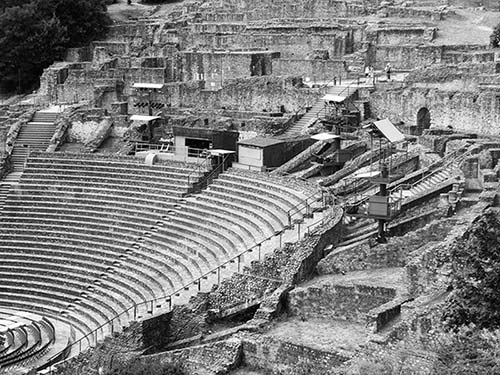
The closer big theater was built under the reign of Emperor Augustus and expanded by Hadrian—at its zenith, it could hold 10,000 spectators. Today it seats 3,000 for concerts. The small theater, an “odeon” (from the Greek “ode” for song), was acoustically designed for speeches and songs. The grounds are peppered with gravestones and sarcophagi. Find a seat in the big theater and read the description of Orange’s Roman theater on here for context.
• Take the ancient path between the Roman theaters and turn right on the street after passing the WCs, then find the Minimes funicular station a long block down on the left. Take the funicular to Vieux Lyon (not St. Just), where it deposits you only a few steps from St. Jean Cathedral. Take some time to explore Vieux Lyon. Or, from the Vieux Lyon funicular stop, you can take Métro line D directly to the Lumière Museum or (with an easy transfer) to the Resistance and Deportation History Center (both described later).
VIEUX LYON (OLD LYON)
These sights can be connected in a pleasant walk through Lyon’s Renaissance-drenched Old Town. To trace this route, see the map on here.
St. Jean Cathedral
Stand back in the square for the best view of the cathedral (brilliant at night and worth returning for). This mostly Gothic cathedral took 200 years to build. It doesn’t soar as high as its northern French counterparts; influenced by their Italian neighbors, churches in southern France aren’t nearly as vertical as their sisters to the north. This cathedral, the seat of the “primate of the Gauls” (as Lyon’s bishop is officially titled), serves what’s considered the oldest Christian city in France.
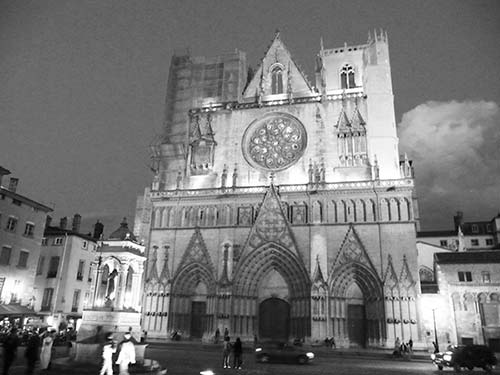
Cost and Hours: Free, Mon-Fri 8:15-19:45, Sat-Sun until 19:00.
Facade: Before entering the cathedral, enjoy the carvings decorating the west facade. Nearby Geneva was the epicenter of Calvinism—a radically puritan Reformation sect that forbade images—and (in the 16th century) loved destroying them. As the Calvinist iconoclasts swept into Lyon, the statues on the cathedral were the first to go (notice the empty niches and the headless bodies). They missed some lovely smaller scenes though: Enjoy the intimate details (e.g., Genesis scenes from 15th century) carved into the small panels at eye level just to the right of the central door.
Interior: Notice the beautiful 13th- and 14th-century stained glass in “The Window of Redemption” above the altar. While the medieval faithful would know each scene, 21st-century workers, not so much. The scenes were replaced in the wrong order after the 2015 restoration: Jesus’ ascension was placed before his birth (you can see the original order on the big postcard sold at the cathedral shop by the entrance).
Under the north (left) transept is a medieval astronomical clock (1383); it has survived wars of all kinds, including the French Revolution. Impressively, its 650-year-old mechanism could compute Catholic holidays, including those that change each year, such as Easter. Notice how the center dial ends with the year 2019; unfortunately, the system is no longer maintained.
Nearby: Outside, take a little detour (make two right turns as you leave) to see the ruins of a mostly 11th-century church, destroyed during the French Revolution when the cathedral was turned into a “temple of reason.” What’s left of a baptistery from an early-Christian church (c. AD 400—back when you couldn’t enter a church until you were baptized) is under glass.
▲▲Heart of Vieux Lyon
Vieux (“Old”) Lyon offers the best concentration of well-preserved Renaissance buildings in France. (With the rise of Lyon’s popularity with river cruise groups, this area has also become très touristy, so prepare to rub elbows as you explore.) The city grew rich from its trade fairs and banking, and was the center of Europe’s silk industry from the 16th to 19th century. The most prominent vestiges of Lyon’s golden age are the elegant pastel buildings of the old center, which were inspired by Italy and financed by the silk industry.
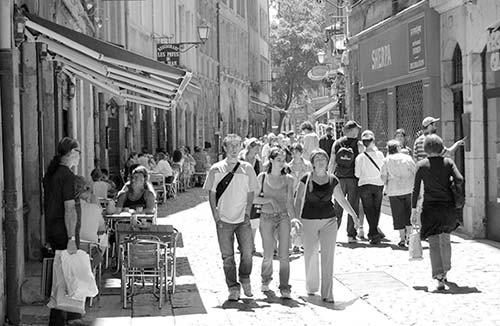
Busy Rue St. Jean, leading north from the cathedral to Place du Change, is the main drag. It’s flanked by parallel pedestrian streets (Rue Juiverie and Rue du Bœuf are quieter and more appealing) and punctuated with picturesque squares and courtyards. The pedestrian-friendly lanes of Vieux Lyon were made for ambling, window-shopping, and café lingering.
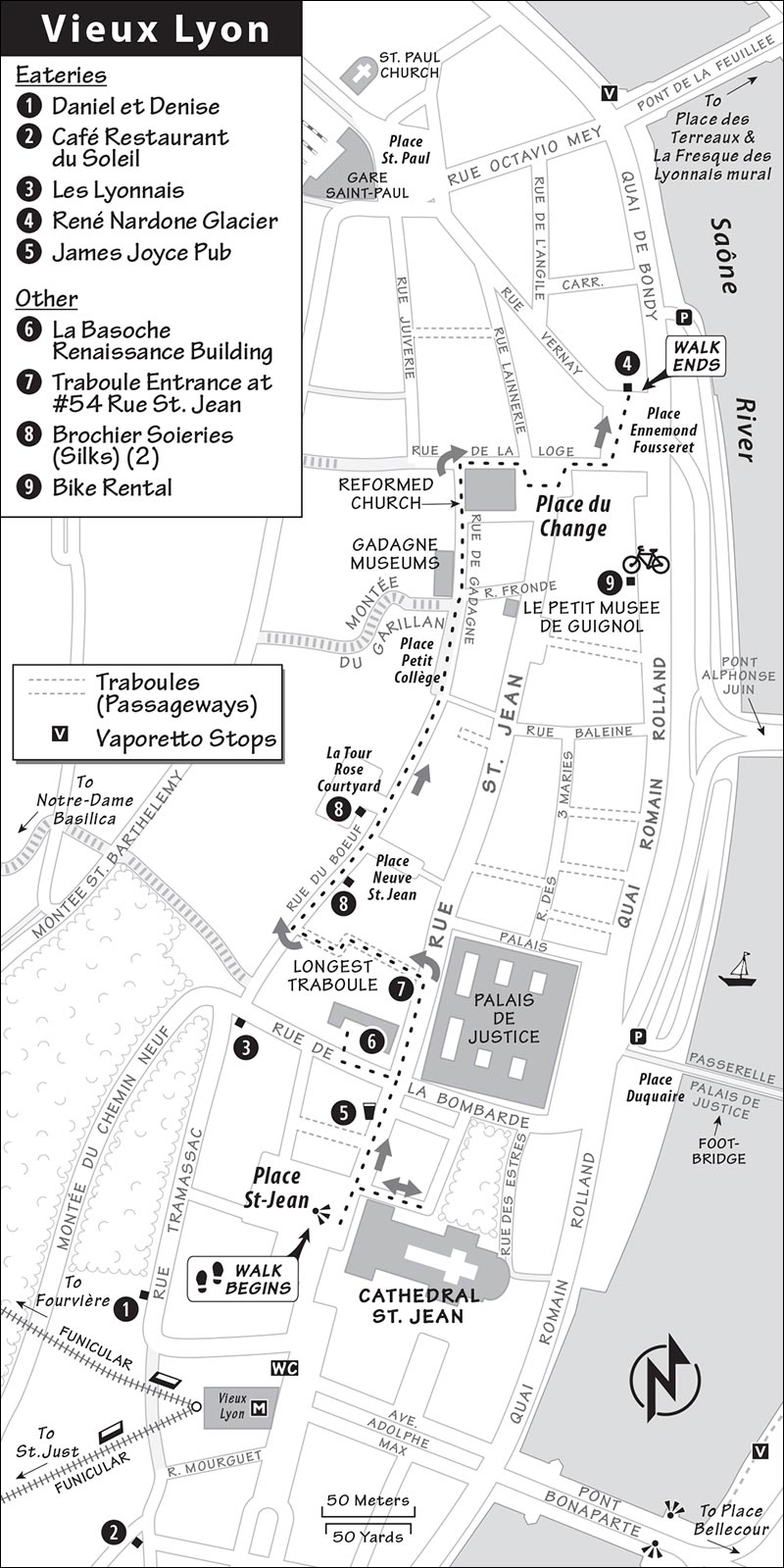
• Stroll along Rue St. Jean and take a short detour by making a left up Rue de la Bombarde to the colorful courtyard of...
La Basoche: This beautifully restored Renaissance building gives you a good idea of what hides behind many facades in Vieux Lyon—and a whiff of Lyon’s golden age. (Until the Revolution it was the home of a brotherhood of young lawyers.) Check out the black-and-white photos that show this structure before its 1968 renovation, and imagine most of Vieux Lyon in this state.
• Return to Rue St. Jean and continue to #54, where you can push open the heavy doors leading into the longest of Lyon’s many traboules.
Longest Traboule: Stepping off the busy street, you enter a cool and quiet passageway—one of many serpentine traboules (passageways) that link the streets of the old town. The old city’s traboules worked as shortcuts, connecting the old town’s three main north-south streets and providing important shelter from the elements as unfinished silk goods were being moved from one stage of production to the next.
This long traboule links three tiny courtyards and eventually pops out on the next street, Rue du Bœuf, where our walk continues.
• Once outside on the small, quieter Rue du Bœuf, turn right and stroll downhill. You’ll stay on this lane to its end. You’re following what would have been the flow of the neighborhood’s “dirty water”—down the gutter of the lane, which was periodically flushed to the river.
Rue du Bœuf: At #21 is Brochier Soieries, a traditional Lyon silk house since 1890 that sells locally made silks (daily). Peek through the window to see the “computerized” silk weaving loom (it was all binary), reminiscent of the early Industrial Revolution.
A little farther along is Place Neuve St. Jean, a small square created by the demolition of an old building. It’s lined with bouchons (traditional Lyon restaurants).
At #16 you can pop into another branch of the silk house for a free exhibit of silkworms at work (May-Nov only).
The passageway at #16 leads to a charming and peaceful Renaissance courtyard with a rich merchants’ showoff spiral staircase.
• Continue straight down Rue du Bœuf to find (on the left) a Renaissance mansion named for a leading merchant family, Gadagne. It’s home to a double museum, showing puppets and city history. Step into its courtyard to enjoy the scene and consider popping into the museum.
Gadagne Museums (Musées Gadagne): This museum (actually two museums with one ticket and the same hours) offers the best look at Lyon’s history and an interactive, kid-friendly look at puppets from around the world. The City History Museum offers a light, thematic look at the story of Lyon. The visit starts on the ground floor with some of Lyon’s icons (find chef Bocuse’s toque and the Lyon-born puppet Guignol). The next level focuses on the critical role that water has played in the city’s past and present. Notice that the Rhône river starts as a glacier in Switzerland. The top floor has interesting rooms devoted to the silk industry, and a few impressive looms and sample fabrics. The Puppets of the World Museum celebrates Guignol puppetry, the still-vibrant tradition first created in Lyon by an unemployed silk worker. Here you can see (and play with) examples of beautifully crafted puppets from around the world. The museum’s pleasant rooftop terrace hosts an inviting café (€8, Wed-Sun 10:30-18:00, closed Mon-Tue, 1 Place du Petit Collège, +33 4 78 42 03 61, www.gadagne.musees.lyon.fr [URL inactive]).
• Walk to the end of Rue du Bœuf. At the T-intersection, go right, downhill into...
Place du Change: This was the banking center of medieval Lyon. The city’s finance industry developed after it began hosting trade fairs in 1420. Its centerpiece is France’s first stock exchange, La Loge, which was completely renovated in the 18th century (creating a stark contrast to the Renaissance architecture around it). It’s now a Reformed church.
• A short block down (turning right onto Rue St. Jean) leads to more puppets, on display and for sale, at Le Petit Musée de Guignol. Otherwise, turning left toward the river below Place du Change, ice-cream connoisseurs must stop at the recommended René Nardone Glacier. From here it’s a short walk north into Presqu’île to Place des Terreaux and the Museum of Fine Arts (cross Pont de la Feuillée and continue straight four blocks).
PRESQU’ILE
Presqu’île literally means “almost an island.” This peninsula between the two rivers is Lyon’s shopping spine, with thriving pedestrian streets (see the “Vieux Lyon & Presqu’île” map on here). The neighborhood’s northern focal point is the...
Place des Terreaux
This stately square hosts the City Hall (Hôtel de Ville), the Museum of Fine Arts, and an action-packed fountain by Frédéric-Auguste Bartholdi (the French sculptor who designed the Statue of Liberty). The fountain features Marianne (the Lady of the Republic) riding a four-horse-powered chariot, symbolically leading Lyon’s two great rivers to the sea. It was originally destined for the city of Bordeaux, which (ultimately) realized that it could not afford the price tag, so the sculptor shopped it at the 1889 World Expo in Paris. There, Lyon’s mayor fell in love and had to have it. After Bartholdi modified it to fit Lyon’s needs, the massive fountain was installed here in 1891. Originally in the square’s center, it was relocated in 1992 when they built a parking garage below the square (imagine moving this thing).
Atelier de Soierie
This silk workshop, just off Place des Terreaux on Rue Romarin (behind Café le Moulin Joli, a Resistance hangout during World War II), welcomes the public to drop in to see silk printing and screen painting by hand. At one end of the workshop is a wall full of 100-year-old print blocks. At the other is a kitchen cooking up buckets of artfully mixed paint in 20 colors (a nearly lost art that today is performed primarily by machines). Within the shop, you’ll see stretched silk canvases, buckets of dye, and artists in action. Friendly staff members speak some English and are happy to field questions while they work. Climb the staircase to visit a boutique selling handmade silk creations—mostly scarves and ties. Prices range from €25 to €250. A handy brochure explains in English how to tie a scarf French-style (Mon-Fri 9:30-13:00 & 14:00-18:30, Sat 9:00-13:00 & 14:00-18:00, closed Sun, +33 4 72 07 97 83).
▲Museum of Fine Arts (Musée des Beaux-Arts)
Located in a former abbey that was secularized by Napoleon in 1803 and made into a public museum, this fine-arts museum has an impressive collection, ranging from Egyptian antiquities to Impressionist paintings. The inner courtyard is a pleasant place to take a peaceful break from city streets. The helpful museum map (pick up when you enter) and audioguide make touring it a pleasure. Plan your arrival carefully, as several key sections may close for lunch. A bar/café with calming terrace seating is on the first floor, next to the bookstore.
Cost and Hours: €8—purchase timed-entry ticket online in summer to avoid lines; Wed-Mon 10:00-18:00 except Fri from 10:30, closed Tue; essential audioguide-€1 (no English explanations posted), picnic-perfect courtyard, 20 Place des Terreaux, Métro: Hôtel de Ville, +33 4 72 10 17 40, www.mba-lyon.fr.
Visiting the Museum: The museum’s map is essential to navigating this confusing place. After passing the ticket taker, walk up a short flight of stairs to the Chapel, a dreamy Orsay-like display of 19th- and 20th-century statues, including works by Rodin (in a left-side chapel), Carpeaux, and Bartholdi (in glass display cases). The next flight of steps leads to Les Antiquités (first floor on map), and a fine collection of ancient artifacts (especially Egyptian—the Porte de Temple Gate from Medamud is mesmerizing), plus Greek, Etruscan, Islamic, and medieval art. This floor ends with a fun Art Nouveau (furniture) display. This first floor is sometimes closed 13:15-14:00.
The second floor displays a pretty selection of paintings from the last six centuries (no famous works, but a good Impressionist collection). You’ll see Renaissance and Baroque paintings by Veronese, Cranach, Rubens, and Rembrandt, and Impressionist works by Monet, Manet, Matisse, Pissarro, Gaugin, Cézanne, and more. The small modern art section shows some works by Picasso, Dufy, Léger, and Braque.
The highlight is a series of Pre-Raphaelite-type works called Le Poème de l’Ame (“The Poem of the Soul”), by Louis Janmot (in the Salle Janmot, down a flight of stairs between the Impressionist and France/Europe in 19th-century sections). This cycle of 18 paintings and 16 charcoal drawings traces the story of the souls of a boy and a girl as they journey through childhood, adolescence, and into adulthood. They struggle with fears and secular temptations before gaining spiritual enlightenment on the way to heaven. The boy loses his faith and enjoys a short but delicious hedonistic fling that leads to misery in hell. But a mother’s prayers intercede, and he reunites with the girl to enjoy heavenly redemption.
Shopping and Eating on the Presqu’île
There’s more to this “almost-an-island” than the sights listed here. Join the river of shoppers on sprawling Rue de la République (north of Place Bellecour) and the teeming and less fancy Rue Victor Hugo pedestrian mall (south of Place Bellecour). Smart clothing boutiques line Rue Président Edouard Herriot.
Passage de l’Argue is an Old World, covered shopping passage from the 1800s that predates shopping malls (between 78 Rue Président Edouard Herriot and 43 Rue de Brest). And Grand Café des Négociants is ideal for an indoor break. This grand café, which has been in business since 1864, feels like it hasn’t changed since then, with its soft velvet chairs, painted ceilings, and glass chandeliers (daily, 1 Place Francisque Régaud, near Cordeliers Métro stop, see “Vieux Lyon & Presqu’îl” map on here, +33 4 78 42 50 05).
For more eating recommendations, see the “Eating in Lyon” section, later.
La Croix-Rousse Walk
This is a mostly straight, downhill stroll along a long, stepped pedestrian lane in the La Croix-Rousse neighborhood. On the 20-minute stroll from top to bottom, you’ll pass laid-back cafés, art galleries, creative graffiti, and used-clothing shops on your way to the Presqu’île.
Hilly, untouristy, and SoHo-esque, this neighborhood to the north of Presqu’île hummed with some 30,000 silk looms in the 1800s. Today this part of town is popular with Lyon’s bohemian-chic crowd, drawn here by abandoned, airy apartment spaces (built in the age of the Jacquard loom, which required exceptionally high ceilings). The French nickname for this crowd is “Bobo”—bourgeois bohemian—people with money and education but who don’t show it. It’s a progressive and green community, where people eat vegetarian and drive electric cars.
The smartest way to visit the district is to take the Métro to the top (line C—a cogwheel train necessary for the steep slope—from the Hôtel de Ville stop to Croix-Rousse), then follow a series of scenic slopes and stairs back down (see “Lyon” map on here).
Outside the Croix-Rousse stop, a produce market stretches down Boulevard de la Croix-Rousse (daily except Mon, until about 12:30, best on Sun). The statue at the center of the square is Monsieur Jacquard, inventor of the loom that powered Lyon’s economy in the mid-1800s.
Start your downhill stroll turning right out of the Métro stop to find Rue des Pierres Plantées and a little square with a big view a block down. Pause to appreciate the views from the top of the parklike Montée de la Grande Côte, and notice how the small concrete square may be used as a soccer field, a tricycle track, an outdoor café, and any other purpose the neighbors can find for it. Continue down the stairs, straight through the gardens along the Montée de la Grande Côte and two more stepped blocks. From here, you’ll go down the steps and begin your descent along the straight vertical spine of the neighborhoods. At Rue des Tables Claudiennes, detour a block to the right for a view over the Roman Amphitheater of the Three Gauls. This ruined arena was once the same size as the one in Arles, holding 20,000 spectators. Parts of the arena were destroyed in the 1800s for city development; serious excavation did not begin until the 1960s. Return to the hill and continue your descent. At the end of the street, jog left, and pass through Place des Capucins. Turn left at the Eglise de Scientologie, continue down the stairs, and you end up back in the more high-powered commercial world of the Presqu’île at the stately Place des Terreaux.
Confluence Neighborhood
At the southern tip of the Presqu’île, where the Rhône and Saône rivers converge, you can experience France’s cutting-edge, urban-design energy. Called La Confluence, this expansive urban renewal project (one of Europe’s most ambitious), features futuristic offices, sustainable residential buildings, shopping, and vast public spaces in an area that recently was a vast wasteland. When completed, the Confluence project will double (yes, double) the size of Lyon’s commercial center. While worthwhile for urban design types, this area is of average interest for most travelers.
To reach La Confluence from Place Bellecour, take Métro A to Perrache station and connect to the T1 tram. You can also walk along the Saône River from Perrache station. Or, cruise down the Saône on the shuttle boat Le Vaporetto, from either the northern end of Vieux Lyon or near Pont Bonaparte, to the Confluence shopping mall dock (limited service; see here). Here you’ll see the Confluence project’s latest showpiece, the Place Nautique—a pleasure-boat marina.
From the dock, it’s a 15-minute walk along the river (not along the tram route) to the Presqu’île’s southern end and the Musée des Confluences. As you follow the pedestrian walkway you’ll pass revamped dock warehouses, wild-and-crazy office buildings, and restaurant barges. The skippable Musée des Confluences is worth a look from the outside for its daring design. Inside, the permanent collection recounts the sweeping story of human existence with good English explanations (closed Mon, 86 Quai Perrache, www.museedesconfluences.fr).
To return, catch the T1 tram (in front of museum, direction: Feyssine) back to the Confluence mall and board Le Vaporetto to Vieux Lyon, or continue on the T1 to the Perrache stop where you can connect to the Métro and other tram lines (see map on here).
EAST BANK OF THE RHONE
Along with two worthwhile museums, Lyon’s east bank of the Rhône River is a destination itself. The inviting and people-friendly riverside people zone between Pont Lafayette and Pont de la Guillotière is lined with restaurant and bar boats, bike lanes, and a mostly younger crowd enjoying the moment. It’s great for a drink or light meal: Prices are reasonable and the scene is local, laid back, and fun. Foodies will also want to visit the Les Halles de Lyon Paul Bocuse for a lively food market experience (described under “Eating in Lyon,” later).
▲Resistance and Deportation History Center (Centre d’Histoire de la Résistance et de la Déportation)
This museum gives visitors a keen understanding of how Lyon became an important city in the Resistance, what life was like for its members, and the clever strategies they employed to fight the Germans. You’ll also learn about the fate of the Jews in Lyon during the war.
Located near Vichy (capital of the French puppet state) and neutral Switzerland, Lyon was the center of the French Resistance from 1942 to 1945. These “underground” Resistance heroes fought the Nazis tooth and nail. Bakers hid radios inside loaves of bread to secretly contact London. Barmaids passed along tips from tipsy Nazis. Communists in black berets cut telephone lines while printers countered Nazi propaganda with anonymous pamphlets. Farmers hid downed airmen in haystacks and housewives spread news from the front with their gossip. Without their bravery, the liberation of France would have been much more difficult.
Cost and Hours: €8, Wed-Sun 10:00-18:00, closed Mon-Tue, audioguide-€1 (also downloadable as an app), 14 Avenue Berthelot, +33 4 78 72 23 11, www.chrd.lyon.fr.
Getting There: The easiest way to reach the museum is to ride the Métro to Perrache station, cross the tram tracks, and transfer to the T2 tram toward St-Priest/Bel Air. You can also take Métro line B to Jean Macé, exit toward the elevated train line, and transfer to the T2 tram (going right, direction Hôtel de Région). Get off the tram at Centre Berthelot. Otherwise it’s a 30-minute hike from Place Bellecour.
Visiting the Museum: The museum’s “Lyon, A City at War 1939-1945” exhibit is rich with artifacts. While you can request the binder with English translations, I’d use the excellent but temperamental audioguide. Visit the 43 displays in numeric order, moving slowly as stops are very close (if using the app, find the image that corresponds to the section you’re in). Everything’s on one floor until the end, where you climb down into a clandestine basement printing office. Your visit ends with a 10-minute video about the liberation of Lyon.
Worthwhile Film: Though these days it’s dedicated to the history of the Resistance, this building actually served as a Nazi torture chamber and Gestapo headquarters under Klaus Barbie (who was finally tried and convicted in 1987 here in Lyon after extradition from Bolivia). More than 11,000 people were killed or deported to concentration camps during his reign. The powerful 45-minute film about his trial (free and worthwhile, even if you don’t visit the museum) is well worth planning around English film times (call or check website in advance but usually 10:30, 12:00, 14:30, 15:30, and 16:30).
▲Lumière Museum (Musée Lumière)
Antoine Lumière and his two sons, Louis and Auguste—the George Eastmans of France—ran a huge factory with 260 workers in the 1880s, producing four million glass photographic plates a day. Then, in 1895, they made the first cinématographe, or movie. In 1903, they pioneered the “autochrome” process of painting frames to make “color photos.” This museum tells their story.
Cost and Hours: €8, Tue-Sun 10:00-18:30, closed Mon, essential audioguide-€3, +33 4 78 78 18 95, www.institut-lumiere.org.
Getting There: Take Métro line D to the Monplaisir-Lumière stop. The museum is in the large mansion with the tiled roof on the square, kitty-corner from the Métro stop at 25 Rue du Premier-Film.
Expect Changes: The museum has been undergoing renovations—expect some changes to this description.
Visiting the Museum: The museum fills Villa Lumière, the family’s belle époque mansion, dating from 1901. Many interesting displays and the audioguide do a great job of explaining filmmaking history and the laborious yet fascinating process of creating moving images. You’ll never again take the quality of today’s movies for granted.
The museum’s highlights are the many antique cameras (ground floor) and the screens playing the earliest “movies.” The first film reels held about 950 frames, which played at 18 per second, so these first movies were only 50 seconds long. About 1,500 Lumière films were catalogued between 1895 and 1907. The very first movie ever made features workers piling out of the Lumière factory at the end of a workday—mesmerizing in its day not for the plot or action, but simply because of the technology that produced moving images. After their initial success, the Lumières sent cameramen to capture scenes from around the world, connecting diverse cultures and people in a way that had never been done before.
Upstairs are exhibits on still photography and the Lumière living quarters (furnished c. 1900). One room has tablets where you can select movies to watch (notice that each movie is tagged with its “Catalog Lumière” number). It also features a selection of short movies by or about Lumière. Across the park from the mansion is a shrine of what’s left of the warehouse where the first movie was actually shot, now a cinema with recent feature-length films in many languages. In a wonderful coincidence, lumière is the French word for light.
Nightlife in Lyon
Lyon has France’s second-largest cultural budget after Paris, so there are always plenty of theatrical productions and concerts to attend (in French, of course). The TI has the latest information and schedules. From mid-June through mid-September, the terrace-café at the Opera House hosts an outdoor jazz café with free concerts (usually Mon-Sat, www.opera-lyon.com).
After dinner, stroll through Lyon to savor the city’s famous illuminations (see sidebar on here).
For lively bar and people-watching scenes in Presqu’île, prowl Rue de la Monnaie (angles off “restaurant row” Rue Mercière to the south) and the streets between Place des Terreaux and the Opera House. The down and dirty James Joyce Irish pub, in the heart of Vieux Lyon, is a lively, English-speaking place (daily, 68 Rue St. Jean—see the “Vieux Lyon” map on here, +33 4 78 37 84 28).
Sleeping in Lyon
Hotels in Lyon are a steal compared with those in Paris. Weekends are generally discounted (Sun-Mon in particular) in this city that lives off business travelers. Prices rise and rooms disappear when trade fairs are in town, so it’s smart to reserve your room well in advance. All my listings are on the Presqu’île, and all have elevators and air-conditioning unless otherwise noted (it’s hottest in June-mid-Sept). Expect to push buttons to gain access to many hotels.
ON OR NEAR PLACE DES CELESTINS
Book ahead to sleep in this classy yet unpretentious neighborhood (Métro: Bellecour). Just a block off the central Place Bellecour and a block to the Saône River, this area gives travelers easy access to Lyon’s sights. Join shoppers perusing the upscale boutiques, or watch children playing in the small square fronting the Théâtre des Célestins. Warning: Weekend nights can be noisy if you score a room facing Place des Célestins.
$$$ Hôtel Globe et Cecil**** offers pricey (on weekdays) comfort on a refined street with a lively bar/café and pleasant public spaces. Its handsome rooms are mostly spacious with modern decor (21 Rue Gasparin, +33 4 78 42 58 95, www.hotel-globeetcecil.fr, reception@hotel-globeetcecil.fr).
$$ Hôtel des Artistes,*** ideally located on Place des Célestins, is a comfortable, business-class hotel that offers a fair value on weekdays and a good value on weekends; standard rooms are tasteful and comfortable but tight (8 Rue Gaspard-André, +33 4 78 42 04 88, www.hotel-des-artistes.fr, reservation@hotel-des-artistes.fr).
$$ Hôtel des Célestins,*** just off Place des Célestins, is warmly run by Cornell-grad Laurent. Its cheery rooms aren’t cheap but are filled with thoughtful touches. Streetside rooms have more light and are bigger (beautiful suites ideal for families or those in need of room to roam, laundry service, 4 Rue des Archers, +33 4 72 56 08 98, www.hotelcelestins.com, info@hotelcelestins.com).
$$ Hôtel du Théâtre** has no air-conditioning and requires stamina to reach the lobby, as it’s 40 steps from street level. But the hotel is well located on Place des Célestins and most of the rooms and bathrooms are spacious and bright (no elevator, 10 Rue de Savoie, enter from hotel’s rear, +33 4 78 42 33 32, www.hotel-du-theatre.fr, contact@hotel-du-theatre.fr).
$ Elysée Hôtel,** a few blocks off Place des Célestins, is a simple little hotel with excellent rates and two-star comfort. Gentle Monsieur Larrive is your host (elevator from first floor up, 92 Rue Président Edouard Herriot, +33 4 78 42 03 15, www.hotel-elysee.fr, accueil@hotel-elysee.fr).
OTHER PLACES ON THE PRESQU’ILE
$$ Hôtel la Résidence,*** south of Place Bellecour and my closest listing to Perrache station, has 65 plain but good-value rooms. Most are spacious and have high ceilings and bathtub-showers (family rooms, 18 Victor Hugo, +33 4 78 42 63 28, www.hotel-la-residence.com, hotel-la-residence@wanadoo.fr).
$ Hôtel Vaubecour** has a charming old-mansion feel and lovely rooms with contemporary comfort (double-paned windows make streetside rooms quiet). Gentle owner Gaëlle is eager to help (popular place—book well in advance, skip the confort rooms that come with smaller beds; no air-con but fans, reception and rooms on second floor, 28 Rue Vaubecour, +33 4 78 37 44 91, www.hotelvaubecour-lyon.com, contact@hotelvaubecour-lyon.com).
$ Le Boulevardier,** a quirky budget option located a few blocks south of Place des Terreaux, has 14 rooms above a nostalgic café. The rooms have character—some with antique furniture and toys, and others with church views (larger rooms worth the extra euros, no air-con but fans, 5 Rue de la Fromagerie, +33 4 78 28 48 22, www.leboulevardier.fr, hotelboulevardier@gmail.com).
Eating in Lyon
Dining is a ▲▲▲ attraction in Lyon and the value is good. Half the fun is joining the procession of window shoppers mulling over where they’ll dîner ce soir. In the evening, the city’s population seems to double as locals emerge to stretch their stomachs. The tried-and-true salade lyonnaise (usually filling) followed by quenelles (dumplings) is a classic Lyon meal. (While the quenelle is a local favorite, for some it’s just a big doughy dumpling.) You won’t want dessert.
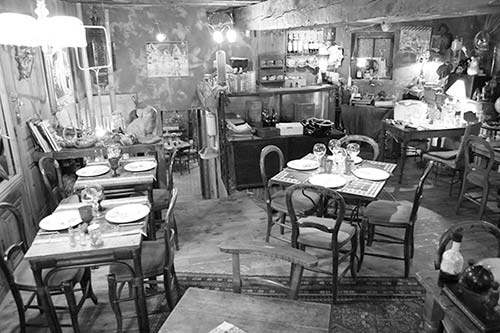
Lyon’s characteristic bouchons are small bistros that evolved from the days when Mama would feed the silk workers after a long day. True bouchons are simple places with limited selection and seating (“just like Mama’s”), serving only traditional fare and special 46-centiliter pot (pron. “poh”) wine pitchers. The lively pedestrian streets of Vieux Lyon and Rue Mercière on the Presqu’île are bouchon bazaars, worth strolling even if you dine elsewhere. Though food quality may be better away from these popular restaurant rows, you can’t beat the atmosphere. Many of Lyon’s restaurants close on Sunday and Monday and during August, except along Rue Mercière. It’s smart to reserve a day ahead if you want a particular place (you can ask your hotelier for help), or try showing up when they open.
IN OR NEAR VIEUX LYON
While Vieux Lyon has charming atmosphere, parts of it are overrun. Avoid Place Neuve St. Jean and focus on the places I recommend. For locations, see the “Vieux Lyon” map on here.
$$$ Daniel et Denise is a touch formal, but lively and and worth booking ahead. Reputed chef Joseph Viola has created a buzz by providing fine cuisine at affordable prices in a classic bouchon setting (indoor seating only, closed Sun-Mon, 36 Rue Tramassac, +33 4 78 42 24 62, www.danieletdenise.fr).
$$ Café Restaurant du Soleil serves what are possibly Lyon’s biggest quenelles, including the traditional brochet (pike) and scallops (my favorite), in a good-value menu. The atmosphere and setting, both inside and out, is unforgettable (daily, 2 Rue Saint Georges, +33 4 78 37 60 02).
$$ Les Lyonnais is a block off the Rue du Bœuf action, making it a bit quieter. Its lighthearted interior has rich colors, wood tables, and a photo gallery of loyal customers—be ready to share a table with one of them. Stéphane runs the place with grace, offering good menus with salade lyonnaise and quenelles, or tasty and filling salads (closed Sun dinner and all day Mon, small terrace, 1 Rue Tramassac, +33 4 78 37 64 82).
Ice Cream: René Nardone Glacier, with pleasant outdoor seating on the river near Place du Change, serves up some of Lyon’s best ice cream, made fresh daily next door. Ask Armelle about her peanut ice cream (long hours daily in May-Sept, off-season 9:30-19:00, 3 Place Ennemond Fousseret).
ON THE PRESQU’ILE
The pedestrian Rue Mercière is the tourist-friendly epicenter of bouchons on the Presqu’île. Along this street, an entertaining cancan of restaurants stretches four blocks from Place des Jacobins to Rue Grenette. Enjoy surveying the scene and choose whichever eatery appeals. See the “Vieux Lyon & Presqu’îl” map on here for locations.
Near the Museum of Fine Arts
$$ Le Bouchon des Filles is a cozy and busy traditional bouchon on a quiet street where the two “filles” (“girls”) offer a good-value menu including a cheese course (open daily for dinner plus Sat-Sun for lunch, reservations recommended, 20 Rue Sergent Blandan, +33 4 78 30 40 44, www.lebouchondesfilles.fr).
On or near Rue Mercière
$ Bistrot à Tartines/L’Epicerie is a young, boisterous, and fun place for tasty tartines (big slice of bread topped with goodies) offered at good prices by a friendly staff. You can split a tartine and save money (and room for their popular desserts). The interior feels like a cute—if a bit shabby—antique general store, and the front terrace has good people watching (daily, food served all day, 2 Rue de la Monnaie, +33 4 78 37 70 85).
$$ Bistrot de Lyon, famed chef-owner Jean-Paul Lacombe’s least-expensive establishment, feels touristy but still bustles with authentic, circa-1900 Lyonnaise atmosphere and reliable cuisine (€22-30 2-3 course menus, daily, 64 Rue Mercière, +33 4 78 38 47 47).
$$ La Meunière, a few blocks east of Rue Mercière, is the place to sample authentic Lyon specialties like sweetbreads, veal, kidneys, and more—if you dare. The ambience is warm and as real as it gets (opens at 19:30, closed Sun-Mon, 11 Rue Neuve, +33 4 78 28 62 91, www.lameuniere.fr).
Refined Dining
$$$ Maison Marie is an oasis of dining calm just off raucous Rue Mercière, where charming owner Marie serves classical French cuisine with fresh seasonal produce and pays close attention to her clients (closed Sun-Mon, indoor and outdoor seating, 5 Rue Tupin, +33 78 42 38 12).
$$$ Brasserie le Sud is one of four places in Lyon where you can sample the cuisine of the late legendary chef Paul Bocuse at affordable prices. His brasseries feature international cuisine from different parts of the world (each named for the corner it represents—north, south, east, and west). Le Sud is the most accessible, with a sunny Mediterranean menu and feel, but is less cozy than other places I list. It’s dressy, with three dining zones: bright and spacious inside, under a big awning, and outside facing a big modern square. With professional service, nicely presented and reliably tasty dishes, and fair prices, it’s understandably popular. While the prix fixe menus are the most economical, order à la carte to enjoy the full range of the kitchen (daily, reservations recommended, 11 Place Antonin-Poncet, a few blocks off Place Bellecour, +33 4 72 77 80 00, www.nordsudbrasseries.com).
$$$ Arvine is a fine example of Lyon’s trendsetting bistronomie cuisine. This softly lit, contemporary bistro accommodates 26 diners, all eager to sample the chef’s creations through a €55 five-course set menu. Reserve ahead online and prepare to be surprised (closed Sun-Mon, near Place des Terreaux at 6 Rue Hippolyte Flandrin, +33 4 78 28 32 26, www.arvine-restaurant.fr).
ON THE EAST BANK OF THE RHONE
Les Halles de Lyon Paul Bocuse is a thriving market that serves its many creative chefs. Though away from the normal tourist action, foodies and market enthusiasts enjoy a visit or meal here. It’s a complete food festival—crammed with butchers, fishmongers, pastry specialists, cheese shops, and colorful produce stands, with food stands and mini restaurants mixed in. For a memorable lunch or dinner, drop by and survey your many dining options (indoor and outdoor, market open daily 7:00-19:00, dining options generally open 11:00-14:30, several places reopen 18:30-22:00; take T1 tram to Part Dieu-Servient stop, walk to Rue Garibaldi, and turn right—it’s under a round concrete structure at 102 Cours Lafayette).
Lyon Connections
After Paris, Lyon is France’s most important rail hub. Train travelers find this gateway to the Alps, Provence, the Riviera, and Burgundy an easy stopover. And now the Eurostar connects Lyon with London.
Two main train stations serve Lyon: Part-Dieu and Perrache. Most trains officially depart from Part-Dieu, though many also stop at Perrache, and trains run between the stations (service can be infrequent). Double-check your train’s departure station.
From Lyon by Train to: Paris (hourly, 2 hours), Annecy (about hourly, 2 hours; also 4/day by bus, 2.5 hours), Chamonix (6/day, 5-6 hours, 2-3 changes, some require bus), Strasbourg (7/day, 4-5 hours), Dijon (hourly, 2 hours), Beaune (hourly, 1.5 hours), Avignon (hourly, 2 hours, slower to Centre-Ville station), Arles (hourly, 3 hours, most change in Avignon, Marseille, or Nîmes), Nice (9/day, 4.5 hours, most with change in Montpellier or Marseille), Carcassonne (8/day, 4 hours), Geneva (8/day, 2 hours), Barcelona (2/day, 5 hours, more with change in Perpignan, Narbonne, or Valence), London (2/day “direct” but border check at Lille, 6 hours on Eurostar).
From Lyon by Bus: BlaBlaCar and FlixBus leave from Perrache station (and the airport).
The Rhône Valley
The Rhône Valley is the narrow part of the hourglass that links the areas of Provence and Burgundy. The region is bordered to the west by the soft hills of the Massif Central, and with the rolling foothills of the Alps just to the east, it’s the gateway to the high Alps (the region is called Rhône-Alpes). The mighty Rhône River rumbles through the valley from its origin in the Swiss Alps to its outlet 500 miles away in the Mediterranean near Arles.
Vineyards blanket the western side of the Rhône Valley, from those of the Beaujolais just north of Lyon to the steep slopes of Tain-Hermitage below Lyon. On the eastern side of the river and closer to Avignon are the vineyards of the famous Côtes du Rhône.
The Rhône Valley has always provided the path of least resistance for access from the Mediterranean to northern Europe, and today, Roman ruins litter the valley between Lyon and Orange.
BEAUJOLAIS WINE ROUTE
Between Lyon and Mâcon, the Beaujolais region makes for an appealing detour, thanks to its beautiful vineyards and villages and easygoing wine tasting (for more on Beaujolais wines, see here).
The Beaujolais wine road starts 45 minutes north of Lyon and runs from Villefranche-sur-Saône to Mâcon. The Route du Beaujolais winds up, down, and around the hills just west of the A-6 autoroute and passes through Beaujolais’ most important villages: Chiroubles, Fleurie, Chénas, Juliénas, and Saint-Amour. Look for Route du Beaujolais signs, and expect to get lost more than a few times (Lyon’s TI has a route map, and you can check there for more information). Often referred to as French Tuscany, it’s a gorgeous region well worth the detour.
Note that while Villefranche-sur-Saône may be the Beaujolais capital, it’s an unappealing city that’s best avoided. Focus your time on the small villages and look for dégustation (tasting) signs.
From Lyon to Mâcon: To enjoy the best of this wine route, start by making your way to the hill of Fleurie with its chapel and viewpoint, then pass Moulin à Vent’s famous vineyards and see its trademark windmill. In Juliénas, the old church has been transformed into a cellar and tasting room and is used as a bar by the locals. You’ll find more serious wines at Le Château de Juliénas, an authentic castle with impressive vaulted cellars (www.chateaudejulienas.com).
Continuing north, you’ll enter the Mâconnais white wine region, passing signs to the famous villages of Pouilly and Fuissé as you near Mâcon. If it’s lunchtime, enjoy a stop at $$ La Marmite de l’Echanson in the lovely village of Leynes, where friendly and wine-smart David fires up local specialties (indoor and outdoor seating, closed Tue-Wed, +33 3 85 51 73 14). The 45-minute hike to the 1,600-foot-high Solutré Rock (a prehistoric site) offers grandiose views over the Saône valley, vineyards, and the twin shorter sister Vergisson Rock.
Train Alternative: Without a car, consider seeing the wine route by train. Trains between Lyon and Mâcon stop at several wine villages (6 trains/day from Lyon).
Sleeping on the Beaujolais Wine Route: A French couple who lived in the US for over a decade now rents three rooms at $ L’Esprit des Vignes, with scenic views over the Saône valley and Mont Blanc. Virginie (who also leads tours for my company) offers day trips. Olivier brews a wide variety of beers. Their delighful home is located 20 minutes south of Cluny and two miles from Juliénas (includes breakfast, +33 6 52 90 88 61, www.lespritdesvignes.fr, virginie@lespritdesvignes.fr).