THE FRENCH ALPS
Annecy • Chamonix
Chamonix Activities at a Glance
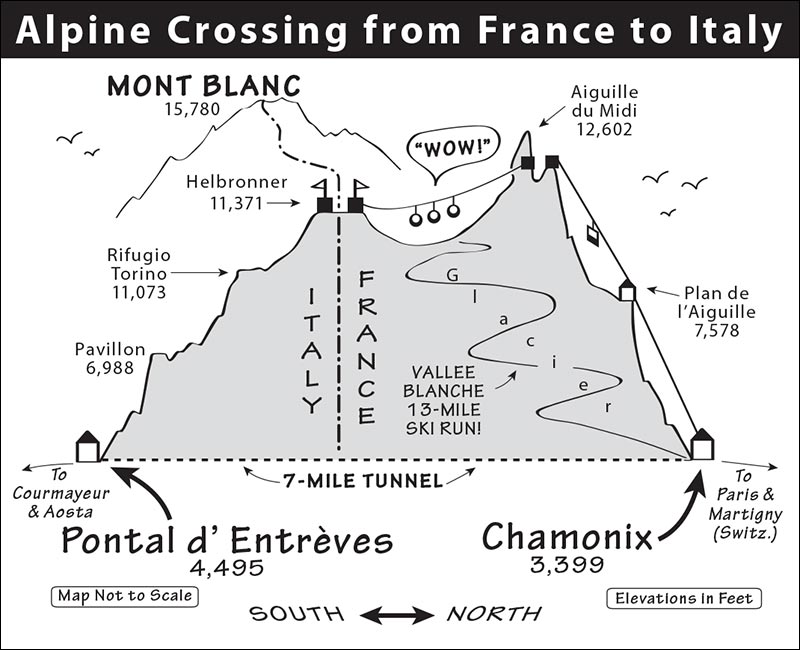
Map: Alpine Crossing from France to Italy
The Savoie region grows Europe’s highest mountains and is the penthouse of the French Alps (the lower Alpes-Dauphiné lie to the south). More than just a pretty-peaked face, stubborn Savoie maintained its independence from France until 1860, when mountains became targets, rather than obstacles, for travelers. Savoie’s borders once stretched south to the Riviera and far to the west across the Rhône River Valley. Home to the very first winter Olympics (1924, in Chamonix), today’s Savoie is France’s mountain-sports capital, showcasing 15,780-foot Mont Blanc as its centerpiece. Boasting wooden chalets overflowing with geraniums, and cheese fondue in most restaurants, Savoie feels more Swiss than French.
The scenery is drop-dead spectacular. Serenely self-confident Annecy is a postcard-perfect blend of natural and man-made beauty. In Chamonix, it’s just you and Madame Nature—there’s not a museum or important building in sight. Take Europe’s ultimate cable-car ride to the 12,602-foot Aiguille du Midi in Chamonix. And with three major international airports within two to three hours (Lyon, Geneva, and Milan), the French Alps make a fine first or last stop on your overseas adventure.
PLANNING YOUR TIME
Lakefront Annecy has boats, bikes, and hikes with mountain views for all tastes and abilities. Its arcaded walking streets and good transportation connections (most trains to Chamonix pass through Annecy) make it a convenient stopover, but if you’re pressed for time and antsy for Alps, slide your sled to Chamonix. There you can skip along alpine ridges, glide over mountain meadows, zip down the mountain on a luge (wheeled bobsled), or meander riverside paths on a mountain bike. Plan a minimum of two nights and one day in Chamonix, and try hard to work in an additional night and a day in gorgeous Annecy. Weather is everything in this area: Check the forecast. If it looks good, make haste to Chamonix; if it’s gloomy, Annecy offers more distraction.
The Alps have twin peaks: the summer and winter seasons, when hotels and trails or slopes are slammed. June and November are dead quiet in Chamonix (many hotels and restaurants close) as locals recover from one high season and prepare for the next. Annecy remains popular year-round.
GETTING AROUND THE ALPS
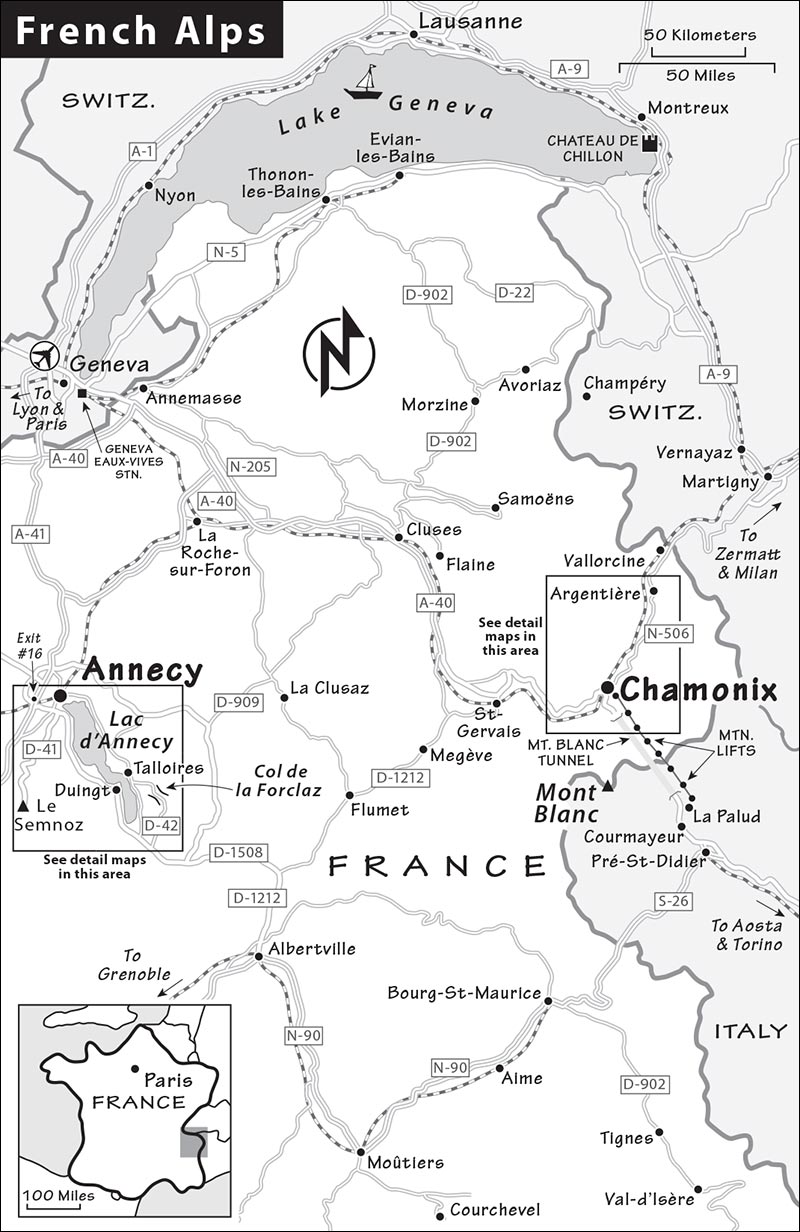
Annecy and Chamonix are well connected by train and bus. Buses run from Chamonix to nearby villages, and the Aiguille du Midi lift takes travelers from Chamonix to Italy over Europe’s most scenic border crossing. If you have a car, pricey autoroutes make the going easy, and scenic drives near Annecy allow you to savor remarkable views.
Entering Switzerland by Car: Drivers passing through Switzerland need a “vignette” decal to use Swiss autoroutes (€41, 40 Swiss francs, valid one calendar year, can be used on one car only)—even if only to reach Geneva’s airport from bordering France (though locals suggest this section is not heavily patrolled; skipping the autoroute via local roads through Geneva is possible but a headache). It’s a €300 fine if you’re caught sans decal. You can buy Swiss vignettes at Annecy’s Mont Blanc Automobile Club (see “Helpful Hints,” later) or for a bit more at the autoroute border crossing.
SAVOIE’S CUISINE SCENE
Savoie cuisine is mountain-hearty. Its Swiss-similar specialties include fondue savoyarde (melted Beaufort and Comté cheeses and local white wine, sometimes with a dash of Cognac), raclette (chunks of melted cheese served with potatoes, pickles, sausage, and bread), tartiflette (hearty scalloped potatoes with melted cheese), poulet de Bresse (the best chicken in France), Morteau (smoked pork sausage), gratin savoyard (a potato dish with cream, cheese, and garlic), and fresh fish. Look also for pierrades, heated stone blocks delivered to your table along with thinly sliced meats, vegetables, potatoes, and more that you cook on the stone. Local cheeses are Morbier (look for a charcoal streak down the middle), Comté (like Gruyère), Beaufort (aged for two years, hard and strong), Reblochon (mild and creamy), and Tomme de Savoie (mild and semihard). Evian water comes from Savoie, as does Chartreuse liqueur. Apremont and Crépy are two of the area’s surprisingly good white wines. The local beer, Baton de Feu, is more robust than other French beers.
Annecy
There’s something for everyone in this lakefront city that knows how to entertain: mountain views, romantic canals, a hovering château, and swimming in—or boating on or biking around—the translucent lake. Sophisticated yet outdoors-oriented and bike-crazy, Annecy (ahn-see) is France’s answer to Switzerland’s Luzern, and, though you may not have glaciers knocking at your door as in nearby Chamonix, the distant peaks frame a darn pretty picture with Annecy’s lakefront setting. Don’t bother with museums in Annecy: You’re here for the vistas, arcaded streets, and outdoor activities. During the winter holidays, Christmas markets and festive decorations animate the city. Annecy is a joy before noon in any season, but crowds on high-season weekend afternoons will try your patience. Spend your mornings in the old town and afternoons around the lake.
Orientation to Annecy
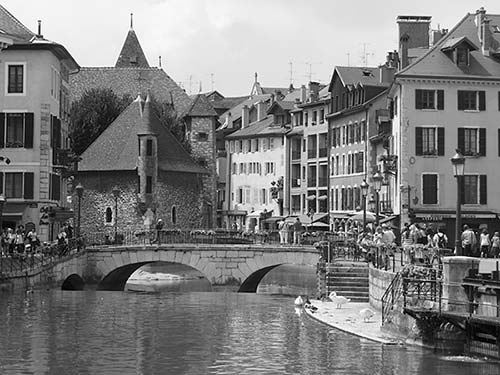
Modern Annecy (pop. 50,000) sprawls for miles, but we’re interested only in its compact old town, on the northwest corner of the lake (known as Lac d’Annecy, or Lake Annecy). The old town is split by the Thiou River (which looks more like a canal) and bounded by the château to the south, and the TI and Rue Royale to the north.
TOURIST INFORMATION
The TI is a few blocks from the old town, across from the big grass field, inside the Bonlieu shopping center (daily 9:00-12:30 & 13:45-18:00, Sun hours vary depending on season; 1 Rue Jean Jaurès, +33 4 50 45 00 33, www.lac-annecy.com). Get a city map, the Town Walks walking-tour brochure (covering several themed walks and basic historical information), the map of the lake showing the bike trail (and a good brochure about the bike trail), and, if you’re staying awhile, the Lac Annecy Magazine. There’s a handy WC across the hall from the TI. You’ll also find TIs in most villages on the lake (many open daily in summer, weekends only off-season).
ARRIVAL IN ANNECY
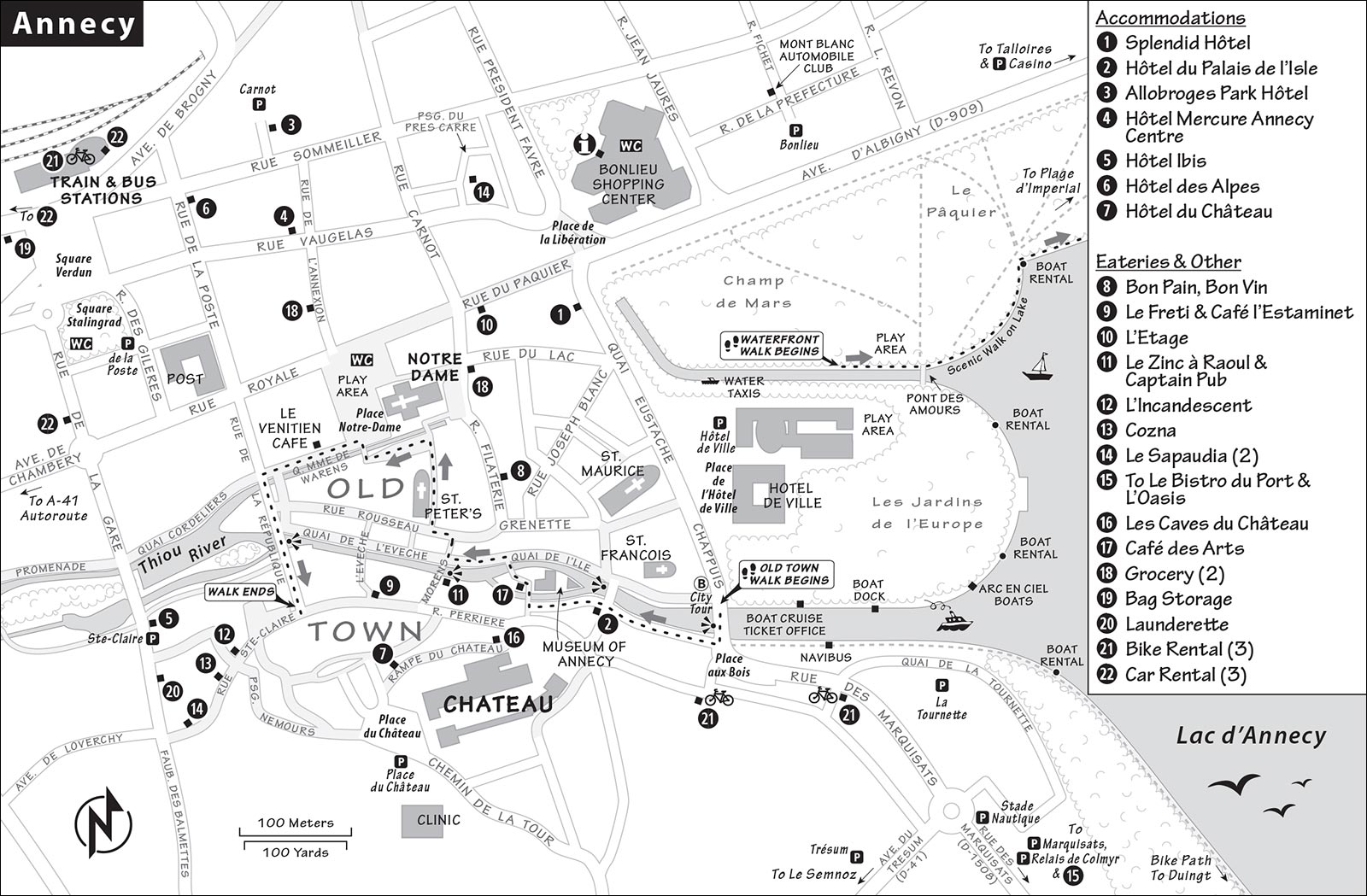
By Train and Bus: The stations sit side by side. Baggage storage is available nearby (see “Helpful Hints,” later). To reach the old town and TI, cross the street in front of the stations, turn left, and walk to the Hôtel des Alpes. Turn right on Rue de la Poste, then left on Rue Royale to reach the TI and some hotels, or continue straight to more recommended hotels.
By Car: Annecy is a traffic mess in high season and on weekends. Smart drivers plan to arrive early, during lunch, or late. Avoid most of the snarls by taking exit #16 from the autoroute (headed north, it’s signed Annecy-Centre; headed south, the sign reads Albertville). Avoid exit #17, the other Annecy option. From exit #16, follow Annecy/Albertville signs. Upon entering Annecy, follow signs for Le Lac or Le Château depending on the location of your hotel. (Don’t follow signs for Annecy-le-Vieux.)
Refer to the “Annecy” map in this chapter for parking lots. The first 30 minutes are free; after that figure €1.50 per hour (about €16/24 hours). Ask your hotel for a free overnight parking pass (most hotels have agreements with a nearby garage). Upon arrival, ditch your car at the first lot you come to, then get advice from your hotel for more convenient parking. Parking Ste-Claire, Parking de la Poste, and Parking Place du Château work for the hotels I list away from the lake. On the lake, you can park near the big boat docks at the underground Hôtel de Ville lot or at Parking La Tournette, or a block farther along at Parking Stade Nautique. If all else fails, the big Parking Trésum, just off the lake, usually has spaces. The Marquisats parking lot is cheaper but a 20-minute walk to town. Annecy also has several free, remote parking lots (called Parc Relais) with easy and quick bus connections into the center (www.annecy.fr/146-parkings.htm, look for Parkings Gratuits). Parc Relais de Colmyr is closest to the center (but charges in summer).
By Plane: From Geneva’s airport (code: GVA, www.gva.ch), Annecy is a 45-minute autoroute drive (Swiss vignette required; see “Getting Around the Alps,” earlier). Several bus companies connect the airport to Annecy cheaply (see www.omio.com). On weekdays, TPG bus #272 is best (hourly Mon-Fri, none on weekends, 80 minutes, www.tpg.ch). BlaBlaCar bus runs a few daily trips (www.blablacar.fr). Or go slower by train (2/hour, 1.75 hours, expect crowded cars). Your easiest solution is to book a private shuttle in advance (€110/1-4 passengers, €130/5-8, +33 6 99 21 00 06, www.genevashuttle.com). Taxis charge an outrageous 200 Swiss francs. Geneva’s airport has a helpful transportation desk at baggage claim.
From Lyon’s St-Exupéry airport (code: LYS, www.lyonaeroports.com), allow 1.5 hours by car (all autoroute), 3 hours by infrequent BlaBlaCar bus or FlixBus (www.flixbus.com), or 2.5 hours by train (8/day).
HELPFUL HINTS
Bike Alert: Pedestrians need to be aware of bike riders and avoid walking in bike lanes. If you ride a bike here, obey the same rules you would when driving a car (look before merging, don’t stop in a travel lane, etc.).
Market Days: A thriving outdoor food market occupies much of the western end of the old town center (on and around Rue de la République) on Tuesday, Friday, and Sunday mornings until about 12:30. The biggest market in Annecy is on Saturday, but it’s less central and geared toward locals (more clothes, fewer crafts; until 12:30, around Boulevard Taine—several blocks behind the TI).
Supermarkets: The Monoprix is at the corner of Rue du Lac and Rue Notre-Dame (Mon-Sat 8:30-19:50, closed Sun, supermarket upstairs). A smaller Franprix is on Rue de l’Annexion just off Rue Royale (Mon-Sat 8:00-21:00, Sun 9:00-19:00).
Baggage Storage: Store your bags at the Vival grocery across from the train station (€3/hour, or €12/day, daily 7:00-23:00, 1 Rue de l’Industrie—see the “Annecy” map). Bike renters can leave their bags at most bike-rental shops. You can also book baggage storage ahead at www.nannybag.com.
Taxi: Call +33 4 50 45 05 67.
Mont Blanc Automobile Club: If you’ll be driving on Swiss autoroutes, buy your Swiss vignette here (15 Rue de la Préfecture, Mon-Fri 9:00-12:00 & 14:00-18:00, Sat 9:00-12:00 & 13:00-17:00, closed Sun).
Laundry: Lav’ Confort Express launderette is at the western edge of the old town near where Rue de la Gare meets Rue Ste-Claire (daily 6:00-21:00, 6 Rue de la Gare).
Bike and Paddleboard Rental: Many places rent standard bikes for about €20/day (leave ID as deposit, includes helmet and basket, half-day rentals; electric, tandem, and kids’ bikes/carriers also available; hours generally daily 9:00-12:30 & 14:00-18:30). All can keep your bags while you ride. Ask the TI about a rental shop near your hotel.
Véloncey Bikes is at the train station and offers a screaming deal to those with a valid train ticket to Annecy (€8/day, otherwise €21/day, requires €250 deposit, closed 13:00-14:00 and Sun, +33 4 50 51 38 90).
Roul’ ma Poule, near the lakefront bike path across from the lake steamers, rents rollerblades, bikes, and more (March-Oct, 4 Rue Marquisats, +33 4 50 27 86 83, www.roulmapoule.com). They also rent paddleboards (about €15/half-day) from their shop in Annecy-le-Vieux (47 Avenue du Petit Port, +33 4 50 23 31 15). Cyclable is also near the lake on Place aux Bois (more choices, daily 9:00-19:00, +33 4 50 51 51 50, www.cyclable.com).
Car Rental: Avis is at the train station (+33 4 56 41 80 02). Hertz and Sixt are a block from the station (Hertz: 15 bis Avenue de la Gare, +33 4 50 51 19 89, Sixt: 5 Avenue de Chevéne, +33 4 80 73 00 10).
Bus Tour: Red open-top minibuses run hour-long loops around the old town and along sections of the lake—an easy introduction to Annecy. Board the Annecy City Tour bus by the view bridge where the river enters the old town (€14, April-Oct 3-4 trips/day, some English commentary, see the “Annecy” map for bus stop, details at TI or www.annecycitytour.com).
Bad Weather: If it’s raining, you could consider a day trip to Lyon (trains run about hourly, 2 hours; see “Annecy Connections,” later). The last train back to Annecy usually leaves Lyon at about 21:00, allowing a full day in the big city.
Sights in Annecy
▲▲Old Town Walk
Most of the old town is wonderfully traffic-free. The river, canals, and arcaded streets are made for ambling. This 45-minute walking tour will get you familiar with Annecy toute de suite. Do it early to allow time for une pause café at a canalfront café, or in the evening to enjoy the old town’s soft lighting. No sight in Annecy merits an entry fee. Cool your jets and learn to saunter. As you wander Annecy’s lovely lanes you’ll be following in the footsteps of Jean-Jacques Rousseau, who adored strolling here (see sidebar, later).
Start in the center of the bridge on Quai Eustache Chappuis (it’s the bridge closest to the lake). With your back to the lake, take in the iconic view of the old town. You’re looking down the Thiou River, which starts its puny 2.2-mile trek here (running from the lake into tributaries of the Rhône River). It splits the old town in two and has provided power and resources for Annecy’s economy since the Middle Ages. The Museum of Annecy (Palais de l’Isle) covers the tiny island in the river straight ahead, the St. François de Sales Church (1610) sits stage right, and the château (built in 1219) looms above to the left. The lakefront park over your right shoulder is more like an arboretum, home to a variety of plants, flowers, and several sequoia and giant chestnut trees.
Stroll down the left side of the river toward the island. You’ll soon spot twin metal gates allowing overflow from the Thiou to pass under the St. François de Sales Church and into the St. Dominique Canal. The pretty church, named for the saint who embraced humanism and preached nonviolence during the wars of the Reformation (which were particularly violent in this region), was converted into a textile factory after the Revolution. It became a church again in 1923.
Keep straight along the river at the first bridge, skirting past the Museum of Annecy, and then cross onto the minuscule island at the next bridge. You’ll pass the tempting Café des Arts (opens at 10:00) and the entrance to the museum (described later).
Resume your walk by crossing to the other side of the Thiou and turn left on Quai de I’lle. Notice the homes with doors right at river level. The river is carefully controlled with overflow gates and locks to maintain its level, allowing it to run safely through the heart of the city. At the next bridge (Pont Morens), look for the protruding outhouse on the upper floor of the building across the canal (boarded up now, thankfully) and ponder the value of clean rivers (the Thiou is today considered among the cleanest rivers in Europe). This bridge was smothered with houses in the Middle Ages, when a central address was all-important and any available space was used for housing.
Turn your back to the canal and walk under those heavy arches, then make a left onto Rue J. Jacques Rousseau (who prowled these lanes for 14 years—see sidebar). You’ll come to Annecy’s plain St. Peter’s Cathedral (built in 1535, and used by the Counts of Geneva during the Reformation). Turn right just before the cathedral on Passage de la Cathédrale, then make a left along the canal and walk to the next bridge. Notice the merging of two canals and wooden walkways. The canal running under the building is the Notre Dame Canal; the other is the Vassé Canal (both were instrumental in Annecy’s economic development). Cross the bridge, take a short detour into the big square (Place Notre-Dame) to admire the flowers, then double back and continue along the canal. Consider a canalfront pause at the peaceful Le Venitien Café, which draws a young predinner crowd (open daily).
Continue on and turn left when you reach Rue de la République. If it’s market day and you’re here before 13:00, prepare for jam-packed streets in this area. When you get back to the Thiou River, stop on the bridge to take in the view over Quai de l’Evêché. Those metal gates (on both sides of the bridge) once fed water to a turbine that powered a cotton factory in the late 1800s. Continue along Rue de la République until you reach the arcaded and pedestrian-popular Rue Ste-Claire. Our walk is done. From here you can turn left to return to the lake. Or take any lane to the right up to the Château Museum.
Museum of Annecy (Palais de l’Isle)
This serenely situated 13th-century building cuts like the prow of a ship through the heart of the Thiou River. Once a prison, it held captured French Resistance fighters during World War II. Today, you can still see several of the prison cells, but most of this skippable museum is taken up with exhibits on local architecture.
Cost and Hours: €4, €7.30 combo-ticket includes Château Museum; Wed-Mon June-Sept 10:30-18:00, Oct-May 10:00-12:00 & 14:00-17:00, closed Tue year-round; free English leaflet.
Château Museum (Musée-Château d’Annecy)
The castle, built in 1219 by aristocrats from nearby Geneva, cuts an impressive figure as it hangs above the lake in the old town. But there’s little to see inside: a few rooms devoted to local folklore, anthropology, and natural history, and a modern-art collection that rotates regularly. Skip it unless you want a great view over Annecy from the far end of the courtyard.
Cost and Hours: €5.60, €7.30 combo-ticket with Museum of Annecy, same hours as Museum of Annecy.
▲Annecy’s Waterfront
Stroll the bike/walking path in either direction for lake and mountain views. The best views are found walking east with the lake on your right. The peaks of Mont Veyrier and La Tournette dominate the left (east) side of the lake while Le Semnoz and the tallest viewable peak—La Sambuy at 7,200 feet—control the west and south views.
Beaches in and Around Annecy
Annecy’s lake is ringed with good beaches offering great swimming and views. Some are private and charge a small fee, others are free. Most have grassy shores. Plage d’Imperial offers the most kid fun, with water slides and more (small fee, served by the tourist train). A bit past Plage d’Imperial, Plage d’Albigny is a good, sandy public beach but also draws lots of people in summer (free). Plage Municipale de Sevrier, 10 minutes from Annecy, has lots of grass and a sandy beach with great views on the lake’s bike path (free).
SCENIC RIDES, STROLLS, AND HIKES
Lakeside paths and short, steep hikes up hillsides offer rewarding views, even with clouds. Boats, bikes, and cars make this lake’s villages, hikes, and views accessible.
Here are a few suggestions for how to make the most of your time along this beautiful lake, including my favorite bike and car trips that mix in some scenic hiking and boating options.
▲▲Boating
This is one of Europe’s cleanest, clearest lakes, and the water is warmer than you’d think (average summer water temperature is 72 degrees Fahrenheit).
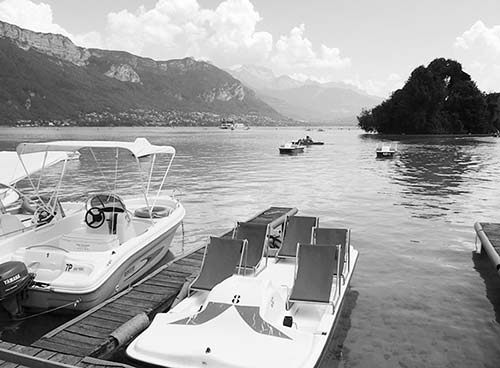
On Your Own: To tool around the lake, rent a paddleboat (pédalos, some equipped with a slide, about €22/hour for 2 people; some boats can handle 6 passengers) or a motorboat (hors-bord, no license needed; about €65/hour for 2 people, €170/day, up to 7 people possible, several companies charge the same rates). Water taxis will take you for a personal cruise or to destinations along the lake such as Talloires or Duingt (figure €200/hour for up to 4 passengers for a cruise, €110 to Talloires, +33 6 28 06 74 87, www.water-taxi.fr).
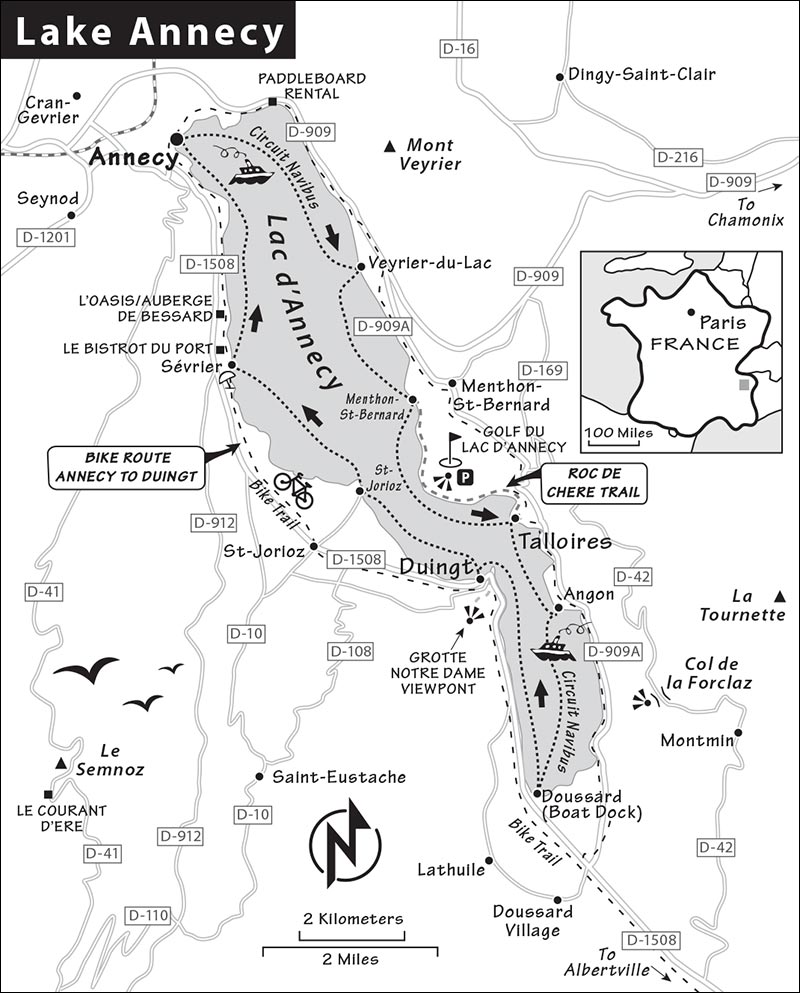
Organized Cruises: Several worthwhile lake cruises are offered by Compagnie des Bateaux du Lac d’Annecy. Their 60- and 90-minute cruises make no stops and come with French narration (and downloadable explanations in English); the 60-minute trip is the better option (€19 or €22, each run 4/day May-Aug, fewer April and Sept-mid-Oct, generally 1/day off-season, no cruises in Jan). Their two-hour cruises, called Circuit Navibus, stop at several villages on a clockwise loop around the lake and allow a stopover—Duingt or Talloires, described later, are good choices (€23 for entire loop, less for shorter trips, 3-5/day late April-Sept); these are ideal for hikers and cyclists (see later). Another boat offers 2.5-hour lunch cruises for about €85 and elaborate dinner and dancing cruises. Get schedules and prices for all boat trips at the TI or on the lake behind Hôtel de Ville (+33 4 50 51 08 40, www.bateaux-annecy.com). Another company, L’Arc en Ciel, runs lake cruises in smaller boats (€16 one-hour trip with some commentary, www.arcenciel-annecy.com).
▲▲Biking Annecy’s Lake Path
Annecy was made for biking. It’s an ain’t-it-great-to-be-alive way to poke around the lake (sun or clouds) and test waterfront cafés and grassy parks and beaches. A scenic lakefront bike trail runs along the entire west side of the lake and most of the east side. Even a short pedal on the path is worth the effort, as there are no hills, you’re separated from car traffic, and the lake and mountain views make you forget the hard seat. Expect big crowds on weekends. Wear sunglasses and bring water and a bathing suit.
Leave Annecy passing right by the big boats with the lake on your left, pedal as far as your legs (or battery) take you, break for a lakefront café, and consider a swim at one of the many grassy beaches. You’ll pass wheat fields, farms, towns, and lots of other riders (treat the trail like a highway—merge carefully, don’t stop in your lane, etc.). My favorite easy ride is the seven-mile stretch from Annecy to the village of Duingt (described later)—steady pedalers make it in 45 minutes; smell-the-roses types need an hour. You can ride to Duingt and take your bike on the Circuit Navibus boat back to Annecy (not recommended mid-July-mid-Aug, when boats are most crowded), or vice versa (€15, 3-5/day from Duingt, 45 minutes; generally at about 11:25, 15:55, and 18:40; more departures in summer, verify times before leaving). Riding 20 minutes past Duingt to the lake’s southern end at Doussard brings some of the best lake views (Circuit Navibus boat stops here, one-hour trip back to Annecy). Serious cyclists can make it around the lake in about three hours (be prepared for narrow roads on limited stretches with no bike path and some darn steep hills on the far side of the lake—an e-bike is a big help for this ride).
Brake for a Break: About 15 minutes after leaving Annecy you’ll come to L’Oasis (Auberge de Bessard) chalet/café, an inviting Shangri-la kind of place with a pétanque court and outdoor tables scattered about a big grassy garden (serves coffee, beer, salads, snacks, and complete meals; March-Oct from about 9:00, closed Mon except in summer).
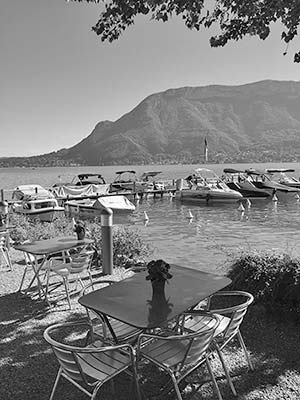
▲Duingt
The quiet village of Duingt is a good destination by boat (see “Organized Cruises,” earlier) or bike from Annecy and a practical stop for drivers. Here you’ll find a café, bakery, grocery store, tiny boat dock, and a good, short hike (see below).
Bike riders exit the trail just before the rail tunnel, cross under the trail, and turn right to find bike racks and access to the village center and the hike. If you arrive by boat, walk through the park with the lake on your right, and cross into the village (follow yellow arrows to reach the hike and grocery store; when arrows end, turn right at the sign pointing the opposite way to les Commerces).
By car it’s a 20-minute drive from Annecy. Park at Duingt’s church (WCs and a picnic-friendly lakefront plaza nearby) and walk left past the Spar grocery store and the old rail tunnel to find the hike and village center. Bus #50a runs hourly between Duingt and Annecy. The stop in Duingt is by the church.
Duingt’s boulangerie (closed Wed) sells tasty sandwiches, quiches, and drinks and is on the lakefront road, 50 yards toward Annecy from the Hôtel du Roselet. The small park between the castle and the boat dock has picnic tables and views.
Viewpoint Hike: A short, steep, and beautiful trail leading up to glorious lake views starts from the rear of the village (100 yards from the old rail tunnel toward the town center, 200 yards from the church). Find signs to Grotte N-D du Lac Belvedere, and walk up the trail passing the Stations of the Cross. In another 15 minutes, great views and benches await at the end of the paved walkway. A steep dirt trail continues up from here (follow les Taillefer signs) for even better vistas (some rocky, uneven sections).
▲▲Talloires
This is the lake’s most charming and upscale village, and well worth a visit (or overnight stay in one of its lovely but pricey hotels). There’s a nice public beach for swimming plus paddleboats, a delightful bay lined with a few classy hotels and view cafés, and a very scenic but very uphill hike. You’ll find a good grocery store in the village center and good lunch option at $$ Café de la Place (daily, 7 Place des Vendangeurs, +33 4 50 64 40 74).
To reach Talloires from Annecy, allow 30 minutes by car or 40 minutes by Circuit Navibus boat (and 1.5 scenic hours back as the boat does a one-way loop around the lake). The boat deposits you on the bay, and parking is available close to the beach (follow signs to la Plage). Bus #60 runs every 45 minutes to Annecy from the Centre stop in Talloires (near the top of the village), a quicker alternative to the full boat loop. There are gaps in the bike trail on this side of the lake, so there are points where you’ll share the road with cars, but many cyclists do it; the ride takes 45-60 minutes.
Roc de Chère Trail
Two trails from Talloires lead up to jaw-dropping views over the village and Lake Annecy (good hiking shoes essential). The shorter but steeper route leaves from the bay, 10 minutes to the left from the boat dock. Follow the bay to its end, passing the Abbaye de Talloires Hotel, and go under the yellow bar to reach the trailhead and posted trail map. From here it’s a grueling 45-minute hike straight up to your destinations—the Belvédère du Roc de Chère and the Belvédère de la Crête.
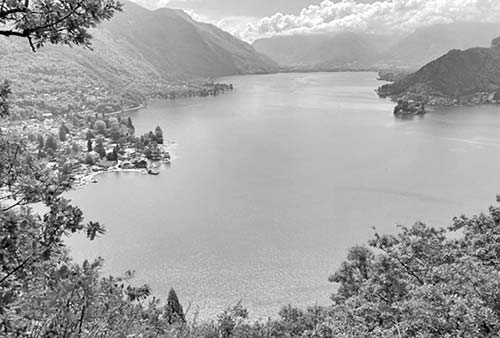
For an easier but longer ascent (figure an hour one way, faster back), walk up through the village and turn left on the main road (D-909A) and follow the narrow sidewalk. Just after passing Chalet Christine, find the stone staircase leading left (after the hairpin curve—a wood sign marks this access). The trail climbs for 20 steep minutes up a rocky path with some very uneven footing. You’ll pass a map of the area’s trails and come to benches with glorious views. In 10 more minutes you’ll reach the two belvédères.
From either viewpoint you could continue to the next village, Menthon-St-Bernard, and catch the Circuit Navibus boat or bus #60 to Annecy there, or simply backtrack to Talloires.
Those with a car can avoid the steep hike by turning at the tiny signs for the Roc de Chère/Golf du Lac d’Annecy golf course between Menthon-St-Bernard and Talloires. Then look for hiking signs by the bus shelter (parking available; you can also get here on bus #60). It’s a 20-minute walk from there to the lake views.
Driving Around the Lake
The busy roads that link villages along the lake (D-1508 on the west side and D-909 on the east) deliver mostly modest, though occasionally spectacular, lake views (better from D-909). They eventually lead to a scenic route to Chamonix and access to fantastic view drives (described next). Read the bike route description earlier for suggested stops along the lake. Be prepared for afternoon traffic on weekends and on any day in summer.
For a terrific day around the lake, drivers can follow this plan: Rise early and start at Le Semnoz, then return to the lake and drive south, stopping in little Duingt for picnic supplies, then have a spectacular view lunch (picnic or café) at Col de la Forclaz. Next, continue down to Talloires, then back to Annecy. Note that Col de la Forclaz ties in well with the scenic route to Chamonix.
If you don’t have a car, Ligne d’Eté buses run to Le Semnoz (and its viewpoint) from the Annecy bus station (€7 round-trip, free July-Aug; 9/day daily July-Aug, Sat-Sun only in June and September, none Oct-May; 40 minutes, stops at the luge, bikes allowed, details at TI and www.sibra.fr).
Le Semnoz: For majestic mountain panoramas near Annecy that include Mont Blanc, drive or take the summer-only bus up...and up...and up to Le Semnoz (about 5,000 feet). Follow D-41 from near the lake (see the “Lake Annecy” map). Allow about 30 minutes one-way and expect lots of bicycles. After leaving the city, you’ll pass through Annecy’s forest and climb past tree level to grandiose views over the high Alps, featuring Monsieur Blanc. Just before the top, you’ll pass the fun summer Luge d’Eté (turn right at the huge SEMNOZ sign and drive under the overpass to find it; about €4/ride in summer, July-Aug daily; May-June and Sept-Oct Wed, Sat-Sun, and holidays). Back on D-41, continue past the hotel, and park when you see the chalet-café Le Courant d’Ere (good for a drink and snacks, but meals are mediocre; open Wed-Mon 10:00-18:00 in high season, Sat-Sun off-season, +33 4 50 01 23 17). Climb to the chairlift station above the café for a magnificent panorama in all directions. Those big signs downhill from the café lead to a 3.75-mile loop hike passing three lakes and a mountain refuge.
Col de la Forclaz: For drop-dead gorgeous views that take in the entire lake and surrounding peaks, drive 18 miles from Annecy (allow 45 minutes one-way) to Col de la Forclaz. Start by taking D-1508 south toward Albertville. Three kilometers after leaving the lake at Doussard, turn left on D-42 (signed Col de la Forclaz), then wind your way up a narrow lane for five miles past lovely scenery to the Col de la Forclaz (3,600 feet). Look out for bicyclists on this climb.
Park as close to the top as you can, then walk up to the $$ Chalet la Pricaz for the best view café and an amazing lunch option—and paragliders galore (daily from 10:00). From the café it’s a steep 15-minute walk to the takeoff point for the paragliders, with even better views. Several outfits offer a chance to jump off a cliff and sail over the lake, including the appropriately named Adrenaline Parapente (€95 for a 15-minute ride, €130 for 25 minutes, www.annecy-parapente.fr).
From here, D-42 continues scenically downhill toward Talloires and the road back to Annecy.
Sleeping in Annecy
Annecy is popular, particularly on weekends and during the summer. Hotel rates drop from about mid-October through late April and increase in summer. Most hotels can help you find free overnight parking (in lots, usually after 19:00 until 9:00 in the morning). Unless otherwise noted, these hotels have air-conditioning and elevators.
IN THE TOWN CENTER
This part of town is pedestrian-friendly and comes with some noise.
$$ Splendid Hôtel*** decorates Annecy’s busy, parkfront street and makes an impression with its grand, American-style facade. Standard rooms are tight but quiet and well appointed; ask about larger accommodations and the pricier fifth-floor rooms with nice decks and lake views (big beds, bar, terrace, fitness room, 4 Quai Eustache Chappuis, +33 4 50 45 20 00, www.splendidhotel.fr, info@splendidhotel.fr).
$$ Hôtel du Palais de l’Isle*** offers a romantic canalside location with a nautical feel in the thick of the old town and 34 comfortable rooms—several with canal or rooftop views. Check-in is on the first floor up (13 Rue Perrière, +33 4 50 45 86 87, www.palaisannecy.com, contact@palaisannecy.com).
$$ Allobroges Park Hôtel,*** near the train station, rents 50 lovely rooms in a handsome mansion with cozy lounges (small bar, small terrace, great breakfast, easy pay parking, down a short alley at 11 Rue Sommeiller, +33 4 50 45 03 11, www.allobroges.com, info@allobroges.com).
$$ Hôtel Mercure Annecy Centre*** has spacious but uninspired rooms and drab public spaces, but it’s central and perfectly sleepable (26 Rue Vaugelas, +33 4 50 45 59 80, www.mercure.com, h2812@accor.com).
$$ Hôtel Ibis*** is a good choice, with updated, well-configured rooms (all with queen-size beds, half with canal views, many with balconies), a canalside lounge, and access to underground public parking. It’s well situated on the edge of the old town, a few blocks from the train station (12 Rue de la Gare, +33 4 50 45 43 21, www.ibis.com, h0538@accor.com).
$ Hôtel des Alpes,** a top value, has a homey feel with 32 pleasant rooms at a busy intersection a block from the train station. Rooms on the courtyard are quieter, but those facing the street have effective double-pane windows (family rooms, 12 Rue de la Poste, +33 4 50 45 04 56, www.hotelannecy.com, info@hotelannecy.com).
AT THE FOOT OF THE CHATEAU
This place is in a quiet area a steep five-minute walk up from the old town on Rampe du Château.
$ Hôtel du Château,** an unpretentious place run by unpretentious Romain and Amélie, sits barely below the château. It comes with a view terrace (nice for breakfast) and 16 simple, spotless rooms—about half have good views. It’s first-come, first-get for the few free parking spots (no air-con, no elevator, 16 Rampe du Château, +33 4 50 45 27 66, www.annecy-hotel.com, hotelduchateauannecy@gmail.com).
Eating in Annecy
Although the touristy old town is well stocked with forgettable restaurants, I’ve found a few worthy places. And while you’ll pay more to eat with views of the river or canal, the experience is uniquely Annecy. Book ahead (just a day works) or arrive right at opening time to snag a table. Ubiquitous and sumptuous gelati shops remind me how close Italy is. If it’s sunny, assemble a gourmet picnic at the arcaded stores and dine lakeside.
$$ Bon Pain, Bon Vin is a fun find serving a variety of delicious and reasonably priced shared plates in a wine bar-like setting, with barstools only downstairs, and a warm, traditional dining room upstairs. The easygoing staff will translate the menu, which is ideal for dish splitting. You can even choose a bottle of wine and pay only for the amount you drink (daily until late, 17 Rue Filaterie, +33 4 50 45 25 62).
$ Le Freti is a rollicking and reliable restaurant for local cuisine at good prices. It’s the place to go for good fondue, raclette, or anything with cheese. There’s fine outside seating under the arcade (but no raclette service) and inside upstairs, where each booth comes with an outlet for melting raclette (no reservations taken in summer—arrive early or expect a long wait, reservations smart off-season, cheap wine, air-con, closed Tue, no lunch Mon, enter at 12 Rue Ste-Claire and go upstairs, +33 4 50 51 29 52).
$$ Café l’Estaminet, a pub-like place with a warm interior and a few waterside tables on the back terrace, dishes out salads, omelets, pasta, mussels, fries, and more for fair prices (closed Mon, no lunch Tue, 8 Rue Ste-Claire, +33 4 50 45 88 83).
$$ L’Etage is a good choice if you can’t decide what you want. Well-prepared regional specialties and a good range of standard brasserie fare are served at respectable prices. Dine along the pedestrian street terrace, inside the sweet little bar area, or upstairs under wood beams around a big fireplace (dinner daily, 13 Rue du Paquier, +33 4 50 51 03 28).
$$ Le Zinc à Raoul, a cool little bistro-café, serves mostly Savoyarde specialties with some standard café fare in a wood-cozy interior or on a lively outside terrace. The cheese fondue with morel mushrooms is excellent (dinner daily, closed Tue off-season, 11 Rue du Pont Morens, +33 4 50 60 36 88).
$$ L’Incandescent is an intimate place that draws loyal diners like a warm light to enjoy original menu items, creative presentations (dishes are often served in the casserole they were cooked in), and attentive service that’s worth booking ahead for (dinner daily, 4 Rue Faubourg Sainte Claire, +33 4 50 63 96 23).
$$$ Cozna is a trendy but fine choice, with a chef whose mix of classic French recipes and creative twists has caused a stir in Annecy (book several days ahead, closed Sat-Sun, good indoor and terrace seating, 22 Faubourg Ste-Claire, +33 4 50 65 00 25).
$ Le Sapaudia cooks up Annecy’s favorite pizza and calzones before your eyes. It’s as much a takeout place as a dine-in restaurant, with just a few simple tables (daily, 12 Faubourg Ste-Claire, +33 4 50 45 24 03). There’s a second location closer to the TI on the appealing Cours du Pré Carré (daily, 10 Rue Vaugelas, +33 4 50 51 20 05).
Lakefront Dining: Many cafés and restaurants ring Annecy’s postcard-perfect lake. If you have a car and want views, prowl the many waterfront villages. $$$ Le Bistrot du Port, a nautical place five minutes from Annecy by car, is beautifully situated on the boat dock at the southern end of Sévrier-Centre (daily, no dinner Sun, Port de Sévrier, turn off D-1508 at the McDonald’s, +33 4 50 52 45 00).
Dessert: Wherever you eat, don’t miss an ice cream-licking stroll along the lake after dark. Gelati shops abound on central Rue Ste-Claire.
Nightlife: Start or end your evening at one of these local, different-as-night-and-day places. At the cozy wine bar Les Caves du Château, you’ll escape the crowds by heading just 20 steps up the Rampe du Château from busy Rue Ste-Claire. They offer appetizers and a good choice of wines by the glass from throughout France (Tue-Sat from 18:30, 6 Rampe du Château, +33 9 51 17 29 98).
Café des Arts is Annecy’s most atmospheric café, marooned on the island at the Palais de l’Isle. With good prices, it attracts a mix of local hipsters and the odd tourist (daily 10:00-late).
At the Captain Pub (arrr, matey!) you’ll step down into a venerable pirate’s den deep in Annecy’s old town. Half the place works as a $$ restaurant with nice seating inside and out, the other half is the pub (open 11:00-late, 10 beers on tap, 50 more in bottles, 11 Rue du Pont Morens, +33 4 50 45 79 80).
Annecy Connections
Check BlaBlaCar bus (www.blablacar.fr) and FlixBus (www.flixbus.com) for cheaper fares and sometimes better schedules.
From Annecy by Train or Bus to: Chamonix (train: 10/day, 2.5 hours, two quick changes; by bus: 3-5/day by BlaBlaCar bus, 1.5 hours), Lyon (train or SNCF bus: hourly, 2 hours; bus: 6/day by BlaBlaCar bus and FlixBus, 2 hours, stops at Lyon airport and/or Lyon-Perrache), Beaune (about hourly, 4 hours, change in Lyon), Nice (8/day, 7 hours, start with bus or train to Lyon, more with 2-3 changes), Paris’ Gare de Lyon (hourly, 4 hours, many with change in Lyon), Geneva (about hourly, 1.5 hours by bus/train; bus-and-train options also available from Geneva’s airport in 2 hours).
Chamonix
Surrounded by snow-capped peaks, powerful—if receding—glaciers, and richly rewarding hiking trails, Chamonix (shah-moh-nee) is France’s favorite alpine resort. Officially called Chamonix-Mont Blanc, it’s the largest of five villages lining the valley at the base of Mont Blanc. Ever since tourists eclipsed cows as the town’s economic base a couple hundred years ago, Chamonix’s purpose has been to dazzle visitors with some of Europe’s top alpine thrills. But you’ll also learn a thing or two about glaciers and get a look into the wild world of mountain climbing. Chamonix is a busy place from early July through late August and during winter holidays, but it’s plenty peaceful at other times. Chamonix’s sister city is, logically, Aspen, Colorado.
PLANNING YOUR TIME
Summers—or any time a sunny day follows a rainy stretch—bring crowds and long lift lines. Ride the lifts by 8:00 (crowds and clouds roll in later in the morning).
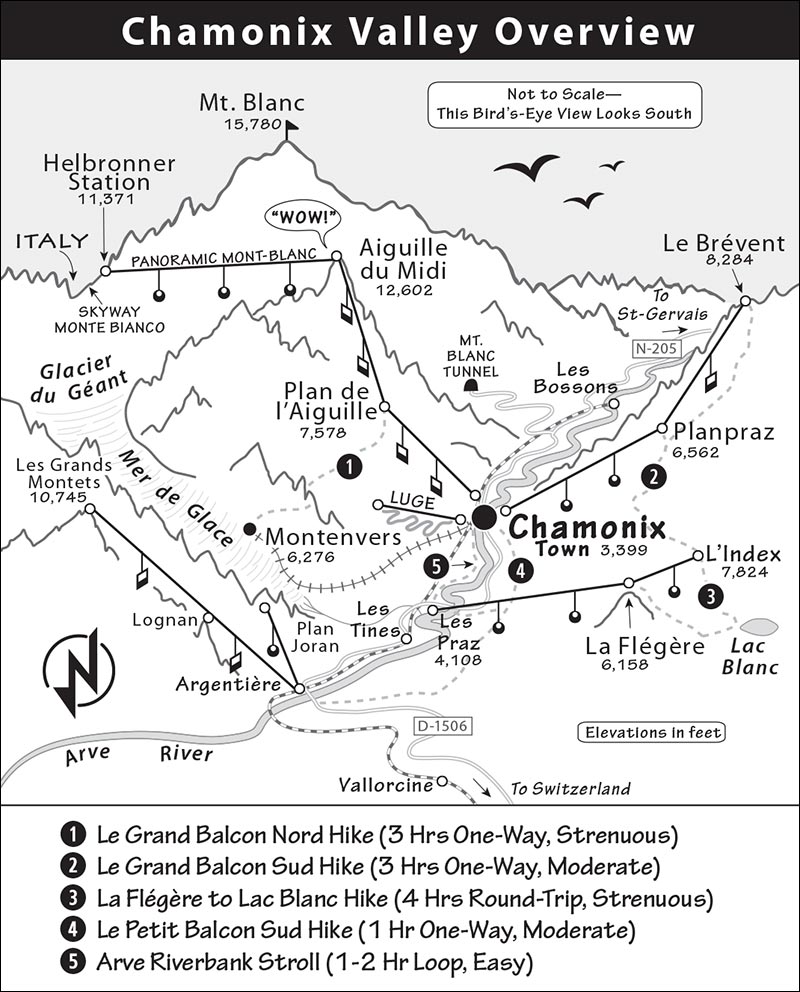
If you’re a good hiker and have one sunny day (and there’s minimal snow), spend it this way: Start with the Aiguille du Midi lift (go very early, reservations possible and recommended July-Aug), take the Panoramique Mont Blanc télécabines to Pointe Helbronner, double back to Plan de l’Aiguille, then do the Grand Balcon Nord hike (usually hikeable by mid-June) to Montenvers and its Mer de Glace. Explore there, then take the cogwheel train down to Chamonix. End your day with a well-deserved drink at a view café in town.
If you can’t get to Helbronner or if the snow is too deep to hike, take the lift up to the Aiguille du Midi, and on the way back make a layover at Plan de l’Aiguille (the little café at the lift station and the refuge, a 20-minute hike down, both have brilliant views and well-priced drinks and food). Return to Chamonix and from there either take the cogwheel train up to Montenvers and the Mer de Glace, do the Petit Balcon Sud hike, or take the Brévent lift to Planpraz, find a seat at one of several magnificent view cafés, and watch the parasailers launch into the abyss.
Orientation to Chamonix
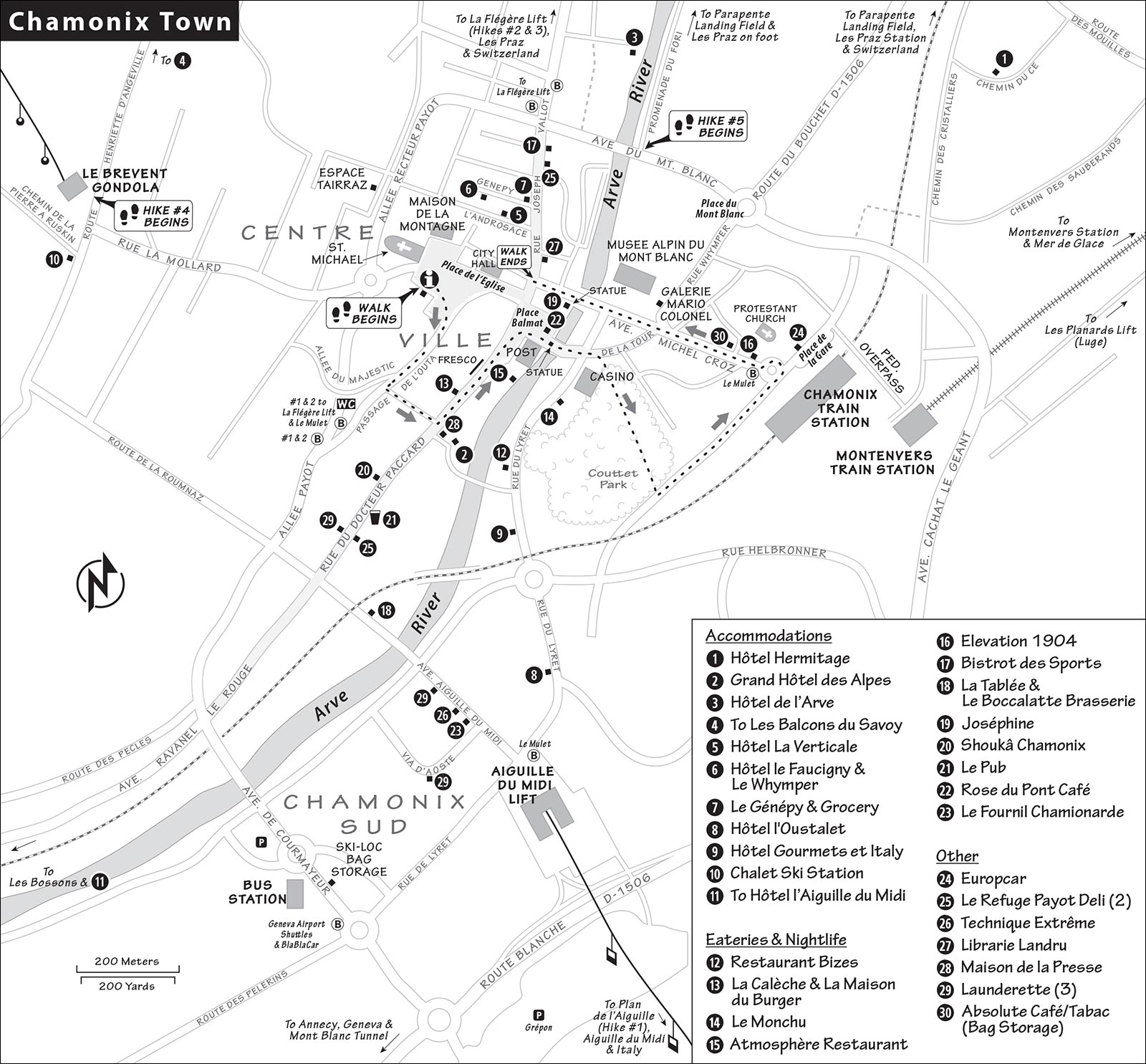
The frothy Arve River splits Chamonix in two—with mountains (Mont Blanc and the Aiguilles Rouges peaks) towering on either side. A thriving pedestrian zone forms Chamonix’s lively core. The TI is just above the pedestrian zone, and the train station is two long blocks across the river. To get your mountain bearings, head to the TI and find the big photo in front. And to see the town, follow my self-guided Chamonix Walk from that point.
Located where Switzerland, Italy, and France intersect, this town has always drawn an international crowd. Today about half of its foreign visitors are British—many have stayed and found jobs in hotels and restaurants.
TOURIST INFORMATION
Visit the TI to make plans (daily mid-June-mid-Sept and mid-Dec-mid-April 9:00-19:00; off-season generally Mon-Sat 9:00-12:30 & 14:00-18:00, closed Sun; +33 4 50 53 00 24, www.chamonix.com). Get the latest mountain weather forecast, pick up the free town and valley map and the “panorama” map of all the valley lifts, and maybe the €5 Carte des Sentiers hiking map (see “Chamonix Area Hikes” on here). I like to take a picture of that map posted on the TI’s back wall. Ask about snow levels and hours of lifts and trains, and consider buying the Multipass lift ticket (described later). The TI’s helpful website and free app have updated sightseeing info, weather forecasts, and more. Pull up a beachy sling chair outside the TI and plan your hike.
ARRIVAL IN CHAMONIX
By Train: Walk straight out of the station and up Avenue Michel Croz. In three blocks, you’ll reach the town center; turn left at the big clock, then right for the TI. While the train station has no baggage storage, you can leave bags at the Absolute Café/Tabac shop (a block in front of the station on the right at 223 Avenue Michel Croz, €6-10/day per bag, Mon-Fri 7:00-19:00, Sat from 8:00, closed Sun).
By Bus: The long-distance bus station is south of the town center (234 Avenue de Courmayeur). It’s a 15-minute walk to the town center. Or take the free shuttle bus called Le Mulet that stops in front of the station (see here). You can stash bags across the street from the bus station at Ski-Loc (small fee, daily 8:45-12:30 & 15:00-19:00, 253 Avenue de Courmayeur; +33 4 50 53 36 86).
By Car: There are three roundabouts as you enter Chamonix from the direction of Geneva or Annecy. Hotels are signed from each roundabout. The second roundabout (just before the Aiguille du Midi lift station) provides access to hotels south of the TI. For most of my recommended hotels and the TI, take the third roundabout into Chamonix (Chamonix Nord), and follow signs to Centre-Ville. Parking is metered and well signed. From mid-July to late August, traffic and parking are a mess in Chamonix—plan ahead or arrive by 9:30 to get a spot. You’ll find big pay lots as you enter Chamonix from both directions, with free shuttle service to the town center (Parking Grépon is handy if coming from Annecy/Geneva, about €1/hour, €18/24 hours).
The Mont Blanc tunnel (7.2 miles long, about a 15-minute drive) allows quick access between Chamonix and Italy (one-way-€50, round-trip-€62 with return valid for 1 week, www.tunnelmb.com).
By Plane: The nearest international airport is in Geneva, Switzerland (code: GVA, www.gva.ch; hourly trains, 3 hours with two changes; 2 hours by car, airport shuttle van, or bus—see “Chamonix Connections” at the end of this chapter). Farther west is Lyon’s St-Exupéry airport (code: LYS, www.lyonaeroports.com; linked by 4-6 buses/day, 3.5 hours on BlaBlaCar bus or FlixBus; 3 hours by car). Milan’s Malpensa airport (code: MXP, www.milanairports.com) is a 2.75-hour drive away.
HELPFUL HINTS
Dead Seasons: Many hotels, restaurants, and lifts close between seasons, usually from mid-April to mid-June and again from mid-Sept to mid-Dec. Check ahead.
Crowd-Beating Tips: Trails are quieter the earlier in the day you go. The only lift with serious crowd challenges is the big one: Aiguille du Midi. In high season (especially on a good day after a stretch of bad weather), take an early lift to beat the crowds and afternoon clouds (lift opens at 6:30 or 7:00 in summer, at 8:00 in spring and fall; go no later than 8:00 in summer). Have breakfast on top.
Regardless of the weather, good restaurants in Chamonix can be booked solid for summer evenings—it’s smart to make reservations.
Plan Ahead: Bright snow abounds up high, so bring sunglasses and dress for the cold. For Chamonix’s weather, check at your hotel, the TI, or online at www.chamonix-meteo.com. For current lift information and to book the Aiguille du Midi lift, use www.montblancnaturalresort.com.
Open-Air Market: Chamonix’s Saturday-morning market fills big Place du Mont Blanc.
Supermarkets: Supermarkets are plentiful. The Super-U is central and big (next to Le Génépy on Rue Joseph Vallot). Supplement your run-of-the-mill groceries with gourmet local specialties from Le Refuge Payot deli (two locations: 166 Rue Joseph Vallot and 255 Rue du Docteur Paccard).
Inexpensive Mountain Gear: The best deals on sunglasses, lightweight gloves, day packs, and the like are at Technique Extrême (daily 9:00-19:00, 200 Avenue de l’Aiguille du Midi).
English Books: Small collections are kept at Librarie Landru (open daily, 74 Rue Joseph Vallot) and at Maison de la Presse (daily, 93 Rue du Docteur Paccard).
Laundry: Right by the Aiguille du Midi lift, Cham’Laverie will wash and fold your laundry while you’re out exploring (98 Via d’Aoste, +33 4 50 53 56 48, www.chamlaverie.com, Arno). Chamonix also has two good, central self-service launderettes, both with long hours daily: One is a block up from the Aiguille du Midi lift at 174 Avenue de l’Aiguille du Midi; the other is in the Blanche Neige Gallerie on 262 Rue du Docteur Paccard, across from Le Refuge Payot.
Taxis: There’s usually one at the train station. If not, try Alp Taxi (+33 6 81 78 79 51, www.alp-taxi.com) or Chamonix Cabs (+33 6 79 01 46 02, https://chamonixcabs.com).
Car Rental: Europcar is across from the train station (Mon-Sat 9:00-12:00 & 14:00-18:00, closed Sun, 36 Place de la Gare, +33 4 50 53 63 40, +33 6 85 40 04 72).
Local Guides: Cultural guides can be hired through the TI (€250/half-day in English, €400/full day). Bernadette Tsuda is excellent (+33 6 23 36 34 89).
Tourist Train: The Le Petit Train runs a 40-minute loop throughout Chamonix, with English narration on an audioguide (€8, departs from in front of the post office on Place Balmat, May-Sept every 40 minutes, OK to get off at some stops and catch the next train).
Local Firewater: Pick up a little (5 cl) bottle of génépi liqueur, the local herb schnapps, and nip on it throughout your high-altitude adventures. It’ll warm you and make you feel like a local.
GETTING AROUND (AND UP AND DOWN) THE VALLEY
Lifts and cogwheel trains are named for their highest destination (e.g., Aiguille du Midi, Montenvers, and Le Brévent). More details on individual lifts are given under “Sights in Chamonix,” later. You can find current lift information and book the big Aiguille du Midi lift at www.montblancnaturalresort.com. You can also buy tickets (and reserve the Aiguille du Midi lift) at any valley lift station.
By Lift: Cable cars (téléphériques) climb mountains all along the valley. The mightiest ones—Aiguille du Midi and Le Brévent—leave from Chamonix and offer access to great hiking, though the La Flégère lift is no slouch.
The lift to Aiguille de Midi is usually closed from early November to mid-December for maintenance. The télécabines (gondolas) on the Panoramique Mont Blanc lift to Helbronner (atop the Italian border) run only from mid-May to late September, and only in good weather. The lift called Skyway Monte Bianco (on the Italian side of the mountain) runs from Helbronner down to Pontal d’Entrèves and rotates 360 degrees for panoramic views en route.
Other area lifts are generally open from mid-Dec to mid-April and from mid-June to mid-late Sept. Because maintenance closures can occur anytime, verify schedules for all lifts at the TI.
The Multipass lift ticket saves time and money for most, particularly if you’re spending two or more days in the Chamonix valley. It allows unlimited access to all the lifts and trains (except Panoramique Mont Blanc télécabines to Italy). You also get discounts for various activities in Chamonix, such as the adventure Parc de Loisirs des Planards.
Your pass is a smart card, valid for the day (not 24 hours). With it you can scan your way to the top and ride lifts you’d otherwise skip. You could hop on a lift just to have a drink from a view café at the top (about €80/1 day, €95/2 days, €110/3 days, €150/6 days, add €3 to all passes for the physical card itself; kids 4-14—and kids over 64—pay about 15 percent less for two-day and longer passes, kids under 4 may not be allowed to ride). The one-day pass is only a few euros more than the round-trip ticket to Aiguille du Midi, and a terrific value if you plan to do more than the Aiguille round-trip the same day. Families benefit from reduced fares. The pass is sold online (www.montblancnaturalresort.com), at participating lift stations, and at some hotels.
By Foot: See “Chamonix Area Hikes” on here.
By Bike: The peaceful river valley trail is ideal for bikes (and pedestrians). The TI has a brochure showing bike-rental shops and the best mountain-biking routes.
By Bus or Train: One road and one scenic rail line lace together the valley’s towns and lifts. To help reduce traffic and pollution, your hotel offers a free Chamonix Guest Card (Carte d’Hôte) good for local travel during your stay (also included with lift passes; €10/week at TI or €3/day on bus if not staying at a hotel). The cards are valid on all Chamonix-area buses and the scenic valley train (from Servoz to Vallorcine). This is a great value for those with time to explore the valley.
Local buses #1 and #2 run to valley villages (2/hour, details in English at www.chamonix.net/english/transport/bus). In Chamonix, the easiest stop to find is 200 yards to the right when you leave the TI (past Hôtel Mont Blanc—look for the bus shelters); the website shows other stops in Chamonix by route. Direction “Le Tour” on bus #2 and “Les Praz/Flégère” on bus #1 will take you toward Les Praz (for the Grand Balcon Sud and La Flégère hikes) and Switzerland (see “Chamonix Area Hikes” map, later).
Free Le Mulet/Navette minibuses circulate around Chamonix village (3-4/hour, daily 8:00-19:00). They’re especially handy to or from the Aiguille du Midi lift or the bus station, which are a 15-minute walk from many hotels.
The train ride toward Martigny in Switzerland is gorgeous, and villages such as Les Praz and Tines (10 minutes by bus) offer quiet escapes from busy Chamonix.
Chamonix Walk
Cut in half by a raging little river and with lifts reaching to staggering mountain peaks on either side of its valley, Chamonix really feels like a mountain resort. Yet hiding in its pedestrian-mall town center, among all the outdoor shops and restaurants, is a little history. This quick self-guided walk will help you understand the town that for a thousand years had more cows than people. Then, with the 19th century, came the realization that mountains make wonderful vacation destinations. Chamonix became the springboard to Europe’s tallest peak and was transformed into an alpine resort.
• Start at the map in front of the tourist office.
Triangle of Friendship and TI: The big image of the surrounding peaks offers a fun review of the reasons you’re here. From this point, you can see the Aiguille du Midi lift climbing steeply up the cliffs in the distance ahead of you and, behind you, the similarly staggering Le Brévent lift. The town square is actually a triangle. Known as the Triangle of Friendship (Place du Triangle de l’Amitié), it celebrates the peaceful and productive collaboration of France, Switzerland, and Italy (whose borders come together near here). Ahead on the left is the Hôtel de Ville (look for the flags), which has been the City Hall since 1910. There is almost always some kind of cultural exhibition on the square.
• Look for the church spire.
St. Michael’s Church and Maison de la Montagne: Facing the square is Chamonix’s historic St. Michael’s Catholic Church. The church is made from granite just like the surrounding mountains. Immediately inside the entry are stained-glass windows (circa 1925) celebrating winter sports, with saints looking down over the participants enjoying the local nature.
While most of the building is relatively new, its stone-spire base dates from Romanesque times (800 years ago), and there was a church on this spot centuries before that. In 1091 the owner of the valley had no use for this remote land and gave it to an Italian monastery. The monks built the first church and a priory next door, today’s Maison de la Montagne, which houses the guide and mountaineering headquarters (for details, see “Chamonix Area Hikes,” later). Behind the church, on the right side, a stony overpass leads to the Espace Tairraz crystal museum (see “Rainy Day Options,” later).
• From this triangular square, stroll down a few steps and turn right, browsing highlights of Chamonix’s history (in English) posted on info panels as you head up Allée du Majestic. Keep straight along a parking lot. Ahead on the right is a public WC and behind that is a handy local bus stop. (This is the best town center stop for bus #1 or #2 to Flégère.) At the WC, turn left across the parking lot and walk down a lane to reach the busy pedestrian street, Rue du Docteur Paccard. Turn left here, walking a few steps to the next square.
Mountain Guides Fresco: Ahead and above is the eye-catching Mountain Guides fresco, created in 2010, with impressive 3-D effects and featuring a cast of 20 leading characters from Chamonix history. Capping the top is Marie Paradis, the first woman to climb Mont Blanc (1808). Below, from left to right, are names you’ll recognize from Chamonix street names: Michel-Gabriel Paccard (doctor and avid climber), Jacques Balmat (who, with Paccard, was the first to scale Mont Blanc in 1786), Henriette d’Angeville (the second woman to climb Mont Blanc, in 1838), and, in the next window, Joseph Vallot, the first to conduct scientific research on Mont Blanc (he built an observatory below the summit in 1890—and climbed Mont Blanc 34 times). The other characters are scientists, famous skiers, climbers known for scaling other international peaks, and mountain guides.
• Continuing past the fresco, you’ll pass the cinema on the left (movies listed as “v.o.”—version originale—are shown in their original languages) and the post office on the right. Hook right to the statue (immediately over the river) of two men looking up at the mountains, which marks...
Place Balmat and the Arve River: The centerpiece of Place Balmat is the statue erected here in 1886—100 years after Jacques Balmat, a mountaineer, and Michel-Gabriel Paccard, a doctor, made the first ascent of 15,780-foot Mont Blanc. Shown in this statue is Balmat, pointing excitedly up to the summit, along with scientist Horace de Saussure (the smart-looking guy), whom Balmat led to the top a year later. The statue was erected with funds donated by alpine clubs from as far afield as Boston (see the granite engraving). If you look up the river about a block there’s another statue, this one of Paccard, erected in 1986 to honor the 200th anniversary of the first ascent. Both Paccard and Balmat forever enjoy a good view of the mountain they were the first to conquer.
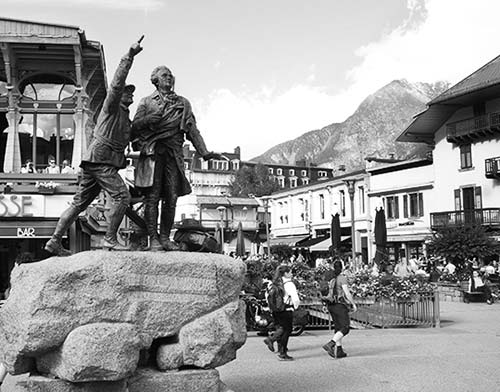
Just behind the Balmat statue is the eye-poppingly pink, over-the-top recommended Art Nouveau Rose du Pont café, well worth a detour to admire its beautiful interior and upstairs terraces.
Raging below you is the Arve River. Born near the Swiss border, it flows to Geneva where it joins the Rhône River’s run south to the Mediterranean. Sediment from glacial melt makes the water milky. (In winter, when little is melting, the river is smaller and much clearer.) In medieval times, the first bridge here was made of wood and used mostly by cows. Today’s stone bridge dates from 1880. Historically, whenever there was a big melt and a heavy rain, the Arve would flood the town. But in the 1960s the river was channeled into a canal, and since then it’s been regularly dredged to help prevent flooding.
• Look across the street to the...
Casino: Built in 1848, this was once one of Chamonix’s oldest hotels—intended for Romantic Age travelers, back when local guides carried aristocrats in sedan chairs up to see a glacier. The building has a northern Italian design—a reminder that this town (like Nice) was once part of the northern Italian kingdom of Savoy. Napoleon III came here in 1860, and from this building’s balcony he welcomed the citizens of Chamonix after they voted to join France. The hotel later became a casino, part of Chamonix’s drive to be considered a real tourist resort.
• Walk to the left of the casino, then veer right into a grassy park, created in 2014, when its original huge trees were cut down (you’ll see the stumps and the massive timbers used for benches).
Couttet Park: The grassy expanse covers a hill, or moraine (rocky debris left by a receding glacier)—a reminder that a glacier once filled this valley. Info panels tell about the geology.
• Turn left on the street behind the park and walk 200 yards to the train station.
Protestant Church: Across the street from the train station, hiding in a woodsy lot, is a small Protestant church with a tiny but evocative graveyard—built in the 1860s for the many English visitors who traveled here on their Grand Tours.
• From here, with your back to the station, a walk straight up the main drag (Avenue Michel Croz) takes you back to the river, the statue of Paccard, and the center of Chamonix.
Sights in Chamonix
MOUNTAIN LIFTS, GONDOLAS, AND TRAINS
Map: Alpine Crossing from France to Italy
Taking the Panoramique Mont Blanc to Italy
Returning to Chamonix via Plan de l’Aiguille
▲▲▲Lifts to Le Brévent and La Flégère
▲▲Hike #1 (3 hours one-way, strenuous) Plan de l’Aiguille to Montenvers-Mer de Glace (Le Grand Balcon Nord)
▲▲Hike #2 (3 hours one-way, moderate) La Flégère to Planpraz (Le Grand Balcon Sud)
▲▲Hike #3 (4 hours round-trip, strenuous) La Flégère to Lac Blanc
▲Hike #4 (1 hour one-way, moderate) Le Petit Balcon Sud to Chalet de la Floria
Hike (or Bike) #5 (1-2 hours round-trip, easy) Arve Riverbank Stroll
Hike #6 (40 minutes round-trip, easy) Domaine de Balme—Hike to the Swiss Border
Espace Tairraz: Crystal Museum Center (Musée des Cristaux)
MOUNTAIN LIFTS, GONDOLAS, AND TRAINS
▲▲▲Aiguille du Midi
The Aiguille du Midi (ay-gwee doo mee-dee) is the most spectacular mountain lift in Europe—and the most popular ride in the valley. If the weather’s clear, the price doesn’t matter (live webcams at the cable-car station show views from the top, helping you decide whether it’s worth going up). Take an early lift and have breakfast above 12,000 feet. Remember, it’s freezing cold up there and you’ll need sunglasses.
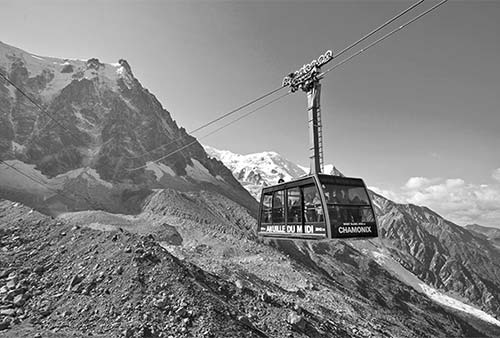
Cost: From Chamonix to Plan de l’Aiguille—round-trip-€40 (one-way-€22); to Aiguille du Midi—round-trip-€75 (one-way-€58, not including parachute). Tickets for the Panoramique Mont Blanc télécabine from Aiguille du Midi to Pointe Helbronner (Italy) are sold at both base and summit lift stations with no difference in price (round-trip-€40). Figure about €115 to round-trip from Chamonix to Pointe Helbronner. As conditions can change quickly, wait to buy the Helbronner ticket until you reach the top of Aiguille du Midi. If continuing down into Italy on the Skyway Monte Bianco, buy that ticket at Helbronner (€64, baggage allowed).
Discounts: Prices listed above are for ages 15-64; kids 4-14 and over 64 ride for about 15 percent less (family rates for 2 adults and 2 children ages 14 and under are also available). While going all the way up and only halfway down (and hiking from Plan de l’Aiguille) costs the same as a round-trip ticket, those with a round-trip ticket who hike over to Montenvers can use it to ride the train back into Chamonix, saving about €30.
Hours: Lifts generally run daily mid-June-late Aug 6:30 or 7:00-17:00, late May-mid-June and Sept 8:10-16:30, and Oct-mid-May 8:10-15:30, sometimes closed mid-May-late May, always closed early Nov-mid-Dec. Be warned: Hours can change with the weather. Always confirm plans locally. Cars run every 10 minutes during busy times; the last return from Aiguille du Midi is generally one hour after the last ascent. The last télécabine departure to Pointe Helbronner is about 14:45 (15:45 in summer) and the last train down from Montenvers (for hikers) is between 16:00 and 17:00, depending on the season.
Information: A helpful information office sits across from the ticket window at the base of the Aiguille du Midi lift (www.montblancnaturalresort.com).
Crowd-Beating Strategies: To beat the hordes and clouds, ride the Aiguille du Midi lift (up and down) as early as you can (first lift departs at 6:30 or 7:00 in summer). To avoid major delays in summer, leave no later than 8:00, no reservation needed. While you can reserve ahead for a later time, sights and trails get busier the later you go. Crowds are worst on a sunny day after a string of bad days.
Reservations: For the Aiguille du Midi lift, you can reserve a spot for free online at the website above or in person at the info booth across from the lift. Reservations are possible far in advance (but there are no same-day reservations—you’ll have to join the ticket-buying line or buy from the self-serve kiosks by the info booth, described next). In high season, the lift is usually booked up one day out: Reserve at least two days ahead. (While reserved tickets are nonrefundable, they can be modified.)
When you book tickets, you’ll get a departure time with a number for your car (which may run late when busy). Arrive at least 10 minutes before your scheduled departure.
Downloading Tickets: You can buy and download tickets from your phone at the self-serve kiosks next to the info booth (English instructions posted, and ticket office staff can help). Reservations are not possible for the télécabines to Helbronner.
Time to Allow: Chamonix to Aiguille du Midi—20 minutes one-way, 1.5 hours round-trip with sightseeing time, 2.5 hours in peak season. (In peak season, you can get hung up by crowds at Helbronner.) On busy days, minimize delays returning to Chamonix by making a reservation for your return lift time upon arrival at the top of Aiguille du Midi. (When crowded, attendants hand out return-time cards as you arrive—ask for advice when you get to the top.)
If you arrive early at the station in Chamonix, you can pay another €8 to experience the 3-D movie about Aiguille du Midi near the gift shop, or grab an easy picnic of tasty sandwiches, quiches, and more at Le Fournil Chamionarde boulangerie (daily 7:00-19:00, 208 Avenue de l’Aiguille du Midi, see map on here).
Visiting the Aiguille du Midi
Pile into the téléphérique (cable car), try to grab a window spot, and soar to the tip of a rock needle 12,602 feet above sea level (you’ll be packed in like sardines; take off your day pack to allow more room). Chamonix shrinks as trees fly by, soon replaced by whizzing rocks, ice, and snow. Change cars at Plan de l’Aiguille to reach the top. Notice the receding glaciers on the right as you ascend. No matter how sunny it is, it’s cold and the air is thin. People are giddy with delight (those prone to altitude sickness or agoraphobia are less giddy). Fun things can happen at Aiguille du Midi if you’re not too winded to join the locals in the halfway-to-heaven tango.
Aiguille du Midi Station and the Summit: You have two options on arrival: Walk up the exterior steps to the viewing platform immediately above the lift, where along with the view you’ll find WCs, a gift shop, a cafeteria, and a restaurant; or (better) walk across the skybridge and explore the various displays and view terraces (best from atop the elevator).
The skybridge deposits you in the main building. You’ll first pass an info booth (which sells tickets for the Panoramique lift to Italy). Stop there to assess the crowds, the trip to Italy, and return-to-Chamonix options (remember, it may be quiet now, but later it can be horribly crowded with hours-long delays). Ask about reserving a time for your descent back into Chamonix. Past the info booth, find the elevator to the tippy top (described next), other view terraces, a few nooks and crannies to explore (including an interesting exhibit about the 1950s construction), and an exhibit called “Vertical Space Extreme” with amazing photos and videos of daredevil mountaineers. A tubular walkway called “Le Tube” gets you away from the crowds to quieter views. Spot the climbers on Mont Blanc and ponder the value of an ice ax. Stairs near Le Tube’s entry lead up to a heated room with an exhibit on Mont Blanc’s fragile environment.
Another route past the info booth leads to Vallée Blanche signs and a drippy “ice tunnel” where skiers and mountain climbers make their exit. The views are sensational if you can get close (only skiers/climbers allowed past a certain point); merely observing is exhilarating. Skiers make the 13-mile run to the Mer de Glace from here. Next to the tunnel is the small station for the Panoramique Mont Blanc lift to Helbronner (Italy).
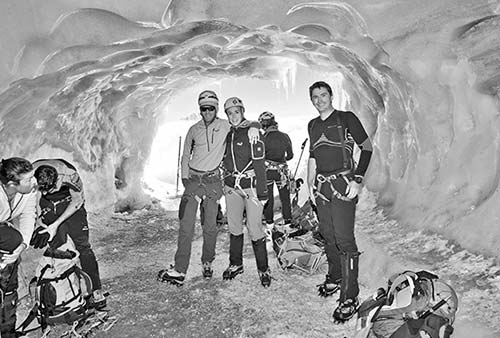
The highlight of your ascent is riding the elevator to the summit (signed Terrasse 3842)—12,602 feet above sea level (pose with the much-photographed altitude sign). From this platform, the Alps spread out before you. Use the orientation posters to identify key peaks: You can see the main Swiss and Italian summits rising above 13,000 feet. If it’s clear, you can see the bent little Matterhorn—the tall, shady pyramid listed in French on the observation table as “Cervin—4,505 meters” (14,775 feet). And looming on the other side is Mont Blanc, the Alps’ highest point, at 4,810 meters (15,780 feet).
Use the telescopes to spot mountaineers (roped up and following guides); more than 2,000 people scale Mont Blanc each year. A long but not technically challenging climb, the summit was first conquered in 1786, more than 170 years before this lift was built. Find the Giant’s Tooth peak, spot the télécabines to Italy, and identify lift stations of the Aiguilles Rouges mountain range across the valley, on the other side of Chamonix. That rusty tin-can needle above you serves as a communications tower. Check the temperature near the elevator. The “Step Into the Void” glass box offers a chance to stand in what feels like midair. (They’ll take your photo for a fee.) But it can be a long wait for a small payoff.
Descend in the elevator, and then either ride the télécabines to Italy (described next) or return to the building above the cable car and climb the metal steps to the viewing platform for more great views (go easy, the air is thin). From there you can visit the view cafeteria (good prices), restaurant, gift shop, and WCs before making the trip back down the mountain.
Taking the Panoramique Mont Blanc to Italy
For your private glacial dream world, embark on the little red Panoramique Mont Blanc télécabine and sail south to Pointe Helbronner, the mountaintop Italian border station (typically open late May-late Sept). This line stretches three miles over ice, snow, and rocks. In a gondola for four (if it’s not too crowded, you can usually get a private one for two if you ask), you’ll dangle peacefully for 40 minutes as you glide over glaciers and past a forest of peaks to Italy. Hang your head out the window. Enjoy the silence. Explore every corner of your view. From Helbronner, you can turn around and return to Aiguille du Midi, or descend into Italy on the Skyway Monte Bianco lift (described later, under “Day Trips near Chamonix”)—but for most there’s really no point unless you’re traveling on into Italy.
Helbronner station, at over 11,000 feet, has a whole different crowd (people coming up from Italy with no intention of going to Aiguille du Midi). There’s a cafeteria, a crystal hall, a botanical garden, and a theater with short films. An elevator down goes to a passage to the Torino Refugio climber’s refuge (with view terrace and restaurant) and, most importantly, spiraling stairs leading to a 360-degree viewing platform with killer views, from the Matterhorn to Mont Blanc (called Monte Bianco here in Italy). Keep an eye on the crowds and the slow line to assure your timely return to Aiguille du Midi.
Returning to Chamonix via Plan de l’Aiguille
To get from Aiguille du Midi to Chamonix, you’ll need to change cable cars at Plan de l’Aiguille. Take some time here on your way down. Cars depart every few minutes. At Plan de l’Aiguille you’ll find a scenic café with sandwiches, drinks, outdoor tables, paragliders jumping off cliffs (except July-Aug), and rocky perches for private sunbathing. It’s a great place to just hang out. But the best reason to get off here is to follow the wonderful trail to the Mer de Glace—the Grand Balcon Nord—then catch the train back into Chamonix (for details, see “Chamonix Area Hikes—Hike #1,” later).
For shorter but still scenic walks, find the 20-minute trail to Lac Bleu, or follow the Montenvers-Mer de Glace trail below the lift station and walk 15 minutes to the cozy and cliff-hanging $ Refuge du Plan de l’Aiguille, where you can enjoy reasonable meals with massive views (good omelets, pastas, salads, and mouthwatering tarts made by welcoming manager Claude—no English, no problem) and drinks inside or out (open daily early June-late Oct, +33 6 65 64 27 53). This is a manageable hike for most travelers (or a great overnight for a steal—see “Sleeping in Chamonix,” later).
Don’t hike all the way down to Chamonix from Plan de l’Aiguille or Montenvers-Mer de Glace; it’s a long, steep walk through thick forests with few views. Ride the cable car down, and as you’re finally dropping back into Chamonix, notice the highway disappearing into the mountain—that’s the Mont Blanc Tunnel.
▲▲▲Mer de Glace (Montenvers)
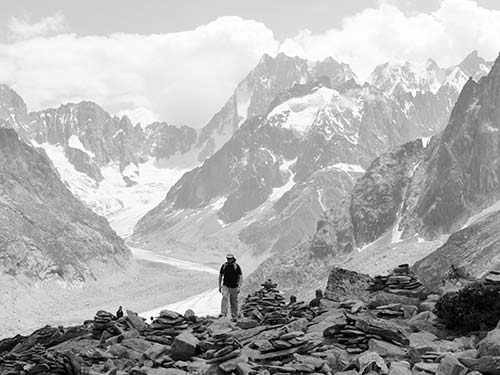
From Gare de Montenvers (the little station over the tracks from Chamonix’s main train station), the cute cogwheel Train du Montenvers toots you up to tiny Montenvers (mohn-tuh-vehr). Sit on the left-hand side as you go up for good views among pine trees over the valley. There you’ll see a dirty, rapidly receding glacier called the Mer de Glace (mayr duh glahs, “Sea of Ice”) and fantastic views up the Vallée Blanche of splintered, snow-capped peaks. (As the glacier recedes, it is literally pulling away from the train station.)
Cost and Hours: Round-trip-€39, one-way-€32, family rates available, prices include gondola and ice caves entry; daily 8:30 or 9:00-17:00, July-Aug until 17:30, 2-3/hour, 20 minutes; confirm first/last trip times with TI or call +33 4 50 53 12 54, www.montblancnaturalresort.com. The train doesn’t run during scheduled maintenance breaks (first three weeks of Oct and last three weeks of Nov).
Visiting the Glacier: Find the view deck across from the train station. France’s largest glacier, roughly four miles long, is impressive from above and below. The swirling glacier is 600 feet deep where it begins its flow and extends under the dirt about a half-mile downhill to the left. Imagine that it recently reached as high as the vegetation below (see the dirt cliffs—called moraines—left behind in its retreat). When the train was built (1909), the glacier reached the same level as the station, and back in 1860 it stretched all the way down to the valley floor.
Look up to the cut-glass peaks. Aiguille du Dru’s powerful spire, at about 11,700 feet, has made an irresistible target for climbers for over 150 years. It was first scaled in 1860 (well before the train you took here was built) and was recently free-climbed (no ropes, belays, or such—are you kidding me?). The smooth snow field to the left of Dru’s spire (Les Grands Montets) is the top of Chamonix’s most challenging ski run, with a vertical drop of about 6,500 feet (down the opposite side).
The Alps were formed about 100 million years ago by the collision of two continents: the African plate pushing north against the stable plates of Europe and Asia. In the process, the sediments of the ancient Tethys Ocean (which occupied the general real estate of the modern Mediterranean) became smooshed between the landmasses. Shoving all this material together made the rocks and sediments fold, shatter, and pile on top of each other; over millennia, this growing jumble built itself up into today’s Alps. Up in the mountains, look for folds and faults in the rocks that hint at this immense compression, which is still happening today: The Alps continue to rise by at least a millimeter each year (while erosion wears them down at about the same rate).
The current shape of the mountains and valleys is the handiwork of at least five ice ages over the last two million years. Glaciers flowed down the mountain valleys, scooped out beautiful alpine lakes, and carried rocks far away from where they formed. The Alps were the first mountains extensively studied by geologists, and many of the geological terms that describe mountains originated here. Once you learn how to recognize a few of the landforms shaped by glaciers, you can easily spot these features when you visit other alpine areas. Study glacier exhibits to train your eye to recognize what you’re seeing.
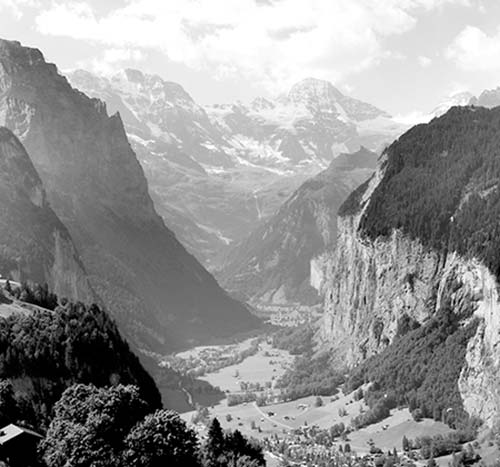
Glaciers are big and blunt, so they make simple, large-scale marks on the landscape. If a valley is U-shaped, like Chamonix’s (with steep sides and a rounded base), it’s probably been scoured out by a glacier. (California’s Yosemite Valley is another classic example.)
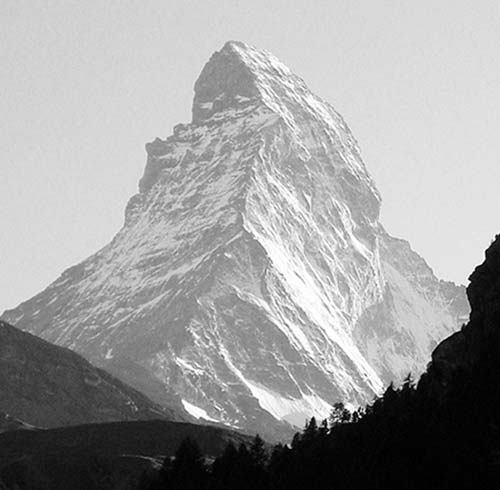
A cirque (French for “circus”) is the amphitheater-like depression carved out at the upper part of a valley by a glacier. If two adjacent cirques erode back close to each other, a sharp, steep-sided ridge forms, called an arête (French for “fishbone”). Cirques and arêtes are common in mountains that have had glaciers. More rarely, when three or more cirques erode toward one another, a pyramidal peak is created—called a horn. Switzerland’s Matterhorn (visible—barely—from the Aiguille du Midi) is the world’s most famous example. Glaciers flowed down all sides of this mountain, scooping material away as they went to leave its distinctive sharp peak.
A common feature left behind by retreating glaciers is a moraine, a pile of dirt and rocks that was carried along on the glacier as it advanced, then was dumped as the glacier melted (plainly visible around the Mer de Glace).
Alpine glaciers can only originate above the snowline, so if you see any of these landforms (U-shaped valleys, cirques, horns, or moraines) in lower elevations, you know that the climate there used to be colder. The effects of a warming climate have profoundly hit the glaciers of the Alps, which have lost at least a third of their volume since the 1950s. At that rate, some studies project that most here could virtually disappear by the end of the 21st century, affecting water storage and hydroelectric power generation, and making mountainsides less stable.
Another consequence of the warming climate is that winter weather no longer reliably produces snow at altitudes that it did in the past—which is bad news for Europe’s huge ski industry. Seeing a future of ever-warmer winters, alpine resorts are putting their ingenuity to the test. This goes beyond snow machines: Many resorts are investing hugely in new spas, convention centers, and other attractions that don’t require snow. Meanwhile, European governments strive to invest in environmentally friendly technologies in hopes of keeping their mountains white and their valleys green.
The hypnotic blue-green ice caves lie far below and are basically a 75-yard-long tunnel dug into the glacier (skippable for most). By mid-2024, a new gondola should take you right to the ice caves, replacing the old chair lift. If you choose to walk down the steep path to the caves, you’ll pass signs showing the various heights of the glacier over the years, making it clear how fast it is receding.
The cafeteria behind you on the view deck sells salads, wraps, sandwiches, and more at good prices. The Grand Hôtel du Montenvers, a few minutes’ walk toward Chamonix from the deck, offers a full-service restaurant (fair prices, limited selection), view tables, and a warm interior (you can even bunk here in style—see “Sleeping in Chamonix,” later). The hotel was built in 1880, when tourists arrived on foot or by mule.
The three-hour trail to Plan de l’Aiguille (see here for a description) begins across from the hotel. Follow signs for Le Signal/Plan de l’Aiguille above two stone buildings and track the trail as it rises (sometimes steeply, with no shade) to the left, above the Mer de Glace valley. For rewarding views, hike this trail for about 20 minutes until you see weird metal objects on the hills in the distance—this is where the view opens up. The higher you climb, the better the views get as the peaks of the Aiguilles Rouges appear magically behind you. Bring a picnic. Le Signal is a brilliant destination—but it’s a long climb (figure one hour all uphill).
The Glaciorium lies 50 yards behind the hotel along the main walkway. It houses a small but worthwhile exhibit on glaciers of the world with dioramas, a film, interactive displays, and terrific images that explain the life of a glacier (all well described in English, free, daily 9:30-18:00 in summer, 10:00-16:00 in winter).
▲▲▲Lifts to Le Brévent and La Flégère
Though Aiguille du Midi gives a more spectacular ride, the Le Brévent and La Flégère lifts offer worthwhile hiking and viewing options, with unobstructed panoramas across to the Mont Blanc range and fewer crowds. The Le Brévent (luh bray-vahn) lift starts in Chamonix; the La Flégère (lah flay-zhair) gondola starts from nearby Les Praz (lay prah). The lifts are connected by a scenic hike or by bus along the valley floor (bus is free with Chamonix Guest Card, see Hike #2 in the next section); both have sensational view cafés. Both lifts are closed from late April to mid-June and again by mid-September (reopening when ski season starts, usually in Dec).
Le Brévent and Planpraz
This gondola, a steep 10-minute walk up the road above Chamonix’s TI, is a worthwhile trip just for the ride and view cafés alone (ideal with a Multipass). It takes two lifts to reach Le Brévent’s top. The gondola to Planpraz, with automated eight-person télécabines, runs every minute. Sit backward and watch Chamonix shrink away below (round-trip to Planpraz-€23, one-way-€18). Planpraz merits a little exploring—there are view restaurants and cafés and good hiking options. The free little funicular (Funi) takes you up to a view platform where you’ll find parasailers and an easier start if you want to hike between Planpraz and La Flégère (my Hike #2 in reverse).
The cable car to Le Brévent station leaves from Planpraz and runs every 5-15 minutes. At the top, you get 360-degree views, more hikes, an exhibit on how the region has evolved over 60,000 years, and a smashing view café. It’s a fine stop, but for most, Planpraz is plenty high (round-trip from Chamonix to Le Brévent-€40, one-way-€30; daily 8:45-16:45, July-Aug 8:15-17:45, last return from Planpraz 30-45 minutes after last ascent, closed late April-mid-June and mid-Sept, +33 4 50 53 13 18).
La Flégère and L’Index
This lift runs from the neighboring village of Les Praz to La Flégère station every 15 minutes; to go higher, take the chairlift to L’Index (La Flégère—round-trip-€24, one-way-€20; L’Index—round-trip-€40, one-way-€30; daily 8:30-16:30, summer 8:15-17:30, last return from La Flégère 15 minutes after last ascent, closed late April-mid-June and mid-Sept-Dec, +33 4 50 53 18 58). Hikes to Planpraz and Lac Blanc leave from the top of this station (see Hikes #2 and #3 in the next section). Les Praz is easy to reach from Chamonix by local bus (10 minutes—it’s the first stop after Chamonix).
CHAMONIX AREA HIKES
The Maison de la Montagne is a good first stop for serious hikers (located across from the TI, first-floor WC). On the second floor, the Office de Haute-Montagne (High Mountain Office) can help you plan your hikes and tell you about trail and snow conditions (mid-June-mid-Sept daily 9:00-12:00 & 15:00-18:00, otherwise closed Sun, +33 4 50 53 22 08, www.chamoniarde.com). The staff speaks enough English and has vital weather reports and maps, as well as some English hiking guidebooks to consult. Ask to look at the trail guidebook (sold in many stores and at the TI, includes the helpful Carte des Sentiers, the region’s hiking map).
The adjacent room holds a worthwhile exhibit on climate change and the danger of avalanches, with some English explanations (same hours as Office de Haute-Montagne).
At Compagnie des Guides de Chamonix on the ground floor, you can hire a mountaineering or climbing guide (about €450/day, less per person for groups) to help you scale Mont Blanc, or hike to the Matterhorn and Zermatt (daily 9:00-12:00 & 14:30-19:00, closed Sun-Mon off-season, +33 4 50 53 00 88, www.chamonix-guides.com).
In this section, I describe two fairly strenuous hikes, two moderately strenuous hikes, and two easier walks (see the “Chamonix Area Hikes” map). Start early, when the weather’s generally best. This is most important in summer as trails become more crowded as the day goes on. If hiking late in the day, confirm lift closing hours to avoid a long, steep hike down.
For your hike, bring sunglasses, sunscreen, rain gear, water, snacks, a first aid kit, and maybe light gloves. Pack warm layers (mountain weather can change in a moment) and wear good shoes (trails are rocky and uneven). Take your time, watch your footing, don’t take shortcuts, and say “Bonjour!” to your fellow hikers. Note that there’s no shade on hikes #1 (unless you go very early), #2, and #3.
▲▲Hike #1 (3 hours one-way, strenuous) Plan de l’Aiguille to Montenvers-Mer de Glace (Le Grand Balcon Nord)
This three-hour hike (including breaks) is the most efficient way to incorporate a high-country adventure into your ride down from the valley’s greatest lift, and check out a world-class glacier to boot. The spectacular, well-used trail rises but mostly falls (dropping 1,500 feet from Plan de l’Aiguille to Montenvers and the Mer de Glace) and is moderately difficult, provided the snow has melted (generally snow-covered until June; get trail details and conditions at the Office de Haute-Montagne, listed earlier). Several stretches are steep and strenuous, with uneven footing and slippery rocks. Wear good shoes (hard soles are better) and watch your footing. Note the last train time from Montenvers-Mer de Glace back to Chamonix, or you’ll be hiking another hour and a half straight down.
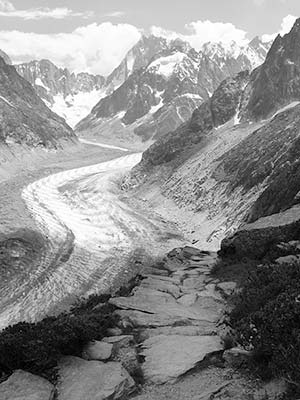
To experience this marvelous hike at its peaceful best, go early. In mid-July, I started the trail at 9:15 (after visiting the Aiguille du Midi) and didn’t meet another hiker for over an hour. If you start very early, shade covers the trail for long stretches.
To start the hike, from the Aiguille du Midi lift get off at Plan de l’Aiguille, sortie to the café/bar, then find signs leading down to Montenvers-Mer de Glace. Follow the main trail below the gondola cables (avoid spur trails to the right). You’ll drop steadily for 15 minutes down to a wonderful refuge (the recommended Refuge du Plan de l’Aiguille, good prices for meals and drinks), then go right, hiking the spectacularly scenic, undulating, and (for short periods) strenuous trail to Montenvers (overlooking the Mer de Glace glacier). Plan on lots of boulder-stepping and occasional stream crossings. Stop frequently to turn around and appreciate the views.
After hiking a bit more than an hour at a moderate yet steady pace, the trail splits. Follow signs uphill to Le Signal (more scenic and easier), rather than to the left toward Montenvers (it looks easier but becomes very difficult—and you miss the best views). You’ll grind it out uphill for about 20 minutes, level off, and then climb more gradually to the trail’s best views at Le Signal. Savor the 360-degree panorama of splintered peaks that you worked so hard to reach, and make your own stone monument. From here, it’s a long and sometimes steep, but memorable, half-hour drop to Montenvers and the Mer de Glace. In Montenvers, take the train back to Chamonix. Don’t walk the rest of the trail down from Montenvers (long, steep, and disappointing views).
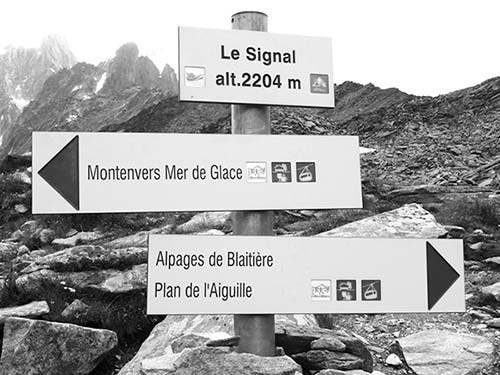
▲▲Hike #2 (3 hours one-way, moderate) La Flégère to Planpraz (Le Grand Balcon Sud)
This lovely hike traverses above Chamonix Valley, with staggering views of Mont Blanc, countless other peaks, glaciers, wildflowers, and a fraction of the crowds that the Aiguille du Midi side draws. While you’ll start at 1,900 meters (6,230 feet) and end at 2,000 meters (6,560 feet), there’s a lot more than just 100 meters (330 feet) of climbing between the La Flégère and Planpraz lift stations. The hike works fine in either direction, but I prefer starting in La Flégère so that I end in Chamonix, which is the direction I describe next. Lifts serving this hike are open mid-June to mid-September.
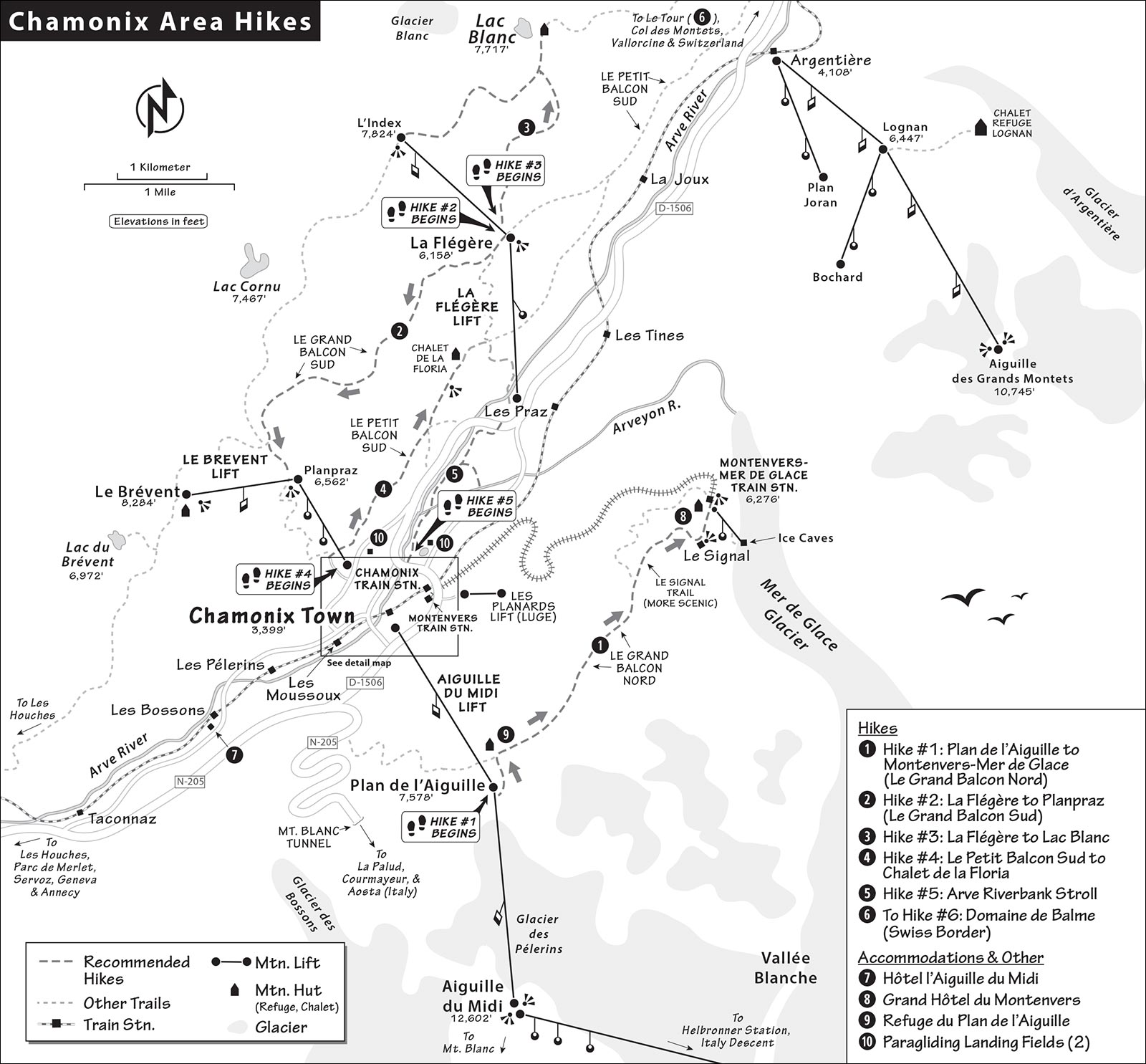
The trail around Mont Blanc is one of Europe’s top long-distance hikes, and while demanding, it’s doable for fit hikers. Known as the Tour du Mont Blanc (TMB), the popular hike—about 100 miles long and generally done in 10 days—weaves above and below the tree line as it crosses six passes and loops through corners of France, Switzerland, and Italy.
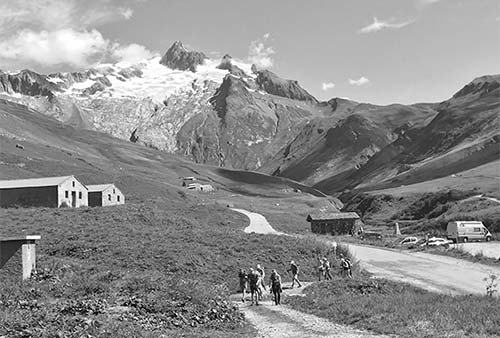
A typical day on the TMB includes seven to eight hours of walking, with little breaks for alpine serendipity along the way, and comes with perhaps 3,000 feet of elevation gain and loss. Well-groomed and clearly marked, the trail offers medieval bridges, deep gorges, tiny alpine chapels, and inviting huts offering a break and a drink. While there’s not much wildlife, hikers enjoy rustic farm scenes with sheep, goats, and cows, and opportunities to pick up a slab of alpine cheese (the energy bar of the mountains) from the farmer who made it.
Camping is forbidden on this well-worn circuit. Instead, reserve well in advance for one of the mountain huts and lodges (refuges) or village hotels spaced out along the route. They come in a variety of prices and comfort levels—ranging from little more than a hut with no electricity to venerable old hotels. It’s customary to book dinner and breakfast with your bed. While private rooms are available, most hikers share a co-ed dorm with facilities down the hall. The food is rustic and family style (no menu—ya eat what ya get) and can be quite good. Hanging out in the late afternoon with hikers from around Europe and enjoying a drink after a good day on the trail is a big part of the TMB joy.
Interested? If you don’t have the time or energy for the entire TMB loop, you can choose a segment. A good abbreviated plan is to hike the section from Chamonix to Courmayeur, Italy—roughly half the loop—and return to your starting point via the scenic Helbronner and Aiguille du Midi lifts (or by bus through the Mont Blanc Tunnel).
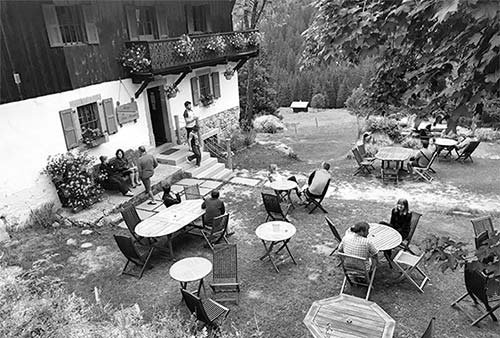
I enjoyed hiking the TMB in early September 2021, and I did it the comfortable way: I booked a seven-day self-guided tour with a company that arranged mountain guesthouses, hotels, and refuges with wonderful dinners along the way (for around $2,000) and a “Sherpa service” to shuttle my bag by van to each night’s accommodations. My travel companion and I cherry-picked the route, hiking the best 60 miles of the 100-mile circuit in six days. On average, each day was a six- to eight-hour, 10-mile hike with a picnic lunch break atop a ridge after a 3,000-foot altitude gain. We stayed in small villages and zipped through the boring sections by catching local buses. For a complete report on what was a great experience, search for “Tour du Mont Blanc” at RickSteves.com. Along with many articles you’ll find a six-minute video clip from my TV episode (on Classroom Europe) and a one-hour presentation (the Nov 29, 2021, episode of Monday Night Travel) describing the hike with lots of photos.
To enjoy this or any other classic long-distance hikes in Europe, I’d recommend Cassandra Overby’s helpful book, Explore Europe on Foot (2018).
This hike requires stamina and appropriate shoes. The trail is a mix of dirt paths, ankle-twisting rocky sections, and short stretches of service roads. You’ll pass by winter lifts and walk through meadows and along small sections of forest. Keep your eyes out for signs to Planpraz; red-and-white markers also help identify the trail.
A round-trip La Flégère ticket lets you go up the La Flégère lift and down at Planpraz and saves about €14 over two one-way tickets. To reach the La Flégère lift, take bus #1 or #2 from Chamonix (free with Chamonix Guest Card), or walk 40 minutes along the Arve River to Les Praz (see Hike #5, described later).
Take the lift up to La Flégère, then walk out the back to near the snack stand to get your bearings. Before setting out, stop by the lift ticket booth to confirm your hike plan, the trail, and the last lift descent time from Planpraz. Enjoy distant views of the receding Mer de Glace glacier and the cliff-hanging Hôtel du Montenvers on the opposite side of Chamonix’s valley.
To start the hike, walk toward the L’Index lift and follow signs for La Charlanon and Planpraz. Signage is inconsistent, so expect to do some route-finding along the way. Here are two points where you could miss the trail, each when you reach a small road: At the first real road, cross and follow the Croisement du Sentier à 100 m sign, and later a sign to Planpraz. At a second road, under a ski lift, cross the road and take the rocky, stepped trail steeply uphill, following the Le Brévent par Planpraz sign. For the last hour or so, you’ll see the Planpraz lift station, your end point, on a high ridge ahead of you. After a steep final climb, you reach the station. Avoid the long, boring hike down by catching the lift from Planpraz to Chamonix. (Or, take the cable car up to Le Brévent for more views.)
▲▲Hike #3 (4 hours round-trip, strenuous) La Flégère to Lac Blanc
This is the most demanding trail of those I list; it climbs steeply and steadily over a rough, boulder-strewn path for two hours to snowy Lac Blanc (pronounced “lock blanh”). Some footing is tricky, and good shoes or boots are a must. I like this trail, as it gets you away from the valley edge and opens views to peaks you don’t see from other hikes.
The destination is a snow-white lake framed by peaks and the nifty Refuge-Hôtel du Lac Blanc, with good lunches (and dinners, if you stay the night, summers only). Views on the return trip are breathtaking. Check for snow conditions on the trail (often a problem until July) and go early (particularly in summer), as there is no shade and this trail is popular.
Follow the directions for Hike #2 to La Flégère station, then walk out the station’s rear door past the snack stand to get oriented. Track the trail as it drops way down to that winter chairlift station, then hooks hard left back up a steep hill. You can avoid this considerable down-and-up (and save 30 minutes) by taking the L’Index chairlift behind you (about €11 one-way, €14 round-trip, €38 from the base). Confirm that the trail from L’Index is free of snow, as this shortcut can be dicey, especially for kids. However you start, the trail is well signed to Lac Blanc, and its surface improves as you climb.
▲Hike #4 (1 hour one-way, moderate) Le Petit Balcon Sud to Chalet de la Floria
This trail runs above the valley on the Brévent side from the village of Les Houches to Argentière, passing Chamonix about halfway, and is handy when snow or poor weather make other hikes problematic. No lifts are required—just strong thighs for the roughly 1,000-foot climb up and down. There are two routes up; an 80-minute scenic trail that starts with a steep climb then rises and falls with some steep segments and uneven footing, and a more direct 60-minute uphill route along a gravel road (I like taking the scenic route there and that faster one back). The highlight of either route is the flower-covered Chalet de la Floria café/bar, which has drinks, snacks, flowers, and magnificent views (July-Aug daily, late May-June and Sept-Oct closed Tue, cash only, check with the TI to be sure the chalet is open).
To find the longer, scenic trail, start at the Le Brévent lift station (parking available; follow sign to Niveau 3/level 3, the upper lot, for best trail access). Begin by walking 20 minutes up and up, starting along an asphalt road to the left of the lift leading uphill (on Chemin de la Pierre à Ruskin), which turns into a rocky path. Skip the first turnoff to the Petit Balcon Sud trail (be patient, as signs to other trails can make this trail confusing to follow), and walk left and up toward La Pierre à Ruskin. Continue uphill (avoiding other offshoots) until the trail comes to a T. Turn right and follow signs to the trail marked Balcon Sud Les Tines, passing under the gondola in a few minutes. You’ll walk about 40 scenic minutes tracking Balcon Sud Les Tines signs until the turnoff to La Floria). It’s a 20-minute uphill slog to Chalet la Floria from here.
To find the shorter trail, start at the huge grassy area where parasailers land by the recommended Hotel Savoy (see “Chamonix Town” map, earlier), then follow the narrow path signed Plan des Sentiers that passes between homes to the Rue de Nants. Turn left on Rue de Nants, then look to your right for signs leading up to La Floria.
The Petit Balcon Sud trail continues beyond Chalet de la Floria to the north, but there’s little reason to continue farther on this trail. The quick route back to Chamonix is well signed.
Hike (or Bike) #5 (1-2 hours round-trip, easy) Arve Riverbank Stroll
For a level, forested-valley stroll, bike ride, or jog, follow the Arve River toward Les Praz. At Chamonix’s Hôtel Alpina, follow the path upstream past Chamonix’s Centre Sportif complex, with its red-clay tennis courts, and find the green arrow to Les Praz. At the huge sediment pile, cross the bridge to the left and turn right along the rushing river for a peaceful woodsy stroll with no destination in particular.
To reach Les Praz, cross the second bridge and turn right along a different fork of the river to walk along Promenade des Econtres. You’ll get to Les Praz in about an hour—an appealing destination with a number of cafés, a pleasing village green, and bus service back to Chamonix.
If you keep right after the tennis courts (passing piles of river sediment dredged to deter flooding), you’ll come to a grassy landing field, where paragliders touch down. Walk to the top of the little grassy hill (after the skateboard park) for fine Mont Blanc views and a great picnic spot.
Hike #6 (40 minutes round-trip, easy) Domaine de Balme—Hike to the Swiss Border
For a memorable and easy hike, consider this: Ride the local bus to Le Tour (free with Chamonix Guest Card, 2/hour, 25 minutes). From there, catch the gondola to Charamillon. From Charamillon a chairlift takes you to Les Autannes at over 7,200 feet (about €32 round-trip from Le Tour, lifts run about 9:00-17:00). At the top, it’s an easy 20-minute walk in an alpine wonderland through meadows and past cows to the Swiss border at Col de Balme. There you’ll find a stone marked with France on one side and Switzerland on the other and, nearby, a mountain hut. When you’re ready to head back, backtrack the way you came and find the trail near the top of the chairlift. It’s a one-hour hike down to the top of the gondola for the ride back down to Le Tour.
OTHER ACTIVITIES
▲Luge (Luge d’Eté)
Here’s something for fun-seekers: Ride a plastic sled on rails up the hill, and then zip down a twisty, banked slalom course. Young or old, hare or tortoise, any fit person can manage a luge. Freinez signs tell you when to brake. The luge course is set in a grassy park with kids’ play areas.
Cost and Hours: One ride-€8.50, six rides-€42 (do at least two rides—one to get used to it, the second to show your stuff); ask about double sleds, kids under 8 must ride with adult, entry includes all activities in Parc de Loisirs des Planards—see the “Kids’ Activities” sidebar, earlier; generally July-Aug daily 10:00-18:30, mid-April-June and Sept-Oct Sat-Sun and select weekdays 11:00-17:00, check website to confirm hours; 15-minute walk from town center, over the tracks from train station and past Montenvers train station—see the “Chamonix Valley Overview” map, earlier; +33 4 50 53 08 97, www.planards.fr.
▲▲▲Paragliding (Parapente)
When it’s sunny and clear, the skies above Chamonix sparkle with colorful parachute-like sails that circle the valley like birds of prey. For about €150 plus the cost of the lift up to Planpraz (Le Brévent ski area) or Plan de l’Aiguille, you can launch yourself off a mountain in a tandem paraglider with a trained, experienced pilot and fly like a bird for about 20 minutes (true thrill-seekers can launch from Aiguille du Midi, €350, 40-minute ride). Most pilots will meet you at the lift station in Chamonix (usually from Le Brévent side, as it has the most reliable conditions, though you can ask them to fly you from Plan de l’Aiguille if you’ll be there anyway and are pressed for time—not possible July-Aug). Sean Potts is English, has been paragliding in Chamonix for 25 years—more than 12,000 flights—and is easy to work with (www.fly-chamonix.com, info@fly-chamonix.com). You can also try Summits Parapente (smart to reserve a day ahead, open year-round, +33 7 66 06 76 09, www.summits.fr).
For a sneak preview, walk to one of the two main landing areas and watch paragliders perfect their landings (see “Chamonix Area Hikes—Hike #5,” earlier).
RAINY-DAY OPTIONS
If the weather disagrees with your plans, stay cool and check out the following options.
Musée Alpin du Mont Blanc
Situated in one of Chamonix’s oldest “palaces,” this museum should be open by 2024 following a complete renovation. Inside, expect to find exhibits about Chamonix’s evolution from a farming economy to one focused on skiing, mountaineering, and tourism. The museum will also feature Chamonix’s mineralogical history and displays on the first Winter Olympics, held right here.
Cost and Hours: Check online or call ahead, 89 Avenue Michel Croz, +33 4 50 53 25 93, www.musee-alpin-chamonix.fr.
Espace Tairraz: Crystal Museum Center (Musée des Cristaux)
The Espace Tairraz displays a fascinating collection of crystals in every color, shape, size, and texture. While most are excavated from the mountains around you, you’ll also find astonishing samples from all over the world. It’s hard to believe these dazzling rocks are natural and not factory made.
Cost and Hours: €7, Tue-Sun 10:00-12:00 & 14:00-18:00, closed Mon, 615 Allée Recteur Payot, +33 4 50 55 53 93.
Galerie Mario Colonel
One of Chamonix’s most celebrated nature photographers displays his mesmerizing photographs of the scenery high above you. Be sure to look at the photos upstairs. These are so good you may not miss seeing the real thing.
Cost and Hours: Free, daily 10:00-12:30 & 15:00-19:30, no midday closure July-Aug, a block from the train station at 19 Rue Whymper, +33 4 50 91 40 20, www.mario-colonel.com.
Day Trips near Chamonix
A Day in French-Speaking Switzerland
Plenty of tempting alpine and cultural thrills await just an hour or two away in Switzerland. A scenic road and rail route sneaks you from Chamonix to the Swiss town of Martigny. Train travelers cross without formalities, but drivers are charged a one-time fee for a permit, known as a vignette, to use Swiss autobahns. For vignette details, see “Getting Around the Alps: Entering Switzerland by Car” at the beginning of this chapter.
A Little Italy
The remote Valle d’Aosta and its historic capital city of Aosta offer a serious change of culture. The side trip is worthwhile if you’d like to taste Italy (spaghetti, gelato, and cappuccino), enjoy the town’s great evening ambience, or view the ancient ruins in Aosta (often called the “Rome of the North”).
Getting There: Take the spectacular lift (Aiguille du Midi–Helbronner—described earlier, summer only) to Italy. From Helbronner, ride the Skyway Monte Bianco lift, which stops at Pavillon du Mont Fréty on its way down to Pontal d’Entrèves. It’s an amazing ride—the gondola rotates 360 degrees as you sail along (www.montebianco.com). From Pontal d’Entrèves, take the bus to Aosta (1-2 hours, at least hourly, change in Courmayeur). Aosta’s train station has connections to anywhere in Italy (about every 2 hours, usually on slow trains via Turin).
For a more down-to-earth experience, you can take the bus from Chamonix to Aosta via the Mont Blanc Tunnel. FlixBus and local SAT buses run to Courmayeur, where you connect to frequent local buses to Aosta (from €15 one-way, €22 round-trip to Courmayeur, reservation required in summer; buses run 5/day July-mid-Sept, 2-3/day mid-Sept-June Mon-Sat, 2 hours). FlixBus also has comfortable, reasonably priced direct buses to Aosta, but with fewer departures (www.flixbus.com). Get schedules at the TI or at Chamonix’s bus station (234 Avenue de Courmayeur, +33 4 50 53 00 95, www.sat-montblanc.com). Drivers can travel straight through the Mont Blanc Tunnel (one-way toll-€50, round-trip toll-€62 with return valid for 1 week, www.tunnelmb.com).
Sleeping in Chamonix
Reasonable hotels and dorm-like chalets abound in Chamonix, with easy parking and quick access from the train station. The TI can help you find budget accommodations anytime—either in person or by email (reservation@chamonix.com). Outside of winter, mid-July to August is most difficult, when some hotels have five-day minimum-stay requirements. Very few hotels offer air-conditioning, but most have elevators. Prices tumble off-season (outside July-Aug and Dec-Jan). Many hotels and restaurants are closed in May, June, and November, but you’ll still find a room and a meal. If you want a view of Mont Blanc, ask for côté Mont Blanc (coat-ay mohn blanh). Travelers who visit June through September should contemplate a night high above in a refuge-hotel.
Ask at your hotel about the free Chamonix Guest Card (Carte d’Hôte), which provides free public transit (see here). For locations, see the “Chamonix Town” map, earlier.
IN THE CITY CENTER
$$$ Hôtel Hermitage,**** a 10-minute walk from the town center, is a gorgeous chalet hotel with the coziest lounges in Chamonix and a lovely garden with views. It has a small bar, three saunas, a Jacuzzi, a small pool, and 28 alpine-elegant rooms, all with balconies and reasonable prices considering the quality (big family rooms and suites, easy parking, closed mid-Sept-mid-Dec and mid-April-mid-June, north of the train station at 63 Chemin du Cé, +33 4 50 53 13 87, www.hermitage-paccard.com, info@hermitage-paccard.com).
$$$ Grand Hôtel des Alpes***** rents top-comfort rooms in a grand old building with loads of character in Chamonix’s traffic-free area. Rooms are big, tasteful, and luxurious; public spaces are wood-paneled cozy; and there’s a riverfront terrace (private garage-€25/day, 75 Rue du Docteur Paccard, +33 4 50 55 37 80, www.grandhoteldesalpes.com, info@grandhoteldesalpes.com).
$$ Hôtel de l’Arve*** offers simple, midrange comfort with a contemporary alpine feel in its 37 rooms—some with balconies and some right on the Arve River looking up at Mont Blanc. This good-value hotel comes with a fireplace lounge, pool table, pleasant garden, sauna, climbing wall, and easy, free parking. Check their website for deals (family rooms, several apartments ideal for families, 60 Impasse des Anémones, +33 4 50 53 02 31, https://hotelarve-chamonix.com, reservation@hotelarve-chamonix.com).
$$ Les Balcons du Savoy is a large hotel/apartment complex set on a huge grassy area a 10-minute walk from Chamonix’s center. You’ll feel close to town yet a bit away, with the forest just across a quiet lane. All units are well appointed with full kitchens and generous balconies, and there’s an indoor pool (studios to 4-bedroom units, 179 Rue Mummery, +33 4 50 55 32 32, www.lesbalconsdusavoy.com).
$$ Hôtel La Verticale,** tucked down a short alley, is a modest place with 24 modern rooms at fair rates. It has a bar, a small breakfast room, and an elevator (25 Impasse de l’Androsace, +33 4 50 53 00 51, www.hotellaverticale.com).
Hôtel Le Faucigny Properties: The next three accommodations are run by the same outfit, offering a good range of comfort in central locations and sharing a single website (www.hameaufaucigny-chamonix.com). Check in for all is at the Hôtel le Faucigny.
$$$ Le Whymper, on a small alley behind Hôtel le Faucigny, has 10 plush rooms designed for small groups, plus a pleasant central living room (rooms rented to individuals when not taken by groups, no elevator, 76 Impasse de l’Androsace, +33 4 50 53 91 60).
$$ Hôtel le Faucigny*** is a peaceful full-service hotel with a sauna and hot tub, and afternoon tea and treats in the lounge. The front terrace provides a tranquil retreat with mountain views. Its 27 rooms are tight, some with small bathrooms, but they’re comfortable and quite modern (no elevator, 118 Place de l’Église, +33 4 50 53 01 17, faucigny@hameaufaucigny-chamonix.com).
$$ Le Génépy, also close by, offers 10 apartments facing a peaceful central courtyard just off Rue Joseph Vallot. Rooms are bright, modern, and well designed with fully equipped kitchens. Apartments on the ground floor come with private patios; second- and third-floor rooms have views of Mont Blanc, and many have small balconies (16 Impasse du Génépy, +33 4 85 30 01 00).
NEAR THE AIGUILLE DU MIDI LIFT STATION
The next two hotels are closer to the Aiguille du Midi lift station.
$$ Hôtel l’Oustalet*** is a chalet hotel warmly run by two sisters (Véronique and Agnès) who understand the importance of good service. The place is family-friendly, with lots of grass, a big pool, and six family suites. All rooms are wood-paneled, with views and balconies (terrific breakfast, try the teurgoule rice pudding; sauna and Turkish bath, free and secure parking, near Aiguille du Midi lift at 330 Rue du Lyret, +33 4 50 55 54 99, www.hotel-oustalet.com, infos@hotel-oustalet.com).
$ Hôtel Gourmets et Italy*** is a 36-room place with comfy public spaces, a cool riverfront terrace, balcony views from many of its appealing rooms, and a small pool (some rooms with Mont Blanc view, family rooms, closed late April-early June and mid-Oct-mid-Dec, 2 blocks from casino on Mont Blanc side of river, 96 Rue du Lyret, +33 4 50 53 01 38, www.hotelgourmets-chamonix.com, hgicham@aol.com).
BUDGET DIGS
¢ Chalet Ski Station, filling a 300-year-old building, is a spartan but clean hostel that bustles with youthful energy. Gentle Veronique rents 44 beds to a young and sporty crowd who don’t mind the steep 10-minute climb above town to the base of the Le Brévent lift (self-serve kitchen, 6 Route des Moussoux, +33 4 50 53 20 25, https://www.hostel-skistation-chamonix.com, chaletskistation@wanadoo.fr).
NEAR CHAMONIX
If Chamonix overwhelms you, spend the night in one of the valley’s often-overlooked, lower-profile villages.
$$$ Hôtel l’Aiguille du Midi,*** a mountain retreat, lies near the train station in the village of Les Bossons, about two miles from Chamonix toward Annecy. It’s run by the English-speaking Farini family in a parklike setting with stunning views of Mont Blanc and the Bossons Glacier. This family-friendly place has a swimming pool, a clay tennis court, table tennis, a massage room, and a laundry room to boot. Most of the alpine-comfortable rooms come with modern bathrooms, many have decks with views, and several are good for families. A few budget rooms (chambres économique) lack views but have access to all the amenities. The classy restaurant offers à la carte and menu options, with menus from €36 (RS%, family rooms, elevator, easy by train, get off at Les Bossons, +33 4 50 53 00 65, www.hotel-aiguilledumidi.com, info@hotel-aiguilledumidi.com) To locate this hotel, see the “Chamonix Area Hikes” map, earlier.
REFUGES AND REFUGE-HOTELS NEAR CHAMONIX
Chamonix has the answer for hikers who want to sleep high above, but aren’t into packing it in: refuge-hotels (generally open mid-June to mid- or late Sept, depending on snow levels). Refuge-hotels usually have some private rooms (but mostly dorm rooms), hot showers down the hall, and restaurants. Most require you to take dinner and breakfast there (a great value, and you don’t have many alternatives anyway). Reserve in advance (a few days is generally enough), then pack a small bag for a memorable night among new international friends. The TI in Chamonix can explain your options (see here). See the “Chamonix Area Hikes” map, earlier, for locations.
$$ Grand Hôtel du Montenvers, Chamonix’s oldest and classiest refuge-hotel, was built in 1880 as a simple climbing base for mountain guides before the train went there. Today’s 16 wood-cozy rooms have been restored to their original look, and there’s a 10-bed dorm room with comfy sleeping nooks. The dining room has alpine character, and the terrace tables have the views (at the Montenvers train stop, May-Sept and Nov-Dec, half-board required but reasonable, +33 4 50 53 87 70, https://en.refugedumontenvers.com, contact@refugemontenvers.fr). For directions, see “Hike #1” on here.
¢ Refuge du Plan de l’Aiguille is a cool experience near Chamonix. It’s a basic, welcoming, fairly easy-to-reach refuge a 15-minute walk below the Plan de l’Aiguille lift station, right on the trail between the Aiguille du Midi and Montenvers-Mer de Glace. It has a warm interior and a $ café/restaurant with a killer view. The friendly cook and guardian Claude is a retired pastry chef, so the meals are good and the desserts heavenly (some private rooms, half-board required but reasonable, open early June-late Oct, +33 6 65 64 27 53, http://refuge-plan-aiguille.com, hello@refuge-plan-aiguille.com).
Eating in Chamonix
You have plenty of dining options in Chamonix: cozy, traditional savoyarde restaurants serving classic local dishes; rustic sports bars with typical brasserie fare; big, kitschy, family-friendly eateries that smell like cheese from all the fondue and raclette they serve; and trendy, modern foodie haunts. Sit on a terrace overlooking the rushing river or on the main square watching the steady stream of outdoor enthusiasts. Restaurants want to satisfy ravenous hikers with the hearty and filling regional cuisine. The local beer is Mont Blanc amber (Rousse de Mt. Blanc). Menus tend to be pretty similar—it’s the atmosphere that varies. Most restaurants open by 18:00 or serve nonstop, making early dinners easy. For locations, see the “Chamonix Town” map, earlier.
IN THE TOWN CENTER
$$ Restaurant Bizes (Little Kisses) is a cool little place popular with foodies, offering fun dining (inside and out) in a small setting right on the rushing river. The menu changes frequently, but there are always veggie and gluten-free options and roasted meats from their charcoal oven. With modern international dishes (ranging from smoked prawns to chicken curry), this place offers a break from heavy traditional fare (daily, 64 Rue du Lyret, +33 9 51 92 25 03).
For maximum alpine ambience and local cuisine, look no further than the next two places. $$$ La Calèche mixes over-the-top alpine tradition with elegance and a family-friendly vibe. If you want to eat fondue or raclette (served in the traditional way) and feel like you’re in an alpine museum (find the luge from the Chamonix 1924 Olympic Games, hanging copper pots, cow bells, and stuffed alpine animals), this is it (daily, centrally located just off Place Balmat at 18 Rue du Docteur Paccard, +33 4 50 55 94 68).
$$ Le Monchu is more lively and casual, with elaborate mountain decor—you’ll sit on lambskin-covered chairs—and well-priced savoyarde cuisine served by helpful staff (big outdoor terrace, daily, 1 Rue de Lyret, +33 4 50 53 04 80).
$$$ Atmosphère Restaurant is serious and pricey, yet a fair value. Dressy and jazzy with a white-tablecloth ambience, it serves a mix of savoyarde and French cuisine from a classy menu. In high season, two dinner seatings are offered on the long, skinny riverfront terrace: 19:00 and 21:15. To get a table literally over the torrent, make a reservation by phone; skip this place if you can’t dine riverside (closed Tue-Wed, 123 Place Balmat, +33 4 50 55 97 97).
$ Elevation 1904 is a down-and-dirty climbers’ haunt across from the train station, serving cheap but tasty sandwiches, burgers, pasta, and salads (daily, 263 Avenue Michel Croz, +33 4 50 53 00 52).
$$ Bistrot des Sports is where to come to hang with the locals. The bar has a fun energy, and the back room is a brightly lit, low-key, family-friendly restaurant with a French brasserie menu featuring big salads, regional specialties and fondue, pastas, pierrades, and vegetarian dishes. A few local craft beers, a good wine list, and plenty of wines by the glass add to the conviviality (daily, 176 Rue Joseph Vallot, +33 4 50 53 00 46).
$ La Maison du Burger is a simple takeout joint with a few plastic tables on the pedestrian street right downtown. They serve a fun array of burgers, toasted sandwiches, and crêpes—both sweet and savory (daily until 23:00, near the recommended La Calèche restaurant at 34 Rue du Docteur Paccard).
Dining Well with a View: Many eateries offering great views also serve mediocre food at inflated prices. Dining at a café on Place Balmat (by the statues), you’ll hear the Arve River and have great views of mountains and people...but you can do better. Consider these places:
$$ La Tablée is my go-to place for a fine meal at good prices—even without its view of Mont Blanc (from its popular terrace tables). You’ll find a mix of carefully prepared regional and traditional cuisine, and great salads. The interior is warm and the service is excellent (good menu deals, come early to land an outside table, opens at 18:30, daily, 75 Avenue de l’Aiguille du Midi, +33 4 50 53 31 23).
$ Le Boccalatte Brasserie sits just above La Tablée and delivers classic brasserie fare mixed with regional specialties. Hardworking Thierry (from Alsace) serves well-priced meals in a casual interior and on a big, easygoing view terrace. The tartiflette with salad will fill you up, or choose from a large selection of salads, pizzas, and such. Thierry’s steak tartare is a fun event as he mixes it tableside. A good beer selection is on tap, including Rousse de Mt. Blanc (daily, 59 Avenue de l’Aiguille du Midi, +33 4 50 53 52 14).
$$$ Joséphine is a classy café with a handsome interior that opens to broad terrace tables with mountain views and the sound of the Arve rushing by. The wide-ranging menu is mostly traditional French, along with some cheesy local dishes (long hours daily, 76 Avenue Michel Croz, +33 4 50 53 18 98).
Quality Caffeine: Seek out Shoukâ Chamonix for Chamonix’s best coffee, fine teas, and homemade chocolate, served in a warm interior or on a welcoming terrace (daily 8:00-19:30, 206 Rue du Docteur Paccard).
Après Hike: Bistrot des Sports, listed earlier, is where locals hang their ice axes after a hard day in the mountains. Drinks are cheap, local beers are on tap, the crowd is loud, and the ambience works.
Le Pub is aptly named and a good spot to raise a glass with the British crowd (daily, 225 Rue du Docteur Paccard, +33 4 50 55 92 88).
Chamonix Connections
Bus and train service to Chamonix is surprisingly good. Some train routes pass through Switzerland to reach Chamonix (such as from Paris and Colmar) and require extra tickets if you have a France-only rail pass. You can avoid passing through Switzerland if you plan ahead, but it usually takes longer, and you miss some great scenery. The route to Colmar (via Bern and Basel) is beautiful and costs roughly €60 for the Swiss portion (€25 for the French portion). You’ll get a fun taste of Switzerland’s charms, and, though you’ll make many transfers en route, they all work like a Swiss clock.
Chamonix’s bus station is a few blocks from the Aiguille du Midi lift station at 234 Avenue de Courmayeur (see the map on here; Mon-Fri 8:15-12:00 & 14:00-17:15, closed Sat-Sun; open daily with longer hours in high season; +33 4 50 53 05 55). FlixBus, BlaBlaCar, and Eurolines serve this station, as do some airport buses and shuttles. You’ll also find an info office for regional SAT buses (unreliable hours—usually Mon-Fri 9:00-12:00 & 14:30-18:30, closed Sat-Sun; +33 4 50 58 02 53, www.sat-montblanc.com).
From Chamonix by Train to: Annecy (10/day, 2.5 hours, 2 changes), Lyon (6/day, 5 hours, 2-3 changes); Beaune and Dijon (7/day, 7 hours, several changes); Nice (4/day, 10 hours, change in St-Gervais and Lyon); Arles (5/day, 7-8 hours, change in St-Gervais and Lyon); Paris’ Gare de Lyon (7/day, more in summer and winter, 6-7 hours, some change in Switzerland); Colmar (hourly, 6 hours via Switzerland with 3-6 changes); Martigny, Switzerland (nearly hourly, 2 hours, scenic trip); Geneva, Switzerland and its airport (roughly hourly, 3 hours, 2 changes).
From Chamonix by Bus to: Annecy (3-5/day, 1.5 hours, BlaBlaCar, www.blablacar.fr); Geneva Airport (3-5/day, about 1.5 hours on BlaBlaCar; 5/day, 1.5 hours, on Swisstours, www.stts.ch); Paris (night bus possible—check Flixbus for deals or see www.eurolines.fr); Courmayeur, Italy (SAT buses 2-4/day, 45 minutes, reservation required in summer); Aosta, Italy (SAT bus—4/day, 2 hours, change at Courmayeur; FlixBus—3/day direct, 1.5 hours; fewer off-season, reservations required in summer). Flixbus (www.flixbus.com) may offer more connections than noted here. For more on buses to Italy, see “Day Trips near Chamonix,” earlier.
From Chamonix to Geneva Airport by Shuttle: Mountain Dropoffs is a reliable outfit (www.mountaindropoffs.com); Alpybus and Geneva Shuttle are other good shuttle services with similar rates (www.alpybus.com [URL inactive], www.genevashuttle.com). You can also try Taxi Alpin (+33 6 79 01 46 02 or +33 6 32 50 58 02, www.taxialpin.fr).