THE FRENCH RIVIERA
La Côte d’Azur: Nice • Villefranche-sur-Mer • The Three Corniches • Monaco • Antibes • Inland Riviera
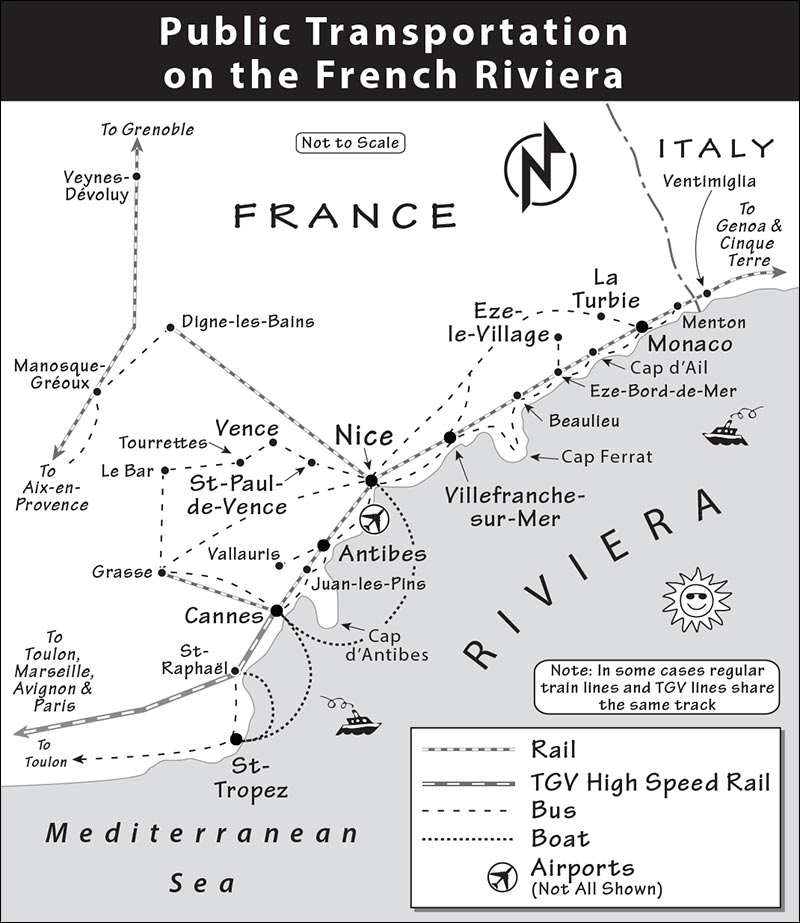
Map: Public Transportation on the French Riviera
Map: Vieux Nice Hotels & Restaurants
Orientation to Villefranche-sur-Mer
Villefranche-sur-Mer Town Walk
Activities in Villefranche-sur-Mer
Sleeping in Villefranche-sur-Mer
Eating in Villefranche-sur-Mer
Villefranche-sur-Mer Connections
Orientation to St-Paul-de-Vence
A hundred years ago, celebrities from London to Moscow flocked to the French Riviera to socialize, gamble, and escape the dreary weather at home. Today, budget vacationers and heat-seeking Europeans fill belle époque resorts at France’s most sought-after fun-in-the-sun destination.
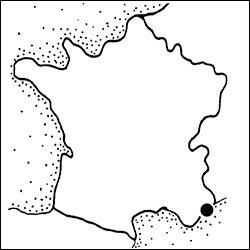
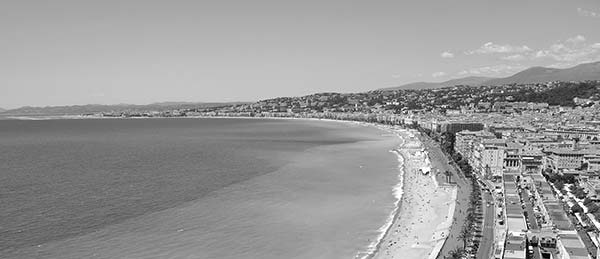
Some of France’s most stunning scenery and intriguing museums lie along this strip of land—as do millions of sun-worshipping tourists. Nice has world-class museums, a splendid beachfront promenade, a seductive old town, and all the drawbacks of a major city. The day-trip possibilities are easy and exciting: Fifteen minutes east of Nice, little Villefranche-sur-Mer stares across the bay to woodsy and exclusive Cap Ferrat; the eagle’s-nest Eze-le-Village surveys the scene from high above; Monaco offers a royal welcome and a fairy-tale past; Antibes has a thriving port and silky sand beaches; and the inland hill towns present a rocky and photogenic alternative to the beach scene. Evenings on the Riviera, a.k.a. la Côte d’Azur, were made for a promenade and outdoor dining.
CHOOSING A HOME BASE
My favorite home bases are Nice, Antibes, and Villefranche-sur-Mer.
Nice is the region’s capital and France’s fifth-largest city. With convenient train and bus connections to most regional sights, this is the most practical base for train travelers. Urban Nice also has museums, a beach scene that rocks, the best selection of hotels in all price ranges, and good nightlife options. A car is a headache in Nice (take it to Antibes or Villefranche-sur-Mer).
Nearby Antibes is much smaller, with a bustling center, a lively night scene, great sandy beaches, grand vistas, good walking trails, and a stellar Picasso museum. Antibes has frequent train service to Nice and Monaco. It’s a convenient base for drivers, with relatively light traffic and easy hotel parking.
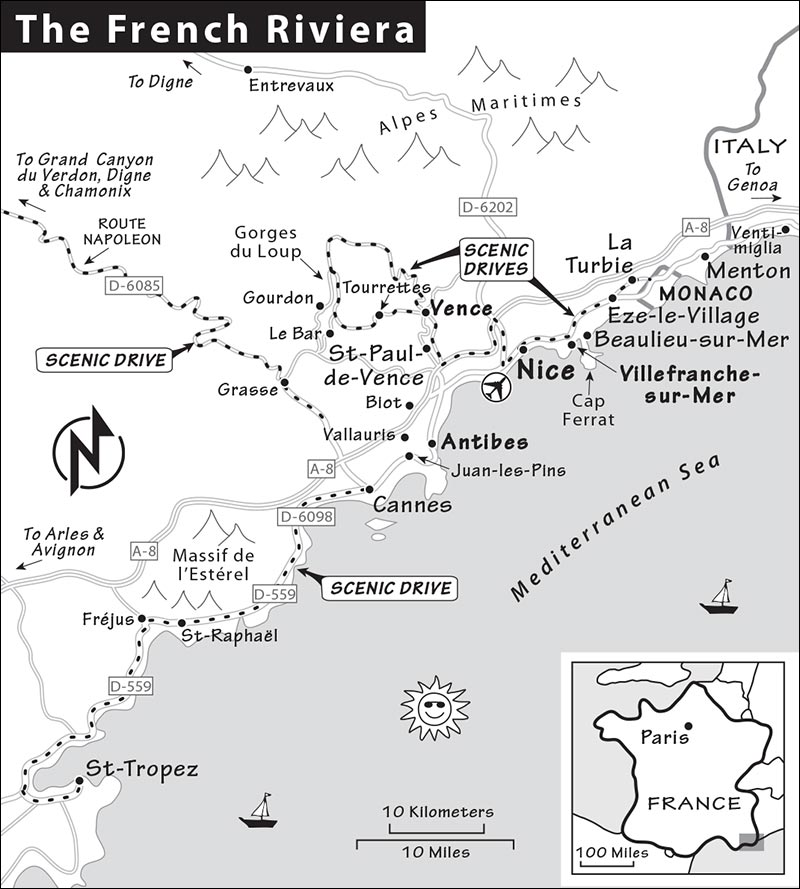
Villefranche-sur-Mer is the romantic’s choice, with a serene setting and small-town warmth. It has sand-pebble beaches; quick public transportation to Nice, Monaco, and Cap Ferrat; good restaurants; and a handful of great hotels (in every price range), most with easy parking.
PLANNING YOUR TIME
The French Riviera makes a terrific off-season destination. From mid-October through early April, there are no crowds or cruise ships, and no heat or humidity. Skies are clear, and views to the snowy Alps are exhilarating.
Ideally, allow a full day for Nice, a day for Monaco and the Corniche route that connects it with Nice, and a half-day for Antibes, Villefranche-sur-Mer, or Cap Ferrat (or better, a full day combining Villefranche and Cap Ferrat). Monaco and Villefranche-sur-Mer are radiant at night, and Antibes is enjoyable by day (good beaches and hiking) and night (good choice of restaurants and a lively after-hours scene). Hill-town-loving travelers should add a day to explore the charming villages of St-Paul-de-Vence and Vence.
HELPFUL HINTS
Sightseeing Tips: Mondays and Tuesdays can frustrate market lovers and museumgoers. Closed on Monday: Nice’s Modern and Contemporary Art Museum, Fine Arts Museum, and Cours Saleya produce and flower market; Antibes’ Picasso Museum and market hall (Sept-May). Closed on Tuesday: Chagall, Matisse, Masséna, and Archaeological museums in Nice. Matisse’s Chapel of the Rosary in Vence is closed Sunday and Monday and in the morning on Wednesday and Saturday.
The French Riviera Pass includes entry to many Riviera sights and activities, including Nice’s Chagall, Matisse, Fine Arts, and Masséna Museums; Monaco’s Oceanography Museum; and Villa Ephrussi de Rothschild on Cap Ferrat (€28/24 hours, €40/48 hours, €59/72 hours, +33 4 92 14 46 14, http://en.frenchrivierapass.com). It’s worth the cost if you have an aggressive sightseeing plan.
The €15 All Museums Pass for Nice covers entrance for four days to all of the city’s museums, except the Chagall Museum (www.nice.fr/fr/culture—click “Musées et Galeries” then “Préparer ma Visite”).
Medical Help: Riviera Medical Services has a list of English-speaking physicians all along the Riviera. They can help you make an appointment or call an ambulance (+33 4 93 26 12 70, www.rivieramedical.com).
Events: The Riviera is famous for staging major events. Unless you’re taking part in the festivities, these occasions give you only room shortages and traffic jams. Here are the three biggies: Nice Carnival (two weeks in Feb, www.nicecarnaval.com), Cannes Film Festival (12 days in mid-May, www.festival-cannes.com), and the Grand Prix of Monaco (4 days in late May, www.acm.mc). To accommodate the busy schedules of the rich and famous (and really mess up a lot of normal people), the film festival and car race often overlap.
English Website: Travel writer and Riviera resident Jeanne Oliver runs FrenchRivieraTraveller.com, an extremely helpful website for visitors.
Connecting to the Alps: If driving from the Riviera north to the Alps region (see next chapter), consider taking La Route Napoléon. After getting bored in his toy Elba empire, Napoléon gathered his entourage, landed on the Riviera, bared his breast, and told his fellow Frenchmen, “Strike me down or follow me.” France followed. But just in case, he took the high road, returning to Paris along the route known today as La Route Napoléon. (Waterloo followed shortly afterward.) The route is beautiful (from south to north, follow signs: Digne, Sisteron, and Grenoble). Little Entrevaux is worth a quick leg stretch. Climb high to the citadel for great views and appreciate the unspoiled character of the town. An assortment of pleasant villages with inexpensive hotels lies along this route, making an overnight easy.
GETTING AROUND THE RIVIERA
Trains and buses do a good job of connecting places along the coast, with fine views along many routes. Buses also provide reasonable service to some inland hill towns. Nice makes the most convenient base for train, bus, or boat day trips, though public transport also works well from Riviera towns such as Antibes and Villefranche-sur-Mer. Driving is a challenge in this congested region (traffic, parking, etc.).
By Public Transportation
In the Riviera, buses are often less expensive and more convenient while trains are faster and more expensive. For an overview of the most useful train and bus connections, see the “Public Transportation in the French Riviera” chart in this chapter (confirm all connections and last train/bus times locally).
Buses: Most of the area’s top destinations are connected by the Zou bus network (https://zou.maregionsud.fr). You’ll need a digital or physical travel card for buses and trams in Nice and nearby destinations such as Villefranche-sur-Mer, Cap Ferrat, and Eze-le-Village. Purchase a €2 travel card and add funds to cover your trips (sold on the Lignes d’Azur Mobile app, from bus drivers, vending machines at the main train station or tram/bus stops including at the airport, and at Lignes d’Azur offices).
Fares are very reasonable. Single trips on Nice’s city buses cost €1.70 (covers 74 minutes of travel in one direction including transfers). Or you can pay €7 for an all-day pass, or €20 for a seven-day pass. Round-trip travel by tram to and from the airport costs €10.
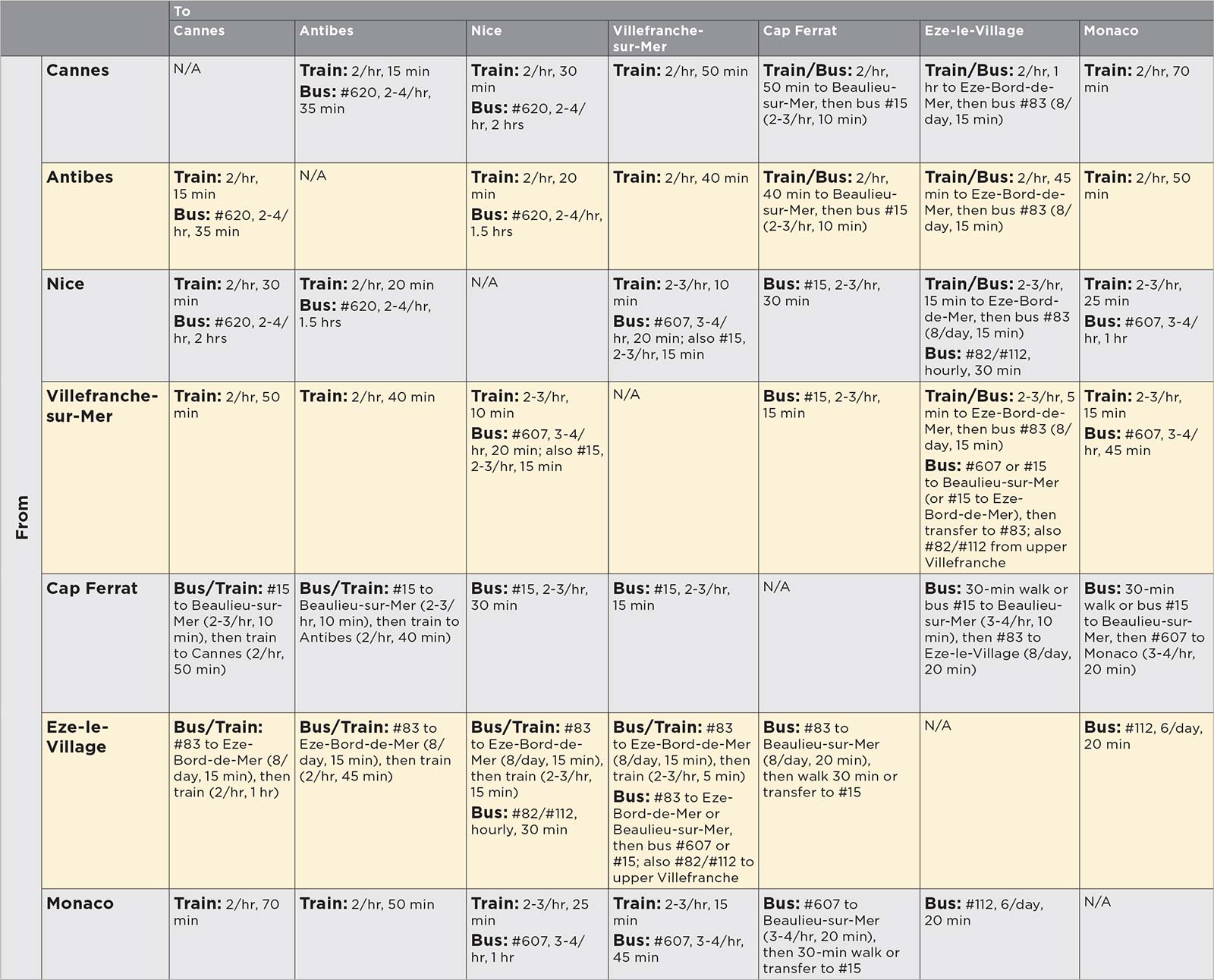
For buses serving destinations farther from Nice, buy a €2.50 fare (valid 2.5 hours). With this fare, you can transfer from Nice’s tram to regional buses (to Monaco, Vence, and Antibes).
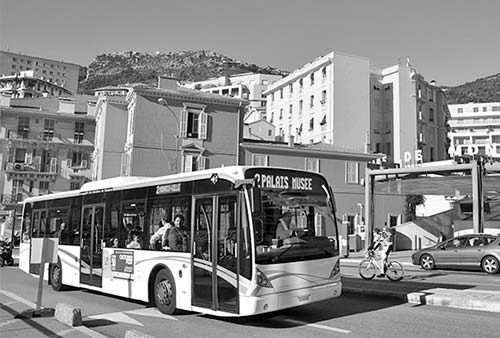
You’ll be able to get around most of the Riviera on the following major bus routes:
• Bus #607 runs eastbound from Nice along the Low Corniche (3-4/hour) stopping in Villefranche-sur-Mer (20 minutes), Beaulieu-sur-Mer (30 minutes), Eze-Bord-de-Mer (40 minutes, transfer to #83 to Eze-le-Village), and Monaco (1 hour).
• Bus #15 runs eastbound from Nice (2-3/hour) to Villefranche-sur-Mer (15 minutes), and all Cap Ferrat stops, ending at St-Jean-Cap-Ferrat (30 minutes).
• Buses #82 and #112 run from Nice and upper Villefranche-sur-Mer to Eze-le-Village (together they depart about hourly; only #82 runs on Sunday; 30 minutes to reach Eze from Nice). Bus #112, which runs along the scenic Middle Corniche, continues from Eze-le-Village to Monte Carlo in Monaco (6/day, none on Sun, 20 minutes).
The following leave from the Parc Phoenix stop on the T-2 tram line, west of Nice before the airport:
• Bus #620 goes from near the Nice airport westbound (4/hour Mon-Sat, 2/hour Sun) to Antibes (1.5 hours) and Cannes (2 hours).
• For the inland towns, bus #9 runs from Nice to Vence but not St-Paul (4/hour, 1 hour).
Trains: These are more expensive (Nice to Monaco by train is about €4) but much faster and less jammed than the bus, and there’s no quicker way to move about the Riviera (www.sncf-connect.com/en-en). Speedy trains link the Riviera’s beachfront destinations. (Never board a train without a ticket or valid pass—fare inspectors accept no excuses. The minimum fine: €50.)
By Car
This is France’s most challenging region to drive in. Beautifully distracting vistas (natural and human), loads of Sunday-driver tourists, and every hour being rush-hour in the summer make for a dangerous combination. Parking can be exasperating. Bring lots of coins and patience.
To sample some of the Riviera’s best scenery, connect Provence and the Riviera by driving the splendid coastal road between Cannes and Fréjus (D-6098 from Cannes/D-559 from Fréjus). Once in the Riviera, the most scenic and thrilling road trip is along the three coastal roads—called “corniches”—between Nice and Monaco (see “The Three Corniches,” later).
By Boat
Trans Côte d’Azur offers seasonal boat service from Nice to Monaco. For details, see the “By Boat” section under “Nice Connections,” later.
TOURS IN THE RIVIERA
Most hotels and TIs have information on economical shared minivan excursions from Nice (per person: roughly €80/half-day, €160/day).
Local Guides with Cars
The Riviera is teeming with guides happy to take you for a ride. I trust these guides to take your time seriously:
Ingrid Schmucker is a smart, delightful, and talented guide who drives a cushy Mercedes van (from €650/day for 2-6 people, €250/half-day walking tour of Nice, +33 6 14 83 03 33, https://bestfrenchriviera.tours, info@bestfrenchriviera.tours). Sylvie Di Cristo is also good and guides both on and beyond the Riviera (€400/half-day, €900/day for up to 7 people; +33 6 09 88 83 83, http://frenchrivieraguides.com). Live Harmony, run by Catherine and Cecilia Cotton, a mother-daughter team, have oodles of experience and are particularly knowledgeable about Monaco and areas east of Nice (+33 6 25 91 43 88 or +33 6 11 50 04 08, www.liveharmony.fr, contact@liveharmony.fr). Cecilia also takes travelers on short sailing trips (contact her for rates).
Charming Fouad Zarrou runs France Azur Excursions and offers a fun experience. His tours are more about exploring the region’s natural beauty and culture than its history. He provides comfortable transportation in his minivan (figure €400/half-day, +33 6 20 68 10 70, http://franceazurexcursions.com).
Local Guides Without Cars
For a guided tour of Nice or the region using public transit or with a guide joining you in your rental car, Boba Vukadinovic-Millet is an effective and engaging teacher, ideal for those wanting to dive more deeply into the region’s history and art. She can arrange chauffeur-driven rental options (car, minivan, bus) if needed (from €280/half-day and €430/day, +33 6 27 45 68 39, www.yourguideboba.com, boba@yourguideboba.com).
THE RIVIERA’S ART SCENE
The list of artists who have painted the Riviera reads like a Who’s Who of 20th-century art. Pierre-Auguste Renoir, Henri Matisse, Marc Chagall, Georges Braque, Raoul Dufy, Fernand Léger, and Pablo Picasso all lived and worked here—and raved about the region’s wonderful light. Their simple, semi-abstract, and—most important—colorful works reflect the pleasurable atmosphere of the Riviera.
But the artists were mostly drawn to the uncomplicated lifestyle of fishermen and farmers that has reigned here for centuries. As the artists grew older, they retired in the sun, turned their backs on modern art’s “isms,” and painted with the wide-eyed wonder of children, using bright primary colors, basic outlines, and simple subjects.
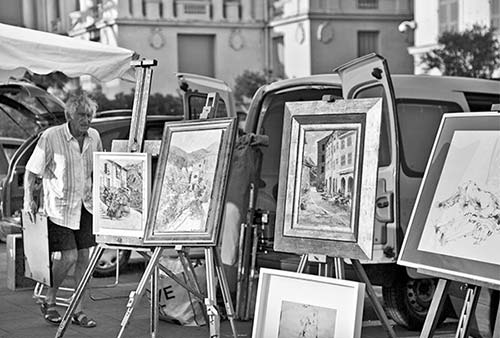
A collection of modern- and contemporary-art museums dot the Riviera, allowing art lovers to appreciate these masters’ works while immersed in the same sun and culture that inspired them. Many of the museums were designed to blend pieces with the surrounding views, gardens, and fountains, thus highlighting that modern art is not only stimulating, but sometimes simply beautiful.
THE RIVIERA’S CUISINE SCENE
The Riviera adds an Italian-Mediterranean flair to the food of Provence. While many of the same dishes served in Provence are available in the Riviera (see “Provence’s Cuisine Scene” on here), there are differences, especially if you look for anything Italian or from the sea. When dining on the Riviera, I expect views and ambience more than top-quality cuisine.
A fresh and colorful salade niçoise makes the perfect introduction to the Riviera’s cuisine. The authentic version has lots of ripe tomatoes and raw vegetables (such as radishes, green peppers, celery, and perhaps artichoke or fava beans), as well as tuna (usually canned), anchovy, hard-boiled egg, and olives (but no potatoes or green beans). This is my go-to salad for a tasty, healthy, cheap, and fast lunch. I like to spend a couple of extra euros and eat it in a place with a nice ambience and view.
For lunch on the go, look for a pan bagnat (like a salade niçoise stuffed into a crusty roll drizzled with olive oil and wine vinegar). Other tasty bread treats include pissaladière (bread dough topped with caramelized onions, olives, and anchovies), fougasse (a spindly, lace-like bread sometimes flavored with nuts, herbs, olives, or ham), and socca (a thin chickpea-and-olive-oil crêpe, seasoned with pepper and often served in a paper cone by street vendors).
The Riviera specializes in all sorts of fish and shellfish. Bouillabaisse is the Riviera’s most famous dish; you’ll find it in seafront villages and cities. It’s a spicy fish stew based on recipes handed down from sailors in Marseille. This dish often requires a minimum order of two and can cost up to €40-60 per person. Far less pricey than bouillabaisse and worth trying is the local soupe de poissons (fish soup). It’s a creamy soup flavored like bouillabaisse, with anise and orange, and served with croutons and rouille sauce (but has no chunks of fish).
Other fishy options include fruits de mer (platters of seafood—including tiny shellfish, from which you get the edible part only by sucking really hard), herb-infused mussels, stuffed sardines, squid (slowly simmered with tomatoes and herbs), and tuna (thon). The popular loup flambé au fenouil is grilled sea bass, flavored with fennel and torched with pastis prior to serving.
For details on dining in France’s restaurants, cafés, and brasseries; getting takeout; and assembling a picnic—as well as a rundown of French cuisine—see the “Eating” section in the Practicalities chapter.
Wines of the Riviera: I mostly drink wines from Provence here, as local wines can be pricey. Bandol (red) and cassis (white) are popular and from a region nearly on the Riviera. The most popular wines made in the Riviera are Bellet rosé and white, the latter often found in fish-shaped bottles.
Nice
Nice (sounds like “niece”), with its spectacular Alps-meets-Mediterranean surroundings, is the big-city highlight of the Riviera. Its traffic-free Vieux Nice—the old town—blends Italian and French flavors to create a spicy Mediterranean dressing, while its big squares, broad seaside walkways, and long beaches invite lounging and people-watching. More than a pretty town on the Riviera, it’s the cultural and political powerhouse of the region with its own dialect, its own cuisine, and a story worth knowing.
Nice may be nice, but it’s jammed from mid-May through August—reserve ahead and get a room with air-conditioning. The city gets quiet and stays fairly mild from November to April. Everything you’ll want to see in Nice is either within walking distance, or a short bike, bus, or tram ride away.
Orientation to Nice
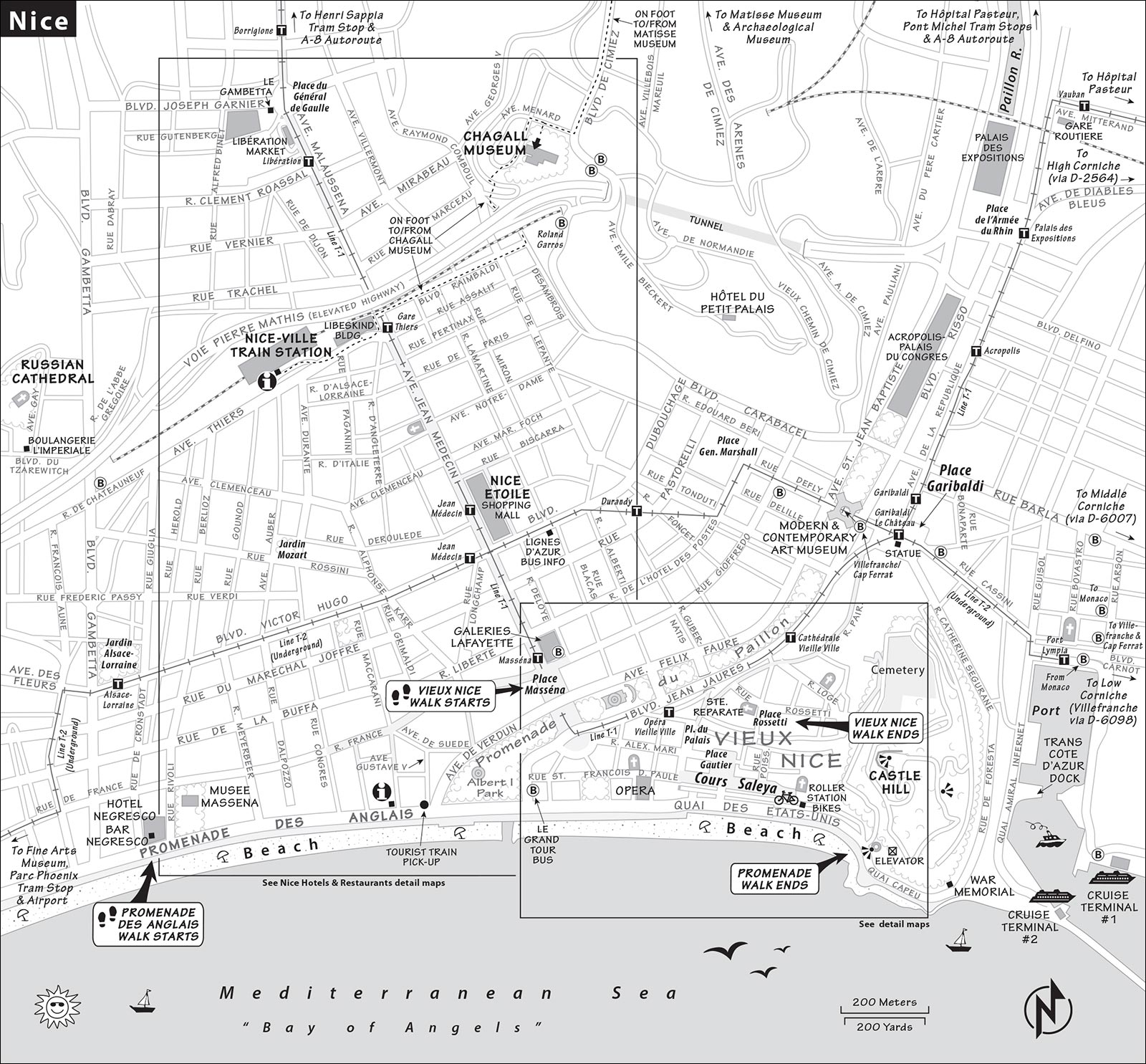
Focus your time on the area between the beach and the train tracks (about 15 blocks apart). The city revolves around its grand Place Masséna, where pedestrian-friendly Avenue Jean Médecin meets Vieux Nice and the Promenade du Paillon parkway (with quick access to the beaches). It’s a 20-minute walk from the train station to the beach, and a 20-minute stroll along the promenade from the fancy Hôtel Negresco to the heart of Vieux Nice. Two handy-for-tourists tram lines run through the heart of Nice. The area’s busy coastal train line connects neighboring destinations within a few minutes.
TOURIST INFORMATION
Nice has two helpful TIs, one at the train station and another at #5 Promenade des Anglais (both daily 9:00-18:00, July-Aug until 19:00, +33 4 92 14 46 14, www.explorenicecotedazur.com). Ask for day-trip information (including maps of Monaco and Antibes) and details on boat excursions, bus stop locations, and transit schedules.
ARRIVAL IN NICE
By Train: All trains stop at Nice’s main station, called Nice-Ville. With your back to the tracks, car rentals are to the right. You can stash your bags nearby (see “Helpful Hints,” later). The TI is straight out the main doors. The region’s primary bus company, Zou, has a ticket machine in the station.
The nearby T-1 tram zips you to the center in a few minutes (several blocks to the left as you leave the station, departs every few minutes, direction: Hôpital Pasteur; see “Getting Around Nice,” later). To walk to the beach, Promenade des Anglais, or many of my recommended hotels, cross Avenue Thiers in front of the station, go down the steps by Hôtel Interlaken, and continue down Avenue Durante. A taxi to the beach is about €15.
By Car: To reach the city center from the autoroute, take the Nice Centre exit and follow signs. Ask your hotelier where to park (about €20-30/day in central garages; some hotels offer deals but space is limited—arrange ahead). The parking garage at the Nice Etoile shopping center on Avenue Jean Médecin is near many recommended hotels (ticket booth on third floor, 18:00-8:00). You can park for free on Nice streets any day 20:00-9:00 and all day Sunday, otherwise street parking is strictly metered (usually a 2-hour limit).
Day-trippers can avoid driving in the center—and park for free during the day until late (no overnight parking)—by stashing their car at a parking lot at a remote tram or bus stop. Look for blue-on-white Parcazur signs (find locations at www.lignesdazur.com/en/parc-relais), and ride the bus or tram into town (10/hour, 15 minutes, buy round-trip tram or bus ticket and keep it with you—you’ll need it later to exit the parking lot; for tram details, see “Getting Around Nice,” later). The easiest lot to use is Parcazur Henri Sappia, right off the Nice Nord autoroute exit. It always has room and saves you from navigating city streets (daily until 2:30 in the morning). As lots are not guarded, don’t leave anything of value in your car.
By Plane: See “Nice Connections,” later.
HELPFUL HINTS
Theft Alert: Nice has its share of pickpockets (especially at the train station, on the tram, and trolling the beach). Stick to main streets in Vieux Nice after dark.
Sightseeing Tips: The Cours Saleya produce and flower market is closed Monday, and the Chagall and Matisse museums are closed Tuesday. All Nice museums—except the Chagall Museum—are covered by the €15 All Museums Pass (valid 4 days, buy at any participating museum). The separate French Riviera Pass also covers several Nice museums (Chagall, Matisse, Fine Arts, and Masséna) and varied activities such as bike rental, a boat cruise, and the hop-on, hop-off bus; see here.
Boutique Shopping: The chic streets where Rue Alphonse Karr meets Rue de la Liberté and then Rue de Paradis are known as the “Golden Square.” If you need pricey stuff, shop here.
Baggage Storage: Store your bags across from the train station at the recommended Hôtel Belle Meunière or at the Hôtel Interlaken. Bagguys will store bags in Vieux Nice (daily 10:00-19:00, 34 Rue Centrale, +33 6 12 49 11 36, www.bagguys.fr).
Laundry: There are several self-service launderettes around town. Laverie Nicomilo is a handy place for those sleeping between Place Masséna and Vieux Nice (daily, in front of the recommended Hôtel Vendôme at 30 Rue Alberti). Laverie Buffa is near the Promenade des Anglais (daily, 39 Rue de la Buffa). For locations of both, see the map on here. Laverie Béa is in Vieux Nice (daily, 16 Rue Pairolière; see the map on here).
Grocery Store: Small grocery shops are easy to find. The big Monoprix on Avenue Jean Médecin and Rue Biscarra has it all (open daily, see map on here).
Renting a Bike (and Other Wheels): Bike-rental shops are a breeze to find in Nice, and several companies offer bike tours of the city. Bikes (vélos) can be taken on trains. Booking Bikes, located near the main TI, has electric bikes (9 Rue Massenet, see map on here, www.loca-bike.fr). Roller Station rents bikes and is well situated near the sea (leave ID as deposit, no e-bikes, daily, 49 Quai des Etats-Unis—see map on here, +33 4 93 62 99 05; they also sell cheap beach shoes).
Bus Tickets: Lignes d’Azur runs Nice’s city buses. You’ll find the Lignes d’Azur office (Espace Mobilité) at 33 Boulevard Dubouchage, where you can buy transit cards and passes for buses in or within the Nice area (Mon-Fri 7:30-19:30, Sat until 15:00, closed Sun, www.lignesdazur.com).
Hike to Villefranche-sur-Mer: You can take the four-mile coastal trail to reach Villefranche-sur-Mer’s port, but be aware that the first part is along a busy road with narrow sidewalks (see here).
Beach Tips: To make life tolerable on the rocks, swimmers should buy the cheap plastic beach shoes sold at many shops (Roller Station bike rental, listed above, sells them). Locals swim most of the year—except in July and August when the warming sea brings swarms of stinging jellyfish. Ask about the conditions before you dip.
GETTING AROUND NICE
By Public Transportation
Although you can walk to most attractions, smart travelers make good use of the buses and trams within Nice. The bus is especially handy for reaching the Chagall and Matisse museums and the Russian Cathedral. See here for ticket information.
Trams: The L-shaped T-1 tram line runs every few minutes along Avenue Jean Médecin and Boulevard Jean Jaurès, and connects the main train station with Place Masséna and Vieux Nice (Opéra/Vieille Ville stop), the port (transfer at Place Garibaldi or Jean Médecin stops to T-2 line for Port Lympia), and buses east along the coast (Vauban stop). Boarding the tram in the direction of Hôpital Pasteur from the station takes you toward the beach and Vieux Nice (direction: Henri Sappia goes the other way, past the train station and into the hills).
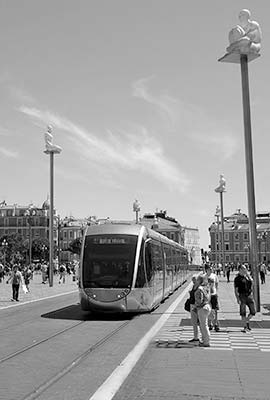
The T-2 tram goes from the airport through the city center to Port Lympia (the old port) in 30 minutes, starting at street level, then dipping underground through central Nice (from Centre Universitaire to Port Lympia stops). Central Nice stations are deep, but all have elevators and escalators. If using the tram to reach the airport, make sure the overhead signs read Airport—the line splits before the airport. Info: Tramway.nice.fr.
By Taxi or Uber
Taxis and Ubers are useful for getting to Nice’s less-central sights (figure €10 for shortest ride, €16 from center to the Chagall Museum). Cabbies normally pick up only at taxi stands (tête de station), or you can call +33 4 93 13 78 78. Uber works here like it does at home, though the price may not be much cheaper than a taxi. Still, Uber drivers are often nicer, better with languages, and more flexible—and you usually get a car within a few minutes.
Tours in Nice
ON WHEELS
Hop-On, Hop-Off Bus
Le Grand Tour Bus provides a useful 16-stop, hop-on, hop-off service on an open-deck bus with good headphone commentary. The route includes the Promenade des Anglais, train station, Port Lympia, Cap de Nice, the Chagall and Matisse museums, and—best of all—Villefranche-sur-Mer (1-day pass-€23, 2-day pass-€26, buy tickets on bus, departs every 45 minutes, daily 10:00-19:00, 1.75-hour loop with Villefranche-sur-Mer, main stop near where Promenade des Anglais and Quai des Etats-Unis meet—across from the Albert I Park, +33 4 92 29 17 00, www.nicelegrandtour.fr/en-gb). While it’s not the best way to get to the Chagall and Matisse museums, this bus is a good value if you’re looking for a city overview and want to also visit these museums or spend time in Villefranche-sur-Mer (best seats are up top on the left as you face forward).
Tourist Train
You have two choices of tourist train routes in Nice: One toots along the promenade and through the old city (€10, 45 minutes); another runs around the port and up to Castle Hill, allowing you 10 minutes there (€12, 55 minutes). The two routes’ hourly departures are staggered, so there’s a departure every half-hour (daily 9:30-17:30, recorded English commentary, meet train at the Monument du Centenaire statue at Albert I Park, across from the Promenade des Anglais, +33 6 20 38 09 00, www.francevoguette.fr).
Bike Tours
Tina Balter at Lifesparkz Bike Tours offers well-designed, customized bike tours for individuals or small groups of all abilities (+33 6 40 52 94 39, www.lifesparkz.net).
A Taste of Nice runs e-bike tours in Nice, into nearby vineyards, and around Monaco (€50 for Nice tour, €125 for others, +33 9 86 68 93 81, www.atasteofnice.com).
BY BOAT
▲Trans Côte d’Azur Cruise
To see Nice from the water, hop on this one-hour tour run by Trans Côte d’Azur. You’ll cruise in a comfortable yacht-size vessel to Cap Ferrat and past Villefranche-sur-Mer, then return to Nice with a final lap along Promenade des Anglais.
Guides enjoy pointing out mansions owned by famous people like Elton John (€20; April-Oct Tue-Sun 2/day, usually at 11:00 and 15:00, no boats Mon or during off-season; verify schedule, arrive 30 minutes early to get best seats). The boats leave from Nice’s port just below Castle Hill—look for the ticket booth (billeterie) on Quai de Lunel. The same company also runs boats to Monaco and St-Tropez (www.trans-cote-azur.com).
ON FOOT
Local Guides and Walking Tours
If interested in hiring a local guide for Nice and other regional destinations, see here for suggestions.
Food Tours and Cooking Classes
Charming Canadian Francophile Rosa Jackson, a food journalist, Cordon Bleu-trained cook, and longtime resident of France, runs Les Petits Farcis cooking school and offers a good street-food tour in Vieux Nice for small groups (4-person minimum, from €95/person based on group size). She also combines a morning shopping trip to the market on Cours Saleya with a cooking session and lunch (from €200/person), and teaches a macaron or choux pastry class (from €95/person, 12 Rue St-Joseph, +33 6 81 67 41 22, www.petitsfarcis.com).
Nice Food and Wine Tours offers cuisine, wine, history, and fun. Nadia Farmer, a charming South African woman who’s adopted Nice as her home, leads a joyful four-hour tour with a steady flow of information and nibbles. You’ll take a short walk through the old town, absorbing a mix of history and market culture as you meet artisan merchants and venture into venerable shops. It’s a mobile feast, so come hungry (€85/person, Tue-Sun at 9:45, no tours Mon, 2-12 people, +33 7 62 09 11 50, www.nicefoodandwinetours.com).
Walks in Nice
To get acquainted with Nice, combine the following two self-guided walks. The Promenade des Anglais Walk covers the sun-drenched seaside that made Nice famous, while the Vieux Nice Walk takes you through the historic old town of this engaging Franco-Italian city.
PROMENADE DES ANGLAIS WALK
This leisurely, level, self-guided walk, worth ▲▲▲, is a straight line along this much-strolled beachfront. It begins near the landmark Hôtel Negresco and ends just before Castle Hill. While this one-mile section is enjoyable at any time, the first half makes a great stroll before or after breakfast or dinner (meals served at some beach cafés). If extending this stroll to Castle Hill, it’s ideal to time things so you wind up on top of the hill at sunset. Allow one hour at a promenade pace to reach the elevator up to Castle Hill. To view where this walk begins and ends, see the “Nice” map, earlier.
• Start your walk outside (or inside, with the purchase of a drink) the pink-domed...
Hôtel Negresco
Built in 1913, Nice’s finest hotel is also a historic monument and belle époque fantasy. Designed as a winter escape for Europe’s aristocracy and royalty, the hotel thrived on the eve of the Great War. Modern royalty—from Prince, to the Beatles, to Elton John—have left behind legends of their own eccentric escapades here.
If you wonder why such a grand hotel has such an understated entry, it’s because today’s front door was originally the back door. A century ago, elegant people avoided the sun, and any posh hotel that cared about its clientele would design its entry on the shady north side. If you walk around to today’s “back,” you’ll see an appropriately grand but ghostly unused front door.
Only patrons are welcome to enter the hotel—and it’s worthwhile to spend a little to linger here. For €10 or so, you can nurse a drink at the Versailles Bar in front of a grand fireplace and regal portrait of Louis XIV (bar closed in winter, past the reception desk on the left). If it’s closed, consider the hotel’s Bar Negresco for a similarly sophisticated experience. After your drink, you’re free to smile at the bouncer and enjoy the hotel’s interior.
If inside, don’t miss the huge, art-filled Salon Royal ballroom. The chandelier hanging from its dome is made of 16,000 pieces of crystal. It was built in France for the Russian czar’s Moscow palace...but thanks to the Bolshevik Revolution, he couldn’t take delivery. Bronze portrait busts of Czar Alexander III and his wife, Maria Feodorovna—who returned to her native Denmark after the Revolution—are to the right, facing the shops. Circle the interior of the ballroom and admire the soft light from the glass dome that Gustave Eiffel designed two decades after his more famous tower in Paris, then wander the perimeter to enjoy both historic and modern art. Fine portraits include Emperor Napoleon III (who acquired Nice for France from Italy in 1860) and his wife, Empress Eugénie.
• Across the street from the Hôtel Negresco (to the east) is...
Villa Masséna
When Nice became part of France, France invested heavily in what it expected to be the country’s new high-society retreat—an elite resort akin to Russia’s Sochi on the Black Sea. This fine palace was built for Jean-Andre Masséna, a military hero of the Napoleonic age. Take a moment to stroll around the lovely garden. As you enter from the beach side, immediately on your right, find a memorial to the 86 people who died in the 2016 terrorist attack on the Promenade des Anglais (garden is free, open daily 10:00-18:00). The Masséna Museum inside the villa (described later, under “Sights in Nice”) offers an interesting look at belle époque Nice.
• From Villa Masséna, head for the beach, where we’ll begin strolling along Promenade des Anglais. But first, grab a blue chair and gaze out to the...
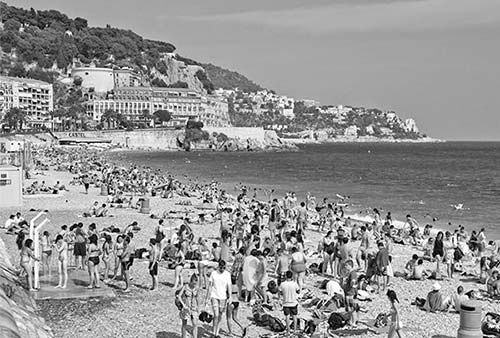
Bay of Angels (Baie des Anges)
Face the water. The body of Nice’s patron saint, Réparate, was supposedly escorted into this bay by angels in the fourth century. To your right is where you might have been escorted into France—Nice’s airport, built on a massive landfill. The tip of land beyond the runway is Cap d’Antibes.
Until 1860, Antibes and Nice were in different countries—Antibes was French, but Nice was a protectorate of the Italian kingdom of Savoy-Piedmont, a.k.a. the kingdom of Sardinia. In 1850, the people here spoke Italian or Nissart (a local dialect) and ate pasta. As the story goes, the region was given a choice: Join newly united Italy or join France, which was enjoying prosperous times under the rule of Napoleon III. The majority voted in 1860 to go French...and voilà! This referendum was later revealed to have been falsified in a deal brokered between King Victor Emmanuel of Sardinia and Napoleon III.
The lower green hill to your left is Castle Hill (where this walk ends). Beyond that lie Villefranche-sur-Mer and Cap Ferrat (marked by the tower at land’s end, and home to lots of millionaires), then Monaco (which you can’t see, with more millionaires), then Italy. Behind you are the foothills of the Alps, which trap threatening clouds, ensuring that the Côte d’Azur enjoys sunshine more than 300 days each year. While 350,000 people live in Nice, pollution is carefully treated—the water is routinely tested and is very clean. But with the climate crisis, the warmer water is attracting jellyfish in the summer, making swimming a stinging memory.
• With the sea on your right, begin strolling.
The Promenade
This area was the favorite haunt of 19th-century British tourists, who wanted a place to stroll in their finery while admiring the sea views (locals called this area—between Boulevard Victor Hugo and the sea—“Little London”). In the 1920s, after American soldiers stationed here during World War I raved about the scene, American tourists arrived. When first built, this promenade was a dusty path about six feet wide and about 10 blocks long. It’s been widened and lengthened over the years to keep up with tourist demand, smartwatch step counters, and increased bicycle use. As you walk, be careful to avoid the bike lanes.
Nearby sit two fine belle époque establishments: the West End and Westminster hotels, both boasting English names to help those original guests feel at home. These hotels symbolize Nice’s arrival as a tourist mecca in the 19th century, when the combination of leisure time and a stable economy allowed visitors to find the sun even in winter.
Just after Hôtel le Royal, look out to the sea and imagine a grand casino built on piers over the water (you might see easels with paintings of it nearby). La Jetée Promenade, Nice’s elegant pier and first casino, was built in 1883. Even then, there was sufficient tourism in Nice to justify constructing a palatial building with gaming rooms. La Jetée Promenade stood just offshore, until the Germans dismantled it during World War II to salvage its copper and iron. When La Jetée was thriving, it took gamblers two full days to get to the Riviera by train from Paris. In those days, the Promenade was all about dressing up, being seen, and struttin’ your stuff.
Although La Jetée Promenade is long gone, you can still see the striking 1927 Art Deco facade of the Palais de la Méditerranée, once a magnificent complex housing a casino, luxury hotel, and theater. It became one of the most famous destinations in all of Europe until a terrible fire left only the facade standing. It was destroyed in the 1980s to make room for a new hotel (the Hyatt Regency). The facade of the grand, old building was spared the wrecking ball, but the classy interior was lost forever.
Stroll to the steel sculpture of an angel. This is Angels of the Bay—another memorial to the 86 “angels” killed along this promenade in the Bastille Day terrorist attack of 2016. The sculpture was installed in 2022 to mark the spot where the terrorist truck driver was killed.
Twenty yards beyond the monument at the entry to the beach, note the signboard in English with beach rules and a map of private beaches. It explains the flag system for wind, pollution, and so on. Despite the lack of sand, the pebble beaches here are a popular draw. France has a strong ethic of public access—all along the Riviera you’ll find public beaches (and public showers). You’ll pass several beach restaurants; some serve breakfast, all serve lunch, some do dinner, and a few have beachy bars...tailor-made for a break from this walk.
Albert I Park, on the left, is named after the Belgian king who defied a German ultimatum at the beginning of World War I. While the English came first, the Belgians and Russians arrived soon after and were also big fans of 19th-century Nice. The tall statue capped by the Greek goddess of victory, Nike, commemorates the 100-year anniversary of Nice’s annexation to France (Nice’s original name was Nikaia, after Nike).
The park is part of a long, winding greenbelt called the Promenade du Paillon. The Paillon River flows under the park on its way to the sea. This is the historical divide between Vieux Nice and the new town.
Continuing along the promenade and passing the river, enter the Quai des Etats-Unis (“Quay of the United States”). This name was given as a tip-of-the-cap to the Americans for finally entering World War I in 1917. The big, blue chair statue celebrates the inviting symbol of this venerable walk and kicks off the best stretch of beach—suddenly quieter and with less traffic. Check out the laid-back couches at the Plage Beau Rivage lounge and consider a beachfront drink.
Those tall, rusted steel girders reaching for the sky were erected in 2010 to celebrate the 150th anniversary of Nice’s union with France. (The nine beams represent the nine valleys of the Nice region.) Done by the same artist who created the popular Arc of the Riviera sculpture in the parkway near Place Masséna, this “art” infuriates many locals as an ugly waste of money.
A block ahead on the left, the elegant back side of Nice’s opera house faces the sea. The tiny bronze Statue of Liberty (right in front of you as you face the opera) reminds all that this stretch of seafront promenade is named for the USA.
As you continue your stroll, you’ll come to a long stretch of two-level galleries on the left, with a walkway on top (likely closed). This terrace was British tourists’ preferred place for a seaside stroll before the Promenade des Anglais was built. The ground floor served the city’s fishermen. You’ll soon come upon a grand, marble-columned gate, called the Great Middle Gate. Atop the columns, about 12 feet up, you’ll see an inscription from 1917 commending the US for joining World War I and saving France from “barbarianism.” Just through that gate, you’ll find the bustling Cours Saleya Market. (There are handy WCs under the gallery arches.)
Continuing east, near the end of those galleries (as you come upon a colonnaded arcade), look to the far-right side of the promenade and find the three-foot-tall white metal winch at the ramp to the beach. Long before tourism—and long before Nice dredged its harbor—hardworking fishing boats rather than vacationing tourists lined the beach. The boats were hauled in through the surf by winches like this and tied to the iron rings on either side.
• You could end your walk here, but the view from the point just past the Hôtel la Pérouse is wonderful. Either way, you have several great options: Continue 15 minutes along the coast to Port Lympia, around the base of Castle Hill (fine views of the entire promenade and a monumental war memorial carved into the hillside), hike or ride the free elevator up to Castle Hill (catch the elevator next to Hôtel Suisse; see listing for Castle Hill under “Sights in Nice,” later), head into Vieux Nice (you can follow my “Vieux Nice Walk,” next), or grab a blue chair or piece of beach and just be on vacation—Riviera style.
VIEUX NICE WALK
This self-guided walk through Nice’s old town, worth ▲▲, gives you an introduction to the city’s bicultural heritage and its most interesting neighborhoods. For the route, see the “Vieux Nice Hotels & Restaurants” map on here.
Allow about one hour at a leisurely pace for this level walk from Place Masséna to Place Rossetti. It’s best done in the morning while the outdoor market thrives on Cours Saleya—consider coffee or breakfast at a café there (suggestions later in this walk)—and preferably not on a Sunday, when things are quiet. This ramble is also a joy at night, when fountains glow and pedestrians rule the streets.
• Start where Avenue Jean Médecin hits the people-friendly Place Masséna—the successful result of a long, expensive city upgrade and the new center of Nice. Find a spot on the black-and-white checkerboard pavement for best views.
Place Masséna
The grand Place Masséna has been Nice’s drawing room since the 18th century, where old meets new, and where the tramway bends between Vieux Nice and the train station. The square’s black-and-white pavement feels like an elegant outdoor ballroom, with the sleek tram waltzing across its dance floor. While once congested with cars, today’s square is crossed only by these graceful trams, which swoosh silently by every couple of minutes. The men on pedestals sitting high above are modern-art additions that arrived with the tram. For a mood-altering experience, return after dark and watch the illuminated figures float yoga-like above. Each figure represents one of the many cultures that weave the social tapestry of Nice—their colors change as if in conversation. Place Masséna is at its sophisticated best after the sun goes down.
Appreciate the city’s Italian heritage. This square was designed to resemble the city of Turin—then capital of Savoy and the Italian Duchy that controlled Nice. (It was the Treaty of Turin in 1860 that officially ceded Nice to France.) The lovely portico flanking the beginning of Avenue Jean Médecin is an example of Italian architecture, not French (the architecture past the porticos has a more French sensibility). The rich colors of the buildings reflect the taste of previous Italian rulers.
This square’s name is a tribute to Jean-André Masséna, a French military leader during the Revolutionary and Napoleonic wars. Not just another pretty face in a long lineup of French military heroes, he’s considered among the greatest commanders in history—anywhere, anytime. Napoleon called him “the greatest name of my military Empire.”
Looking across Place Masséna with your back to the fountains, start a clockwise spin tour: The modern swoosh sculpture at palm-tree height in the parkway is meant to represent the arc of Nice’s beautiful bay. To the right stretches modern Nice, born with the arrival of the train in 1864—and tourism after that. Avenue Jean Médecin, Nice’s Champs-Elysées, cuts from here through the new town to the train station. Looking up the avenue, you’ll see the tracks, the freeway, and the Alps beyond. Once crammed with cars, buses, and delivery vehicles tangling with pedestrians, Avenue Jean Médecin was turned into a stroller’s nirvana in 2007. Businesses along it flourish in the welcoming environment of generous sidewalks and no traffic.
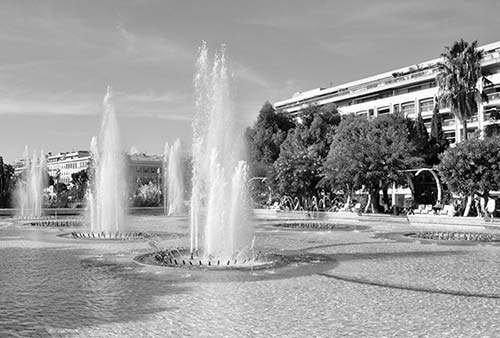
Now turn to face the fountains and look east to see Nice’s ongoing effort to “put the human element into the heart of the town.” An ugly concrete bus station and parking structures were demolished, and the Promenade du Paillon (named for the river it covers) was created to fill the space. Today, this pedestrian- and family-friendly parkway extends from the sea to the Modern and Contemporary Art Museum—a modern-day, green Promenade des Anglais. Forming a key spine for biking, walking, and kids at play, the Promenade du Paillon is a delight any time of day. Notice the fountain—its surprise geysers delight children by day and its night mood lights fires up a romantic’s heart. Past the fountain stands a bronze statue of the square’s namesake, Masséna. The hills beyond separate Nice from Villefranche-sur-Mer.
To the right of the Promenade du Paillon lies Vieux Nice, with its jumbled and colorful facades below Castle Hill. Look closer and about 90 degrees to the right, the statue of Apollo has horsey hair and holds a beach towel (in the fountain) as if to say, “It’s beer o’clock, let’s go.”
• Walk past Apollo into Vieux Nice (careful of those trams). A block down Rue de l’Opéra you’ll see a grouping of rusted steel girders (described earlier in my “Promenade des Anglais Walk”). Turn left onto...
Rue St. François de Paule
This colorful street leads into the heart of Vieux Nice. On the left, the red, white, and blue marks the Hôtel de Ville (City Hall)—a site busy with secular wedding parties on Saturdays. Across the street, the Côté Vin wine shop offers a great peek at how the French like to buy their wine—at a shop that comes with a wide variety, organized by region, and expert advice.
The small trees in boxes lining the street are a reminder that olives are integral to the French Riviera’s culture and cuisine. The Alziari olive oil shop (at #14 on the right) dates from 1868 and produces top-quality, stone-ground olive oil. The proud and charming owner, Gilles Piot, claims that stone wheels create less acidity, since grinding with metal creates heat. Until a generation ago, locals filled their own containers here from the shop’s huge oil vats. Head to the back room to enjoy historic photos of both Nice and the olive-oil-making process. There’s dégustation (tasting) in the corner, and you can buy a small box of your favorite olives at the glass counter (100-gram minimum, no mixing).
A few awnings down, La Couqueto is a colorful shop filled with Provençal fabrics and crafts, including lovely folk characters (santons). Michelle runs the shop (a photo of her mother and grandmother looks down on the action). Next door, circle through the recommended Boulangerie Jeannot to see what’s on display. Line up for a fresh sandwich, quiche, or pastry, then grab a table out front to people-watch.
Next up: Nice’s grand opera house, built of pink Carrara marble in 1885 (the architect was a student of Charles Garnier, who designed the Parisian opera house). Imagine this opulent jewel back in the 19th century, buried deep in Vieux Nice. With all the fancy big-city folks wintering here, this rough-edged town needed some high-class entertainment. And Victorians needed an alternative to those “devilish” gambling houses. (Queen Victoria, so disgusted by casinos, would actually close the drapes on her train window when passing Monte Carlo.) The four statues on top represent theater, dance, music, and party poopers. If the box office is open, you can step in for a peek at the fancy foyer.
Across the street, Pâtisserie Auer’s grand old storefront would love to tempt you with chocolates and candied fruits. It’s changed little over the centuries. The writing on the window says, “Since 1820 from father to son.” Wander in for a whiff of chocolate and a dazzling interior. The twin gold royal shields topping the mirrors partway back remind shoppers that Queen Victoria indulged her sweet tooth here.
• Continue on, sifting your way through a cluttered block of tacky souvenir shops to the big market square.
Cours Saleya
Named for its broad exposure to the sun (soleil), Cours Saleya (koor sah-lay-yah)—a commotion of color, sights, smells, and people—has been Nice’s main market square since the Middle Ages (flower market all day Tue-Sun, produce market Tue-Sun until 13:00, antiques and flea market on Mon).
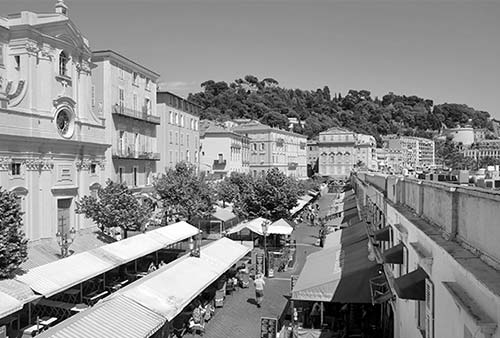
The first section is devoted to the Riviera’s largest flower market. In operation since the 19th century, this market offers plants and flowers that grow effortlessly in this climate, including the local favorites: carnations, roses, and jasmine. Locals know the season by what’s on sale. Until the recent rise in imported flowers, this region supplied all of France with flowers. The Riviera’s three big industries are tourism, flowers, and perfume (made from these flowers...take a whiff).
The boisterous produce section trumpets the season with mushrooms, strawberries, white asparagus, zucchini flowers, and more—whatever’s fresh gets top billing.
The market opens up at Place Pierre Gautier. It’s also called Plassa dou Gouvernou—you’ll see bilingual street signs here that include the old Niçois language, a Provençal dialect. This is where farmers set up stalls to sell their produce and herbs directly.
From the steps, look up to the hill that dominates to the east. In the Middle Ages, a massive castle stood there with soldiers at the ready. Over time, the city sprawled down to where you are now. With the river guarding one side (running under today’s Promenade du Paillon parkway) and the sea the other, this mountain fortress seemed strong—until Louis XIV leveled it in 1706. Nice’s medieval seawall ran along the line of two-story buildings where you’re standing.
Now, look across Place Pierre Gautier to the large “palace.” The Ducal Palace was where the kings of Sardinia, the city’s Italian rulers until 1860, resided when in Nice. Today, the palace is the local police headquarters. The land upon which the Cours Saleya sits was once the duke’s gardens and became a market after Nice’s union with France.
• Continue down Cours Saleya (public WC on your right) to a busy red street-food stall at the end of the market.
Socca du Cours (Chez Marie-Thé) is an enticing recommended street-food stand where people line up for fresh socca, the local chickpea-flour pancake. The flatbread-like pissaladière (with or without anchovies) is sold by the slice like pizza, and other homemade dishes are sold by weight (200 grams is a meal). This is a great place to assemble a picnic for a bench on the promenade or a niche on the beach. Nearby, you can buy an assortment of olives, a tiny tub of seasonal fruit, and a pastry.
• The golden building that seals the end of the square is where Henri Matisse spent 17 years on the top two floors. I imagine he was inspired by his view. Turn left a block before Matisse’s home onto...
Rue de la Poissonnerie
Look up at the first floor of the first building on your right. Adam and Eve are squaring off, each whacking the other with a long, zucchini-like gourd. This likely represents “Truth Day,” a day in centuries past designed to let quarrelsome neighbors and couples living in these tight quarters of the old town air their grievances—to vent for domestic peace.
Next, check out the small Baroque church (Notre-Dame de l’Annonciation, closed 12:00-14:30). It’s dedicated to St. Rita, the patron saint of desperate causes and desperate women. She holds a special place in locals’ hearts, making this the most popular church in Nice. Drop in for a peek at the decor. It’s a star-bursty Baroque more dazzling than you’ll see elsewhere in France. While French Baroque is more classical (think Versailles), the Baroque you see here is Italian: pure Counter-Reformation propaganda (think some fancy church in Rome). The first chapel on the right is dedicated to St. Erasmus, protector of mariners.
• Turn right on the next street, where you’ll pass one of Vieux Nice’s happening bars (the recommended Distilleries Ideales), with a swashbuckling interior that buzzes until the wee hours. Pause at the next corner and study the classic Vieux Nice scene in all directions. Now turn left on Rue Droite and enter an area that feels like Little Naples.
Rue Droite
In the Middle Ages, this straight, skinny street was the main road within the old walled town. Donkeys carrying salt on their backs used this road to reach Turin, then the county’s capital. Pass the recommended restaurant Acchiardo. Notice stepped lanes leading uphill to the castle. Pop into the Jesuit Eglise St-Jacques (also called Eglise du Gésu) for an explosion of Baroque exuberance hidden behind that plain church facade.
Continue up Rue Droite from the church. On the right, pass Chez Thérésa and her socca oven (tables and a WC are across the street).
At the corner of Rue Rossetti, turn right and side-trip about 20 yards uphill to find a stone bathtub on your right. This was a 17th-century community laundry where, for generations, women would gather to wash their clothes (and gossip).
From the bath, head back down Rue Rossetti and continue downhill to the intersection with Rue Benoît Bunico. In the 18th century, Rue Benoît Bunico served as a ghetto for Nice’s Jews (from where you stand to 110 yards or so uphill). At sunset, gates would seal the street at either end, locking people in until daylight. In 1848, with revolutionary fervor sweeping Europe, the House of Savoy allowed the people a new constitution. This included abolishing all ghettos in the realm. Today, absolutely nothing physical survives of the old Jewish quarter.
• Continue down Rue Rossetti to...
Place Rossetti
The most Italian of Nice’s squares, Place Rossetti comes alive after dark—in part because of the gelato shop, popular for its 100 innovative flavors. Check out the square’s Cathedral of Ste. Réparate, relocated here around 1700 (the facade and bell tower are not so old), when Castle Hill was converted to military use. The name comes from Nice’s patron saint, whose martyred body floated to Nice in the second century accompanied by angels (remember the Bay of Angels?). Notice the church’s majolica tile dome—very Italian in style. When the Italian state of Savoy ruled Nice from 1388 to 1860, it worked to centralize its power with architecture and urban design. Step inside the cathedral—the Baroque interior is worth a wander.
• This is the end of our walk. From here you can hike up Castle Hill (from Place Rossetti, take Rue Rossetti uphill). Or you can stroll over to the trendy Place Garibaldi (northeast of here) and Rue Bonaparte to enjoy a colorful and local scene (both Castle Hill and Place Garibaldi are described later, under “Sights in Nice”). Then again, you could have an ice cream and browse the colorful lanes of Vieux Nice...or grab Apollo and hit the beach.
Sights in Nice
▲▲▲Chagall Museum (Musée National Marc Chagall)
▲Matisse Museum (Musée Matisse)
Archaeological Museum (Musée Archéologique)
Modern and Contemporary Art Museum (Musée d’Art Moderne et d’Art Contemporain, a.k.a. MAMAC)
Fine Arts Museum (Musée des Beaux-Arts)
Masséna Museum (Musée Masséna)
▲Russian Cathedral (Cathédrale Russe)
▲Castle Hill (Colline du Château)
Libération Market (Marché de la Libération)
Some of Nice’s top attractions—the Promenade des Anglais, the beach, and the old town—were covered earlier in my self-guided walks. But Nice offers some additional worthwhile sights, covered here.
MUSEUMS
Nice’s top museums—the Chagall and Matisse museums—are located farther from the city center, tucked away among the mansions and palaces on Cimiez Hill, where Queen Victoria made her summer escape. As you climb into the hills, you’ll get a glimpse of this world of royalty and aristocrats, evident in the lovely 19th-century belle époque architecture along Boulevard de Cimiez.
As both museums are in the same direction and served by the same, frequent bus line, try to visit them on the same trip. From Place Masséna, the Chagall Museum is a 10-minute bus ride, and the Matisse Museum is several stops beyond that. It’s a pleasant 30-minute walk between the two museums (best to visit Matisse Museum—and if interested, the nearby Archaeological Museum—first, as the walk from there to Chagall is downhill).
▲▲▲Chagall Museum (Musée National Marc Chagall)
Even if you don’t get modern art, this museum—with the world’s largest collection of Marc Chagall’s work in captivity—is a delight.
After World War II, Chagall returned from the United States to settle first in Vence and later in St-Paul-de-Vence, both not far from Nice. Between 1954 and 1967, he painted a cycle of 17 large murals designed for, and donated to, this museum. These paintings, inspired by the biblical books of Genesis, Exodus, and the Song of Songs, make up the “nave,” or core, of what Chagall called the “House of Brotherhood.”
Cost and Hours: €8, covered by French Riviera Pass; Wed-Mon 10:00-18:00, Nov-April until 17:00, closed Tue year-round; ticket includes essential audioguide, must check day packs, idyllic $ garden café (salads and plats), +33 4 93 53 87 20, https://musees-nationaux-alpesmaritimes.fr/chagall. Note that the museum is often closed midday (12:00-14:00), and may close at other odd times (check the website for the latest).
Getting There: The museum is located on Avenue Docteur Ménard. Taxis from the city center cost about €16. Buses connect the museum with downtown Nice. From downtown, catch bus #5 (5/hour, 10 minutes); stops include the east end of the Galeries Lafayette department store, near the Masséna tram stop, on Rue Sacha Guitry, or along Rue Gioffredo. Watch for a Musée Chagall sign on the bus shelter where you’ll get off (on Boulevard de Cimiez).
Visiting the Museum: This small museum consists of the main hall (with 12 large paintings) and the Song of Songs room (with five more paintings), a mosaic-lined pond (viewed from inside), two rooms for special exhibits, and an auditorium with a fine set of stained-glass windows. The auditorium has been used to screen an amazing 52-minute film about Chagall in English (ask about it when you visit).
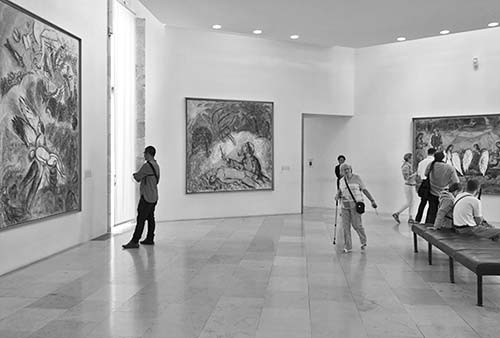
In the main hall you’ll find the core of the collection: Genesis and Exodus scenes. Chagall was a great storyteller, and this cycle of 12 paintings (painted between 1958 and 1966) is an epic story indeed. Each painting is a lighter-than-air collage of images that draws from Chagall’s Russian folk-village youth, his Jewish heritage, the Bible, and his feeling that he existed somewhere between heaven and earth. He believed that the Bible was a synonym for nature, and that both color and biblical themes were key for understanding God’s love for his creation. Chagall’s brilliant blues and reds celebrate nature, as do his spiritual and folk themes. Notice the focus on couples. To Chagall, humans loving each other mirrored God’s love of creation. He said, “If I was not a Jew, I would not have been an artist.”
The adjacent room houses five more paintings, inspired by the Old Testament Song of Songs. Chagall was one of the few “serious” 20th-century artists to portray unabashed love. Chagall uses unearthly colors and a mystical ambience to celebrate human love. These red-toned canvases are hard to interpret literally, but they capture the rosy spirit of a man in love with life.
Back near the entry, the wall mosaic evokes the prophet Elijah in his chariot of fire (from the Second Book of Kings)—with Chagall’s addition of the 12 signs of the zodiac, which he used to symbolize Time. The auditorium, where the Chagall documentary film shows, is worth a peaceful moment to enjoy three Chagall stained-glass windows depicting the seven days of creation.
Leaving the Museum: From here, you could return to downtown Nice or head to the Matisse Museum. Taxis usually wait in front of the museum, or you can request an Uber. For the bus back to downtown Nice, turn right out of the museum, then make another right down Boulevard de Cimiez, and ride bus #5 heading downhill. To continue to the Matisse Museum, catch #5 using the uphill stop.
To walk to the train station area from the museum (25 minutes), turn right out of the museum grounds and follow the first street to the right (hugging the museum). Drop down ramps and staircases, turn left at the bottom under the freeway and train tracks, then turn right on Boulevard Raimbaldi.
Note that Libération Market (described later, under “Other Sights in Nice”) is about a 10-minute walk from the Chagall Museum, with good lunch options.
▲Matisse Museum (Musée Matisse)
This museum fills an old mansion in a park surrounded by scant Roman ruins. It houses France’s top sampling of works by Henri Matisse. (Matisse was first recognized as a master by American and Russian collectors who bought up most of his masterpieces, leaving little of his best work for French museums.) The museum offers an introduction to the artist’s many styles and materials, both shaped by Mediterranean light, his travels, and the community of early-20th-century artists who found inspiration together on the Côte d’Azur.
Cost and Hours: €10, covered by All Museums Pass and by French Riviera Pass; Wed-Mon 10:00-18:00, Nov-April until 17:00, closed Tue year-round; 164 Avenue des Arènes de Cimiez, +33 4 93 81 08 08, www.musee-matisse-nice.org.
Getting There: Bus #5, direction: Rimiez, goes from the east end of Galeries Lafayette—just off Place Masséna. The same bus also runs from the Chagall Museum (get off at Arènes-Matisse; look for the crumbling Roman arena, then walk 50 yards into the park to find the pink villa). Or you can take an Uber or a cab (€20 from downtown).
Eating: There’s a handy and inviting $ food-and-drink cart in the park in front of the museum.
Visiting the Museum: The museum’s layout can be confusing. You’ll enter in the new wing, see a couple of iconic works by Matisse, then be directed through exhibits featuring other artists. You’ll end up in the classic old villa for the main Matisse collection. As you tour the museum, look for Matisse’s favorite motifs—including fruit, flowers, wallpaper, and sunny rooms—often with a window opening onto a sunny landscape. Another favorite subject is the odalisque (harem concubine), usually shown sprawled in a seductive pose and with a simplified, masklike face. You’ll also see a few souvenirs from his travels to places like Morocco, which greatly influenced his work.
Matisse understood how colors and shapes affect us emotionally. He could create either shocking, clashing works (early Fauvism) or geometrical, balanced, harmonious ones (later cutouts). Whereas other modern artists reveled in purely abstract design, Matisse usually kept the subject matter at least vaguely recognizable. As the master of leaving things out, he could suggest a woman’s body with a single curvy line—letting the viewer’s mind fill in the rest. Ignoring traditional 3-D perspective, he expressed his passion for life through simplified but recognizable scenes in which dark outlines and saturated, bright blocks of color create an overall 2-D decorative pattern.
Leaving the Museum: To visit the Archaeological Museum (see next listing), turn left from the museum and walk along the park. On the left, you’ll pass the entrance to the museum and on the right, you’ll see an ancient amphitheater.
For bus #5 (frequent service to downtown and the Chagall Museum), follow my directions and continue straight until you reach the main road (Avenue des Arènes de Cimiez), turn right, and walk with the Roman ruins on your right. When you reach the small roundabout, find the bus shelter (facing downhill).
To walk to the Chagall Museum (about 30 minutes downhill), head to the main road (Avenue des Arènes de Cimiez), then turn left and walk down it until you reach Avenue Colonel Evans. Turn right onto Avenue Colonel Evans, then turn left to walk down Boulevard de Cimiez.
Archaeological Museum (Musée Archéologique)
Much of Nice is built upon the Roman remains of the city of Cemenelum, which, from the first to the fifth century AD, had a population of about 20,000. This museum has a small exhibit of art and artifacts from that time (no English descriptions) and the scant remains of baths and an impressive amphitheater (which held 5,000 people).
Cost and Hours: €10, covered by All Museums Pass; Wed-Mon 10:00-18:00, Nov-April until 17:00, closed Tue year-round; near Matisse Museum at 160 Avenue des Arènes de Cimiez, +33 4 93 81 59 57, www.musee-archeologie-nice.org.
Modern and Contemporary Art Museum (Musée d’Art Moderne et d’Art Contemporain, a.k.a MAMAC)
This ultramodern museum features a colorful, far-out, and limited collection focused on American and European American artists from the 1960s and 1970s (Pop Art and New Realism are highlighted). The exhibits cover three floors, one of which is devoted to temporary shows. The permanent collection includes a few works by Andy Warhol and Roy Lichtenstein. You’ll also find rooms dedicated to Yves Klein and Niki de Saint Phalle. Helpful English explanations are posted in most rooms, and there’s a timeline of Riviera artists from 1947 to 1977. Don’t leave without exploring the 360-degree views from the rooftop.
Cost and Hours: €10, covered by All Museums Pass; Tue-Sun 10:00-18:00, Nov-April from 11:00, closed Mon year-round; near Vieux Nice, on Place Yves Klein, facing Place Garibaldi, both trams T-1 and T-2 stop at Garibaldi, +33 4 97 13 42 01, www.mamac-nice.org.
Fine Arts Museum (Musée des Beaux-Arts)
Housed in a sumptuous Riviera villa with lovely gardens, this museum shows off art from the 17th to 20th century. While its top treasure is a Mannerist masterpiece (Bronzino’s Crucified Christ), most visitors come for paintings by Sisley, Bonnard, and Raoul Dufy, as well as a few sculptures by Rodin and Carpeaux.
Cost and Hours: €10, covered by All Museums Pass; Tue-Sun 10:00-18:00, Nov-April from 11:00, closed Mon year-round; at the western end of Nice—take T-2 tram to the Centre Universitaire Méditerranéen and follow sign up the big stairs; 33 Avenue des Baumettes; +33 4 92 15 28 28, www.musee-beaux-arts-nice.org.
Masséna Museum (Musée Masséna)
Like Nice’s main square, this museum was named in honor of Jean-André Masséna, a hometown boy and highly regarded commander during France’s Revolutionary and Napoleonic wars. The beachfront mansion is worth a look for its lavish decor and lovely gardens alone (for English explanations, try the QR code at the ticket desk). The gardens on the seaward side of the museum (open and free to the public) house a memorial to the 86 people who died in the terrorist attack on the Promenade des Anglais in 2016.
Cost and Hours: €10, covered by All Museums Pass, gardens always free; Wed-Mon 10:00-18:00, Nov-April from 11:00, closed Tue year-round; 35 Promenade des Anglais—take T-2 tram to Alsace-Lorraine, then walk six minutes toward the water, following signs to Palais Masséna, +33 4 93 91 19 10, www.massena-nice.org.
OTHER SIGHTS IN NICE
▲Russian Cathedral (Cathédrale Russe)
Nice’s Russian Orthodox church—claimed by some to be the finest outside Russia—is worth a visit. Several hundred rich Russian families wintered in Nice in the late 19th century, and they needed a worthy Orthodox house of worship. Dowager Czarina Maria Feodorovna and her son, Czar Nicholas II, offered the land, and construction began in 1903. Nicholas (“St. Nicholas” to the Russian Orthodox; he was the last emperor of Russia) underwrote much of the project and gave this church to the Russian community. Construction was completed in 1912. (In 1918, Russian comrades who didn’t winter on the Riviera assassinated him.) Here in the land of olives and anchovies, these proud onion domes seem odd. But, I imagine, so did those old Russians.
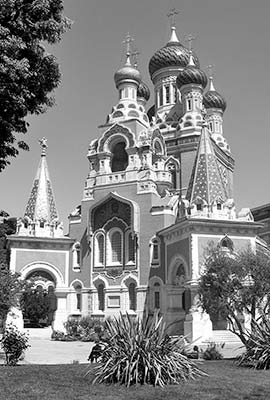
Cost and Hours: Free; daily 9:00-18:00, chanted services Sat at 17:00; €10 worthwhile 30-minute guided tour (usually in the afternoon, by request); no shorts or bare shoulders (shawls available), Avenue Nicolas II, +33 9 81 09 53 45, www.sobor.fr. The humble museum in the basement (€5, free if you take the tour) has a fascinating collection of 19th-century artifacts from the aristocratic Russian community.
Getting There: It’s a 15-minute walk from the train station; you could also ride the T-2 tram to the Alsace-Lorraine stop and walk 10 minutes, or take bus #8 from Place Masséna (northwest corner of Galeries Lafayette) to the Thiers-Gambetta stop a few minutes away. Given its relatively remote location, Uber can be handy coming or going.
Eating: A block from the cathedral, $ Boulangerie L’Impériale is a little bakery selling sandwiches, salads, and pastries (closed Sun, 10 Boulevard du Tzarewitch, +33 4 93 44 99 45).
Visiting the Cathedral: Step inside, and imagine the one-room interior filled with music, incense, and worshippers. About 600 faithful from the Orthodox community worship here each week. There are no chairs because Orthodox Christians prefer to pray while standing. While the architecture is classic, the paintings show what was in vogue in 1912—joyful Art Nouveau symbolizing a garden of God’s creation.
At the altar, the gold-plated, bronze iconostasis (wall of icons) divides the temporal world of the worshippers and the spiritual realm. Like nearly everything else in this cathedral, the iconostasis was shipped here from St. Petersburg.
▲Castle Hill (Colline du Château)
This hill offers sensational views over Nice, the old port, the foothills of the Alps, and the Mediterranean.
Nice was founded by the Greeks centuries before Christ on this hill. Throughout the Middle Ages, it was a fortress town with residents crammed onto the fortified hilltop, as life in the flatlands below was too risky. Then, in the 16th century, the count evacuated the population of the fortress town, sending them to a walled and protected town below. This spot was turned into a state-of-the-art citadel to help defend the Italian House of Savoy. In 1706, French King Louis XIV—in a strategic move against the Italians—had the hill-capping fort demolished. Later the town’s cemeteries were cleared and relocated to the hilltop...and then came the tourists.
Today you’ll find a view terrace, playground, botanical garden, cafés, and two intriguing cemeteries (one Jewish and one Christian)—but no castle—on Castle Hill.
Cost and Hours: Park is free and closes at 20:00 in summer, earlier off-season.
Getting There: You can get to the top by foot, by elevator (free, daily 9:00-19:00 but often not functioning, next to beachfront Hôtel Suisse), or by pricey tourist train (see “Tours in Nice,” earlier). See the “Promenade des Anglais Walk” for a pleasant stroll that ends near Castle Hill.
Leaving Castle Hill: There are multiple ways to get down, including the elevator or steps down to the promenade, staircases to the old town, and a paved lane leading to Place Garibaldi and the old port (departure point for boat trips and buses to Monaco and Villefranche-sur-Mer).
Place Garibaldi
A short stroll north from touristy Vieux Nice, Place Garibaldi is where workaday meets trendy. The square centers on a statue of the Italian revolutionary Giuseppe Garibaldi, who spearheaded the unification of Italy. He was born here in Nice, so you’ll see another version of him as a baby, cradled in the arms of angels. The statue faces Turin (in Italy)—a nod to when Nice was part of the Duchy of Savoy, of which Turin was the capital. The Italian-style porticos and the nearby, classic Café de Turin date from that period of Savoy rule. Several fun streets span out from the square.
Place Garibaldi is also a hub for public transportation: You’ll see stops for trams T-1 and T-2 (underground), and buses heading to other towns in this region.
Libération Market (Marché de la Libération)
North of the city center (near the Chagall Museum), a lively market scene bustles with real people and real merchants most mornings (Tue-Sun until 13:00, closed Monday). The sprawling marché—selling produce, seafood, cheese, socca, and more—is an untouristy alternative to the always-mobbed Cours Saleya Market, and it’s a great place for a memorable lunch. Tiny eateries and bakeries around the market keep the shoppers happy. It’s right on the T-1 tram line along Avenue Malausséna (stop: Libération).
If you’d rather a sit-down lunch than a market picnic, $ Le Gambetta—a classic brasserie scene inside and out—is enjoyed for its fish and oysters (daily, 1 Place du Général de Gaulle, +33 4 93 84 76 07).
Nightlife in Nice
The city is a walker’s delight after dark. I can’t get enough of the night scene on Place Masséna or the fountains lining Promenade du Paillon. Promenade des Anglais, Cours Saleya, and Vieux Nice are also worth an evening wander.
Nice’s bars play host to a happening late-night scene, filled with jazz, rock, and trolling singles. Most activity focuses on Vieux Nice. Rue de la Préfecture and Place du Palais are ground zero for bar life, though Place Rossetti and Rue Droite are also good targets. Distilleries Ideales is a good place to start or end your evening, with a lively international crowd and a Pirates of the Caribbean interior (lots of beers on tap, 24 Rue de la Préfecture, where it meets Rue de la Poissonnerie—see “Vieux Nice Hotels & Restaurants” map, happy hour 18:00-21:00). Wayne’s Bar and others nearby are happening spots for the younger, Franco-Anglo backpacker crowd (15 Rue Préfecture). Along the Promenade des Anglais, the classy Bar Negresco at the recommended Hôtel Negresco is fancy-cigar old English with frequent live jazz.
To savor lovely views over Nice into the Med, find the Hôtel Aston La Scala: Its sixth-floor “club” lounge has comfy seats with views, and jazz and blues on many Thursdays, Fridays, and Saturdays (usually at 19:00). But the seventh-floor outdoor bar/terrace is where I rest my feet and savor fabulous views (both floors open daily, Promenade du Paillon at 12 Avenue Félix Faure, +33 4 92 22 20 06).
Sleeping in Nice
Don’t look for charming hotels in Nice. Seek out a good location and modern, reliable amenities (like elevators and air-conditioning). Prices generally drop considerably November through March, but go sky-high during the Nice Carnival (February), the Cannes Film Festival (May), and Monaco’s Grand Prix (late May). Between the film festival and the Grand Prix, the second half of May is slammed. Nice is also one of Europe’s top convention cities, and June is convention month here. For parking, ask your hotelier, or see “Arrival in Nice—By Car” on here.
CITY CENTER
The train station area offers Nice’s cheapest sleeps, but the neighborhood feels sketchy after dark. The cheapest places are older, well worn, and come with some street noise. Places closer to Avenue Jean Médecin are more expensive and in a more comfortable area.
$$$ Hôtel du Petit Palais**** is a little belle époque jewel with 25 handsome rooms tucked neatly into a residential area on the hill several blocks from the Chagall Museum. It’s bird-chirping peaceful and plush, with tastefully designed rooms, a garden terrace, and a small pool. You’ll walk 15 minutes down to Vieux Nice (or take bus #5 from the Chagall or Roland Garros stop to Place Masséna). Free street parking is usually easy to find (17 Avenue Emile Bieckert, +33 4 93 62 19 11, www.petitpalaisnice.com, reservation@petitpalaisnice.com).
$$ Hôtel Vendôme*** gives you a whiff of the belle époque, with pastel pinks, high ceilings, and grand staircases in a mansion set off the street. The modern rooms come in all sizes; many have balconies, some bigger than others (limited pay parking—book well ahead, 26 Rue Pastorelli at the corner of Rue Alberti, +33 4 93 62 00 77, www.hotel-vendome-nice.com, contact@hotel-vendome-nice.com).
$$ Maison Durante*** is a boutique hotel in a happy, orange building a short walk from the train station. It lacks a real lobby but rents sharp rooms wrapped around a flowery courtyard (16 Avenue Durante, +33 4 93 88 84 40, www.maisondurante.fr, reception@maisondurante.fr).
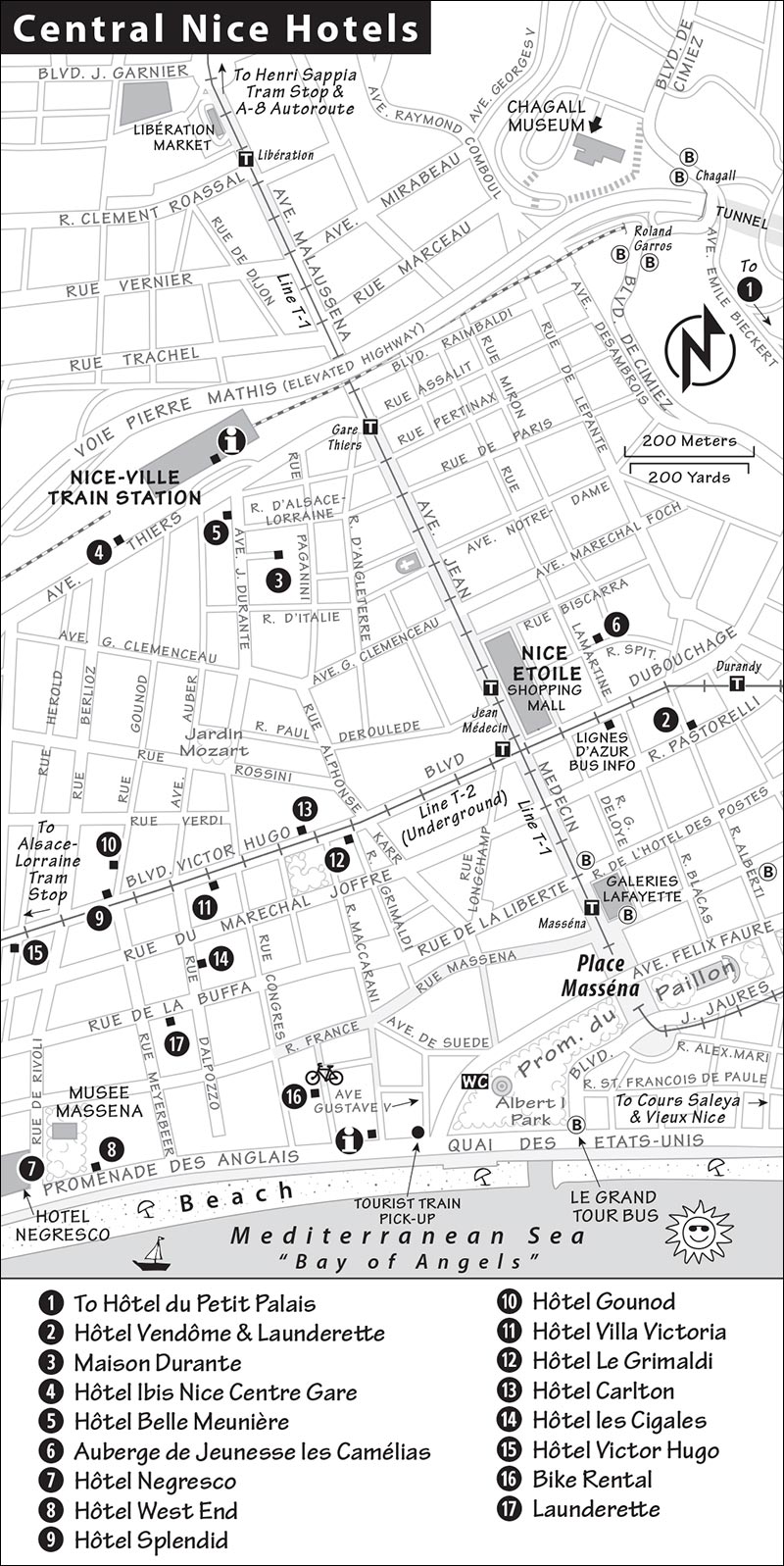
$$ Hôtel Ibis Nice Centre Gare,*** 100 yards to the right as you leave the train station, provides a secure refuge in this seedy area. It’s big (200 rooms), modern, has well-configured rooms and a pool, and is next to a handy parking garage (bar, café, 14 Avenue Thiers, +33 4 93 88 85 55, www.ibis.com, h1396@accor.com).
$ Hôtel Belle Meunière,* a block below the train station, in an old mansion built for Napoleon III’s mistress, attracts budget-minded travelers with cheap rates. Simple but well kept, the place has adequate rooms and charismatic Mademoiselle Marie-Pierre presiding with her perfect English (family rooms, air-con, no elevator but just 3 floors, laundry service, limited pay parking, 21 Avenue Durante, +33 4 93 88 66 15, www.bellemeuniere.com, hotel.belle.meuniere@cegetel.net).
¢ Auberge de Jeunesse les Camélias is a fun, good-value hostel with a handy location, modern facilities, and a lively evening atmosphere. Rooms (locked with keypads) accommodate four to eight people and come with showers and sinks—WCs are down the hall; private rooms for up to three people are available (includes breakfast, rooms closed 11:00-15:00 but guests can leave bags, laundry, kitchen, safes, bar, 3 Rue Spitalieri, +33 4 93 62 15 54, www.hihostels.com, nice-les-camelias@hifrance.org).
NEAR THE PROMENADE DES ANGLAIS
These hotels are close to the beach. The Negresco and West End are big, vintage Nice hotels that open onto the sea from the heart of the Promenade des Anglais.
$$$$ Hôtel Negresco***** owns Nice’s most prestigious address on the Promenade des Anglais and knows it. Still, it’s the kind of place that if you were to splurge just once in your life... Rooms are opulent (see my “Promenade des Anglais Walk” for more description), tips are expected, and the well-heeled clientele matches the hotel’s character (some view rooms, très classy bar, 37 Promenade des Anglais, +33 4 93 16 64 00, www.hotel-negresco-nice.com, reservations@lenegresco.com).
$$$$ Hôtel West End**** opens onto the Promenade des Anglais with formal service and decor, comfy public spaces, and high prices (some view rooms, 31 Promenade des Anglais, +33 4 92 14 44 00, www.westendnice.com, reservation@westendnice.com).
On or near Boulevard Victor Hugo
$$$ Hôtel Splendid**** is a worthwhile splurge if you miss your Marriott. The panoramic rooftop pool, bar/restaurant, and breakfast room almost justify the cost...but throw in plush rooms, a free gym, and spa services, and you’re as good as at home (pay parking, 50 Boulevard Victor Hugo, +33 4 93 16 41 00, www.splendid-nice.com, info@splendid-nice.com).
$$$ Hôtel Gounod**** lies behind its sister hotel, Hôtel Splendid. Because the two share the same owners, Gounod’s guests are allowed free access to Splendid’s pool, hot tub, and other amenities. Rooms here are well appointed, quiet, and have high ceilings (family rooms, pay parking, 3 Rue Gounod, +33 4 93 16 42 00, www.gounod-nice.com, info@gounod-nice.com).
$$$ Hôtel Villa Victoria**** is a service-oriented place that welcomes travelers into an elegant building with a spacious lobby overlooking a wonderful, sprawling garden-courtyard. Rooms are comfortable and well kept (limited pay parking, 33 Boulevard Victor Hugo, +33 4 93 88 39 60, www.villa-victoria.com, contact@villa-victoria.com).
$$$ Le Grimaldi**** is a lovely place with 48 spacious rooms, high ceilings, and traditional decor with rich colors (a few suites ideal for families, cozy lobby and small bar, 15 Rue Grimaldi, +33 4 93 16 00 24, www.le-grimaldi.com, info@le-grimaldi.com).
$ Hôtel Carlton*** is a fine value in this classy neighborhood. It’s an unpretentious and comfortable place with mostly spacious and modestly decorated rooms, many with decks (26 Boulevard Victor Hugo, +33 4 93 88 87 83, www.hotel-carlton-nice.com, info@hotel-carlton-nice.com).
$$ Hôtel les Cigales,*** a few blocks from the Promenade des Anglais, is a sweet little place with 19 richly colored rooms and an intimate upstairs terrace, all well managed by friendly Veronique and Eliane (RS%, 16 Rue Dalpozzo, +33 4 97 03 10 70, https://hotel-les-cigales.fr, infos@hotel-lescigales.com).
$ Hôtel Victor Hugo, a traditional and spotless seven-room hotel, is an adorable time-warp place where Gilles warmly welcomes guests. All rooms are on the ground floor and come with kitchenettes and air-conditioning. While it’s a short walk from the Promenade des Anglais, it’s a long walk from Vieux Nice, but close to the T-2 line (RS%, includes breakfast, 59 Boulevard Victor Hugo, +33 4 93 88 12 39, www.hotel-victor-hugo-nice.com, contact@hotel-victor-hugo-nice.com).
IN OR NEAR VIEUX NICE
Most of these hotels are either on the sea or within an easy walk of it.
$$$$ Hôtel la Pérouse,**** built into the rock of Castle Hill at the east end of the bay, is a worthwhile splurge. This refuge-hotel is top-to-bottom flawless in every detail—from its elegant rooms (satin curtains, velour headboards) and attentive staff to its rooftop terrace with hot tub, sleek pool, and lovely $$$ garden restaurant. Sleep here to be spoiled and to escape the big city (good family options, 11 Quai Rauba Capeu, +33 4 93 62 34 63, www.hotel-la-perouse.com, lp@hotel-la-perouse.com).
$$$$ Hôtel Suisse,**** below Castle Hill, has brilliant sea and city views—for a price. It’s surprisingly quiet given the busy street below (most view rooms have balconies, 15 Quai Rauba Capeu, +33 4 92 17 39 00, www.hotels-ocre-azur.com, suisse@hoa-hotels.com).
$$$ Hôtel Mercure Marché aux Fleurs**** is ideally situated near the sea and Cours Saleya. Rooms are sharp and prices can be either reasonable or exorbitant (superior rooms worth the extra euros—especially those with views, standard doubles are tight, some beds in a loft set-up; 91 Quai des Etats-Unis, +33 4 93 85 74 19, www.hotelmercure.com, h0962@accor.com).
$$ Room With a Vue rents four well-designed rooms (several with small balconies) right on Cours Saleya above the Pain et Cie bakery/café where you check in (3 Louis Gassin, +33 4 93 62 94 32, roomwithavue@gmail.com, enthusiastic manager Fred).
¢ Villa Saint Exupéry Beach is a sprawling place with more than 200 beds, split between a building with $ private rooms and the hostel next door (dorms with 4-8 beds). The owners and many staff are English, so communication is easy. The vibe is young and fun, with a bar, cheap restaurant, community kitchen, air-con, elevator, and beaucoup services including laundry, yoga classes, free walking tour of Vieux Nice, and scuba diving (no curfew, 6 Rue Sacha Guitry, +33 4 93 16 13 45, www.villahostels.com, info@villahostels.com).
NEAR THE AIRPORT
Several airport hotels offer a handy and cheap port-in-the-storm for those with early flights or who are just stopping in for a single night: $$ Hôtel Campanile (www.campanile.fr) and $$$ Hôtel Nouvel (www.novotel.com) are closest; $$ Hôtel Ibis Budget Nice Aéroport (www.ibis.com) is cheap and a few minutes away, though two other Ibis hotels are closer and a bit pricier. Free shuttles connect these hotels with both airport terminals.
Eating in Nice
You’ll find plenty of regional dishes and lots of Italian influence blended with classic French cuisine in this Franco-Italian city. My favorite dining spots are in Vieux Nice. It’s well worth booking ahead for these places (think about booking in person while you take my Vieux Nice Walk). Otherwise, arrive when they open (usually at 19:00). If Vieux Nice is too far or too touristy, I’ve listed some great places handier to your hotel. Promenade des Anglais is ideal for picnic dinners on warm, languid evenings or a meal at a beachside restaurant. For a more romantic and peaceful meal, head for nearby Villefranche-sur-Mer (described later). Avoid the terribly touristy eateries lining Rue Masséna.
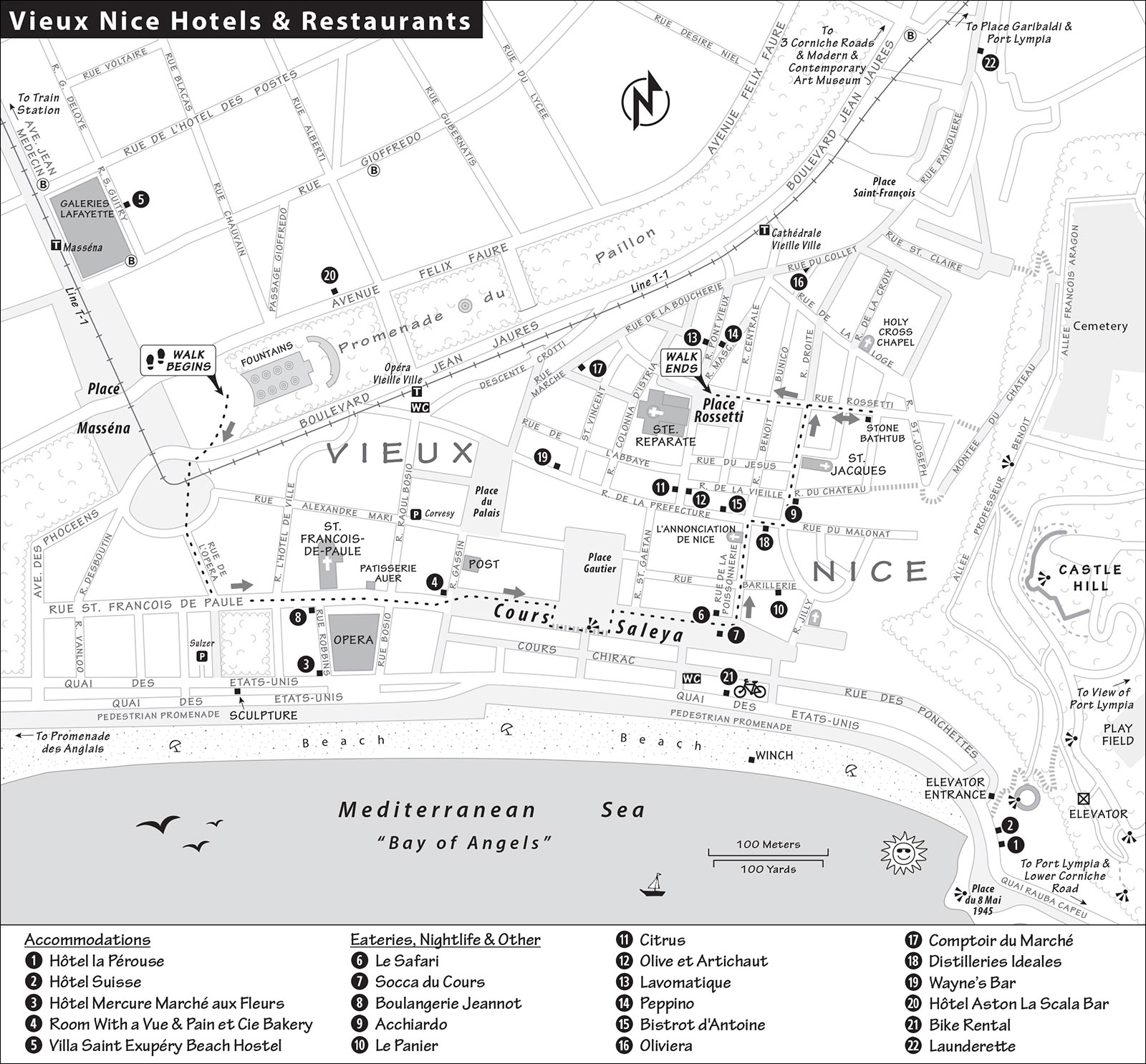
VIEUX NICE
Nice’s dinner scene converges on Cours Saleya, which is entertaining enough in itself to make the generally mediocre food a fair deal. Most of my recommendations are on side lanes a few blocks from here. My listings are mostly small mom-and-pop places—fun, but not particularly romantic, with tight seating and short menus. Even if you’re eating elsewhere, it’s fun to wander through here in the evening. For locations, see the “Vieux Nice Hotels & Restaurants” map, earlier.
On Cours Saleya
While local foodies would avoid Cours Saleya like a McDonald’s, the energy of wall-to-wall restaurants taking over Vieux Nice’s market square each evening is enticing.
$$ Le Safari is a good option for Niçois cuisine, pasta, pizza, and outdoor dining. This sprawling café-restaurant (40 tables on the outdoor terrace and 40 tables inside), convivial and rustic with the coolest interior on the Cours, has lots of tourists and hurried servers (daily noon to late, 1 Cours Saleya, +33 4 93 80 18 44, www.restaurantsafari.fr).
$ Socca du Cours (Chez Marie-Thé), across from Le Safari at the end of the Cours Saleya Market, is an appealing street-food stand with excellent fresh socca. See my Vieux Nice Walk, earlier, for more on this spot (Wed-Sun until 13:30, closed Mon-Tue, Place Charles Félix).
$ Boulangerie Jeannot is next to the opera at the west end of the market action. It’s a cheap and cheery bakery made to order for a quick lunch. Line up and select a sandwich, salad, quiche, or baked good, then grab a table out front to enjoy the parade of people, or sit along the side for more quiet (Thu-Tue 7:00-20:00, closed Wed, 8 Rue St. François de Paule). You could also take your food to the beach or promenade, just a block away.
Characteristic Places in and near Vieux Nice
$$ Acchiardo, run by Jean-François and Raphael Acchiardo and their friendly waitstaff, is a homey but lively eatery that’s been family-run since 1927. If the menu sounds Italian (ravioli, gnocchi, linguini), that’s because it’s Niçois. Servings are copious, and the house wine is good (closed Sat-Sun and Aug, indoor seating only, 38 Rue Droite, +33 4 93 85 51 16).
$$ Le Panier, a short block off Cours Saleya but a world apart, is a sweet place that greets you with a few outdoor tables and a soft white dining room in a mezzanine above an open kitchen. The chef offers refined seafood dishes from octopus to sea bream, and a few tasty meat options (closed Tue-Wed, 5 Rue Barillerie, +33 4 89 97 14 37).
$$ Citrus is an oasis of calm in this lively area with soft lighting, a warm interior, and comfortable seating. The cuisine mixes refined classic French and Niçois cuisine with creative touches and no pretense. Plates are beautifully presented by a fun waitstaff (closed Mon-Tue, 7 Rue Sainte-Réparate, +33 4 93 16 27 93).
$$$ Olive et Artichaut is a trendy bistro-diner with a small counter and a foodie vibe. You’ll find carefully prepared Mediterranean dishes with tasty twists that have earned this place a Michelin Bib Gourmand rating. Owner Aurelie works the front of the house while her husband Thomas works la cuisine (book several days ahead, closed Sun-Mon, 6 Rue Sainte-Réparate, +33 4 89 14 97 51, www.oliveartichaut.com).
$ Lavomatique is a tight place with a smart, local clientele. Its menu is fun and accessible, changing daily according to what’s fresh in the market. It features eight or so Mediterranean dishes designed to be shared (three or four plates will make a meal for two). There’s a lively commotion to the place where you’ll rub shoulders with locals while the chefs prepare dishes in front of you in an open kitchen. Come early and land a spot at the counter (delicious falafel and pork ribs, closed Sat-Sun, 11 Rue du Pont Vieux, +33 4 93 55 54 18).
$ Peppino is a tiny place that feels like a funky antique shop, with simple tables and chairs. The cuisine favors mama’s Italian recipes (the lasagna is a hearty favorite, and the charcuterie plates are good). Arrive right at 18:30 or book ahead (closed Tue-Wed, 8 Rue du Pont Vieux, +33 4 93 80 41 12).
$$ Bistrot d’Antoine has appeal inside and out, with the best outdoor seating of my Vieux Nice recommendations. It’s a warm, vine-draped place whose creative and eclectic menu has earned Michelin’s approval. Choose from three zones: the quiet upstairs, the main floor with the open kitchen action, or outside (closed Sun-Mon, 27 Rue de la Préfecture, +33 4 93 85 29 57).
Near Place Garibaldi: $$ Piexes has a fun vibe on trendy Rue Bonaparte outside the old town, just beyond Place Garibaldi. It’s a mod place serving fish to an in-the-know clientele, and it’s reasonably priced for the elegance (€20 lunches, à la carte for dinner, closed Sun, no reservations taken, 5 Rue Bonaparte, +33 4 93 56 30 90). Rue Bonaparte is also lined with other appealing places to dine.
Lunch and Olive Oil Tasting
$$ Oliviera venerates the French olive. This welcoming shop/restaurant offers olive oil tastings and a menu of Mediterranean dishes paired with specific oils (like a wine pairing). The owner, Nadim (a fun-loving smart aleck), is evangelical about olive oil and turns your lunch into an experience (couples can share one entrée and one main plate, as portions are big—and more variety means more kinds of oil). The short but oily menu features both vegetarian and meaty dishes (Tue-Sat lunch only, closed Sun-Mon, cash only, 8 bis Rue du Collet, +33 4 93 13 06 45). When not serving lunch, Nadim runs Oliviera as a shop, giving out free tastes with commentary and selling his olive oil (shop open Tue-Sat 10:00-18:00, closed Sun-Mon).
CITY CENTER
Near Nice Etoile, on Rue Biscarra
An appealing lineup of casual bistros overflowing with outdoor tables stretches along the broad sidewalk on workaday Rue Biscarra (just east of Avenue Jean Médecin behind the Nice Etoile shopping mall). Come here to dine with area residents away from most tourists. Peruse the choices—they’re all different and reservations are normally not needed. $ Vin Sur Vin is busiest and a good choice (closed Sun, 18 Rue Biscarra, +33 4 93 92 93 20).
Near Place Masséna
$ L’Ovale takes its name from the shape of a rugby ball. Come here for an unpretentious and local café-bistro experience. Animated owner David serves traditional dishes from southwestern France (rich and meaty). Dining is inside only. Consider the cassoulet or the hearty salade de manchons with duck and walnuts (daily, 29 Rue Pastorelli, +33 4 93 80 31 65).
$$$ Les Sens (“The Senses”) is a handsome restaurant with a wine-bar-meets-bistro feel, serving classic French fare at reasonable prices (good three-course menus). Welcoming owner Gauvain helps non-French-speaking diners feel at home (closed Sat-Sun, 37 Rue Pastorelli, +33 9 81 06 57 00).
$$ La Maison de Marie is a rare find in Nice—a restaurant that offers both finer plates and a budget menu of pastas. It’s a bustling place with a sprawling garden terrace tucked away off a main drag (daily, 5 Rue Masséna, +33 4 93 82 15 93).
$$ Comptoir du Marché, named for its red wooden counter, feels like a wine shop-meets-bistro-meets-bakery with cozy ambience inside and outside. Barely inside Vieux Nice, it serves traditional French cuisine with a smile (closed Sun-Mon, 8 Rue du Marché—see the “Vieux Nice Hotels & Restaurants” map earlier, +33 4 93 13 45 01).
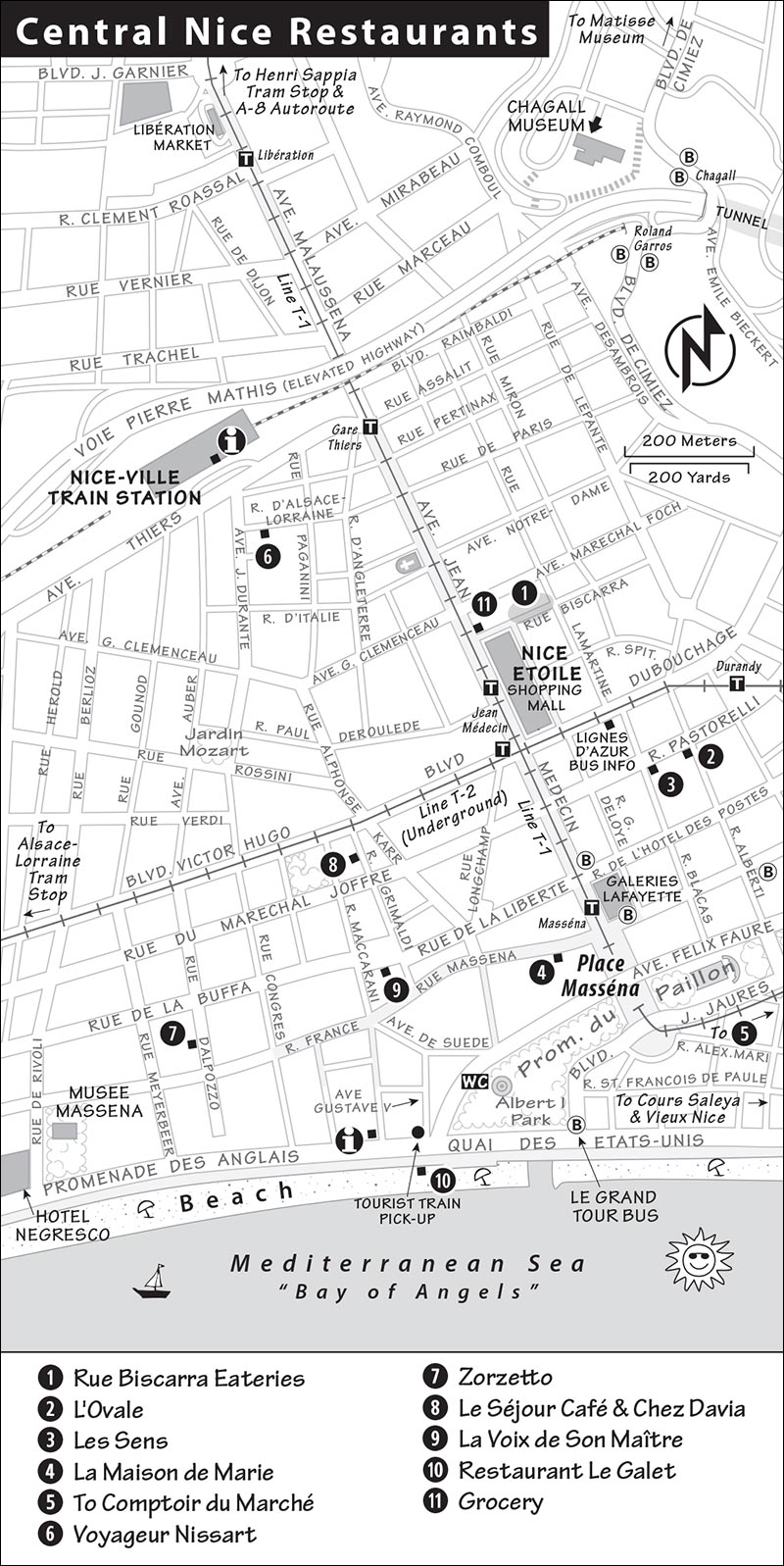
Near the Train Station
$ Voyageur Nissart has blended good-value cuisine with friendly service since 1908. Kind owners Max and Cédric are great hosts, and the quality of their food makes this place both very popular and a good choice for travelers on a budget (book ahead, leave a message in English). Try anything à la niçoise, including the tasty salade niçoise (good three-course menus, inexpensive wines, indoor and outdoor seating, closed Mon-Tue, a block below the train station at 19 Rue d’Alsace-Lorraine, +33 4 93 82 19 60, www.voyageurnissart.com).
Near the Promenade des Anglais
$$$ Zorzetto is a calm and welcoming place away from the tourist fray. The cuisine is regional and creative, and the Claude Monet look-alike chef, Maryan, presides from his open kitchen in the back. He calls his cuisine “Italian cooked with French sophistication” and lovingly describes each plate as if on a mission. Dive into the menu with a sense of adventure (closed Tue-Wed, indoor and outdoor seating, 3 Rue Dalpozzo, +33 4 89 24 83 14).
$$$ Le Séjour Café is a romantic bistro delivering Michelin-approved Mediterranean cuisine in a warm, candlelit, and living room-like interior. It’s classy but not snobby, with hushed acoustics and a smart local clientele (closed Sun-Mon, 11 Rue Grimaldi, +33 4 97 0 55 36, www.sejourcafe.com).
$$$ Chez Davia, with a small, accessible menu, features creative and nicely presented Niçois cuisine that comes with a dash of Japan. They have street-side tables and tight seating inside, where, as if sitting on grandma’s time-warp furniture, you’ll get caught up in a creative commotion of the kitchen and the young crew (closed Mon, 11 bis Rue Grimaldi, +33 4 93 87 91 39).
$ La Voix de Son Maître is the only crêperie I list in Nice. Dine on the broad terrace or inside, with relaxed service, gramophone ambience, and red velvet accents. Their top-end, house-special crêpes are creative, enticing, and cheap. Split a salad to start—try the goat cheese salad with honey—and wash it down with a bowl of traditional cider from Brittany (closed Sun, on Place Grimaldi, +33 4 93 82 28 47).
Dining on the Beach
$$$ Restaurant Le Galet is your best eat-on-the-beach option. The city vanishes as you step down to the beach. The food is nicely presented and the tables feel elegant, even at the edge of the sand. Arrive for the sunset and you’ll have an unforgettable meal (open for dinner May-mid-Sept, 3 Promenade des Anglais, +33 4 93 88 17 23). Sunbathers can rent beach chairs and have drinks and meals served literally on the beach.
Nice Connections
GETTING AROUND THE RIVIERA
Nice is perfectly situated for exploring the Riviera by public transport. Monaco, Eze-le-Village, Villefranche-sur-Mer, Antibes, Vence, and St-Paul-de-Vence are all within about a one-hour bus or train ride. With a little planning, you can link the top destinations in an all-day circuit (for example: Nice, Monaco, and Eze-le-Village, then back to Nice). For a comparison of train and bus connections from Nice to nearby coastal towns, see the “Public Transportation in the French Riviera” sidebar on here. It’s also possible to take a boat to several destinations in the Riviera.
By Train
From Nice-Ville Station to: Antibes (2/hour, 20 minutes), Villefranche-sur-Mer (2-3/hour, 10 minutes), Eze-le-Village (2-3/hour, 15 minutes to Eze-Bord-de-Mer, then infrequent bus #83 to Eze, 8/day, 15 minutes), Monaco (2-3/hour, 25 minutes).
By Bus
Buses to destinations outside of Nice do not run through downtown Nice. You must take a tram or walk a fair bit to reach the stops (usually at the edges of town; see the “Nice” map earlier for tram stop locations).
Regional buses are a great deal. A €1.70 Nice bus fare or pass is good for many nearby destinations (such as Villefranche-sur-Mer, Cap Ferrat, Eze-le-Village, and even Vence). For destinations farther from Nice (such as Monaco), you’ll need a different fare (€2.50). For more info on buses in the Riviera, see here and www.lignesdazur.com or https://zou.maregionsud.fr (under the Menu, click on “Getting Around by Bus” and then “In Alpes-Maritimes”).
Eastbound Buses: Trams T-1 and/or T-2 will get you close to these stops.
Bus #607 runs from Nice’s Port Lympia through Villefranche-sur-Mer (3-4/hour, 20 minutes) and Monaco (1 hour). To find the #607 bus stop from the Port Lympia T-2 station, cross the tracks and climb the steps, cross the busy street and turn right, then take the first left (Rue Arson). The stop is two blocks down.
Bus #15 runs to Villefranche-sur-Mer (2-3/hour, 15 minutes) and around Cap Ferrat (30 minutes to St-Jean-Cap-Ferrat). Catch the bus on Place Yves Klein (Rue Defly), at the Modern and Contemporary Art Museum, or near the Port Lympia tram stop. To find the #15 bus stop from the tram stop at Port Lympia, cross the tram tracks, climb the steps and cross the busy street, then turn right. The stop is around the first corner to the left, on Rue Arson.
The following buses leave from the Gare Routière at the Vauban T-1 tram stop, 20 minutes north of the Modern and Contemporary Art Museum. To reach the bus stop, turn right off the tram and take your first left, then walk under the arch. Buses #82 and #112 run to Eze-le-Village (about hourly, only #82 runs on Sun, 30 minutes; you can also catch bus #82 on Rue Barla, between Place Garibaldi and Port Lympia).
Westbound Buses: Take the T-2 tram west of the city center to the Parc Phoenix stop to catch these buses (bus stops are parallel to the tram stop). Bus #620 goes to Antibes (1.5 hours) and Cannes (2 hours). Bus #9 serves Vence (4/hour, 1 hour). To reach St-Paul-de-Vence, take the train to Cagnes-sur-Mer and transfer to frequent bus #655 (allow about one hour total; bus #655 also goes onward to Vence).
By Boat
In summer, Trans Côte d’Azur offers scenic trips several days a week from Nice to Monaco. Boats to Monaco depart at 9:30 and 16:00 and return at 11:00 and 18:00 (€43 round-trip, €32 if you don’t get off in Monaco, 45 minutes each way, June-Sept Tue, Thu, and Sat only). Drinks and WCs are available on board. Reservations are required (+33 4 92 98 71 30, www.trans-cote-azur.com). The same company also runs one-hour round-trip cruises along the coast to Cap Ferrat (see listing under “Tours in Nice,” earlier).
GETTING TO DESTINATIONS BEYOND THE RIVIERA
By Long-Distance Bus and Train
BlaBlaCar and Flixbus run long-distance bus service from Nice; see “Transportation” in the Practicalities chapter. Compare schedules and fares with trains.
Most long-distance train connections from Nice to other French cities require a change in Marseille. The Intercité train to Bordeaux (serving Antibes, Cannes, Toulon, and Marseille—and connecting from there to Arles, Nîmes, and Carcassonne) requires a reservation.
From Nice by Train to: Marseille (18/day, 2.5 hours), Cassis (hourly, 2.5 hours, one transfer), Arles (hourly, 4-5 hours, most require transfer in Marseille or Avignon), Avignon (hourly, most by TGV, 4 hours, many require transfer in Marseille), Lyon (hourly, 4.5 hours, may require change), Paris Gare de Lyon (hourly, 6.5 hours, may require change, night train available), Aix-en-Provence TGV Station (12/day, 3-4 hours, usually changes in Marseille), Chamonix (6/day, 11 hours, requires multiple changes, some in Italy), Beaune (7/day, 7 hours, 1-2 transfers), Florence (6/day, 8 hours, 1-3 transfers), Milan (hourly, 6 hours, several transfers), Venice (6/day, 10 hours, 1-3 transfers), Barcelona (2/day via Montpellier or Valence, 8 hours, more with multiple changes).
By Plane
Nice’s easy-to-navigate airport (Aéroport de Nice Côte d’Azur, code: NCE, www.nice.aeroport.fr) is 30 minutes west of the city center and literally in the Mediterranean, with landfill runways. The two terminals are far apart but linked by frequent shuttle buses and the T-2 tram (both free for this connection). Both terminals have airport info desks, banks, ATMs, and trams and buses to seaside destinations. Terminal 2 has car rental and a bus station across from the main entry (see below for destinations served). Planes leave roughly hourly for Paris (one-hour flight).
Linking the Airport and City Center
By Taxi/Uber: There’s a flat-rate taxi fee of €32 to the center of Nice, but Nice’s airport taxis are notorious for overcharging—consider Uber as it should be cheaper. Otherwise, by taxi allow €60 to Villefranche-sur-Mer, €70 to Antibes, and about €5 more at night and on weekends (small fee for bags). Before riding, confirm your fare. It’s always a good idea to ask for a receipt (reçu). There’s no designated Uber pickup zone; arrange a pickup location with your driver.
By Tram: The T-2 tram serves both airport terminals and runs frequently into Nice (allow 30 minutes), and at €10 round-trip it’s a good deal (do not board line T-3). The tram is handy for those sleeping at hotels near the Promenade des Anglais and Place Masséna. If you’re heading to the airport from Nice, make sure the tram reads Airport since the line splits—don’t take one heading to Cadam.
Linking the Airport and Nearby Destinations by Tram/Bus
To get to Villefranche-sur-Mer from the airport, take the T-2 tram to the last stop (Port Lympia). There, you can use the same ticket to transfer to a bus (see “Nice Connections—By Bus,” earlier).
To reach Antibes, take bus #82 from either terminal (about 2/hour, 40 minutes, €11). Express bus #80 runs from the airport directly to Monaco (2/hour, 50 minutes, €22). Flixbus and BlaBlaCar serve destinations farther afield and stop at Terminal 2.
Villefranche-sur-Mer
In the glitzy world of the Riviera, Villefranche-sur-Mer offers travelers an easygoing slice of small-town Mediterranean life. From here, convenient day trips let you gamble in Monaco, saunter the Promenade des Anglais in Nice, indulge in seaside walks and glorious gardens in Cap Ferrat, and savor views from Eze-le-Village and the Grande Corniche.
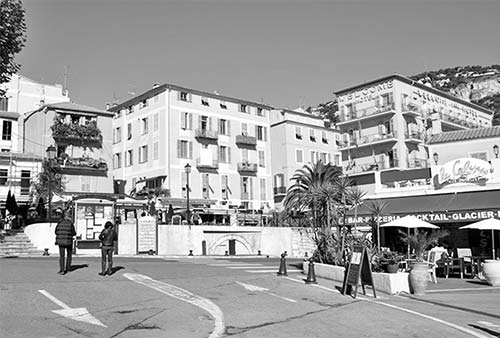
Villefranche-sur-Mer feels more Italian than French—pastel orange buildings line steep, narrow lanes that spill into the sea, and linguine is on most menus. Luxury yachts glisten in the bay, while cruise ships make regular calls to Villefranche-sur-Mer’s deep harbor, creating periodic rush hours of shoppers and bucket-listers. Sand-pebble beaches, a handful of interesting sights, and quick access to Cap Ferrat keep other visitors just busy enough.
The bay is famously deep. Pirates in the Middle Ages, the American navy in World War II, and cruise ships have all liked it for the same reason: It’s over 1,000 feet deep.
Orientation to Villefranche-sur-Mer
TOURIST INFORMATION
The TI is just off the main (Lower Corniche) road that runs between Nice and Monaco. It’s located in the small park (Jardin François Binon) below the Nice/Monaco bus stop, labeled Octroi (Mon-Sat 10:00-13:00 & 14:00-18:00, closed Sun except in July-Aug; +33 4 93 01 73 68, www.tourisme-villefranche-sur-mer.com). Pick up bus schedules and info on sightseeing boat rides. The TI has brochure-maps showing seaside walks around Villefranche and neighboring Cap Ferrat and information on the Villa Ephrussi de Rothschild.
ARRIVAL IN VILLEFRANCHE-SUR-MER
By Bus: Get off at the Octroi stop. To reach the old town, walk past the TI along Avenue Général de Gaulle, take the first stairway on the left, turn right at the street’s end, then make a sharp left to U-turn down the long ramp just after the crosswalk. The hop-on, hop-off bus from Nice stops at the Octroi stop and at the citadel (see here).
By Train: While most trains stop in Villefranche-sur-Mer, you may need to transfer to a local train in Nice or Monaco to get here. Villefranche-sur-Mer’s train station is just above the beach, a level 10-minute stroll from the old town and most of my recommended hotels (taxis usually won’t take such a short trip). If sleeping here, do not take the steps down from the station; instead, turn right following signs to the TI and Rue Obscure.
By Car: From Nice’s port, follow signs for Menton, Monaco, and Basse Corniche. In Villefranche-sur-Mer, turn right at the TI (first signal after Hôtel la Flore) for parking and hotels. For a quick visit to the TI, park at the metered lot just below the TI. You’ll pay to park in all public parking areas except from 12:00 to 14:00 and 19:00 to 9:00. Street parking around the citadel is reasonable, but the lot at the harbor is pricey (Parking Wilson). Free spots may be available at the Port de la Darse. Some hotels have their own parking, but most charge.
By Plane: Allow an hour to connect from Nice’s airport to Villefranche-sur-Mer (for details, see here).
HELPFUL HINTS
Market Days: A fun bric-a-brac market enlivens Villefranche-sur-Mer on Sundays (on Place Amélie Pollonnais by Hôtel Welcome, and in Jardin François Binon by the TI). On Saturday and Wednesday mornings, a market sets up in Jardin François Binon. A small trinket market springs to action on Place Amélie Pollonnais whenever cruise ships grace the harbor.
E-Bike Rental: The adventurous can try Eco-Loc e-bikes as an alternative to taking the bus to Cap Ferrat, Eze-le-Village, or even Nice. You get about 25 miles on a fully charged battery (after that you’re pedaling; daily 9:00-17:00, closed off-season, deposit and ID required, best to reserve 24 hours in advance; helmets, locks, and baskets available; pick up bike by the cruise terminal entrance at the port, +33 6 66 92 72 41, www.ecoloc06.fr).
Hop-On, Hop-Off Bus Tour: Le Grand Tour Bus provides a 16-stop hop-on, hop-off service that connects Villefranche-sur-Mer with Nice (see here).
Spectator Sports: Lively boules action takes place each evening just below the TI and the huge soccer field (for more on this sport, see here).
GETTING AROUND VILLEFRANCHE-SUR-MER
By Bus: Handy electric minibus #80 (€1.70) runs from the train station, Port de la Darse, and the waterfront up the main drag along the Low Corniche road (Basse Corniche) to upper Villefranche on the Middle Corniche road (Moyenne Corniche). It runs only once per hour (Mon-Sat 7:00-19:45, schedule posted at stops and available at TI) but saves you the sweat of walking uphill (and gets you within a 15-minute walk of Fort Alban, described later); handy stops are Place Amélie Pollonnais (by the cruise terminal), the Octroi stop on the Low Corniche road (Avenue Foch), and at the Col de Villefranche stop, near Hôtel la Fiancée du Pirate (for buses to Eze-le-Village). The bus continues to the outlying suburban Nice Riquier train station.
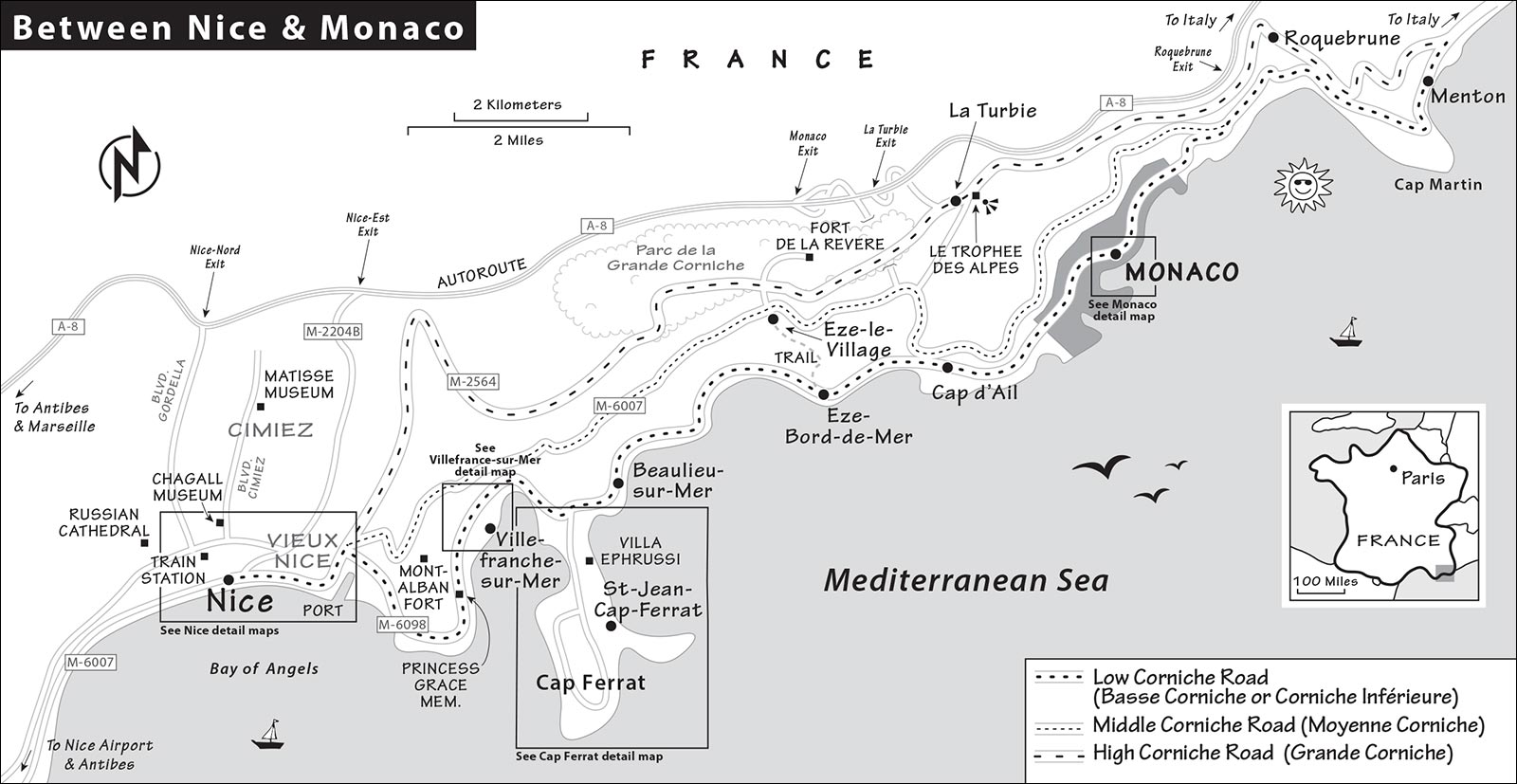
By Taxi/Uber: Taxis wait between the cruise terminal and Place Amélie Pollonnais. Beware of taxi drivers who overcharge. Normal weekday, daytime rates to outside destinations should be about €25 to Cap Ferrat, €45 to central Nice or Eze-le-Village, and €70 to the airport or Monaco. For a taxi, call +33 4 93 55 55 55. Uber is less present here than in Nice, so you may wait a bit longer.
Villefranche-sur-Mer Town Walk
For tourists, Villefranche is a tiny, easy-to-cover town that snuggles around its harbor under its citadel. This quick self-guided walk laces together everything of importance, starting at the waterfront near where cruise-ship tenders land and finishing at the citadel.
• If arriving by bus or train, you’ll walk five minutes to the starting point. Go to the end of the short pier directly in front of Hôtel Welcome, where we’ll start with a spin tour (spin to the right) to get oriented.
The Harbor: Look out to sea. Cap Ferrat, across the bay, is a landscaped paradise where the 1 percent of the 1 percent compete for the best view. The Rothschild mansion, Villa Ephrussi (roughly straight across, hugging the top, just breaking the horizon), is the most worthwhile sight to visit in the area. To its right, just over the saddle of the hill, the next big home, with the red-tiled roof, belonged to Paul Allen. Geologically, Cap Ferrat is the southern tip of the Alps. The range emerges from the sea here and arcs all across Europe, over 700 miles, to Vienna.
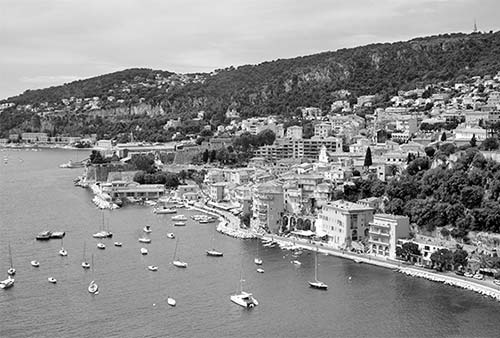
As the deepest natural harbor on the Riviera, this was the region’s most important port until Nice built its own in the 18th century. Today, ships bring tourists rather than pirates. The bay is generally filled with beautiful yachts.
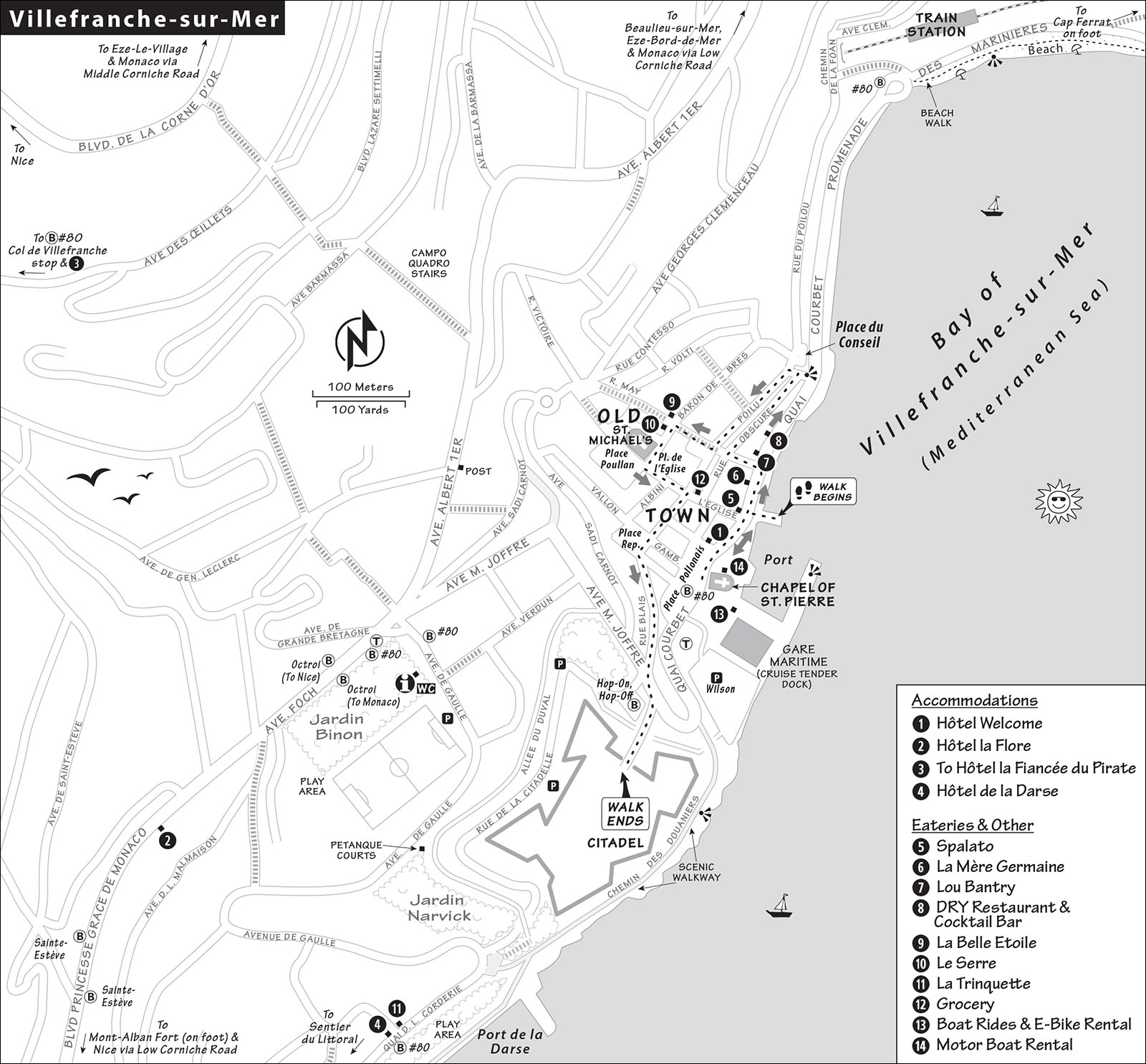
Close by, on the hill to the right, is the 16th-century citadel (where this walk ends). Much closer, the yellow fishermen’s chapel (with the little-toe bell tower) has an interior painted by Jean Cocteau. Hôtel Welcome (where Cocteau lived in the 1920s) offers the balconies of dreams. Peer up the skinny lane just right of the hotel for a glimpse of the Baroque facade of St. Michael’s church and bell tower. The harborfront, lined by restaurants (including several I recommend), curves right, to the town beach. Fifty yards above the beach stands the train station, and above that, supported by arches on the right, is the Low Corniche road (Basse Corniche), which leads to Monaco. Until that road was built in the 1860s, those hills were free of any development all the way to Monaco. Above the train station is a gated community, home to celebs like Eric Clapton...and where Madonna once rented a villa for her birthday.
• Leave the pier and walk left 20 yards past the last couple of fishing boats surviving from the town’s once-prominent fishing community, and a fish stand where restaurateurs come to buy this morning’s catch. Find a small bronze bust of the artist Jean Cocteau. A few more steps take you to the little chapel he painted.
Chapel of St. Pierre (Chapelle Cocteau): This chapel is the town’s cultural highlight. Cocteau, who decorated the place, was a Parisian transplant who adored little Villefranche-sur-Mer. He once said, “When I look at Villefranche, I see my youth.” Cocteau distinguished himself as an artist, poet, novelist, playwright, and filmmaker. Influenced by his pals Marcel Proust, Edith Piaf, and Pablo Picasso, Cocteau was a leader among 20th-century avant-garde intellectuals. At the door, Marie-France—who is passionate about Cocteau’s art—collects a €4 donation for a fishermen’s charity. She then sets you free to enjoy the chapel’s small but intriguing interior. She’s delighted to give you a small tour if you ask (Wed-Sun 9:30-12:30 & 14:00-18:00, usually closed Mon-Tue, hours vary with cruise-ship traffic and season).
• From the chapel, turn right and stroll the harbor promenade 100 yards past romantic harborside tables. Restaurant la Mère Germaine is named for Mother Germaine, who famously took care of US Navy troops in World War II. If it’s not too busy, step inside the hallway leading to the WC—it’s lined with historic photos. Immediately after the restaurant, a lane leads up into the old town. Walk up a few steps, under the first arch, and when you reach a long tunnel-like street, turn right.
Rue Obscure, the Old Town, and St. Michael’s Church: Here, under 13th-century vaults, you’re in another age. Walk about 100 yards to the end of Rue Obscure (which means “dark street”). Wind up to the sunlight and a tiny fountain at Place du Conseil. In the 19th century (before most homes had running water) this was a vital and busy water source for the neighborhood. Enjoy the viewpoint overlooking the harbor.
Notice how structures here are built into the rocks. Then stroll back past the fountain and down the open lane, appreciating the stonework, steep apartment stairs, and homes built over heavy arches.
At Place des Garçons (the square with a namesake restaurant), turn right on Rue May and climb the stepped lane. Take your first left at the recommended La Belle Etolle and La Serre restaurants to find St. Michael’s Church, facing a delightful square with a single magnolia tree. The surprisingly large church features an 18th-century organ, a particularly engaging crucifix at the high altar, and (to the left) a fine statue of a much-venerated recumbent Christ—carved from a fig tree by a galley slave in the 1600s.
• Leaving St. Michael’s, farther uphill is the modern town. But go downhill halfway to the water, where you hit the little commercial street (Rue du Poilu), and turn right. Find your way through a sweet little square, then climb the pedestrian ramp on the left (browsing a real-estate window if you’d like to move here) and walk up to the...
Citadel: The town’s mammoth castle was built in the 1500s by the Duke of Savoy to defend against the French. When the region joined France in 1860, the castle became just a barracks. Since the 20th century, it’s housed the police station, City Hall, a summer outdoor theater, and art galleries. The single fortified entry—originally a drawbridge over a dry moat (a.k.a. kill zone)—still leads into this huge complex.
The exterior walls slope thickly at the base, indicating that they were built in the “Age of Black Powder”—the 16th century—when the advent of gunpowder made thicker, cannonball-deflecting walls a necessity for any effective fortification. The bastions are designed for smarter crossfire during an attack.
• And that concludes our introductory walk. For a seaside stroll (described next), drop back down below the citadel to the harbor parking lot (Parking Wilson) and find the stone path that leads to the right.
Activities in Villefranche-sur-Mer
▲Seafront Walks
Chemin des Douaniers: This short seaside walkway (très romantic after dark), originally used by customs agents to patrol the harbor, leads under the citadel and connects the old town with the workaday harbor (Port de la Darse). At the port you’ll find a good café, an 18th-century dry dock, and, at the far southern end, France’s Institute of Oceanography and access to a seaside trail (described next).
Sentier du Littoral: A beautiful sea-swept trail lies at the southern end of the Port de la Darse. This sporty trail is roughly cobbled but manageable, and while you could walk all the way into Nice and bus back, I wouldn’t. The closer you get to Nice, the more stairs you’ll find, and there’s a sizeable stretch along the main road with a narrow sidewalk; it’s best to walk as far as you want, then double back. If you’re starting from the north end of the Port de la Darse, to reach the trail you’ll walk 15 minutes through the long port area, passing the cool little kiosk café (ideal for a break). Turn left shortly after the café when you see signs to Plage de la Darse. Cross a small bridge, then find the steps up to the seawall and turn right. Follow this path to the trailhead, passing under a building overhang just before reaching the trail.
Beach Walk to Cap Ferrat: A short walk along the waterfront past the train station and along the beach yields postcard-perfect views back to Villefranche-sur-Mer. (It’s especially nice before breakfast.) To reach Cap Ferrat (about 45 minutes), follow the beachfront road, then climb the steps where the road curves right and continue on the lane that parallels the train tracks (Avenue Louise Bordes). Continue straight past the mansions, and take the first right on Avenue de Grasseuil. You’ll see signs to Villa Ephrussi de Rothschild, then to Cap Ferrat’s port (see “Cap Ferrat” map, later).
Mont-Alban Fort
This fort, with a remarkable setting and spectacular views, hangs on the high ridge that separates Nice and Villefranche-sur-Mer. It’s an ambitious (but doable) destination for hikers but also accessible by car and bus (fort interior closed to tourists). Minibus #80 drops you a 15-minute walk away at the Col de Villefranche stop; bus #33 takes you within a few minutes of the fort (catch it at the Vauban T-1 tram stop in Nice). Drivers head straight up from Villefranche-sur-Mer and follow signs (parking available near the fort).
Boat Rides (Promenades en Mer)
To view this beautiful coastline from the sea, consider taking a quick sightseeing cruise with AMV (€16-26; some stay in the bay, others go as far as Monaco; select days June-Sept, departs across from Hôtel Welcome, +33 4 93 76 65 65, www.amv-sirenes.com). You can also rent your own motorboat through Glisse Evasion (€110/2 hours for a small boat, larger boats available, https://location-bateaux-villefranche.fr).
Sleeping in Villefranche-sur-Mer
These listings all have seaview rooms—well worth paying extra for.
$$$$ Hôtel Welcome**** has the best location in Villefranche-sur-Mer, and charges for it. Anchored seaside in the old town, with all of its 35 plush, balconied rooms overlooking the harbor and a lounge/wine bar that opens to the water, this place lowers my pulse and empties my wallet (pricey garage—must reserve, 3 Quai de l’Amiral Courbet, +33 4 93 76 27 62, www.welcomehotel.com, contact@welcomehotel.com).
$$ Hôtel la Flore*** is a fine value—particularly if your idea of sightseeing is to enjoy a panoramic view from your spacious bedroom balcony (even street-facing rooms have nice decks). The hotel is warmly run and good for families. Several rooms in the annex sleep four and come with kitchenettes, views, and private hot tubs. It’s a 10-minute uphill hike from the old town, but parking is easy and secure (€10/day), and the bus stops for Nice and Monaco are close by (use the St. Estève stop; hotel on the main road at 5 Boulevard Princesse Grace de Monaco, +33 4 93 76 30 30, www.hotellaflore.fr, infos@hotellaflore.fr).
$$ Hôtel la Fiancée du Pirate*** is a family-friendly view refuge high above Villefranche-sur-Mer on the Middle Corniche and a 15-minute walk to Mont-Alban Fort views (best for drivers, although it is on bus lines #80, #82, and #112 to Eze-le-Village and Nice). Don’t be fooled by the modest facade—Eric and Laurence offer 15 lovely and comfortable rooms, a large pool, a hot tub, a nice garden, and a terrific view lounge area. The big breakfast features homemade crêpes (RS%, laundry service, free parking, 8 Boulevard de la Corne d’Or, Moyenne Corniche/N-7, +33 4 93 76 67 40, www.fianceedupirate.com, info@fianceedupirate.com).
$ Hôtel de la Darse** is a shy little hotel burrowed in the shadow of its highbrow neighbors. It’s a great value with handsome rooms, but isn’t central—figure 10 scenic minutes of level walking to the old town and a steep 15-minute walk up to the main road (minibus #80 stops in front; handy for drivers, free parking usually available close by). Seaview rooms are easily worth the extra euros (no elevator, good restaurant, 32 Avenue Général de Gaulle, +33 4 93 01 72 54, www.hoteldeladarse.com, info@hoteldeladarse.com). From the TI, walk or drive down Avenue Général de Gaulle (walkers should turn left on Allée du Colonel Duval into the Jardins de Narvik and follow steps to the bottom).
Eating in Villefranche-sur-Mer
For me, dining in Villefranche-sur-Mer is about a mix of Italian and French, a sea view, and ambience.
HARBORFRONT RESTAURANTS
A strip of fun and hardworking restaurants lines the harborfront, all with a slim line of tables on the water, a front terrace of outdoor tables, and indoor seating. Dining on the water is a joy—arrive early or reserve a table. Servings are generally big enough to split. You’ll encounter my four favorites in this order (all open for lunch and dinner):
$$ Spalato is a casual and family-friendly place—youthful and family-run—with Italian and Mediterranean cuisine, salads, vegan bowls, poke bowls, and pizza (daily, 5 Quai de l’Amiral Courbet, +33 9 80 76 86 21, www.spalato-restaurant-villefranche-sur-mer.com).
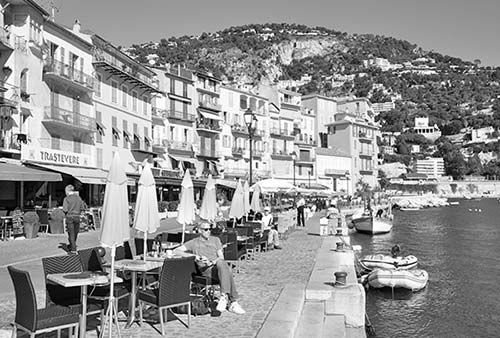
$$$$ La Mère Germaine is the only place in town classy enough to lure a yachter ashore. It’s dressy, with formal service and high prices. If you’re looking for a bouillabaisse splurge (the coastal fish-stew specialty), this is the place. The restaurant’s name commemorates the current owner’s grandmother, who fed hungry GIs during World War II. The hall leading to the WC is lined with historic photos (daily, 9 Quai de l’Amiral Courbet, +33 4 93 01 71 39, www.meregermaine.com).
$$$ Lou Bantry feels nautical and offers a fun Mediterranean menu of big, splittable plates, an array of hearty salads, and mussels. Order with adventure and be rewarded (daily, 13 Quai de l’Amiral Courbet, +33 4 93 91 87 68, https://restaurant-lou-bantry.fr).
$$$ DRY Restaurant & Cocktail Bar is more of a party. Its eclectic menu features sharing plates that combine Mediterranean flavors with street foods of the world. The vibe is festive and young, with outdoor couches and cocktails (daily, 17 Quai de l’Amiral Courbet, +33 4 93 01 71 31, www.dryrestaurant.com).
GOOD OPTIONS OFF THE HARBOR
Near St. Michael’s Church: If you don’t need a sea view, two delightful spots are nestled across from each other on a tiny, stepped lane near the church. $$ La Belle Etoile is the romantic’s choice, with a charming interior graced with white tablecloths and soft lighting. This intimate place serves delicious and well-presented French and Mediterranean cuisine (closed Tue-Wed, 1 Rue Baron de Brès, +33 4 97 08 09 41). $ Le Serre is simple and cozy. Hardworking owners Mary and mama Sylvie serve well-priced dinners to a loyal local clientele. Choose from the many thin-crust pizzas, salads, and meats. The daube niçoise meat stew is the house specialty (dinner only, closed Mon, cheap house wine, 16 Rue de May, +33 4 93 76 79 91).
Dinner with Live Jazz: $ La Trinquette is a small, low-key place on the more workaday marina a 10-minute stroll around the citadel. From Thursday to Sunday, Jean-Charles serves a simple and cheap preconcert dinner from a small menu. Then guests settle in to enjoy cool live music over drinks (30 Avenue Général de Gaulle, +33 4 93 16 92 48). The dinner is a bargain. You’re welcome to dine without staying for the concert or come after dinner to enjoy the music (concerts start at 21:00 and cost €15).
Grocery Store: A handy Casino is a few blocks above Hôtel Welcome at 12 Rue du Poilu (daily 8:00-12:30 & 15:30-19:30).
Dinner Options for Drivers: If you’re planning a day at the beach or a Cap Ferrat beach hike, you can cap that memorably with a dinner at one of two remote beach restaurants: $$$ Restaurant de la Plage de Passable (looking back at Villefranche for its famous sunset) or $$$ Plage de la Paloma.
Villefranche-sur-Mer Connections
For a comparison of connections by train and bus, see the “Public Transportation in the French Riviera” sidebar on here. If you’re going to Nice’s airport, you can take a taxi/Uber or, for much less, take bus #15 to Nice’s Port Lympia stop and transfer to the T-2 tram (see “Nice Connections,” earlier).
BY TRAIN
Trains are faster and run later than buses (until 24:00). It’s a level, 10-minute walk from the port to the train station.
From Villefranche-sur-Mer by Train to: Monaco (2-3/hour, 15 minutes), Nice (2-3/hour, 10 minutes), Antibes (2/hour, 40 minutes), Eze-Bord-de-Mer (2-3/hour, 5 minutes) then transfer to bus #83 for Eze-le-Village.
BY BUS
In Villefranche-sur-Mer, the most convenient bus stop is Octroi, just above the TI.
Bus #15 runs from Villefranche-sur-Mer in one direction to Nice (15 minutes) and in the other direction through Beaulieu-sur-Mer (5 minutes) to Cap Ferrat, ending at the port in the village of St-Jean (15 minutes; for other transportation options, see “Getting to Cap Ferrat,” later).
Bus #607 runs along the coastal road from Villefranche-sur-Mer westbound to Nice (3-4/hour, 20 minutes) and eastbound to Beaulieu-sur-Mer (10 minutes) and Monaco (45 minutes).
To reach Eze-le-Village by bus you have two choices: Take bus #80 to the Col de Villefranche stop on the Middle Corniche, then catch bus #82 or #112, which together provide about hourly service to Eze-le-Village (only #82 runs on Sun). You can also take bus #607 or #15 (from stop Octroi) to the Baie des Fourmis stop in nearby Beaulieu-sur-Mer, then catch bus #83 to Eze-le-Village (8/day).
For more on these buses, including ticket info, routes, and frequencies, see here.
The Three Corniches
Nice, Villefranche-sur-Mer, and Monaco are linked by three coastal routes: the Low, Middle, and High Corniches. Each Corniche (kor-neesh) offers sensational views and a different perspective. The villages and sights in this section are listed from west to east in the order you’ll reach them when traveling from Villefranche-sur-Mer to Monaco.
The corniches are peppered with impressive villas such as La Leopolda, a sprawling estate with a particularly grand entry that’s named for its 1930s owner, King Leopold II of Belgium. Those driving up to the Middle Corniche from Villefranche-sur-Mer can look down on this yellow mansion and its lush garden, which fill an entire hilltop. The property was later owned by the Agnelli family (of Fiat fame and fortune), and then by the Safra family (Syrian and Brazilian bankers). Its current value is more than a half-billion dollars.
THE CORNICHE ROADS
For an overview of these three roads, see the “Between Nice & Monaco” map, earlier.
Low Corniche: The Basse Corniche (also called “Corniche Inférieure”) strings ports, beaches, and seaside villages together for a traffic-filled ground-floor view. It was built in the 1860s (along with the train line) to bring people to the casino in Monte Carlo. When this Low Corniche was finished, many hill-town villagers descended to the shore and founded the communities that now line the sea, such as Cap Ferrat. Before 1860, almost no one lived on the coast between Villefranche-sur-Mer and Monte Carlo. Think about that as you make the congested trip today.
Middle Corniche: The Moyenne Corniche is higher, quieter, and far more impressive. It runs through Eze-le-Village and provides breathtaking views over the Mediterranean, with several scenic pullouts.
High Corniche: Napoleon’s crowning road-construction achievement, the Grande Corniche runs through the sweet and untouristed village of La Turbie and caps the cliffs with staggering views from almost 1,600 feet above the sea. Two thousand years ago, this was called the Via Aurelia and used by the Romans to conquer the West. As you approach La Turbie you’ll see a striking soccer field cut out of the mountain. This is the practice field for the Monaco team, which has some very wealthy supporters (including a billionaire Russian owner). The road slicing across the mountain below the soccer field leads to the corner where Princess Grace died in a tragic car crash in 1982. Above La Turbie is the ancient Roman “Trophy of the Alps” (Le Trophée des Alpes), one of this region’s most evocative historical sights, with dramatic views over the entire country of Monaco. Built in about 10 BC and designed to be seen from far out at sea, the massive monument celebrates the achievements of Augustus Caesar.
By Car
Drivers can find the three routes from Nice by driving up Boulevard Jean Jaurès, past Vieux Nice and the port. For the Low Corniche (to Villefranche-sur-Mer and Cap Ferrat), follow signs to Monaco par la Basse Corniche, which leads past Nice’s port. The turnoff for the Middle Corniche (Moyenne Corniche) is shortly after the turnoff to the Low Corniche (follow autoroute signs). Signs for the High (Grande) Corniche appear a bit after that; follow D-2564 to Col des 4 Chemins and the Grande Corniche.
Best Route from Nice to Monaco: This breathtaking drive, worth ▲▲▲, takes the Middle Corniche from Nice or Villefranche-sur-Mer to Eze-le-Village, then uphill for cloud-piercing, 360-degree views. Across from Eze-le-Village’s parking lot, follow Parc de la Grande Corniche signs uphill. Cross the Grande Corniche at the top and follow Fort de la Revère signs, where you’ll find jaw-dropping views north to the Alps, straight down to the village, and along the Riviera from the Italian border to Cap d’Antibes. Bring a picnic, as benches and tables are plentiful. Continue east from here back along the Grande Corniche to La Turbie, keeping an eye out for brilliant views back over Eze-le-Village, then finish by dropping down into Monaco.
By Bus
Buses travel along each Corniche; the higher the route, the less frequent the buses (see the “Between Nice & Monaco” map, earlier). Bus #607 runs along the Low Corniche from Nice to Monaco (3-4/hour). Bus #112 provides the single best route to enjoy this area as it connects Monaco and Nice via Eze-le-Village along the Middle Corniche (6/day, none on Sun). Bus #603 connects Nice with La Turbie and Monaco along the High Corniche (5/day), and bus #11 runs from Monaco to La Turbie (10/day Mon-Sat, 5/day Sun).
Cap Ferrat
This exclusive peninsula, rated ▲▲, decorates Villefranche-sur-Mer’s views. Cap Ferrat is a peaceful side trip off the busy Nice-Monaco route (Low Corniche). You could spend a leisurely day on this peninsula, wandering the spiffy port village of St-Jean-Cap-Ferrat (usually called “St-Jean”), touring the wistful Villa Ephrussi de Rothschild mansion and gardens, and hiking on sections of the beautiful trails that follow the coast. If you owned a house here, you’d have some of the world’s wealthiest neighbors.
Tourist Information: The TI is at the harbor in St-Jean on Quai Virgile Allari (daily 9:30-13:00 & 14:30-17:30, closed Sun in off-season, +33 4 93 76 08 90, www.saintjeancapferrat-tourisme.fr).
PLANNING YOUR TIME
Here’s how I’d spend a day on the Cap: From Nice or Villefranche-sur-Mer, take bus #15 to the Villa Ephrussi de Rothschild stop (called Passable/Rothschild), and visit the villa. Walk 30 minutes, mostly downhill, to St-Jean for lunch (many options, including grocery shops for picnic supplies) and poke around the village. Take the 45-minute walk on the Plage de la Paloma trail (ideal for picnics), then enjoy the Plage de la Paloma beach (public or private; see listing below). Return to Villefranche-sur-Mer, Nice, or points beyond by train or bus.
Here’s an alternative plan for the star-gazing, nature-loving beach bum: Visit Villa Ephrussi, then walk to St-Jean for lunch, hike six miles clockwise around the entirety of Cap Ferrat (about two hours), and enjoy the late afternoon on the beach at Plage de Passable. At sunset, have a drink or dinner at the recommended Restaurant de la Plage de Passable, then walk to the bus stop or catch an Uber or taxi back.
GETTING TO CAP FERRAT
From Nice or Villefranche-sur-Mer: Bus #15 (direction: Port de St-Jean) runs to all Cap Ferrat stops (for info on tickets, route, and frequency, see here). For the Villa Ephrussi de Rothschild, get off at the Passable/Rothschild stop (allow 25 minutes from Nice and 10 minutes from Villefranche-sur-Mer’s Octroi stop). The return bus (direction: Nice) begins in St-Jean.
Warning: In high season, late-afternoon buses back to Villefranche-sur-Mer or Nice along the Low Corniche can be jammed (worse on weekends), potentially leaving passengers stranded at stops. To avoid this, either take the train or board bus #15 on the Cap itself (before it gets crowded).
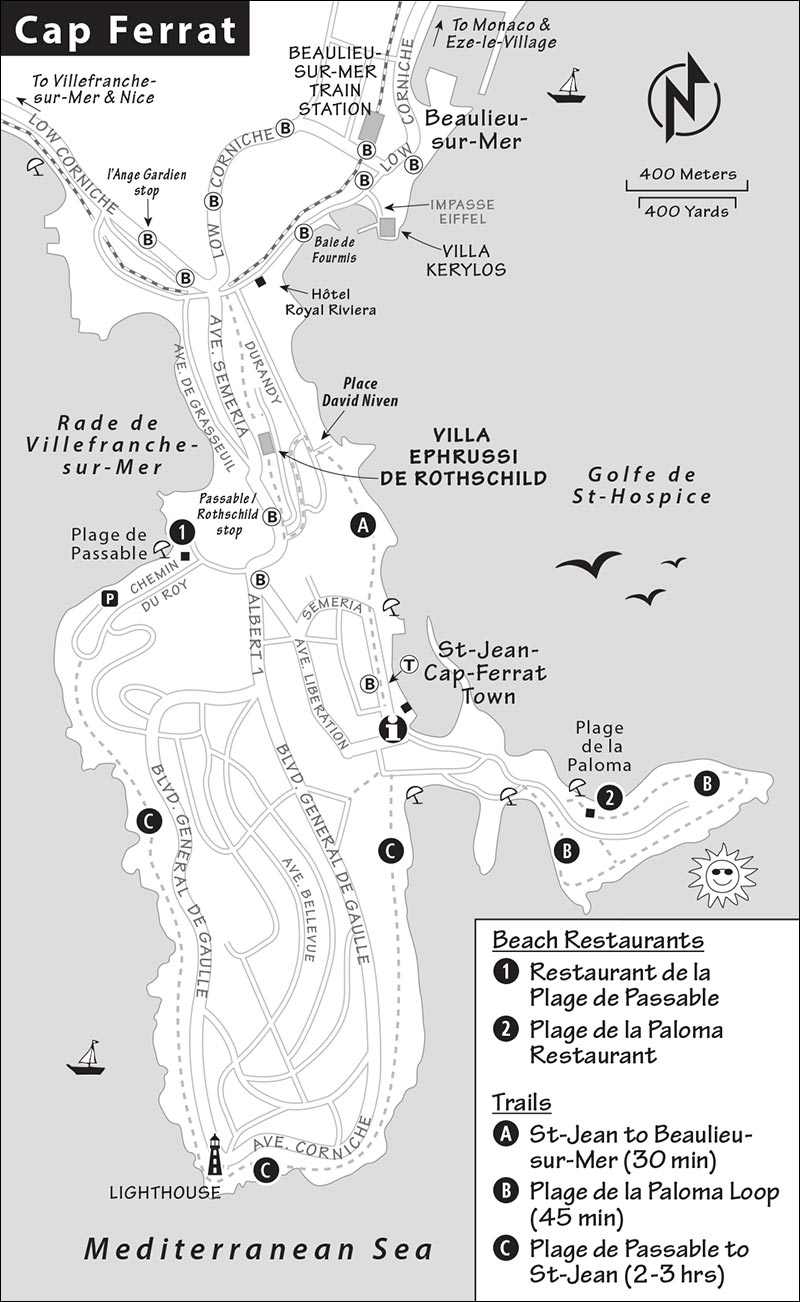
Cap Ferrat is quick by car (take the Low Corniche) or taxi/Uber (allow €22 one-way from Villefranche-sur-Mer).
Sights on Cap Ferrat
▲Villa Ephrussi de Rothschild
In what seems like the ultimate in Riviera extravagance, Venice, Versailles, and the Côte d’Azur come together in the soft orange Villa Ephrussi. Rising above Cap Ferrat, this 1905 mansion has views west to Villefranche-sur-Mer and east to Beaulieu-sur-Mer. As you enter the grounds, look back and see the neighboring Villa Maryland, on an equally prominent high point surrounded by a private forest.
Cost and Hours: Palace and gardens—€16, includes excellent audioguide; daily 10:00-18:00, until 19:00 in summer, shorter hours in winter; +33 4 93 01 33 09, www.villa-ephrussi.com.
Getting There: With luck, drivers can find a free spot to park along the entry road just inside the gate. The nearest bus stop is Passable, just a few minutes after the bus turns onto Cap Ferrat (bus #15, 5-minute walk uphill to the villa). If returning to Nice or Villefranche-sur-Mer by bus, check the posted schedule, and keep in mind that you’re only a minute from the time-point listed for Port de St-Jean.
Visiting the Villa: Buy your ticket at the side of the building with the gift shop and get the small map of the gardens, then walk to the main entrance and pick up an audioguide (which does not cover the gardens). Start with the well-furnished ground floor, where you’ll see a variety of personal possessions, including those belonging to Béatrice, Baroness de Rothschild, the French banking heiress who built and furnished the place (such as her bathroom case for cruises). Upstairs, a 20-minute film (with English subtitles) describes life on the Riviera during the belle époque and gives good background on the life of the rich and eccentric baroness.
As you stroll through the upstairs rooms, you’ll pass royal furnishings, the baroness’ porcelain collection, and more. Her bedroom, sensibly, has views to the sea on both the port and starboard sides, and toward the bow, stretching like the prow of a vast cruise ship, is her garden. Don’t miss the view from her private terrace.
The gorgeous gardens are why most come here. The ship-shaped gardens were inspired by Béatrice’s many ocean-liner trips. She even dressed her small army of gardeners like sailors. Behind the mansion, stroll through the nine lush gardens re-created from locations all over the world—and with maximum sea views. Don’t miss the Jardin Exotique’s wild cactus, the rose garden at the far end, and the view back to the house from the “Temple of Love” gazebo. Cross the stepping-stone bridge by the playful fountains, if you dare.
An appropriately classy $$ garden-tearoom serves drinks and lunches with a view (12:00-17:30).
Walks from the Villa Ephrussi: It’s a lovely 30-minute stroll, mostly downhill and east, from the Villa Ephrussi to the port of St-Jean. To get there, make a U-turn left at the stop sign below the Villa Ephrussi and follow signs along a small road toward the Hôtel Royal Riviera on Avenue Henri Honoré Sauvan (see “Cap Ferrat” map). Walk about five minutes down; when the road comes to a T, keep straight, passing a brown gate down a pedestrian path, which ends at the seafront trail (on Place David Niven)—a right turn here gets you to St-Jean in 15 more minutes.
To get to Plage de Passable from the Villa Ephrussi, turn left on the main road just below the villa (Avenue Denis Séméria); after 50 yards you’ll find signs leading down to the beach.
St-Jean-Cap-Ferrat
This quiet harbor town lies in Cap Ferrat’s center, yet is off most tourist itineraries and feels overlooked. St-Jean boasts yachts, boardwalks, views, and boutiques packaged in a “take your time, darling” atmosphere. It’s a few miles off the busy Nice-to-Monaco road—convenient for drivers. A string of restaurants lines the port. St-Jean is especially peaceful at night.
For picnics, the short pedestrian street in St-Jean has all you need (grocery store, bakery, charcuterie, and pizza to go), and you’ll have no trouble finding portside or seaside seating. There’s a big Casino grocery on the port below the main drag. Plage de la Paloma, described later, is a 10-minute walk away.
Plage de Passable
This pebbly little beach, located below the Villa Ephrussi, comes with great views of Villefranche-sur-Mer. It’s a peaceful place, popular with families. One half is public (free, daily 9:00-18:00, shower, WC, snack bar with sandwiches), and the other is run by a small restaurant (about €50/person whether you spend an hour or a full day, front-row spots require spending at least €40 on food and drink, includes changing locker, lounge chair, and shower; reserve ahead in summer or on weekends as this is a prime spot, +33 4 93 76 06 17). If you want to experience the French Riviera rent-a-beach ritual, this is the place.
Parking near the beach (curbside or in a nearby lot) is tricky; plan on a healthy walk from your car to the beach and figure about €14/day in metered spots (free in off-season). But the bus is easy. Bus #15 stops a 10-minute walk uphill from the beach, near Villa Ephrussi.
Along with its beach, Plage de Passable is great as a springboard for the hike around the cape and for dinner. Arrive before sunset, then watch as darkness descends and lights flicker over Villefranche-sur-Mer’s heavenly setting. $$$ Restaurant de la Plage de Passable is your chance to dine on the beach with romance and class (with good-enough food) while enjoying terrific views and the sounds of children still at play (food served all day, dinner nightly from 20:00, daily late May-early Sept, always make a reservation, +33 4 93 76 06 17, www.plage-de-passable.fr). Cocktails are popular upstairs in the aptly named Sunset Bar.
Plage de la Paloma
This half-private, half-public beach is a 10-minute walk from St-Jean-Cap-Ferrat. You can enjoy the pebbly beach for free (with shower and WC but no snack bar). Or, for €50/person you can get a lounge chair and the freedom to relax on the elegant side. Reserve your lounge chair by calling +33 4 82 29 80 79. They often have a complimentary shuttle bus to St-Jean and even the train station for customers on request (handy for after dinner).
$$$ Plage de la Paloma Restaurant is inviting for dining on the beach, with a range of affordable salads for lunch and expensive dinners (daily, lunch from 12:00 and dinner from 20:00, closed late Sept-Easter, +33 4 93 01 64 71, www.paloma-beach.com).
WALKS AROUND CAP FERRAT
The Cap is perfect for a walk; you’ll find well-maintained and well-marked foot trails covering most of its length with easy, mostly level options (worth ▲▲). The TIs in Villefranche-sur-Mer and St-Jean have maps of Cap Ferrat showing the walking paths.
Plage de la Paloma Loop Trail (45 minutes)
A few blocks east of St-Jean’s port, a scenic trail offers an easy sampling of Cap Ferrat’s beauty. From the port, walk or drive about a quarter-mile east (with the port on your left, passing Hôtel la Voile d’Or); parking is available at the port or (if you’re lucky) on streets near Plage de la Paloma. You’ll find the trailhead where the road comes to a T. Cross the small gravel park (Jardin de la Paix) to start the trail, and do the walk counterclockwise. The trail is level and paved, yet uneven enough that good shoes are helpful. Plunk your picnic on one of the benches along the trail, or eat at the restaurant on Plage de la Paloma at the end of the walk (described earlier).
Plage de Passable Around the Cape to St-Jean (2 hours)
For a longer hike that circles the cape, follow the signs below the Villa Ephrussi marked Plage Passable (10 minutes downhill on foot from the villa, parking available nearby). Walk down to the beach (you’ll pass the recommended Restaurant de la Plage de Passable—ideal for lunch), turn left, and cross the beach. Go along a paved road behind the apartment building, and after about 60 yards, take the steps down to the trail (Sentier Littoral). Walk as far as you want and double back, or do the entire loop—it’s about six miles (10 kilometers) around the cape. Near the end of the trail, you’ll pass through the port of St-Jean, where you can take bus #15 back to the Plage de Passable/Villa Ephrussi stop, or ride to Villefranche-sur-Mer or to Nice.
Eze-le-Village
The medieval fortified village of Eze (pronounced “ehz”) caps a peak high above the sea. It’s an amazing, stony, once-important village crowned with the husk of its once-mighty castle, now filled with exotic flowers, cacti, and tourists. In fact, the entire town has been consumed by tourism. Amazingly, with all its dramatic views, none are open to the public without paying admission or buying an overpriced drink.
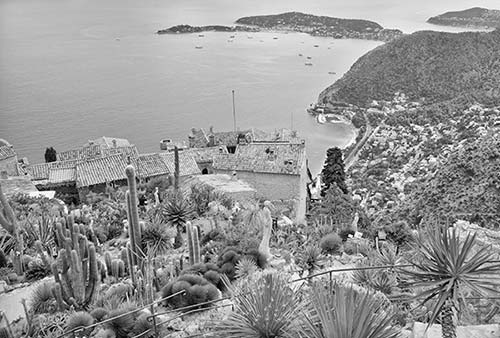
The village’s one lane zigzags to the summit with inviting side lanes, and it seems every former dwelling is now a pricey gallery, perfume outlet, or part of a stylish boutique or hotel. As you explore, note how historic cave dwellings and odd crannies have been made into inviting, Old World-chic shops. Though there are plenty of cafés and restaurants, for the same reason I don’t write guidebooks for Disneyland, I’ll leave the choice up to you.
Note that the proper name is Eze-le-Village, not to be confused with its sister far below at sea level (Eze-Bord-de-Mer—a modern beach resort). While the pinnacle town is mobbed by cruise-ship and tour-bus groups during the day, Eze can be delightfully quiet early and late.
GETTING TO EZE-LE-VILLAGE
If you are coming by car, it’s easy to park in Eze-le-Village’s big underground garage.
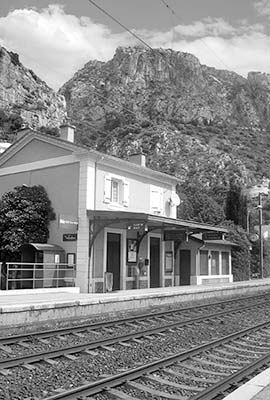
From Nice and upper Villefranche-sur-Mer, buses #82 and #112 together provide about hourly service to Eze-le-Village (only #82 runs on Sun, 30 minutes from Nice).
From Nice, Villefranche-sur-Mer, or Monaco, you can also take the train or the Nice-Monaco bus (#607) to Eze-Bord-de-Mer, getting off at the Gare d’Eze stop. From there, take the infrequent #83 shuttle bus straight up to Eze-le-Village (8/day, daily about 9:00-18:00, schedule posted at stop, 15 minutes).
To connect Eze-le-Village directly with Monte Carlo in Monaco, take bus #112 (6/day Mon-Sat, none on Sun, 20 minutes).
Orientation to Eze-le-Village
Tourist Information: The helpful TI is adjacent to Eze-le-Village’s main parking lot, just below the town’s entry. Ask here for bus schedules (daily 9:00-12:00 & 13:00-18:00, July-Aug until 19:00, Nov-March until 17:00 and closed Sun, Place de Gaulle, +33 4 93 41 26 00, www.eze-tourisme.com).
Helpful Hints: The stop for buses to Nice is across the road by the Avia gas station, and the stops for buses to Eze-Bord-de-Mer and Monaco are on the village side of the main road, near the Casino grocery. Public WCs are just behind the TI and in the village behind the church. For picnic supplies, there’s a handy Casino grocery at the foot of the village by the bus stop (daily 8:00-19:30) and an excellent bakery across the main road from that.
Eze-le-Village Walk
This self-guided walk gives you a quick orientation to the village. It’ll guide you to the summit, leaving you to explore and shop your way back down.
• From the TI, hike uphill into the town. You’ll come to an exclusive hotel gate and the start of the Nietzsche Path, a steep trail down to the beach, marked Eze/Mer. For a panoramic view and an ideal picnic perch, side-trip 90 steps down this path (for details, see “Hike to Eze-Bord-de-Mer,” later). Continuing up into the village, find the steps immediately after the ritzy hotel gate and climb to...
Place du Centenaire: In this minuscule square, a stone plaque in the flower bed (behind the candy stand) celebrates the 100th anniversary of the 1860 plebiscite, the time when all 133 Eze residents voted to leave the Italian Duchy of Savoy and join France. A town map here helps you get oriented.
• Now pass through the once-formidable town gate and climb into the 14th-century village.
As you walk, stop to read the few information plaques (in English) and contemplate the changes this village has witnessed in the last century. Eze-le-Village was off any traveler’s radar until well after World War II (running water was made available only in the 1950s), yet today hotel rooms outnumber local residents two to one (66 to 29).
• While you can just wander without getting more than a few steps off the path, there’s only one through lane, and it winds and climbs until you reach the top. Detours to Château de la Chèvre d’Or and Château Eza take you to elegant hotels with bars and restaurants that amp up all they offer with magnificent views. But your destination is the summit of this rock, with its amazing views and fancy garden cradled in the scant remains of its ruined castle.
Jardin Exotique d’Eze: Eze’s main street dead-ends at the summit. You’ll find a ticket office and a turnstile with a wall built to be sure no visitor sees a view without paying. Once inside, you’ll get that view as you explore a prickly festival of cactus and exotic plants suspended between the sea and sky. Since 1949, the ruins of an old château have been home to 400 different plants 1,400 feet above the sea. At the summit, enjoying that “king of the mountain” feeling, you’ll be treated to a commanding 360-degree view, with a helpful table d’orientation. The castle was demolished by Louis XIV in 1706. Louis destroyed castles like this all over Europe (most notably along the Rhine), because he didn’t want to risk having to do battle with their owners at some future date (€7, daily 9:00-18:30, July-Sept until 19:30, Nov-March until 16:30, well described in English, +33 4 93 41 10 30, www.jardinexotique-eze.fr).
• Your tour’s over. As you descend, follow the pastel bell tower and Eglise signs and drop by the...
Eze Church: Though built during Napoleonic times, this church has an uncharacteristic Baroque fanciness—a reminder that 300 years of Savoy rule left the townsfolk with an Italian savoir faire and a sensibility for decor. Exploring this cool, peaceful, and thought-provoking oasis, you’ll notice that the marble is not actually marble but painted stucco—and, with the humidity, it is in a state of decay. Notice also the pulpit with the arm holding a crucifix, giving sermons reminding the faithful that Christ died for their sins a little extra visual punch.
Sights in Eze-le-Village
Fragonard Perfume Factory (Parfumerie Fragonard)
This factory (about 100 yards below the entry to Eze-le-Village) offers a free and enthusiastic welcome to anyone curious about the local perfume heritage and industry. For the independent traveler, a bonus is to see how efficiently mass tourism (bus tours and cruise groups) is handled. There’s a huge tour-bus parking lot and a double-barrel tour route that leads to a massive shopping area. (The gravel outside is littered with color-coded stickers tourists wear so that salespeople know which guide gets the kickback.) But individuals are welcome to drop in too. Free 20-minute tours in English generally leave on the half-hour—you can call to confirm the schedule.
Cost and Hours: Daily 9:30-18:00, but best Mon-Fri 9:00-11:00 & 14:00-15:30 when people are actually working in the “factory,” +33 4 93 41 05 05, https://usines-parfum.fragonard.com.
Hike to Eze-Bord-de-Mer
A steep trail leaves Eze-le-Village from the foot of the hill-town entry, near the fancy hotel gate (100 yards up from the main road), and descends 1,300 feet to the sea along a no-shade, all-view trail. The trail is easy to follow but uneven in a few sections—allow 45 minutes (good walking shoes are essential; expect to be on all fours in certain sections). Once in Eze-Bord-de-Mer, you can catch a bus or train to all destinations between Nice and Monaco. In the late 1800s while walking this trail—now named for him—German philosopher Friedrich Nietzsche was moved to write his unconventionally spiritual novel, Thus Spoke Zarathustra.
Monaco
Despite high prices, wall-to-wall daytime tourists, and a Disneyesque atmosphere, Monaco is a Riviera must. Monaco is on the go. Since 1929, cars have raced around the port and in front of the casino in one of the world’s most famous auto races, the Grand Prix de Monaco. The modern breakwater—constructed elsewhere and towed in by sea—enables big cruise ships to dock here, and the district of Fontvieille, reclaimed from the sea, bristles with luxury high-rise condos. But don’t look for anything too deep in this glittering tax haven. Many of its 36,000 residents live here because there’s no income tax—there are only about 6,000 true Monegasques.
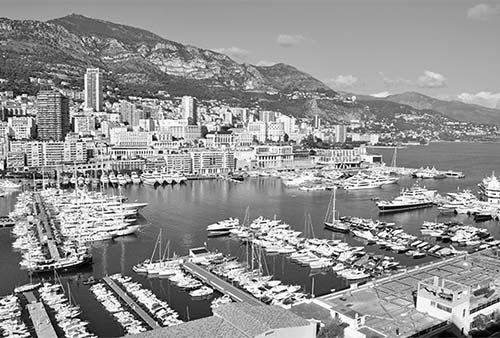
This minuscule principality (0.75 square mile) borders only France and the Mediterranean. The country has always been tiny, but it used to be...less tiny. In an 1860 plebiscite, Monaco lost two-thirds of its territory when the region of Menton voted to join France. To compensate, France suggested that Monaco build a fancy casino and promised to connect it to the world with a road (the Low Corniche) and a train line. This started a high-class tourist boom that has yet to let up.
Many people use “Monaco” and “Monte Carlo” interchangeably. Monaco (moh-nah-koh, in French) is the country. Monte Carlo is one of four districts in the pint-size country and well known because it’s the neighborhood of the famed casino.
Although nominally independent, Monaco is run as a part of France. A French civil servant appointed by the French president—with the blessing of Monaco’s prince—serves as state minister and manages the place. Monaco’s phone system, electricity, water, and so on, are all French.
The glamorous romance and marriage of the American actress Grace Kelly to Prince Rainier added to Monaco’s fairy-tale mystique. Princess Grace first came to Monaco to star in the 1955 Alfred Hitchcock movie To Catch a Thief, in which she was filmed racing along the Corniches. She married the prince in 1956 and adopted the country, but tragically, the much-loved princess died in 1982 after suffering a stroke while driving on one of those same scenic roads.
The death of Prince Rainier in 2005 ended his 56-year enlightened reign. Today, Monaco is ruled by Prince Albert Alexandre Louis Pierre, Marquis of Baux—son of Prince Rainier and Princess Grace.
Monaco boasts the highest per capita income in Europe, as well as the highest population density. While real estate is unaffordable for the masses (about 30,000 workers who can’t begin to afford to live here commute daily from France), the government makes sure parking is cheap and plentiful.
The famous car race, the Grand Prix de Monaco, is a big deal for four days a year. But the racetrack and stands that consume the tiny principality take two months to set up and a month to take down. So for three months every spring, it’s impossible to appreciate the visual charm of the harbor basin and some of the city’s architecture.
Orientation to Monaco
The principality of Monaco has three tourist areas: Monaco-Ville, Monte Carlo, and La Condamine. Monaco-Ville fills the rock high above everything else and is referred to by locals as Le Rocher (“The Rock”). This is the oldest part of Monaco, home to the Prince’s Palace and most of the key sights. Monte Carlo is the area around the casino. La Condamine is the port, which lies between Monaco-Ville and Monte Carlo. From here it’s a 20-minute walk up to the Prince’s Palace or to the casino, or a few minutes by frequent bus to either (see “Getting Around Monaco,” later).
TOURIST INFORMATION
The main TI is at the top of the park above the casino (Mon-Sat 9:30-17:30, closed Sun except July-Aug, 2 Boulevard des Moulins, +377 92 16 61 16 or +377 92 16 61 66, www.visitmonaco.com).
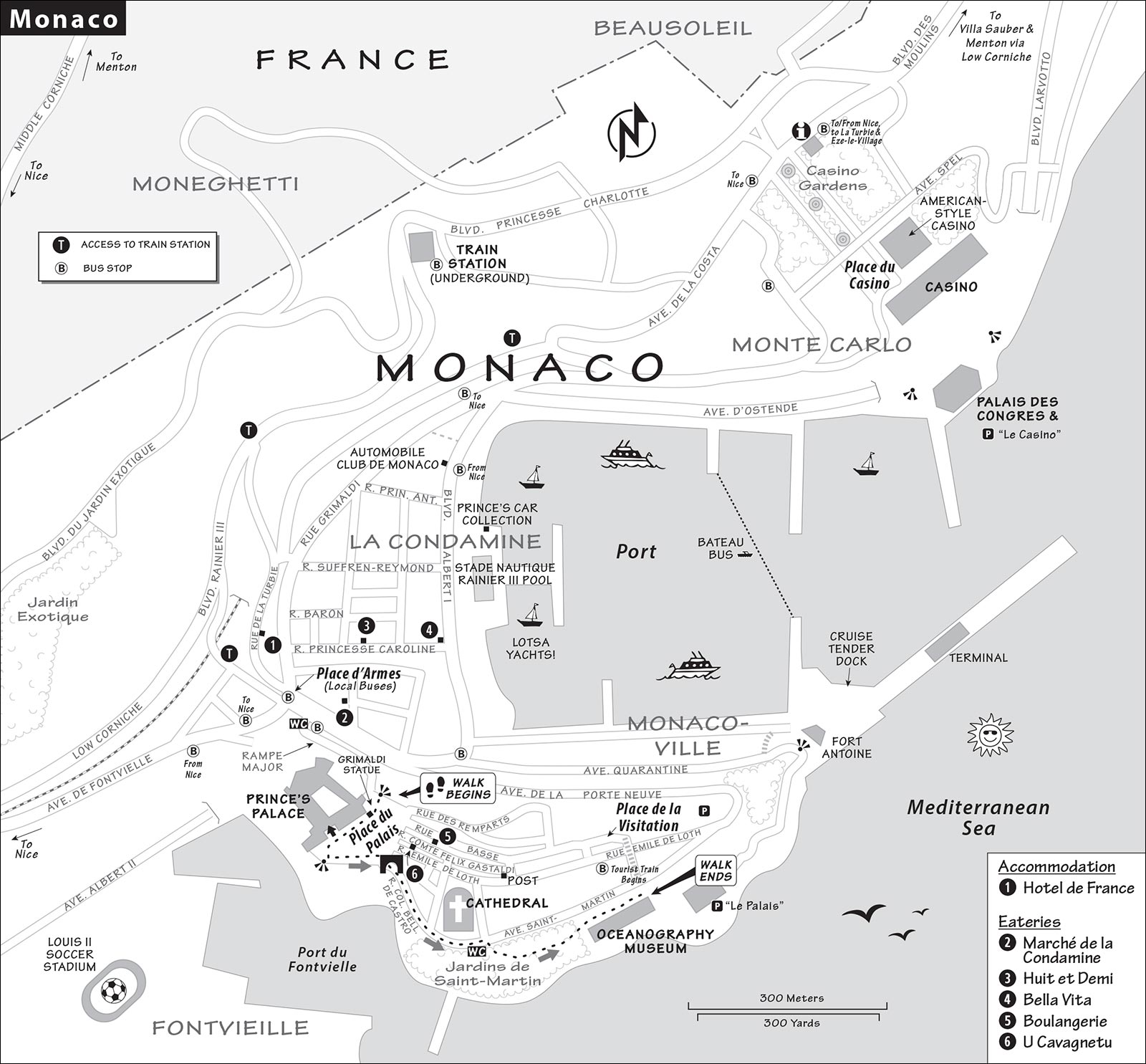
ARRIVAL IN MONACO
By Bus from Nice and Villefranche-sur-Mer: Bus riders need to pay attention to the monitor showing the next stop. Cap d’Ail is the town before Monaco, so be on the lookout after that (the last stop before Monaco is called “Cimetière”). You’ll enter Monaco through the modern cityscape of high-rises in the Fontvieille district. When you see the rocky outcrop of old Monaco, be ready to get off.
The following stops are the ones that matter to tourists (listed in order as you reach them from Nice): Place d’Armes (at the base of Monaco-Ville), Princesse Antoinette/Ste-Devote (on the port), Monte Carlo-Casino, and Place des Moulins (in front of the TI).
Most riders will get off at Place d’Armes to visit Monaco-Ville first. Use the crosswalk in front of the tunnel, then keep right and find bus stops #1 and #2 and the ramp to the palace. Casino-first types wait for the Monte Carlo-Casino stop. There’s no reason to exit at the port stop.
By Train from Nice: The long, entirely underground train station is in the center of Monaco. From here, it’s a 15-minute walk to the casino or the port, and about 15 minutes to the base of the palace. The station has no baggage storage.
The ticket windows and WCs are up the escalator at the Italy end of the station. There are three exits from the train platform level (one at each end and one in the middle).
To reach Monaco-Ville and the palace, take the exit at the Nice end of the tracks (signed Sortie Fontvieille/Le Rocher). This leads through a long tunnel to a pedestrian plaza, where you’ll go right, down a few steps, to join Rue de la Turbie and eventually find the base of Monaco-Ville at Place d’Armes. From here, it’s a 10-minute hike up to the palace, or five minutes by bus (#1 or #2) plus a short walk.
To reach Monaco’s port and the casino, take the middle exit, following Sortie Port Hercule signs down the steps and escalators and through a long hall until you pop out by a little church at the port. From here, buses #1 and #2 to Monaco-Ville stop right on the street in front; buses to Monte Carlo are across both busy streets and to the right. It’s a 20-minute uphill walk to the casino (along Avenue d’Ostende to your left).
By Car: There’s plenty of affordable underground parking in Monaco. Follow Centre-Ville signs into Monaco (warning: traffic can be heavy), then watch for the signs to parking garages at Le Casino (for Monte Carlo) or Le Palais (for Monaco-Ville). You’ll pay about €4/hour.
HELPFUL HINTS
Grand Prix Prep: From early April through May, visitors will encounter construction detours as the country prepares for its largest event of the year, the Grand Prix de Monaco.
Combo-Tickets: Two combo-tickets are available for Monaco’s big sights—one for the Prince’s Palace and the Oceanography Museum (€25) and another for the palace and the prince’s private car collection (€17).
Changing of the Guard: This popular event takes place daily (in good weather) at 11:55 at the Prince’s Palace. Arrive by 11:30 to get a good viewing spot.
Local Guides: The mother-daughter team of Catherine and Cecilia Cotton at Live Harmony offer local expertise in and around Monaco (for contact details, see here).
Loop Trip by Bus or Train: For those staying in Nice, another day-trip option is to take the bus or train to Monaco, then take a bus from Monaco to Eze-le-Village, and return to Nice from there by bus. For bus numbers, frequencies, and stop locations, see “Monaco Connections,” later.
Evening Events: Monaco’s cultural highlights include its Philharmonic Orchestra (+377 92 00 13 70, www.opmc.mc) and the Monte Carlo Ballet (+377 97 70 65 20, www.balletsdemontecarlo.com).
Post Office: The handiest post office for local stamps is in Monaco-Ville (described on my self-guided walk; Mon-Fri 8:00-19:00, Sat until 13:00, closed Sun).
A Quick Swim Downtown? There’s a spacious swimming jetty hiding out behind the cruise terminal. With showers, benches, and ladders into the sea, it’s free and popular with locals for a quick midday dip.
GETTING AROUND MONACO
By Local Bus: Buses #1 and #2 link all areas with frequent service (about every 5 minutes, fewer on Sun, buses run until 21:00). If you pay the driver, a single ticket is €2, 15 tickets €20, and a day pass €5.50; save by using red curbside machines, where you get 10 tickets for €10. You can split a 10-ride or 15-ride ticket with your travel partners. Bus tickets are good for a free transfer if used within 30 minutes.
For an interesting loop ride through Monaco, ride bus #2 from one end to the other and back (25 minutes each way). You’ll need two tickets, and you must get off the bus at the last stop and then get on again.
By Tour Bus: You could pay €27 for a hop-on, hop-off open-deck bus tour that makes 12 stops in Monaco (but note that local buses #1 and #2 do the same thing for far less).
By Tourist Train: An efficient way to enjoy a scenic blitz tour, Monaco Tours tourist trains begin at the Oceanography Museum and pass by the port, casino, and palace (€11, 2/hour 10:30-17:00, 45 minutes, recorded English commentary).
By Taxi: If you’ve lost all track of time at the casino, you can call the 24-hour taxi service (+377 93 15 01 01)...assuming you still have enough money to pay for the cab home.
Monaco-Ville Walk
Most of Monaco’s attractions (except the casino and the prince’s car collection) are in Monaco-Ville, packed within a few Disneyesque blocks. This self-guided walk connects these sights in a tight little loop, starting from the palace square.
• To get from anywhere in Monaco to the palace square (Monaco-Ville’s sightseeing center and home of the palace), take bus #1 or #2 to the end of the line at Place de la Visitation. Turn right as you step off the bus and walk five minutes down Rue Emile de Loth. You’ll pass the post office, a worthwhile stop for its collection of valuable Monegasque stamps.
Palace Square (Place du Palais)
This square is the best place to get oriented to Monaco. Facing the palace, walk to the right and look out over the city (er...principality). This rock gave birth to the mighty minination in 1297, and it’s managed to remain an independent country for most of its 700-plus years. Looking beyond the glitzy port, notice the faded green dome roof: It belongs to the casino that put Monaco on the map in the 1860s. The casino was located away from Monaco-Ville because Prince Charles III (r. 1856-1889) wanted to shield his people from low-life gamblers.
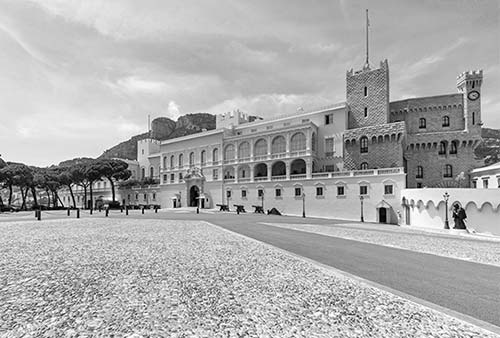
The famous Grand Prix runs along the port and then up the ramp to the casino (at top speeds of 180 mph). Italy is so close, you can almost smell the pesto. But Monaco is surrounded by France. Look beyond the skyscrapers. If it’s green, it’s in France. You could walk one-way from France to France, passing through Monaco, in about an hour.
The odd statue of a woman with a fishing net is dedicated to the glorious reign of Prince Albert I (1889-1922). The son of Charles III (who built the casino), Albert I was a true Renaissance man. He had a Jacques Cousteau-like fascination with the sea (and built Monaco’s famous aquarium, the Oceanography Museum) and was a determined pacifist who made many attempts to dissuade Germany’s Kaiser Wilhelm II from becoming involved in World War I.
Keeping the view on your left, escape the crowds for a moment with a short detour 50 yards up the street. Gawk at the houses lining this street and imagine waking up to that view every day.
• Head toward the palace, passing electric car chargers (Prince Albert is an environmentalist), and find a statue of a monk grasping a sword.
Meet François Grimaldi, a renegade sword-carrying Italian dressed as a monk, who captured Monaco in 1297 and began the dynasty that still rules the principality. Prince Albert is his great-great-great...grandson, which gives Monaco’s princely family the distinction of being the longest-lasting dynasty in Europe (as they are not technically “kings,” you can’t call it a royal family).
• Now walk to the...
Prince’s Palace (Palais Princier)
A medieval castle once sat where the palace is today. Its strategic setting has had a lot to do with Monaco’s ability to resist attackers. Today, Prince Albert and his wife live in the palace, while Princesses Stephanie and Caroline live down the street. The palace guards protect the prince 24/7 and still stage a changing of the guard ceremony with all the pageantry of an important nation (daily 11:55-12:05 in good weather, fun to watch but jam-packed, arrive by 11:30).
An audioguide takes you through part of the prince’s lavish palace in 30 minutes. The rooms are well furnished and impressive, and you’ll pick up some knowledge of art and Monegasque history and heritage.
Cost and Hours: €10, includes audioguide, €25 combo-ticket includes Oceanography Museum; hours vary but generally daily 10:00-18:00, July-Aug until 19:00, closed Nov-March; buy ticket at the Billeterie at the souvenir stand 75 yards opposite the palace entrance; +377 93 25 18 31, www.palais.mc.
• Facing the palace, head to the viewpoint to the left. Below the cannonballs is the district known as...
Fontvieille
Monaco’s newest, reclaimed-from-the-sea area has seen much of Monaco’s post-WWII growth (residential and commercial—notice the lushly planted building tops). The goal of Fontvieille: affordable housing. Prince Rainier continued—some say, was obsessed with—Monaco’s economic growth, creating landfills (topped with apartments, such as in Fontvieille), flashy ports, more beaches, a big sports stadium marked by tall arches, and a rail station. Today, thanks to Prince Rainier’s past efforts, tiny Monaco is a member of the United Nations. (If you have kids with you, check out the nifty play area just below.)
• With your back to the palace, leave the square through the arch at the far right (onto Rue Colonel Bellando de Castro) and find the...
Cathedral of Monaco (Cathédrale de Monaco)
The somber but beautifully lit cathedral, rebuilt in 1878 with local limestone in a romantic faux-medieval style, shows that Monaco cared for more than just its new casino. It’s where, under modest tombstones, centuries of Grimaldis are buried, and where Princess Grace and Prince Rainier were married in 1956. Inside, circle slowly behind the altar (counterclockwise). The second tomb is that of Albert I, who did much to put Monaco on the world stage. The second-to-last tomb—inscribed “Gratia Patricia, MCMLXXXII”—is where Princess Grace lies. Next to Grace is her husband’s tomb (Prince Rainier III, who died in 2005). At the gate is a blank tombstone...
Cost and Hours: Free, daily 8:30-19:15.
• Leave the cathedral (across the street is a photo of the 1956 wedding in the same church), jog right, and dip into the immaculately maintained Jardins de Saint-Martin, with more fine views and good WCs. In the gardens, turn left. Eventually you’ll find the impressive building housing the...
Oceanography Museum (Musée Océanographique)
Prince Albert I had this cliff-hanging museum built in 1910 as a monument to his enthusiasm for things from the sea. The museum’s aquarium, which Jacques Cousteau captained for 32 years, has oceans of sea life. Your visit has two parts: the aquarium and Albert’s museum.
Cost and Hours: €19, €12 for kids under 18, €25 combo-ticket includes Prince’s Palace; daily 10:00-19:00, July-Aug 9:30-20:00, Oct-March 10:00-18:00; down the steps from Monaco-Ville bus stop, at the opposite end of Monaco-Ville from the palace; +377 93 15 36 00, www.oceano.mc.
Visiting the Museum: The ground floor, dedicated to rotating exhibits, leads down to the multifloor aquarium. As you descend you’ll find a Mediterranean zone, a more colorful tropical zone, and even a turtle zone outside (all well described in English).
Upstairs is the museum. The fancy Albert I Hall features huge circa-1900 display cases, like a massive cabinet of curiosities, filled with his collectibles. The museum is filled with ship models, whale skeletons, oceanographic instruments, and scenes of Albert and his beachcombers hard at work (with good English information), as well as plenty of kid-friendly interactive bits.
Cap your visit by taking the elevator to the rooftop terrace, with its playground, affordable restaurant and café, and great views.
• The red-brick steps across from the Oceanography Museum lead up to stops for buses #1 and #2, both of which run to the port, the casino, and the train station. To walk back to the palace and through the old city, turn left at the top of the brick steps. If you’re into stamps, walk down Rue Emile de Loth to find the post office, where philatelists and postcard writers with panache can buy—or just gaze in awe at—the impressive collection of Monegasque stamps.
More Sights in Monaco
▲Prince of Monaco’s Car Collection
Prince Rainier III started collecting cars in 1950. By 1993, with the establishment of this exhibit, the collection burst out of the jam-packed palace garage and into the public eye. Today (with Prince Albert II taking over where the late Prince Rainier left off), two glittering acres of cars are displayed chronologically (described in English) in a princely car show ranging from the horseless carriage to today’s Bugattis and Lamborghinis. With circa-1920 perfume boxes and single-stem flower vases, stories of the princely family and clips of early Grand Prix races, the exhibit tells an entertaining story.
Cost and Hours: €10, €17 combo-ticket with Prince’s Palace, daily 10:00-19:00, last entry one hour before closing, at the port between Monaco-Ville and Monte Carlo by the Stade Nautique Rainier III pool, +377 92 05 28 56, www.mtcc.mc.
▲Monte Carlo Casino (Casino de Monte-Carlo)
Monte Carlo, which means “Charles’ Hill,” is named for Charles III, the prince who presided over Monaco’s 19th-century makeover. In the mid-1800s, olive groves stood here. Then, with the construction of the casino in the 1860s, plus easy road and train access (thanks to France), one of Europe’s poorest countries was on the Grand Tour map—the place for the vacationing aristocracy to play. Today, Monaco has the world’s highest per capita income.
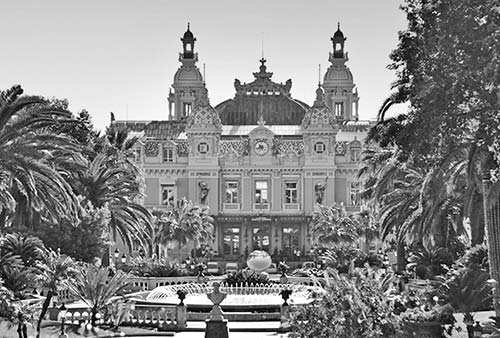
The Monte Carlo casino is intended to make you feel elegant while losing your shorts. In 1878, Charles Garnier, architect of the Opéra Garnier in Paris, contributed to a massive redesign and expansion. The casino’s grand entry provides access to slot machines, gaming rooms, and the adjoining opera house. Cruise ship visitors can jam the entry during afternoons. Expect lines at the entrance at any time during peak season.
Cost and Hours: Atrium—free, casino—€18, daily 10:00 until late, +377 92 16 20 00, www.montecarlosbm.com.
To visit, you have three basic options. You can visit the atrium for free, you can pay to tour everything in the morning as a sightseer, or you can pay to go inside as a gambler in the afternoon or evening.
Free Visit to the Atrium: Whenever the casino is open, you are welcome to climb the fancy stairs, step into the glorious atrium, and gawk at the sumptuous 1860s belle époque architecture.
Tourist Visit: From 10:00 until 13:00 (last entry at 12:15), you can pay €18 to tour the casino gambling rooms with the help of the included 45-minute audioguide, which gives the place meaning (no age limits; if you come back later to gamble you don’t need to pay again).
Enter as a Gambler: From 14:00, you can enter for the full experience (€18 entry fee includes a €10 voucher for a drink or chips). You must be 18, show your passport, and meet their dress code—no shorts, T-shirts, tennis shoes, ripped pants, or hoodies. (The passport is needed as they don’t want Monaco citizens in here squandering their wealth...they only want outsiders in here squandering their wealth.)
Visiting the Casino: Enter through the sumptuous atrium. This is the lobby for the 520-seat opera house (open Nov-April only for performances). The first gambling rooms (Salle Europe and Salle des Amériques) offer slot machines, European and English roulette, blackjack, Punto Banco—a version of baccarat—and slot machines. The more glamorous game rooms (Salons Touzet and Salle Medecin) have those same games and Ultimate Texas Hold ’em poker, but you play against the cashier with higher stakes (the exclusive Salle Blanche is off-limits to you).
The park behind the casino is a peaceful place with a good view of the building’s rear facade and of Monaco-Ville.
Eating: The casino has two dining options. The $$$$ Train Bleu restaurant is for deep pockets for whom price is no object and elegance is everything. $$$ Le Salon Rose offers brasserie food—big salads and pasta dishes in a classy setting. If you paid to tour the casino or to gamble, show your ticket for a discount.
Take the Money and Run: The stop for buses returning to Nice and Villefranche-sur-Mer, and for local buses #1 and #2, is on Avenue de la Costa, at the top of the park above the casino (at the small shopping mall). To reach the train station from the casino, take bus #1 or #2 from this stop, or find Boulevard Princesse Charlotte (parallels Avenue de la Costa one block above) and walk 15 minutes.
Sleeping and Eating in Monaco
Sleeping: Centrally located on a lovely street, $$ Hôtel de France** is comfortable, well run by friendly Sylvie and Christoph, and reasonably priced—for Monaco (includes breakfast, air-con, no elevator; exit west from train station, 10-minute walk to 6 Rue de la Turbie, +377 93 30 24 64, www.hoteldefrance.mc, hoteldefrance@monaco.mc).
Eating near the Port: Several cafés serve basic, inexpensive fare (day and night) on the port. Marché de la Condamine is a kind of food court in a renovated market hall with a variety of stands offering good-value meals and drinks to take to your table (Tue-Sat until 15:00, Sun until 13:30, closed Mon, across from Place d’Armes at 11 Rue Terrazzani).
For a more refined meal, troll the places that line the flowery and traffic-free Rue Princesse Caroline between Rue Grimaldi and the port. $$$ Huit et Demi is a reliable choice, with a white-tablecloth-meets-director’s-chair ambience and good outdoor seating (closed Sun, 7 Rue Princesse Caroline, +377 93 50 97 02). A few blocks below, $$ Bella Vita—an easygoing and popular place for salads, Italian fare, and classic French dishes—has a large terrace and modern interior (daily, serves nonstop from 7:00 to late, 21 Rue Princesse Caroline, +377 93 50 42 02).
Eating in Monaco-Ville: You’ll find stands selling cheap to-go sandwiches and salads along the narrow lanes near the palace. The Boulangerie at 8 Rue Basse sells particularly good pan bagnat. At $$ U Cavagnetu, just a block from Albert’s palace, you’ll dine cheaply on specialties from Monaco—pizza and such (daily, serves nonstop 11:00-23:00, 14 Rue Comte Félix Gastaldi, +377 97 98 20 40). Monaco-Ville has other pizzerias, crêperies, and sandwich stands, but the neighborhood is dead at night.
Monaco Connections
BY TRAIN
For a comparison of train and bus connections, see the “Public Transportation in the French Riviera” sidebar on here. Most trains heading west will stop in Villefranche-sur-Mer, Nice, and Antibes (ask). The last train leaves Monaco for Villefranche-sur-Mer and Nice at about 23:30.
From Monaco by Train to: Villefranche-sur-Mer (2-3/hour, 15 minutes), Nice (2-3/hour, 25 minutes), Antibes (2/hour, 50 minutes), Cannes (2/hour, 70 minutes).
BY BUS
Frequent bus #607, which runs along the Low Corniche back to Nice (1 hour) and Villefranche-sur–Mer (45 minutes), is often slammed. For a better chance of securing a seat, board at the stop near the TI on Avenue de la Costa (see the “Monaco” map, earlier) rather than the stop near Place d’Armes. The last bus leaves Monaco for Nice at about 21:00. For bus details, including tickets, routes, frequencies, and travel times, see here.
Bus #112, which goes along the scenic Middle Corniche to Eze-le-Village then on to Nice (6/day Mon-Sat, none on Sun, 20 minutes to Eze), departs Monaco from in front of the main TI near the casino.
Bus #80 express takes the freeway from the Place d’Armes stop to Nice Airport (2/hour, 50 minutes, €22).
Antibes
West of Nice, Antibes has a down-to-earth, easygoing ambience. Its old town is a warren of narrow streets and red-tile roofs rising above the blue Med, protected by twin medieval towers and wrapped in medieval ramparts. Visitors making the short trip from Nice can browse Europe’s biggest yacht harbor, snooze on a sandy beach, loiter through an enjoyable old town, and hike along a sea-swept trail. The town’s cultural claim to fame, the Picasso Museum (closed on Mondays), shows off its appealing collection in a fine old building.
Though much smaller than Nice, Antibes has a history that dates back just as far. Both towns were founded by Greek traders in the fifth century BC. To the Greeks, Antibes was “Antipolis”—the town (polis) opposite (anti) Nice. For the next several centuries, Antibes remained in the shadow of its neighbor. By the turn of the 20th century, the town was a military base, so the rich and famous partied elsewhere. But when the army checked out after World War I, Antibes was “discovered” and enjoyed a particularly roaring ’20s with the help of party animals like Rudolph Valentino; F. Scott Fitzgerald and his wife, Zelda; and the rowdy (yet silent) Charlie Chaplin. Fun seekers even invented water-skiing right here in the 1920s.
The most appealing hotels in Antibes are best by car, and overall Antibes works well for drivers—compared with Nice, parking is easy, traffic is minimal, and it’s a convenient springboard for the inland Riviera.
Orientation to Antibes
Antibes’ old town lies between the port and Boulevard Albert I and Avenue Robert Soleau. Place Nationale is the old town’s hub of activity. Stroll above the sea between the old port and Place Albert I (where Boulevard Albert I meets the water). Good beaches lie just beyond Place Albert I, and the walk there continues to fine views. Play areas for children are along this path and on Place des Martyrs de la Résistance (close to recommended Hôtel Relais du Postillon).
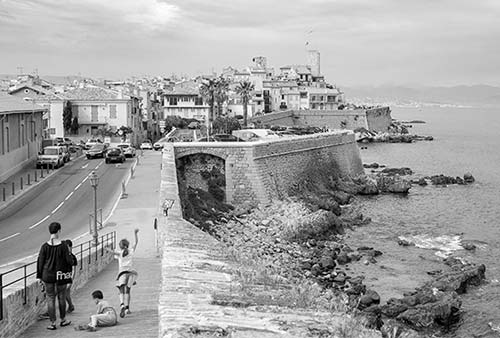
TOURIST INFORMATION
The TI is by the small bus station near Place des Martyrs de la Résistance (July-Aug daily 9:00-19:00; April-June and Sept Mon-Sat 9:30-12:30 & 14:00-18:00, Sun 9:00-13:00; shorter hours and closed Sun in winter; Place Guynemer, +33 4 22 10 60 10, www.antibesjuanlespins.com). Hikers should get the free tourist map of the Sentier Touristique de Tirepoil hike (see “Sights in Antibes,” later).
ARRIVAL IN ANTIBES
By Train: Bus #14 runs limited service from below the train station and along Avenue Robert Soleau to the city center (near several recommended hotels and the old town), then continues to the fine Plage de la Salis, with quick access to the Phare de la Garoupe trail (hourly, runs 10:00-16:00, none on Sun, bus stop 100 yards to right as you exit train station). It’s a level 10- to 15-minute walk to the town center. Taxis usually wait in front of the station (+33 4 93 67 67 67).
Day-trippers can store bags at Luggage Storage (10-minute walk from the station, daily 9:00-20:00, in a small mall at 14 Avenue Robert Soleau, +33 6 11 96 09 12).
To walk from the station to the port, the old town, and the Picasso Museum (15 minutes), cross the street in front of the station, skirting left of the café, and follow Avenue de la Libération downhill as it bends left. At the end of the street, head to the right along the port. If you walk on the water’s edge, you’ll see the yachts get bigger as you go.
To walk directly to the baggage storage, Hertz and Thrifty car rental, the TI, and recommended hotels in the old town, turn right out of the station and walk down Avenue Robert Soleau.
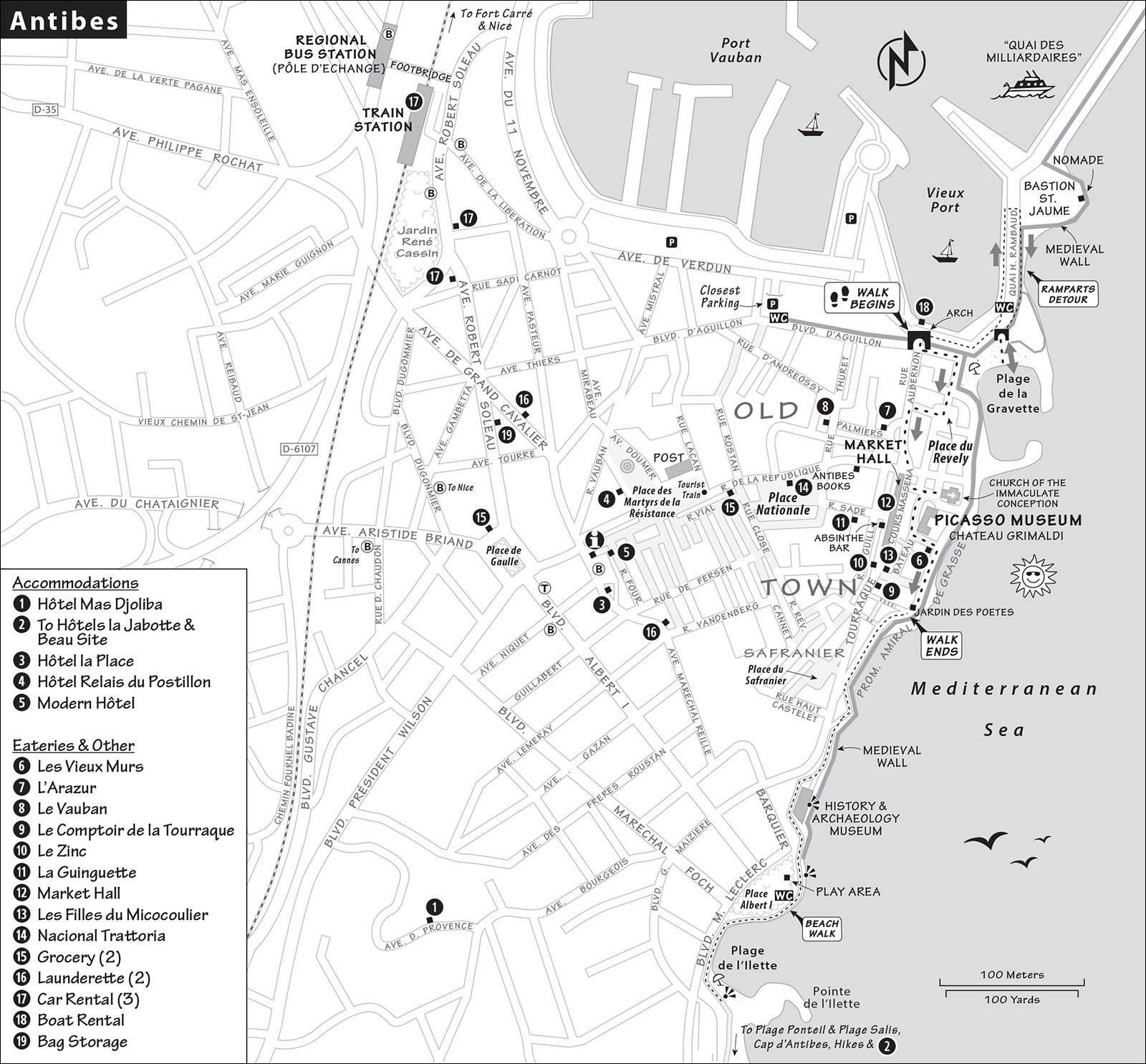
By Bus: Antibes’ regional bus station, called the Pôle d’Echange, is behind the train station—take the footbridge over the tracks to reach it. Buses #620 to Nice and Cannes, and #82 to Nice’s airport stop here. Buses to and from Nice stop at the far right/east end (info office open Mon-Fri 7:00-19:00, Sat 9:00-12:30 & 14:00-17:00, closed Sun). Bus #620 to Nice also stops in the city center near Place Général de Gaulle on Boulevard Dugommier, and #620 to Cannes stops on Rue Directeur Chaudron (for locations, see the “Antibes” map).
Some city buses (like handy bus #2) use the regional bus station, but most stop on Place Guynemer, a block over from Place Général de Gaulle by the TI (www.envibus.fr).
By Car: Day-trippers follow signs to Centre-Ville, then Port Vauban. The easiest places to park are a pair of convenient but pricey parking lots located outside the ramparts of the old town (Parking Vauban and Parking Pré aux Pécheurs). A free lot is available opposite Fort Carré (north of the port), from where it’s a 20-minute level but unappealing walk to the old town. Street parking is metered, but free Monday through Friday 12:00-14:00 & 19:00-8:00 and all day Saturday and Sunday. Pay parking is available at Antibes’ train station.
HELPFUL HINTS
Markets: Antibes’ old-time market hall (Marché Provençal) hosts a vibrant produce market in the morning (daily until 13:00, closed Mon Sept-May) and handicrafts in the afternoon (from 15:00 mid-June-Sept Tue-Sun, Oct-mid-June Fri-Sun only). A lively antiques/flea market fills Place Nationale and Place Audiberti, next to the port (Thu and Sat 7:00-18:00). A clothing market unfolds on Boulevard Albert I (Thu 8:00-13:00).
English Bookstore: With a welcoming vibe and Fenella ready to help, Antibes Books has a good selection of books in English—normally including mine (daily 10:00-19:00, 13 Rue Georges Clemenceau, +33 4 93 61 96 47, www.antibesbooks.com).
Laundry: The Lav’Matic launderette is at 19 Avenue du Grand Cavalier (daily 6:00-21:00). There’s another laverie on Place des Gendarmes d’Ouvéa, closer to my recommended hotels (daily 7:00-20:00).
Bike Rental: The TI has a list of places where you can rent bikes (including e-bikes)—a good way for nondrivers to reach the hikes described later.
Taxi: +33 4 93 67 67 67.
Car Rental: The big-name agencies have offices in Antibes. The most central are Avis/Budget (at the train station, daily 9:00-12:00 & 13:00-17:00, +33 4 93 34 65 15), Hertz (a few blocks from the train station at 31 Avenue Robert Soleau; Mon-Sat 8:00-12:00 & 14:00-18:00, closed Sun, +33 4 92 91 28 00), and Thrifty (nearby at 46 Avenue Robert Soleau, same hours as Hertz, +33 4 92 91 28 00).
Boat Rental: You can motor your own seven-person yacht thanks to Antibes Bateaux Services (€150/half-day, at the small fish market on the port, +33 6 15 75 44 36, www.antibes-bateaux.com).
GETTING AROUND ANTIBES
Local buses (Envibus) cost €1 if you buy a ticket from a machine or at the bus station (€1.50 from driver, cash only). They’re handiest for carless travelers wanting access to Cap d’Antibes. Get schedules online (www.envibus.fr/en/bus-routes [URL inactive]) or at the bus station. Bus #14 provides very limited service between the train station, city center, old town, and Plage de la Salis (Mon-Sat 10:00-16:00, hourly). It also takes you to Fort Carré, where free parking is available. Bus #2 provides access to the best beaches, the path to La Phare de la Garoupe, and the Cap d’Antibes trail. It runs from the Pôle d’Echange bus station through the city center and down Boulevard Albert I (daily 7:00-19:00, every 50 minutes).
Antibes Walk
This 40-minute self-guided walk will help you get your bearings, and works well day or night.
• Begin at the old port (Vieux Port) at the southern end of Avenue de Verdun. Stand at the port, across from the archway with the clock.
Old Port: Locals claim that this is Europe’s first and biggest pleasure-boat harbor, with 1,600 berths. That star-shaped stone structure crowning the opposite end of the port is Fort Carré, which protected Antibes from foreigners for centuries.
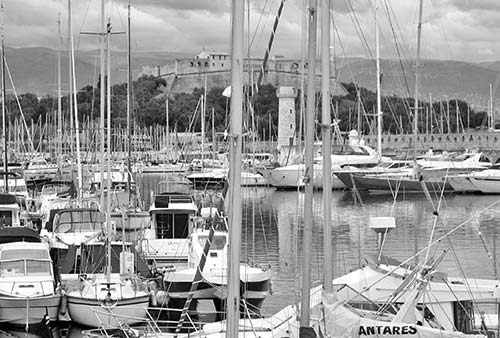
The pathetic remains of a once-hearty fishing fleet are moored in front of you. The Mediterranean is pretty much fished out. Most of the seafood you’ll eat here comes from fish farms or the Atlantic.
• With the water on your left, walk a block past the sorry fleet and duck under the first open arch to the shell-shaped...
Plage de la Gravette: This normally quiet public beach is tucked right in the middle of old Antibes. Walk up and out 50 yards onto the paved area. Appreciate the scale of the ramparts that protected this town. Because Antibes was the last fort before the Italian border, the French king made sure the ramparts were top-notch. The twin towers crowning the old town are the church’s bell tower and the tower topping Château Grimaldi (today’s Picasso Museum). As you face the old town, forested Cap d’Antibes is the point of land in the distance to the left. Is anyone swimming? Locals don’t swim much in July and August because of jellyfish—common now in warmer water. Throughout the Mediterranean, you’ll see red flags warning of dangerous storms or tides. Many beaches now also have white flags with jellyfish symbols warning that swimming might be a stinging experience.
• For a close-up look at the megayachts and a walk along the ramparts, follow this fun detour. Otherwise, skip ahead to the “Old Antibes” directions.
Antibes’ Megayacht Harbor: Take a three-block detour to the right as you leave Plage de la Gravette for a glimpse at the epitome of conspicuous consumption. You’ll walk along the harbor under the ramparts.
You’ll eventually reach a restricted area harboring massive yachts. Climb the ramparts on your right and make your way to the modern white sculpture. Nomade—a man of letters looking pensively out to sea—was created in 2010 by the Spanish artist Jaume Plensa (find the posted English explanations nearby). Have a seat inside the sculpture and ponder how human communication forms who we are and links all people. Looking north, the Alps make a beautiful backdrop when it’s clear.
Browse the line of huge pleasure craft stern-tied to the pier (which was built in the 1970s with financial aid from mostly Saudi Arabian yacht owners, who wanted a decent place to tie up). Locals call this the Quai des Milliardaires (“billionaires’ dock”).
Old Antibes: Return along the ramparts, then enter Antibes’ old town through the arch under the clock.
• You could walk directly up the main street to get to our next stop, but here’s a more scenic option: Passing through the gate, turn immediately left, walk to the small square, and then walk up the steep steps on the left. Enjoy fine views as you walk along the ramparts above the beach for about 50 yards. Then head through the arch at #14 and into picturesque Place du Revely. Six centuries before Christ, a thousand Greeks lived in a fort here and traded with indigenous Celts. Cross Place du Revely to the right, go down the ramp under several arches, then turn left when you reach the main drag into the old town and Antibes’ market hall, Le Marché Provençal.
Market Hall: Antibes’ market hall bustles under a 19th-century canopy, with flowers, produce, Provençal products, and beach accessories. The market wears many hats: fresh produce until 13:00 and varied handicrafts from 15:00. The market hall also offers fun outdoor dining options in the evenings.
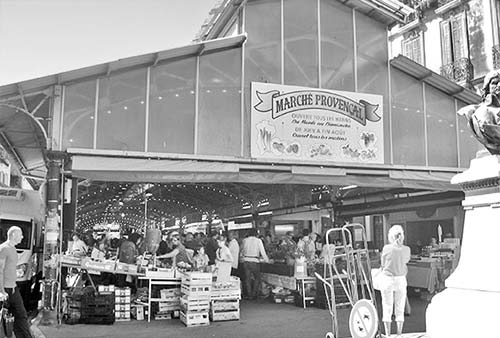
Absinthe Bar: On the market’s right (at the corner of Rue Sade), a pretty shop hides an atmospheric absinthe bar in its ninth-century vaulted cellar. You’re welcome to go through the shop (or enter via Rue Sade) and descend to find an amazing collection of absinthe fountains, the oldest dating from the 1860s. The owner, Fred, will gladly show you his memorabilia and help you with the pouring ritual if you buy a drink. (You’ll feel the absinthe after one swallow.) On Friday and Saturday nights (and daily in July-Aug), the basement is transformed into an absinthe-infused jazz bar lounge with 1920s ambience and a piano player.
• Double back to where you first entered the market, exit the hall, and find Rue Christian Chessel leading uphill to the pretty pastel...
Church of the Immaculate Conception: A church, built on the site of a Greek temple, has stood on this site since the 12th century. The stone bell tower standing in front of the church predates it by several centuries, when it was part of the city’s defenses. Many of those heavy stones were pillaged from Antibes’ Roman monuments. Peeking inside and marveling at this medieval church’s gilded Baroque decor, you’ll gently nudge your travel partner and whisper, “Oh yes, Nice and Antibes straddled a cultural border. That’s why this flavor of Baroque is more French and subdued than the more bombastic Italian-style Baroque that wowed us in Nice.”
• Looming above the church is the white-stone...
Château Grimaldi: This site was home to the acropolis of the Greek city of Antipolis and later a Roman fort. Later still, the château was the residence of the Grimaldi family (a branch of which still rules Monaco). Today it houses Antibes’ Picasso Museum. Its proximity to the cathedral symbolized the sometimes too-cozy relationship between society’s two dominant landowning classes: the Church and the nobility. (In 1789, the French Revolution changed all that.)
• After visiting the Picasso Museum (see “Sights in Antibes,” next), work your way through the warren of pretty lanes, then head out to the water, turn right along the ramparts, and find a sweeping sea view.
Viewpoint: Stroll this delightful promenade until you reach a viewpoint and a little oasis of cacti and succulents called Poets’ Garden (Jardin des Poetes). From this viewpoint look across the bay for forested Cap d’Antibes, crowned by its lighthouse and studded with mansions (a proposed hike here is described later). The Cap was long the refuge of Antibes’ rich and famous, and a favorite haunt of F. Scott Fitzgerald and Ernest Hemingway.
• Our walk is done—but if you want to keep going, you can continue along the ramparts to the Archaeology Museum and beaches, circle inland into the charming neighborhood called La Commune Libre du Safranier, or take a hard U-turn downhill and return directly to the Market Hall.
Sights in Antibes
▲▲Picasso Museum (Musée Picasso)
Sitting serenely where the old town meets the sea is Château Grimaldi. Through much of the Middle Ages a fort, this now houses a museum offering a compact collection of Picasso’s paintings, sketches, and ceramics. Picasso lived in this castle for part of 1946, when he cranked out an amazing amount of art (most of the paintings you’ll see are from this short but prolific stretch of his long and varied career). He was elated by the end of World War II, and his works show a celebration of color and a rediscovery of light after France’s long nightmare of war. Picasso was also reenergized by his young companion, the painter Françoise Gilot (with whom he would father two children). The resulting collection, donated by Picasso to the city, put Antibes on the tourist map. In 1966, the city opened the first-anywhere Picasso museum.
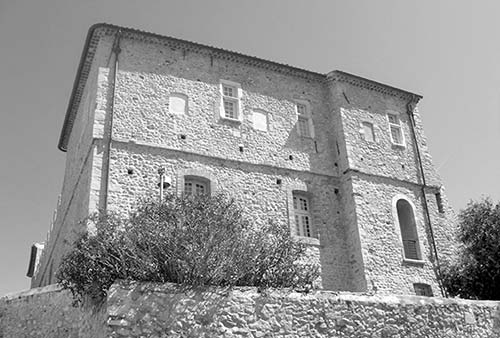
Cost and Hours: €8; Tue-Sun 10:00-18:00 (mid-Sept-mid-June closed 13:00-14:00), closed Mon year-round; +33 4 92 90 54 20.
Visiting the Museum: The museum’s highlight is on the top floor, where you’ll find the permanent collection of Picasso’s works. Visitors are greeted by a large image of Picasso and a display of photographs of the artist at work and play during his time in Antibes. Understanding the importance of marketing, he had his own photographer and clearly loved posing.
The first gallery room (up the small staircase to your left) displays several famous works, including the lively, frolicking, and big-breasted La Joie de Vivre (1946). This Greek bacchanal sums up the newfound freedom in a just-liberated France and sets the tone for the rest of the collection. You’ll also see several ceramic creations and the colorless, three-paneled Satyr, Faun, and Centaur with Trident. As you leave this room, don’t miss the adorable (pregnant?) goat.
Throughout, you’ll see both black-and-white and colorful ink sketches that challenge the imagination—these show off Picasso’s skill as a cartoonist and caricaturist. Look for scenes from Greek myths, a cute Basque fisherman (Pêcheur attablé), and seafood. He had a particular interest in sea urchins (considered an aphrodisiac) and painted them frequently when he was in love with Gilot, a woman 40 years his junior. Look also for several Cubist-style nudes (nus couchés), one painted on plywood.
Near the end, don’t miss the wall devoted to Picasso’s ceramic plates. In 1947, inspired by a visit to a ceramics factory in nearby Vallauris, Picasso discovered the joy of this medium. He was smitten by the texture of soft clay and devoted a great deal of time to exploring how to work with it—producing over 2,000 pieces in one year. In the same room, the wall-sized painting Ulysses and the Sirens screams action and anxiety. Lashed to the ship mast, Ulysses survives the temptation of the sirens.
History and Archaeology Museum (Musée d’Histoire et d’Archéologie)
More than 2,000 years ago, Antibes was the center of a thriving maritime culture. It was an important Roman commercial port with aqueducts, theaters, baths, and so on. This museum—the only place to get a sense of the city’s ancient roots—displays Greek, Roman, and Etruscan odds and ends in two simple halls, sadly with no English descriptions. Your visit starts at an 1894 model of Antibes and continues past displays of Roman coins, cups, plates, and scads of amphorae.
Cost and Hours: €3; Tue-Sun 10:00-12:30 & 14:00-18:00, shorter hours off-season, closed Mon year-round, on the water between Picasso Museum and Place Albert I, +33 4 92 95 85 98.
Fort Carré
This impressively situated, mid-16th-century citadel, on the headland overlooking the harbor, protected Antibes from Nice (which until 1860 wasn’t part of France). You can usually tour this unusual star-shaped fort for the fantastic views over Antibes, but there’s little to see inside (€3, Tue-Sun 10:00-18:00, mid-Sept-mid-June until 17:00, closed Mon year-round; verify hours at TI).
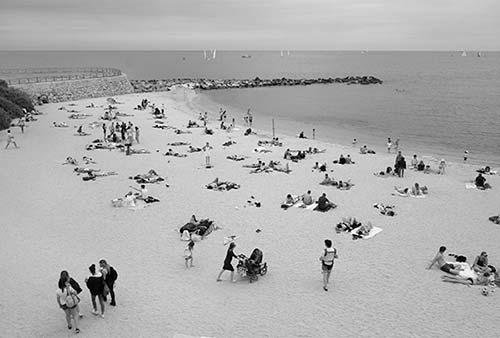
▲Beaches (Plages)
Good beaches stretch from the south end of Antibes toward Cap d’Antibes. They’re busy but manageable in summer and on weekends, with cheap snack stands and good views of the old town. The closest beach to the old town is at the port (Plage de la Gravette), which seems calm in any season.
HIKES
I list two good hikes here. Orient yourself from the seaside rampart walk below the Picasso Museum or from the bottom of Boulevard Albert I (where it meets the beach). That tower on the hill is your destination for the first hike. The longer Cap d’Antibes hike begins over that hill, a few miles farther away. The two hikes are easy to combine by bus, bike, or car.
▲▲Chapelle et Phare de la Garoupe Hike
The territorial views—best in the morning, skippable if it’s hazy—from this viewpoint more than merit the climb from Plage de la Salis. An orientation table explains that you can see from Nice to Cannes and up to the Alps. The peaceful $$ Le Bistrot du Curé has drinks and light snacks (closed Mon, in winter open Thu-Sun only).
Getting There: It’s a level 20-minute walk (or a quick ride on bus #2 or #14) from Antibes’ center to the Plage de la Salis bus stop, then a 20-minute hike up cobbled Chemin du Calvaire to the lighthouse tower (find the trail a block ahead of the stop on the right, a few blocks after Maupassant Apartments). By car or bike, follow signs for Cap d’Antibes, then look for Chapelle et Phare de la Garoupe signs.
▲▲Cap d’Antibes Hike (Sentier Touristique de Tirepoil)
Cap d’Antibes is filled with exclusive villas and mansions protected by high walls. Roads are just lanes, bounded on both sides by the high and greedy walls, in this home of some of the most expensive real estate in France (and where “public” seems like a necessary evil). But all the money in the world can’t buy you the beach in France, so a thin strip of rocky coastline forms a two-mile-long, parklike zone with an extremely scenic, mostly paved but often rocky trail (Sentier Touristique de Tirepoil). At a fast clip you can walk the entire circle in just over an hour. Don’t do the hike without the tourist map (available at hotels or the TI). You can do it in either direction or in segments.
Getting There: Drivers will find parking easier at the trail’s eastern end (Plage de la Garoupe), though some street parking is also available a few blocks from the trail’s other end (look near the recommended Hôtel Beau Site). Pedestrians should start at the trail’s western end. Take bus #2 from Antibes for about 15 minutes to the La Fontaine stop (next to Hôtel Beau Site).
Walking the Trail: From the La Fontaine bus stop, walk five minutes down Avenue Mrs. L. D. Beaumont to the gate of the Villa Eilenroc. Enter through the gate to the trail skirting the villa on your left, and walk five more minutes to the rocky coastal trail. Now turn left and follow the trail for nearly an hour around Cap Gros. As you walk, you’ll have fancy fences with security cameras on one side and dramatic sea views on the other. The public space is rarely more than 50 yards wide and often extremely rocky—impassible if not for the paved trail carved out for the delight of hikers. There’s no way to get lost without jumping into the sea or scaling villa security walls.
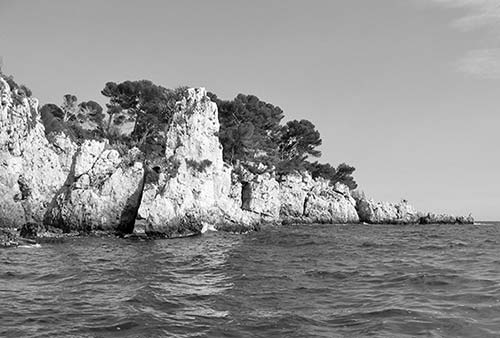
You return to civilization at a tiny resort (Plage de la Garoupe) with an expensive restaurant, a fine beach (both public and private), and a fun and inexpensive beachside bar/café. From here it’s a 10-minute walk up Boulevard de la Garoupe or Avenue André Sella and Avenue Tour Gandolphe to the La Fontaine bus stop.
With a car (or bike), you could start and end at Plage de la Garoupe by walking up to the bus stop and following the directions from there, or doing the loop in the other direction.
Sleeping in Antibes
Several sleepable options are available in the town center, but my favorite Antibes hotels are farther out and most convenient for drivers. Hotels have air-conditioning and elevators unless otherwise noted.
OUTSIDE THE TOWN CENTER
$$$ Hôtel Mas Djoliba*** is a traditional manor house with chirping birds and a flower-filled moat. While most convenient for drivers, it’s workable for walkers (10-minute walk to Plage de la Salis, 15 minutes to old Antibes). Bigger rooms are worth the additional cost, and several rooms come with small decks (several good family rooms, no elevator but just three floors, boules court and loaner balls; 29 Avenue de Provence—from Boulevard Albert I, look for gray signs two blocks before the sea, turn right onto Boulevard Général Maizière, and follow signs; +33 4 93 34 02 48, www.hotel-djoliba.com, contact@hotel-djoliba.com, Delphine).
$$$ Hôtel la Jabotte** is a cozy little hotel hidden along an ignored alley a block from the best beaches and a 20-minute walk from the old town. It’s run with panache by Nathalie and Pierre (and dog Hush), and its rich colors and decor show a personal touch. The immaculate rooms (all but one on the ground floor) have smallish bathrooms and individual terraces facing a cute, central garden where you’ll get to know your neighbor (3-night minimum in high season, free breakfast for Rick Steves readers with current guidebook; sauna, bikes, kayaks, and paddleboards available; 13 Avenue Max Maurey, take the third right after passing Hôtel Josse, +33 4 93 61 45 89, www.jabotte.com, info@jabotte.com). The hotel can shuttle clients to hiking trails, restaurants, etc., in their small tuk-tuk vehicle for a small fee. They also offer transport to the train station or the airport in their electric car.
$$ Hôtel Beau Site,**** my only listing on Cap d’Antibes, is a 10-minute drive from town. It’s a terrific value if you want to get away...but not too far away. (Without a car, you’ll feel isolated.) Helpful Nathalie welcomes you with a pool, a comfy patio garden, and secure pay parking. Rooms are spacious and comfortable, and several have balconies (electric bikes available, 141 Boulevard Kennedy, +33 4 93 61 53 43, www.hotelbeausite.net, contact@hotelbeausite.net). The hotel is a 10-minute walk from Plage de la Garoupe on the Cap d’Antibes loop hike (described earlier).
IN THE TOWN CENTER
$$ Hôtel la Place*** is central and comfortable, with a hands-on owner. It overlooks the small bus station with tastefully designed rooms and a comfy lounge (no elevator, 1 Avenue 24 Août, +33 4 97 21 03 11, www.la-place-hotel.com, contact@la-place-hotel.com).
$ Hôtel Relais du Postillon** is a laid-back, central place above a cozy café with 16 good rooms at very fair rates. The furnishings are tasteful, and several rooms have small balconies or terraces (tiny elevator, pay parking, 8 Rue Championnet, +33 4 93 34 20 77, www.relaisdupostillon.com, relais@relaisdupostillon.com).
$ Modern Hôtel,** in the pedestrian zone behind the city bus station, is suitable for budget-conscious travelers. The 17 standard-size rooms are simple and spick-and-span (no elevator, 1 Rue Fourmillière, +33 4 92 90 59 05, www.modernhotel06.com, modern-hotel@wanadoo.fr).
Eating in Antibes
Antibes is a fun and relaxed place to dine out. These restaurants are all within a few minutes’ walk of each other, so it’s fun to comparison shop at lunch. Booking ahead (or arriving right when they open) can be smart, especially on weekends and on Monday when many places are closed.
ROMANTIC SPLURGES
$$$$ Les Vieux Murs, a dressy and romantic place directly on the rampart overlooking the sea, serves elegantly presented French classics. It has a hushed and formal dining room under chandeliers hanging from stony vaults, and a handful of tables on the sea-breeze patio (à la carte or an enticing €60 set menu, daily, 25 Promenade Amiral de Grasse, +33 4 93 34 06 73, www.lesvieuxmurs.com).
$$$$ L’Arazur Restaurant is the love child of a young couple who both worked as chefs at Michelin-starred restaurants and wanted a quieter life in the south. Lucas does the cooking while Jeanne runs the restaurant. The setting is relaxed yet elegant, and the attention to quality is clear. The ground floor is more romantic than their stark basement, and their tasting menu with wine is a hit (dinner only, closed Mon, 8 Rue des Palmiers, +33 4 93 34 75 60, www.larazur.fr).
MORE CASUAL DINING
$$$ Le Vauban is a traditional and dressy place with red-velvet chairs and formal service, serving seafood and classic French dishes. It’s popular with locals for special events (closed Mon-Tue, opposite 4 Rue Thuret, +33 4 93 34 33 05, www.levauban.fr).
$$$ Le Comptoir de la Tourraque offers good Mediterranean cuisine and a good-value fixed-price menu in a warm and creaky setting (dinner only, closed Wed, 1 Rue de la Tourraque, +33 4 93 95 24 86).
$$ Le Zinc is a cool little bistro just above the market hall, with a small and tasty menu. Owners Philippe and Georgiana are hands-on and serve local cuisine with a twist of South France and a dash of Asia (closed Sun-Mon, 15 Cours Masséna, +33 4 83 14 69 20).
$$ La Guinguette serves Mediterranean cuisine to an appreciative crowd in a large, delightful garden courtyard. It’s a popular place, so it’s smart to arrive early or book ahead (daily, 5 Rue Sade, +33 4 93 34 64 74, www.laguinguette-antibes.fr).
LESS EXPENSIVE OPTIONS
Antibes’ Market Hall (Marché Provençal) has an inviting ambience and is popular with budget-minded diners each evening after the market stalls close. It’s a happy scene, with the tables of a fun variety of eateries filling the space. It’s not haute cuisine, but prices are usually reasonable, and slurping mussels or munching a pizza under a classic 19th-century canopy can make for a great memory. To start your soirée, consider a glass of wine from one of several wine bars that call the market area home.
$ Les Filles du Micocoulier has a fun selection of crêpes both sweet and savory. It’s just right for a casual budget meal on the terrace overlooking the market hall (closed Wed and—as they only have outdoor tables—in bad weather, 4 Cours Masséna, +33 4 93 34 84 83).
$ Nacional Trattoria is a stylish Italian place with a serious menu of meat and fish (including a great octopus dish), but casual enough to be family-friendly and offer plenty of pizza. The sprawling dining room is almost dressy, and they have tables on the town’s main square. The food is nicely presented by a young and energetic waitstaff (closed Mon, 61 Place Nationale, +33 4 93 61 77 30).
Picnic on the Beach or Ramparts: Romantics on a shoestring can find boulangeries for takeaway sandwiches and salads and grocery stores open until late, then enjoy a picnic on the beach or ramparts. There’s a good Carrefour City market at 44 Rue de la République and a Monoprix on Place Général de Gaulle—both open late.
Antibes Connections
For a comparison of train and bus connections, see the “Public Transportation in the French Riviera” sidebar on here.
From Antibes by Train: TGV and local trains deliver great service to Antibes’ little station. Trains go to Cannes (2/hour, 15 minutes), Nice (2/hour, 20 minutes), Villefranche-sur-Mer (2/hour, 40 minutes), Monaco (2/hour, 50 minutes), and Marseille (hourly, 2.5 hours).
By Bus: All the buses listed below serve the Pôle d’Echange regional bus station (behind the train station). Handy bus #620 ties everything together from Cannes to Nice, but runs at a snail’s pace when traffic is bad. It goes west to Cannes (35 minutes) and east to Nice (1.5 hours). For bus details, including info on tickets, routes, and frequencies, see the “Getting Around the Riviera” section on here. Bus #82 runs to Nice Airport (2/hour, 40 minutes).
Inland Riviera
For a verdant, rocky, fresh escape from the beaches, head inland and upward. Some perfectly perched hill towns and splendid scenery hang overlooked in this region more famous for beaches and bikinis. Driving is the easiest way to get around, though Vence and St-Paul-de-Vence are well served by bus from Nice (see “Nice Connections” on here).
St-Paul-de-Vence
This most famous of Riviera hill towns is said to be the most-visited village in France—and I believe it. This incredibly situated hamlet, with views to the sea and the Alps, is understandably popular. Every cobble and flower seems just so, and the setting is postcard-perfect. But it can also feel like an overrun and overrestored artist’s shopping mall. Avoid visiting between 11:00 and 18:00, particularly on weekends. Beat the crowds by skipping breakfast at your hotel to get here early, or come for dinner and experience the village at its tranquil best.
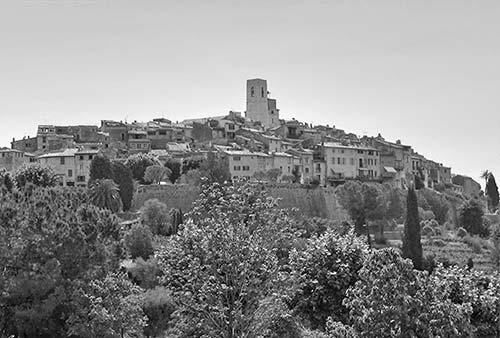
Orientation to St-Paul-de-Vence
Tourist Information: The helpful TI, just through the gate into the old town on Rue Grande, has maps with minimal explanations of key buildings, and cheap rental boules for pétanque on the square. Ask about their lantern-led evening tours in English (€12, 2/week July-Aug only; TI open daily 10:00-18:00, June-Sept until 19:00, closes for lunch on weekends, +33 4 93 32 86 95, www.saint-pauldevence.com). Fill your water bottle at the stone tap across the lane.
Arrival in St-Paul-de-Vence: Pay to park as close as you can to the village. Free parking is available at the entry to Fondation Maeght (a 20-minute walk to town but takes longer going back). Bus #655 stops on the main road, just above the village. Regardless of how you arrive, if the pedestrian lane leading into the old town is jammed, walk along the road that veers up and left after Café de la Place, and enter the town through its side door.
Sights in St-Paul-de-Vence
Old Town
St-Paul’s old town has no essential sights, though its perfectly cobbled lanes and peekaboo views delight most who come. You’ll pass two vintage eateries before piercing the walls of the old town. The recommended La Colombe d’Or is a memorable place for a meal. Back when the town was teeming with artists, this historic hotel/restaurant served as their clubhouse. Its walls are covered with paintings by Picasso, Miró, Braque, Chagall, and others who traded their art for free meals. Café de la Place is the spot to have a coffee and croissant while watching waves of tourists crash into town and the afternoon pétanque competition. Find the cool boules sculpture and think about renting a set of boules from the TI.
After entering the walls of St-Paul, meander deep to find its quieter streets and panoramic views. How many art galleries can this village support? Imagine the time it took to create the intricate stone patterns in the street you’re walking along. Visit Marc Chagall’s grave in the cemetery at the opposite end of town (easy to find with TI map), a 10-minute walk keeping straight along the main drag (from the cemetery entrance, turn right, then left to find Chagall). Walk up the stairs to the view platform above the cemetery and try to locate the hill town of Vence at the foot of an impressive mountain. Is the sea out there—somewhere?
▲Fondation Maeght
This inviting, pricey, and far-out private museum is situated a steep walk or short drive above St-Paul-de-Vence. Fondation Maeght (fohn-dah-shown mahg) offers a memorable introduction to modern Mediterranean art by gathering many of the Riviera’s most famous artists under one roof. An expansion project designed to create more space for the collection should be completed by the time you visit. (The new installation may differ slightly from the description that follows.)
Cost and Hours: €16, daily 10:00-18:00, July-Aug until 19:00, great gift shop and cafeteria, 623 Chemin des Gardettes, +33 4 93 32 81 63, www.fondation-maeght.com.
Getting There: The museum is a steep uphill 20-minute walk from St-Paul-de-Vence. Parking is usually available (and free) at the sight and in lower lots, signed Parking Conseillé. Buses stop below the museum (from the stop, walk on the main road with St-Paul village on your left, then find the road up and up on the right). From July through September, a “Maeght-Matisse” shuttle bus connects Fondation Maeght, Vence’s center, and Matisse Chapel (about hourly); see the Maeght website to confirm details.
Visiting the Museum: The founder, art dealer Aimé Maeght, long envisioned the creation of a perfect exhibition space for the artists he supported and befriended. He purchased this arid hilltop, planted 35,000 trees and shrubs, and hired the Catalan architect José Luis Sert to enact his vision.
A sweeping lawn laced with lighthearted sculptures and bending pine trees greets visitors. On the right, a chapel designed by Georges Braque—in memory of the Maeghts’ young son, who died of leukemia—features a moving purple stained-glass work over the altar. The unusual museum building is purposely low profile to let its world-class modern art collection take center stage. Works by Fernand Léger, Joan Miró, Alexander Calder, Georges Braque, Marc Chagall, and many others are thoughtfully arranged in well-lit rooms (the permanent collection is sometimes replaced by special thematic shows). Outside, in the back, you’ll find a Gaudí-esque sculpture labyrinth by Miró and a courtyard filled with the wispy works of Alberto Giacometti—both designed by the artists for these spaces.
Eating in St-Paul-de-Vence
$$ Le Tilleul (Linden Tree) is my choice for dining well in St-Paul, either at inviting tables on the broad terrace or in its comfy interior (daily, across from the TI on Place du Tilleul, +33 4 93 32 80 36, www.restaurant-letilleul.com).
Book well ahead for $$$$ La Colombe d’Or, a veritable institution in St-Paul where the menu hasn’t changed in 50 years (see description earlier). Dine on good-enough cuisine inside by the fire to best feel its pulse (closed Nov-Dec, +33 4 93 32 80 02, www.la-colombe-dor.com, contact@la-colombe-dor.com).
Vence
Vence, an appealing town set high above the Riviera, sees a fraction of the crowds that you’ll find in St-Paul. While growth has sprawled beyond Vence’s old walls and cars jam its roundabouts, the traffic-free lanes of the old city are a delight, the mountains are front and center, and the breeze is fresh. Vence bubbles with workaday life—and ample tourist activity in the day, focused on its artistic claim to fame—Matisse’s Chapel of the Rosary—but it’s quiet at night. With far fewer visitors and cooler temperatures, you’ll feel a distinct difference from the resorts lining the coast. Vence makes a handy base for travelers wanting the best of both worlds: a hill-town refuge near the sea.
Orientation to Vence
Tourist Information: Vence’s helpful TI is at the southwest corner of the main square, Place du Grand Jardin (in the Villa Alexandrine; Mon-Sat 9:00-12:00 & 14:00-18:00, closed Sun except 10:00-14:00 in July-Aug, shorter hours in winter; +33 4 93 58 06 38, www.vence-tourisme.fr). Pick up the artistic city map and a list of art galleries and bus schedules.
Arrival in Vence: Bus #9 (from Nice, about an hour) or #655 (from Cagnes-sur-Mer and St-Paul-de-Vence) drop you at the Ara bus stop/plaza just off the roundabout at Place Maréchal Juin, a 10-minute walk to the town center (along Avenue Henri Isnard or Avenue de la Résistance). If returning to Nice, your bus ticket is good for the tram as well. If arriving by car, follow signs to cité historique and park in the underground Parking Grand Jardin, near the TI. For a taxi, call +33 4 93 58 11 14, or have the TI call for you.
Markets: You’ll find a small gathering of vendors on Place du Grand Jardin most days and a big all-day antiques market there every Wednesday. If you miss market day, a handy Utile supermarket is just past the TI, barely off Place du Grand Jardin; Monoprix stores are at 12 Avenue de la Résistance, across from the entrance to the Marie Antoinette parking lot (grocery store upstairs, Mon-Sat 8:30-19:00, Sun 9:00-13:00), and at 41 Avenue Henri Isnard (same hours).
Sights in Vence
Old City
Vence’s old city is a delight to wander using the TI map and the information plaques (in English) scattered throughout town. Find the lookout to the left of the Auberge des Seigneurs hotel to get perspective on Vence’s setting. Wander into the old town and find the 11th-century Cathedral Notre-Dame, the third church to be built on this site. Peek inside to see its colorful Chagall mosaic depicting baby Moses being saved from the waters of the Nile. In the late 1940s, when the Riviera was the place to be for artistic creativity, Chagall bought a home near the Matisse Chapel; he would live in the region for the rest of his life. Find the explanatory English handouts at the entry. The proud guardian may also offer to explain the history (in limited English).
Vence Museum (Musée de Vence)
Housed in the 17th-century Château de Villeneuve (with an imposing 12th-century watchtower next door), this museum bills itself as one of the Riviera’s high temples of modern art, with a rotating slate of exhibits. Check with the TI or their website to see what’s showing.
Cost and Hours: €7, Tue-Sun 11:00-18:00, closed Mon, ask for loaner guide in English, 2 Place du Frêne, +33 4 93 58 15 78, www.museedevence.fr.
▲Chapel of the Rosary (Chapelle du Rosaire)
The chapel—a short drive or a 20-minute walk from town—was designed by an elderly and ailing Henri Matisse as thanks to a Dominican nun who had taken care of him (he was 81 when the chapel was completed). While the chapel is the ultimate pilgrimage for his fans, the experience may underwhelm others. (Picasso thought it looked like a bathroom.) The chapel’s design seems basic—white porcelain tiles, simple black designs, and floor-to-ceiling windows—but it’s a space of light and calm that many claim only a master could have created.
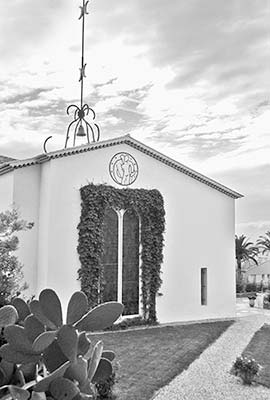
Cost and Hours: €7; Tue, Thu, and Fri 10:00-11:30 & 14:00-17:30, Wed and Sat 14:00-17:30 (Nov-March until 16:30), closed Sun-Mon and mid-Nov-mid-Dec, 466 Avenue Henri Matisse, +33 4 93 58 03 26, http://chapellematisse.fr.
Getting There: On foot, it’s a 20-minute walk from Place du Grand Jardin. Walk down Avenue Henri Isnard all the way to the traffic circle. Turn right across the one-lane bridge on Avenue Henri Matisse, following signs to St-Jeannet. By car, follow signs toward St-Jeannet, cross the bridge, and start looking for curbside parking after a few blocks—the chapel is about 400 yards after the bridge toward St-Jeannet. By bus, see Maeght Fondation listing, earlier.
Visiting the Chapel: Your visit begins in the little museum, where you’ll find a series of charcoal drawings and some photos of the artist. The famous yet modest chapel holds a simple series of charcoal black-on-white tile sketches and uses three symbolic colors as accents: yellow (sunlight and the light of God), green (nature), and blue (the Mediterranean sky). Bright sunlight filters through the stained-glass windows and does a cheery dance across the sketches.
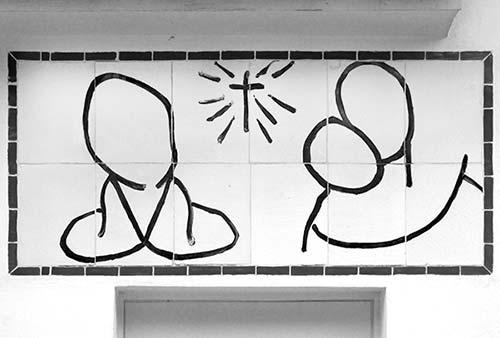
An upstairs room displays the colorful vestments Matisse designed for the priests. Outside, there’s a terrace with terrific views toward Vence, and clean WCs.
Sleeping in Vence
These places tend to close their reception desks between 12:00 and 16:00. Make arrangements in advance if you plan to arrive during this time.
$$ La Maison du Frêne is a modern, art-packed B&B with thoughtful touches everywhere and four sumptuous suites at great rates. Energetic and art-crazy Guy and son Antoine are your hosts (RS%, includes breakfast, kids under 12 free; across from the Vence Museum at 1 Place du Frêne; +33 6 88 90 49 69, www.lamaisondufrene.com, contact@lamaisondufrene.com).
$ Auberge des Seigneurs is a modest Old World place located in a 17th-century building over a restaurant that merits a visit. There are six spacious and spotless rooms, some with bathrooms in need of upgrades but all with good character (no air-con, no elevator, 1 Rue du Docteur Binet, +33 4 93 58 04 24, https://auberge-seigneurs.fr, sandrine.rodi@wanadoo.fr).
Eating in Vence
Tempting outdoor eateries litter the old town. Lights embedded in the cobbles illuminate the way after dark. The restaurants I list have similar prices and quality, and all have outside dining options.
$$ Auberge des Seigneurs, below the recommended hotel (see listing above), is the place to go for a traditional experience and excellent cuisine at fair prices (closed Sun-Mon).
$$ La Régence is a reliable brasserie with a big terrace, an appealing Art Nouveau interior, and easygoing service. Come here for a good selection of regional classics—the veggie-filled salade niçoise could feed two (daily, 10 Place du Grand Jardin, +33 4 93 24 02 10).
$$$ La Cassolette is an intimate place with romantic tables across from the floodlit church (closed Wed except July-Aug, 10 Place Clemenceau, +33 4 93 58 84 15).
$ Le Michel Ange is a sweet, kid-friendly place on an adorable square serving good-value cuisine from pizza to pasta, as well as tasty plats du jour (open for lunch Tue-Sun, dinner Fri-Sat, closed Mon, 1 Place Godeau, +33 4 93 58 32 56).
For inexpensive, casual dining, head to Place du Peyra, where you’ll find ample outdoor seating and early dinner service. At the basic $$ Bistro du Peyra, enjoy a relaxed dinner salad or pasta dish outdoors to the sound of the town’s main fountain (closed Sun-Mon off-season, 13 Place du Peyra, +33 4 93 58 67 63).