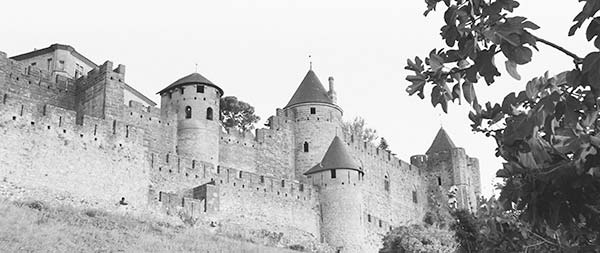
LANGUEDOC-ROUSSILLON
Albi • Carcassonne • Collioure
Cathar Sights near Carcassonne
From the 10th to the 13th century, this mighty and independent region controlled most of southern France. The ultimate in mean-spirited crusades against the Cathars (or Albigensians) began here in 1208, igniting Languedoc-Roussillon’s meltdown and eventual incorporation into the state of France.
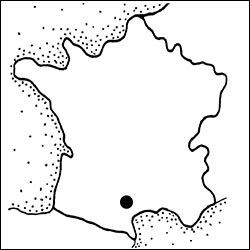
The name languedoc comes from the langue (language) that its people spoke: Langue d’oc (“language of Oc” or Occitan—Oc for the way they said “yes”) was the dialect of southern France; langue d’oïl was the dialect of northern France (where oïl later became oui, or “yes”). Languedoc-Roussillon’s language faded with its power.
The Moors, Charlemagne, and the Spanish have all called this area home, with the Roussillon part corresponding closely with its Catalan corner, near the border with Spain. The Spanish influence is still muy present, particularly in the south, where restaurants serve paella and the siesta is respected.
While sharing many of the same attributes as Provence (climate, wind, grapes, and sea), this sunny, southwesternmost region of France is allocated little time by most travelers. Lacking Provence’s cachet, sophistication, and tourism, Languedoc-Roussillon (long-dohk roo-see-yohn) feels more real. Pay homage to Henri de Toulouse-Lautrec in Albi; spend a night in Europe’s greatest fortress city, Carcassonne; scamper up to a remote Cathar castle; and sift through sand in Collioure. That wind you feel—la tramontane—is this region’s version of Provence’s mistral wind.
PLANNING YOUR TIME
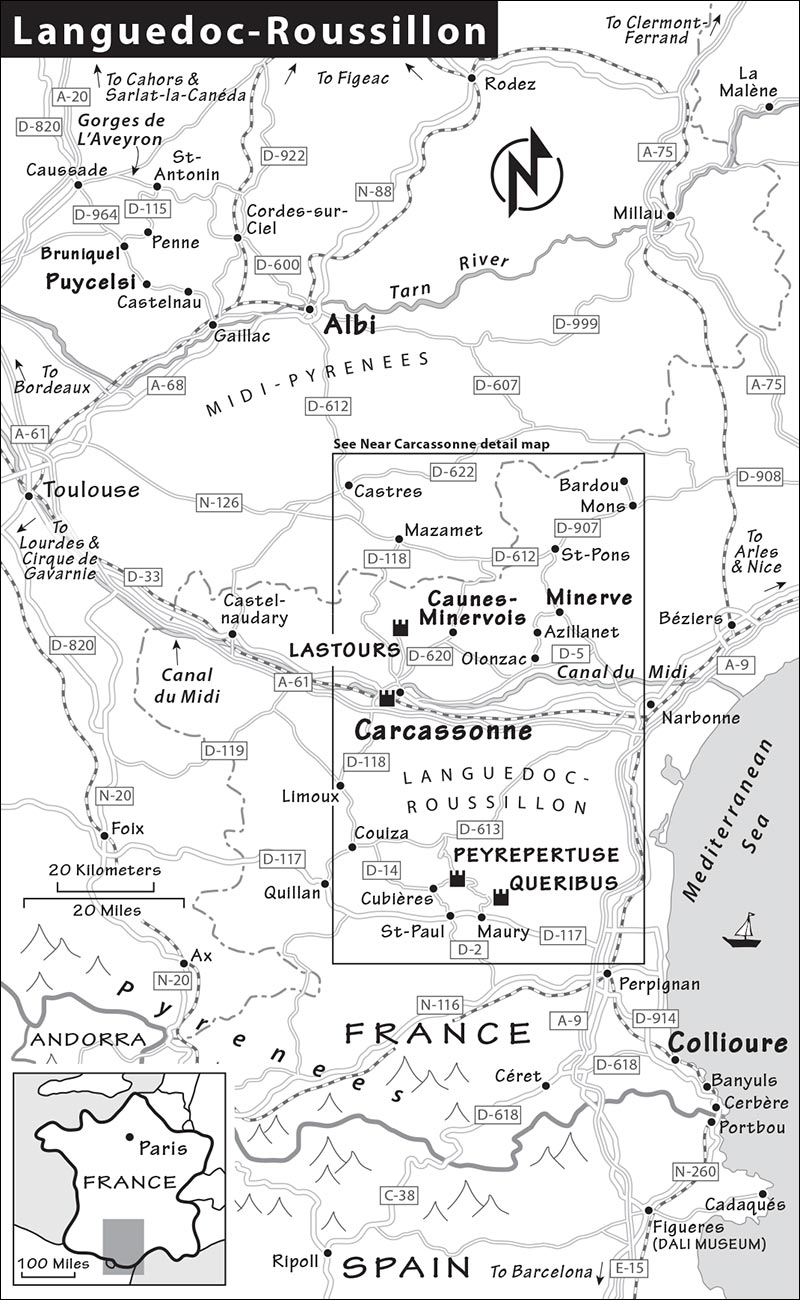
Languedoc-Roussillon is a logical stop between the Dordogne and Provence—or on the way to Barcelona, which is not far across the border.
If you’re driving between the Dordogne and Carcassonne, consider stopping for the day or overnight in Albi, Puycelsi, or St-Cirq-Lapopie (about 1.5 hours from the Dordogne’s Sarlat-le-Canéda). Figure about two autoroute hours from Albi to either the Dordogne or Carcassonne; Puycelsi is 40 minutes closer to the Dordogne. By train, Carcassonne and Albi take about the same travel time from Sarlat-la-Canéda (about 7 hours).
Plan your arrival in popular Carcassonne carefully: Get there late in the afternoon, spend the night, and leave no later than 11:00 the next morning to miss most day-trippers.
Collioure lies a few hours from Carcassonne and is your Mediterranean beach-town vacation from your vacation, where you’ll want two nights and a full day. The most exciting Cathar castles—Peyrepertuse and Quéribus—work well as stops between Carcassonne and Collioure on a scenic drive.
GETTING AROUND LANGUEDOC-ROUSSILLON
Albi, Carcassonne, and Collioure are accessible by train, but a car is essential for seeing the remote sights. Pick up your rental car in Albi or Carcassonne and consider Michelin maps #344 and #338. Roads can be pencil-thin, and traffic très slow. To find the Cathar castle ruins or the village of Minerve, you’ll need wheels of your own and a good map—or a minivan tour (see here).
If you’re connecting Languedoc with eastern regions like Provence, route D-5 between Béziers and Olonzac will escort you scenically between long lines of plane trees and along sections of the Canal du Midi.
For a side trip from Albi, choose from a scenic one-hour detour connecting Albi and points north, or with a bit more time, follow the “Route of the Bastides” (for either, see here). If you really want to joyride, take a half-day drive through the glorious Lot River Valley via Villefranche-de-Rouergue, Cajarc, and St-Cirq-Lapopie (if you’re not overnighting there—see the Dordogne chapter).
LANGUEDOC-ROUSSILLON’S CUISINE AND WINE SCENE
Hearty peasant cooking and full-bodied red wines are Languedoc-Roussillon’s tasty trademarks. While the cuisine shares common roots with Provence (olives, olive oil, tomatoes, anchovies, onions, herbs, and garlic), you’ll find a distinctly heartier cuisine in Languedoc-Roussillon. Be adventurous. Cassoulet, an old Roman concoction of goose, duck, pork, mutton, sausage, and white beans, is the main-course specialty. You’ll also see cargolade, a satisfying stew of snail, lamb, and sausage. Local cheeses are Roquefort and Pelardon (a nutty-tasting goat cheese). Closer to the Mediterranean, look for oysters from the Thau Basin; codfish brandade, made with anchovies and herbs; and Catalan tuna.
Driving through Languedoc-Roussillon reveals how important wine is to the region: Vineyards extend as far as the eye can see. This region is the single biggest wine-producing region in the world, and it accounts for over a third of France’s total wine production. This means that you need to be selective (you generally get what you pay for), but there are plenty of fine needles at good prices in this vineyard haystack.
Corbières, Minervois, and Côtes du Roussillon are the area’s good-value red wines. Syrah, grenache, mourvèdre, and carignan grapes dominate the reds, though the area also produces tasty rosés and some good white wines (made from the picpoul grape, often blended with other southern-French grapes such as bourboulenc, muscat, roussanne, and viognier). You’ll also taste good-value sparkling wines. The town of Limoux is home to a sparkling wine that predates Champagne. The regional brandy, Armagnac, tastes just like Cognac and costs less.
Albi
Albi, an enjoyable river city of sienna-tone bricks, half-timbered buildings, and a marvelous traffic-free center, is worth a stop for two world-class sights: its towering, red-brick cathedral and the Toulouse-Lautrec Museum. Lost in the Dordogne-to-Carcassonne shuffle and overshadowed by its big brother Toulouse, unpretentious yet dignified Albi rewards the stray tourist well. For most, Albi works best as a day stop, though some will be smitten by its charm and lured into spending a night.
Orientation to Albi
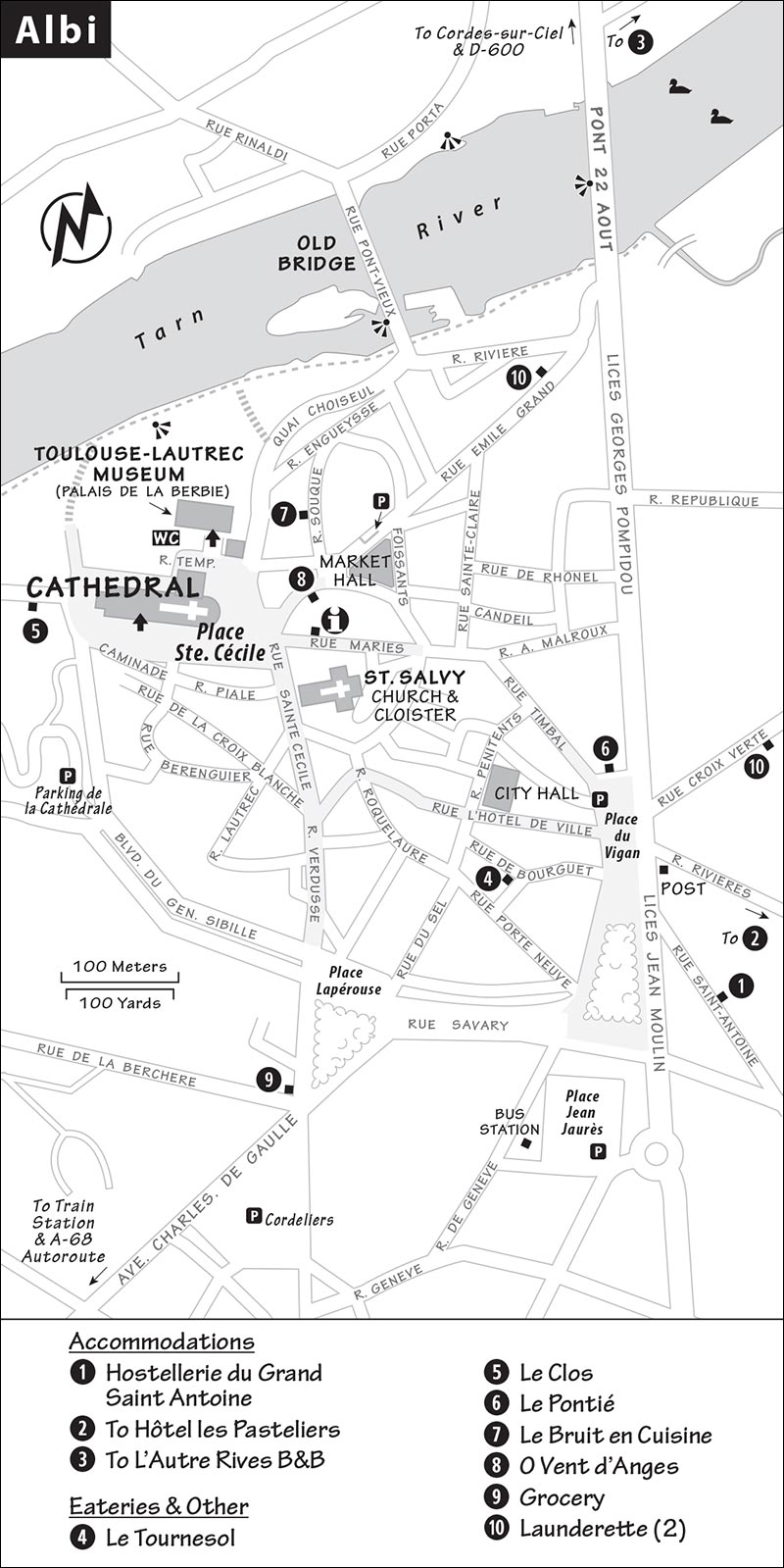
Albi’s cathedral is home base. For our purposes, this is the city center—all sights, pedestrian streets, and hotels fan out from here and are less than a 10-minute walk away. The Tarn River hides below and behind the cathedral. The best city view is from the 22 Août 1944 bridge. Albi is dead quiet on Sundays and Monday mornings.
TOURIST INFORMATION
The main TI is across the square from the cathedral, at 42 Rue Mariès (daily 9:30-18:00, shorter hours Nov-March; +33 5 63 36 36 00, www.albi-tourisme.fr). The TI can store your bags and sells a worthwhile combo-ticket that includes the Toulouse-Lautrec museum and the cathedral choir for €15 (saves €1). Ask about concerts in the cathedral and pick up two maps: one of the city center with walking tours, and the map of La Route des Bastides Albigeoises (hill towns near Albi).
ARRIVAL IN ALBI
By Train: There are two stations in Albi; you want Albi-Ville. It’s a level 15-minute walk to the town center: Exit the station, take the second left onto Avenue Maréchal Joffre, and then take another left on Avenue Charles de Gaulle. Go straight across Place Lapérouse and find the traffic-free street to the left that leads into the city center. This turns into Rue Ste. Cécile, the main shopping street that takes you to my recommended hotels and the cathedral.
By Car: Follow Centre-Ville and Cathédrale signs (if you lose your way, follow the tall church tower). The lower part of Parking de la Cathédrale is free; reasonably priced pay garages are under the market hall (Marché Couvert) and Place du Vigan. If you find a spot on the street, note that parking meters are free 12:00-14:00 and 19:00-8:00—as well as all day Sat-Sun.
HELPFUL HINTS
Market Days: The beautiful Art Nouveau market hall, a block past the cathedral square, hosts a market daily except Monday (7:00-14:00). On Saturday mornings, a lively farmers market gathers around the market hall and the TI.
Supermarkets: You’ll find Carrefour City, open long hours, at 14 Place Lapérouse. There’s also a grocery at the market hall in the city center.
Baggage Storage: The Toulouse-Lautrec Museum has lockers accessible during the museum’s open hours; the TI will also store bags for a small fee.
Laundry: Do your washing at Laverie, close to recommended hotels, 45 Rue Croix Verte (daily until 22:00); or at Lavomatique, above the river at 10 Rue Emile Grand (daily 7:00-21:00).
Taxi: Call Albi Taxi Radio (+33 6 12 99 42 46).
Tourist Train: The petit train leaves from Place Ste. Cécile in front of the cathedral and makes a 45-minute scenic loop around Albi (€8, daily in high season, buy ticket at TI).
Sights in Albi
Everything of sightseeing interest is within a few blocks of the towering cathedral. (I’ve included walking directions to connect some of the key sights.) Get oriented in the main square (see map).
Place Ste. Cécile
Grab the lone bench or a café table on the far side of Place Ste. Cécile. With the church directly in front of you, the bishop’s palace (with the Toulouse-Lautrec Museum inside) is a bit to the right. The TI is hard on your right, and the market hall is a block behind it.
Why the big church? At its peak, Albi was the administrative center for 465 churches. Back when tithes were essentially legally required taxes, everyone gave their 10 percent, or “dime,” to the church. The local bishop was filthy rich, and with all those dimes, he had money to build a dandy church. In medieval times, there was no interest in making a space so people could step back and get a perspective on such a beautiful building. A clutter of houses snuggled right up to the church’s stout walls, and only in the 19th century were things cleared away. (Just in the past few years the cars were also cleared out.)
Why so many bricks? Because there were no stone quarries nearby. Albi is part of a swath of red-brick towns from here to Toulouse (nicknamed “the pink city” for the way its rosy bricks dominate that townscape). Notice on this square the buffed brick addresses next to the sluggish stucco ones. As late as the 1960s, the town’s brickwork was considered low-class and was covered by stucco. Today, the stucco is being peeled away, and Albi has that brick pride back.
▲▲Ste. Cécile Cathedral (Cathédrale Ste. Cécile)
When the heretical Cathars were defeated in the 13th century, this massive cathedral was the final nail in their coffin. Big and bold, it made it clear who was in charge. The imposing exterior and the stunning interior drive home the message of the Catholic (read: “universal”) Church in a way that would have stuck with any medieval worshipper. This place oozes power—get on board, or get run over.
Cost and Hours: It’s free to enter the church (daily 10:00-18:30). Once inside, you’ll pay €6 to visit the choir (includes excellent audioguide describing art throughout the church, open daily from 10:00 except Sun when it opens after Mass—usually 12:00, last entry one hour before the church closes). The treasury (a single room of reliquaries and church art) isn’t worth the entry fee or the climb.
Organ Concerts: From mid-July to mid-August, concerts are held at the cathedral at 16:00 on Sun (ask TI for schedule).
 Self-Guided Tour: Visit the cathedral using the following commentary, which you can supplement with an excellent audioguide (it’s especially good if you want to know more about the church’s Last Judgment mural; pick it up as you enter the choir).
• Begin facing the...
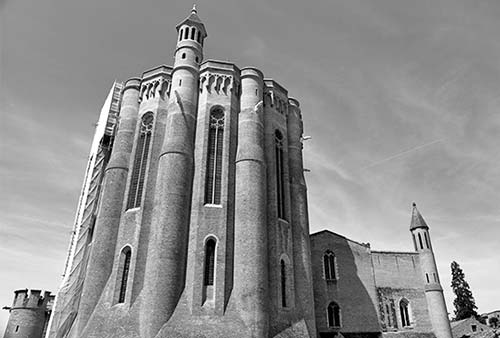
Exterior: The cathedral looks less like a church and more like a fortress, as it was a central feature of the town’s defensive walls. Notice how high the windows are (out of stone-tossing range). The simple Gothic style was typical of this region—designed to be sensitive to the antimaterialistic tastes of the local Cathars.
The top (from the gargoyles and newer, brighter bricks upward) is a fanciful, 19th-century, Romantic-era renovation. The church was originally as plain and austere as the bishop’s palace (the similar, bold brick building to the right). Imagine the church with a rooftop more like that of the bishop’s palace.
• Walk to the bottom of the cathedral’s steps and gaze up at the extravagant Flamboyant Gothic...
Entry Porch: The entry was built about two centuries after the original plain church (1494), when concerns about Cathar sensitivities were long passé. Originally colorfully painted, it provided one fancy entry.
• Head into the cathedral’s...
Interior: The inside of the church—also far from plain—looks essentially as it did in 1500. The highlights are the vast Last Judgment mural (west wall, under the organ) and the ornate choir (east end).
• Walk toward the front of the altar and find a good spot to view the...
Last Judgment Mural: The oldest art in the church (1474), this is also the biggest Last Judgment painting from the Middle Ages. The dead come out of the ground, then line up (above) with a printed accounting of their good and bad deeds displayed in ledgers on their chests. Judgment, here we come. Those on the left (God’s right) look cocky and relaxed. Those on the right—the hedonists—look edgy. The assembly above the risen dead (on the left) shows the heavenly hierarchy: The pope and bishops sit closest to the center; then more bishops and priests—before kings—followed by monks; and then, finally, commoners like you and me.
Get closer. Inspect both sides of the arch to find seven frames illustrating a wonderland of gruesome punishments that sinners could suffer through while attempting to earn a second chance at salvation. Those who fail end up in the black clouds of hell (upper right).
But where’s Jesus—the key figure in any Judgment Day painting? The missing arch in the middle (cut out in late Renaissance times to open the way to a new chapel) once featured Christ overseeing the action. A black-and-white image (left of the altar as you face the painting) provides a good guess at how this painting would have looked—though no one knows for sure.
The altar in front of the Last Judgment is the newest art in the church. But this is not the front of the church at all—the altar is to the west. Turn 180 degrees and head east, for Jerusalem (where most medieval churches point).
• Stop in front of the choir—a fancy, more intimate room within the finely carved stone “screen.” Find the desk selling tickets to the choir and pick up the included audioguide and choir plan.
Choir of the Canons: In the Middle Ages, nearly all cathedrals had ornate Gothic choir screens like this one. These highly decorated walls divided the church into a private place for clergy and a general zone for the common rabble. The screen enclosed the altar and added mystery to the Mass. In the 16th century, with the success of the Protestant movement and the Catholic Church’s Counter-Reformation, choir screens were removed. (In the 20th century, the Church took things one step further, and priests actually turned and faced their parishioners.) Later, French Revolution atheists destroyed most of the choir screens that remained—Albi’s is a rare survivor.
Follow the plan as you stroll around the choir. You’ll see colorful Old Testament figures along the Dark Ages exterior columns and New Testament figures in the enlightened interior. Stepping inside the choir, marvel at the fine limestone carving. Scan each of the 72 unique little angels just above the wood-paneled choir stalls. Check out the brilliant ceiling, which hasn’t been touched or restored in 500 years. A bishop, impressed by the fresco technique of the Italian Renaissance, invited seven Bolognese artists to do the work. Good call.
• Exit the cathedral through the side door, located about opposite the cathedral’s entrance. You’ll pass a WC on your way to the...
▲▲Toulouse-Lautrec Museum (Musée Toulouse-Lautrec)
The Palais de la Berbie (once the fortified home of Albi’s archbishop) has the world’s largest collection of Henri de Toulouse-Lautrec’s paintings, posters, and sketches.
Cost and Hours: €10, June-Sept daily 10:00-18:00; Oct-May Tue-Sun 10:00-12:30 & 14:00-18:00, closed Mon (printed English explanations in most rooms, download the museum’s app for more descriptions), lockers available, on Place Ste. Cécile.
Information: +33 5 63 49 48 70, https://musee-toulouse-lautrec.com [URL inactive].
Background: Henri de Toulouse-Lautrec, born in Albi in 1864, was crippled from youth. After he broke his right leg at age 13 and then his left leg the next year (probably due to a genetic disorder), the lower half of his body stopped growing. His father, once very engaged in parenting, lost interest in his son. Henri moved to the fringes of society, where he gained an affinity for people who didn’t quite fit in. He later made his mark painting the dregs of the Parisian underclass with an intimacy only made possible by his life experience.
Visiting the Museum: From the turnstile, walk down a few steps and enter the main floor collection.
The first room is filled with intriguing portraits of Toulouse-Lautrec painted by artists on whom he made an impact. There’s also a rare self-portrait on display.
In the next sections we see his earliest classical paintings (of horses and pets) and his boyhood doodles. In the 1880s, Henri was stuck in Albi, far from any artistic action. During these years, he found inspiration in nature, in the pages of magazines, and by observing people. This was his Impressionistic stage.
Next, go down a few more steps to see some of his first portraits of family and friends, most done in an Impressionist style.
Step into the next room for his most famous stuff: paintings of the prostitutes and brothels of Paris. In 1882, Henri moved to the big city to pursue his passion. In these early Paris works, we see his trademark shocking colors, and down-and-dirty street-life scenes emerge. Compare his art-school work to his street work: Henri augmented his classical training with vivid life experience. His subjects were from bars, brothels, and cabarets...Toto, we’re not in Albi anymore. In these exploratory years, he dabbled in any style he encountered. The naked body emerged as one of his fascinations.
Henri started making money in the 1890s by selling illustrations to magazines and newspapers. Back then, his daily happy hour included brothel visits—1892-1894 was his prostitution period. He respected the women, feeling both fascination and empathy toward them. The prostitutes accepted him the way he was and let him into their world...which he sketched brilliantly. He shows these sex workers as real humans—they are neither glorified nor vulgarized in his works.
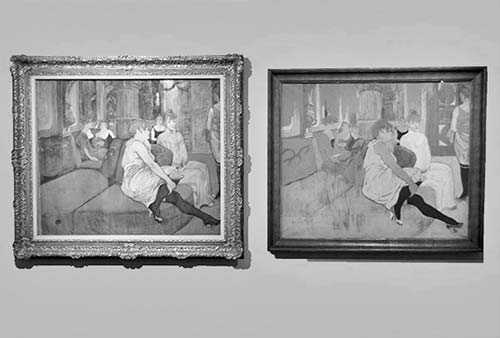
At the far end of this room, notice the big Au Salon de la Rue des Moulins (1894). There are two versions: the quick sketch, then the finished studio version. With this piece, Toulouse-Lautrec arrived—no more sampling. The artist has established his unique style, oblivious to society’s norms: colors (strong), subject matter (society’s underbelly), and moralism (none). Henri’s trademark use of cardboard was simply his quick, snapshot way of working: He’d capture these slice-of-life impressions on the fly on cheap, disposable material, intending to convert them to finer canvas paintings later, in his studio. But the cardboard quickies survive as Toulouse-Lautrec masterpieces.
Spiral up two flights through a room showing off a rare, 13th-century terra-cotta tile floor original to the building. Enter the next room on the left to find Lautrec’s famous advertising posters, which were his bread and butter. He was an innovative advertiser, creating simple, bold, and powerful lithographic images (a bit farther along, find two original lithograph blocks made by preparing the stone with a backward image, then applying ink—which sticks chemically to the black points—to print posters). Four-color posters meant creating four different blocks. Many of the displayed works show different stages of the printing process: first with black ink, then the red layer, then the finished poster. The Moulin Rouge poster established his business reputation in Paris—strong symbols, bold and simple: just what, where, and when. To your right, cabaret singer and club owner Aristide Bruant (dans son cabaret—“in his cabaret”) is portrayed as bold and dashing.
The next rooms have more advertising posters. Henri was fascinated by cancan dancers (whose legs moved with an agility he’d never experience), and he captured them expertly. Find the dancers Jane Avril and Yvette Guilbert (check out those lips), then portraits of Parisian notables and misfits, and finally the darker works he painted before his death.
One thing you will not see (because it’s unfortunately kept in storage) is Toulouse-Lautrec’s cane, which offers more insight into this tortured artistic genius. To protect him from his self-destructive lifestyle, loved ones had him locked up in a psychiatric hospital. But, with the help of this clever hollow cane, he still got his booze. Friends would drop by with hallucinogenic absinthe, his drink of choice—also popular among many other artists of the time. With these special deliveries, he’d restock his cane, which even came equipped with a fancy little glass.
In 1901, at age 37, alcoholic, paranoid, depressed, and syphilitic, Toulouse-Lautrec returned to his mother—the only woman who ever really loved him—and died in her arms. The art world didn’t mourn. Obituaries, speaking for the art establishment, said good riddance to Toulouse-Lautrec and his ugly art. Although no one in the art world wanted Henri’s pieces, his mother and his best friend—a boyhood pal and art dealer named Maurice Joyant—recognized his genius and saved his work. They first offered it to the Louvre, which refused. Finally, in 1922, the mayor of Albi accepted the collection and hung Toulouse-Lautrec’s work here in what had previously been a sleepy museum of archaeology.
Your visit continues with a few rooms showing off the one-time grandeur of the Palais de la Berbie (check out the ceilings) and two captivating paintings by 17th-century master Georges de La Tour.
If you still have stamina, you can climb up to the next floor, with a good exhibit of modern art. You’ll see works by Toulouse-Lautrec’s classmates and contemporaries, including paintings by Matisse, Degas, Brayer, and Vuillard.
• Leaving the museum, curl around to the right, following the hulking building to find a gorgeous garden overlooking a fine...
▲Albi Town View
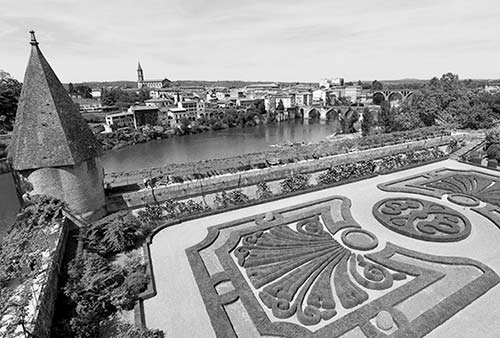
Albi is here because of its river access to Bordeaux (which connected the town to global markets). In medieval times, the fastest, most economical way to transport goods was down rivers like this. The lower, older bridge (Pont Vieux) was first built in 1020. Prior to its construction, the weir (look just beyond this first bridge) provided a series of stepping-stones that enabled people to cross the river. The garden of the bishop’s palace dates from the 17th century (when the palace at Versailles inspired the French to create fancy gardens). The palace grew in importance from the 13th century until 1789, when the French Revolution ended the power of the bishops, and the state confiscated the building. Since 1905, it’s been a museum.
• The last two sights are in the town center, roughly behind the cathedral.
St. Salvy Church and Cloister (Eglise St. Salvi et Cloître)
Although this church (the oldest in town) is nothing special, the cloister creates a delightful space embracing an ancient well (now planted) and modern garden. Find the easy-to-miss entrance on the main shopping street, Rue Ste. Cécile, a block off the main square. Delicate arches surround an enclosed courtyard, providing a peaceful interlude from the shoppers that fill the pedestrian streets. Notice the church wall from the courtyard. It was the only stone building in Albi in the 11th century; the taller parts, added later, are made of brick.
This is one of many little hidden courtyards in Albi. In the rough-and-tumble Middle Ages, most buildings faced inward. If doors are open, you’re welcome to pop into courtyards.
• Leave the cloister, go up the steps, and find a sweet square with a quiet café.
Market Hall (Marché Couvert)
Albi’s elegant Art Nouveau market is good for picnic-gathering and people-watching. There are fun lunch counters on its main floor and a grocery store on the lower level (Tue-Sun 7:00-14:00, closed Mon, 2 blocks from cathedral). On Saturdays, a lively farmers market sets up outside the market hall.
Sleeping in Albi
$$ Hostellerie du Grand Saint Antoine*** is Albi’s oldest hotel (established in 1784) and the most traditional place I list. Guests enter an inviting, spacious lobby that opens onto an enclosed garden. Some of the 30 rooms are Old World cozy, while others have modern flair (elevator, air-con, private pay parking, a block above big Place du Vigan at 17 Rue Saint-Antoine, +33 5 63 54 04 04, www.hotel-saint-antoine-albi.com, courriel@hotel-saint-antoine-albi.com).
$ Hôtel les Pasteliers** is a cool, homey place with appealing lounges, a service-oriented owner, and funky, comfortable rooms at terrific prices (air-con, no elevator, good and cheap breakfast, pay secured parking, 3 Rue Honoré de Balzac, +33 5 63 54 26 51, https://hotelsalbi.com, contact@hotellespasteliers.com).
$$ L’Autre Rives B&B may have an austere facade, but friendly Isabelle and dog Malko warmly welcome you to their big 1930s home with an inviting terrace, big garden, and pool. Each of the five rooms has a different theme, and all have contemporary comfort and personal touches (two-night minimum in July-Aug; no elevator, no air-con but the rooms stay cool; breakfast and parking included, 60 Rue Cantepau, 15-minute walk from the cathedral, +33 6 75 47 01 51, www.lautrerives.com, contact@lautrerives.com).
Eating in Albi
Albi is filled with reasonable restaurants that serve a meaty local cuisine, including plenty of duck dishes. If you’re adventurous, search out these local specialties: tripe (cow intestines), andouillette (sausages made from pig intestines), foie de veau (calf liver), and tête de veau (calf’s head). Besides the restaurants listed here, there are many tempting cafés on the squares behind St. Salvy’s cloister and in front of the market hall.
$ Le Tournesol is a good (primarily lunch) option for vegetarians, since that’s all they do. The food is delicious (with vegan options), the setting is bright with many windows and a good terrace, and the service is friendly. Try the wonderful homemade tarts (open Tue-Sat for lunch, dinner Fri and Sat in July-Aug, 11 Rue de l’Ort en Salvy, +33 5 63 38 38 14).
$ Le Clos, a short block behind the cathedral, is an old-school place (literally and figuratively) transformed into a delightful family-run restaurant with a charming courtyard laced with cheery lights and covered with umbrellas. Friendly waiters serve regional dishes including good salads, confit de canard, and foie gras (closed Tue-Wed, 3 Rue du Castelviel, +33 5 63 38 19 74).
$$ Le Pontié is Albi’s go-to brasserie with a big selection of pizzas, plats, and such and a large terrace. Interior seating is pleasant and prices are fair (daily, 1 Place du Vigan, +33 5 63 54 16 34).
$ Le Bruit en Cuisine blends modern with traditional food and offers pizza straight out of the oven. Interior tables are OK, but you’ll have a spectacular view of the cathedral (and might catch a memorable sunset) from the broad, lamp-lit terrace (reservations recommended, daily, 22 Rue de la Souque, +33 5 63 36 70 31).
$ O Vent d’Anges, on the market hall square, is Albi’s happening wine bar-café, with tables sprawling over several terraces. It’s good for an evening aperitif or small plates that can make a meal. Big salads, plats, and a delicious house burger are served during lunch only (closed Mon, brunch only on Sun, 9 Place St-Julien, +33 5 81 02 62 33).
Albi Connections
You’ll connect to just about any destination through Toulouse.
From Albi by Train to: Toulouse (hourly, 70 minutes), Carcassonne (hourly, 2.5 hours, change in Toulouse), Sarlat-la-Canéda (3/day, 7-8.5 hours with 2 changes), Paris (6/day, 6-7 hours, change in Toulouse or Montauban; also a night train with change in Toulouse—may not run every day).
Near Albi
ROUTE OF THE BASTIDES
The hilly terrain north of Albi was tailor-made for medieval villages to organize around for defensive purposes. Here, along the Route of the Bastides (La Route des Bastides Albigeoises), scores of fortified villages (bastides) spill over hilltops, above rivers, and between wheat fields, creating a ▲ detour for drivers. These planned communities were the medieval product of community efforts organized by local religious or military leaders. Most bastides were built during the Hundred Years’ War (see sidebar on here) to establish a foothold for French or English rule in this hotly contested region, and to provide stability to benefit trade. Unlike other French hill towns, bastides were not safe havens provided by a castle. Instead, they were a premeditated effort by a community to collectively construct houses as a planned defensive unit, sans castle.
Connect these bastides as a day trip from Albi, or as you drive between Albi and the Dordogne. I’ve described the top bastides in the order you’ll reach them on these driving routes.
Day Trip from Albi: For a good 80-mile loop route northwest from Albi, cross the 22 Août 1944 bridge and follow signs to Cordes-sur-Ciel (without stops, the loop takes about 2.5 hours). The view of Cordes as you approach is memorable. From Cordes, follow signs to Saint-Antonin-Noble-Val, an appealing, flat “hill town” on the river, with few tourists. Then turn south and west past vertical little Penne, Bruniquel (signed from Saint-Antonin-Noble-Val), Larroque, Puycelsi (my favorite), and, finally, Castelnau-de-Montmiral (with a lovely main square), before returning to Albi. Each of these places is worth exploring if you have the time.
On the Way to the Dordogne: For a one-way scenic route north to the Dordogne that includes many of the same bastides, leave Albi, head toward Toulouse, and make time on the free A-68. Exit at Gaillac, go to its center, and track D-964 to Castelnau-de-Montmiral, Puycelsi, and on to Bruniquel. From here you can head directly to Caussade on D-115 and D-964, then hop on the A-20 northbound (toward Cahors/Paris); from here, exits for Cahors, St-Cirq-Lapopie, Rocamadour, and Sarlat-la-Canéda are all well marked.
Cordes-sur-Ciel
It’s hard to resist this brilliantly situated hill town about 20 miles north of Albi, but I would (in high season, at least). Enjoy the fantastic view on the road from Albi and consider a detour up into town only if the coast looks clear (read: off-season). Cordes, once an important Cathar base, has slipped over the boutique-filled edge to the point where it’s hard to find the medieval town under all the shops. But it’s dramatically set, boasting great views and filled with steep streets and beautiful half-timbered buildings (TI: +33 5 63 56 00 52, www.cordessurciel.fr). Watch for the viewpoint about 1.25 miles (2 km) past the entrance of the village on the left, marked as Eglise St-Antoine.
Bruniquel
This overlooked, très photogenic, but less-tended village will test your thighs as you climb the lanes upward to the Châteaux de Bruniquel (small fee, daily 10:00-18:00, July-Aug until 19:00, closed Nov-Feb). Don’t miss the dramatic view up to the village from the river below as you drive along D-964 (about an hour northwest of Albi).
▲Puycelsi
Forty minutes north of Albi, this town crowns a high bluff overlooking thick forests and sweeping pastures. Drive to the top (passing a signed, lower lot) to find parking and an unspoiled, level village with a couple of cafés, a bistro with a view, a small grocery, a bakery, a few chambres d’hôtes, and one sharp little hotel.
From the parking lot, pass the Puycelsi Roc Café and make your way through town. Appreciate the fine collection of buildings with lovingly tended flowerbeds. At the opposite side of the village, a rampart walk yields sweeping views, reminding us of the village’s history as a bastide. The parklike ramparts near the parking area come with picnic benches, grand vistas (ideal at sunset), and a WC. It’s a good place to listen to the birds and feel the wind.
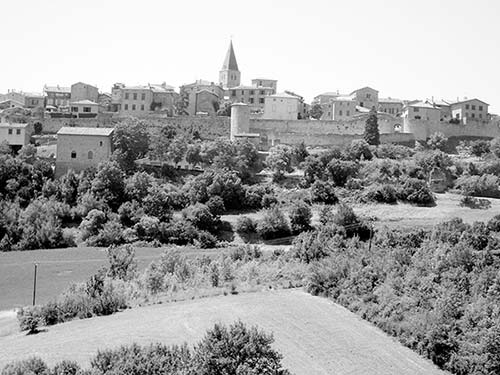
As you wander, consider the recent history of an ancient town like this. In 1900, 2,000 people lived here with neither running water nor electricity. Then things changed. Millions of French men lost their lives in World War I; Puycelsi didn’t escape this fate, as the monument (by the parking lot) attests. World War II added to the exodus and by 1968 the village was down to three families. But then running water replaced the venerable cisterns and things started looking up. Today, there is just enough commercial activity to keep locals happy. The town has a stable population of 110, all marveling at how lucky they are to live here.
Sleeping in Puycelsi: An overnight here is my idea of vacation. Church bells keep a vigil, ringing on the hour throughout the night.
$ L’Ancienne Auberge, buried deep in the village, is the place to sleep, with eight surprisingly smart and comfortable rooms, some with sublime views. Dinner is possible; reserve ahead with friendly Greg and Sophie (no air-con but ceiling fans, Place de l’Eglise, +33 5 63 33 65 90, www.ancienne-auberge.fr, aubergepuycelsi@gmail.com). Ask about their apartments that can accommodate up to four people.
$ Chambres Chez Delphine is another great choice just behind L’Ancienne Auberge. This cavelike 17th-century house is filled with a variety of rooms, ranging from a small romantic room for two to a three-bedroom suite with a kitchen, all hovering above a small garden and pool (family rooms, cash only, +33 5 63 33 13 65, www.chezdelphine.com [URL inactive]).
Eating in Puycelsi: $$ Jardin de Lys bistro-café clings to the hillside, offering breathtaking views and all-day service in July-Aug. Come for a drink at least, or, better, for dinner based on original recipes (closed Mon-Tue, +33 5 63 60 23 55). $ Puycelsi Roc Café, at the parking lot, has good café fare at very reasonable prices, a warm interior, and pleasant outdoor tables (daily for lunch and dinner in high season, +33 5 63 33 13 67).
Castelnau-de-Montmiral
This overlooked village (30 minutes northwest of Albi) has quiet lanes leading to a perfectly preserved bastide square surrounded by fine arcades and filled with brick half-timbered facades. Ditch your car below and wander up to the square, where a TI, restaurant, and café await. Have a drink or lunch on the square.
Carcassonne
Medieval Carcassonne is a 13th-century world of towers, turrets, and cobblestones. Europe’s ultimate walled fortress city, it’s also stuffed with tourists. At 10:00, salespeople stand at the doors of their main-street shops, a gauntlet of tacky temptations poised and ready for their daily ration of customers—consider yourself warned. But early, late, or off-season, a quieter Carcassonne is an evocative playground for any medievalist. Forget midday—spend the night. In fact, this is one city that can be well seen with a late afternoon arrival. There’s only one “sight” to enter, and the majesty of the place is best enjoyed after-hours.
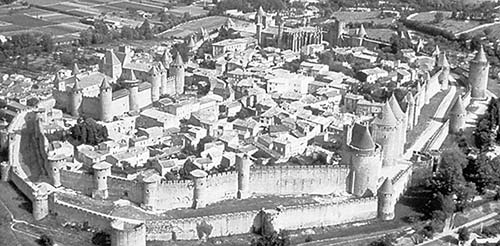
Locals like to believe that Carcassonne got its name this way: 1,200 years ago, Charlemagne and his troops besieged this fortress-town (then called La Cité) for several years. A cunning townsperson named Madame Carcas saved the town. Just as food was running out, she fed the last few bits of grain to the last pig and tossed him over the wall. Splat. Charlemagne’s bored and frustrated forces, amazed that the town still had enough food to throw fat party pigs over the wall, decided they would never succeed in starving the people out. They ended the siege and the city was saved. Madame Carcas sonne-d (sounded) the long-awaited victory bells, and La Cité had a new name: Carcas-sonne.
It’s a good story...but historians suspect that Carcassonne is a Frenchified version of the town’s original name (Carcas). As a teenage backpacker on my first visit to Carcassonne, I wrote this in my journal: “Before me lies Carcassonne, the perfect medieval city. Like a fish that everyone thought was extinct, somehow Europe’s greatest Romanesque fortress city has survived the centuries. I was supposed to be gone yesterday, but here I sit imprisoned by choice—curled in a cranny on top of the wall. The wind blows away the sounds of today, and my imagination ‘medievals’ me. The moat is one foot over and 100 feet down. Small plants and moss upholster my throne.”
Decades later, on my most recent visit, Carcassonne “medievaled” me just the same. Let this place make you a kid on a rampart, too.
Orientation to Carcassonne
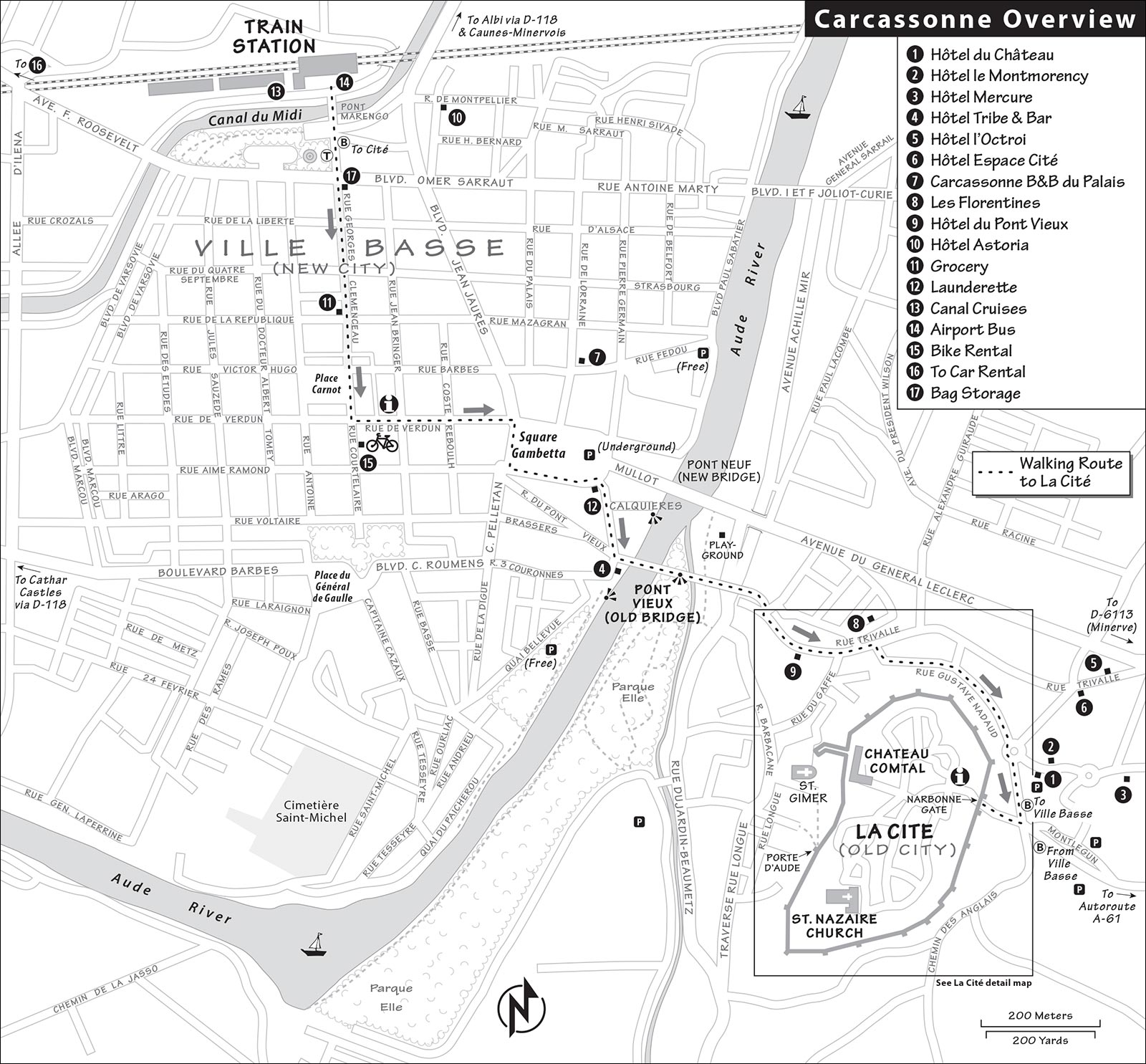
Contemporary Carcassonne is neatly divided into two cities: the magnificent La Cité (the fortified old city, with 200 full-time residents taking care of lots more tourists) and the lively Ville Basse (modern lower city). Two bridges, the busy Pont Neuf and the traffic-free Pont Vieux, both with great views, connect the two parts. The train station is separated from Ville Basse by the Canal du Midi.
TOURIST INFORMATION
The main TI, in Ville Basse, is useful only if you’re walking to La Cité (28 Rue de Verdun). A far more convenient branch is on the main street in La Cité, just after entering the main gate (Narbonne Gate—or Porte Narbonnaise). Both TIs have similar hours (July-Aug daily 9:00-19:00; otherwise Mon-Sat 9:30-18:00, Sun until 14:30, +33 4 68 10 24 30, www.tourisme-carcassonne.fr [URL inactive]).
At either TI, pick up a map of La Cité. Ask about walking tours of La Cité, offered in July and August (or follow my tour later in this section). Find cycling ideas on the website’s menu under “Practical,” then “By Bike.”
ARRIVAL IN CARCASSONNE
By Train: The train station is in Ville Basse, a 30-minute walk from La Cité (see next page for bag storage). You have three basic options for reaching La Cité: taxi, bus, or on foot.
Taxis charge €12 for the short trip to La Cité but cannot enter the city walls. Taxis usually wait in front of the train station.
Three cheaper options run to La Cité from near the train station. Public bus #4 leaves from Port du Canal—just across the canal from the station (€1, hourly Mon-Sat, 10:00-18:00). The rubber-tired electric train-bus departs across the canal from the big square on the right (€4 one-way, €6 round-trip, hourly 11:00-19:00, daily mid-June-Sept only). Schedules may be posted in the bus shelter.
An airport bus departs from in front of the station to Carcassonne’s airport, scheduled to coincide with departing flights (€6); most departures also stop at La Cité en route.
A taxi to the airport costs around €20.
The 30-minute walk through Ville Basse to La Cité ends with a good uphill climb. Walk straight out of the station, cross the canal, then follow the route shown on the “Carcassonne Overview” map in this chapter (starting up Rue Clemenceau). La Cité is signposted.
By Car: Follow signs to Centre-Ville, then La Cité. You’ll come to a drawbridge at the Narbonne Gate, the walled city’s main entrance, where day-trippers will find several huge public pay lots (about €10/6 hours). Free parking is available below on both sides of the river, but it’s more plentiful on the Ville Basse side (just north of the Pont Neuf or along Quai Bellevue; see the “Carcassonne Overview” map). Leave nothing of value in your car; theft is common in public lots. Allow 15 minutes on foot over uneven surfaces to hotels in La Cité.
HELPFUL HINTS
Market Days: The Ville Basse hosts a thriving, untouristy market on Saturday mornings until 13:00 (on Boulevard du Commandant Roumens).
Supermarkets: There’s a small one in the train station. You’ll also find a Monoprix department store (with a grocery section) where Rue Clemenceau and Rue de la République cross, a few blocks from the train station.
Baggage Storage: Friendly Sandra at the snack bar Saquette by Fred, across from the train station, stores bags (€5, 8:00-20:00, closed Tue; look under the big Le Bristol sign, +33 4 68 71 62 18).
Summer Festivals: Carcassonne becomes colorfully medieval during many special events in July and August. Highlights are the spectacle équestre (jousting matches) and July 14 (Bastille Day) fireworks. The TI has details on these and other events.
Laundry: Try Laverie Express (daily 8:00-22:00, 5 Square Gambetta by Hôtel Ibis; from La Cité, cross Pont Vieux and turn right).
Bike Rental: Bike riding is very popular thanks to the scenic towpath that follows the Canal du Midi (start at the train station). ALTERride, near the Ville Basse TI, rents standard and e-bikes (mid-June-mid-Sept daily 9:30-19:00, closed Mon rest of the year, smart to reserve ahead in high season, 16 Rue Courtejaire, +33 6 67 16 99 10, contact@alter-ride.fr).
Car Rental: Find Rent A Car a 15-minute walk from behind the train station (closed during lunch and Sun, 58 Avenue Franklin Roosevelt, +33 4 68 11 74 10, www.rentacar.fr).
Guided Excursions: Charming Wendy Gedney and her terrific team lead Vin en Vacances city walks of Carcassonne (€200/per group of up to 8), wine tastings at their tasting room, and half- or full-day vineyard tours that mix wine tasting with local food, sightseeing, and cultural experiences. Wendy and her colleagues all have excellent knowledge of the region and its wines. Tours include stops at two wineries, lunch, and visits to key sights such as the Cathar castles. All wine tours are private (prices start at €80 per person for a group of 8; more for smaller groups, see website for other tour options, +33 6 42 33 34 09, www.vinenvacances.com).
Minivan Service: Get comfortable transportation from Jean-Michel, who can take up to eight passengers to the village of Minerve, all area châteaux and sights, airports, and hotels. He’s also an English-speaking guide (for 4 passengers plan on about €350/half-day, €500/day, €49/person half-day tour for the Châteaux of Lastours; bike transport also possible; +33 6 12 27 47 01, www.sun-tour.fr, magicaltours11@gmail.com).
Tourist Train or Horse Carriage: You have two options for taking a 20-minute loop around La Cité in high season (both cost €8 and begin at the Narbonne Gate): The tourist train has headphone English commentary and loops outside the wall, while the horse-and-carriage ride is in French and clip-clops between the two walls.
Cooking Classes: British expat Linda Wearn offers classic French and Mediterranean cooking classes in nearby Caunes-Minervois. Up to eight cooks learn to prepare a meal to be enjoyed together. Companions are welcome to observe and join for lunch (€125/person, €40 companion, 10 Avenue de l’Argent Double, Caunes-Minervois—about €80 round-trip by taxi from Carcassonne, +33 7 86 49 92 71, www.latabledemiliecaunes.com).
Carcassonne Walk
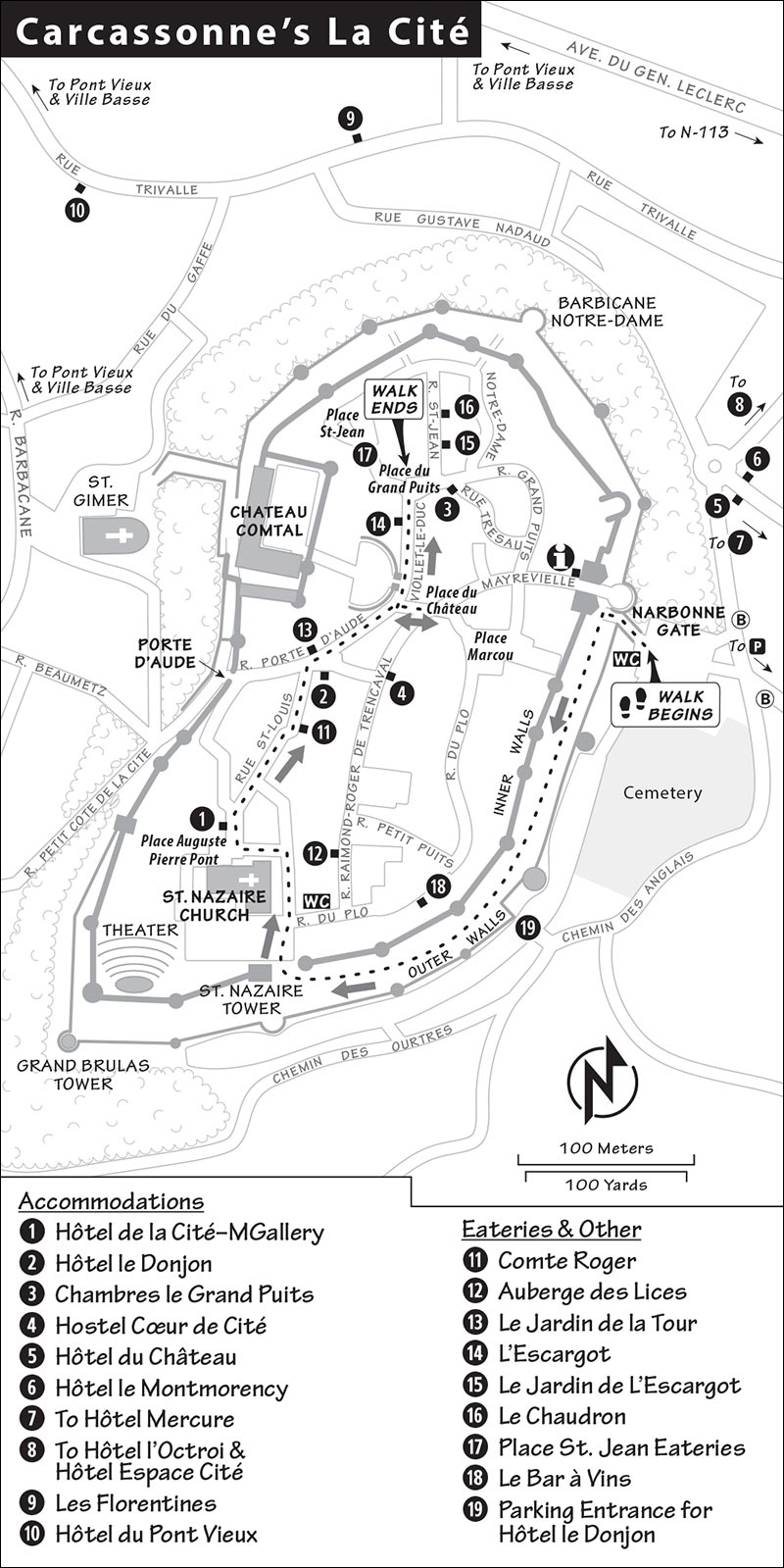
While the tourists shuffle up the main street, this self-guided walk, rated ▲▲▲, introduces you to the city with history and wonder, rather than tour groups and plastic swords. We’ll sneak into the town on the other side of the wall...through the back door (see the “Carcassonne’s La Cité” map). This walk can be done at any hour. It’s wonderfully peaceful and scenic early or late in the day, when the sun is low (but the church and castle may be closed).
• Start on the modern asphalt 20 steps outside La Cité’s main entrance, the Narbonne Gate (Porte Narbonnaise). Pause a moment to simply take in Europe’s best-preserved fortress city.
La Cité: On the pillar to the right of the gate, you’re welcomed by a 12-foot-tall, contemporary-looking bust of Madame Carcas—which is modeled after a 16th-century original of the town’s legendary first lady (for her story, see here). This relates to a ninth-century siege, during the days of Charlemagne.
But, when you gaze at the awe-inspiring turrets and ramparts of La Cité (as old Carcassonne is called), you’re really looking at an edifice from the 13th-century crusade of the king of France and the pope against the heretical Cathars (see “The Cathars” sidebar, earlier). Back then, the notion of a Paris-centered France was a dream and far from reality. This independently minded region was essentially a different country whose inhabitants spoke a different language (Occitan). It sympathized with the Cathar movement, and Carcassonne was one of its leading cities. This was an age when defenses were better than offenses, and this strategic headquarters employed state-of-the-art fortifications.
• Cross the bridge toward the...
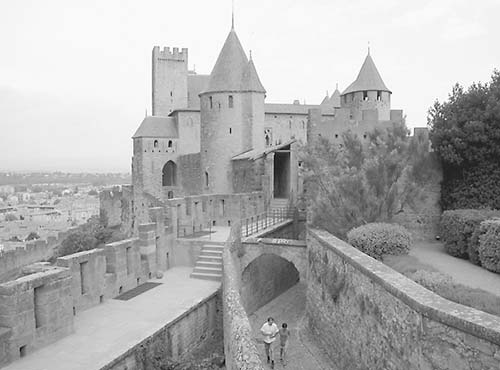
Narbonne Gate: Pause at the drawbridge and survey this immense fortification. When forces from northern France finally conquered Carcassonne, it was a strategic prize. Not taking any chances, they evicted the residents, whom they allowed to settle in the lower town (Ville Basse)—as long as they stayed across the river. (Though it’s called “new,” this lower town actually dates from the 13th century.) La Cité remained a French military garrison until the 18th century. This drawbridge was made crooked to slow attackers’ rush to the main gate and has a similar effect on tourists today.
This is La Cité’s biggest gate and worth a closer look. High above, between the two big turrets, a statue of Mary blesses all who enter. She may be blessing you, but not if you’re an enemy: The drawbridge is outfitted with “murder holes” to attack people from above, a heavy portcullis (a big iron grate) that dropped down, and huge doors bolstered by beefy sliding beams. Notice the arrow slits. (In fact, you’re already dead.) Behind you is a barbican, an extra defensive tower.
• Don’t enter the city yet. After crossing the drawbridge, lose the crowds and walk left between the walls. At the first short set of stairs, climb to the outer-wall walkway and linger while facing the inner walls.
Wall Walk: The Romans built Carcassonne’s first wall, upon which the bigger medieval wall was constructed. Identify the ancient Roman bits by looking about one-third of the way up and finding the smaller rocks mixed with narrow stripes of red bricks (and no arrow slits). The outer wall that you’re on was not built until the 13th century (after the French defeated the city), more than a thousand years after the Roman walls went up. The massive walls you see today, with 52 towers, defended an important site near the intersection of north-south and east-west trade routes.
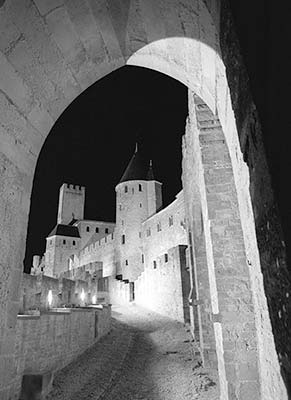
Look over the wall and down at the moat below (now mostly used for parking). Like most medieval moats, it was never filled with water (let alone alligators). A ditch like this—which was originally even deeper—effectively stopped attacking forces from rolling up against the wall in their mobile towers and spilling into the city. Another enemy tactic was to “undermine” (tunnel underneath) the wall, causing a section to cave in. Notice the small, square holes at foot level along the ramparts. Wooden extensions of the rampart walkways outside the walls (which we’ll see later, at the castle) once plugged into these holes so that townsfolk could drop nasty, sticky things on anyone trying to tunnel underneath. When you see a new section of a wall like this, it’s often an indication that the spot was once successfully undermined.
In peacetime the area between the two walls (les lices) was used for medieval tournaments, jousting practice, and markets. But during times of war, it was always kept clear so defenders could see and target anyone approaching.
During La Cité’s golden age, the 1100s, independent rulers with open minds allowed Jews and Cathars to live and prosper within the walls, while troubadours wrote poems of ideal love. This liberal attitude made for a rich intellectual life but also led to La Cité’s downfall. The Crusades aimed to rid France of the dangerous Cathar movement (and their liberal sympathizers), which led to Carcassonne’s defeat and eventual incorporation into the kingdom of France.
The walls of this majestic fortress were partially reconstructed in 1855 as part of a program to restore France’s important monuments (led by the Neo-Gothic architect Eugène Viollet-le-Duc). The tidy crenellations and the pointy tower roofs are generally from the 19th century.
As you continue your wall walk to higher points, the lack of guardrails is striking. This would never fly in the US, but in France, if you fall, it’s your own fault (so be careful). Note the lights embedded in the outer walls. This fortress, like most important French monuments, is beautifully illuminated every night (for directions to a good nighttime view, see “Night Wall Walk” under “Sights in Carcassonne,” later).
• You could keep working your way around the walls (though you may be detoured inside for a stretch if special events block your path). If you do the entire wall walk, you’ll see five authentic Roman towers just before returning to the Narbonne Gate. Walking the entire circle between the inner and outer gate is a terrific 30-minute stroll (and fantastic after dark).
But for this tour, we’ll stop at the first possible entrance into La Cité, the...
Inner Wall Tower (St. Nazaire Tower): The tower has the same four gates it had in Roman times. Before entering, notice the squat tower on the outer wall—this was another barbican (placed opposite each inner gate for extra protection). Barbicans were generally semicircular—open on the inside to expose anyone who breached the outer defenses. Notice the holes in the barbican for supporting a wooden catwalk.
While breaching the wall, study the ornate defenses. Look to the right. Damn. More arrow slits—you’re dead again. Look up to see a slot for the portcullis and the frame for a heavy wooden door. Imagine the heavy beams that would have bolstered the door against battering rams. The beam hole on the left goes back eight feet so the beam could slide. The entry is at an angle (to provide better cover). At the inner set of doors, you can see centuries-old, rusty parts of the hinge.
Once safely inside the wall, pretend you’re a defender. Hook right and station yourself in the first arrow slit, where the design gives you both range and protection. Notice how, from here, you can guard the entrance through the outer wall (immediately opposite).
• Opposite the tower stands the...
St. Nazaire Church (Basilique St. Nazaire): This was a cathedral until the 18th century, when the bishop moved to the lower town. Today, due to the depopulation of the basically dead-except-for-tourism Cité, it’s not even a functioning parish church. Step inside. Notice the Romanesque arches of the nave and the delicately vaulted Gothic arches over the altar and transepts. After its successful conquest of this region in the 13th-century Albigensian Crusades, France set out to destroy all the Romanesque churches and replace them with Gothic ones—symbolically asserting its northern rule with this more northern architectural style. With the start of the costly Hundred Years’ War in 1337, the expensive demolition was abandoned. Today, the Romanesque remainder survives, and the destroyed section has been rebuilt Gothic, leaving us with one of the best examples of Gothic architecture in southern France. When the lights are off, the interior—lit only by candles and 14th-century stained glass (some of finest in southern France)—is evocatively medieval. A plaque near the door says that St. Dominique (founder of the Dominican order) preached at this church in 1213.
• The ivy-covered luxury hotel in front of the church entrance is...
Hôtel de la Cité: This hotel sits where the bishop’s palace did 700 years ago. Today, it’s a worthwhile detour to see how the privileged few travel. You’re welcome to wander in. Find the cozy bar/library (consider returning for a pre- or post-dinner drink). Stepping into the rear garden, turn right for super wall views.
While little of historic interest survives in La Cité, along with this bishop’s palace, it was once filled with abbeys, monasteries, the headquarters of the local Inquisition, fortified noble mansions, and one huge castle within this castle—our next stop.
• Leaving the hotel, turn left and take the right fork at the medieval flatiron building. Notice the surviving timbers and medieval wattle-and-daub construction (spaces between the oak posts were filled in with twigs and sticks, then finished with a layer of clay, mud, or dung). You can see the beams were roughed up so the daub finish would attach more firmly.
Follow Rue St. Louis for several blocks. Merge right onto Rue de la Porte d’Aude, then look for a small view terrace on your left, a block up.
Château Comtal: Originally built in 1125, Carcassonne’s third layer of defense was enlarged in later reconstructions. From this impressive viewpoint you can see the wooden rampart extensions (rebuilt in modern times) that once circled the entire city wall. (Notice the empty peg holes to the left of the bridge.) During sieges, these would be covered with wet animal skins as a fire retardant. Château Comtal is a worthwhile visit for those with time and interest (see “Sights in Carcassonne,” later).
• Fifty yards away, opposite the entrance to the castle, is...
Place du Château: This busy little square sports a modest statue honoring Jean-Pierre Cros-Mayrevieille, the man who saved the city from deterioration and neglect in the 19th century (he was helped by Eugène Viollet-le-Duc, who restored Paris’ Notre-Dame Cathedral). The bronze model (considered fairly accurate) circling the base of the statue shows Carcassonne’s walls as they looked before their fanciful 1855 Neo-Gothic reconstruction.
• It’s downhill from here to the Narbonne Gate (where this walk started). But first, one last stop. Backtrack a few steps to face the château entry, then turn right and walk one block to...
Place du Grand Puits: This huge well is the oldest of Carcassonne’s 22 wells. In an age of starve-’em-out sieges, it took more than stout walls to keep a town safe—you also needed a steady supply of water and food.
• Our walk is finished. You can return to the Château Comtal entrance gate to tour the castle. Or, if you turn left at the fountain, you’ll pop out in the charming, restaurant-lined Place St-Jean; a hard left here takes you down into the château’s moat garden (free to roam) and a small gate (on the right side of the castle), which leads to the most impressive part of the city wall (around the Porte d’Aude).
Sights in Carcassonne
▲▲▲Night Wall Walk
Save some post-dinner energy for a don’t-miss walk around the same walls you visited today (great dinner picnic sites as well). The effect at night is mesmerizing: The embedded lights become torches and unfamiliar voices become the enemy. You can enter and exit the old city from two locations: Porte d’Aude, on the west side, or from the main Narbonne Gate, on the east side. From either point you can walk 15 minutes down to the Pont Vieux (old bridge) and find an unforgettable view of the floodlit walled town. Ideally, take one route down and the other back up (see the “La Cité” map).
▲▲Château Comtal and Rampart Walk
Your best look at Carcassonne’s medieval architecture is a walk through this castle-within-the-castle, followed by a walk atop the city ramparts (possible only with a castle ticket). Follow the basic panels in English (and rent the audioguide for the full story—as narrated by Eugène Viollet-le-Duc, the man who helped restore the old city in the 19th century), cross the drawbridge over the garden moat, and once inside the courtyard, enter the château on your left and climb to the top of the stairs.
Start your visit in a small theater, where a short video sets the stage (except during temporary exhibits). Next is a big model of La Cité (made in 1910 to show the city as it looked in 1300). Enjoy the black-and-white images of old Carcassonne on the walkway above. From here, a self-guided tour with posted English explanations (and your audioguide) leads you around the inner ramparts of Carcassonne’s castle. You’ll see the underpinnings of the towers and of the catwalks that hung from the walls, and learn all about medieval defense systems. The views are terrific. Your visit ends with a museum showing fragments from St. Nazaire Church and important homes.
From the castle you can climb out onto the highest city ramparts and circle about two-thirds of the old town on many narrow and steep steps. The west rampart lets you circle all the way to the St. Nazaire Tower, from where you can exit (keep your audioguide until the exit at the end of the rampart walk). The north rampart is only open to guided visits.
Cost and Hours: €9.50, daily 10:00-18:30, Oct-March 9:30-17:00, last entry to castle 90 minutes before closing, but it’s possible to enter the ramparts only after the castle closes (€6.50, daily 17:00-17:45, Oct-March 15:45-16:15); audioguide-€3; book ahead online in July and August to avoid long ticket lines, +33 4 68 11 70 70, www.remparts-carcassonne.fr.
Porte d’Aude, Pont Vieux, and Riverside Walks
A magnificent stretch of fortifications extends behind Château Comtal. The impressive gate called Porte d’Aude is central to this section and allows access from the walls down a path to Pont Vieux, a 14th-century bridge that spans the Aude River with 12 massive arches. It was built to connect La Cité with the Ville Basse, which was first populated with outcasts from La Cité. Agreements and treaties between the two towns (which did not always get along) were signed here. Today the pedestrian-only bridge provides stirring views day or night and access to walking paths along the river. Those paths run along both banks of the river, offering occasional views to the fortress and a verdant escape for runners and walkers.
Canal du Midi
Completed in 1681, this sleepy 155-mile canal connects France’s Mediterranean and Atlantic coasts and, at about its midpoint, runs directly in front of the train station in Carcassonne. Before railways, Canal du Midi was clogged with commercial traffic; today, it floats only pleasure craft. Carcassonne Croisière runs 1.5-2.5-hour canal trips from in front of the station (about €9-11, smart to book ahead, April-Oct 2-4/day, +33 6 80 47 54 33, www.carcassonne-navigationcroisiere.com).
Travelers with limited time are best off biking along the canal: The path is level, pedaling is a breeze, and you can cover far more territory than by boat—for bike rental location, see “Helpful Hints,” earlier.
Nightlife in Carcassonne
There are several low-key ways to enjoy La Cité after dark. For relief from all the medieval kitsch, savor a pricey drink in five-star, library-meets-bar ambience at the Hôtel de la Cité bar. To taste the liveliest square, with loads of tourists and strolling musicians, sip a drink or nibble a dessert on Place Marcou. Near the château, the recommended L’Escargot morphs into a convivial bar after dinner is finished.
For a peaceful drink and floodlit views from outside the wall, pause at the recommended Hôtel du Château’s broad terrace, below the Narbonne Gate (2 Rue Camille Saint-Saëns). Or check out the view from the trendy rooftop bar at Hotel Tribe in the lower town (see “Sleeping in Carcassonne,” later). To be a medieval poet, share a bottle of wine in your own private niche somewhere remote on the ramparts.
Le Bar à Vins is the only real nightclub in the old town. It’s a down-and-dirty bar with a huge open-air terrace offering lively music, plenty of drinks, gut-bomb pub grub, and a fun garden scene in the moonshadow of the wall (daily 12:00 until late in high season, 6 Rue du Plô, +33 4 68 47 38 38).
Sleeping in Carcassonne
Sleep within or near the old walls in La Cité. I’ve also listed a hotel near the train station. In the summer, when La Cité is jammed with tourists, consider sleeping in quieter Caunes-Minervois. July and August are most expensive, when the town is packed. At other times of the year, prices drop and there are generally plenty of rooms. Hotels have air-conditioning and elevators, unless noted.
IN LA CITE
Pricey hotels, good B&Bs, and an excellent youth hostel offer a full range of rooms inside the walls. The Hôtel de la Cité and Hôtel le Donjon offer private pay parking near the castle moat.
$$$$ Hôtel de la Cité-MGallery***** offers 59 rooms with deluxe everything in a beautiful building next to St. Nazaire Church. Peaceful gardens, a swimming pool and spa, royal public spaces, the elegant La Barbacane restaurant, and reliable luxury are yours—for a price (family rooms, private pay parking, Place Auguste-Pierre Pont, +33 4 68 71 98 71, www.mgallery.com, h8613@accor.com).
$$$ Hôtel le Donjon**** has 43 well-appointed rooms, a lobby with wads of character, and a great location inside the walls. Rooms are split between two buildings in La Cité (the main building and a look-alike annex across the street). The main building is most appealing, and the rooms with terraces on the garden are delightful (secure pay parking, 2 Rue Comte Roger, +33 4 68 11 23 00, www.hotel-donjon.fr, info@hotel-donjon.fr).
$ Chambres le Grand Puits, 30 yards from the grand puits (big well), is a splendid value. It has one cute double room and two cavernous apartment-like rooms that could sleep five, with kitchenette, private terrace, and sweet personal touches. Inquire in the small boutique, and say bonjour to happy-go-lucky Nicole (includes self-serve breakfast, cash only, no elevator, no air-con, 8 Place du Grand Puits, +33 4 68 25 16 67, http://legrandpuits.free.fr, nicole.trucco@club-internet.fr).
¢ Hostel Cœur de Cité is big, clean, and well-run, with an outdoor garden courtyard, a self-service kitchen, a TV room, a bar, and a welcoming ambience. If you ever wanted to bunk down in a hostel, consider doing it here—all ages are welcome; private rooms available, good deal for families. Reserve ahead for summer (no air-con, no elevator, rental towels, Rue du Vicomte Trencavel, +33 4 68 25 23 16, www.coeurdecite.org).
JUST OUTSIDE LA CITE
Sleeping just outside La Cité offers the best of both worlds: quick access to the ramparts, less claustrophobic surroundings, and easy parking.
$$$ Hôtel du Château**** and $$ Hôtel le Montmorency*** are adjacent hotels that lie barely below La Cité’s main gate and are run by the same family. Check-in, parking, and breakfast for both hotels are at Hôtel du Château. Guests enjoy an easy walk to La Cité, a snazzy pool, a hot tub, view terraces to the walls of Carcassonne, a lazy hound, and a sweet cat. Hôtel du Château gives four-star comfort with 17 sumptuous rooms (RS%—use code “RICKSTEVES,” pay parking, 2 Rue Camille Saint-Saëns, +33 4 68 11 38 38, www.hotelduchateau.net, contact@hotelduchateau.net). Hôtel le Montmorency, a few steps behind Hôtel du Château, offers très mod rooms, some with views of the ramparts. Many come with private decks or terraces (RS%—use code “RICKSTEVES,” no elevator but only one floor up, pay parking, 2 Rue Camille Saint-Saëns, +33 4 68 11 96 70, www.hotelmontmorency.com, contact@hotelmontmorency.com).
$$ Hôtel Mercure**** hides a block behind the Hôtel le Montmorency, a five-minute walk to La Cité. It rents 80 comfy rooms (“classic” rooms are snug) and has a refreshing garden, good-sized pool, big elevators, a small fitness room, a restaurant, and a warm bar-lounge. A few rooms have views of La Cité (many family rooms, free parking, 18 Rue Camille Saint-Saëns, +33 4 68 11 92 82, www.mercure.com, h1622@accor.com).
CLOSE TO LA CITE
These places are on either side of the Pont Vieux, about 15 minutes below La Cité and 15 to 20 minutes from the train station on foot.
$$ Hôtel Tribe,**** a modern hotel just across Pont Vieux, offers 70 rooms with terrific views up to La Cité—and 30 nonview rooms that you don’t want (indoor pool with views, pay parking garage, 2 Rue des Trois Couronnes, +33 4 68 25 36 10, https://all.accor.com, hb897@accor.com). Their trendy bar also has a good view.
$$ Hôtel l’Octroi*** delivers colorful, contemporary comfort, efficient service, and a young vibe from its full-service bar to its small, stylish pool and 21 rooms (RS%—use code “RICKSTEVES,” family rooms, no elevator, pay parking, 143 Rue Trivalle, +33 4 68 25 29 08, www.hoteloctroi.com, contact@hoteloctroi.com).
$ Hôtel Espace Cité,** three blocks downhill from the main gate to La Cité, is a fair value, with 48 small-but-clean, cookie-cutter rooms (no elevator, limited free parking—otherwise pay parking in garage, 132 Rue Trivalle, +33 4 68 25 24 24, www.hotelespacecite.fr, contact@hotel-espace-cite.fr).
$ Carcassonne Bed and Breakfast du Palais is a meticulously maintained, five-room chambres d’hôte (plus an apartment) that sits a 15-minute walk below La Cité and 15 minutes from the train station. British owners Mike and Peter have gorgeously furnished the homey rooms with antiques. A cool courtyard has a swimming pool to relax in. It’s a popular place, so book ahead (2-night minimum, 14 Rue de Lorraine, +33 6 77 81 08 24, www.carcassonnebandb.com, info@carcassonnebandb.com).
$ Les Florentines is a good-value five-room B&B run by amiable Fred Calme. The three bigger rooms on the street side have air-con and one has a big deck and grand views of La Cité, even from your bed. The other two rooms are smaller and without air-con, but homey and quieter (cash only, family rooms, includes breakfast, no elevator, pay parking, 71 Rue Trivalle, +33 6 25 94 88 42, www.chambres-hotes-carcassonne.fr, lesflorentines1@gmail.com).
$ Hôtel du Pont Vieux,*** with welcoming Catherine and Jean-Michel, offers 19 sharp rooms, a peaceful garden, and a small rooftop terrace with million-dollar views. Four rooms come with views to La Cité; others look over the garden (secure pay parking garage—reserve ahead, no elevator, 32 Rue Trivalle, +33 4 68 25 24 99, www.hotelpontvieux.com, info@hoteldupontvieux.com).
NEAR THE TRAIN STATION
$ Hôtel Astoria** has some of the cheapest hotel beds that I list in town, divided between a main hotel and an annex across the street. Book ahead—it’s popular. Rooms are colorful and clean (no elevator, reserve ahead for pay parking; from the train station, walk across the canal, turn left, and go two blocks to 18 Rue Tourtel; +33 4 68 25 31 38, https://astoriacarcassonne.com, info@astoriacarcassonne.com).
IN CAUNES-MINERVOIS
To experience unspoiled, tranquil Languedoc-Roussillon, sleep surrounded by vineyards in the characteristic village of Caunes-Minervois. Comfortably nestled in the foothills of the Montagne Noire, Caunes-Minervois is a 25-minute drive from Carcassonne. Take route D-118 or follow signs toward Mazamet to a big roundabout and find D-620. The town houses an eighth-century abbey, two cafés, several restaurants, a pizzeria, a handful of wineries, and only a trickle of tourists. The friendly staff at the town’s TI (in the abbey) is eager to help you explore the region. Caunes-Minervois makes an ideal base for exploring the area’s wine roads. For even more remote accommodations, see my recommendations in Couiza and Cucugnan, under “South of Carcassonne,” later.
$ Hôtel d’Alibert, in a 15th-century home with character, sits in the heart of the village. It has a mix of nicely renovated and Old World traditional rooms. It’s managed with a relaxed je ne sais quoi by Frédéric “call me Fredo” Dalibert and his son, who can help plan your wine-tasting excursion (includes breakfast, Place de la Mairie, +33 4 68 78 00 54, www.hotel-dalibert.com, frederic.guiraud.dalibert@gmail.com). Inquire ahead about meal offerings during your stay.
Eating in Carcassonne
For a social outing in La Cité, take your pick from a food circus of basic eateries on a leafy courtyard—often with strolling musicians in the summer—on lively Place Marcou. If rubbing elbows with too many tourists gives you hives, go local and dine below in Ville Basse (the new city). Cassoulet (described on here) is the traditional must. It’s a rustic peasant’s dish—beloved for sure, but locals will remind you “there’s no gourmet cassoulet” (tip: a dash of vinegar helps the digestion); big salads provide a lighter alternative. For a local before-dinner drink, try a glass of Muscat de Saint-Jean-de-Minervois.
IN LA CITE
$$$ Comte Roger has a quiet elegance that seems out of place in touristy Carcassonne. If you want one fine meal in the old town, book a table here to enjoy Chef Pierre’s fresh Mediterranean cuisine. Ask for a table on the vine-covered patio or eat in their stylish dining room. Pierre’s cassoulet comes closer than anyone to breaking the “no gourmet cassoulet” rule (closed Sun-Mon, reservations strongly recommended, 14 Rue St. Louis, +33 4 68 11 93 40, www.comteroger.com).
$$ Auberge des Lices, serving traditional plates with a rustic-plush ambience, is hidden down a quiet lane and has a courtyard with cathedral views (daily July-Aug, closed Tue-Wed Sept-June, 3 Rue Raymond Roger Trencavel, +33 4 68 72 34 07).
$$ Le Jardin de la Tour, run with panache by Elodie for many years, offers good cassoulet, duck, seafood, and a list of first-course plates (with lots of vegetables) designed for sharing family-style. Inside, you’ll feel like you’re dining in an antique shop; outside, enjoy the peaceful atmosphere in the parklike garden (closed Sun-Mon, lunch served July-Aug only, 11 Rue de la Porte d’Aude, +33 4 68 25 71 24).
$ L’Escargot is casual and welcoming, like a wine bar with tapas. The tight seating, sizzle of an open kitchen, minimal tables, wine-bottle walls, and popular following combine to create a convivial bustle. Thomas and his staff serve several gourmet salads and give their Spanish and French plates an extra twist: anise in the escargot, apple in the foie gras...and definitely no cassoulet. Reserve ahead during busy times (lunch from 12:15 and two dinner seatings: 19:00 and 21:00, three seating zones: peaceful streetside, quiet basement, busy ground-floor kitchen area, closed Wed and in Jan, 7 Rue Viollet-Le-Duc, +33 4 68 47 12 55, https://restaurant-lescargot.com).
When L’Escargot is full, they send people two blocks away to their branch Le Jardin de L’Escargot, with the same decor, menu, and prices, at 4 Rue St. Jean.
$$ Le Chaudron takes its cassoulet seriously. It’s carefully traditional, served with a salad, and may be the best in town. You’ll dine in a peaceful outdoor setting under the shade of trees, in the simple interior room, or the more refined and spacious upstairs space (closed Tue-Wed, 6 Rue St Jean, +33 4 68 71 09 08).
Castle Views on Place St. Jean: On this great little square in La Cité, several eateries compete for your business. All have outside terrace tables with views to the floodlit Château Comtal. $ Restaurant Adélaïde is a lively bistro with good prices; they serve a three-course menu with cassoulet as well as big salads (daily except closed Mon Oct-March, +33 4 68 47 66 61). Kid-friendly $$ Le Créneau, with more commotion and energy, serves creative tapas and pizzas. There’s a cafeteria vibe inside and a sunny, castle-view roof terrace. Owner-chef Paul is enthusiastic about his oysters and escargot (closed Sun evening and all day Mon off-season, +33 4 68 71 81 53).
Picnics: Basic supplies can be gathered at shops along the main drag (generally open until at least 19:30, better to buy outside La Cité). For your beggar’s banquet, picnic on the city walls or in the little park above Place Marcou.
Carcassonne Connections
From Carcassonne by Train to: Albi (hourly, 2.5 hours, change in Toulouse), Collioure (8/day, 2 hours, some require change in Perpignan or Narbonne), Sarlat-la-Canéda (3/day, 6.5-7.5 hours, 1 change usually in Bordeaux), Arles (2/day direct, 2.5 hours, more with transfer in Narbonne or Nîmes), Nice (3/day, 6 hours with change in Marseille), Paris (Gare de Lyon: hourly, 6 hours, 1 change), Toulouse (nearly hourly, 1 hour), Barcelona (2/day, 3 hours, change in Narbonne).
Cathar Sights near Carcassonne
The land around Carcassonne is carpeted with vineyards and littered with romantically ruined castles, ancient abbeys, and photogenic villages. To the south, the castle remains of Peyrepertuse and Quéribus make terrific stops between Carcassonne and Collioure (allow 2 hours from Carcassonne on narrow, winding roads; from the castles it’s another 1.5 hours to Collioure). You can also link them on a fine loop trip from Carcassonne.
Northeast of Carcassonne, two Cathar sights and the gorge-sculpted village of Minerve (45 minutes from Carcassonne) work well for Provence-bound travelers or as a day trip from Carcassonne.
Getting There: Public transportation is hopeless; taxis for up to six people cost about €470 for a daylong excursion (taxi +33 4 68 71 50 50). See here for excursion bus and minivan tours to these places.
SOUTH OF CARCASSONNE
▲▲Chateaux of Hautes Corbières
About two hours south of Carcassonne, in the scenic foothills of the Pyrenees, lies a series of surreal, mountain-capping castle ruins. Like a Maginot Line of the 13th century, these cloud-piercing castles were strategically located between France and the Spanish kingdom of Roussillon. As you can see by flipping through the picture books in Carcassonne’s tourist shops, these crumbled ruins are an impressive contrast to the restored walls of La Cité. You’ll want a hat (there’s no shade) and sturdy walking shoes—prepare for a vigorous climb.
Getting There: Connect two of these castles (but visit just one) along this incredibly scenic 2.5-hour drive. You can either make a loop from Carcassonne or continue on to the seaside village of Collioure.
From Carcassonne drive to Limoux, then Couiza. At Couiza follow little D-14 to Bugarach (passing through Languedoc’s only spa town, Rennes-les-Bains). Near Bugarach, views open to rocky ridgelines hovering above dense forests. You’ll soon see signs leading the way to Peyrepertuse. At Cubières, canyon lovers can detour to the Gorges de Galamus, driving partway into the teeth of white-rock slabs that seem to squeeze closer the farther in you go (those looping back to Carcassonne can do the whole canyon on their way back). Peyrepertuse is a short hop from Cubières; you’ll pass snack stands and view cafés on the twisty drive up. After visiting this Cathar castle, your next destination—Quéribus—is a well-signed, 15-minute drive away.
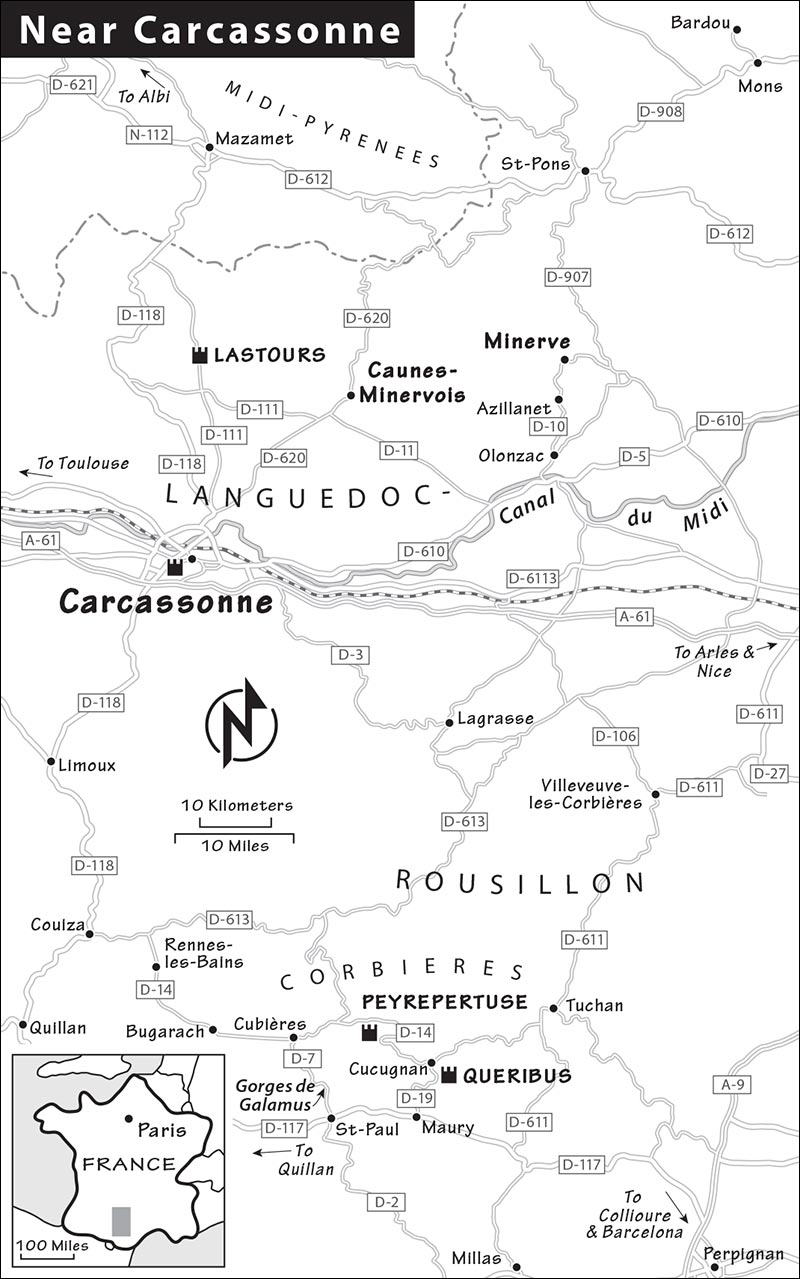
From Quéribus it’s a 1.5-hour drive to Collioure (follow signs in direction: Maury, then direction: Perpignan). If returning to Carcassonne, follow signs for Maury, then St-Paul-de-Fenouillet, then drive through the Gorges de Galamus and track D-14 to Bugarach, Couiza, Limoux, and Carcassonne.
Sleeping Along This Route: If sleeping in a 16th-century fortified castle stirs your soul, head for the peaceful village of Couiza and the $$ Château des Ducs de Joyeuse,*** where you’ll sleep like a duke at commoner prices. The sturdy castle has been renovated into a fine hotel with a pool, a pétanque field, tennis courts, and a central courtyard smothered with ambience. Enjoy a meal at its reasonably priced $$ restaurant (Allée Georges Roux, Couiza, +33 4 68 74 23 50, www.chateau-des-ducs.com, reception@chateau-des-ducs.com).
To really get away (and I mean really), sleep in the little village of Cucugnan, located between Peyrepertuse and Quéribus. The website Cucugnan.fr lists all accommodations in town, including these good places:
$ L’Ecurie de Cucugnan is a friendly bed-and-breakfast with five comfortable rooms at great rates, a view pool, and a shady garden. Joël, winemaker and owner, doesn’t speak English, but his wife (a teacher) and daughter Clara do (includes breakfast, full house rental available, 18 Rue Achille Mir, +33 4 68 33 37 42, www.ecuriedecucugnan.fr, ecurie.cucugnan@orange.fr).
$$ Ferrairolles Eco Guesthouse, about 16 miles from the castle ruins, is an elegant four-room guesthouse run by dynamic Dutchwoman Rolinka Blooming (who doubles as a Rick Steves’ Europe tour guide). Located on the scenic route from Carcassonne to Collioure in remote Villeneuve-les-Corbières, it’s 30 minutes from the Mediterranean and surrounded by Cathar castles, canyons, hiking trails, and vineyards (includes breakfast, nice pool, ask about vegetarian dinners and her tiny house accommodations, +33 6 47 53 16 34, https://rolinkablooming.com, ecoguesthouseferrairolles@gmail.com).
▲▲Peyrepertuse
The most spectacular Cathar castle is Peyrepertuse (pay-ruh-pehr-tews), where the ruins rise from a splinter of cliff: Try to spot it on your drive up from the village. From the parking lot, you’ll first hike downhill, curling around the back of the rock wall, then hike steeply up 15 minutes through a scrubby forest to the fortress. The views are sensational in all directions (including to Quéribus, sticking up from an adjacent ridge). But what’s most amazing is that they could build this place at all. This was a lookout in the Middle Ages, staffed with 25 very lonely men. Today, it’s a scamperer’s paradise with weed-infested structures in varying states of ruin. Let your imagination soar, but watch your step as you try to reconstruct this eagle’s nest—the footing is tricky. Don’t miss the St. Louis stairway to the upper castle ruins—another stiff, 10-minute climb straight up.
Cost and Hours: €7, daily 9:00-19:00, €8 July-Aug until 20:00, shorter hours off-season, theatrical audioguide-€4 for two (narrated from the perspective of a French captain posted here), free handout gives plenty of background, +33 4 30 37 00 77, www.peyrepertuse.com).
▲Quéribus
While Peyrepertuse rides along a high ridge, this bulky castle caps a mountaintop and delivers more amazing views (find the snow-covered peaks of the Pyrenees). It owns a similar history to Peyrepertuse but has an easier (but still uphill) footpath to access the site and gentler climbing within the ruins. It’s famous as the last Cathar castle to fall, and was abandoned after 1659, when the border between France and Spain was moved farther south into the high Pyrenees.
Cost and Hours: €7.50, daily 9:30-19:00—July-Aug until 20:00, Oct-April 10:00-17:00 or 18:30, theatrical audioguide-€4 for two, good handout, +33 4 68 45 03 69, www.cucugnan.fr.
NORTH OF CARCASSONNE
The next two Cathar sights provide an easy excursion north from Carcassonne, offering a taste of this area’s appealing countryside. They tie in well with a visit to the village of Caunes-Minervois (where I recommend staying—see “Sleeping in Carcassonne,” earlier).
Châteaux of Lastours
Ten scenic miles north of Carcassonne, four ruined castles cap a rugged hilltop and give visitors a handy (if less dramatic) look at the region’s Cathar castles. These castles, which once surrounded a fortified village, date from the 11th century. The village welcomed Cathars (becoming a bishop’s seat at one point) but paid dearly for this tolerance with destruction by French troops in 1227. But three of the four castles still have their towers intact.
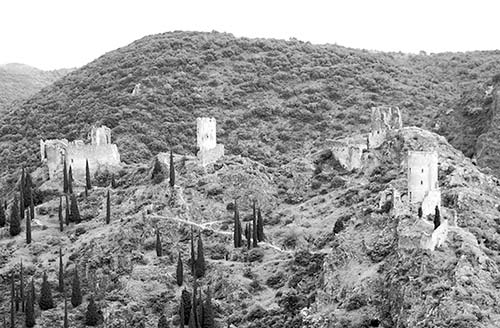
From the village of Lastours you can hike to the castles, then drive to an impressive viewpoint. Hikers park at the lot as they enter the village, walk 500 yards upriver to the modern ticket and information office, then walk 20 minutes uphill to the castles (ask for the good brochure with your ticket and allow at least an hour for a reasonable tour; good shoes and water are smart). Don’t leave sans making the short drive into the village and up to the belvédère for a smashing panorama over the castles.
Cost and Hours: Castles and belvedere viewpoint—€8, viewpoint only—€3; daily July-Aug 9:00-20:00, April-June and Sept 9:30-18:00, Oct-March 10:00-17:00; closed Dec-Jan; +33 4 68 77 56 02; www.chateauxdelastours.fr.
Getting There: From Carcassonne, follow signs to Mazamet, then Conques-sur-Orbiel, then Lastours.
▲Minerve
A onetime Cathar hideout with Celtic origins, the photogenic village of Minerve is sculpted out of a swirling canyon that provided a natural defense. Strong as it was, it couldn’t keep out the pope’s armies, and the village was razed during the vicious Albigensian Crusades of the early 1200s.
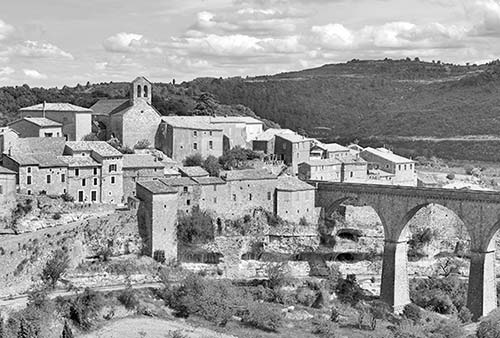
Getting There: Located between Carcassonne and Béziers, Minerve is seven miles north of Olonzac and 45 minutes by car from Carcassonne. It makes for a good stop between Provence and Carcassonne. As you approach Minerve, don’t miss the view from the bus parking lot near the bridge to the village.
Visiting Minerve: Follow the P signs to the pay parking lot above the village (good WCs). Take in the views from the cliff at the parking lot, then walk 200 yards past canyon views to enter the village and find the TI (Rue des Martyrs, +33 4 68 91 81 43, www.minervois-caroux.com). Pick up the brochure with a simple self-guided tour of the village describing Minerve’s history. Hikers should ask about trails into and above the canyon.
Minerve has cool cafés, one hotel, a nifty little bookshop, a few wine shops, and a smattering of art galleries. You’ll also find two small museums: a prehistory museum and the compact Hurepel de Minerve, with models from the Cathar era and excellent English descriptions that effectively describe this terrible time (€3.50, free for children under 14, interesting for kids, daily 10:00-13:00 & 14:00-18:00, closed Nov-March, Rue des Martyrs, +33 4 68 91 12 26).
After your village stroll, explore the canyon below by walking down to the riverbed: follow Access Remparts signs from below Café de la Place. Metal steps head down to the river, and a short-but-rough trail across the riverbed leads up to a catapult and terrific views back to Minerve. From the viewpoint, backtrack down and over to the village side of the river; from there pick up signs to Poterne to return to the town up a cobbled lane, or go back up the metal steps and turn right at the top to return to the village entrance (and to the parking lot).
Sleeping and Eating in Minerve: Stay here and melt into southern France (almost literally, if it’s summer).
$ Relais Chantovent’s unpretentious and spotless rooms are designed for those who come to get away from it all, with no phones or TV...and ample quiet. All five rooms have queen-size beds (+33 4 68 91 14 18, www.relaischantovent-minerve.fr, relaischantovent@orange.fr). Its sharp $$ restaurant has a marvelous view from its deck and deserves your business; it’s popular, so reserve ahead (open for lunch Thu-Tue 12:15-14:00, and for dinner Thu-Sat and Mon 19:30-21:00, closed Tue-Wed and Sun evening).
$ Café de la Place has light snacks, a good patio, and some tables with views.
Collioure
Surrounded by less-appealing resorts, lovely Collioure is blessed with a privileged climate and a romantic setting. By Mediterranean standards, this seaside village should be slammed with tourists—it has everything. But, outside of peak times, it is surprisingly quiet. Collioure is a pastel treat with six petite and pebbly beaches, leafy squares under a once-mighty castle, and a lighthouse to mark where the Pyrenees meet the sea.
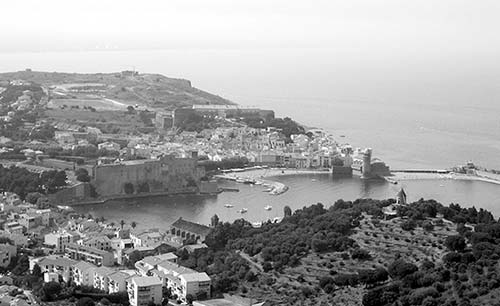
Just 15 miles from the Spanish border, Collioure (Cotlliure in Catalan) shares a common history and independent attitude with its Catalan siblings across the border. Undeniably French yet with a proud strain of Catalan, it flies the yellow and red flag of Catalunya, displays street names in French and Catalan, and sports a few business names with el and els, rather than le and les. Less than a century ago, most villagers spoke Catalan; today that language is enjoying a resurgence as Collioure rediscovers its roots.
Come here to unwind and regroup. Even with its crowds of vacationers in peak season (July and August are busy), Collioure is what many look for when they head to the Riviera—a sunny, relaxing splash in the Mediterranean.
PLANNING YOUR TIME
Check your ambition at the station. Enjoy a slow coffee on la Med, lose yourself in the old town’s streets, compare the gelati shops on Rue Vauban, sample the fine local wines, and relax on a pebble-sand beach (water shoes are helpful). The hills above Collioure deliver fantastic views whether from your car or the tourist train (described later).
Orientation to Collioure
Most of Collioure’s shopping, sights, and hotels are in the old town, near the Château Royal. You’ll find memorable views of the old town from across the bay near the recommended Hôtel Boramar and brilliant views from the hills above. You can walk from one end of Collioure to the other in 20 minutes.
TOURIST INFORMATION
The TI hides behind the main beachfront cafés at 5 Place du 18 Juin (June-Sept Mon-Fri 9:15-18:30, Sat-Sun 10:15-17:45; same hours April-June except closes Mon-Fri 12:30-14:00; shorter hours and closed Sun Oct-March; +33 4 68 82 15 47, www.collioure.com). The TI’s free app gives a good history of the town, with an emphasis on the artists who painted here (Wi-Fi required).
ARRIVAL IN COLLIOURE
By Train: Walk out of the station (baggage storage possible if you book ahead—see “Helpful Hints,” later), turn right, and follow Rue Aristide Maillol downhill for about 10 minutes until you see Hôtel Restaurant La Frégate. Before leaving the station, check the schedule for Spanish side-trips or for your next destination (station generally staffed Mon-Fri 9:15-13:00 & 14:30-18:00; ticket machine available).
By Car: Collioure is 16 miles south of Perpignan. From the autoroute, take the Perpignan-Sud Sortie exit and follow signs to Argelès-sur-Mer (also called Argelès). Pass Argelès, staying on D-914, and follow signs to Collioure par la Corniche. To reach the center, follow Collioure Centre-Ville signs, and turn left onto Rue de la République.
Parking is a challenge and almost impossible in summer—arrive early or late (see “Collioure” map for locations). There’s a central pay lot (Parking Glacis) accessed from the bottom of Rue de la République, behind the post office (about €15/24 hours). You may find a space at Parking Douy as you drop downhill toward the city center (5-minute walk to the center, 6-hour limit, €9). The best deal is Parking du Stade, a 15-minute walk from the center past Fort Miradou (on Route du Pla de las Fourques, about €2/hour). In high season, it’s easiest to park at the remote Parking Cap Dourat on the Route de Madeloc (€13/24 hours) and take the free shuttle bus into town (3/hour, daily July-Aug only, runs 10:00-24:00). Leave nothing of value in your car.
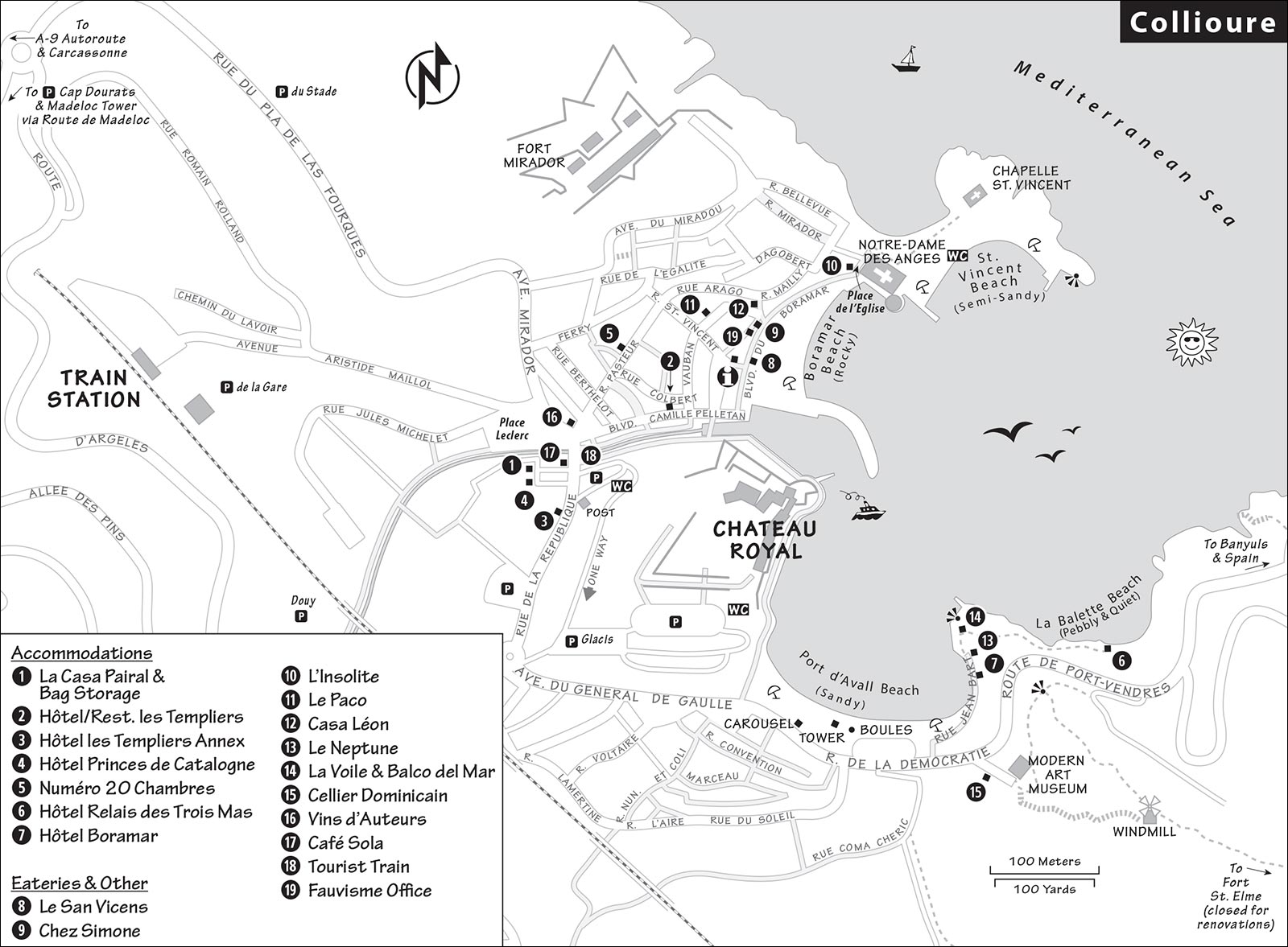
HELPFUL HINTS
Market Days: Markets are held on Wednesday and Sunday mornings on Place Général Leclerc and Place du 8 Mai 1945, across from Hôtel Frégate.
Baggage Storage: You can store your bags at the recommended La Casa Païral hotel (€10/bag, daily 7:30-22:00).
Taxi: Call +33 4 68 82 09 30 or +33 7 62 12 68 68.
Tourist Train: Collioure’s petit train leaves from the main square (next to bridge, bottom of Rue République, where you’ll find a ticket booth with departures posted). It winds on tiny lanes through vineyards, climbs 300 yards above sea level to a five-minute photo stop at Fort St. Elme, and then drops down through more lovingly terraced vineyards, cork trees, and cactus to the neighboring village of Port Vendres before returning to your starting point. There’s good recorded narration in English. You can hop out at Fort St. Elme and hike back down. You can also disembark at Port Vendres, a 45-minute walk back to Collioure (€9 round-trip, cash only, 45 minutes, departures at least on the hour 10:00-18:00; www.petit-train-touristique.com).
Sights in Collioure
Notre-Dame des Anges (Our Lady of the Angels Church)
Inviting Evening Spots in Collioure
▲Views Below the Stone Windmill
▲▲Drive/Hike Through Vineyards To Madeloc Tower (Tour de Madeloc)
There’s no important sight here except what lies on the beach and the views over Collioure. Indulge in a long seaside lunch, inspect the colorful art galleries, catch up on your diary, and maybe take a hike. Collioure’s bay caters to more than just sun-loving tourists. Don’t be surprised to see French Marines playing commando in their rafts. Sightseeing here is most romantic in the evening, when yellow lamps reflect warm pastels and deep blues.
▲View from the Beach
Walk out to the jetty’s end, past the church and the little chapel, and find a spot along the rail. Collioure has been popular since well before your visit. For more than 2,500 years, people have battled to control its enviable position on the Mediterranean at the foot of the Pyrenees. The mountains rising behind Collioure provide a natural defense, and its port gives it a commercial edge, making Collioure an irresistible target. A string of forts defended Collioure’s landlocked side. Panning from left to right, you’ll see the low-slung remains of a 17th-century fort, the still-standing Fort St. Elme (built by powerful Spanish king and Holy Roman Emperor Charles V) at the top of a hill, and then the 2,100-foot-high observation tower of Madeloc, capping the mountain peak. Topping the village to the far right is the 18th-century citadelle, Fort Mirador, now home to a French Marine base and commando training center. Scattered ruins crown several other hilltops.
Back to the left, that old windmill (1344) was originally used for grain; today it grinds out olive oil. The stony soil and dry weather conditions in the hills above Collioure are ideal for growing wine grapes. Those beautiful terraced vineyards, averaging 250 days of sunshine a year, grow primarily grenache, syrah, and mourvèdre grapes, which make tasty reds and rosés.
Collioure’s medieval town hunkers down between its church and royal château. The town was batted back and forth between the French and Spanish for centuries. Locals just wanted to be left alone—as Catalans (and most still do today; notice the yellow-and-red Catalan flag flying above the château). The town was Spanish for nearly 400 years before becoming definitively French in 1659 (thanks to Louis XIV). After years of obscurity, Collioure was rediscovered by artists drawn to its pastel houses and lovely setting. Henri Matisse, André Derain, Pablo Picasso, Georges Braque, Raoul Dufy, and Marc Chagall were all inspired to paint here at one time or another. You may recognize Collioure in paintings in many museums across Europe.
Château Royal (Royal Castle)
The 800-year-old castle, built over Roman ruins, served as home over the years to Majorcan kings, Crusaders, Dominican monks, and Louis XIV (who had the final say on the appearance we see now). It served as an internment camp after the Spanish Civil War and again after World War II. Today it’s a sprawling vacant shell, giving tourists a place to prowl, offering rampart walks, harbor views, and a home to local history and art exhibits.
Cost and Hours: €7, free first Sun of month Oct-June, daily 10:00-18:00, July-Aug 9:30-18:30, Nov-March 10:00-17:00, +33 4 68 82 06 43.
Notre-Dame des Anges (Our Lady of the Angels Church)
This waterfront church is worth a look (daily 8:30-16:30). Supporting a guiding light (for ships as well as souls), the church’s foundations are built into the sea, and its one-of-a-kind lighthouse/bell tower helped sailors return home safely. The highlight is its over-the-top golden altar, unusual in France but typical of Catalan churches across the border. Drop €1 in the box to the left of the altar: lights, cameras, reaction—oh là!
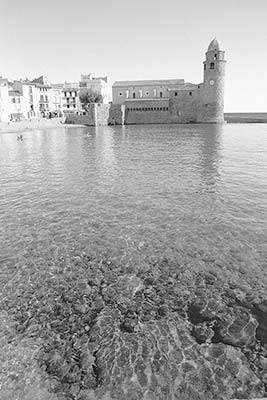
Fauvism
Art lovers will enjoy meandering along the harborfront (Boulevard Boramar) and seeing seven copies of paintings by Derain and Matisse—inspired by the artists’ stays in Collioure in 1905—mounted as panels along sidewalk walls. Two additional panels are past the church, and two more are along Avenue du Mirador in the quieter and more colorful part of town that you reach by taking the steps in front of the church. The Vitrine sur le Fauvisme office, behind the TI at 10 Rue de la Prud’homie, sells a “Fauvism” booklet. A touch screen here gives a deeper perspective on the early-20th-century artistic period (ask about walking tours; Mon-Sat 9:15-12:30 & 14:00-18:15; closed Sun and Nov-March).
If you enjoyed seeing these copies, you can view a good collection of original paintings by Derain and Matisse in the museum in Céret (see “Near Collioure,” later) and in the recommended Hôtel les Templiers.
Stroll Around the Bay
A highlight of any Collioure visit is to walk the length of the harbor and the various scooped-out beaches of the bay. Empty picture frames play on the town’s heritage of inspiring artists for your photo fun. Between the church and the castle, look for memorial winches (by the Copacabana restaurant, for example) that recall the days when anchovy boats were hauled onto the beach—back when anchovies didn’t ornament tourist salads but helped hungry locals get through the winter. An easy promenade runs around the base of the château to the Port d’Avall beach. While strolling, notice Anchois Roque (a traditional anchovy shop) across the street from the beachfront carousel. A bit beyond that is the Cellier Dominicain, offering a good wine tasting (see below). Follow the promenade to the end of the line (La Balette), where you’ll find the laid-back Balco del Mar bar with exceptional views of Collioure. From here, you can return the way you came, or climb up the stairs to the road, then make your way up to a stone windmill before coming back to town (see “Walks and Hikes,” later).
Beaches (Plages)
You’ll usually find the best sand-to-stone ratio at Plage de Port d’Avall or Plage St. Vincent (chaise lounge rental-€40/day for 2, paddleboat/kayak rentals-€15/hour, summer only). The tiny Plage de la Balette is quietest but rocky, with brilliant views of Collioure and a stone skipper’s nirvana. All three spots come with beach showers.
Wine Tasting
Collioure and the surrounding area produce well-respected wines, and many shops offer informal tastings of the sweet Banyuls and Collioure reds and rosés. Cellier Dominicain is ideal for tasting, with a fine selection at good prices and a helpful staff who offer a one-hour cellar tour for a small fee on Thursday and Saturday afternoons in season (free tasting, open daily 9:00-12:00 & 13:30-18:00, closed Sun in off-season, cellar tours usually run at 16:00, near the Hôtel Triton on Place Orphila, +33 4 68 82 05 63).
For a good selection of wines from many wineries and fair prices, try Vins d’Auteurs (next to Hôtel Frégate at 6 Place Maréchal Leclerc, daily, +33 4 68 55 45 22).
Inviting Evening Spots in Collioure
Collioure has no shortage of cafés and bars where you can enjoy views of the village, sip a drink beachside, or mix it up with locals in the old town. Balco del Mar is the place to savor a seaside drink with memorable views of Collioure’s old town (daily 11:00 to late, near Plage de la Balette, behind and below La Voile restaurant). The cafés along the harborfront on the old city side offer a sandy scene (see “Eating in Collioure”). The recommended Le Paco, tucked in the old town, is a lively Spanish-feeling pub crammed with locals (open late). Café Sola is a local and lively standby (2 Rue de la République, next to the recommended Hôtel Casa Pairal).
WALKS AND HIKES
The views described here offer different perspectives of this splendid area.
▲Views Below the Stone Windmill
Stone steps lead five minutes up behind Collioure’s modern art museum to fine views that are positively peachy at sunset. Find the museum’s gateway behind Hôtel Triton, and walk through its stony backyard. Red le moulin signs recommend a clockwise loop up to the windmill and back: Bear left (hugging the museum’s back) and climb up the steps to a small, square structure with fine views. From here, you can huff up another five minutes to the windmill itself (interesting to see, though the views are less obstructed from below). The windmill is also the starting point for the next hike.
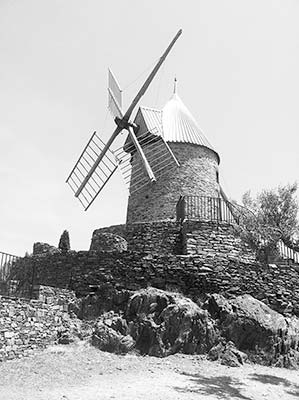
▲Hike to Fort St. Elme
This vertical hike is best done early or late (there’s no shade) and is worth the sweat, even if you don’t make it to the top (trail starts from windmill described above, allow 30 minutes from there each way). You can’t miss the square castle lurking high above Collioure. Closed for renovations likely through 2025, the privately owned castle was built in 1552 by Holy Roman Emperor Charles V and has a rich history (www.fortsaintelme.com [URL inactive]). To avoid the hike up, take the tourist train to the fort and then walk back down (see “Helpful Hints,” earlier). Cheaters can drive here via Port Vendres.
▲▲Drive/Hike Through Vineyards to Madeloc Tower (Tour de Madeloc)
Check your vertigo at the hotel, fasten your seatbelt, and take this drive-and-hike combination high above Collioure. The narrow road, hairpin turns, and absence of guardrails only add to the experience, as Collioure shrinks to Lego size and the clouds become your neighbors. Drive as far as you like on this route—the views become exceptional quickly and turnouts allow for panorama appreciation and easy turnarounds. Drive carefully—the road is popular with serious bicycle riders. If you plan to go up to Madeloc Tower, be aware that there’s no shade—do this hike early or late in the day.
Leave Collioure, heading toward Perpignan, and look for signs reading Tour de Madeloc at the roundabout. Climb through steep and rocky terraced vineyards, still following signs and negotiating countless hairpin turns. About eight kilometers past the roundabout, turn right at the intersection toward Balcon de Madeloc (where you see a sign to Port Vendres). In three more kilometers (about 20 minutes after you leave Collioure), you’ll come to a fork in the road with a paved path (marked by a “no entry” symbol that applies to cars) and a road leading downhill. Park at the fork, and walk up the paved path. The views are everywhere and magnificent—the Pyrenees on one side, and the beach towns of Port Vendres and Collioure on the other. Just 15 minutes of walking will get you to Pyrenees views; allow 30 minutes at a slow-yet-steady pace along the splintered ridgetop to reach the eagle’s-nest setting of the ancient tower (La Tour), now fitted with communication devices. Here you can commune with the gods.
NEAR COLLIOURE
The 15-mile, 40-minute coastal drive via the Col de Banyuls into Spain is beautiful and well worth the countless curves, even if you don’t venture past the border. If you make it to the border, park and check out the abandoned (and strangely lost-in-time) border station. It’s from the pre-EU era, when passports were stamped and money was exchanged with each new country.
To visit the wild Salvador Dalí Theater-Museum, follow the autoroute to Figueres, which takes about an hour each way (museum—€17 Sept-June, €21 July-Aug; buy a timed-entry ticket online in advance to avoid the risk of not getting in on busy days, €1 extra to purchase ticket in person; July-Aug daily 9:00-20:00; Sept-June Tue-Sun 10:30-18:00, closed Mon; last entry 45 minutes before closing, Spanish tel. +34 972 677 500, www.salvador-dali.org).
Ambitious train travelers can also day-trip to Spain, either to Barcelona or to the closer Figueres (see “Collioure Connections” at the end of this chapter). Get train schedules at the station.
Céret
To see the art that Collioure inspired, you’ll have to drive 25 winding miles inland to this pleasing town, featuring fountains and mountains at its doorstep. Céret’s claim to fame is its modern art museum, with works by some of Collioure’s more famous visitors, including Picasso, Joan Miró, Chagall, and Matisse (€10, daily 10:00-19:00, Oct-June until 18:00 and closed Mon, +33 4 68 87 27 76, www.musee-ceret.com). Allow 40 minutes to Céret by car, or ride the bus from Perpignan—ask at Collioure’s TI.
Sleeping in Collioure
Collioure has a fair range of hotels at favorable rates. You have two good choices for your hotel’s location: central, in the old town (closer to train station); or across the bay, with views of the old town (10-minute walk from the central zone, with easier parking). Unless noted, these accommodations have air-conditioning and elevators.
IN THE OLD TOWN
To orient you to the hotel locations, I’ve used the landmark Hôtel Frégate, at the edge of the old town, a 10-minute walk down from the train station.
$$$ La Casa Païral,**** opposite Hôtel Frégate and hiding down a short alley (behind Café Sola), is a Mediterranean-elegant oasis. Enter to the sounds of a fountain gurgling in the flowery courtyard. Reclining lounges await in the garden and by the pool. The rooms are quiet and tastefully designed; “collection” rooms cost more and have either high ceilings or small balconies over a courtyard (closed in winter, no elevator, pay parking—reserve ahead, good breakfast, bag storage, Impasse des Palmiers, +33 4 68 82 05 81, www.hotel-casa-pairal.com, contact@hotel-casa-pairal.com).
$ Hôtel les Templiers,** with two buildings in the heart of the old town, has wall-to-wall paintings in its main building, a perennially popular café-bar, low-key management, and good-value rooms. The paintings are payments in kind and thank-yous from artists who have stayed here: In the bar is a black-and-white photo of the hotel’s owner with Picasso. In the main (and best) building—where you’ll check in—choose between a view to the castle or facing the quieter back lane; many rooms here have traditional Catalan furniture. The annex, a five-minute walk away on 16 Rue de la République, is a notch lower in quality and price, with no reception and no elevator (main hotel is a block toward beach from Hôtel Frégate along drainage canal at 12 Quai de l’Amirauté, +33 4 68 98 31 10, www.hotel-templiers.com, contact@hotel-templiers.com).
$ Hôtel Princes de Catalogne*** offers 30 comfortable, spacious, well-maintained rooms. For maximum quiet, get a room on the mountain side, or côté montagne (some view rooms, family rooms, pay parking, next to Hôtel Casa Pairal, Ruedes Palmiers, +33 4 68 98 30 00, www.hotel-princescatalogne.com, contact@hotel-princescatalogne.com).
$ Numéro 20 Chambres, with eager-to-help hosts Véronique and Noël, is a good budget value. Their four rooms are simple, clean, spacious, and suitable for families, with small fridges, coffeemakers, and microwaves; beds can be a bit short for tall people (family rooms, cash only, no elevator, on pedestrian street two blocks past Hôtel Frégate at 20 Rue Pasteur, +33 4 68 82 15 31, +33 6 17 50 16 89, www.collioure-chambre-peroneille.fr, numero20ruepasteur@gmail.com).
ACROSS THE BAY
$$$ Hôtel Relais des Trois Mas**** clings to the hill above La Balette beach and delivers 23 modern and comfortable rooms, many with killer views (standard rooms have smaller beds). They have the best view pool and whirlpool in Collioure (no elevator but just two floors, several large suites, free valet parking, Michelin-star $$$$ restaurant with dinner menus from €95 and lunch menus from €65 (restaurant closed Mon-Tue, Route de Port Vendres, +33 4 68 82 05 07, www.relaisdestroismas.com, contact@relaisdes3mas.com).
$ Hôtel Boramar,** across the bay from Collioure’s center, is understated and modest (like its owner Thierry), but well maintained (also like Thierry) and a terrific value. Ten of the 14 rooms face the water, many with balconies, and a fine breakfast terrace faces the beach (family rooms, no air-con, no elevator, Wi-Fi in lobby, Rue Jean Bart, +33 4 68 82 07 06, www.hotel-boramar.fr, hotelboramar.collioure@orange.fr).
Eating in Collioure
Test the local wine and eat anything Catalan, including the fish and anchovies (hand-filleted, as no machine has ever been able to accomplish this precise task). Most of my recommended restaurants have indoor and outdoor tables and are located in the old town. Several delicious gelati shops and a Grand Marnier crêpe stand next to the Copacabana restaurant fuel after-dinner strollers with the perfect last course. Many restaurants close in bad weather and through the winter.
Eating Cheaply: Small places sell a variety of meals to go (à emporter; ah em-pohr-tay) for budget-minded romantics wanting to dine on the bay. There’s a shady harborside park under Château Royal with handy benches and fine views.
HARBORFRONT STRIP
A string of waterside eateries (behind the TI) delivers café fare with a view, mostly mediocre values, and a fun beachside scene. All are open daily.
$$$ Le San Vicens (2 Boulevard du Boramar) and its next-door neighbors have great seating at their beachside tables but meals are so-so; they’re better for a drink or dessert.
Just off the beach, $$ Chez Simone, a lighthearted and popular place, serves plats with sea views. Enticing tapas sampler plates are a fun way to enjoy some variety (closed Mon, 7 Rue Mailly, +33 4 34 29 93 47).
$ L’Insolite is a modest place offering salads, burgers, seafood, and a nicer view from a quieter perch near the church, with outdoor tables only (daily, off-season until 18:00, 4 Place de l’Eglise, +33 4 68 82 22 94).
IN THE OLD TOWN
$$ Le Paco, close and dark, is a lively little place drenched in south-of-the-border character. The offerings of French/Catalan cuisine, served to a mostly local crowd, include a variety of tapas and select other dishes (closed Thu, some outdoor seating, on a tiny lane two blocks off the harbor at 18 Rue Rière, +33 4 68 82 90 91).
$$$ Casa Léon offers some of the town’s freshest Mediterranean cuisine, served in a tight-but-fun interior or at outside tables. The massive parillade de poissons seafood plate (about €39) is their specialty, though the anchovy dishes and dorado are also delicious (daily, one block from the bay, 2 Rue Rière, +33 4 68 82 10 74).
$$ Hôtel-Restaurant les Templiers, with painting-lined walls, a tiled floor, and cushioned benches, is popular with locals and dishes up Catalan-inspired plates and excellent seafood (daily, 12 Quai de l’Amirauté, +33 4 68 98 31 10).
HARBORFRONT SOUTH OF THE CASTLE
Some of the town’s best values are just south of the castle, facing the Port d’Avall beach. When you take your harborside stroll, drop into each to consider an evening meal, and, if you like the Neptune, reserve the table of your dreams.
$$$ Le Neptune is an elegant restaurant where you’ll want to wear your nicest; it’s borderline stuffy but clearly offers the best dressy value in town. Foodies will love the adventurous and well-presented dishes, and those on a budget can dine elegantly with their €42 menu. There are harbor views for all, with outdoor seating below and a covered dining room on top that feels al fresco (closed Mon-Tue, reservations a must, 9 Route de Port-Vendres, +33 4 68 82 02 27, www.leneptune-collioure.com).
$$ La Voile (“The Sail”), next to Le Neptune, perches under three decorative sails with open seating, a long counter facing the sea, and a yacht-club vibe. It’s casual with hearty fish dishes and good-enough dinner salads. They only take reservations a couple of hours before service and close in bad weather (daily, 9 Route de Port-Vendres). Their harborside bar below, Balco del Mar, is inviting any time of day.
Collioure Connections
From Collioure by Train to: Carcassonne (8/day, 2 hours, some require change in Perpignan or Narbonne); Paris (hourly, 7 hours, 1-2 changes); Barcelona, Spain (3/day, 2.5 hours, most change in Perpignan); Figueres, Spain (6/day, 1.5-2 hours, most change in Perpignan or Portbou); Avignon/Arles (6/day, 3.5-4.5 hours, several transfer points possible).