DORDOGNE
Sarlat-la-Canéda • Dordogne River Valley • Cro-Magnon Caves • Oradour-sur-Glane • St-Emilion • Rocamadour • Lot River Valley
Prehistoric Sights at a Glance
Orientation to Sarlat-la-Canéda
The Best of the Dordogne River Valley
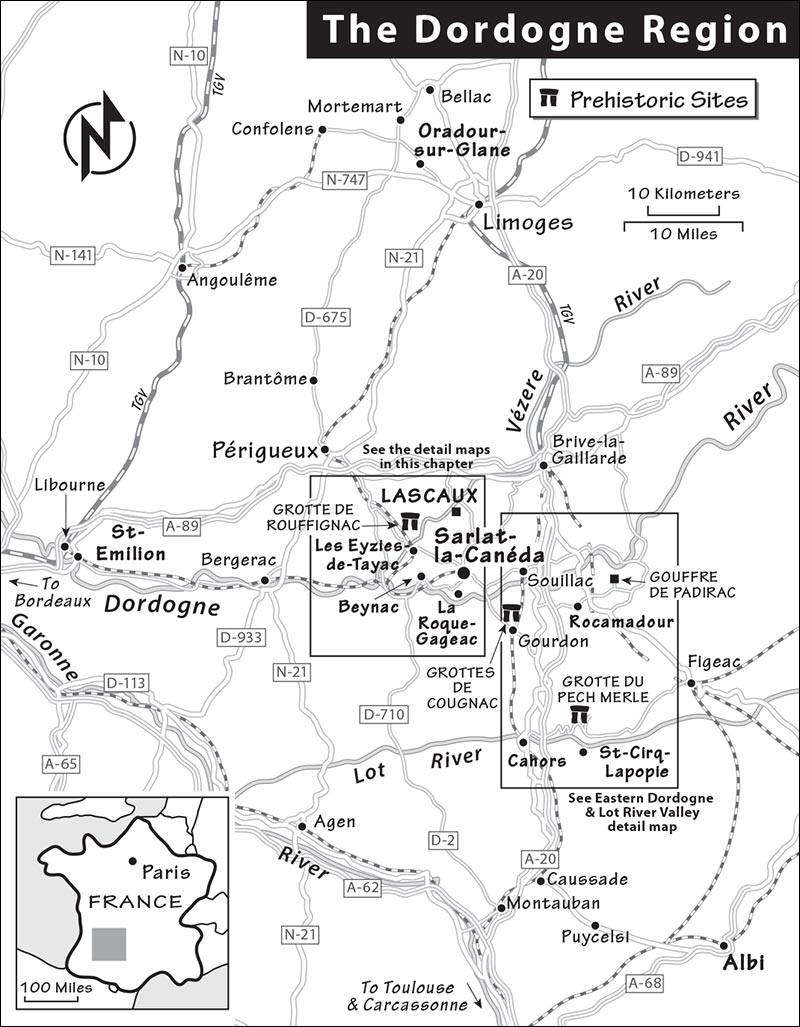
Map: Dordogne Canoe Trips & Scenic Loop Drive
Map: Cro-Magnon Caves near Sarlat-la-Canéda
Sleeping near Les Eyzies-de-Tayac
Caves and Other Sights near Les Eyzies-de-Tayac
The Overlooked Eastern Dordogne
Map: Eastern Dordogne & Lot River Valley
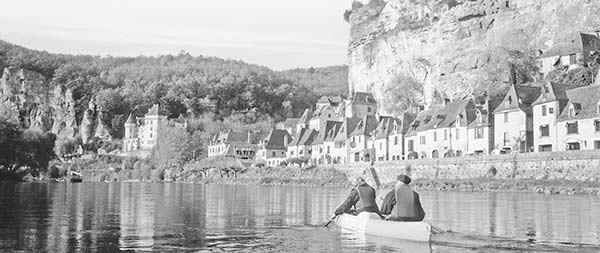
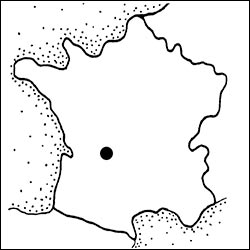
The Dordogne River Valley is a delicious brew, blending natural and man-made beauty. Walnut orchards, tobacco plants, sunflowers, and cornfields carpet the valley, while stone fortresses patrol the cliffs above. During much of the on-again, off-again Hundred Years’ War this strategic river—so peaceful today—separated warring England and France. Today’s Dordogne River carries more travelers than goods, as the region’s economy relies heavily on tourism.
The joys of the Dordogne include rock-sculpted villages, formidable castles, fertile farms surrounding I-should-retire-here cottages, magnificent vistas, lazy canoe rides, and a local cuisine worth loosening your belt for. You’ll also find an amazing cache of prehistoric artifacts. Limestone caves decorated with prehistoric artwork litter the Dordogne region.
PLANNING YOUR TIME
Although tourists inundate the region in the summer, the Dordogne’s charm is protected by its relative inaccessibility. Given the time it takes to get here by car or train, allow a minimum of two nights (ideally three) and most of two days. Whirlwind travelers could consider flying here: Quick flights connect Paris with Dordogne cities Brive-la-Gaillarde and Bergerac, where you can rent a car. Bullet trains link Paris in two hours (frequent flights as well) with Bordeaux, where you’ll find easy car rental (two-hour drive to Sarlat).
Your sightseeing obligations are prehistoric cave art; the Dordogne River Valley, with its villages and castles; the town of Sarlat-la-Canéda (often shortened to “Sarlat,” pronounced sar-lah); and, with more time, the less-traveled Lot River Valley.
If you’re connecting the Dordogne with the Loire region by car, the fastest path is usually via the free A-20 autoroute (exit at Souillac or Brive for Sarlat-la-Canéda and nearby villages). Break up your trip from the north by stopping in the martyr village of Oradour-sur-Glane. If you’re connecting the Dordogne and Carcassonne, explore the Lot River Valley on your way south (see “Route of the Bastides” on here). If heading west, taste the Bordeaux wine region’s prettiest town, St-Emilion.
Those serious about visiting the Dordogne’s best caves need to plan carefully and book ahead (explained on here).
The following three-day itinerary is designed for drivers, but it’s doable—if you’re determined—by taxi rides, a canoe trip (the best way to see the Dordogne regardless of whether you’ve got a car), and a minivan tour.
Day 1—Sarlat-la-Canéda and the Dordogne Valley: Enjoy a morning in Sarlat (best on a market day—Sat or Wed), then spend the afternoon on a canoe trip, with time at the day’s end to explore Beynac and/or Castelnaud. If it’s not market day in Sarlat, do the canoe trip, Beynac, and Castelnaud first, and enjoy the late afternoon and evening in Sarlat. (Because the town’s essential sights are outdoors, my self-guided Sarlat walk works great after dinner.) The sensational views from Castelnaud’s castle and Domme are best in the morning; visit Beynac’s castle or viewpoint late in the day for the best light. With a little lead time, some canoe-rental companies can pick up nondrivers in Sarlat. Taxis are reasonable between Sarlat and the river villages.
Day 2—Prehistoric Caves: Your day will depend on whether you’ve booked the cave(s) in advance (many caves can be booked ahead—see details in each cave listing, later).
Lacking reservations, start your day in Les Eyzies-de-Tayac at the Prehistory Welcome Center and the National Museum of Prehistory for your cave-art introduction. From there, head to the Grotte de Rouffignac (no prebooking, but you can usually get in). If you’re here in July or August, to beat the crowds, reverse this plan and start with Rouffignac.
If you’ve reserved a cave (like Font-de-Gaume), try to first visit the National Museum of Prehistory. Serious cave dwellers can add Lascaux II or IV replica caves, which offer excellent introductions to cave art (prebooking required).
Without a car, this day’s full list of activities is only possible by taxi or excursion tour (I list several reliable tour companies). By train, you can link Sarlat-la-Canéda and Les Eyzies-de-Tayac, though you’ll need to transfer, and some connections aren’t great.
Day 3—Other Sights: Head east and upriver to explore Rocamadour, Gouffre de Padirac, and storybook villages such as Carennac, Autoire, and Loubressac. Though Rocamadour is accessible by train and a short taxi ride, the rest of these places are feasible only with your own wheels, by taxi, or on an excursion tour.
CHOOSING A HOME BASE
Sarlat-la-Canéda is the only viable solution for train travelers. Drivers should consider sleeping in a riverside village. For the best view hotel I’ve found in the area, try Hôtel L’Esplanade in Domme (see here).
GETTING AROUND THE DORDOGNE
This region is a joy with a car but tough without one. Think about renting a car for a day, renting a canoe or e-bike, or taking a minivan excursion. If you’re up for a splurge, take a hot-air balloon ride.
On Your Own
By Train: Connecting the Dordogne’s sights by train is hopeless. The only train runs from Sarlat-la-Canéda to Les Eyzies-de-Tayac, with the Prehistory Welcome Center and museum and the Grotte de Font-de-Gaume (3/day, 2 hours, transfer in Le Buisson to train or bus, some long waits, 15-minute walk from station to museum, 45-minute walk from station to Font-de-Gaume cave).
By Car: Roads are small, slow, and scenic. There’s no autoroute near Sarlat-la-Canéda; count on more travel time than usual. Little Sarlat is routinely snarled with traffic on market days, particularly Saturdays. You can rent a car in Sarlat (see Sarlat’s “Helpful Hints,” later), though bigger cities—such as Libourne, Périgueux, Bergerac, and Brive-la-Gaillarde—offer greater selection and drop-off flexibility and easier rail connections from other regions. In summer (mid-June-mid-Sept), you’ll pay to park in most villages’ riverfront lots between 10:00 and 19:00. Leave nothing in your car at night—thieves enjoy the Dordogne, too.
By Taxi: To taxi from Sarlat-la-Canéda to Beynac or La Roque-Gageac, allow €35 one-way (€50 at night and on Sun); from Sarlat to Les Eyzies-de-Tayac, allow €60 one-way (€80 at night and on Sun). Christoph Kusters speaks fluent English and also does tours—see “With a Tour,” below (+33 6 08 70 61 67, www.taxialacarte.com). Corinne Brouqui, who runs Beynac-based Taxi Corinne, is helpful, speaks a little English, and can provide regional as well as local transport (+33 5 53 29 42 07, mobile +33 6 72 76 03 32). Christoph or Corinne may be able to pick you up within a few minutes if you call. Still, it’s best to book your rides (even short transfers) in advance, as there are very few taxis around.
By Bike: Cyclists find the Dordogne beautiful but hilly, with lots of traffic on key roads with no bike lanes. You can pick up a basic bike for the day in Sarlat-la-Canéda; serious riders will be impressed with Liberty Bike’s services and Aquitaine Bike’s fleet and tours (described later, under Sarlat’s “Helpful Hints”). The most pleasing ride is along the abandoned rail line that starts just outside Sarlat and runs to Souillac.
By Boat: Nondrivers should rent a canoe, my favorite way to explore a small but gorgeous slice of this region. A canoe offers access to the river’s sights and villages at your own pace, and some canoe companies will pick you up in Sarlat-la-Canéda for no extra charge (based on their schedule). Because a canoe costs only about €24/person (for the trip I recommend), and you can spend all day on and off the river touring sights I cover, this is a swimmingly good deal. For the same scenery with less work (but no ability to visit villages and castles en route), you can take a boat cruise from Beynac or La Roque-Gageac (€10).
With a Tour
Custom Taxi/Minivan Excursions
You have several good options. Book the first two companies listed well ahead as they are popular.
Private Tours: Gentle Christoph and lively Sarissa Kusters speak flawless English and provide top service in their Wi-Fi-equipped Mercedes vans (7 people), whether you need a private tour, a taxi from the train station in Sarlat-la-Canéda to the town center, or a pickup in Paris, Oradour-sur-Glane, or just about anywhere in the region. They can organize your trip, book cave visits, and give good running commentary. Ask about their walking tours and transfer options to St-Emilion/Bordeaux, Oradour-sur-Glane, and even Carcassonne (€55/hour, +33 6 08 70 61 67, www.taxialacarte.com).
Exploreo Tours is run by passionate world traveler (and fluent English speaker) David Lascoux. He offers a variety of half- and full-day minivan trips in the Dordogne region with expert commentary (for private groups only, 4 people-€460/day, €260/half-day, +33 6 03 37 17 31, www.exploreo24.com).
Shared Tours: Check with Ophorus Excursions for a full range of informative half- and full-day trips—for individuals or private groups—to caves, castles, and villages, including gourmet food tours of Sarlat (options also include the Lot River Valley, Rocamadour, or St-Emilion) in a comfortable minivan with competent, English-fluent guides and up to eight fellow travelers (shared tour-€75/half-day, €175/day; private tour-€410/half-day, €720/day; +33 5 56 15 26 09, www.ophorus.com).
Hot-Air Balloon Rides
If ever you were going to spring for a hot-air balloon ride in France, the Dordogne is the place to do it. Balloons take you high above its gorgeous river and hilly terrain capped with golden stone castles and villages. Montgolfières du Périgord is conveniently based in La Roque-Gageac and offers a variety of flights with well-trained pilots (one-hour flight about €220/person, departures in good weather generally just after sunrise and just before sunset, +33 5 53 28 18 58, www.montgolfiere-du-perigord.com).
THE DORDOGNE’S CUISINE SCENE
Gourmets flock to this area for its geese, ducks, and wild mushrooms. The geese produce (involuntarily) the region’s famous foie gras. (They’re force-fed, denied exercise during the last weeks of their lives, and slaughtered for their livers, meat, and fluffy down—see sidebar on here.) Foie gras tastes like butter and costs like gold. The main duck specialty is confit de canard (duck meat preserved in its own fat—sounds terrible, but tastes great). You’ll also see magret de canard (sautéed duck breast), smoked duck, and anything fried in duck fat on menus.
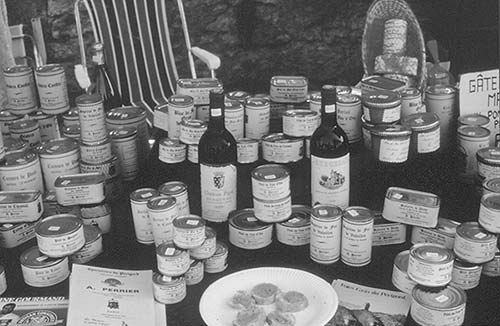
Pommes de terre sarladaises are mouthwatering, thinly sliced potatoes fried in duck fat and commonly served with confit de canard. Wild truffles are dirty black mushrooms that grow underground, generally on the roots of oak trees. Farmers traditionally locate them with sniffing pigs and then charge a fortune for their catch (roughly $300 per pound). Local cèpe mushrooms are commonly pan-fried with parsley and garlic—look for omelets cooked this way.
Native cheeses are Cabécou (a silver-dollar-size, pungent, nutty-flavored goat cheese) and Echourgnac (made by local Trappist monks). You’ll find walnuts (noix) in breads, salads, cakes, liqueurs, salad dressings, and more.
The region is not known for producing great wine, but prices are reasonable. Wines to sample are Bergerac (red, white, and rosé), Pecharmant (red, must be at least four years old), Cahors (a full-bodied red), and Monbazillac (sweet dessert wine). The vin de noix (sweet walnut liqueur) is delightful before dinner.
DORDOGNE MARKETS
Markets are a big deal in rural France, and nowhere more so than in the Dordogne. I’ve listed good markets for every day of the week, so there’s no excuse for drivers not to experience one. Here’s what to look for:
Strawberries (fraises): For the French, the Dordogne is the region famous for the very tastiest strawberries. Available from April to November, they’re gorgeous, and they smell even better than they look. Buy une barquette (small basket), and suddenly your two-star hotel room is a three-star. Look also for fraises des bois, the tiny, sweet, and less visually appealing strawberries found in nearby forests.
Fresh Veggies: Outdoor markets allow you to meet the farmers and buy directly from them. (See what’s fresh and look for it on your menu this evening.) Subtly check out the hands of the person helping customers—if they’re not gnarled and rough from working the fields, move on.
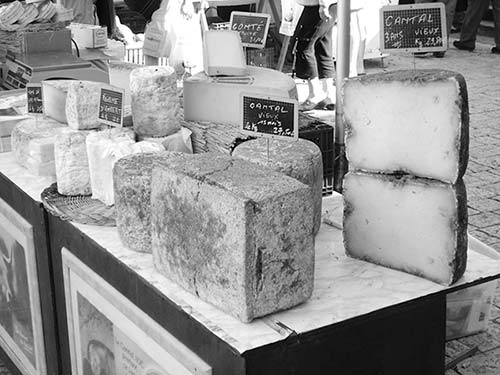
Cheeses (fromages): The region is famous for its Cabécou goat cheese (described earlier), though often you’ll also find Auvergne cheeses (St. Nectaire and Cantal are the most common) from just east of the Dordogne (usually in big rounds) and Tomme and Brebis (sheep cheeses) from the Pyrenees to the south.
Truffles (truffes): Only the bigger markets will have these ugly, jet-black mushrooms on display. Truffle season is during off-season (Nov-Feb), when you’ll find them at every market. During summer, the fresh truffles you might see are truffes d’été, a less desirable and cheaper, but still tasty, species. If you see truffles displayed at other times, they’ve been sterilized (a preservative measure that can reduce flavor). On Sarlat-la-Canéda market days, you may find a man in the center of Place de la Liberté with a photo of his grandfather and his truffle-hunting dog. From December to mid-February there’s a truffle market on Saturday mornings on Rue Fénelon (details at TI).
Anything with Walnuts (aux noix): Pain aux noix is a thick-as-a-brick bread loaf chock-full of walnuts. Moutarde de noix is walnut mustard. Confiture de noix is a walnut spread for hors d’oeuvres. Gâteaux de noix are tasty cakes studded with walnuts. Liqueur de noix is a marvelous creamy liqueur, great over ice or blended with a local white wine.
Goose or Duck Livers and Pâté (foie gras): This spread—which you are not supposed to spread but rather to eat in small chunks on warm toast—is made from geese (better) and ducks (still good) or from a mix of the two. You’ll see two basic forms: entier and bloc. Both are 100 percent foie gras; entier is a piece cut right from the product, whereas bloc has been blended. Foie gras is best accompanied by a sweet white wine (such as the locally produced Monbazillac or Sauternes from Bordeaux). You can bring the unopened tins back into the US in a checked bag, pas de problème.
Confit de Canard: At butcher stands, look for chunks of duck smothered in white fat. If you have kitchen access, try it: Scrape off some of the fat, then sauté the chunks until they’re crispy on the outside and heated through. Save some of that fat for roasting potatoes.
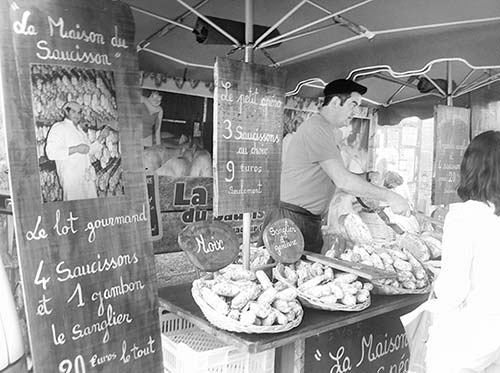
Dried Sausages (saucissons secs): Long tables piled high with dried sausages covered in herbs or stuffed with local goodies are a common sight in French markets. You’ll always be offered a mouthwatering sample. Some of the variations you’ll see include porc, canard (duck), fumé (smoked), à l’ail (garlic), cendré (rolled in ashes), aux myrtilles (with blueberries), sanglier (wild boar), and even âne (donkey)—and, but of course, aux noix (with walnuts).
Olive Oil (huile d’olive): Look for stylish bottles of various olive oils, as well as vegetable oils flavored with truffles, walnuts, chestnuts (châtaignes), and hazelnuts (noisettes)—good for cooking, ideal on salads, and great as gifts. Pure walnut oil, pressed at local mills from nuts grown in the region, is a local specialty, best on salads. Don’t cook with pure walnut oil, as it burns quickly.
Olives and Nuts (olives et noix): These interlopers from Provence find their way to every market in France.
Brandies and Liqueurs: Armagnac and Cognac are made a few hours away, as are southwestern fruit-flavored liquors like pomme verte; they’re usually available from a seller or two.
Dordogne Market Days
The best markets are in Sarlat-la-Canéda (Sat and Wed, in that order), followed by the markets in Cahors on Saturday, St-Cyprien on Sunday, and Le Bugue on Tuesday. Markets usually shut down by 13:00.
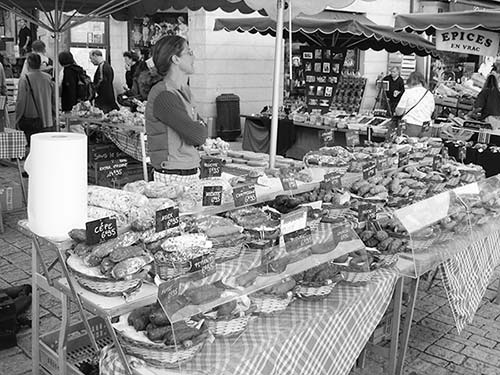
Sunday: St-Cyprien (lively market, 10 minutes west of Beynac, difficult parking) and St-Geniès (a tiny, intimate market with few tourists; halfway between Sarlat and Montignac)
Monday: Les Eyzies-de-Tayac (April-Oct) and a tiny market in Beynac (mid-June-mid-Sept)
Tuesday: Cénac (you can canoe from here) and Le Bugue (great market 20 minutes west of Beynac)
Wednesday: Sarlat (big market) and Montignac (near Lascaux)
Thursday: Domme (good market)
Friday: Souillac (transfer point to Cahors, Carcassonne) and La Roque-Gageac (May-Sept)
Saturday: Sarlat and Cahors (both are excellent), the little bastide village of Belvès (small market), and Montignac
Sarlat-la-Canéda
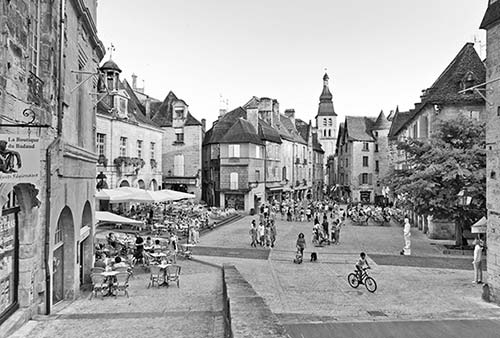
Sarlat–la-Canéda is a pedestrian-filled banquet of a town, serenely set amid forested hills with no blockbuster sights. Still, Sarlat delivers a seductive tangle of traffic-free, golden cobblestone lanes peppered with beautiful buildings, lined with foie gras shops (geese hate Sarlat), and stuffed with tourists. The town is warmly lit at night and ideal for after-dinner strolls. It’s just the right size—large enough to have a theater with four screens, but small enough that everything is an easy meander from the town center. And though undeniably popular with tourists, it’s the handiest home base for those without a car.
Orientation to Sarlat-la-Canéda
Rue de la République slices like an arrow through the circular old town. The action lies east of Rue de la République. Sarlat’s smaller half has few shops and many quiet lanes.
TOURIST INFORMATION
The TI is 50 yards to the right of the Cathedral of St. Sacerdos as you face it (July-Aug Mon-Sat 9:00-19:00, Sun 10:00-13:00 & 14:00-18:00; April-June and Sept until 18:00; Oct Mon-Sat 9:00-12:00 & 14:00-17:00, Sun 10:00-13:00; shorter hours and closed Sun Nov-March; on Rue Tourny, +33 5 53 31 45 45, www.sarlat-tourisme.com). Ask for information on caves and renting a car, bike, or canoe. The TI also sells tickets for the panoramic elevator ride (€5, cash only, credit-card payment available at elevator).
ARRIVAL IN SARLAT-LA-CANEDA
By Train: The sleepy train station keeps a lonely vigil (without a shop, café, or hotel in sight). It’s a mostly downhill, 20-minute walk to the town center (taxis are about €10-20, book ahead; see “Helpful Hints,” next). To walk into town, turn left out of the station and follow Avenue de la Gare as it curves downhill, then turn right at the bottom, on Avenue Thiers, to reach the town center. Some trains (such as those from Limoges and Cahors) arrive at nearby Souillac, which is poorly connected to Sarlat’s train station by bus (2-3/day, schedule at www.transperigord.fr).
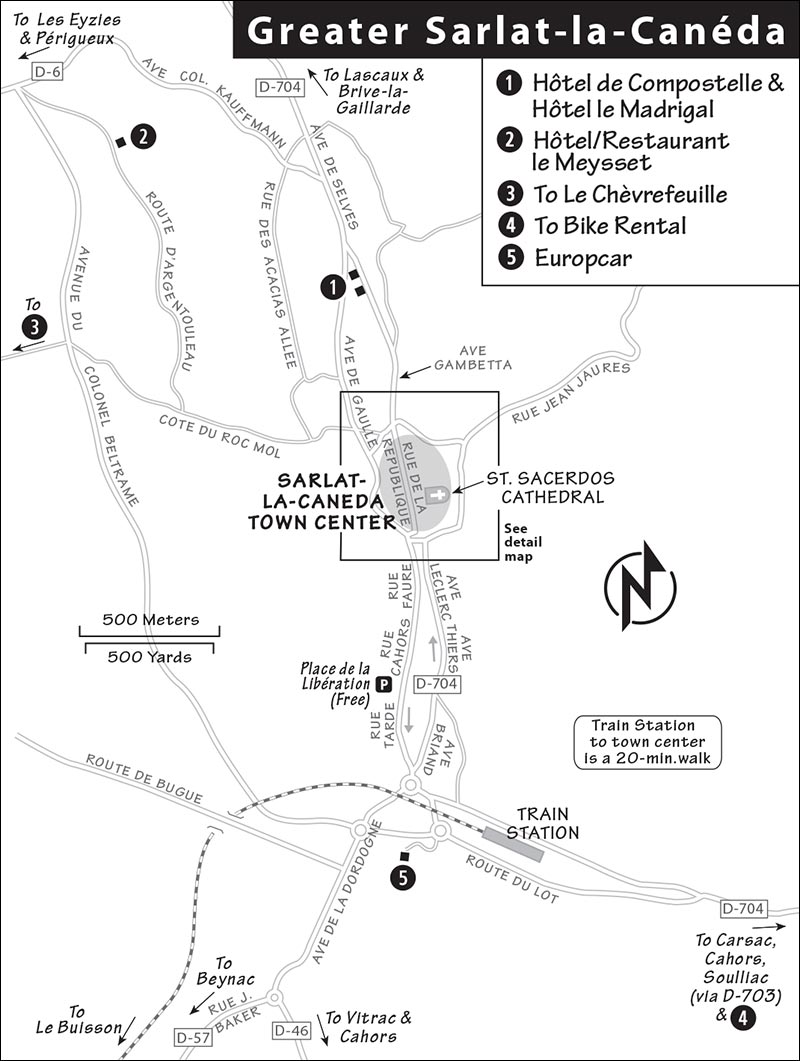
By Car: The hilly terrain around Sarlat-la-Canéda creates traffic funnels unusual for a town of this size. Hotels know the best strategies for parking. The most central pay parking lot is Place de la Grande Rigaudie at the southern edge of the town’s pedestrianized center. Free parking is available at Place des Cordeliers (a five-minute walk north of Place de la Petite Rigaudie) and at Place de la Libération (a 10-minute walk south of the center—for location, see the “Greater Sarlat-la-Canéda” map). Street parking is metered in high season and easy to find on nonmarket and off-season days (about €2/hour, free 19:00-9:00). On market days, avoid the center by parking along Avenue du Général de Gaulle (at the north end of town), or in one of the free lots described above (signed from the ring road).
HELPFUL HINTS
Market Days: Sarlat has been an important market town since the Middle Ages. Outdoor markets still thrive on Wednesday morning and all day Saturday. Saturday’s market swallows the entire town and is best in the morning (produce and food vendors leave around noon). Come before 9:00, have breakfast or coffee on the square (the recommended Brasserie Costa serves breakfast), and watch them set up. From late November to March, a truffle market takes place on Saturday mornings on Rue Fénelon.
Supermarkets: There’s a Petit Casino grocery at 32 Rue de la République. The Carrefour grocery at 23 Avenue Gambetta is less central but bigger. Both are open daily in season.
Laundry: A Laverie launderette sits across from the recommended Hôtel la Couleuvrine (self-serve daily 24 hours, 10 Place de la Bouquerie, +33 6 80 46 60 43).
Biking: Sarlat-la-Canéda is surrounded by beautiful scenery that would be ideal for biking...were it not for all those hills (e-bikes help), cars, and shoulderless roads. Villages along the Dordogne River make better biking bases (bike-rental places can advise quieter routes), though prepare for some serious ups and downs in this area. Castelnaud is best, with a bike route that starts along the Dordogne and follows the Céou river for 13 miles mostly along a peaceful country lane with few vehicles. There’s also a scenic 16-mile bike-only lane from Sarlat to Souillac, following an abandoned rail right-of-way that can be made into a loop trip—see “Dordogne Scenic Loop,” later (Liberty Cycle rental, described next, is located at the trail’s start). Bike-canoe combinations are also possible—ask when renting your bike.
Liberty Cycle rents bikes and offers short bike tours from Sarlat (daily, delivery to hotel possible, south of town on Avenue du Périgord—see the “Greater Sarlat-la-Canéda” map, +33 7 81 24 78 79, www.liberty-cycle.com). At the southern edge of Castelnaud, Bike Bus also offers rentals and tours (daily, +33 5 53 31 10 61, www.bike-bus.com). Aquitaine Bike can deliver quality hybrid and road bikes to your hotel in and near Sarlat and provides route advice, customized self-guided tours, and roadside assistance (4-day minimum, tours available, +33 5 53 30 35 17, mobile +33 6 32 35 56 50, www.aquitainebike.com).
Taxi: Call friendly Christoph Kusters (+33 6 08 70 61 67, www.taxialacarte.com, also offers regional day trips—see “With a Tour,” earlier), Taxi Sarlat (+33 5 53 59 02 43), or Philippe Marquay, who speaks English and accepts credit cards (+33 6 73 31 29 18).
Car Rental: Try Europcar (Le Pontet Sud Impasse Jean Secret, a level 20-minute walk from the center, but I’d take a taxi to get there—for location, see the “Greater Sarlat-la-Canéda” map later in this section, +33 5 53 30 30 40).
Cooking Classes: Périgord cuisine is the focus at Le Chèvrefeuille, which offers hands-on cooking classes and demonstrations. Courses are run by friendly British expats and are situated in the countryside about a half-hour drive from Sarlat (€175/day, €110/half-day; May-Sept, book ahead at www.cookerycoursedordogne.com; they also run a recommended hotel—see here).
Sarlat-la-Canéda Walk
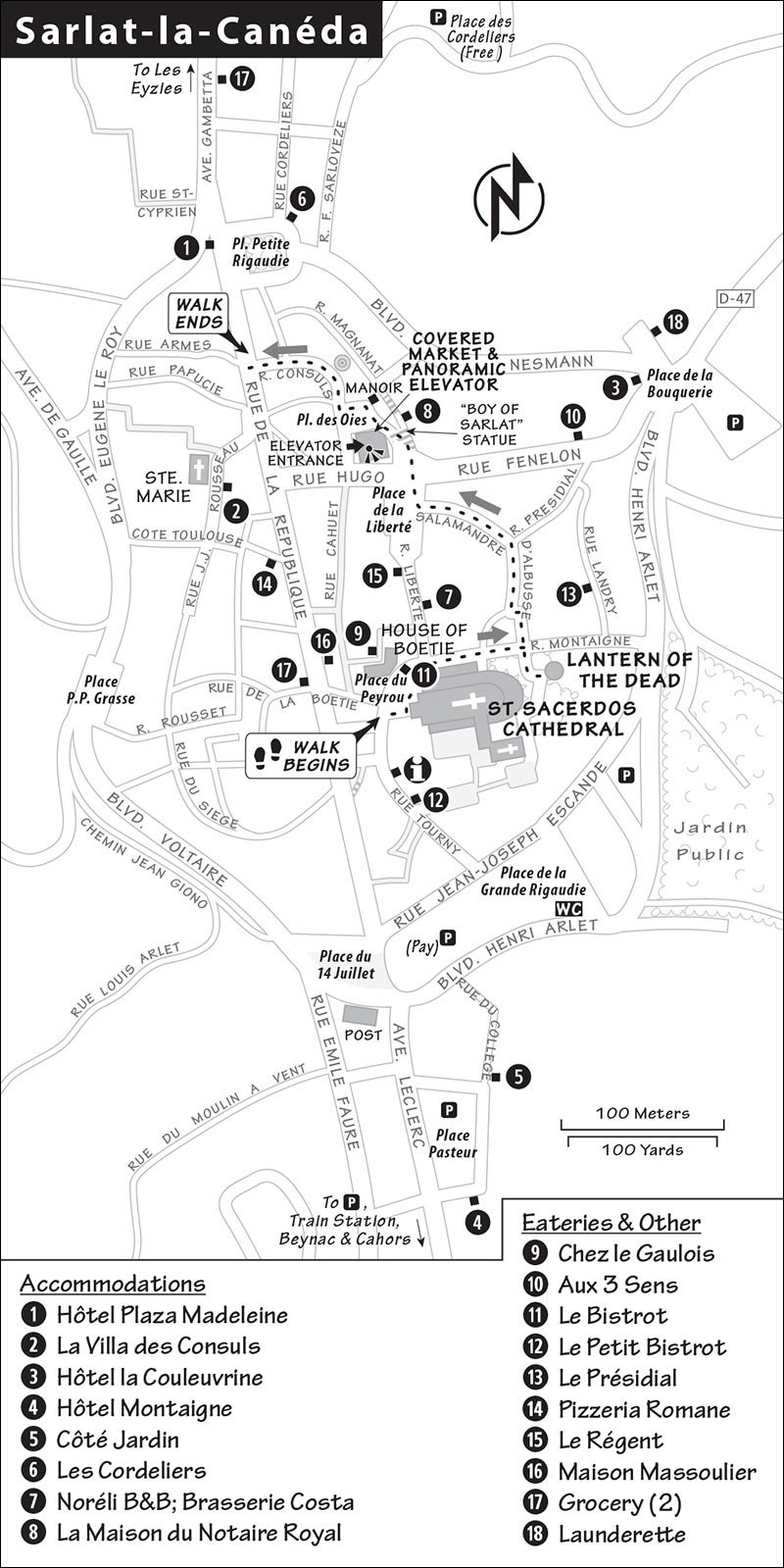
This short self-guided walk, rated ▲▲, starts facing the Cathedral of St. Sacerdos (a few steps from the TI). The walk works well in the day—when sights are open—but in some ways it’s better after dinner, when the gaslit lanes and candlelit restaurants twinkle. (You can always circle back the next day to sights that interest you.) Use the “Sarlat-la-Canéda” map to help navigate.
• Start a bit left of center in front of the Cathedral of St. Sacerdos, on the...
Place du Peyrou: An eighth-century Benedictine abbey once stood where the Cathedral of St. Sacerdos is today. It provided the stability for Sarlat to develop into an important trading city during the Middle Ages. The old Bishop’s Palace, built right into the cathedral (on the right, with its top-floor Florentine-style loggia), recalls Sarlat’s Italian connection. The Italian bishop was the boyfriend of Catherine de’ Medici (queen of France)—a relationship that landed him this fine residence. After a short stint here, he split to Paris with loads of local money. And though his departure scandalized the town, it left Sarlat with a heritage of Italian architecture. (Notice the fine Italianate house of Etienne de la Boétie on the opposite side of the square and the similar loggia to its right.)
Another reason for Sarlat’s Italo-flavored urban design was its loyalty to the king during wartime. Sarlat’s glory century was from about 1450 to 1550, after the Hundred Years’ War (see sidebar on here). Loyal to the French cause—through a century of war—Sarlat was rewarded by the French king, who gave the town lots of money to rebuild itself in stone. Sarlat’s new nobility needed fancy houses, complete with ego-boosting features. Many of Sarlat’s most impressive buildings date from this prosperous era, when the Renaissance style was in vogue and everyone wanted an architect with an Italian résumé.
• Take a closer look (opposite the cathedral) at...
The House of Etienne de la Boétie: This house was a typical 16th-century merchant’s home—family upstairs and open ground floor (its stone arch now filled in) with big, fat sills to display retail goods. Pan up, scanning the crude-but-still-Renaissance carved reliefs. It was a time when anything Italian was trendy (when yokels “stuck a feather in their cap and called it macaroni”). La Boétie (lah bow-ess-ee), a 16th-century bleeding-heart liberal who spoke and wrote against the rule of tyrannical kings, remains a local favorite.
Notice how the house just to the left arches over the small street. This was a common practice to maximize buildable space in the Middle Ages. Sarlat enjoyed a population boom in the mid-15th century after the Hundred Years’ War ended.
• If you’re doing this walk during the day, head into the cathedral now. After hours, skip ahead to the Lantern of the Dead (see below).
Cathedral of St. Sacerdos: Though the cathedral’s facade has a few well-worn 12th-century carvings, most of it dates from the 18th and 19th centuries. Step inside. The faithful believed that Mary delivered them from the great plague of 1348, so you’ll find a full complement of Virgin Marys here and throughout the town. The Gothic interiors in this part of France are simple, with clean lines and nothing extravagant. The first chapel on the left is the baptistery. Locals would come here to give thanks after they made the pilgrimage to Lourdes for healing and returned satisfied. The second column on the right side of the nave shows a long list of hometown boys who gave their lives for France in World War I.
• Exit the cathedral’s front door and turn right, walk uphill on the first lane (Rue de Montaigne), then go right again through a short walkway that leads behind the church. Here you’ll find a bullet-shaped building ready for some kind of medieval takeoff, known as the...
Lantern of the Dead (Lanterne des Morts): Dating from 1147, this is the oldest monument in town. In four horrible days, a quarter of Sarlat’s population (1,000 out of 4,000) died in a plague. People prayed to St. Bernard of Clairvaux for help. He blessed their bread—and instituted hygiene standards while he was at it, stopping the disease. This lantern was built in gratitude and as a marker for the cemetery that was located behind it.
• Facing the church, go back the way you came, toward an adorable house with its own tiny tower. Cross one street and keep straight, turn left a block later on Impasse de la Vieille Poste, make a quick right on Rue d’Albusse, and then take a left onto...
Rue de la Salamandre: The salamander—unfazed by fire or water—was Sarlat’s mascot. Befitting its favorite animal, Sarlat was also unfazed by fire (from war) and water (from floods). Walk a few steps down this “Street of the Salamander” and find the Gothic-framed doorway just below on your right. Step back and notice the tower that housed the staircase. Spiral staircase towers like this (Sarlat has about 20) date from about 1600 (after the wars of religion between the Catholics and Protestants), when the new nobility needed to show off.
• Continue downhill, passing under the salamander-capped arch, and pause near (or better, sit down at) the café on the...
Place de la Liberté: This has been Sarlat’s main market square since the Middle Ages, though it was expanded in the 18th century. Sarlat’s patriotic Town Hall stands behind you (with a café perfectly situated for people-watching). You can’t miss the dark stone roofs topping the buildings across the square. They’re typical of this region: Called lauzes in French, the flat limestone rocks were originally gathered by farmers clearing their fields, then made into cheap, durable roofing material (today few people can afford them). The unusually steep pitch of the lauzes roofs—which last up to 300 years—helps distribute the weight of the roof (about 160 pounds per square foot) over a greater area. Although most lauzes roofs have been replaced by roofs made from more affordable materials, many remain. The small windows in the roof are critical: They provide air circulation, allowing the lichen that coat the porous stone to grow—sealing gaps between the stones and effectively waterproofing the roof. Without that layer, the stone would crumble after repeated freeze-and-thaw cycles.
• Walk right, to the “upper” end of the square. The bulky Church of Ste. Marie, right across from you, today serves as Sarlat’s...
Covered Market and Panoramic Elevator: Once a parish church dedicated to St. Marie, with a massive lauzes roof and a soaring bell tower, this building was converted into a gunpowder factory and then a post office before becoming today’s indoor market (daily, mid-April-Oct 8:30-13:00, Nov-mid April Tue-Wed and Fri-Sat only). Marvel at its tall, strangely modern, seven-ton doors, and imagine the effort it took to deliver and install them in the center of this tight-laned town.
On the opposite side of this building (walk through if it’s open, or around if it’s closed), you’ll find the entrance to a panoramic elevator, which whisks eight tourists up through the center of the ancient church’s bell tower for bird’s-eye views over Sarlat’s rooftops. Your elevator operator doubles as a guide, who gives a quick history of Sarlat at the top. You’ll see parts of the town not visible except from above, like sections of the medieval wall that circled the town. If they gather enough English-speakers, the informal spiel is in English; otherwise, it’ll be in French and you’ll use the English handout (feel free to ask questions). The glass-walled open-air elevator doesn’t run in the rain (€5, buy timed-entry ticket at machines, credit card only, rarely a wait, cash-only tickets available at TI; 4/hour, 12-minute visit, generally open daily 10:00-12:30 & 14:00-18:00, shorter hours off-season).
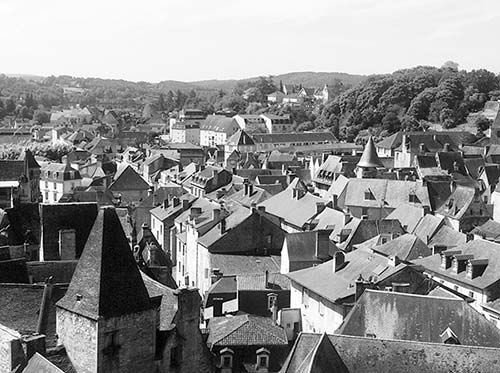
• When you’ve returned to earth, double back into Place de la Liberté and climb up the small ramp opposite the market’s big doors to meet the “Boy of Sarlat”—a statue marking the best view over Place de la Liberté. Notice the cathedral’s tower to the left, with a salamander swinging happily from its spire. Just below you on the stairs are several shops.
Foie Gras and Beyond: Tourist-pleasing stores line the streets of Sarlat and are filled with the finest local products. The shop near the “boy” sells it all, from truffles to foie gras to walnut wine to truffle liqueur. To better understand what you’re looking at, read the foie gras sidebar on here.
• Turn left behind the boy and trickle like medieval rainwater down the ramp into an inviting square. Here you’ll find a little gaggle of geese.
Place des Oies: Feathers fly when geese are traded on this “Square of the Geese” on market days (Nov-March). Birds have been serious business here since the Middle Ages. Even today, a typical Sarlat menu reads, “duck, duck, goose.” Trophy homes surround this cute little square on all sides.
Check out the wealthy merchant’s home to the right as you enter the square—the Manoir de Gisson—with a tower built big enough to match his ego. The owner was the town counsel, a position that arose as cities like Sarlat outgrew the Middle Ages. Town counsels replaced priests in resolving civil conflicts and performing other civic duties. Touring the interior of the manor reveals how the wealthy lived in Sarlat (study the big poster next to the entry). You’ll climb up one of those spiral staircase towers, ogle at several rooms carefully decorated with authentic 16th- to 18th-century furniture, and peek inside the impressive lauzes roof. It’s fun to gaze out the windows and imagine living here, surrounded by 360 degrees of gorgeous cityscape (€8.50; daily April-mid-Nov 10:00-18:30, July-Aug until 19:00, closed mid-Nov-March; borrow English booklet, +33 5 53 28 70 55, www.manoirdegisson.com).
• Walk to the right along Rue des Consuls. Just before Le Mirandol restaurant, look to the right to see a...
Fourteenth-Century Vault and Fountain: For generations, this was the town’s only source of water, protected by the Virgin Mary (find her at the end of the fountain). Opposite the restaurant and fountain, find the wooden doorway (open late June-Aug only) that houses a massive Renaissance stairway. These showy stairways, which replaced more space-efficient spiral ones, required a big house and a bigger income. Impressive.
• Follow the curve along Rue des Consuls, and enter the straight-as-an-arrow...
Rue de la République: This “modern” thoroughfare, known as La Traverse to locals, dates from the mid-1800s, when blasting big roads through medieval cities was standard operating procedure (it’s traffic-free in afternoons in high season). In 1963 Sarlat’s other streets became off-limits to cars, thanks to France’s forward-thinking minister of culture, André Malraux. The law that bears his name has served to preserve and restore important monuments and neighborhoods throughout France. Eager to protect the country’s architectural heritage, private investors, cities, and regions worked together to create traffic-free zones, rebuild crumbling buildings, and make sure that no cables or ugly wiring marred the ambience of towns like this. Without the Malraux Law, Sarlat might well have more “efficient” roads like Rue de la République slicing through its old town center.
• Our walk is over, but make sure you take time for a poetic ramble through the town’s quiet side—or, better yet, stroll any of Sarlat’s lanes after dark. This is the only town in France illuminated by gas lamps, which cause the warm limestone to glow, turning the romance of Sarlat up even higher. Now may also be a good time to find a café and raise a toast to Monsieur Malraux.
Sleeping in Sarlat-la-Canéda
Sarlat-la-Canéda is the train traveler’s best Dordogne home base. Book early here for July and August. Parking can be a headache (ask your hotelier for help). Drivers will find rooms and parking easier just outside of town or in the nearby villages and destinations described later, under “The Best of the Dordogne River Valley” (most are a 15-minute drive away). Hotels have air-conditioning unless otherwise noted.
HOTELS IN THE TOWN CENTER
$$$ Hôtel Plaza Madeleine**** is a central and upscale value with formal service, a handsome pub/wine bar, stylish public spaces, and 42 very sharp rooms with every comfort. You’ll find a covered pool out back, a sauna, and a whirlpool bath—all free for guests (connecting rooms for families, big breakfast buffet, elevator, pay garage parking, at north end of ring road at 1 Place de la Petite Rigaudie, +33 5 53 59 10 41, www.plaza-madeleine.com, contact@plaza-madeleine.com).
$$ La Villa des Consuls,*** a cross between a B&B and a hotel, occupies a 17th-century home buried on Sarlat’s quiet side with 11 lovely, spacious rooms, each with a small kitchen and many with a living room. The rooms surround a small courtyard and come with wood floors, private decks, and high ceilings (family rooms, higher prices for 1-night stays, adorable Sophie helps with hauling bags from the street, reception closed 13:00-14:00 and after 17:00, pay parking—book ahead, 3 Rue Jean-Jacques Rousseau, +33 5 53 31 90 05, www.villaconsuls.fr, reception@villaconsuls.fr).
$ Hôtel la Couleuvrine*** offers 27 smallish but comfortable rooms with character at fair rates in a historic building with a handy location—across from the launderette and with easy parking (for Sarlat). Bathrooms are generally small but modern (family rooms, a few rooms with private terraces, no air-con, elevator, on ring road at 1 Place de la Bouquerie, +33 5 53 59 27 80, www.la-couleuvrine.com, contact@la-couleuvrine.com). Half-pension is encouraged during busy periods and in the summer—figure €40 per person beyond the room price for breakfast and a good dinner in the classy restaurant.
$ Hôtel Montaigne*** is a good-value and well-run hotel located a block south of the pedestrian zone. The 28 freshly updated rooms are very comfortable—some could sleep four people and come with full kitchens. Nice lounges grace the inside and a terrace is one floor up. Of the hotels I list, this is the one nearest the train station (family rooms, elevator, good pay parking nearby or in a garage that must be booked ahead, Place Pasteur, +33 5 53 31 93 88, www.hotelmontaigne.fr, contact@hotelmontaigne.fr).
CHAMBRES D’HOTES IN THE CENTER
These chambres d’hôtes are central and compare well with the hotels listed earlier.
$ Côté Jardin is a fine spread with good rates run by gregarious Michelle. She rents three top-comfort rooms, each with its own terrace, surrounding a large garden. Her breakfast room is beyond cozy (air-con, mini-fridge and microwave in rooms, 13 Rue du Collège, +33 6 03 11 52, http://sarlat-cote-jardin-guest-house.hotels-aquitaine.com/en, msimonet24@gmail.com).
$ Les Cordeliers, owned by gentle American Jeff Klein, offers high-end comfort at two-star prices. Most of the seven cushy rooms are huge, all are air-conditioned and well furnished, and a small kitchen is at your disposal. The building has sky-blue shutters and easy parking nearby but no elevator for its three floors (closed Nov-Feb, 51 Rue des Cordeliers, +33 5 53 31 94 66, mobile +33 6 10 21 79 55, www.lescordeliers-sarlat.com, info@lescordeliers-sarlat.com).
$ Noréli B&B is run by friendly Bruno Da Costa, who rents four cavernous, simple, but surprisingly comfortable rooms above an outdoor café. You’re in the thick of Sarlat’s pedestrian zone (perfect for market days). Rooms come with sky-high ceilings, big and soundproof windows over Sarlat’s world, polished wood floors, cheap furnishings, and bathrooms you can get lost in (family rooms, no air-con, includes continental breakfast, 9 Place de la Liberté, +33 6 70 32 63 54, noreli.sarlat@gmail.com).
¢ La Maison du Notaire Royal, run by English-speaking Pierre-Henri Toulemon and French-speaking Diane, has four large and homey rooms with a private entry in a 17th-century home located a few steps above the main square. Guests have access to a fridge, microwave, and sweet garden tables (includes breakfast, no air-con, cash only, no deposit required, free parking—book ahead, call a day ahead to confirm arrival time, look for big steps from northeast corner of Place de la Liberté, 4 Rue Magnanat, +33 5 53 31 26 60, mobile +33 6 08 67 76 90, www.lamaisondunotaireroyal.fr, contact@lamaisondunotaireroyal.fr). They also rent a cottage a few blocks from the town center with a living room, kitchen, and three bedrooms that can sleep seven (3-day minimum, easy parking).
HOTELS NORTH OF TOWN
For locations of the following hotels, see the “Greater Sarlat-la-Canéda” map. The first two are a 10-minute walk north of the old town on Avenue de Selves. All have easy parking.
$ Hôtel de Compostelle*** features a cheery, spacious lobby and 23 sharp, generously sized, and air-conditioned rooms, many with decks. There are several good family rooms at good rates—and the kids will enjoy the pool (elevator is one floor up, pay parking, fitness room privileges at their sister hotel—see next listing; 66 Avenue de Selves, +33 5 53 59 08 53, www.hotel-compostelle-sarlat.com, info@hotel-compostelle-sarlat.com).
$ Hôtel le Madrigal,** one block past Hôtel de Compostelle (same owners), is an intimate nine-room hotel with good rates for two-star rooms, all with queen-size beds and smallish bathrooms (family rooms, no air-con, no elevator, three floors, fitness room, pay parking, 50 Avenue de Selves, +33 5 53 59 21 98, www.hotel-madrigal-sarlat.com, info@hotel-madrigal-sarlat.com).
$$ Hôtel le Meysset*** is close enough to town yet surrounded by nature, with lovely views at affordable rates. Rooms are sharp—many have private patios and several overlook the bucolic setting. The dressy but casual restaurant and big view terrace are worth the trip even if sleeping elsewhere (62 Route d’Argentouleau, +33 5 53 59 08 29, www.hotel-meysset.com, contact@hotel-meysset.com).
Eating in Sarlat-la-Canéda
Sarlat is stuffed with restaurants that cater to tourists, but you can still dine well and cheaply. None of the places listed here are pricey and most have great value (three-course menus from €20-30). Pickings are slim on Sunday, when many of the finer places are closed—this is a good night to think about a café dinner. If you have a car, consider driving to Domme or La Roque-Gageac for a riverfront dining experience. Wherever you dine, sample a glass of sweet Monbazillac wine with your foie gras.
$ Chez le Gaulois is a change from the traditional places that line Sarlat’s lanes. Pyrenees-raised Olivier and his wife Nora serve a hearty mountain cuisine featuring fondue, raclette, tartiflette (roasted potatoes mixed with ham and cheese—comes with a salad), and thinly sliced ham (Olivier spends all evening slicing away). The cassolette de légumes (a ratatouille-like dish) and filling salade plein sud are also tasty. They have a nice terrace, but the fun is inside where the walls are cluttered with ham hocks and the soundtrack is jazz (closed Sun, walk under the arch next to Maison de La Boétie on Place André Malraux, +33 5 53 59 50 64).
$$$ Aux 3 Sens delivers what locals consider the best cuisine in Sarlat, with a splendid blend of Argentinian and regional dishes served in a calm, contemporary setting (closed Sun-Mon, 15 Rue de Fénelon, +33 5 53 30 19 59).
$$ Le Bistrot owns a fine address across from the cathedral. It’s a lively and relaxed place to dine well on regional cuisine, either inside a cheery room or, better, outside facing the view (closed Sat-Sun, 14 Place de Peyrou, +33 5 53 28 28 40).
$$ Le Petit Bistrot is quieter and classier than its sister restaurant, Le Bistrot. It has a warm interior and small terraces on the street, but I prefer sitting upstairs. The cuisine highlights local products and dishes (closed Sun, next to the TI at 7 Rue Tourny, +33 53 29 17 80).
$$$ Le Présidial is a lovely, formal place for a refined meal of regional cuisine in a historic mansion. The setting is exceptional—you’re greeted with beautiful gardens (where you can dine in good weather), and the interior comes with high ceilings, stone walls, and rich wood floors (closed Sun, reservations recommended, 6 Rue Landry, +33 5 53 28 92 47).
$ Pizzeria Romane is a cozy and family-friendly place where you can watch your tasty pizza bake in the oven and enjoy it on the smoke-free patio, or get it to go (lots of salads, pastas, and more; closed Mon July-Aug, otherwise closed Mon-Tue, on the quiet side of Sarlat at 3 Côte de Toulouse, +33 5 53 59 23 88).
On Place de la Liberté: The next two places are your best bet for a decent meal on Sarlat’s made-for-people-watching main square. Skip them if you can’t eat outside.
$ Le Régent serves everything from pizza and burgers to traditional dishes. Of its two terraces, I love being right on the square—the upstairs terrace is quieter but removed from the action. The €35 menu gives a good taste of Sarlat’s specialties, and they serve until late (daily, +33 5 53 31 06 36).
$ Brasserie Costa offers main-square views from its outdoor tables and good-quality café fare available nonstop from 11:00 to 22:00. Come here for easygoing service and good salads or un plat (closed Mon and Nov-March, +33 5 53 31 99 95, also rents rooms—see “Noréli B&B,” earlier).
Pastries: At $ Maison Massoulier, a classy pastry shop with sidewalk tables along Rue de la République, you can enjoy decadent desserts with a hot drink while people-watching (daily, 33 Rue de la République, +33 5 53 59 00 85).
Sarlat-la-Canéda Connections
Sarlat’s TI has train schedules. Souillac and Périgueux are the train hubs for points within the greater region. For all the following destinations, you could go west on the Libourne/Bordeaux line (transferring in either city, depending on your connection), or east by infrequent bus to Souillac (bus leaves from Sarlat train station). I’ve listed the fastest path in each case. For any travel to the southeast, it’s easier to take a train from Souillac.
From Sarlat-la-Canéda by Train to: Les Eyzies-de-Tayac (2-3/day, 1-2 hours, transfer in Le Buisson), Paris (4/day, 5 hours, change in Bordeaux), Amboise (3/day, 7 hours, via Bordeaux, then TGV to Tours’ St-Pierre-des-Corps, then local train to Amboise), Bourges (3/day, 8 hours, 2 changes), Limoges/Oradour-sur-Glane (4/day, 5 hours, change in Libourne or in Le Buisson and Périgueux—then 15-minute walk to catch bus to Oradour-sur-Glane), Cahors (2/day, 6.5 hours, 2 changes), Albi (2/day, 7.5 hours with 2 changes), Carcassonne (3/day, 6-7 hours, 1-2 changes usually in Bordeaux and/or Toulouse), St-Emilion (5/day, 2 hours).
To Beynac, La Roque-Gageac, Castelnaud, and Domme: These are accessible only by taxi or bike (best rented in Sarlat). See Sarlat’s “Helpful Hints” for specifics.
The Best of the Dordogne River Valley
The most striking stretch of the Dordogne lies between Carsac and Beynac. Traveling by canoe is the best way to savor the highlights of the Dordogne River Valley, though several scenic sights lie off the river and require a car or bike. Following my “Dordogne Scenic Loop,” you’ll easily link Sarlat-la-Canéda with La Roque-Gageac, Beynac and its château, and Castelnaud before returning to Sarlat.
PLANNING YOUR TIME
Drivers should allow a minimum of a half-day to sample the river valley. Drive slowly to savor the scenery and to stay out of trouble on the narrow, cliff-hanging roads. The area is picnic-perfect, but buy your supplies before leaving Sarlat; pickings are slim in the villages (though view cafés are abundant). Vitrac (near Sarlat) is the best place to park for a canoe ride down the river. La Roque-Gageac, Beynac, and Domme have good restaurants. Along the way, you’ll pass cornfields busy growing feed for ducks and geese—locals are appalled that humans would eat the stuff.
In riverfront villages, you’ll pay a small fee to park during the day. Parked cars are catnip to thieves: Take everything out or stow belongings out of sight.
Key villages along these routes are described in detail later in this chapter, under “Dordogne Towns and Sights.”
Dordogne Scenic Loop
Following these directions, beginning and ending in Sarlat-la-Canéda, you can see this area by car or bike, a ▲▲▲ experience covering 27 hilly miles. Cyclists can cut seven miles off this distance and still see most of the highlights by following D-704 from Sarlat toward Cahors, then taking the Montfort turnoff at the roundabout (after the big Leclerc grocery store) and tracking signs to Montfort—see the “Dordogne Canoe Trips & Scenic Loop Drive” map. Once in Montfort, follow the river downstream to La Roque-Gageac.
From Sarlat to Beynac and Back: Leave Sarlat on D-704 following signs toward Cahors. You’ll soon pass the huge Leclerc store, the Rougié foie gras outlet store, then the limestone quarry that gives the houses in this area their lemony color.
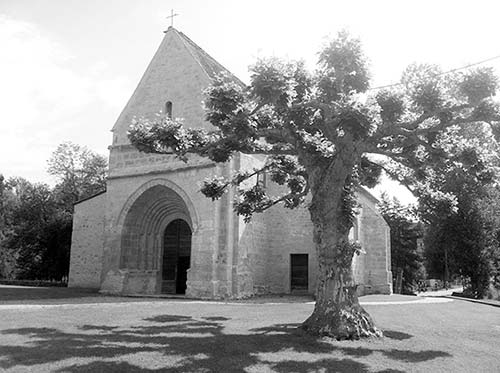
In about five minutes, be on the lookout for the little signposted turnoff on the right to the Eglise de Carsac (Church of Carsac). Set peacefully among cornfields, with its WWI monument, bonsai-like plane trees, and simple, bulky Romanesque exterior, the Eglise de Carsac church is part of a vivid rural French scene. Take a break here and enter the church (usually open). The stone capitals behind the altar are exquisitely medieval, and the chapel to the left of the altar reminds us how colorful medieval churches were. As you leave, notice the remnants of a medieval wall and tower in the hill across from the church.
Continue on, following signs to Montfort. About a kilometer west of Carsac, pull over to enjoy the scenic viewpoint (overlooking a bend in the river known as Cingle de Montfort). Find the view between the trees across the Dordogne River where fields of walnut trees stretch to distant castles, and the nearby hills are covered in oak trees. This area is nicknamed “black Périgord” for its thick blanket of oaks, which stay leafy throughout the winter. The fairy-tale castle you see is Montfort, once the medieval home of tough-guy Simon de Montfort, who led the Cathar Crusades in the early 13th century. Today it’s considered mysterious by locals. (It’s rumored that the castle is now the home of a brother of the emir of Kuwait.) A plaque on the rock near where you parked honors those who fought Nazi occupiers in this area in 1943.
Pass under Montfort’s castle (which you can’t tour; its cute little village has a few cafés and restaurants lassoed in a small pedestrian zone). If you’re combining a canoe trip with this drive, cross the river following signs to Domme, and find my recommended canoe rental on the right side (see “Dordogne Canoe Trip,” next).
The touristy bastide (fortified village) of Domme is well worth a side-trip from Vitrac or La Roque-Gageac for its sensational views (best early in the day). Our driving route continues to the riverfront villages of La Roque-Gageac, then on to Castelnaud, and finally to Beynac (all described later in this chapter). From Beynac, it’s a quick run back to Sarlat.
Dordogne Canoe Trip
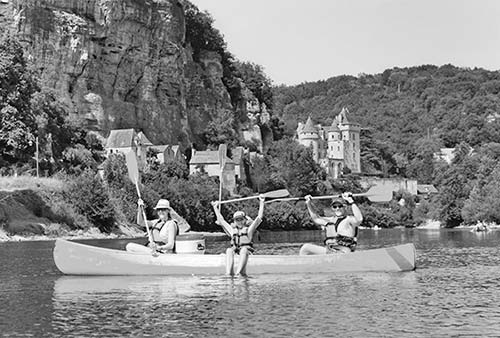
For a refreshing break from the car or train, explore the riverside castles and villages of the Dordogne by canoe, a trip worth ▲▲▲. My recommended route is a nine-mile paddle from Vitrac to Beynac. This is the most interesting, scenic, and handy trip if you’re based in or near Sarlat. Vitrac, on the river close to Sarlat, is a good starting point. And, with its mighty castle and good cafés and restaurants, Beynac delivers the perfect finale to your journey. Allow 2 hours for this paddle at a relaxed pace in spring and fall, and up to 2.5 hours in summer when the river is usually at its lowest flow.
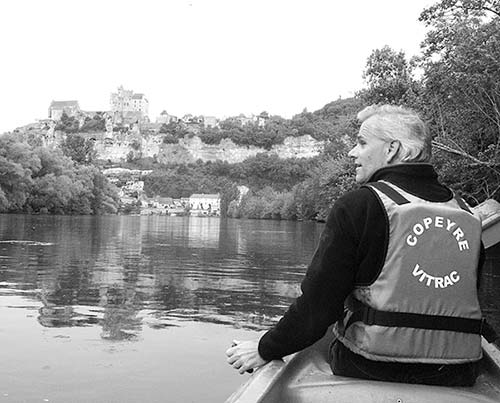
Planning Your Trip: The trip is fun even in light rain—but steady, heavy rains can make the current too fast to handle. Prolonged droughts can have the opposite effect. Check river levels before you rent.
Bring a picnic (you can rent a large waterproof storage container) and beach your boat wherever it works—it’s light enough that you can drag it up high and dry to go explore. (The canoes aren’t worth stealing, as they’re cheap and color-coded for their parent company.) It’s OK if you’re a complete novice—the only whitewater you’ll encounter will be the rare wake of passing tour boats...and your travel partner frothing at the views.
Renting a Canoe or Kayak: You can rent plastic boats—hard, light, and indestructible—from many area outfits. Whether a two-person canoe or a one-person kayak, they’re stable enough for beginners (canoes are easier to manage in the river and more comfortable). Some rental places will pick you up at an agreed-upon spot, even in Sarlat, if they aren’t too busy and you can give a precise pickup time and location (and be flexible on the return time). Also, consider hiring a taxi/driver to connect your canoe float with a visit to a prehistoric cave (see “Helpful Hints,” earlier).
All companies let you put in anytime between 9:30 and 16:00 (start no later than 15:00 to allow time to linger when the mood strikes; they’ll pick you up at agreed-upon times). They all charge about the same and most accept cash only (two-person canoe-€24/person, one-person kayak-€30). You’ll get a life vest and, for a few euros extra, a watertight bucket in which to store your belongings. (The bucket is bigger than you’d need for just a wallet and phone; if that’s all you have bring a resealable plastic baggie or something similar for dry storage.) You must have shoes that stay on your feet; travelers wearing flip-flops will be invited to purchase more appropriate footwear (sold at most boat launches for around €15).
Périgord-Aventure et Loisirs has a pullout arrangement in Beynac (to get to their Vitrac put-in base, from the main roundabout in the town of Vitrac, cross the Dordogne and turn right). They may be able to pick you up in Sarlat for a small fee (return times to Sarlat based on driver availability; +33 05 53 28 23 82, mobile +33 6 83 27 30 06, www.perigordaventureloisirs.com). Allow time to explore Beynac after your river paddle and before the return shuttle trip. Périgord-Aventure also arranges a longer, 14-mile trip from Carsac to Beynac, adding the gorgeous Montfort loop (Cingle de Montfort). Ask about their canoe, hike, and bike options, such as a canoe trip to Beynac, followed by a 2.5-mile walk along a riverside trail to Castelnaud, and ending with a 6-mile mountain-bike ride on uneven terrain back to your starting point in Vitrac (€40, 5 hours, no discounts, reserve in advance).
The Nine-Mile Paddle from Vitrac to Beynac: Here’s a rundown of the two-hour Vitrac-Beynac adventure: Leave Vitrac, paddling at an easy pace through lush, forested land. The fortified hill town of Domme will appear dead ahead after a bit, then you’ll pass through Heron Gulch. About an hour after leaving Vitrac, you’ll reach La Roque-Gageac—one of two easy and worthwhile stops before Beynac.
Paddle past La Roque-Gageac’s wooden docks (with the tour boats) to the stone ramp leading up to the town. Do a 180-degree turn and beach thyself, dragging the boat high and dry. From there you’re in La Roque-Gageac’s tiny town center, with a TI and plenty of cafés, snacks, and ice-cream options. Enjoy the town before heading back to your canoe and into the water.
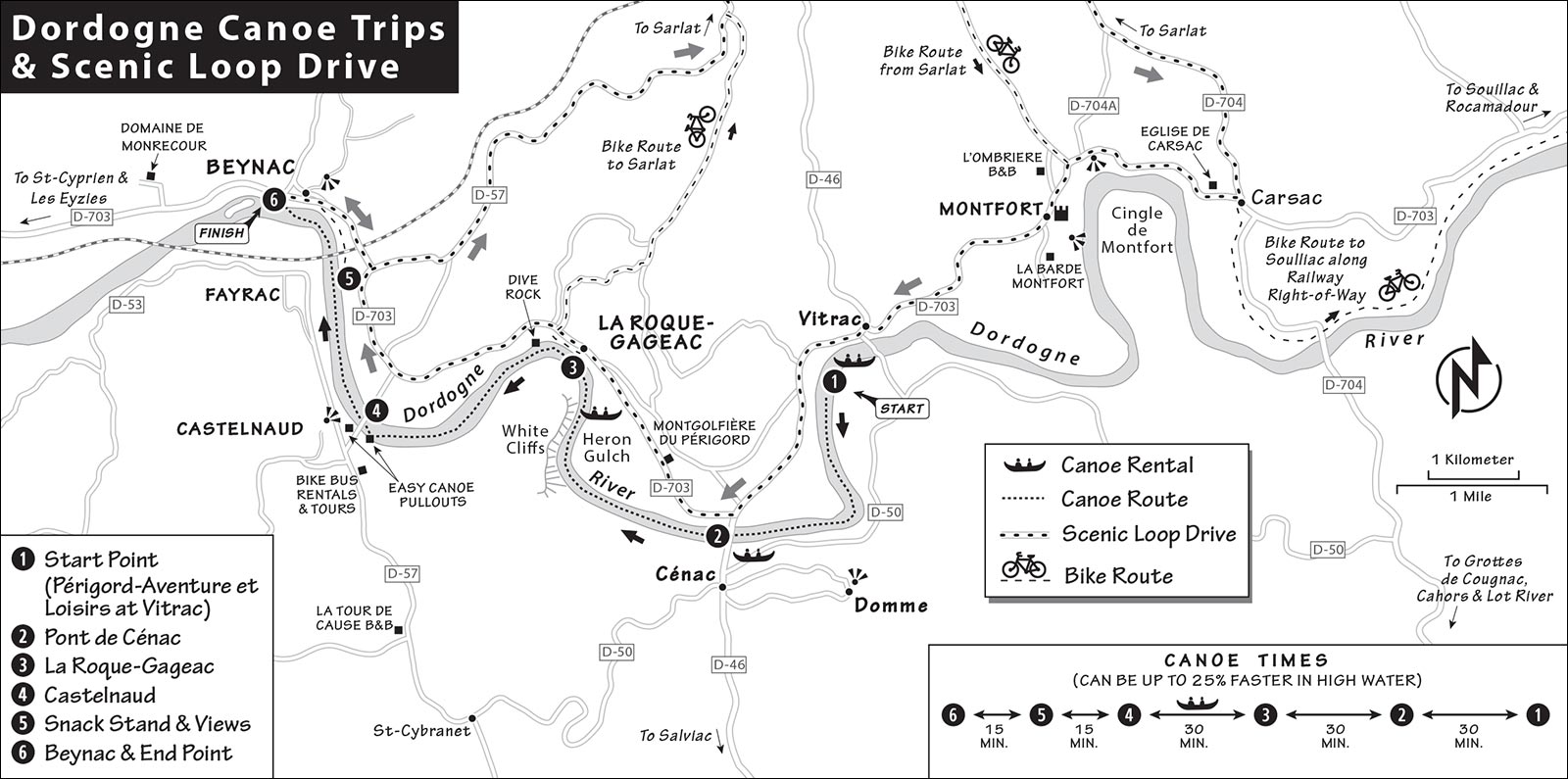
When leaving La Roque-Gageac, float backward for a bit to enjoy the village view. About 15 minutes farther downstream, you’ll approach views of the feudal village and castle of Castelnaud. Look for the castle’s huge model of medieval catapults silhouetted menacingly against the sky (it’s a long and steep but worthwhile climb to tour this castle). Two grassy pullouts flank the bridge below the castle. The bridge arches make terrific frames for castle views. Nearby, there’s a small market, a good bakery, and a charcuterie with all you need for a picnic. The local café serves good-enough fare with views (near where you pull out).
Another 15 minutes downstream brings views of Château de Fayrac on your left. The lords of Castelnaud built this to spy on Beynac during the Hundred Years’ War (1336-1453). It’s another 15 minutes to your last stop: Beynac. The awesome Beynac castle—looming high above the town—gets more impressive as you approach. Slow down and enjoy the ride (sometimes there’s a snack stand with the same views at the bridge on the right). Keep to the right as you approach the Périgord-Aventure depot. You’ll see the ramp just before the parking lot and wooden dock (where the tour boats tie up). Do another 180-degree turn, and beach yourself hard. The office is right there. Return your boat and explore Beynac.
Other Canoe Options: All along the river you’ll see canoe companies, each with stacks of plastic canoes. Depending on their location and relations with places to pull out, each one works best on a particular stretch of the river. All have essentially the same policies. Below Domme in Cénac, Canoe Randonnée Dordogne has canoes and kayaks for the scenic two-hour stretch to a pullout just past Beynac (to reach their office coming from Sarlat or Beynac, take the first left after crossing the bridge to Cénac, +33 5 53 28 22 01). In La Roque-Gageac, Canoe-Dordogne rents canoes for the worthwhile two-hour float to Château des Milandes, allowing canoers to stop in Beynac along the way (+33 7 67 23 05 12). For a lazier, no-paddle alternative, a boat cruise on the river to Castelnaud and back—either from Beynac or La Roque-Gageac—is great for landlubbers (€10, 1 hour, described in the next section).
Dordogne Towns and Sights
The towns and sights described coincide with the Dordogne River Valley scenic loop and canoe trip outlined earlier. These villages are a joy to wander early and late in the day. In high season, expect mobs of tourists and traffic in the afternoons. Those with a car can enjoy tranquil rural accommodations at great prices in these cozy villages. Read about the villages next, then make your choice—you can’t go wrong. If you sleep in one of the listed accommodations, you can expect air-conditioning unless noted, but no elevator.
Montfort
There’s more to this castle-topped village than meets the eye—leave most tourists behind and find a handful of cafés, restaurants, and chambres d’hôtes, including these recommended listings (for locations, see the “Dordogne Canoe Trips & Scenic Loop Drive” map).
Sleeping near Montfort: A warm, modern stone home is the setting for $ La Barde Montfort, which has five good rooms offered by friendly French owners Virginie and Eric. Guests enjoy a swimming pool, cozy lounge, big grass yard, and views to Montfort castle from most rooms’ terraces (no air-con but rooms stay cool, family rooms, includes breakfast, ask about home-cooked dinners, 2-night minimum, well signed behind Montfort castle at 135 Route de la Plage de Caudon, +33 5 53 28 24 34, www.labardemontfort.com, contact@labardemontfort.com).
$ L’Ombrière, with four elegant rooms run by Bordeaux refugees Chloé and Grégory, is a calm B&B overlooking a walnut grove with many picnic spaces (includes breakfast, attic rooms have air-con, on east edge of Montfort village—watch for signs, +33 7 66 26 93 53, www.lombriere.com, lombrieredordogne@gmail.com).
▲▲Domme
This busy little town merits a stop for its stunning view and is ideal early in the day. Otherwise, come late, when crowds recede and the light is divine. If you come for lunch or dinner, arrive early enough to savor the cliff-capping setting, and if you are here on market day (Thu) expect to hoof it up from a parking lot well below (cars not allowed in old town until the market is over). On other days you can park close to the top.
The TI is a block behind the viewpoint on Place de la Halle (open daily). The panorama terrace has picnic-perfect benches, a café, and a view you won’t soon forget. Follow the path that leads west from the terrace for more views and a peaceful park, then loop back into town along back lanes. While the main street is lined with touristy shops, you can lose yourself in some of the unusually picturesque back lanes, where roses climb over rustic doorways.
Sleeping and Eating in Domme: The town has many forgettable restaurants, but a few places stand out.
$$ Hôtel L’Esplanade*** is a special place with a cliffside setting and a generous terrace that delivers the valley’s most sensational views from many of its 15 comfortable bedrooms (no air-con and no elevator—but only two floors). If you come for the fine $$$ restaurant (closed Mon-Tue), book ahead for view seating. Both the hotel and the restaurant, while très traditional, are run with causal class by owner Sophie and her son (+33 5 53 28 31 41, www.esplanade-perigord.com, esplanade.domme@wanadoo.fr).
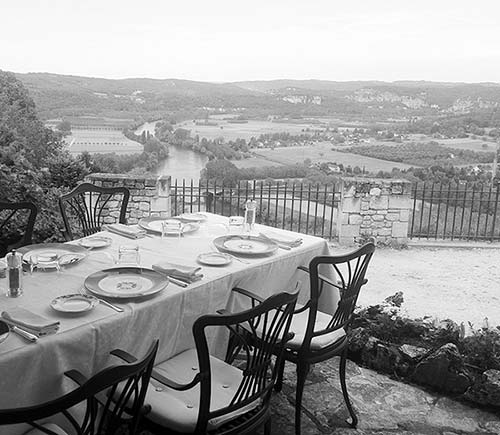
$$ 1 Logis à Domme is a classy bed-and-breakfast for those seeking tradition and spotless attention to detail. You’ll enjoy an Old World living room/library, a garden that Claude Monet would appreciate, a tiny pool and hot tub, and spacious, beautifully decorated rooms (air-con, 2-night minimum in summer, 1 Place Porte Delbos, www.1logisadomme.fr, +33 6 88 30 70 27).
$$$ Cabanoix et Châtaignes is a small bistro serving delicious Dordogne fare blended with international flavors. Enjoy the sunset from Domme’s viewpoint, then come here to dine in a quaint courtyard with comfortable seating and a warm ambience (book a few days ahead, usually closed Tue-Wed; from the viewpoint, walk past the church several blocks down Grand Rue and turn left to 3 Rue Geoffroy de Vivans; +33 5 53 31 07 11, www.restaurantcabanoix.com).
$ Belvédère Café owns a privileged position at the viewpoint and serves café fare with salads and a good selection of plats. Enjoy million-dollar views from the outside tables—try to eat here at sunset (daily for lunch and dinner, closed Nov-March, at Le Panorama, +33 5 53 31 12 01).
▲▲▲La Roque-Gageac
Whether you’re joyriding, paddling the Dordogne, or taking a hot-air balloon ride, La Roque-Gageac (lah rohk-gah-zhahk) is an essential stop—and a strong contender on all the “cutest towns in France” lists. Called by most simply “La Roque” (“The Rock”), it looks sculpted out of the rock between the river and the cliffs. It also is a fine base for touring the region.
At the upstream end of town, you’ll find lots of parking and the glassy TI built into the cliffs (closed off-season; a Plan du Village map—including Beynac, described later—is available). Nearby find a WC, swings and slides for kids, canoe rental, and pétanque (boules) courts. There’s also a peaceful parking lot at the downstream end of the village. A small market brightens La Roque-Gageac on Friday mornings in summer. Though busy with day-trippers, the town is tranquil at night.
Visiting La Roque-Gageac: Stand along the river just downstream from the boat ticket office and survey La Roque-Gageac: It’s a one-street town stretching along the river. The highest stonework (on the far right) was home to the town’s earliest inhabitants in the 10th century. High above (about center), 12th-century cave dwellers built a settlement during the era of Norman (Viking) river raids. Long after the Vikings were tamed, French soldiers used this lofty perch as a barracks while fighting against England in the Hundred Years’ War. Sturdy modern supports now reinforce the sky-high cave (Fort de la Roque-Gageac), which is open to visitors, but there’s not much to see other than a short video and big views (€7, daily 10:00-19:00, off-season until 18:00).
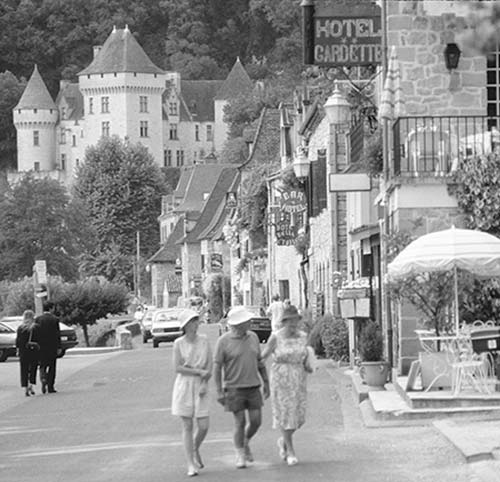
Now locate the exotic foliage around the church on the right. Tropical gardens (bamboo, bananas, lemons, cactus, and more) are a village forte, because limestone absorbs heat. Also notice the two church chapels extending over the cliff—when level land is scarce, necessity is the mother of invention.
The wooden boats on the river are modeled after boats called gabarres, originally built here to take prized oak barrels filled with local wine down to Bordeaux. Unable to return against the river current, the boats were routinely taken apart for their lumber. Today, tourists, rather than barrels, fill the boats on river cruises.
Looking downstream, notice the fanciful castle built in the 19th century by a British aristocrat. The old building just beyond that (downstream end of town) actually is historic—it’s the quarantine house, where lepers and out-of-town visitors who dropped by in times of plague would be kept (after their boats were burned).
Walk along the main drag to get a closer look at the village. La Roque-Gageac frequently endures winter floods that would leave you (standing where you are now) underwater. When there’s a big rain in central France, La Roque-Gageac floods two days later. The first floors of all the riverfront buildings are vacated off-season. The modern riverfront wall finished in 2014 was pushed out into the river, adding 13 feet of width to the street. Notice the openings at sidewalk level allowing water to flow through in heavy rains. A house about five buildings downriver from Hôtel la Belle Etoile has high-water marks engraved on its wall (inondation means “flood”).
Climb into the town by strolling up the cobbled lane to the right of Hôtel la Belle Etoile. Where the stepped path ends, veer right to find the exotic plants and viewpoint (in front of the simple church). Tucked into this garden is the recommended Restaurant de la Bambousaie. From here you can make out Château de Castelnaud downriver, and the village of Domme capping its hill to the left. For a nice loop that connects back to the river at the other end of the village, stroll along the upper lanes, passing the entrance to Fort de la Roque-Gageac, charming homes, and well-tended gardens.
Boat Tours: Tour boats cruise from La Roque-Gageac to Castelnaud and back (one-hour cruise-€12; one company’s ticket includes an audioguide, the other doesn’t; 2/hour, April-Nov daily, +33 5 53 29 40 44 or +33 5 53 29 40 95).
Hot-Air Balloon Rides: Located in La Roque-Gageac, Montgolfières du Périgord offers a range of flights (see here).
Sleeping and Eating: Along with Beynac, this is one of the region’s most beautiful villages.
$$$ Manoir de la Malartrie is a wonderful splurge. It has five country-classy rooms and two family apartments with oak-meets-leather public areas, all surrounding a big, heated pool and impeccable terraced gardens (begging for a picnic). Your angelic hostess Ouafaa (wah-fah) manages her place with quiet elegance and serves the most impressive breakfast spread in France. She also offers dinner a few times during the week—it’s worth asking about (free parking, barely downstream from the village—10-minute walk to town on trail above the road, +33 5 53 29 03 51, mobile +33 6 18 61 61 18, www.chambresdhotes-lamalartrie.com, lamalartrie@orange.fr).
$ Hôtel la Belle Etoile,*** a well-managed hotel-restaurant in the center of La Roque-Gageac, is a solid value. Hostess Danielle and chef Régis (ray-geez) offer good, simple rooms overlooking the river, a nice terrace, and a superb restaurant (air-con, free parking, closed Nov-March, +33 5 53 29 51 44, www.belleetoile.fr, hotel.belle-etoile@wanadoo.fr). Régis is the third generation of his family to be chef here and he takes his job seriously. Come to the $$$ restaurant for a memorable dinner of classic French cuisine with modern accents in a romantic setting. The œufs cocottes are really good (closed for lunch Wed-Tue and all day Mon; book a few days ahead).
$ L’Auberge des Platanes,** across from La Roque-Gageac’s TI and parking lot, rents 21 rooms above a sprawling café—guests take a backseat to café clients. Half the rooms are basic and traditional; the other half, in a different building, are modern, pricier, and have air-con (+33 5 53 29 51 58, www.aubergedesplatanes.com, contact@aubergedesplatanes.com).
$$ Restaurant de la Bambousaie hides in the exotic garden with wooden tables immersed in bamboo, soft music, and ponds. They serve big salads—la Périgourdine is excellent—and meat and fish dishes. It opens as a café in between lunch and dinner (daily, +33 7 81 69 00 56, entrance at the top of the upstream parking lot cliffside).
▲▲Château de Castelnaud
This castle may look a tad less mighty than Château de Beynac (down the river), but it packs a powerful medieval punch. The exhibits—which focus on warfare (armor, crossbows, guns, and catapults)—are well presented. The castle’s many French descriptions are not translated (except for several subtitled videos), but an English handout helps with succinct room-by-room descriptions that highlight life and death during the Hundred Years’ War.
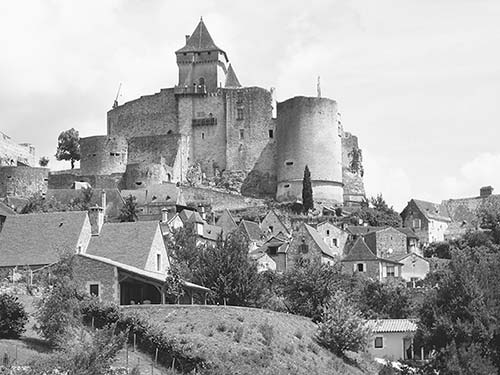
Cost and Hours: €13; daily July-Aug 9:00-20:00, April-June and Sept 10:00-19:00, Oct and Feb-March until 18:00, shorter hours Nov-Jan, last entry one hour before closing, +33 5 53 31 30 00, www.castelnaud.com.
Activities: The castle offers demonstrations of medieval warfare during busy times (usually around holidays and summer). These are fun to observe, even in French—ask when getting your ticket.
Getting There: From the river, it’s a steep 30-minute hike through the village to the castle. Drivers must park in the pay lot (5-minute walk downhill to the castle). You can stop at Castelnaud on your canoe trip and hike up to the castle, or walk an hour from Beynac along a riverside path to the village, where it’s still a good climb to the castle (the path is tricky to follow in parts—it hugs the river as it passes through campgrounds and farms—but determined walkers do fine).
Visiting the Castle: After passing the ticket booth, read your essential handout and follow the suite de la visite signs. A very tight and medieval lit spiral stairway leads up four floors through the tower to the first rooms (a bypass route is available, though you will miss a couple of rooms in this tricky-to-navigate castle).
A five-minute video sets the stage for your visit. Every room has authentic medieval weapons and a story to tell about how they were used and their limitations (like cannons that could only be fired once an hour, and the biggest and most artistic crossbows I’ve ever seen). Some rooms display costumed mannequins and suits of armor, others show informative videos (with English subtitles)—don’t miss the catapult video where you’ll learn that the big ones could fire only two shots per hour and required up to 250 men to manage. Kids eat it up, thanks in part to the children’s guide with fun puzzles. The rampart views are as unbeatable as the four siege machines are formidable.
On your way back down, you’ll see a medieval kitchen and an iron forge with a worthwhile video. You’ll emerge into a courtyard with a 150-foot-deep well (drop a pebble). A few cafés and fun medieval shops await at the foot of the castle.
Sleeping near Castelnaud: This village is ideally situated between La Roque-Gageac and Beynac. $$ La Tour de Cause is where owners Anne and Jean have found their heaven, amid their renovated farmhouse with five top-quality rooms. Some have immense walk-in showers, and the upstairs rooms have beautiful wood-beam high ceilings. There’s also a big pool and fine gardens (3-night minimum July-Aug, 2-night minimum the rest of the year, includes breakfast, fans, +33 6 11 36 95 56, www.latourdecause.com, latourdecause.info@orange.fr). From the Dordogne River, cross the bridge to Castelnaud, follow signs toward Daglan, then make a hard right turn in the hamlet of Pont de Cause and park near their gate.
▲▲▲Beynac
Four miles downstream from La Roque-Gageac, Beynac (bay-nak) is the other must-see Dordogne village. It’s also home to one of the most imposing castles in France.
This well-preserved medieval town winds like a sepia-tone film set from the castle above to the river below (easy parking at the top avoids the steep climb). The stone village—with cobbled lanes that retain their Occitan (old French) names—is just plain pretty, best late in the afternoon and downright dreamy after dark. For the best light, tour the castle late, or at least walk out to the sensational viewpoint, then have dinner here.
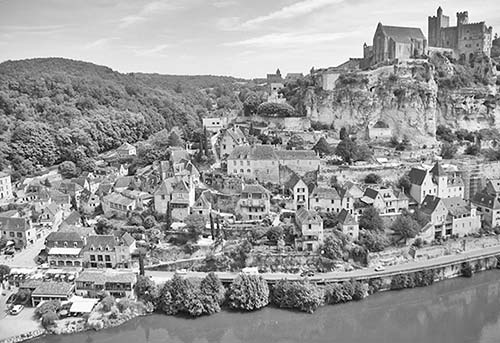
Drivers can park at pay lots located on the river (busy), way up at the castle (quieter, follow signs to Château de Beynac), or halfway between. The same parking ticket works at all three lots (park below, explore the lower village, then drive to the top for the castle). The TI is near the river, across from Hôtel du Château (closed in winter). Pick up the Plan du Village in English for a simple self-guided walking tour (includes La Roque-Gageac), and get information on hiking and canoes. A few steps down from the TI is the post office (ATM outside) and the canoe outfitter, Périgord-Aventure et Loisirs, who can shuttle you up to Vitrac for the paddle back to Beynac (see here). If you need a lift, call Beynac-based Taxi Corinne (see here). From mid-June to mid-September, a cute little market sets up on Monday mornings in the riverfront parking lot.
During the evenings, some farms in this area let you witness the force-feeding of geese for the “ultimate pleasure” of foie gras. Look for Gavage signs, but beware: It can be hard for the squeamish to watch.
Force-feeding geese and ducks quickly fattens their livers, the principal ingredient of the Dordogne specialty foie gras. Among animal-rights activists, the practice is as controversial as bullfighting (and their case is well documented). But talking to local farmers, it’s fascinating to hear the other side of the story. While awful conditions certainly exist in some places, here in the Dordogne, farmers pride themselves on treating their animals in what they consider a humane manner. Here’s their take:
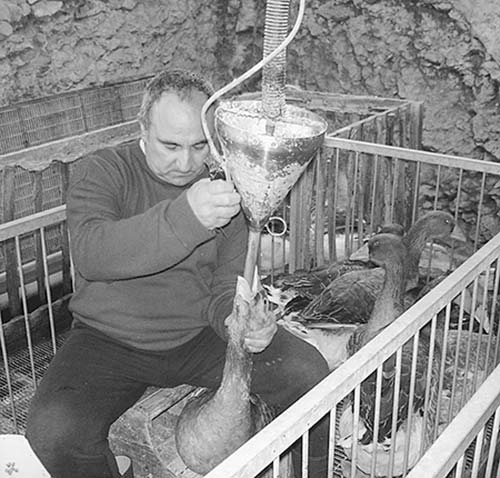
French enthusiasts of le gavage (as the process is called) say the animals are calm, in no pain, and are designed to take in food this way because of their massive gullets and expandable livers (used to store lots of fat for long migrations). Geese and ducks do not have a gag reflex, and the linings of their throats are tough (they swallow rocks to store in their gizzards for grinding the food they eat). They can eat lots of food easily, without choking. Dordogne ducks and geese live lives at least as comfy as the chickens, cows, and pigs that many people have no problem eating, and they are slaughtered as humanely as any nonhuman can expect in this food-chain existence.
The quality of foie gras depends on a stress-free environment; the birds do best with the same human feeder and a steady flow of good corn. These mostly free-range geese and ducks live six months (most factory-farmed chickens in the US live less than two months and are plumped with hormones). Their “golden weeks” are the last few, when they go into the pen to have their livers fattened. With two or three feedings a day, their liver grows from about a quarter-pound to nearly two pounds. A goose with a fattened liver looks like he’s waddling around with a full diaper under his feathers. (Signs in this region show geese with this unique and, for foie-gras lovers, mouthwatering shape.) The same process is applied to ducks to get the marginally less exquisite and less expensive duck-liver foie gras.
The varieties of product you’ll be tempted to buy (or order in restaurants) can be confusing. Here’s a primer: Foie gras means “fattened liver”; foie gras d’oie is from a goose, and foie gras de canard is from a duck (you’ll also see a blend of the two). Pâté de foie gras is a “paste” of foie gras combined with other meats, fats, and seasonings (think of liverwurst). Most American consumers get the chance to eat foie gras only as pâtés—and be careful, because pâté in French refers to a pork spread.
The foie gras d’oie entier (a solid chunk of pure goose liver) is the most expensive and prized version of canned foie gras, costing about €28 for 130 grams (about a tuna-can-size tin). The bloc de foie gras d’oie is made of chunks of pure goose liver that have been pressed together; it’s more easily spreadable (figure €18 for 130 grams). The medaillons de foie gras d’oie must be at least 50 percent foie gras (the rest will be a pâté filler, about €10 for 130 grams). Stay away from mousse, a mixture of several things, with or without wings or liver. Read the label carefully: Eleveur en Dordogne/Périgord means that the animal was actually raised locally; produit en Dordogne/Périgord/France means it was processed here, but may have originated elsewhere. It’s also trendy to label products artisan conserveur—“conserved artisanally”—but this promises only that the product was canned locally.
After a week in the Dordogne, I leave feeling a strong need for a foie gras detox.
Château de Beynac: Beynac’s brooding, cliff-clinging château, worth ▲▲, soars 500 feet above the Dordogne River (€9.50, daily July-Aug 9:00-20:00, Sept-Dec and Feb-June 10:00-18:30, closed Jan, last entry one hour before closing, +33 5 53 29 50 40, www.chateau-beynac.com). Well-done commentaries are available via a QR code. This castle is the ultimate for that top-of-the-world, king-of-the-castle feeling (Richard the Lionheart spent 10 years here). During the Hundred Years’ War (see sidebar on here), the castle of Beynac was a French stronghold, while the English set up camp across the river at Castelnaud. This authentic, sparsely furnished castle is best for its valley views, but it still manages to evoke a memorable medieval feel. (These castles never had much furniture, in any case.)
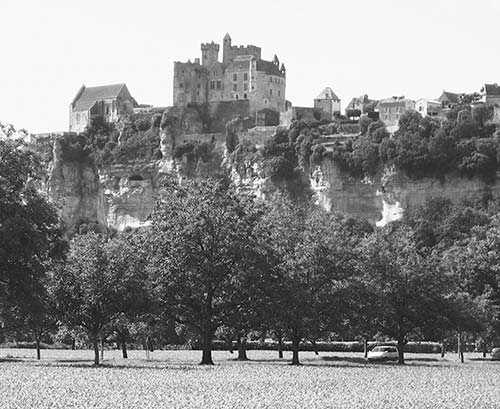
You’re free to wander on your own. As you tour the castle, swords, spears, and crossbows keep you honest, and two stone WCs keep kids entertained. The furnishings show how soldiers parked their swords and hung their crossbows before sitting down to dinner and drink (the hardy soldiers drank over two quarts of wine per day). Circling up through the castle, find your way to the highest crenellated terraces for sensational views. This is the closest look you’ll have to a lauzes roof. Just down the river, mighty Castelnaud—which seems so imposing from up close—looks like a child’s playset.
Walks and Viewpoints: A busy road separates Beynac from its river. A grade-separated sidewalk parallels the road and connects to a riverfront trail, which begins across from Hôtel Bonnet at the eastern end of town and follows the river toward Castelnaud, offering great views back toward Beynac. For able route-finders, this is a level one-hour hike to the village of Castelnaud. Make time to walk at least a few hundred yards along this trail to enjoy the view to Beynac.
Traffic-free lanes climb steeply uphill from the river to Beynac’s château—the farther you get from the road, the more medieval the village feels. One of the Dordogne’s most commanding views lies a short walk from the castle at the top of the village (easy parking, not essential if you toured the castle). Step just outside the village’s upper end and take the lane to the right, passing the little cemetery. Stroll uphill to an odd glass structure. Castelnaud’s castle hangs on the hill in the distance straight ahead. Château de Fayrac (owned by a Texan) is just right of the rail bridge and was originally constructed by the lords of Castelnaud to keep a close eye on the castle of Beynac. The Château de Marqueyssac, on a hill to the left, was built by the barons of Beynac to keep a close eye on the boys at Castelnaud—touché. More than a thousand such castles were erected in the Dordogne alone during the Hundred Years’ War.
Boat Tours: Boats leave from Beynac’s riverside parking lot for relaxing, 50-minute river cruises to Château de Fayrac and back (€10, nearly hourly, departures Easter-Oct daily 10:00-12:00 & 14:00-17:00, more frequent July-Aug, +33 5 53 28 51 15).
Sleeping in or near Beynac: Two excellent choices are available at Domaine de Monrecour****: a château with elegant $$$ rooms, many with views to other castles, fine public spaces, air-conditioning, and a grand terrace overlooking its pool; and beautifully renovated rooms in a $$ stone annex, with all the comfort of the château—including a pool—but at far cheaper rates. The annex pool is designed for families while the château pool is for adults. Other than that, anyone can go where they please. The grounds are enormous with sweeping views from terraces, and there’s a gastronomique restaurant, $$$$ La Table de Monrecour. The hotel is located in the village of St-Vincent de Cosse, a few minutes west of Beynac (+33 5 53 28 33 59, www.monrecour.com, contact@monrecour.com).
$ Hôtel Pontet** is a good budget option in Beynac, with 10 modern and clean rooms (air-con, 100 yards from the river on the main street; when reception is closed—11:30-14:00 and after 19:00—check in at the Hostellerie Maleville restaurant on the river, tel. 05 53 29 50 06, www.hostellerie-maleville.com, hostellerie.maleville@orange.fr).
Eating in Beynac: Beynac has a few worthwhile places to eat and a bakery with handy picnic-ready lunch items (across from the TI). Have a drink up high at the café opposite the castle entry (see next), or down below at the small café, which hides right on the river (walk down the steps across from Hôtel du Château); stay for dinner if the spirit moves you.
$ Taverne des Remparts, Beynac’s scenic eatery, faces the castle at the top of the town and serves salads, omelets, and plats. I can’t imagine leaving Beynac without relaxing at their view-perfect café for at least a drink or an ice cream (glace à la noix—walnut ice cream—cannot get more local). Virginie promises a free house aperitif with this book and your meal. Usually open until at least 19:30, but call ahead to be sure (daily, closed in winter, across from castle, +33 5 53 29 57 76).
$$ La Petite Tonnelle, cut into the rock, has a romantic interior and a fine terrace out front. Locals love it for its tasty cuisine served at fair prices, though the service can be erratic. It’s a block up from Hôtel du Château (good menu options, daily, on the road to the castle, +33 5 53 29 95 18, https://la-petite-tonnelle.fr).
Cro-Magnon Caves
The area around the town of Les Eyzies-de-Tayac—about a 30-minute drive from Sarlat or the Dordogne Valley—has a rich history of prehistoric cave art. The paintings you’ll see in this area’s caves are famous throughout the world for their remarkably modern-looking technique, beauty, and mystery.
For a rundown of your cave options, see “Prehistoric Sights at a Glance.” And to fully appreciate the art you’ll see, take time to read the following information, written by Gene Openshaw, on the purpose of the art and the Cro-Magnon style of painting.
CAVE ART 101
From 18,000 to 10,000 BC, long before Stonehenge, before the pyramids, before metalworking and farming, back when mammoths and saber-toothed cats still roamed the earth, prehistoric people painted deep inside limestone caverns in southern France and northern Spain. These are not crude doodles with a charcoal-tipped stick. They’re sophisticated, costly, and time-consuming engineering projects planned and executed by dedicated artists supported by a unified and stable culture—the Magdalenians.
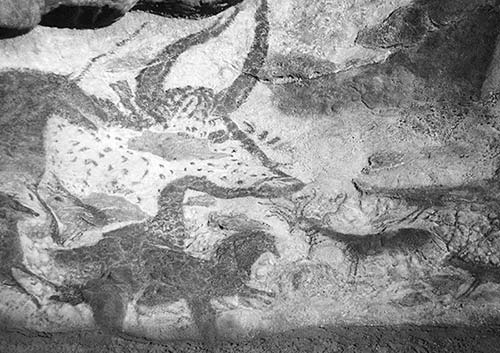
The Magdalenians (c. 18,000-10,000 BC): These hunter-gatherers of the Upper Paleolithic period (40,000-10,000 BC) were driven south by the Second Ice Age. (Historians named them after the Madeleine archaeological site near Les Eyzies-de-Tayac.) The Magdalenians flourished in southern France and northern Spain for eight millennia—long enough to chronicle the evolution and extinction of several animal species. (Think: Egypt lasted a mere 3,000 years, Rome lasted 1,000, America only about 250 so far.)
Physically, the people were Cro-Magnons. Unlike hulking, beetle-browed Neanderthals, Cro-Magnons were fully developed Homo sapiens who could blend in to our modern population. We know these people by the possessions found in their settlements: stone axes, flint arrowheads, bone needles for making clothes, musical instruments, grease lamps (without their juniper wicks), and cave paintings and sculptures. Many objects are beautifully decorated.
The Magdalenians did not live in the deep limestone caverns they painted (which are cold and difficult to access). But many did live in the shallow cliffside caves that you’ll see throughout your Dordogne travels, which were continuously inhabited from prehistoric times until the Middle Ages.
The Paintings: Though there are dozens of caves painted over a span of more than 8,000 years, they’re all surprisingly similar. These Stone Age hunters painted the animals they hunted—bison or bulls (especially at Lascaux and Grotte de Font-de-Gaume), horses, deer, reindeer, ibex (mountain goats), wolves, bears, and cats, plus animals that are now extinct—mammoths (the engravings at Grotte de Rouffignac), woolly rhinoceroses (at Grotte de Font-de-Gaume), and wild oxen.
Besides animals, you’ll see geometric and abstract designs, such as circles, squiggles, and hash marks. There’s scarcely a Homo sapiens in sight (except the famous “fallen hunter” at Lascaux), but there are human handprints traced on the wall by blowing paint through a hollow bone tube around the hand. The hunter-gatherers painted the animals they hunted, but none of the plants they gathered.
Style: The animals stand in profile, with unnaturally big bodies and small limbs and heads. Black, red, and yellow dominate (with some white, brown, and violet). The thick black outlines are often wavy, suggesting the animal in motion. Except for a few friezes showing a conga line of animals running across the cave wall, there is no apparent order or composition. Some paintings are simply superimposed atop others. The artists clearly had mastered the animals’ anatomy, but they chose to simplify the outlines and distort the heads and limbs for effect, always painting in the distinct Magdalenian style.
Many of the cave paintings are on a Sistine Chapel-size scale. The “canvas” was huge: Lascaux’s main caverns are more than a football field long, Grotte de Font-de-Gaume is 430 feet long, and Grotte de Rouffignac meanders six miles deep. The figures are monumental (one bull at Lascaux is 17 feet long). All are painted high up on walls and ceilings, like the woolly rhinoceros of Grotte de Font-de-Gaume.
Techniques: Besides painting the animals, these early artists also engraved them on the wall by laboriously scratching outlines into the rock with a flint blade, many following the rock’s natural contour. A typical animal might be made using several techniques—an engraved outline that follows the natural contour, reinforced with thick outline paint, then colored in.
The paints were mixed from natural pigments dissolved in cave water and oil (animal or vegetable). At Lascaux, archaeologists have found more than 150 different minerals on hand to mix paints. Even basic black might be a mix of manganese dioxide, ground quartz, and a calcium phosphate that had to be made by heating bone to 700 degrees Fahrenheit, then grinding it.
No paintbrushes have been found, so artists probably used a sponge-like material made from animal skin and fat. They may have used moss or hair, or maybe even finger-painted with globs of pure pigment. Once they’d drawn the outlines, they filled everything in with spray paint—either spit out from the mouth or blown through tubes made of hollow bone.
Imagine the engineering problems of painting one of these caves, and you can appreciate how sophisticated these “primitive” people were. First, you’d have to haul all your materials into a cold, pitch-black, hard-to-access place. Assistants erected scaffolding to reach ceilings and high walls, ground up minerals with a mortar and pestle, mixed paints, tended the torches and oil lamps, prepared the “paintbrushes,” laid out major outlines with a connect-the-dots series of points...then stepped aside for Magdalenian Michelangelos to ascend the scaffolding and create.
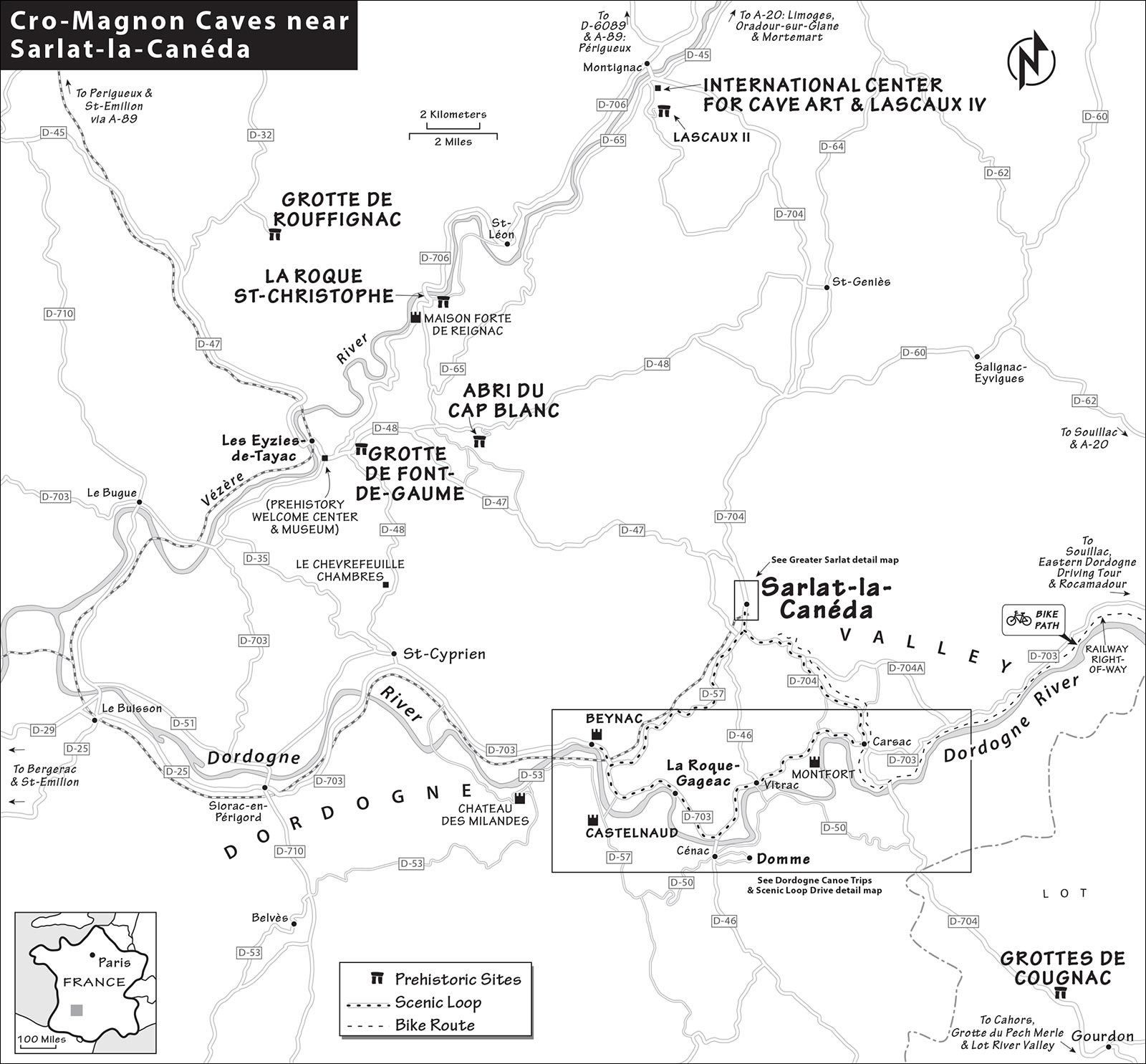
Dating: Determining exactly how old this art is—and whether it’s authentic—is tricky. (Because much of the actual paint is mineral-based with no organic material, carbon-dating techniques are often ineffective.) As different caves feature different animals, prehistorians can deduce which caves are relatively older and younger, since climate change caused various animal species to come and go within certain regions. In several cases, experts confirmed the authenticity of a painting because the portrayals of the animals showed anatomical details not previously known—until they were discovered by modern technology. (For instance, in Grotte de Rouffignac, the mammoths are shown with a strange skin flap over their anus, which was only discovered during the 20th century on a preserved mammoth found in Siberian permafrost.) They can also estimate dates by checking the amount of calcium glaze formed over the paint, which can sometimes only be seen by infrared photography.
Why? No one knows the purpose of the cave paintings. Interestingly, the sites the artists chose were deliberately awe-inspiring, out of the way, and special. They knew their work here would last for untold generations, as had the paintings that came before theirs. Here are some theories of what this first human art might mean.
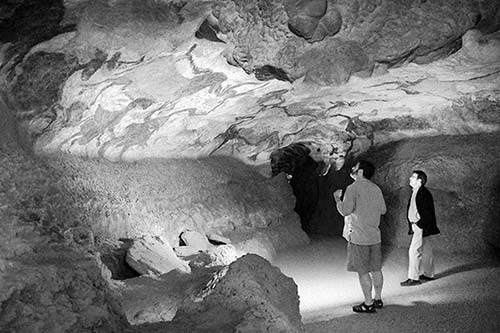
It’s no mystery that hunters would paint animals, the source of their existence. The first scholar to study the caves, Abbé Henri Breuil, thought the painted animals were magic symbols made by hunters to increase the supply of game. Or perhaps hunters thought that if you could “master” an animal by painting it, you could later master it in battle. Some scholars think the paintings teach the art of hunting, but there’s very little apparent hunting technique shown. Did they worship animals? The paintings definitely depict an animal-centered (rather than a human-centered) universe.
The paintings may have had a religious purpose, and some of the caverns are large and special enough that rituals and ceremonies could have been held there. But the paintings show no sacrifices, rituals, or ceremonies. Scholars writing on primitive art in other parts of the world speculate that art was made by shamans in a religious or drug-induced trance, but France’s paintings are very methodical.
The order of paintings on the walls seems random. Could it be that the caves are a painted collage of the history of the Magdalenians, with each successive generation adding its distinct animal or symbol to the collage, putting it in just the right spot that established their place in history?
The fact that styles and subject matter changed so little over the millennia might imply that the artists purposely chose timeless images to relate their generation with those before and after. Perhaps they simply lived in a stable culture that did not value innovation. Or were these people too primitive to invent new techniques and topics?
Maybe the paintings are simply the result of the universal human drive to create, and these caverns were Europe’s first art galleries, bringing the first tourists.
Very likely there is no single meaning that applies to all the paintings in all the caves. Prehistoric art may be as varied in meaning as current art.
Picture yourself as a Magdalenian viewing these paintings: You’d be guided by someone into a cold, echoing, and otherworldly chamber. In the darkness, someone would light torches and lamps, and suddenly the animals would flicker to life, appearing to run around the cave, like a prehistoric movie. In front of you, a bull would appear, behind you a mammoth (which you’d never seen in the flesh), and overhead a symbol that might have tied the whole experience together. You’d be amazed that an artist could capture the real world and reproduce it on a wall. Whatever the purpose—religious, aesthetic, or just plain fun—there’s no doubt the effect was (and is) thrilling.
Today, you can visit the caves and share a common experience with a caveman. Feel a bond with these long-gone people...or stand in awe at how different they were from us. Ultimately, the paintings are as mysterious as the human species.
PLANNING YOUR TIME
While the cave art here is remarkable, it can be a challenge to strategize your visit. Delicate caves come with strict restrictions, and many of them are in out-of-the-way locations—making it time-consuming to fit a cave visit into your vacation. Try to see a cave on your way in or out of the area—Lascaux is north of Sarlat, Cougnac and Pech Merle are to the south. Allow two to three hours per cave (including transit time) as you must arrive early at most.
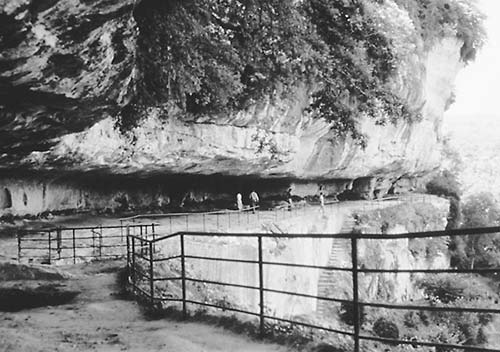
Some caves are privately owned or owned by a community. This does not mean that the owners have the right to do as they please. Irrespective of ownership, the caves are strictly monitored and maintained by the French government, which also determines the number of daily visitors that a cave can handle.
Some caves are easier to plan ahead for—and well worth a traveler’s time. Access to the most famous cave with original art, Font-de-Gaume, is very restricted, making tickets difficult to get in high season. Drivers who can’t get a ticket here should try the other interesting caves I recommend (Rouffignac is the best backup cave).
But even procrastinators who arrive in the Dordogne without reservations can show up to some caves and take their chances. Use the “Prehistoric Sights at a Glance” sidebar and the tips in each listing to determine which cave(s) best fit into your itinerary.
July and August are busiest, and rainy weather anytime sends sightseers scurrying for the caves. The caves are quieter from October through April (though Rouffignac closes entirely Nov-March); in high season, Saturdays are best (unless it’s a holiday)—but note that Grotte de Font-de-Gaume and Abri du Cap Blanc are closed that day, as is the Prehistory Welcome Center (except July-Aug).
HELPFUL HINTS
Book Ahead: If seeing the very best matters, plan well ahead, especially for Grotte de Font-de-Gaume. If you don’t score an entry here, the best original cave art alternatives are Rouffignac (reservations not required) or the Grottes de Cougnac (reservations possible but not required). At either, you can generally show up and get in with a short wait—call ahead to see how busy they are.
Abri du Cap Blanc can be booked in advance, but usually has same-day spots (except July-Aug), though it has only carvings, not paintings. Lascaux II and IV (exact replicas) also must be booked ahead. Grotte du Pech Merle is easy to book ahead and has good English descriptions but requires a considerable detour, unless you’re heading to or from the south.
Drivers Fare Best: All the prehistoric caves listed here (except Grotte du Pech Merle) are within 45 minutes of Sarlat-la-Canéda. But public transit is scarce: Without a car or a guide with a car, you’ll be like a caveman without a spear (see here for guided tours that connect some of these sights).
Cave Tips: Read “Cave Art 101” (earlier) to gain a better understanding of what you’ll see. Dress warmly, even if it’s hot outside. Tours can last up to an hour, and the caves are all a steady, chilly 55 degrees Fahrenheit, with 98 or 99 percent humidity. On a tour, lag behind the group to have the paintings to yourself for a few moments. Photography, day packs, big purses, and strollers are not allowed. (You can take your camera—without using it—and check the rest at the site.)
Local Guide: It’s well worth spending a day with Angelika Siméon, a passionate guide/lecturer eager to teach you about the caves. She can help with cave reservations and makes your cave visit easy and educational (book ahead; rates vary by itinerary; angelika.simeon@wanadoo.fr).
Les Eyzies-de-Tayac
This single-street town (referred to as Les Eyzies) is the touristy hub of a cluster of Cro-Magnon caves, castles, and rivers. It merits a stop for its Prehistory Welcome Center, National Museum of Prehistory, and (if you can get in) the Grotte de Font-de-Gaume cave, a 15-minute walk or two-minute drive outside of town. Les Eyzies is world-famous because it’s where the original Cro-Magnon man was discovered in 1868. That breakthrough set of bones was found by workers building a road at the western end of the main street (today it’s just behind the hotel of Monsieur Magnon—Hôtel le Cro-Magnon). The name “Cro-Magnon” translates as “Mr. Magnon’s Hole.”
Orientation: Les Eyzies’ TI is below the museum on the main drag at 19 Avenue de la Préhistoire and has loads of information, including where you can rent bikes (July-Aug daily 9:30-18:30, Sept-Oct and April-June closes earlier and shorter Sun hours, Nov-March closed Sun, +33 5 53 06 97 05, www.lascaux-dordogne.com). The train station is a level 500 yards from the town center (turn right from the station to get into town).
Sights in Les Eyzies-de-Tayac
Prehistory Welcome Center (Pôle d’Interpretation de la Préhistorie)
Consider starting your prehistoric explorations at the Pôle d’Interpretation de la Préhistoire (PIP). You’ll pass it as you enter Les Eyzies from the east (Sarlat). This glass-and-concrete facility is a helpful resource for planning a visit to the region’s important prehistoric sites. The low-slung building houses timelines, a good eight-minute film (English subtitles), and exhibits that work together to give visitors a primer on the origins of humanity. The English-speaking staff is happy to provide maps of the region and give suggestions on places to see. After visiting, walk out the center’s back door 200 yards on a quiet lane to the National Museum of Prehistory.
Cost and Hours: Free; Mon-Fri 9:30-12:30 & 13:30-18:00, Sun from 10:30, off-season until 17:00, closed Sat except July-Aug; free parking across the street from Hôtel des Roches—look for the tall silver PIP sign and follow the path to 30 Rue du Moulin (behind and to the right of the hotel); +33 5 53 06 06 97, www.pole-prehistoire.com.
▲National Museum of Prehistory (Musée National de Préhistoire)
This well-presented, modern museum houses more than 18,000 bones, stones, and crude little doodads that were uncovered locally. It takes you through prehistory—starting 400,000 years ago—and is good preparation for your cave visits. Appropriately located on a cliff inhabited by humans for 35,000 years (above Les Eyzies-de-Tayac’s TI), the museum’s sleek design is intended to help it blend into the surrounding rock. Inside, the many worthwhile exhibits include videos demonstrating scratched designs, painting techniques, and how spearheads were made. You’ll also see full-size models of Cro-Magnon people and animals that stare at racks of arrowheads. The museum’s handheld English explanations require patience to correlate to the exhibits.

Cost and Hours: €6, €8 with temporary exhibits, July-Aug daily 9:30-18:30; June and Sept Wed-Mon 9:30-18:00, closed Tue; Oct-May Wed-Mon 9:30-12:30 & 14:00-17:30, closed Tue; last entry 45 minutes before closing, +33 5 53 06 45 65, www.musee-prehistoire-eyzies.fr.
Information: For context, read the “Cave Art 101” sidebar before you go.
Tours: To get the most out of your visit, consider a private or semiprivate English-language guided tour, which can be reserved on the museum website.
Visiting the Museum: Pick up the museum layout with your ticket. Notice the timeline shown on the stone wall starting a mere 7 million years ago. Then enter, walking in the footsteps of your ancestors, and greet the 10-year-old Turkana Boy, whose bone fragments were found in Kenya in 1984 by Richard Leakey and date from 1.5 million years ago.
Spiral up the stairs to the first floor, which sets the stage by describing human evolution and the fundamental importance of tools. You’ll also see a life-size re-creation of Megaloceros—a gigantic deer (with even bigger antlers)—and a skeleton of an oversized steppe bison, both of which appear in some of the area’s cave paintings.
The more engaging second floor highlights prehistoric artifacts found in France. Some of the most interesting objects you’ll see are displayed in this order: a handheld arrow launcher, a 5,000-year-old flat-bottomed boat (pirogue) made from oak, prehistoric fire pits, amazing cavewoman jewelry (including a necklace labeled La Parure de St-Germain-la-Rivière, made of 70 stag teeth—pretty impressive, given that stags only have two teeth each), engravings on stone (find the impressively realistic female figure), a handheld lamp used to light cave interiors (lampe façonnée, found at Lascaux), and beautiful replicas of horses (much like the sculptures at the cave of Abri du Cap Blanc).
Your visit ends on the cliff edge, with a Fred Flintstone-style photo op on a stone ledge (through the short tunnel) that some of our ancient ancestors once called home.
Sleeping near Les Eyzies-de-Tayac
$$ Le Chèvrefeuille, halfway between Les Eyzies-de-Tayac and the river at St-Cyprien, is a family-friendly place offering homey comfort in a farm setting. Ian and Sara Fisk moved to France from England to raise their children. Five rustic guest rooms and two small apartments in various configurations handle singles to family groups (includes breakfast, cash only, free loaner bikes, pay laundry facilities, cooking classes for families and adults, big swimming pool, large grass and play areas, pétanque court, closed mid-Oct-April except for apartments, +33 5 53 59 47 97, www.lechevrefeuille.com, info@lechevrefeuille.com). From near Les Eyzies, head south on D-48 about six kilometers, turn right into the small hamlet of Pechboutier, and look for their sign.
Caves and Other Sights near Les Eyzies-de-Tayac
I’ve arranged these geographically and included sights that can be handy if you have extra time while awaiting your cave appointment: the stately-for-a-cave Maison Forte de Reignac and the evocative troglodyte terraces of La Roque St-Christophe. Most of the caves and other sights listed here are within a 20-minute drive of Les Eyzies.
JUST EAST OF LES EYZIES-DE-TAYAC
The Grotte de Font-de-Gaume and Abri du Cap Blanc are barely outside of Les Eyzies, and are managed by the same outfit.
▲▲▲Grotte de Font-de-Gaume
Even if you’re not a connoisseur of Cro-Magnon art, you’ll dig this cave—the last one in France with prehistoric multicolored (polychrome) paintings still open to the public. (Lascaux—45 minutes down the road—has replica caves with more dramatic paintings closer to their original coloring; the other caves with original paintings open to the public are monochrome.) This cave, made millions of years ago—not by a river, but by the geological activity that created the Pyrenees Mountains—is entirely natural. It contains 15,000-year-old paintings of 230 animals, 82 of which are bison.
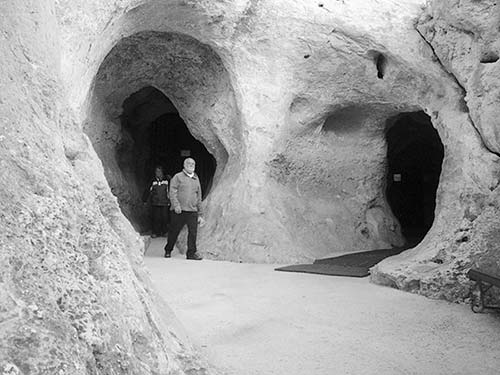
On a carefully guided and controlled 100-yard walk, you’ll see about 20 red-and-black bison, a few horses, and a reindeer—often in elegant motion—painted with a moving sensitivity. Often, when two animals face each other, one is black, and the other is red. Your guide, with a laser pointer and great reverence, will trace the faded outline of the animals and explain how, over 15 millennia in the past, cave dwellers used local minerals and the rock’s natural contours to give the paintings dimension. Some locals knew about the cave long ago, when there was little interest in prehistory, but the paintings were officially discovered in 1901 by the village schoolteacher.
Cost and Hours: €11.50, 17 and under free, includes required 45-minute tour; Sun-Fri 9:30-17:30, off season 9:30-12:30 & 14:00-17:30, closed Sat year-round; closed day may change to Mon in 2024—check ahead; no photography or large bags.
Information: +33 5 53 06 86 00, www.eyzies.monuments-nationaux.fr [URL inactive].
Reservations: Access to Font-de-Gaume is extremely restricted, with only 78 spaces available each day (6 tours of 13 each). Book as far ahead as you can, particularly for high season (preferably with an English tour, though I’d take any availability to see these paintings—keep checking back if your date isn’t immediately available). Travelers outside summer have a far better chance. Online reservations are usually the only way to get a ticket, though if you feel lucky and it’s off-season, show up 20 minutes before a scheduled tour to see if a spot is available.
You must check in at least 30 minutes before your tour time. Expect a 10-minute uphill walk to the starting point.
Tours: At least one English tour is available each day, but if all you can get is a French tour, don’t fret—most important is experiencing the art itself. You can buy an informative book afterward in the gift shop.
Getting There: The cave is at the corner of D-47 and D-48, about a two-minute drive (or a 15-minute walk) east of Les Eyzies (toward Sarlat). There’s easy on-site parking. After checking in at the ticket house, walk 400 yards on an uphill path to the cave entrance (where there’s a free, safe bag check and a WC).
▲Abri du Cap Blanc
In this prehistoric rock shelter (a 10-minute drive from Grotte de Font-de-Gaume), early artists used the rock’s natural contours to add dimension to their sculpture. Your guide spends the tour in a single stone room explaining the 14,000-year-old “carvings.” The small museum helps prepare you for your visit, and the useful English handout describes what the French-speaking guide is talking about (some guides add English commentary). Look for places where the artists smoothed or roughened the surfaces to add depth. Keep in mind that you won’t see cave paintings. Impressive as these artworks are, their subtle majesty is lost on some.
Cost and Hours: €8, ages 18 and under free; includes required 45-minute tour (often with some English), 6 tours/day (35 people each). The cave is open Sun-Fri mid-May-mid-Sept 10:00-18:00, mid-Sept-mid-May 10:00-12:30 & 14:00-17:30, closed Sat year-round, last entry at about 16:15; closed day may change to Mon in 2024—check ahead.
Information: +33 5 53 59 60 30, www.eyzies.monuments.nationaux.fr [URL inactive].
Reservations: Tickets can be booked online at the website above. Off-season, spots may be available 20 minutes before scheduled tour.
Getting There: Abri du Cap Blanc is well signed and is located about seven kilometers after Grotte de Font-de-Gaume on the road to Sarlat. From the parking lot, walk 200 yards down to the entry.
NORTHEAST OF LES EYZIES-DE-TAYAC
I’ve listed the following stops—an elegant manor burrowed into the side of a cliff, a medieval cave dwelling, and one of the region’s most famous stops for cave art—in the order you reach them traveling northeast from Les Eyzies along the Vézère River on D-706.
Maison Forte de Reignac
For over 700 years, a powerful lord ruled from this unusual home carved from a rock face high above the Vézère River. After a short but steep hike to the entry, you’ll climb through several floors of well-furnished rooms, some with lit fireplaces and mannequins in period dress. Kids love this tree-house-like place. Your tour concludes in a room that houses torture devices and highlights man’s creative abilities to inflict unthinkable pain...and a slow death. (This section may be too gruesome for young kids.) The loaner English handout provides good context.
Cost and Hours: €10, €18 combo-ticket with La Roque St-Christophe, daily 10:00-19:00, July-Aug until 20:00, Oct-Nov and Feb-March until 18:00, closed Dec-Jan; just north of the village of Tursac, +33 5 53 50 69 54, www.maison-forte-reignac.com. From Les Eyzies-de-Tayac, it’s a twisty 10-minute drive up D-706 (direction: La Roque St-Christophe).
▲La Roque St-Christophe
Five fascinating terraces carved by the Vézère River have provided shelter to people here for 55,000 years. Although the terraces were inhabited in prehistoric times, there’s no prehistoric art on display—the exhibit (except for one small cave) is entirely medieval.
Cost and Hours: €11, €18 combo-ticket with Maison Forte de Reignac, daily July-Aug 9:30-19:30, April-June and Sept 10:00-18:30, Oct-March 10:00-17:30, last entry one hour before closing, lots of steps; eight kilometers north of Les Eyzies-de-Tayac—soon after passing Maison Forte de Reignac—follow signs to Montignac; +33 5 53 50 70 45, www.roque-st-christophe.com.
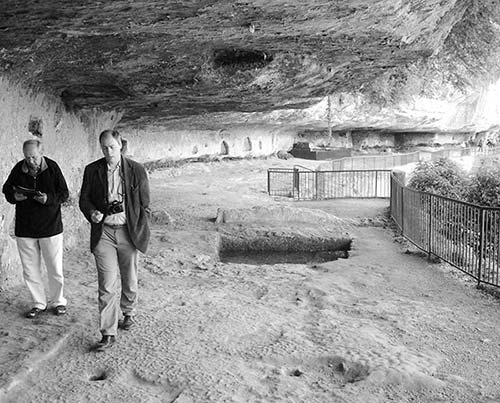
Background: The official recorded history goes back to AD 976, when people settled here to steer clear of the Viking raiders who’d routinely sail up the river. (Back then, in this part of Europe, the standard closing of a prayer wasn’t “amen,” but “and deliver us from the Norseman, amen.”) A clever relay of river watchtowers kept an eye out for raiders. When they came, cave dwellers gathered their kids, hauled up their animals (see the big, re-created winch), and pulled up the ladders. Although there’s absolutely nothing old here except for the gouged-out rock (with holes for beams, carved out of the soft limestone), it’s easy to imagine the entire village—complete with butcher, baker, and candlestick maker—in this family-friendly exhibit. This place is a dream for kids of any age.
Visiting the Terraces: There’s a free parking lot across the stream, with picnic tables, a WC, and, adjacent to the babbling brook, a pondside café (selling salads, sandwiches, and drinks—the nearby pretty village of St-Léon provides more lunch choices). Climb through the one-way circuit, which is slippery when damp. Handy panels in English show the medieval buildings that once filled this space. On the big terrace, don’t miss the 20-minute movie explaining the geological formation and re-creating what the cliff looked like when inhabited-–stand close to the screen to read the subtitles. Allow at least one hour for your visit.
▲▲International Center for Cave Art (Lascaux Centre International de l’Art Pariétal)
The region’s—and the world’s—most famous cave paintings are at Lascaux, 14 miles north of Sarlat-la-Canéda and Les Eyzies-de-Tayac. The Lascaux caves were discovered accidentally in 1940 by four kids and their dog. From 1948 to 1963, more than a million people climbed through the prehistoric wonderland of incredibly vivid and colorful paintings—but the visitors tracked in fungus on their shoes and changed the temperature and humidity with their heavy breathing. In just 15 years, the precious art deteriorated more than during the previous 15,000 years, and the caves were closed to the public.
Today you can only see replicas here. Seeing the real thing at one of the other caves is thrilling, but coming to Lascaux and taking one of the scheduled tours is a terrific introduction to the region’s cave art and how electrifying it once looked. Forget that these are copies and enjoy being swept away by the prehistoric majesty of it all.
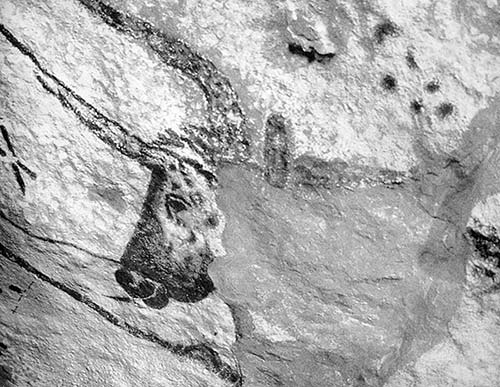
To plan your visit, know the lingo: Lascaux I is the original cave. In 1983, a replica of the cave called Lascaux II was built next to the original—accurate to within one centimeter, reproducing the best 40-yard-long stretch, and showing 90 percent of the paintings found in Lascaux. Lascaux III is an exhibit designed to travel abroad. The razzle-dazzle Lascaux IV opened in 2017, reproducing almost 100 percent of the original cave and designed with the latest technology. Visitors can tour Lascaux II or IV—or both—depending on their interest. The Lascaux caves are a constant 56 degrees year-round, so dress warmly.
Cost and Hours: Lascaux IV—€22 includes 40-minute tour, audioguide, 3-D film, and many exhibits; daily July-Aug 8:00-22:00, April-June and Sept-early Nov 9:00-19:00, shorter hours in winter and closed Jan; Lascaux II—€14, includes 75-minute tour; daily July-Aug 9:00-19:00, early April-June and Sept-early Nov 10:00-13:00 & 14:00-17:00, closed mid-Nov-March.
Information: Located on Avenue de Lascaux in Montignac; +33 5 53 50 99 10, www.lascaux.fr/en, contact@lascaux.fr.
Reservations: For either cave, reservations for the few daily English tours are essential (English tours are usually available at 10:00 or 11:00 and 15:00 or 16:00). More times are added in high season.
Eating: Lascaux IV has a good cafeteria with fair prices and outdoor seating. The pleasant town of Montignac is less than a mile away with cafés and food shops.
Visiting the Caves: These replica caves each took years to create. The prehistoric reindeer, horses, and bulls of the original Lascaux cave were painstakingly reproduced by talented artists, using the same dyes, tools, and techniques their predecessors used 15,000 years ago.
Lascaux IV gives a thorough overview of the original cave but has a circus-like feel in high season: You’ll wade through huge parking lots to get there (remote lots add 500 yards), then join groups of 35 people that are processed every six minutes. It’s housed in the International Center for Cave Art, a sight in itself, built into the hillside next to the original cave. Your visit to this state-of-the-art center starts with a well-done, 40-minute guided tour of the replica caves. Then you are set free with a tablet to view interactive exhibits that explain the role Lascaux played in prehistory, scientific research analyzing cave art, and the link from cave art to modern art. The thought-provoking, what-do-these-paintings-mean, 3-D film is a fine way to finish your visit. Plan to spend a minimum of 1.5 hours here.
Lascaux II sits a half-mile above Lascaux IV in the woods and offers a more intimate, quiet, and intensive look at the caves on a 75-minute tour with a group of 20 people.
NORTHWEST OF LES EYZIES
▲▲Grotte de Rouffignac
At Rouffignac you’ll ride a clunky little train down a giant subterranean riverbed, exploring about half a mile of this six-mile-long gallery with black-on-white paintings and engravings. The cave itself was long known to locals, but the 15,000-year-old drawings were officially “discovered” only in 1956. With a little planning, you’ll have no trouble getting a ticket to this fascinating cave. Dress warmly, as you’ll be sitting during your visit.
Cost and Hours: €8.15; daily July-Aug 9:00-11:30 & 14:00-18:00, April-June and Sept-Oct 10:00-11:30 & 14:00-17:00, closed Nov-March; essential audioguide-€1.50; one-hour guided tours run 2-3/hour, no reservations.
Information: +33 5 53 05 41 71, www.grottederouffignac.fr.
Getting Tickets: It’s really crowded only from mid-July through August, and during these months the ticket office opens at 9:00 and closes when tickets are sold out for the day—usually by noon. Arrive by 8:30 in summer and 30 minutes early at other times of year (you may get an entry time for a bit later in the day). Weekends tend to be quietest, particularly Saturday.
Getting There: Grotte de Rouffignac is well signed from the route between Les Eyzies-de-Tayac and Périgueux (don’t take the first turnoff, for Rouffignac; wait for the Grotte de Rouffignac sign); allow 25 minutes from Les Eyzies-de-Tayac.
Visiting the Cave: Your tour will be in French (with highlights described in English), but the audioguide explains it all (with text and photos). Before the tour begins, study your audioguide’s background sections and the displays in the cave entry area. Once on the tour it’s easy to follow along. Here’s the gist of what they’re saying on the stops of your train ride:
The cave was created by the underground river. It’s entirely natural, but it was much shallower before the train-track bed was excavated. As you travel, imagine the motivation and determination of the artists who crawled more than a half-mile into this dark and mysterious cave. They left behind their art...and the wonder of people who crawled in centuries later to see it all.
You’ll ride about five minutes before the first stop. Along the way, you’ll see crater-like burrows made by hibernating bears long before the first humans drew here. There are hundreds of them—not because there were so many bears, but because year after year, a few of them would return, preferring to make their own private place to sleep (rather than using some other bear’s den). After a long winter nap, bears would have one thing on their mind: Cut those toenails. The walls are scarred with the scratching of bears in need of clippers.
Stop 1: The guide points out bear scratches on the right. On the left, images of woolly mammoths etched into the walls can be seen only when lit from the side (as your guide will demonstrate). As the rock is very soft here, these were simply gouged out by the artists’ fingers.
Stop 2: Look for images of finely detailed rhinoceroses outlined in black. Notice how the thicker coloring under their tummies suggests the animals’ girth. The rock is harder here, so nothing is engraved. Soon after, your guide will point out graffiti littering the ceiling—made by “modern” visitors who were not aware of the prehistoric drawings around them (with dates going back to the 18th century).
Stop 3: On the left, you’ll see woolly mammoths and horses engraved with tools in the harder rock. On the right is the biggest composition of the cave: a herd of 10 peaceful mammoths. A mysterious calcite problem threatens to cover the art with ugly white splotches.
Off the Train: When you get off the train, notice how high the original floor was (today’s floor was dug out in the 20th century to allow for visitors). Imagine both the prehistoric makers and viewers of this art crawling all the way back here with pretty lousy flashlight substitutes. The artists lay on their backs while creating these 60 images (unlike at Lascaux, where they built scaffolds).
The ceiling is covered with a remarkable gathering of animals. You’ll see a fine 16-foot-long horse, a group of mountain goats, and a grandpa mammoth. Art even decorates the walls far down the big, scary hole. When the group chuckles, it’s because the guide is explaining how the mammoth with the fine detail (showing a flap of skin over its anus) helped authenticate the drawings: These couldn’t be fakes, because no one knew about this anatomical detail until the preserved remains of an actual mammoth were found in Siberian permafrost in modern times. (The discovery explained the painted skin flap, which had long puzzled French prehistorians.)
SOUTH OF THE RIVER
Two caves lie to the south: the Grottes de Cougnac, described here, is roughly on the way between the Dordogne Valley and the A-20 autoroute (about 30 minutes from Sarlat, 45 minutes from Les Eyzies). The Grotte du Pech Merle is an hour farther south, near the Lot River Valley (see here).
▲▲Grottes de Cougnac
Located 23 kilometers south of Sarlat-la-Canéda and three well-signed kilometers north of Gourdon on D-704, this cave holds fascinating rock formations and the oldest (20,000-25,000-year-old) paintings and drawings open to the public. Family-run and less developed than other sites, it provides a more intimate look at cave art, as guides take more time to explain the caves (your guide should give some explanations in English—ask). The art you see is single-color outlines or silhouettes (in red, yellow, or black). It’s just one small part of the full tour, which focuses heavily on the cave’s geology and unique formations—you’ll see spaghetti-style stalactites, curtain stalactites, and much more.
Cost and Hours: €10, includes required 70-minute tour; these hours correspond to first/last tour times: July-Aug daily 10:00-17:45; April-June and Sept Sun-Fri 10:00-11:30 & 14:30-17:00, closed Sat; Oct Mon-Sat 14:00-16:00, closed Sun; closed Nov-March; free WCs, consider the decent €5 English-language booklet.
Information: +33 5 65 41 47 54, www.grottesdecougnac.com.
Reservations: Online reservations are possible and smart. Otherwise, you can call the ticket office right when it opens, or show up 20 minutes before those times, to try and snag a spot. During summer and in bad weather, they’re most crowded from 11:00 to 12:00 and 15:00 to 17:00. At quieter times, you can usually stop by before 11:00 and get in. From April to June and in September, be careful not to arrive too close to the last tour before lunch (11:30)—if that tour is full, you’ll have to wait for the 14:30 departure. Note: If you have time to kill, you’re only minutes from the town of Gourdon (with shops, restaurants, and a historic center).
Visiting the Cave: The 70-minute tour (likely in French) begins in a cave below the entrance, where the guide explains the geological formations (you’ll learn that it takes 70 years for water to make it from the earth’s surface into the cave). From this first cave, you’ll return to the fresh air and walk eight minutes to a second cave. Inside, you’ll twist and twist through forests of stalagmites and stalactites before reaching the grand finale: the drawings you came to see. They are worth the wait. Vivid depictions (about 10) of ibex, mammoths, and giant deer (Megaloceros), as well as a few nifty representations of humans, are outlined in rust or black. The rendering of the giant deer’s antlers is exquisite, and many drawings use the cave’s form to add depth and movement. The art is subtle—small sketches here and there, rather than the grand canvases of some of the more famous caves—but powerful.
Oradour-sur-Glane
Lost in lush countryside, two hours north of Sarlat-la-Canéda, Oradour-sur-Glane is a powerful experience—worth ▲▲▲. French children know this town well, as most come here on school trips. Village des Martyrs, as it is known, was machine-gunned and burned on June 10, 1944, by Nazi troops. With cool attention to detail, the Nazis methodically rounded up the entire population of 642 townspeople, of whom about 200 were children. The women and children were herded into the town church, where they were tear-gassed and machine-gunned as they tried to escape the burning chapel. Oradour’s men were tortured and executed. The town was then set on fire, its victims left under a blanket of ashes.
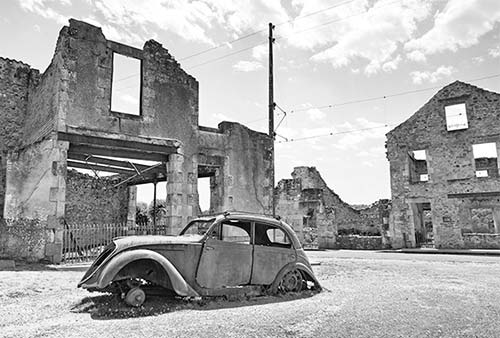
The reason for the mass killings remains unclear. Some say the Nazis wanted revenge for the kidnapping of one of their officers, but others believe the Nazis were simply terrorizing the populace in the wake of D-Day. Today, the ghost town, left untouched since 1944 (by order of President Charles de Gaulle), greets every pilgrim who enters with only one English word: Remember. Given the events in Ukraine at the time of this writing, that message seems more important than ever.
ORIENTATION TO ORADOUR-SUR-GLANE
Cost and Hours: Entering the village is free, but the museum costs €8 (audioguide-€2). Both are open daily mid-May-mid-Sept 9:00-18:00, off-season until 16:00 or 17:00, last visit one hour before closing, +33 5 55 43 04 30, www.oradour.org. Allow two hours for your visit.
Getting There: For drivers coming from the south, Oradour-sur-Glane is well signed off the (mostly free) A-20. Those driving from the north should take A-10 to Poitiers, then follow signs toward Limoges and turn south at Bellac. Bus #12 links Oradour-sur-Glane with the train station in Limoges (3/day, Mon-Sat only, 40 minutes, schedule on Oradour website), consider taking the bus one way to Oradour and taxi (€5 one-way) the other (taxi +33 5 55 38 38 38, Limoges TI +33 5 55 34 46 87). Those without a car should consider a taxi tour; Christoph Kusters can pick you up in Limoges and take you to Oradour and other sights on the way to your Dordogne hotel (reverse this plan if leaving the Dordogne; see listing under “Getting Around the Dordogne” on here).
VISITING ORADOUR-SUR-GLANE
Follow Village Martyrs signs to find the parking lot above the rust-colored underground museum (Centre de la Mémoire). The pricey-for-what-it-offers museum gives a standard timeline of the rise of Hitler and WWII events. The most impactful sections show haunting footage of everyday life in Oradour before the attack, and display a day-by-day account of the unthinkable events that took place here almost 80 years ago. While good explanations are posted in English, the museum is skippable for many—it’s the ruined village that matters most.
From the museum’s back door, emerge at the edge of the village and stroll uphill, then turn right at the first intersection. Join other hushed visitors to walk the length of Oradour’s main street, past gutted, charred buildings and along lonely streetcar tracks under overhead wires. It’s amazing that the wires that powered the streetcars have survived intact, and shocking to see just how big and how ruined the village is—a harrowing embodiment of the brutality and pointlessness of war.
Lieu de Supplice signs show where the townsmen were tormented and murdered. Recueillez-vous means to pause and reflect. The plaques on the buildings provide the names and occupations of the people who lived there (laine means wool, sabotier is a maker of wooden shoes, couturier is a tailor, quincaillerie is a hardware store, cordonnier is shoe repair, menuisier is a carpenter, and tissus are fabrics). You’ll pass several cafés and butcher shops and a hôtel-restaurant. This village was not so different from many you have seen on your trip.
At the end of main street, visit the modest church, with its rusted-out cross and bullet-pocked altar. Then double back through the upper part of the village, bearing right at the second street to the cemetery (cimetière). The names of all who died in the massacre on that June day are etched into the rear wall of the cemetery, around an austere pillar. In front of the pillar, glass cases display the remains of some of the victims. Leaving the cemetery, turn right, then left through the hedges to find the entrance to the bunker-like underground memorial, with displays of people’s possessions found after the attack: eyeglasses, children’s toys, sewing machines, cutlery, pocket watches, and so on.
Nearby: The appealing village of Mortemart lies 15 minutes north with a good café (closed Mon-Tue) wedged between its ancient market hall and low-slung château. Park yourself here and find the grassy path to the right of the château to wander at will. You’re on a Grande Randonnée path, part of France’s network of long-distance trails.
St-Emilion
Two hours due west of Sarlat-la-Canéda and just 40 minutes from Bordeaux, pretty St-Emilion is carved like an amphitheater into the bowl of a limestone hill. Its tidy, steep lanes connect a few inviting squares with heavy cobbles and scads of well-stocked wine shops. There’s little to do in this well-heeled town other than enjoy the setting, climb a tower or two, and sample the local sauce. Sunday is market day.
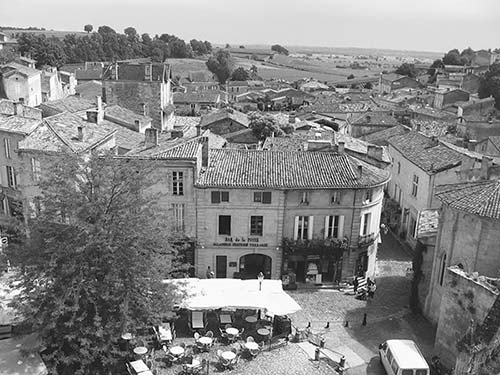
They’ve been making wine in St-Emilion for more than 1,800 years—making it the oldest wine producer in the Bordeaux region (though it accounts for barely 5 percent of Bordeaux’s famous red wine). Blending cabernet franc and merlot grapes, St-Emilion wines are also the most robust in Bordeaux. About 60 percent of the grapes you see are merlot.
The English-fluent TI is located at the top of the town on Place des Créneaux, across from the town’s highest bell tower (open daily year-round, Place des Créneaux, +33 5 57 55 28 28, www.saint-emilion-tourisme.com). They can help with bike rentals (see next for e-bikes) and have helpful English-language handouts (also available online) outlining self-guided cycling routes, wine tastings, and themed, well-marked walking routes through the vineyards.
Getting There: It’s a 20-minute walk from St-Emilion’s train station into town or, for a small fee, you can book a ride in an electric tuk-tuk (April-Oct, +33 6 40 83 62 60) or golf cart (+33 7 49 77 76 72); 4 trains/day from Sarlat-la-Canéda, 2 hours; hourly from Bordeaux, 30 minutes. You can also get off the train in Libourne (5 miles away), with easy car rental and taxis.
Drivers will find pay parking in lots at the upper and lower ends of the town.
Wine Tasting and Wine Shops: Next to the TI, Maison du Vin is a fair starting point for an introduction to wine (daily, +33 5 57 55 50 55, www.maisonduvinsaintemilion.com). They offer reasonably priced, one- to two-hour wine-tasting classes (register in advance by phone).
Keepers of small shops greet visitors in flawless English, with a free tasting table, maps of the vineyards, and several open bottles. Americans may represent only about 15 percent of the visitors, but they buy 40 percent of the wine. Cercle des Oenophiles is an easygoing place where you can taste wines and tour nearby cellars storing more than 400,000 bottles (free, daily except closed 12:30-14:00, 12 Rue Guadet, +33 5 57 74 45 55, cdoriviere@neuf.fr).
Tours and Views: An interesting 45-minute underground tour makes three stops at sights that otherwise aren’t open to visitors: the catacombs (sorry, no bones), monolithic church, and Trinity Chapel (€15, English tour daily—usually at about 14:00, more tours in French, thorough English handout given on French tours, book on the TI’s website).
You can climb the bell tower in front of the TI for a good view (€2, ask at TI for key), but the view is best from the Tour du Roy several blocks below (also €2, but no key required).
Getting into the Vineyards: Hop on Le Petit Train for a scenic 35-minute loop through nearby vineyards (€8, every 45 minutes from 10:30-17:45, leaves from Espace Villemaurine at the top of the town, www.train-des-grands-vignobles.com). They also offer wine-tasting options (see website, or better, get details at the TI). Les Cordeliers offers fun electric tuk-tuk tours through its vineyards and visits to cellars for up to four people including a tasting (€25/person; +33 5 57 24 42 13, www.lescordeliers.com). Walking tours (€12.50) are available, too.
The TI has good information on bike routes, or follow the one I describe next. You can rent e-bikes at Lovelec-33 (daily, Port de Libourne, +33 6 79 16 26 86, www.location-velo-electrique-libourne.fr).
Ophorus offers a full range of minivan tours of St. Emilion and the surrounding wine region, as well as basic transfers (cheaper from Bordeaux, www.ophorus.com).
For standard taxi service contact Montransport (www.montransport.com, contact@montransport.com).
Quickie Vineyard Loop: This 10-kilometer loop can be done in 20 minutes by car, and in two relaxed hours by bike. Leave the upper end of St-Emilion on D-243E-1 and head to St-Christophe des Bardes. Pass through the village (direction: St-Genès), then follow signs to the right to St-Laurent des Combes. Joyride your way down through hillsides of vines, then find signs looping back to St-Emilion’s lower end via D-245, turning right on D-122.
Sleeping in St-Emilion: There are no cheap beds in St-Emilion. Chambres d’hôtes hidden among the surrounding vineyards offer a better value—ask the TI for a list. Hotel prices skyrocket during the VinExpo festival at the end of June and during harvest time (late Sept).
$$$ Au Logis des Remparts*** offers very good comfort, a pool, and a tranquil garden with vineyards (+33 5 57 24 70 43, www.logisdesremparts.com, contact@logisdesremparts.com).
$$$ Logis des Cordeliers Chambres is run by gentle Valérie, who speaks just enough English and rents four comfortable rooms in a restored 18th-century mansion (includes breakfast, 7 Rue Porte Brunet, +33 7 82 78 01 55, www.logis-des-cordeliers.com, contact@logis-des-cordeliers.com).
$$ L’Auberge de la Commanderie** has 17 modern rooms at midrange prices (air-con, elevator, pay parking—reserve ahead, closed Jan, +33 5 57 24 70 19, www.aubergedelacommanderie.com, contact@aubergedelacommanderie.com).
Eating in St-Emilion: The town is filled with tempting places—window shop the options and choose what looks best or consider these suggestions. Skip most of the cafés lining the street by the TI and instead head to the picture-perfect square, Place du Marché, which is lined with appealing cafés.
$$$ L’Envers du Décor is a delightful wine bar-bistro specializing in fun, wine, and food—in that order. Meat dishes are their forte (daily, a few doors from the TI at 11 Rue du Clocher, +33 5 57 74 48 31).
$$$ Logis de la Cadène has street appeal with a pleasing patio terrace, a warm interior, and very pricey fine cuisine (closed Sat-Sun, just above Amelia-Canta Café at 3 Place du Marché du Bois, +33 5 57 24 71 40, www.logisdelacadene.fr).
The Overlooked Eastern Dordogne
This remote, less-visited section of the Dordogne (Quercy région) is detour-worthy for those with more time. Its undisputed highlight is the pilgrimage town of Rocamadour, but there’s much more to see. For a good introduction to this area, follow this self-guided driving tour connecting Sarlat and Rocamadour.
Eastern Dordogne Driving Tour
The direct route from Sarlat to Rocamadour takes about 75 minutes. To follow a more engaging route from the Sarlat area to Rocamadour, drive upriver from Souillac, connecting these worthwhile stops (about two hours, without breaks): Martel, Carennac, Château de Castelnau-Bretenoux, Loubressac, and Autoire (Carennac and Loubressac are my favorites if you must choose—each offers good lunch options). Allow 45 minutes from Sarlat to Souillac, then 15 minutes to Martel, and 20 minutes to Carennac (Château de Castelnau-Bretenoux and Loubressac are within 10 minutes of Carennac; Autoire is about 10 minutes beyond Loubressac). From Carennac or Autoire, it’s 25 minutes south to Rocamadour. On Mondays, these towns are very quiet, and most shops are closed.
• Start by taking D-803 east from Souillac’s center to...
Martel: This well-preserved medieval town of 1,500 souls and seven towers offers a good chance to stretch your legs and stock up on picnic items (market days are Wed and Sat on the atmospheric Place des Consuls). Lacking a riverfront or a hilltop setting, Martel is largely overlooked by tourists. Park in one of the lots near the center, then find the market square (Place des Consuls), with the TI in a smaller, adjoining square (closed 12:30-14:00 and Sun, +33 5 65 33 22 00). Buy a copy of their well-done walking-tour pamphlet, and enjoy the handsome pedestrian area lined with historic buildings. The walking tour starts at Martel’s delightful main square with a medieval covered market and reasonable lunch cafés—my favorite, $ Maison Sophie, has the best seats and food (closed Mon, +33 5 65 27 87 34)—and connects the town’s seven towers and the fortress-like church of St. Maur. The town is said to be named for Charles Martel, Charlemagne’s grandfather and role model, who stopped the Moors’ advance into northern France in 732.
• From Martel, continue east on D-803 toward Vayrac and Bétaille, then cross the Dordogne on D-20 and turn right to find...
Carennac: This jumble of peaked roofs and half-timbered walls, lassoed between the river and D-20, begs to be photographed. Park along D-20 and wander the village to the river on foot. Find the fortified Prieuré St. Pierre, explore its evocative church, and examine its exquisitely carved tympanum. It was built as an outpost of the Cluny Abbey in the 10th century and then fortified in the 1500s during the French Wars of Religion (a series of civil wars between Catholic and Protestant factions). You can pay a small fee to enter the tranquil, two-story cloister (pay at little TI by the entry). In the chapter house, you’ll see a life-size statue group surrounding the body of Christ. Back outside, walk down to the small bridge and cross for more village views. You’ll pass the idyllic $$ Le Prieuré restaurant, with nice seating inside and out, and regional cuisine locals adore (daily, +33 5 65 39 76 74).
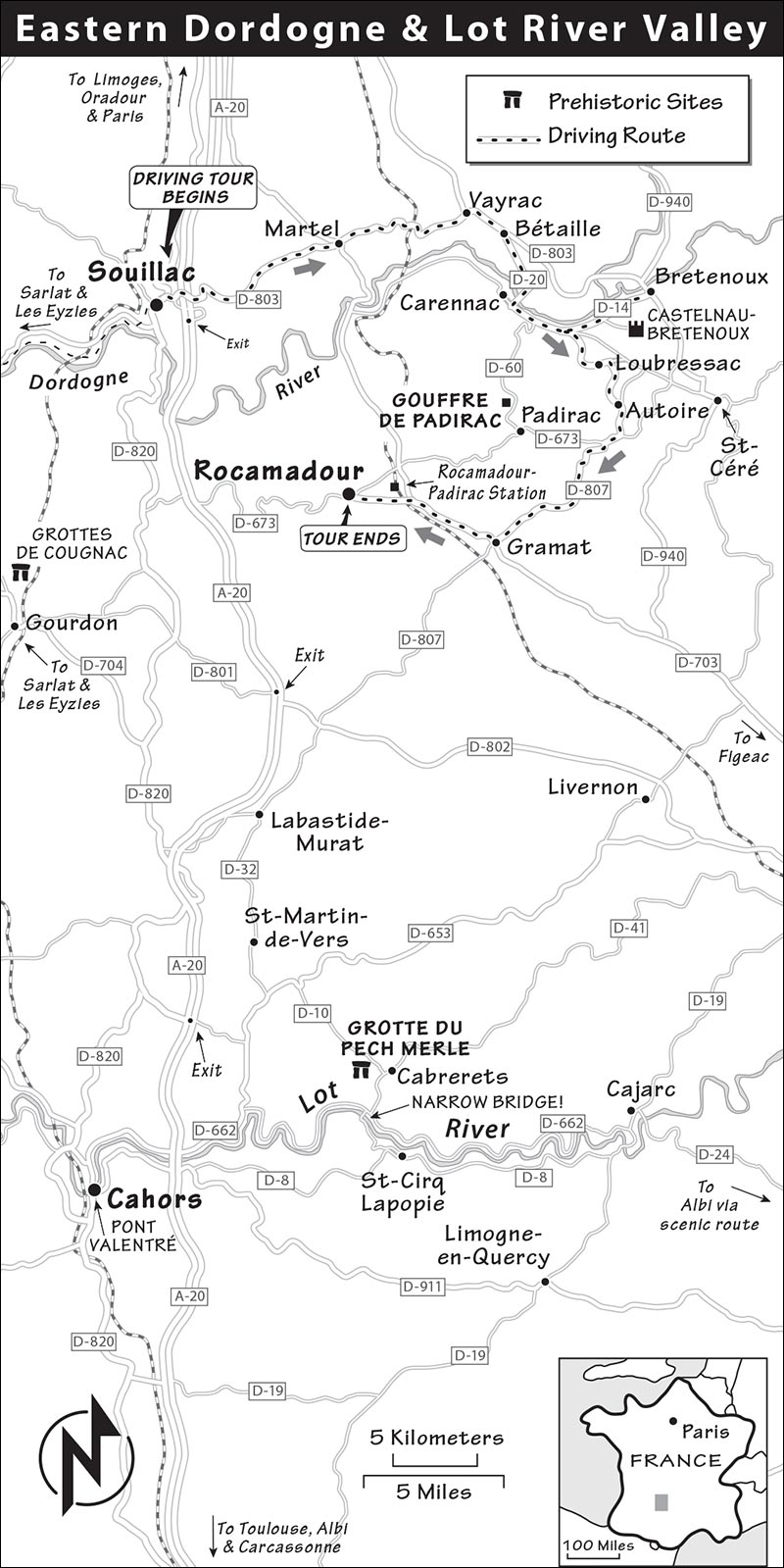
• From here, head east on D-30, tracking the Dordogne River. A detour left on D-14 leads to the splendidly situated and once-powerful military castle called...
Château de Castelnau-Bretenoux: This château has views in all directions and a few well-furnished rooms. The reddish-golden stone and massive 12th-century walls make an impression, as does its elevation—almost 800 feet. Consider detouring for a closer look (watch for the turnoff on the left, over the one-lane bridge), but skip the interior. The village of Bretenoux has good markets on Tuesday and Saturday mornings.
• Backtrack on D-14 to D-30 and continue uphill (still on D-14) before turning left on D-118 to find our next stop...
Loubressac: Mystical Loubressac hangs atop a beefy ridge, with outlandish views, a gaggle of adorable homes, and a hotel-restaurant worth detouring for. Take a loop stroll through the village, pick your favorite home and garden, then consider a café or meal at the relaxed and reasonable $ Hôtel le Cantou**. If it’s lunchtime, their brasserie has fine outside seating and good-value meals. If you’re really on vacation, spend the night and enjoy a special dinner with territorial views at the striking yet warm gastronomique $$ restaurant (closed Wed-Thu), and let gregarious owner Chris take good care of you in fluent English. The hotel has smallish but meticulously clean and comfortable rooms, half with valley views and ceiling fans (5 Place du Forail, +33 5 36 08 08 00, www.hotel-lecantou354.com, direction@hotel-lecantou354.com).
• From here it’s a short hop on D-118/D-135 to lovely little...
Autoire: Snuggled in a welcoming cirque, this idyllic village rotates around its central fountain and square. It’s just a few minutes beyond Loubressac.
• From here you can follow signs to Gramat, then on to Rocamadour. The caves of Gouffre de Padirac (described later) are also nearby, and well signed from this area.
Rocamadour
An hour east of Sarlat-la-Canéda, this historic town with its dramatic rock-face setting is a ▲▲ sight after dark. Once one of Europe’s top pilgrimage sites, today it feels more tacky than spiritual. Still, if you can get into the medieval mindset, its dramatic, cliffhanger setting—combined with the memory of the countless thousands of faithful who trekked from all over Europe to worship here—overwhelms the kitschy tourism and makes it a worthwhile two-hour stop.
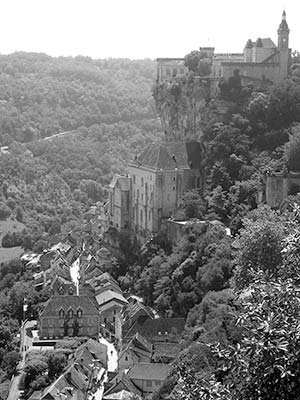
Those who visit only during the day in high season might wonder why they bothered, as there’s little to do here except admire the pilgrims’ steps and devotion (with scads of people who aren’t pilgrims), visit a few churches, and then stare at the view. Travelers who arrive late and spend the night enjoy fewer crowds—and a floodlit spectacle. To scenically connect Rocamadour and Sarlat, follow the driving tour outlined in the previous section.
Orientation to Rocamadour
Rocamadour has three levels, connected by steps and trails or elevators. The bottom level (La Cité Médiévale, or simply La Cité) is a single, long pedestrian street lined with shops and restaurants. The sanctuary level (Cité Religieuse)—the main attraction—sits halfway up the massive cliff, 216 holy steps above La Cité. Its centerpiece is a church with seven chapels gathered around a small square. A switchback trail, the Way of the Cross (Chemin de la Croix), leads from the sanctuary to the top level. Here you’ll find a cliff-capping château (public access to ramparts only) and—a 15-minute walk away—a small upper town, called L’Hospitalet. You can drive between the upper town (where you’ll approach from the north) and the lower town (where you’ll approach from the south).
TOURIST INFORMATION
The TI in Rocamadour is on the lower-level pedestrian street in La Cité Médiévale (daily July-Aug 9:30-19:00, April-June and Sept-Oct 10:00-18:00, Nov-March closed at lunch, +33 5 65 33 22 00, www.vallee-dordogne.com).
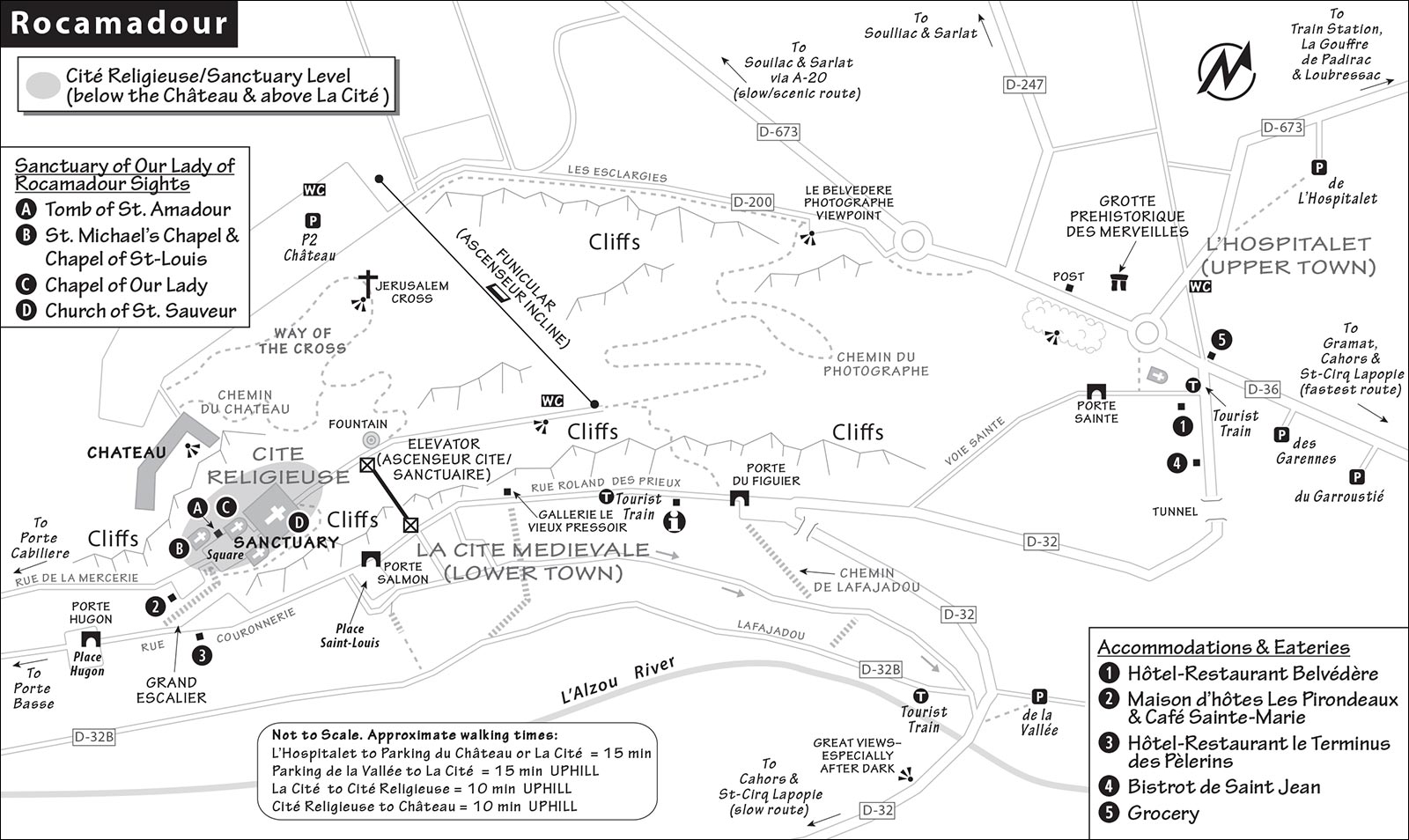
ARRIVAL IN ROCAMADOUR
By Train: Trains (3-5/day, transfer in Brive-la-Gaillarde) leave you at the unstaffed Rocamadour-Padirac station, a 2.5-mile pilgrimage to the village. It’s about a €40 taxi ride (see “Helpful Hints—Taxi”) or €2 by bus (4/day, daily in July-Aug and on weekends in June, #876 and #877, schedule at www.lio-occitanie.fr).
By Car: All parking lots charge €6 for the day (or €7 for seven days—smart if you’re staying overnight or plan to come back). Day-trippers heading to the sanctuary should park in the upper lot by the château: From L’Hospitalet, follow P2 Château signs to the western end of town until you see the Ascenseur Incliné (elevator) signs. From here, it’s easy to walk or take the elevator down to the sanctuary.
You could park in the lower lot, but it takes more effort to get up to the sanctuary: To do this, follow signs to La Cité and look for Parking de la Vallée signs. Hike 15 minutes up into La Cité Médiévale or take the little tourist train—le petit train (4/hour, daily 10:00-19:00, about €4); then either climb the stairs or take the elevator up to the sanctuary.
HELPFUL HINTS
Funicular and Elevator: This vertical town has two handy lifts, each charging a small fee. From top to bottom, the funicular (ascenseur incliné) connects the château and parking lot at the top with the sanctuary below. A traditional elevator (ascenseur cité/sanctuaire) connects the sanctuary with La Cité Médiévale. If you buy a round-trip ticket, keep the receipt for your return ride. If the ticket window is unstaffed, press the button to call the lift, then pay as you exit. The lifts are within 50 yards of each other at the sanctuary level and both stop running at 19:00 (at 18:00 off-season). The best option may be to buy a one-way ticket (about €4) to ride both lifts up, then walk down.
Views After Dark: If you’re staying overnight, don’t miss the views of a floodlit Rocamadour from the opposite side of the valley (doable by car, on foot, or by tourist train; see next). It’s best as a half-hour (round-trip) stroll: From the town’s southeast end (Porte du Figuier), follow the quiet road down, cross the bridge, and head up the far side of the gorge opposite the town. Leave before it gets dark, as the floodlighting is best just after twilight. Wear light-colored or reflective clothing, or take a flashlight—it’s a dark road with no shoulder.
Within the town, climb the steps to just below the sanctuary, and consider a drink with a view at the Café Sainte-Marie.
Night views from L’Hospitalet are memorable as well—anywhere near the Hôtel Belvédère is good, or grab a spot at their café terrace to savor the scene.
Tourist Train: Most useful for connecting the valley parking lot to the lower town (explained earlier), the petit train is also an option for enjoying the view after dark—with 50 other travelers, a bad sound system blaring worthless multilingual commentary, and a view-cramping rooftop (€7 round-trip for evening ride, 30-minute round-trip from the lower town by the TI or 60 minutes from L’Hospitalet—where the train originates before descending into the lower town—April-Sept 1-2 trips/evening starting at twilight—the first one is by far the best, check at the TI or call +33 5 65 33 65 99). Or you can walk the same route in 30 minutes (see earlier) and take much better photos.
Money: There’s an ATM in the upper town (near the roundabout) and one in the lower town (near the elevator).
Taxi: Dial +33 5 65 38 75 07 or +33 7 86 56 03 93.
Sights in Rocamadour
IN THE UPPER TOWN (L’HOSPITALET)
If you’re coming from Sarlat or from the north, your first view of Rocamadour is the same as the one seen by medieval pilgrims—at the top of the gorge from the hamlet of L’Hospitalet, named for the hospitality it gave pilgrims. Stop here for sweeping views. Facing the view, a right turn leads to the P2 Château parking lot described earlier (for most, the best place to park for the sanctuary); a left leads down to La Cité Médiévale and valley parking.
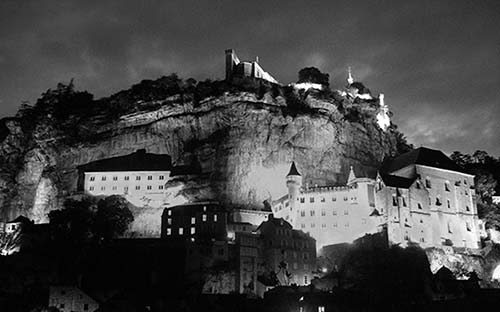
Taking in the view, imagine the impact of this sight in the 13th century, as awestruck pilgrims first gazed on the sanctuary cut from the limestone cliffs. It was through L’Hospitalet’s fortified gate that medieval pilgrims gained access to the Holy Way, the path leading from L’Hospitalet to Rocamadour.
Grotte Préhistorique des Merveilles
This cave, located in the upper town (next to the small gas station), has the usual geological formations and a handful of small, blurred cave paintings. It’s of no interest if you have seen or will see other prehistoric caves—its sole advantages are that it requires little effort to visit (with only about 10 steps down), and the guide can answer questions in English on the required 45-minute French tour.
Cost and Hours: €8.50; daily July-Aug 10:00-18:00, April-June and Sept 10:30-12:00 & 14:00-17:00, closed Oct-March; decent handout available, +33 7 88 26 84 78, www.grottedesmerveilles.com.
Château de Rocamadour
Dating from the 14th century, the original château fortified a bluff that was an easy base for bandits to attack the wealthy church below. Today’s structure is a 19th-century private house that was transformed into a reception spot for pilgrims. It’s privé unless you are a pilgrim (in which case you can sleep here). It only offers tourists a short rampart walk for a grand view (not worth the entry fee; turnstile requires exact change).
The zigzag Way of the Cross (Chemin de la Croix)—a path marked with 14 Stations of the Cross with a chapel for each station—gives religious purpose to the 15-minute hike between the château and the sanctuary below.
BETWEEN THE UPPER AND LOWER TOWNS (LA CITE RELIGIEUSE)
▲Sanctuary of Our Lady of Rocamadour
These sights form the heart of your vertical sightseeing. Be sure to read the “Rocamadour’s Religious History” sidebar (next) before beginning your visit.
Cost and Hours: Free, open daily generally 8:00-19:00.
Getting There: To reach the sights from the parking lot in the upper town, descend the paved Way of the Cross path or take the elevator and walk downhill about 150 yards. If you’re coming from the lower town, ride the elevator up or climb the Grand Escalier steps (like a good pilgrim), passing a plaque listing key medieval pilgrims, such as St. Bernard, St. Dominique, and St. Louis (the only French king to become a saint; he brought the Crown of Thorns to Paris and had Sainte-Chapelle constructed to house it). Either way, your destination will be signed Sanctuaires.
 Self-Guided Tour: Find the concrete bench on the small square facing the cliff. Though the buildings originated much earlier, most of what you see was rebuilt in the 19th century. Crammed onto a ledge on a cliff, the church couldn’t follow the standard floor plan, so its seven chapels surround the square (called the parvis) rather than the church. The bishop’s palace and the Chapel of St. Blaise de la Divine Miséricorde are behind you. The bishop’s palace has a gift shop selling various pilgrimage mementos, including modern versions of the medallions that pilgrims prized centuries ago as proof of their visit (about €16 for a tiny one). The two most historic chapels are straight ahead on either side of the steps.
• Walk up the flight of steps to the cliff, where a tomb is cut into the rock.
This is where the miraculously preserved body of St. Amadour was found in 1166. Places of pilgrimage do better with multiple miracles, so, along with its Black Virgin and the miracle of St. Amadour’s body, Rocamadour has the Sword of Roland. The rusty sword of Charlemagne’s nephew sticks in the cliffside, 30 feet above Amadour’s tomb and a bit to the right. According to medieval sources, Roland was about to die in battle, but the great warrior didn’t want his sword to fall into enemy hands. He hurled it from deep in southern France, and it landed here—stuck miraculously into the Rocamadour cliffs just above the Black Virgin. (The sword is clearly from the 18th century, but never mind.)
St. Michael’s Chapel is built around the original cave to your left as you face the cliff (open only to pilgrims, with little to see inside). A few steps farther along, the tiny Chapel of St-Louis is sculpted into the rock with a view terrace just beyond. Since 2011, this chapel has been dedicated to “Notre-Dame du Rugby,” honoring a sport that’s revered in southwestern France by displaying jerseys on the wall.
Backtrack to the Chapel of Our Lady (Chapelle Notre-Dame), the focal point for pilgrims. Step inside. Sitting above the altar is the much-venerated Black Virgin, a 12th-century statue (covered with a thin plating of blackened silver) that depicts Mary presenting Jesus to the world. The oldest thing in the sanctuary—from the ninth century—is a simple rusted bell hanging from the ceiling. The suspended sailboat models are a reminder that sailors relied on Mary for safe passage, and the marble plaque on the left wall lists “incontestable” years of miracles, mostly from sailors who were in danger of being shipwrecked.
The adjacent Church of St. Sauveur is the sanctuary’s main place of worship. You can’t miss the dazzling organ, installed in 2013. The impressive wooden balcony was designed for the monks. Imagine attending a Mass here in centuries past, when pilgrims filled the church and monks lined those balconies. While Rocamadour’s church seems more like a tourist attraction, it remains a sacred place of worship. A sign reminds tourists “to admire, to contemplate, to pray. You’re welcome to respectfully visit.” A bulletin board on the wall usually displays fliers for pilgrimages to Lourdes or Santiago de Compostela. Rocamadour has been both a key destination and staging point for pilgrims for centuries.
• From here, you can walk down the Grand Escalier to the lower town. Or head in the opposite direction and walk under the Church of St. Sauveur to find the Way of the Cross (Chemin de la Croix) and elevators up (Château par ascenseur) or down (La Cité par ascenseur). The passage under the church is lined with votive plaques, many of them reading “Merci à Notre-Dame” (thank you to the Virgin Mary) or “Reconnaissance” (in appreciation).
IN THE LOWER TOWN (LA CITE MEDIEVALE)
Rocamadour’s town is basically one long street traversing the cliff below the sanctuary. For eight centuries it has housed, fed, and sold souvenirs to visitors like you. There’s precious little here other than tacky trinket shops, but I enjoy popping into the Galerie le Vieux Pressoir (named for its 13th-century walnut millstone). It fills a medieval vaulted room with the fine art of a talented couple: Richard Begyn and Veronique Guinard (about 50 yards up from the elevator).
Of Rocamadour’s 11 original gates, seven survive (designed to control the pilgrim crowds). In the 14th century, as many as 20,000 people a day from all over Europe would converge on this spot. From the western end of town, 216 steps lead up to the church at the sanctuary level. Traditionally, pilgrims kneel on each and pray an “Ave Maria” to Our Lady.
NEAR ROCAMADOUR
▲Gouffre de Padirac
A 20-minute drive northeast of Rocamadour is the huge sinkhole of Padirac, with its underground river and miles of stalagmites and stalactites (but no cave art). Though it’s an impressive cave, if you’ve seen caves already, it may feel tame in comparison. But the mechanics of the visit are easy. Here’s the drill: Buy a ticket (or get in line with an e-ticket), get your included audioguide, hike the stairs down, dropping about 75 yards (with big views of the sinkhole—a round shaft about 100 yards wide and deep), or ride the elevator to the river level. Line up and wait for your boat. Pack into the boat with about a dozen others for the slow row past a fantasy world of hanging cave formations (ask your guide to give you brief English explanations). Get out and hike a big circle with your audioguide, enjoying lots of caverns, underground lakes, and mighty stalagmites and stalactites. Get back on the boat and retrace your course. Three elevators zip you back to the sunlight. The visit takes 1.5 hours (crowds make it take longer in summer). Dress warmly. For a knickknack Padirac, don’t miss the shop. The excellent website explains it all in English.
Cost and Hours: €18-21.50, includes audioguide, reserve online at least 24 hours ahead in high season; open daily mid-July-Aug 8:00-21:30, April-mid-July and Sept-early Nov 9:30-19:00, closed mid-Nov-March, last visit 1.5 hours before closing, +33 5 65 33 64 56, www.gouffre-de-padirac.com.
Sleeping in Rocamadour
Hotels are a good deal here. Those in the upper town (L’Hospitalet) have views down to Rocamadour and easier parking, but the spirit of St. Amadour is more present below, in the lower town (La Cité, which I prefer). Every hotel—including the ones I recommend—has a restaurant where they’d like you to dine.
In the Upper Town (L’Hospitalet): $ Hôtel Belvédère** has 17 well-maintained, modern, and appealing rooms with access to a nearby pool. Six rooms have views over Rocamadour, and six have valley views (rooms #14-18 have best views, air-con, free parking, +33 5 65 33 63 25, www.hotel-le-belvedere.fr, lebelvedere-rocamadour@orange.fr).
In the Lower Town (La Cité): $$ Maison d’hôtes Les Pirondeaux rents three high-end rooms at the foot of the sanctuary, some with kitchenettes and some good for families (+33 6 87 82 28 27, www.chambrehotesrocamadour.fr, contact@chambrehotesrocamadour.fr).
$ Hôtel-Restaurant le Terminus des Pèlerins,** at the western end of the pedestrian street in La Cité Médiévale, has 12 simple but homey rooms with wood furnishings; the best have balconies—but smaller bathrooms—and face the valley. Reserved, motherly owner Geneviève was born in this hotel (air-con, family rooms, +33 5 65 33 62 14, www.terminus-des-pelerins.fr, hotelterm.pelerinsroc@wanadoo.fr).
Eating in Rocamadour
$$ Hôtel Belvédère has great views from its modern dining room or outside terrace. Come early to get a windowside table, ideally for a meal just before sunset (daily, +33 5 65 33 63 25; also recommended under “Sleeping in Rocamadour,” earlier).
The best views are at $$ Bistrot de Saint Jean, hidden under Hôtel Belvédère, where the focus is mainly on meat (daily, free parking, +33 05 65 33 18 45).
Grocery Store: There’s a small one on Place de l’Europe in the upper town (daily 8:00-20:00).
Lot River Valley
An hour and a half south of the Dordogne, the overlooked Lot River meanders through a strikingly beautiful valley under stubborn cliffs and past tempting villages. If you have a car, the prehistoric cave paintings at Grotte du Pech Merle, the breathtaking town of St-Cirq-Lapopie, and the fortified bridge at Cahors are the sights in this valley. The bridge can be also visited by train as it’s not far from Cahor’s train station. These sights can be combined to make a terrific day for drivers willing to invest the time (doable as a long day trip from the Sarlat area). They also work well as a day trip from Rocamadour, but are best to visit when connecting the Dordogne with Albi, Puycelsi, or Carcassonne. (If you’re going to or coming from the south, you can scenically connect this area with Albi via Villefranche-de-Rouergue and Cordes-sur-Ciel.)
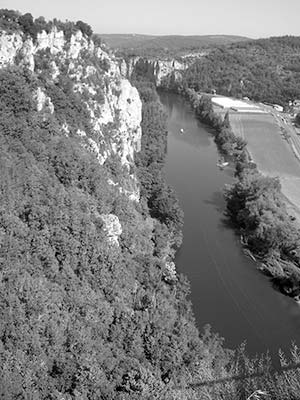
St-Cirq-Lapopie
This spectacularly situated village, clinging to a ledge sailing above the Lot River, knows only two directions—straight up and way down. In St-Cirq-Lapopie, there’s little to do but wander the rambling footpaths, inspect the flowers and stones, and thrill over the vistas. You’ll find picnic perches, a smattering of galleries and restaurants, and views from the bottom and top of the village that justify the pain. Leave no stone unturned in your quest to find the village’s best view (the overlook from the rocky monolith behind the TI is a good start). In this town, every building seems historic. You’ll lose most tourists by wandering downhill from the church.
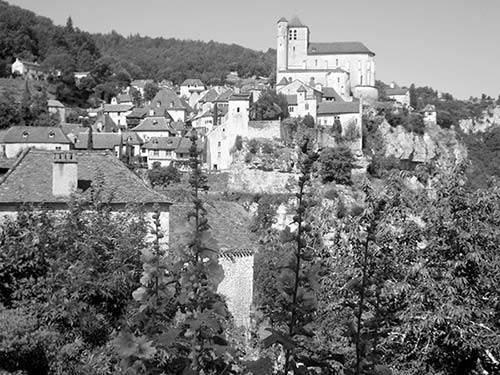
The TI is across from the recommended Auberge du Sombral (daily 10:00-13:00 & 14:00-18:00, July-Aug 10:00-18:30, Oct-April until 17:00 and closed Sun, +33 5 65 31 31 31). Pick up the visitors guide in English, with brief descriptions of a dozen historic buildings, and ask for information on area hikes. The level Chemin d’Hallage/tow path below makes a fine hike: It was cut into the rock to allow boats to be pulled along the river.
St-Cirq-Lapopie is slammed on weekends and in high season (mid-June-mid-Sept), but is peaceful early and after hours all year. Come early and spend a few hours, or arrive later and spend the night—your first views of St-Cirq-Lapopie are eye-popping enough to convince you to stay (find a good pullout and savor the view). Hotel selection in the village is limited to a simple but adequately comfortable and perfectly located hotel (see below). The lanes are steep—those with imperfect knees but still wanting a lovely village retreat should sleep an hour south in the level, quiet hilltop village of Puycelsi (see here).
Getting There: St-Cirq-Lapopie is well signed 40 minutes east of Cahors, 60 minutes south of Rocamadour, and just 15 minutes from the cave paintings of Grotte du Pech Merle. Allow 1.5 hours from Sarlat.
Arriving by car from the west, you’ll pass the town across the Lot River, then cross a narrow bridge and climb. There are five pay parking lots from well below to above the village. The Village lot (P4) is closest, with a roundabout route to it—but in high season you may be directed to lower lots, leaving you a good climb to the center (P1 is free but far).
Sleeping and Eating in St-Cirq-Lapopie: The village has all of one hotel, but plenty of chambres d’hôtes close by (check short-term rental sites like Airbnb), most of which are closed off-season (mid-Nov-March).
$ Auberge du Sombral,** run by low-key, English-speaking Marion, is central and a fair value right in the town center across from the TI. The hotel has just eight smallish rooms, most with double beds and good bathrooms (no air-con, no elevator, two floors, +33 5 65 31 26 08, www.lesombral.com, aubergesombral@gmail.com). The good $ restaurant serves reliable lunches (every day but Wed) in its cozy dining room or on the front terrace.
As restaurants go, $ Lou Bolat Brasserie works for a quick meal. It serves low-risk light fare (salads, crêpes, pizza, and plats) in a low-stress setting, with good views from the pleasant side terrace (daily for lunch and dinner April-Sept, at the upper end of town, just off the main road by the post office on Place du Balat, +33 5 65 30 29 04).
$$ Le Gourmet Quercynois has great ambience inside and out and serves nothing but regional cuisine (daily, a block below the main road on Rue de la Peyrolerie, +33 4 65 31 21 20).
Picnicking: This town was made for picnics; consider picking up dinner fixings in the hamlet of La Tour de Faure. There’s a handy Proxi grocery store on the other side of the river at the end of the bridge, and a bakery a short way east of the bridge.
▲▲Grotte du Pech Merle
This cave, about 30 minutes east of Cahors, has prehistoric paintings of mammoths, bison, and horses—rivaling the better-known cave art at Grotte de Font-de-Gaume. With 700 visitors allowed per day and a remote setting, it’s a snap to get a reservation compared with other caves, but that also makes it a bit less special. Still, it has fascinating cave art and interesting stalactite and stalagmite formations. And the mud-preserved Cro-Magnon footprint is one of a kind.
Cost and Hours: €15; daily July-Aug 9:15-17:00, April-June and Sept-early Nov 9:30-12:00 & 13:30-17:00; limited off-season hours and closed in Jan, fewer visitors on weekends.
Information: +33 5 65 31 27 05, www.pechmerle.com. Before you visit, read “Cave Art 101” on here.
Reservations: It’s best to reserve in advance online or by phone. Book at least a week ahead in summer; a few days ahead outside summer usually works. Try to snag an English tour (only a few per week, call for tour times); these caves require a significant detour and can fill with private groups.
Visiting the Cave: Allow a total of two hours for your visit. Walk the prehistory timeline before entering the good museum that gives a succinct overview of human evolution. Next, see a 20-minute film (with English subtitles) that prepares you for the cave art you’ll see, and finish with a one-hour tour of the caves. If you can’t join an English tour, ask for the English translations or spring for the €4.50 booklet. But don’t worry about the language barrier; you’ll be well prepared for the cave if you tour the museum and watch the film first.
The cave is unusual as it’s owned and operated by residents of the nearby village of Cabrerets, where you’ll find bakeries, groceries, and cafés. A café on the Pech Merle site offers light meals.
▲Cahors and the Pont Valentré
Cahors is home to one of Europe’s best medieval monuments, the Pont Valentré. This massive fortified bridge was built in 1308 to keep the English out of Cahors. It worked.
To find the bridge as you’re approaching Cahors by car, follow signs to Centre-Ville, Gare SNCF, then Toutes Directions, and finally Pont Valentré. Turn left at the river and find parking lots a few blocks down and a fine riverside promenade to the bridge.
Practice your French reading skills at the panel telling the story of the devil—which you will later see on top of the center tower— then cross the bridge (away from the city) and have a view drink at the riverside café. A short, steep hike up the trail across the road from this end of the bridge leads to terrific views (the rock is dangerous if the trail is wet). This trail was once part of the pilgrimage route to Santiago de Compostela in northwest Spain. Imagine that cars were allowed to cross this bridge until recently.
Back on the city side of the bridge, several wine boutiques offer a good selection of Cahors wines at fair prices.
If you need an urban fix, walk for 10 minutes on the street that continues straight from the bridge (Rue de Président Wilson) and find the old city (Vielle Ville) after crossing Boulevard Gambetta. Cahors’ thriving, pedestrian-friendly center is filled with good lunch options, cafés, cool gardens, and riverside parkways. To find this area by car, follow Centre-Ville and St. Urcisse Eglise signs, and park where you can.
If you feel like bedding down in this untouristed city with a view of the bridge, sleep at the modern $$ Best Western Hotel Divona**** (113 Avenue André Breton, +33 5 65 21 18 39, www.divona-hotel-cahors.com, contact@hoteldivona.fr).