NORMANDY
Rouen • Honfleur • Bayeux • D-Day Beaches • Mont St-Michel
Sleeping and Eating near Omaha Beach
Sweeping coastlines, half-timbered towns, and thatched roofs decorate the rolling green hills of Normandy (Normandie). Parisians call Normandy “the 21st arrondissement.” It’s their escape—the nearest beach. Brits consider this area close enough for a weekend escape (you’ll notice that the BBC comes through loud and clear on your car radio). Americans find it a rare place where their country played a pivotal role in European history.
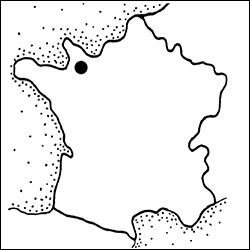
Despite the peacefulness you sense today, the region’s past is filled with war. Normandy was founded by Viking Norsemen who invaded from the north, settled here in the ninth century, and gave the region its name. A couple hundred years later, William the Conqueror invaded England from Normandy. His 1066 victory is commemorated in a remarkable tapestry at Bayeux. A few hundred years after that, France’s greatest cheerleader, Joan of Arc (Jeanne d’Arc), was convicted of heresy in Rouen and burned at the stake by the English, against whom she rallied France during the Hundred Years’ War. And in 1944, Normandy was the site of a WWII battle that changed the course of history.
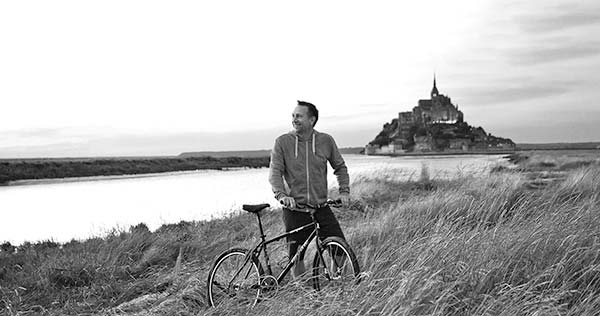
The rugged, rainy coast of Normandy harbors pristine beaches, wartime bunkers, and enchanting fishing villages like Honfleur. And, on the border Normandy shares with Brittany, the almost surreal island-abbey of Mont St-Michel rises serene and majestic, oblivious to the tides of tourists.
PLANNING YOUR TIME
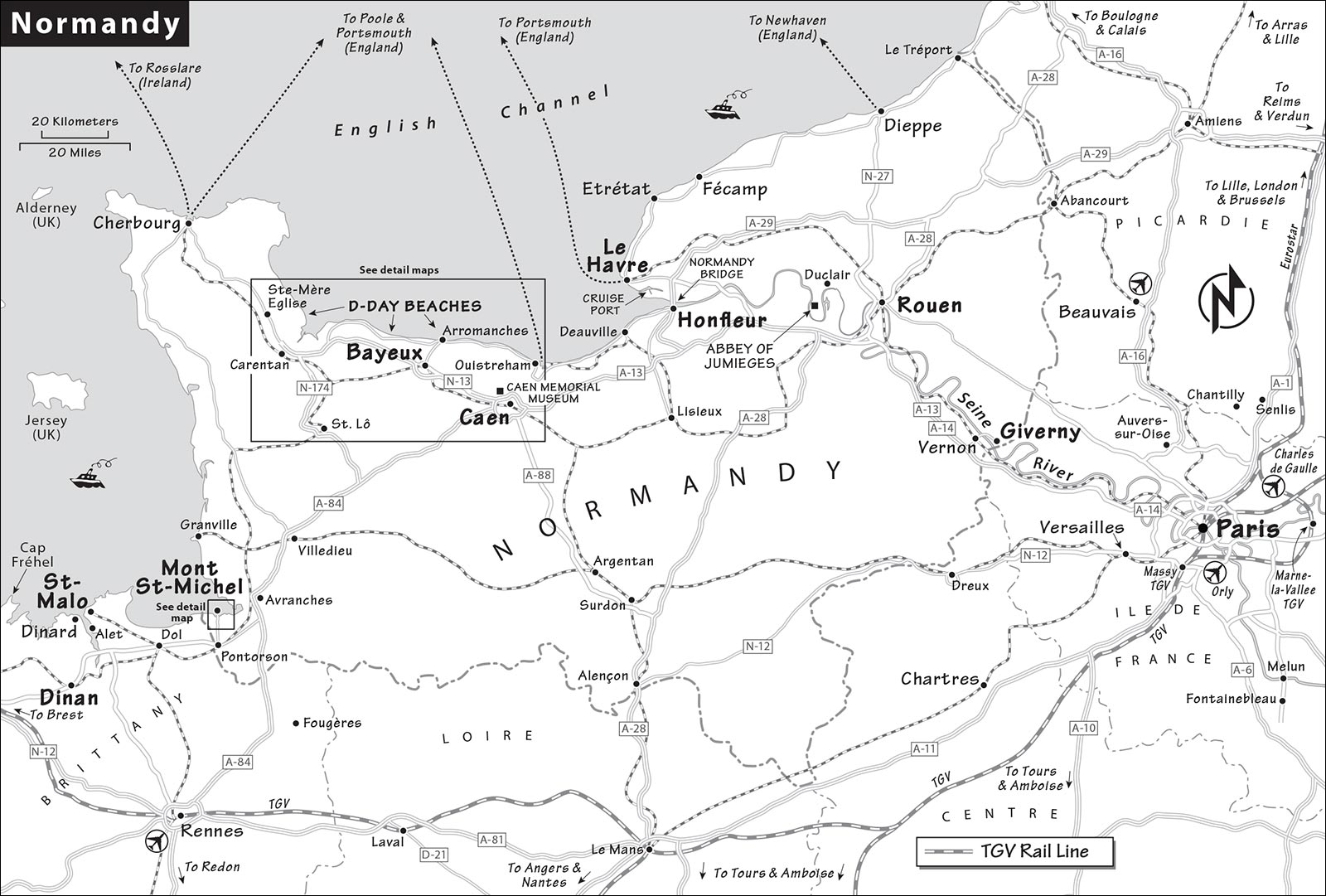
For many, Normandy makes the perfect jet-lag antidote: A good first stop for your trip is Rouen, which is a few hours by car or train from Paris’ Charles de Gaulle or Beauvais airport. Plan on four nights for a first visit to Normandy: Honfleur and Mont St-Michel each merit an overnight and the D-Day beaches merit two. At a minimum, you’ll want a full day for the D-Day beaches and a half-day each in Honfleur, Bayeux, and Mont St-Michel.
If you’re driving between Paris and Honfleur, Giverny (with the glorious gardens and lovely home of Claude Monet—see the Near Paris chapter) and Rouen make good detours and overnights. The WWII memorial museum in Caen works well as a stop between Honfleur and Bayeux (and the D-Day beaches). Mont St-Michel must be seen early or late to avoid the masses of midday tourists. Dinan, just 45 minutes by car from Mont St-Michel, offers a fine introduction to Brittany (see next chapter). Drivers can enjoy Mont St-Michel as a day trip from Dinan.
Winter travelers should note that many sights on the D-Day beaches and in Bayeux are closed in January. For practical information about travel, current events, concerts, and more in Normandy, see www.normandie-tourisme.fr.
GETTING AROUND NORMANDY
On Your Own
This region is best explored by car. If you’re driving into Honfleur from the north, take the impressive Normandy Bridge (Pont de Normandie, €6 toll); if you’re coming from the Rouen area, follow the Route of the Ancient Abbeys (described later). If you’re driving from Mont St-Michel into Brittany, follow my recommended scenic route to the town of St-Malo (see here). If you’re renting a car for Normandy and don’t want to drive in Paris (who would?), take the train between Paris and Rouen or Caen and use a car-rental agency at one of those stations.
Trains from Paris serve Rouen, Caen, Bayeux, Mont St-Michel (via Pontorson or Rennes), and Dinan, though service between these sights is frustrating (try linking by bus—see next). Mont St-Michel is a headache by train, except from Paris. A hotel in Bayeux run shuttles between Bayeux and Mont St-Michel—a great help to those without cars (see here).
Buses link Giverny, Honfleur, Arromanches, and Mont St-Michel to train stations in nearby towns (less frequent on Sun). To plan ahead, visit the websites for Nomad (for Le Havre, Honfleur, Bayeux, Arromanches, and Caen, www.nomadcar14.fr [URL inactive]), Keolis (for Mont St-Michel, https://keolis-armor.com), and Breizhgo for Brittany (Dinan and St-Malo, French only, www.breizhgo.bzh), or try Google Maps. Bus companies commonly offer good-value and multiride discounts.
With a Tour or Shuttle
Another good option is to use an excursion tour to link destinations. Westcapades provides trips to Mont St-Michel from Dinan and St-Malo (for details, see here).
Private shuttles make it easy to link Paris and Normandy without driving or connecting by train. Albion Transport organizes private transfers between Paris airports or hotels and key Normandy destinations such as Honfleur, Bayeux, and Caen (about €500 for up to 3 people, €620 for 3-6 people, extra fee for stops en route at Giverny or Honfleur, +33 2 31 78 88 88, www.albionvoyages.com).
D-Day Beaches
For specifics on getting around the D-Day Beaches, see that section.
NORMANDY’S CUISINE SCENE
Normandy is known as the land of the four C’s: Calvados, Camembert, cider, and crème. The region specializes in cream sauces, organ meats (sweetbreads, tripe, and kidneys—the gizzard salads are great), and seafood (fruits de mer). Lamb is big here and you’ll see scads of sheep feeding on naturally sea-salted meadows (most famously near Mont St-Michel) producing a much-sought-after main course. If you like Scotland’s haggis, tripes à la mode de Caen is for you (and not me). You’ll see crêperies offering inexpensive and good-value meals everywhere. A galette is a savory buckwheat crêpe enjoyed as a main course; a crêpe is sweet and eaten for dessert. Dairy products are big, too. Local cheeses are Camembert (mild to very strong; see sidebar), Brillat-Savarin (buttery), Livarot (spicy and pungent), Pavé d’Auge (spicy and tangy), and Pont l’Evêque (earthy).
What, no local wine? Eh oui, that’s right. Here’s how to cope. Fresh, white Muscadet wines are made nearby (in western Loire); they’re cheap and a good match with much of Normandy’s cuisine. But Normandy is rightly proud of its many apple-based beverages. You can’t miss the powerful Calvados apple brandy or the Bénédictine brandy (made by local monks). The local dessert, trou Normand, is apple sorbet swimming in Calvados. The region also produces three kinds of alcoholic apple ciders: Cidre can be doux (sweet), brut (dry), or bouché (sparkling—and the strongest). You’ll also find bottles of Pommeau, a tasty blend of apple juice and Calvados (sold in many shops), as well as poiré, a tasty pear cider. And don’t leave Normandy without sampling a kir Normand, a pinch of crème de cassis mixed with cider. Drivers in Normandy should be on the lookout for Route du Cidre signs (with a bright red apple); this tourist trail leads you to small producers of handcrafted cider and brandy.
Rouen
This 2,000-year-old city mixes Gothic architecture, half-timbered houses, and contemporary bustle like no other place in France. Busy Rouen (roo-ahn) is France’s fifth-largest port and Europe’s biggest food exporter (mostly wheat and grain). Its cobbled and traffic-free old town is a delight to wander.
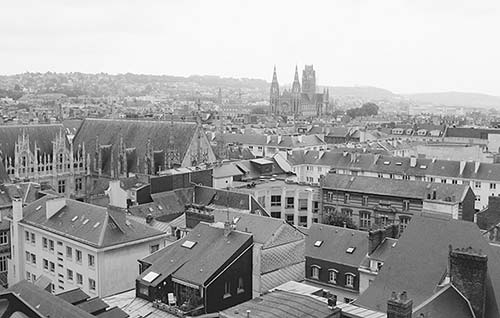
Rouen was a regional capital during Roman times, and France’s second-largest city in medieval times (with 40,000 residents—only Paris had more). In the ninth century, the Normans made Rouen their capital. William the Conqueror called it home before moving to England. After that, Rouen walked a political tightrope between England and France for centuries. (It was an English base during the Hundred Years’ War.) Joan of Arc was burned here in 1431.
Rouen’s historic wealth was built on its wool industry and trade—for centuries, it was the last bridge across the Seine River before the Atlantic. In April 1944, as America and Britain weakened German control of Normandy prior to the D-Day landings, Allied bombers destroyed 50 percent of Rouen. Although the industrial suburbs were devastated, most of the historic core survived, keeping Rouen a pedestrian haven.
PLANNING YOUR TIME
If you want a dose of a lively midsize French city, Rouen is an easy day trip from Paris, with convenient train connections to Gare St. Lazare. For a memorable day trip from Paris, combine Rouen with Giverny.
If you’re planning to rent a car as you leave Paris, save headaches by taking the train to Rouen and picking up a rental car there. Spend a quiet night in Rouen, which has good hotel values, and pick up your car the next morning (closed Sun). Or take an early train to Rouen, pick up keys to a rental car, stash your bags in it, and leave it in the secure rental lot at the station. Then visit Rouen on foot before heading out to explore Normandy. This plan also works in reverse: Park your car in Rouen and visit the city before dropping off your rental at the station and taking a train to Paris.
From Paris, those relying on trains to reach Normandy can visit Rouen on the way and then end their day in Honfleur or Bayeux (see “Helpful Hints” for baggage storage options). Connecting to buses in Normandy requires planning, as service is limited on some routes.
Orientation to Rouen
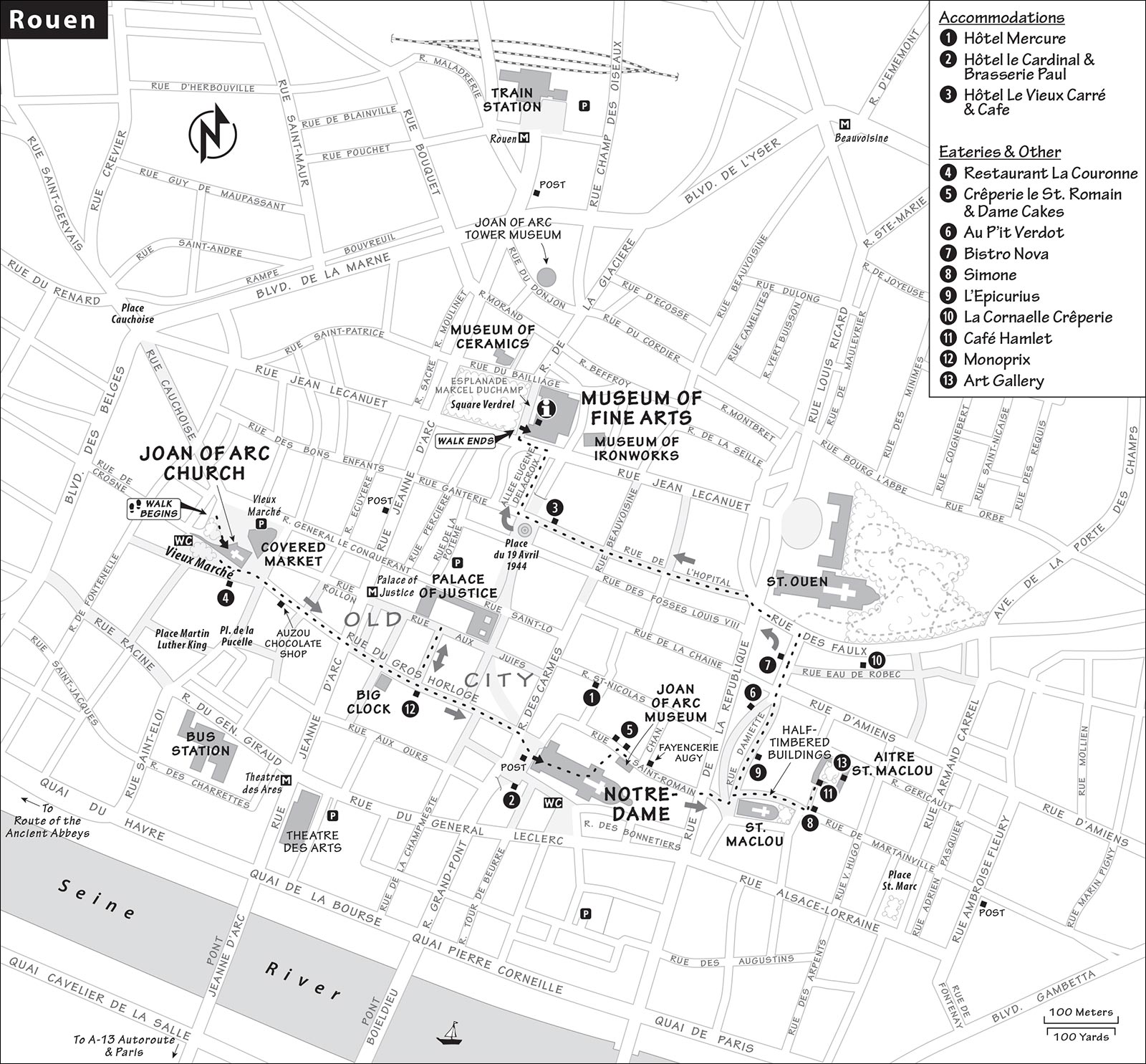
Although Paris embraces the Seine, Rouen ignores it. The area we’re most interested in is bounded by the river to the south, the Museum of Fine Arts (Esplanade Marcel Duchamp) to the north, Rue de la République to the east, and Place du Vieux Marché to the west. It’s a 20-minute walk from the train station to the Notre-Dame Cathedral. Everything else of interest is within a 10-minute walk of the cathedral.
TOURIST INFORMATION
The TI is in the same building as Rouen’s Museum of Fine Arts (a 10-minute walk from the train station), and rents €5 audioguides covering the cathedral, Rouen’s historic center, and the history of Joan of Arc in Rouen (though this book’s self-guided walk is plenty for most). If driving, get information about the Route of the Ancient Abbeys (TI open Mon-Sat 9:00-18:00, Sun 10:00-17:00, closed Sun Nov-March, Esplanade Marcel Duchamp, +33 2 32 08 32 40, www.visiterouen.com).
ARRIVAL IN ROUEN
By Train: Visitors want the main station, called Rive Droite. Note that there’s no baggage storage at the station.
Rue Jeanne d’Arc cuts straight from the Rive Droite station through the town center to the Seine River. Day-trippers can walk from the station down Rue Jeanne d’Arc toward Rue du Gros Horloge—a busy pedestrian mall in the medieval center, near the start of my self-guided walk.
Rouen’s subway (Métrobus) whisks travelers from the station to the Palais de Justice in one stop, saving you 15 minutes of walking to the city center (€1.70 for 1 hour; buy tickets from machines one level underground, then validate ticket on subway two levels down; direction: Technopôle or Georges Braque). Returning to the station, take a subway in direction: Boulingrin and get off at Gare-Rue Verte.
Taxis are to the right as you exit the station and will take you to any of my recommended hotels for about €10.
By Car: Finding the city center from the autoroute is tricky. Follow signs for Centre-Ville and Rive Droite (right bank). If you get turned around on the narrow, one-way streets, aim toward the highest cathedral spires you spot.
As you head toward the center, you should see signs for P&R Relais. These are lots outside the city’s core where you can park for free, then hop on a tram into town (€1.70 each way). The Kindarena P&R Relais is a great choice. It’s located at a major bus station with buses to Rouen’s center every few minutes (8 minutes to the center).
In the city, drivers can park on the street (metered 9:00-19:00, usually 2-3-hour time limit, free overnight and all day Sun) or pay for more secure parking in one of many well-signed underground lots (about €17/day; see map for locations). For day-trippers taking my self-guided walk of Rouen, the garage under Place du Vieux Marché is ideal. For those staying overnight, Parking Cathédrale (between the cathedral and the river) is handy, as is the larger Parking Palais de Justice.
When leaving Rouen, head for the riverfront road, where autoroute signs will guide you to Paris or to Le Havre and Caen (for D-Day beaches and Honfleur). If you’re following the Route of the Ancient Abbeys from here, see here.
HELPFUL HINTS
Closed Days: Most Rouen museums are closed either Mondays or Tuesdays and less-important sights are closed midday (12:00-14:00). The cathedral doesn’t open until 14:00 on Monday, and the Joan of Arc Church is closed on Friday and Sunday mornings.
Nearly all Rouen restaurants are closed on Sunday and Monday.
Market Days: The best open-air market is on Place St. Marc, a few blocks east of St. Maclou Church. You’ll find everything from fresh produce to antiques (Tue and Fri-Sun; best by far Sat-Sun but closes by 13:30; smaller market all day Tue and Fri). A simple market is on Place du Vieux Marché, near the Joan of Arc Church (Tue-Sun until 13:30, closed Mon).
Baggage Storage: There is no baggage storage at the train station, but you can reserve storage through Nannybag.com at central Rouen businesses near the station. The Museum of Fine Arts has storage lockers (available only when museum is open, see “Sights in Rouen,” later).
Supermarket: A big Monoprix with long hours is on Rue du Gros Horloge (groceries at the back).
Cathedral of Light: Rouen’s cathedral sports a dazzling light show on its facade after dark (July-mid-Sept daily, June and last two weeks of Sept Fri-Sat only).
Taxi: Call Les Taxi Jaunes at +33 2 35 88 50 50.
Car Rental: Agencies at the train station include Europcar (+33 2 35 88 21 20), Avis (+33 2 35 88 60 94), and Hertz (+33 2 35 70 70 71). All close Sunday and at lunch (usually Mon-Sat 12:30-14:00).
Rouen Walk
On this 1.5-hour self-guided walk, you’ll see the essential Rouen sights and experience the city’s pedestrian-friendly streets. All sights except the Joan of Arc Museum and Bell Tower Panorama are free—visiting these sights and the Museum of Fine Arts adds another three hours to your walk and makes for a fine, if full, day.
This walk is designed for day-trippers coming by train but works just as well for drivers (park at the underground garage at Place du Vieux Marché, where the walk begins).
We’ll stroll the length of Rue du Gros Horloge to Notre-Dame Cathedral, visit the Aître St. Maclou (plague cemetery), pass the church of St. Ouen, and end at the Museum of Fine Arts, a short walk back to the train station or Place du Vieux Marché. The map on here highlights our route.
• If arriving by train, walk down Rue Jeanne d’Arc and turn right on Rue du Guillaume le Conquérant. This takes you to the back door of our starting point...
▲Place du Vieux Marché
Surrounded by half-timbered buildings, this old market square houses a cute, covered produce-and-fish market, a park commemorating Joan of Arc’s burning, and a modern church named after her. Find the tall, aluminum-and-concrete cross in the small garden near the entrance to the church. That towering cross marks the spot where Rouen publicly punished and executed people. The pillories stood here, and during the Revolution, the town’s guillotine made 800 people “a foot shorter at the top.” In 1431, Joan of Arc—only 19 years old—was burned right here. Find her flaming statue (built into the wall of the church, facing the cross). As the flames engulfed her, an English soldier said, “Oh my God, we’ve killed a saint.” Nearly 500 years later, Joan was canonized, and the soldier was proven right.
• Now step inside...
▲Joan of Arc Church (Eglise Jeanne d’Arc)
This modern church is a tribute to the young woman who was canonized in 1920 and later became the patron saint of France. The church, completed in 1979, feels Scandinavian inside and out—another reminder of Normandy’s Nordic roots. Sumptuous 16th-century windows, salvaged from a church lost during World War II, were worked into the soft architectural lines. The pointed, stake-like support columns to the right seem fitting for a church dedicated to a woman burned at the stake. This interior feels uplifting, with a ship’s-hull vaulting and sweeping wood ceiling sailing over curved pews and a wall of glass below. Make time to savor this unusual sanctuary.
Cost and Hours: Free, Mon-Thu and Sat 10:00-12:00 & 14:00-18:00, Fri and Sun 14:00-18:00, closed during Mass, €0.50 English pamphlet describes the stained-glass scenes. A clean public WC is 70 yards straight ahead from the church doors.
• Turn left out of the church.
Ruined Church and Julia Child
As you leave the church, you’re stepping over the ruins of a 15th-century church (destroyed during the French Revolution). The charming half-timbered building just beyond—overflowing with flags and geraniums—is the recommended Restaurant La Couronne, reputedly the oldest restaurant in France. It was here, in 1948, that American chef and author Julia Child ate her first French meal, experiencing a culinary epiphany that changed her life (and the eating habits of a generation of Americans). Inside the restaurant’s front doors find historic photos of happy diners, including Julia, Queen Elizabeth II, Princess Grace, and Salvador Dalí.
• Leave the square with the church on your left and join the busy pedestrian street, Rue du Gros Horloge. An important thoroughfare in Roman times, it’s been the city’s main shopping street since the Middle Ages. A block up on your right (at #163) is Rouen’s most famous chocolate shop.
Auzou and Houses That Lean Out
The friendly chocolatiers at Auzou would love to tempt you with their chocolate-covered almond “tears (larmes) of Joan of Arc.” Although you must resist touching, you are welcome to taste a tear (delicious). The first one is free; a small bag costs about €11.
Before moving on, notice the architecture outside. The higher floors of the Auzou house lean out, evidence that the building dates from before 1520, when such street-crowding construction was prohibited. (People feared that houses leaning over the street like this would block breezes and make the city more susceptible to disease.) Look around the corner and down the lane behind the Auzou building to see a fine line of half-timbered Gothic facades. Study the house next to Auzou, at #161. You can tell it was built after 1520 (because its facade is flat) and that it’s Renaissance (because of the characteristic carved wooden corner-posts). We’ll see more houses like this later on our walk.
• Your route continues past a medieval McDonald’s to busy Rue Jeanne d’Arc.
Pause here and look both ways. With the 19th-century Industrial Age, France expanded its transportation infrastructure. A train line connecting Paris to Rouen arrived in the early 1840s, and major roads like this were plowed through to get traffic efficiently to the station (that green-topped tower in the distance to the left is the train station). The facades here date from the 1860s and are in the Haussmann style so dominant in Paris in that era.
• Cross the street and continue straight to the...
▲Great Clock (Gros Horloge) and Rouen Panorama
This impressive, circa-1528 Renaissance clock, the Gros Horloge (groh or-lohzh), decorates the former City Hall. Notice that the clock has only an hour hand. In the 16th century, an hour hand offered sufficient precision; minute hands became necessary only in a later, faster-paced age (forget second hands). The orb above the clock makes one revolution in 29 days. (The cycle of the moon let people know the tides—of practical value here, as Rouen was a port for seabound vessels.) The town medallion (sculpted into the stone below the clock) features a sacrificial lamb, which has both religious meaning (Jesus is the Lamb of God) and commercial significance (wool was the source of Rouen’s wealth). The clock’s artistic highlight fills the underside of the arch (walk underneath and stretch your back), with the “Good Shepherd” and loads of sheep.
Bell Tower Panorama: To see the inner workings of the clock and an extraordinary panorama over Rouen and its cathedral, climb the clock tower’s 100 steps. You’ll tour several rooms with the help of a friendly, 40-minute audioguide and learn about the clock mechanism and life in Rouen when the tower was built. The big one- and two-ton bells ring on the hour—a deafening experience if you’re in the tower. Don’t miss the 360-degree view outside from the very top, and make sure to walk around the parapet for a view of the cathedral (€7.50, includes audioguide, Tue-Sun 10:00-12:00 & 14:00-18:00, Oct-March afternoons only, closed Mon year-round, last entry one hour before closing).
• Walk under the Gros Horloge and continue straight a half-block, then take a one-block detour left (up Rue Thouret) to see the…
Palace of Justice (Palais de Justice)
Rouen is the capital of Normandy, and this impressive building is its parliament. The section on the left is the oldest, in Flamboyant Gothic style dating from 1550. Normandy was an independent little country from 911 to 1204. Since being incorporated into France, it’s retained an independent spirit and has enjoyed a bit of autonomy.
The parliament building fronts the historic Rue aux Juifs (Street of the Jews)—a reminder that this was the Jewish quarter from the 10th century until the early 14th century, when the Jews were expelled from France. Their homes were destroyed and the city took their land. The empty real estate was used for the parliament.
Tours of La Maison Sublime, an ancient crypt marking the oldest Jewish settlement in France, are available in French only (€9.50, one hour; Sat at 10:30 and 14:30, Tue and Thu at 14:30; request an English booklet, passport required for entry, +33 2 35 52 48 09, www.visitezlamaisonsublime.fr).
• Double back and continue up Rue du Gros Horloge. In a block, high on the left, you’ll see a stone plaque dedicated to hometown hero Cavelier de la Salle, who explored the mouth of the Mississippi River, claimed the territory of Louisiana for France, and was assassinated in Texas in 1687. Soon you’ll reach...
▲▲Notre-Dame Cathedral (Cathédrale Notre-Dame)
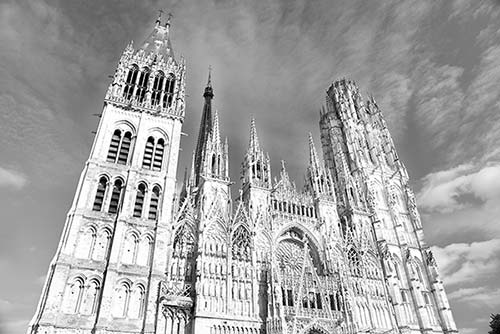
This cathedral is a landmark of art history. You’re seeing essentially what Claude Monet saw as he painted 30 different studies of this facade at various times of day. (Unfortunately, today there’s scaffolding set up for a long-term cleaning project.) Using the physical building only as a rack upon which to hang light, mist, dusk, and shadows, Monet was capturing “impressions.” Find the plaque showing a copy of one of the paintings (in the corner of the square, about 70 paces angling left if exiting the cathedral). You can see an original in Rouen’s Museum of Fine Arts. Imagine Claude setting up his easel here as curious onlookers pass him by. Back up (steering clear of the trash receptacle) to see how much better the painting looks from a distance. Use the nearby telescopes to inspect details of the church facade.
Cost and Hours: Free; Tue-Sat 7:30-19:00, Sun 8:00-18:00, Mon 14:00-19:00; Nov-March until 18:00 and may close 12:00-14:00; Mass: Tue-Sat at 10:00, July-Aug also at 18:00, Sun and holidays at 8:30 and 10:30.
 Self-Guided Tour
There’s been a church on this site for more than a thousand years. Charlemagne honored it with a visit in the eighth century before the Vikings sacked it a hundred years later. The building you see today was constructed between the 12th and 14th centuries, though lightning strikes, wars (the cathedral was devastated in WWII bombing), and other destructive forces meant constant rebuilding.
• We’ll start outside, facing the...
Central Facade: Look up at the elaborate, frilly, and soaring facade, with bright statues on either side of the central portal—later, we’ll meet some of their friends face-to-face inside the cathedral. The facade is another fine Rouen example of Flamboyant Gothic, and the dark spire, soaring nearly 500 feet, is awe-inspiring. Why such a big cathedral here? Until the 1700s, Rouen was the second-largest city in France—rich from its wool trade and its booming port. On summer evenings, there’s usually a colorful light show on the cathedral’s facade (see “Helpful Hints,” earlier).
Get closer. Above the main door is a marvelous depiction of the Tree of Jesse. Jesse, King David’s father, is shown reclined, resting his head on his hand, looking nonplussed. The tree grows from Jesse’s back; the figures sprouting from its branches represent the lineage of Jesus. Many statues on the facade are headless. In 1562, during the French Wars of Religion, Protestant iconoclasts held the city for six months—more than enough time to deface this Catholic church.
• Head inside.
Cathedral Interior: Look down the center of the nave. This is a classic Gothic nave—four stories of pointed-arch arcades, the top filled with windows to help illuminate the interior. Today, the interior is lighter than intended because clear glass has replaced the original colored glass (destroyed over the centuries by angry Protestants, horrible storms, changing tastes, and WWII bombs).
Circle counterclockwise around the church, starting down the right aisle. The side chapels and windows, each dedicated to a different saint, display the changing styles through the centuries (short English descriptions are posted in most chapels).
Near the high altar, look across and up at the north transept rose window, which dates from around 1300 (scaffolding may make this tricky to see). It survived a terrible hurricane in 1683. During World War II the glass was taken out, but the original stone tracery did not survive. On the right (in the south transept) is a chapel dedicated to Joan of Arc. Its focal point is a touching statue of the saint being burned. The chapel’s modern 1956 windows replaced those destroyed in the war. You may also see several stands holding a “memorial” to Joan with maps showing her path to liberate France (the French consider it a pilgrimage to follow her path on foot).
Passing through an iron gate after the high altar, find several stone statues (this area may be closed for a lengthy cleaning project). Each is “bolted” to the wall—as they originally were in their niches high above the street centuries ago. These figures were lifted from the facade during a cleaning and provide a rare chance to stand toe-to-toe with a medieval statue.
Several stone tombs on your left date from when Rouen was the Norman capital. The first tomb is for Rollo, the first duke of Normandy, who died about 932 (he’s also the great-great-great-great grandfather of William the Conqueror, seventh duke of Normandy, c. 1028). Rollo, called the Father of Normandy, was chief of the first gang of Vikings (the original “Normans”) who decided to settle here. He died at the age of 80, but he is portrayed on his tomb as if he were 32 (as was the fashion, because Jesus died at that age). Thanks to later pillage and plunder, only Rollo’s femur is inside the tomb.
And speaking of body parts, the next tomb once contained the heart of English King Richard the Lionheart, famous for his military exploits in the Third Crusade (he died in 1199). Over the years, people forgot about the heart, and it was only rediscovered in 1838. It was eventually analyzed by forensic scientists, who concluded that the king had died from a festering arrow wound (not poison, as popularly thought). Look across the altar to the radiant stained-glass window (we’ll get there soon, but the view is best from here).
Smile at the cute angels on your right and circle behind the altar. The beautiful windows with bold blues and reds are generally from the 13th century. Opposite Richard the Lionheart’s tomb is a fine window dedicated to St. Julian, patron of hoteliers and travelers (with pane-by-pane descriptions in English on an easel below).
Continue around to the altar, then look up to the ceiling just behind the choir. In 1999, a fierce winter storm caused a spire to crash through the roof (directly above Rollo’s femur), landing on the choir.
• Exit while you can, through the side door of the north transept. (If the door is closed, leave through the main entrance, turn right, then loop back alongside the church.)
North Transept Facade: Outside, look back at the facade over the door of the north transept. The fine-but-dirty tympanum (the area over the door) shows a graphic Last Judgment. Jesus stands between the saved (on the left) and the damned (on the right). Notice the devil to the right grasping a miser, who clutches a bag of coins. Next to him, look for the hellish hot tub, where even a bishop (pointy hat) is eternally in hot water. And is it my imagination, or are those saved souls on the far left high-fiving each other?
Much of the facade has been cleaned, blasted with jets of water. But the limestone carving like this is still black—it’s too delicate to survive the hosing. A more delicate laser cleaning was used with astonishing results on the lowest section of this facade, though there hasn’t been any move to continue this process for years.
• From this courtyard, a gate deposits you on a traffic-free street facing the elegant Art Nouveau facade of the recommended Dame Cakes tea shop. This was originally the workshop of the church’s lead 19th-century craftsman, Ferdinand Marrou. To showcase his work, he fashioned the wrought iron on this door as well as the fine touches inside.
Turn right and walk along the appealing Rue St. Romain for one last church sight.
Spire View: In a short distance, look up through an opening above the entrance to the Joan of Arc Museum and gaze back at the cathedral’s prickly spire. Made of cast iron in the late 1800s—about the same time Gustave Eiffel was building his tower in Paris—the spire is, at 490 feet, the tallest in France. You can also see the smaller (green) spires, one of which was blown over in that violent 1999 storm and crashed—all 30 tons of it—through the roof to the cathedral floor. Replaced in 2013, it’s now securely bolted down.
You’ll also see a stone plaque on the wall acknowledging Joan of Arc’s “réhabilitation”—the trial in which her original conviction was overturned.
• To learn more about Rouen’s most famous figure, consider touring the nearby...
Joan of Arc Museum (Historial Jeanne d’Arc)
Rouen’s Archbishop’s Palace, where in 1431 Joan of Arc was tried and sentenced to death for heresy, hosts a somewhat tired, multimedia experience that tells her story. Equipped with headphones, you’ll walk for 75 minutes through several rooms, each with a brief video presentation that tries very hard to teach and entertain. The sound can be confusing, as your headphones must compete with a French version booming from speakers. There’s not enough seating in each room, so hustle ahead to snag a bench or you’ll be doing lots of standing. You’ll learn about Joan’s short life, her two years of fame, and her eventual sainthood. Your tour ends in the Officialité—the room where the trial took place. You’re then set free to explore exhibits examining the role Joan of Arc has played in French culture over the centuries. The complete experience is informative but poorly organized—kids and adults alike may find it a little boring.
Cost and Hours: €11, required tours depart on the quarter-hour Tue-Sun from 10:00, last tour generally at 17:15, closed 12:00-13:00 and Mon year-round, 7 Rue St. Romain, +33 2 35 52 48 00, www.historial-jeannedarc.fr.
• From the museum, continue down atmospheric Rue St. Romain and peer down Rue des Chanoines for a skinny example of the higgledy-piggledy streets common in medieval Rouen. At #26, find the shop marked...
Fayencerie Augy
For decades, Monsieur Augy and his family welcomed shoppers to browse his studio/gallery/shop and see Rouen’s earthenware “china.” The shop is now a bookstore, but in honor of Monsieur Augy, the original storefront has been retained.
Rouen was the first city in France to make this colorfully glazed faience earthenware. In the 1700s, the town had 18 factories churning out the popular product. For more faience, visit the local Museum of Ceramics (see “Sights in Rouen,” later).
• Back on Rue St. Romain, walk along the massive Archbishop’s Palace, which (after crossing Rue de la République) leads to the fancy...
St. Maclou Church (Eglise St. Maclou)
This church’s unique, bowed facade is textbook Flamboyant Gothic. Notice the flame-like tracery decorating its gable and flying buttresses. Because this was built at the very end of the Gothic age—and construction took many years—the carved wooden doors are from the next age: the Renaissance (c. 1550). Study the graphic Last Judgment above the doors, and imagine the mindset of the frightened parishioners who worshipped here (is that another hellish hot tub?). If it’s open, the bright and airy interior is worth a look (closed Tue-Fri).
• Leaving the church, turn right, and then take another right (giving the little boys on the corner wall a wide berth). Wander past a fine wall of half-timbered buildings fronting Rue Martainville, to the back end of St. Maclou Church.
Half-Timbered Buildings
Because the local stone—a chalky limestone from the cliffs of the Seine River—was of poor quality (your thumbnail is stronger), and because local oak was plentiful, half-timbered buildings became a Rouen specialty from the 14th through 19th century. There are still 2,000 half-timbered buildings in town; about 100 date from before 1520. Cantilevered floors were standard until the early 1500s. These top-heavy designs made sense: City land was limited, property taxes were based on ground-floor square footage, and the cantilevering minimized unsupported spans on upper floors. The oak beams provided the structural skeleton of the building, which was then filled in with a mix of clay, straw, or whatever was available.
Until the Industrial Age, this was the textile district, where cloth was processed, dyed, and sold. When that industry moved across the river in the 19th century, the neighborhood was mothballed and forgotten. After World War II it was recognized as historic and preserved. Eventually rents went up, and gentrification crept in.
• A block after the church, on the left at 186 Rue Martainville, a short lane leads to the...
▲Aître St. Maclou (Plague Cemetery)
During the great plagues of the Middle Ages, as many as two-thirds of the people in this parish died. For the decimated community, dealing with the corpses was an overwhelming task. This half-timbered courtyard (c. 1520, free to enter, daily 9:00-18:00) was a mass grave—an ossuary where the bodies were “processed.” Find the posterboards (under the beamed corridor) that give good background about the cemetery, then wander into the courtyard. Bodies were dumped into an open pit where the well is now and drenched in liquid lime to speed decomposition. Later, the bones were stacked in alcoves above the once-open arcades that line this courtyard. Notice the colonnades with their ghoulish carvings of gravediggers’ tools, skulls, crossbones, and characters doing the “dance of death.” In this danse macabre, Death, the great equalizer, grabs people of all social classes.
The spaces of the half-timbered building surrounding the ancient courtyard have been finding new life. The art gallery/boutique in the far corner is worth a close look to see artists at work and admire the beautiful displays. The recommended Café Hamlet in the opposite corner (where you entered) is a fine place to pause for a coffee or delicious meal.
Leave the cemetery the same way you came in, and find the tiny glass case in the wall to the right of the café. Perhaps to overcome evil, the now-mummified cat was buried during the building’s construction.
Nearby: Farther down Rue Martainville, at Place St. Marc, a colorful market is lively Saturday and Sunday until about 13:30 and all day Tuesday and Friday.
• Our walk is over.
To return to the train station or reach the Museum of Fine Arts directly, turn right from the boneyard, then right again at the little boys (onto Rue Damiette), and hike up a pleasing half-timbered lane to the vertical St. Ouen Church (a seventh-century abbey turned 15th-century church; lush park behind). Turn left when you see St. Ouen Church and continue down traffic-free Rue de l’Hôpital (which becomes Rue Ganterie). Turn right on Allée Eugene Délacroix to find the museum directly ahead.
To continue to the train station, turn left onto Rue Jean-Lecanuet, then right onto Rue Jeanne d’Arc.
Sights in Rouen
These museums, within blocks of one another, are all free and never crowded. You can find information about each on the website Musees-Rouen-Normandie.fr.
▲Museum of Fine Arts (Musée des Beaux-Arts)
Paintings from many periods are beautifully displayed in this overlooked two-floor museum. You’ll find a nifty collection of Impressionist canvases by Monet, Sisley, Renoir, Degas, and Pissarro, as well as works by Caravaggio, Rubens, Veronese, Jan Steen, Velázquez, Géricault, Ingres, and Delacroix. With its free admission and calm interior, this museum is worth a short visit for the Impressionists and a surgical hit of a few other key artists.
Cost and Hours: Free, €9 for frequent and impressive special exhibitions—check website; open Wed-Mon 10:00-18:00, closed Tue; lockers available, a few blocks below train station at Esplanade Marcel Duchamp, +33 2 35 71 28 40.
Visiting the Museum: Take a picture of the museum map at the info desk as you enter, then climb the grand staircase that divides the museum into two wings. Use the room numbers posted on the doors to navigate.
After climbing one floor, walk into the large room and turn right, passing a large model of Rome’s Pantheon, and tour this wing counterclockwise. You’ll first find a few works by Ingres and Jacques-Louis David (Room 2.21). Next, turn right into the long room (2.33), with Impressionist paintings, mostly by Monet and Sisley, inspired by Normandy’s landscape. Here you’ll find one of Monet’s famous paintings of the Rouen cathedral facade. Continue your counterclockwise loop to enjoy more works by Impressionist greats, including Renoir, Pissarro, Degas, and Eugène Boudin. Make it a point to appreciate beautiful paintings by Impressionists whose names you may not recognize. Room 2.27 showcases a huge scene of Rouen’s busy port in 1855, and Room 2.30 has several small works by Eugène Delacroix. End your tour of this wing passing through Room 2.31, filled with paintings by Théodore Géricault, whose works highlight human suffering and triumph (think of The Raft of the Medusa in the Louvre)...and horses.
Paintings on the other side of the grand staircase are devoted to French painters from the 17th and 18th centuries (Boucher, Fragonard, and Poussin) and Italian works, including several by Veronese. A gripping Caravaggio canvas (octagonal Room 2.4), depicting the flagellation of Christ, demands attention with its dramatic lighting and realistic faces.
Stairs at the rear, near the Caravaggio, lead down one floor to an intriguing collection of paintings by 16th-century Dutch and Belgian artists, some medieval iconography, and temporary exhibits. On the other side of the first floor, pass through the bookstore to find an appealing collection of modern art: An entire room is devoted to hometown boy Raymond Duchamp-Villon (brother of the famous Dadaist Marcel Duchamp), followed by a few colorful Modiglianis, many paintings by Raoul Dufy, and an assortment of other artists.
Museum of Ironworks (Musée le Secq des Tournelles, a.k.a. Musée de la Ferronnerie)
This deconsecrated church houses a vast collection of iron objects, many of them more than 1,500 years old. Locks, chests, keys, tools, thimbles, coffee grinders, corkscrews, and flatware from centuries ago—virtually anything made of iron is on display. I love this stuff. It’s worth ducking into this unusual place for a quick look into the one-time nave with iron shop signs flying overhead.
Cost and Hours: Free, no English explanations, Wed-Mon 14:00-18:00, closed Tue, behind Museum of Fine Arts at 2 Rue Jacques Villon, +33 2 35 88 42 92.
Museum of Ceramics (Musée de la Céramique)
This fine old mansion is filled with examples of Rouen’s famous faience earthenware, dating from the 16th to 18th century. There are also examples of Sèvres and Delft wares—but not a word of English.
Cost and Hours: Free, Wed-Mon 14:00-18:00, closed Tue, 1 Rue Faucon, +33 2 35 07 31 74.
Joan of Arc Tower (La Tour Jeanne d’Arc)
One block uphill from the Museum of Fine Arts on Rue du Bouvreuil, this misnamed and massive tower (1204) was once part of Rouen’s brooding castle. Joan was a prisoner in the castle before her execution (but not in this actual tower). The tower interior is closed to visitors.
NEAR ROUEN
The Route of the Ancient Abbeys (La Route des Anciennes Abbayes)
This driving route—punctuated with medieval abbeys, apples, cherry trees, and Seine River views—provides a pleasing detour for those with cars connecting Rouen and Honfleur or the D-Day beaches. The only “essential” stop on this drive is the Abbey of Jumièges, about 45 minutes from Rouen.
From Rouen to Duclair: Leaving Rouen, follow the Seine along its right bank and track signs carefully for D-982 to Duclair. Fifteen minutes west of Rouen, drivers can pause to admire the gleaming Romanesque church at the Abbey of St. Georges de Boscherville (skip the abbey grounds). This perfectly intact and beautiful church makes for interesting comparisons with the ruined church you’ll see at Jumièges. The abbey’s unblemished white stone interior and utter silence have a calming effect. If it’s lunchtime, there’s a good boulangerie near the church.
From Duclair to Jumièges: Leaving Duclair, follow D-65 to Jumièges and the ▲ Abbey of Jumièges, a spiritual place for lovers of evocative ruins (€7; daily 9:30-18:30, off-season closes for lunch and at 17:30; helpful English flier, multimedia guide-€5—or download the free Jumièges app to see virtual reconstructions of the original abbey; well-done Itineraries book-€9; +33 2 35 37 24 02, www.abbayedejumieges.fr).
Founded in AD 654 as a Benedictine abbey, it was leveled by Vikings in the ninth century, then rebuilt by William the Conqueror in 1044. This magnificent complex thrived for centuries as Normandy’s largest abbey. It was part of the great monastic movement that reestablished civilization in Normandy from the chaos that followed the fall of Rome.
The abbey was destroyed 750 years later during the French Revolution, when it was used as a quarry, and it has changed little since then. Today there is no roof, and many walls are entirely gone. But what remains of the abbey’s Church of Notre-Dame is awe-inspiring. Study its stark Romanesque facade soaring 160 feet high (it was too much trouble to scavenge those stones). Imagine wooden spires capping those tall towers. Stroll down the nave’s center; notice the three levels of arches and the slender wall capped by a lantern tower that separated the nave from the apse. Find a stone seat in the ruined apse and imagine the church before its destruction. Stones outline chapels that surrounded the apse. Discover memorable views of the ruins and better appreciate its importance by wandering out the right transept, past ongoing excavations and into the park. Exit the left transept and climb a bit for more views. Then walk 250 yards to find a small museum housing some impressively preserved stone artifacts from the abbey, including a rare sculpture of William the Conqueror’s head.
Decent lunch options lie across the street from the abbey, and there’s a TI for the village of Jumièges in front of the parking lot.
From Jumièges Onward: From near Jumièges you can cross the Seine on the tiny, free, and frequent car ferry to D-913, then connect with fast A-13, or continue following the right bank of the Seine and cross it at the Pont de Tancarville bridge (€5). For a grand view, cross even farther west on the magnificent Normandy Bridge, near Honfleur (Pont de Normandie, €6). By any route, allow 75 minutes from Jumièges to Honfleur, or two hours to Bayeux.
Sleeping in Rouen
These hotels are perfectly central, within two blocks of Notre-Dame Cathedral.
$$ Hôtel Mercure*** is a modern business hotel with a professional staff, a comfortable lobby/bar you can stretch out in, and 125 well-equipped and modern rooms at usually reasonable rates. Suites come with good views of the cathedral but are pricey and not much bigger than a double, many upper-floor rooms have balconies and at least partial views of the cathedral, and standard rooms are plenty comfortable (air-con, elevator, pay parking garage, spendy breakfast, 7 Rue Croix de Fer, +33 2 35 52 69 52, www.mercure.com, h1301@accor.com).
$$ Hôtel le Cardinal** is a spotless good value with 15 well-designed rooms, most with point-blank views of the cathedral and all with queen-size beds and good bathrooms (larger but pricier fourth-floor rooms with balconies and great cathedral views, reception often unstaffed as owners do the cleaning, elevator, 1 Place de la Cathédrale, +33 2 35 70 24 42, www.cardinal-hotel.fr [URL inactive], info@cardinal-hotel.fr).
$ Hôtel le Vieux Carré** is an adorable and humble 12-room place a block from the Museum of Fine Arts. You’re greeted by a leafy, half-timbered courtyard where a good-value lunch and afternoon tea are served; a cozy lobby; and welcoming owner Benoît. Rooms are a little tight and basic (mostly double beds) but clean and traditional with floral wallpaper and a mix of tubs and showers (no elevator but just three floors, 34 Rue Ganterie, +33 2 35 71 67 70, www.hotel-vieux-carre.com, vieuxcarre.rouen@gmail.com).
Eating in Rouen
To find the best eating action, prowl the streets between the St. Maclou and St. Ouen churches (Rues Martainville and Damiette) for crêperies, wine bars, international cuisine, and traditional restaurants. This is Rouen’s liveliest area at night—except Sunday and Monday, when, incredibly, almost all places are closed. To dine on those nights, find a central café such as Brasserie Paul, next to the recommended Hôtel Cardinal (daily, 1 Place de la Cathédrale, +33 2 35 71 86 07), or ask your hotelier for advice.
$$$$ Restaurant la Couronne is a venerable and incredibly atmospheric place to dine very well. Reserve ahead to experience the same cuisine that Julia Child tasted when she ate her first French meal here in 1948 (daily, 31 Place du Vieux Marché, +33 2 35 71 40 90, www.lacouronne-rouen.fr).
$ Crêperie le St. Romain, between the cathedral and St. Maclou Church, is an excellent budget option. Here you’ll find filling crêpes with small salads in a warm setting (tables in the rear are best, Tue-Thu until 18:30, Fri-Sat until 21:30, 52 Rue St. Romain, +33 2 35 88 90 36).
$ Au P’it Verdot is a happening wine bar/café where locals gather for a glass of wine and meat-and-cheese plates in the thick of restaurant row (appetizers only, Tue-Sat 18:00-24:00, 13 Rue Père Adam, +33 2 35 36 34 43).
$ Bistro Nova is a fun place to eat well in a warm, friendly setting with good outside and indoor seating. The good-value menu changes daily, but one meat, one fish, and one veggie plat are always available—and dishes are copious (excellent wine list, lunch and dinner, 2 Place du Lieutenant Aubert, +33 2 35 70 20 25).
$$ Simone is where locals in the know go for beautifully presented, fresh cuisine with clever twists at good prices. Book this place a day ahead to land a seat inside or outside (214 Rue Martainville, +33 2 35 70 53 97).
$$$ L’Epicurius delivers refined and lovingly presented French cuisine to discerning diners in a smart dining room (€35-75 menus, 31 Rue Damiette, +33 9 75 30 04 67).
$ La Cornaelle Crêperie sits in a lively area and dishes excellent crêpes on its nice terrace or in a pleasant dining room (174 Rue de Robec, +33 2 35 08 53 75).
$$$ Café Hamlet, wonderfully situated in the corner of the Aître St. Maclou, makes a fine mini-splurge where you can enjoy the cuisine of Rouen’s most famous chef, Gilles Tournadre, at manageable prices in an impressive interior. Dine downstairs in a large room under high ceilings and stylish light fixtures, upstairs with wood beams and windows to the Aître St. Maclou courtyard, or in the atrium courtyard-café area (184 Rue Martainville, +33 2 35 00 46 27, www.cafe-hamlet.fr).
Lunch Places: For lunch only, try one of these two options.
$$ Dame Cakes is ideal if you need a Jane Austen fix at lunch or teatime. The decor is from a more precious era, and the baked goods are out of this world. Locals adore the tables in the back garden, while tourists eat up the cathedral view from the first-floor room (closed Sun, 70 Rue St. Romain, +33 2 35 07 49 31).
$ At Hôtel le Vieux Carré, the friendly folks dish up a good-value lunch and serve it in their charming courtyard or in their cozy interior lounge (daily, see “Sleeping in Rouen,” earlier).
Rouen Connections
Rouen is well served by trains from Paris and Caen, making Bayeux and the D-Day beaches a snap to reach.
From Rouen by Train to: Paris’ Gare St. Lazare (nearly hourly, 1.5 hours), Bayeux (12/day, 2.5 hours, change in Caen, some trips by bus), Caen (14/day, 1.5 hours, some by bus), Pontorson/Mont St-Michel (2/day, 5-6 hours, 1-3 changes; more with change in Paris, 7 hours).
By Train and Bus to: Honfleur (15/day Mon-Sat, 5/day Sun, frequent 1-hour train to Le Havre, then find the gare routière just outside train station and take almost hourly buses #111, #122, or #123 for the 30-minute trip over Normandy Bridge to Honfleur, www.nomadcar14.fr [URL inactive]).
Route Tips for Drivers: Those continuing to Honfleur or the D-Day beaches should consider the Route of the Ancient Abbeys, outlined earlier, under “Sights in Rouen.”
Honfleur
Gazing at its cozy harbor lined with skinny, soaring houses, it’s easy to overlook the historic importance of Honfleur (ohn-flur). For more than a thousand years, this port thrived with commerce and sent sailing expeditions throughout the world, all thanks to its ideal location where the Seine River greets the English Channel. William the Conqueror received supplies shipped from Honfleur. Samuel de Champlain sailed from here in 1603 to North America, where he founded Quebec City. But the busy port lost traction when sails were replaced with steam. Ever so slowly, Honfleur slipped into the charming town you see today.
That charm enthralled 19th-century Impressionists, who were captivated by Honfleur’s unusual light. The artist Eugène Boudin lived and painted in Honfleur, attracting Monet and other creative types from Paris. In some ways, modern art was born in the fine light of idyllic little Honfleur.
Honfleur escaped the bombs of World War II and today offers a romantic port enclosed on three sides by outdoor cafés. Long eclipsed by the gargantuan port of Le Havre just across the Seine, Honfleur happily uses its past as a bar stool...and sits on it.
Orientation to Honfleur
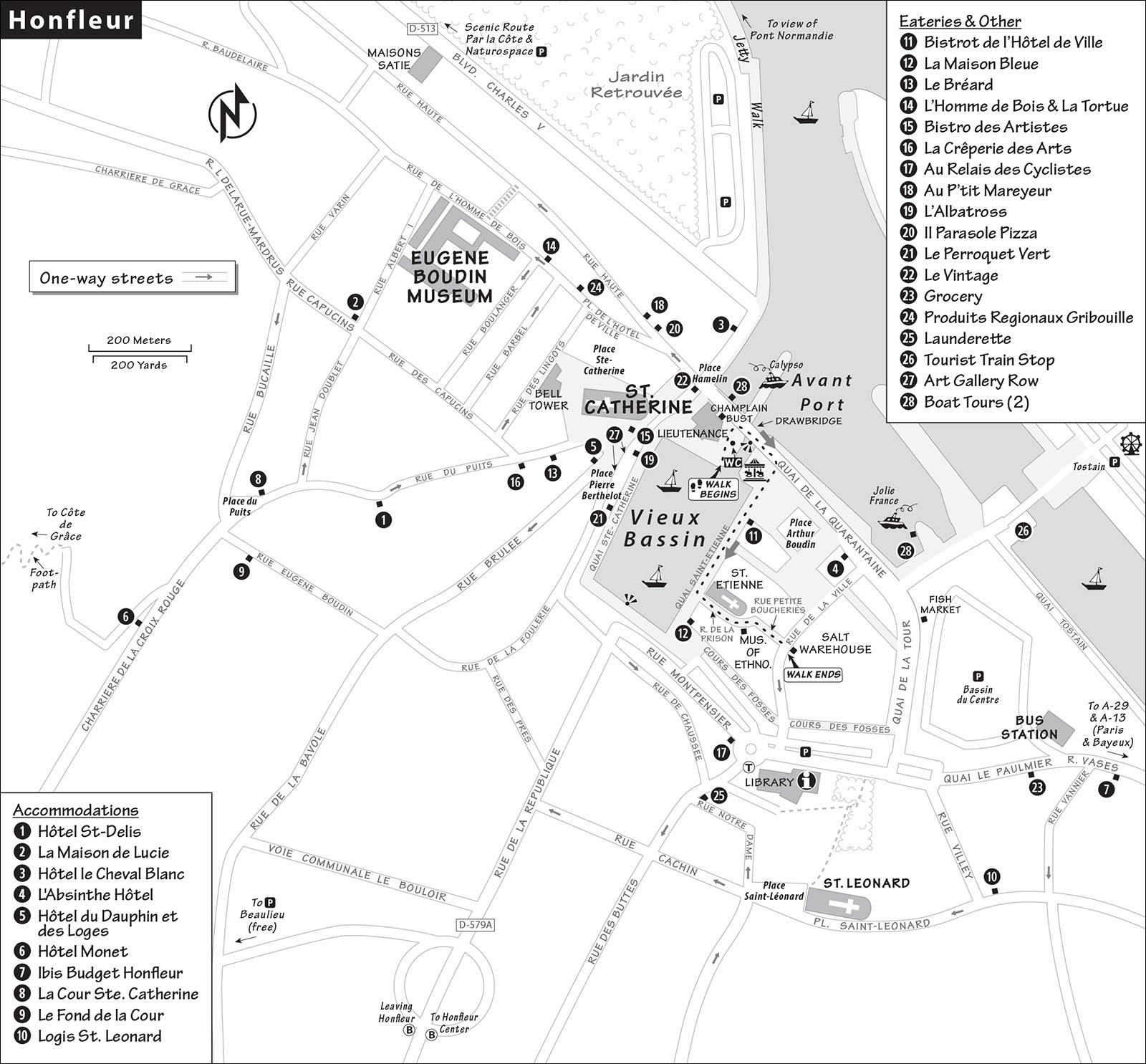
Honfleur’s appealing lanes and activities are all within a short stroll of its old port, the Vieux Bassin. The Seine River flows just east of the center, the hills of the Côte de Grâce form its western limit, and Rue de la République slices north-south through the center to the port. Honfleur has two can’t-miss sights—the harbor and St. Catherine Church—and a handful of other intriguing monuments. But really, the town itself is the sight.
TOURIST INFORMATION
The TI is in the glassy public library (Mediathéque) on Quai le Paulmier, two blocks from the Vieux Bassin (Mon-Sat 9:30-19:00, Sun 10:00-17:00; Sept-June Mon-Sat until 18:30 and closed for lunch 12:30-14:00; closed Sun afternoon Nov-Easter; free WCs, +33 2 31 89 23 30, www.honfleur-tourism.co.uk). Here you can rent a €5 audioguide for a self-guided town walk, pick up regional bus schedules, and get information on the D-Day beaches.
ARRIVAL IN HONFLEUR
By Bus: Regional Nomad buses and FlixBuses from Paris serve the small bus station. Confirm your departure plans at the helpful information counter. To reach the TI and old town, turn right as you exit the station and walk five minutes up Quai le Paulmier. Note that the bus stop on Rue de la République is closer to some accommodations (see the “Honfleur” map).
By Car: Follow Centre-Ville signs, then find your hotel and unload your bags (double-parking is OK for a few minutes). Parking is a headache in Honfleur, especially on summer and holiday weekends. Some hotels offer pay parking (worth considering); otherwise, your hotelier knows where you can park cheaply or for free. Parking Bassin du Centre is central and pricey (about €3/hour, €24/24 hours, near the TI). To save piles of euros, find the big lot by the Ferris wheel, across the small bridge past the boat tours (€6/day). Free parking in Honfleur is not central. You can find it at the Naturospace Museum (15-minute walk up Boulevard Charles V, near the beach) and at Parking Beaulieu (take Rue St-Nichol to Rue Guillaume de Beaulieu). Street parking, metered during the day, is free from 20:00 to 8:00.
HELPFUL HINTS
Museum Pass: The €13 museum pass, sold at participating museums, covers the Eugène Boudin Museum, Maisons Satie, and the Museum of Ethnography and Norman Popular Arts (www.musees-honfleur.fr).
Market Day: The area around St. Catherine Church becomes a colorful open-air market every Saturday (9:00-13:00). A smaller organic-food market happens here on Wednesday mornings, and a flea market takes center stage the first Sunday of every month and also on Wednesday evenings in summer.
Grocery Store: There’s one near the TI at 16 Quai le Paulmier.
Regional Products: Visit Produits Regionaux Gribouille for any Norman delicacy you can dream up. Ask about cider and Calvados tastings (closed Tue-Wed, 16 Rue de l’Homme de Bois, +33 2 31 89 29 54).
Laundry: Lavomatique is a block above and behind the TI (self-service only, daily 7:30-21:30, 4 Rue Notre-Dame).
Taxi: Dial +33 6 08 60 17 98.
Tourist Train: Honfleur’s handy petit train toots you up the Côte de Grâce—the hill overlooking town—and back in about 45 minutes (€8, June-Sept daily 10:30-17:30, off-season weekends only, departures on the hour except at lunchtime, leaves from near the bridge that leads to the Ferris wheel).
Old Honfleur Walk
Allow 50 minutes for this easy self-guided walk that starts on the port, in front of the historic La Lieutenance building.
▲▲Vieux Bassin (Old Port)
Find the small drawbridge that boats must pass under to reach the old port, and survey the scene. If you’re an early riser, you can watch the morning light as it shines brilliantly on Honfleur’s harbor. Cross the bridge toward the big Ferris wheel for good perspective on the picturesque scene. The word “Honfleur” is Scandinavian, meaning the shelter (fleur) of Hon (a Viking warlord). This town has been sheltering residents for about a thousand years. During the Hundred Years’ War (14th and 15th centuries), the entire harbor was fortified by a big wall with twin gatehouses (the one surviving gatehouse is La Lieutenance). A narrower channel than the one you see today was protected by a heavy chain that guards lifted to allow boats to pass. After the walls were demolished around 1700, those skinny houses on the right side were built for the town’s fishermen. How about a room on the top floor, with no elevator? Imagine moving a piano or a refrigerator into one of these units today. The spire halfway up the left side of the port belongs to Honfleur’s oldest church, St. Etienne. The port, once crammed with fishing boats, now harbors sleek sailboats.
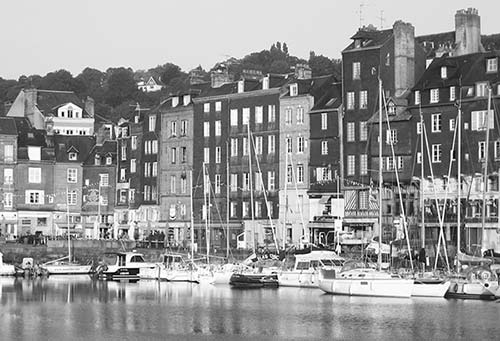
• Enter the old gatehouse.
La Lieutenance
To best appreciate Honfleur’s seafaring past, you can visit several rooms of La Lieutenance. There is a good film and exhibits that explain (in perfect English) Honfleur’s global sailing expeditions and once powerful role in the region. You’ll also learn about the fragility of the Seine estuary and enjoy a great view terrace (€6, Tue-Sun 10:00-18:00, closed Mon, Quai de la Planchette, +33 2 61 67 11 60).
• Walk to the back side of La Lieutenance.
Avant Port (Outer Harbor)
In front of the barrel-vaulted arch (once the entry to the town), you can see a bronze bust of Samuel de Champlain, the explorer who sailed 400 years ago with an Honfleur crew—famous for their maritime skills—to make his discoveries in the New World. Champlain is acknowledged as the founder of the Canadian city of Quebec, which remains French-speaking to this day.
Turn around to see various tour and fishing boats and the masts of the high-flying Normandy Bridge (described later) to your left in the distance. Fisherfolk catch flatfish, scallops, and tiny shrimp daily to bring to the Marché au Poisson (fish market; look for white metal structures with blue lettering 100 yards to your right). Wednesday through Saturday, you may see fisherpeople selling crevettes (shrimp) and more. You can buy them cuites (cooked) or vivantes (alive and wiggly). Vendors are happy to let you sample one (rip off the cute little head and tail, and pop what’s left into your mouth—délicieuse!), or buy a cupful to go for a few euros.
• Walk past the merry-go-round and along the low side of the harbor, passing the Bistrot de l’Hôtel de Ville.
Quai Saint-Etienne
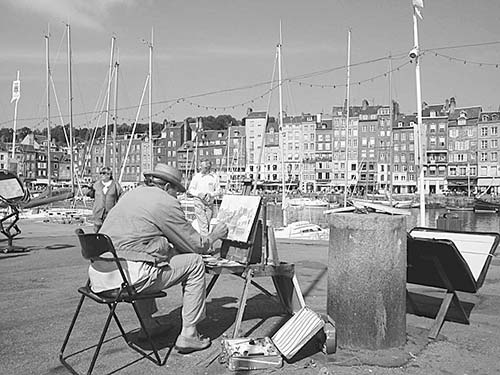
You might see artists sitting at easels around the harbor, as Boudin and Monet did. Many consider Honfleur the birthplace of Impressionism. The 19th century was a time when people began to revere the out-of-doors, and pretty towns like Honfleur and the nearby coast made perfect subjects (and still do). And with the advent of new railway lines in the late 1800s, artists could travel to find the best light like never before. Monet came here to visit the artist Boudin, a hometown boy, and the battle cry of the Impressionists—“Out of the studio and into the light!”—was born. Artists set up their easels along the harbor to catch the light playing on the line of buildings, slate shingles, timbers, geraniums, clouds, and reflections in the water—much as they still do today.
• Continue along the harbor for a chance to study the Lego-style timber-frame houses of Honfleur. Find the Church of St. Etienne (today’s skippable Museum of the Sea), then head up (unsigned) Rue de la Prison to the...
▲Museum of Ethnography and Norman Popular Arts
Honfleur’s engaging little Museum of Ethnography and Norman Popular Arts (Museé d’Ethnographie et d’Art Populaire Normand) is located in the old prison and courthouse, a short block off the harbor in the heart of Old Honfleur. It re-creates typical rooms from Honfleur’s past and crams them with everyday objects—costumes, furniture, looms, and an antique printing press. You’ll see the old yard and climb through two stories of furnished rooms. The museum paints a picture of daily life in Honfleur during the time when its ships were king and the city had global significance.
Cost and Hours: €4.20; Wed-Mon 10:00-12:00 & 14:00-18:00, no lunchtime closure July-Aug, closed mid-Nov-mid-Feb and Tue year-round; pick up English translation at the desk; Rue de la Prison, +33 2 31 89 14 12.
• Next, bend around to...
Rue des Petites Boucheries and Rue de la Ville
Here we can see some prime examples of Old Honfleur architecture. The oldest beams of buildings like these were numbered so they could be disassembled and moved. The street is named for butcher shops that once lined this lane—the ancient wood shed just before the passage is a surviving example. Walking through the passage, you’ll pop out onto Rue de la Ville. Across the lane is one of three huge 17th-century salt warehouses (today used for exhibitions). If it’s open, wander in to see the huge stone hall with its majestic wooden ceiling and imagine the importance of salt as a preservative before refrigeration existed.
Strategically positioned Honfleur guarded Paris from a naval attack up the Seine. That’s why the king fortified it with a wall in the 1300s. In the 1600s, when England was no longer a threat, the walls were torn down, leaving the town with some wide boulevards (like the one in front of the TI) and plenty of stones (like those that made the salt warehouse).
• Our walk is over. Consider returning to Vieux Bassin for nearby Honfleur sights.
Sights in Honfleur
▲▲St. Catherine Church (Eglise Ste. Catherine)
St. Catherine’s replaced an earlier stone church, destroyed in the Hundred Years’ War. The unusual wood-shingled exterior suggests that this church has a different story to tell than most. In those chaotic times, the town’s money was spent to fortify its walls, leaving only enough funds to erect a wooden church. In the last months of World War II, a bomb fell through the church’s roof—but didn’t explode—leaving this unique church intact for you to visit today. Even if you’re suffering from church burnout, you won’t want to miss this one.
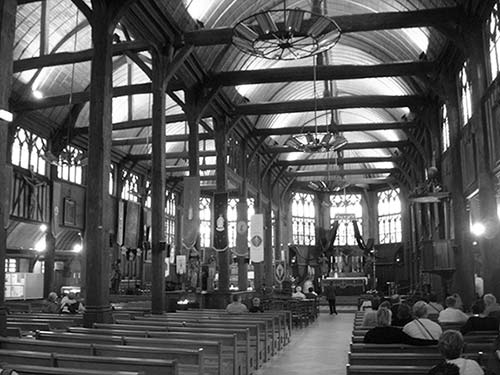
Cost and Hours: Free, daily 9:00-18:30, Sept-June until 17:15, Place Ste-Catherine.
Visiting the Church: Walk inside. You’d swear that if it were turned over, the building would float—the legacy of a community of sailors and fishermen, with loads of talented boat builders (and no church architect). When workers put up the first (left) nave in 1466, it soon became apparent that more space was needed—so a second was built in 1497 (on the right). Because it felt too much like a market hall, they added side aisles and two altars.
The oak columns were prepared as if the wood was meant for a ship—soaked in seawater for seven years and then dried for seven years. Notice some pillars are full-length and others are supported by stone bases. Trees come in different sizes, yet each pillar had to be the same length.
The pipe organ (from 1772, rebuilt in 1953) behind you is popular for concerts, and half of the modern pews are designed to flip so that you can face the music. That rocks. The balustrade below the organ merits close inspection: Its carved wooden panels feature musical instruments used in the 16th century.
Find a seat and enjoy the worshipful ambience of this beautiful space. But don’t sit in the dark wood box toward the front; this was reserved for the local noble lord and his family. And if you must gossip, do so at the “cackling zone”—an open-air porch (outside, about halfway up on the right) where historically (and perhaps hysterically) people gathered after Mass.
Bell Tower: The church’s bell tower was built away from the church to avoid placing too much stress on the wooden church’s roof, and to minimize fire hazards. Notice the funky shingled chestnut beams that run from its squat base to support the skinny tower, and find the small, faded wooden sculpture of a tiny St. Catherine over the door. Until recently the bell ringer lived in the bell tower.
HONFLEUR’S ART GALLERIES
Eugène Boudin established Honfleur’s artistic tradition in the 1800s. The town remains a popular haunt for artists, many of whom display their works in Honfleur’s numerous art galleries (the best ones are along the streets between St. Catherine Church and the port). As you stroll around the town taking in its old sights, take time to enjoy today’s art, too.
▲Eugène Boudin Museum
This pleasing little museum opened in 1869 and has several interesting rooms, with many paintings of Honfleur and the surrounding countryside, giving you a feel for Honfleur in the 1800s.
Cost and Hours: €8, covered by museum pass; March-Sept Wed-Mon 10:00-12:00 & 14:00-18:00, no lunchtime closure July-Aug, closed weekday mornings Oct-Feb, closed Tue year-round; good but skippable audioguide-€2, elevator, Rue de l’Homme de Bois, +33 2 31 89 54 00, www.musees-honfleur.fr.
Born in Honfleur, Boudin was the son of a harbor pilot. As an amateur teenage artist, he found work in an art-supply store that catered to famous artists from Paris (such as landscapists Corot and Millet) who came to paint the seaside. Boudin studied in Paris and his work was exhibited there, but he kept his hometown roots.
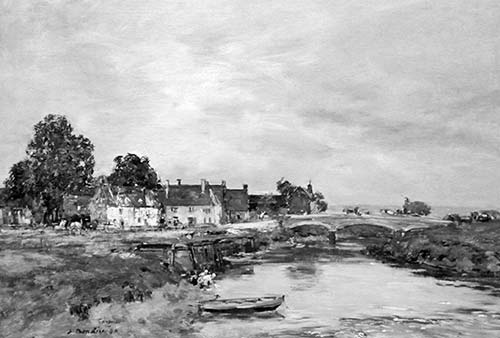
At age 30 Boudin met the teenage Claude Monet. Monet had grown up in nearby Le Havre and, like Boudin, sketched the world around him—beaches, boats, and small-town life. Boudin encouraged him to don a scarf, set up his easel outdoors, and paint the scene exactly as he saw it. Today, we say, “Well, duh!” But “open-air” painting was unorthodox for artists trained to thoroughly study their subjects in the perfect lighting of a controlled studio setting. Boudin didn’t so much teach Monet as give him the courage to follow his artistic instincts.
In the 1860s and 1870s, Boudin spent summers at his farm (St. Siméon) on the outskirts of Honfleur, hosting Monet, Edouard Manet, and other hangers-on. They taught Boudin the Impressionist techniques of using bright colors and building a subject with many individual brushstrokes. Boudin adapted those “strokes” to build subjects with “patches” of color. In 1874, Boudin joined the renegade Impressionists at their “revolutionary” exhibition in Paris.
Visiting the Museum: The museum regularly shuffles its collection—expect some changes from this description. Pick up a museum map at the ticket counter, tip your beret to Eugène Boudin, and climb the stairs (or take the elevator). The first floor has good WCs, kids’ activity rooms, and temporary exhibits.
Second Floor: Making a right off the stairs leads into a large room featuring special exhibits and is usually worth a quick look. A left off the stairs leads through a room of paintings filled with scenes you might recognize by artists whose names you won’t recognize, to the Peintures du 19eme Siècle room. This is the museum’s highlight, with a fine collection of Boudin’s artwork, starting with his first beach scenes and moving chronologically from there. Boudin loved his outdoor world and filled his paintings with port scenes, the sea, and big skies (a glass case at the end of the room displays his “sky studies”). His skies were good enough to earn him the nickname “King of Skies.” This collection of Boudin’s paintings—which the artist gave to his hometown—shows how his technique developed, from realistic portrayals of subjects (outlines colored in, like a coloring book) to masses of colors catching light (Impressionism). Boudin’s beach scenes, showing aristocrats taking a healthy saltwater dip, helped fuel that style.
You’ll also see a few paintings of his colleagues and contemporaries (usually Claude Monet and Gustave Courbet), letting you see how those masters took Boudin’s approach to the next level. When Boudin and other Honfleur artists showed their work in Paris, they created enough of a stir that Normandy came into vogue. Many Parisian artists (including Monet and other early Impressionists) traveled to Honfleur to dial in to the action. Boudin himself made a big impression on the father of Impressionism by introducing Monet to the practice of painting outside.
Third Floor: Follow the steps that lead up from this room to the small, enjoyable Hambourg/Rachet collection, which is largely from the mid-20th century and features an appealing collection of works by hometown boy, André Hambourg (notice how his work evolves—the Honfleur port scene is eye-popping).
Double back to the main stairway and consider climbing to another wing on the third floor to find a collection of more abstract, 20th-century works by artists who lived and learned in Honfleur, including the Fauvist painter Raoul Dufy. There’s an exceptional view of the Normandy Bridge through the big windows.
▲Maisons Satie
If Honfleur is over-the-top cute, this museum, housed in composer Erik Satie’s birthplace, is a burst of witty charm—just like the musical genius it honors. If you like Satie’s music, this is a delight—a 1920s “Yellow Submarine.” If not, you won’t get the many references to his life and work. Allow about an hour for your visit.
Cost and Hours: €6.50, includes audioguide, covered by museum pass; Wed-Mon 10:00-18:00, closed Jan and Tue year-round; last entry one hour before closing, 5-minute walk from harbor (the official address is 67 Boulevard Charles V, though the entrance is off Rue Haute; +33 2 31 89 11 11).
Visiting the Museum: As you wander from room to room with your included audioguide, infrared signals transmit bits of Satie’s dreamy music, along with a first-person story. As if you’re living as an artist in 1920s Paris, you’ll drift through a weird and whimsical series of old-school installations—winged pears, strangers in windows, and small girls with green eyes. The finale—performed by you—is the Laboratory of Emotions pedal-go-round, a self-propelled carousel where your feet create the music (pedal softly). For a relaxing finish, watch the quirky 12-minute movie (French only) featuring modern dance springing from Parade, Satie’s collaboration with Pablo Picasso and Jean Cocteau. You’ll even hear the boos and whistles that greeted these ballets’ debuts.
HONFLEUR WALKS AND DRIVES
▲Côte de Grâce Walk (or Drive)
For good exercise and a bird’s-eye view of Honfleur and the Normandy Bridge, go for a 30-minute uphill walk around and up to the Côte de Grâce—best in the early morning, late afternoon, or at sunset. The path is smooth but becomes steep toward the end. From St. Catherine Church, walk up Rue du Puits and then follow the blue-on-white Rampe du Mont Joli signs (look for signs marked pietons, “pedestrians”) to reach the splendid view over Honfleur and the Normandy Bridge at the top. This viewpoint alone justifies the climb.
Drivers can also access this viewpoint: Head up Rue Brulée and make a right on Rue Eugène Boudin, then take a hard left at Rue de Puits. Follow this road up and up, past Hôtel Monet, then track Notre-Dame de Côte de Grâce signs. Stop along the way to take in the first viewpoint.
At the top, walkers and drivers can continue past the viewpoint for about 300 yards along a country lane to the Chapel of Notre-Dame de Grâce, built in the early 1600s by the mariners and people of Honfleur (open daily 8:30-18:30). Model boats hang from the ceiling, paintings of boats balance high on the walls, and several stained-glass windows are decorated with images of sailors at sea praying to the Virgin Mary. Find the 23 church bells hanging on a wood rack 20 steps to the right as you leave the church and imagine the racket they make (the bells ring four times an hour). Below the chapel, a lookout offers a sweeping view of super-industrial Le Havre and the Seine estuary where the river hits the Manche (English Channel). The radar tower you see below controls traffic on one of the busiest waterways in Europe. You can make this a loop walk (or drive) by returning via the paved road below this viewpoint.
Jetty/Park Walk
Take a level stroll along the water past the Hôtel le Cheval Blanc to find the mouth of the Seine River, big ships at sea, and a sandy beach when the tide is out. Strolling on a cobbled walkway (with Le Havre’s industrial port across the water), you’ll pass a defunct lighthouse, kid-friendly parks carpeted with flowers and grass, and the lock connecting Honfleur to the Seine and the sea. Breezy vistas of the sea, a beach that Boudin would have loved, and views of the Normandy Bridge reward the diligent walker (allow 20 minutes to reach the beach).
NEAR HONFLEUR
Boat Excursions
Boat trips in and around Honfleur depart from behind the historic La Liutenance building and from a pier at the opposite end of the outer port (Easter-Oct usually about 11:00-17:00). The tour boat Calypso takes a good 45-minute spin around Honfleur’s harbor (€10, from behind La Lieutenance). The Jolie France (alternating with the Ville d’Honfleur) cruises to the Normandy Bridge, which, unfortunately, means two boring trips through the locks (€16/1.5 hours, narration in French, printed English translations available, departs from pier along route to the Ferris wheel, Jetée du Transit; +33 6 71 64 50 46, www.promenade-en-bateau-honfleur.fr).
Normandy Bridge (Pont de Normandie)
The 1.25-mile-long Normandy Bridge is the longest cable-stayed bridge in Europe (€6 toll each way, not worth a detour, about 2 miles from the town center). The bridge is a key piece of infrastructure that links the Atlantic ports from Belgium to Spain. You can view the bridge from Honfleur (best from a boat excursion or the “Old Honfleur Walk” described earlier, and best at night, when the bridge is floodlit). Drivers can consider visiting the bridge’s free Exhibition Hall (just before tollbooth on Le Havre side, daily 8:00-19:00). The Seine finishes its winding journey here, dropping only 1,500 feet from its source, 450 miles away. The river flows so slowly that, in certain places, a stiff breeze can send it flowing upstream.
▲Etrétat
France’s answer to the White Cliffs of Dover, these chalky cliffs soar high above a (usually) calm, crescent beach and make an exceptional excursion from Honfleur. Park in the seafront lot in Etrétat to access two equally worthwhile—and vertiginous—paths with soaring views (and crowds of hikers in summer and on weekends). Both trails lead straight up, then level out. There’s no need to complete either 1.5-hour trail—you can enjoy the view at the top, then turn around and go back the way you came, in about half that time. The southern trail features dramatic stone arches spilling into the sea, while the northern trail leads to rocky spires rising from the water, and a small chapel. You’ll recognize these cliffs—and the arches and stone spires that decorate them—from countless Impressionist paintings, including several at the Eugène Boudin Museum in Honfleur. The small, Coney Island-like town holds plenty of cafés, a gorgeous market hall around which the town spins, and a marvelous 14th-century building that today is a hotel.
Getting There: Etrétat is north of Le Havre. To get here by car (50 minutes), cross the Normandy Bridge and follow A-29, then exit at sortie Etrétat. By bus, it’s a two-hour one-way trip from Honfleur, with connections at Le Havre’s train station (see “Honfleur Connections” for buses from Honfleur to Le Havre). Bus #24 serves Etrétat from Le Havre’s gare routière at the train station (5/day, 1 hour, see Google Maps for schedule).
Sleeping in Etrétat: $$$$ Dormy House is all about its commanding setting and glorious views. It’s a big place, with several buildings, two restaurants, a handsome bar/lounge, and lovely view terraces. High-quality, comfortable rooms are on par with the views—it all adds up to a fine splurge (Route du Havre at the edge of Etrétat, +33 2 35 27 07 88, www.dormy-house.com, info@dormy-house.com). To sleep well in the heart of town for a third of the price of Dormy House, find the comfortable and welcoming $ Hôtel des Falaises (1 Boulevard René Coty, +33 2 35 27 02 77, www.hoteldesfalaises-etretat.com, falaisesetretat@gmail.com).
Nightlife in Honfleur
Nightlife in Honfleur centers on the old port. Several bar/cafés line the high-building side of the port, including pub-like L’Albatross (a young and sassy clubhouse) and Le Perroquet Vert (let’s just say that it has a more mature following). Le Vintage, just off the port, has a relaxed bar scene and live piano and jazz on weekend nights (daily, 8 Quai des Passagers, +33 2 31 87 41 47).
Sleeping in Honfleur
Honfleur is popular in summer and particularly busy on weekends and holidays (blame Paris). A few moderate accommodations remain, but most hotels are pricey. Hotels do not have air-conditioning or elevators unless noted. Expect to climb narrow stairways to reach your room, though most hotels have only a few floors.
HOTELS
$$$$ Hôtel St-Delis delivers a world of calm luxury and is well located for exploring Honfleur. Once the home of the Impressionist artist Henri de Saint-Delis, it’s now an air-conditioned, high-end refuge protected by high walls (43 Rue du Puits, +33 2 31 81 78 10, https://hotel-saint-delis.fr, contact@hotel-saint-delis.fr).
$$$ La Maison de Lucie*** is my favorite Normand splurge and greets its guests with a garden courtyard, comfy lounges, and rooms replete with thoughtful touches, fine furnishings, and views over Honfleur. Their cozy annex, a block away, has five lovely rooms surrounding a peaceful courtyard (suites available, 44 Rue des Capucins, +33 2 31 14 40 40, www.lamaisondelucie.com, info@lamaisondelucie.com).
$$$ Hôtel le Cheval Blanc*** is a good waterfront splurge with port views from all of its 35 well-configured rooms, plus a rare-in-this-town elevator and air-conditioning (family rooms, pay parking, apartments available near the hotel, 2 Quai des Passagers, +33 2 31 81 65 00, www.hotel-honfleur.com, info@hotel-honfleur.com).
$$$ L’Absinthe Hôtel*** offers 11 tasteful rooms with king- and queen-size beds in two locations. The traditional rooms in the main (reception) section come with wood-beamed decor and share a cozy public lounge with a fireplace. Six more contemporary rooms are above the next-door restaurant and have views of the modern port and three-star, state-of-the-art comfort (air-con in both buildings, Parking Tostain is best, by the Ferris wheel, 1 Rue de la Ville, +33 2 31 89 23 23, www.absinthe.fr, reservation@absinthe.fr).
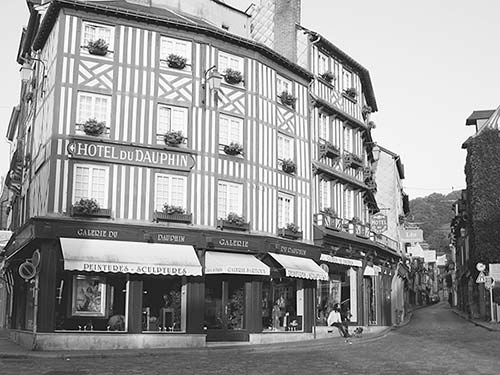
$$ Hôtel du Dauphin et des Loges*** combines two hotels in adjacent locations and delivers very central and fairly priced rooms. The main building (Hôtel du Dauphin with reception) has narrow stairs (normal for Honfleur) and an Escher-esque floor plan with uninspired but sleepable rooms. The Hôtel des Loges is a touch more comfortable and stylish (a stone’s throw from St. Catherine Church at 10 Place Pierre Berthelot, +33 2 31 89 15 53, www.hoteldudauphin.com, info@hotel-du-dauphin.com).
$$ Hôtel Monet,** on the road to the Côte de Grâce and a 15-minute walk down to the port, is a fair value, particularly for drivers. This tranquil spot, run by amiable Steve and Ophelie, offers 12 small and two larger rooms, all with private patios that surround a gravel parking area (free parking nearby, €5 to park in their lot, Charrière du Puits, +33 2 31 89 00 90, www.hotel-monet-honfleur.com, contact@hotel-monet-honfleur.com). Reception is open until 20:00.
¢ Ibis Budget Honfleur is modern, efficient, trim, and cheap, with prefab bathrooms and an antiseptically clean ambience (family rooms, reception closed 21:00-6:00 but self-check-in with credit card available 24 hours, elevator, across from bus station and main parking lot at 2 Rue des Vases, +33 8 92 68 07 81, https://all.accor.com, h2716-re@accor.com).
CHAMBRES D’HOTES
The TI has a long list of Honfleur’s many chambres d’hôtes (rooms in private homes), but most are too far from the town center. Those listed here are good values.
$$ La Cour Ste. Catherine is an enchanting bed-and-breakfast with six big, tasteful rooms—each with a separate sitting area—surrounding a perfectly Normand courtyard with exquisite plantings and small sitting areas placed just so. There’s a cozy lounge area ideal for cool evenings. They also have several cushy apartments (including one that can sleep eight comfortably) with full kitchens and small living rooms. They serve wine and other drinks all day (includes good breakfast, RS%—free parking with this book, 200 yards up Rue du Puits from St. Catherine Church at #74, +33 7 87 04 49 16, www.coursaintecatherine.com, coursaintecatherine@orange.fr). Ask about their gîte (home rental), 10 minutes outside of town.
$$ Le Fond de la Cour, kitty-corner to La Cour Ste. Catherine and run by British expats Amanda and Craig and son Ben, offers a good mix of modern and comfortable accommodations around a quiet courtyard. They have cottages that can sleep four, and four comfortable double rooms (doubles include English-style breakfast, free street parking nearby, 29 Rue Eugène Boudin, +33 6 72 20 72 98, amanda.ferguson@orange.fr).
A Little Farther: $$$ Logis St. Leonard is a sweet, somewhat pricey three-room place on Honfleur’s quiet side (longer walk but few tourists) where guests are given the run of the house—well, almost. Overseen by earnest Anne-Marie, it’s decorated with oodles of personal touches. One room owns a winning terrace, and all rooms have access to the peaceful garden (includes breakfast, +33 6 63 72 72 38, annemariecarneiro14@gmail.com).
Eating in Honfleur
Eat seafood, crêpes, or cream sauces here. Choose between an irresistible waterfront table at one of many mediocre-quality, lookalike places lining the harbor, or finer dining elsewhere in town. It’s best to reserve a day or two ahead (particularly on weekends).
DINING ALONG THE HARBOR
Survey the eateries lining the harbor (all open Wed when many other places are closed). The food isn’t great, but you’ll find plenty of salads, crêpes, and seafood—and a great setting. Even if you dine elsewhere, come to the harbor for a before- or after-dinner stroll or a drink. Bistrot de l’Hôtel de Ville and La Maison Bleue, on the Quai St. Etienne side of the harbor, own the best café views of Honfleur.
BETTER FOOD, NO VIEWS
While I wouldn’t blame you for enjoying a forgettable meal in an unforgettable setting on the harborfront, consider these finer alternatives a couple of blocks away.
$$$ Le Bréard is a formal place to dial it up a little and eat very well for a fair-enough price. The modern decor is understated, and the cuisine is inventive, delicious, and not particularly Normand (closed Wed-Thu, 7 Rue du Puits, +33 2 31 89 53 40, www.restaurant-lebreard.com).
$$ L’Homme de Bois combines warm color and wood-beam and brick-wall ambience with authentic Normand cuisine that is loved by locals. The menu offers good seafood and meat choices (the duck filets are delectable) and good-value fixed-priced menus (daily, a few outside tables, avoid the upstairs room, reserve a day or two ahead, 30 Rue de l’Homme de Bois, +33 2 31 89 75 27, www.lhommedeboishonfleur.com).
At $$$ La Tortue, next to L’Homme de Bois, the hands-on owners prepare delicious cuisine, including a gourmet vegetarian menu, all beautifully presented and served in a warm setting (daily, call ahead to avoid occasional closures, 36 Rue de l’Homme de Bois, +33 2 31 81 24 60, www.restaurantlatortue.fr).
$$ Bistro des Artistes is a two-woman operation with a charming 10-table, shoebox dining room that France’s president loves (seriously), so it’s best to book a few days ahead, particularly for a window table. Hardworking Anne-Marie cooks up huge portions; one course is plenty...and maybe a dessert (great salads, daily, closed Tue-Wed off-season, 30 Place Berthelot, +33 2 31 89 95 90).
$ La Crêperie des Arts serves up good crêpes in an appealing setting with a huge fireplace; this is a good, centrally located budget option (closed Wed, 13 Rue du Puits, +33 2 31 89 14 02).
$ Au Relais des Cyclistes, on a busy street near the TI, is an eclectic, lively, pub-like place for a simple, inexpensive meal with a good selection and fun indoor and outdoor seating (closed Thu, 10 Place de la Porte de Rouen, +33 2 31 89 09 76).
$$ Au P’tit Mareyeur is all about seafood, and a good value. The cozy ground floor and upstairs rooms offer equal comfort and ambience (good menu choices and vegetarian options, closed Tue-Wed and Jan, 4 Rue Haute, +33 2 31 98 84 23).
OTHER OPTIONS
Breakfast: If it’s even close to sunny, skip your hotel breakfast and eat on the port, where several cafés offer petit déjeuner (€8 for continental fare, €14-20 for more elaborate choices—the bagel options at L’Albatross are filling). Morning sun and views are best from this high side of the harbor.
Dessert: Honfleur is ice cream crazy, with gelato and traditional ice cream shops on every corner.
Nighttime Food to Go: Order a pizza to go until late from $ Il Parasole (daily, 2 Rue Haute, +33 2 31 98 94 29), and enjoy a picnic dinner with port views a few steps away at the Lieutenance gatehouse.
Honfleur Connections
There’s no direct train service to Honfleur, but bus service is good. FlixBus provides the only no-transfer connection to Paris (about 3 hours), though only a few days a week. It’s easy to take one of these regional buses to connect with trains to Paris or elsewhere: Bus #111 links Honfleur with train service in Le Havre, Caen, and Deauville. Express bus #122 runs between Le Havre, Honfleur, and Caen. Bus #123 runs between Le Havre, Honfleur, and Lisieux (with train connections). Although train and bus service usually is coordinated, confirm your connection with the helpful staff at Honfleur’s bus station (English info desk open Mon-Sat 9:30-12:00 & 13:15-18:00, in summer also Sun, +33 2 31 62 96 20, www.nomadcar14.fr [URL inactive]). If the station is closed, you can get schedules at the TI. Rail-pass holders will save money by connecting through Deauville, as bus fares increase with distance.
From Honfleur by Bus and/or Train to: Caen (express bus #122 5/day, 1 hour; slower bus #111 12/day Mon-Sat, 7/day Sun, 2 hours), Bayeux (express bus #122 or slower local bus #111 to Caen—see above, then 20-minute train to Bayeux), Rouen (almost hourly bus #111, #122, or #123 to Le Havre, which includes 30-minute bus ride over Normandy Bridge, then easy transfer to 1-hour train to Rouen), Paris’ Gare St. Lazare (about hourly, 2-3.5 hours, by bus to Caen, Lisieux, Deauville, or Le Havre, then train to Paris; buses from Honfleur meet most Paris trains).
Route Tips for Drivers: If driving to Rouen, see the Route of the Ancient Abbeys (described earlier, under “Sights in Rouen”). If connecting to the D-Day beaches, consider taking the scenic route “par la côte” to Trouville, which goes past sea views, thatched hamlets, and stupendous mansions. From Honfleur, drive to the port, pass Hôtel du Cheval Blanc, and stick to this road (D-513) to Trouville, then follow signs for A-13 to Caen.
Bayeux
Only six miles from the D-Day beaches, Bayeux was the first city liberated after the landing on June 6, 1944. Incredibly, the town was spared the bombs of World War II. The Allied Command needed an intact town from which to administer the push to Berlin. And after a local chaplain made sure London knew that his city was neither strategically important nor a German headquarters, a scheduled bombing raid was canceled—making Bayeux the closest city to the D-Day landing site not destroyed. Even without its famous medieval tapestry and proximity to the D-Day beaches, Bayeux would be worth a visit for its enjoyable town center and awe-inspiring cathedral, beautifully illuminated at night. Its location and manageable size (pop. 14,000) make Bayeux an ideal home base for visiting the area’s sights, particularly if you lack a car.
Orientation to Bayeux
Bayeux grew up along the Aure River and is today hemmed in by its ring road. Its main shopping street (Rue St. Jean) has sliced through its center since Roman times. The river powered the town’s waterwheels and flushed its waste as its industry grew. The TI is located in the old fish market over where the river meets Rue St. Jean, and the nearby waterwheel was part of the tanning and dyeing industry in the 15th century. Across from the Bayeux Tapestry museum, another waterwheel once powered a flour mill (now a recommended crêpe restaurant); its lock created a mill pond that did double-duty as the bishop’s fish pond.
TOURIST INFORMATION
The information-packed TI is on a small bridge two blocks north of the cathedral. Confirm times for the sights you want to see in the region, ask for bus schedules to the beaches, and inquire about special events, concerts, and short tours of local sights (daily July-Aug 9:00-19:00, April-June and Sept-Oct 9:30-12:30 & 14:00-18:00; shorter hours off-season; on Pont St. Jean leading to Rue St. Jean, +33 2 31 51 28 28, www.bessin-normandie.com).
ARRIVAL IN BAYEUX
By Train and Bus: Trains and buses share a station (no bag check). It’s a 15-minute walk from the station to the Bayeux Tapestry museum, and 15 minutes from the tapestry to Place St. Patrice. To reach the tapestry, the cathedral, and recommended hotels, cross the major street in front of the station and follow Rue de Cremel toward l’Hôpital, then turn left on Rue Nesmond. Find signs to the Tapisserie (tapestry) or continue on to the cathedral. Taxis usually wait at the station—allow €10 to any recommended hotel or sight in Bayeux, and €27 to Arromanches (€38 after 19:00 and on Sundays, taxi +33 2 31 92 92 40 or mobile +33 6 70 40 07 96).
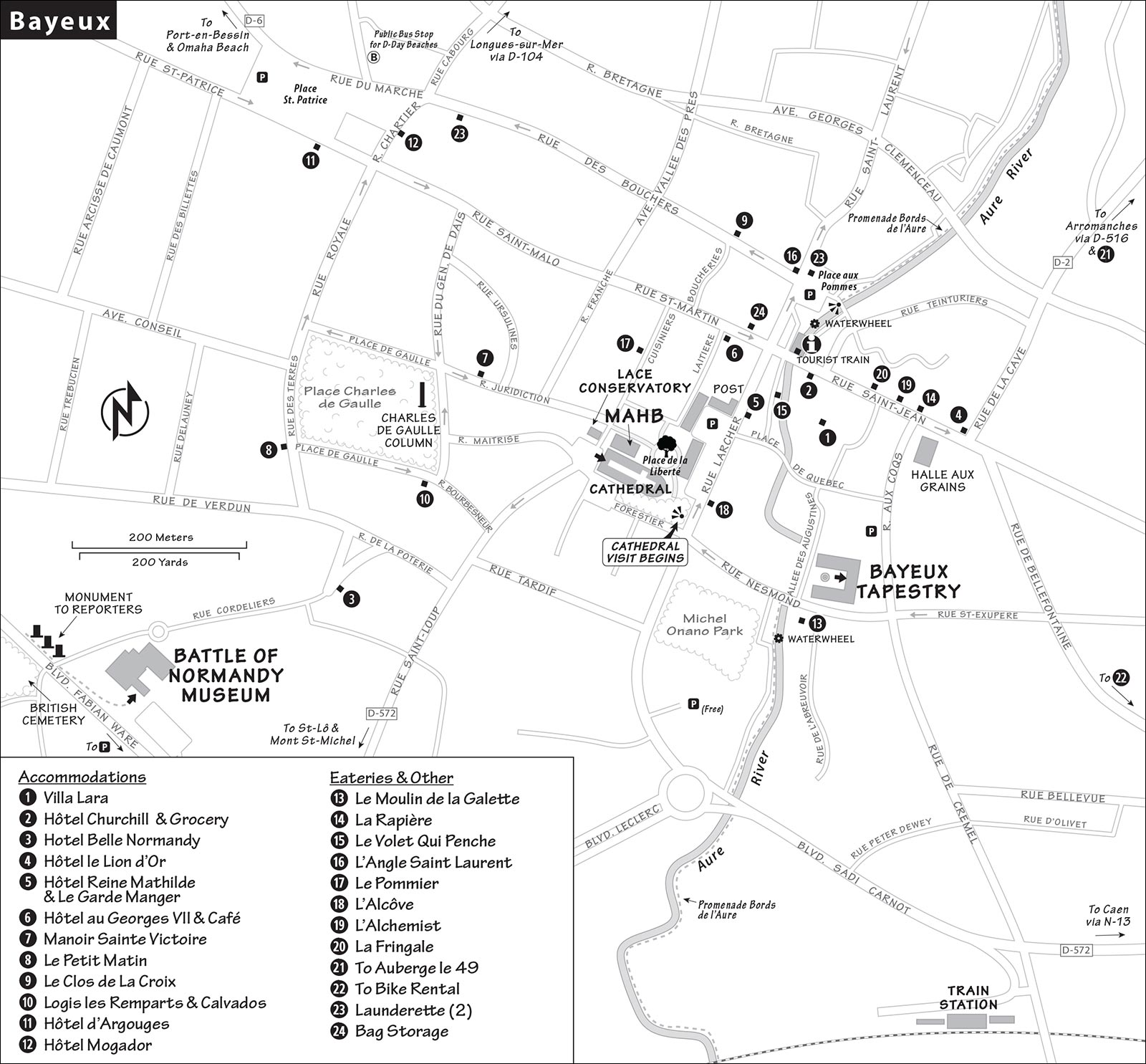
By Car: A handy ring road circles Bayeux, with well-signed parking and hotels. Look for the cathedral spires and follow signs for Centre-Ville, and then signs for the Tapisserie or your hotel. Pay parking lots are in the town center (including at the Hôtel de Ville near the TI; and at Place St. Patrice, 3-hour limit, free 12:00-14:00 & overnight 19:00-9:00). The most central free parking is just off the roundabout by Boulevard Sadi Carnot (see map) or along Boulevard Fabian Ware, closer to the Battle of Normandy Museum (the TI has a map of free parking, or ask your hotelier).
By Private Shuttle from Paris: Albion Transport offers top-notch transfers to Bayeux direct from Paris airports, train stations, or hotels (see listing under “Getting Around Normandy,” at the beginning of this chapter).
HELPFUL HINTS
Sightseeing Tips: Bayeux’s three main museums—the Bayeux Tapestry, Battle of Normandy Memorial Museum, and MAHB—offer combo-tickets that save you money if you see more than one sight. A combo-ticket covering two sights is €14; for all three it’s €16 (the tapestry alone is €12, buy at the first sight you visit). Note that many sights close in January.
Cathedral Illuminations: Sound-and-light shows play on the exterior and sometimes interior of the cathedral in summer and occasionally during other times of year—ask.
Market Days: The Saturday open-air market on Place St. Patrice is Bayeux’s best, though the Wednesday market on pedestrian Rue St. Jean is pleasant. Both end by 13:00. Don’t leave your car on Place St. Patrice on a Friday night, as it will be towed early Saturday.
Baggage Storage: The good folks at Bajocave Wine Shop will store your bags (Tue-Sat 10:00-12:30 & 14:00-19:00, closed Sun-Mon, a block from the TI at 10 Rue Saint-Martin, +33 9 73 52 09 30).
Grocery Store: Carrefour City, at Rue St. Jean 14, is next to the recommended Hôtel Churchill (long hours).
Laundry: A launderette is a block behind the TI, at #10 Rue Maréchal Foch. Another launderette is near Place St. Patrice, at 69 Rue des Bouchers (both open daily 7:00-21:00).
Taxi: Dial +33 2 31 92 92 40 or mobile +33 6 70 40 07 96.
Car Rental: Skip the inefficient agency in Bayeux and rent your car in nearby Caen (see here).
Calvados Tasting: For a fun and easy cider and Calvados sampling in a cozy setting, drop by the recommended Logis les Remparts B&B (€6 incudes tastes of a Calvados brandy, a dry cider, and a sweet cider; same price for three different Calvados brandies; Tue-Sat 10:00-19:00, Sun until 12:00, closed Mon; 4 Rue Bourbesneur, +33 2 31 92 50 40).
Tours in Bayeux
Self-Guided Walking Tour
Pick up the map called Découvrez Vieux Bayeux at the TI, which corresponds to bronze info plates embedded in sidewalks around town.
Guided Walks of Old Bayeux
For a chatty, anecdote-filled stroll through the historic center—with no interiors but plenty of factoids—join Christèle or Marie-Noëlle of Discovery Walks for a guided walk (€15, 2-hour walk daily at 9:30 April-Sept, no reservation needed—just show up at the TI, rain or shine, private tours possible year-round, www.discovery-walks.org). The TI offers morning tours of historic Bayeux in French and English (€5, July-mid-Sept, get times at TI, departs from cathedral).
Bike Rental and Tours
Biking along the D-Day beaches has become popular as more separated bike paths have been developed, making it safer and more fun for pedalers (see “Getting Around the D-Day Beaches” on here).
Locvélo, which rents top-quality bikes of every size and type, has meticulously crafted several scenic and historic self-guided rides that keep you off the main roads and on bike paths and quiet rural lanes. You can download the routes to your phone—they include precise directions and even tips for fun stops (like farm-made ice cream and Calvados tastings). Bikes cost €25-45 a day and can be delivered to your hotel in Bayeux (Rue d’Audrieu, +33 6 46 34 37 21, www.locvelo.fr).
Hugo at Petite Reine leads e-bike tours from Bayeux into the Normand countryside, to the D-Day beaches, and to Mont St-Michel (with a minivan shuttle). Tours last a few hours to all day (€90-220, +33 6 80 87 87 37, https://us.petitereinenormandie.fr, hugo@petitereinenormandie.fr).
Touristy Choo-Choo Train
Bayeux’s hop-on, hop-off tourist train leaves hourly from the TI for a 35-minute ride through town with recorded English commentary. Stops include the cathedral and the Battle of Normandy Memorial Museum (€7, pay driver).
Sights in Bayeux
▲▲▲Bayeux Tapestry (Tapisserie de Bayeux)
Made of wool embroidered onto linen cloth, this historically precious document is a mesmerizing 70-yard-long cartoon. The tapestry tells the story of William the Conqueror’s rise from duke of Normandy to king of England, and shows his victory over England’s King Harold at the Battle of Hastings in 1066. Long and skinny, the tapestry was designed to hang in the nave of Bayeux’s cathedral as a reminder for locals of their ancestor’s courage. The excellent museum that houses the tapestry is an unusually good chance to teach your kids about the Middle Ages. Models, mannequins, a movie, and more make it an engaging, fun place to visit.
Cost and Hours: €12, covered by Bayeux museums combo-ticket, includes excellent audioguide for adults and special kids’ version; daily May-Aug 9:00-19:00, March-April and Sept-Oct until 18:30; Nov-Dec and Feb 9:30-12:30 & 14:00-18:00, closed Jan; last entry 45 minutes before closing, 13 bis Rue de Nesmond, +33 2 31 51 25 50, www.bayeuxmuseum.com. Photography of the actual tapestry is not allowed, but you can take pictures of a replica.
Planning Your Visit: It’s busiest in August, and most crowded 10:00-12:00 and 14:00-17:00. As the audioguide cannot be paused, you’re limited to 25 minutes with the tapestry. It’s a strict one-way route that you’ll likely share with a conveyor belt of people moving along with you. Allow at least a full hour for your complete museum visit. The 16-minute film at the end is skippable (runs every 40 minutes; if you’re determined to see it, ask about the next English showing).
Visiting the Museum: Your visit starts with the actual tapestry, accompanied by an included audioguide that gives a top-notch, fast-moving, 25-minute scene-by-scene narration complete with period music (no pausing or rewinding—if you lose your place, find subtitles in Latin). Remember, the tapestry is Norman propaganda: The English (the bad guys, referred to as les goddamns, after a phrase the French kept hearing them say) are shown with mustaches and long hair; the French (les good guys) are clean-cut and clean-shaven—with even the backs of their heads shaved for a better helmet fit—but have long noses.
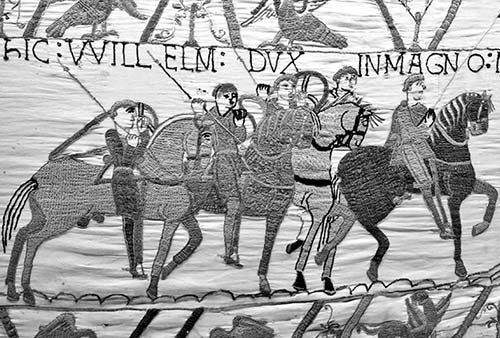
Appreciate the fun details—such as the bare legs in scene 4 or Harold’s pouting expressions in various frames—and look for references to places you may have visited (like Dinan and Rennes). Pay strict attention to scene 23, where Harold takes his oath to William; the importance of keeping one’s word is the point of the tapestry. Get close and (almost) feel the tapestry’s texture. Many scenes are flat-out beautiful. Some feature brilliant portrayals of horses and boats with a 3-D perspective created by using different colors; other scenes show a total absence of depth perspective. The most famous scene is Harold’s death: This marks the end of the intense battle—and victory for William.
Next, you’ll climb upstairs into a room filled with engaging exhibits, including a full-size replica of a Viking ship much like the one William used to cross the channel (Normans inherited their weaponry and seafaring skills from the Norsemen). You’ll also see mannequins (find William looking unmoved with his new crown), a replica of the Domesday Book (an inventory of nobles’ lands as ordered by William), and models of castles (who knew that the Tower of London was a Norman project?). Good explanations outline the events surrounding the invasion and the subsequent creation of the tapestry, and a touchscreen lets you see the back side of the embroidery.
Your visit finishes with a film that ties it all together (in the cinema upstairs, skippable if you’re pressed for time). Just before the theater you reach a replica of the tapestry (which you are welcome to photograph).
▲Bayeux Cathedral
This massive building, as big as Paris’ Notre-Dame, dominates the small town of Bayeux. Make it a point to enjoy the cathedral rising over the town late in the afternoon, when the facade is bathed in light, or after dark, when the entire church is illuminated.
Cost and Hours: Free, daily 8:30-18:00, July-Aug until 19:00, 4 Rue du Général de Dais. Ask about sound-and-light shows (generally in summer).
Visiting the Cathedral: Start your visit facing the cathedral’s southwest corner for a view with WOW impact, then find the small square opposite the front entry (info board about the cathedral facade in rear corner). Notice the two towers—originally Romanesque, they were capped later with tall Gothic spires. The cathedral’s west facade is structurally Romanesque, but with a decorative Gothic “curtain” added.
Now step inside the cathedral. The magnificent view of the nave from the top of the steps shows a mix of Romanesque (ground floor) and soaring Gothic (upper floors). Historians believe the Bayeux Tapestry originally hung here. Imagine it draped partway up the big Romanesque arches. Try to visualize this scene with the original, richly colored stained glass in all those upper windows. Rare 13th-century stained-glass bits are in the high central window above the altar; the other glass (below) is from the 19th and 20th centuries.
Walk down the nave and notice the areas between the big, round arches. That busy zigzag patterning characterizes Norman art in France as well as in England. These 11th-century Romanesque arches are decorated with a manic mix of repeated geometric shapes: half-circles, hash marks, full circles, and diagonal lines. Notice also the creepy faces eyeing you, especially the ring of devil heads lining the third arch on the right.
More 13th-century Norman Gothic is in the choir (the fancy area behind the central altar). Here, simple Romanesque carvings lie around Gothic arches whose characteristically tall, thin lines add a graceful verticality to the interior.
For maximum 1066 atmosphere, step into the beautifully lit crypt (beneath the central altar), which originally was used as a safe spot for the cathedral’s relics. The small crypt displays two freestanding columns and bulky capitals with fine Romanesque carvings. During a reinforcement of the nave, these two columns were replaced. Workers removed the Gothic veneer and discovered their true inner Romanesque beauty. Orange angel-musicians on other columns add color to this somber room. Walk to the rear of the small room and turn around to appreciate the lighting of the ancient capitals.
Nearby: Leaving the church, turn right and walk about 50 paces. Look back on the church’s spire to spy a little rectangular stone house. This was the watchman’s home, from which he’d keep an eye out for incoming English troops during the Hundred Years’ War...and for Germans five centuries later. (It didn’t work—the Germans took the town in 1940.) Bayeux was liberated on D-Day plus one: June 7. According to an interesting (but likely false) legend, the only casualty that day was the lookout, who supposedly was shot while watching from the window of this stone house.
A big Liberty Tree thrives down some steps you just walked past but is off-limits during construction (if open, take those steps down). Liberty Trees were planted in cities throughout France in 1793 (when the king was beheaded) to celebrate the end of the Old Regime and the people’s hard-won freedom. When this tree was planted, the cathedral kicked off a decade in which it was not considered a church but a revolutionary “temple of reason.”
Place Charles de Gaulle
A few blocks from the cathedral’s entrance, up Rue Maîtrise, is a huge, grassy yet historic square. That round column you pass when you enter among the trees is dedicated to the first public appearance of Charles de Gaulle in newly freed France (June 14, 1944; video footage of the event is shown at the Battle of Normandy Memorial Museum). The self-appointed leader of the Free French Forces, now with Churchill’s endorsement, proceeded to rally the French to rise up and help push out the Germans. This event initiated de Gaulle’s legitimacy as head of the Free French. Bayeux later served as the first administrative capital of post-Nazi-occupied France.
But there’s more to this square than WWII memories. Walk to the center. In the 10th century, a massive castle stood here. The statue you see is Poppa, the mistress or wife of the Viking conqueror Rollo, who in 911 became the first duke of Normandy. The people of Normandy came from this union (not to mention many English royals—Rollo’s descendants include William the Conqueror).
River Walk (Promenade Bords de l’Aure)
Join the locals and promenade along the meandering walking path that follows the little Aure River for about 2.5 miles through Bayeux. Find the waterwheel behind the TI to its right and keep walking (path marked on city maps). This scene is best at night.
Lace Conservatory (Conservatoire de Dentelles)
This conservatory offers a chance to watch workers design and weave intricate lace (dentelle), just as artisans did in the 1600s, when lace was an important Bayeux industry, competing to break the Venetian monopoly on this required bit of formal wear. Enter to the clicking sound of the small wooden bobbins used by the lacemakers, and appreciate the concentration their work requires. You can also see examples of lace from the past and pick up some nifty souvenirs. The community helps fund this teaching workshop to keep the tradition alive. The conservatory building is nicknamed the “Adam and Eve House” for its carved 15th-century facade (find Adam, Eve, and the snake).
Cost and Hours: Free, Mon-Sat 9:30-12:30 & 14:00-17:30, closed Sun, across from cathedral entrance, 6 Rue du Bienvenu, +33 2 31 92 73 80).
▲MAHB (Musée d’Art et d’Histoire Baron Gérard)
For a break from D-Day and tapestries, MAHB offers a modest review of European art and history in a beautiful display space within what was once the Bayeux bishop’s palace. The 14 rooms on two floors are laid out in chronological order (prehistory, ancient Rome, medieval, and early modern) and descriptions are translated into English. You’ll see evidence of human activity in this area from 250,000 years ago, though Bayeux itself was born during the Roman Empire. In the stern Court of Justice—a courtroom from French revolutionary times (1793)—a bust of Lady Liberty (Marianne) presides over the elegant tribunal like a secular goddess. Look for a small but sumptuous room with Napoleonic stained glass (1806). You’ll also see a fine little collection of 18th- and 19th-century paintings donated by Baron Henri-Alexandre Gérard more than a century ago. Notable are an early work—Le Philosophe (The Philosopher)—by Neoclassical master Jacques-Louis David and, by Antoine-Jean Gros, Sappho—a moonlit version of the Greek poetess’ suicide that influenced Géricault and Delacroix. Lace lovers will enjoy several rooms of exquisite lace with drawers full of bobbins and artful creations. Your visit is capped with an exhibit dedicated to the ceramics of Bayeux.
Cost and Hours: €7.50, covered by Bayeux museums combo-ticket, daily 9:30-18:30, Oct-April 10:00-12:30 & 14:00-18:00, near the cathedral at 37 Rue du Bienvenu, +33 2 31 92 14 21, www.bayeuxmuseum.com.
Battle of Normandy Memorial Museum (Musée Mémorial de la Bataille de Normandie)
With its many maps, timelines, and engaging displays of the epic battle to liberate northern France, this museum provides a good overview of World War II’s Battle of Normandy.
Cost and Hours: €7.50, covered by Bayeux museums combo-ticket; daily 9:30-18:30, closed Jan, last entry one hour before closing; off Bayeux’s ring road on Boulevard Fabian Ware, free parking, +33 2 31 51 25 50, www.bayeuxmuseum.com.
Visiting the Museum: The museum has a remarkable collection of antiaircraft guns from both sides, a few “portable” telephones used by Germans and Americans, and a rare machine-gun nest. You’ll get a good briefing on the Atlantic Wall (the German fortifications stretching along the coast—useful before visiting Longues-sur-Mer), learn why Normandy was selected as the landing site, understand General Charles de Gaulle’s contributions to the invasion, and realize the key role played by aviation. You’ll also appreciate the challenges faced by doctors, war correspondents, and civil engineers (who had to clean up after the battles—the gargantuan bulldozer on display looks useful, while the total destruction of Caen looks overwhelming).
A 25-minute film awaits near the end of the exhibits. Using original footage, it gives a good summary of the Normandy and highlights the slog that continued even after the beaches were liberated (generally shown in English May-Sept at 10:30, 12:00, 14:00, 15:30, and 17:00; Oct-April at 10:30, 14:45, and 16:15).
Nearby: A right out of the museum leads along a footpath to the Monument to Reporters, a grassy walkway lined with stone monuments listing, by year, the names of reporters who have died in the line of duty from 1944 to today. Some years have been kinder to journalists than others. Notice how many names from more recent years are Arabic.
The path continues to the British Military Cemetery, decorated with 4,144 simple gravestones marking the final resting places of these fallen soldiers. The cemetery memorial’s Latin inscription reads, “We Who Were Conquered by William Have Liberated His Fatherland.” Interestingly, this cemetery has soldiers’ graves from all countries involved in the Battle of Normandy (even Germany) except the United States, which requires its soldiers to be buried on US property—such as the American Cemetery at Omaha Beach.
Sleeping in Bayeux
Bayeux offers an excellent range of accommodations for every budget. Drivers should also see “Sleeping in Arromanches,” on here. Unless noted, hotels do not have air-conditioning or elevators, but you won’t find many floors to climb, either.
NEAR THE TAPESTRY
$$$$ Villa Lara***** owns the town’s most luxurious accommodations smack in the center of Bayeux. Most of the 28 very spacious rooms have good views of the cathedral, and a few have small terraces. The hotel also has several over-the-top luxurious two-bedroom apartments with lavish living rooms and bigger kitchens than my own at home. The hotel’s attentive staff takes top-notch care of the guests (pricey but excellent breakfast, elevator, air-con, exercise room, comfortable lounges, free and secure parking, between the tapestry museum and TI at 6 Place de Québec, +33 2 31 92 00 55, www.hotel-villalara.com, info@hotel-villalara.com).
$$$ Hôtel Churchill,*** on a traffic-free street across from the TI, could not be more central. The hotel has 46 well-designed rooms—some with traditional furnishings, and others more modern. All have big beds, air-con, and surround convivial public spaces. Manager Matthias takes good care of his clients (family rooms, 14 Rue St. Jean, +33 2 31 21 31 80, www.hotel-churchill.fr, info@hotel-churchill.fr).
$$$ Hôtel Belle Normandy**** is a less central yet beautiful hotel featuring 20 spacious rooms with all the comforts, a big garden, and a service-oriented staff (1 Rue des Cordeliers, +33 2 61 77 07 70, www.bellenormandy.com, booking@bellenormandy.com).
$$ Hôtel le Lion d’Or,**** General Eisenhower’s favorite hotel in Bayeux, draws a loyal American and British clientele who love the historic aspect of staying here. It has an atmospheric Old World bar/lounge, 33 stylish and pricey rooms, and a responsive staff (limited pay parking—best booked ahead, restaurant with fair prices, 71 Rue St. Jean, +33 2 31 92 06 90, www.liondor-bayeux.fr, info@liondor-bayeux.fr).
$ Hôtel Reine Mathilde** is a solid budget value with 16 good rooms above a bustling brasserie, and 10 pricier and larger $$$ rooms with three-star comfort in two annexes nearby (family rooms, air-con, reception one block from TI at 23 Rue Larcher, +33 2 31 92 08 13, www.hotel-bayeux-reinemathilde.fr, info@hotel-bayeux-reinemathilde.fr).
¢ Hôtel au Georges VII offers 10 no-star, no-frills rooms (some with only a sink or a shower) with just enough comfort. The rooms are up a tight staircase above a central café, and the bartender doubles as the receptionist. Rooms with full bathrooms are no cheaper than other, better hotels listed above. Reception closes at 19:00 (19 Rue St. Martin, +33 2 31 92 28 53, augeorges7@orange.fr).
CHAMBRES D’HOTES IN THE TOWN CENTER
Chambres d’hôtes are a good value and plentiful in Bayeux.
$$ Manoir Sainte Victoire is a classy, 17th-century building with three top-quality, wood-beamed rooms over a small garden (run by the friendly Bunels). Each has a small kitchenette and views of the cathedral (32 Rue de la Jurisdiction, +33 2 31 22 74 69, www.manoirsaintevictoire.com, contact@manoirsaintevictoire.com).
$ Le Petit Matin, run by friendly Pascal, is a central, kid-friendly, and handsome bed-and-breakfast with good public spaces, five beautiful rooms with generous bathrooms, and a magnifique back garden with play toys and tables (includes breakfast, on Place Charles de Gaulle at 9 Rue des Terres, +33 2 31 10 09 27, www.lepetitmatin.fr, lepetitmatin@hotmail.fr).
$$ At Le Clos de La Croix, friendly Gilles and Mickaël offer five big and comfortable rooms tastefully decorated with antique and modern touches at good rates. The 18th-century mansion has nice public spaces and a splendid back garden. Some rooms have cathedral or garden views (includes breakfast, 2-night minimum, cash or Paypal only, free and handy parking, 16 Rue des Bouchers, +33 6 16 99 61 50, www.closdelacroix.fr, contact@closdelacroix.fr).
$ Logis les Remparts, run by bubbly Christèle, is a delightful three-room bed-and-breakfast situated above an atmospheric Calvados cider-tasting shop. The big and beautifully decorated rooms are a great value—one is a huge, two-room suite (breakfast extra, stays under €200 are cash only, a few blocks above the cathedral on parklike Place Charles de Gaulle at 4 Rue Bourbesneur, +33 2 31 92 50 40, www.lecornu.fr, lecornu.bayeux@gmail.com).
NEAR PLACE ST. PATRICE
These hotels just off the big Place St. Patrice are a 10-minute walk up Rue St. Martin from the TI (a 15-minute walk to the tapestry).
$$ Hôtel d’Argouges*** (dar-goozh) is named for its builder, Lord d’Argouges. This tranquil retreat has a mini-château feel, with classy public spaces, lovely private gardens, and 28 standard-comfort rooms (big family rooms, good breakfast, secure free parking, laundry service, just off Place St. Patrice at 21 Rue St. Patrice, +33 2 31 92 88 86, www.hotel-dargouges.com, info@hotel-dargouges.com).
$ Hôtel Mogador** is shy and simple, but it’s also a good-value, 14-room place with a tiny courtyard and newly renovated rooms. Choose between wood-beamed quarters on the busy square, or quieter and cooler rooms sans beams on the ground floor (20 Rue Alain Chartier at Place St. Patrice, +33 2 31 92 24 58, www.hotel-mogador.fr, lemogador@gmail.com).
Eating in Bayeux
You’ll find a mosh pit of inexpensive cafés and restaurants along traffic-free Rue St. Jean. As there’s more demand than supply for good restaurants in Bayeux, you’re smart to book a day ahead for most of the listings below. Plan ahead for Sundays, when many places close. Drivers can also consider the short drive to Arromanches for seaside dining options (see “Eating in Arromanches,” later).
$ Le Moulin de la Galette is like eating in an Impressionist painting if you land a table outside; if you’re inside, it’s like a wood-beamed tree house. Enjoy a fine selection of gourmet crêpes (Forrestière is my favorite), salads, good burgers, and plats at fair prices in a dreamy setting right on the small river. The place is popular so book a day ahead (by phone or in person) or come when it opens at 12:00 and at 18:30 (closed Wed, 38 Rue de Nesmond, +33 2 31 22 47 75, www.moulindelagalette-bayeux.com).
$$ La Rapière is a wood-beamed eatery—calm and romantic—filled with diners enjoying a refined meal. You’re limited to three-course menus only, so come hungry—and there’s a good vegetarian option. Kind owner Linda cannot do enough for guests who book well ahead. Reservations are easily made on her website (Mon-Sat dinner only, closed Sun, 53 Rue St. Jean, +33 2 31 21 05 45, www.larapiere.net).
$$ Le Volet Qui Penche is a wine-shop-meets-casual bistro with a cozy interior or outside tables, above the river. The limited menu changes constantly and features French classics (like snails, foie gras, cod, and steak) and a good choice of wines and cider by the glass (open Tue-Sat for lunch and dinner, closed Sun-Mon, near the TI at 3 Passage de l’Islet, +33 2 31 21 98 54, helpful Stéphane and chef Jérome).
$$$ L’Angle Saint Laurent is a tasteful place run by a husband-and-wife team. Come here for a special meal of Normand specialties done in a contemporary gourmet style. The selection is limited and changes with the season (Tue-Fri lunch and dinner, Sat dinner only, closed Sun-Mon, reserve in advance, good wine list, 2 Rue des Bouchers, +33 2 31 92 03 01, www.langlesaintlaurent.com).
$ Le Garde Manger, a popular, family-friendly eatery, offers basic grub all day (omelets, big salads, bigger burgers) with a marvelous outside terrace and partial cathedral views (long hours daily, a block from Rue St. Jean at 23 Rue Larcher).
$$ Le Pommier, with street appeal inside and out, is a good place to sample regional cuisine with some modern twists in a relaxed yet refined atmosphere. Gentle owner Thierry mixes old and new in his cuisine and decor, and focuses on fresh organic food (good vegetarian menu, closed Wed, 38 Rue des Cuisiniers, +33 2 31 21 52 10).
$$ L’Alcôve is a small eatery with cheery ground-floor and upstairs rooms, a small front terrace, and a well-earned reputation for its carefully prepared, well-priced food. Warmly run by Magalie (whose husband is le chef), it’s a mix of modern and traditional cuisine (great value three-course menu, good à la carte choices including delicious veggie options; open Wed-Sat for lunch and dinner, Tue lunch only, closed Sun-Mon; 31 Rue Larcher, +33 2 31 92 30 08).
$$ L’Alchemist is the exception to the mediocre rule on Rue St. Jean. Its staff dishes delectable, mostly French classics—with style and a smile—in an appealing dining room and a sharp front terrace (closed Thu and Sun, 49 Rue St. Jean, +33 2 14 08 03 97).
$ La Fringale is Bayeux’s low-key diner with a big selection of basic café fare. It’s also nicely located on the main pedestrian street and has tables available when others don’t (closed Sun, 43 Rue St. Jean, +33 2 31 22 72 52).
$$ Auberge le 49, in an old stone farmhouse, is barely outside Bayeux but merits the short drive for its beautifully presented cuisine at fair prices. The service is friendly, the setting is calm, and there’s a pleasant outside terrace and indoor seating (closed Sun-Mon, 49 Route de Courseulles, Saint-Vigor-le-Grand, +33 6 08 16 70 06).
Bayeux Connections
From Bayeux by Train to: Paris’ Gare St. Lazare (9/day, 2.5 hours, some change in Caen), Amboise (7/day, 5 hours, several changes), Rouen (12/day, 2.5 hours, change in Caen, some trips by bus), Caen (20/day, 20 minutes), Honfleur (12/day, 20-minute train to Caen, then 1-hour express bus #122, 2/day; or train to Caen and slower bus #111, 12/day Mon-Sat, 7/day Sun, 2 hours); bus info +33 2 31 89 28 41, www.nomadcar14.fr [URL inactive], Pontorson/Mont St-Michel (2/day, 2 hours to Pontorson, then bus to Mont St-Michel; also consider faster shuttle van described next).
By Bus to the D-Day Beaches: Nomad offers minimal service to D-Day beaches with stops in Bayeux at Place St. Patrice and at the train station (schedules at TI, www.nomadcar14.fr [URL inactive]). Line #121 runs east to Arromanches and Juno Beach (5/day in summer; 3/day Mon-Sat and none on Sun in off-season; 30 minutes to Arromanches, 50 minutes to Juno Beach). Line #120 runs west to the American Cemetery and Vierville-sur-Mer (6/day in summer; 3/day Mon-Sat in off-season, none on Sun; 35 minutes to American Cemetery, 45 minutes to Vierville-sur-Mer). Going round-trip by bus often leaves you stuck with either too much or too little time at either sight; consider a taxi one way and a bus the other (see taxi info under Bayeux’s “Helpful Hints,” earlier).
By Shuttle Van to Mont St-Michel: The recommended Hôtel Churchill runs daily minivan excursions to Mont St-Michel for €95 round-trip (about 1.5 hours each way, plus at least 3 hours at Mont St-Michel). It’s a good deal, as you’ll likely get a free tour of Normandy along the way from your knowledgeable driver.
Route Tips for Drivers: Drivers connecting Bayeux with Mont St-Michel should use the speedy, free A-84 autoroute (from near the train station, follow signs to Villars-Bocage, then take A-84 toward Rennes).
D-Day Beaches
The 54 miles of Atlantic coast north of Bayeux—stretching from Utah Beach in the west to Sword Beach in the east—are littered with WWII museums, monuments, cemeteries, and battle remains left in tribute to the courage of the British, Canadian, and American armies that successfully carried out the largest amphibious invasion in history: D-Day. (It’s called Jour J in French.) It was on these serene beaches, at the crack of dawn on June 6, 1944, that the Allies (roughly one-half Americans and one-half British and Canadians) finally gained a foothold in France. From this moment, Nazi Europe was destined to crumble.
“The first 24 hours of the invasion will be decisive... The fate of Germany depends on the outcome... For the Allies, as well as Germany, it will be the longest day.”
—Field Marshal Erwin Rommel, April 22, 1944 (from The Longest Day, by Cornelius Ryan)
“The Americans have certainly achieved some things from the technical point of view, in certain fields. However, one needs things of a completely different order to wage war. Never forget that America has a word written in giant letters, and this word is, bluff. America has always been a bluffer, from the president right on down to the negro at the bottom.”
—Reichs Marshal Hermann Goering, October 4, 1942
June 6, 2024, will mark the 80th anniversary of the landings. It will most certainly be a poignant commemoration, given how very few D-Day veterans remain alive. Locals talk of the last visits of veterans with heartfelt sorrow; they have adored seeing the old soldiers in their villages and fear losing the firsthand accounts of the battles. All along this rambling coast, locals will never forget what the troops and their families sacrificed all those years ago. A warm regard for Americans has survived political disputes, from de Gaulle through Trump and beyond. This remains particularly friendly soil for Americans—a place where US soldiers are still honored and the image of the US as a force for good remains largely untarnished.
PLANNING YOUR TIME
I’ve listed the prime D-Day sites from east to west, starting with Arromanches (the British sector) and then going to the American sectors (with a stop-by-stop tour of Omaha Beach and its related sights, followed by Utah Beach). Finally, I backtrack east to cover the Canadian sector at Juno Beach. In the British and Canadian sectors, urban sprawl makes it harder to envision the events of June 1944, but the American sector looks much as it did some 80 years ago. To best appreciate the beaches, avoid visiting at high tide if you can. For more information on touring the D-Day beaches, including current hours and some €5 short tours, Normandie-Tourisme.fr is a helpful resource.
D-Day Sites in One Day
If you have only one day, spend it visiting the exciting sites and impressive museums along the beaches (skip the Caen Memorial Museum). With more time, you could easily spend a full day on Omaha and Utah beaches and never be bored. (To squeeze in the Caen Memorial Museum, visit it on your way to or from the area.) Note that the American Cemetery closes at 18:00 from mid-April to mid-Sept and at 17:00 the rest of the year—and you’ll want at least an hour there. (The flag ceremony an hour before closing is a moving experience.)
If traveling by car, begin on the cliffs above Arromanches. From there, visit the Port Winston artificial harbor and the dazzling new D-Day Landing Museum, then continue west to Longues-sur-Mer and tour the German gun battery. Spend your afternoon visiting the American Cemetery and its well-done visitors center, walking on Omaha Beach at Vierville-sur-Mer, and exploring the Pointe du Hoc Ranger Monument. Consider a quick stop at the German Military Cemetery on your way home. With an extra half or full day, see the impressive inland paratrooper sights and the top-notch landing museum at Utah Beach.
Canadians will want to start at the excellent Juno Beach Centre and Canadian Cemetery, a worthwhile visit for all travelers (in Courseulles-sur-Mer, 10 minutes east of Arromanches).
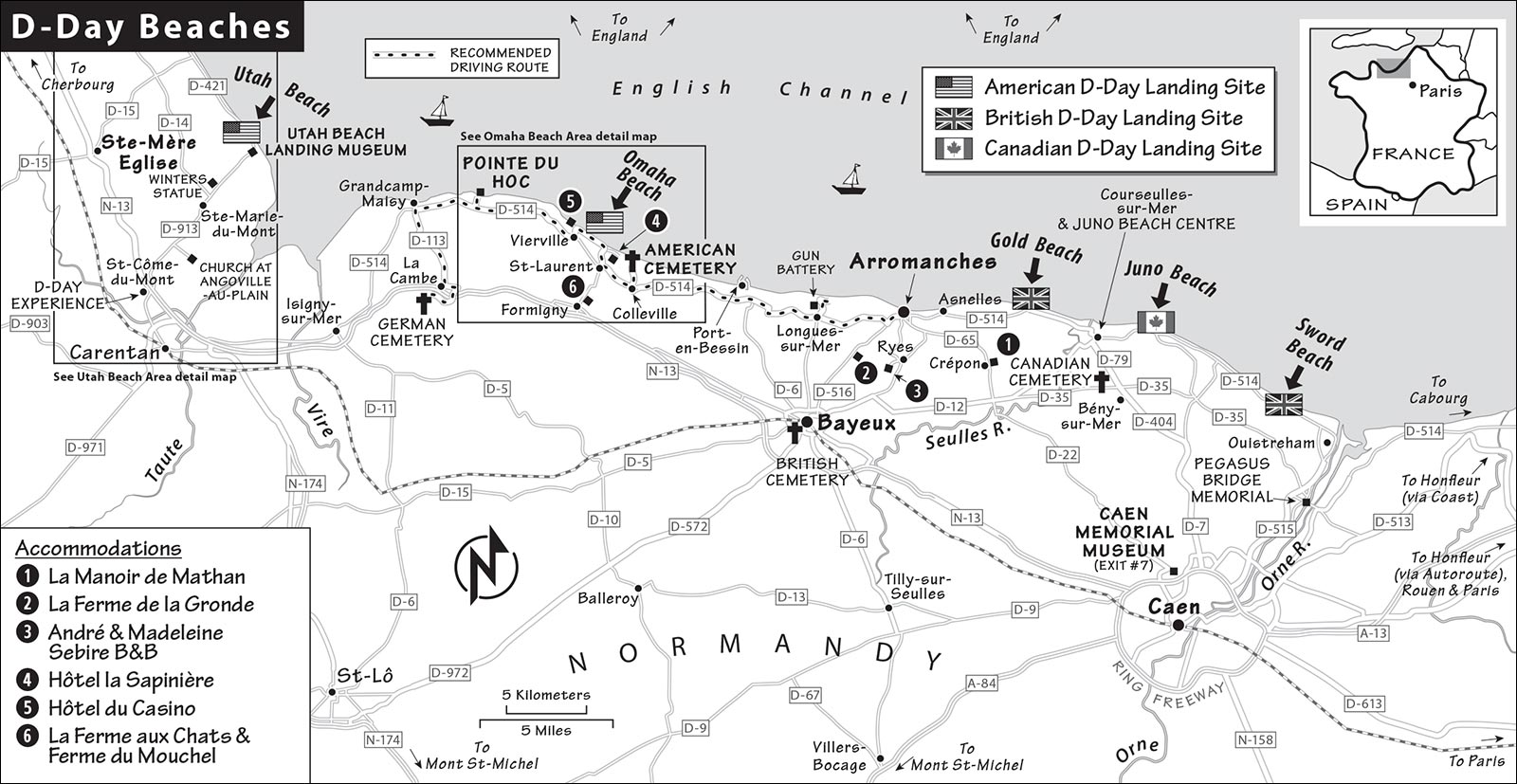
Day-Tripping to the Beaches from Paris: If you’re staying in Paris and considering a day trip to the D-Day beaches by train and rental car, think twice: Going by train to Caen, picking up a car, driving to your first stop, then returning to Paris will take at least seven hours alone. Beware that Sunday train service to Bayeux is limited. A better alternative is to book a service to meet you at the Bayeux or Caen train station and drive you around the D-Day sites (see “By Taxi Minivan” and “By Minivan Tour,” later), or take a private shuttle for a cushy connection from Paris (see here). The Caen Memorial Museum also runs a useful D-Day tour program for day-trippers.
GETTING AROUND THE D-DAY BEACHES
On Your Own
Though the minivan excursions listed later teach important history lessons, renting a car is a less expensive way for three or more people to visit the beaches (see rental options in Caen on here).
Very limited bus service links Bayeux, the coastal town of Arromanches, and the most impressive sites of D-Day (see Nomad info on here)—but it’s not practical for anything more than one sight.
I used to poo-poo biking to D-Day sights, as roads here are narrow with no shoulders and too many blind curves. The roads haven’t changed, but bike paths and well-signed country lanes have expanded in recent years (as have e-bikes) to the point where biking is a good option. It’s a 13-mile round-trip ride from Bayeux to Arromanches, and 22 miles round-trip to the American Cemetery, with ample ups and downs. Essential and expert information on biking routes, bike tours, and rentals is available in Bayeux (see here).
By Taxi Minivan (Unguided)
Taxi minivans shuttle up to seven people between the key sites at reasonable rates (which vary depending on how far you go). Allow €110 for a round-trip to the American Cemetery and Omaha Beach; €360 for a six-hour trip to visit both Utah and Omaha Beaches plus Arromanches. No guiding is included: You’re paying strictly for transport. Figure about €27 each way between Bayeux and Arromanches and €44 between Bayeux and the American Cemetery (50 percent surcharge after 19:00 and on Sun, taxi +33 2 31 92 92 40 or mobile +33 6 70 40 07 96, www.taxisbayeux.com, taxisbayeux@orange.fr).
Abbeilles Taxis offer D-Day excursions from Caen (+33 2 31 52 17 89, www.taxis-abbeilles-caen.com, taxis.abeilles.caen@wanadoo.fr).
By Minivan Tour (Guided)
An army of small companies and private guides offer all-day guided excursions to the D-Day beaches. I’ve worked hard to find guides who respect the importance of your time and these sights. Anyone can get you around the beaches, but you should expect your guide to deliver clear history lessons and be at your side constantly. My recommendations meet and exceed these standards. Note that most guides don’t take you to museums, as they’re easily toured on your own. Ideally, use a guide to get the big picture on your first day in the area, then tour the museums (particularly in Arromanches) on your own the next.
Most tours prefer to pick up in Bayeux—though some will also pick up in Caen for a small surcharge—and some I list are happy to meet you wherever you are. Most guides sadly skip Arromanches, preferring to focus on sights farther west: The “classic” itinerary run by most is Ste-Mère Eglise, Utah Beach, Pointe du Hoc, Omaha Beach, and the American Cemetery. Most of the guides listed here deliver riveting commentary about these moving sites.
To secure a tour, book well in advance (3-6 months is best during peak periods). While a private tour may seem pricey, remember that you’re hiring a professional guide and driver/vehicle for the day just for your group. While you can save by hiring a guide for a half-day tour, a full day on the beaches is more satisfying. To spend less, look for a guide who will travel in your rental car or consider a shared minivan tour (both listed below).
Working with Your Guide: When hiring a private guide, take charge of your tour if you have specific interests (some guides can get lost in battle minutiae that you don’t have time for). If you’re doing the “classic tour,” request extra time at the American Cemetery to see the excellent visitors center, and ask your guide to make time for the Utah Beach Landing Museum or the paratrooper museums in Ste-Mère Eglise.
While some guides and companies discourage children, others welcome them (including Magali Desquesne, Dale Booth, Normandy Sightseeing Tours, and Sylvain Kast).
Tours in a Shared Minivan
These tour companies offer shared tours designed for individual sign-ups. Figure about €125/person for a day and €75/person for a half-day. (These companies also run private tours.)
Gold Beach Tours is excellent and offers shared tours in minivans or in WWII Willys Jeeps for private parties (+ 33 9 67 82 05 14, https://goldbeachcompany.com, booking@goldbeachcompany.com).
Normandy Sightseeing Tours delivers a French perspective with capable guides and will pick you up anywhere you like (+33 2 31 51 70 52, www.normandy-sightseeing-tours.com).
Overlord Tours is a reliable choice with well-trained guides and loads of experience (www.overlordtour.com).
Tours with a Private Guide
Costs are about the same for all guides listed here. Private groups should expect to pay €550-725 for up to eight people for an all-day tour, and €350-450 for a half-day.
Expat Guides: These (mostly British) guides, like a band of brothers, are passionate about teaching and offer excellent private tours. Most have 6-8-passenger vehicles. They work together and can help you find a guide if the first one you call is booked.
• Dale Booth Normandy Tours is led by passionate storyteller Dale Booth (+33 2 14 16 66 14, www.dboothnormandytours.com). Dale’s wife Debbie provides inexpensive chauffeur service to D-Day and other sights with an audio tour (www.visitsinnormandy.com).
• Normandy Insight is run by capable and affable Sean Claxton (+33 6 12 84 57 47, www.normandyinsight.com, seanclaxton@aol.com).
• Normandy Battle Tours is owned by Stuart Robertson, D-Day author and historian, who prefers guiding from your car (www.normandybattletours.com).
French Guides: These guides speak fluent English and are excellent teachers. Most were raised near these beaches and grew up playing in the bunkers.
• Normandy Guided Tours, led by local expert Francis Paz, will pick you up wherever you are staying (+33 6 67 37 82 68, www.normandyguidedtours.com, francispaz@normandyguidedtours.com).
• At Destination Normandy, Dominique Fiquet is happy to pick up anywhere (including Paris) and, while D-Day is her focus, she loves guiding at any sight in Normandy (+33 6 83 19 90 03, destination.normandy@gmail.com).
• Normandy American Heroes is led by knowledgeable Rodolphe Passera (+33 6 30 55 63 39, www.normandyamericanheroes.com).
• D-Day Experience Tours is run by friendly Sylvain Kast (+33 2 61 32 81 49, mobile +33 6 17 44 04 46, www.d-day-experience-tours.com).
• Normandy at War Tours is led in fluent English by charming Pierre-Samuel Natanson (+33 6 45 33 61 32, www.normandy-at-war-tours.com).
• Normandy Panorama, run by Vanessa Letourneur and her assistant Adeleine, provides guiding anywhere in Normandy and offers a food tour featuring Camembert and Calvados (+33 6 98 95 89 45, www.normandypanorama.com). They also sell a virtual tour of Arromanches and its artificial harbor.
• D-Day 4 You is led by capable Magali Desquesne, who is happy to guide from your car or take you in her vehicle (+33 6 88 75 86 17, www.dday4you.com).
HELPFUL HINTS
Good Booklet: A free brochure (D-Day 1944 Visitor Guide) gives succinct reviews of D-Day museums and sights with current opening times. It’s available at TIs, but you usually need to ask for it (downloadable at www.normandie-tourisme.fr, search for “brochures”).
Guided Tours at Individual Sites: Tours in English are sometimes available in high season for free or a very low fee in Bayeux, Longues-sur-Mer, the American Cemetery, Point du Hoc, the Utah Beach Landing Museum, and the Juno Beach Centre. Some are quick 20-minute orientation tours; others can last two hours.
Get times at area TIs, check each site’s website, or see www.bayeux-bessin-tourisme.com.
TV and Films About D-Day: D-Day guides recommend some preparatory viewing before your visit. The top two movies are The Longest Day (for the big D-Day story) and Saving Private Ryan (for a realistic sense of what it was like to land here and battle your way into France). Band of Brothers, a powerful 11-hour HBO miniseries telling the story from D-Day preparations, through the landing, and on to the end of the war, is simply the best. Storming Juno is a riveting Canadian documentary that recounts the story of the soldiers who landed on Juno Beach and is a great watch for all travelers.
Food Strategies: The D-Day landing sites are rural, and you won’t find a grocery on every corner. Plan ahead if you want to picnic, or find groceries in Arromanches or Port-en-Bessin. I’ve listed a few good restaurants along the route, and there is no shortage of cafés and crêperies.
Tides: Tides will affect your experience of the beaches throughout the region, changing what you can see and your access to the sand. Avoid visiting the beaches at high tide if possible. Most TIs have tide tables to help you plan (when searching tide charts, the nearest reference point is Port-en-Bessin).
Arromanches
This small town—part of Gold Beach (in the British landing zone)—was ground zero for the D-Day invasion. The Allies decided it would be easier to build their own port than to try to take one from the Nazis—and one here would surprise the enemy. And so, almost overnight, Arromanches sprouted the immense harbor Port Winston, which gave the Allies a foothold in Normandy from which to begin their victorious push toward Berlin and the end of World War II.
Arromanches makes a good home base for drivers touring the D-Day beaches. It’s a touristy but fun little town that offers a pleasant cocktail of war memories, cotton candy, and trinket shops. Here you’ll find an evocative beach, rusty hardware with English descriptions scattered around town, a superb waterfront museum, and a bluff with vast views. The town’s pleasant seaside promenade and plaza are great places from which to view the port.
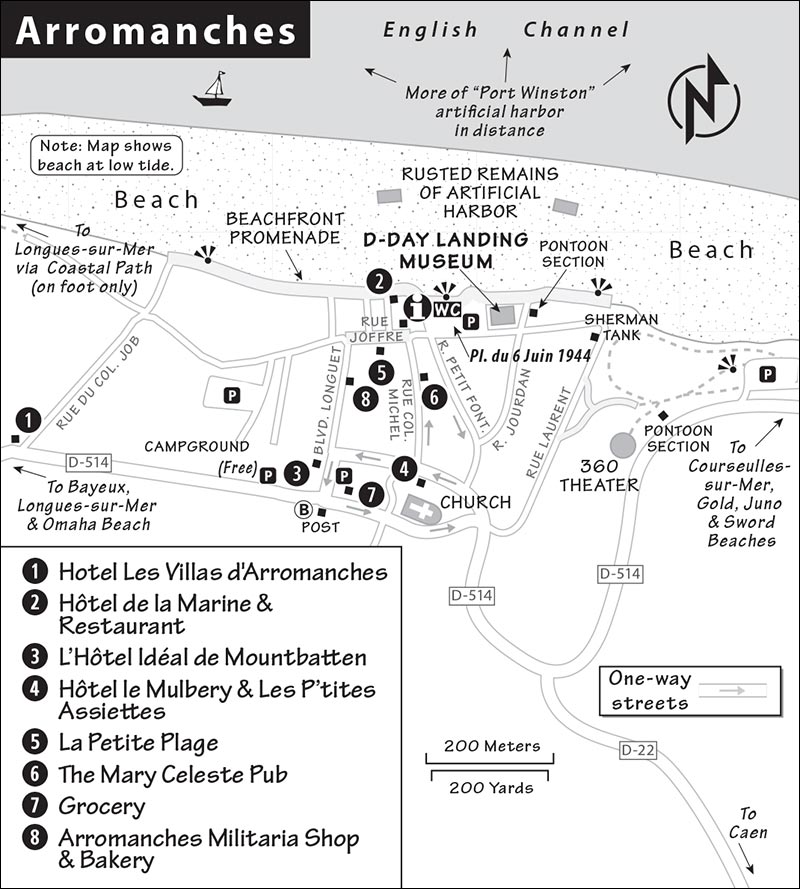
Wander the wide beach, sit on the seawall after dark, listen to the surf, and contemplate the events that took place here 80 years ago.
Orientation to Arromanches
Tourist Information: The TI in the town center has good D-Day information, bus schedules, and a listing of area hotels and chambres d’hôtes (daily 10:00-13:00 & 14:00-19:00, closes earlier off-season, 2 Avenue Maréchal Joffre, +33 2 31 22 36 45, www.bayeux-bessin-tourisme.com.
Arrival in Arromanches: The #121 bus stop and a free parking lot are at the top of town near the post office (10-minute walk to the water). You’ll pay to park at lots and on streets closer to the beach (free 19:00-9:00).
Services and Shopping: An ATM is across from the museum parking lot. A small Proxy market is a long block above the beach, across from L’Hôtel Ideal de Mountbatten (closed 12:30-16:30—that’s my kind of lunch, Sun afternoon, and all day Mon). Arromanches Militaria sells all sorts of D-Day relics and WWII paraphernalia (daily 10:00-19:00, in a tight space at 11 Boulevard Gilbert Longuet). To get an Arromanches-based taxi, call +33 6 66 62 00 99.
Sights in Arromanches
Arromanches’ key sight, the Port Winston artificial harbor, is best seen from two vantage points—above town on the bluff, and from the seawall in town (near the D-Day Landing Museum).
▲▲▲Port Winston Artificial Harbor
Arromanches is all about its artificial harbor—the remains of which can be seen to this day. Winston Churchill’s brainchild, the prefab harbor was made by the British and affectionately nicknamed Port Winston by the troops. To appreciate the massive undertaking of creating this harbor in a matter of days, start on the bluff overlooking the site of the once huge harbor, then head down to the D-Day Landing Museum and a nearby viewing area.
Getting to the Bluff: Drive two minutes toward Courseulles-sur-Mer and pay to park in the big, can’t-miss-it lot overlooking the sea, or hike 10 steep minutes up from behind the D-Day Landing Museum.
Viewing the Harbor from the Bluff: Survey the coast from the observation platform. To the left is the American sector, with Omaha Beach and then Utah Beach (notice the sheer cliffs typical of Normandy’s coastline). Below and to the right lie the British and Canadian sectors (level landscape, no cliffs).
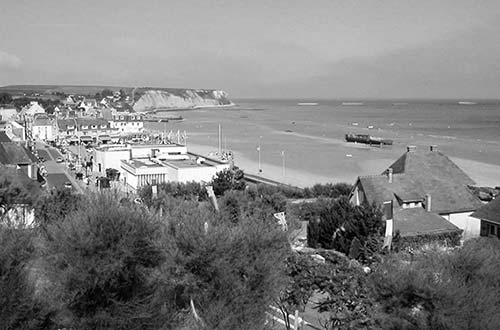
Along these beaches, the Allies arrived in the largest amphibious attack ever, launching the liberation of Western Europe. On D-Day +1—June 7, 1944—17 old ships sailed 100 miles across the English Channel under their own steam to Arromanches. Their crews sank them so that each bow faced the next ship’s stern, forming a sea barrier. Then 500 tugboats towed 115 football-field-size cement blocks (called “Phoenixes”) across the channel. These were also sunk (with the ships and Phoenixes making a semicircle). This created a four-mile-long breakwater about a mile offshore (notice how far it extended to your right). Finally, engineers set up seven floating steel pierheads with extendable legs (an example is to your left), then linked these to shore with four floating roads made of concrete pontoons. Soldiers placed 115 antiaircraft guns on the Phoenixes and pontoons, protecting a port the size of Dover, England. Within just six days of operation, 54,000 vehicles, 326,000 troops, and 110,000 tons of goods had crossed the English Channel. An Allied toehold in Normandy was secure. Eleven months later, Hitler was dead and the war was over.
Arromanches 360° Theater
The domed building at the cliff top houses a 20-minute film about the landings. It’s mostly standing-room-only (though some soft benches are situated along the walls). The screens surrounding you show archival footage and photographs of the liberation of Normandy with booming sound, lots of faces, and colossal destruction, but little substance. It works in any language, but it’s not worth your precious time. You’ll see better films at other sights.
Cost and Hours: €7, €23 combo-ticket with Caen Memorial Museum; 2 shows/hour (on the hour and half-hour), daily May-Aug 9:30-18:00, April-May and Sept from 10:00, Oct-mid-Nov 10:00-17:30, these are first and last showtimes, closed most of Jan, Chemin du Calvaire, +33 2 31 06 06 45, www.arromanches360.com.
• To return to the town center from the bluff, follow signs to Musée du Débarquement—the D-Day Landing Museum. The walk down delivers fine views and a Sherman tank (follow the small road in front of the Arromanches 360° theater).
▲▲D-Day Landing Museum (Musée du Débarquement)
This glassy museum facing the harbor and a broad plaza is a must to fully grasp the liberation of Normandy. Well-designed films, videos, touch screens, and audioguides tell the story of this amazing British accomplishment from full-scale prototypes constructed in Scotland, to the clever design and successful implementation right here. You’ll also get a good briefing on events leading to up the D-Day landings, why the port was essential to the landings, and learn why the American version of this port—just miles away—failed thanks to a bad storm (and the impatience of US engineers who did not properly anchor their pontoons).
Detailed models and virtual reconstructions show the immensity and complexity of Port Winston’s construction with those massive Phoenix caissons. Ponder the overwhelming task of building this harbor in just 12 days, while battles raged all around. This port was used from June to November in 1944.
Cost and Hours: €12.60; daily May-Aug 9:00-19:00, Sept until 18:00, Oct-Dec and Feb-April 10:00-12:30 & 13:30-17:00, closed Jan; lockers available, Place du 6 Juin, +33 2 31 22 34 31, www.musee-arromanches.fr.
Viewing the Harbor from near the Museum: Find the round bulkhead on the seawall, near the entrance to the museum. Stand facing the sea. Designed to be temporary (it was used for almost 6 months), the harbor was supposed to wash out to sea over time—which is exactly what happened with its twin harbor at Omaha Beach. If the tide is out, you’ll see rusted floats mired on the sand close in—these supported the pontoon roads. Imagine the traffic pouring in past the many antiaircraft guns poised to defend against the invasion.
Stroll to the east side of the museum and find a section of a pontoon road with a bulldozer. This pontoon weighed 28 tons. Imagine the task of linking many of these together and keeping them afloat and stable. The memorial a few steps above the pontoon is dedicated to the man who figured out how to do just that. On the hill a bit beyond, there’s a Sherman tank, one of 50,000 deployed during the landings. Walk down to the beach and wander among the concrete and rusted litter of the battle—and be thankful that all you hear are birds and surf.
Sleeping in Arromanches
Arromanches, with its pinwheels and seagulls, has a salty beach-town ambience that makes it a good stop. For evening fun, have a drink at The Mary Celeste pub, a block from the beach on Rue Colonel René Michel.
Drivers should also consider my sleeping recommendations near Omaha Beach (see “Sleeping and Eating near Omaha Beach,” later).
$$$ Hôtel Les Villas d’Arromanches*** has a privileged location, perched above the sea in its own park at the town’s entry, a short walk to the center. This beachy yet classy manor-house features bright and tastefully designed rooms (several with patios), a heated pool, and a comfy wine-bar lounge with a view terrace (free and easy parking, 1 Rue du Lieutenant-Colonel de Job, +33 2 31 21 38 97, www.lesvillasdarromanches.com, contact@lesvillasdarromanches.com).
$$ Hôtel de la Marine*** has a knockout location with point-blank views to the artificial harbor from most of its 33 comfortable rooms, and charming Sylvie at the reception (family rooms, elevator, good view restaurant, Quai du Canada, +33 2 31 22 34 19, www.hotel-de-la-marine.fr, hotel.de.la.marine@wanadoo.fr).
$$ L’Hôtel Idéal de Mountbatten,*** located a long block up from the water, is a 12-room, two-story, motel-esque place with generously sized, stylish, clean, and good-value lodgings—and welcoming owners Sylvie and Laurent (family rooms, reception closed 14:00-16:00, easy parking—free when you book direct, short block below the main post office at 20 Boulevard Gilbert Longuet, +33 2 31 22 59 70, www.hotelarromancheslideal.fr, contact@hotelarromancheslideal.fr).
$ Hôtel le Mulberry hides a few blocks up from the sea and rents basic but clean and comfortable rooms for the best rate in town. They also run a simple restaurant (6 Rue Maurice Lithare, +33 2 31 22 36 05, www.hotel-le-mulberry.com, reception@hotel-le-mulberry.com).
IN THE COUNTRYSIDE NEAR ARROMANCHES
For locations, see the “D-Day Beaches” map on here.
At $$ La Manoir de Mathan, you’ll stay in a beautifully renovated manor house with vast gardens, losing yourself in the countryside, yet you’re only 15 minutes from Arromanches and Bayeux. They rent 21 over-the-top, lovely, and traditional rooms (junior suite rooms are incredible and worth the extra euros). Some rooms have full kitchens, there’s a fine courtyard terrace with room to roam, and eager-to-help Isabelle is in charge (Route de Bayeux, Crépon, +33 2 31 21 38 66, www.normandie-hotel.org, manoir.mathan@gmail.com). They also rent seven modern seaside $$ apartments with knockout views right along the beachfront promenade in the nearby village of Asnelles (2-night minimum, 7-night minimum in summer—you’ll want to stay longer, +33 2 31 92 87 24, www.gites-en-normandie.eu).
$ La Ferme de la Gronde lies midway between Bayeux and Arromanches and has five large, traditional rooms in a big stone farmhouse overlooking wheat fields and lots of grass, with outdoor tables (includes breakfast, 2 big comfortable apartments ideal for families, well signed from D-516 on Route de l’Eglise in Magny-en-Bessin, +33 2 31 21 33 11, enter "Ferme de la Gronde" in the website search bar to see photos, then book via email, www.gites-de-france-calvados.fr, info@chambres-gite-normandie.fr).
At ¢ André and Madeleine Sebire’s B&B, you’ll experience a real Norman farm. The hardworking owners offer four modest, homey, and dirt-cheap rooms in the middle of nowhere (includes breakfast, 2 miles from Arromanches in tiny Ryes at Ferme du Clos Neuf, +33 2 31 22 32 34, emmanuelle.sebire@wanadoo.fr, search on the web for “Ferme du Clos Neuf in Ryes” for images, little English spoken). Follow signs into Ryes, then go down Rue de la Forge (kitty-corner from the restaurant). Turn right just after the small bridge, onto Rue Tringale, and go a half-mile to a sign on the right to Le Clos Neuf. Park near the tractors.