SWITZERLAND: PAST & PRESENT
EARLY HISTORY: CELTS AND ROMANS (c. 500 BC-AD 500)
THE MIDDLE AGES: THE HOLY ROMAN EMPIRE (c. 500-1291)
THE OLD CONFEDERACY (1291-1500)
REFORMATION AND ENLIGHTENMENT (c. 1500-1700)
Switzerland has a unique and impressive story, forging unity from diversity and somehow remaining above the fray when Europe goes ballistic. Despite four languages, diverse geography, ill-defined borders, and many religious sects—and despite being surrounded by continental Europe’s four big powers (France, Germany, Austria, and Italy)—the Swiss cantons banded together to form an independent federal system that still works today.
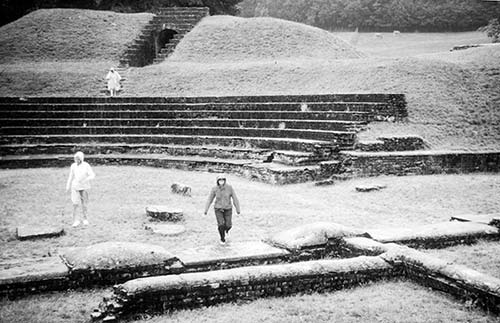
Even if you’re not going to Switzerland for the history (who would?), you’ll encounter it. You can play gladiator inside a fighting arena from Roman times or tour medieval castles and battlegrounds, left over from when the Swiss wrested their independence from foreign rulers. Stripped-down cathedrals attest to the religious violence of the Reformation, which almost tore the country apart. You’ll ride the ingenious cogwheel trains and cliff-climbing funiculars of Switzerland’s progressive 19th century, when the country was at the forefront of the emerging Industrial Age. The specters of Nazi Germany and the Soviet Union arise in underground fortresses and bomb shelters now open to the public. And finally, you’ll see the Switzerland of today—gleaming cities, state-of-the-art transportation, and happy citizens. I love to go a-wandering along the history path, so strap on your rucksack, and let’s go.
EARLY HISTORY: CELTS AND ROMANS (c. 500 BC-AD 500)
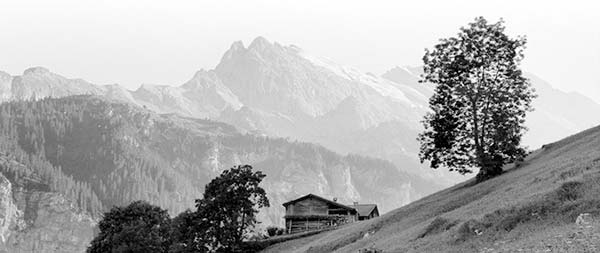
The Alps—Switzerland’s star attraction—were born 500 million years ago, when the ocean floor was rocked by earthquakes that folded the earth’s crust upward and created this long range of peaks (see the “Understanding the Alps” sidebar). The rugged landscape shaped the history and character of the Swiss people. It kept early populations physically isolated, leading to still-present cultural divisions and fostering an ethos of independence. Switzerland’s location at the heart of Western Europe forced it to be international in outlook, yet the impregnable mountains allowed it to remain apart and neutral.
Official Name: The Confoederatio Helvetica, or Switzerland, has a different name in each of its four official languages: Schweizerische Eidgenossenschaft (German), Confédération Suisse (French), Confederazione Svizzera (Italian), and Confederaziun Svizra (Romansh). Locals shorten those to “die Schweiz,” “la Suisse,” “la Svizzera,” and “la Svizra.”
Size: 16,000 square miles (twice the size of New Jersey), with a population of 8.5 million (similar to Virginia).
Geography: Switzerland sits at the crossroads between northern and southern Europe. The Alps are Europe’s high point and continental divide, from which the major rivers flow—Rhine, Rhône, Danube, and Po. Switzerland’s highest point is the 15,200-foot Monte Rosa (specifically, the summit called Dufourspitze), along the Italian border. Though Switzerland is mostly mountainous, the center of the country consists of rolling hills and large lakes.
Latitude and Longitude: 47°N and 8°E, similar latitude to Quebec, Canada.
Major Cities: Zürich (pop. 430,000 in the city, 1.4 million in the metropolitan area), Geneva (192,000), Basel (167,000), and Bern (the capital, 129,000).
Economy: The gross domestic product is $731 billion. Its per-capita GDP of $68,400 is among Europe’s highest. The franc is strong and unemployment is less than half the EU average. Blessed with hydropower and using nuclear technology, Switzerland generates 99 percent of its electricity with virtually no oil.
Government: Founded in 1291 as a confederation of cantons, balancing the needs of its different linguistic/ethnic groups. No single political party (or two or even three parties) dominates. The president, chosen by the legislature, serves for just one calendar year. The two-house Federal Assembly consists of the 46-seat Council of States and the 200-seat National Council, elected for four-year terms.
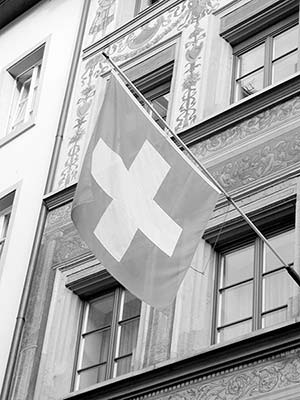
Flag: Switzerland’s distinctive square flag is a white cross on red background.
The Average Swiss: On average, they have 1.5 children and will live to be 83. A typical Swiss man serves at least 245 days of compulsory military service. The average Swiss woman earns over 20 percent less than her male counterparts (similar to the US). The Swiss travel an average of 1,400 miles a year on a train, the equivalent of crossing the country six times. They consume a monthly average of about a quart of alcohol and more than a pound and a half of chocolate.
The first Swiss to appear in written records (c. 500 BC) were a Celtic tribe called the Helvetii. Their name survives today in the country’s official title, Confoederatio Helvetica. “Helvetia,” the female symbol of Switzerland, appears dressed in robes and armed with a spear and shield on coins, stamps, and statues.
In 58 BC, the Helvetii were defeated by Julius Caesar, the Roman general and future ruler. The Romans established a capital at Avenches, near Murten (where evocative ruins remain); built the cities of Zürich, Geneva, Basel, and Lausanne; and assimilated the Helvetii into their Europe-wide empire. Roman culture thrived in Switzerland for almost 500 years.
As Rome fell (c. AD 400), the Alemanni and other Germanic tribes swarmed in from the north, snuffed out Roman culture, and established the German language. In the west, the Burgundians adopted Latin, which eventually evolved into French. But these tribes never penetrated the nooks and crannies of the most remote mountain areas, and in these regions, particularly in the southeast, people still converse in Romansh, a language that descends independently from the colloquial Latin spoken by Roman-era occupiers. South of the Alps, Latin gradually developed into modern-day Italian. These linguistic and cultural divides remain today.
THE MIDDLE AGES: THE HOLY ROMAN EMPIRE (c. 500-1291)
Like most of Europe during the dark medieval centuries, Switzerland was poor, feudal, and swept by barbarian invasions. The mostly pagan Swiss were slowly converted to Christianity by traveling Irish monks, including St. Gallus (seventh century), who gave his name to the canton of St. Gallen. Swiss lands became part of Charlemagne’s empire (c. 800) and then of its successor to the east—the Holy Roman Empire.
Around the turn of the first millennium, Switzerland began to prosper. Cities such as Bern and Luzern were founded, welcoming skilled craftsmen and traders. High in the Alps, clever engineers built bridges and catwalks to open a vital north-south highway through the St. Gotthard Pass. Merchants bought luxury goods in Venice and shipped them over the high mountains to northern Europe. This trade route proved so lucrative that the Holy Roman Emperor ensured access to it by granting the Swiss a measure of independence. Switzerland got a taste of freedom, and when the emperor (a member of the powerful Habsburg family) later tried to bring the country under tighter control, the Swiss had had enough.
Switzerland’s snowy, rugged mountains are its claim to fame—and most likely a main reason for your visit. Fortunately, you don’t have to be a mountain climber to see the Alps up close, as the Swiss transportation system is as remarkable as its mountains. Its cog railways, gondolas, and cable cars whisk you up into the type of scenery that’s only accessible in some countries by ropes, pitons, and crampons.
The Alps were formed by the collision of two continents. About 100 million years ago, the African plate began pushing north against the stable plates of Europe and Asia. In the process, the sediments of the ancient Tethys Ocean (which once occupied the general real estate of the modern Mediterranean) became smooshed between the landmasses. Shoving all this material together made the rocks and sediments fold, shatter, and pile on top of each other; over millennia this growing jumble built itself up into today’s Alps. Up in the mountains, look for folds and faults in the rocks that hint at this immense compression, which is still happening today: The Alps continue to rise by at least a millimeter each year (while erosion wears them down at about the same rate).
The current shape of the mountains and valleys is the handiwork of at least five ice ages over the last two million years. Glaciers flowed down the mountain valleys, scooped out Switzerland’s beautiful alpine lakes, and carried rocks far away from where they had formed. The Alps were the first mountains extensively studied by geologists, and many of the geological terms that describe mountains originated here. Once you learn how to recognize a few of the landforms shaped by glaciers, you can easily spot these features when you visit other alpine areas. Study glacier exhibits to train your eye to recognize what you’re seeing.
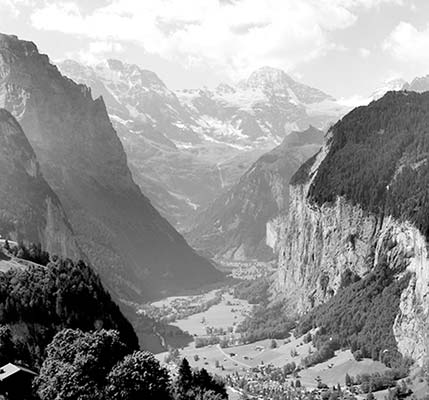
Glaciers are big and blunt, so they make simple, large-scale marks on the landscape. If a valley is U-shaped (with steep sides and a rounded base), it likely was scoured out by a glacier. Switzerland’s Lauterbrunnen Valley and California’s Yosemite Valley are classic examples.
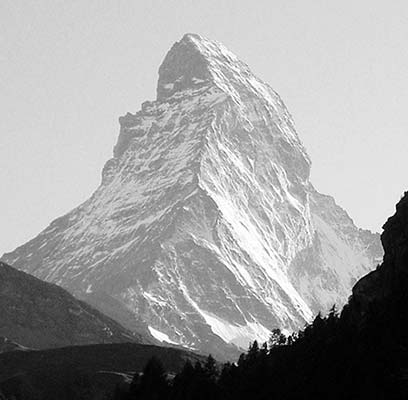
A cirque (French for “circus”) is the amphitheater-like depression carved out at the upper part of a valley by a glacier. If two adjacent cirques erode close to each other, a sharp steep-sided ridge forms, called an arête (French for “fishbone”). Cirques and arêtes are common in mountains with glaciers. More rarely, when three or more cirques erode toward one another, a pyramidal peak is created, called a horn. The Matterhorn is the world’s most famous example. Glaciers flowed down all sides of this mountain, scooping material away and creating the distinctive sharp peak.
A common feature left behind by retreating glaciers is a moraine, a pile of dirt and rocks carried along on the glacier as it advanced, then dumped as the glacier melted. The Lindenhof in Zürich, a hilltop square once crowned with forts to defend the town, perches on a moraine.
Alpine glaciers can only originate above the snowline, so if you see any of these landforms (U-shaped valleys, cirques, horns, or moraines) in lower elevations, you know that the climate there used to be colder. The warming climate has profoundly affected the glaciers of Switzerland, which have lost more than half their total volume since the early 1930s, according to the latest research. Some studies project that most glaciers in Switzerland will virtually disappear by the end of the century, affecting water storage and hydroelectric power generation.
In higher elevations, mountainsides have become less stable due to the melting of permafrost. Major landslides and rockfalls are increasingly common as warming accelerates the weathering and erosion process on slopes. Some communities, including the ski resort of Pontresina, have built dams to protect areas from potential landslides from nearby mountains; some towns have installed alarm systems. Experts report that the unprecedented heat wave of 2022 shrunk Swiss ice volume by 6 percent in just one year.
Another consequence of the warming climate is that winter weather no longer reliably produces snow at altitudes that it did in the past—which is bad news for Switzerland’s huge ski industry. Seeing a future of ever-warmer winters, the Swiss are putting their ingenuity to the test. This goes beyond snow machines: Many resorts are investing hugely in new spas, convention centers, and other attractions that don’t require snow.
With their acute awareness of their alpine climate’s fragility, the Swiss are especially keen to explore green technology—even high up in the Alps. Now when they build mountain refuges, the favored design isn’t necessarily a rustic stone-hut chalet, but a high-tech building that depends on solar power. Switzerland’s technological innovation can help keep its mountains white and its valleys green.
THE OLD CONFEDERACY (1291-1500)
On August 1, 1291 (celebrated today as the country’s national day), representatives of Switzerland’s three original cantons (Uri, Schwyz, and Unterwalden) gathered together and swore an oath. “We will be a single nation of brothers...” they asserted, and joined together to oppose Habsburg rule. According to a famous legend, a Swiss man named William Tell refused to bow to the Habsburg hat, a symbol of their power. As punishment, he was forced to shoot an apple off his own son’s head. His son lived to see another haircut, and Tell led the rebellion. (Sadly, historians say that Tell probably never actually existed.)
The Swiss had to battle the powerful Habsburg family for two full centuries to completely drive them out. Meanwhile, in the west, the Swiss fought Burgundy, trouncing them at the pivotal Battle of Murten. One by one, other cantons and cities (Luzern, Zürich, Bern) joined the confederacy. By around 1500, Switzerland’s territory had grown to become roughly similar to its current bounds.
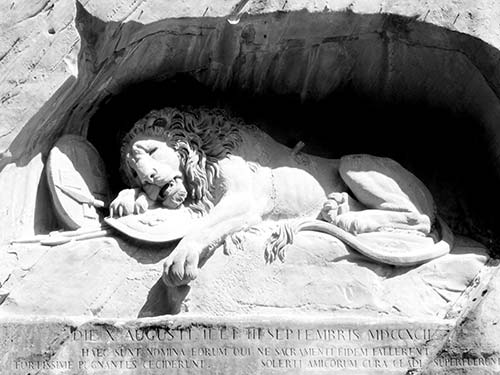
During these centuries of warfare, the Swiss earned a reputation as Europe’s fiercest warriors. Swiss mercenaries became a valuable export, hired by foreign kings to fight their wars and defend their palaces (think of the Swiss Guards, who still protect the Vatican today). During the French Revolution in 1792, when crowds stormed the king’s palace in Paris, it was Swiss mercenaries who went through with the hopeless defense. Six hundred of them were killed—an event memorialized in Luzern’s famous Lion Monument to fallen Swiss Guards.
REFORMATION AND ENLIGHTENMENT (c. 1500-1700)
The Protestant Reformation split Switzerland in two. Huldrych Zwingli preached Protestantism in Zürich (see sidebar on here), John Calvin brought his French flock to Geneva, and the Dutch humanist Desiderius Erasmus taught at Basel. While the cities went Protestant, the more rural cantons stayed true to the Catholic faith, plunging the country into religious warfare (1529-1531). Angry rioters stormed Catholic cathedrals, stripping them of their “graven images” and leaving the austere interiors travelers see today (including Zürich’s Grossmünster, Bern’s Münster, and Lausanne’s cathedral). This destruction of religious symbology is known as “iconoclasm.”
While Europe suffered through a century of religious wars, Switzerland’s struggles were relatively short-lived. Swiss mercenaries fought other countries’ wars more than their own. When peace came to Europe with the Treaty of Westphalia (1648), the agreement also officially recognized Switzerland as a fully independent nation.
1700s AND 1800s
Through the Age of Enlightenment, Switzerland bucked the European trend toward absolute monarchs. As the country steadily advanced economically and technologically, it moved in a firmly democratic direction. However, internal conflict about how to organize the country’s government made for a rocky transition. Swiss Protestants generally favored a strong central government and were more open to new political and social ideas. The more remote, more Catholic cantons wanted to keep power in local areas and preserve traditional ways of life. This tension continues in Swiss politics to this day.
Riding the wave of the French Revolution, Napoleon Bonaparte occupied Switzerland (1798) and tried (unsuccessfully) to establish a unified central government—called the Helvetic Republic—which fell apart within five years. With Napoleon’s defeat (and the 1815 Congress of Vienna), the European powers restored Switzerland’s old status. They also set it on its future political course: neutrality in all conflicts.
In 1847, the Swiss fought a four-week, not-very-bloody civil war that ended in a victory for the advocates of centralization. In 1848, amid a Europe-wide wave of liberal reforms, Switzerland crafted a constitution that struck a balance between the two camps. The constitution created a strong central government but also allowed each canton much more autonomy than the regions in other European countries. (It was partly modeled on America’s, as the Swiss struggles with centralism and federalism mirror American debates over states’ rights.) The country’s seat of government was established in the low-key town of Bern, at the boundary of the German- and French-speaking parts of Switzerland.
Around this time the country began to welcome hordes of tourists, beginning with French, English, and German aristocrats on the Grand Tour, who passed through Switzerland on their way to Italy. Next came the British mountaineers, whose reverence for the Alps was part of the Romantic outlook on nature: For the first time, Europeans looked at mountains as objects of beauty and inspiration, rather than as frustrating obstacles. Visitors marveled at the mountain scenery and the “sublime” rush it gave them. The new technology of rail travel made trips more comfortable and affordable.
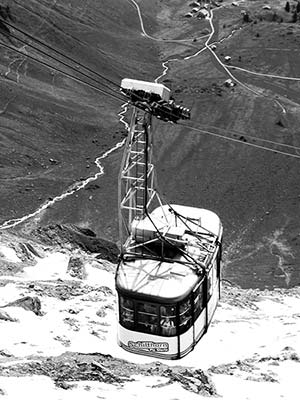
In this heyday of European travel, Switzerland virtually invented mass tourism as we know it—pioneering ways of marking its mountains, offering the first organized vacations, investing in a well-oiled infrastructure, and establishing a reputation for efficiency, cleanliness, quality, and ease (even inventing new names for places that had local names that were considered too intimidating for foreign visitors). Switzerland’s system of high-altitude trains, funiculars, and mountain lifts was built to carry 19th-century tourists to previously unheard-of heights. Today’s visitors stay in the same resort towns (Interlaken, Zermatt, Luzern, St. Moritz), ride the same kind of lifts, and see echoes of themselves in the stylized travel advertisements from that Romantic Age.
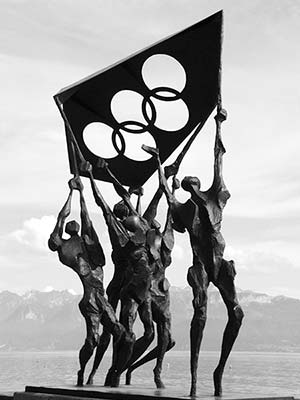
As a neutral country, Switzerland fostered its reputation as a leader in international relations. Like tourists, politicians loved to meet amidst its clear air and alpine vistas. The world’s diplomats descended on Geneva in 1863 and 1864, producing two landmark institutions: the International Red Cross (still run from Geneva) and the Geneva Conventions war treaties. The United Nations and other international organizations still maintain a large presence in Geneva. And when the modern Olympic Games were founded by a French aristocrat in 1894, nearby Lausanne became the movement’s world headquarters.
20TH CENTURY: WORLD WARS
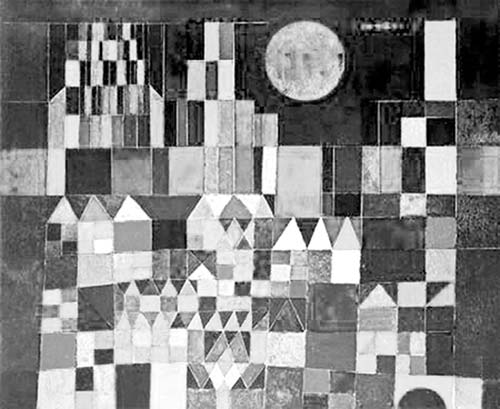
Switzerland entered the 20th century on the cutting edge of progress. Its trains and communications systems were top-notch. The artist Paul Klee (1879-1940), with his playful, eccentric style, contributed to the Modernist movement (see his works at the Rosengart Collection in Luzern and at the Paul Klee Center in Bern). Europe’s rich flocked to visit Swiss doctors at alpine sanatoriums. Carl Jung (1875-1961) pioneered the blossoming field of psychoanalysis. And in the quiet city of Bern, an anonymous patent clerk named Albert Einstein (1879-1955) was rewriting humankind’s understanding of how the universe worked (see sidebar on here).
In World War I (1914-1918), Switzerland declared itself neutral and escaped the devastation that hit the rest of Europe. After the war, Geneva served as the seat of the League of Nations, a short-lived forerunner to the United Nations.
When World War II broke out (1939-1945), Swiss neutrality was not taken for granted. As Nazi Germany and fascist Italy flanked the country, 850,000 Swiss men grabbed their rifles and mobilized to protect the borders. They had an ambitious plan, in case of invasion, to assemble the country’s leadership and military into the innermost, mountainous core of the country—sealing off a fortified Swiss National Redoubt. Switzerland avoided invasion through both “militarized neutrality,” and by trading with (some would say “appeasing”) the Nazis. Switzerland sheltered some refugees—and turned others away—and acted as a mediator between the Allies and the Axis.
Today, critics charge that, though neutral in the war, Switzerland actually helped the Nazi effort by continuing to do business with them. (It’s no secret that a significant number of German-speaking Swiss weren’t all that opposed to the Nazi regime.) They exchanged Swiss francs (the only currency accepted throughout Europe) for Nazi gold—knowing full well that the gold had been stolen from other nations and Holocaust victims. In the 1990s, lawsuits called Swiss banks to account for the ill-gotten bullion in their vaults. A 2002 commission formed by the Swiss government agreed that Switzerland could have done more to resist the Nazis and to help Jewish refugees...but restitution has been slow in coming.
After the war, Switzerland’s policy of neutrality led the country to refuse membership in various international alliances and organizations, including the United Nations, NATO, and the European Union.
SWITZERLAND TODAY
Switzerland maintains a delicate balance between its traditional, neutral past and the high-tech, global future.
As it has been for 700 years, the government is a federalist democracy that gives considerable autonomy to each canton.
On the national level, the executive branch is steered by a seven-member committee, and the presidency is just a figurehead position that rotates between the seven members. There’s a strong bicameral parliament, in which no single political party has more than about a fourth of the seats. Since World War II, legislative power has been held by an ever-changing array of coalitions. No single point of view dominates, and collaboration is essential.
The federal government handles foreign affairs, national defense, currency, and the federal courts—and leaves most everything else to the 26 cantons. Similar to US states, each canton has its own political concerns, dialect, and cultural heritage. Just as we debate “states’ rights,” the Swiss wrangle with just how much autonomy to allow cantons. The person-on-the-street can always make their voice heard thanks to frequent referendums, held when citizens gather enough signatures to require a public vote on an issue. Unlike in most modern democracies, Swiss citizens have a direct say in many political matters and leave fewer decisions to elected representatives.
In business, Zürich continues to be a global center of banking and finance. And Swiss-made equipment helps produce everything from clothing to ballpoint-pen tips to space-bound rocket parts.
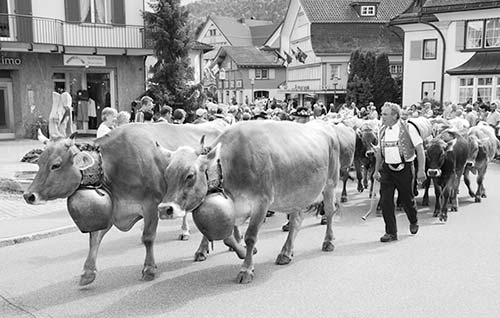
Stability is enhanced by strong social security and a collaborative approach to settling labor disputes between unions and employers. The Swiss have also chosen (at great cost) to protect their agricultural sector against competition from imports, and the government subsidizes families who raise cows and make cheese the old-fashioned way.
In foreign affairs, Switzerland remains neutral...but ever-vigilant. Every able-bodied man serves in the army and stays in the reserves. Each house has a gun and a fully stocked bomb shelter. (Swiss vacuum-packed emergency army bread, which lasts two years, is also said to function as a weapon.) Altogether, the country bristles with 600,000 rifles in homes and 12,000 heavy guns in place. Airstrips are hidden inside mountains, accessed by camouflaged doors. With the push of a button, all road, rail, and bridge entries to Swiss territory can be destroyed, sealing off the country from the outside world. Sentiments are changing, though, and Switzerland has come close to voting away its entire military. Today, you can visit once-hidden military installations, now open to the public as museums (for example, Fortress Fürigen—covered in the Luzern & Central Switzerland chapter).
The question of how closely to integrate with Europe has dominated political discussion in Switzerland for the past few decades. In 2002, the Swiss made a big step away from total neutrality when voters approved a referendum to join the United Nations. In 2008, Switzerland joined the Schengen Agreement, opening its borders to its neighboring countries and most of the EU. Is EU membership next? Probably not. In referendum after referendum the Swiss have strongly rejected the idea of full economic and political integration with the EU, judging the costs to be more significant than the huge potential gains. Still, they’ve seen benefits in collaborating with Europe on practical matters such as scientific research. For example, Switzerland is home to Europe’s high-tech particle accelerator laboratory, called CERN (the place where the World Wide Web was invented by a British scientist).
While it’s nice to think of Swiss neutrality as born of pacifism, many realists argue that it’s more about money: Switzerland’s neutrality policy was key to one of its main sources of income. Traditionally, many Swiss banks allowed foreigners to deposit money with few questions asked. Critics charge that these secret bank accounts have harbored the dirty money of mobsters, terrorists, dictators, guidebook authors, tax evaders, and sleazy businessmen. Switzerland also has a reputation as a safe haven from prosecution, harboring a long list of foreigners (from Hollywood sex offender Roman Polanski to Ugandan dictator Idi Amin). But times are changing. Swiss politicians and bankers responded to outside pressure and introduced legislation that went into effect in 2018, requiring banks to share information on clients with tax authorities in other countries.
Another big issue in Switzerland is how to deal with the rising tide of immigrants. The country’s high standard of living makes it an appealing place to live, and Switzerland has more noncitizen residents than most countries (about 24 percent, compared with 7 percent in the US). Many of those immigrants are wealthy Europeans enjoying the country’s easy tax laws. Others are young Germans, Italians, or Portuguese who have taken jobs in the hospitality industry. Still others are the Swiss-born, Swiss-raised children of an earlier generation of immigrants (called “Secondos”)—who still don’t have Swiss citizenship due to the complicated application requirements. It’s the “less-desirable” immigrants who have drawn fire—those who arrive with little wealth and then rely on generous social services—but it’s not clear that there are really that many immigrants in this category.
Opinions on this and many other issues are generally divided along geographic/linguistic lines. City dwellers, along with French and Italian speakers, tend to favor immigrants’ rights, EU membership, and other progressive issues; rural German speakers are more likely to be conservative. In 2009, when Switzerland voted to ban the construction of new minarets—sparking controversy across Europe—only four cantons opposed the initiative, all of them in French-speaking areas.
Climate issues also loom large in Swiss politics. Swiss people are keenly aware of the widespread impact of climate change. In 2019 elections, the balance of parliamentary power was tipped not toward right-wing nativist parties (as in many other European nations), but toward environmental movements. Switzerland’s various “green” parties took 20 percent of seats—one of the highest ratios in Europe.
With 2,500 years of history, Switzerland has seen many shifts—from Celts to Romans to Habsburgs, from wars to neutrality to technological progress. But what’s striking is how little Switzerland has changed. The Alps are still there, and they’re still big and rugged (even if the glaciers are smaller than ever). The government, after 700 years in existence, remains a model of democracy and international cooperation. Switzerland is fully modern, but you’ll also encounter quaint pockets of the past. Take time to see Swiss history alive today—from the cow parades of Appenzell to the Roman ruins in Avenches, and from the turrets of Château de Chillon to the farmers of Gimmelwald, who still make hay while the sun shines.
NOTABLE SWISS PEOPLE
William Tell (c. 1280-1354): On November 18, 1307, William (Wilhelm) Tell, a Swiss peasant, refused a bailiff’s order to bow to a symbol of the Habsburg emperor. As punishment, Tell was forced to fire his crossbow at an apple resting on his son’s head. He shot cleanly through the apple without injuring his son, and later ambushed and killed the bailiff—launching a revolt for Swiss independence. Though historians say the famous hero is fictional (a similar Danish legend predates the Swiss one), don’t “tell” the Swiss—up to 60 percent still believe there was a real William Tell.
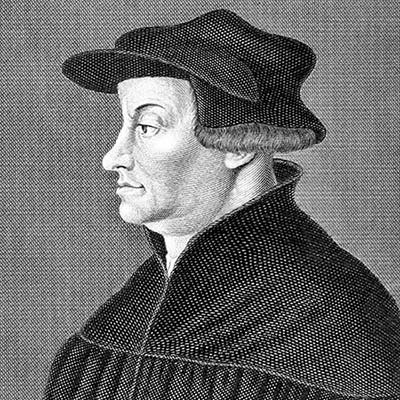
Huldrych Zwingli (1484-1531): The son of a farmer, Huldrych Zwingli started out as a Catholic true believer, but under the influence of Renaissance humanists, turned into a religious revolutionary. Known as the “third man of the Protestant Reformation” (the other two were Martin Luther and John Calvin), he used his position as the top pastor in Zürich to challenge Rome, insisting that Christians study the Bible to guide their beliefs. Many Protestant faiths, including the United Church of Christ and the Presbyterian Church, trace their theology back to Zwingli.
Jean-Jacques Rousseau (1712-1778): One of the most influential writers of the 18th century, Jean-Jacques Rousseau ran away from his humble Geneva home for France when he was 16, but he always considered himself Swiss, not French. His writings celebrated nature and human passion (over cold reason), unleashing forces that would result in the French Revolution, Romantic literature, and even a return to breastfeeding. Publishers couldn’t print his books fast enough, so they rented them out by the day. Rousseau’s descriptions of the Swiss countryside helped start the 19th-century craze for visiting the Alps.
Madame Tussaud (1761-1850): An entertainment empire began when Swiss-born Anna Maria Grosholtz moved to Paris and learned how to sculpt wax. It was an auspicious time and place—she was able to create figures of Voltaire, Jean-Jacques Rousseau, and Benjamin Franklin. Later, during the French Revolution, she made death masks from decapitated heads. After marrying François Tussaud (becoming “Madame Tussaud”), she moved to London and eventually opened a museum of wax figures, which still shows some of her original work.
Henri Dunant (1828-1910): In 1859, Geneva businessman Henri Dunant witnessed one of the bloodiest battles of the 19th century—the Battle of Solferino in northern Italy, where about 40,000 soldiers were killed or wounded. He wrote a book that not only described the carnage, but also proposed a neutral organization that would care for those wounded in wartime. His leadership led to the founding of the International Red Cross and the Geneva Conventions, which put humanitarian limits on the waging of war. He won the first Nobel Peace Prize in 1901.
Carl Jung (1875-1961): After Freud, Carl Jung had the greatest impact on modern psychology; there probably wouldn’t be a New Age movement or the Myers-Briggs personality test without him. The Zürich psychologist popularized such terms as “introvert/extrovert,” “personality complex,” and “collective unconscious.” He once said that the Swiss are a “primitive” people (their love of cows reminded him of African animism), and that under their legendary efficiency is a deeply buried “earth mysticism.”
Hermann Hesse (1877-1962): German-born Hesse, who became a Swiss citizen in 1923, was into psychoanalysis, India, and Buddhism before they were cool. His writing was banned by the Nazis and later beloved by 1960s hippies for its themes of self-discovery and enlightenment. His best-known works—among them Steppenwolf, Siddhartha, and Narcissus and Goldmund—are still widely read today. He was particularly publicity-shy—upon winning the Nobel Prize for Literature in 1946, he wrote to a friend, “To hell with this damn business.”
Paul Klee (1879-1940): Paul Klee’s mastery of color and tone created highly individual art that critics have described as “musical” and “childlike.” Born and raised in Bern, Klee became a teacher at the famous Bauhaus school in Weimar, Germany, but when Hitler came to power in 1933, he was fired. He returned to Switzerland as the Nazis stripped his paintings from museums and classified them as “degenerate.” You can see his work at museums in Bern and Luzern—then decide for yourself.
Le Corbusier (1887-1965): “The house is a machine for living in.” With this and other edicts, architect Charles-Edouard Jeanneret-Gris, better known as Le Corbusier, changed the shape of 20th-century cities. His plan for Paris’ Marais district was emblematic—rows of identical towers set between freeways, replacing public squares and winding streets. The Parisians turned him down, but many office and housing projects in Europe and America followed his precepts. Le Corbusier was one of the most influential architects of his time, though today many regard his International Style as sterile and socially destructive.
Jean Piaget (1896-1980): According to Time magazine, Geneva psychologist Jean Piaget was “the first to take children’s thinking seriously.” Before the publication of his groundbreaking work, parents and teachers regarded children as empty vessels into which they poured knowledge. By studying his own three kids, Piaget deduced that children are constantly testing their own theories of how the world works, asserting that “children have real understanding only of that which they invent themselves.”
Alberto Giacometti (1901-1966): The son of a Post-Impressionist painter, sculptor/painter Alberto Giacometti was born in a Swiss alpine valley near the Italian border. Best known for his stylized, elongated figures, he was an important Surrealist sculptor in the 1930s, while his later work explored existentialism, evoking the melancholy and alienation of a post-WWII world.
Elisabeth Kübler-Ross (1926-2004): She grew up in a strict, Protestant family, but Elisabeth Kübler-Ross defied tradition and got her MD in 1957. A year later, she left Zürich for the US, where she was appalled by the way doctors and hospitals treated the dying. The five stages of grief she first explained in On Death and Dying—denial, anger, bargaining, depression, and acceptance—have become a modern touchstone, now commonly applied to any catastrophic personal loss.
Ursula Andress (born 1936): When the bikini-clad Andress walked out of the ocean in the first James Bond movie, Dr. No, the indelible image of the “Bond heroine” was born. Tough, smart, and outrageously beautiful, Andress was a great match for Sean Connery’s 007, even though the producers dubbed her voice to mask her Swiss-German accent. Though many of her subsequent films were subpar, the list of her leading men is not: Laurence Olivier, Frank Sinatra, Marcello Mastroianni, Peter Sellers, and even Elvis Presley.
Roger Federer (born 1981): This Swiss ace was born and raised near Basel. By the age of 29, Federer had won a record 16 Grand Slam tennis titles, including all four majors. Retired from the sport in 2022, Federer is considered one of the greatest tennis players of all time. He holds a record eight Wimbledon titles, 20 Grand Slam singles titles, and more than 1,200 career wins. The Swiss are justifiably proud of their tennis pro: You can find his face on some 20- and 50-franc coins.