APPENZELL
Appenzell • Ebenalp • Liechtenstein
Sights in the Appenzell Region
Sleeping and Eating on Ebenalp
Welcome to cowbell country. In the moo-mellow and storybook-friendly Appenzell region, you’ll find the warm, intimate side of the land of staggering, icy Alps. With just one percent of Switzerland’s territory and one percent of its population, the little canton of Appenzell stubbornly celebrates its way of life. You’ll see its symbol everywhere: a scary bear walking upright, wielding its sharp claws and teeth. And yet the people here are welcoming. You’ll savor Appenzell’s cozy, small-town atmosphere—and if there’s time, you can stop by one of Europe’s smallest nations, Liechtenstein.
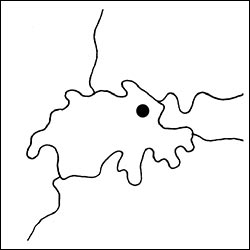
Appenzell is one of Switzerland’s most traditional regions...and the butt of jokes because of it. Entire villages meet to vote in town squares such as Appenzell town’s Landsgemeindeplatz (an event featured on postcard racks). Until 1990, the women of Appenzell were barred from voting on local issues. But in a break from convention, in 2000 Appenzell’s schools were the first in Switzerland to make English—rather than distant French—the mandatory second language.
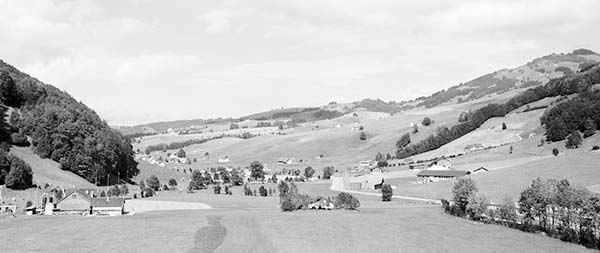
A gentle beauty blankets this region of green, rolling hills, watched over by the 8,200-foot peak of Mount Säntis, Appenzell’s highest point. As you travel, you’ll enjoy an ever-changing parade of finely carved chalets, colorful villages, and cows mooing, “Milk me.” While farmers’ daughters make hay, older women with scythes walk the steep roads, looking as if they just pushed the Grim Reaper down the hill. When locals are asked about Appenzeller cheese, they clench their fists as they answer, “It’s the best.” (It is, without any doubt, the smelliest.)
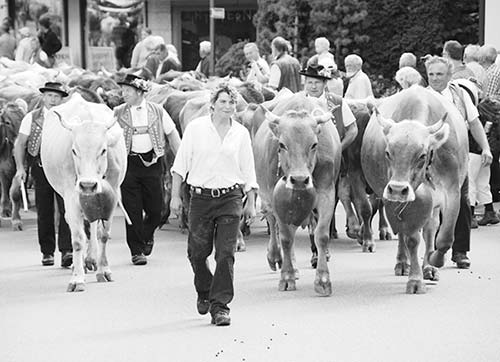
If you’re here in late August or early September, there’s a good chance you’ll get to watch (or at least have to slow down for) the ceremonial procession of flower-bedecked cows and whistling herders in formal folk costumes. The festive march down from the high pastures is a spontaneous move by the herding families, and when they finally do burst into town, locals young and old become children again, running joyously into the streets.
PLANNING YOUR TIME
On a two-week trip through Switzerland, save a day for the Appenzell region. This pastoral area has its subtle charms—but it can be anticlimactic after the rugged Berner Oberland or Matterhorn. In the Appenzell region, I prefer overnighting in Appenzell town, which is a more efficient base for getting around the region; however, those up for a mountaintop retreat and rustic accommodations should consider Ebenalp. If you have only a week or less in Switzerland, skip the Appenzell region and head instead for the high mountains.
GETTING AROUND THE APPENZELL REGION
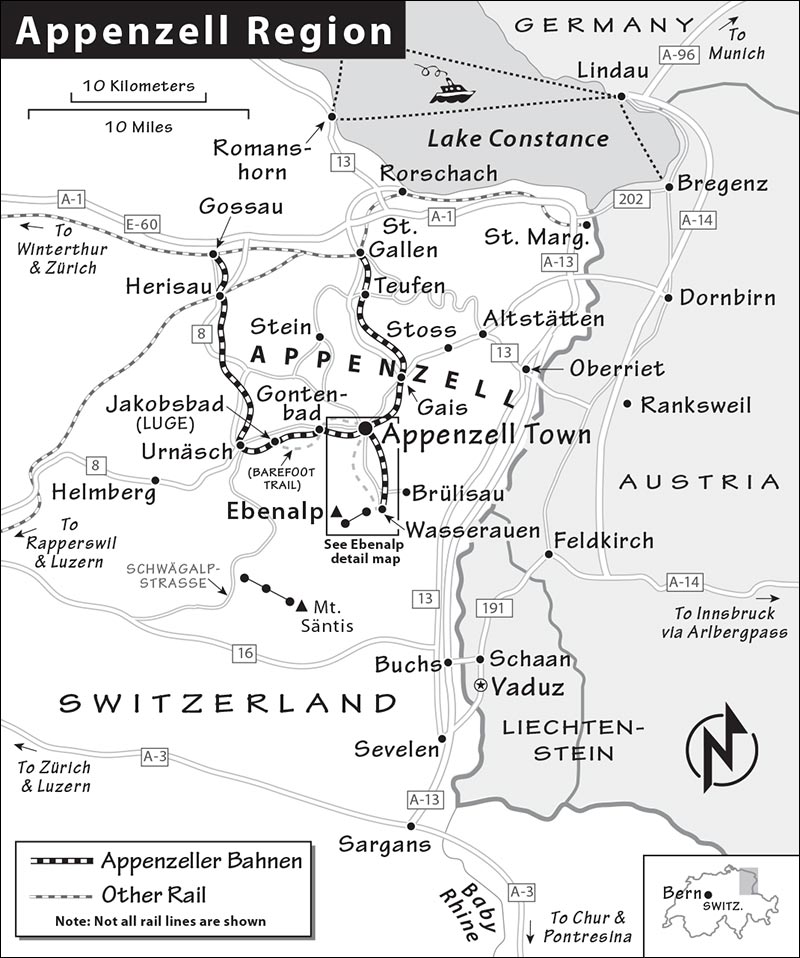
This area is a breeze by car—you could see everything in this chapter in one (very busy) day. Notice that the attractions in Stein and Urnäsch and the Kronberg luge ride form a handy little loop to the west of Appenzell town. The lift up to Ebenalp is just to the south.
The regional narrow-gauge trains are run by a private operator (Appenzeller Bahnen—Eurail Global Pass and Swiss Travel Pass are valid). A very handy train generally runs twice an hour (except after 19:00, when it’s hourly), taking about 50 minutes to connect almost all the destinations I describe. Starting up at Wasserauen (at the base of the Ebenalp lift), it runs through Appenzell town, stopping at Gontenbad (one end of the Barefoot Trail), Jakobsbad (luge ride and other end of the Barefoot Trail), and Urnäsch (folk museum), and then going north to Herisau (change here to reach Luzern) and Gossau (change here to reach Zürich). A separate line runs from Appenzell to the city of St. Gallen.
The one destination in this chapter not well covered by public transportation is Stein (with its folk museum and tourable cheese factory). It is reachable by taxi (for details, see the listing later in this chapter).
Appenzell Town
The center of this authentically Swiss town is a painfully cute pedestrian zone lined with colorful, patterned house fronts (rather than the white-painted or wooden facades favored elsewhere). This is a great spot to simply let your pulse slow and enjoy Swiss small-town life. The big square of Landsgemeindeplatz—near many of my recommended restaurants—is where residents gather on the last Sunday of each April to vote on local issues by show of hands. (The rest of the year, it’s a parking lot.) A fountain on the square shows an Appenzeller raising his hand to be counted.
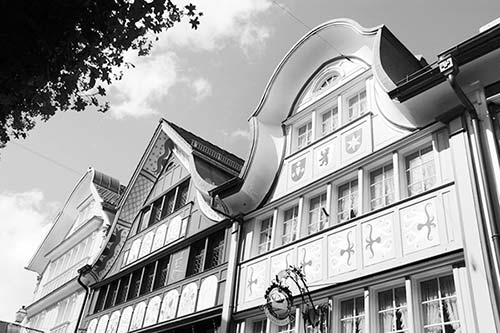
Appenzell town is touristy, sure. But from watching the locals robustly greet each other in the streets or laugh over a local beer in the pubs, it’s clear this is also a real, living town.
Orientation to Appenzell Town
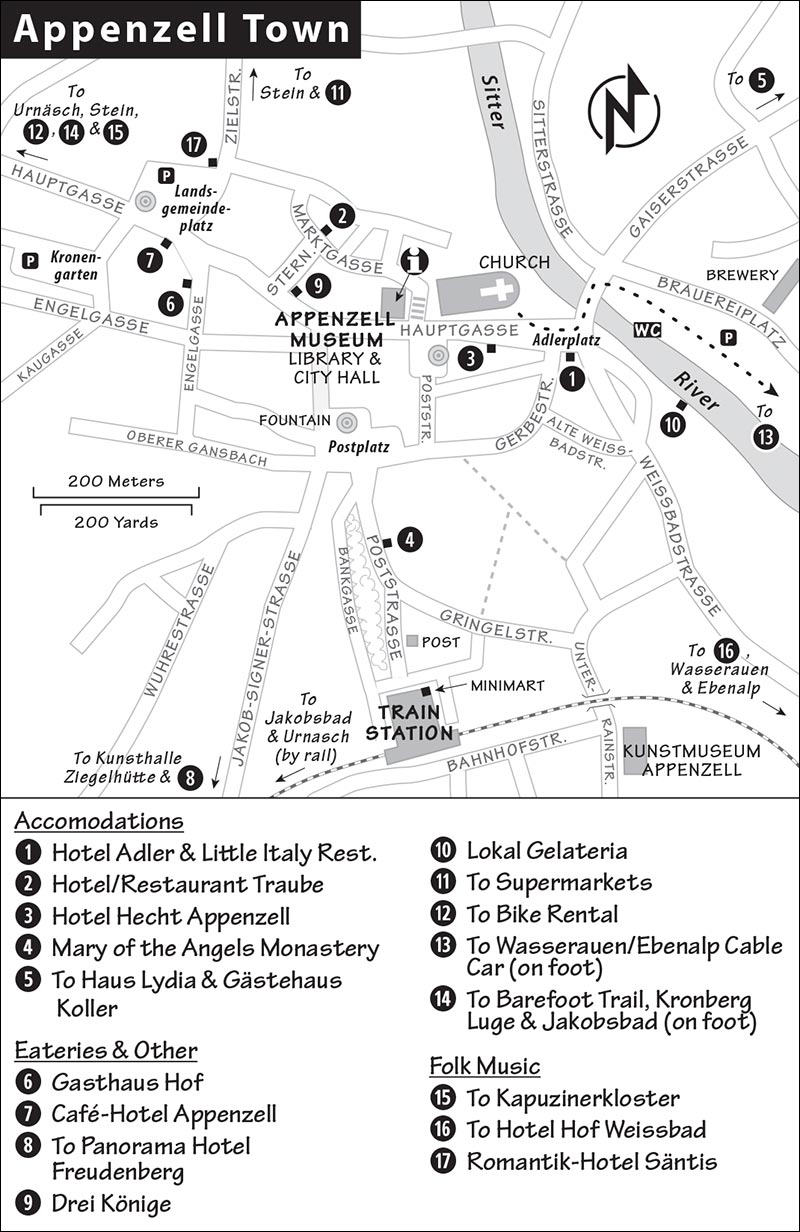
Appenzell town (pop. 6,000) clusters along its main street, Hauptgasse, which runs from the bridge over the Sitter River to the biggest square, Landsgemeindeplatz. From the middle of this colorful drag, Postgasse (which turns into Poststrasse) heads south to the train station. You can walk from one end of town to the other in about 10 minutes.
TOURIST INFORMATION
The helpful TI is on the main street at Hauptgasse 4 (generally Mon-Fri 9:00-12:00 & 13:30-18:00, Sat-Sun until 17:00, +41 71 788 9641, www.appenzell.ch). Stop by on arrival to ask about special events.
If you stay at least three nights in the region, your hotel or pension will give you an Appenzell Card. This card is a great money-saver, as it covers all local train trips (on trains operated by Appenzeller Bahnen, as far as St. Gallen), rides on three different cable cars, admission to local museums, a ride on the Kronberg luge, a day’s bike rental, and more, and it gets you a discount on PubliCar taxi service. It can be well worth extending a two-night stay to three just to get the card.
ARRIVAL IN APPENZELL TOWN
The cute train station has a ticket office (Mon-Fri 7:30-18:00, Sat-Sun 8:00-12:15 & 13:15-17:00), WCs, small lockers (the ticket office and TI can store larger bags), and a handy, well-stocked Shop Mercato minimart (daily 6:00-20:00).
If arriving by car, ask your hotel about parking. If you’re just day-tripping here, leave your car in the pay lot by the brewery just across the river from downtown. Walk across the bridge and veer right onto the main drag, Hauptgasse; the TI is just past the church, on your right.
HELPFUL HINTS
Blue Monday: Some of the region’s museums are closed on Monday, but hiking and biking are good any day the sun shines. The folk museum in Urnäsch and the cheese factory in Stein are other good Monday options—and, spring through fall, so are the folk museum in Appenzell town and the Kronberg luge in Jakobsbad (unless it’s raining).
When the Cows Come Home: If you’re here at the right time of year, you might luck into seeing the festive procession of cows heading up to the high-mountain pastures (Alpfahrt, generally late May-early June) or returning from a summer high in the Alps (Alpabfahrt, generally late Aug-early Sept). Unfortunately, the cows don’t give much advance notice—announcements of the event pop up around town just a few days ahead. There’s also the one-day Appenzell cattle show in early October.
Bike Rental: The train station has a few electric bikes that can be reserved through the national rail system (see here), but don’t forget that the Appenzell Card (described earlier) includes a day’s free bike rental from several shops in the area (the rail system’s bikes are not part of the free program). Some hotels rent bikes or can help you arrange a rental.
For mountain bikes, go to Neff Zweirad, a five-minute walk beyond Landsgemeindeplatz (40 CHF/day, e-bike-50 CHF/day; Mon-Fri 7:30-12:00 & 13:15-18:30, Sat until 16:00, closed Sun, shorter hours off-season; Hauptgasse 58, +41 71 787 3477, www.neff-zweirad.ch).
Sights in the Appenzell Region
Appenzeller Dairy (Appenzeller Schaukäserei)
Appenzell Folklore Museum (Appenzeller Volkskunde Museum)
▲Museum of Appenzell Customs (Appenzeller Brauchtumsmuseum)
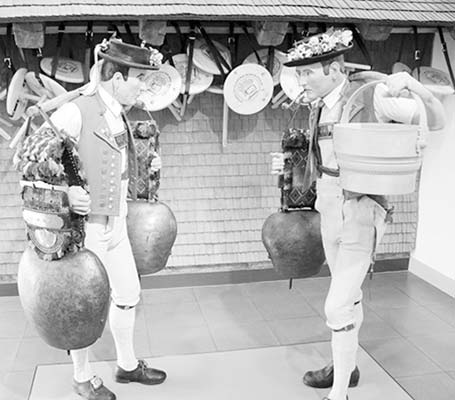
The Appenzell region has three folk museums—one in Appenzell town, another in Stein, and a third in Urnäsch. All are good, and they’re different enough that it’s worth considering visiting all three if you have ample time and interest. To be more selective, weigh these differences: Stein’s is the biggest, most modern, and probably the best presented (but also the most difficult to reach without a car); Urnäsch’s is the most atmospheric, as it’s in a creaky old house; and Appenzell town’s is the most convenient, giving a good all-around look at the region (it’s especially strong on local costumes), but lacking a bit of the charm of the other two.
APPENZELL TOWN
▲Appenzell Museum
This folk moo-seum above the TI provides a fine and efficient look at the local cow culture. Note that its name is similar to the larger Appenzell Folklore Museum in nearby Stein.
Cost and Hours: 7 CHF, covered by Swiss Travel Pass; Mon-Fri 10:00-12:00 & 13:30-17:00, Sat-Sun 11:00-17:00; Nov-March Tue-Sun 14:00-17:00, closed Mon; Hauptgasse 4, +41 71 788 9631, http://museum.ai.ch.
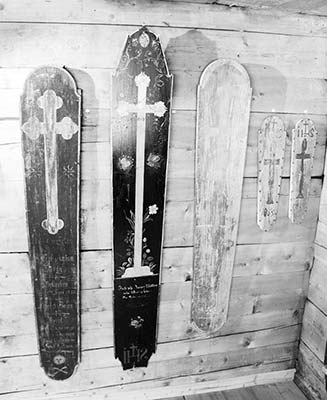
Visiting the Museum: Buy your ticket, borrow the English translations, and ride the elevator all the way up (push button 6). From there, take the stairs to the attic for a collection of coins, measurement instruments, and torture devices. Descend the stairs to check out the excellent collection of traditional costumes, then work your way down through the rest of the exhibits. As you wander, you’ll see old flags and banners, reconstructed rustic rooms, woodcarvings, 19th-century peasant art, tools, handmade embroidery, religious art, and (oddly) an Egyptian coffin. One thought-provoking room displays boards called Rebretter, which were used to lay out the body of a recently deceased loved one. The boards were painted with the name and information of the deceased and, after the burial, displayed on the family’s house.
▲Folk Music
The accordion never really caught on here, making Appenzell’s folk music—which still uses older instruments (violin, dulcimer)—unique in Switzerland. Free concerts take place every Thursday (early June-mid-Oct) at 18:30 in the Kapuzinerkloster (Capuchin monastery) at the far end of Hauptgasse, at #49; every Wednesday at 20:00 at the ritzy Hotel Hof Weissbad (about two miles out of town); and every Saturday (July-Aug) at the Romantik-Hotel Säntis (Landsgemeindeplatz 3). The hotel venues require a reservation if you plan to eat dinner. If not, try to persuade the staff to let you have a drink within earshot of the music. You can also ask the TI (or check their website) about other live music options.
Modern Art Museums
Appenzell showcases modern and contemporary art in a museum with two branches: Kunstmuseum Appenzell is a silver-clad modern building right behind the train tracks (Unterrainstrasse 5, +41 71 788 1800), and Kunsthalle Ziegelhütte is a bit farther out (Ziegeleistrasse 14, +41 71 788 1860).
Cost and Hours: 15 CHF combo-ticket covers both; also covered by Swiss Travel Pass; Tue-Fri 10:00-12:00 & 14:00-17:00, Sat-Sun 11:00-17:00, shorter hours Nov-March, closed Mon year-round; www.h-gebertka.ch [URL inactive].
HIKING
Appenzell makes a good home base for hiking, with gentle hills and pastoral scenery all around. The TI can suggest several easy walks in the region. I recommend two possibilities here.
Appenzell to Wasserauen
This two-hour walk, which takes you to the foot of the Ebenalp cable car (described later), begins near the parish church in Appenzell and leads you along a creek through meadows and forests. The path is well marked. Once you reach Wasserauen, you can take the cable car up to Ebenalp, or simply hop on the train back to Appenzell.
Barefoot Trail (Barfussweg)
This 1.5-hour walk between Jakobsbad and Gontenbad offers a surprising and unusual experience...yes, with your shoes off. The trail leads over meadows, through creeks, and on stretches of asphalted road, in a tranquil valley roughly parallel to the Appenzell-Urnäsch road and rail line. Two specially designed fountains along the way will refresh your feet. The path was inspired by the philosophy of 19th-century therapist Sebastian Kneipp, who sought to treat medical conditions with water of different temperatures and pressures.
To get from Appenzell to the trailhead, take the train to Jakobsbad (1-2/hour, 8 minutes, trailhead right across the street from the train station and the Kronberg luge ticket office—described later), stow your shoes in your pack, and do the barefoot walk to Gontenbad. From Gontenbad, you can ride the train back to Appenzell (4 minutes) or put on your shoes and keep on walking back to town (about another hour).
NEAR APPENZELL TOWN
▲Stein
The unassuming, hill-capping village of Stein has two worthwhile attractions side by side: a cheese-production facility with a visitors center and what’s arguably the region’s best folk museum. If you don’t have a car, use the subsidized taxi service PubliCar, which takes passengers to Stein and other locations not serviced by buses (each passenger pays a distance-dependent fare plus a flat fee—about 12 CHF from Appenzell to Stein). To reserve, ask at the TI, call +41 848 553 060, or download the PubliCar app (more info at www.postauto.ch/publicar-appenzell).
Appenzeller Dairy (Appenzeller Schaukäserei)
This is one of several dozen dairies in the area where the well-known Appenzeller cheese is made, and it’s set up to explain the process to curious visitors. It’s fast, a little smelly, and user-friendly.
Cost and Hours: 12 CHF (includes a small box of cheese containing five samples of various ages), 15 CHF combo-ticket also covers Appenzell Folklore Museum; daily 9:00-18:30, off-season until 17:30; +41 71 368 5070, www.showcheese.ch.
Visiting the Dairy: As you enter, scan the QR code for an English audioguide to the exhibits and ask about the next English showing of the 10-minute video (which treads a fine line between being informative and promotional).
Large, colorful displays trace the cheesemaking process, and you can peer down into the production facility (cheese is generally made 9:00-15:00—most interesting when they pour the contents of the giant vat into the long line of wheel molds). You’ll learn how the special pungent flavor of Appenzeller cheese comes from an age-old, secret-recipe herbal brine mixture that’s lovingly rubbed on each wheel as it ages. Nibble your cheese samples as you explore, noting how the different ages affect the aroma and taste. Head down the long hallway, where you can watch hundreds of wheels of cheese silently age (and occasionally see them turned by an automated cheese-wheel flipper). You can also collect and keep samples of the herbs used in making the secret brine. The dairy shop sells yogurt, meats, and cold drinks, and the restaurant serves powerful cheese specialties, including fondue.
Appenzell Folklore Museum (Appenzeller Volkskunde Museum)
This fine museum offers a modern, well-presented look at the folk culture in these parts.
Cost and Hours: 7 CHF, 15 CHF combo-ticket also covers Appenzeller Dairy, covered by Swiss Travel Pass; Tue-Sun 10:00-17:00, closed Mon; +41 71 368 5056, www.appenzeller-museum.ch.
Demonstrations: A visit to this museum is best on Saturdays and summer Wednesdays, when cheesemaking demonstrations are going on (starts at 13:00, most interesting around 15:00). Other craft demonstrations happen daily during the summer starting at 13:30 (Sun at 10:30). Call ahead to confirm the schedules.
Visiting the Museum: Borrow the essential English translations at the entry, then explore the three floors of exhibits. The ground floor is dedicated to local customs and lifestyles. The replica of the alpine cheesemaking hut is used for live demonstrations. There’s a huge collection of cowbells, which, according to the explanation, are used for various purposes: to scare off evil spirits, to make the lead cow easier to follow in processions, to more easily find a lost cow...“and anyway, cows like them.”
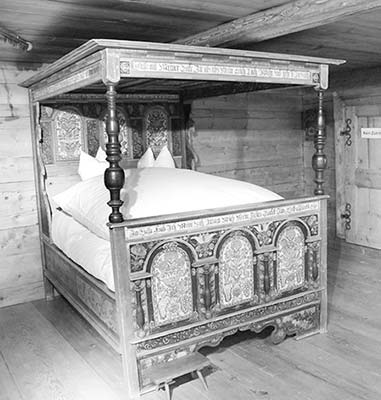
Upstairs is an art collection titled “Peasant Painting 1600-1900,” with everything from huge murals from the sides of barns to delicate oil paintings to miniature wood carvings—virtually all featuring pastoral countryside scenes of cheesemaking huts, cows, and rolling meadows. Each of the “naive” (untrained) artists who created these works is explained in a short bio, which brings the collection to life. You’ll see great examples of the brightly painted traditional regional furniture (also easy to find in local hotels and restaurants).
The basement shows off more furniture pieces (in the replica of a traditional bedroom, notice how the colorful paint makes the furniture stand out from the plain wooden walls). But the focus here is local weaving and embroidery. The exhibit explains how embroidery gradually evolved from being simple and handmade to machine-made, as it went from a craft to an industry. The rustic loom and the giant embroidery machine are sometimes used for demonstrations.
▲Urnäsch
This sleepy one-street town is worth the trip to see what could be one of Europe’s cutest museums. It’s a 15-minute train ride from Appenzell.
▲Museum of Appenzell Customs (Appenzeller Brauchtumsmuseum)
Located on the town square across from the church, this thoroughly enjoyable museum brings this region’s folk traditions to life.
Cost and Hours: 8 CHF, covered by Swiss Travel Pass; Mon-Sat 9:00-11:30 & 13:30-17:00, Sun from 13:30; shorter hours off-season; +41 71 364 2322, www.museum-urnaesch.ch.
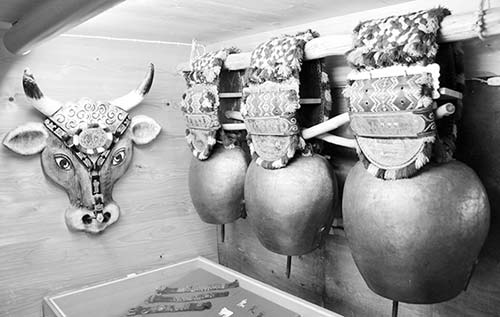
Visiting the Museum: Exhibits are displayed on four floors of two adjacent, different-as-day-and-night buildings. The new building is slick and mostly used for temporary exhibits. The 400-year-old, aptly named “Old House” has low ceilings, dramatically sloping funhouse floors, and lots of creaks. Warm and homey, it’s a happy little honeycomb of Appenzeller culture—you’ll feel like a local invited you over for a visit.
First ask to watch an English showing of the 20-minute movie that explains four of the major regional festivals. The most memorable is Silvesterchläus—the Appenzell New Year, celebrated on January 13 per the old Julian calendar. On this date, local men celebrate by putting on gigantic, cartoonish headdresses and giant cowbells. You’ll see some of those costumes—and others—then twist your way up through the tiny halls and staircases, pausing to look at replicas of local rooms, collections of handicrafts and tools, and other slices of Appenzell life. On the top floor of the new building, don’t miss the music room, where you can try your hand at traditional musical instruments, including a hammered dulcimer and a coin-in-a-bowl (which, in the right hands, is more musical than you might think). There’s no English and barely any German, but it’s still fun to explore.
Kronberg Luge Ride (Bobbahn)
Between Appenzell and Urnäsch, in the village of Jakobsbad, you can enjoy a bobsled ride that runs on steel rails spring through fall. Each sled has seatbelts and can carry two people. Two side handles allow you to control the speed: Respect the Bremsen! signs—which suggest when to brake. The same entertainment zone includes a chairlift for hikes, as well as a high-ropes course.
Cost and Hours: 9 CHF per sled for adults—two adults can share one sled, 6 CHF per sled for kids—ditto, multiple-ride cards available and shareable; daily 9:00-18:00, shorter hours in spring and fall, closed Nov-March; no rides in rainy weather, +41 71 794 1289, www.kronberg.ch.
Getting There: The luge is just across the tracks from the Jakobsbad station, which is an 8-minute train trip from Appenzell.
Sleeping in Appenzell Town
Sleep in touristy Appenzell town if you want comfort—or for a rustic, high-altitude thrill, opt for the low-tech, no-shower dorms at Ebenalp (listed later). Appenzell town is small and the hotels are central. The B&Bs are a 10- to 20-minute hike from the town center.
HOTELS
$$ Hotel Adler rents 20 rooms in a building that dates from 1562 and boasts a historic fondue cellar (winter only) where you can see a stone floor from an even earlier structure. The hotel has two types of rooms: modern or traditional Appenzeller. Franz Leu, a sixth-generation innkeeper, decorates the halls with fun memorabilia while sons Matjaz and Clemens handle day-to-day business (family rooms, elevator, pleasant garden lounge, small free parking lot, closed Nov and Feb, Weissbadstrasse 2, between TI and bridge on Adlerplatz, +41 71 787 1389, www.adlerhotel.ch, info@adlerhotel.ch). The Adler is also home to the recommended Little Italy restaurant.
$$ Hotel/Restaurant Traube rents seven cozy, tastefully decorated, modern rooms in a very pretty building right in the center of town ($$$ restaurant with balcony seating, Marktgasse 7, +41 71 787 1407, www.traube-appenzell.ch, info@traube-appenzell.ch).
$$ Hotel Hecht Appenzell rents 38 bright, updated rooms on the main drag, but without the family-run feel (quieter rooms in back, elevator, spacious breakfast room, Hauptgasse 9, +41 71 788 2222, www.hecht-appenzell.ch, info@hecht-appenzell.ch).
¢ Mary of the Angels Monastery offers 19 simple yet appealing rooms a block from the train station. If you’re looking for a quiet yet central location, and a way to save some francs, this is a good bet (breakfast extra, family rooms, bathrooms down the hall, Poststrasse 7, +41 71 787 1845, www.kloster-appenzell.ch, gaestehaus@kloster-appenzell.ch).
B&Bs
To experience a pleasant Swiss residential neighborhood, consider the following B&Bs, just east of Appenzell’s pedestrian zone. To reach them from the town center (TI/town church), cross the bridge and take a right on Eggerstandenstrasse. You’ll reach Gästehaus Koller first (just a few houses down), then—after another 500 yards or so—Haus Lydia. To reach Haus Lydia by public transit, take the train to the Hirschberg station (2 minutes from Appenzell on the line to St. Gallen). From the station, it’s a three-minute downhill walk following the tracks.
$ Haus Lydia has four guest rooms on the upper floors of a large, traditional home filled with tourist information and a woodsy folk atmosphere, plus a garden with lounge chairs and a view of Ebenalp. The crisp, nicely decorated rooms have a mountain-lodge feel, and are a good value if you have a car or don’t mind a 20-minute walk from the town center (great breakfast, Eggerstandenstrasse 53, +41 71 787 4233, www.hauslydia.ch, contact@hauslydia.ch, friendly Lydia Mock-Inauen). She also rents two roomy apartments by the week (no breakfast).
$ At Gästehaus Koller, Stefan and Karin rent four comfortable rooms on the upper floor of their home. Stefan is a carpenter and did much of the woodwork, and his wife, Karin, makes traditional costumes (Eggerstandenstrasse 9, +41 71 787 0222, www.gaestehaus-koller.ch, info@gaestehaus-koller.ch).
Eating in Appenzell
MEALS WITH TABLE SERVICE
Most of the restaurants in Appenzell’s old town cater to locals and day-trippers with classic Swiss-German menus and elaborate desserts. Almost every menu features (surprise) the heavenly but oh-so-smelly Appenzeller cheese. The Appenzeller beer is tasty, famous, and about the only thing cheap in the region. Many top restaurants cluster around the big main square (Landsgemeindeplatz). All these places are open until about 22:00-23:00.
$$$ Gasthaus Hof, which feels particularly local, has a pleasant beer garden out back. The menu features a bewildering variety of specials, but they are most proud of their cheese dishes—the cozy dining room is filled with the unforgettable aroma of Appenzeller cheese (daily, Engelgasse 4, +41 71 787 4030).
$$$ Café-Hotel Appenzell serves from a large menu (including salads and vegetarian dishes) in a genteel dining room and at a host of inviting outdoor tables. They also run a pastry shop in one corner of the building (daily, at corner of Landsgemeindeplatz closest to TI, +41 71 788 1515).
$$ Little Italy, at the recommended Hotel Adler, dishes up authentic Italian fare at reasonable prices. Run by Calabria native Stefano and his friendly crew, the restaurant offers a delightful selection of antipasti, homemade pastas, pizzas, and gelato. Dine in the bright and cheery dining room or outside on the people-watching terrace on Adlerplatz (open Wed-Sun, closed Mon-Tue, +41 71 787 1389).
With a View over Town: A steep 15-minute uphill walk or short drive from the town center, $$$ Panorama Hotel Freudenberg serves beef, pork, and vegetarian dishes, plus more reasonably priced small plates. You’ll get sweeping vistas over Appenzell’s rooftops from the outdoor tables. If you’d like to dine with a view, it’s worth the effort, but wear appropriate footwear for the steep climb (closed Wed and Nov; go under train station, turn right, and follow yellow Freudenberg signs through a residential zone, then up through the hills; Riedstrasse 57, +41 71 787 1240). Drivers can follow the yellow Freudenberg signs from near the train station.
CHEAP EATS AND TREATS
$$ Drei Könige is clearly the local favorite serving coffee, delicious cakes, and light food in a cozy interior or on a sunny terrace (Wed-Mon 8:00-18:30, Sat-Sun until 17:00, closed Tue; Hauptgasse 26, +41 71 787 1124).
$ Lokal Gelateria is a low-key café serving homemade gelato (made with milk produced just a few miles away), coffee, and alcoholic beverages. Their location, tucked behind an old sawmill along the banks of the Sitter River, makes this a nice place to retreat (usually Wed-Sun 13:30-18:00; closed Mon-Tue, in bad weather, and in winter; Weissbadstrasse 3a, +41 71 787 0115).
Supermarkets and Cafeterias: The Migros (with a self-service cafeteria) and Co-op supermarkets face each other along Zielstrasse, a five-minute walk downhill from Landsgemeindeplatz (both generally open Mon-Sat 8:00-19:00, closed Sun).
Appenzell Connections
For details on taking the train to nearby destinations, see “Getting Around the Appenzell Region,” earlier. For connections beyond the Appenzell region, you’ll generally change in either Herisau or Gossau.
From Appenzell Town by Train to: Zürich (3/hour, 2 hours, change in Gossau), Chur (2/hour, 2.5 hours, 1 or more changes), St. Moritz (1-3/hour, 4 hours, several changes), Luzern (2-3/hour, 3 hours, change in Herisau; more with additional changes), Bern (hourly, 3 hours, change in Gossau), Interlaken (3/hour, 4 hours, 1-3 transfers), Lausanne (2/hour, 4.5 hours, change in Gossau), Munich (2-3/hour, 4.5-6 hours, 1 change, more with additional changes). Train info: www.rail.ch.
Ebenalp
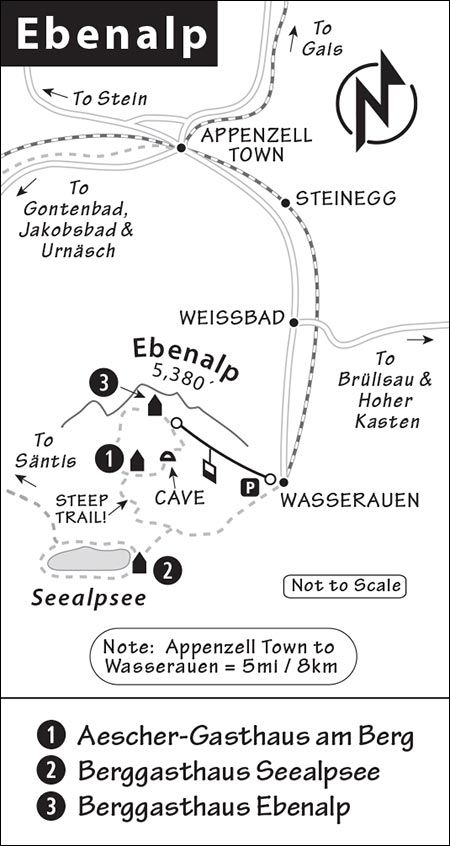
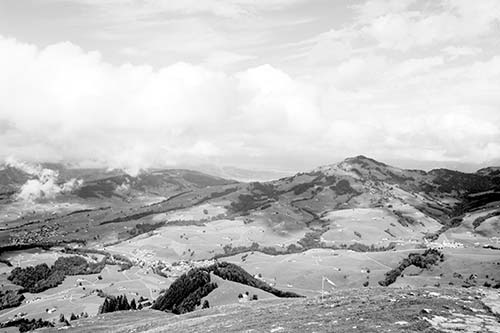
This mountain features wonderful views and a cliff-hanging hut, providing a lofty “hills-are-alive” alternative to Appenzell town. From Wasserauen—five miles south of Appenzell town by road or rail line—ride the lift to Ebenalp (5,380 feet), a high, rocky ridge that drops off to vertical cliffs on the southern side. On the way up, you’ll get a sneak preview of Ebenalp’s cave church and the cliffside boardwalk that leads to the restaurant (near the top, left side). From the top you’ll enjoy a sweeping view north all the way to Lake Constance (Bodensee). Though this excursion is doable in so-so weather, clear skies really enhance the Ebenalp experience—ask in Appenzell before you head up to the mountain or check the webcam at www.ebenalp.ch. In any weather, sturdy shoes and rain gear are recommended—the weather can change in the blink of an eye.
Getting There: First, a train takes you from Appenzell to Wasserauen (1-2/hour, 12 minutes). Then, across the road from the Wasserauen station, the Ebenalp lift carries hikers to the summit and back every 15 minutes (22 CHF one-way, 34 CHF round-trip, half-price with Swiss Travel Pass, 6-minute trip, daily July-Aug 7:30-19:00, June and Sept until 18:00, May and Oct 8:00-17:30, mid-Dec-March 9:30-17:00, usually closed April and Nov-mid-Dec—check website or call ahead, free parking, pick up free hiking map before you ascend, +41 71 799 1212, www.ebenalp.ch).
Hiking from the Lift Station to Aescher-Gasthaus am Berg: Leaving the lift, look for Wildkirchli and Aescher signs pointing to the 15-minute hike down to the mountain hut. First you’ll hike steeply down under the cables, then you’ll hook right and venture downhill through a good-sized natural cave where archaeologists once found the bones of prehistoric bears. It’s slippery, so watch your step and use the railing—trust me, you’ll soon return to daylight. As you emerge into the light, you’ll pass a tiny museum (free and always open; scan barcode with phone for English descriptions) in a hut built on the site where hermit monks lived from 1658 to 1853. Don’t miss the 400-year-old Wildkirchli church, a few yards farther along the cliff, in a separate cave.
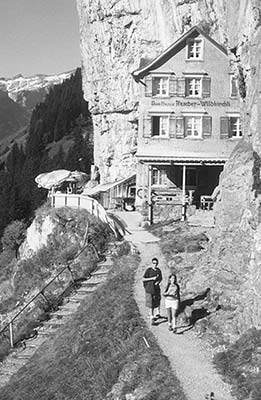
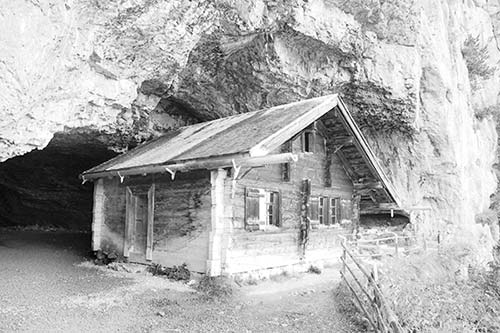
Next you’ll follow the cliff-hugging path (not for those afraid of steep drop-offs, though there’s a sturdy railing) to a 170-year-old, weathered-shingle hut sitting snugly against the mountain. Originally built to house farmers, goats, and cows, it evolved into a lodge for pilgrims coming to the monks for spiritual guidance. Today, the recommended Aescher-Gasthaus am Berg caters to overnighters, and its restaurant welcomes hordes of tourists in search of a decent meal and great views (see listing, later).
From the guesthouse’s sunny cliffside perch, you can almost hear the cows munching on the far side of the valley. Only the paragliders tag your world as 21st century. In the distance, nestled below Säntis peak, are the isolated Seealpsee (Lake-Alp Lake) and the recommended Berggasthaus Seealpsee.
Returning to the Ebenalp Lift: Retrace your steps through the cave (allow 25 minutes for this uphill hike). Or, for a different and more strenuous yet less-crowded return, you can hike up around the back of the mountaintop: As you leave Aescher-Gasthaus am Berg, continue straight on the path. At the fork, the path winds you steeply uphill, among goats and wildflowers, eventually arriving back at the top of the Ebenalp lift (allow 40 minutes).
Hikes from Aescher-Gasthaus am Berg: The trail beyond Aescher-Gasthaus am Berg leads to a pair of rugged hikes that are worth considering: down to the alpine lake called Seealpsee (and eventually all the way down to Wasserauen), or up for a steep-but-scenic route back to the Ebenalp lift (described above).
The hike down to Seealpsee, which takes a little over an hour, is steep but rewarding: Take a left at the first fork beyond Aescher-Gasthaus am Berg. After some initial knee-jarring switchbacks, the trail gets easier, and as it flattens out, a fork to the right leads in about 10 minutes to the lake. To reach Wasserauen (45 minutes) and the train back to Appenzell, retrace your steps until you reach the nearest fork, but this time take the other path (to the right), which turns into a narrow road.
Sleeping and Eating on Ebenalp
Sleeping: Although Appenzell town offers all the predictable comforts, hardy travelers enjoy overnighting on Ebenalp instead. The facilities are limited (only rainwater) and reaching any of these accommodations involves some steep hiking. Beyond these three options, the entire region is a hit with hikers, who can trek between as many as 24 mountain hotels, each a day’s hike apart. All originated as alpine farms.
$$$ Aescher-Gasthaus am Berg offers rustic cliffside accommodations bundled with alpine vistas in their historic guesthouse and in the “Hermit Hut” just up the path. The guesthouse, a wonderland of knotty wood, contains one double, one four-bed room, and a bunkroom; the Hermit Hut sleeps 2 (book well ahead; bunkroom sleeps 6-15—price based on number of guests, bring sleeping sack; no shower or Wi-Fi, +41 71 799 1142, www.aescher.ch, info@aescher.ch).
$ Berggasthaus Seealpsee is on the idyllic alpine Seealpsee, most easily reached by an hour-long hike up a private road from the Wasserauen train station (private rooms available, includes sheets and showers, closed Nov-mid-April, +41 71 799 1140, www.seealpsee.ch, info@seealpsee.ch, Parpan-Dörig family).
$ Berggasthaus Ebenalp perches just a couple of minutes’ steep walk up from the upper lift station (200-foot elevation gain). There’s a bumpy paved path up, and it’s doable with sturdy wheeled luggage. Its bunkroom and private rooms are booked long in advance for Saturdays, but are otherwise empty (restaurant, coin-op rainwater shower, closed April and mid-Nov-mid-Dec, +41 71 799 1194, www.gasthaus-ebenalp.ch, infos@gasthaus-ebenalp.ch).
Eating: Built in 1805, $$ Aescher-Gasthaus am Berg is a memorable place to eat. The hut is actually built into the cliff; its back wall is the rock itself (see photo at the start of the Ebenalp section). The outdoor terrace and comfortable dining room are filled with happy hikers and plenty of tourists drawn by National Geographic publicity that labeled this a “destination of a lifetime.” For a strenuous 45-minute pre-dinner hike, copy the goats: Take the high trail toward the lake, circle clockwise up toward the peak and the lift, then hike down the way you came (closed Dec-early May, 15 minutes by steep trail below top of lift, +41 71 793 9223, www.aescher.ch).
You can also eat at the restaurant of the Berggasthaus Ebenalp, listed earlier.
Liechtenstein
Appenzell is just an hour away by car from the tiny, pricey, and touristy country of Liechtenstein. This quirky remnant of medieval feudal politics is truly landlocked, without a seaport or even an airport. Liechtensteiners—who number about 38,000—speak German, are mostly Catholic, and have a stubborn independent streak. Women were barred from voting until 1984.
Liechtenstein is certainly not worth going out of your way for (unless you collect stamps—postal or passport), but a detour here is something to consider if you have time to kill and happen to be driving south from Appenzell toward Chur or the Upper Engadine (Pontresina/St. Moritz).
Vaduz
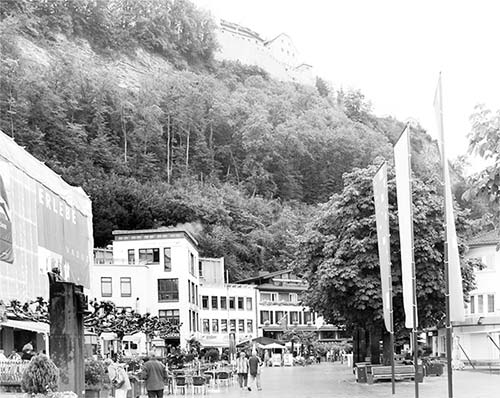
Low-key Vaduz, with about 5,000 people, feels basically like a midsize Swiss town. Its pedestrianized main drag is lined with modern art and hotels bordering a district of slick office parks. Like other “micro-countries,” Liechtenstein offers businesses special tax and accounting incentives. Many European companies establish their official headquarters here to take advantage of its low taxes.
Getting There: Heading south on the A-13 expressway from Appenzell, the road actually skirts Liechtenstein just across the Rhine River (the border). For a 30-minute detour, exit at Buchs and turn toward Schaan. After crossing the border (without stopping, or likely even noticing), you’ll wind up in the town of Schaan. Follow signs (south/right) toward Vaduz, the capital of the Principality of Liechtenstein (Fürstentum Liechtenstein, or FL for short on its sleek black license plates).
Visiting Vaduz: Various parking lots and garages are along the main street, Äulestrasse. Try to park directly under the looming castle. If you park at the Marktplatz garage, you can simply walk one block up to the pedestrian zone called Städtle, where you’ll run right into the TI (at #39, daily 9:00-17:00, +423 239 6363, www.tourismus.li). The TI, which comes off more as a souvenir shop, will stamp your passport for a small fee.
Go for a stroll along enjoyable Städtle street. Use Swiss francs or euros to buy a postcard and some Liechtenstein stamps to send to the collector in your life (but be sure to write and send it before leaving the country).
The prince’s striking castle, a 20-minute hike above Vaduz, is closed to the public, but there’s a fine view from the grounds (find the trail near $$ Café Burg). The billionaire prince, who looks down on his six-by-twelve-mile country, wields more real political power in his realm than any other member of European royalty. The Liechtenstein family purchased this piece of real estate from the Holy Roman Emperor. In 1719, the domain was granted principality status, answering only to the emperor. In 1806, during the age of Napoleon, Liechtenstein’s obligations to the Habsburg emperor disappeared, and the country was granted true independence.
The Liechtenstein princes, who lived near Vienna, saw their country merely as a status symbol and at first didn’t even bother to visit. In fact, it wasn’t until the 20th century that a Liechtenstein prince actually lived here. Later, after World War I, tough times forced the principality to enter an economic union with Switzerland. To this day Liechtenstein enjoys a very close working relationship with its Swiss neighbors—functioning in some ways like just another Swiss canton, with the same currency, international diplomacy, bus system, and even soccer league.
Leaving Vaduz: After visiting the castle grounds, you’ll quickly run out of things to do. No problem—just head back to Switzerland. Continue south through town on Äulestrasse, turn right at the well-marked Schweiz sign, cross back over the Rhine, and you’re back in Switzerland (and on the A-13 expressway)...having checked another country off your list. Or, if you’re headed northeast toward Austria, drive back north through Schaan, then up to Feldkirch.