BERNER OBERLAND
Interlaken • Schilthorn • Jungfrau
Map: Berner Oberland Transport Time/Cost
Sights and Activities near Interlaken
Activities in and near Lauterbrunnen
Lauterbrunnen Valley Connections
Activities in the Berner Oberland
Scenic Rides on Lifts and Trains
Rather than tackle a checklist of famous Swiss mountains and resorts, choose one region to savor: the Berner Oberland. Here you can frolic and hike high above the stress and clouds of the real world. Take a vacation from your busy vacation. Recharge your touristic batteries high in the Alps, where distant avalanches, cowbells, the whistle of marmots, and the crunchy footsteps of happy hikers are the dominant sounds. If the weather’s good (and your budget’s healthy), ride a cable car from your home-base village to a hearty breakfast at the revolving Piz Gloria restaurant on top of the 9,748-foot Schilthorn peak. Linger among alpine whitecaps before riding down to the towns of Mürren, Gimmelwald, or Lauterbrunnen. Tunnel through the Eiger mountain on a train ride to the “top of Europe” at 11,333 feet—Jungfraujoch, the saddle between the Jungfrau and Mönch peaks—for exhilarating panoramas, glacier views, and fun snow activities.
Your gateway to the rugged Berner Oberland—the mountainous part of the canton of Bern—is the old resort town of Interlaken. Near Interlaken is Switzerland’s open-air folk museum, Ballenberg, where you can climb through traditional houses gathered from every corner of this diverse country.
Ah, but the weather’s fine and the Alps beckon. Head deep into the heart of the Alps and ride a lift to a stop just this side of heaven. For me, that stop is the village of Gimmelwald.
By the way, you’ll note that I hardly mention the resort town of Grindelwald in this chapter. That’s because this famed and highly developed resort is designed for mass tourism and big buses, and lacks the charm I enjoy elsewhere.
PLANNING YOUR TIME
Prime time in this region is about late May until early October (though weather can be iffy on the fringes). Spring is not a good time to visit if you plan on dramatic hikes, as many trails are still snow-covered. And many hotels, restaurants, and shops are closed between the skiing and hiking seasons: from late April until late May, and again from mid-October to mid-December.
Interlaken is the region’s administrative headquarters, transportation hub, and tackiest tourist town. Use it for business—banking, laundry, shopping—and as a springboard for alpine thrills...but ideally, not for spending the night.
If the weather’s decent, explore the two areas that tower above either side of the Lauterbrunnen Valley, south of Interlaken: On one side is the summit of Jungfrau (and beneath it, the tiny junction of Kleine Scheidegg), and on the other is Schilthorn (overlooking the villages of Gimmelwald and Mürren).
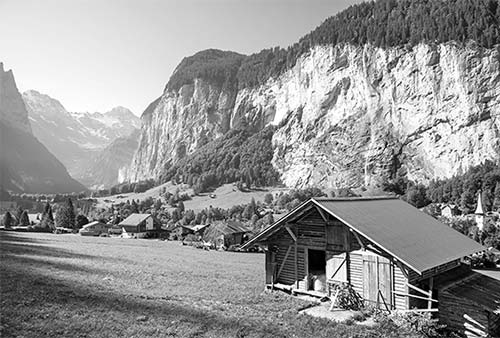
Ideally, spend three nights in the region, with a day exploring each side of the valley. For accommodations without the expense and headache of mountain lifts—and equally handy to both sides of the valley—consider the valley-floor village of Lauterbrunnen. But for the best overnight options, I’d stay on the scenic ridge high above the valley, in the rustic hamlet of Gimmelwald or the resort town of Mürren. I’ve also listed a few options in other nearby mountain villages.
If you like to hike, it’s easy to fill a week of unforgettable days based in the region (either from a home base, hiking from high-mountain hotel to high-mountain village, or doing a mix).
If your time is very limited, spend at least one night: Consider a stay in Gimmelwald, breakfast at the Schilthorn, an afternoon doing the Männlichen-Kleine Scheidegg hike, and an evening train out. A nature lover not spending the night high in the Alps? Alpus interruptus.
The highest-altitude lifts are very expensive, and it only makes sense to splurge if you have a good chance of seeing an alpine panorama instead of fog or clouds. Let your plans flex with the weather. If it’s good—go! Webcams showing live video from the peaks are at Jungfrau.ch, Schilthorn.ch, and on video monitors at lift stations. For general weather reports, visit Meteoswiss.Admin.ch (enter the town name under “Local forecasts”) or Meteo.Search.ch.
For a summary of the wildly scenic activities this region has to offer (from panoramic train rides and lifts to spectacular hikes and mountain biking), see “Activities in the Berner Oberland” on here.
GETTING AROUND THE BERNER OBERLAND
For more than a century, this region has been the target of nature-worshipping pilgrims. And Swiss engineers and visionaries have made the most exciting alpine perches accessible.
By Lift and Train
Part of the fun here—and most of the expense—is riding the many mountain trains and lifts (gondolas, cable cars, and funiculars).
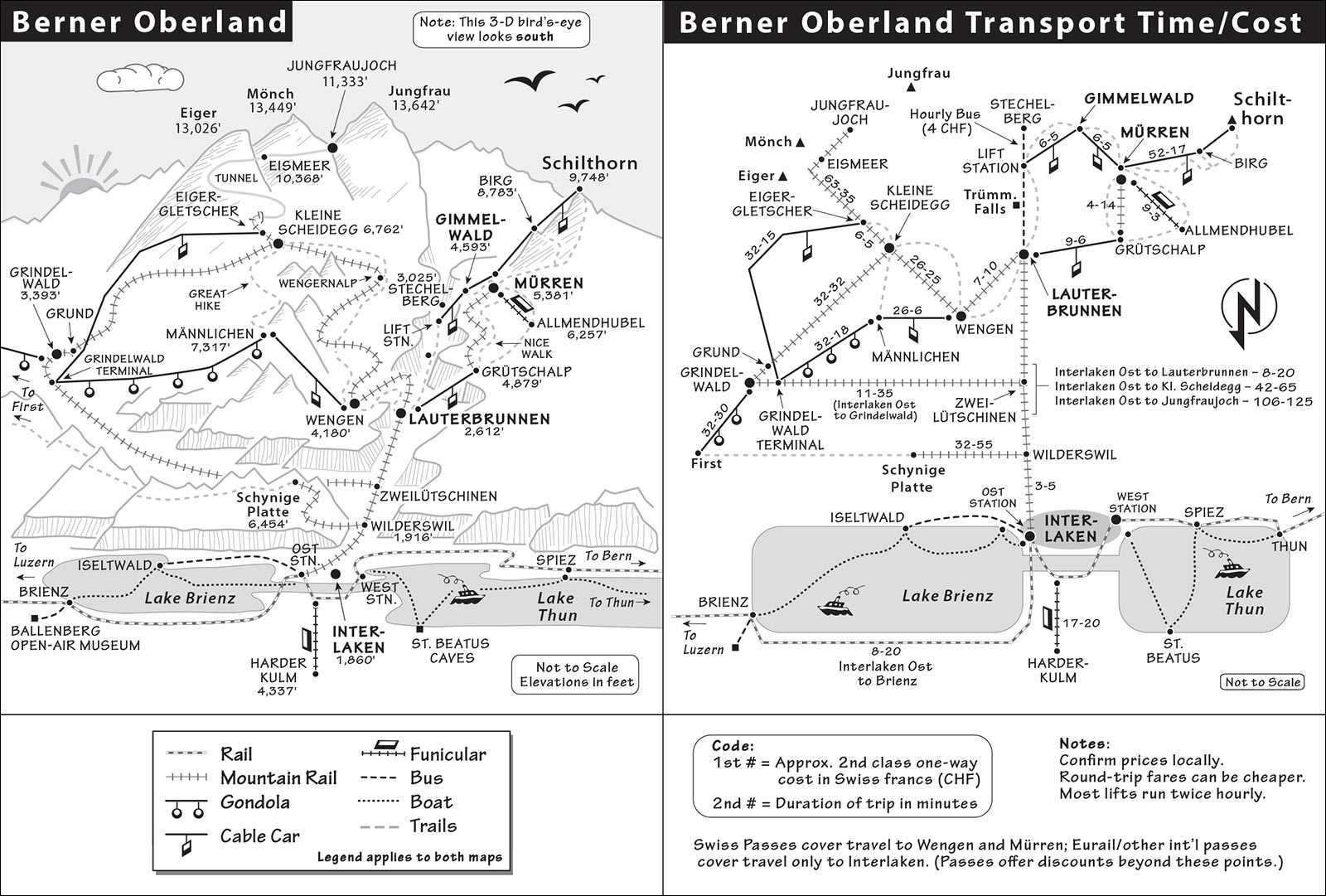
Trains connect Interlaken to Wilderswil, Lauterbrunnen, Wengen, Kleine Scheidegg, the Jungfraujoch, and Grindelwald. Lifts connect Wengen to Männlichen and Grund (near Grindelwald); Grindelwald to First, Männlichen, and Eigergletscher; Lauterbrunnen to Grütschalp (where a train connects to Mürren); and the cable-car station near Stechelberg to Gimmelwald, Mürren, and the Schilthorn.
For an overview of your many options, study the “Berner Oberland Transport Time/Cost” map (above) and the “Berner Oberland at a Glance” sidebar on the next page. Lifts generally go at least twice hourly, and the nationwide timetable at Rail.ch includes their schedules. Lift schedules sometimes flex with demand, adding extra departures in between the scheduled ones.
Train Station Ticket Offices: Ticket offices typically close at 19:00 or 19:30. You’ll find ticket machines on the platforms, but if you need to talk to a real person, don’t wait too late in the day.
Passes and Deals: Trains and lifts can get expensive here—consider money-saving passes. If you have a Eurail Global Pass, trains and lifts beyond Interlaken are 25 percent off (doesn’t require a flexi-day); with the Swiss Travel Pass, they’re covered up to Wengen (above Wengen, pass holders get 25-50 percent off) and up to Mürren (ascending from there to the Schilthorn is 50 percent off). While those two passes are the best option for most Swiss trips using public transportation (both described starting on here), there are a few others to consider: The Berner Oberland Regional Pass covers most trains, buses, and lifts in this area (and all the way to Bern, Luzern, Gstaad, and Birg) but costs about the same as the more versatile Swiss Travel Pass (www.berneseoberlandpass.ch). The Jungfrau Travel Pass is more limited in scope, covering transportation on the east side of the valley, plus from Lauterbrunnen to Mürren via Grütschalp; it’s worth considering only if you’re focusing exclusively on the Wengen-Kleine Scheidegg-Jungfraujoch area (3-8 day versions available, from 190 CHF, www.jungfrau.ch). And the Junior Travelcard, valid across Switzerland for families traveling with children, lets kids ages 5-16 travel free with at least one parent (children under age 5 already travel free; 30 CHF/one child, 60 CHF/two or more children, buy at Swiss train stations).
Individual lifts offer a changing assortment of discounts—ask about deals for early-morning and late-afternoon trips, youths, seniors, families, groups (assemble a party of 10 and you’ll save about 25 percent), and special promotions. Generally, round-trips are double the one-way cost, though some high-up trains and lifts are 10-20 percent cheaper when you buy a round-trip. It’s possible to buy a package covering all of your planned lifts at once, but you’ll lose the flexibility to change with the weather.
By Car
Interlaken, Lauterbrunnen, and Stechelberg are accessible by car. You can’t drive to Gimmelwald, Mürren, Wengen, or Kleine Scheidegg, but don’t let that stop you from staying up in the mountains: Park your car and zip up on a lift. For the lift to Gimmelwald, Mürren, and the Schilthorn, use the pay parking lot at the cable-car station near Stechelberg (this is the cheapest long-term parking in the valley, and almost never fills up). For the train to Wengen or Kleine Scheidegg, use the pay parking garage behind the train station in Lauterbrunnen.
By Bus
The handy PostBus #141 connects points along the upper part of the valley, making a 20-minute run from Lauterbrunnen to Trümmelbach Falls to the Schilthornbahn cable-car station to the village of Stechelberg (2/hour, Lauterbrunnen-Schilthornbahn costs 4.40 CHF, pay driver, covered by many transit passes, www.postauto.ch).
HELPFUL HINTS IN THE BERNER OBERLAND
Public Transit Schedules: Use the nationwide timetable at Rail.ch (it includes trains, buses, and lifts). Scheduled departures for each stop are posted there, but general printed schedules are hard to find. Most timings are regular and easy to memorize (for example, departures at 10 and 40 minutes past every hour). Trains and buses are smartly synced to minimize waits between connections. Upon arrival at any connection, you can count on seeing the connecting departure time posted.
Closed Days: On Sundays and holidays (including lesser-known religious holidays), small-town Switzerland is quiet. Lifts and trains run, but many stores are closed.
Visitor Cards (Gästekarten): Hotels issue free Visitor Cards (paid for by your room tax) that include small discounts on some sights, as well as other perks that vary by town, such as free bus service in Interlaken.
Money: Interlaken, Lauterbrunnen, and Wengen have plenty of banks and ATMs, but there is no bank or ATM in Gimmelwald nor Mürren. Some high-country hotels and restaurants accept only cash. Plan accordingly.
Rainy-Day Options: When it rains here, locals joke that they’re washing the mountains. If clouds roll in, don’t despair. They can roll out just as quickly. With good rain gear, proper shoes, and the right choice of trail, you can thoroughly enjoy a hike in the rain, with surprise views popping out all around you as the clouds break. Some good bad-weather options are the North Face trail (but avoid the steep-and-slippery detour to Sprutz waterfall), the easy downhill amble from Mürren to Gimmelwald, the walk from Allmendhubel to Grütschalp or Grütschalp to Mürren, the Sefinen Valley hike to Kilchbalm, and the Lauterbrunnen Valley walk. Also consider a visit to Trümmelbach Falls, the Swiss Open-Air Museum at Ballenberg, or the Lauterbrunnen Valley Folk Museum. Don’t stress needlessly about depressing weather forecasts—the icons on your weather app can be deceptive. Many “rainy days” are mostly dry and sunny.
Local Guidebook: For in-depth information on the area’s history, folk life, native plants and animals, and hiking options, consider Don Chmura’s Exploring the Lauterbrunnen Valley (sold at Lauterbrunnen TI).
Local Hiking Guide: Licensed private hiking guide Doris Schmied knows local flora, fauna, and culture (contact her for rates, +41 79 689 9816, www.doris-hike.ch).
Skiing and Snowboarding: This is a great winter-sports destination, with good snow on higher runs, nice variety, relatively reasonable prices, and a sense of character that’s missing in swankier resort areas. You can even swish with the Swiss down the world’s longest sledding run (9 miles long, out of Grindelwald, open only when snow’s good). Three ski areas cluster around the Lauterbrunnen Valley: Mürren-Schilthorn (best for experts), Kleine Scheidegg-Männlichen (busiest, best variety of runs), and Grindelwald-First (best for beginners/intermediates, but lower elevation can make for iffier snowpack). For info, see Jungfrau.ch/winter. For more tips, see the Switzerland in Winter chapter.
Hiking Tips: Trails are clearly marked with a signpost at each intersection. Yellow means an easy walk; harder ones are in red and white, and for those, I borrow hiking poles. Your hotel or B&B can likely loan you a set. Poles make my hike much easier, safer, and more relaxed. While helicopters are generally busy making deliveries to high-altitude guesthouses and eateries, they are also standing by for emergency rescues. (Calling 1414 is SOS here in the Alps; from a US phone dial +41 333 333 333.) For more tips, see the “Hiking in the Berner Oberlander” sidebar, later.
Picnic Lunches: My favorite alpine lunches are high-altitude picnics. Co-op and Migros grocery stores (in most villages and near most train stations) seem to be stocked with hikers in mind. A fine picnic for two (fresh bread, local meat and cheese, fruit, vegetables, coffee, and a chocolate treat) is fast, healthy, and can be had for 20 CHF.
Interlaken
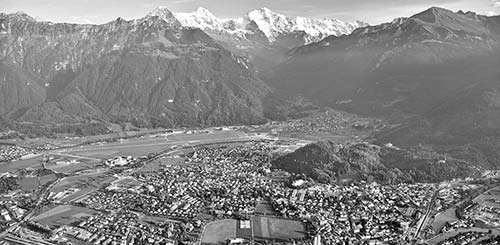
When the 19th-century Romantics redefined mountains as something more than cold and troublesome obstacles, Interlaken became the original alpine resort. Ever since, tourists have flocked to the Alps “because they’re there.” Interlaken’s glory days are long gone, its elegant old hotels eclipsed by newer, swankier alpine resorts. Today the town center has been re-envisioned for the needs of mass tourism. It’s an alpine gateway town whose shops are filled with chocolate bars and Swiss Army knives. Tour guides squeeze their groups into trains and gondolas, and sunburned backpackers nurse adrenaline hangovers.
Efficient Interlaken (pop. 5,500) is, above all, a good administrative and shopping center. Its streets are a strange combination of faded grand hotels, adventure-travel companies, and curry houses. While handy, it’s too bustling and touristy to provide a real mountain experience. Take care of business, give the town a quick look, view the webcam coverage (at the TI) of the weather higher up...then head into the mountains.
Orientation to Interlaken
Interlaken straddles the Aare River, which connects two alpine lakes: Lake Brienz and Lake Thun. The older part of town (called Unterseen) is on the west side of the Aare and has pockets of charm and a cute village square. The newer section (Interlaken proper), with most services and both train stations, is on the river’s east side.
TOURIST INFORMATION
A small TI operates at the Interlaken Ost train station in summer and is convenient if you’re arriving there (daily 10:00-16:00, though hours may vary; closed Oct-May). Otherwise, visit the main TI, located by the post office at Marktgasse 1 (Mon-Fri 8:00-18:00, Sat-Sun 10:00-16:00; shorter hours and closed Sun Oct-May; +41 33 826 5300, www.interlaken.ch). Pick up the hiking guide published by the Jungfraubahn mountain railway (with a good map of the area). The TI sells tickets for the various mountain trains and lifts, and for adventure sports.
ARRIVAL IN INTERLAKEN
Interlaken has two train stations: Ost (East) and West. Major trains generally stop at both stations, but for ease and economy, confirm which station you want when buying your ticket.
Interlaken Ost is the transfer point for narrow-gauge trains to the high mountains (to Lauterbrunnen, Gimmelwald, Jungfraujoch, etc.) and to Luzern. Use this station if you’re headed to those destinations or staying at the recommended Interlaken Hostel (next door). Interlaken Ost has free WCs, lockers, ticket counters, and a summer-only branch TI.
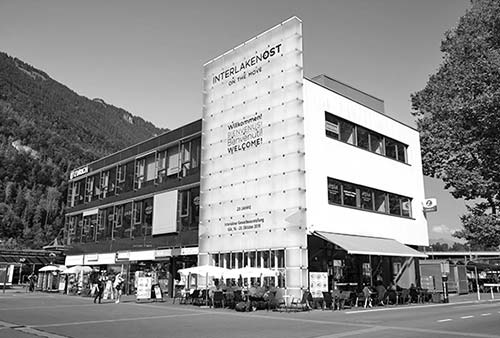
Interlaken West is closer to most of my listed hotels and downtown shopping and services. All trains from western Switzerland—Bern, the Golden Pass, Basel—stop at Interlaken West, and then continue to Interlaken Ost. Interlaken West has pay WCs, lockers (by track 1), ticket counters, and bike rental.
From Interlaken Ost to Interlaken West: It’s a pleasant 30-minute walk between the West and Ost train stations. Otherwise, it’s an easy four-minute trip by train (3/hour, 4.60 CHF), or a 10-minute trip on any of several local buses (#21, #102, #103, or #104; pay 3.60 CHF to the driver, free with Visitor Card). Stops are marked with yellow-and-white PostAuto signs.
Parking: Daytime parking is metered, but you can park free overnight at several spots. Expect to pay about 14 CHF/24 hours.
HELPFUL HINTS
Bike Rental: The Interlaken West train station houses a branch of the Swiss rail system’s bike-rental program (see here). For about the same price, Flying Wheels, a short walk from the Ost train station, is a hip, well-organized, family-friendly outfit that specializes in electric bikes and guided bike tours. Its English-speaking staff give tips on where to go and can help you pick the right bike (bikes—35 CHF/half-day, 39 CHF/day; electric bikes—49 CHF/half-day, 59 CHF/day; includes helmet, daily May-Sept 9:00-19:00 in good weather, shorter hours off-season, across street from northeast corner of Höhematte Park at Höheweg 133, +41 76 453 1464—WhatsApp messages answered, www.flyingwheels.ch). For info on their tours, see “Adventure Sports,” later.
Eiger Sport, a short walk from the West train station, is another bike rental option (bikes—20 CHF/half-day, 30 CHF/day; electric bikes—65 CHF/day; helmets extra, Mon-Fri 8:45-12:15 & 13:30-18:30, Sat 8:45-16:00, closed Sun; from the West train station, cross the river—it’s on the left at Bahnhofstrasse 2, +41 33 823 2043, www.eiger-sport.ch).
“Free” Walking Tours: “Free” tours are actually “pay what you think it’s worth” tours—you’ll be hit up for a tip at the end. Though light on sights and history, they offer a fun city overview and a chance to join a smart local student on a stroll through their hometown (likely Mon, Wed, and Sat at 18:00 from Arab Service Interlaken at Höheweg 95, www.interlaken-walkingtours.ch).
Interlaken Walk
Most visitors use Interlaken as a springboard for high-altitude thrills (and rightly so). But the town does have some history and scenic charm and is worth a short walk. This 45-minute stroll circles from the West train station, down the main drag to the big meadow, past the casino, along the river to the oldest part of town (called Unterseen—historically a separate town), and back to the station. If you’re coming from Interlaken Ost station, walk to the “Fancy Hotel Row” described in the first section of the walk, and start the circuit there.
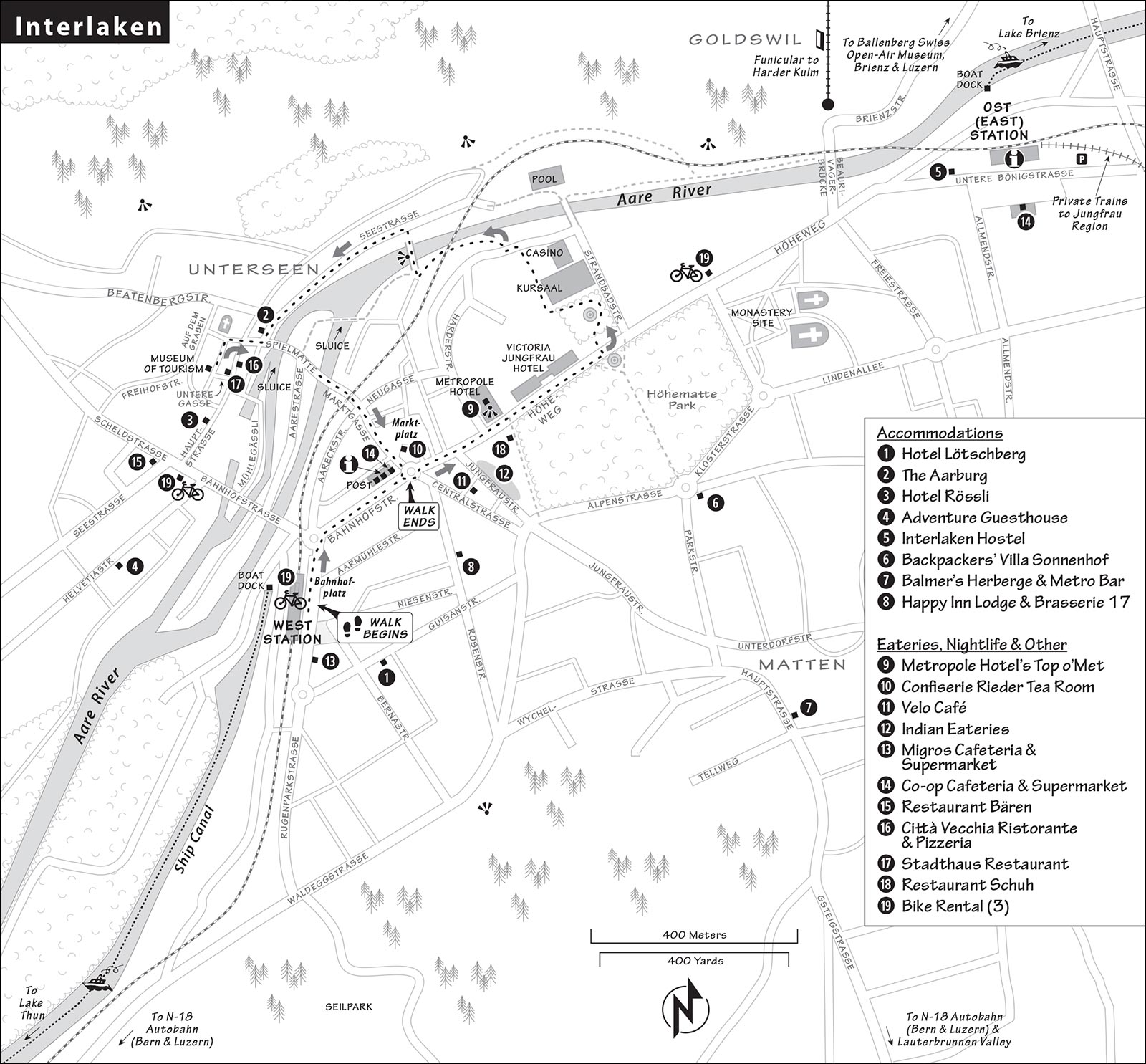
• With your back to the West train station, turn left and walk along...
Bahnhofstrasse: This main drag, which turns into Höheweg as it continues east, cuts through the town center from the West train station to the Ost train station. The best souvenir shopping is along this stretch (finer shops are on the Höheweg stretch, near the fancy hotels). Looking high up to the top of the cliff on your left, notice the pointy dome of Harder Kulm—the historic restaurant at the “Top of Interlaken” (described later).
On your left at the corner of Marktgasse, just past the Hotel Krebs, is a small but handy Co-op grocery store (long hours daily). The TI and post office are in the same building. WCs are inside the round brown structure in front of the Co-op.
Past here, the main drag name changes to Höheweg; on the right at #2, a TV in the window of the Schilthornbahn office shows the weather up top.
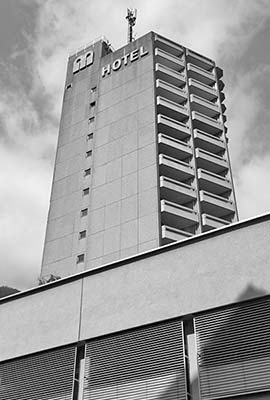
Farther down the street looms the Metropole Hotel (a.k.a. the “concrete shame of Interlaken”)—at 18 stories, by far the town’s tallest building. Step into the main lobby (through the second set of doors) and ride the elevator to the top-floor restaurant for a commanding view of the “inter-laken” area. Gaze deep into the Jungfrau region to the scenic south. A meal or beverage here costs no more than one back on earth (see “Eating in Interlaken,” below). Consider sipping a drink on the outdoor view terrace (or come back tonight—it’s open late most nights).
“Fancy Hotel Row”: The Metropole marks the beginning of Interlaken’s strip of high-end, Romantic Age hotels. Hotels like the Victoria-Jungfrau harken back to the late-19th-century days when Interlaken was the top alpine resort. The first grand hotels were built here to enjoy the views of the Jungfrau in the distance. Today, the junge Frauen getting the most attention are next door at Hooters.
In fact, the odd placement of that restaurant is rooted in local politics. Most of the tourism industry here is locally owned—which is a good thing. But the downside is that local big shots are not above petty village bickering. In this case, the guy who owned this patch of land in front of the classiest hotel in town lost an argument with the hotel’s owner...so, he put up a tacky, low-rise Hooters chain restaurant. That’ll teach him. Meanwhile, the CEOs of the two dominant mountain lifts (the Jungfraubahn and Schilthornbahn) don’t play well together. There’s little coordination, and the map for one system treats the other’s lifts like they don’t exist.
• Now turn your attention to the big field across from those hotels.
Höhematte Park: This “high meadow”—or höhe Matte (but generally referred to simply as “the park”)—originated as farmland belonging to the monastery that predated the town (marked today by the steeples of both the Catholic and Protestant churches, just beyond the far end of the park—neither are of sightseeing interest). The actual monastery site is now home to the courthouse and county administration building. With the Reformation in 1528, the monastery was shut down, and its land taken by the state. Later, as developers started to eye the parkland, the town’s leading hotels and business families bought it and protected it from commercial use (a very early example of smart town planning). Today, this is a fine place to stroll, hang out on the park benches or at Restaurant Schuh, and watch the paragliders gracefully land.
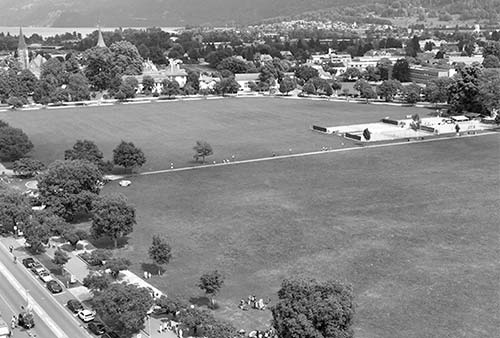
• But for now, we’ll take a detour toward the river. After the Victoria-Jungfrau Hotel, follow the passage on your left (through a shopping arcade) into the grounds of the...
Casino Kursaal: The venerable old Kursaal, originally a kind of 19th-century weight-loss retreat, is now a convention center and casino (passport but no tie required to enter). In the garden, at the top of each hour, dwarves ring the toadstools on the flower clock. And, all day long visitors from India pose at the bronze-colored statue of Yash Chopra—the Steven Spielberg of India, who shot many romantic scenes for his Bollywood films here.
• Circle around the left side of the Kursaal to the river (note the huge public swimming pool across the river—an inviting complex that also has a water slide). Turn left and walk downstream along the riverside path for a few minutes, passing under the train bridge, and cross the pedestrian bridge, stopping in the middle to enjoy the view.
Aare River: This short stretch of Switzerland’s longest river connects Lake Brienz and Lake Thun (with an 18-foot altitude difference that’s controlled by sluices—notice it has quite a flow). From Lake Thun, it heads for Bern and ultimately into the Rhine. In the distance (looking downstream), a church bell tower marks a different parish and the technically separate town of Unterseen, across the river—we’re headed there next. Behind the spire is the pointy summit of the Niesen (like so many Swiss peaks, capped with a restaurant and accessible by a lift).
• Cross the rest of the way over the bridge, turn left, and stroll downstream along the far side of the river, toward the church spire. As you walk, watch on your left for one of those old wooden sluices that help control the river flow. The delightful, tree-lined riverside walk is fronted by fine residences. Notice that your Jungfrau view now includes the Jungfraujoch observation deck (the little brown bump in the ridge just left of the peak).
At the next bridge, turn right and walk a half-block up into the old town square, lined with 17th-century houses on one side and a modern strip on the other.
Unterseen: This was a town when Interlaken was only a monastery, and today it preserves a little of its medieval layout and streetscape. Two recommended restaurants face this square.
In the upper part of the square (behind the big building), the big Tourismuseum sign marks the worthwhile—but generally empty—Museum of Tourism (grandly named, but really a local history museum). It shows off three floors of classic posters, fascinating photos of the construction of the Jungfraujoch, and exhibits on folk life, crafts, and winter sports (8 CHF, covered by Swiss Travel Pass; Wed-Sun 14:00-17:00, closed Mon-Tue and Nov; Dec-April open only Wed and Sun; Obere Gasse 28, +41 33 826 6464, www.touristikmuseum.ch).
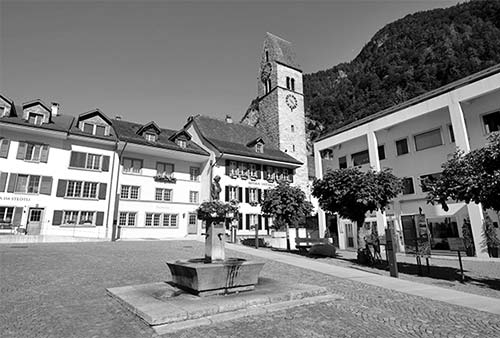
• From the little square, retrace your steps and continue straight across the big bridge, carrying on straight on Spielmatte. From the bridge, watch on your right for another one of those antique sluices.
Soon you’ll reach a second bridge. On the left is yet another old sluice. If you look closely, you’ll notice two heraldic emblems, each featuring an ibex, a wild mountain goat: a yellow one on the left, and a silver one on the right. This marks the border between the two towns/parishes. You’re leaving Unterseen and returning to Interlaken.
Back to the Train Station: You’re just a five-minute walk from the main drag and a 10-minute walk from the West station where we began. Carry on straight past the second bridge, crossing the train tracks. After about three blocks, a little restaurant-lined square called Marktplatz opens up on your left. The river originally ran through here, and the settlement on this side of the river was called “Aarmühle,” named for a mill that was here. But in the 19th century, town fathers mindful of the English tourists flocking here made a key marketing decision: They ditched the difficult-to-pronounce “Aarmühle” and changed the town’s name to the romantic “Interlaken” (between the lakes). Judging from the throngs of tourists on the main drag, that was a smart decision.
• Continuing straight ahead, you’ll run into Bahnhofstrasse/Höheweg again. Turn right to head back to the West station—or turn left to go back toward Höhematte Park and, beyond it, the Harder Kulm funicular and the Ost station.
Sights and Activities near Interlaken
▲▲Swiss Open-Air Museum at Ballenberg
Hünegg Castle (Schloss Hünegg)
Oberhofen Castle (Schloss Oberhofen)
For hikes and walks in the Berner Oberland, see here.
EASYGOING EXCURSIONS
▲▲Swiss Open-Air Museum at Ballenberg
At the far end of Lake Brienz from Interlaken, the Ballenberg open-air museum is a rich collection of more than 100 traditional and historic buildings brought here from every region of the country. All the houses are carefully furnished, and many feature traditional craftspeople at work. The sprawling 50-acre park, laid out roughly as a huge Swiss map (Italian Swiss in the south, Appenzell in the east, and so on), is a natural preserve providing a wonderful setting for this culture-on-a-lazy-Susan look at Switzerland.
Cost and Hours: 28 CHF, covered by Swiss Travel Pass, houses open daily 10:00-17:00, grounds and restaurants 9:00-18:00, entire complex closed Nov-March, +41 33 952 1030, www.ballenberg.ch.
Eating: Along with several eateries, picnic tables and grills with free firewood are scattered throughout the park.
Getting There: The trip from Interlaken to Ballenberg takes about 20 minutes by car (pay parking at either entrance), 50 minutes by train and bus, or 2 hours by boat and bus. By public transport, first go to Brienz by train or boat, then from Brienz to Ballenberg by local bus. Trains for Brienz leave from Interlaken Ost (8 CHF, 2/hour, 15-20 minutes). Boats to Brienz leave from a dock just behind the Ost train station (32 CHF, every 1-2 hours, 1.25 hours, +41 58 327 4811, www.bls.ch).
From the Brienz station or boat dock, catch local bus #151, which stops first at the Ballenberg West museum entrance, then at Ballenberg Ost (1-2/hour, 20 minutes). Use the timetables at Rail.ch to plan your trip, and check bus return times carefully—after 17:15, buses back to Brienz leave only from the park’s west entrance. Without a rail pass, ask for the Ballenberg combo-ticket when buying your train or boat tickets: This covers the complete round-trip from Interlaken (or beyond), and saves about 10 percent off your fare and park entry.
Visiting Ballenberg: Ballenberg has entrances at either end (east and west, about a mile apart). If you start in the east and go west, it’s a generally downhill stroll. Pick up a daily craft-demonstration schedule at the entry, and the free map/guide. There are daily events and demonstrations, hundreds of traditional farm animals (check out the very furry-legged roosters, near the merry-go-round in the center), and a chocolate shop (under the restaurant, just outside the park, on the east side).
There are more historic buildings than you can see in a single visit. Survey your map, note where the demonstrations are happening, and make a plan. Buildings I particularly enjoy are: #1361 (cheese upstairs, cow bells you can ring downstairs); #911 (a big Appenzell house); #611 (barbershop museum upstairs); #321 (sausages hang from the ceiling); and #221 (a house and farm designed for hands-on fun).
Boat Trips
“Interlaken” is literally “between the lakes” of Thun and Brienz, and you can explore these lakes on a lazy boat trip. While more relaxing than exciting—I’d rather spend a sunny day on a high-mountain lift—a lake-boat cruise can be a scenic way to slow your pulse (covered by Swiss Travel Pass or Eurail Global Pass but uses a flexi-day, 5/day July-Aug, 2-4/day spring and fall, +41 58 327 4811, www.bls.ch). You can pay extra for the “first class” top deck, but most people crowd the lower decks; the front deck is smaller but quieter and comes with a nice breeze. The ride begins by heading up a long, boring canal—but then, when the boat reaches the lake, the scenery opens up. From there, boats slowly hopscotch their way up the lake, stopping at middle-of-nowhere docks and offering pleasant views of little shoreline communities and cottages. Returning by train is a good plan, as the boats are slow and run only a few times a day.
Lake Thun: Departing from just behind the West train station (follow signs for Pier One), boats on Lake Thun make stops including the St. Beatus caves (Beatushöhlen, 30 minutes from Interlaken, 16.60 CHF, described next) and two visit-worthy towns: Spiez (80 minutes, 29 CHF) and Thun (2.25 hours, 45 CHF). Consider riding as far as one of these two towns, then zipping back on the train. Note: If disembarking in Spiez, the train station is a dull uphill hike away, but a bus stop is near the boat dock. Buses meet some boats and zip passengers right up to the train station (confirm with boat crew that your boat is coordinated with the bus).
The St. Beatus caves, named after a legendary medieval monk, take about 45 minutes to visit on a self-guided route (19 CHF, daily 9:00-18:00, closed Nov-March, +41 33 841 1643, www.beatushoehlen.swiss). To avoid the hike up to the caves from the lakeshore, follow this plan: Catch bus #21 from either Interlaken station (5.20 CHF, about 2/hour, 15-25 minutes, direction: Thun), get off at the Beatushöhlen stop; tour the caves; take the short, steep hike down to the lake; and return to Interlaken by boat.
Lake Brienz: Departing from behind the Ost train station, boats on Lake Brienz are a fun way to get to the town of Brienz (get off here for the Ballenberg open-air museum; see “Getting There” info under Ballenberg listing, earlier); there’s also a stop at the super-cute village of Iseltwald on the way.
▲Harder Kulm (Harderbahn)
Standing like a pointy little crown on a forested bluff high above Interlaken is a Romantic Age view restaurant that has rewarded a century of visitors with commanding views of Interlaken, the lakes, and the Berner Oberland peaks. While some make the steep climb up from town on foot, most just catch the Harder Kulm funicular—marketed as the “Top of Interlaken”—which leaves from just over the river from Interlaken Ost train station. It’s easy and very scenic, but it’s still a “Berner Oberland Lite” experience, with cut-glass peaks farther away than they are from the many grand lifts near the Lauterbrunnen Valley. I’d go up Harder Kulm only if you’re a mountain-lift completist, or if you’re quickly passing through Interlaken without time to delve deeper. On a nice day, be prepared for lines going up—and going down.
Cost and Hours: 40 CHF round-trip, half-price with Swiss Travel Pass, 25 percent off with Eurail or Interlaken Visitor Card, at least 2/hour, 10 minutes, daily mid-April-late Oct 9:10-21:40, late Oct-late Nov until 17:10, +41 33 828 7233, www.jungfrau.ch (see “Harder Kulm” on the “Experience & Discover” menu).
Visiting the Mountaintop: You’ll ride up in a glass-roofed funicular. From the top station, you’ll walk about five minutes along a ledge to reach the restaurant and nearby viewpoint (at 4,337 feet)—cantilevered to jut out toward the mountain vistas, with Interlaken at your feet. Visitors crowd around on the platform to pose with props: a Swiss flag and a life-size plastic cow.
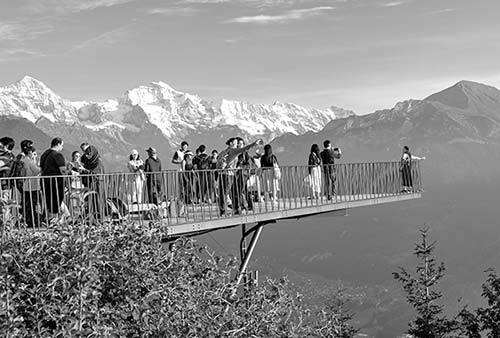
For a slightly more relaxed experience, hike up the little trail just before the restaurant (marked pavilion). Just a few steps takes you above the hubbub, to similar views but without the crowds (and with a few benches for lingering).
The $$ restaurant itself has indoor and outdoor seating—all with grand views—and a predictable menu of Swiss and international standards. Some tables are for the little self-service $ snack bar. In peak season, there’s frequently live folk music out on the terrace.
ADVENTURE SPORTS
High-Adrenaline Trips
Interlaken is a great place for thrill-seekers with money. Choose among rafting, canyoning (rappelling down watery gorges), jet boats, bungee jumping, and paragliding. Costs range from roughly 150 CHF to 200 CHF—more for skydiving and hot-air balloon rides. The dominant operator is Outdoor (+41 33 224 0704, www.outdoor.ch), which offers many of these activities itself and acts as a booking agent for others. Their main office is in Matten, near Balmer’s hostel (Hauptstrasse 15), but they also have a sales point in Interlaken at Höheweg 95, by Höhematte Park. For an overview of additional options, study the racks of brochures at most TIs and hotels.
Rope Courses
Outdoor’s Seilpark offers nine rope courses of varying difficulty and height, giving you a treetop forest adventure through a maze of rope bridges and zip lines—allow two or three hours. Some of the courses are suitable for kids (with supervision).
Cost and Hours: 42 CHF, family deals, no charge for spectators, maximum weight 265 pounds; June daily 10:00-18:00, July-Aug until 20:00, shorter hours off-season, closed Nov-March; last entry two hours before closing time; from Interlaken’s West train station, it’s a 15-minute walk—head right up Rugenparkstrasse and into the park, then look for signs; +41 33 826 7719, www.outdoor.ch (search for “Ropes Park”).
Bike Tours
Flying Wheels offers a guided e-bike tour almost every morning—some days it’s a three-hour tour around Interlaken, touching the shores of both lakes (119 CHF), and other days a six-hour tour of the Lauterbrunnen Valley (219 CHF, includes picnic and Trümmelbach Falls visit). For contact info, see “Helpful Hints,” earlier.
CASTLES
Three impressively well-kept and welcoming old castles in or near the town of Thun are worth considering for day trips (30 minutes from Interlaken by train or car, or about two hours by scenic boat ride).
Thun Castle (Schloss Thun)
Built between 1180 and 1190 by the Dukes of Zähringen, this castle in the center of Thun houses a five-floor historical museum offering insights into the cultural development of the region over some 4,000 years. From the corner turrets of the castle, you’re rewarded with sweeping views of the city of Thun, the lake, and the Alps.
Cost and Hours: 10 CHF, daily 10:00-17:00, shorter hours off-season, Nov-Jan Sun only, +41 33 223 2001, www.schlossthun.ch.
Hünegg Castle (Schloss Hünegg)
Located in Hilterfingen (on the outskirts of Thun), this castle-museum exhibits furnished rooms from the second half of the 19th century. The castle is situated in a beautiful wooded park by the lake, not far from the Hilterfingen boat dock and the #21 bus from Interlaken or Thun.
Cost and Hours: 10 CHF, Tue-Sat 14:00-17:00, Sun from 11:00, closed Mon and mid-Oct-mid-May, +41 33 243 1982, www.schlosshuenegg.ch.
Oberhofen Castle (Schloss Oberhofen)
A 20-minute walk along the lake from Hünegg Castle, this castle is set in a beautifully landscaped park with exotic trees. The castle’s museum explores domestic life in the 16th to 19th centuries, including a Turkish smoking room and a medieval chapel.
Cost and Hours: Gardens—free, daily 9:00-dusk; museum—12 CHF, Tue-Sun 11:00-17:00, closed Mon; both closed off-season, by Oberhofen am Thunersee boat dock, or take bus #21 to Oberhofen Dorf stop, +41 33 243 1235, www.schlossoberhofen.ch.
Nightlife in Interlaken
Lively Nightlife: A young frat-party dance scene rages at the Metro Bar bomb-shelter disco, with cheap drinks and a friendly if loud atmosphere (at Balmer’s hostel, Hauptstrasse 23 in Matten; see lister under “Sleeping in Interlaken”). Brasserie 17 is a more local scene with craft beers on tap and a down-and-dirty pub/sports bar ambience. Thursday evenings often feature live music (also serves food—see listing under “Eating in Interlaken,” in the Happy Inn Lodge hostel at Rosenstrasse 17, +41 33 822 3225).
Mellow Nightlife: To nurse a drink with a park view, the outdoor tables at Restaurant Schuh (on the edge of Höhematte Park) are convenient—if you don’t mind the schlocky music. The Top o’Met restaurant in the Metropole Hotel skyscraper has great indoor and outdoor view seating with reasonable prices, 18 floors above everything else in town (see “Eating in Interlaken,” later). While the interior is lit like a grocery store, the outdoor seating is particularly nice on a warm evening.
Sleeping in Interlaken
Interlaken is not the Alps. I’d sleep in Gimmelwald, Mürren, or at least Lauterbrunnen (20 minutes away by train or car). In ski season, however, prices go down in Interlaken while they shoot up at most mountain hotels. Price ratings given here are for summer; they drop a bit in spring and fall and plunge from November to March.
Hotels and Guest Houses
$$ Hotel Lötschberg has a sun terrace and 18 rooms just a three-minute walk from the West train station, but it’s still residential and quiet. They have a lounge with microwave, fridge, and free tea and coffee (pay parking, laundry facilities, closed Jan-mid-April; General-Guisan-Strasse 31, +41 33 822 2545, www.lotschberg.ch, hotel@lotschberg.ch).
$$ The Aarburg offers nine plain, peaceful rooms over a restaurant in a traditional, beautifully located building just steps from the charming main square of Unterseen, a 10-minute walk from the West train station. Rooms are small, but guests can enjoy the shared lounge (family rooms, limited free parking, Beatenbergstrasse 1, +41 33 820 4460, www.theaarburg.ch, well-run by British Tim and Kat).
$$ Hotel Rössli, in Unterseen, is nicely located, if a bit dated. Their 32 rooms range across comfort levels, including “economy” rooms with a private bath down the hall and “budget” rooms with shared facilities (closed Dec-mid-Jan, elevator, pay parking—reserve, coin laundry, comfy lounge, Hauptstrasse 10, +41 33 822 7816, www.roessli-interlaken.ch, info@roessli-interlaken.ch).
$ Adventure Guesthouse is a cheery, family-friendly, nine-room place with both hostel beds and rooms with private bath, in a quiet residential neighborhood (family rooms, patio, limited free parking, Helvetiastrasse 29, +41 77 456 2338, www.adventure-guesthouse.ch, info@adventure-guesthouse.ch).
Hostels
Interlaken is a prime destination for hostels—with something for every taste, from efficient and institutional to family-friendly and hotelesque to more party-oriented.
¢ Interlaken Hostel is very convenient—right next to the Ost train station in a big, sterile 220-bed modern building, full of daylight and with plenty of amenities (private rooms available, bike rental, pay parking, coin laundry, check-in 15:00-23:00, Untere Bönigstrasse 3, +41 33 826 1090, www.youthhostel.ch/interlaken, interlaken@youthhostel.ch). Their modern, welcoming, self-service restaurant is open to the public and popular with locals for its good value.
¢ Backpackers’ Villa Sonnenhof is a creative, prizewinning guesthouse affiliated with the Methodist church. Wholesome without being restrictive, it’s fun, colorful, and great for families and travelers of all ages (private rooms, family rooms, view rooms have balcony and WC but shared shower, half-board dinner at nearby restaurant, kitchen, elevator, garden, movies, small game room, free entry to public swimming pool and tennis courts, pay parking, laundry; across park from the main drag at Alpenstrasse 16—a level 15-minute walk from either train station, or take bus #102 to Sonnenhof stop; +41 33 826 7171, www.villa.ch, mail@villa.ch).
¢ Balmer’s Herberge is high-energy, youthful, and very social. This 200-bed Interlaken institution is many people’s idea of backpacker heaven, with movies, table tennis, bar, restaurant, kitchen, hot tub, swapping library, excursions, and friendly, hardworking staff. Within a few doors are a laundromat, Co-op grocery store, outdoor adventure booking agency, and pizza and Asian eateries. It can feel like a frat party, especially on summer weekends (reserve far in advance for private rooms; 20-minute walk from either train station, or take bus #104 or #105 to the Hotel Sonne stop; at Hauptstrasse 23 in the suburb of Matten, +41 33 822 1961, www.balmers.com, mail@balmers.com).
¢ Happy Inn Lodge, above the lively, noisy Brasserie 17 pub, has 16 cheap, conveniently located backpacker rooms (3-6 beds/room, bath down the hall), plus two basic doubles with private baths. It’s a decent option for the young and scrappy (five-minute walk from West train station at Rosenstrasse 17, +41 33 822 3225, www.happyinn.com, info@brasserie17.ch).
Eating in Interlaken
In the Heart of Interlaken
$$$ Metropole Hotel’s Top o’Met café/restaurant, capping Interlaken’s 18-story aesthetic nightmare, serves good traditional and modern food at down-to-earth prices, with no gouging on drinks. For 5 CHF, you can enjoy a glass of Swiss wine and awesome views from an indoor or outdoor table. The eclectic menu features Swiss, Italian, and Indian dishes (Mon-Sat 10:00-22:00, Sun until 17:00; hot food served 11:30-14:00 & 18:00-21:30, Höheweg 37, +41 33 828 6666, Marco).
$ Confiserie Rieder Tea Room—on the charming Martkplatz square just off the main drag—is a sweet bit of local elegance tucked away among all the modern tourism. Along with homemade pastries (their specialty is a chocolatey truffle cake) and pralines, they serve light meals of quiche, toast, and salads (Tue-Sat 8:30-18:00, Sun from 11:00, closed Mon, Marktgasse 2, +41 33 822 3673).
$ Brasserie 17 serves a big menu of inexpensive pub food (burgers, salads, ribs, and wings) from behind a long, dark bar where local craft beers are on tap (food served daily 11:30-13:30 & 18:00-21:30, open until at least 23:00, at the Happy Inn Lodge at Rosenstrasse 17, +41 33 822 3225).
Quality Coffee Shop: Interlaken’s hipster coffee joint, $ Velo Café has a tucked-away location, a variety of coffee drinks, and healthy light meals, including breakfast. Choose between the stay-awhile interior, or the streetside terrace (daily 9:00-18:00, Unionsgasse 10, +41 79 902 1626).
$ Global Cuisine: An abundance of restaurants caters to Interlaken’s many international tourists. Jungfraustrasse, a pedestrian street in the center, has a selection of Indian eateries and one lonely Mexican place.
$ Cafeterias: Interlaken’s two large supermarkets have handy cafeterias that are a great bet for a fast, inexpensive, self-service meal amidst a local crowd. Ask them to dish up whatever hot dishes look good or choose a quiche or salad; as they strive to sell out, choices dwindle toward closing. Migros is in a modern mall across the street from the West train station (hours similar to those of the Migros supermarket—see below; free tap water, Rugenparkstrasse 1). The Co-op restaurant is across the square from the Ost train station, upstairs (Mon-Fri 8:00-18:30, Sat until 17:00, Sun 9:00-17:00, Untere Bönigstrasse 10).
Supermarkets: For picnic supplies, the best selection and prices are at the two large supermarkets: Migros near the West train station (Mon-Thu 8:00-20:00, Fri until 21:00, Sat until 18:00, closed Sun), and the Co-op near the Ost train station (Mon-Thu 8:00-19:00, Fri until 20:00, Sat until 18:00, closed Sun). Later in the evening and on Sundays, head to the smaller long-hours Co-op at the corner of Marktgasse and Bahnhofstrasse (daily 7:30-21:00) or the little grocery stores in each train station.
In Unterseen
This sleepy neighborhood, with a charming village feel around its old-world main square, is a fine place for a good meal. Unterseen is just a short walk from the tourist chaos and a 10-minute stroll from the West train station.
$$ Restaurant Bären fills a classic low-ceilinged gingerbread house with cozy indoor and fine outdoor seating. Lovingly run by Hans-Peter and his family, this is my choice for a traditional dinner. It’s a solid value for Rösti, fondue, raclette, fish, traditional sausage, and salads (Wed-Fri 16:30-23:30, Sat-Sun from 10:00, closed Mon-Tue, Seestrasse 2, reserve in advance at +41 33 822 7526).
$$$ Città Vecchia Ristorante and Pizzeria serves good Italian meals in a classy indoor space or outdoors on Unterseen’s leafy main square. It’s top end for an Italian joint so a bit pricey (Thu-Mon 11:30-13:45 & 18:00-22:00, Wed open only at dinner, closed Tue, Untere Gasse 5, +41 33 822 1754).
$$$ Stadthaus, a big, high-energy eatery just across the square, is owned by Wilderswil-born celebrity chef René Schudel. The concept here is quality Swiss food presented without pretense, plus some international dishes. There’s a big, inviting, covered terrace and an interior space that feels like an upscale beer hall (daily 11:00-23:00, Untere Gasse 2, +41 33 822 8689).
Interlaken Connections
Interlaken is connected to Montreux (on Lake Geneva) and Luzern via the Golden Pass scenic rail route (see the Scenic Rail Journeys chapter). Interlaken, Bern, Basel, and Frankfurt are linked by an express train, but for most other destinations you’ll change in Bern. Train info: Rail.ch.
From Interlaken Ost by Train to: Bern (2/hour, 1 hour), Zürich (2/hour, 2 hours, usually with one change in Bern), Zürich Airport (2/hour, 2.5 hours, usually with one change in Bern), Luzern (hourly, 2 hours), Lugano (hourly, 4 hours, change in Luzern and sometimes Arth-Goldau), Zermatt (hourly, 2.25 hours, change in Spiez and Visp), Lausanne (2/hour, 2.25 hours, usually with one change in Bern; longer scenic route via Golden Pass—see the Scenic Rail Journeys chapter).
From Interlaken to the Lauterbrunnen Valley: Note that trains to Lauterbrunnen are covered by the Swiss Travel Pass (or discounted 25 percent with a Eurail Global Pass). Trains to Lauterbrunnen depart from Interlaken Ost (1-2/hour, 20 minutes, 7.60 CHF). You can drive to Lauterbrunnen (20 minutes) or Stechelberg. You can’t drive to Gimmelwald (park at the cable-car station near Stechelberg and ride up on the Schilthornbahn lift) or to Mürren, Wengen, or Kleine Scheidegg (park at Lauterbrunnen train station and take the cable car to Mürren or the train to Wengen or Kleine Scheidegg). For details, see “Lauterbrunnen Valley Connections” on here.
By Car: For a scenic drive from Interlaken to Montreux, Chamonix, or Zermatt, see my recommended driving route on here.
Lauterbrunnen
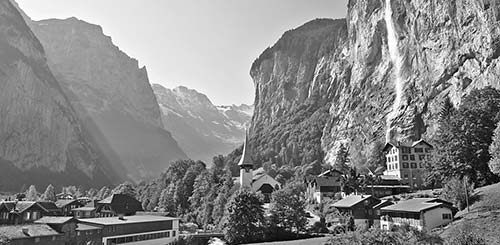
Lauterbrunnen is the valley’s commercial center and transportation hub. Sitting under sheer cliffs in its namesake valley, with its signature waterfall spurting mightily out from the cliff (floodlit at night), Lauterbrunnen is a fine springboard for Jungfrau and Schilthorn adventures. It can get congested—even chaotic—during peak season, especially around the train station. For that reason, I prefer overnighting in Gimmelwald or Mürren, perched on the ledge above the valley.
Orientation to Lauterbrunnen
In addition to its train station and cable car, the town is just big enough to have all the essential services (grocery, bank, bike rental, launderette, and so on)—plus several hotels and hostels. It’s idyllic despite the busy road that slices it in two.
Tourist Information: Stop by the friendly TI to check the weather forecast, find out about guided walks and events, and buy hiking maps or regional train or lift tickets (daily 8:30-12:00 & 13:15-17:00 except closed Mon-Tue in Oct-May; on the main street a few houses up from the train station, +41 33 856 8568, www.lauterbrunnen.swiss).
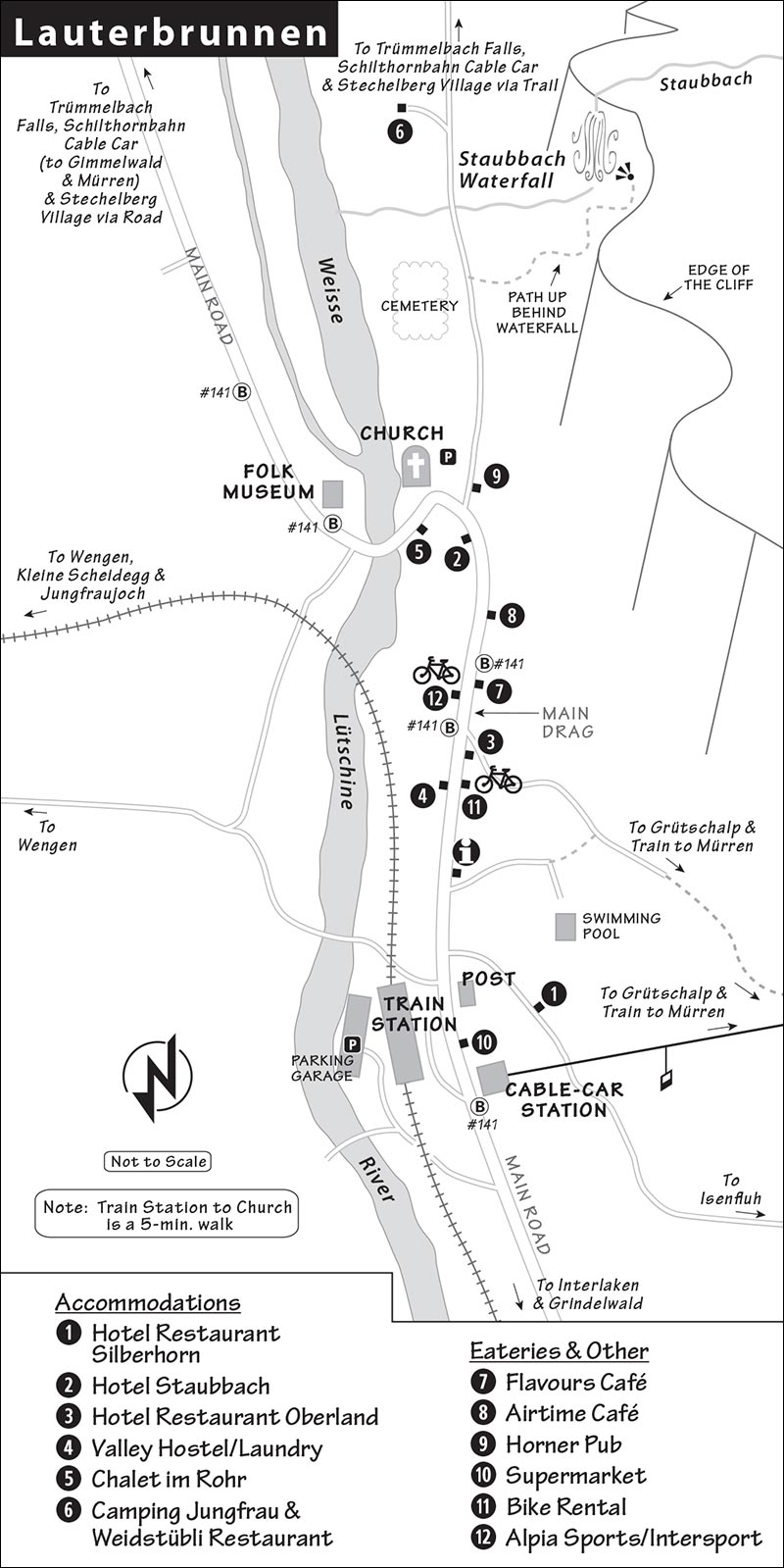
Arrival in Lauterbrunnen: The small, modern train station has a ticket office, a few small lockers (hiding just to the right of the ticket office; check larger bags at ticket desks), and free WCs. Across the main street is the cable-car station; up the ramp to the right is the stop for the PostBus up the valley to Stechelberg (generally parked and ready to depart shortly after each train arrives); and a giant parking garage is on the opposite side of the tracks. Go left as you exit the station to head up the main drag (toward the gushing waterfall) and find the TI and my recommended hotels and eateries.
For drivers, the cheapest parking option is the big outdoor lot by the church (1.50 CHF/hour, 14 CHF/24 hours). The multistory garage behind the station is more convenient if you’re leaving a car here to take a train or lift higher up in the mountains (17 CHF/24 hours). Also, there’s plenty of parking at the Schilthornbahn lift, farther up the valley toward Stechelberg.
HELPFUL HINTS
Medical Help: The Care Mate clinic (with pharmacy) is near the Jungfrau Hotel (look for Arzt sign, English spoken, +41 33 856 2626, answered 24/7).
Money: Several ATMs are along the main street, including one immediately across from the train station.
Laundry: The Valley Hostel has coin-op machines (daily 9:00-21:00, +41 33 855 2008).
Bike Rental: You can rent mountain bikes at Imboden Bike on the main street (reserving online can be smart, bikes—28 CHF/4 hours, 38 CHF/day; electric bikes—38 CHF/4 hours, 50 CHF/day; RS%, includes helmet, Mon-Fri 9:00-17:30, Sat-Sun until 17:00, possibly later in summer, +41 33 855 2114, www.imboden-bike.ch). Make a point to be well-fitted on your bike. Intersport (see next listing) has higher prices but will let you drop bikes in Interlaken for a 10 CHF surcharge.
Sports Gear: Rent summer hiking equipment (boots, poles, baby carriers, via ferrata kits) and winter sports gear (skis and snowboards) at the Alpia Sports/Intersport shop (daily 8:30-12:30 & 13:30-18:30, longer hours in winter, closes for a few weeks in spring and fall, at Hotel Crystal, +41 33 855 3292, www.alpiasport.ch).
Activities in and near Lauterbrunnen
For hikes and walks from Lauterbrunnen, including the “Cloudy-Day Lauterbrunnen Valley Walk” that links Lauterbrunnen to Staubbach and Trümmelbach falls, see here.
Staubbach Falls
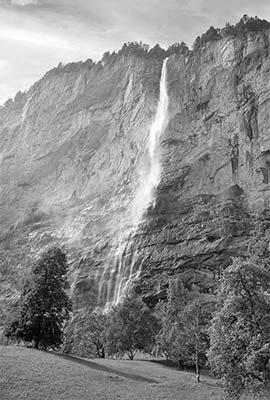
The second highest waterfall in Switzerland (nearly 900 feet) is literally in Lauterbrunnen’s backyard—just follow the side road past the church toward the sound of rushing water. Its spray looks like falling dust—Staub—hence the name. A short trail starting across from the cemetery, by the tree-trunk benches, takes you up a few steep switchbacks to a path cut into the cliff and a delightful little perch behind the falls (there’s a sturdy fence; the path is closed in winter).
▲Trümmelbach Falls
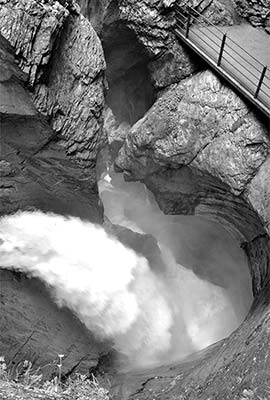
Sneak a behind-the-scenes look at the valley’s most powerful waterfall, Trümmelbach Falls. Ride the elevator up through the mountain, climb to the upper falls, and then hike down through several caves (wet, with lots of stairs, and claustrophobic for some). You’ll see the melt from the Eiger, Mönch, and Jungfrau grinding like God’s band saw through the mountain at the rate of up to 5,000 gallons a second. The upper area is the best; if your legs ache, skip the lower falls and ride down on the elevator. A café (with WC) is directly across from the bus stop. The ticket kiosk and falls are a short walk beyond the café.
Cost and Hours: 14 CHF, children under 4 not admitted, daily 9:00-17:00, July-Aug 8:30-18:00, closed Nov-March, opening date can vary with ice conditions, +41 33 855 3232, www.truemmelbachfaelle.ch.
Getting There: The falls are about halfway between Lauterbrunnen and the Schilthornbahn cable-car station; from either, it’s about a 45-minute walk, or a short ride on the #141 PostBus (Trümmelbachfälle stop, pay driver in cash).
Hang Out with BASE Jumpers
The Lauterbrunnen Valley has become an El Dorado of BASE jumping (the name stands for the four fixed objects parachuters jump from: building, antenna, span, and earth—in this case, cliffs). The world BASE jumping championships are held here. BASE jumpers hike to the top of a cliff, leap off—falling as long as they can (this provides the rush)—then pull the ripcord to release a tiny parachute, hoping it will break their fall and a gust won’t dash them against the walls of the valley. The Lauterbrunnen jumps are considered too tough for beginners—anyone considering BASE jumping should have extensive skydiving experience. Driving up the valley, you’ll see windsocks in fields marking landing places. Unfortunately, several jumpers die here every year.
To learn more about this sport, search for “BASE jumping Lauterbrunnen” on YouTube, visit SwissBaseAssociation.org, or talk with the jumpers themselves. They congregate at the Horner Pub, at the upper end of Lauterbrunnen (near the waterfall). This is the grittiest place in town, providing cheap beds and filling meals for BASE jumpers, with five beers on tap. Locals, jumpers, and tourists gather here in the pub each evening—it’s the town’s only real after-dark scene (daily 12:00-late, dorm beds in 11 rooms, disco Fri-Sat from 22:00 upstairs, +41 33 855 1673, www.hornerpub.ch, mail@hornerpub.ch, run by Charlotte).
Lauterbrunnen Valley Folk Museum (Talmuseum Lauterbrunnen)
This interesting museum shows off the region’s folk culture and two centuries of mountaineering from all the towns of this valley. You’ll see lace, old tools, exhibits on cheese and woodworking, cowbells, classic old photos, and a brass bell—carried from the next valley in 1497—that rang at the church until 1952 (another bell is outside the neighboring village church). Request an English translation booklet.
Cost and Hours: 7 CHF, free with hotel Visitor Card, open limited hours—Wed and Fri 14:00-16:00, Sat 15:00-18:00, closed off-season, over bridge and below church at the far end of Lauterbrunnen town, +41 33 855 3586, www.talmuseum-sagenwelt-lauterbrunnen.ch.
Swimming Pool
Lauterbrunnen’s cute little open-air pool has a great view and is just a minute’s walk up the lane behind the TI.
Cost and Hours: 6 CHF, daily mid-May-June 10:30-18:00, July-Aug from 10:00.
Sleeping in Lauterbrunnen
The price ratings given are for high summer (July-Aug). Expect lower prices off-season (when many hotels close). As free parking is getting hard to find, request it with your hotel reservation. For more peace, choose Gimmelwald or Mürren.
$$ Hotel Silberhorn is a family-run, formal, 40-room hotel. It’s in a very convenient location—a hundred yards uphill from the train station on a quiet side street. Almost every double room comes with a fine view and balcony; you can pay more for waterfall-view rooms clad in warm, knotty-pine woodwork (closed late Oct-mid-Dec, lots of stairs, free parking, dinner available, +41 33 856 2210, www.silberhorn.com, info@silberhorn.com).
$$ Hotel Staubbach, one of the oldest hotels in the valley (1890), is a big, creaky place that’s been nicely upgraded. It has 33 rooms; the ones that face up the valley have balconies and fabulous waterfall views, though you may hear the church bells chiming on the hour. Rooms facing down the valley are a bit cheaper, with no balcony and an “A” rather than an “A-plus” view (family rooms, elevator, free parking, closed mid-Nov-March, 10-minute walk up from station on the left, +41 33 855 5454, www.staubbach.com, hotel@staubbach.com).
$$ Hotel Oberland is smack-dab in the center of town, with 28 tidy rooms, most with balconies and views of the Staubbach waterfall or Jungfrau (family rooms and one apartment, six rooms are in nearby Crystal Hotel annex, no elevator, pay parking, closes a few weeks in late fall, popular with my tour groups, five-minute walk up from station on the right, +41 33 855 1241, www.hoteloberland.ch, info@hoteloberland.ch, Stephen and Rubia).
¢ Valley Hostel is practical and comfortable, offering 92 inexpensive beds in two- to eight-bed rooms for quieter travelers of all ages, plus a pleasant garden (all rooms with shared bath, free parking, open all year, reception open 8:00-12:00 & 16:00-20:00—shorter hours off-season, five-minute walk up from train station, +41 33 855 2008, www.valleyhostel.ch, info@valleyhostel.ch, Abegglen family).
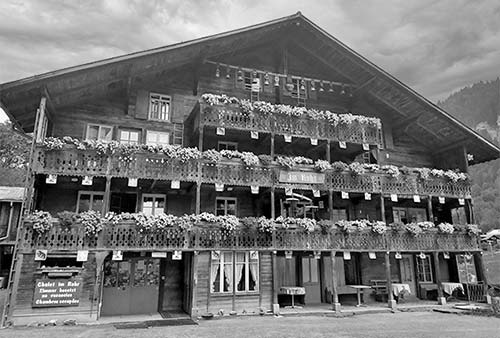
¢ Chalet im Rohr—a creaky, flower-draped, woody time-warp of a place—rents 23 rooms (each with a sink) that are about the cheapest in town. Showers and toilets are down the hall, and the building, while clean, is cheerfully unrenovated—you’ll feel like nothing has changed since the 1970s. Lots of BASE jumpers stay here, and there’s a memorial wall to jumpers who died (cash only, family rooms, no breakfast, common kitchen, lots of stairs, free parking, across from church where main drag curves, +41 33 855 2182, www.chaletimrohr.ch, info@chaletimrohr.ch, Hans and Elsbeth von Allmen-Müller).
¢ Camping Jungfrau, a five-minute drive south of town or 15-minute stroll from the train station, rents two- to six-bed bungalows and cabins, a few dorm beds, and spots for campers. This can be a good deal for families (or small groups) traveling by car who want to stay a few days and cook for themselves. It’s romantically situated along the small lane beyond Staubbach Falls, huge, and well-organized by Manuela. Ample facilities include a recommended restaurant and a grocery store (see listings below), communal kitchen, coin laundry, lounge, ATM, and playground (+41 33 856 2010, www.campingjungfrau.swiss, info@camping-jungfrau.ch).
Eating in Lauterbrunnen
$$ Weidstübli Restaurant, at Camping Jungfrau past the waterfall, has earned a reputation in the valley as a great place to eat. Besides favorite Swiss standards, they do hearty meat and fish dishes, big salads, and vegan burgers. Reservations are wise; choose the bright interior or the attractive outdoor terrace (Wed-Sun 11:30-22:30, closed Mon-Tue and Nov-mid-Dec, +41 33 856 2010, www.weidstuebli.swiss).
$$ Hotel Restaurant Oberland serves good-value meals including traditional Swiss dishes and pizza. It’s a high-volume place with lots of tourists and a huge, streetside front porch. Tables fill quickly, so reservations are a must (daily 11:30-14:00 & 18:00-21:00, dinner seatings at 18:00 and 20:00, +41 33 855 1241, www.hoteloberland.ch).
$$ Hotel Restaurant Silberhorn serves dinner in an elegant dining room with down-to-earth prices. They have all of the Swiss standards, plus good wood-fired pizzas. Call to reserve a view table (daily 18:00-21:00, outdoor seating too, above the cable-car station, +41 33 856 2210).
$$ Flavours, a café without a hint of yodeling or cowbells, serves up full breakfasts, burgers, focaccia sandwiches, fresh-squeezed juices, and gelato (takeaway available, daily 9:00-18:00, kitchen until 15:00, shorter hours off-season, closed Nov-April, +41 33 855 3652).
$ Airtime Café feels like a hipster alpine Starbucks with hot drinks, homemade treats, breakfast, and simple lunches—sandwiches, meat pies, soup, vegan options, and homemade sourdough bread (Fri-Sun 9:00-17:30, kitchen until 16:00, closed Mon-Thu and Nov, +41 33 855 1515, Annette and Fred).
$ Horner Pub, at the upper end of Lauterbrunnen near the waterfall, cranks out budget meals (like pasta, burgers, and raclette), serves breakfast, and has a few outside tables on a side street. It morphs into the town pub in the evenings, with several beers on tap (long hours daily, +41 33 855 1673).
Supermarket: The small but well-stocked Co-op is on the main street across from the train station (daily 8:00-19:00 in summer; Mon-Fri 8:00-18:30, Sat until 17:00, closed Sun rest of year). A smaller grocery is at Camping Jungfrau (daily 8:00-12:00 & 14:30-18:30; call +41 33 856 2010 to check before heading out).
Lauterbrunnen Valley Connections
The valley floor is connected by mountain train, bus, and cable car to the traffic-free villages, peaks, and hikes high above. Prices and trip durations given are one-way and per leg unless otherwise noted.
Getting from Lauterbrunnen to Gimmelwald or Mürren
To reach the mountain villages of Gimmelwald and Mürren, you have two options:
Schilthornbahn Cable Car: This is the most direct way to Gimmelwald, the easiest option if you’re packing heavy, and the most sensible choice for drivers (parking at the cable-car station costs only 11 CHF/24 hours and practically never fills up). First, get to the Schilthornbahn valley station, near the village of Stechelberg at the top end of the valley, either by car (10 minutes) or by PostBus #141 (2/hour, 12 minutes from Lauterbrunnen station, departs five minutes after trains arrive, 4.40 CHF). Then ride up on the breathtaking Schilthornbahn cable car—first stop Gimmelwald (5 minutes), change there for Mürren (5 minutes more). The total bus-plus-cable car cost to Gimmelwald is 10.40 CHF; to Mürren it’s 15.60 CHF.
From Stechelberg, the cable car runs at least twice hourly to Gimmelwald and Mürren (at :25 and :55 past the hour, more frequent during peak season). It runs late into the evening (Sun-Thu until 23:45, Fri-Sat until 24:55), but after 20:00 it’s just once hourly. (The Mürren-Schilthorn route stops running much earlier. Also, be aware that the Schilthornbahn is closed for servicing for a week in April and three weeks in Nov-Dec, at least until a new cable-car lift is finished—see here. During these times, a cargo cable car from the valley floor goes up to Mürren, where a small bus shuttles travelers down to Gimmelwald.)
Grütschalp Cable Car and Mürren Train: This is a slightly quicker, cheaper, and more scenic way to get to Mürren. From the Lauterbrunnen train station, find the cable car station across the street and ride up to Grütschalp, where you’ll immediately transfer to a tiny train. Sit on the left as the train rolls you along the cliffside to Mürren, looking across to the Eiger, Mönch, and Jungfrau panorama. The total trip from Lauterbrunnen to Mürren takes 20 minutes and a through ticket costs 11.20 CHF; if you continue from Mürren down to Gimmelwald on the Schilthornbahn, add 6 CHF. Getting to Gimmelwald this way takes longer and is less convenient (you’ll have to walk across Mürren—about 15 minutes—then take the cable car down in 5 minutes, or hike down in 30).
Trains to Interlaken, Wengen, Kleine Scheidegg, and Jungfraujoch
Lauterbrunnen’s train station has trains to Interlaken Ost (1-2/hour, 20 minutes, 7.60 CHF, covered by Swiss Travel Pass, 25 percent discount with Eurail Global Pass). Also from Lauterbrunnen, cute, old-fashioned, yellow-and-green Wengernalpbahn trains head up the steep cogwheel track twice hourly to Wengen (10 minutes, 6.80 CHF) and Kleine Scheidegg (40 minutes, 30.80 CHF; change here for the Jungfraujoch—see here). Note that the Swiss Travel Pass covers train travel only up to Wengen; buy any supplementary tickets before boarding the train in Lauterbrunnen (or pay a 10-CHF surcharge to buy on board; find the conductor before they find you to avoid a hefty fine). For the best views, sit on the right side—and be ready after the many short tunnels, just before Wengen, for grand views down over the Lauterbrunnen Valley. Feel the cogwheel gripping the tracks as you work your way up the steep incline. In Wengen, you can walk a few minutes up through town to the cable car up to Männlichen, where the spectacular hike to Kleine Scheidegg begins.
Gimmelwald
Saved from developers by its “avalanche zone” classification, Gimmelwald was (before modern tourism) one of the poorest places in Switzerland. Its traditional economy was stuck in the hay, and its farmers—unable to make it in their disadvantaged trade—survived on a trickle of visitors and Swiss government subsidies (and working the ski lifts in winter). For some travelers, there’s little to see in such a village. Others (like me) enjoy a fascinating day sitting on a bench and learning why they say, “If heaven isn’t what it’s cracked up to be, send me back to Gimmelwald.”
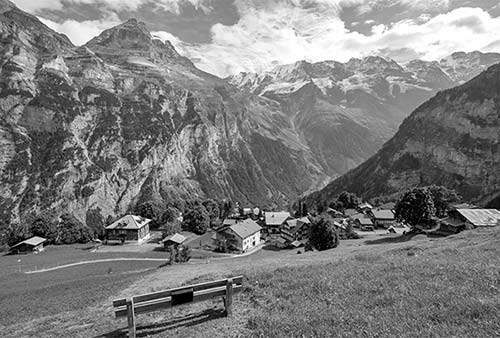
Take a walk through the town. The huge, sheer cliff face that dominates your mountain views is the Schwarzmönch (Black Monk). The three peaks above (or behind) it are, left to right, the Eiger, Mönch, and Jungfrau. Although Gimmelwald’s population dropped in the last century from 300 to about 100 residents, traditions survive. Most Gimmelwalders have one of two last names: von Allmen or Feuz. They are tough and proud. Raising hay in this rugged terrain is labor-intensive. One family harvests enough to feed only about 15 cows. But they’d have it no other way, and, unlike the absentee-landlord town of Mürren, Gimmelwald is locally owned. (When word got out that urban planners wanted to develop Gimmelwald into a town of 1,000, locals pulled some strings to secure the town’s bogus avalanche-zone building code. Today, unlike nearby resort towns, Gimmelwald’s population is the same all year.) Those same folks are happy the masses go to commercialized Grindelwald, just over the Kleine Scheidegg ridge. Don’t confuse Gimmelwald and touristy Grindelwald—they couldn’t be more different.
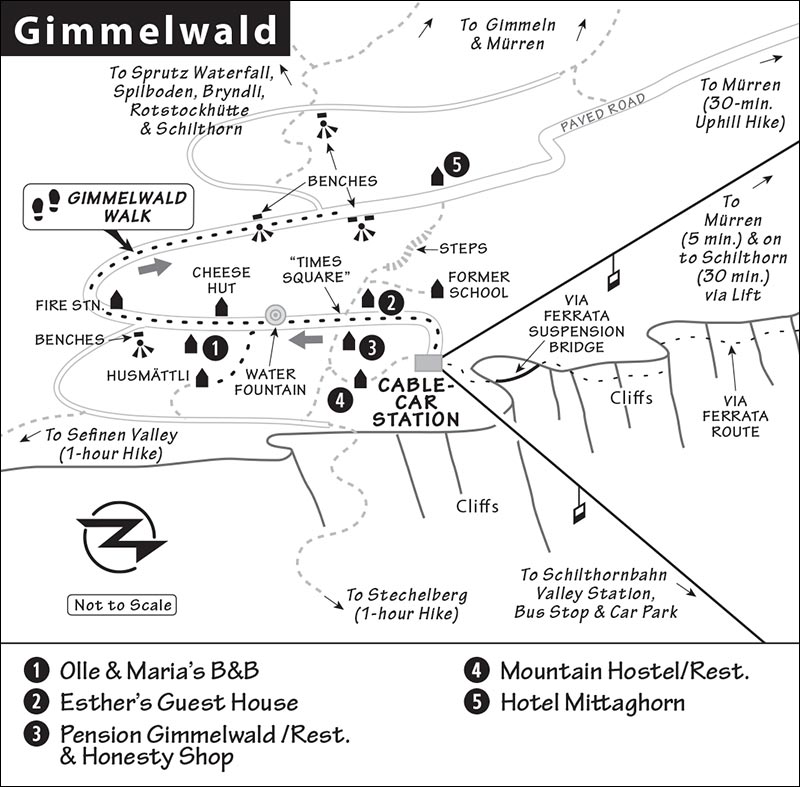
Tourist Information: Gimmelwald has a helpful little website (www.gimmelwald.ch) where you can check out photos of the town in different seasons, get directions for the best hikes from town (under “Summer Activities”), and see all the latest on activities and rooms for rent. For more on hikes from Gimmelwald, see here. And for a bit of Christmas-in-Gimmelwald fun, go to Classroom.RickSteves.com and search for “Christmas Gimmelwald.”
Getting There: See “Lauterbrunnen Valley Connections,” earlier.
Gimmelwald Walk
Gimmelwald, though tiny, with one zigzag street, offers a fine look at a traditional Swiss mountain community.
• Start this quick self-guided walk at the...
Cable-Car Station: When the lift came in the 1960s, the village’s back end became its front door. As you walk out of the station, pause at the big Infopoint map to orient yourself. (You’ll see a QR code that links to an interesting village tour that complements my walk; you can read or listen to its script now or later.) Ready? Let’s turn right (uphill).
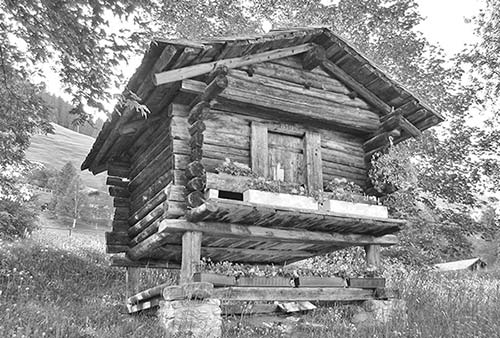
Gimmelwald was—and still is—a farm village. As you start up the street, you’ll see a sweet little hut on the right. Set on stilts to keep out mice, the hut was used for storing cheese (the rocks on the rooftop are not decorative—they keep the shingles on through wild storms).
Behind the cheese hut stands a former village schoolhouse, long the largest structure in town. (In Catholic Swiss towns, the biggest building is the church; in Protestant towns, it’s the school.) Gimmelwald’s students now go to school in Lauterbrunnen, and the building is used as a chapel when the Protestant pastor makes his monthly visit. The little gray tower of loudspeakers on the roof is the town fire siren. Now turn around: On the other side of the street, next to the little playground, is a bench with a nice view, and just beyond it is the recommended Mountain Hostel.
• Walk up the lane 50 yards to Gimmelwald’s...
“Times Square”: The yellow alpine “street sign” shows where you are, the altitude (1,370 meters, or 4,470 feet), how many hours and minutes it takes to walk to nearby points, and which tracks are serious hiking paths (marked with red and white, and further indicated along the way with red and white patches of paint on stones). You’re surrounded by buildings that were built as duplexes, divided vertically right down the middle to house two separate families.
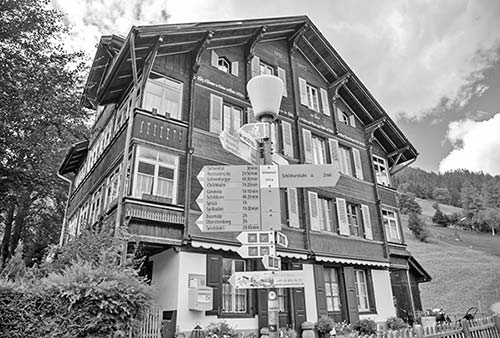
Behind the street sign, the lettering high up on the post office building is a folksy blessing: “Summer brings green, winter brings snow. The sun greets the day, the stars greet the night. This house will protect you from rain, cold, and wind. May God give us his blessings.” The yellow box is a reminder that, small as Gimmelwald is, it still has daily mail service. Someone comes down from Mürren’s post office each day to deliver and pick up mail. The date on this building indicates when it was built—or maybe rebuilt (1911). Gimmelwald has a strict building code: For instance, shutters must be of wood and can only be painted certain colors.
Just down the lane to the left is the recommended Pension Gimmelwald (with rooms, a restaurant, and their wonderful Schwarz Mönch craft beer on tap). Look for the Honesty Shop featuring local crafts and little edibles for sale (summer only). Beyond is the Mountain Hostel, which welcomes all for a drink, pizza, or snack on its fine terrace.
• From this tiny intersection, walk away from the cable-car station and follow the town’s...
Main Street: Head up the road about 30 yards to the next yellow sign post. Generations ago, Gimmelwald had more than twice the population and needed to produce more food. The scant remains of the terracing above was originally for post-WWII potato patches, now gone wild. All along this walk you’ll also see private garden patches. Until recently, most locals grew their own vegetables, often enough to provide most of their family’s needs. Today, while still widespread, most gardening is a hobby.
On the left (opposite the yellow signpost), notice the announcement board, with notifications such as deals on chainsaw sharpening, upcoming shooting competitions, local small business promotions, and news on community projects.
Walk about 30 yards farther to the big barn with a bovine orchestra of cowbells hanging on its wall, traditional milk canisters, and other farm implements. Just before that (on the right) is another big barn, dated 1995 and built in a modern style. At the far front corner is a cow-scratcher. Swiss cows have legal rights (for example, in the winter they must be taken out for exercise at least three times a week).
Traditionally, barns were small (like those on the hillside high above) and closer to the hay. But with trucks and paved roads, hay can be moved more easily, and farm businesses need more cows to be viable. Still, even a well-run big farm hopes just to break even. A century ago the village had 55 households, and 43 of them lived on farming. Today, just a few working farms survive.
• A few steps farther up the lane, on your right, is a...
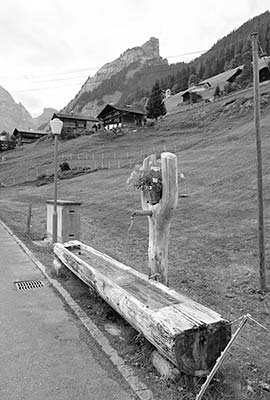
Water Fountain/Trough: This is the site of the town’s historic water supply (see photo on next page). Village kids love to bathe and wage water wars here when the cows aren’t drinking from it. (Many locals drink this water, too, and live to be 100. It’s perfectly drinkable.)
Traditional Swiss cow farmers could make more money for much easier work in another profession. In a good year, farmers produce enough cheese to break even—they support their families on government subsidies. (Throughout the Alps, various governments support traditional farming as much for the tourism as for the cheese.) But these farmers have made a lifestyle choice to keep tradition alive and live high in the mountains.
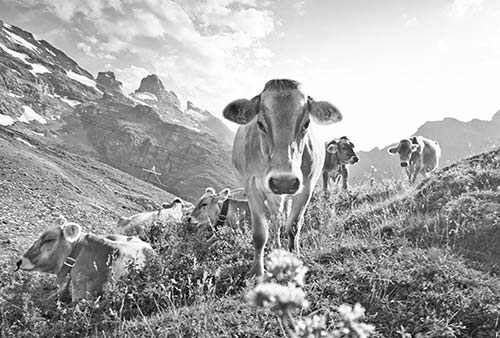
The cows’ grazing ground can range in elevation by as much as 5,000 feet throughout the year. In the summer (usually mid-June), the farmer straps elaborate ceremonial bells on his cows and takes them up to a hut at high elevation. These big bells weigh upward of 10 pounds and, while pricey, they are a proud investment for a humble farmer. When the cows arrive at their summer home, the ornamental bells are hung under the eaves and the cows get more practical bells.
These high-elevation summer stables are called “alps.” Try to find some on a Berner Oberland tourist map (such as Wengernalp, Grütschalp, or Schiltalp). The cows stay at the alps for about 100 days (roughly from June 10 to September 21). The farmers hire a team of cheesemakers to work at each alp—mostly hippies, students, and city slickers eager to spend three summer months in mountainous solitude. Each morning, the hired hands get up at 5:00 to milk the cows; take them to pasture; and make the cheese, milking the cows again when they come home in the evening. In the summer, all the milk is turned into alp cheese (it’s too difficult to get it down to the market in liquid form). In the winter, with the cows at lower altitudes, the fresh milk is sold as milk.
Meanwhile, the farmers, glad to be free of their bovine responsibilities in summer, turn their attention to making hay. The average farmer has a few huts at various altitudes, each surrounded by small hay fields. The farmer follows the seasons up into the mountains, making hay and storing it above the huts. In the fall, the cows come down from the alps and spend the winter in the village, eating the hay the farmer spent the summer preparing for them.
Throughout the year you’ll see farmers moving their herds to various elevations. If snow is in the way, farmers sometimes use tourist cable cars to move their cows. Every two months or so, Gimmelwald farmers bring together cows that aren’t doing so well and herd them into the cable car to meet the butcher in the valley below.
• Detour left down a gravel path (along a wooden fence). First you’ll pass (on your left) another lovingly tended pea-patch garden. With climate change, corn and pole beans are newcomers in the gardens here. Continue downhill along the path 50 yards or so to the corner. Notice the small barn ahead on the left. It’s an 18th-century work of wooden art—cows downstairs and hay upstairs. Just to the right is another water trough in front of a house called...
Husmättli: This is the oldest building in town, from 1658. (There are more 17th-century buildings on the road that zigzags down from Gimmelwald into the Sefinen Valley.) Study the log-cabin construction. Many old houses were built without nails. The wood was logged up the valley and cut on the still-working water-powered village mill (also in the Sefinen Valley).
From the water trough in front of Husmättli, look up to see a house with 10 solar panels on the roof—it’s a B&B run by Olle and Maria, and we’ll be passing there soon. As part of a green energy policy, a Swiss building code requires that new structures provide 30 percent of their own power. Switzerland is gradually moving away from nuclear power; its last reactor is supposed to close in 2034. The panels you see heat the water that Olle and Maria use for bathing and home heating; they fire up their furnace only from November to February.
• Return up the gravel path to the main paved road, turn left, and continue.
Although solar power is here, Gimmelwald still heats mostly with wood—and since the wood needs to age a couple of years to burn well, it’s stacked everywhere.
Twenty yards along, on the left, look for the house with the Self Service sign. Climb the ramp, open the door, and you’ll find a refrigerator with local cheese sold on the honor system by the Rubin family, with their woody portrait keeping an eye on the fridge. (Villagers generally see no need to lock their doors.) While inside, notice the lovingly stacked wall of kindling. Just outside the door, in the summer months, you may see a bunch of scythes hanging above a sharpening stone. Farmers pound, rather than grind, the blade to get it razor-sharp for efficient mowing on slopes too rocky or steep for machines or grazing animals. Feel a blade...carefully.
A few steps farther, notice the cute cheese hut on the right. This is where the cheese you saw on sale was aged (thousands of pounds turned and salted). The hut’s front wall is an alpine art gallery with nail shoes used as flowerpots. Nail shoes grip the steep, wet fields—this is critical for a farmer’s safety, especially when carrying a sharp scythe. Even today, farmers buy metal tacks and fasten them to boots. The hut is full of strong cheese—up to three years old.
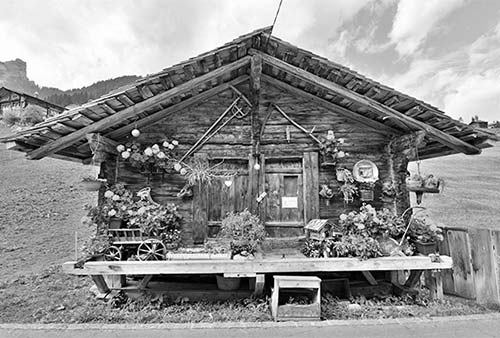
Look up. In the summer, a few goats are kept here behind the hut (rather than at a high alp) to provide families with fresh milk (about a half-gallon per day per goat). The farmers fence the goats in so they eat only this difficult-to-harvest grass.
See the B&B sign on the left? We’ve reached the solar-powered home and inn shared by Olle and Maria, who were the village schoolteachers for over three decades until the local school closed in 2010. (Check out Maria’s cute “Amazing Window Store.” It’s mostly handmade giftables, and the proceeds support local charities.)
• Fifty yards farther along on the right is the house called...
Alpenrose: This is another old village school building, in use from about 1810 to 1930. Now it’s a family home. You might see more ceremonial cowbells hanging under the eaves on the uphill side.
• At the end of town, pause at the tiny viewpoint just before where a lane branches off to the left, leading into the dramatic...
Sefinen Valley: At the bottom of this wild valley is a stream that rushes down toward Stechelberg. All the old homes in town are made from wood cut from the left-hand side of this valley (shady side, slow-growing, better timber) and milled in the water-powered sawmill farther down this road. The recommended hourlong hike down and then up to the head of Sefinen Valley and Kilchbalm starts from here.
• A few steps ahead, the road switches back at the...
Gimmelwald Fire Station (Feuerwehrmagazin): Peer through the cloudy windows in the bottom-floor door at the tractor-like engines. Then walk up around the hairpin bend to the notice board on the side of the building. The Föhnwacht-Reglement sheet explains rules to keep the village from burning down during the Föhn season, a period of fierce dry winds. During this time, there’s a 24-hour fire watch, and even smoking cigarettes outdoors is forbidden. Mürren was devastated by a Föhn-caused fire in the 1920s. Villagers in Gimmelwald—mindful of the safety of their volunteer fire department—are particularly careful. The town hasn’t had a terrible fire in its history (a rare feat among alpine villages).
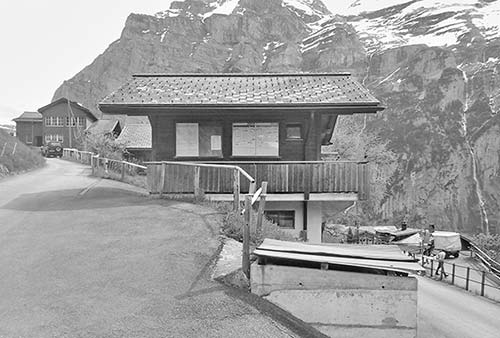
Check out the other posted notices. This year’s Swiss Army calendar tells reservists when and where to go (in all four official Swiss languages). Every Swiss male is required to do a 22-week stint in the military, then serve three weeks a year in the reserves until age 34. The Schiessübungen poster details the shooting exercises required this year.
• Unless you’re really pooped, continue uphill along the road.
High Road to More Views: High on the left, notice the hay field. It’s a festival of alpine flowers in season (best at this altitude in May and June). On the right lives a legendary local gardener and her husband, who’s fanatic about firewood (“trees tremble as he approaches”).
• In a couple of minutes, you’ll reach a peaceful set of benches, through a break in the fence on the downhill side of the lane.
Have a seat and take a moment to relax and savor the view. For decades, this has been a favorite place of mine to sit quietly, appreciate the Alps, and be thankful that I can travel and experience such wonders.
• Continue about 100 yards until you see steps leading downhill on your right, just before Hotel Mittaghorn. Take these steps and you’ll be back at the cable-car station in no time.
Sleeping in Gimmelwald
Gimmelwald is my home base in the Berner Oberland. To inhale the Alps at 4,593 feet and really hold them in, you’ll want to sleep high in Gimmelwald, too. Poor and pleasantly stuck in the past, the village has only a few accommodations options—all of them quirky and memorable. Note that the Visitor Card that comes with your hotel stay gives you free entry to the public swimming pool in nearby Mürren (at the Sportzentrum—described later in this chapter). Be warned: You’ll meet a lot of my readers in this town. This is a disappointment to some; others enjoy the chance to be part of a fun extended family.
$$ Olle and Maria’s B&B has Gimmelwald’s most expensive and comfortable rooms. The Eggimanns’ quirky but alpine-sleek house, where they raised three kids, offers visitors an intimate peek at this community. Two rooms with shared bath are upstairs in the house; there’s also a ground-level studio apartment with its own bath, a kitchenette, and a private entrance (family room available, breakfast optional, three-night minimum, pay cash or with PayPal or Wise, nonrefundable 50 percent deposit required, pay laundry service; from cable car, continue straight for 200 yards along the town’s only road, look for B&B sign on left; +41 33 855 3575, www.olleandmarias.ch, oeggimann@bluewin.ch).
$ Esther’s Guest House rents seven clean, basic, and comfortable rooms. Three rooms have private bathrooms, the other four rooms share two bathrooms, and all share a generous lounge and kitchen (family rooms available—one sleeps up to six, breakfast extra, low ceilings, overlooking the village’s main “intersection,” +41 33 855 5488, www.esthersguesthouse.ch, info@esthersguesthouse.ch). Tobias and Franziska also rent three apartments with kitchenettes next door, sleeping four to eight people.
$ Pension Gimmelwald is an old, low-ceilinged farmhouse converted into a family-style inn, with 10 simple shared-bath rooms, two rooms with private bath, and a duplex apartment that sleeps up to seven at a pinch. There’s a lively restaurant with nice old-style decor and a cozy bar. Its generous restaurant terrace, overlooking the Mountain Hostel, has gorgeous views across the valley (half-board available, open late May-mid-Oct and late Dec-March, two-minute walk up from cable-car station, +41 33 855 1730, www.hotel-pensiongimmelwald.ch, welcome@hotel-pensiongimmelwald.ch, Englishman David and Sabine).
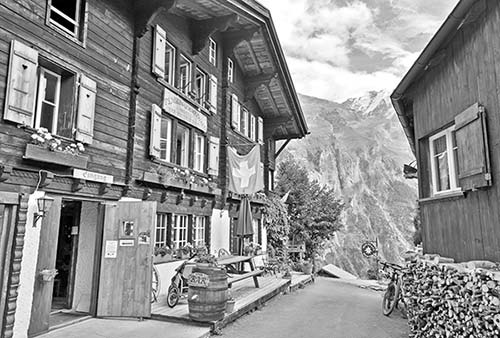
¢ Mountain Hostel is a beehive of activity, as clean as its guests, cheap, respectable, and friendly. The 52-bed hostel has low ceilings and healthy plumbing, and it serves simple meals. There are three large dorm rooms, one reserved for women. They also have four double rooms with shared bath. Janine Wenger runs this relaxed hostel and lines the porch with flowers. Read the signs, respect the house rules, and leave things tidier than you found them (closed Nov-mid-Dec and for about a month after Easter, from the lift station it’s 20 yards up the path to the left, +41 33 855 1704, www.mountainhostel.com, info@mountainhostel.com).
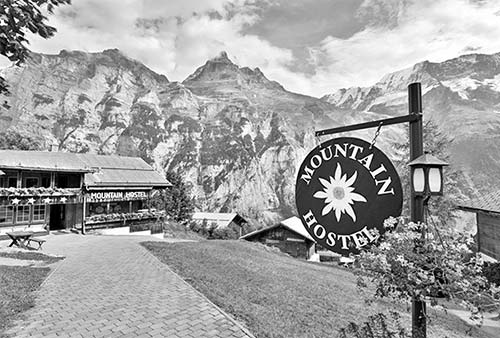
Hotel Mittaghorn, one of my fond favorites, is another option after its renovation is complete (scheduled to reopen in 2024 with new owners; +41 33 855 1470, www.mittaghorn.ch, contact@mittaghorn.ch, Urs and Christine).
Eating in Gimmelwald
$$ Pension Gimmelwald Restaurant serves dinner to 30 people each night at 19:00 (reservations required). You get a three-course meal for 30 CHF (you have no choices, although there’s a vegetarian option). Simple lunches (burgers, soup, nachos) are served 12:00-15:00. Eat in their rustic indoor dining room or on a terrace with a great view. David proudly pours their award-winning, very smooth Schwarz Mönch dark beer. The atmosphere here is jazz-and-blues mellow (daily late May-mid-Oct and late Dec-March 12:00-22:00, closed off-season, +41 33 855 1730).
$$ Mountain Hostel Restaurant specializes in pizza (served 12:00-21:00; the bar stays open later). They also serve breakfast from 7:30 to 9:30 (open daily in summer, weekends only in winter, closed Nov-mid-Dec and for about a month after Easter, +41 33 855 1704).
Picnics: If you can, pack in some supplies from the larger towns. Mürren has a grocery store and good restaurants (see “Eating in Mürren,” later). If you need a few groceries and want to skip the hike to Mürren, you can buy the essentials—noodles, spaghetti sauce, and candy bars—at the little Honesty Shop at Pension Gimmelwald (closed off-season). Farmers post signs to sell their produce. The Rubin family sells cheese and eggs in their house on the town’s main street (see “Gimmelwald Walk,” earlier).
Nightlife: For after-dark entertainment in Gimmelwald, Mountain Hostel is the place. The bar is open until at least 23:00 nightly in season, and occasional live bands come to play (the website says what’s on). Pension Gimmelwald offers a mellow scene with an old-time bar, cozy lounge, and view terrace. And from almost anywhere in Gimmelwald, you can watch the sun tuck the mountaintops into bed as the moon rises over the Jungfrau. If that’s not enough nightlife, stay in Interlaken.
Mürren
Pleasant as an alpine resort can be, Mürren is traffic-free and filled with cafés, souvenirs, old-timers with walking sticks, and snap-happy tourists. Its chalets are prefab-rustic. With help from a cliffside train, a funicular, and a cable car, hiking options here are endless. Sitting on a ledge more than 2,000 feet above the Lauterbrunnen Valley (total altitude: just over a mile high), surrounded by a fortissimo chorus of mountains, the town has all the comforts of home without the pretense of more famous resorts.
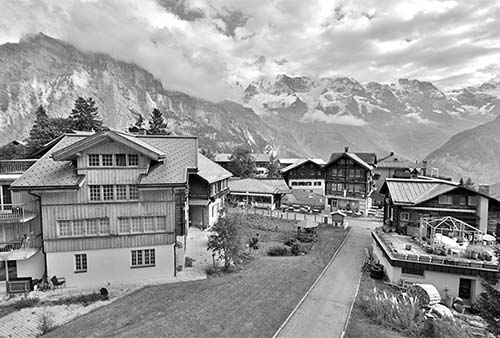
Mürren has been settled for centuries, but its historic character has been overwhelmed by development (unlike Gimmelwald). Still, it’s a peaceful town, with 400 permanent residents—and dropping. There’s no full-time doctor, no police officer (they call Lauterbrunnen if there’s a problem), and no resident priest or pastor. (The Protestant church—up by the TI—posts a sign showing where the region’s roving pastor preaches each Sunday.) There’s not enough business to keep a bank, butcher, or proper bakery open (the only place for provisions is the Co-op grocery store). Depending on the time of year, Mürren is either lively (winter and summer, when the population swells to 4,000) or completely dead (spring and fall).
Getting There: See “Lauterbrunnen Valley Connections” on here.
Orientation to Mürren
Mürren perches high on a ledge overlooking the Lauterbrunnen Valley. You can walk from one end of town to the other in 10 minutes.
Tourist Information: Mürren’s TI, inconveniently located in the sports center uphill from the train station, is a wealth of information (June-Oct and mid-Dec-April daily 8:30-19:30; off-season Mon-Fri 8:30-12:00 & 13:00-17:00, closed Sat-Sun; free WCs, follow signs to Sportzentrum on the upper road—behind the giant old Hotel Alpin Palace, +41 33 856 8686, www.muerren.swiss). Pick up the flier that lists a slew of weekly activities, including a town walking tour (1/week June-Oct and Dec-April, free with your hotel’s Visitor Card, otherwise 20 CHF).
HELPFUL HINTS
Money: There’s no ATM in town, so plan ahead for any cash needs.
Laundry: Find a little self-service launderette in a shed by the side of Hotel Bellevue (open 24/7, but you must buy tokens at the hotel bar).
Bike Rental: You can rent mountain bikes at Intersport (30 CHF/half-day, 40 CHF/day, includes helmet, daily 9:00-12:00 & 13:00-18:00, closed off-season, in middle of town, +41 33 855 2355, www.intersport-muerren.ch). There’s a bigger bike-rental place in Lauterbrunnen (Imboden Bike, described on here).
Sports Center: The slick Sportzentrum that houses the TI offers a world of indoor activities, including table tennis, a fitness room, sauna, hot tub, and steam bath (each with its own opening hours and price; most activities open same hours as TI—see above). The indoor pool (but not the other activities) is free with the Visitor Card given out by hotels and hostels (otherwise 12 CHF, daily 13:00-20:00, until 21:00 in winter, +41 33 856 8686, www.sportzentrum-muerren.ch). A $ café offers a reasonably priced, basic menu, with spacious indoor and outdoor seating (daily 9:00-17:30).
Yoga: Denise (proprietor of the recommended Chalet Fontana) offers yoga classes at the sports center on Wednesdays in summer (€15, RS%, +41 78 642 3485).
Skiing and Snowboarding: The Mürren-Schilthorn ski area is the Berner Oberland’s best place for experts, especially those eager to tackle the famous, nearly 10-mile-long Inferno run. The runs on top, especially the Kanonenrohr, are quite steep and have predictably good snow; lower areas cater to all levels but can be icier. For rental gear, try the friendly, convenient Ed Abegglen shop (best prices, next to recommended Chalet Fontana, +41 33 855 1245), Alfred’s Sporthaus (good selection and decent prices, between ski school and Sportzentrum, +41 33 855 3030), or Intersport (in the town center, +41 33 855 2355). For more info on snow sports, see the Switzerland in Winter chapter.
Mürren Walk
Mürren has long been a top ski resort, but a walk across town offers a glimpse into a time before ski lifts. This stroll takes you through town on the main drag, from the train station (where you’ll arrive if coming from Lauterbrunnen) to the cable-car station.
• Start at the…
Train Station: The first trains pulled into Mürren in 1891. This is the “port” of Mürren. Goods are brought up from Lauterbrunnen on the cable car to Grütschalp, then transferred to the train. Look inside the station for exhibits on the history of the rail line.
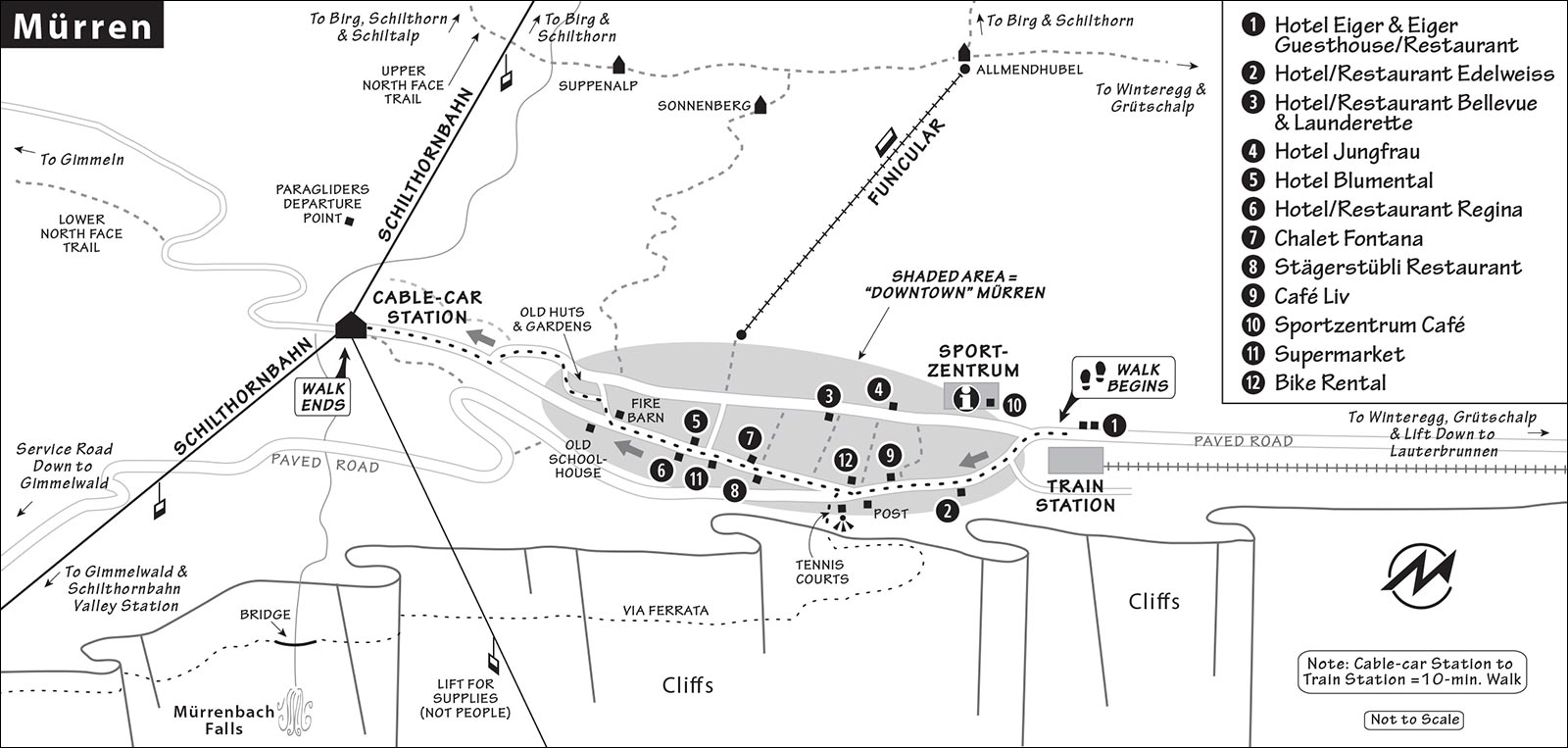
• Wander into town along the main road (take the lower, left fork) for a stroll under the...
Alpin Palace Hotel: This towering place was the “Grand Palace Hotel” until it burned in 1928. Today they’re working on an ambitious renovation. The green meadow below the station on the left is a popular hangout for wild mountain goat and chamois (the animals, not the rags) that seem to understand that they can’t be hunted so close to residences.
• Carry on past the hotel for a...
Cliffside Stroll: Just ahead, the small wooden platform cantilevered over the cliff is where snow-removal trucks dump their loads in the winter. Just beyond, on the right (across from Hotel Alpina), you can fill your water bottle with sweet spring water from the Alps high above. Farther down, Hotel Edelweiss’ restaurant terrace comes with breathtaking views (overhanging a sheer cliff).
Hotels and restaurants crowd the cliff all along this side of town to enjoy views of the big three: Eiger, Mönch, and Jungfrau. Farther along, you’ll pass the inviting outdoor seating of the recommended Café Liv—the closest thing to a Starbucks in town.
• Just after the café, detour from the main street out to the cliff-hanging tennis court. Pause at the far corner of the first court, step up to the small arch, and look down.
Via Ferrata: Directly below, at the base of the modern wall, is the start of the 1.5-mile via ferrata, a “trail” with a steel-cable guide that mountaineers use to venture safely along the cliff all the way to Gimmelwald (see “Activities in Mürren,” later). The steel cable disappears over the cliff and ends at the Gimmelwald lift station (which you can see in the distance). On the hillside above and behind you may see parasailers taking off from above the Schilthorn lift station. Track their flight as they expertly catch the valley updraft (feel it on your face). Farther to the right, the Allmendhubel funicular trundles visitors up to some of the best views in the region—and the start of some glorious hikes (described later). Listen for the river, waterfalls, and avalanches on the far side.
• Backtrack the way you came, then turn left at the Intersport shop onto the main street to reach...
“Downtown” Mürren: At the main intersection, a small service road leads down to Gimmelwald. Stay right (following Schilthornbahn and Mürren signs) and enter the main drag. Here you’ll find my favorite restaurant in town (Stägerstübli), the only grocery store (Co-op), and the best souvenir shop (Abegglen).
A bit farther on, past the faded old Hotel Regina, the tiny fire barn on the right (labeled Feuerwehr) has a list showing the leaders of the volunteer force and their responsibilities. The old barn behind it on the right evokes the time, not so long ago, when the town’s barns housed cows. Imagine Mürren with more cows than people, rather than more visitors than residents.
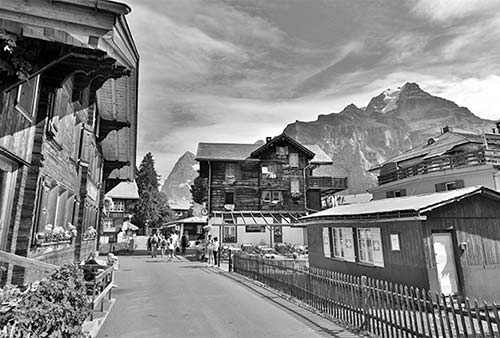
Across from the fire barn is the town bulletin board—with notices targeting both visitors and locals.
About 60 feet beyond the fire barn (across the street from and just before the old schoolhouse—Altes Schulhaus), detour right uphill a few steps into the oldest part of town. Explore the windy little lanes, admiring the ancient woodwork on the houses, 400-year-old timbers that could tell a story, Swiss precision in firewood stacking, and cute little pea patches. Arc your way up and around to the left, eventually returning to the main drag at the Hotel Alpenruh.
• Back on the main drag, continue to the far end of Mürren, where you come to the...
Cable-Car Station: The Schilthornbahn is the critical link connecting Mürren with the valley floor (via the village of Gimmelwald) and the reason most visitors are here—to summit the mighty Schilthorn peak. With ever-larger crowds of skiers in winter and tourists in summer blitzing from the valley floor to the Schilthorn and back, a new, bigger cable car is being built to better serve the town.
• From here you can hike or catch the lift (five minutes) down to Gimmelwald. Or hike back into town along the high road, where you’ll pass Mürren’s two churches, the Allmendhubel funicular station, and the Sportzentrum (with swimming pool and TI).
Activities in Mürren
During ski season and in the height of summer, the Mürren area offers plenty of activities ranging from mild to wild for those willing to seek them out. In spring and fall, Mürren is pretty quiet.
Allmendhubel Funicular (Allmendhubelbahn)
A surprisingly rewarding funicular (built in 1912, renovated in 1999) carries nature lovers in less than four minutes from Mürren up to Allmendhubel, a 6,257-foot perch offering a Jungfrau view that, though much lower, rivals the Schilthorn (without all of the James Bond kitsch). Consider mixing a mountain lift, grand views, and a hike with your meal by eating at the restaurant on Allmendhubel (good chef, open daily until 17:00).
Allmendhubel, with a huge playground, is particularly good for families. This is also the departure point for the North Face hike and walks to Grütschalp (see here for trails from Mürren). While at Allmendhubel, consider its flower trail, a 20-minute loop with nice mountain views and (from July through Sept) a chance to see more than 150 different types of alpine flowers in bloom. At a minimum, simply climb the steep hill behind the playground to reach a stunning viewpoint, with benches looking out over the little restaurant facing all that big scenery.
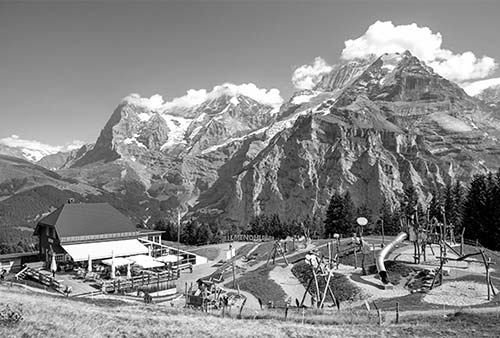
Cost and Hours: 8.80 CHF one-way, 14 CHF round-trip, half-price with Swiss Travel Pass, 25 percent off with Eurail Global Pass, early June-mid-Oct daily 9:00-17:00, runs every 20 minutes, +41 33 855 2042 or +41 33 856 2141, www.schilthorn.ch.
Tandem Paragliding
If you’ve ever wondered what it’s like to soar like an eagle, a tandem paragliding flight will give you a pretty good idea. Two companies offer guided flights that take off just above the Mürren cable-car station and end near the Stechelberg cable-car station. After your pilot rigs you into the tandem harness and gives you a few brief instructions, he’ll take you on a short run downhill and then you’re both up, up, and away—flying gracefully over the Lauterbrunnen Valley, along cliff faces, past waterfalls, and over treetops. Flights last around 15 to 20 minutes...God willing.
Cost: 180 CHF for Mürren-Stechelberg flight, transport to Mürren not included; other flight options available, no experience necessary. Airtime Paragliding is based at the recommended Airtime Café in Lauterbrunnen (+41 79 247 8463, https://airtime-paragliding.ch). Paragliding Jungfrau offers similar tandem flights at similar prices (+41 79 779 9000, www.paragliding-jungfrau.ch).
Mürren Via Ferrata (Klettersteig Mürren)
Mountaineers and thrill-seekers can test their nerves on this 1.5-mile trail along the cliff running from Mürren to Gimmelwald. A via ferrata (“way of iron” in Italian) or Klettersteig (“climbing path” in German) is a cliffside trail made of metal steps drilled into the mountainside with a cable running at shoulder height above it. Equipped with a helmet, harness, and two carabiners, you are clipped to the cable the entire way.
The journey takes about three hours (one-way only, dry weather only). While half of the route is easily walked, for several hundred yards (across what’s called “The Hammer Corner”) you are literally hanging over a 2,400-foot drop. I did it, and through the most horrifying sections, I was too scared to look down or take pictures. Along with ladders and steps, the trip comes with three thrilling canyon crossings—one by zip line (possible with guide only), another on a single high wire (with steadying wires for each hand), and a final stint on the terrifying suspension “Nepal Bridge” (which you can see from the Schilthorn cable-car—look for it just above or below Gimmelwald). For a peek at what you’re considering getting yourself into, search for “Via Ferrata Mürren Gimmelwald” on YouTube.
On Your Own: Experienced mountaineers can rent gear locally and do it independently; others should hire a licensed mountain guide.
With a Guided Tour: The most practical way to experience the via ferrata is to join a guided group tour (149 CHF, includes gear and donation to the Mürren Via Ferrata Association, tours go daily from Intersport in Mürren, June-mid-Oct at 9:10 and 14:10, weather permitting, hiking shoes required—ask about rental, small groups of 4-8, reserve through Outdoor at +41 33 224 0701, www.klettersteig-muerren.ch and www.outdoor.ch).
Nightlife in Mürren
Mürren has several lively, atmospheric places for a drink after dinner (for details on these recommended spots, see “Sleeping in Mürren” and “Eating in Mürren,” next). Tächi Bar at Hotel Eiger is a classy cocktail bar with dancing. For a simpler bar-and-view scene, Hotel Bellevue has elegant alpine-lounge ambience and a great terrace. In summer, you can enjoy occasional folkloric evenings (check with the TI for dates).
Sleeping in Mürren
Mürren is just over a mile high, so if you sleep here you may feel the altitude. These price rankings are based on summer room rates; they often rise during the ski season. Except where noted, all hotels and restaurants listed here close in spring (anywhere from Easter to early June) and again in fall (sometime between mid-Oct and mid-Dec). Half-board, if available, can be a good idea in Mürren.
$$$$ Hotel Eiger, a four-star hotel dramatically and conveniently situated just across from the tiny train station, is a good but expensive bet. Family-run for four generations, Adrian and Susanna Stähli offer all the services you’d expect in a big-city hotel (plush lounge, elegant dining rooms, original art on the walls, indoor swimming pool, exercise room, and saunas) while maintaining an Old World, woody elegance in its 50 business-class yet charming rooms. Their “unique” suites, while pricey, include two double rooms and can be a good value for groups of four or five (grand breakfast, discounts for stays of three nights or more, elevator, +41 33 856 5454, www.hoteleiger.com, info@hoteleiger.com).
$$$ Hotel Edelweiss is all about the location—convenient and literally hanging on the cliff with devastating views. It’s a big, modern building with 42 straightforward rooms (most with balconies) and a busy, recommended restaurant that’s well-run by hardworking Sandra and Daniel Kuster-von Allmen (family rooms, elevator, piano in lounge, self-serve pay laundry, closed Nov-mid-Dec, +41 33 856 5600, www.edelweiss-muerren.ch, info@edelweiss-muerren.ch).
$$ Hotel Bellevue feels country-upscale and authentically Swiss, with a homey lounge, solid woodsy furniture, a great view terrace, the recommended hunter-themed Jägerstübli restaurant, and 19 comfortable rooms—most with balconies and views. It may be under new management in the near future, so some details could change (discount if staying two nights or more in June or Oct, self-serve pay laundry, +41 33 855 1401, www.bellevuemuerren.ch, bellevue@muerren.ch).
$$ Hotel Jungfrau has a classic exterior and a modern interior, with 29 rooms plus two apartments for up to six people (elevator, pay laundry service, close to TI/Sportzentrum on the upper road, +41 33 856 6464, www.hoteljungfrau.ch, mail@hoteljungfrau.ch, Martin and Connie).
$$ Hotel Blumental, once family-run but now owned by the Schilthornbahn lift company, has 14 cozy but dated rooms with woody accents and down comforters, plus six rooms of equal quality in the chalet out back (half-board available; reception sometimes at Hotel Alpenruh, a three-minute walk away; +41 33 855 8856, www.blumental-muerren.ch, blumental@schilthorn.ch).
$ Eiger Guesthouse offers 21 good, small, budget rooms—including some great bunk-bed family rooms—across from the train station, above an easygoing ground-floor pub. Four of the rooms share three sets of bathroom facilities, while the rest are en suite. Ema—born in Portugal but a longtime Switzerland resident—is your host (RS%, closed Nov, +41 33 856 5460, www.eigerguesthouse.com, info@eigerguesthouse.com).
$ Hotel Regina, once a luxury hotel catering to posh English holiday-goers, may be a faded beauty but still has plenty of charm. It has 50 basic rooms (most with shared toilets and showers) and is conveniently located at the cable-car end of town. The owners continue to revive the place bit by bit. For solo travelers, the single rooms are a decent value (family deals, +41 33 855 4242, www.reginamuerren.ch, info@reginamuerren.ch).
$ Chalet Fontana, run by charming Englishwoman Denise Fussell, is a fine budget option, with five simple, crispy-clean, and comfortable rooms with shared bath (closed mid-Oct-April, fridge in common kitchen, across street from Stägerstübli restaurant in town center, +41 78 642 3485, www.chaletfontana.ch, chaletfontana@gmail.com). Denise also rents a family apartment with kitchen, bathroom, and breakfast (in a separate building with a mountain view).
Eating in Mürren
Outside of summer and ski season, only a few places remain open—so plan ahead if you visit during spring or fall.
$$ Stägerstübli, right in the town center, has a big menu, including all the Swiss standards plus some more adventurous meats (including goat, venison, wild boar, and rabbit), cheese Spätzle, and a couple of Asian options. It’s in a 1902 building that was once a tearoom for rich tourists. Locals were limited to the room in the back—which is now the nicer indoor space (you might see grizzled regulars in the front room). Sitting on the broad terrace, you know just who’s out and about in town (Thu-Mon 11:00-23:00, hot food served until 20:00, closed Tue-Wed, +41 33 855 1316, Lydia).
$$ Hotel Edelweiss offers lunch and dinner in the most cliff-hanging setting in town, with Swiss specialties, burgers, pizzas, and salads. It’s family-friendly, the views are incredible, the dining spaces are attractive (despite the boxy exterior), and the prices are good (daily 11:00-20:30, +41 33 856 5600).
$$ Eiger Guesthouse Restaurant, a busy local hangout with a relaxed pub atmosphere, has long hours and a mostly Italian menu (pizzas, meal-sized salads). They also serve fondue, raclette, Rösti, inexpensive house wine, and local beers. A few outdoor tables have partial views (daily 11:30-14:00 & 17:30-22:00, closed Nov, +41 33 856 5460).
$$ Hotel Bellevue’s restaurant is atmospheric, with three dining zones: a spectacular view terrace, a sophisticated indoor area, and the Jägerstübli—a cozy, well-antlered hunters’ room guaranteed to disgust vegetarians. This is a good bet for game, as they buy chamois, wild boar, and deer directly from local hunters (meatless dishes available too; daily 11:30-14:00 & 18:00-21:00, +41 33 855 1401).
$$ Hotel Regina sets out a dinner buffet every day between 18:00 and 20:00. There are several options: soup and salad for 18 CHF; fill a plate with main dishes and salad for 30 CHF; or a full four-course meal for 42 CHF. Check the menu in the afternoon to see what they’re serving (reservations appreciated, +41 33 855 4242).
$ Café Liv is a hip coffee shop with hot sandwiches, smoothies, homemade cakes, and quality coffee, including takeaway (daily 10:00-17:00, less off-season, in town center on the main street, across from tennis courts, +41 76 213 7305).
$ The breezy café at Mürren’s Sportzentrum is good for a sandwich or an afternoon snack, and it is pleasantly away from the crowds (daily 9:00-17:30).
Supermarket: The Co-op has good picnic fixings and sandwiches (Mon-Fri 8:00-18:30, Sat-Sun until 18:00, sometimes closes Tue-Thu afternoons in off-season). This place is a godsend for those on a tight budget.
Activities in the Berner Oberland
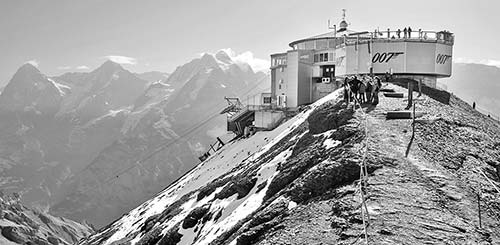
Scenic Rides on Lifts and Trains
The Berner Oberland is famous for its high-altitude thrill rides. I’ve described the best of them here. A nice hot chocolate at 10,000 or even 11,000 feet on a sunny day surrounded by the heart of the Swiss Alps is pretty hard to beat. And those on a tight budget can enjoy the same majesty by taking advantage of much less expensive lifts and hiking (see “Hiking and Biking,” later).
THE SCHILTHORN AND PIZ GLORIA
The Schilthornbahn cable car carries skiers, hikers, and sightseers effortlessly to the nearly 10,000-foot summit of the Schilthorn, where the Piz Gloria cable-car station awaits, with its solar-powered revolving restaurant, shop, and panorama terrace. At the top, you have a spectacular view of more than 100 peaks—starring the Eiger, Mönch, and Jungfrau mountains, all lined up just across the valley. The entire experience is worth ▲▲▲.
Cost: You can ride to the Schilthorn and back from three points—the cable-car station near Stechelberg on the valley floor (108 CHF), cliff-hanging Gimmelwald (97.60 CHF), or the higher Mürren (85.60 CHF).
Hours: Starting from Stechelberg, the ride requires three changes on the way up: at Gimmelwald (5 minutes), Mürren (5 minutes), and Birg; the entire ride, from valley floor to mountaintop, takes about 35 minutes (or about 25 minutes from Mürren). The first Schilthorn-bound lifts leave Stechelberg at 7:25, Gimmelwald at 7:30, and Mürren at 7:35; last lift from Stechelberg at 16:25, last return from Schilthorn at 17:55 (earlier in winter). Note that the Stechelberg-Gimmelwald-Mürren segment runs far longer hours (until about 24:00) than the Mürren-Birg-Schilthorn segment. Lifts run all year, except during maintenance closures (a week in April and three weeks in Nov-Dec). There will be no closures after the eventual opening of a new cable car; read on for details of this project.
Discounts: With a Swiss Travel Pass, you ride free to Mürren then pay half-price to the top; if you have a Eurail Global Pass, you get 25 percent off any ride. Special promotions can save you even more (including a good-value early-morning brunch deal)—check the website or ask when buying tickets.
Information: See Schilthorn.ch or call +41 33 826 0007 for more details and current weather conditions.
Avoiding Crowds: Crowds (mostly mass tourism groups coming up from Interlaken) are a big problem in peak season, especially on weekends (the worst bottleneck is in Mürren). Groups have priority access. Beat the Interlaken hordes by catching an early lift, preferably before 9:30, or a later one—it’s quieter after about 14:30 and the mountains across the valley are bathed in late-day sunlight. You can also reserve a specific lift departure time online at least 24 hours in advance (5 CHF extra); you have the option to use the ticket at another time without a reserved spot.
Project 20XX and Construction Closures: To alleviate congestion at Mürren and get more tourists up and down quicker and easier, a bigger and better cable-car lift is under construction. The project, called “Project 20XX,” may cause some closures (likely in 2024) before it is finished (likely in 2025). For the latest, visit Schilthornbahn20xx.ch.
Visiting the Schilthorn
Ascending the Schilthorn: As the cable car floats up the first stage of the ascent, from Stechelberg to Gimmelwald, you’ll see sweet little farms dotting the valley, the paved trail along the river, a line of tour buses foretelling how many groups are above you, and the treacherous metal “Nepal Bridge” marking the end of the via ferrata cableway hike. On stage two—Gimmelwald to Mürren—you’ll sail above the rooftops of Gimmelwald. You’ll also see fields of wooden tripods, which serve two purposes: They stop avalanches and shelter newly planted trees. Made of wood, they’re designed to eventually rot when the tree they protect is strong enough to survive the winter snowpack. On the third stage, just above Mürren on the way to Birg, look right to see a reservoir building that powers gray shower posts that make snow—a ski-industry necessity in these days of climate change. Keep an eye on the altitude meter. You’ll change cable cars at Birg, midway between Mürren and the Schilthorn.
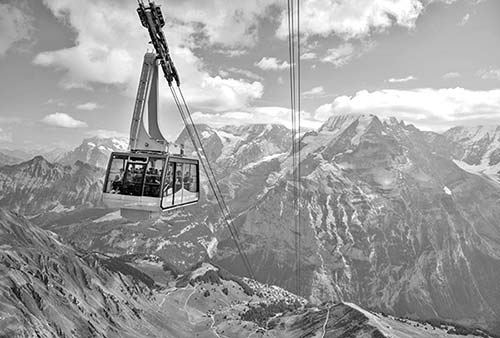
Birg Station (8,783 Feet)
If you’re heading to the Schilthorn summit and the weather’s good, skip Birg for now and go directly to your connecting cable car. On the way back down, plan on 30 minutes here, which is plenty of time for Birg’s two high-altitude attractions. Or linger longer and enjoy the Birg cafeteria (which I prefer to the Schilthorn’s).
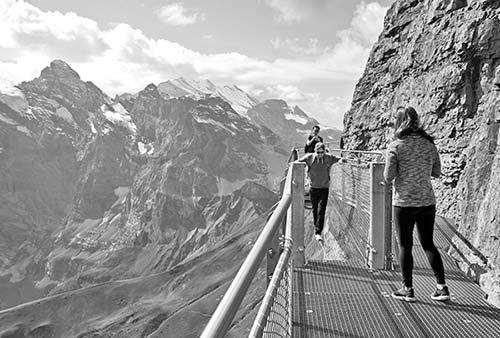
Birg’s two activities are a viewing platform (called the Skyline Walk) and the Thrill Walk. Free to enter, the Thrill Walk is a 600-foot-long catwalk bolted to the cliffside. If walking the see-through metal catwalk seems tame to you, along the way you can choose to tightrope across a cable bridge (there’s a net below), cross a section of glass flooring, and crawl through a chain-link tube—all with airy views to the valley far below.
Schilthorn Summit Sights (9,748 Feet)
Remember, you’re here for the view—and it can disappear for the rest of the day in minutes. (The Schilthorn peak doubles as an ideal cloud-catcher.) So, if it’s sunny when you arrive, ignore the indoor attractions—head outside on the deck and enjoy the vistas until you’re satiated.
Upon arrival, head up two escalators to the Skyline View Platform (or go to the right out of the lift to zip up on the elevator). On this stark, often very cold, and scenic patio, information boards identify the peaks, and directional signs point hikers toward some seriously steep downhill climbs. There are plenty of James Bond-themed photo ops (this mountain was one of the major locations in the 1969 film On Her Majesty’s Secret Service). The big, round viewing scopes identify each peak as you survey the panorama; the pink scopes magnify. Note that the classic “Eiger, Mönch, Jungfrau” panorama is on the opposite side from the big platform. Watch paragliders set up, psych up, take off, and fly with the birds. In summer, live folk musicians often perform here (typically June-Aug 11:00-15:00). A highlight for travelers from arid lands is the “touch the snow” corner created by a hard-working little snowmaking machine.
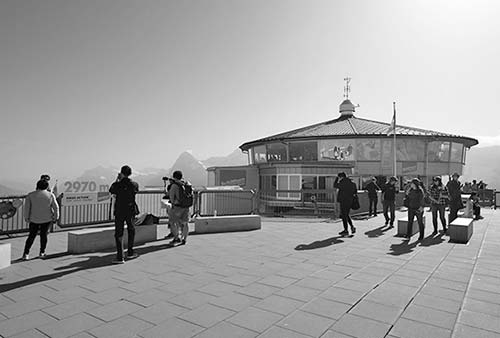
Find the stairs near the view terrace to walk along the ridge out back—the 007 Walk of Fame, where cast and crew members from the film have left their handprints and personal messages. At the end of this is the Piz Gloria view platform, offering great views back at the revolving restaurant with the mountains beyond. If you dare, let yourself through the gate by the platform and walk carefully along a gravelly, borderline scary trail (with no railings) to leave the crowds behind and really feel rugged. This is a great place for a photo of the mountain-climber you.
Piz Gloria Station: Once you’ve been outside, or if the weather is foul, consider a drink or a bite at the 360º $$ Restaurant Piz Gloria (top floor, up the stairs). In this revolving restaurant, you’re invited to sit and slowly spin—viewing all the scenery from the comfort of your chair through cloudy windows. The restaurant serves drinks (including hot cocoa), salads, soups, and main dishes all day. Or consider the 35-CHF James Bond Brunch, with breakfast items (8:00-11:00), then soups, salad bar, and warm dishes until 14:00 (after that, it’s à la carte only). If you’re heading up hungry in the morning, pay for brunch down below, where you’ll get a discount. Reservations can be smart for Piz Gloria (+41 33 826 0007, or at www.schilthorn.com). A much less expensive $ snack bar/cafe is on the main level with tables inside and out on the view patio. (And remember, there is a better, equally scenic dining option at the Birg Station.)
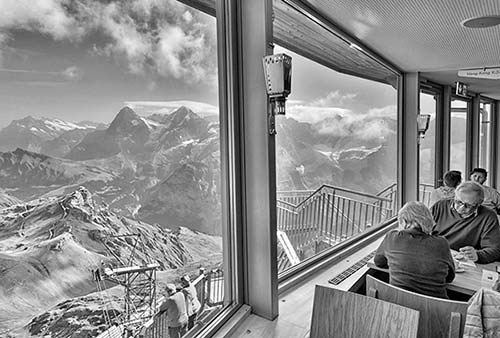
Downstairs, follow the maze that leads to the Bond World 007 exhibit and cinema. (Remember: Enticing and worthwhile as this is, don’t spend time here until you’ve been outside to enjoy the actual views, as things can cloud up.) This interactive exhibit, well-explained in English, is worth a few minutes for even non-Bond fans. It takes you behind the scenes of the 1969 James Bond movie, On Her Majesty’s Secret Service, which used the Schilthorn as one of its major locations (and helped finance the complex’s completion). Step into the role of James Bond and try your hand at flying a helicopter to Piz Gloria or bobsledding down the Alps in the simulators. Even the prizewinning WCs are Bond-themed—a sign in the men’s room urged me to “Aim Like James.”
At the end of the exhibit, the Bond World 007 cinema shows a 20-minute, three-part video on a continuous loop that highlights the area’s natural wonders and activities (including racing down the famous Inferno ski run), briefly shares the story of the Schilthornbahn lift itself and the Project 20XX work, and shows a substantial clip from On Her Majesty’s Secret Service.
Hiking: You can hike down from the Schilthorn, but it’s tough. (Hiking up is easier on your knees...if you don’t mind a 5,000-foot altitude gain from Mürren.) Hiking down from Birg Station makes more sense for most. For information on hikes from lift stations along the Schilthorn cable-car line, see “Hiking and Biking,” later. My favorite “hike” from the Schilthorn is simply along the ridge out back, to get away from the station and be all alone on top of an Alp. (But if you need company, both Birg and the Piz Gloria have Wi-Fi.)
JUNGFRAUJOCH
A literal high point of any trip to the Swiss Alps is the Jungfraubahn train ride through the Eiger mountain to the Jungfraujoch (the saddle between the Mönch and Jungfrau mountains)—an experience worth ▲▲▲. At 11,333 feet, it’s Europe’s highest train station. (If you have a heart or lung condition, you may want to check with your doctor before making this ascent.) Keep in mind that you can enjoy the Berner Oberland without taking this trip—it’s long, slow, expensive, crowded, and cold. But if the weather’s perfect and you have a spare day and spare cash, the views are exhilarating and it’s fun to be on a snowy glacier in midsummer.
I’ve focused here on the train route up from Lauterbrunnen via Kleine Scheidegg to the Jungfraujoch. There’s also an alternate approach, starting with the Eiger Express—a big new cable car from Grindelwald to Eigergletscher (above Kleine Scheidegg)—where you connect to the train for the last segment up (described later).
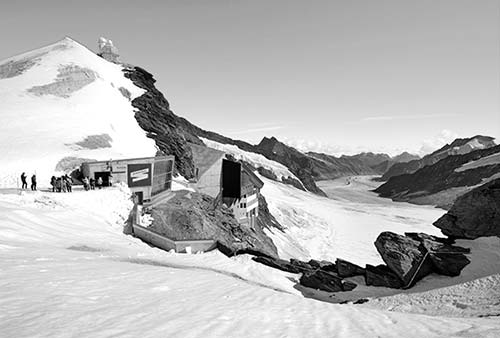
Cost and Hours: Round-trip fares are 236 CHF from Interlaken Ost, 222 CHF from Lauterbrunnen, 208 CHF from Wengen, and 156 CHF from Kleine Scheidegg. The train runs about twice hourly year-round. The last train back down departs the Jungfraujoch at 16:17 and Kleine Scheidegg at 17:14 (one hour later July-Aug).
Discounts: From May to late October, a “Good Morning Ticket” saves you 25 percent on the earliest departures of the day. To get the discount you must leave the top no later than 13:17. Eurail Global pass holders get 25 percent off and can’t combine discounts, so they should go whenever they want. The same goes for Swiss Travel Pass holders, who travel free as far as Wengen (with a 25 percent discount beyond): Buy your supplementary ticket before boarding, or to avoid a steep fine—find the conductor before they find you and pay a 10-CHF surcharge to buy it on board. There’s also the Jungfrau Travel Pass, but it’s usually hard to make it pay off (see here for details).
Information and Booking: Visit www.jungfrau.ch, stop by the ticket counters in Interlaken or Lauterbrunnen, or call +41 33 828 7233.
Crowd-Beating Tips: At peak periods (especially July-Aug), trains are standing-room only. During peak times, reserve a seat at a fixed time the day before (5 CHF extra for each leg—up and down; allow about two hours up top). The Jungfraujoch platforms can be jammed and chaotic. Without a reservation, you may have to wait in line (potentially an hour or more) both to get up and to get back down.
Weather: Don’t bother coming all the way up here if it’s cloudy. But be aware that even when it’s socked in down in the valleys, it can be gloriously sunny up top—check the webcams and weather forecast at www.jungfrau.ch before committing.
Planning Your Trip: Visiting the Jungfraujoch takes most of a day. The trip up from Lauterbrunnen takes a little under two hours each way, with a change of trains at Kleine Scheidegg. If you’re coming from Interlaken, Gimmelwald, or Mürren, add another half-hour. You’ll want at least 1.5 hours at the top—more if you eat, hike, or frolic in the snow. Expect outdoor temperatures to be around freezing in summer—so if you plan to go outside, bring a hat and gloves, shoes with good traction, sunglasses, and sunscreen. Even if you stay inside, the train is chilly and you’ll need a jacket. To minimize altitude sickness, local guides recommend drinking a half-liter of water as you ascend on the train.
Eiger Express: This new cable car, opened in 2020, runs from Grindelwald to Eigergletscher, where tourists switch to the train for the last segment up to Jungfraujoch. The 15-minute ride glides scenically along the bottom of the famed North Face of the Eiger in sleek 26-seat cable cars. This investment of about $500 million was designed to funnel masses of tourists up from Grindelwald and Interlaken. If you’re staying in either town, the Eiger Express cuts about an hour off the time needed for the Jungfraujoch experience—but travelers from the Lauterbrunnen Valley still do better by taking the slow, scenic train to Kleine Scheidegg.
Ultimate Alpine Combo: For a thrilling day of alpine scenery, try this plan: From Lauterbrunnen, ride the train to Wengen, ride the cable car up to Männlichen, hike from there to Kleine Scheidegg (about 1.5 hours, easy), then catch the train up to the Jungfraujoch.
Eating: You’ll find a variety of eateries in the main Jungfraujoch building (see “Shops and Services,” later), but it’s all overpriced and poor quality; I’d eat before or after my visit—or bring a picnic.
Visiting the Jungfraujoch
Ascending the Jungfraujoch: From Lauterbrunnen or Wengen, you’ll board a characteristic little yellow-and-green Wengernalpbahn train to get as far as Kleine Scheidegg. There, you’ll transfer to the Jungfraujoch train. The platform can be a bit hectic—take a calming breath and find your way to the end of the correct line: green if you’ve reserved, yellow if you haven’t.
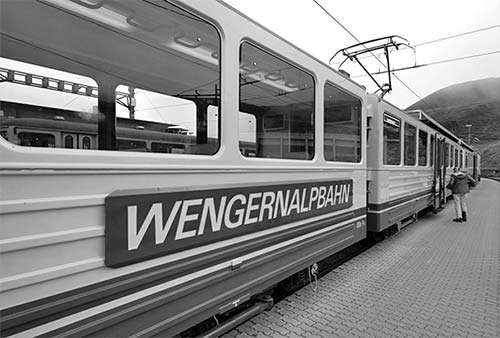
The 45-minute ride from Kleine Scheidegg to the top is mostly in a tunnel, but with a couple of stops. The first one, after five minutes, is at Eigergletscher, the high-altitude junction with the Eiger Express cable car. You’ll then enter the tunnel in which you’ll travel through the Eiger to the Jungfraujoch. After about 10 more minutes, you’ll stop for five minutes at the Eismeer viewpoint, where you can get out of the train and enjoy glacier and mountain views from an amazing perch (10,368 feet). Look out the windows and marvel at how people could climb the Eiger—and how the Swiss built this train track more than a hundred years ago. (You can generally listen in as guides explain the views to their groups.) Notice how the once-solid ice mass is now broken by treacherous crevices as it melts. Back on your train, you’ll ride up through darkness—watching video screens explaining your sightseeing options up top.
Jungfraujoch Sights (11,333 Feet)
Once you reach the top, breathe deep, take it easy, and move slowly—you’re way high up and your body isn’t used to such altitudes. Study the map to see your options. The big blue TOUR signs lead you on a loosely one-way route through the complex, with several numbered stops I’ve outlined below.
Jungfrau Panorama: To get ahead of the crowds, muscle your way through the congested shopping zone, bearing left for the TOUR signs (direction: Sphinx). You’ll follow a tunnel to the Jungfrau Panorama, a 360-degree video that’s pleasantly distracting while you wait in line for the elevator that rockets you up to the observation deck—and the highest Jungfraujoch viewpoint.
Sphinx Observation Deck: Head up the stairs and out onto the platform; at above 11,000 feet, the views are truly astounding. Use the orientation panels to get your bearings: You’re between the Mönch and the Jungfrau (the Eiger is hidden, behind the Mönch). Looking toward the Mönch, notice the fun snow area below you, and the trail snaking across the snow to the Mönchsjochhütte (both described later). Looking left, you’re gazing (north) down on the Lauterbrunnen Valley area: Kleine Scheidegg, Gimmelwald, and in the distance, Interlaken. Try to spot the Schilthorn cable-car station. Farther to the left looms the giant Jungfrau. And left of that spreads the Aletsch Glacier—Europe’s longest, at nearly 11 miles (or a bit less, by the time you read this). The silver-domed building above you is a scientific measurement station (from 1930). Scared of heights? Look down through the floor grates.
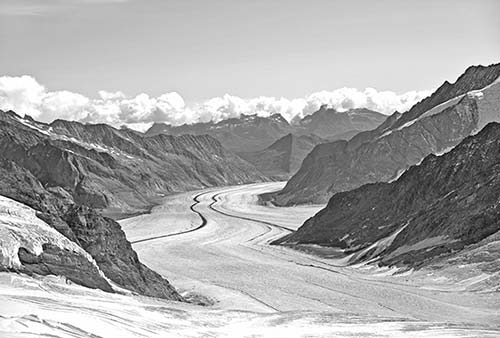
Ride the elevator back downstairs, where you’ll find a small exhibit with interesting statistics on recent climate warming and the recovery of the ozone layer. From here, turn right to go outside to walk on the glacier (direction: Aletsch Glacier).
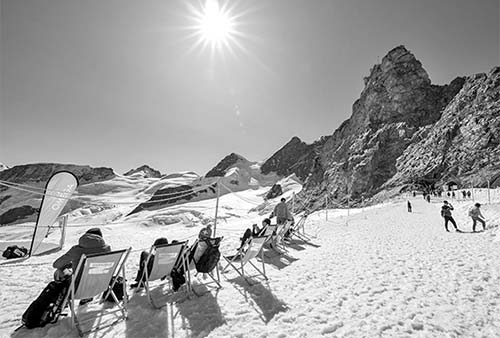
Aletsch Glacier: You’ll find both outdoor and indoor attractions on the glacier. Snow Fun Park offers skiing and snowboarding (35 CHF), sledding (20 CHF), and a zip line (25 CHF—prices include equipment; 45 CHF for all three activities, mid-May-mid-Oct). The ticket desk also sells hot, cold, and hard drinks to enjoy in a sling-backed chair on the snow. To get away from the Jungfraujoch crowds, you can hike an hour across the ice to Mönchsjochhütte (a mountain hut with a small restaurant). While this can be a highlight, you need good shoes—when it’s slushy, you’ll end up with wet feet.
Back inside you’ll head through a passage leading to and through several entertaining exhibits. Alpine Sensation is a fun zone draped in light-up edelweiss and Swiss kitsch. A history exhibit lines the tunnel, telling the story of the construction of the Jungfraujoch train line and station and memorializing the workers (mostly Italian) who died while working here. Ice Palace (Eispalast) is a slippery side trip off the main tunnel, with walls and floors made of ice and a few modest ice carvings.
The Plateau: Next you’ll ride an elevator (or hike up a few flights of stairs) to the third and last outdoor experience: the Plateau, where you can walk out on the snow toward the Jungfrau and look back at the classic Jungfraujoch view—with the Sphinx’s glittering silver dome capping a sheer cliff.
The Berghaus: Back in the main building (Berghaus) is a cluster of shops and eateries next to the train station. Consider departure times and lines, then you can peruse several levels of shops (including the Lindt Swiss Chocolate Heaven, a candy store with a brief exhibit about Swiss chocolate making); the pricey $$$ Restaurant Crystal; the self-service $ Aletsch cafeteria; and a basic $ coffee bar, near the doors to the train station. Indian tourists appreciate the Bollywood restaurant nearby.
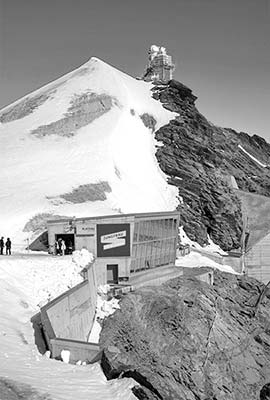
Return Trip: Trains depart twice hourly; unless you’ve reserved a seat, you may have to wait in line to board a train back down to earth. In Kleine Scheidegg, you’ll change to the Wengernalpbahn line back down to Lauterbrunnen. Remember, you can connect from the first stop (Eigergletscher) directly to Grindelwald in 15 minutes on the new Eiger Express cable car (described earlier).
Hiking and Biking
The Berner Oberland offers days of possible hikes. Many are a fun combination of trails, mountain trains, and cable-car rides. The information below can help you decide which hike to tackle but isn’t intended as a turn-by-turn guide. Good hiking maps and more detailed trail descriptions are essential, and they’re available from area TIs and hotels. Before setting out on any hike, check locally to be sure you’ve made the best match between your skills, gear, and trail conditions (snow can persist on trails even into summer). Every year, tourists die doing stupid things in the Alps. Respect the risks or you could end up as a sad memory marked by a cross at the side of a trail. (For tougher hikes, do what you can to buy, rent, or borrow hiking poles.)
EASIER HIKES
On the Valley Floor
▲▲Cloudy-Day Lauterbrunnen Valley Walk
Try the easy trails and pleasant walks along the floor of the Lauterbrunnen Valley. You don’t ever need to (and shouldn’t) walk along the main road, which parallels the river. A fine, paved, mostly vehicle-free farm lane (great for walkers, runners, bikers, and people with strollers) goes all the way along the valley on the opposite side of the river from the main road, from the town of Lauterbrunnen to the top of the valley (Stechelberg). Small bridges let you cross from the lane to the main road at various points. PostBus #141 runs the entire length, with stops along the way, twice an hour.
For a smell-the-cows-and-flowers lowland walk—ideal for a cloudy day, weary body, or tight budget—try this three-mile, basically level ramble from Lauterbrunnen to Stechelberg. While you could go either way, I’d go upstream (very gradually uphill) to walk toward the grandest mountain views.
Leaving Lauterbrunnen town, take the side road to the right, past the Horner Pub). Just beyond that, with the cemetery on your left, climb up the path on your right to the free and slippery gallery that runs under the Staubbach waterfall, one of 72 waterfalls in the valley. Fact-filled information posts accompany each one. Here, notice the cone-like mound of earth piled against the side of the cliff—formed by centuries of rocks hurled by the water. You’ll see mounds like this (and often “ice caves” formed by the constant mist) all along the valley.
Follow the river up the valley. Along the way, you may see BASE jumpers—parachutists who leap from cliffs—or helicopters looking for their bodies. Windsocks in fields mark landing spots. Lauterbrunnen Valley is a mecca for BASE jumpers. Keep your eyes open for people looking up in the sky as if spotting Superman. (It’s a bird, it’s a plane...no, it’s a BASE jumper!)
About 45 minutes after leaving town, you can cross the river for an optional side trip to Trümmelbach Falls (it’s signposted; see here). After seeing the falls, you can catch the PostBus in either direction—back to Lauterbrunnen or on to Stechelberg. (Or keep walking: From the falls, walk uphill on the main road about five minutes, then cross through the Breithorn Campsite and over the river to return to the trail.)
After walking about half an hour farther upstream, you come to a fine picnic stop at the base of Mürrenbach Falls, where the water enjoys a 1,400-foot free fall. Just beyond is the Schilthornbahn cable-car station. From here you can ride the lift up; catch the PostBus back to Lauterbrunnen; or walk another half-hour to the top of the valley. Just before the end of the trail, a five-minute side trip takes you over a bridge and to one final waterfall, Sefinenfall. Next to Hotel Stechelberg, where the road ends, you’ll find another stop for the PostBus back to Lauterbrunnen.
Alternate Route via Gimmelwald: If you’re staying in Gimmelwald, try this plan: Take the Schilthornbahn lift down to the station near Stechelberg (five minutes), then walk 1.5 hours along the river to Lauterbrunnen (with the possible side-trip to Trümmelbach Falls about halfway). To return to Gimmelwald from Lauterbrunnen, take the cable car up to Grütschalp and transfer to the train to Mürren (20 minutes total). From Mürren, it’s a downhill walk (30 minutes) to Gimmelwald. You can also walk from Grütschalp to Gimmelwald (1.5 hours). This loop trip can be reversed or started at any point along the way—such as Lauterbrunnen or Mürren.
From Gimmelwald
▲Sefinen Valley to Kilchbalm
The trail from Gimmelwald up the Sefinen Valley (Sefinental) is easy and a good rainy-weather hike. After about an hour and a gain of about a thousand feet, you hit the end of the trail at Kilchbalm, a dramatic bowl of glacier fields. There’s no food or drink along the way. While the trail—downhill on a service road for half an hour and then uphill along a trail for half an hour—is just a hike through a forest, the payoff at the end is great.
From the Gimmelwald fire station, walk about 100 yards down the paved road, following Stechelberg signs. Turn onto the dirt Sefinental road, which becomes a lane, then a trail. Follow signs to Kilchbalm through a forest, along a river, and finally to a big rocky meadow with the river running through it to where the trail ends. (Notice the intriguing cave on the right where shepherds are said to have slept.) From here, surrounded by a powerful amphitheater of glaciers, you’ll enjoy an unforgettable setting.
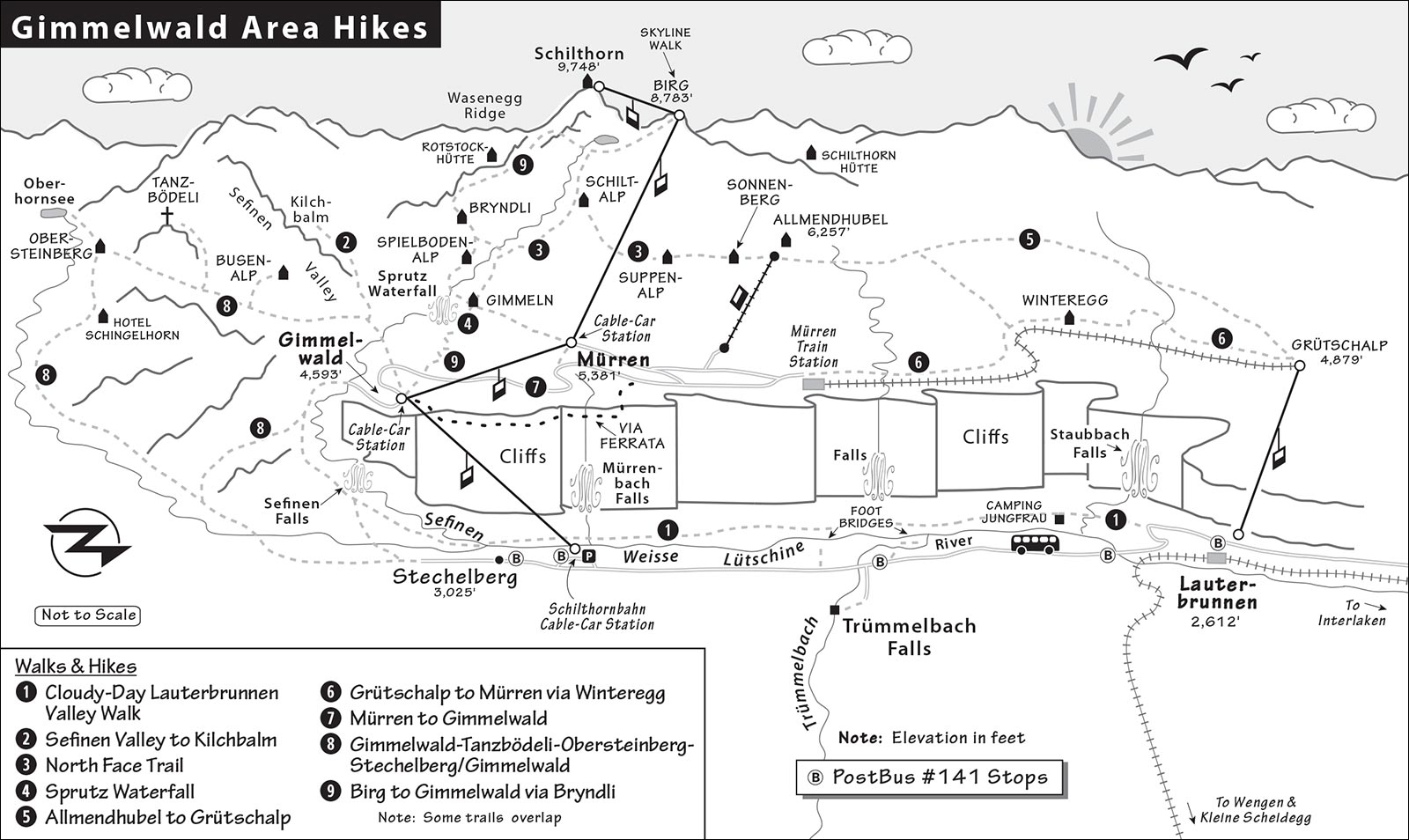
From Mürren
▲▲▲North Face Trail (with Sprutz Waterfall Option)
This pleasant, fairly easy, 2.5-hour, four-mile hike offers excellent views, flowery meadows, mountain huts, and a dozen information boards describing the fascinating climbing history of the great peaks around you. You’ll also pass a few farms (technically “alps,” as they are only open in the summer) that serve meals and drinks. You’ll begin at 6,257 feet (Allmendhubel) and finish at 5,381 feet (if you end in Mürren); while it’s mostly downhill, there’s one uphill stretch that can be challenging if you’re not in shape. The trail is well-signed and easy to follow.
The signed route loops counterclockwise from Allmendhubel around to Mürren; near the end, at Spielboden, you can go directly into Mürren or opt to extend the hike and descend into Gimmelwald via the Sprutz waterfall. This final, optional stretch is the most challenging—it goes very steeply downhill, with uneven footing, behind the waterfall, and then steeply down again into Gimmelwald. To keep things easy, skip Sprutz and circle back to Mürren.
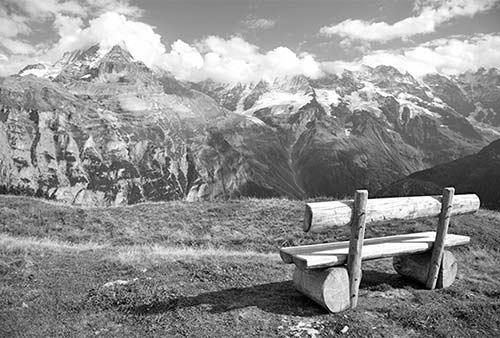
To begin the hike, ride the Allmendhubel funicular up from Mürren (good restaurant at top). Leaving the funicular, follow the path uphill, skirting around the alp-themed play area. From here, follow the trail or service road down into the valley toward Sonnenberg.
You can navigate the North Face trail from Allmendhubel simply by following yellow directional signs connecting these farms or hamlets in this order: Sonnenberg, Suppenalp, Schiltalp (Im Schilt), Gimmeln, and Mürren. For the harder finish that includes the waterfall and skips Mürren, from Gimmeln go through Spielbodenalp, downhill to Sprutz, and steeply through the forest to Gimmelwald.
Here’s a more detailed description of the route: From Allmendhubel, head over a little ridge and drop into lovely Blumental (“Flower Valley,” under the Schilthornbahn cable-car line), which is hopping with marmots (see the “Hiking in the Berner Oberland” sidebar for more on these rodents and other animals you may see).
Follow the gravelly service road down into the valley. At the intersection just before pension/restaurant Sonnenberg (where they were allowed to break the all-wood building code with concrete for protection against avalanches), turn right to the quainter Suppenalp.
Follow the paved trail across the meadow, then hook left to Suppenalp. Lean against the house with a salad, soup, or sandwich, and enjoy the view (closed Mon-Tue). Notice how older huts are built into the protected side of rocks and outcroppings, in anticipation of avalanches.
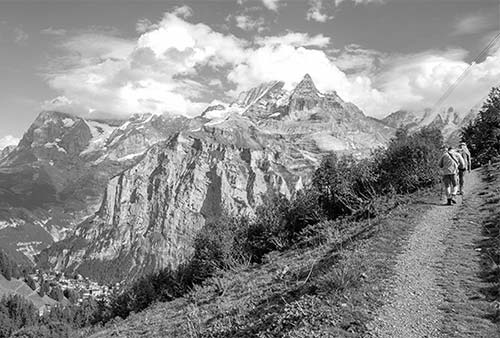
From here, head uphill on the gravel path—directly toward the looming, craggy Schwarzmönch peak. You’ll gain altitude as you curve around the ridge (called Schiltgrat), directly under the tourists gliding in cable cars up to the Schilthorn. In spots where the path is not clear, look for white-and-red stripes painted on rocks. Watch for great views down over Mürren. Going through a small alpine forest, more peaks come into view. You’ll emerge at a broad, grassy meadow high over Gimmelwald, where the views open up. Look high on the right for both the Birg and Piz Gloria stations on the Schilthornbahn.
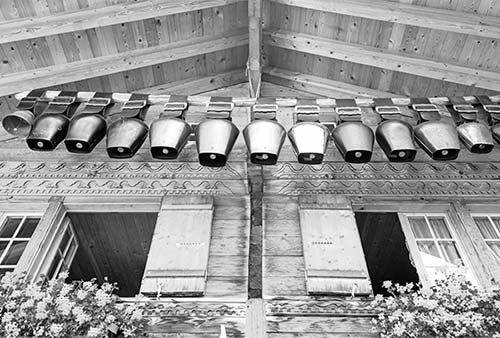
After strolling blissfully through high alpine meadows (enjoying grand views of the Eiger with boards describing historic ascents), you’ll finally come to a group of huts called Schiltalp (with a romantic farm setting and food and drink for sale). At Schiltalp, if the poles under the eaves have bells, the cows are up here. If not, the cows are at the lower farms. Half the cows in Gimmelwald (about 100) spend their summers here. In July, August, and September, you can watch cheese being made. Thirty years ago, each family had its own hut. Labor was cheap and available. Today, it’s a communal thing, with several families sharing the expense of a single cow herder. Cow herders are master cheesemakers and have veterinary skills, too.
From Schiltalp, the trail winds gracefully downhill to the hamlet of Gimmeln, then back to Mürren.
Or—for a more dangerous and demanding option—from Gimmeln, hike to Spielbodenalp and descend steeply through a thick forest and under the dramatic Sprutz waterfall into Gimmelwald.
Sprutz Waterfall
The forest above Gimmelwald hides a powerful waterfall with a trail snaking behind it, offering a fun gorge experience. The waterfall itself is not well-signed, but it’s on the Spielboden-Gimmelwald trail. It’s steep, through a forest, requires climbing up and down stairs that are carved into the rock without handrails, and can be very slippery when wet—but the actual crossing under the waterfall is just misty.
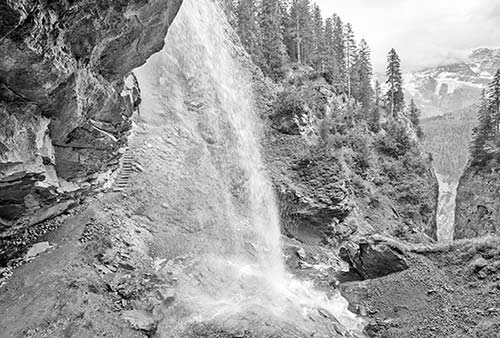
The hike up to Sprutz from Gimmelwald isn’t worth the trip in itself, but the trail is handy when combined with the hike down from Birg and Bryndli (described later) or the North Face trail (described above).
From the waterfall you’ll climb back into the thick forest and continue your steep descent until you pop out at the meadows high above Gimmelwald. From here, you’ll follow narrow, rutted trails cut into the grass as you descend very steeply to Gimmelwald.
▲Allmendhubel to Grütschalp (a.k.a. Mountain View Trail)
For a not-too-tough two-hour walk with great Jungfrau views, ride the funicular from Mürren to Allmendhubel and walk to Grütschalp (a drop of about 1,500 feet), where you can catch the train back to Mürren. You’ll see this route clearly marked as the “Mountain View trail” on maps and brochures.
This region is a wonderful place to hike. I’ve listed my favorite excursions in this chapter. The super-scenic walk from Männlichen to Kleine Scheidegg is the best of all worlds: It’s both dramatic and relatively easy (gently downhill, but doesn’t open until June). Other relatively easy hikes include the North Face trail from Allmendhubel; various walks from Mürren or Allmendhubel to Grütschalp; the Sefinen Valley hike from Gimmelwald; and the stroll along the Lauterbrunnen Valley floor. More challenging routes include the spectacular hike from Schynige Platte to First and the hike from Gimmelwald to Tanzbödeli to Obersteinberg to Stechelberg.
For easy hikes, it’s usually enough to use the 3-D maps in the free brochures (called Wandern/Hiking) published by the Schilthornbahn (for the west side of the valley) and the Jungfraubahn (for the east side); they’re available at stations, hotels, and TIs. These overview maps of the mountainsides also make attractive souvenirs. But for more demanding hikes, get a more detailed map and check trail conditions before departing.
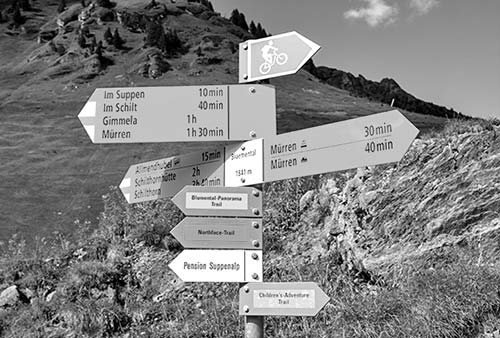
Don’t forget a water bottle and some munchies. In addition to a good map, for serious hikes it’s wise to carry sun protection, an extra layer of clothing, basic first-aid supplies, and hiking poles. Know when the last lifts run in the afternoon. Trails are well-marked, with yellow signs listing destinations and the estimated time it’ll take you to walk there; some trails are also marked with red-and-white stripes painted on rocks and trees.
Electric Fences: The many working farms in this area contain their livestock with solar-powered electric fences (which look like plastic tape strung between thin metal poles). You can’t tell if they’re turned on without touching a wire—but it’s much better not finding out. On certain trails (for example, at several points on the North Face trail), hikers may need to let themselves through gates in the electric fences. In some, a long, plastic, pointy pole sticks out horizontally and pivots like a door—just walk on through (if there’s tape on the pole, touch it only on the tape). At other gates, you’ll need to grab a plastic handle, unhook it, and rehook it—again, being careful not to touch the wires.
Weather Concerns: Clouds can roll in anytime, but on warm summer days, skies are usually clearest in the morning. Locals always seem to know the weather report (as much of their income depends on it). All over the region, TV sets are tuned to the local weather station, with real-time views from all the famous peaks. You can also check weather reports and view live webcams at Jungfrau.ch and Schilthorn.ch. For more detailed weather reports in English, visit Meteoswiss.admin.ch.
Snow can curtail your hiking plans, even in July. Before setting out on any hike, get advice from the TI or a knowledgeable local. The high trails (Männlichen to Kleine Scheidegg, Schynige Platte to First, and anything from Schilthorn or Birg) are typically passable only from June into October.
Wildlife: As hunting is not allowed in the vicinity of any lifts, animals find safe havens in places you’re likely to be. Keep an eye out for chamois (called Gemsen here)—the sure-footed “goat antelopes” that live at the top of the tree line and go a little lower when hungry. Spotting an ibex—a wild goat with horns, scrambling along the rocky terrain—is another Berner Oberland thrill. You’ll also encounter marmots—big alpine rodents that get fat each summer, then sleep underground for six months through the winter. These burrowing critters are fun to watch, and if you sit still, they don’t see you. You’ll hear them whistle. The best viewing place is above Allmendhubel, in the meadow above the highest hut in Blumental.
▲Grütschalp to Mürren
For a family-friendly, super-easy panorama stroll with grand views, walk either direction between Mürren (5,381 feet) and Grütschalp (4,879 feet)—roughly following the scenic train line between the same points. You’ll enjoy the best vistas walking from Grütschalp to Mürren.
Aside from the dramatic views of the Eiger, Mönch, and Jungfrau, a highlight of this trail is the wonderful restaurant/playground/cheese farm midway at Winteregg. (The Grütschalp-Mürren train also stops at Winteregg.) Here, the Alpkäserei Staubbach lets you peer into the cheese-making action through a window (before 11:00) and buy fresh yogurt and cheese. The Berg-Restaurant Winteregg has a dramatic view terrace and an extensive alp-happy playground (www.restaurant-winteregg.ch).
The trail from the tiny station at Grütschalp to Winteregg (5,177 feet) is the best part: a 30-minute scenic walk mostly through cow country with an accompaniment of tinkling bells on a gravelly lane. The trail between Winteregg and Mürren mostly parallels the train track—also scenic and gravelly, but less interesting.
▲Paved Downhill Bliss from Mürren to Gimmelwald
This super-easy, super-scenic stroll brings you down on a paved road from Mürren to Gimmelwald in about 30 minutes. While there’s a 900-foot elevation drop, it’s all smooth and easy—doable for any fitness level, or even with a stroller (and more interesting than the five-minute cable-car ride). It’s simple—just stay on the same paved path the whole way down—but I’ve noted a few things to look out for.
In Mürren, follow the Gimmelwald signs, which lead down through the lower levels of town. You’ll end up on the paved road that runs between the two villages—and though it’s closed to casual car traffic, watch out for service vehicles (like mini trucks and tractors) and for bikes blazing downhill. Crossing under the first set of overhead cables (for the service lift from the valley floor up to Mürren), look high on the right for the Birg cable-car station. As the road bends left, you’ll pass some “tripods” on your right—these provide structure for new trees being planted as an avalanche barrier.
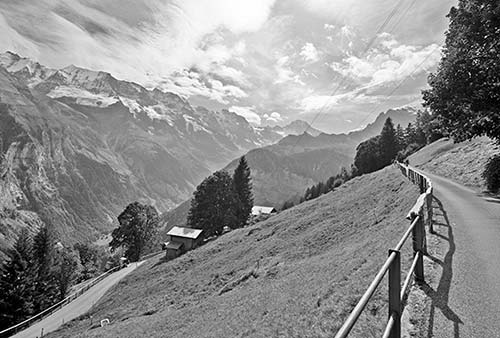
Enjoy the grand alpine views across the valley. You’ll cross the little Mürrenbach stream as it churns downhill; on the right, look for the flood gates used to control its flow, and on the left, watch it tumble down into the valley. Continuing farther, down in the valley below you’ll see some of the houses of Stechelberg—the end-of-the-valley community. Crossing under the second set of cable-car cables, visually trace them downhill toward Gimmelwald’s station—the end point of this walk, and the starting point of my self-guided “Gimmelwald Walk” (see here).
A bit farther along, you’ll see steep switchbacks snaking down below you. Head on down. At the second switchback are more of those avalanche tripods. After the third switchback, the road straightens out, following the cable cars all the way into town. You’ll pass through a small forest, cross the little Wyenbach waterfall, then reach the outlying houses of Gimmelwald. One of the first buildings you’ll pass is Hotel Mittaghorn; just past this, a stepped lane leads directly into the village center and the cable car station. Or, for a commanding “aerial view” over Gimmelwald, carry on farther to the four benches positioned perfectly over town. Lounge here as long as you like, with alpine cliffs in your face, a real Swiss mountain farming community all around you, and a charming village at your feet. (You could also follow my “Gimmelwald Walk” in reverse as you stroll through the town to the lift station.)
From Lauterbrunnen/Wengen
▲▲▲Männlichen-Kleine Scheidegg Hike
This is my favorite easy alpine hike (2.5 miles, about 1.5 hours, 900-foot altitude drop to Kleine Scheidegg). It’s entertaining all the way, with glorious mountain views. If you missed the plot, it’s the Monk (Mönch) protecting the Young Maiden (Jungfrau) from the Ogre (Eiger). The trail usually opens sometime in June and closes due to snow in October. Ask about conditions and get a map at lift stations or at TIs; there are also useful webcams at Maennlichen.ch and Jungfrau.ch.
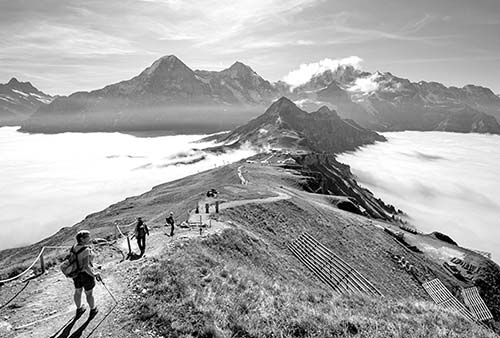
Ascending to Männlichen: If the weather’s good, start off bright and early. From the Lauterbrunnen train station, take the little mountain train up to Wengen. Sit on the right side of the train for great valley and waterfall views. In Wengen, buy a picnic at the Co-op grocery across the square from the station, walk a couple of blocks into town, and catch the lift to Männlichen, located on top of the ridge high above you (26 CHF one-way, half-price with Swiss Travel Pass, 3/hour, six-minute trip, late May-late Oct first ascent at 8:50, last descent at 16:50, longer hours July-mid-Sept, different hours in winter, closed in spring and fall, +41 33 855 2933, www.maennlichen.ch). Couch potato thrill-seekers can pay 5 CHF extra for the “Royal Ride” to climb the spiral stairs and enjoy an open-air rooftop perch. This lift may run even when the trail is closed; if the weather is questionable, confirm that the Männlichen-Kleine Scheidegg trail is open before ascending. If it’s sunny, don’t waste time in Wengen—you can linger back here after your hike.
Riding the gondola from Wengen to Männlichen, you’ll go over the old lift station—built in 1978, then inundated by a 1999 avalanche that buried a good part of Wengen (notice there’s no development in the “red zone” above the tennis courts). Farms are built with earthen ramps on the uphill side in anticipation of the next slide. The forest of avalanche fences near the top was reinforced after that 1999 avalanche. As you ascend, you can also survey Wengen—the bright red roofs mark new vacation condos, mostly English-owned and used only a few weeks a year.
When you get to the station at the top of the Wengen-Männlichen lift (7,317 feet), check inside to see if they have any free “king for a day” Männlichen Experience envelopes; these fun souvenirs open to make a panoramic crown that names the mountains you’re seeing.
At Männlichen there are two gondola stations, an inviting and economic cafeteria (indoor and outdoor seating), a playground, and a panoramic summit a short hike away.
Männlichen Gipfel Detour (“The Royal Walk”): Before your easy hike, consider a steeper detour: From the Wengen-Männlichen lift station, hike uphill to the little peak, topped with a crown-shaped viewpoint (Männlichen Gipfel, 7,687 feet). Marked as “The Royal Walk,” this paved path gains more than 350 feet of elevation; if you’re in decent shape, it takes about 20 minutes up, then 10 minutes back down. The last stretch is thin-air-sucking steep, with ropes you can grab onto for added confidence. Once at the summit, you’re rewarded with 360-degree views. Beneath you, look for avalanche barriers—both directly below the viewpoint, and striping the cliffs across the valley. Looking back at the cable car, you’ll see the Eiger, Mönch, and Jungfrau; in front of them, the pointy Tschuggen peak indicates the location of the Jungfraujoch station. Stretching to the right of those peaks is the Lauterbrunnen Valley; on the far ridge, try to spot the Birg and Schilthorn cable-car stations. On the left side of the three big peaks is the Grindelwald Valley, a parallel universe of alpine villages, lifts, and hikes. And in the opposite direction from the big peaks, the knobby ridge straight ahead is Schynige Platte, with Interlaken on the valley floor beyond and below.
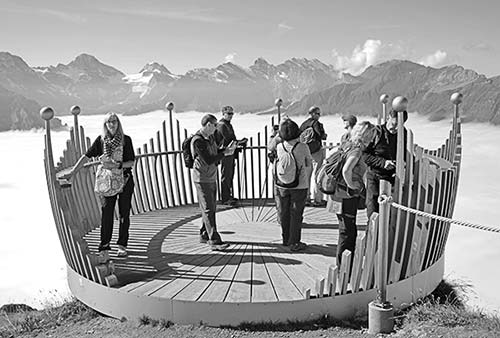
Easy Männlichen to Kleine Scheidegg Hike: Back at the lift station, enjoy the walk—facing spectacular alpine panorama views—to Kleine Scheidegg. From the Männlichen lift station, just head downhill. Ahead of you in the distance, left to right, are the north faces of the Eiger, Mönch, and Jungfrau; in the foreground is the Tschuggen peak, and just behind it, the Lauberhorn. This hike takes you around the left (east) side of this ridge. Simply follow the signs for Kleine Scheidegg, and you’ll be there in about 1.5 hours—allowing extra time for gawking, picnicking, and photography. (Speed walkers can make it in an hour.)
Walk a few minutes to the second Männlichen lift station (with free WCs; these lifts go to Grindelwald, the touristy town in the valley to your left). Nearby is the Berghaus Männlichen restaurant and cafeteria, a great kids’ play area, and a landing pad for helicopter sightseeing flights.
From here, carry on along the path as it curls around the left (Grindelwald-facing) side of the ridge. From time to time, you might have to tiptoe through streams of melted snow—or some small snowbanks (with ropes to hang onto for safety), even well into the summer—but the path is well-marked, well-maintained, and mostly level all the way to Kleine Scheidegg.
About two-thirds of the way through the hike, you’ll arrive at a cluster of benches and a shelter with incredible unobstructed views of all three peaks—the perfect picnic spot.
About 15 minutes later, you’ll reach the first sign of civilization: the recommended Restaurant Grindelwaldblick (the best lunch stop up here—less crowded, more Swiss and friendlier than Kleine Scheidegg options; it’s described on here). Hike to the restaurant’s fun mountain lookout to survey the Eiger and look down on the Kleine Scheidegg (rated ▲▲ for its spectacular panoramic mountain view).
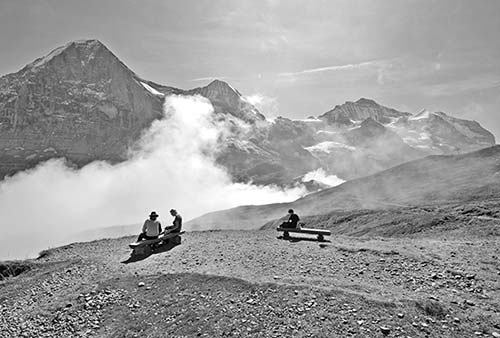
From the Grindelwaldblick, it’s a steep five-minute hike down to the Kleine Scheidegg train station where, since 1893, two lines from the world’s longest rack railway meet up at the foot of the Eiger, Mönch, and Jungfrau. From Kleine Scheidegg, you could catch this train up to the Jungfraujoch.
To return to the valley, take the train back down from Kleine Scheidegg (25 minutes to Wengen, then another 15 minutes to Lauterbrunnen). If you have a Swiss Travel Pass, it doesn’t cover your fare until Wengen, though it does give a discount; buy a supplementary ticket before boarding or pay a 10-CHF surcharge to buy on board (but find the conductor before they find you, or you may have to pay a steep fine). If you’re up for it, hike part of the way downhill (gorgeous 30-minute hike to the Wengernalp station, a little farther to the Allmend stop; 60 more steep minutes from there into Wengen—not dangerous, but requires a good set of knees). The alpine views might be accompanied by the valley-filling mellow sound of cow bells, alphorns, and distant avalanches. If the weather turns bad or you run out of steam, catch the train at any of the stations along the way. The boring final descent from Wengen to Lauterbrunnen is steep—catch the train instead.
MORE DIFFICULT HIKES
From Schynige Platte
▲▲Schynige Platte to First
The best day I’ve had hiking in the Berner Oberland was on this demanding all-day ridge walk, with Lake Brienz on one side and all that Jungfrau beauty on the other. You pay for, rather than earn, the high-country thrills (riding a lift up to the start and down from the finish).
Wilderswil to Schynige Platte Train Ascent: From the Wilderswil train station (just outside Interlaken), catch the charming old time train up to Schynige Platte (6,454 feet; 32 CHF one-way, goes every 40 minutes and takes about an hour, runs late May-late Oct). Catch the early 8:05 train to have time at Faulhorn (trail’s high point) and to get to the First gondola before it stops running. (Or sleep at the mountain hotel at the top; see listing below.) The TI produces a helpful Schynige Platte map/guide narrating the train ride up and describing various hiking options from there (available at Wilderswil train station).
Schynige Platte to First Hike: Allow at least seven hours for this hike (six hours of hiking plus stops for photo fun and picnicking). The trail is nearly all above the tree line and without shelter or water until the gondola station at First. While powerfully beautiful from start to finish, the best hour is the first hour—the Panorama Way.
From the Schynige Platte train station do not take the direct route to First. Add 30 minutes to the hike by walking past the mountain hotel and climbing to a peak called Daube. From that lookout, follow a ridge until you meet the Schynige Platte-First trail. From there (assuming you’re not looping back to your starting point), just follow the signs to Faulhorn and First. Along the way you’ll pass a solitary mountain hut squatting on a ridge saddle (strictly no WC or water for non-customers) and then pass under Faulhorn (capped by the highest old time mountain hotel in Switzerland), the high point of the trail at 8,790 feet. From there, it’s all downhill, hiking past an alpine lake (Bachsee) and down to First (7,106 feet). You’ll be alone for most of the trail, but the last hour from Bachsee is busy with Grindelwald tourists taking a walk from the First gondola.
First Gondola Descent: This gondola takes you from the end of the trail down into Grindelwald town (32 CHF; runs continuously—until at least 17:00 in summer, 30 minutes). From there you can catch a train back via Zweilutschinen to wherever you’re staying (2/hour).
The First station comes with the First Cliff Walk, a scenic catwalk popular with the Grindelwald crowd (free and a fascinating chance to imagine a rock climber hanging by their fingers onto the craggy face you’re strolling under). While you’ll avoid the 2.5-hour hike down by catching the gondola from First, you can make the descent a little more fun (and a little more expensive) with a trio of activities. Two stops break the long cable-car ride into thirds, and each third can be swapped for a thrill ride: the First Flyer and First Glider (two versions—like a zipline for four, 800 meters long from First to Schreckfeld); the Mountain Cart (three-wheeled cart on a 3-km track from Schreckfeld to Bort); and the Trottibike Scooter (on a 4.5-km paved lane from Bort to Grindelwald). Each segment costs around 20 SF (depending on your lift pass) and can come with a long wait.
Hiking in Reverse (from First to Schynige Platte): You can also do this hike in reverse, which means less climbing, from First (7,106 feet) to Schynige Platte (6,454 feet, last train down at 17:53).
Sleeping in Schynige Platte: For an early start on the Schynige Platte to First hike, sleep at the $ Berghotel Schynige Platte, a rustic and well-run mountain inn offering simple rooms and good food (open July-late Oct, +41 33 828 7373, www.hotelschynigeplatte.ch, hotel.schynigeplatte@jungfrau.ch, Jasmin and Thomas Willem).
▲▲▲Panorama Way Loop Trail
To enjoy the best of the Schynige Platte-First hike without the demanding six-hour hike, simply ride the Schynige Platte train round-trip and take your choice of two scenic “Panoramaweg” loop hikes, which include the Daube lookout and the scenic ridge walk.
For each of these walks, start from the station by walking past the hotel and then climbing 20 minutes to the Daube lookout. From there the Panorama Way stretches along an incredibly scenic ridge. In my lectures to illustrate the wonder of the Swiss Alps, I’ve long described it this way: “Imagine tight-roping high above the valleys on a ridge, with lakes on one side stretching all the way to Germany, cut-glass peaks—the Eiger, Mönch, and Jungfrau—on the other. And ahead of you, the long legato tones of an alphorn announcing that the helicopter-stocked mountain hut is open, it’s just around the corner, and the coffee schnapps is on.”
With the help of the simple tourist map and signposts, you can decide which version of the Panoramaweg you want to take—1.5 hours or 2.5 hours, each looping back to Schynige Platte.
Back at the Schynige Platte station, an alpine flower park offers a delightful stroll through several hundred alpine flowers, including a chance to see edelweiss growing in the wild (free, late May-late Oct daily 8:30-18:00, www.alpengarten.ch).
From Gimmelwald
▲Gimmelwald-Tanzbödeli-Obersteinberg-Stechelberg/Gimmelwald
This six-hour, 11-mile hike can be extremely rewarding, offering perfect peace, very few people, traditional alpine culture, and spectacular views. It’s one long trail with two one-hour side trips. Allow eight hours if you include both the Busenalp and Tanzbödeli excursions.
This demanding hike requires serious shoes and is best done with poles. There’s no food or water along the way, so pack accordingly. For either of the side trips, I’d hide my bag in the bushes to lighten my load (especially for Tanzbödeli, which finishes with a scramble).
About 100 yards below the Gimmelwald firehouse, take the Sefinental dirt road (described earlier, in the Sefinen Valley to Kilchbalm hike). As the dirt road switches back after about 30 minutes, take the right turn across the river and start your long ascent, following signs to Obersteinberg.
Busenalp Side Trip: After two hours of hard climbing, you have the option of this 30-minute (each way) side trip. Busenalp, a working farm, lies at the end of a scant trail (just follow the cow pies uphill, arcing to the right). As the farm comes into view, there’s a welcome picnic bench with grand views. At Busenalp, friendly Elisa works hard all summer minding 55 cows, three horses, six goats, and a variable number of chickens—and enjoying the tranquility.
Tanzbödeli: Farther along the main trail, at the Obersteinberg 50 Min/Tanzbödeli 20 Min signpost, is the steep trail to the Tanzbödeli (“Dancing Floor”). This grassy plateau (about the size of a football field) is a favorite alpine perch—great for a little romance or a picnic with breathtaking views of the upper and lower Lauterbrunnen Valley. I found the last 100 yards a frightening scramble—too steep for hiking poles, which I stowed—but very rewarding. (From a distance, throughout the region, the Dancing Floor is marked by the shark-fin-shaped Spitzhorn peak that towers over the perch.)
Obersteinberg: From Tanzbödeli, you return to the main trail (there’s no other way out) and continue to Obersteinberg. You’re entering a natural reserve, so you’re likely to see chamois and other alpine critters. You’ll eventually hit the Mountain Hotel Obersteinberg (see below; they can normally serve you a meal or drink, and might let you look at their cheese cellar).
Sleeping in Obersteinberg: Two romantic yet rustic $ mountain hotels are side by side (at about 6,000 feet in altitude, a 20-minute walk from each other), accessible only to hikers via a steep 2.5-hour hike above Stechelberg. They each charge about 100 CHF a night per person with dinner and breakfast in simple double rooms and are open from June through September. Both serve lunches to hikers.
Mountain Hotel Obersteinberg is a classic working alpine farm run by Julian and his family. They rent 12 primitive double rooms and 30 less-expensive loft beds. There’s no shower, no hot water, and no electricity. Candles light up the night. Ask for a hot-water bottle to warm your bed (cash only, reserve by phone only, +41 33 855 2033, www.stechelberg.ch; look under “Accommodation & Dining”).
Berggasthaus Tschingelhorn Steinberg, 20 minutes below Obersteinberg, is more comfortable with good food, a little electricity, and showers (+41 33 855 1343, www.tschingelhorn.ch, info@tschingelhorn.ch; run by Rudi, Stephanie, and team).
Stechelberg/Gimmelwald: From Obersteinberg, the trail leads to another mountain hotel at Tschingelhorn, then back down to Stechelberg and the Schilthornbahn cable car valley station (1.5 hours total). Or branch off before reaching Stechelberg and hike back up to Gimmelwald (2 hours total).
From Mürren
To arrange a guide for the white-knuckle, cliff-hugging via ferrata trail near Mürren, see here.
From the Schilthorn
Several tough trails lead down from the Schilthorn (there’s a reason that virtually all visitors take the cable car down). Only a serious, experienced hiker should consider walking all or part of the way back to Gimmelwald. Proper shoes and clothing (weather can change quickly) and good knees are required. Don’t attempt to hike down unless you’ve confirmed that the trail is clear of snow. While it’s possible to make the steep descent directly from the top of the Schilthorn, I prefer the less strenuous (but still challenging) hike from the intermediate cable-car station at Birg.
▲▲Birg to Gimmelwald via Bryndli
You can combine this difficult downhill hike (4-5 hours) from the Birg cable-car station with a visit to the Schilthorn by buying the round-trip excursion early-bird fare (it’s cheaper than the Gimmelwald-Schilthorn-Birg ticket). Visit the summit first, then descend to Birg to hike down.
The most interesting trail from Birg to Gimmelwald is the high one via Grauseeli lake and Wasenegg Ridge to Bryndli, then down to Spilboden and the Sprutz waterfall. Warning: This trail drops 4,500 feet, is quite steep and slippery in places, and can take over four hours. Locals take their kindergarteners on this hike, but Americans unused to alpine hikes shouldn’t attempt it.
From the Birg lift station, hike toward the Schilthorn, taking your first left down and passing along the left side of the little Grauseeli lake. From the lake, a gravelly trail leads down rough switchbacks (including a stretch where the path narrows and you can hang onto a guide cable against the cliff face) until it levels out. When you see a rock painted with arrows pointing to Mürren and Rotstockhütte, follow the path to Rotstockhütte (traditional old farm with light meals and drinks), traversing the cow-grazed mountainside.
The safer, well-signposted approach to Bryndli is to drop down to Rotstockhütte then climb back up to Bryndli. Thrill-seekers instead follow Wasenegg Ridge, which is more scary than dangerous if you’re sure-footed and can handle the 50-foot-long “tightrope-with-handrail” section along an extremely narrow ledge with a thousand-foot drop. This trail gets you to Bryndli with the least altitude change. A barbed-wire fence leads you to Bryndli’s knobby little summit, where you’ll enjoy an incredible 360-degree view and a chance to sign your name on the register stored in the little wooden box.
From Bryndli, a steep trail winds directly down toward Gimmelwald and soon hits a bigger, easier trail. The trail bends right (just before the farm/restaurant at Spielboden), leading to Sprutz. Walk under the Sprutz waterfall, then follow a steep, wooded trail that deposits you in a meadow of flowers at the top side of Gimmelwald. (For details on the hike from Spielboden down to Sprutz and Gimmelwald, see here.)
MOUNTAIN BIKING
Mountain biking is popular and accepted, as long as you stay on clearly marked mountain-bike paths. You can rent bikes in Mürren, Lauterbrunnen, or Interlaken (see listings under each section). You may save time and avoid disappointment by reserving your bike online in advance. Wherever you rent your bike, take a few minutes to be sure it’s properly fitted to your size. Rentals come with helmets. Locks, while not considered necessary, are available on request. Some hotels and B&Bs also rent or loan mountain bikes.
While there is a world of more demanding mountain bike routes for serious bikers, I’ve outlined a couple of the most popular and easy bike rides here.
Lauterbrunnen Valley
From top to bottom, Lauterbrunnen Valley seems made to order for a bike ride. Using Lauterbrunnen town as a springboard, you can pedal to the top of the valley, down the valley to Interlaken, or both. It’s two totally different rides: top of the valley is sweet and romantic; down to Interlaken is more intense and less scenic. Except in Lauterbrunnen town, you’ll never need to share the road with cars since you’ll be on a bike path. Here are tips for both ends of the valley. Lacing the two rides together (including a visit to Interlaken) makes for a great day.
Top of the Valley (Lauterbrunnen Town to Stechelberg): From Lauterbrunnen town it’s gently uphill, always on the right (traffic-free) side of the river. Along the way you can explore a typical European campground, stop at Trümmelbach Falls (signposted across the river), and maybe even see a BASE jumper. Eventually (near the top of the valley) the paved lane turns left over the river to the regular road. Don’t follow it; instead, stay on the gravelly lane, which becomes a path all the way to the top. At the top you’ll reach a “rainbow bridge”; carry your bike over it to get to the hamlet of Stechelberg. For more descriptions see “Cloudy-Day Lauterbrunnen Valley Walk” (here), which follows the same route.
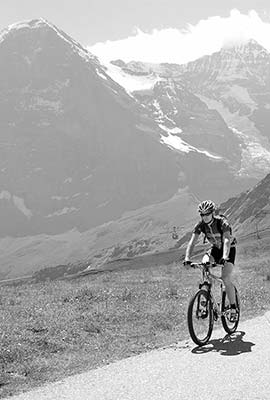
Bottom of the Valley (Lauterbrunnen Town to Interlaken): While the top of the valley is more idyllic, it’s fun to spend an hour charging downhill on the gravelly eight-mile path along the river from Lauterbrunnen to the “big city” of Interlaken. Immediately below the Lauterbrunnen station, turn right, pass the big parking garage, go downhill over the river, and look for a hard left onto a tiny riverside lane. You’re on your way, and except for at the very start, the trail is marked for bikes. Staying on the right side of the river, follow signs downhill to Zweilütschinen, then Wilderswil, then into Interlaken (with plenty of things to see and do). Do not bike back uphill—it’s hard and dull. Instead, return to Lauterbrunnen from the Interlaken Ost train station (2/hour, evenings 1/hour, 20 minutes; you can take your bike on for half the ticket price).
Mürren-Winteregg-Grütschalp and Back
This fairly level route takes you not along the peaceful valley floor but through high country, with awesome mountain views (see the “Grütschalp to Mürren” hike description on here).
More Berner Oberland Towns
I’d sleep in Gimmelwald, Mürren, or Lauterbrunnen, but you could also consider overnighting in the following places.
Sleeping and Eating in Wengen
Wengen—a bigger, fancier Mürren (pop. 1,300) on the east side of the valley at 4,180 feet—has plenty of grand hotels, restaurants, shops, diversions, and terrific views...though it lacks the soul of the towns I’ve described earlier. This mostly traffic-free resort is an easy train ride above Lauterbrunnen and halfway up to Kleine Scheidegg and Männlichen. From Wengen, you can catch the Männlichen lift (www.maennlichen.ch) up to the ridge and take the rewarding, view-filled, mostly downhill Männlichen-Kleine Scheidegg hike (described earlier, under “Hiking and Biking”).
Wengen’s TI is a two-minute walk from the station. When you get off the train, look for the big map and bear left up to the main drag (Dorfstrasse). This strip is lined with big hotels on the left; on the right are a playing field, the bottom station for the Männlichen cable car, and the TI (Tourist Center Wengen, daily 9:00-18:00, sometimes later in summer, closed Sat-Sun off-season, +41 33 856 8585, https://wengen.swiss).
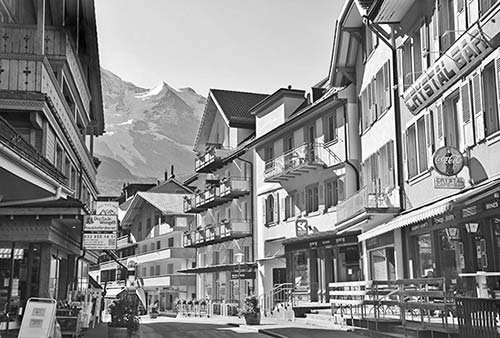
The good-sized Co-op grocery, across the square from the train station, is great for picnic fixings (daily 8:00-18:30; closed Sun off-season). The small Dorflade Wengen grocery store on the main street (near the cable-car station) opens a little earlier and later.
Above the Train Station: $$$ Hotel Schönegg, at the top end of Wengen’s main road, is a centrally located splurge exuding a warm and woody ski-lodge ambience, with a generous view terrace out front. Its 20 rooms are designed in a cozy alpine style, almost all with balconies and great views (family room with fireplace, elevator, sauna, half-board in good restaurant with big terrace available, +41 33 855 3422, www.hotel-schoenegg.ch, mail@hotel-schoenegg.ch).
$$ Hotel Berghaus, in a quiet area facing a pasture, is a five-minute uphill walk from the main street (about 10 minutes from the station). This sedate old place offers 19 rooms above a fine restaurant specializing in fish (family room, elevator, open June-Sept and mid-Dec-early April, +41 33 855 2151, www.berghaus-wengen.ch, info@berghaus-wengen.ch, Fontana family). From the main drag, head up the street across from Hotel Bernerhof, bear right at the fork, go 200 yards more (past the church), and it’s on the left.
Below the Train Station: Friendly Therese and Willy Brunner run the $$$ Bären Hotel, which offers 17 tidy rooms with modern bathrooms. To save money, opt for one of the three rooms without a balcony (half-board available in their restaurant, family rooms, elevator, kids’ playroom, table tennis, closed mid-April-mid-May and mid-Oct-mid-Dec, +41 33 855 1419, www.baeren-wengen.ch, info@baeren-wengen.ch). Their $$$ restaurant is a bright, inviting option for a memorable dinner with sharp, professional service. They source many ingredients locally and enjoy crafting seasonal specials (dinner reservations wise, breakfast available to non-guests, daily 8:00-10:30 & 18:00-22:00). From the station, cross the street to the Co-op grocery, turn right and go under the rail bridge, and follow the road down the hill—the hotel will be on your right.
Sleeping and Eating at or near Kleine Scheidegg
This high settlement above the timberline (6,762 feet) is as close as you can stay to the Jungfraujoch. All these places serve meals and let you sleep face-to-face with the Eiger. Confirm prices and availability before ascending.
$$$$ Hotel Bellevue des Alpes, lovingly maintaining a 1930s elegance, is a very expensive but potentially worthwhile splurge. Since the 1840s, five generations of von Almens have run this classic old 60-room alpine hotel. Every detail has been preserved, and filmmakers often use the hotel as a set for pre-WWII period shoots. The hallway is like a museum lined with old photos (breakfast and sumptuous four-course dinner included, four floors and no elevator, no TVs, closed mid-April-mid-June and mid-Sept-mid-Dec, +41 33 855 1212, www.scheidegg-hotels.ch, welcome@scheidegg-hotels.ch).
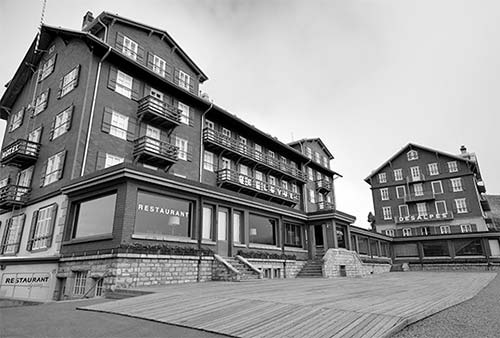
$$ Bergrestaurant Kleine Scheidegg is a handy, basic lodge in the train-station building. It has 17 rooms with shared bath, plus $ dorm beds (breakfast and dinner included for all guests, lodge closed off-season, +41 33 828 7828, www.bergrestaurant-kleine-scheidegg.ch). The $$ restaurant (open year-round) has a predictable menu of basic Swiss and international food.
$ Restaurant Grindelwaldblick, a 10-minute hike up along the path toward Männlichen and visible from the train station, is more charming, romantic, and remote than Bergrestaurant Kleine Scheidegg (private rooms, family room, closed Nov and May, +41 33 855 1374, www.grindelwaldblick.ch, info@grindelwaldblick.ch). The $$ restaurant, with a great sun terrace and a cozy interior, sells good three-course lunches and dinners, including a cheesy Rösti (food served daily 11:00-20:00, drinks until 22:00).
Sleeping in Stechelberg
Stechelberg, at 3,025 feet, is the hamlet at the end of the road up the Lauterbrunnen Valley; it’s about a mile beyond the Schilthornbahn lift. From the lift station to Stechelberg, it’s a five-minute ride on the same PostBus #141 that comes from Lauterbrunnen (2/hour, get off at “Stechelberg, Hotel”) or a 20-minute walk. Beyond Stechelberg lies the rugged upper end of the Lauterbrunnen Valley, which is mostly a nature reserve with only a few scattered huts and a narrow service road.
$$ Hotel Stechelberg, at road’s end, is surrounded by waterfalls and vertical rock, with a garden terrace, a good restaurant, and 16 quiet rooms—half with shared bath in a functional old building, half with private bath in a concrete, no-character new building (free parking, bus stops right in front, hotel closed mid-Nov-Christmas, restaurant closed Mon-Tue off-season, +41 33 855 2921, https://hotel-stechelberg.ch, hotel@stechelberg.ch, Marianne and Otto).
¢ The Alpenhof fills a former “Nature Friends’ Hut” with 44 cheap beds in rooms of two to six beds with bathrooms down the hall. Creaking like a wooden chalet built in 1926 should, and surrounded by a broad lawn, it provides a good, inexpensive base for drivers and families (each group gets a private room, breakfast optional, open nearly year-round, kitchen, no Wi-Fi, free parking, reception staffed 8:00-12:00 & 17:00-18:30, +41 33 855 1202, www.alpenhof-stechelberg.ch, alpenhof@stechelberg.ch, Diane from Australia and Marc from England). It’s 300 yards from the Stechelberg Hotel bus stop: Continue up the road, stay right at the fork, cross the river, and it’s on your left.