BERN & MURTEN
Map: Bern Hotels & Restaurants
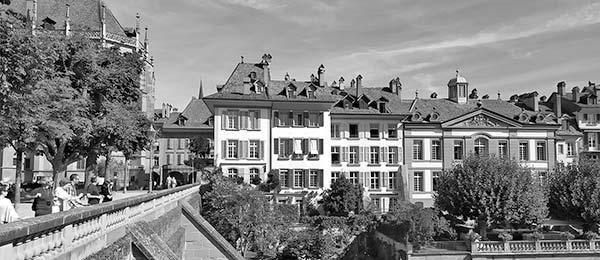
Enjoy urban Switzerland in the charming, compact capital of Bern, with a location that’s easily spliced into many Swiss itineraries. This is where Albert Einstein uncovered his genius and where artist Paul Klee set a playful, creative tone that lives on in this likable town. Bern’s neighbors are appealing, too: Ramble the ramparts of Murten, Switzerland’s best-preserved medieval town, and resurrect the ruins of an ancient Roman capital in nearby Avenches.
PLANNING YOUR TIME
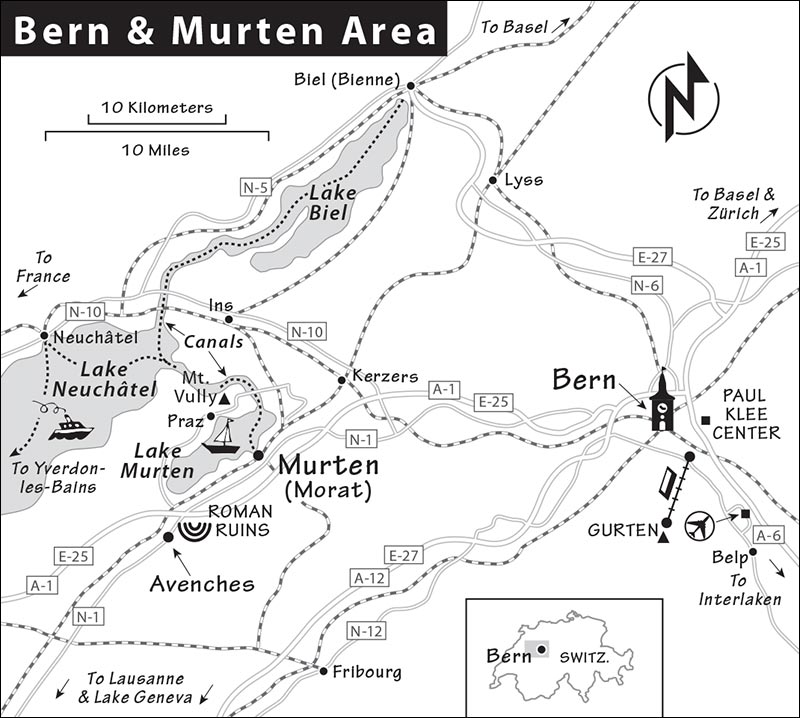
On a quick trip, big Bern and little Murten—about a half-hour apart by train or car—are each worth a half-day. Either makes a fine day trip or overnight stop. Murten, while easy by train, is even better by car.
Bern is a convenient stop between other Swiss destinations (such as going from the Berner Oberland to Murten, Luzern, or Zürich). But a short taste of Bern may leave you wanting more. Consider spending a night (or two) to linger, explore, and savor its livability.
If you’re day-tripping, stick your bag in a locker at the Bern station, spend a few hours taking my self-guided “Heart of Bern” walk and visiting some museums, then catch a late-afternoon train to your next stop. You could combine the destinations in this chapter by ending your busy Bern day in Murten, where you can spend the evening wandering the walls and savoring a lakeview dinner. In the morning, linger in Murten or move on to your next destination.
Bern
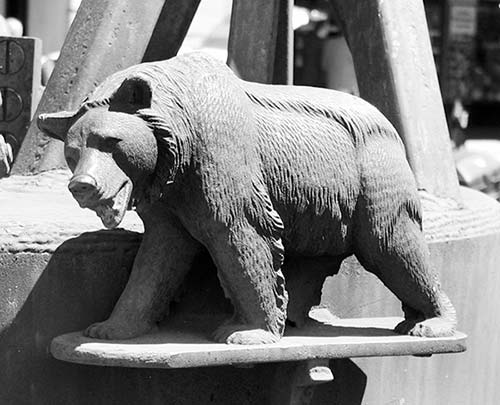
Stately but human, classy but fun, Switzerland’s de facto capital is the most rewarding place to experience Swiss urbanity. Window-shop along streets lined with cozy, covered arcades, people-watch in the lively market square, and sip from your choice of colorful, historic fountains. Enjoy Bern’s excellent museums, quaint-for-a-capital ambience, and delightful river scene. In this city (and canton), look for flags “bear-ing” the symbol of the local mascot: a roaring bear.
The city, founded in 1191, managed to avoid war damage and hasn’t burned down since a great fire swept through in 1405. After the fire, wooden buildings were no longer allowed, and Bern took on its gray-green sandstone complexion (using stone quarried nearby). During its 12th- and 13th-century growth spurt, the town grew through two walls. Looking at the map of the city—contained within a bend of the Aare River—you can see how Bern started with a castle at the tip of the peninsula and expanded with a series of walls, each defending an ever-bigger city from its one land-accessible side. The clock tower marks the first wall (1218). A generation later, another wall was built (in 1256, at today’s prison tower). The final wall—where today’s train station sits—was built in 1344.
In 1353, the surrounding canton (also called Bern) became the eighth to join the Swiss Federation. Today, Canton Bern is Switzerland’s second-largest, both in area (after Graubünden) and population (after Zürich). Since 1848, the city of Bern has been Switzerland’s seat of government. It’s small for a capital (140,000 people, or 400,000 with the suburbs—two-thirds Protestant and one-third Catholic). Though firmly German-speaking, it’s strategically located near French-speaking regions, and you’ll also hear French around town.
Bern’s pointy towers, sandstone buildings, colorful fountains, and riverside setting make it one of Europe’s finest surviving medieval towns. Einstein, Klee, and a trio of real, live mascot bears are among the famous Bernese who’ve contributed to the inviting character of this wonderfully livable small city. And more than 18,000 students help keep Bern young and frisky, despite all the government ministries and bureaucrats.
Orientation to Bern
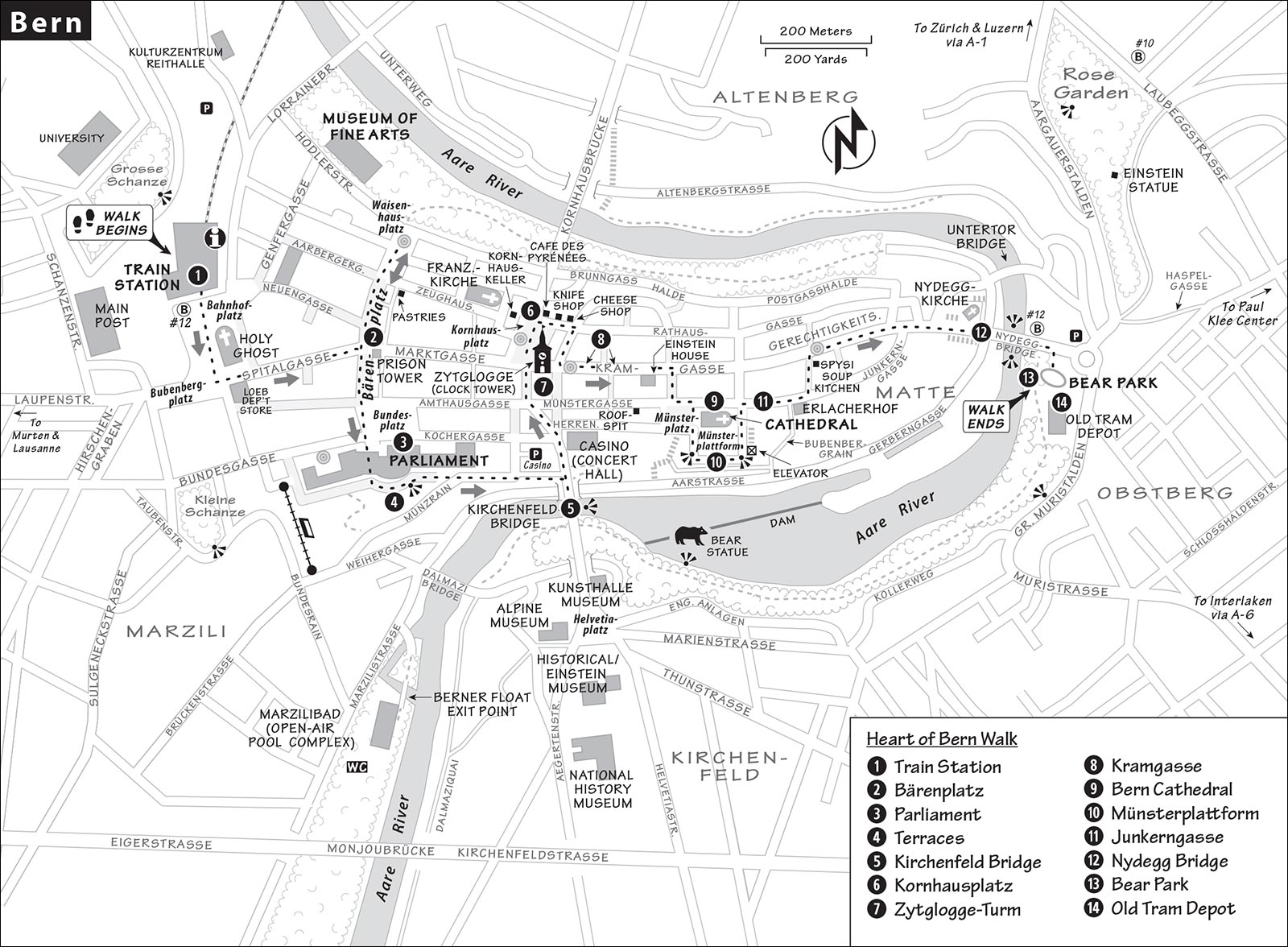
User-friendly Bern is packed into a peninsula bounded by the Aare River. The train station is located where the peninsula connects to the mainland. From there, a handy main drag leads gradually downhill, straight through the middle of town past most of the major sights, to the tip of the peninsula (then across a bridge and finally to the Bear Park and a hilltop rose garden). Allow a leisurely 30 minutes to walk from the station to the Bear Park following my self-guided walk, later in this chapter.
Tourist Information: The main TI is on the ground floor inside the train station (Mon-Fri 9:00-18:00, Sat-Sun until 17:00, +41 31 328 1212, www.bern.com). If you don’t have a Swiss Museum Pass and plan to do some serious sightseeing, ask about the Museum Card, which covers the main sights in town (28 CHF/24 hours, 35 CHF/48 hours).
ARRIVAL IN BERN
By Train: Bern’s bustling train station is a thriving three-story mall. The trains almost get lost. The lower level—where the trains arrive—has pay WCs (with showers), a Co-op grocery store, a big Migros takeaway deli, and lots of other long-hours, takeout eateries. The ground floor has the TI, train ticket office (Mon-Fri 7:00-21:00, Sat-Sun until 20:00), and lockers (down a corridor behind the TI). And on the upper level, you’ll find another Migros grocery store and a pharmacy (long hours daily).
On arrival, follow signs to exit to Bahnhofplatz. Trams and buses fan out from under the glass canopy on this square (use the electronic board and posted maps to find the correct lettered platform—or Kante—for your bus or tram). While most of my recommended sights and accommodations are within walking distance, hopping a bus or tram can be smart (and, with the Bern Ticket provided by your hotel, it’s free; your lodging confirmation serves as your transit ticket until you get the card at check-in).
By Car: The old town is essentially car-free (only service vehicles and public transit allowed). The most convenient place to park near the old town is the underground Casino Bern garage at Kochergasse 1, very close to the Zytglogge clock tower (3.60 CHF/hour, 28 CHF/24 hours, www.parking-bern.ch). For cheaper parking (especially if staying longer), consider the park-and-ride at the Neufeld exit (2 CHF/hour, 18 CHF/day, includes bus ride downtown to the train station). If you’re staying overnight, ask your hotel if they have a discount deal. Another affordable option—if you’re day-tripping to Bern and want to visit the Paul Klee Center—is to park there all day (until midnight) for 7 CHF, then hop on bus #12 into the town center.
HELPFUL HINTS
Blue Monday: Most of Bern’s museums are closed on Mondays. But you can still follow my self-guided walk, tour the cathedral (and climb its tower), tour the Zytglogge-Turm, watch the parliament in action (generally possible Mon afternoons), ogle the beasts at Bear Park, and go for a stroll along the river.
Market: An outdoor market with clothes, gifts, and other merchandise fills Waisenhausplatz at the north end of Bärenplatz several times per week (Tue 9:00-18:00 and Sat until 17:00, plus April-Oct Thu 9:00-18:00, does not run in Dec, www.marktbern.ch).
Bookstore: A block from the train station, Stauffacher is huge, with an entire floor of English books, including a fine selection of writing on Switzerland, and a café (Mon-Fri 9:00-19:00, Thu until 20:00, Sat until 17:00, closed Sun, Neuengasse 37—for location see the “Bern Hotels & Restaurants” map, later, +41 31 313 6363, www.stauffacher.ch).
Laundry: The self-service Jet Wash launderette is a three-stop bus ride from the train station (Mon-Sat 7:00-21:00, Sun 9:00-18:00, take bus #20 from platform E in front of station to the Lorraine stop, then find Dammweg 43 on the left, +41 77 417 9502, www.jetwash.ch). For location, see the “Bern Hotels & Restaurants” map, later.
GETTING AROUND BERN
The city is walkable, though its buses and trams can be handy. For short rides of up to five stops—such as between the train station and Bear Park—buy a Kurzstreckebillet (short-stretch ticket, 2.60 CHF). For longer journeys—such as going all the way out to the Paul Klee Center—you’ll need an Einzelbillett (standard single ticket, 4.60 CHF). A day pass is 9.20 CHF (buy tickets from touch-screen machines at stops, credit cards accepted, info at +41 31 321 8844, www.bernmobil.ch). All public transit in Bern is also covered by the Swiss Travel Pass. And if you’re overnighting here, your hotel or hostel will give you a Bern Ticket that covers local transit. Be sure to ask for it at check-in (using it may require installing an app on your mobile phone, but after that, the ticket works without an Internet connection).
Tours in Bern
Walking Tours
These leave from mid-April through October from the train-station TI (Wed and Sun at 13:00; Mon, Fri, and Sat at 11:00; off-season Sat at 11:00 only, 1.5 hours, 25 CHF, online booking encouraged, call TI the day before to confirm schedule and ensure the guide speaks English, www.bern.com). This tour can be combined with the TI’s tour of the Zytglogge clock (see its description on my “Heart of Bern Walk,” next).
Local Guide
Marie-Therese Lauper is a charming and hardworking independent guide who offers special rates for individuals and small groups (+41 079 700 0880, amthlauper@bluewin.ch).
Heart of Bern Walk
9 Bern Cathedral (Berner Münster)
14 Old Tram Depot (Altes Tramdepot)
Follow this self-guided walk to explore central Bern. You’ll start at the train station and finish at the Bear Park at the far end of town, where you can catch a bus back to the station. Along the way, visit a bakery or supermarket to put together a picnic, which you can eat at a terrace behind the cathedral or near Bear Park. (I’ll point out a good cheese shop, too.)
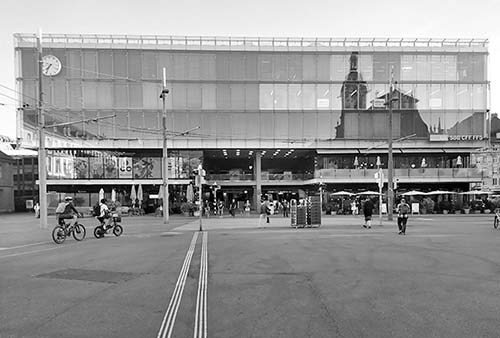
1 Train Station
The station is essentially a bright and airy shopping mall, with a TI and all the shops you could need. For a grand perch, ride the escalator to the top floor. The huge board listing departures illustrates why so many Swiss urbanites choose not to own a car.
With your back to the big departures board, step outside onto the big square called Bahnhofplatz. The old town was sealed off here with a fortified wall, which was replaced in the 19th century by the train station.
Cross the street to the transit hub under the big glass canopy. Bern’s vision is to create a carless city. The striking glass top, designed by renowned Spanish architect Santiago Calatrava, makes riding the bus or tram a bit more elegant.
On the left of the square stands the Holy Ghost Church (Heiliggeistkirche). Notice the gray-green Bernese sandstone, used for the church and surrounding buildings. Because this stone is porous and easily eroded by water, Bern’s buildings are designed with characteristic oversize eaves. To maintain architectural harmony, even newer buildings (like these) are required to be built with the same local stone (though generally just a thin veneer).
• Turn left onto the street that runs in front of the church, called Spitalgasse. This marks the start of one long street (with four names). The spine of both the peninsula and our walk, this street rambles downhill through the heart of town to the bridge and Bear Park.
As you walk under the arcades, about 100 yards down the street, you’ll reach the first of Bern’s 11 Renaissance fountains, the Bagpiper. These colorful 16th-century fountains—mostly by the same artist—are Bern’s trademark. The city commissioned them for many reasons: to brighten the cityscape, to show off the town’s wealth, and to remind citizens of great local heroes and events. The fountains also gave 16th-century artists something to work on after the Reformation deprived them of their most important patron, the Catholic Church. Evenly spaced throughout town, the fountains naturally became community gathering places—the spot to get the latest neighborhood news and gossip.
Shopping opportunities abound under the more than three miles of arcades that line Bern’s streets. Stores run the gamut from affordable to high-end (typically open late on Thu and closed Sun). In German, the slang for the corridor under these arcades is Rohr (pipe). To stroll through the town is to rohren (go piping).
• Continue rohren down Spitalgasse until you reach...
2 Bärenplatz
The tram tracks run under the Prison Tower (Käfigturm)—once a part of the city wall (c. 1256). Renovated in the 1640s, the tower served as a prison until 1897 (Käfig means “cage”). Notice how the hand on the clock really is a hand—and how it was built in a slower-paced era, when just an hour hand told time precisely enough. The bears on the tower are part of Bern’s coat of arms (with the double-eagle reminder that Bern was part of the Holy Roman Empire in the early Middle Ages). You’ll see many, many bears depicted all throughout this walk—and live bears await you at the end.
As each of the town’s successive walls and moats was torn down, Bern was left with an elongated swath of land that’s now a people-friendly “square” like this one. Bärenplatz is a top place to be seen in the evening. It was named for the bear pits that filled a ditch here, back when this was beyond the town center.
Head to the left 50 yards to find the Dutch Tower (Holländerturm). Swiss soldiers were famous mercenaries—guns for hire who fought all over Europe. Returning from a battle in the Netherlands, the soldiers brought back the habit of smoking. But in the 18th century, smoking tobacco was forbidden within the city walls of Bern, so they hid in this tower to smoke discreetly. Locals joke that now that a modern-day smoking ban has come to Bern, this tower may regain its historic function.
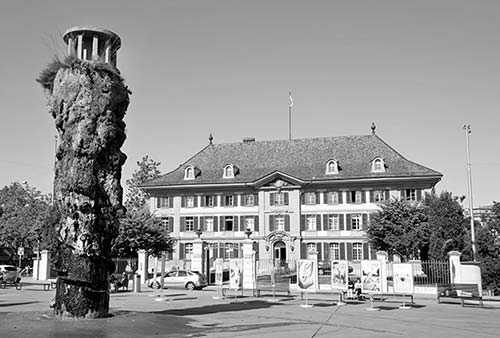
Farther along, about 100 yards down at the far end of the square (here called Waisenhausplatz), find the modern, mossy fountain by the Swiss surrealist Meret Oppenheim. Made in 1983, it symbolizes growth and life and is supposed to demonstrate communication between an object of art and the beholder. It worked well...too well, in fact, as most citizens immediately communicated their dislike and wanted it destroyed. But Bern’s politicians proved braver than expected, and the fountain survived. Time has transformed Oppenheim’s gray concrete column into a multicolored pillar topped with moss, grass, and flowers. Residents do like it in the winter, when it’s covered with ice. The grand building beyond the fountain—once the city orphanage—is the police station.
Art lovers can detour just a couple of blocks to the left (as you face the fountain) to reach Bern’s concise Museum of Fine Arts, with one or two quality paintings by virtually all of the great European masters...plus some Swiss artists mixed in (described later, under “More Sights in Bern”).
• With your back to the modern fountain, stroll a few blocks back down toward the south end of Bärenplatz.
On the nearby corner (with Zeughausgasse), look for the Glatz pastry shop; they invented their own local cookie, the Berner Mandelbärli (“Bern Almond Bear”). Most mornings except Sunday, this area thrives with market stalls selling local produce, bread, flowers, sausages, cheeses, and other goodies. Farther down, closer to another fountain, are some tempting food carts. Brick-and-mortar restaurants also line the square (see “Eating in Bern,” later). Old-timers play giant chess under the trees, and a massive underground parking lot hides under your feet.
• Just past the end of Bärenplatz looms a giant building. This is the...
3 Parliament (Bundeshaus)
You may brush elbows with some high-powered legislators, but you wouldn’t know it—everything looks very casual for a national capital. Like so much else in Bern, the parliament building is made of that distinctive green-gray sandstone. When Switzerland became a modern nation in 1848, Bern became the seat of government for two main reasons: It straddles the German and French parts of the country, and the city offered to build all the necessary buildings. Look right. Look left. This entire chunk of Bern’s hilltop is federally owned—including the super-swanky, five-star Bellevue Palace Hotel just up the street to the left, where visiting dignitaries stay. (Legally, Switzerland does not have a “capital”—Bern is simply the seat of government, and the de facto “Federal City,” or Bundesstadt. But that’s a whole other story...)
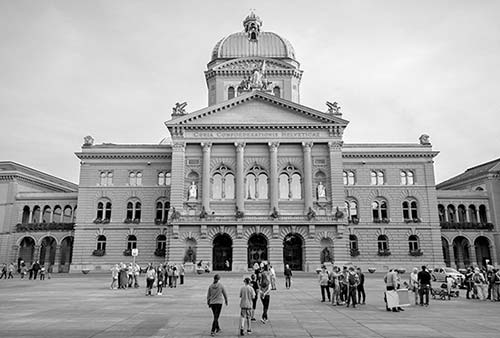
Check out the building’s statuary: The woman on the top of the building represents political independence, the one on the left (under the 1291—when the first three cantons bound together to found the nucleus of Switzerland) stands for freedom, and the one on the right (under 1848—when the people got their constitution assuring democracy) symbolizes peace.
Switzerland’s bicameral system was inspired by the US Constitution, with one big difference: Executive power is shared by a committee of seven, with a rotating ceremonial president and a passion for consensus. This is partly a mechanism to avoid power grabs by any single individual...a safeguard that the Swiss love (and enjoy bragging about lately).
Bundesplatz, the fine granite plaza in front of the parliament (built in 2004 to replace a parking lot), is a favorite spot for demonstrations and markets. On Tuesday and Saturday mornings, it hosts a higher-end market than the one we just saw on Bärenplatz; the choosiest chefs come here to source their ingredients. Hidden in the pavement is a 26-squirt fountain (one for each canton)—a real kid-pleaser and fun photo spot on a hot summer day. On the left is the Swiss National Bank—this country’s Fort Knox, with half the Swiss gold stock buried under the square (the rest is in Zürich).
Touring the Parliament: When parliament is in session, the galleries are open to the public so you can watch the action (free; generally Mon afternoon, Tue and Thu mornings, and all day Wed; leave ID at entrance, lines can be long, no photos). When parliament is not in session (for example, from mid-July to mid-Aug), you can take a free, guided, hour-long tour of the building (English tours typically Wed, Thu, and Sat at 14:00, less frequent outside summer; reserve up to 3 days ahead at www.parlament.ch—click “Services” then “Visiting the Parliament Building,” +41 58 322 9022). The visitors entrance is around the back of the building.
• Walk through the archway to the right of the parliament. You’ll pop out overlooking Bern’s outskirts from a series of...
4 Terraces
From here, you have a commanding view over the outskirts of Bern. Below you flows the Aare River—fed by glaciers, which give it its bright-blue sheen. On a hot day, the river is speckled with locals doing the “Bern float” (described on here). On the right side of the river, look for Bern’s biggest swimming pool, the Marzilibad. Just this side of the pool complex, notice the canal that cuts away from the river. This was dug recently to allow a safer exit for swimmers floating down the river (before, they had to grab for a pole along the riverbank as they floated past).
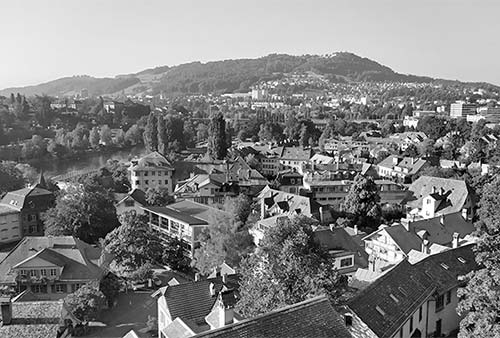
Just above the river is Bern’s own little “mountain,” the Gurten (with the view tower poking up above its forested summit). The Gurten is the city’s favorite recreation spot, offering a luge ride and music festivals in summer and modest skiing opportunities for children in winter. To frolic with the Bernese, you can either hike up or ride a little funicular to the summit (take tram #9 to Wabern/Gurtenbahn, then ride the funicular from there).
Pan to the left, where, on a clear day, you can see the mirage-like outlines of the Eiger, Mönch, and Jungfrau—the highest peaks in the Berner Oberland. The prickly, chalet-style building in front of these peaks holds Bern’s Albert Einstein Museum and its Historical Museum, described later and easily reached on the opposite side of the bridge we’re about to visit.
Before moving on, look back at the rounded end of the Parliament building; up high, see the colorful seals of the 26 cantons of Switzerland.
• Turn left and stroll along the terrace walls a few hundred yards to...
5 Kirchenfeld Bridge
Walk out to the center of the bridge for great views back on Bern’s cathedral and town center—lined up along its promontory and hemmed in by the Aare River. Directly below, notice the security nets. The bridge used to be the favorite place for suicides—to the terror of people living below. Bern has many high bridges, and you’ll see this safety netting on all of them.
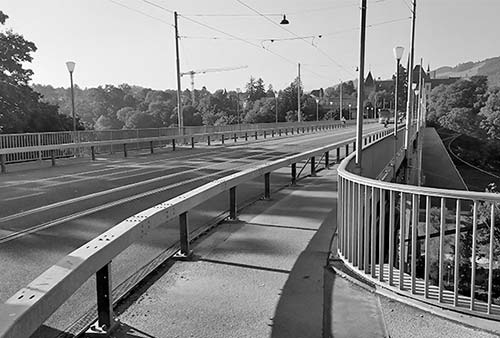
Look down at the dam that runs across the river below you. (Wait—is that a bear out on the dam?) The waterfall here was natural, but a system of modern sluices better controls the flow. Even so, Bern was deluged with dangerous floods until 2005, when a new canal was built upriver—allowing high waters to be diverted harmlessly. Just this side of the dam is the recommended Schwellenmätteli Restaurant lounge, where a trendy local crowd enjoys cocktails over the rushing river on nice days. By the way, the Aare begins in the mountains and flows through Interlaken; after leaving Bern, it continues north and joins the Rhine in Basel.
If you continued along this bridge to its far end, you’d reach the sprawling complex of museums (described later, under “More Sights in Bern”); if you’re planning to visit any of them, you might do it now.
Otherwise, turn around, and head back to the base of the bridge, then cross the street. The fine building marked Casino isn’t for gamblers—it’s the home of Bern’s Symphony Orchestra, and it also hosts graduation ceremonies and wedding receptions. Step into the lobby, then bear right to ogle the vast, opulent café that fills a restored Neoclassical gallery. The outdoor terrace here serves coffee for not much more than other local cafés.
• Leaving the bridge and the river behind you, follow the tram tracks around the left side of the handsome sandstone house (with the man-and-Swiss-flag mural). You’ll reach another swath of land created by the removal of a city wall—first called Theaterplatz, and then...
6 Kornhausplatz
This square is ornamented by the colorful fountain of an Ogre (Chindlifresser, “child-eater”). Two legends try to explain this gruesome sight. It’s either a folkloric representation of the Greek god Chronos, or a figure that was intended to scare children off the former city walls.
Kornhausplatz is a major hub for tram traffic, which ground to a halt in the summer of 2019 when record-high temperatures actually warped the tracks. Living in a mountain nation of receding glaciers, rockslides, and avalanches, the Swiss feel the tangible, everyday effects of climate change. Climate issues are huge in Swiss politics. The country has several environmental parties, and they combined to win an unprecedented 20 percent of available parliament seats a few months after the 2019 heat wave. Meanwhile, Switzerland’s far-right, nativist movement has faltered because they’ve been caught flat-footed on climate issues. (Apparently, even Swiss racists have a soft spot for the environment.)
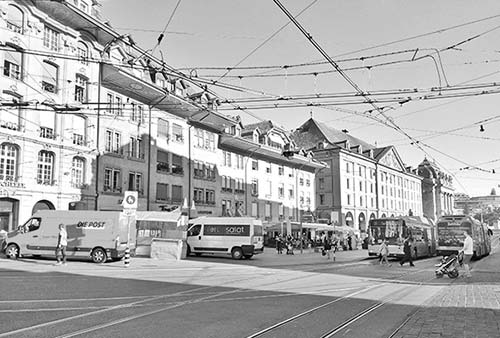
The building behind the Ogre, on the left, used to be the granary and now houses the modern public library and the huge recommended Kornhauskeller restaurant. If the restaurant is open, wander down the stairs and head inside—even if you’re not eating here, you must take a peek at this magnificent subterranean place. Once the vast city wine cellar, this space was built in high Baroque style (1718) and renovated with paintings inspired by the Pre-Raphaelites in 1897. The 12 columns (in the upper level) show traditional costumes of Bernese women. Across the street from the Kornhauskeller, notice the Café des Pyrénées. This was a hotspot for Bern’s avant-garde in the 1960s; the gray-ponytail crowd still hangs out here today.
Head up the little street next to the café, Rathausgasse, to reach two quality shops selling classic Swiss items (both on the left). First up, at #84, Klötzli Messerschmiede sells a wide range of top-quality knives—from touristy Swiss Army models, to heirloom-quality pocketknives, to professional chef’s knives. Tucked behind the cash register is a special room with a suit of armor and real swords.
Next door at #82, Zur Chäshütte (the Cheese Hut) is a little shop with a classic cheese counter. Step inside, take a big whiff of the funky aroma, and peruse the well-stocked display case. With more than 150 types of cheese, you may want to buy a few slabs for your picnic. Rezent means strong, pungent, and well-aged, while mitte is a bit milder. Consider buying a combination: a hard, aged cheese (their “house cheese”—Hauskäse—is aged in the cellar below your feet); a more typical, semi-mild Swiss cheese (such as Gruyère, Emmentaler, or the more intense Appenzeller); a goat-milk cheese (Geiss); or perhaps a softer, French-style, brie-like cheese. They also sell yogurt, honey, and jam.
• Just past the cheese shop, turn right one short block down Zibelegässli. You’ll run right into Bern’s main landmark...
7 Zytglogge-Turm
Bern’s famous clock tower was part of the original wall marking the first gate to the city (c. 1250). The clock, which dates back to 1530, performs four minutes before each hour: The happy jester comes to life, Father Time turns his hourglass, the rooster crows (in German, that’s “kee-kee-ree-kee” rather than “cock-a-doodle-doo”), and the golden man on top hammers the bells. Apparently, this little spectacle was considered quite entertaining five centuries ago. The word Zytglogge is local dialect. The Standard German equivalent, which doesn’t actually exist, would be Zeitglocke (literally “time bell”).
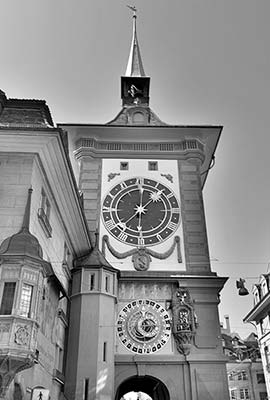
To pass the time waiting for the action, study the clockworks and try to figure out how they work. On the lower disc, does the golden hour hand look like it’s running slow? If it does, that’s probably because it’s showing solar time, and in summer, because of the modern innovation of Daylight Saving Time. You can determine the zodiac, today’s date, and the phase of the moon—look at the black-and-gold orb.
Inside the archway under the clock are the old regional measurements (Swiss foot, the bigger Bernese foot, and the Elle, or “elbow,” which was the distance from the elbow to the fingertip) and the official meter and double meter. It took a strong leader like Napoleon to bring consistency to measurements in Europe; he replaced the many goofy feet and elbows of medieval Europe with the metric system used today (c. 1800).
Touring the Tower: Enthusiasts can tour the medieval internal mechanics—early Swiss engineering at its best—and see the bellows that enable the old rooster to crow (20 CHF, one-hour tour; April-Oct Mon, Fri, and Sat at 14:15, Wed and Sun at 15:15; off-season Sat at 14:15 only; reserve in advance through www.bern.com).
• With the clock at your back, continue your stroll down the main drag. At this point, you enter the oldest part of town, where bigger department stores are replaced by quainter shops and galleries on...
8 Kramgasse
Bern’s arcades, common in Alpine towns, shelter pedestrians from both sun and snow. Though the arcades are privately owned, owners must keep them clean and allow public access. Then as now, the main activity here is shopping—kramen means, roughly, to shop for an assortment of items (“rummage” would be the closest translation). Pop-up stores are popular in Bern—up-and-coming vendors can lease a space for six months to test the market.
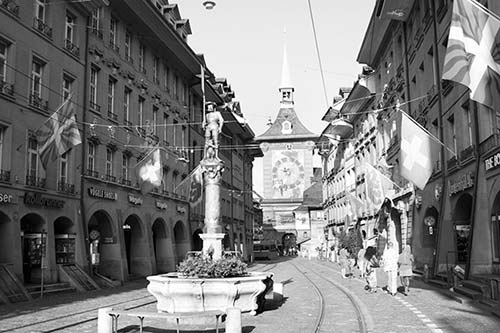
Most shops are underneath the arcades, but don’t miss the ones in the cellars that you can access only from the main road. The cellars, marked by old-time hatches, were (among other things) used for storing wine. The wine was produced around Lausanne on Lake Geneva, which was then controlled by Bern—so they sent ample amounts of wine here as tribute. People said “merry Bern” was floating on wine, just as Venice was floating on water. The merry times ended in 1798, when Napoleon’s army moved in (and drank all the wine). After that, the wine cellars were empty and the city got a new nickname: “sad Bern.” Napoleon’s soldiers also looted Bern’s tremendous treasury, and Napoleon used money from Bern to finance his Egyptian crusade.
In the middle of the street is the Zähringen Fountain. It’s named for the German duke, Berthold V, the Duke of Zähringen, who founded Bern in 1191. Legend says he couldn’t decide on the name, so he went hunting, proclaiming that he’d name the city for the first animal he killed. It was, of course, a Bär (bear)—and Bern had its name. Notice the armor-clad bear is holding a flag not of a bear, but of a lion—the family crest of the Zähringers.
Directly in front of and behind the fountain, a grate reveals a bit of the canal that used to flow open down the middle of the peninsula, providing people with a handy disposal system, place to wash, and the medieval equivalent of a fire hose. Today, the water that pours from the fountains’ spouts is perfectly potable—locals love to brag about the quality of their water. Fill up your bottle and save a few francs.
By the way, although this feels like a pedestrian zone, buses and occasional cars do tend to sneak up on distracted tourists—stay alert. The bus that uses this street—#12—is practically made for visitors, connecting the train station to the Paul Klee Center by way of the main drag...handy to hop on and off at will.
• Now head down Kramgasse. On the right at #73, chocolate lovers will want to peek into Confiserie Tschirren—the top-end chocolatier and pastry shop in Bern. Keep going. About 200 yards down, on the right at #49, is the home of a very smart man.
The apartment that Albert Einstein called home between 1903 and 1905—the years when he formulated his special theory of relativity while working in obscurity at the Patent Office—is now the Einstein House museum (6 CHF; daily 10:00-17:00, closed late Dec-Jan; +41 31 312 0091, www.einstein-bern.ch). Einstein and his wife Mileva welcomed their first child in this one-bedroom apartment and shared a kitchen and bathroom with the neighbors. Inside, you can see period furniture, including Einstein’s Patent Office desk, and a few photos and manuscripts. Another apartment one floor up has been turned into an informative—if dry—exhibit on Einstein’s life. This quick, inexpensive visit (well-described in English with a few historic artifacts and a 20-minute video—request English) is just about the right amount of Einstein for most visitors. I actually didn’t find it that exciting, but I guess everything’s relative.
The man who changed how we see our universe made his greatest discoveries during the eight years he lived in Bern (1901-1909). Raised in Germany, Albert Einstein (1879-1955) went to college in Zürich, hoping to land a job teaching math and physics. But the young grad’s GPA and résumé were mediocre, so instead he took a job in Bern’s Patent Office, inspecting and registering inventions.
Twenty-three-year-old Albert and his new bride Mileva (his brainy college sweetheart) rented an apartment at Kramgasse 49 (today’s Einstein House), where Mileva soon gave birth to their first son, little Hans Albert. Einstein punched the clock at the Patent Office and spent his spare time reading, hiking the Bernese countryside, and thinking. At night, he’d join with his mates—the self-named “Olympia Academy”—to smoke, drink beer, and talk math and philosophy. Outwardly, he led an ordinary life, but his thoughts were always on science’s Big Questions. At home, in pubs, or at work he’d scribble down equations and ideas, filing them in his self-described “Department of Theoretical Physics”—a desk drawer in his office.
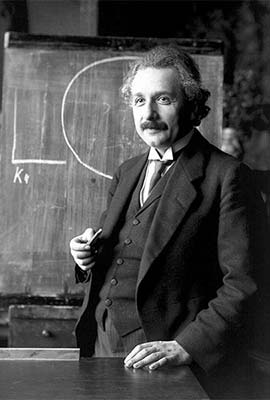
Then, one warm spring day, as Einstein walked on the outskirts of Bern, it all started coming together. So began his annus mirabilis—the miracle year of 1905—in which the 26-year-old amateur physicist wrote five papers that would shock and perplex the world. Published in a major physics journal, they touched on subjects such as how molecules move and how light can appear as either a wave of energy or as a beam of tiny particles.
The most famous paper, his theory of special relativity, described a world in motion. A person on a moving train and someone who’s stationary see the world from different perspectives—that’s the classic principle of relativity described by Galileo and Newton. But Einstein said there’s an exception to the rule—light, which has a speed that remains constant whether it’s on a moving train or on the ground. So, a person on a moving train and one at rest won’t agree on what they see...yet they’re both right. The discrepancies only become obvious as the train travels close to the speed of light. Then, while the person on the train thinks everything is normal, the one on the ground sees the train shrink, train clocks slow down, and the person on the train stops aging!
Einstein’s papers initially drew little interest and a measure of skepticism. But over time, other physicists grasped the significance of Einstein’s work, seeing how he took earlier findings, wove them together, and did the math that explained it all. Subsequent experiments proved that even Einstein’s most bizarre assertions were correct. Time on a fast-moving jet really does slow down (hence, those interminable intercontinental flights).
Einstein was invited to lecture at the local university, though he was still working nine-to-five at the Patent Office. In his spare time, he worked on his next project, general relativity. He theorized that gravity is not a force that attracts things but a curving of space—like a bowling ball on a soft mattress—that affects the motion of nearby objects. In 1909, Einstein’s growing reputation won him a job offer to teach in Zürich, and he quit the Patent Office and left Bern for good.
Einstein would never again approach the creative level of his days in Bern. (In 1922, he won the Nobel Prize for his work done during the 1905 annus mirabilis.) Albert and Mileva split, and he married a cousin. When Hitler took power in Germany (1933), Einstein—a pacifist and a Jew—left Europe for America. His curly black hair had turned white, and his aging face later became a pop-culture icon of genius—complete with pipe, moustache, basset-hound eyes, and halo of frizzy white hair (which he backcombed in order to look sufficiently unkempt).
In 1939, Einstein wrote a letter to President Franklin Delano Roosevelt warning that scientists (including some in Germany) could soon discover a way to release an enormous amount of energy. The research was based on a principle he’d outlined back in 1905—that energy is equivalent to mass times the speed of light squared (a very big number). And so, E = mc2 became the principle behind the atomic bomb—a very big bang from an idea hatched in the pubs and arcaded streets of Bern.
To learn more, visit the Einstein House in the town center and the Einstein Museum just across the river (both described in this chapter).
If this little exhibit piques your interest, consider visiting the Einstein Museum’s far more extensive exhibit (triple the price but free with Swiss Travel Pass), located within Bern’s Historical Museum (see “More Sights in Bern,” later in this chapter).
A bit farther down, you reach the Samson fountain. In the statue on top, notice the donkey’s jawbone tucked into Samson’s waistband. This is the symbol of the butcher’s guild, which was located just to the left, in what is today the music conservatory. Notice how close this fountain is to the previous one. It’s believed that the butchers financed this fountain specifically to have one next to their slaughterhouse.
Near the fountain on the right, in the cellar of #37, is Hanftheke Bern (hanf means hemp), a marijuana shop. In Switzerland, marijuana with less than 1 percent THC (the psychoactive component of cannabis) is legal. This strain is high in cannabidiols, which make you very relaxed...but you can’t get high on it. The person behind the counter is happy to explain the local approach to pot.
• Twenty yards below the Samson fountain, at #29, turn right through the narrow tunnel-lane, Münstergässchen, to the...
9 Bern Cathedral (Berner Münster)
Bern’s 15th-century Catholic-turned-Protestant cathedral is capped with a 330-foot-tall tower, the highest in Switzerland (finished in 1893). The late-Gothic church was dedicated to St. Vincent of Zaragoza.
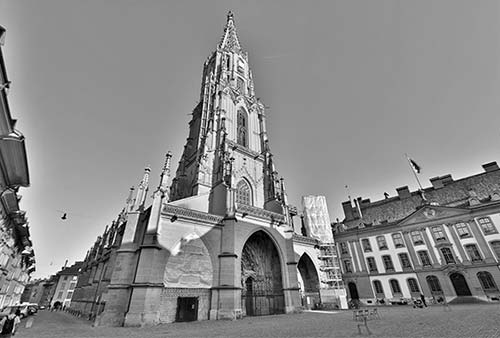
Before heading into the church, if it’s Tuesday or Saturday, head up the street to your right (Münstergasse) to find a thriving market—this one specializing in meat. At #41 (on the left), look way up high to see a rusted-metal sculpture sticking out from the roofline. This is called Roofspit, and it shoots a spurt of water down onto the street below a few times each minute (it’s turned off during the market). Notice the 5-CHF coins permanently stuck in the pavement where the water splashes, luring suckers to bend over to grab a coin—and get wet. Who says the Swiss don’t have a sense of humor?
Return to the cathedral, and get up close to the main portal, with its striking gold-leaf highlights. This seems pretty un-Protestant; it probably survived because its theme, the Last Judgment, showed that no matter how rich you are or what rank you have in Church hierarchy, anyone can end up in hell (an idea Protestants dug). Condemned people are popping in the flames like lottery balls. Notice the humorous details in the commotion of people heading to hell (especially what the little green devil is doing to the sinful monk). Just below on the left are statues of the virtuous virgins (dressed like Bern burghers), while on the right are the foolish virgins who squandered their oil (dressed like the city’s historic rivals, the Burgundians).
Cost and Hours: Free to enter cathedral; Mon-Sat 10:00-17:00, Sun from 11:30, shorter hours off-season; audioguide-5 CHF, +41 31 312 0462, www.bernermuenster.ch.
Visiting the Church: Step inside and grab a pew in the nave. The plain interior was once adorned with 26 separate little chapels and altars dedicated to Mary and various saints. An ornate screen separated the priests from the worshippers. But when the Reformation came to town in 1528, all this was swept away. The iconoclasts believed that images distracted worshippers from focusing on God, so they destroyed the distasteful decoration. The new center of attention was the pulpit, where Protestant preachers shared the word of God—not in Latin, but in the people’s language.
Those Protestant iconoclasts didn’t manage to trash the church’s precious painted keystones. Look up to the ceiling, where you can see giant, colorful coats of arms. These don’t honor saints, but prestigious Bernese families. Notice that this church isn’t a “Cathedral” (that’s in Lausanne), but a Münster. The local burghers actively discouraged having their church be named a cathedral, because then they’d have a bishop in town, bossing them around. The Bernese burghers remained independent; this church was sometimes called the people’s church (Leutkirche).
For another bit of decoration that the iconoclasts missed, head to the third glassed-in chapel on the right. High on the far wall (to the left of the window), you can see a bit of an angel’s halo; just to the left of this, you can very faintly see an image of Mary kneeling. This was likely a scene of the Annunciation. Historians are using modern technology to uncover pre-iconoclasm art like this.
Continue to the end of the right aisle, and look right for a beautiful, colorful, highly entertaining stained-glass window (from the 1760s) illustrating the “dance of death”—the idea that no matter who you are, no matter how powerful or wealthy, death will still come for you. Spend some time appreciating each of the scenes of a macabre skeleton harassing a Bernese person.
Now head to the giant, black-marble altar under the transept. Look toward the apse; the three stained-glass panels on the left are original, from 1441. Now look up to the ceiling over the choir, where you’ll see another 78 colorful keystone decorations, featuring saints and other Christian VIPs.
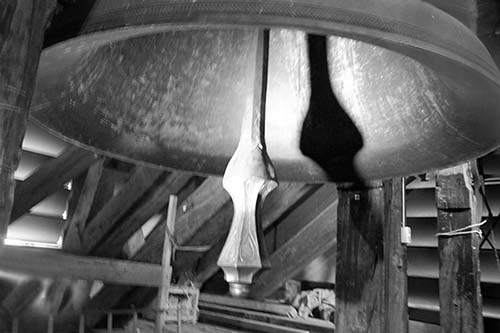
Climbing the Tower: You can pay 5 CHF to huff up the spiral staircase (more than 300 steps) to a viewpoint at the base of the lacy see-through steeple (same hours as cathedral). From this 210-foot-high vantage point, you enjoy a behind-the-scenes look at the varied courtyards and rooftop gardens hidden behind the conformist building facades. Don’t forget to turn around to appreciate an up-close look at the tower’s carved figures. On the way down, peek at the cathedral’s bells—including the largest bell in Switzerland, a 10.5-ton beauty cast in 1611 and called Susanne (named by a bellringer after his sizeable girlfriend). This bell was so heavy that it took eight men to swing her. If you’re up here when the Prayer Bell rings, you may feel the tower sway.
• Head behind the cathedral to a terrace overlooking the river, the...
10 Münsterplattform
Starting in the 14th century, this terrace was built from all kinds of “recycled” stones from older buildings. Archaeologists have even unearthed some heads of statues that were victims of Reformation iconoclasts.
Look out over the edge of the terrace for another view of the dam in the Aare below you. The base of the terrace, once overgrown, has recently been reclaimed and spiffed up to host many sweet little community gardens.
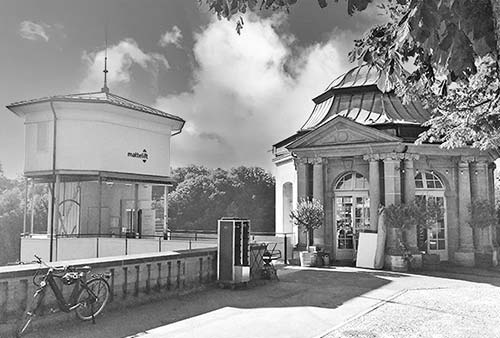
Twin 18th-century pavilions grace the square. On the right is a tiny branch of the city library (providing park-goers with books, boules, and table tennis). And in the far left is a café offering a scenic spot under a chestnut tree for a bite or a drink on a sunny day. Behind the café, the elevator (a “vertical tram”) has been carrying passengers up and down since 1896 (1.50 CHF).
• With your back to the river, exit on the right. Walking past the end of the cathedral, turn right and walk down...
11 Junkerngasse
Still the most expensive street to live on in Bern, this sleepy lane was lined with the mansions of the wealthy burghers of Bern—mostly on the right, facing out over the river. But you’d never know it since these mansions blend in with the simple townhouses nearby. The Bernese value thrift and hard work, and pride themselves in not showing off wealth (“That’s for Zürich!” they snort).
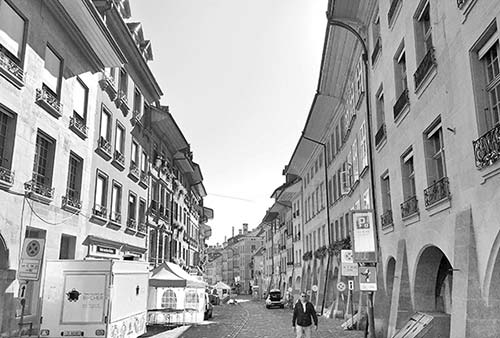
At the end of the first block on the right (#47) is the Erlacherhof—a particularly fancy mansion, known as the only house in Bern with a courtyard. Today it’s the mayor’s residence.
Just past the building, on the right, notice the stairs leading through the wall and down to the river (marked Bubenbergrain). Historically, the lower-lying, riverside part of Bern was home to tradespeople: fishermen, tanners, and traders. But they needed to bring their wares up to market in the town, so several of these staircases were built.
A few steps past the Erlacherhof (and the fountain nearby), watch on the left for the tiny lane marked Ob. Gerechtigkeitsgasse, with a big sign for Spysi. Head down this little lane and look for a door halfway down on the right. This is Spysi, a sort of soup kitchen that was established during the Industrial Revolution. Many of the tradespeople who used the steps we just saw were replaced by modern factory jobs, leaving them poor and destitute. Spysi (from speisen, “to eat”) offered them a very cheap meal. To this day, from November through April, down-on-their-luck Bernese people can get a big bowl of soup and a hunk of bread here for a few coins. Just past Spysi, notice the pissoir—a discrete public urinal for men.
At the end of the little lane is Bern’s main drag again—now called Gerechtigkeitsgasse. You’re greeted by the Fountain of Justice, a blindfolded figure who triumphs over the mayor, pope, sultan, and Holy Roman Emperor. (Notice that Bern’s mayor is depicted as being of equal status with these European powers.)
Turn right and walk down the main drag, seeing that—as the terrain changes—the houses get narrower, and the cellar doors are vertical rather than horizontal. Remember that as you walk, you’re going back in time, getting closer to the original (and oldest) core of town. The cellars along this stretch are a little less big-corporate and more funky and colorful, from the “Cave of Tango” to the “Seamen’s Club.”
Near the end of the street on the left, look for the Café Restaurant Treff. Find the three gutter openings in the middle of the street out front (sometimes they’re covered—if so skip ahead). They’re just like the channels we’ve passed all through town. Except...do you notice anything strange about the middle one? The water is running backward—uphill. This is an elaborate (but very subtle) prank: The water in the middle opening comes from a different source, so it looks like it flows backward, just to, y’know, mess with people. (Swiss humor strikes again!)
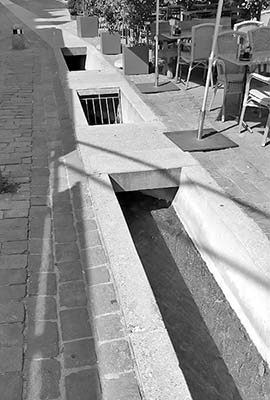
Across the street, find the Junkere Café-Bar at #1. Look for the red nette Toilet sign on the window of the side door. The city government pays local bars to let the public use their WCs—so feel free to pop in and use the toilet.
• From here, you reach...
12 Nydegg Bridge
Head partway out onto the bridge and look left, where a church sits on the site of the original town castle. Notice the curve of the streets in this part of town: The outer curve follows the path of the original city wall, while the inner curve traces the wall that surrounded the castle. The small bridge below is the oldest in Bern (and, until 1844, was the only bridge crossing the Aare here). High on the ridge, just above the tollbooth’s pointy spire, is the Rosengarten—a delightful garden with a grand view over Bern and a recommended restaurant (described later).
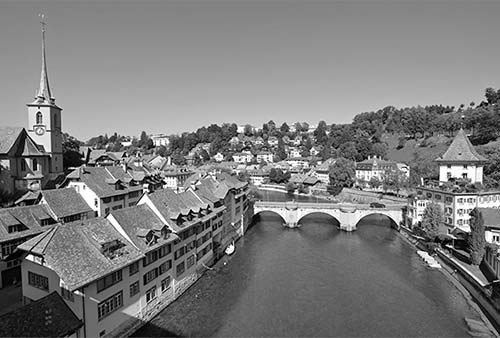
Before you cross the bridge, look upstream. On the side of the tall white building, you can (barely) pick out the words Fabrique de Chocolat W. Lindt—the original Lindt chocolate factory, evoking an age when this stretch of river was lined with mills powering the industrial zone of Bern—tanneries, shipyards, lumber mills, and so on. As you look upstream, notice the peaceful path along the left bank, a nice place for a walk.
• Continue across the bridge, bear right, and look over the railings into...
13 Bear Park (BärenPark)
The symbol of Bern is the bear, and some lively ones frolic along this terraced hillside, to the delight of locals and tourists who crowd along the rails. From 1857 to 2009, Bern housed its mascot bears in two big, barren, concrete pits (Bärengraben). But thanks to the agitation of bear rights’ activists, the city government was forced to replace the pits with posher digs. The last of the pit bears died in 2009, and later that year, three-year-old brown bears Finn (a male from Finland) and Björk (a female from Denmark) moved to the big enclosure between the old pits and the river. Soon they welcomed their female cubs, Ursina and Berna. This ursine family enjoys much better conditions than their fore-bears, including a private fishing channel next to the river. In 2013, the surly teenager Berna was sent to a preserve in Bulgaria due to irreconcilable differences with her mother. Today Bern’s bear family is happy, and Berna is shacked up with a new boyfriend in Bulgaria.
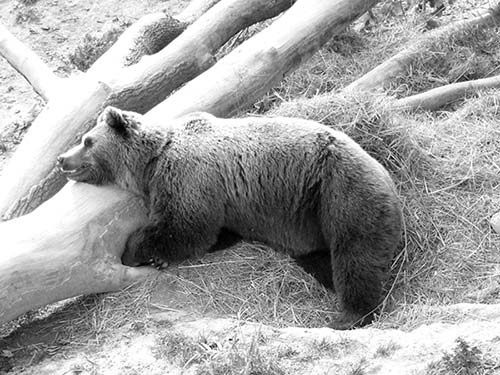
The two historic pits are still there. The first one is used from time to time to hold the bears while their enclosure is cleaned. You can visit the second one—find the concrete stairs leading down to the Bären Bistro, a bear-themed bar (for more info, see www.tierpark-bern.ch).
• Above Bear Park is the...
14 Old Tram Depot (Altes Tramdepot)
This used to be the garage for trams that ran across the bridge from the old town. Now the depot hosts a brewery restaurant/café with a lively beer garden and terrace, a nice public WC, and Eiswerkstatt, a popular ice cream shop.
To continue this walk, you could take a seven-minute hike up the moderately steep, cobbled pathway to the left (with your back to the river). This takes you to the city’s delightful rose garden (Rosengarten)—a manicured, picnic-perfect park with inviting benches, a fun kids’ play area, the recommended Restaurant Rosengarten, and the best viewpoint in town for watching the sunset. A statue of Albert Einstein reposes on one of the benches, inviting humorous selfies.
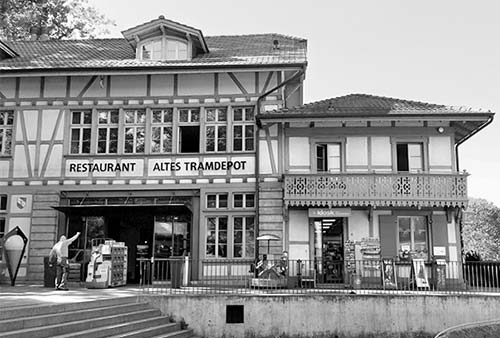
Alternatively, you could turn right and walk along the river, then return to the center via either Kirchenfeld or Dalmazi bridge.
Or, to return directly to the train station, jump on bus #12 (every 6 minutes, get ticket from machine, covered by Swiss Travel Pass or hotel-issued Bern Ticket). For that matter, you could take bus #12 in the opposite direction to head out to the Paul Klee Center—just a few minutes’ ride.
Wherever you wander in Bern, be sure to get off into the quieter side lanes, which have a fascinating and entertaining array of shops and little eateries.
More Sights in Bern
Some of Bern’s top sights are described on my “Heart of Bern Walk,” above. With more time, consider visiting some of the city’s other sights.
▲Museum of Fine Arts (Kunstmuseum Bern)
Featuring 800 years of art, this three-story museum shows off quality European and Swiss art, plus temporary exhibits. While the specific canvases can change, you’ll typically find old masters from the 13th to 19th century (including Fra Angelico and Filippo Lippi); 19th-century Impressionist and Post-Impressionist art by Manet, Monet, Cézanne, Van Gogh, and Toulouse-Lautrec; and 20th-century works by Dalí, Picasso, and Miró. Each artist is represented by one or two fine pieces.
But the stars of the show are the lesser-known Swiss artists, who are mixed in among the big names as if to assert their worthiness on the global stage. Be sure to tune into some of these names: You’ll find Paul Klee (1879-1940), of course, with his vivid, almost childlike works. But you’ll also discover Adolf Wölfli (1864-1930), who did intricate collages with pencil on paper; Alberto Giacometti (1901-1966), who sculpted rough-textured figures; Ernst Ludwig Kirchner (1880-1938), whose big, colorful, sloppy canvases are reminiscent of Cézanne; Ferdinand Hodler (1853-1918), whose serene landscapes evoke Van Gogh, with bold lines and soothing colors; Pierre Bonnard (1867-1947), an Impressionist with a love of color and a Renoir-like flair; and Johannes Itten (1888-1967), who was influential in the Bauhaus movement and made huge strides in exploring the harmonious use of colors.
Cost and Hours: 10 CHF, extra for some temporary exhibits, covered by Swiss Travel Pass; Tue 10:00-21:00, Wed-Sun until 17:00, closed Mon; no English descriptions—rent the worthwhile English audioguide (6 CHF), café, a block off the north end of Bärenplatz at Hodlerstrasse 8, +41 31 328 0944, www.kunstmuseumbern.ch.
▲▲Paul Klee Center (Zentrum Paul Klee)
Paul Klee wasn’t just a great painter—he was an interdisciplinary explosion of creative energy. The center, which fosters music and theater as well as the visual arts, has a mission: to bring art to the people. For example, a huge zone is devoted to a children’s creative workshop that includes painting and a shadow theater. The building itself, designed by Italian architect Renzo Piano, is notable: With a wavy design mirroring the wavy landscape of the Bern countryside, it celebrates the creative spirit of the Swiss-born artist.
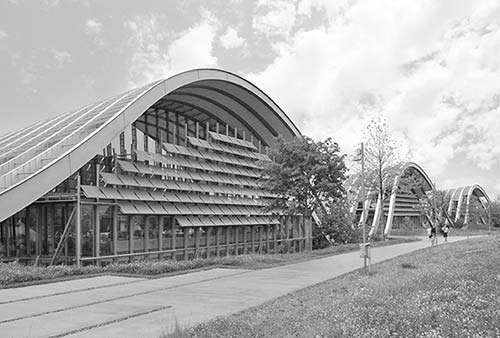
Cost and Hours: 20 CHF, covered by Swiss Travel Pass, Tue-Sun 10:00-17:00, closed Mon, audioguide-6 CHF, pick up free English-language booklet for each exhibit, mandatory lockers, café, Monument im Fruchtland 3, +41 31 359 0101, www.zpk.org.
Getting There: From the train station (or other downtown stops), ride frequent bus #12 for 15 minutes to its last stop, Zentrum Paul Klee, then walk 200 yards up the path.
Parking: Museumgoers can park all day (until midnight) for 7 CHF—a great deal if you combine the museum visit with a trip into town afterward. Buy the ticket inside, at the ticket desk.
Children’s Workshops: 15 CHF for one-hour workshop (age 4 and up, Tue-Sun at 14:00 and 16:00, Sat-Sun also at 12:00, reservations recommended at +41 31 359 0161).
Visiting the Center: While it owns about 4,000 Klee works, the center has no permanent exhibit; rather, it curates engaging temporary exhibits that pull from its Klee collection—sometimes heavily, sometimes tangentially. (But the curators always make sure there are at least a few Klee pieces on display.) It’s the best place in the world to experience and learn about this modernist painter of lively, almost childlike art. Artistically, you can’t put Klee in a box. His paintings—mostly from the 1920s and 1930s—are playful yet enigmatic. His art is full of symbolism...or maybe we just think so. Kids love Klee, and they always teach the art snobs a thing or two with their interpretations.
The center fills three connected buildings. As you walk from the bus stop, the first building (no entry fee) has a café, WCs, lockers, and the children’s workshop. The second building houses the main exhibition space (with two large halls) and the ticket desk. The third building is mostly administrative, except for a space at the front where visitors can hang out on a giant bench built out of colorful boxes. The grounds surrounding the center, though not that interesting, are open to all. The fancy Restaurant Schöngrün is between the bus stop and the center.
▲Einstein Museum (at Bern Historical Museum)
Fans of the genius will want to visit this museum devoted to Einstein and his times. For those with a keen interest in Einstein or his theories, it’s worth ▲▲. This museum is far more engaging than the Einstein House downtown and has many more artifacts from Einstein’s life. But it’s also much more expensive—so unless you’re a serious Einstein fan, or have a Swiss Travel Pass, it may not be worth the money. The Einstein exhibit fills the second floor of Bern’s Historical Museum, and the rest of the museum is included in your ticket whether you want it or not—but it’s an afterthought to the Einstein section (and skippable).
Cost and Hours: 18 CHF, covered by Swiss Travel Pass, Tue-Sun 10:00-17:00, closed Mon, free downloadable audioguide, +41 31 350 7711, www.einsteinmuseum.ch.
Getting There: It’s in the big, prickly, chateau-style building across the Kirchenfeld Bridge from parliament at Helvetiaplatz 5—take tram #6, #7, or #8, or bus #19, or walk a scenic 10 minutes.
Visiting the Museum: Buy your ticket and head up to the second floor. The final ascent—through a mirrored stairway—prepares your brain to expand your ideas about space and time. The exhibit uses photos, displays, and artifacts to thoughtfully trace Einstein’s entire life—from his birth in Germany, to his education in Zürich and early working years in Bern, to his professional success in Berlin, to his exile at Princeton after the rise of the Nazis.
The museum explains Einstein’s accomplishments and complicated personal life, details his travels after leaving Bern, and places him in historical context, with special emphasis on his Jewish identity (which for Einstein was more cultural than religious). Einstein’s concepts are nicely illustrated by video presentations, and everything is well-explained in English (the audioguide is not necessary). You’ll learn fascinating details, like the fact that Einstein’s second wife was his cousin, and that he was offered the presidency of Israel in 1952 but turned it down.
Other Bern Museums
The Historical Museum and its Einstein exhibit are part of a larger ensemble that includes Alpine, Communication, Natural History, Rifle, and Kunsthalle (contemporary art) museums. All appeal mainly to visitors with specific interests. The Natural History Museum is fun for kids. The TI has a helpful pamphlet describing the museums (all covered by Swiss Travel Pass except Rifle Museum, most open Tue-Sun 10:00-17:00, closed Mon; see “Getting There” for Einstein Museum, above; www.museen-bern.ch).
▲Marzilibad Pool Complex
Within sight of the Swiss parliament building, the riverside Marzilibad is a well-equipped public swimming pool and park with picnic spots, restaurant, lockers, wading pools, games, and more. There are multiple pools for swimmers of different ages and abilities. You can also laze on a wide, green lawn. A Bern institution since the 1780s, it’s one of the city’s main social hubs.
Cost and Hours: Free, mid-May-mid-Sept daily 9:00-19:00, opens earlier and closes later in midsummer, closed off-season, Marzilistrasse 29, +41 31 311 0046, www.sportamt-bern.ch.
Getting There: The Marzilibahn funicular gets you partway down to the complex from the old town for 1.50 CHF (runs until 21:00, www.marzilibahn.ch), but you can also walk down or take bus #30.
The Bern Float: The Bernese, proud of their very clean river and their basic ruddiness, have a tradition—sort of a wet, urban paseo. On summer days, they hike upstream 5 to 30 minutes, then float back down the river to the Marzilibad. The water—which comes from the high mountains—is clean, vivid blue, and very cold (it maxes out at about 65 degrees Fahrenheit, even in summer).
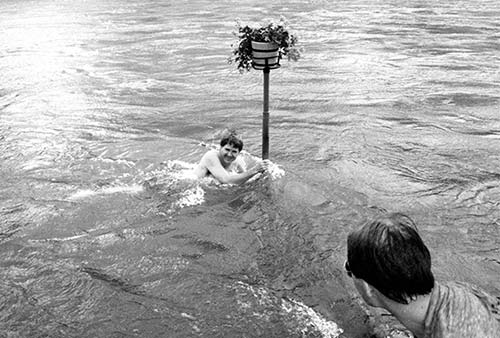
The TI warns that this activity is only for strong, experienced swimmers (some tourists have drowned in the river after overestimating their abilities). If you think you’d like to join in, first search online for the city of Bern’s cleverly named “Aare you safe?” web page and read the Aare River safety rules and tips. Consult with experienced locals, and don’t go alone. The river can be hazardous, conditions can change, and there are weirs and dams downstream.
If you choose to try it, hike up the paved riverside sidewalk as far as you like, then take the steps leading into the water whenever you want to “put in.” As you approach Marzilibad, be ready to paddle your way over to the canal just beyond it—designed to catch floaters completing their trip. You can also try to grab one of the several poles placed to help people exit the river. The locals make it look easy, but it’s not—the current is swift. If you miss the last pole, you’re history.
Bern’s Edgy Alternative Zone
To see a funky side of staid Switzerland, head to the counterculture art settlement called the Kulturzentrum Reithalle (named for the former “Riding Hall” that’s part of the complex, sometimes also called the Reitschule). You’ll find graffiti, wood-pallet furniture, stacked containers, skate ramps, drug deals, and other facets of real-life Swiss society that many visitors miss entirely. (Heidi and cowbells it ain’t.) The complex, at Neubrückstrasse 8, is tucked along the train tracks a five-minute walk north of the station, near the river—you’ll see it as you come in on the train from Interlaken or Zürich (www.reitschule.ch).
Sleeping in Bern
As Switzerland’s capital, Bern hosts not only tourists but also waves of businesspeople and politicians, keeping room rates rather high throughout the year. In general, prices rise during the week and drop on weekends; however, frequent conventions and other events can drive demand and prices radically higher. Sleeping within walking distance of the train station is convenient and puts you in the endearing heart of the city, but can be pricier and often comes with street noise, especially on weekends when revelers flock downtown. If you don’t mind a short tram ride, you can find cheaper, quieter lodgings in the neighborhood across the river to the north. Make sure you get your free Bern Ticket city transport pass code at check-in. You have to install an app on your mobile phone to use the code, but it’s a quick, simple process.
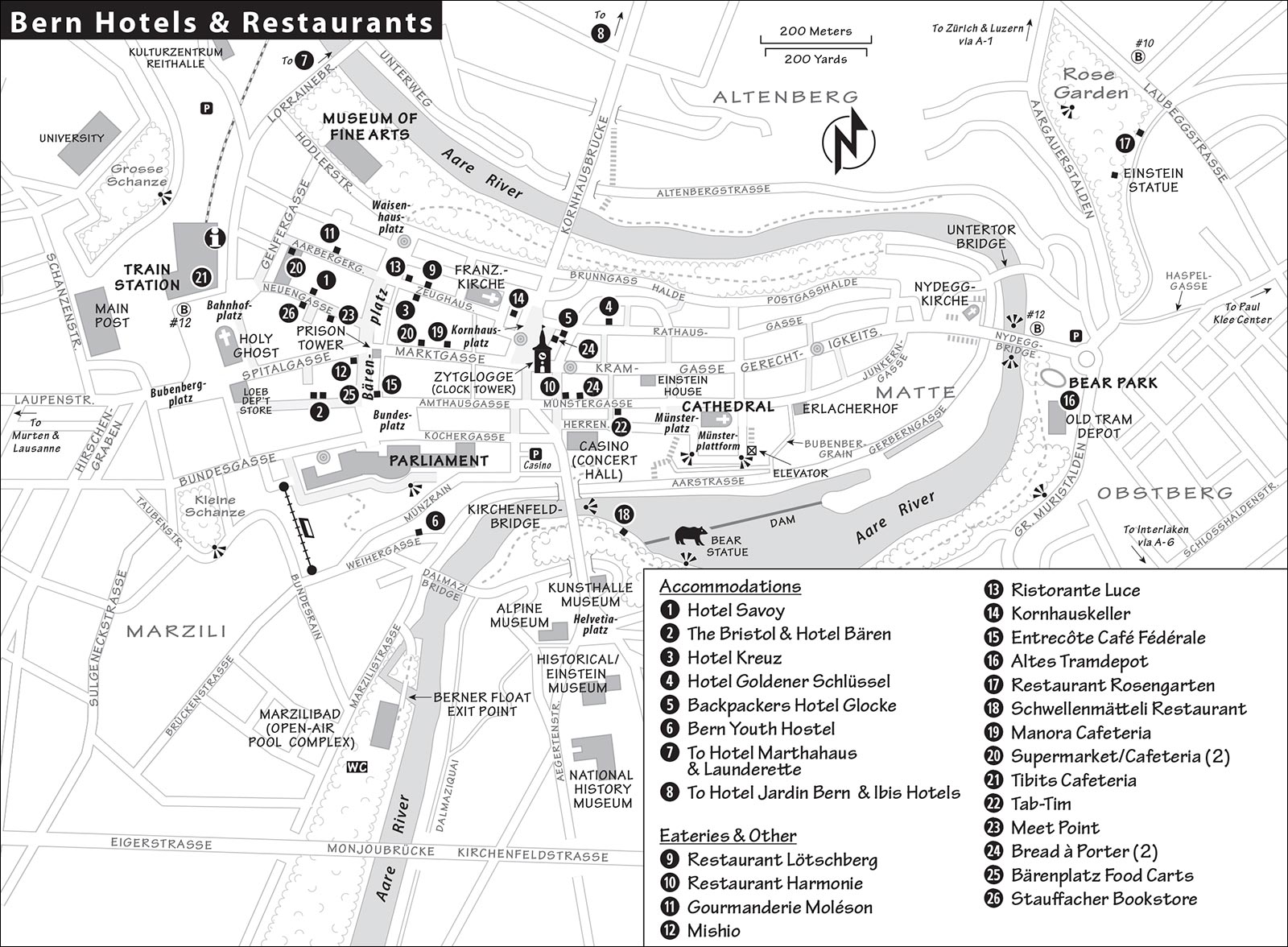
DOWNTOWN BERN, NEAR THE STATION
These places are within a 5- to 10-minute walk from the train station. The hotels listed here have rates that can skyrocket during conventions, then drop to tempting lows on weekends and at slower times, making a high-end splurge suddenly affordable—check around to find the best rates for your dates. Especially on weekends, light sleepers should request a quiet back-facing room.
$$$ Hotel Savoy is a formal, business-class place located super centrally, just off the main drag near the station. It has a sterile lobby and 64 solid rooms (family rooms, air-con, elevator, Neuengasse 26, +41 31 328 6666, www.hotelsavoybern.ch, info@hotelsavoybern.ch).
$$$ The Bristol is well-located on a quieter side street near the station. It feels young and playful, and aims at a Monty Python-esque sense of humor (with a plaid color scheme and oddball art in the lobby). The 100 rooms are modern, solidly built, and well-equipped (family rooms, air-con, elevator, gym, Schauplatzgasse 10, +41 31 311 0101, www.thebristol-bern.ch, welcome@thebristol-bern.ch).
$$$ Hotel Bären, almost next door to the Bristol, is also modern and convenient, with 69 slightly simpler rooms and more minimalist decor (family rooms, some rooms with air-con, includes breakfast if you book direct, elevator, small gym, self-serve laundry, Schauplatzgasse 4; +41 31 311 3367, www.baerenbern.ch, reception@baerenbern.ch).
$$$ Hotel Kreuz rents 97 good rooms filling a beautiful historic building a few steps off the lively Bärenplatz (family rooms, air-con, elevator, Zeughausgasse 41, +41 31 329 9595, www.kreuzbern.ch, info@kreuzbern.ch).
$ Hotel Goldener Schlüssel is the oldest inn in downtown Bern, but it’s been nicely renovated. Its 34 small, Euro-style rooms are fitted with prefab bathroom pods. The quieter, high-ceilinged back rooms are worth reserving in warm weather, as the rooms facing Rathausgasse get café and disco noise from across the street (RS%, family rooms, elevator, Rathausgasse 72, +41 31 311 0216, www.goldener-schluessel-bern.ch, info@goldener-schluessel-bern.ch).
¢ Backpackers Hotel Glocke rents the cheapest beds in the old town. It’s a mixture of small dorms (maximum 6 beds) and basic but adequate $ double rooms, some with private bathrooms. The pubs and cafés along the street keep things noisy until about 23:00, and while the reception desk provides free earplugs, light sleepers may be happier elsewhere. The pleasant common room has a nice view over the bustling city-center streets below (family rooms, no breakfast, elevator, laundry facilities, no curfew, reception open 8:00-12:00 & 15:00-21:00, 10-minute walk from station or take tram #9 to Zytglogge stop, Rathausgasse 75, +41 31 311 3771, www.bernbackpackers.ch, info@bernbackpackers.ch).
¢ Bern Youth Hostel, below the parliament building near the river, is big (188 beds), well-run, and welcoming even to people who don’t often stay in youth hostels. In addition to dorm beds, they have doubles and quads with private baths, making this an affordable alternative to expensive downtown hotels (elevator, affordable dinners, pay parking—reserve, Weihergasse 4, +41 31 326 1111, www.youthhostel.ch/bern, bern@youthhostel.ch). To reach the hostel, walk three blocks south from the train station and take the Marzilibahn funicular down to Weihergasse (1.50 CHF, free with hostel confirmation or Bern Ticket, runs until 21:00, after that use bus #30, www.marzilibahn.ch).
NORTH OF THE RIVER
These listings are an easy bus or tram ride from the center.
$$ Hotel Marthahaus is a better value than downtown hotels. Located two bus stops from the train station (walkable without luggage) in a quiet, elegant residential neighborhood north of the river, it’s run as a fundraiser by a charitable organization that helps young people and seniors. Half of the 40 bright, simple rooms have shared bathrooms (family rooms, elevator, guest kitchen, pay parking—reserve; take bus #20 from platform G at station to the Gewerbeschule stop, walk up the street to Wyttenbachstrasse and follow the yellow signs two short blocks to Wyttenbachstrasse 22a, +41 31 332 4135, www.marthahaus.ch, info@marthahaus.ch).
$$ Hotel Jardin Bern, with 24 rooms slightly farther out, is tasteful, modern, and family-run by identical twin brothers Andreas and Daniel Balz (family rooms, fans, elevator, laundry service, limited free parking; take tram #9 to the Parkstrasse stop, then walk one block; +41 31 333 0117, www.hotel-jardin.ch, info@hotel-jardin.ch).
Two impersonal but inexpensive $ Ibis chain hotels share a big metallic building at the Bern Convention Center (both with air-con, elevator, and pay parking): Ibis Bern Expo (+41 31 335 1200) and Ibis Budget Bern Expo (+41 31 335 1212, www.ibis.com). From the station, take tram #9 for 10 minutes to the Guisanplatz Expo (direction: Wankdorf Bahnhof, hotels are at Am Guisanplatz 2).
Eating in Bern
OLD TOWN
$$ Restaurant Lötschberg, a local favorite with a fun and youthful vibe, serves old-style Swiss cuisine in a modern space. One long wall is lined with a large variety of Swiss wines. They also have a less-expensive takeaway counter at the front of the restaurant, with affordable salads and sandwiches to go (open daily until 23:00, Zeughausgasse 16, +41 31 311 3455).
$$ Restaurant Harmonie, just off Kornmarkt, is a cozy classic. The interior has hard-backed wooden tables filled mostly by locals, and there’s a small outdoor terrace draped in ivy. The menu is traditional Swiss with some international flourishes—including a variety of burgers (Mon-Fri 11:00-23:00, closed Sat-Sun, Hotelgasse 3, +41 31 313 1141).
$$ Gourmanderie Moléson feels refined, high-end, and posh. It’s a long, skinny, classy bistro serving healthy and classic dishes with a French flair, including fondue and tartes flambées (like pizza without tomato sauce—known as Flammkuchen in German). It has a dressy and very Swiss interior with tables that tumble out onto the street (Mon-Fri 11:30-14:30 & 18:00-23:30, dinner only on Sat, closed Sun, Aarbergergasse 24, +41 31 311 4463, www.moleson-bern.ch).
$$ Mishio is a mod pan-Asian place worth considering. The interior has an open kitchen, noisy acoustics, and plain furnishings. The trick here is to get an outside table on the terrace, which overlooks the lively Bärenplatz (Mon-Sat 11:30-22:00, closed Sun, Bärenplatz 2, +41 31 313 1121).
$$ Ristorante Luce brings the cooking of Italy’s Emilia Romagna region (with lots of pastas and pizzas) to Bern. Choose between a venerable dining hall and great seating out on lively Bärenplatz (daily 11:30-23:00, limited menu from 14:00 to 18:00, reservations smart, Zeughausgasse 28, +41 31 310 9999, www.ristoranteluce.ch).
$$$ Kornhauskeller, in the palatial cellar of the old granary originally built to house the state’s wine cellar, has vaulted archways decorated with colorful murals. This dressy, pricey Mediterranean (Swiss, French, Italian) place offers a fine antipasto bar: Make a meal out of the 25-CHF or 32-CHF plate, telling the person behind the buffet exactly what you’d like (Tue-Sat 11:30-14:30 & 17:30-24:00, closed Sun-Mon, Kornhausplatz 18, +41 31 327 7272).
$$$ Entrecôte Café Fédérale is a dressy and traditional bistro with a reputation for great steak. It sits at the bottom of Bärenplatz, with tables under trees facing the parliament building. Very old-school urban Swiss, it’s a quiet place with more local politicians than tourists (daily 11:00-23:00, Bärenplatz 31, +41 31 311 1624, www.entrecote.ch).
ACROSS THE RIVER, WITH VIEWS
$$ Altes Tramdepot, in the Old Tram Depot above Bear Park, offers seating in its big, boisterous microbrewery (which was once the tram shed), or on a leafy Biergarten terrace with a postcard view of the old town’s skyline. It’s popular, serving good-time Swiss food: meat, fish, burgers, Rösti, wurst plates, and Flammkuchen. They do 25-CHF weekday lunches and have beer flights for those who want to sample five of their brews (daily 11:00-24:00, reserve in evening for outdoor view seating, bus #12 to Bärengraben stop, +41 31 368 1415, www.altestramdepot.ch).
$$$ Restaurant Rosengarten, perched at the edge of the city’s rose garden atop the hill above Bear Park, enjoys commanding city views—especially at sunset (when you should reserve ahead). During the day, come for lunch, or for tea and cake amidst grannies (24-CHF weekday lunch specials). At night, you’ll dine with couples enjoying the fresh seasonal menu. The outdoor section, with a big playground next door, feels like an upscale Biergarten (daily 9:00-23:30, Alter Aargauerstalden 31b, a moderately steep walk up from the Bear Park—or take bus #10 from the old town, +41 31 331 3206, www.rosengarten.be).
$$ Schwellenmätteli Restaurant is a chance to join trendy locals for a meal or drink while sitting directly over the river, next to the roar of water racing over the dam. The inside section is peaceful and open all year. The outside, open only in good weather, is loud—not good for conversation—but fun: At the tip of the platform is a lounge complete with sofas, mattresses, and a glass floor that lets you see the river racing underneath. This mod restaurant/lounge has a Swiss-Mediterranean menu (burgers, Flammkuchen, veggie dishes, and weekday lunch specials)—but you’re here for the setting, not the food (daily until 23:30, reservations smart for dinner, Dalmaziquai 11, cross Kirchenfeld Bridge from downtown and take path downhill to your left, or a pleasant 15-minute riverside stroll from Bear Park, +41 31 350 5001, www.schwellenmaetteli.ch).
CHEAP EATS
Bern offers lots of budget alternatives to formal restaurant dining. Note that many eateries and takeout joints close just before dinner time; if you’re planning a picnic dinner, aim to shop in the afternoon. Unless noted, the places below are all $.
Self-Service Restaurants: For solid food at budget prices, the cafeterias at all three of Bern’s major downtown retailers set out a tempting spread, including main dishes for well under 20 CHF, a salad bar, desserts, and much more. The Manora restaurant at the Manor department store has fine views from the rooftop (Mon-Sat 9:00-17:00, closed Sun, Marktgasse 10). At the Co-op (Aarbergergasse 53), the cafeteria has a nice glassed-in terrace and a roof garden. Migros (Marktgasse 46) has free tap water (hidden next to the tray-return conveyor belt). Both the Co-op and Migros restaurants have kids’ play zones and are open the same hours as the supermarkets in the same building (see the end of this section). $$ Tibits, a busy buffet chain on the ground floor of the train station, offers a huge variety of vegetarian-only salads and sandwiches, plus two different hot dishes. Help yourself to a plate and pile it on. You’ll pay by weight: An average helping will cost you about 20 CHF (free water, daily until 22:30, Bahnhofplatz 10, +41 31 312 9111).
Global Food: Some good-value international places hide deep under the arcades in the old town. Popular $$ Tab-Tim serves Thai lunches on weekdays for 13-15 CHF—it’s a bit more expensive on evenings and weekends. Its outdoor tables spill across the street (Mon-Sat 10:00-22:00, Sun 12:00-17:30, Münstergasse 57, +41 31 311 5936). Shiny, well-kept Meet Point, a Middle Eastern takeout counter with a couple of tables under the arcades, sells döner kebabs for 12.50 CHF—still a bargain here (Mon-Fri 9:30-21:00, Sat until 20:00, closed Sun, Neuengasse 17).
Bakeries: Small bakeries are all around town. One of many options is Bread à Porter, which offers fresh sandwiches, quiches, and salads, with a few casual dine-in tables (Mon-Fri 6:30-19:00, Sat 7:00-17:00, closed Sun, two locations at Kornhausplatz 11 and Münstergasse 74).
Bärenplatz Food Carts: For lunch, drop by the food carts that cluster around the parliament end of Bärenplatz (Mon-Sat mornings). The assortment often includes an organic sausage-and-falafel wagon, tacos, Asian fast food, and more. Grab what looks good and enjoy it on the bench under the Prison Tower. Near the north end of Bärenplatz, consider the takeout counter inside the recommended Lötschberg restaurant (described earlier).
Prepared Meals: You’ll get a solid value on takeout food from the two Migros Takeaway delis. One is in the bottom level of the train station (long hours daily) and another is at Marktgasse 40 (same hours as the adjacent Migros supermarket; see next). The staff will pack you a hot lunch or dinner to take away for 10-15 CHF. Portions are big—often enough for two—and there are always several options on offer (such as lasagna with side salad or bratwurst with potatoes and veggies), as well as pizzas, quiches, and salads. Co-op runs an impressively large, very popular prepared-food court at Marktgasse 24 (Mon-Wed 7:00-19:00, Thu until 21:00, Fri until 20:00, Sat until 17:00, closed Sun).
Supermarkets: Two large supermarkets are in the center—Co-op (Aarbergergasse 53, in the basement) and Migros (Marktgasse 46, ground floor). Both are open similar hours (roughly Mon-Wed 8:00-19:00, Thu until 21:00, Fri until 20:00, Sat until 17:00, closed Sun). Early, late, or on Sunday, visit one of the midsize supermarkets in the train station (Migros on the upper level, Co-op on the lower level).
Bern Connections
From Bern by Train to: Murten (hourly direct, 35 minutes, more with change in Kerzers), Avenches (every 3 hours direct, 40 minutes, or hourly with change in Kerzers, 55 minutes), Lausanne (2/hour, 1 hour), Interlaken (2/hour, 1 hour, a few change in Spiez), Luzern (hourly direct, 1 hour; scenic route via Interlaken takes 3 hours), Zürich (2/hour, 1 hour), Zürich Airport (2/hour, 70-80 minutes), Zermatt (1-2/hour, 2 hours, transfer in Visp), Montreux (2/hour, 1.5 hours, transfer in Lausanne), Lugano (hourly, 3 hours, change in Zürich or Luzern), Appenzell (easiest with 1 change in Gossau, hourly, 3 hours), Frankfurt (hourly, 4 hours, 4/day direct, others change in Basel). Train info: www.rail.ch.
Murten
The finest medieval ramparts in Switzerland surround the old town of Murten (pop. 9,000, pronounced MOOR-ten; if you say MURR-ten, you get a quizzical look). You’re on the linguistic cusp of Switzerland: 25 percent of Murten speaks French; a few miles to the southwest, nearly everyone does (French-speakers call the town Morat).
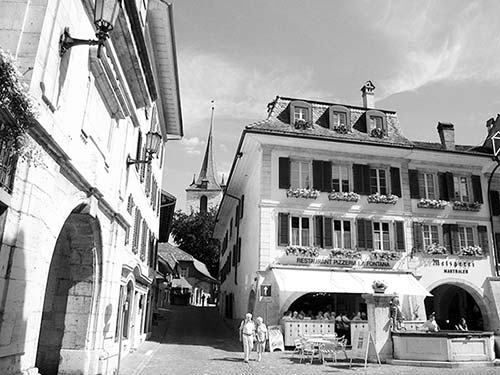
Murten’s old center is endearing. Its lively streets include a nicely arcaded main drag with breezy outdoor cafés and elegant shops (many closed Mon). Its castle is romantic, overlooking Lake Murten and the rolling vineyards of gentle Mont Vully in the distance. Spend a night here and have a local Vully wine (white, red, or rosé) with dinner. Murten is touristed, but mostly by locals, and never to the point of feeling overrun.
Make time for nearby Avenches (see end of chapter). Though sleepy today, the town was once a powerful Roman capital—as its ruins attest.
Orientation to Murten
TOURIST INFORMATION
Murten’s TI is smack in the center of the old town, along the main street (Mon-Fri 9:00-12:00 & 13:00-18:00, Sat-Sun 10:00-12:00 & 13:00-17:00; Oct-March shorter hours and closed Sat-Sun; Hauptgasse 27, +41 26 670 5112, www.regionmurtensee.ch).
ARRIVAL IN MURTEN
By Train: The train station is a five-minute walk from the center, and has a ticket office, free WC, and small pay lockers—the ticket office can store bigger bags (Mon-Fri 6:50-18:30, Sat 7:50-18:00, Sun 7:50-12:00 & 13:00-17:00). To reach the town from the station, exit to the right, take the first left, and walk uphill on Bahnhofstrasse, then turn right through the town gate. Murten’s old center is tiny, and a delight on foot.
By Car: If you’re overnighting here, get parking advice from your hotelier. During the day, don’t park inside the town walls; metered prices are steep and there’s a strict time limit. Instead, park in the lots outside the walls at either end of town: one next to the Co-op supermarket, the other near the clock tower (2 CHF/hour, pay at machine).
HELPFUL HINTS
Local Guide: American Mary Brunisholz, who married into this part of Switzerland, is an excellent guide with a car (300 CHF/half-day, +41 78 601 7040, mary.brunisholz@vtxnet.ch). The TI has a list of other guides.
Events: The town’s Youth Festival commemorates the anniversary of the Battle of Murten each June 22. The Murten Classics music festival takes place in August and September, and the Light Festival lights up the town and the lake in mid-late January.
Murten Walk
This self-guided introductory walk will give you the lay of the land and a lesson on the historic 15th-century Battle of Murten.
• Start your walk just outside the town’s main gate, in front of the public school, where you see a statue of the feisty town hero...
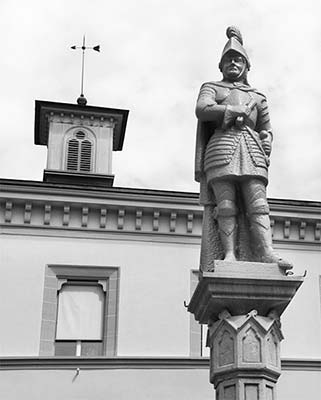
Adrian von Bubenberg
Burgundy was the aggressive power of the day, and this Murten native stopped a 15th-century Burgundian power grab by beating Charles the Bold. Adrian von Bubenberg (sent by Bern to hold the line against the expansionist Burgundians) stands here, looking across the lake at the distant peaks of the Jura Mountains—the historic border between the Swiss and the French (more on the battle a little later).
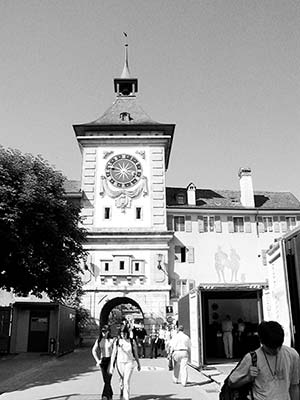
The earliest Swiss clockmakers were from those Jura Mountains. Look at the clock tower—where’s the minute hand? As part of its lease, the restaurant below takes responsibility for hand-winding the clock each day, as it has since 1712. That’s the Bern gate—so called because it opens up onto the road to Bern.
• Rather than enter the gate, go right instead (hugging the outside of the wall, not downhill). Head around the first turret, and look up at the cannonballs, left in the wall from the 1476 Battle of Murten to remind townsfolk of their incredible victory over the Burgundians—like an Alamo with a happy ending. Turn the corner onto the...
Lakeview Terrace
Across the way is Mont Vully (mohn voo-YEE)—one big vineyard and a mecca for lovers of Swiss wines. The lowlands to the right—a rich former lakebed—are the heart of the fertile Three Lakes Region (Lakes Biel, Neuchâtel, and Murten). The lush farmland is called the “vegetable garden of Switzerland” for its soil, which yields more than 60 varieties of produce.
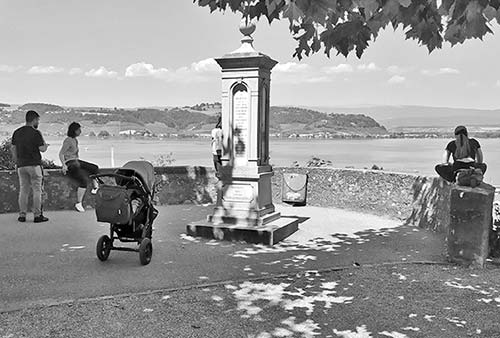
The ancient Celtic Helvetii tribe settled here and took advantage of the fertility of this land. The Romans located their capital nearby (at Avenches) when they took over the region and established their colony of Helvetia (named after the Celtic tribe—the same word is the Latin origin of Switzerland’s official name, Confoederatio Helvetica).
• Behind you, check out the small...
French Church
Foreseeing a showdown with Burgundy, Adrian von Bubenberg had the town walls strengthened. As three-quarters of the townspeople were German-speaking, they took a vote and decided to tear down the French church to get more stones. (This little church was rebuilt for the French-speaking community six years after its big one was demolished.)
• Circle round the church, and if it’s open, go inside.
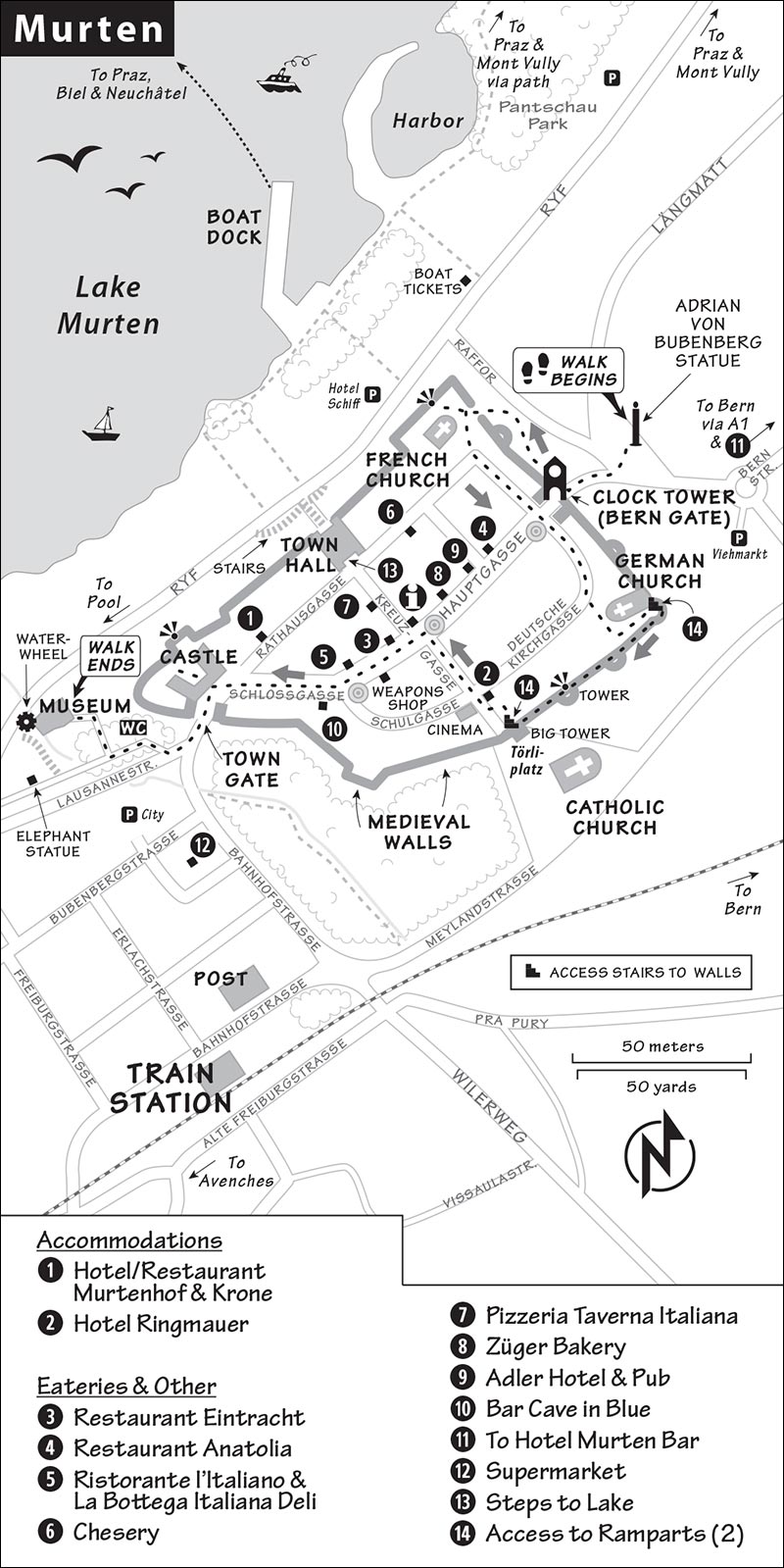
As the Calvinist Reformation swept through Catholic Switzerland in the early 16th century, churches like this were stripped of their rich paintings, sculptures, and stained glass. Elaborate altars were replaced with simple, Bible-topped tables, and pulpits became the focus. The emphasis was teaching the word of God. In this church, about the only exceptions to the “no distractions” rule are the tiny stained-glass coats of arms—heraldry of the wealthy families who helped fund its construction. The church, still Protestant and serving its French community, is open sporadically.
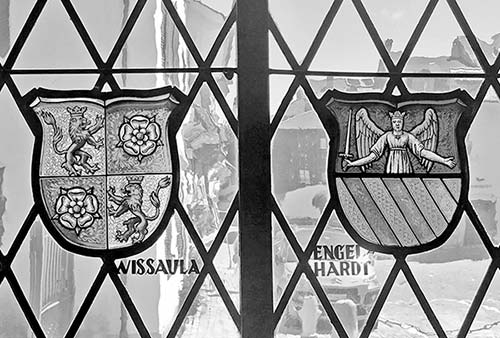
• From here, leave the church and head straight toward the pointy spire of the German church across town. Walk along Französischer Kirchgasse past the clock tower and go up the lane to #26 (on left). This is one of few Murten buildings that survived a 15th-century fire that destroyed the then-wooden town. Stand in the doorway and remember that people during the Middle Ages were much shorter. Before the fire, most houses looked like this one. After the fire, building was limited to the characteristic yellow Jura stone (like the former library, across the street, at #31). Continue straight ahead to the...
German Church
Murten’s German church is also post-Reformation Protestant simple. Inside, in the center of the ceiling, notice the big stucco relief with two seals: the bear for Bern and the three castles for Fribourg. As the town is on the border between two cantons (Bern and Fribourg), for 400 years its rule was shared: Every five years, it would flip between cantons. Around 1800, when Switzerland was reorganized under Napoleonic rule, Murten became firmly a part of Fribourg.
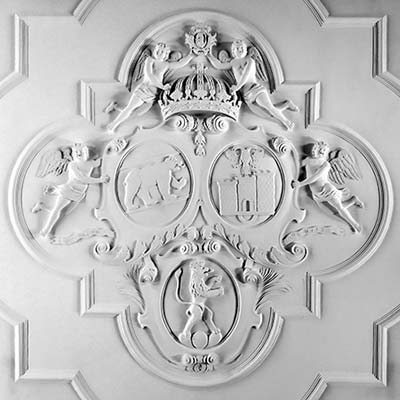
The Protestant passion for Bible study is also evident in this church. Explore the choir (two rows of seats on each side for big shots) behind the altar. Find Adrian von Bubenberg’s seat. (Hint: The window above shows the war hero in red, with his victorious local yokels in their alpine red-knit hats...underdogs whupping the Burgundians.) The old pulpit was carved in 1460 from a single oak tree. Notice the two prime seats on either side of the altar; the one to the preacher’s right was for the leader of Bern or Fribourg—depending on who happened to be ruling that year. The front window (crucifixion) dates from 1926.
• Leaving the church, hook left around the back. Finger the limestone and sandstone tombstones, quarried from Mont Vully for noble families. Then climb the two flights of creaky stairs and start walking along the...
Ramparts
Strolling Murten’s ramparts is a must (free, open daily until dusk). Survey the town and note the uniformity of its architecture. Paint your place the wrong color, and you may be instructed to redo the job—at your own expense. Scanning the countless chimneys and beavertail ceramic roof tiles, think of the enforced conformity that comes with living in a small town (and look to see if there are any oddballs). Telephone and electricity wires are all underground, as in Europe generally. Look back at the roof of the German church. The six-sided “star of David” isn’t a Jewish symbol in this case; it recalls the star that guided the wise men to Bethlehem on the first Christmas.
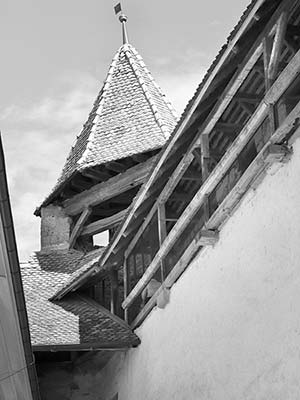
• Continue 50 yards to the tower with the steep staircase. Climb the steps for a commanding town and lake view.
Enjoy perhaps the ultimate view. The Jura Mountains in the distance (at the border with France) peek above vine-laden Mont Vully. On the right is the German church, Bern Tower, and French church. And to the far left is the castle tower—flying the black-and-white flag of Fribourg Canton—where this walk finishes.
With your back to the lake, look inland and imagine the action on June 22, 1476. Mighty Charles the Bold, with his 20,000 well-armed Burgundians, was camped on the hill (the one with the divided forest) for 10 days, laying siege to the town of 2,000. Runners were sent out from the town to gather help. A makeshift army of about 10,000 villagers gathered on the hills to the left. Just as George Washington attacked when the Redcoats were celebrating Christmas, the Swiss swooped in as the Burgundians were still hungover from a big Midsummer Night’s Eve bash. The Battle of Murten was fought in pouring rain—a muddy, bloody mess. More than 10,000 Burgundians were slaughtered—many driven into the lake with their armor to drown (try swimming in a coat of mail). For centuries, French bones would wash ashore. Charles the (no-longer-so-) Bold barely got away on a very fast horse.
This victory demonstrated to the Swiss the advantages of E Pluribus Unum, and the gradual unification of the many still-fiercely independent Swiss cantons into the Helvetic Confederation snowballed. In this sweet little corner, an influential battle in European history had been fought. Burgundian power ebbed, and Europe got to know a new nation...Switzerland.
• Walk a bit farther along the wall and descend at the next tower (across from Hotel-Restaurant Ringmauer).
At the bottom of the stairs, study the fine old clock mechanism from 1816. It once powered the big clock in the City Hall tower. Later, it spent decades in a to-be-assembled pile, gathering dust in an attic. Finally, in 1991, a town resident—recognizing a good challenge—reassembled it into perfect working order. Notice how the gearbox powers three clock faces (as the tower had), and how the old hand crank raises the stones that power the clock, which rings on the quarter-hour. The white face displays the clock’s time.
• Step outside the wall, where you’ll see the Catholic church (1886), private gardens along the wall, and evidence of how the wall was constructed in several distinct stages.
The first phase was built with large river stones, some arranged in a neat fishbone pattern. Later, the town ran out of money, and the next stage shows pebbles and rubble mixed with a rough concrete. And finally, when the town prospered again, they finished the wall with finely cut sandstone. The former dry moat is now individual private gardens.
• Walk back into town, stopping on the first corner at the fire station-turned-community-cinema.
Contributors are thanked with their names on the cinema door. Notice what’s playing tonight (in Switzerland, movies are subtitled, not dubbed, to accommodate a two-language audience). At this corner, spin slowly, admiring the town’s fine shutters.
• Then, continue a block (noticing again that most buildings were stone—built after a fire) to the...
Main Street (Hauptgasse)
In the 19th century, Murten’s townsfolk got their water from the three fountains on this street. Turn left along the street and enjoy the colorful store signs—they still hang out their shingles in the traditional fashion. Bakery and pâtisserie competition on this street is fierce. Drop into one for regional specialties: Nidlechueche, a sweet, doughy cream tart; and Seeländer Zwetschgen, a chocolate-covered prune with liqueur.
Near the top of the main street, Simonet Weapons sells all the latest products from Victorinox, originator of the Swiss Army knife (closed all day Sun-Mon and Wed afternoon). At the top of the street (#16), Murten’s oldest house has fine paintings under its eaves.
• Farther to the right, at the top of town, step into the courtyard of...
Murten Castle (Schloss Murten)
The town castle, which houses the police station in its former prison (tower open to the public), shows off an impressive cannon from 1882. Back outside and just downhill, below the tower, find the overlook where a plaque helps you identify the villages on the other side of the Murtensee.
• If it’s open, continue down (passing a free WC) to visit the...
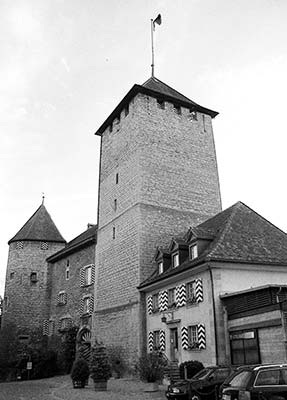
Town Museum (Museum Murten)
The town museum, farther down the hill, earnestly shows off Murten’s history in five floors of modern displays, artifacts, and temporary exhibitions. It fills an old mill that’s been nicely renovated (6 CHF, Tue-Sat 14:00-17:00, Sun from 10:00, closed Mon and in winter, described in German and French only—borrow English booklet, +41 26 670 3100, www.museummurten.ch). Outside is a functioning water mill, a lane leading down to the lake, and a wooden elephant.
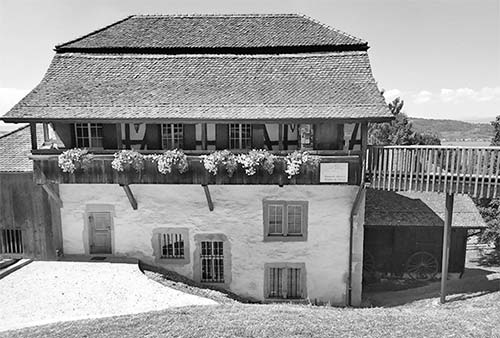
An elephant? Yes, in 1866 an elephant escaped from a traveling American circus. It rampaged through Murten and was killed. To this day, one lane is nicknamed Elephant Alley.
Our walk ends here, but you can backtrack to the Town Hall (past the Hotel Murtenhof & Krone) and descend the steps nearby for some more fine lake views.
Activities in Murten
Lake Activities
To get to Murten’s lazy lakefront, you can take the steps by the Town Hall. Or go out the main town gate and take a left down the hill. You’ll see the boat dock first. Just beyond the grassy breakwater and the small-boat harbor is a big park flanked by handy eateries. There’s mini golf, windsurfing/paddle boarding gear rental and instruction, a snack bar, and a fine lakeside promenade with benches made for sunset views.
Lake Murten Cruises
Boats do a 1.25-hour loop cruise at 12:00, 14:15, and 15:40. Consider stopping in a small town (Praz or Môtier) on the French-speaking shore. From there you could hike through vineyards up Mont Vully—where a pretty lake and Alp views await—and return on the lake with your same ticket. Or you can walk back to Murten, clockwise around the lake (about 1.5 hours from Praz) or meet the train at Sugiez in Bas-Vully. Ask the TI for the Vully Les Vignerons map to help you make a plan and for information on wine tastings in the area.
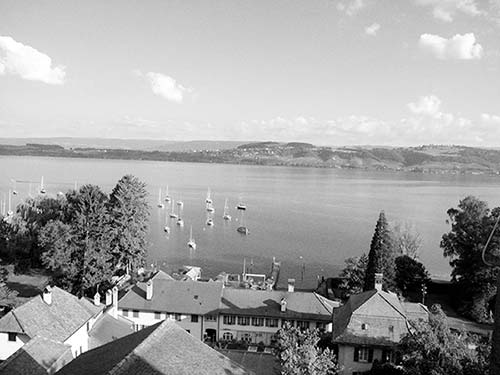
Another option is the Three Lakes cruise, which covers the region’s trio of lakes—connected by canals—and stops at several medieval villages on the way to the town of Biel (Bienne in French). The boat leaves Murten at 9:50, arrives in Biel at 14:05, then turns around and heads back along the same route, leaving Biel at 14:45 and arriving in Murten at 18:55. You can condense this full-day trip by taking the boat to Biel and a train back to Murten (1 hour).
Cost and Hours: 1.25-hour loop cruise—22 CHF; boat from Murten to Praz or Môtier—12 CHF; half-day Three Lakes cruise—61 CHF one-way, 69 CHF round-trip; all covered by Swiss Travel Pass and discounted 50 percent with Eurail Global Pass, ask TI about boat-trip discount vouchers; buy tickets on board or at the kiosk at pier 1; boats run daily mid-May-late Sept, Fri-Sun only in off-season, no boats in winter but see website for special Licht Festival trips; +41 32 729 9600, www.lnm.ch.
Swimming Pool
The Olympic-size public swimming pool is outside of town next to the lake, just past the castle (8 CHF; indoor pool open Tue-Fri 9:30-21:00, Sat-Sun until 18:00, Mon 14:00-21:00; outdoor pool daily in summer; Lausannestrasse 2, +41 26 672 3636, www.schwimmbad-murten.ch).
Biking
The Three Lakes region has 100 miles of signposted bike paths. Pick up a free map at the TI. The best easy ride circles the lake and Mont Vully (through vineyards and, if you like, to the summit for a good view). The Murten train station participates in the Swiss rail system’s bike rental program (online reservations required; for rates and specifics, see here).
Nightlife in Murten
Movies
Murten’s cute little community theater plays movies nightly (16 CHF, Schulgasse 18, www.kino-murten.ch). Movies are shown in their original language (capital letter indicates the soundtrack language, small letters indicate subtitles—for example, “E/fd” means English with French and German (Deutsch) subtitles).
From early July to early August, Murten hosts an open-air film festival (outside wall, past main gate, details at www.openairkino-murten.ch).
Pubs
There are a few options for nightlife. The Adler Hotel & Pub sells drinks and tasty Flammkuchen in a fun and welcoming interior or lively exterior along Murten’s main drag (daily 11:00-late, Hauptgasse 45, +41 26 672 1920). Bar Cave in Blue on the main street is popular with the late-night crowd (daily from 21:30, Schlossgasse 4, +41 26 670 1901). The Hotel Murten bar just outside the clock tower is another good place for drinks (daily 15:00-late, at Bernstrasse 7, +41 26 678 8181; don’t confuse this with the Hotel Murtenhof & Krone within the walls).
Sleeping in Murten
This adorable town is no secret. The peak time is May through mid-September (especially on weekends)—make a reservation and expect maximum prices. The nearest youth hostel is in Avenches (see the end of this chapter).
$$ Hotel Murtenhof & Krone offers elegance at fair-for-Switzerland prices in 57 nicely appointed rooms—each a stylish mix of old and new. There’s a wide range of sleeping accommodations, so email them your needs in terms of size, view, and price (RS%, more expensive rooms with air-con, family rooms, private spa bookable, elevator, pay parking, next to castle at Rathausgasse 3, +41 26 672 9030, www.murtenhof.ch, info@murtenhof.ch, well-run by brothers Marc and Ariste Joachim). They have the best lakeview restaurant in town (described next, under “Eating in Murten”). They can also take you wakesurfing on the lake.
$$ Hotel Ringmauer (Ramparts) sits just under the wall in the quiet corner of town farthest from the lake. It rents 10 small, simple rooms (family rooms, attached restaurant, Deutsche Kirchgasse 2, +41 26 670 1101, www.restaurantringmauer.ch, restaurantringmauer@bluewin.ch, Padmakumara Nawarathna and family).
Eating in Murten
Eating in Murten is a joy. I’d stroll the main drag up one side and down the other to survey the action before making a choice. For elegance and a lake view, you can’t beat the restaurant at Hotel Murtenhof & Krone. There are also several good options right on the lake a 10-minute walk down from the town center. Budget eaters can assemble a picnic at the Co-op grocery. Bakeries make good sandwiches, but they close by about 18:00.
RESTAURANTS
Anything called Seeländer or mentioning “three lakes” is typical of this Three Lakes region. Traditional restaurants serve Egli-Filets, the very popular perch “from the lake” (these days caught in the Bodensee—Lake Constance in English—up by the German border). As this area is Switzerland’s vegetable garden, restaurants pride themselves on offering good produce. There’s a French accent to the cuisine here, and restaurants offer sophisticated fixed-price meals that tempt gourmet tastes. You’ll want a glass of smooth and refreshing Vully (voo-YEE) wine with your meal (about 5 CHF/glass).
$$$ Hotel Murtenhof & Krone’s classy restaurant is perched high above the lake in the old town—reserve ahead for a view table. Its covered terrace keeps diners comfortable regardless of the weather. Sipping a glass of local wine with the right travel partner, while gazing across the lake at hillside vineyards as the sun sets, is one of Europe’s fine moments. Order à la carte or get the five-course tasting menu for 89 CHF (Tue-Sun 11:00-14:30 & 17:30-22:00, closed Mon; open Wed-Sat only in winter; +41 26 672 9030, www.murtenhof.ch).
$$ Restaurant Eintracht serves good-value, local cuisine from a fun and unpretentious menu, including old-time chef specials (20-CHF lunch specials include soup and main course, half-portions and healthy specials available, generally Thu-Tue 8:00-23:30 except Sun until 18:00, closed Wed, streetside seating under arcades, Hauptgasse 19, +41 26 670 2240).
$$$ Restaurant Anatolia is an ambitious, upscale Turkish restaurant that’s the pride of its welcoming owner, Mehmet. The eggplant stuffed with vegetables and tomato sauce is a winner, as is the three-course, 55-CHF fixed-price fish meal. Dine indoors under a fine mural of Istanbul or watch the main-drag action from an outside table (daily 10:00-23:00, shorter hours and closed Wed evenings off-season, Hauptgasse 45, +41 26 670 2868, www.anatolia.ch).
$$ Ristorante l’Italiano is the town choice for authentic Italian cuisine. As its menu makes quite clear, they don’t serve pizza—just a full range of pastas and Italian meat and fish dishes (Tue-Sat 10:00-14:00 & 17:30-22:30, closed Sun-Mon; outdoor seating, Hauptgasse 11, +41 26 672 2212, Prozzillo family). La Bottega Italiana, a deli next door, is owned by the same family.
$$ Chesery is a café (with regional cheese plates, quiches, and other light meals), wine bar, and elegant secondhand store. There’s nice outdoor seating and a slightly frou-frou interior. This quirky spot is worth a peek even if you’re not eating (Mon and Thu-Sat 11:00-22:00, Sun until 18:00, closed Tue-Wed, Rathausgasse 28, +41 26 670 6577).
$$ Pizzeria Taverna Italiana serves wood-fired pizzas for around 20 CHF, and also has a full Italian menu including risotto, mussels, and other seafood. Its outdoor tables fill a traffic-free side street (daily 10:30-15:00 & 17:00-22:00, Kreuzgasse 4, +41 26 670 2122).
CHEAP EATS
The main street has several bakeries, all with ample charm. Züger has indoor and outdoor seating, an inviting pastry and confectionary counter, and delicate open-face sandwiches typical of the region. This is the perfect place to try the local Nidlechueche, a tart with multiple layers of sweet cream glaze (11.60-CHF breakfast combo—coffee, croissant, and roll; generally Wed-Mon 7:30-18:30, closed Tue, Hauptgasse 33, +41 26 670 2253).
The Co-op supermarket towers between the train station and city center (Mon-Fri until 20:00, Sat-Sun until 18:00).
Murten Connections
From Murten by Train to: Avenches (1-2/hour, 7 minutes, direction: Lausanne), Bern (hourly direct, 35 minutes, more with change in Kerzers), Lausanne (hourly direct, 1.5 hours), Zürich (via Bern, 1 hour 40 minutes). Train info: www.rail.ch.
ROUTE TIPS FOR DRIVERS
Murten to Lake Geneva (50 miles): The autobahn from Bern to Lausanne/Lake Geneva makes everything speedy (see the Lake Geneva & French Switzerland chapter). Murten and Avenches are 10 minutes off the autobahn; Broc, Bulle, and Gruyères are within sight of each other and the autobahn. It takes about an hour to drive from Murten to Montreux. The autobahn (direction: Simplon) takes you high above Montreux (pull off at great viewpoint rest stop) and Château de Chillon. For the castle, take the first exit east of the castle (Villeneuve); signs direct you along the lake back to the castle.
Near Murten: Avenches
Avenches, four miles south of Murten, was once Aventicum, the Roman capital of Helvetia. Today, it’s a quaint little French-speaking town with an ancient amphitheater taking a bite out of it. Below the town spreads a vast field of sparse Roman ruins.
With a pleasant, small-town French ambience, Avenches (ah-VAHNSH) is much quieter than Murten, and its old walls are mostly gone. Just a few minutes away by train, it makes an easy half-day trip. From the unstaffed Avenches train station, it’s a seven-minute, somewhat steep walk to the town, amphitheater, and Roman museum. Exploring more of the ruins requires some outdoor walking. The TI is on the town’s main square (closed Sun, Place de l’Eglise 3, +41 26 676 9922, www.avenches.ch).
Drivers park for free at Parking du Faubourg (along Route du Faubourg), a two-minute walk downhill from the amphitheater. Parking up in the old town has a fee and a three-hour limit.
Sights in Avenches
Roman Avenches
Aventicum was a Roman capital, with a population of 20,000. The Romans appreciated its strategic crossroads location, fertile land, and comfortable climate (in modern times, Avenches has found favor with retirees for its livability). While the population of today’s Avenches could barely fill the well-worn ruins of their Roman amphitheater, Aventicum was once one of the larger cities of the Roman Empire. Everything sits on Roman ruins, which were quarried nearly to oblivion over several centuries; the scant remains were finally spared in the 19th century, and today, things are carefully preserved. Metal detectors must be registered here. Parents, knowing that turning up anything ancient will bring on the archaeologists, yell at their kids, “Don’t dig!” Even the benches on the main street are bits of a 2,000-year-old temple cornice.
The town has five Roman sights: the amphitheater, a museum (next to the amphitheater), a lone tower (viewable in the distance), plus a sanctuary and a theater in a field outside of town. See below for museum cost and hours; the ruins are free and always viewable.
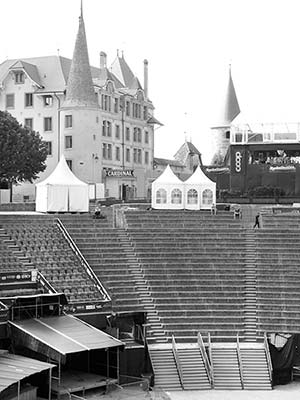
Amphitheater
The amphitheater, or arena, which once seated 18,000, is the largest Roman ruin in Switzerland. There’s no more gladiator action, but it’s still in use—normally busy with an annual opera festival and other musical events. However, during a major renovation to turn it into an even better concert venue (through 2028), you’ll still be able to see the amphitheater from above, but not go in.
Walk along the rim of the amphitheater to just past the museum entrance and scan the surrounding countryside. The Roman town filled the low area in front of you (now partly farmland; Avenches’ medieval residents retreated to the more easily defensible hilltop). The tower on the ridge (on the left)—the only one remaining of the original 73 towers—marks where the wall once stood. In the middle, past the lone standing column of the sanctuary, you can see the small theater ruins.
Roman Museum
Next to the amphitheater, the museum fills a medieval tower with three floors of Roman artifacts—such as gravestones, mosaics, glass, fishing spears, and many domestic goods. It’s not only free, but superbly designed, with touch screens and English booklets that make the exhibits accessible and give you just enough detail. On the second floor, don’t miss the “gold” bust of Marcus Aurelius (AD 80) found in an old Roman sewer in 1939. It’s actually a plastic copy; the original is in a bank in Lausanne.
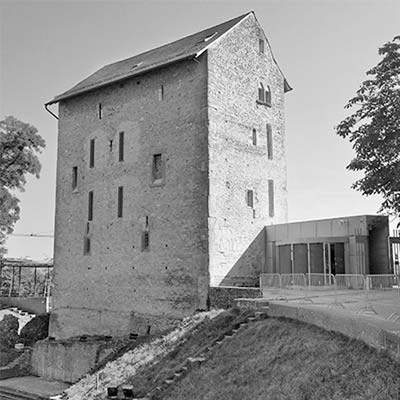
Cost and Hours: Free, except for some temporary exhibits; Tue-Sun 10:00-17:00, closed Mon except in June, shorter hours off-season and closed Tue Nov-Jan; +41 26 557 3300, www.aventicum.org.
Theater and Sanctuary
Perhaps the best Aventicum experience is to spend some quiet time at sunset pondering the evocative Roman theater (Théâtre Romaine) and sanctuary in the fields, a half-mile walk out of town (tiny free car park at the site). The single column marks “Du Cigognier”—nicknamed the “stork sanctuary” (c. 1700) for the stork nest it supported. The site was a quarry until the 19th century, so almost nothing remains.
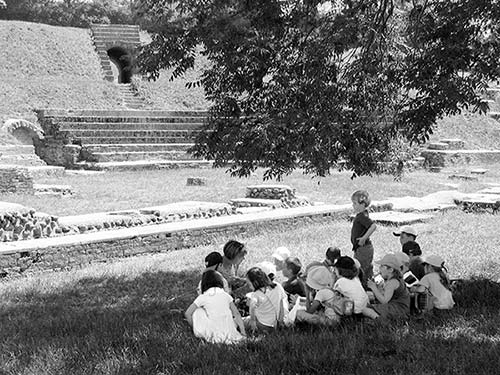
Sleeping in Avenches
Sleeping in the Avenches youth hostel is the Murten area’s best option for travelers on a tight budget. Coming here works best by car. It’s not impossible by train, though hauling your bags uphill from the train station is a chore.
$$ Hotel de la Couronne is an Old World, three-star place with a modern interior. Centrally set on the main square, it’s unpretentious, with 20 bright, spacious rooms (family rooms, next to TI at Rue Centrale 20, +41 26 675 5414, www.swisshotel-lacouronne.ch, info@swisshotel-lacouronne.ch).
¢ The Avenches IYHF hostel fills a traditional building in a quiet setting on the far side of town. It’s a 15-minute walk from the train station—those with wheeled bags can avoid stairs and cobbles by taking the path that circles right around the old town walls. The 85-bed hostel has a homey TV room and a big backyard with a ping-pong table (private rooms available, dinner available if you reserve ahead, no curfew, reception open 7:00-10:00 & 17:00-21:00, pay parking, closed late Oct-March, Rue du Lavoir 5, +41 26 675 2666, www.youthhostel.ch/avenches, avenches@youthhostel.ch).