ZERMATT & THE MATTERHORN
High-Mountain Activities in Zermatt
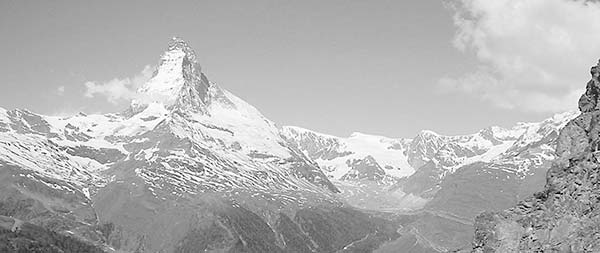
There’s just something about the Matterhorn, the most recognizable mountain on the planet. Anyone who says, “You’ve seen one mountain, you’ve seen them all” hasn’t laid eyes on this pointy, craggy peak. And hiking with that iconic pinnacle as a backdrop is even more exciting.
Oh, and there’s a town, too. Zermatt, a bustling burg of about 5,800 people, might well be the most touristy resort in Switzerland. While the village has pockets of traditional charm, virtually everyone you meet in Zermatt earns a living one way or another from those who flock here for a peek at the peak. Aside from the stone quarries you’ll pass on the way into town, tourism is Zermatt’s only industry.
With the first ascent of the Matterhorn in 1865 and the arrival of trains, Zermatt found itself on the Grand Tour of Europe. Over time, its residents learned it was easier to milk the tourists than the goats, and mountain tourism became the focus. Today the town is a collection of over a hundred modern chalet-style hotels with a well-organized and groomed infrastructure for summer and winter sports with no gas engines—only electric cars slalom between the pedestrians. Sure, there are fabulously wealthy visitors, but locals like to say that the “traffic-free” nature of the town is a great equalizer. With only pedestrians and the golf-cart-style shuttles on the lanes, “you have no idea who owns a Ferrari.”
Zermatt has some disadvantages. Many find it quite touristy, and its location—at the dead-end of a long valley in the southwest corner of the country—is not on the way to anything (though it links up with the Glacier Express). And if you make the long journey here only to find cloudy weather, you may end up shopping for a T-shirt that reads, “I went all the way to Zermatt and didn’t even see the lousy Matterhorn.” But in sunny weather, riding the high-mountain lifts, poking through lost-in-time farm hamlets, and ambling along on scenic hikes are even more enjoyable with that triangular summit nodding its white head in the background.
GETTING TO ZERMATT
Zermatt is barely two hours from Bern and Interlaken by train, thanks to the Lötschberg Base Tunnel. It’s also easy to reach from Zürich or Lausanne (about three hours). Another popular way to reach Zermatt is from the St. Moritz area on the Glacier Express, an all-day ride on a historic narrow-gauge line that cuts across the country (see the Scenic Rail Journeys chapter). You can also do just half of this route by connecting Zermatt with Luzern or Lugano (changing in Andermatt).
PLANNING YOUR TIME
High summer into early fall is the best time to come to Zermatt. On a two-week trip in Switzerland, I’d suggest two nights and the better part of two days here—if the weather’s good. The first half of September can be a sweet spot: Europe’s summer vacation season is over, so it’s no longer “high season” (making it easier and more affordable to find a room). But things are still up and running, and you can often catch the last few days of sunny weather. Spring is a bad time to visit: Most trails, lifts, and restaurants are closed. Before June, I’d skip it.
Zermatt has earned its reputation for untrustworthy weather—the valley can get completely socked in at any time of year. While two good-weather days are enough to experience the highlights, add at least one buffer day, if you can, as insurance against rain. For the latest weather report, check the webcams and forecast at www.zermatt.ch. In clear weather, you’ll want to spend your daylight hours up above town.
With One Day: If you have just one good day in Zermatt in high season (when all the lifts are running), follow this plan, which connects the Gornergrat and the Klein Matterhorn (buy the Peak2Peak ticket, which includes the necessary lifts). Start the day by taking the first train up to the high Gornergrat ridge. On the way down, do the gentle-but-gorgeous Riffelseeweg hike that connects the Rotenboden and Riffelberg train stops. From Riffelberg (on the Gornergrat hillside), take a gondola over and down to the stop called Furi, on the Klein Matterhorn (runs July-Aug only). Depending on your timing and interest, ride all the way up to the Matterhorn Glacier Paradise station at the Klein Matterhorn summit, then return via the Schwarzsee ridge (and perhaps hike part of the way back to Zermatt). Outside of peak summer, when the Riffelberg-Furi connector is not running, this plan still works—you’ll just need to connect the two lifts through Zermatt, which takes a bit longer. To visualize this plan, see the “Zermatt Area” map, later.
There are three main lift experiences from Zermatt. All are well worth your time in good weather (for suggestions on weaving these together, see the “Planning Your Time” section). But if you need to choose among them, here are the key differences:
Gornergrat Railway: If you can fit only one high-mountain excursion on your trip to Zermatt, make it this one. This pleasant and easy cogwheel train ride departs immediately across the street from Zermatt’s train station and summits the Gornergrat ridge in just over 30 minutes. The train runs above ground the entire time, with great scenery the whole way. The top offers Matterhorn vistas as well as the best glacier views. One of the main reasons to ascend the Gornergrat ridge is for access to the dramatic, fairly easy but steeply downhill Riffelseeweg hike between two stations, with great Matterhorn views. The Gornergrat Railway also runs later in the day, making this a good choice if you’re trying to squeeze an extra activity into a sunny afternoon.
Rothorn Lift: This is your short-and-sweet option. The first stretch of this ascent is to Sunnegga via a funicular inside the mountain (with no views). When you emerge at Sunnegga, you’re rewarded with the classic Matterhorn view. From here it’s a relatively quick gondola-and-cable car ascent to the Rothorn summit. The views here are less striking than from the Gornergrat and Klein Matterhorn summits, but the journey is relatively easy and affordable (five-minute walk from Zermatt train station to base station, then 30 minutes to summit). Another big draw is the wonderful hike from the Blauherd station (partway up) to the alpine lake Stellisee, with grand Matterhorn views. This is the area’s only truly “easy” high-mountain walk (under an hour) beyond simply wandering around a lift station.
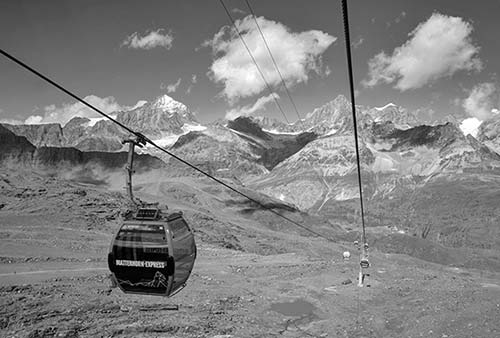
Matterhorn Glacier Paradise Lift: This lift, to the Klein Matterhorn summit, is the longest, priciest high-altitude option (in fact, it’s the highest lift station in Europe). From the base station, which is a 10- to 15-minute walk from the center of Zermatt, a series of gondolas and cable cars take you up, up, up, over glaciers to the summit (about 50 minutes). While extremely expensive, this lift gives you that top-of-the-world feeling. Klein Matterhorn is the only accessible place in the Zermatt region with snow year-round, allowing for summer skiing. There are no hikes at the top, but the moderately difficult Matterhorn Trail hike, from the midway Schwarzsee station, is one of the area’s most satisfying.
With a Second Day: If it’s clear, I’d head up to the Rothorn summit, or at least to the midpoint lift station at Blauherd for the easy walk to the alpine lake Stellisee (and consider the restaurant at Fluhalp). With the rest of your day, consider one of the hikes from the Sunnegga ridge, or relax in Zermatt.
Arriving on a Sunny Afternoon: If you arrive in Zermatt in the midafternoon with a few hours of clear daylight, I’d get a head start and ascend the Gornergrat, then hike the Riffelseeweg on your way back down. The Gornergrat train runs into the early evening in high season, but confirm the exact schedule.
Alternative for Serious Hikers: If the Rothorn excursion sounds more appealing than the Matterhorn Glacier Paradise, start with the two-hour Naturweg hike from Sunnegga to Riffelalp (better Matterhorn views than if done in reverse). Then take the train to Gornergrat and, on the way back down, get off at Rotenboden and hike to Riffelberg. From there, you can either keep walking or take the train back to town. If Mother Nature cooperates, you can do the Matterhorn Glacier Paradise and/or hikes from Schwarzsee on a second day.
Orientation to Zermatt
Zermatt (elevation 5,265 feet) lies at the end of the Nikolaital valley, in the shadow of the mighty Matterhorn (14,690 feet, “Cervin” in French, “Cervino” in Italian).
The train station is at the north end of the town’s shopping zone, a few steps from the main drag, Bahnhofstrasse. As you stand in front of the station, facing the parking lot with the tracks at your back, the heart of the village is to your right. Lifts to thrilling Matterhorn viewpoints leave from near the train station: The cog railway up to Gornergrat leaves from directly across the street; the Sunnegga-Rothorn station for the lift to Rothorn is a few blocks ahead (along the Gornergrat tracks, then across the river); and the lift up to the Matterhorn Glacier Paradise (at the Klein Matterhorn peak) is at the upper (southern) end of the village (about three-quarters of a mile away).
Zermatt bans cars within the town limits and brags that its streets are traffic-free. Well, not quite. Electric cars (resembling big golf carts) buzz around the streets like four-wheeled Vespas. Half of these cars are owned by hotels, which use them to shuttle guests and luggage to the train station; the other half operate as taxis. As these cars are silent and weave speedily between pedestrians, stay alert on any street wide enough for traffic.
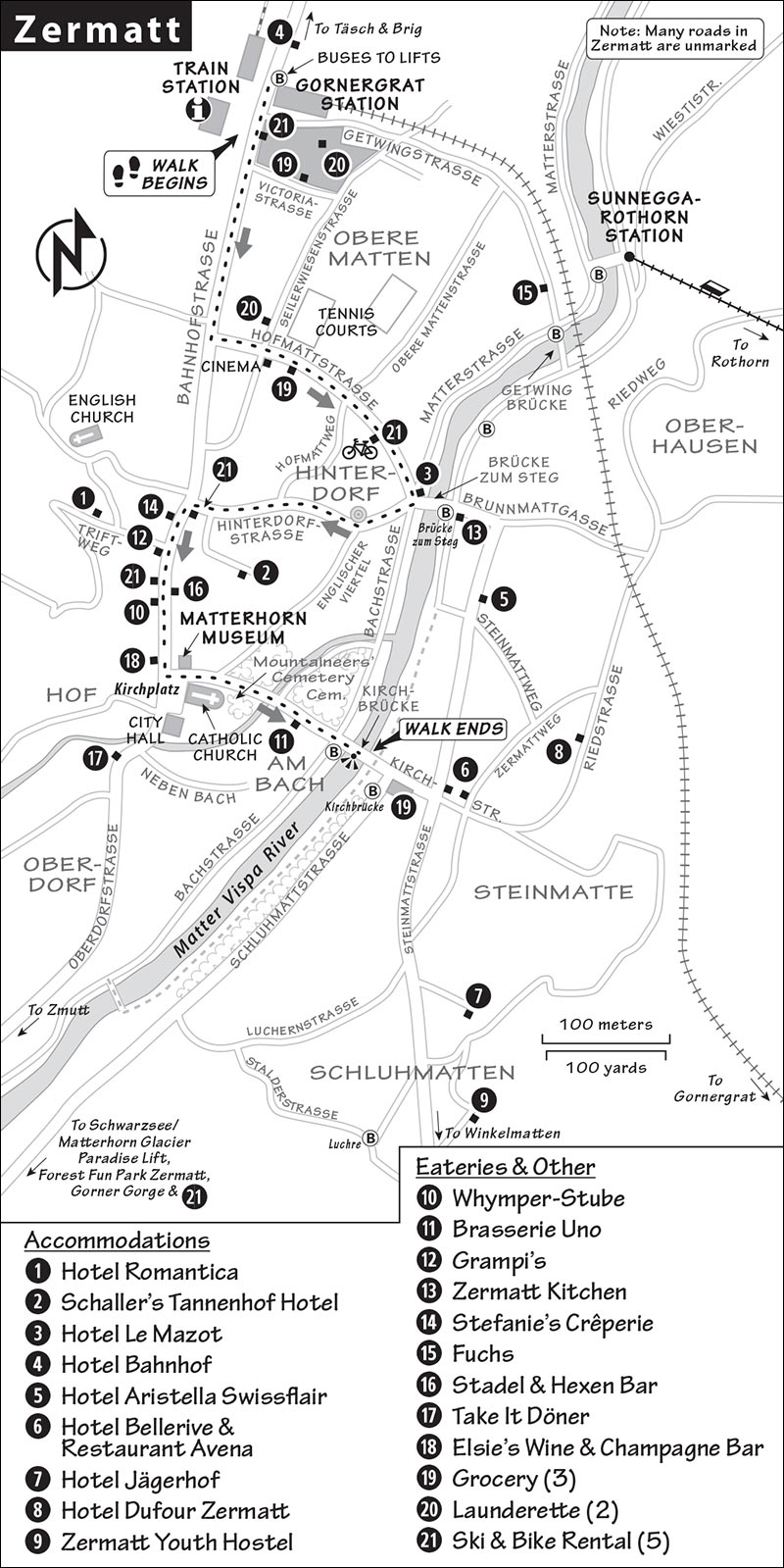
In this small town, locals don’t bother much with street names and house numbers. To find your hotel, use a map (the TI has a free detailed one).
TOURIST INFORMATION
Zermatt’s TI is at the train station, facing the big e-car parking lot (daily 8:00-18:00, +41 27 966 8100, www.zermatt.ch). The unstaffed lobby stays open later and has maps and brochures.
The TI sells lift passes/tickets and is well-versed in helping visitors weigh their options given current weather, time constraints, budgets, and hiking interests. They also offer several free resources: an extremely detailed village map, lift schedules/prices, and a panoramic hiking map. The region’s trail signs can be confusing; the hiking map, which outlines the distance and difficulty level of the most popular hikes, can help you avoid taking a longer or steeper route than you intended. More detailed maps are available for free on the TI’s website.
ARRIVAL IN ZERMATT
Zermatt’s small train station is in the middle of town. The ticket office is beside the tracks; a free WC and pay lockers are downstairs. The TI is straight ahead from the head of the tracks and on the right. Lines of electric taxis wait in the big parking lot out front.
All the hotels I list are within walking distance of the train station (provided you’re packing light). However, the places across the river are far enough away that you might want to take a hotel shuttle (ask about this when you book), a taxi, or the bus. There are also free airport-style luggage carts at the train station (5-CHF deposit)—useful if it’s a fairly level walk to your hotel (or if your car is parked at Täsch, you can use them to wheel your baggage onto the shuttle train—see below). Look for racks of carts just behind the head of the tracks or along the back wall of the station.
Because cars are not allowed in Zermatt, drivers can park in the huge lot at Täsch, a few miles before Zermatt (16 CHF/day), then take the shuttle train into town (runs every 20 minutes until about 22:00, less frequent after that, 8.20 CHF one-way, www.matterhornterminal.ch). Täsch has many parking options, but the big modern lot at the station is most convenient. With 4,000 spots, it’s rarely full (look for the big sign: Matterhorn Terminal Täsch). Park (you’ll pay when you leave) and hop on the next shuttle train—it’s very slick.
GETTING AROUND ZERMATT
Even though Zermatt is “traffic-free,” your feet aren’t your only transportation option. Buses (basically oversized electric cars) are useful for hauling luggage to more distant lodgings or for saving the 20-minute walk between the station and the Matterhorn Glacier Paradise lift station at the top of town. These free buses depart across from the train station and make several stops along the way to the Matterhorn Glacier Paradise station, including at the Sunnegga-Rothorn lift (about 3/hour, last buses leave around 18:00 or 19:00). The green Bergbahnen line goes more directly; the red line takes a roundabout route via the Winkelmatten neighborhood. Ask the TI for a timetable or check www.e-bus.ch.
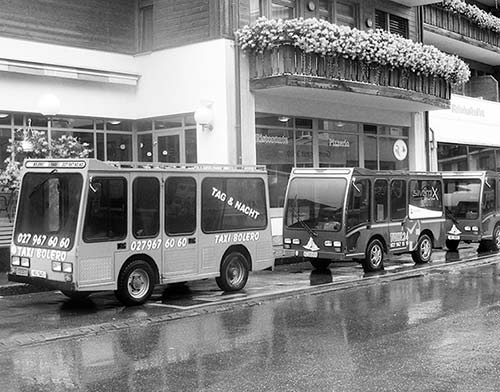
You can also hire a taxi from in front of the train station (12 CHF for a short ride in the heart of town; extra charge for greater distances, luggage, and rides at night or that are more uphill).
HELPFUL HINTS
Festivals: Folk troupes from all over western Switzerland converge on Zermatt for the Folklore Festival, usually on the second weekend in August.
Blackneck Goat Parade: The local Valais Blackneck goat, unique to this region (with a black head and shoulders, a white rear end, and long horns), is being heavily promoted as a sort of mascot for the Zermatt area. (Baby goats that don’t fit the proper color scheme are immediately butchered, ensuring the herd evolves as expected.) Every day in summer (July-mid-Aug, at about 9:00 and again at 16:30), a small flock of these furry goats are herded through the center of town (down the length of Bahnhofstrasse) on the way to and from the pasture. Keep an eye out for this charming and unusual parade.
Laundry: Two launderettes provide drop-off service only. Waschsalon Doli is nice and central (Mon-Sat 8:30-12:00 & 14:00-19:00, closed Sun, a block off the main drag at Hofmattstrasse 3—look for the concrete stairs leading down to a basement across from the tennis courts, +41 27 967 5100). Womy Express is in the Viktoria Center mall across from the train station (Mon-Fri 8:30-12:00 & 14:00-18:00, closed Sat-Sun, +41 27 967 3242).
Cinema: The Vernissage Cinema, oddly located in the Backstage Hotel, plays a rotating schedule of historical Matterhorn-centric films and some first-run features in the evening during peak season (Hofmattstrasse 4, +41 27 966 6970, www.backstagehotel.ch).
Ski and Mountain Bike Rental: For equipment rental in town, try Matterhorn Sport (Bahnhofstrasse 78, +41 27 967 2956, www.matterhornsport.ch), Bayard Sports & Fashion (branches on Bahnhofplatz and at Bahnhofstrasse 35, +41 27 966 4960, www.bayardzermatt.ch), Bike Arena (near the Migros at Hofmattstrasse 30, +41 27 510 25 11, www.bikearenazermatt.ch), and Dorsaz-Sport (near Matterhorn Glacier Paradise lift station, +41 27 966 3810, www.dorsaz-sport.ch).
Zermatt Walk
At first glance, Zermatt appears to be single-minded about catching the tourist dollar. The streets may be lined with chalet after chalet, but all the dark wood and overflowing flower boxes lend this super-touristy town a pleasant realness. This walk, worth ▲ and only about 30 minutes, orients you to the town while exploring some back streets and more authentic spots that many visitors miss.
Train Station Square (Bahnhofplatz): Zermatt entertains two million guests a year...and they all arrive here. While skiing is the big draw in winter, this is a popular terminal in summer for the scenic Glacier Express—the daily eight-hour train ride connecting Zermatt and the St. Moritz area in the Upper Engadine (see the Scenic Rail Journeys chapter). The first train arrived here in 1891 (and the first winter train in 1928).
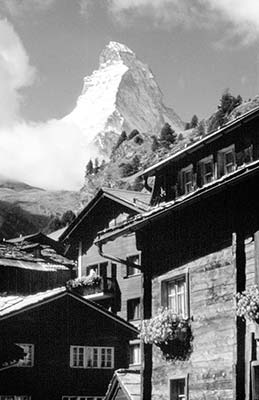
Across the street is the station for the cogwheel train to Gornergrat (at an altitude of more than 10,000 feet), which opened in 1899. If you walked alongside that train station—following its tracks for a few short blocks—then crossed the river and turned left, you’d reach the base station for the funicular to Rothorn in about five minutes.
The town is committed to its car-free environment. Listen to the sounds of a traffic-free city. Locals who own cars have to park them at a garage at the south end of town. E-cars—like oversized golf carts—move people to and from hotels and serve as taxis. (The first Zermatt bus ran on gas...it lasted about one day after locals put sugar in the tank. City leaders got the message.)
Here at Bahnhofplatz, you’ll find the TI and the big Co-op supermarket (a budget-friendly depot for most shopping needs).
• Now stroll up...
Bahnhofstrasse and Hofmattstrasse: Zermatt strives to be a high-class mountain resort for active guests. The town’s main street, Bahnhofstrasse, is lined with hotels, souvenir shops, après-ski bars, and fondue restaurants. You’ll notice even bikes are forbidden—this street is only for people, the occasional e-car, and the twice-daily parade of goats in summer.
After 250 yards, turn left just before Hotel Pollux and stroll down Hofmattstrasse. Between here and the river, this practical street has a sports arena (its tennis courts freeze over and become ice rinks for curling and hockey in the winter), a handy laundry service (see “Helpful Hints,” earlier), indoor golf, a cinema (tucked in the back of a hotel, on your right), and the Migros supermarket.
• Continue along the street until you reach the little bridge.
Brücke zum Steg and the River: For centuries, the bridge called Brücke zum Steg has crossed the Matter Vispa River. Two hundred years ago, this was a humble wooden crossing just strong enough to support a cow. The embankment containing the river was built after World War II to contain floods (once common with the spring and summer melts). This is the practical spine of Zermatt, with a shuttle bus running along the riverbank. Higher buildings are connected to this street by a clever system of tunnels and elevators (handy in the snowy winter).
Notice the many small hotels. Hotels in Zermatt are generally family owned and run. Local inheritance laws—which require that all relatives who own a stake in a plot of land agree to any sale—have prevented big chains from infiltrating the town.
While hotel owners may be local, hotel staffers are typically not Swiss. Zermatt may look quintessentially Swiss, but most of the workers who keep the hotels, restaurants, and lifts going are from other parts of Europe, particularly Portugal. In Täsch, the next village down the valley (with more affordable housing than Zermatt), most residents are Portuguese. While some Swiss feel that the current policy of free movement between Switzerland and the rest of Europe should be curtailed, immigrants are hard at work in Switzerland’s hospitality industry.
• Now look toward the Matterhorn at the far end of the valley and imagine standing on the old wooden bridge in 1800. To get an even better taste of those days, head into the...
Hinterdorf Quarter: Once the core of the Zermatt village, this small but very atmospheric area is worth a ▲▲ stroll. To reach it from the bridge, head slowly up Hinterdorfstrasse—the tight, cobbled lane just to the right of the Matterhorn—and take a slight right turn at the fountain, which honors mountaineering legend Ulrich Inderbinen (for more on Inderbinen, see the Matterhorn Museum listing, later). Walk up the street.
The narrow lanes through here are lined with traditional wooden buildings called mazots, built between the 16th and 18th centuries. As you explore, you’ll notice several buildings labeled according to their former purpose. Before the tourism boom, you’d have seen houses built with hand-hewn larch trees. Foundations were made by stacking local quarried stone, set on stilts with “plate stones” to keep rodents out of storage huts (filled with tasty corn, cheese, and meat). Staircases were on the outside to save space on the heated inside.
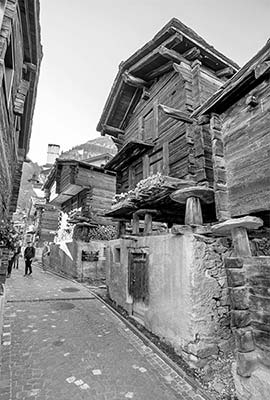
Elsewhere in town, you’ll see several mazots perched around Hotel Romantica, and on the walk up to—and around—the Winkelmatten area. The valley’s best and most scenically situated clusters of mazots are in the hamlets of Blatten and Zum See, just below the Furi gondola station, and in Zmutt below the Schwarzsee gondola station (see the “Zermatt Area” map, later).
• Walk uphill on Hinterdorfstrasse until you reach busy Bahnhofstrasse again. Turn left on this main drag as the street narrows, and pass through Zermatt’s nightlife district until the street opens up into a big square (with a church at its far end).
Church Square (Kirchplatz): As you enter the square, notice the two grand 19th-century hotels. Monte Rosa Hotel, on your right, was Zermatt’s first (1838). The Grand Hotel Zermatterhof, facing it on the left in the small park, was built a few decades later. Locals thought early tourists would appreciate big, modern, city-type buildings like these. Only later did they realize people came here to escape the urban environment and enjoy woody chalet-type hotels, as is now the standard.
The plaque on Monte Rosa honors the Englishman Edward Whymper. He fell in love with the Matterhorn and, in 1865, set out from this hotel for the first ascent of that mountain. On the way down, four of Whymper’s party of seven fell to their deaths. (You’ll see their names listed on bronze markers along Bahnhofstrasse.) The news put Zermatt on the map and mountain lovers soon began flocking here. Now, each year several thousand attempt to climb the iconic mountain. While most make it, about a dozen die trying.
Now walk to the far end of the square. The Matterhorn Museum fills the sunken building at the corner of the square, under an angled glass roof (see listing under “Sights in Zermatt,” later). Just above that, at street level, enjoy Zermatt’s beloved marmot fountain.
Straight ahead is the Parish Church (Pfarrkirche) of St. Mauritius. Built in 1913, this replaced an earlier church that dated back to the 13th century. Its central location makes it a hub of local activity—from weddings to concerts. Inside, the ceiling features a cheerful painting of Noah’s Ark, by Paolo Parente.
Beyond the church stands the City Hall (Gemeindehaus). And just beyond that are three community information boards that illustrate how, behind the crowds of tourists, a real community lives and works here. They list everything from report dates for military reserve training to upcoming ballot measures (the Swiss love participating in their democracy) to childcare services. While it’s a little old-fashioned, it’s a far cry from the days when such news would be hollered from the steps of the City Hall by the local herald.
Backtrack to the marmot fountain. Nearby, in front of the church, notice the standard yellow signpost—which you’ll find at every trail intersection in the high country—telling the altitude (1,616 meters) and how long it takes to hike to nearby points.
Walk downhill on Kirchstrasse, between the side of the church and the museum. You’ll pass a park on your left with several “sister cities” plaques.
• Turn right immediately behind the church to reach the...
Mountaineers’ Cemetery: This is dedicated to great climbers and mountain guides, many of whom died on the mountain (and many of whom were English). It’s worth a thoughtful wander. The lovingly tended graves are adorned with flowers and lit by glowing votive lanterns at night. Look for “the tomb of the unknown climber” (bottom corner, nearest the fence).
• For our walk’s grand finale, keep going downhill. Pause when you get to the middle of...
Church Bridge (Kirchbrücke): On your left, you’ll see a much larger cemetery. Space here is very limited; notice the several compact rows of available space, all ready for future occupants. While an unusual use of valuable real estate in the heart of such a touristy city, this is a poignant reminder that this is also a place where people spend their lives.
Now turn 180 degrees and enjoy a fantastic, famous view of the Matterhorn—with the Matter Vispa River trickling down from those foothills and gushing under your feet. The bridge even has a special platform that allows more people to crowd in for the ultimate Matterhorn selfie.
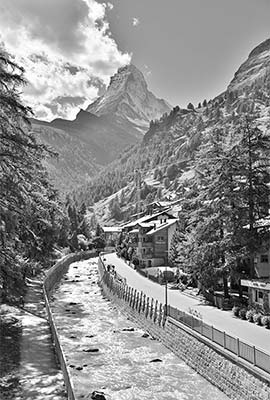
• There’s one more landmark worth knowing about: It’s the multistage lift to Matterhorn Glacier Paradise, about a 10-minute walk farther up the valley (see listing under “High Mountain Activities in Zermatt,” later). You can follow the river partway, or—for the most direct route—cross the bridge, turn right at the Spar Express grocery, and follow Schluhmattstrasse past a couple dozen hotels. Buses and taxis also go there from the town center.
Sights in Zermatt
Consider the following options for when the weather is not cooperating with an alpine adventure—or for when you return from a busy morning high in the Alps. Besides the sights listed below, other bad-weather options include walking up and out of town until you hit the cloud cover (the hamlet of Winkelmatten is a pleasant 20-minute stroll from the Catholic church), catching a movie, and/or taking a dip in one of the big hotel pools (nonguests can enjoy for a fee; get advice from TI).
▲▲Matterhorn Museum
This fun and interesting museum is the town’s best indoor activity, and worth at least an hour of your time, especially on a rainy day. Most of the museum is underground—the idea is that it’s like an archaeological dig where you can unearth the history of Zermatt and its famous mountain. There are also reproductions of an old hotel and church from Zermatt’s past. Exhibits show off typical village furnishings, tools, and stuffed alpine fauna, and detail the local prehistory and geology. The museum brings you back to the 19th century, when Zermatt saw the advent of mountaineering and the golden age of tourism. Quite suddenly, what had been a tiny, backwater village became a major destination, known worldwide.
Cost and Hours: 10 CHF, covered by Swiss Travel Pass, includes audioguide download for your smartphone; hours vary but likely open daily 14:00-18:00 in summer, 15:00-18:00 in shoulder season, closed off-season; under glass dome at Kirchplatz 11, across from Catholic church, +41 27 967 4100, www.zermatt.ch/museum.
Visiting the Museum: Pick up the free English flier and head downstairs. The museum’s main hall is filled with little mazots (those stone-roofed huts you’ve seen all around town). Each hut houses an exhibit, and throughout, you’ll pass taxidermied mountain animals. Circling the huts roughly clockwise, you’ll see:
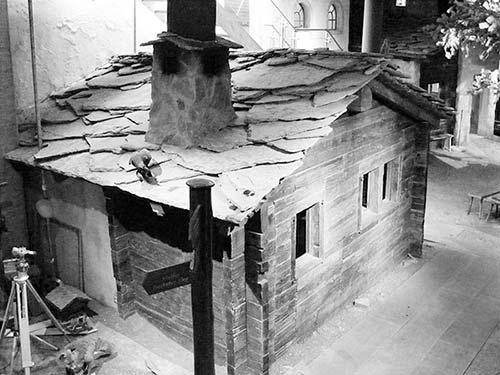
The Mule Driver’s House features a relief map of Zermatt’s valley, offering a helpful topographic overview.
In the Mountain Guides’ House, press the buttons to see the different routes up the Matterhorn. Consider that even now, only about half the people who attempt this climb make it to the top. Find the picture (a rare one in color) of local hero Ulrich Inderbinen, who climbed the Matterhorn more than 370 times, the last when he was—no kidding—90 years old. (Inderbinen died in 2004 at age 104; a fountain in the Hinterdorf area of town honors him.)
The Alpine Museum displays artifacts found after deadly accidents, with a room dedicated to July 14, 1865—the day the Matterhorn was finally conquered by a team of seven climbers. (Four of them died on the descent, when the least-experienced among them fell, dragging three others to their deaths; you can see the snapped rope in a glass case.)
In the mockup of the belle-époque Monte Rosa Hotel, short movies play. Just beyond that is a corridor with WCs; don’t miss the display case in this hall that holds a collection of Matterhorn memorabilia and products.
The Alpine Dairy captures life for summer cheesemakers on the high Alps. From here, circle back through more huts. The Living Area shows how people cohabitated in a very small space. You’ll then cut through a replica chapel and peek inside the Priest’s House—which doubled as a sort of guesthouse for the very first visitors (scientists and scholars) to Zermatt.
Finally, go back into the hotel and head upstairs. More exhibits wrap around the space on an upper walkway, which eventually brings you back to the entrance/exit.
Forest Fun Park Zermatt
This high-ropes park has zip lines and a good range of ropes courses at various difficulty levels. Since it’s open in all weather, the park is a great way to enjoy active fun on a rainy day. It’s located right under the gondola line to Furi, about 10 minutes past the lift station—you’ll hear people screaming through the trees below you on your way up the mountain.
Cost and Hours: 37 CHF, 21 CHF for kids, daily 10:00-19:00, shorter hours or closed off-season, Zen Stechenstrasse 110, +41 27 968 1010, www.zermatt-fun.com.
Gorner Gorge (Gornerschlucht)
This deep, narrow, and dramatic gorge is lined with a skinny wooden walkway over its river so hikers can enter at one end and walk about 15 minutes (past a waterfall and whirlpools) to the other. You can enter and leave at either end or just go in and out from the bottom. It’s about 15 minutes beyond the top end of Zermatt and on the path down from the Furi gondola station. This is especially worth considering if you’re hiking to or from Furi (well signed, right under the gondola). Wear sturdy shoes as the visit (allow 15-20 minutes) involves steep stairs and potentially slippery walkways.
Cost and Hours: 5 CHF, daily 9:15-17:45, closed off-season, +41 27 967 2096, www.gornergorge.ch.
High-Mountain Activities in Zermatt
Think of the Zermatt region’s many lifts and hikes in terms of the three high-mountain summit stations to which they’re linked: Matterhorn Glacier Paradise (the highest and closest to the Matterhorn), Gornergrat (the historic train that goes to 10,000 feet), and Rothorn (farthest up the valley from the Matterhorn). For a quick comparison of these three summit experiences, see the “Which Lift?” sidebar near the beginning of this chapter. While prices are steep, the community has invested hundreds of millions of dollars in their mountain lifts. They’re state of the art, they manage crowds well, and experiencing them is unforgettable. Strategies for enjoying each of these are laid out below.
Weather Watch: Whichever excursions you opt for, pay close attention to the weather—the lifts aren’t cheap, and none of them is worth it if the Matterhorn is completely socked in. If the weather’s iffy, confirm that the entire route is open before you buy a summit ticket—upper segments can close if it’s too windy (though the Gornergrat train and some Klein Matterhorn lifts usually keep running).
That said, don’t wait for perfectly clear skies to head into the hills—even in bright, sunny weather, the Matterhorn loves playing peek-a-boo behind the clouds, and often wears a puffy crown. (It’s shaped like a hook and grabs onto passing clouds.) As long as some part of the Matterhorn is visible, local hoteliers like to say, “Clouds add drama!” If it’s at least sunny-ish, get up the mountainside.
Be Prepared: Even when it’s balmy in the valley, take cold-weather gear if you’re heading up the mountainside. It’s chilly and often windy (even at the lower elevations).
Passes and Tickets: It can be tricky figuring out the best ticketing option for your excursion. Consult the TI to determine whether you should buy a pass covering multiple lifts, or individual tickets.
A Peak Pass gives you unlimited access to all lifts in the area, bike transport, and use of the local bus (July-Aug: 216 CHF/1 day, 241 CHF/2 days, longer versions available; prices are about 10 percent cheaper in June and Sept-Oct and about 20 percent cheaper Nov-May; 25 percent discount on any pass with Swiss Travel Pass; 5-CHF refundable card deposit, www.matterhornparadise.ch). You can purchase the pass online or in person at the Zermatt TI, the train station in Täsch, or the base stations for all three lifts/trains.
Another pass option—available July-Aug—is the Peak2Peak ticket: a one-day pass covering the trains/lifts for the Matterhorn Glacier Paradise and the Gornergrat, as well as the Riffelberg Express gondola that connects them (197 CHF, half-price with Swiss Travel Pass; slightly cheaper version available Dec-April; this ticket is not sold—and Riffelberg Express does not run—May-June or Sept-Nov).
Even with the freedom and ease of a pass, it pays to consider individual tickets (lift prices are listed later). Keep in mind that Swiss Travel Pass holders pay half-price on full-fare individual tickets and the Peak2Peak ticket but get only a 25 percent discount on the Peak Pass. While they don’t like to advertise it, all three mountain excursions offer discounted prices if you’re ascending later in the afternoon—always ask. (They don’t stack discounts, and the Swiss Travel Pass half-price is better than the afternoon deal.)
Connecting the Mountainsides: I’ve described the three main excursions as separate experiences, but you could connect them to make the most of a sunny day. In the peak of summer, the Gornergrat railway connects to the Klein Matterhorn hillside and lifts via the Riffelberg Express gondola, running between Riffelberg and Furi (26.50 CHF, half-price with Swiss Travel Pass, also covered by Peak2Peak ticket—see above; runs July-Aug only from 8:30 to 16:30, last descent at 16:45).
Hikers can connect the Gornergrat hillside with Sunnegga, on the slopes of the Rothorn, via the moderately strenuous two-hour Naturweg hike (described later, under “Hikes from Sunnegga”).
MATTERHORN GLACIER PARADISE
An excursion to what’s branded as Matterhorn Glacier Paradise (the summit station for the Klein—“Little”—Matterhorn) has several highlights: the summit (with views across the top of the Alps and a few fun indoor/outdoor activities), the halfway point at Schwarzsee (a nice spot to bask in Matterhorn views), hikes down the mountainside (including my favorite, the Matterhorn Trail from Schwarzsee), and the multistage lift ride itself, which takes you from the valley floor to dizzying heights...with Matterhorn views most of the way. (Note that by the time you visit, the lift may extend all the way over the border and down into Italy.)
The Matterhorn Glacier Paradise is impressive but expensive. If you’ve visited the Berner Oberland’s Schilthorn and/or Jungfraujoch (or France’s Aiguille du Midi) in clear weather, the trip up to this summit may not be as worthwhile for the high price tag. But you could still consider riding partway up to the Schwarzsee midpoint.
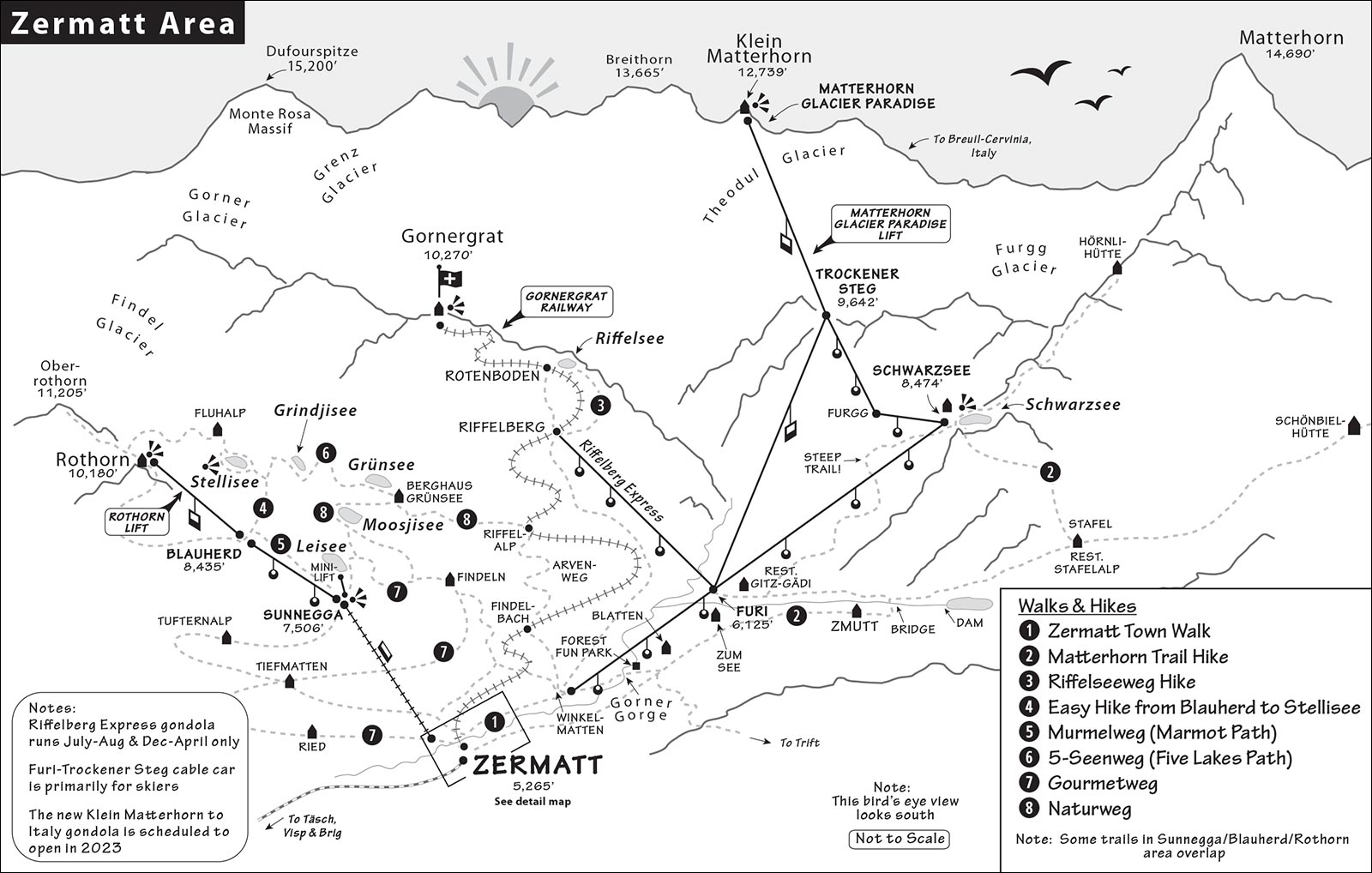
Lift Stages: There are several stages (six to eight minutes each, all run continuously). The entire journey—from the Glacier Paradise lift station in Zermatt to the top station at Klein Matterhorn—takes approximately 50 minutes.
The lift trip starts with a gondola ride. You’ll stay in the same gondola as it passes through several stations: First you’ll ascend over glacier-carved foothills to Furi. Then you’ll go above the tree line, and with smashing glacier views on your left, up to Schwarzsee, with its point-blank Matterhorn views, a humble restaurant with a big terrace, and trails leading back down the mountain. From Schwarzsee, the gondola dips down to the Furgg intermediary station, then soars up to Trockener Steg—where you’ll disembark.
Trockener Steg has free WCs and the Info Cube, a free attraction with hands-on exhibits and a virtual-reality journey over the glacier. When you’re ready to continue your trip, board the sleek cable car up to the Klein Matterhorn summit. As you ascend, you’ll enjoy great views on the left side over glaciers and across to the Gornergrat train station. (For even more thrills, you can pay extra for a “crystal ride” in a special cabin with see-through glass panels in the floor; 10 CHF one-way, 15 CHF round-trip—purchase either at the base station or before boarding the cable car at Trockener Steg.)
Note: At certain times of year, there’s a direct cablecar from Furi to Trockener Steg. As this is designed for skiers heading up first thing in the morning, it typically only runs very early and can be crowded (often stops running by 8:00 or 9:00). I’d rather stay on the multistage gondola to relax and enjoy the ride, but if your timing is right and you’re trying to pack a lot into one day, this shortcut may be a good option.
Returning to the valley the way you came, consider hopping off at Schwarzsee for a hike, or at Furi for a hike or meal (all described later). From the base station, the elevators across the street lead to a taxi stand and bus stop to return to town.
Cost: A peak-season (July-Aug) round-trip ticket between Zermatt and the Matterhorn Glacier Paradise summit costs 120 CHF; Zermatt to Schwarzsee is 61 CHF round-trip (40 CHF one-way). All tickets are about 10 percent less in spring and fall, and half-price with the Swiss Travel Pass. If heading up in the afternoon, ask about discounts.
Hours: The Klein Matterhorn lifts are open daily year-round. In summer (May-mid-Oct) they generally start running at 8:30, with the last ride up between 16:00 and 16:30, and the last ride down at 16:15-16:30 (from the summit) and 17:00-18:00 (from Furi). Note that the two stretches of gondola (from Furi to Schwarzsee, and from Schwarzsee to Trockener Steg) only run June to mid-Oct. The direct cable car between Furi and Trockener Steg keeps its own schedule—check times carefully if planning to take this shortcut.
Remember, the Riffelberg Express gondola—a spur line connecting Furi up to Riffelberg, on the Gornergrat hillside—runs only in July and August, and during the winter ski season, but not May-June or Sept-Nov (see “Connecting the Mountainsides,” on here).
Information: For detailed schedule and price info, go to www.matterhornparadise.ch.
Getting There: The base station for the gondola to Furi (and Schwarzsee) is about three-quarters of a mile upriver from the Zermatt train station: Walk up Bahnhofstrasse to the Catholic church, cross the bridge, and follow the river from there. The gradually uphill walk takes 10 to 15 minutes from the town center. Otherwise, you can catch an e-bus (see “Getting Around Zermatt,” earlier).
Trip Tips: It’s always frigid and often windy at the summit—bring cold-weather gear no matter how pleasant it might be in the valley. Consider packing a lunch, as the summit’s restaurant is expensive and crowded. Save money by using the free WCs at the Schwarzsee or Trockener Steg stations rather than the 2-CHF WCs at the summit.
Since the area around the summit stays snow-covered all year long, there are no real hiking opportunities up top (but there are some great hikes on your way down—especially at Schwarzsee, described later). However, all that snow means that you can usually get in some summer skiing (rent gear in town—there are no rentals up top—and get an early start, before the snow turns slushy).
▲▲▲Matterhorn Glacier Paradise Summit (12,739 feet)
The highest cable-car station in Europe perches near the pointy top of the Klein Matterhorn. Be warned: Some visitors are disappointed by the view of the “real” Matterhorn from the summit, because it’s not the classic postcard profile. (For views of the Matterhorn you imagined, visit the intermediate Schwarzsee stop.)
Exiting the cable car, you step into a long tunnel carved out of granite—similar to the surface on which climbers hang. Go ahead and grip it. To the left is a “cinema lounge,” with cozy pod seats suspended from the ceiling and several short films about high adventure in the area (skippable unless you’re killing time waiting for clouds to clear). Most attractions are to the right: First, the elevator to the observation deck; then the $$$ “Ice” restaurant and shop (with pricey WCs); and finally the entrance to the Glacier Palace and the exit to the snow fields, where shivering tourists venture out to walk under ski lifts.
Observation Deck (Panorama-Plattform): The undisputed highlight of the Matterhorn Glacier Paradise, this perch offers 360-degree views of the Alps. On a clear day, you can see Italy and France (including Mont Blanc, the Alps’ highest peak), as well as the “back” of the Berner Oberland’s Jungfrau and Mönch peaks. To get here, ride the elevator, then climb up the 42 metal steps.
Here’s a quick spin-tour of the view from the top. Begin by facing the large cross, with a reminder to “Be More Human” (mehr Mensch sein)—a humbling thought when you’re surrounded by nature’s majesty. To the left of the cross is the Matterhorn, with a little bit of Zermatt poking out in the valley far below. To the right of the cross, you can see the Gornergrat (look for the building with silver turrets on the corners). If you’ve ridden the cogwheel train up there already, follow your route, and notice how the main, upper part of the Gorner glacier is tucked just out of view from this vantage point. It’s hidden behind the pointy peak called Breithorn (13,661 feet). Notice intrepid mountain climbers scaling its back, like ants climbing a snowy anthill. Pan right to look out over a vast snow field (with the concrete elevator shaft in the middle). Looking in this direction, you’re surrounded on three sides—virtually your entire field of vision—by Italy. (Zermatt fills a small nub of Switzerland that pokes into its neighbor.) Farther to the right, in the distance, is the Testa Grigia lift station. From here, lifts descend all the way to the village of Breuil-Cervinia—Italy’s Zermatt doppelgänger. (By the time you visit, the cable car connecting this lift station to that one may be up and running.) Spinning farther right, look for the Trockener Steg lift station, which connects the place where you’re standing to Zermatt in the valley far below. And finally, of course, is the giant triangular Matterhorn.
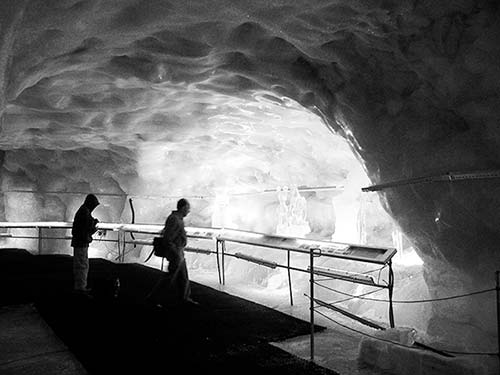
Glacier Palace (Gletscher-Palast): A tunnel carved 50 feet below the glacier surface, this attraction brags that it’s the “highest glacial grotto in the world.” You’ll walk deep into the tunnel, where a maze of corridors hides some fun ice sculptures (including one of the Matterhorn—handy if the real one’s socked in). This area, with some low-impact information boards, is fun to explore but not exactly thrilling. Look for the small Hindu shrine and the ice tube that you can slide down (find the pads at the bottom end to sit on as you go down).
Matterhorn Glacier Ride II
A tri-cable gondola continuing the Klein Matterhorn journey may be open by the time you visit. It goes over the Theodul glacier as it descends 1,190 feet to Testa Grigia (11,345 feet), just over the border in Italy. From here, lifts descend to the Italian town of Breuil-Cervinia. This is not intended for through passengers—in fact, luggage will likely be forbidden—so the gondola will function mainly as an international extension of the existing Klein Matterhorn day trip from Zermatt.
▲Schwarzsee Ridge (8,474 feet)
Roughly halfway to the Klein Matterhorn summit is the gondola station of Schwarzsee (named for the alpine lake nearby). Though much lower in elevation than the top station, this area is the closest you can get to the Matterhorn by lift. A short walk below the station is a $$ restaurant with rustic mountain food and a big view terrace, plus a lovely picnic spot near the station—making this a great pit stop on your way up or down the mountain. It’s also the starting point for one of the best hikes in the area, the Matterhorn Trail (described next). Shorter walks back to town from the gondola station at Furi are also worthwhile (described later).
▲▲Matterhorn Trail Hike (2-3 hours)
This moderately strenuous hike (#29 on local signs and maps) goes from Schwarzsee via Stafel to either Furi (2 hours), where you can ride the gondola back into town, or all the way to Zermatt (3 hours total), either via Zmutt or Furi. (From Schwarzsee, avoid the trail that leads directly down to Furi—it’s much steeper than it is fun.)
From the Schwarzsee station, head down to the lake, then follow Matterhorn Trail signs to Stafelalp (the name of the hillside and the restaurant). A little farther down the path, ignore the red signs pointing to Stafelalp—red signs are for skiers—and stay on the main road. At the first major fork, about 30 minutes into your hike, a wooden sign off to the right points to the shortest path to Restaurant Stafelalp (20 minutes from here, near the mini village of Stafel), which takes you through a fascinating pocket of mossy hillocks, ponds, and bubbling streams.
From the restaurant, follow signs to Furi and Zmutt. After about 30 minutes you’ll need to make a choice: Head downhill to cross over a dam and on to the cute hamlet of Zmutt (25 minutes); or stay on the path to the gondola at Furi (which becomes hike #29a after the fork; about 40 mostly level minutes). I recommend taking the Zmutt fork, as it is a joy—an almost tourist-free time warp (with a restaurant or two as well as a fine cluster of traditional mazot buildings); from there, it’s about an hour down to Zermatt.
Furi (6,125 feet)
There’s not much to see at this lift station—it’s in a wooded area, with the Matterhorn out of view—but it offers an opportunity for a hike back down to Zermatt (described next). It also has a fine restaurant, worth considering on your way back down.
Eating in Furi: There are a couple of straightforward restaurants, with sunny terraces, next to the Furi lift station. But for a better meal, it’s worth a 10-minute, gently uphill walk to $$$ Restaurant Gitz-Gädi. Attached to an upscale ski hotel, this restaurant has attentive service and excellent regional dishes, plus creative spins on cordon bleu (some using local raclette cheese). There’s delightful seating both inside and outside on the terrace. It’s popular, so during peak season, call ahead before hiking up here (daily 8:00-19:30, +41 27 966 28 00). Another foodie destination in Furi—closer to the lift station—is $$$$ Aroleid, expected to reopen in 2023 (www.aroleid-kollektiv.ch).
▲Furi to Zermatt Hike (1 hour)
If returning to Zermatt via Furi, you can either take the gondola from Furi or hike a pleasant hour, past the adorable hamlets of Zum See and Blatten (and its restaurant) and the Gorner Gorge (see listing under “Sights in Zermatt,” earlier). The trail is steep, stony, and stepped at times.
GORNERGRAT
The Gornergrat has been wowing visitors since 1899. Located between the Klein Matterhorn and the Rothorn, it’s not inherently better than the neighboring peaks, but it’s a best-of-all-worlds experience. It’s a simple half-hour cogwheel train ride from downtown Zermatt to the summit. The ride itself is spectacular, with Matterhorn views most of the way. And the summit comes with two main highlights: the views from the top station, and the Riffelseeweg hike between the Rotenboden and Riffelberg stops partway up. Because the train runs relatively late, the Gornergrat can be a good choice for travelers who want to squeeze in a lift before dinner (though things get quieter up top after about 16:00, and trains run less frequently later in the day—see “Hours,” below).
Train Stations: A cogwheel train takes you from Zermatt steeply up to the Gornergrat summit (10,270 feet) with stops at Findelbach, Riffelalp, Riffelberg, and Rotenboden. On the way up, sit on the right side for great Matterhorn vistas.
Cost: Peak-season (June-Aug) trips up to the Gornergrat station cost 126 CHF round-trip (110 CHF in May and Sept-Oct; no round-trip discount). If combining a Gornergrat trip and a Matterhorn Glacier Paradise visit on the same day via the Riffelberg Express, consider the Peak2Peak ticket (described earlier, under “Passes and Tickets”).
Hours: Trains run daily year-round, departing 2-3/hour from early June to mid-Oct, with the first ascent at about 7:00 and the last descent around 20:00 (after 17:30, trains run only hourly); off-season, there are fewer departures and the last descent is around 19:00. The Riffelberg Express gondola runs only in July-Aug and Dec-April; see “Connecting the Mountainsides,” earlier.
Information: +41 848 642 442, www.gornergratbahn.ch.
Getting There: The Gornergrat train station is right across the street from Zermatt’s train station.
▲▲Gornergrat Top Station (10,270 feet)
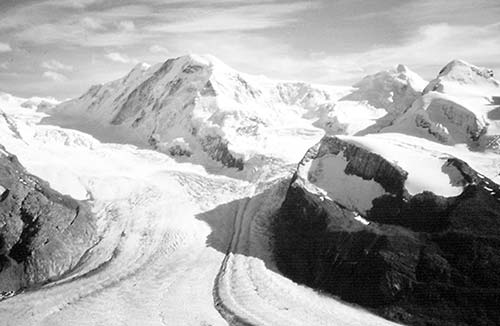
From the train platform, head up to the large hilltop building with the silver turrets—either follow the serpentine path, or ride the elevator, located in the first building you come to. (For an even better view, you can hike up to the stone terrace up above.) The sweeping panorama includes excellent views of the Matterhorn (though it’s not quite the perfect profile that you see from the Rothorn). You’re also up close to the other big mountain in the neighborhood, Monte Rosa, the highest point in Switzerland (15,200 feet). And from here you have the best possible look at the Gorner glacier, a thousand-foot sheer drop below the platform. Observe the slow-motion rivers of ice that flow across the mountaintops between here and the Matterhorn.
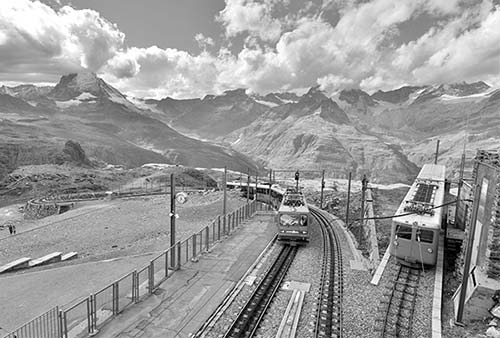
The main building houses shops, a hotel, and—upstairs—a $$$$ restaurant and a $$$ self-serve buffet. Nearby is a small chapel and, just below, the Zoom the Matterhorn attraction. It features hands-on exhibits (such as a mini rock-climbing wall and a station where you can smell various mountain flowers and herbs); a wrap-around movie about the Matterhorn in all four seasons; and a virtual paraglider flight (all included in your train ticket, daily 9:45-16:15).
▲▲▲Riffelseeweg Hike (1.5 hours)
Perhaps my favorite hike in the entire Zermatt region is the Riffelseeweg path (hike #21 on local signs and maps), which usually opens in late June and connects the Rotenboden station to the Riffelberg station. Overall it’s an easy hike—for those with good knees—though there’s lots of downhill walking (with an elevation loss of 700 feet) on occasionally steep, rocky terrain. But your effort is rewarded with beautiful topography and spectacular Matterhorn views almost the entire way.
Take the train from the Gornergrat summit back down to the Rotenboden station. From there, follow the official Riffelseeweg trail, which is clearly marked at each signpost. (It’s not the Swiss Topwalk labeled #23 toward Riffelalp—don’t confuse your Riffels!)
Just down the hillside from the Rotenboden station, you’ll pass the pretty lake called Riffelsee—and, if you’re lucky, catch the Matterhorn’s reflection on its surface. Farther along, you’ll pass another little lake and head more steeply downhill. When you reach a fork, take the left/downhill option, marked as 35 minutes to Riffelberg (don’t continue straight ahead for 20 minutes to Riffelberg, which cheats you out of some of the best scenery). From here, you’ll descend steeply through a dramatically rocky and rugged landscape with head-on views of the Matterhorn. At the next fork, stay straight (still marked for Riffelberg). You’ll curl around the side of a hill, then head up a brief uphill stretch, cresting at a meadow. Walk across the meadow and soon the Riffelberg station comes into view.
While most stops on the Gornergrat train line have few services, Riffelberg has WCs, a small shop, and nearby restaurants. From Riffelberg, you can continue by train back into Zermatt, disembark at any point to hike down, or cross over from Riffelalp to Sunnegga, on the Rothorn side, via the Naturweg hike (described later). Or, in summer (July-Aug), you can head over to the Matterhorn Glacier Paradise station via the Riffelberg Express gondola, which whisks you efficiently to the gondola station at Furi (described on here, under “Connecting the Mountainsides”).
ROTHORN
Of the main mountain options in the area, the Rothorn (ROTE-horn) hillside offers the classic Matterhorn view. It’s also less crowded than the Gornergrat. There’s plenty to see and do on an ascent up Rothorn: Its first stage, at Sunnegga, offers the cheapest ride into the mountains—and arguably the best Matterhorn vantage point anywhere. Several hiking trails extend from Sunnegga (described later). Beyond Sunnegga, highlights include the view from the Rothorn summit and the easy loop hike from Blauherd to Stellisee (and on to Fluhalp, if you choose).
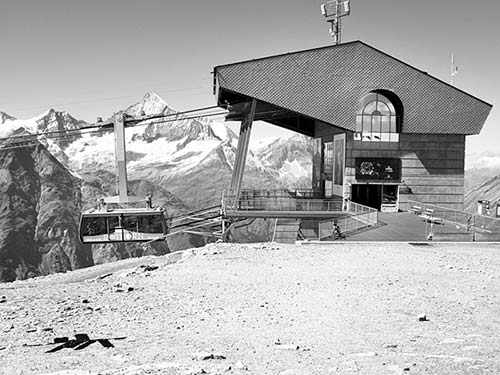
The view from Rothorn is fantastic, but it’s not that much better than what you see from Blauherd—if you don’t have a Peak Pass, you might want to skip the summit and save your time and money for the lower stations.
Lift Stages: The lift system up to Rothorn has three parts: a frequent funicular up to Sunnegga (3-6/hour, 8 minutes), a five-minute gondola ride to Blauherd, and, finally, a cable car to Rothorn (at least 3/hour). If you catch all the connections, you get to the top in about 30 minutes.
Cost: A peak-season (July-Aug) ticket between Zermatt and the Rothorn costs 74 CHF round-trip (49 CHF one-way); Zermatt to Blauherd is 53 CHF round-trip (33 CHF one-way), and Zermatt to Sunnegga is 26 CHF round-trip (18 CHF one-way). All full-fare tickets are about 10 percent cheaper in spring and fall, and half-price with the Swiss Travel Pass. If going in the afternoon, ask about discounts.
Tip: If you intend to tackle the Naturweg hike but don’t have a Peak Pass, you’ll save money by getting the Naturweg combo-ticket in advance to cover your one-way rides between Zermatt and Sunnegga, and between Riffelalp and Zermatt (43 CHF; half-price with Swiss Travel Pass).
Hours: Daily lifts to the summit operate seasonally: The lower-elevation Sunnegga funicular operates late May-late Oct; the middle lift (Sunnegga-Blauherd) stops running in early Oct; and the top lift (Blauherd-Rothorn) runs July-early Oct. From July to mid-Sept, the lifts start running at 8:00, with the last ride to the summit from Blauherd at 16:40, and the last ride down between 16:50 (from Rothorn) and 18:00 (from Sunnegga). Lifts operate on shorter schedules outside those months. Everything is open again for skiers in winter but closes entirely in the shoulder season.
Information: For detailed schedules and pricing, go to www.matterhornparadise.ch.
Getting There: The base station for the Sunnegga-Rothorn funicular is across the river from the Zermatt train station, just downstream from the Gornergrat train tracks—about a five-minute walk from the heart of town.
▲▲Rothorn Summit (10,180 feet)
Atop the Rothorn, there’s less to do than at some of the other lift summits, but it’s peaceful being immersed in the scenery of the entire Matterhorn massif.
Facing the Matterhorn and looking just to the left, in the foreground you’ll see Gornergrat—look for the stations of the cogwheel train marking the route to the top. (The hiking trail called Naturweg connects Blauherd—just below you—with the Riffelalp station on that parallel ridge—see later.) Far below you’ll see the Grünsee, a lake with a restaurant (more easily hikeable from Sunnegga than from here). Higher up, the pointy peak marks the Klein Matterhorn summit; you can see the lift stations connecting its Glacier Paradise station to the valley below. And finally, over your left shoulder, check out the giant Findel glacier. The gravelly area behind the restaurant offers better views of this glacier and serves as the launching point for paragliders stepping into thin air. Also up top is a fancy $$$$ pizzeria, and some spots where you can picnic on the rocks.
▲▲▲Easy Hike from Blauherd to Stellisee (1 hour)
Probably the best hike on this mountainside is the mostly level walk from the Blauherd station (8,435 feet) to the scenic mountain lake called Stellisee. If you’re looking for an “easy” hike in this vertical region, this is about the best you’ll do. While the lake itself is modest, it provides a dramatic foreground for Matterhorn photos. The hike to Stellisee, around it, and back again takes less than an hour; you can extend the walk by continuing gradually uphill to the restaurant at Fluhalp, then back again (adds about 20 minutes each way).
From the Blauherd station (with WCs and a small lounge with exhibits on local ecology), head for the giant heart-shaped photo-op cutout on a nearby ridge. From here, turn 180 degrees and follow the path along the ridge under the cables for the Hublot-Express lift (marked for 5-Seenweg and Murmelweg). Just beyond, the path forks; either route gets you there, but the upper one is more interesting and scenic.
After about 15 minutes, you reach the lake called Stellisee. It’s pretty in its own right, but on calm days it becomes a reflecting pool for the Matterhorn—walk around to the far end to take in the view. On a nice day, the lakeside boulders make for a picturesque picnic spot.
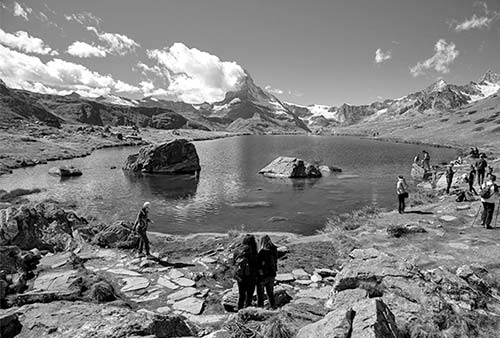
From here, you could head back the way you came to Blauherd. The return is an utter delight, with head-on Matterhorn views the entire way. (Returning along this upper path, it’s easy to get diverted to the gravel road just below, which also leads back to the lift station.)
Or, if you’re up for more of a hike, continue to the restaurant hut at Fluhalp—the path climbs gently but steadily from here.
Hikes from Blauherd to Sunnegga
Murmelweg (40 minutes): This 1,000-foot descent along the Murmelweg (“Marmot Path”) to Sunnegga is a disappointment—just steep enough so you can’t enjoy the view, and with no guarantee you’ll see the elusive rodents.
5-Seenweg (2.5 hours): Of more interest to hardy hikers is the moderately strenuous, up-and-down 5-Seenweg (“Five Lakes Path”; #11 on local maps). The trail zigzags across the Findelbach valley as it connects five alpine lakes: Stellisee (described earlier), Grindjisee, Grünsee (with the appealing Berghaus Grünsee restaurant), Moosjisee, and Leisee. The 5-Seenweg covers much of the same ground as the Naturweg hike described later, but in reverse (overall downhill, rather than up from Sunnegga), and looping between Blauherd and Sunnegga rather than continuing all the way across to Riffelalp on the Gornergrat side.
▲▲▲Sunnegga Viewpoint (7,506 feet)
This stop, just uphill from Zermatt at the end of the in-mountain funicular (just an eight-minute ride), is the cheapest of all the lifts from Zermatt, but it’s quite possibly the best spot anywhere to enjoy the classic Matterhorn view. (It’s also the starting point for several great hikes, described next.)
From the Sunnegga lift station, you can go through the tunnel (following the Wolli sheep signs) to take a free mini-lift down to a lakeside picnic-and-play area with nice views. Or you can eat at the self-service $$$ buffet. The outdoor terrace is ideal for a hot drink with just about the best view you can get.
▲▲Hikes from Sunnegga
Gourmetweg Hike (Sunnegga-Zermatt, 2.5 hours): This popular hike is mostly gentle, taking you through deserted villages, among larch forests, and past several restaurants. If you follow the official #6 path via the hamlet of Ried, it takes about 2.5 hours. You can cut the walk shorter by following signs off the route to steeper paths back to Zermatt.
The first part, leading through several sleepy hamlets, has fantastic Matterhorn views but is confusingly signed. Near the start of the hike, a fork points left (signed Paradies), but either path will take you to the same spot farther down the Gourmetweg trail. A little farther along (with the village of Findeln below you), a sign shows the Gourmetweg going downhill on a low road and also on a higher path—take the low road.
Not long after Findeln, with the ravine on your left, there are two spots where you can cut the walk short and hike steeply down into town via the Winkelmatten neighborhood (about 50 minutes to reach central Zermatt). If you continue on the Gourmetweg toward Ried, be warned that the trail turns into a relatively tedious forest walk, albeit over soft, fragrant pine needles. You have one last chance at a more direct route (via Tiefmatten) into town but after that, resist the urge to follow downhill paths off the main trail—some of these seeming shortcuts are knee killers, and ultimately won’t save time.
Naturweg Hike (Sunnegga-Riffelalp, 2 hours): With enough up and down to get your heart pumping, the #19 Naturweg trail connects Sunnegga with Riffelalp. From the cute lake called Leisee, just under the Sunnegga station, go crosswise via the unremarkable Moosjisee, then up-up-up toward Grünsee. The path doesn’t lead to the lake itself (though it’s just a short detour off the trail), but rather to the pleasant Berghaus Grünsee restaurant and mountain refuge—perfectly placed for a well-earned break. From the refuge you’re rewarded with an extra-scenic final stretch through forests and on to Riffelalp.
From Riffelalp you can either take the Gornergrat train back to town, or follow one of two good, relatively easy trails all the way into Zermatt (1.5 hours via the Arvenweg, hike #14, or 2 hours via the poorly signed Riffelalpweg, hike #20).
Note that the Naturweg trail overlaps substantially with the 5-Seenweg (hike #11, described earlier) that connects Sunnegga with Blauherd. If you’d like much of the same scenery, but without switching over to the Gornergrat side of the valley (and a different mountain-lift zone), consider that hike instead.
OTHER MOUNTAIN ACTIVITIES
Paragliding
Tandem paragliding down the mountainside is an expensive but unforgettable experience. You pick the altitude of your takeoff point and land back in Zermatt (about 170 CHF from Blauherd or Riffelberg, 220 CHF from Gornergrat or Rothorn; contact Air Taxi Paragliding, +41 27 967 6744, http://airtaxi-zermatt.ch; or FlyZermatt, +41 27 967 2100, www.flyzermatt.com).
Mountain Biking
The hills above Zermatt are laced with great mountain-bike paths, ranging from moderate to difficult. Bikers can buy day passes or single-ride tickets for riding lifts and transporting bikes. For more information on trails and passes, or to connect with local guides, visit the TI and pick up the helpful bike map. Detailed info on individualized bike tours is available for free on the TI’s website (www.zermatt.ch/en/bike).
Summer Skiing
Zermatt’s high elevation and variety of runs—and, in winter, the chance to actually ski or snowboard from Switzerland to Italy—make this a popular skiing destination. Summer skiing is usually an option at Matterhorn Glacier Paradise (see listing, earlier, for lift times). A one-day summer lift ticket will run you about 95 CHF; for specifics, see www.matterhornparadise.ch. However, due to extreme temperatures caused by global climate change, 2022 was the first year in recent memory when summer skiing was impossible; it remains to be seen whether this was a fluke...or if the days of summer skiing at the Matterhorn are numbered.
For equipment rental in town, see “Helpful Hints,” earlier. For more tips, see the Switzerland in Winter chapter.
Sleeping in Zermatt
Little Zermatt has more than a hundred hotels. This is a resort town, plain and simple, where building after building is for guests (many who rent by the week). You’ll pay less at most places early and late in the season (June and Oct), and more during ski season (Dec-late March/early April). Most hotels close in the off-season (early spring and late fall) and many listed below don’t have a night reception. Let your hotel know if you plan to arrive after 19:00. For hotel locations, see the “Zermatt” map, earlier.
Town Center
$$$ Hotel Romantica, a flower-dappled, four-story chalet located one scenic (and steep) block up from the main street, offers 13 cozy, traditional alpine rooms with balconies. It’s lovingly run and decorated by the Cremonini family—Thor and Michele—who make you feel at home and provide all the modern conveniences. They also rent two tiny alpine cottages (family room, some minimum-stay requirements, elevator, closed May and Nov, Chrum 21, +41 27 966 2650, www.romantica-zermatt.ch, info@romantica-zermatt.ch).
$$ Schaller’s Tannenhof Hotel is ideally located near the main drag, tucked away in tranquil back streets. Its 16 rooms are slick and modern, and its restaurant, in a sunken atrium, surrounds an old cogwheel train car (includes breakfast, elevator, Englischer Viertel 3, +41 27 966 2690, www.tannenhofzermatt.ch, info@tannenhofzermatt.ch).
$ Hotel Le Mazot has nine cozy-if-basic budget rooms with spacious bathrooms, in a quiet location next to the river. The four rooms with stunning Matterhorn-view balconies make this a good value (some shared baths, closed May and Oct, Hofmattstrasse 23, +41 27 966 0606, www.mazot-zermatt.ch, info@mazot-zermatt.ch).
¢-$ Hotel Bahnhof is a respectable budget hotel and hostel in a remodeled building with four floors (but no elevator) across the street from the train station. There are 17 tidy, alpine-style rooms (those without bath have Matterhorn-view balconies) and three dorm rooms. The basement features a relaxing lounge, a dining room, and a large guests’ kitchen. It’s well-run, but management is offsite at night—so if the younger crowd comes back late after partying, you’re on your own (family rooms, no breakfast, nice showers, closed May and Oct-Nov, Bahnhofplatz 54, +41 27 967 2406, www.hotelbahnhofzermatt.com, welcome@hotelbahnhofzermatt.com, Lauber family).
Across the River
These places are only slightly farther from the train station—still walkable, but more comfortable by e-car. Ask your hotel if they can provide a transfer (either free, or for a fee), or consider a taxi at the station. On foot, follow Bahnhofstrasse all the way up to the Catholic church and take a left onto Kirchstrasse. Cross the river and walk up Kirchstrasse one more block to the intersection with Steinmattstrasse. All of these places are within a few minutes’ walk from here.
$$$ Hotel Aristella Swissflair, filling a modern chalet-style building, has 28 welcoming rooms (some with Matterhorn views), a staff that works hard to provide extra touches, and an especially nice spa/sauna/wellness center (Steinmattweg 7, +41 27 967 2041, www.aristella-zermatt.ch, info@aristella-zermatt.ch, Perren-Tenisch family).
$$$ Hotel Bellerive feels more stylish and hip, with 25 rooms, a nice lounge, an inviting terrace, and a spa right in the heart of a bustling hotel-and-restaurant zone (elevator, Riedstrasse 3, +41 21 966 7474, www.bellerive-zermatt.ch, info@bellerive-zermatt.ch, Noti family).
$$ Hotel Jägerhof has 48 homey rooms and seven apartments with a mix of rustic charm and modern comfort. The lounge and restaurant—complete with mounted deer heads—are cozy, and there’s a fine winter garden and cute little private fondue chalet. The rooms with balconies are worth the extra cost. They’ll pick you up at the train station for no extra fee—use the designated phone at the station (family rooms, elevator, fitness room, Steinmattstrasse 85, +41 27 966 3800, www.jaegerhofzermatt.ch, info@jaegerhofzermatt.ch, Perren family).
$ Hotel Dufour Zermatt, a block higher up from the others, fills a classic chalet that feels like old Zermatt. It has 17 rooms in the original, woody building, plus six more in a newer annex. Rooms are traditional, but with a few modern touches. The winter garden is a fine place to relax (Riedstrasse 35, +41 27 966 2400, www.dufourzermatt.ch, info@dufourzermatt.ch).
¢-$ Zermatt Youth Hostel looks over town from a perch high above the river and offers views of the Matterhorn. The super-modern hostel offers dorm beds and private rooms, most with bathrooms—travelers of all ages will feel comfortable here (no curfew, reception open 7:00-10:00 & 16:00-21:00, Staldenweg 5, +41 27 967 2320, www.youthhostel.ch/zermatt, zermatt@youthhostel.ch). From the station, take the red-line bus marked Winkelmatten to the Luchre stop; the hostel is 50 yards uphill from there (follow signs with international hostel symbol).
Eating in Zermatt
Zermatt’s restaurants are very expensive. But affordable takeout-type places aren’t too hard to find, and you can easily assemble a picnic at one of the town’s bakeries or supermarkets.
$$$ Whymper-Stube, named for the first brave soul to conquer the Matterhorn, specializes in raclette and fondue (traditional cheese, as well as meat—which they call “Chinese-style”). It’s also a rare place that lets you order a single portion of cheese fondue, rather than for the entire table. This cozy space with a friendly staff attracts mainly tourists, but local regulars warm six barstools in the corner. On evenings in peak season, reservations are smart (kitchen open daily 11:00-21:00 except no lunch service in winter, closed May and mid-Oct-mid-Nov, Bahnhofstrasse 80, in the cellar of the Monte Rosa Hotel, across from the huge Grand Hotel Zermatterhof, +41 27 967 2296, www.whymper-stube.ch).
$$$$ Brasserie Uno is the best of Zermatt’s many high-cuisine restaurants. Rising-star chef Luís Romo prioritizes locally sourced ingredients and respects Valais cuisine, but injects his Mexican heritage and other international influences. The result: delicious, thoughtfully prepared meals that balance creativity and tradition. The ambience is casual and inviting, with attentive yet easygoing service. Reservations are essential (Tue-Sat seatings 19:00-19:45, closed Sun-Mon, Kirchstrasse 38, +41 79 851 1768, www.brasserieuno.com).
$$ Grampi’s, tucked upstairs a few steps off the main drag, is a bustling restaurant serving Italian specialties. Try a pizza baked in their wood-fired oven or a healthy salad (daily 18:00-24:00, Bahnhofstrasse 70, +41 27 967 7775).
$$$ Restaurant Avena, in the heart of the hotel zone just across the river, has a cozy, country-cutesy interior and a big, covered and heated terrace with some Matterhorn-view tables. The menu is an eclectic mix of traditional Swiss and modern international dishes; they enjoy cooking local game, and the “surprise fixed-price menu” is a hit for adventurous big eaters (Wed-Mon 16:00-24:00, closed Tue, Steinmattstrasse 53, +41 27 967 8333).
$$ Zermatt Kitchen, facing the river right at the old bridge, feels like it could be a trendy big-city café...but the Matterhorn is right out the front door. There’s limited indoor seating, tables outside facing the river, and an appealing menu of coffee, cakes, brunch, and lunch dishes (Thu-Mon 9:00-19:00, may also be open for dinner on weekends, closed Tue-Wed, Uferweg 1, +41 766 414 644).
$ Stefanie’s Crêperie is understandably popular—sometimes marked with a long line. This little walk-up window in a cellar along Bahnhofstrasse cranks out fresh sweet and savory crêpes that make for a light meal or dessert (no seating, Sun-Fri 13:00-19:00, Sat until 20:00, Bahnhofstrasse 60).
$$ Stadel, although right along the main street, can easily be overlooked—it’s unpretentious and nondescript. But this small restaurant with indoor/outdoor seating dishes up homemade Swiss specialties with a smile and at fair prices (daily 12:00-22:00, closed Nov, Bahnhofstrasse 45, +41 27 967 3536).
Bakery: $-$$ Fuchs is a bakery with outposts all over town. They have good pastries and decent sandwiches. Some locations are takeout-only, while the branch along the Gornergrat tracks, just a short walk from the train station, has a little outdoor terrace and table service (daily 7:00-18:30, Getwingstrasse 24).
Kebabs: $ Take It Döner is tucked away just uphill from the Catholic church (daily 11:00-21:00, Oberdorfstrasse 24, cash only).
Supermarkets: A large Co-op is in the little mall across from the train station, and Migros is across from the tennis courts on Hofmattstrasse. The small Spar Express, along the river at the corner of Kirchstrasse and Schluhmattstrasse, is convenient if you’re staying at the upper end of town. All are open daily about 8:00-19:00.
Pre- or After-Dinner Drinks: There are only a few parts of town dishing up after-dinner action. Hexen Bar caters to a crowd looking for something a bit more traditional. Elsie’s Wine and Champagne Bar oozes with character; the extensive list of wine and cocktails can be enjoyed inside or out, with views of the Catholic church and Grand Hotel Zermatterhof.
Zermatt Connections
Zermatt is at the end of the Nikolaital valley, which is reached on the narrow-gauge Matterhorn Gotthard Railway (MGB, www.mgbahn.ch). This scenic ride—which follows rivers and waterfalls along the lip of a canyon—is described on here of the Scenic Rail Journeys chapter. Swiss Rail info: www.sbb.ch.
By Train: All these trains from Zermatt transfer in Visp. Some have multiple transfers. Trains from Zermatt go to: Bern (1-2/hour, 2 hours), Zürich (1-2/hour, 3.5 hours), Montreux (1-3/hour, 2.5 hours), Lausanne (2/hour, 3 hours), Interlaken Ost (1-2/hour, 2.5 hours, 2 transfers), Luzern (hourly, 3 hours, 2 transfers).
By Glacier Express to Eastern Switzerland: This scenic train departs Zermatt (at least once daily through most of the year, more in summer) and arcs scenically on high-altitude tracks over the middle of Switzerland to the east. All of these Glacier Express trains go through Chur (6 hours), then continue either to Davos or St. Moritz (8 hours total to either). For details, see the Scenic Rail Journeys chapter.