SWITZERLAND IN WINTER
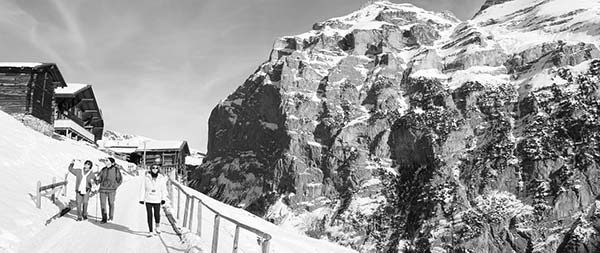
One of my favorite Swiss memories happened one winter night on the snowy slopes of the Berner Oberland. My friend Walter (who ran the old Hotel Mittaghorn in Gimmelwald) and I, warmed by hot chocolate laced with schnapps, decided to go sledding between mountain-high villages. We strapped flashlights to our heads, miner-style, and zoomed through the crisp, moonlit night.
That said, this is a summertime book. I’ve included plenty of tips on hiking, while mostly ignoring the winter-sports scene. But winter activities are an important part of the Swiss culture (and tourist industry).
Just a century ago, clever entrepreneurs in the Swiss Alps realized that skiing (which began as a method of wintertime transportation in Scandinavia 4,000 years ago) could be a profitable extension of their resorts’ spring and summer seasons. Telemark (cross-country) skiing came first, then alpine (downhill) skiing, and, more recently, snowboarding. Generations of Swiss skiers have honed their skills on these slopes. Big names include Erika Hess, Vreni Schneider, Wendy Holdener, Carlo Janka, and the venerable 1948 Olympic champion Karl Molitor.
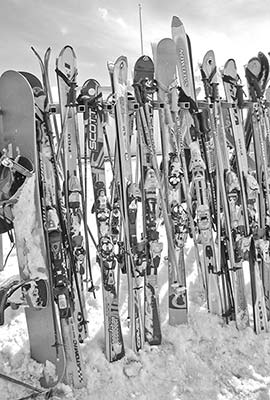
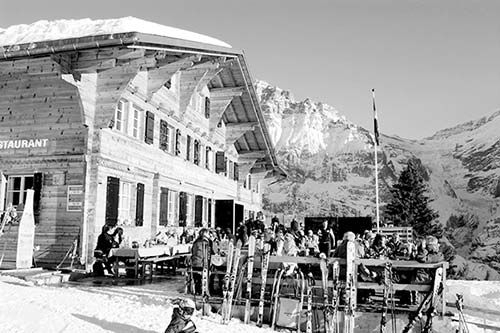
You don’t have to be a skier or snowboarder to enjoy Switzerland in the winter. Ski resorts offer plenty of other activities, including snowshoeing, sledding, ice skating...and shopping. Or just ride up a lift, rent a chair in the sun, and warm up with a glass of Pflümli (plum liqueur).
TOP WINTER DESTINATIONS
The winter-sports season begins in early December and runs through Easter. Peak time hits at Christmas and New Year’s—during this period, hotel prices in resort towns surpass summer highs.
While Switzerland’s resorts vary greatly, they share a rich ski culture, an astounding variety of terrain, relatively mild temperatures (compared to many American destinations), and a lively après-ski scene. For those who can afford them, the best winter activities are in the Berner Oberland (Mürren, Wengen, Grindelwald, and Gstaad); the southern canton of Valais (Zermatt, Saas-Fee, Crans-Montana, and Verbier); and the eastern canton of Graubünden (St. Moritz, Davos, Klosters, and Arosa).
The Berner Oberland offers the ultimate diversity of terrain and character, as well as great sledding and stellar views (see the Berner Oberland chapter). The cliff-hanging town of Mürren is relatively uncrowded and a good home base for expert skiers, with the 10,000-foot Schilthorn peak as the backbone of its ski area. Across the valley, Wengen offers skiing for all skill levels, fine accommodations, and shopping, with a complex lift system connecting it to Kleine Scheidegg, Männlichen, and Grindelwald. Grindelwald, a little closer to Interlaken, is a bit pricier but has the world’s longest sled run and easy access to more than 100 miles of downhill trails, including the area’s best range of beginners’ runs. For more on these ski regions, see the Jungfrau Region tourism website (www.jungfrauregion.swiss).
The canton of Valais is known for its excellent winemaking (in the Rhône River valley) as well as its ski slopes (www.valais.ch). Connected to Italy by several high-mountain passes, Valais is home to Switzerland’s best-known sight: the Matterhorn (see the Zermatt & the Matterhorn chapter). The area around the Matterhorn, including the villages of Zermatt and Saas-Fee, enjoys high elevation and good skiing.
The canton of Graubünden (www.graubuenden.ch) is home to St. Moritz, a resort town so well known that it’s a registered trademark (see the Upper Engadine chapter). St. Moritz offers designer boutiques, luxury accommodations, a natural mineral-spring spa...oh, and ski slopes, too (www.stmoritz.ch). In addition to skiing, winter visitors to St. Moritz play polo and cricket on snow, go bobsledding on natural ice, or try “skijoring”—skiing while being pulled by riderless horses.
TIPS FOR WINTER SPORTS
Expect to spend 70-90 CHF a day on lift tickets. You may find cheaper prices in the off-peak season (before mid-Dec and after Easter), if you buy a multiday pass, or if you have a Swiss Travel Pass. Prices may also be lower for seniors, teenagers, and kids (exact age cutoffs vary). Most ski areas offer half-day afternoon passes.
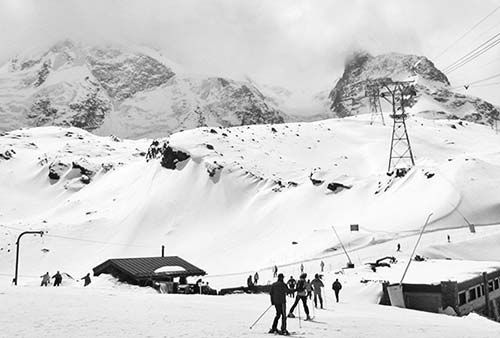
Rental prices are a bit higher than what you’d find in the US. Depending on the fanciness of the gear, you’ll pay 50-80 CHF per day for skiing or snowboarding equipment. If you haven’t packed ski wear, you’ll pay about 50 CHF per day to rent ski pants, a jacket, and gloves.
Many rental shops in Switzerland belong to the Intersport rental network (www.intersportrent.ch), which sets fairly high standards for its member shops. Places outside this network can be cheaper, but Intersport shops are generally a safe bet and offer useful bonuses: You can reserve gear online at a discount, and many network shops let you pick up rental gear at one ski area and drop it off at another in the region for no charge (an especially handy option in the Berner Oberland).
Always ask your hotelier if they’ve arranged any special rental deals through local shops. Rental prices don’t vary much (since so many shops are part of the Intersport network), so choose a place that’s close to your hotel or convenient for getting up the mountain.
Swiss ski resorts are deservedly popular, and slopes can get crowded. Peak crowd times are Christmas, New Year’s, mid-February to mid-March (when European school holidays hit), and Easter. The Berner Oberland also fills up in mid-January for world-class racing. Hit the slopes as soon as they open—the hordes don’t usually arrive until 10:00 or later. This is especially true in swankier resorts, where well-heeled tourists enjoy long nights and short ski days.
For more in-depth information on the winter scene, see the winter sports section of the Swiss tourism website (www.myswitzerland.com).
CHRISTMAS CELEBRATIONS
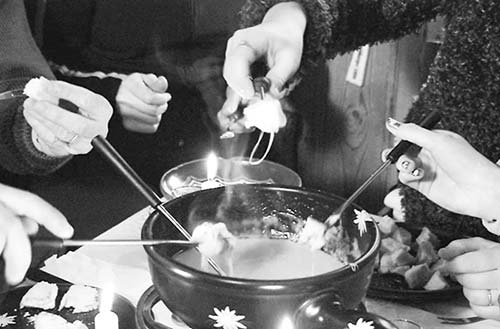
Switzerland is an ideal place to celebrate the winter holidays. Imagine spending your days exploring Christmas markets in cozy Swiss cities, sipping hot mulled wine (Glühwein), picking out your favorite handmade ornaments, then relaxing at night in a warm little chalet, making figure-eights with your cube of bread through a steaming pot of cheese fondue.
Swiss Christmas markets are a treat, whether in big cities (such as Bern, Zürich, and Basel) or smaller towns (Interlaken, Appenzell, Chur, and many others). While some of the bigger markets start at the beginning of December and run through Christmas Eve, smaller towns host markets for just one week or weekend. Check the Swiss Tourist Board’s website for dates (www.myswitzerland.com/experiences/winter/christmas).
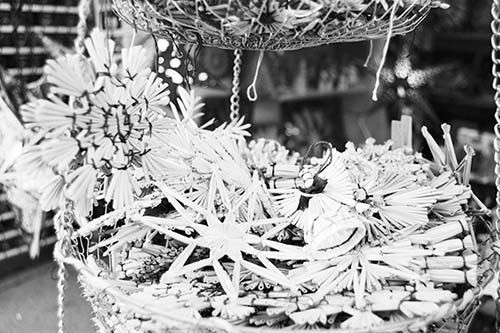
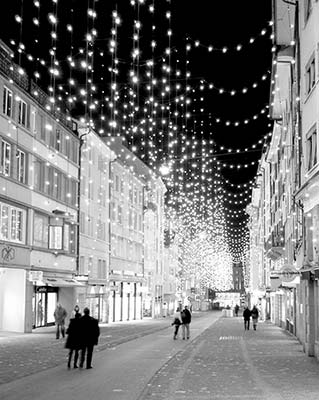
You’ll find all cities festively decorated, but Zürich’s remarkable display of tasteful, twinkling lights is arguably Switzerland’s best. This being the land of Calvin—the most austere of Protestant Reformers—most Christmas decorations are relatively understated here, but they’re still charming.
In the village of Gimmelwald, residents in each home decorate a window for Advent. Just as children open a different little paper window each day on an Advent calendar, Gimmelwald residents reveal a new decorated window on a different house each day.
The debut of a new Advent window often comes with a party. Under a cold sky, with stars reflecting off the snow and the moon inside a halo, the village gathers. In a kind of roving block party, neighbors emerge to meet friends and enjoy grilled sausages, hot mulled wine, and folk music on the accordion. Men take sections of logs (the size of a four-foot chunk of telephone pole), cut the ends into a point, and plant them upright in the snow. Coated with tar, they’re set ablaze—torches to light and warm the cozy yet frigid occasion. In the distance, children ride old-time wooden sleds, going up and down, up and down.
For the Swiss, a communal pot of fondue is purely a winter specialty. Invitations to a cozy Swiss party include the Swiss-German word FIGUGEGL (fee-GOO-geck-ul), which stands for Fondue isch guet und git e gueti Luune—“Fondue is good and gives a good mood.” According to tradition, if you drop your bread into the pot, you must kiss the person to your left.
Each Christmas season, usually on St. Nicholas Day (December 6), Swiss children receive a visit from Samichlaus—that’s Swiss German for St. Nicholas. With his black-clad, soot-faced henchman, Schmutzli, by his side, Samichlaus goes door to door, visiting the town’s children. He knocks on the door, and when the frightened-but-excited kids answer, Samichlaus consults his big book of sins—co-authored by parents—and does some lighthearted moralizing. Schmutzli stands by as a menacing enforcer, traditionally holding either a stick or switch for beating bad children, and a sack for carrying them away to be eaten (nowadays he eats only the really bad children).
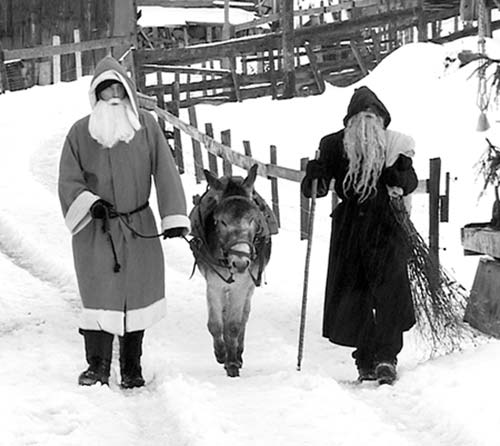
Then Samichlaus asks the kids to earn a little forgiveness by reciting a poem. After the poems and assurances of reform, Samichlaus allows them to reach deep into his bag for a smattering of tangerines, nuts, gingerbread, and other treats. (Schmutzli—whose name means “the little dirty one”—usually smears his face with ashes, rather than the problematic, full-on blackface worn by his Dutch counterpart, Zwarte Piet.)
Cutting and decorating the Christmas tree—traditionally on December 24—is a family affair. Real candles, kept upright by dangling ornamental counterbalances, are attached, then lit by the children. (Locals are bold with their candles; to me, it feels as if their pine houses, with open beams, are ready to go up in flames.) Presents are opened while the candles burn. The tree stays up after Christmas; candles are lit again on New Year’s Eve for good luck. Some traditional rural Swiss churches also light candles on their trees for Christmas Eve services.
OTHER FESTIVITIES
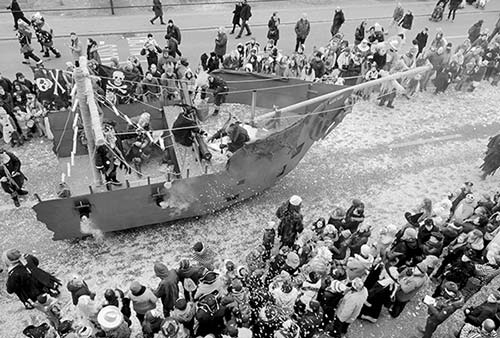
Second only to Christmas is Fasnacht, the Germanic equivalent of Mardi Gras or Carnival. Traditionally celebrated in the days before or after Ash Wednesday, Fasnacht festivities often include a parade with floats and locals in traditional masks and garish, larger-than-life costumes. Quirky traditions vary from town to town (for example, in Basel—home to Switzerland’s most outlandish Fasnacht—celebrations begin promptly at 4:00 in the morning and feature roving fife-and-drum bands). This pre-Christian ceremony likely dates from a pagan tradition to frighten away evil winter spirits and welcome the renewal of springtime. The most famous Fasnacht celebrations in Switzerland occur in Basel (www.fasnacht.ch), Bern (www.fasnacht.be), and Luzern (www.luzerner-fasnacht.ch). If you’ll be in Switzerland at this time of year, it’s worth the effort to catch one of these weird and wonderful celebrations.