UPPER ENGADINE
Pontresina • Samedan • St. Moritz
Sights and Activities in Pontresina
Sights and Activities in St. Moritz
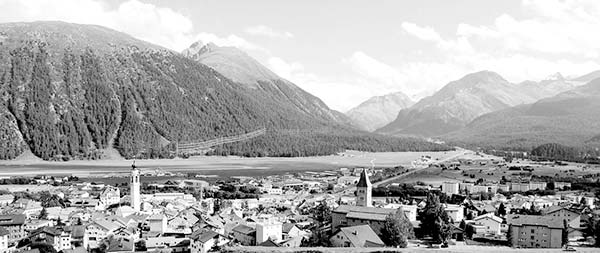
Pontresina, Samedan, and St. Moritz are a trio of towns that anchor the Upper Engadine region—tucked away in an intriguing and picturesque fringe of Switzerland. Here you can ride a vintage funicular to a scenic hike along a mountain ridge, explore the unique townscapes of a remote mountain valley, gaze on a local virtuoso’s paintings that capture the region’s grandeur, and catch enticing snippets of the rarely heard Romansh language.
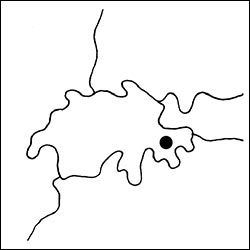
Nestled in the southeast corner of the country, the time-passed Upper Engadine (Engiadin Ota in Romansh, Oberengadin in German) is arguably less thrilling—and certainly more difficult to reach—than the mountain resorts of the Berner Oberland and Zermatt. But that’s precisely its charm: This region, wedged in the Alps between Italy and Austria, offers rough-around-the-edges mountain culture that feels far from Germanic influence, and closer to the Latin roots that run deep beneath this part of Switzerland. It’s also a more rugged landscape—less groomed by humanity, with more wildlife than you’ll see elsewhere in Switzerland (the area is home to the largest colony of ibex in the Alps). And for train travelers riding the scenic Bernina Express or Glacier Express, or drivers keen to experience the country’s most exciting roads, this area is an easy stopover.
Celtic people inhabited this region centuries before Christ, and the hillsides are still terraced, recalling the hard work that came with farming up here in ancient times. Like French and Spanish, the Romansh language evolved from the Latin that arrived with Roman soldiers and settlers, who moved here as Rome expanded. Town names date back to various invaders. For instance, “Pontresina” comes from “Bridge of the Saracens.”
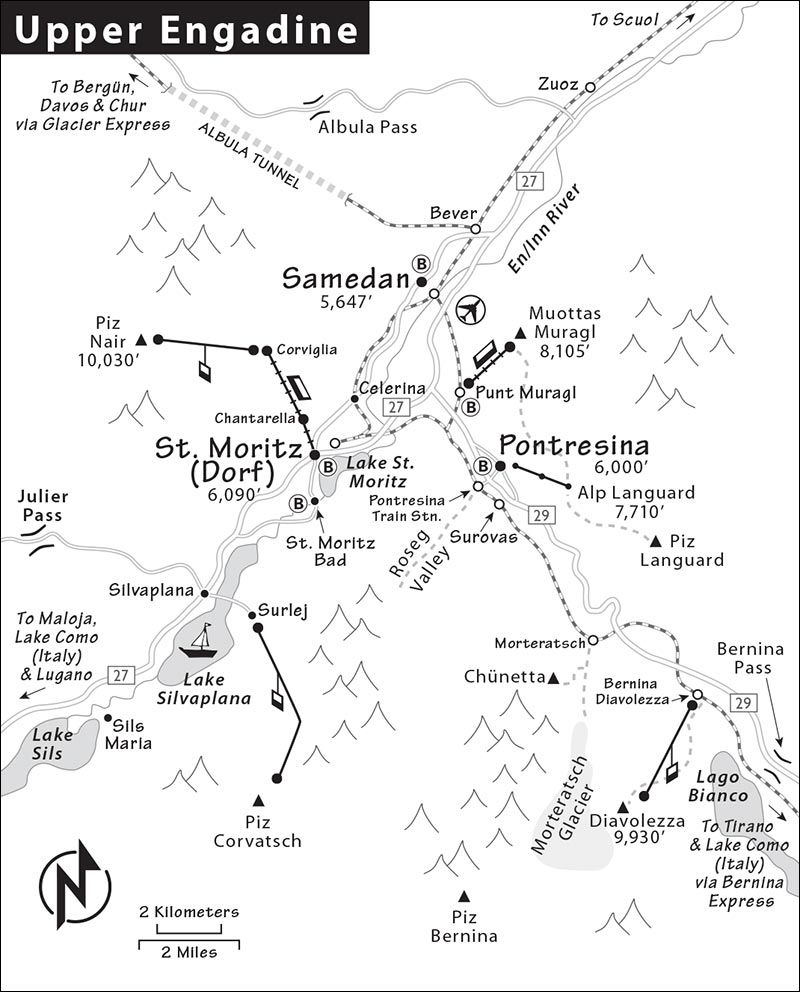
Two valleys meet in the Upper Engadine, carving out a picturesque region dominated by three very different towns that form a convenient little triangle, each about 10 minutes apart by train or bus. The most famous—but perhaps least visit-worthy—is the ritzy ski resort of St. Moritz. To settle into the region, I prefer Pontresina, a lower-key resort town where high-mountain activities are valued more than high society. Pontresina’s relatively reasonable prices and proximity to my favorite hike make it an ideal base for the region. Humble Samedan, with its cobbled lanes and lovingly painted facades, is worth a lazy walk to learn about traditional Engadine architecture, but offers little else besides pure village relaxation.
The towns are fine, but the mountains (accessed by easy lifts) are the big draw: Piz Nair over St. Moritz offers a bird’s-eye overview of the Upper Engadine; Muottas Muragl features stately valley views and the chance to hike along a super-scenic ridge; and Alp Languard, over Pontresina, is accessed by a fun, breezy chairlift (and is the endpoint of that glorious hike).
If you can ignore the jet set comparing tans in St. Moritz, the Upper Engadine feels like a place where normal Swiss people go to find some high-altitude fun. And with the Engadin guest card—which covers all area lifts and transit and is free at most hotels if you stay at least two nights—it’s extremely affordable, too.
PLANNING YOUR TIME
Compared with the other high-mountain areas I recommend in this book (especially the Lauterbrunnen Valley and Zermatt), the Upper Engadine is pretty ho-hum. On a one- or even a two-week trip around Switzerland, it’s probably not worth going out of your way to spend time here...unless you’re seeking to get well off the beaten path.
But for those linking two of Switzerland’s top scenic rail journeys—the Glacier Express and the Bernina Express—the Upper Engadine is a logical overnight stop (and far more appealing than Chur). With just one night, you’ll get only a fleeting glimpse of the Upper Engadine’s charms (maybe you’ll have time to ascend the Muottas Muragl funicular for sunset). Consider spending a second night here, hope for nice weather, and use that time for riding lifts, hiking, and town-hopping. The chance to experience Switzerland’s overlooked Romansh corner is a cultural bonus.
Lingering in the Upper Engadine may also work well for drivers: The valley lies right at the end of the stunning Julier Pass, a high-alpine wonderland of waterfalls and green ridges (take routes via Tiefencastel).
The Upper Engadine in One Full Day: If staying two nights, with one full (good-weather) day, I’d rise early to do the Muottas Muragl panoramic hike to Alp Languard (above Pontresina) in the morning, then head over to St. Moritz for a joyride up to Piz Nair. In the afternoon, consider visiting the Segantini Museum in St. Moritz and detouring to Samedan for a quick town stroll. If it’s still nice out, maybe head back up to Muottas Muragl to watch the sunset. (If the weather’s bad, hit the Bellavita spa in Pontresina.)
With More Time: With two full days, spread these activities out. Do the Muottas Muragl hike one day, maybe combined with the Morteratsch Glacier trail near Pontresina (especially if it’s cloudy). On day two, hike around on Piz Nair, tour the Segantini Museum or walk around St. Moritz’s lake, and take a leisurely wander in Samedan.
Seasonal Closures: Like other mountain resort areas, this region has two distinct tourist seasons: summer (June-mid-Oct) and winter (Dec-March). In spring and fall many places are closed and the area can feel dead.
GETTING AROUND THE UPPER ENGADINE
Pontresina, Samedan, St. Moritz, and Punt Muragl (the base of the funicular to Muottas Muragl) are all less than 10 minutes apart and well connected by bus (about 2/hour, 5.60 CHF per trip, 11.20 CHF for 24-hour ticket). You can also take the train between towns (runs about hourly, same price), but the more frequent buses take you up into each village center and save you time and the walk up from the train station down below. Bus rides within a town (such as between St. Moritz Bad and St. Moritz Dorf) cost 3 CHF. All local transport is covered by the Engadin guest card and Swiss Travel Pass.
You can pick up the bus schedule (Fahrplan/Urari) at a TI, but the Switzerland-wide SBB Mobile transport app works great here: Just punch in where you’re heading and it will list your upcoming options by both bus and train. Bus info: +41 81 837 9595, www.engadinbus.ch.
When checking bus schedules, pay close attention to which stop you’re using. For example, Pontresina Bahnhof is at the bottom of town, while Pontresina Post is up in the town center, near my recommended hotels and restaurants. St. Moritz’s most useful stops are Schulhausplatz (town center, near the Piz Nair funicular station) and Bahnhof (train station). The Samedan Chesa Planta and Samedan Central stops—a few blocks apart in the town center—are more central than Samedan Bahnhof.
Even if you have a car, when you consider the cost of parking, the value of the Engadin guest card, and the frequency of buses and trains, it makes little sense to drive between towns.
HELPFUL HINTS
Altitude Alert: Even the valley floor here is at a high elevation (more than 6,000 feet), and you might feel dizzy and tired, especially on your first day. Top athletes from all over the world come here for altitude training.
Hiking Tips: Hikers should have appropriate gear, including solid shoes, sun protection, a windbreaker, a hat, plenty of water, and maybe hiking poles (for more hiking tips, see the sidebar on here). Even in summer, chilling winds blow down from the snow-capped mountains, and it can get cold—especially on chairlifts. Trails are marked according to their difficulty. Yellow signs indicate easy hikes and walks. White-and-red signs signal more demanding hikes, where real hiking boots are in order. Blue signs are for alpine routes that require serious gear (these trails can be treacherous and include rock climbing and glacier crossings).
Keep in mind that in the Alps, some flowers are protected; pick one, and you may be fined. Some meadows are also protected for haymaking. Signs ask you to stick to the trails, as trampled grass is hard to cut.
Winter Activities: If you want to ski some of the most famous slopes in the world, head for Corviglia, the largest ski area in the region. It offers varied terrain, mostly intermediate runs, and good snowboarding (convenient from St. Moritz, or a bus ride from Pontresina). Other areas to consider are Corvatsch-Furtschellas (great views) and Diavolezza-Lagalb (smaller, less crowded, great for nonskiers who want views). Both cater mainly to intermediate and expert skiers. See www.engadin.ch/en/bergbahnen for more information and to buy lift tickets in advance. The area also has more than 100 miles of cross-country skiing trails, great sledding, Nordic walking, and spectator sports such as polo in the snow (horses and all). Ask at any TI for information; for more tips, see the Switzerland in Winter chapter.
Essential Brochures: Any TI can give you the local bus schedule (Fahrplan/Urari) and a panoramic foldout map showing the lifts and hiking trails.
Pontresina
A popular winter and summer mountain resort with about 2,000 residents, Pontresina (“Puntraschinga” in Romansh) makes a good Upper Engadine home base. At 6,000 feet above sea level on a wind-protected terrace overlooking the Bernina Valley, Pontresina faces southwest and enjoys plenty of sunshine. Popular trails through its larch forests offer spectacular views of the 13,000-foot Piz Bernina peak and the immense Morteratsch Glacier.
Pontresina’s first tourists, mostly German and British, arrived in the 1850s. For a while, it was a summer-only destination. But by the early 1900s, the Muottas Muragl railway was inaugurated, the first grand hotels were built, and tourists began showing up in winter, too.
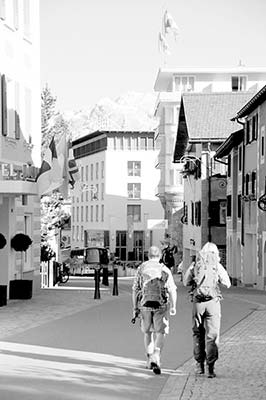
The town feels a bit sterile and resorty, with not quite enough local charm or character. (For more rusticity, wander the steep streets up toward the town church on the hillside. This area has more of a neighborhood feel, with some traditional Engadine architecture.) But Pontresina offers more activities and services than Samedan, without being as glitzy as St. Moritz. This makes it the best compromise home base in this region.
Orientation to Pontresina
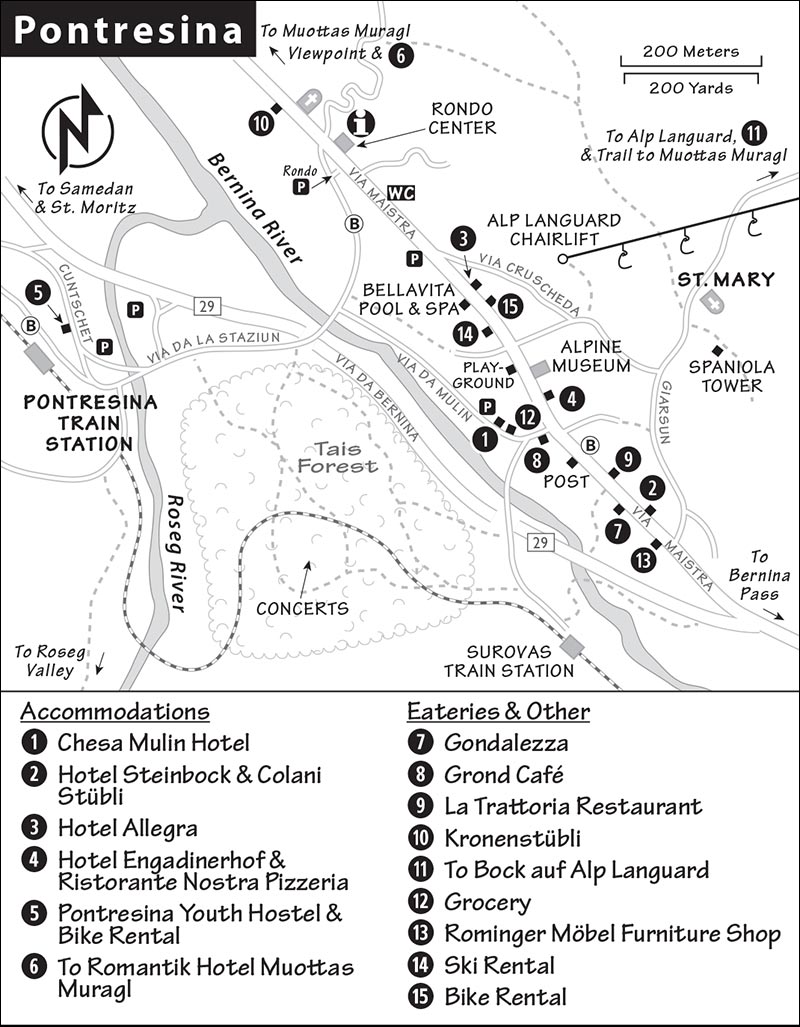
Pontresina sits on a ledge overlooking the confluence of two mountain streams, which then flow together across the valley to join the Inn River as it heads north to Innsbruck. Virtually everything of interest is along Via Maistra (may-strah)—Romansh for “Main Street.” My recommended hotels are at the top end of Via Maistra, and the TI is near the bottom end. The train station sits in the valley floor a 10-to-15-minute walk below.
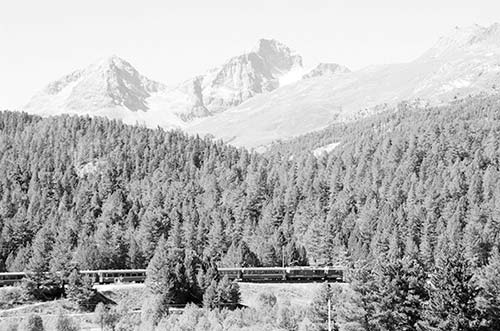
Tourist Information: The TI is in the heart of town in the big, round, landmark Rondo Culture and Congress Center, right on Via Maistra. The staff is happy to suggest hikes and mountain lifts (Mon-Sat 8:30-18:00, closed Sat 12:00-15:00 for lunch, Sun 16:00-18:00, shorter hours and closed Sun off-season, +41 81 838 8300, www.pontresina.ch).
ARRIVAL IN PONTRESINA
The train station lies at the foot of the town and has lockers and a ticket office. You can walk about 15 minutes steeply uphill to the town center, following the white signs to Pontresina. Or take bus #1 or #2 to Pontresina Post, near my recommended hotels (2-3/hour, buy ticket at counter inside train station or on bus, free with Swiss Travel Pass). To get straight to the TI, get off at Pontresina Rondo or Pontresina Punt Ota Sur. Walking the 10 (easier) minutes from Pontresina back down Via da Mulin to the train station offers dramatic gorge views.
All my recommended hotels (except the hostel) offer free or discounted parking, but drivers who aren’t spending the night should head for one of the hourly pay garages: either near the uphill end of Via da Mulin or near the TI, at the Rondo Center.
HELPFUL HINTS
Music: Free summer classical music concerts are offered in the Tais Forest across the river, and (on rainy days) in the Rondo Center or in the church next door (daily at 11:00, mid-June-mid-Sept, confirm and get details at TI).
Ski Rental: Try Gruber Sport (at Via Maistra 190, across from Hotel Schweizerhof, +41 81 842 6236, www.gruber-sport.ch).
Shopping: Furniture and housewares store Rominger Möbel has an upstairs showroom that’s like a modern Engadine home show: Walking among hand-carved beds, tables, and dressers—all made from the fragrant Swiss pine unique to this region—gives you a sense of good living high in this remote corner of Switzerland. You can find good souvenirs here (Mon-Fri 9:15-12:00 & 14:00-18:30, Sat until 17:00, closed Sun, Via Maistra 246, at the top end of town 5 minutes past Pontresina Post bus stop, +41 81 842 6263, www.rominger.ch).
Sights and Activities in Pontresina
Church of St. Mary (Begräbniskirche Sta. Maria)
▲▲Muottas Muragl Viewpoint (8,105 feet)
▲▲▲Muottas Muragl Panoramic Hike
▲▲Alp Languard Viewpoint (7,710 feet)
CHURCHES AND MUSEUMS
▲Church of St. Mary (Begräbniskirche Sta. Maria)
Above town, just beyond the five-sided, 13th-century Spaniola Tower, stands this remarkable little church. Inside, the wooden ceiling is entirely original. Faded 13th-century, Byzantine-inspired frescoes survive on the west wall (to the left as you enter). The other walls and ceiling were richly decorated by an Italian workshop (1497). The frescoes depict the legend of Mary Magdalene and (above) the story of Lazarus’ resurrection. Imagine this church five centuries ago, packed with illiterate villagers who worshipped by following along with the pictures.
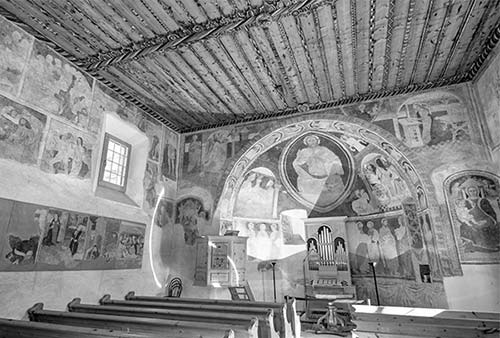
Cost and Hours: Free entry, but limited hours: in summer generally open Mon-Fri 15:30-17:30, closed Sat-Sun; in shoulder season open only Mon, Wed, and Fri; closed off-season. For information, contact the Pontresina TI.
Hiking Back to Town: For a quick (10-minute) hike, walk down from the church a different way: Follow the yellow sign for Las Blais, which takes you along the hillside under the chairlift. Signs along the way share interesting facts on ibex, which you may see from here if you look up the mountain. Eventually, head down to the left following the Puntraschigna-Laret sign; you’ll come back into town near the TI.
Alpine Museum (Museum Alpin)
This little museum, founded by the local mountain guides association, is worth a quick visit. The exhibits fill three floors of an old Engadine town house. Be sure to pick up the brief English descriptions when you enter, then explore.
Cost and Hours: 8 CHF, covered by Swiss Travel Pass; Mon-Sat 15:30-18:00, closed Sun and off-season; Via Maistra 199, +41 81 838 8349, www.pontresina.ch/museumalpin.
Visiting the Museum: The ground floor has replicas of traditional rooms (bedroom, kitchen, living room) as well as good temporary exhibits. The small basement features hunting (with antique rifles and stuffed animals) and alpine wildlife.
The heart of the collection is upstairs, covering the development of alpine climbing and skiing, the regional mining industry (with plenty of mineral samples), and traditional costumes. You’ll find a relief map of the entire valley, and models and replica interiors of mountain huts. Look for the chunk of 10,000-year-old wood, which was pulled out of a glacier. One room is devoted to birds: About 130 of the 250 bird species found in the Upper Engadine are shown here. Listen to the recorded songs of 60 different birds on the primitive aviary jukebox. In the room with the mineral samples, you can choose from four mellow slideshow themes (mountains, flowers, butterflies, and a changing theme)—the mountain slides will make you feel like a wimp.
LIFTS AND HIKES
Pontresina is a hiker’s paradise. The town boasts one of Switzerland’s largest mountaineering schools and has a good reputation for adventure sports. Shops lining Via Maistra rent and sell all kinds of sports gear. The TI will help you find the right hike. Their great, free foldout Wandern map is marked with hiking trails and lists details about each one; QR codes link to websites with more information. (Most hikers agree that the Muottas Muragl-Alp Languard panoramic route is tops.) For a fee, you can hire an English-speaking mountaineer through the TI.
▲▲Muottas Muragl Viewpoint (8,105 feet)
The impressive alpine perch of Muottas Muragl (pronounced MWOH-tas moo-RAY) isn’t as high as other spots mentioned in this chapter (Piz Nair, Diavolezza), but it’s my favorite for its spectacular views over Pontresina, Samedan, and far away to the valleys and lakes beyond St. Moritz. To reach the viewpoint, ride the cute 1907 funicular from the Punt Muragl valley station about 10 minutes to the summit. At the top of the funicular, you can rent a deck chair, have a meal, do an easygoing loop hike, or start a hike over to Alp Languard (described later). And since the funicular runs until late in the evening, Muottas Muragl is the perfect place to watch the sunset (the funicular is discounted after 18:00). A pricey-but-good $$$ restaurant on the terrace is open late daily and a fine spot to sip a sunset aperitivo.
Cost and Hours: Catch the funicular from the Punt Muragl valley station: 28 CHF one-way, 39 CHF round-trip, 15 CHF after 18:00, covered by Engadin guest card; runs early June-mid-Oct 2/hour 8:00-23:00, typically departs at :15 and :45 past each hour; round-trip ticket lets you return on this funicular or on the Alp Languard lift described later; also runs late Dec-March; +41 81 842 8232, www.muottasmuragl.ch.
Getting There: To reach the valley station from Pontresina, take bus #1 (in either direction—the bus stops at Punt Muragl both on the way into and out of town) or #2 (direction: Maloja). You can also catch the train between Pontresina and Samedan and get off at Punt Muragl (by request only—press the green button, or the train won’t stop). You can park here for free—but if you’re hiking to Alp Languard, it makes more sense to take the train or bus, as the hike ends back at Pontresina.
▲▲▲Muottas Muragl Panoramic Hike
This fantastic hike over to Alp Languard, directly above Pontresina, comes with grand views the entire way and a gradual descent of about 400 feet (follow the Panoramaweg trail, #10). Midway, at Unterer Schafberg, there’s a great soup or coffee-and-cakes stop (ask for the WC key for a fun alpine memory). Keep your eyes open for ibex, bighorn stags, and marmots. It’s about four hours round-trip from Pontresina, including three hours of easy to moderately strenuous hiking. Leave Pontresina by 13:30 if you want to reach Alp Languard in time to catch the chairlift down to Pontresina (otherwise, you just bought yourself 45 minutes more of hiking).
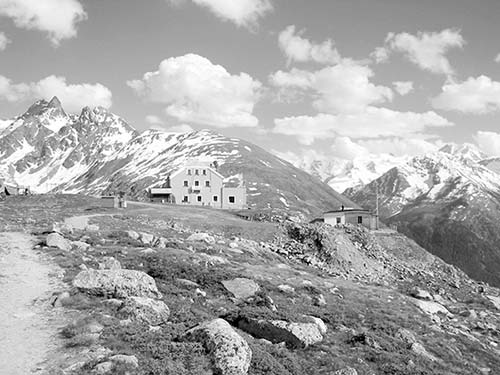
For extra credit, consider the more challenging upper route that climbs the mountainside above the main route via the Chamanna Segantini hut (trail #20, adds about an hour to the hike).
▲▲Alp Languard Viewpoint (7,710 feet)
Pontresina has its own scenic, charming, and easy-to-reach mountaintop lift station, accessed by a fun 15-minute chairlift ride from the town center. If you’d like to enjoy an affordable Upper Engadine viewpoint with grand views for minimal effort, plus a tempting restaurant...this is the place.
Cost and Hours: 18.50 CHF one-way; 26.50 CHF round-trip—or, if coming from Muottas Muragl, use the return part of the round-trip ticket you bought there; covered by Engadin guest card, runs continuously early June-late Oct 8:30-17:30, +41 81 842 6255.
Getting There: To find the chairlift station, go up the ramp across from the Bellavita pool, between the Allegra and Schweizerhof hotels.
Visiting Alp Languard: The trip itself is a joy, as you float silently for about 15 minutes high above the treetops. Up top, the view is outstanding as you look out over St. Moritz (with Piz Nair overhead) and the village of Celerina, across the valley. From here, you can head out on a loop hike, bask in a lounge chair, unwind after your hike from Muottas Muragl, let the kids loose in the play area, and enjoy an affordable lunch with unbeatable views at the $$ Bock auf Alp Languard chalet (early June-mid-Oct daily 9:00-17:00, +41 79 719 7810).
If you’d like to hike down (or if you make it here too late to catch the chairlift), the descent takes about 45 minutes. Where the path splits, take the left fork (the “Röntgenweg”) for an easier descent on a zigzag path through the trees.
▲▲Bernina Railway Joyriding
If you enjoy scenic rail journeys but aren’t up for the full Bernina Express train-plus-bus trip to Lugano, there’s good news: The best, most scenic part of the Bernina Express is the one-to-two-hour stretch from Pontresina to the Bernina Pass or beyond to Poschiavo. You can take any regional train, or pay extra for a panoramic Bernina Express seat. The train trip is covered by a Swiss Travel Pass (panoramic seat reservations cost extra); the Engadin guest card covers you as far as the viewpoint at Alp Grüm, so if going beyond that, you’ll need to buy a separate ticket.
From Pontresina, trains leave at least hourly heading south, toward Tirano. Along the way, you’ll enjoy dramatic scenery as you head up and over the Bernina Pass—the highest rail crossing in Europe, accomplished with a twisting track so that it can be done with a standard (non-cogwheel) locomotive. Designated Bernina Express trains (marked PE on schedules) run about five times daily and make fewer stops; regional trains (marked R) stop at more points of interest. Two of the activities listed next—Morteratsch Glacier and the Diavolezza cable car—are on this train line. Other intriguing stops, farther along the same line, include Ospizio Bernina (at the summit, with the dramatic Lago Bianco); Alp Grüm (with views over the Palü Glacier); the charming, tidy, and fun-to-explore small town of Poschiavo; Brusio, for a closer look at the Bernina Railway’s famous circular viaduct; and the end of the line, the Italian town of Tirano. The most scenic and efficient half-day plan may be to simply ride the train about two hours to Poschiavo, stroll the town, maybe grab lunch, then ride back the way you came.
For complete descriptions of all these options, see the Bernina Express section of the Scenic Rail Journeys chapter.
Morteratsch Glacier Walk
A popular, inexpensive excursion from Pontresina is by train to Morteratsch, partway up the Bernina Pass. From Morteratsch, an easy trail leads up-valley for 50 minutes to the tongue of the Morteratsch Glacier, with signposts marking the glacier’s reach in past decades. It’s also a pleasant walk on a cloudy day. The whole round-trip from Pontresina is about two hours by train.
Following the glacial stream gently uphill, you first pass a field of dramatically lumpy glacier-hewn rocks. Farther along, you get the sense you’re hiking on the bottom of a drained swimming pool—it’s amazing (and alarming) to see, high up on the hillsides, the obvious former extent of the glacier (it hit the upper line in 1850). At the top of the trail, you’re eye-to-eye with the snout of the glacier. Keep in mind that much of what looks like rock here is actually dirty ice. To extend the hike, you can scramble over the rock field past the end of the official path for a more up-close look, but be careful—the ground is very unstable beyond the groomed path.
Back at the trailhead, you can eat at the restaurant near the train stop, and also visit a traditional cheesemaker (mid-June-early Oct only, +41 81 842 6273, www.alp-schaukaeserei.ch).
Getting There: The train drops you off right at the foot of the trail (hourly, 8 minutes from Pontresina). From the highway, drivers should follow signs for Morteratsch to the large parking lot at the end of the road (pay at machine). Walk from the lot toward the white Morteratsch Hotel, and then past it (with the hotel on the right) to the trailhead.
Diavolezza Peak (9,930 feet)
The 15-minute cable-car ride up to the peak called Diavolezza—the “she-devil”—takes you over an otherworldly green landscape of babbling brooks, then past stark rock and ice to a ridgetop station. There you’ll find a restaurant and terrace with expansive views of the top of the Morteratsch Glacier. To turn this into a hiking excursion, return to the valley on foot (2 hours on a moderately difficult trail via Lake Diavolezza, or 3.5 hours on an easier trail past Lake Collinas).
Getting There: To reach the lift station from Pontresina, either take the train 10 minutes beyond Morteratsch to the Bernina Diavolezza stop or drive 12 minutes toward the Bernina Pass (free parking). The cable car is covered by the Engadin guest card (otherwise 31 CHF one-way, 44 CHF round-trip, 3/hour, daily 8:30-17:00, +41 81 838 7373, www.diavolezza.ch).
Roseg Valley Stroll
You can hike two easy hours up the Roseg Valley, directly opposite Pontresina (look for the trailhead behind the Pontresina train station), and marvel at its glacier (from a distance). Consider taking the fun horse-drawn omnibus back to Pontresina—or take the omnibus up and hike back (reservations required, mid-June-late Oct departures at fixed hours, 25 CHF one-way, 37 CHF round-trip, +41 78 944 7555, www.engadin-kutschen.ch). You can also rent a private carriage (several coachmen offer this—try the Costa family, +41 81 842 6057, www.stalla-engiadina.ch, office@stalla-engiadina.ch).
OTHER ACTIVITIES
▲Bellavita Pool and Spa
This delightful pool is an ideal place to relax in any weather. The fun complex includes a big indoor lap pool, an enclosed 250-foot-long spiral waterslide, an outdoor pool that stays at 93 degrees Fahrenheit year-round, and an indoor water playground for kids. There’s also a spa (nudity required) with a series of saunas, steam baths, and more. (The spa is usually mixed-gender and adults-only, but it’s women-only Mon 13:00-17:00 and Thu after 17:00; kids ages 6-15 allowed with parents Sat-Sun 12:00-16:00.) Taken together, this is an ideal place to wind down after a long day hiking (or on a train)—it’s affordable and open fairly late.
Cost and Hours: Pool only—11 CHF, pool and spa—26.50 CHF; pool open Mon-Fri 10:00-22:00, Sat-Sun until 21:00, spa open similar hours; in the middle of town at Via Maistra 178, +41 81 837 0037, www.pontresina-bellavita.ch. You can rent a swimsuit for a few francs, or buy one in the shop.
Biking
Several sports stores rent bicycles, e-bikes, in-line skates, tennis rackets, and other gear. Riding the train to the Bernina Pass and biking nine miles back into town is just one of many fun biking options. In the town center, Fähndrich Sport rents good mountain bikes and e-bikes (Via Maistra 169, +41 81 842 7155, www.faehndrich-sport.ch). Across the street from the train station, in the lower level of the big youth hostel building, Bikezentrum Pontresina rents a huge selection of bikes (+41 81 544 6550, www.pontresina-sports.ch).
Sleeping in Pontresina
These hotels are all within steps of Pontresina Post, the town’s most convenient bus stop. All of these hotels, including the hostel, offer the Engadin guest card free to guests staying at least two nights (see the “Free Transport and Lifts for Hotel Guests” sidebar, earlier).
$$ Chesa Mulin Hotel, below the main street, has 30 modern, bright, and comfortable rooms, most with nature themes. This functional, well-designed place attracts serious hikers who want a good night’s sleep more than luxury digs. The inviting sitting area with open fireplace and library makes bad weather tolerable, and the breakfast buffet is a delight. The friendly Isepponi-Schmid family takes good care of their guests (discounts sometimes available in shoulder season for guests over age 60, elevator, sauna, sundeck, free access to Bellavita pool and spa with 2-night stay, limited free parking, Via da Mulin 15, +41 81 838 8200, www.chesa-mulin.ch, info@chesa-mulin.ch).
$$ Hotel Steinbock, situated in an old Engadine house, blends a respect for tradition with modern comfort and conveniences. Its 32 smallish rooms are woody and traditional, but the excellent restaurant, charmingly decorated lounges, access to an indoor pool at the big hotel next door, and other touches give it real class (Via Maistra 219, +41 81 839 3626, www.hotelsteinbock.ch, info@hotelsteinbock.ch).
$$ Hotel Allegra feels a bit more modern, snazzy, and hotelesque than others I recommend, with 54 businesslike rooms located in the heart of town (elevator, Via Maistra 171, +41 81 838 9900, www.allegrahotel.ch, info@allegrahotel.ch).
$ Hotel Engadinerhof, while less cozy, can be a good value. The hotel preserves a pre-WWII ambience, and its 88 rooms gather around a sprawling and classic Old World lounge. The three-night minimum is waived when business is slow. Cheaper sink-only “budget” rooms are clean and have well-preserved furniture from the 1930s. “Standard” rooms are similarly old-fashioned but add antique bathrooms, and “comfort” rooms are modern (family deals, elevator, free pickup from train station if staying at least 3 nights, pay parking, Via Maistra 203, +41 81 839 3100, www.engadinerhof.com, info@engadinerhof.com).
¢ Pontresina Youth Hostel, across the street from the train station, rents 120 beds (24-hour access, though check-in times are limited; includes sheets and lockers, discount at Bellavita spa, dinner available, pay laundry service, game and TV room, limited pay parking, closed early April-early June and late-Oct-early Dec, Via da la Staziun 46, +41 81 842 7223, www.youthhostel.ch/pontresina, pontresina@youthhostel.ch).
High in the Mountains: Perched on a ledge above town, $$$ Romantik Hotel Muottas Muragl offers a secluded overnight high in the Alps. Its 16 elegant-rustic rooms are furnished in local Swiss pinewood. When the funicular takes the last tourist down, things become as peaceful as the Alps can be (cheaper for 3 or more nights, price includes funicular ticket, open mid-June-mid-Oct and mid-Dec-March only, free parking at base of funicular, +41 81 842 8232, www.muottasmuragl.ch, info@muottasmuragl.ch).
Eating in Pontresina
Virtually all restaurants in Pontresina are part of a hotel, apart from a few bakeries that serve reasonably priced meals. Except for the Grond Café, all the restaurants listed below are closed off-season, generally from early April to early June and again from mid-October to mid-December. The Muottas Muragl and Alp Languard viewpoints (both described earlier) also have good eating options (though Alp Languard’s closes before dinnertime).
$$$ Colani Stübli, a cozy yet elegant eatery, is an inviting place to relax over a meal of beautifully presented local fare, with an emphasis on meat and fish. This is a great spot for traditional, hearty Upper Engadine specialties—such as Krautpizokel and Capuns—executed at a high level. They have a variety of dining areas, ranging from time-warp to modern elegance (daily 12:00-14:00 & 18:00-21:00, at Hotel Steinbock, Via Maistra 219, +41 81 839 3626).
$$ Ristorante Nostra Pizzeria serves wood-fired pizzas as well as some local dishes in two pleasantly low-key rooms on the ground floor of Hotel Engadinerhof (pastas, meat dishes, fondue for two, daily 11:00-14:00 & 18:00-22:00, Via Maistra 203, +41 81 839 3333).
$$ Gondolezza is a fun spot when the weather’s good. Huddled around a namesake, antique gondola cabin on a grassy lawn, it has cozy seating inside the gondola plus sprawling outdoor tables and chairs, with plenty of cushy seating to nurse a drink or have a meal with a grand view across the valley. They serve pricey fondue and raclette dishes and more affordable light meals, plus snacks and cocktails (hours are weather dependent, generally Wed-Mon 15:30-22:00, closed Tue; at the far end of town—just beyond the Pontresina Post bus stop—in front of the grand Hotel Walther; +41 81 839 36 96).
$ Grond Café is a bakery with great desserts, plus sandwiches and takeaway lunches (daily 7:00-18:30, Via da Mulin 29, +41 81 838 8030).
$$ Pontresina Youth Hostel, by the train station, welcomes nonguests for its hearty, affordable, four-course self-serve dinner (includes soup, salad, main course with vegetarian option, dessert, and tap water; daily 18:00-19:30, reservations appreciated, Via da la Staziun 46, +41 81 842 7223, www.youthhostel.ch/pontresina). They also serve breakfast year-round and a three-course lunch in winter.
Elegant Five-Star Hotel Dining Rooms: Pontresina’s two top hotels have wonderful restaurants in sumptuous dining rooms. $$$ La Trattoria, in the fanciful faux-castle Hotel Walther at the top end of town, serves inventive, well-executed Italian cuisine (hours variable, but typically daily 18:30-20:00 in summer, off-season closed Sun-Mon, Via Maistra 215, +41 81 839 3636). $$$$ Kronenstübli is in the Grand Hotel Kronenhof, which dominates the bottom end of town and has public rooms fit for a Viennese palace. It’s less accommodating to anyone concerned about price, but if you’ve got francs to burn, its multicourse fixed-price meal is a memorable splurge (Tue-Sat 19:00-21:30, closed Sun-Mon, Via Maistra, +41 81 830 3030, www.kronenhof.com).
Supermarket: Picnickers seek out the Co-op grocery, just below Via Maistra on Via da Mulin (Mon-Fri 8:00-19:00, Sat-Sun until 18:00).
Samedan
Tiny Samedan (sah-MAY-den, population 3,000) is the prettiest—and sleepiest—town of the three described in this chapter. The historic capital of the valley, it’s stuffed with traditional Engadine architecture, and Romansh remains strong here. Though charming, Samedan is also humble, workaday, and even a bit rough around the edges. Aside from the grand Hotel Bernina, the town seems almost untouched by the era of belle époque tourism. It was primarily the region’s transportation hub back then, when horse-drawn carriages met arriving train passengers to cart them off to fancy hotels in St. Moritz and Pontresina—and today it still feels like the backwater cousin of its ritzy neighbors.
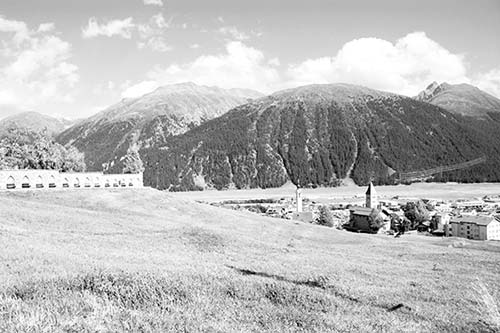
There’s not much to do here after an hour or two, but it’s worth popping over from Pontresina for a quick taste of untouched Engadine-village beauty.
Orientation to Samedan
Samedan is gently spread along the slope of a hill that rises from the Inn River. The train station is at the bottom of town; the town center clusters just above. The main street, called Plazzet, runs through the middle of town parallel to the river (it’s closed off on market day—Tue, June-early Oct). All the streets seem to converge at the main square (Plaz, in Romansh), with its tall Protestant church.
Tourist Information: Samedan’s TI is at Plazzet 3, by the Chesa Planta bus stop (Mon-Fri 8:30-12:00 & 15:00-18:00, Sat 15:00-17:00, closed Sun year-round and Sat off-season, +41 81 851 0060, www.engadin.ch/en/samedan).
Arrival in Samedan: Whether you come by bus or train, you’ll stop at the train station, which has lockers, ticket windows, and a free WC. Most buses do go up into the town itself after a short wait (ask the driver); if you stay on, you’ll want to get off in two stops, at Samedan Chesa Planta, then backtrack a short block to the main square. Or, from the train station, just hike up the hill: Go straight ahead out of the station, hook left around the Terminus Hotel, then take the next left up Via Mulin. You’ll walk through a small square, then pass the TI on your right, before emerging at the main square. Drivers who are here for just a quick visit can park free for one hour in the big garage just off the roundabout into town (past the Co-op and before the station). Pay parking is also available at the train station.
Sights in Samedan
Samedan Town Walk
Samedan offers few activities other than relaxing and enjoying the town. For a start, follow this pleasant, uphill, self-guided stroll with nice views. The route described here takes you steeply up through town (you’ll feel the altitude) to a perch overlooking Samedan’s magnificent setting, and offers a look at the local architecture.
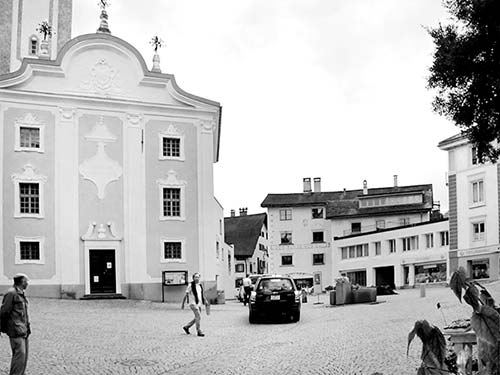
Begin at the main square (Plaz), where Samedan’s cobbled streets meet. A giant church tower soars overhead, and a functional fountain quietly gurgles in the middle of the square. At the corner of the church, notice the stone block marking distances to other places, including Pontresina and the Italian border (Grenze, in German). Notice that the town name is spelled Samaden—as it appeared when the town was first mentioned in writing, in 1130.
Just behind the church tower, the blocky, modern building with the colorful tiled window frames is Samedan’s “vertical spa,” with several levels of pools (more expensive and purely therapeutic than Pontresina’s spa, www.mineralbad-samedan.ch).
From the square, walk uphill on Surtuor (leaving the steeple behind you on the left) to the fork in the road, and take the lane on the left, following the white sign for Kath. Kirche. Continue straight up the hill for a block to find (tucked back on the right) a 13th-century, castle-like stone tower that belonged to a noble family. From its wooden balcony, they’d oversee festivities in their little domain. It’s now used for changing museum exhibits (www.latuor.ch).
Next door, the house at #12 dates from 1656. The extended roof beams form an X-shaped St. Andrew’s cross. This was a popular way to bless homes here. Notice the sturdy beam ends—roofs were built to support heavy stones and snow. Houses in the region are known by Romansh names: For example, you’ll see houses marked Chesa Juzi (Juzi’s House) and Chesa dals 3 Frers (House of the Three Brothers). A little farther up, across the street, look between Chesa Manzoni and Chesa Sleim to see a strikingly modern house that’s influenced by old local styles.
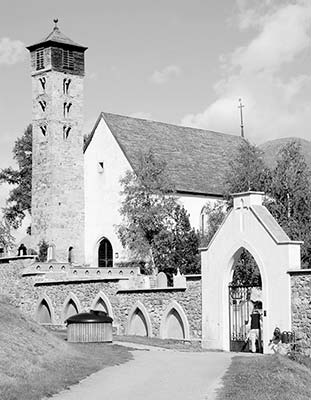
Continue uphill to the Catholic Church (Neo-Romanesque from 1910, with a bell dating back to 1505), at the top of the town. Looking uphill from here, survey the surrounding slopes and their ancient terracing, a vestige from Celtic peoples.
Now carry on uphill, passing the ski lift. Yes, you can do it. Where the road swings right, pause at the wooden bench for the gorgeous view. Samedan overlooks the point where the Inn River (coming from St. Moritz) is joined by the Flaz (coming from Pontresina and the Bernina Pass). From here, the Inn continues through Innsbruck in Austria before joining the Danube. The valley on your right leads to Pontresina (you can even see a few of its rooftops) and, beyond that, the Bernina Pass. The white building capping the hill directly ahead is the Muottas Muragl viewpoint with its hotel and restaurant.
Huff and puff the thin air (you’re at 6,000 feet) to the dramatically situated Protestant Church of St. Peter. The Romanesque bell tower (c. 1100) predates today’s late-Gothic church (c. 1480; now a burial church, generally closed to tourists). Benches line the cemetery walls and offer sunny, wind-protected picnic spots. To the right of the church stands a monument marked Gemeinschaftsgrab—a “community grave” honoring all members of this region who have passed on. The plaque lets you read some Romansh; if you speak German, there’s a handy translation. Now appreciate the view: Beneath you stretches the highest-altitude airport in Europe, a favorite place to fly gliders (launched by a yellow truck with a huge winch).
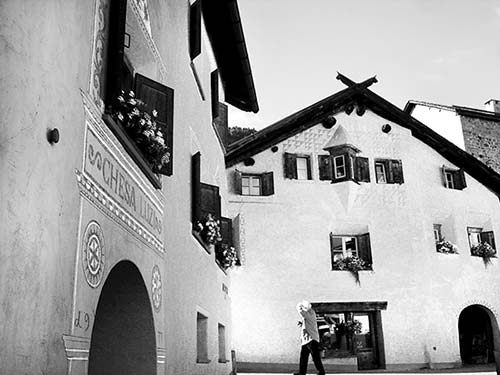
Samedan and Pontresina both have fine old Engadine houses. A short stroll in either town shows plenty of traditional elements and medieval ingenuity intended to keep inhabitants warm in the harsh mountain weather. Walls are thick—typically two feet—for insulation. Notice how windows are like the narrow end of a funnel; they were originally covered with animal skin rather than glass. Bay windows gathered maximum precious light and came with built-in seats where women sat to do handwork.
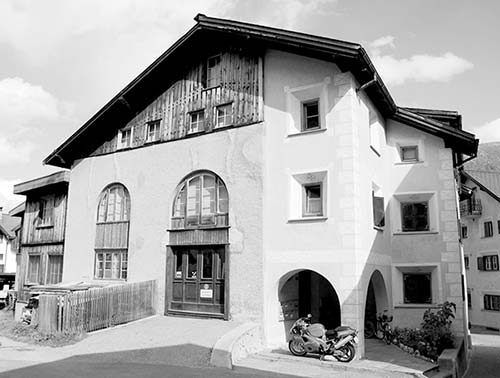
Even though they’re thoroughly modernized, the structural essence of these grand farmhouses survives. You can still see the big lower door for animals and the big upper door for hay and the carriage—with a smaller door built into it for people to get in and out while minimizing heat loss. People had the animals sleep below in the hope their rising body heat would warm the living space above. Proud noble-family coats of arms still decorate buildings; many local families can trace their heritage to the Middle Ages.
Look for the traditional Engadine sgraffito ornamentation on exterior walls. To make sgraffito, facades are covered with a layer of dark plaster, which is then covered with white or colored plaster. Before the white plaster dries, decorative designs are scratched into it, so that the dark background appears. These rustic and crude decorations—much more durable than painted facades—look modern, but have a long history.
When you’ve had your fill of this panorama, continue around the far side of the church, where the paved path leads quickly back down into town—steer for the tall steeple. (The first residential street you come to, on the right, says “dead end,” but a footpath lets you get through.)
Chesa Planta
This interesting old mansion, just a block from the main square, shows off upper-crust lifestyles of the 18th and 19th centuries. This former residence of the wealthy local Planta family is preserved just as it was when they lived here. It’s rarely open, but the fascinating interior makes it worth considering if you happen to be here at the right time. You’ll see some gorgeous wood-carved rooms, a beautifully painted dining room, original granite slab floors, and fancy ceramic stoves. Upstairs, the same building houses a Romansh library (biblioteca rumauntscha), where scholars collect Romansh literature. A copy of any new book published in the Romansh language is sent to this library.
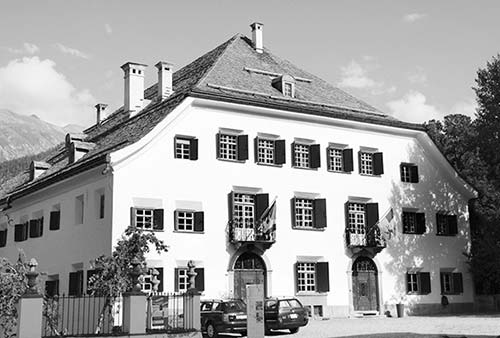
Cost and Hours: 15 CHF, covered by Swiss Travel Pass, 1.5-hour tour in German and usually also English runs Thu at 15:30 in early June-late Oct; may open other weekdays, at least partly for temporary exhibits—check; +41 81 852 1272, www.chesaplanta.ch.
St. Moritz
The oldest and perhaps best-known winter resort in the world, St. Moritz has long been the snowy haunt of Europe’s rich and famous. It’s said that in 1864, St. Moritz hotel pioneer Johannes Badrutt invented winter tourism in the Alps. To allay his British guests’ skepticism, he offered them free accommodations if the winter weather was bad. They came and enjoyed fine weather. He liquored them up, they had fun...and they brought their friends along the next year. St. Moritz added to its fame when it hosted the Winter Olympics in 1928 and 1948.
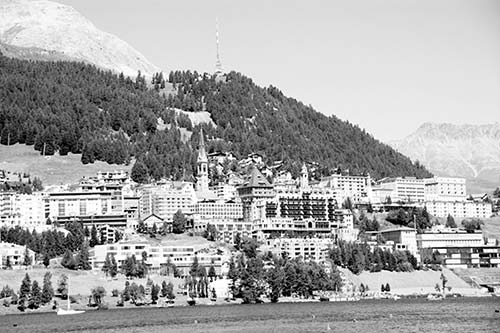
Although St. Moritz might have been a real town once, today it’s little more than a charmless cluster of luxury hotels and designer boutiques. (Think of it as the anti-Gimmelwald.) For the jet set, winter is prime time in St. Moritz, when celebrity-spotting and prices are at their peak. In summer, however, it’s pretty quiet and mostly attracts sporty Swiss vacationers of means who come for active recreation (in-line skating, polo, golf, paragliding, horseback riding, lake strolling, etc.).
For the rest of us, the town has little to offer—I don’t recommend overnighting here (though nightlife seekers will find it far livelier than surrounding towns). But in good weather, it’s worth a visit for the funicular-and-cable-car ride up to Piz Nair (free with Engadin guest card), a hike or bike on the mountainside above town, and a visit to the Segantini Museum.
Orientation to St. Moritz
The older section of St. Moritz (known as the “Dorf”) sits on a steep slope above the lake. The train station (Bahnhof) is next to the lake at the base of the hill. The main bus stop (Schulhausplatz) is at the top. From the center of town, the busy Via dal Bagn runs downhill to the modern suburb of St. Moritz Bad, which sprawls on a level plain at the far end of the lake. St. Moritz Bad has sports facilities (covered pool, tennis courts, ice-skating hall, horseback riding, and so on), a big Co-op supermarket, and a one-block shopping district (Via Salet), but it’s mostly a characterless concrete town. Aside from its proximity to the lake, St. Moritz Bad is pretty, well, bad.
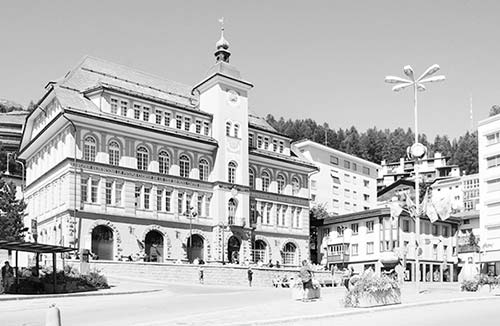
Tourist Information: The TI is along the main drag in the old center, a couple of short, meandering blocks below the central bus stop at Schulhausplatz (Mon-Sat 9:00-18:30, closed Sun, shorter hours off-season, Via Maistra 12, +41 81 837 3333, www.stmoritz.ch). There’s also a tiny branch TI next to the ticket office at the train station (similar hours, plus Sun 10:00-13:30 & 14:30-18:30).
ARRIVAL IN ST. MORITZ
The most straightforward approach from Pontresina is by bus, since it takes you directly to St. Moritz’s town center (Schulhausplatz stop, a short walk below the Piz Nair lift and above the TI).
St. Moritz’s train station is near the lake, just below the Dorf. The station has lockers, ticket windows, a baggage-storage desk, and a branch TI. To get into town, you can simply walk uphill for 15 minutes, but it’s more fun (and less work) to head up via the Serletta parking garage: Exit the station to the left (look for Zentrum/Dorf signs with an escalator icon) and cross the footbridge into the garage. Inside, find the art-lined escalator (Switzerland’s longest) that zips you up next to the Palace Hotel. Even ritzier, to enjoy your own private Swiss mountain lift for a couple of minutes, ride the angled elevator—which feels like a mini-funicular—that runs next to the escalators (enter underneath the first stage). From the top, it’s a relatively quick walk up to the center (head uphill and to the left). You can also take a bus from the station up to Schulhausplatz.
If arriving by car, you can pay to park at the Serletta garage near the train station (see above) or at the more central Quadrellas garage, right on Schulhausplatz. Street parking is a little cheaper.
HELPFUL HINTS
Bike Rental: Try Skiservice Corvatsch (Via Stredas 11, +41 81 838 77 88), or ask at the TI for tips.
Winter Activities: Ender Sport is one of many ski-rental shops (just uphill from TI at Via Maistra 26, +41 81 833 3536, www.endersport.com). For a thrilling splurge, you can take a ride—between a professional pilot and brakeman—on the mile-long Olympic bobsled course from St. Moritz to Celerina...in 75 seconds (270 CHF, open mid-Jan-early March, reserve ahead, www.olympia-bobrun.ch).
Posters: St. Moritz’s tourist board offers pre-WWII tourism posters for 5-10 CHF each. Buy one at the main TI or order online (https://shop.stmoritz.ch).
Sights and Activities in St. Moritz
ST. MORITZ DORF (TOWN CENTER)
While not without its charms, the old town center of St. Moritz feels rather sterile and soulless—surrounded by high-rise, high-price development.
The most natural entry point is the square called Schulhausplatz, named for the landmark schoolhouse, now a city library, that dominates it. Schulhausplatz is officially called “Plazza da Scoula” in Romansh (but you won’t hear much Romansh in German-speaking St. Moritz). Here you’ll find St. Moritz’s most central bus stop and parking garage, and a handy Co-op grocery (to the right of the library). The Piz Nair lift departs from just uphill, roughly behind the library (follow signs up the stepped lane around its left side).
On the downhill side of Schulhausplatz sprawls the tight and tidy historical center, with the TI more or less in its middle, on Plazza Mauritius. On the street in front of the TI sits Hanselmann, a venerable cafè/Bäckerei/Confiserie. Directly behind the TI is the Chesa Veglia, a house dating from 1658, offering a good look at rustic Engadine architecture (described on here; also houses a traditional restaurant). Just beyond is the Kulm Hotel—one of the city’s many grand hotels—and downhill (on Via Serletta) you’ll find the entrance to the escalator and elevator/mini-funicular leading all the way down to the lake. If you ride to the bottom, you’ll pop out at a view platform that extends over the calm turquoise waters.
Hemming in the bottom of the historical center (above the train station and lake) is Via Serlas, famed for its high-end shopping. This is dominated by Badrutt’s Palace, a grand hotel that opened in 1896 and has been hosting VIPs ever since (including Marlene Dietrich, Audrey Hepburn, Alfred Hitchcock, and John Lennon...though not all in the same room).
There’s only one real museum in the town center: the Berry Museum, dedicated not to delicious little fruits but to local painter Peter Robert Berry (1864-1942). While Berry enjoyed neither the talent nor the fame of Segantini, and the entry price is steep, this is a suitable rainy-day activity for art lovers (15 CHF, covered by Swiss Travel Pass; Mon-Fri 14:00-18:00, closed Sat-Sun; closed in shoulder season, open in winter; just below the center of the pedestrian zone at Via Arona 32, +41 81 833 3018, www.berrymuseum.com).
The two museums listed below—while a bit farther from the town center—are more worthwhile.
MUSEUMS JUST OUTSIDE CENTRAL ST. MORITZ
These are a 10-to-15-minute walk from the center, with the Segantini Museum perched directly uphill from the Engadiner. A steep, woodsy path connects the two—look for the path directly across the street from the Segantini; leaving the Engadiner, head to the right to start the walk up.
▲▲Segantini Museum
This museum is dedicated to the ultimate painter of alpine life, Giovanni Segantini (1858-1899). The tiny museum, which looks like a Neo-Byzantine church, is based on Segantini’s design for the Swiss Pavilion at the 1900 World’s Fair in Paris—but made of local stone rather than the originally intended steel. Segantini’s vision—both his pavilion and his life’s major work—lives on here, near where he settled in his 30s.
Cost and Hours: 15 CHF, Tue-Sun 11:00-17:00, closed Mon and off-season, Via Somplaz 30, +41 81 833 4454, www.segantini-museum.ch.
Getting There: To reach the museum on foot you can simply follow signs along Via Somplaz, but for a nicer stroll, look for the “Segantiniweg” path that cuts through the woods just above the road. (Or take bus #2 one stop from Schulhausplatz to the Segantini Museum stop.) Drivers will find metered roadside parking just before the museum.
Background: Segantini came to these mountains to get away from the misty air of his native Milan and to live more cheaply (in those days, Switzerland was a low-budget destination—I know, hard to imagine). The crisp alpine atmosphere was great for capturing the bright, sharp, crystal-clear mountain light. Painting in the open air with brushstrokes that invigorated his fascinating scenes, Segantini created works reminiscent of the French Impressionists. Segantini died young (at age 41), and money ran out before this grandiose pavilion could be built. Segantini’s masterpiece, the Alpine Triptych, was also intended for the World’s Fair but never completed.
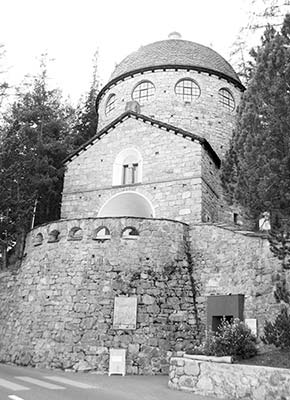
Visiting the Museum: The paintings are displayed on two floors. Begin by climbing the stairs to the round room on the top floor, where you can view the haunting Alpine Triptych: three paintings representing (left to right) life, nature, and death. Notice how, even in the death scene—as the body of a newly deceased loved one is brought out to a horse cart while mourning women look on—there’s a glimmer of hope and faith in the swirling clouds above. Segantini even designed the Triptych’s frames, ornamented with the local five-needled Swiss pine.
Then head back to the entry level, and spend some time with the many smaller canvases here. Particularly notable is Ave Maria at the Crossing, where a man rowing a simple boat—laden with a flock of sheep and a mother and baby—pauses to pray at sunset as the church bells toll.
Engadiner Museum (Museum Engiandinais)
This four-story Engadine-style house, built in 1905 to house this museum, displays a collection of lovingly reassembled living areas (stüvas) from the region’s surviving patrician houses of centuries past. Most of these interiors are entirely paneled in wood, much of it elaborately carved (especially in the Stüa de Gros). Following the well-done tablet guide (included with entry), you can also peek at a smoky farm kitchen and a nightmare-inducing four-poster bed that’s overseen by a painted skeleton, just in case life in medieval Switzerland didn’t provide enough reminders of one’s mortality.
Cost and Hours: 15 CHF, covered by Swiss Travel Pass; open Thu-Sun 11:00-17:00, closed Mon-Wed and off-season; walk 10 minutes downhill from town center to Via dal Bagn 39, +41 81 833 4333, www.museum-engiadinais.ch.
LIFTS AND HIKES
▲▲▲Corviglia Funicular and Cable Car to Piz Nair (10,030 feet)
A trip up to the Piz Nair summit is the best reason to visit St. Moritz in the summer. The ride up is a treat, and from the top you get a sprawling, nearly 360-degree view across the Upper Engadine’s rugged mountain rooftop and down to the strangely colorful lakes and valleys below. (This is especially appealing if you have an Engadin guest card, which makes it free. Without the card, your money’s better spent on a visit to Muottas Muragl and Alp Languard.)
Cost: 12.60 CHF for each leg, 69-CHF round-trip ticket, covered by Engadin guest card, +41 81 83 5020, www.mountains.ch.
Lift Stages: The ride up to Piz Nair has three stages: two funiculars, then a cable car, all of which leave every 20 minutes. The entire trip to the top, from the center of St. Moritz, takes about half an hour.
The departure station is just uphill from Schulhausplatz, in the middle of St. Moritz Dorf. From here, ride the first funicular just five minutes up to Chantarella (6,578 feet; this leg runs 8:20-17:00, last ascent to Piz Nair at 16:00, last descent at 17:20). There’s not much to see here, but you can follow “Heidi’s Flower Trail,” a relatively level one-hour loop through wildflower fields.
At Chantarella, change to a second funicular up to Corviglia in about seven minutes (aim for a seat on the left; runs 8:30-16:50, last descent at 17:10). Corviglia (8,156 feet) is a lovely spot to pause on your way back down. Next to the lift station, the swanky, crassly promotional $$$ Quattro Bar (hyping the Audi model) perfectly captures the whole St. Moritz vibe. For something a little more rustic, you can hike steeply 10 minutes uphill to the $$ Alpina Hütte, which also serves food.
At Corviglia, switch to the cable car for the last leg—about seven more minutes—up to Piz Nair (8:45-16:25, last descent at 16:45).
At the Piz Nair summit station (10,030 feet), you’ll find a panoramic $$$ restaurant with a small outdoor terrace (Sonnenterrasse). Nearby, wander the metal walkway to enjoy spine-tingling views straight down. Looking in the direction the cable car runs, you can just barely see the St. Moritz train station on the edge of the big, turquoise lake. Directly above that, the long town at the base of a sharp ridge is Pontresina. And just to the left, up the valley, is Samedan. (You can’t quite see the town itself, but you can see the Samedan airstrip for private jets that give the “jet set” their name.) Look at the sharp pinnacle the cable car runs next to; immediately above it, on a high plateau, is the station for the Muottas Muragl mountain lift, reached by funicular from near Pontresina.
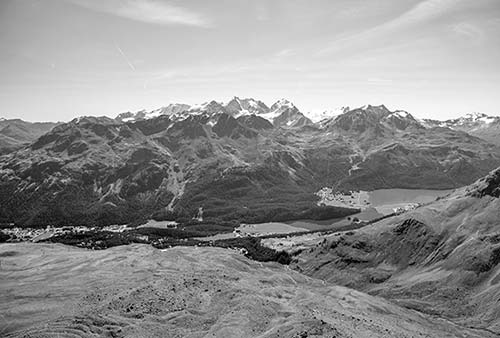
Now pan to the right. Of the cut-glass peaks along the horizon, the tallest is Piz Bernina (13,284 feet), which gives this mountain range (and the Bernina Express) its name. In the foreground and just to the right, the emerald alpine lake is one of a chain that leads all the way to Italy (the biggest one is Silvaplana).
Before leaving, circle around back behind the lift station. The view is less striking, but the statue of an ibex makes for great photos. Hardy visitors scramble up the rocky trail to the communications tower for even bigger views.
Hikes: The mountain’s footpaths and bike trails are well maintained. Experienced hikers up for a steep challenge can walk back to town in four to five hours. For a much easier descent, ride the cable car down to the Corviglia ridge, then enjoy great views while hiking from there back into town (2 hours via Marguns—which also has eating options, fairly easy walk most of the way but with steep parts at the start and end).
Walk Around the Lake
The charming lake below St. Moritz is a delightful place for a stroll—especially on sunny summer days, when it’s filled with sailboats. It takes about an hour to walk all the way around.
Eating in St. Moritz
As in Pontresina, most of St. Moritz’s restaurants are in hotels. $$$ Restaurant Hauser is the standard stop for locals who know where to find a good-value sit-down restaurant meal. Centrally located, this place has everything—restaurant, café, pastry shop, indoor and outdoor seating, and a vast menu—and you’ll find everyone here (also sandwiches to go, daily 7:00-21:00, below Hotel Hauser at Via Traunter Plazzas 7, +41 81 837 5050). To shop for a snack or a picnic, a small, basic Co-op grocery is right on the main square (Mon-Fri 8:00-19:00, Sat-Sun until 18:00, Schulhausplatz/Plazza da Scoula 12).
Upper Engadine Connections
BY TRAIN
From Pontresina to: Chur (hourly, 2 hours, change in Samedan), Zürich (hourly, 3.5 hours, change in Samedan and Chur or Landquart), Luzern (hourly, 4.5 hours, 3 changes), Appenzell (hourly, 5 hours, 3 changes), Zermatt (every 2 hours, 7 hours, several changes).
From St. Moritz and Samedan to: Chur (hourly direct, 2 hours, more with change), Zürich (1-2/hour, 3.5 hours, change in Chur or Landquart), Luzern (1-2/hour, 4.5 hours, several changes), Appenzell (1-3/hour, 4 hours, several changes), Zermatt (1-2 direct Glacier Express trains/day, 8 hours), Tirano (hourly, 2.5 hours), Milan (hourly, 5 hours, 1-2 changes).
For details on the Bernina Express to Tirano and Lugano, and the Glacier Express to Zermatt, see the Scenic Rail Journeys chapter.
Train info: www.rail.ch.
BY BUS
While the Bernina Express connects this area to Lugano, it’s a very roundabout (if scenic) journey. Much speedier, the Palm Express bus (#631) offers a connection-free trip over the Maloja Pass to Lugano (departs St. Moritz train station at 10:25, stops at Menaggio on Italy’s Lake Como en route, arrives at Lugano’s train station at 14:16; daily mid-June-late Oct, Fri-Sun only off-season, reservations required by 8:30 the same day, +41 58 341 3492, www.postauto.ch). Otherwise, connect via train to Thusis, then bus to Bellinzona, then train to Lugano (hourly, 4 hours). To Milan, the quickest route is by bus from St. Moritz to Chiavenna in Italy, then onward by train (every 2 hours, 4.5 hours).