LAKE GENEVA & FRENCH SWITZERLAND
Lausanne • Château de Chillon • Montreux • Gruyères
Lake Geneva and French Switzerland at a Glance
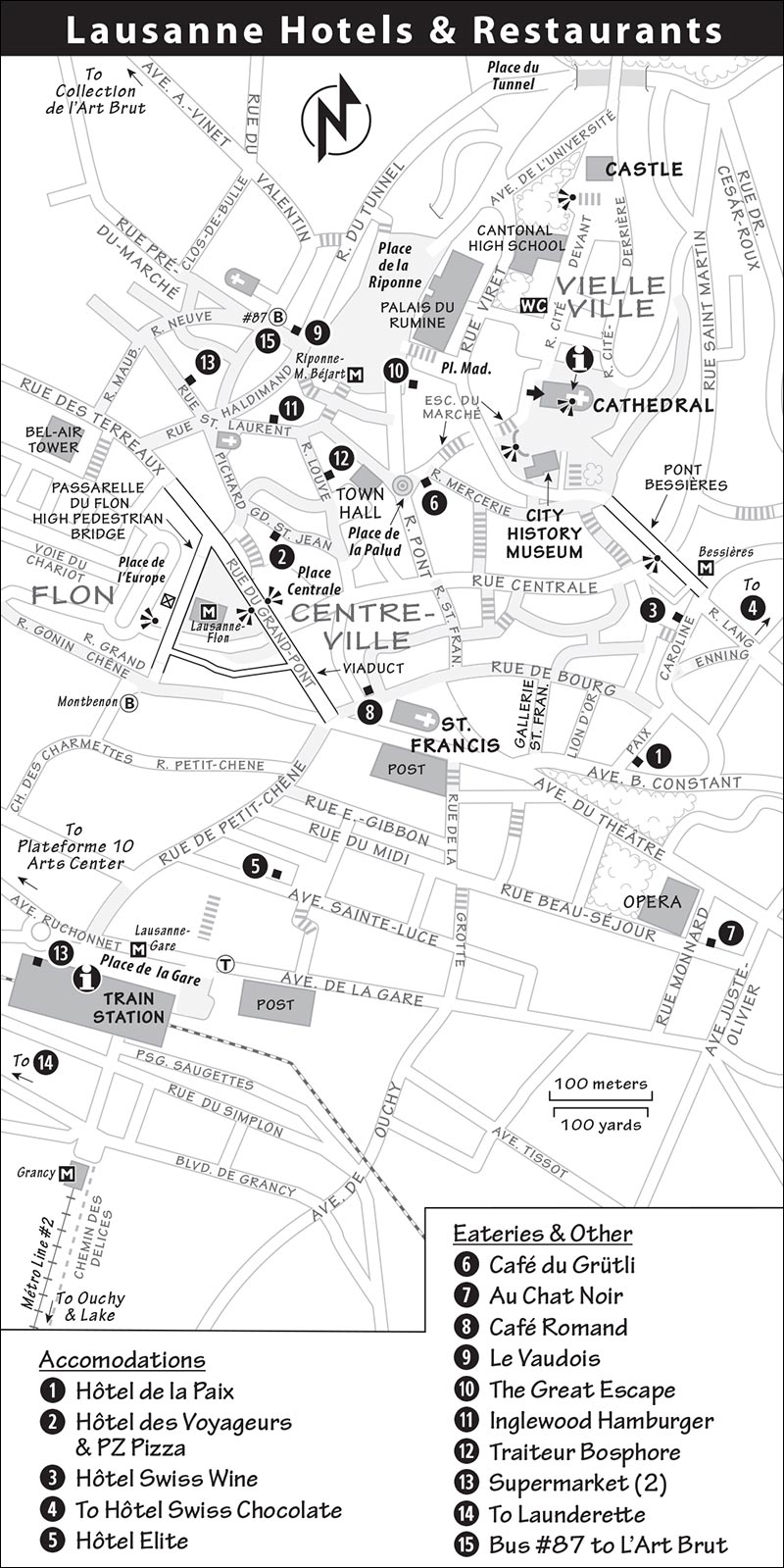
Map: Lausanne Hotels & Restaurants
Sleeping and Eating in Gruyères
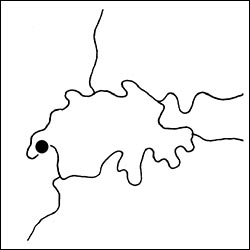
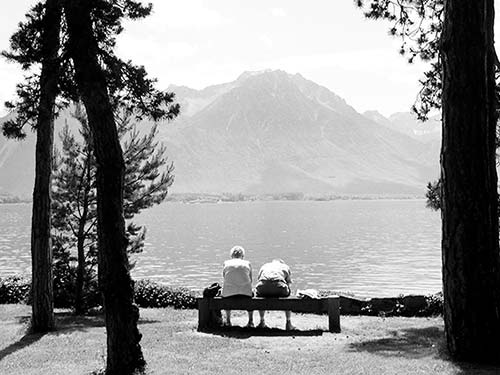
Lake Geneva, in the southwest corner of the country, is the Swiss Riviera. Separating France and Switzerland, the lake is surrounded by Alps and lined with a collage of castles, museums, spas, resort towns, and vineyards. The elegant French-style villas that grace the lakeshore—with pastel colors, frilly balconies, and characteristic mansard roofs—give it an air of gentility. And compared to the high mountains, this part of Switzerland (like Lugano and Italian-speaking Ticino) tends to be hazy and languid, with hints of a Mediterranean climate...even a few palm trees. The area is so beautiful that Charlie Chaplin and Idi Amin both chose it as their second home.
French is the predominant language at Lake Geneva (“Lac Léman” in French, “Genfersee” in German). To establish a better connection with the locals, see the “French Survival Phrases” in the appendix, s’il vous plaît.
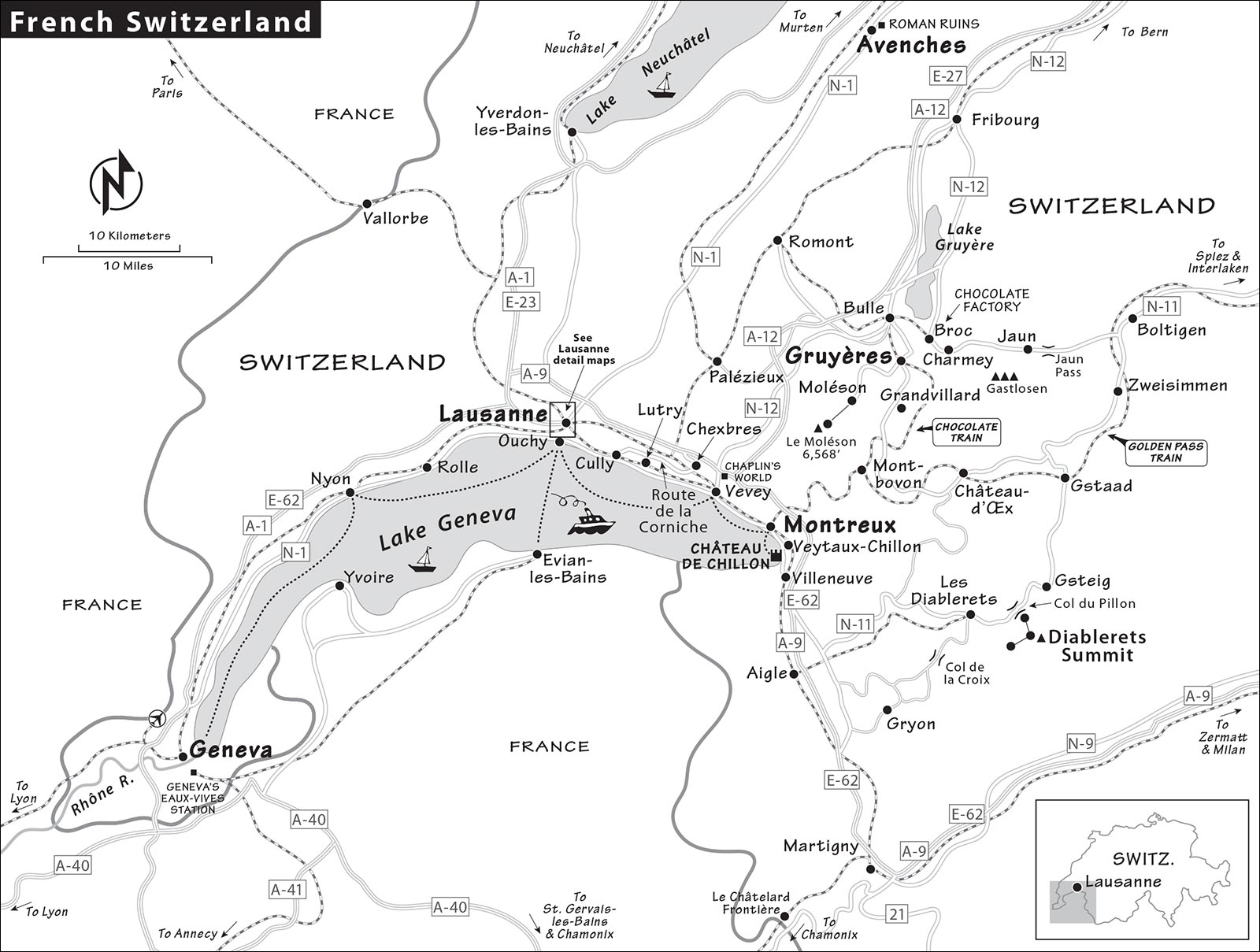
Skip the big, dull city of Geneva; instead, sleep in fun, breezy Lausanne. Explore the romantic Château de Chillon and stylishly syncopated Montreux. It’s also worth taking a day to delve into the French Swiss countryside, which offers up rolling green foothills topped with castles; chocolates, vineyards, and Gruyère cheese galore; a high-mountain excursion to give you a quick dose of the Alps; and picturesque towns tucked into the folds of the hillsides.
PLANNING YOUR TIME
On a quick trip, you can get a good overview of Lake Geneva’s highlights in one very busy day. Lausanne makes the best home base. In the morning, get oriented with my self-guided Old Lausanne Walk; dip into the cathedral and, if you have time and interest, the outstanding Art Brut and/or Olympic museums; and make sure you side-trip to Château de Chillon well before closing time.
With more time, linger longer at Lausanne’s great museums; lazily float your way between Lausanne and Chillon (2 hours) or other lakeside towns on a scenic boat cruise; stroll Montreux’s breezy promenade; or consider day trips into the surrounding vineyards and villages.
Beyond Lausanne and Chillon, the French Swiss countryside to the east is lower on the list of priorities. Gruyères is a fine (if touristy) village; while workable as a day trip by public transportation, it’s most efficient with the Chocolate Train excursion from Montreux. Otherwise, I’d skip this area without a car. Drivers who are connecting Lake Geneva and the Berner Oberland can carve out some time for the Gruyères region en route, or consider a longer detour via Les Diablerets.
GETTING AROUND LAKE GENEVA
By Train: You can easily connect towns along Lake Geneva via train. The faster IR (interregional) trains efficiently zip between larger cities, such as Lausanne and Montreux. Slower, regional “S” trains connect smaller destinations—most notably Château de Chillon. The regional trains, while a bit slower, spend more of their journey time down along the lakefront—making them more scenic.
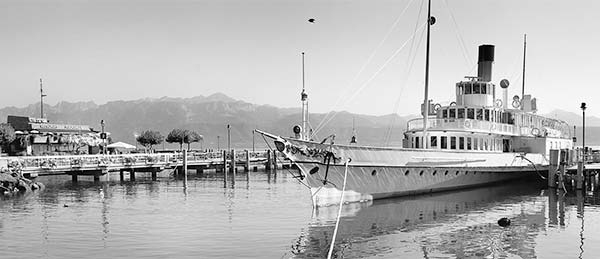
By Boat: This region offers a dizzying array of boat routes. Daily boat trips connect Lausanne with Vevey (21 CHF, 1 hour), Montreux (26 CHF, 1.5 hours), Château de Chillon (29 CHF, 2 hours), and points in between. In the summer (late June-early Sept), these run about four times per day in each direction (fewer in shoulder season, virtually none mid-Oct-mid-April). Some of the boats are historic, belle époque paddlewheel steamers, which feel just right in this romantic setting.
For just a quick hop on the water—on the most scenic stretch of the lake—the 15-minute cruise between Montreux and Château de Chillon is fun. The pretty town of Vevey, between Montreux and Lausanne, is enjoyable for a short stop and a visit to Charlie Chaplin’s former home. A different route runs from Lausanne directly across the lake to Evian-les-Bains, the French spa town famous for its mineral water (hourly, 35 minutes, passport required).
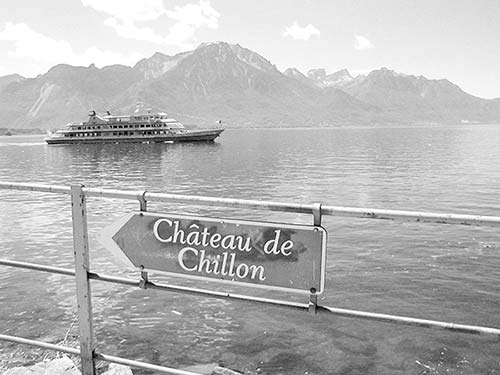
To find a cruise that appeals to you, study the schedule (at www.cgn.ch, at TIs, and at boat ticket windows; or call CGN at +41 848 811 848). First class costs about 40 percent more and gets you passage on the deck up top, where you should scramble for the first-come, first-served chairs. You can sail free with a Swiss Travel Pass (using a travel day of a flexipass—ideally do this on your day of arrival or departure) or get 50 percent off with a Eurail Global Pass (does not use a day of a pass).
Lausanne
Lausanne is the most interesting city on the lake, proudly dubbing itself the “Olympic Capital” (it’s been home to the International Olympic Committee since 1915). Amble along the serene lakefront promenade, stroll through the multilevel and characteristic old town, explore the sculptures at Olympic Park, and visit the remarkable Art Brut museum. Take a peek at the Gothic cathedral, and climb its tower for the view.
The Romans founded Lausanne on the lakefront—but with the fall of Rome and the rise of the barbarians, the first Lausanners fled for the hills, establishing today’s old town. Over time, the city covered its rivers and spanned its valleys with beefy bridges. Later, as Lake Geneva became part of the Grand Tour of European tourism during the Romantic age, the waterfront—a district called Ouchy—was revived. The city thus has a design problem that goes back 1,500 years: two charming zones separated by a nondescript residential/industrial section. Thankfully, the waterfront and the old town are easily linked by a steep, handy Métro line. This helps somewhat, but Lausanne is undeniably challenging to navigate: It’s next to impossible to avoid going uphill or downhill (or both) when walking between any two points. The city is a joy to explore...but it makes you work for it.
Orientation to Lausanne
Lausanne has the energy and cultural sophistication of a larger city, but is home to only about 130,000 people (350,000 in the greater area). A progressive city government that subsidizes art and culture and a university with plenty of foreign students carbonate the place with a youthful spirit.
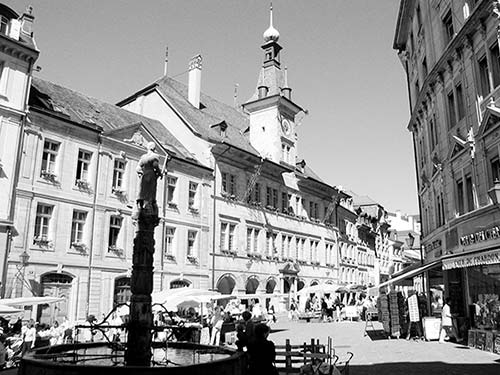
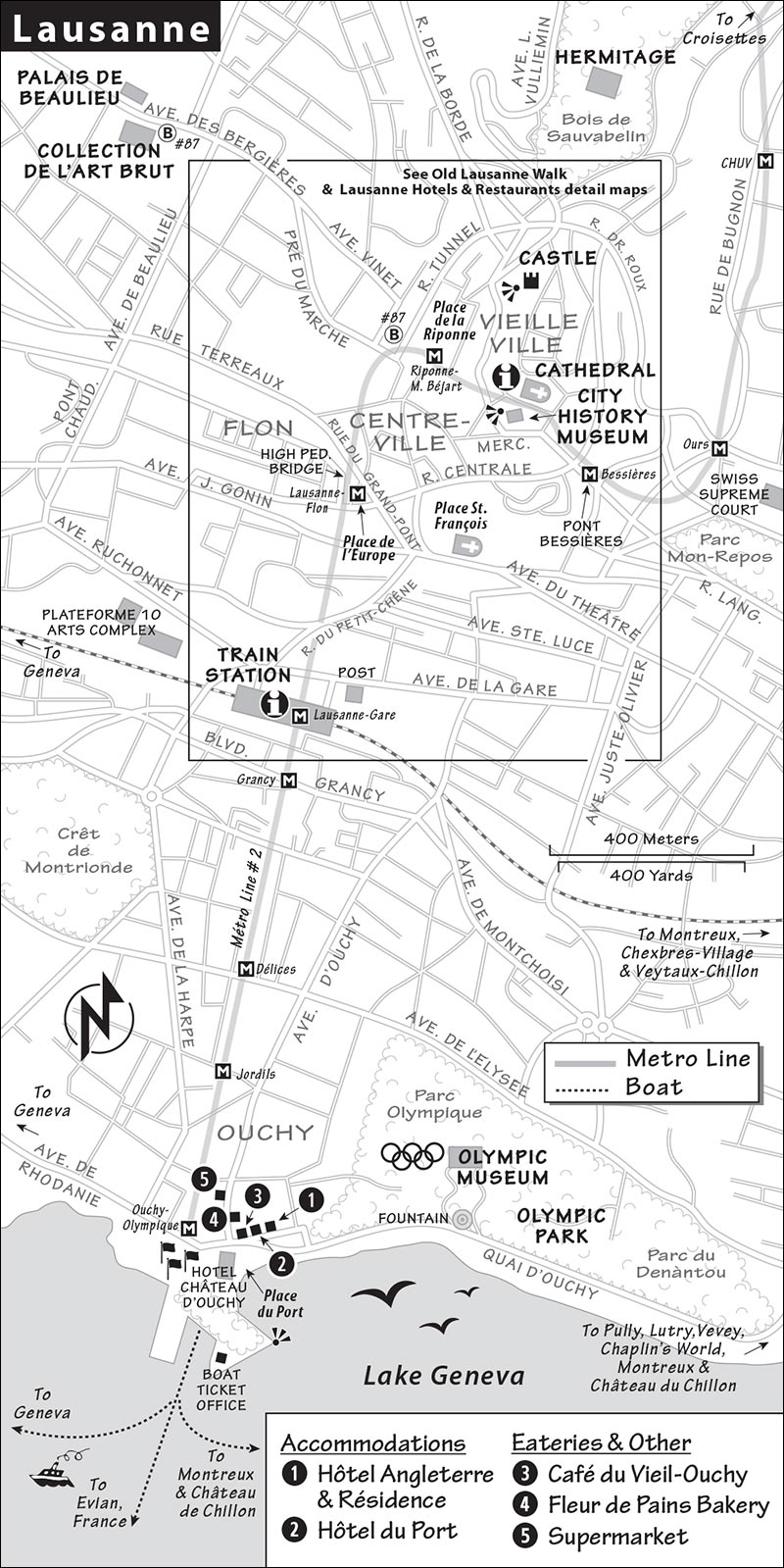
The tourist’s Lausanne has two parts: the lakefront Ouchy (oo-SHEE), with a breezy resort ambience and the Olympic Museum; and the old town, with creaky Old World charm and fine museums, directly uphill from the lake. The old town district is divided roughly into two parts: The true old town, or vieille ville (vee-yay veel), near the cathedral, is staid and sleepy; more interesting is the city center, or centre-ville, located on an adjacent hillock where you’ll find my favorite hotels and restaurants.
A third zone—around the train station—is located between Ouchy and the old town, but you’ll likely spend time there only when in transit, or possibly to visit nearby art museums. These three zones—and much more—are all connected by the slick Métro.
Walking around Lausanne’s old town feels like a life-size game of Chutes and Ladders. Two-dimensional maps don’t do justice to the city’s bridges, underpasses, stairways, hills, and valleys. Even the Métro trains and platforms are on an incline. Expect to be confused by the street plan at first. The model of old Lausanne in the City History Museum helps you understand how it developed.
Be careful to pronounce Lausanne correctly (loh-zahn), and don’t confuse it with Luzern.
TOURIST INFORMATION
Lausanne’s helpful TI is at the train station’s main entrance (daily 9:00-19:00, +41 21 613 7373, www.lausanne-tourisme.ch). A second branch is inside the cathedral, at the welcome desk for the tower climb (Mon-Sat 9:30-12:30 & 13:30-18:30, Sun 13:00-17:30, shorter hours off-season). Another good (unofficial) resource—especially for recent reports on the restaurant scene—is The Lausanne Guide, a blog written by two American expats (www.thelausanneguide.com).
Lausanne has a variety of walking tours, but they are usually offered in multiple languages—and English sometimes doesn’t make the cut. Ask for details at the TI. Most are run by Lausanne à Pied (15 CHF, Mon-Sat usually at 10:00 and 14:30, 2 hours, no tours Sun or Oct-April, meet in front of Town Hall at Place de la Palud, www.lausanne-a-pied.ch). The TI also runs its own town walks (20 CHF, typically Sat at 14:00).
Be sure to ask about concerts (free and otherwise)—especially organ concerts at the cathedral. There are ample cultural events from about mid-June through mid-September (check out www.lausanne.ch/agenda).
ARRIVAL IN LAUSANNE
By Train: The train station—with lockers, WCs, ATMs, ticket office, TI, pharmacy, and late-night groceries—is midway between the old town and the lakefront. The station area will be torn up for many years to come as the area is modernized. But here’s the gist:
The simple way to get either up to the old town or down to the lake—in about five minutes—is by Métro. If you arrive at track 1, head straight out the main door, cross the street, and look for the blue Métro sign. From other tracks, you’ll descend into a pedestrian underpass; follow this past track 1 (and under the street) to surface across from the station, near the Métro stop. The Métro runs every few minutes; to go up (old town), look for direction: Croisettes (at street level); to go down (lakefront), look for direction: Ouchy-Olympique (below street level). You’ll find ticket machines standing by (Métro also covered by Swiss Travel Pass; for more on riding the Métro, see “Getting Around Lausanne,” later).
Taxis can be hard to find in the torn-up station area (exit to the right and go to the end of the station, near the post office). And they’re fairly expensive, charging about 15-20 CHF to most of my recommended hotels. But this may be a worthwhile investment if you’re packing heavy in this disorienting, hilly city.
By Car: Driving is tricky—especially in the twisty old town. Consider leaving your car at a park-and-ride (labeled P+R); several surround the city center and are well connected by Métro to the old town. If you’re coming on the freeway from the north (such as from Bern), exit at Vennes and use the covered park-and-ride garage by the Vennes Métro stop (20 CHF/day covers parking and transit into the center). Or stay on the freeway as it loops down to Lausanne Sud, ending near the Bellerive park-and-ride, about a 15-minute walk from the Ouchy-Olympique Métro station (16 CHF/day). If you’re approaching on the lakeside road from the east (such as from Montreux), follow blue signs along the lakeshore directly to Ouchy. For more information, go to www.lausanne.ch/stationnement.
By Boat: From the dock, veer left toward the plaza with the flagpoles. Across the street is the Métro station.
By Plane: Lausanne and the Lake Geneva area are served by the Geneva airport, at the lake’s southwest corner. The airport sits on the western edge of Geneva, straddling the French border. For more on the airport, and how to get to town from there, see “Lausanne Connections,” later.
HELPFUL HINTS
Sunday Closures: Sundays are pin-drop quiet; many shops and restaurants are closed.
Market Days: On Wednesday and Saturday mornings, produce stands fill the pedestrian streets of the old town.
Laundry: Quick-Wash, well-run and handy, is just behind the train station (self-service, daily 8:00-22:00, Boulevard de Grancy 44, +41 79 449 3761).
Bike Rental: A bike is worthless in this steep city, but can be great for exploring the lakefront, vineyards, and nearby villages. It’s a three-hour waterfront pedal from Ouchy to Montreux and back. Your best bet is the city’s PubliBike program (requires registering online; details at www.publibike.ch [URL inactive]). Or, you can rent a more serious bike at the train station’s ticket office, then bring it down to Ouchy on the Métro.
GETTING AROUND LAUSANNE
By Public Transport: Lausanne’s nifty Métro and bus network makes it easy to get around. For transit info, visit www.t-l.ch.
The Métro has two lines (converging at the Lausanne-Flon stop in the city center), with a third line under construction. But only line #2 is useful for travelers. Using it is simple: up (direction: Croisettes) or down (direction: Ouchy-Olympique). This inclined 14-stop line climbs up from the lakefront to the old town, then all the way up to the freeway. The key stops are Ouchy-Olympique (at the lakefront); Lausanne-Gare (at the train station); Lausanne-Flon (at the bottom end of the old town—exit into Place de l’Europe, ride the elevator up to the pedestrian bridge on Rue du Grand-Chêne, then stroll straight into the town center); and Riponne-M. Béjart (at the top end of the old town, on Place de la Riponne). You’re unlikely to need the bus, except to reach the Art Brut museum.
If you’re sleeping in Lausanne, your hotel should give you a Lausanne Transport Card, which covers local transit and is paid for by your hotel tax. Otherwise, unless you have a Swiss Travel Pass, you’ll need to buy tickets from the machines. Tickets are valid on both Métro and buses (short-ride ticket-2.30 CHF, valid 30 minutes, up to three stops; single ticket-3.70 CHF, valid one hour; all-day ticket-9.30 CHF, valid 6:00-24:00). Almost everything in this chapter is in the central zone 11.
By Taxi: Cabs are pricey—figure 15-20 CHF for even a short ride.
Old Lausanne Walk
There’s no way to see this town without lots of climbing. Locals are used to it (try to keep up). This self-guided stroll introduces you to both parts of Lausanne’s charming old town, starting in centre-ville near the Church of St. Francis and ending in vieille ville near the cathedral.
1 Lausanne-Flon Métro Station
This is where you’re most likely to arrive in town.
• From the Métro stop, ride the elevator up to the high pedestrian bridge (Passerelle du Flon). Orient yourself from midway across the bridge, which leads to the city’s main thoroughfare. Start by looking west (toward the solitary gray skyscraper).
2 Passerelle du Flon View
Below you stretches Flon (the “Quartier du Flon”)—once a ravine of the Flon River, then a down-and-dirty industrial zone, and now—so typical of post-industrial 21st-century Europe—a thriving people zone. Its old warehouses come alive at night with trendy bars and nightclubs. The only reminder of the mills that once churned here is the name of the hottest nightclub in town: MàD (which stands for “Moulin à Danse” or “Dance at the Mill”; it’s just out of sight at Rue de Genève 23). The Art Deco-ish Bel-Air Tower (to the right) is famous as the country’s first skyscraper (1932). The more elegant building, far to the left in the trees, was the 19th-century home of the Swiss Supreme Court.
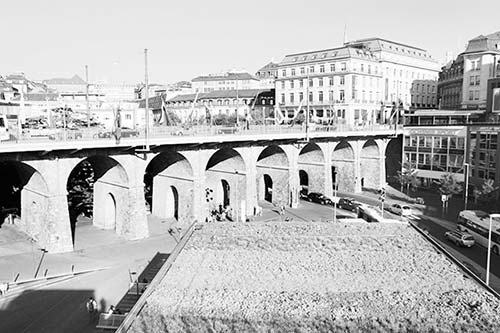
Turn around and look down on the green rooftop of the Métro station (where different local plants grow all year). Scan this human coral reef of a city. Look for the viaduct, built in the 19th century as a double set of arches to cross the ravine. Now, as the city has evolved, only the top set of arches is visible.
• Walk to where the pedestrian bridge hits the busy street, Rue du Grand-Pont. Head right toward the green copper spire of the Church of St. Francis. As you walk along Rue du Grand-Pont, enjoy lovely views of the cathedral on your left and the grassy Métro station on the right, with its vertical garden. You’ll soon reach...
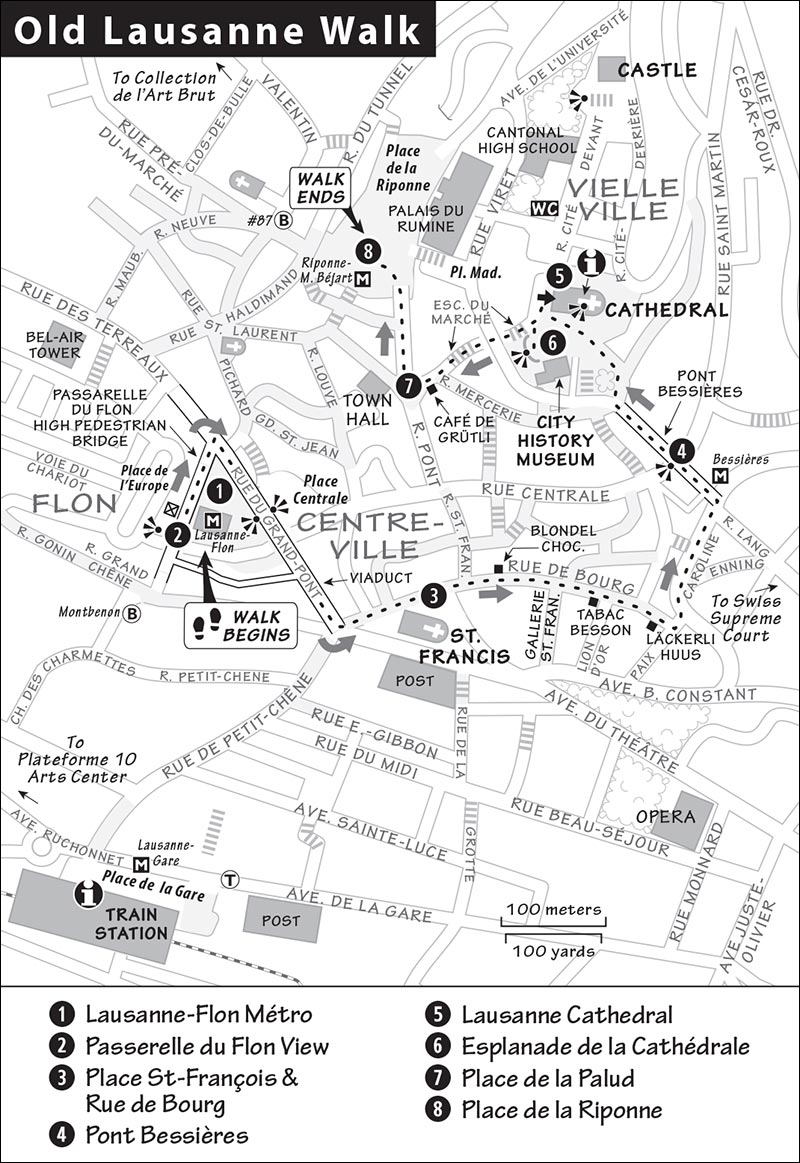
3 Place St-François & Rue de Bourg
The Church of St. Francis marks the town’s center and transportation hub. Across the busy street stands the grand post office, a belle époque building from the days when post offices were a big deal. It’s flanked by two also-grand banks (still a big deal in Switzerland). The church is Gothic, founded by Franciscans in the 13th century. But in 1536, it went Protestant—and was gutted of decorations. Later, a grand Baroque organ was installed. The church’s locally quarried stones, laid 500 years ago, cleaned up quite nicely.
Circle around the left side of the church to find the humble fountain. This replaced a much larger horse trough (this was once where wagons entered town). Look for a fun piece of public art: Brass plaques, embedded in the surrounding cobbles, feature the names of children born in the city hospital on full-moon nights in the year 1998.
As you face the fountain, turn left and head up the pedestrianized Rue de Bourg. Stow your guidebook and simply enjoy strolling this pretty shopping street, lined with top-end shops. (On Wednesdays and Saturdays, this street is also filled with market stalls.) Notice the fine architecture above the noisy storefronts. Here are a few things to watch for: At the first corner (Rue St. François), glance downhill—it’s lined with circa-1960 St. Francis signposts. Blondel (on the left, at #5) has been hand-making chocolate in Lausanne for more than 150 years. (Much of Switzerland’s famous chocolate production—including big names like Nestlé and Cailler—got their start in the area around Lake Geneva.) At #12 (on the right), you can look down the elegant Galerie St. François, which stretches to a busy shopping street. Just beyond at #22 (also on the right) is Tabac Besson, a classic wood-grained Old World tobacco store. Finally, at the very top of the street at #28 (right) is Läckerli Huus, selling sweets from the city of Basel.
• When the street ends, turn left (onto Rue Caroline), continuing uphill, then bearing left over the large bridge toward the cathedral.
4 Pont Bessières
Pause mid-bridge and enjoy the view—similar to the earlier Passerelle du Flon view but higher up. Find the skyscraper, the courthouse, and the Jura Mountains in the distance (border of France). And notice how the old river valley below is built over. After the fall of Rome—and the end of the protection it provided—vulnerable locals moved from the lakefront Ouchy area up into the relative safety of adjacent hilltops between river valleys. Looking out over the landscape, appreciate what a terrible location this was for building a modern city. Imagine the headaches this location has caused for urban planners, who’ve had to figure out some way to turn Lausanne into a cohesive, well-connected metropolis. Two rivers have been covered over; bridges and viaducts run every which way; and elevators, funiculars, and a uniquely vertical Métro attempt to tame the undulating land. And yet, somehow, it works...if you don’t mind a little exercise. By the way, the oversized railing you may be leaning on is designed to discourage suicidal people from leaping.
Walking toward the cathedral, you’ll notice that Lausanne’s true old town (vieille ville, where we’re headed)—filling the highest hill in town with administration buildings, offices, schools, and apartments—is subdued compared with the commercial center (centre-ville, which we just left).
• Once across the bridge, bear right and curve on up (with the patch of grass on your left—or use the stairs straight up through the park) to the upper level around the giant cathedral. Walk alongside the massive building, passing the City History Museum on your left (we’ll circle back here soon) to the big, leafy terrace in front of the cathedral. We’ll enjoy the view in a bit. But first, check out the biggest church in the country.
5 Lausanne Cathedral (Cathédrale de Lausanne)
Lausanne’s cathedral is an Evangelical Reform Church, meaning that it belongs to the tradition of the early Protestant reformer John Calvin. Iconoclasm, the removal of religious symbols, suited the Calvinists well. The once-ornate cathedral, originally dedicated to Mary, was cleared of all its statues and decorations. Its frescoes were plastered over, and its colorful windows were trashed and replaced by plain ones. But, thankfully, there’s still a lot to see.
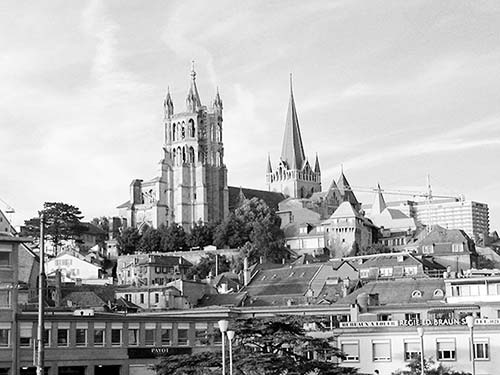
Cost and Hours: Free, daily 9:00-19:00, Oct-March until 17:30; www.cathedrale-lausanne.ch.
Concerts: Organ concerts take place on some Friday evenings in peak season, usually at 20:00 (look for posted schedules, check online at www.grandesorgues.ch, or ask at the cathedral welcome center/TI).
Visiting the Church: Enter through the main doors, facing the view terrace. (If the door’s closed...open it.) Walk partway down the nave and look back.
The pipe organ above the main door is American-made (by Boston-based company Fisk) and was installed in 2003. Locals love their organ and figure its cost (4 million CHF) was money well spent. Look back at its 7,000 pipes: The “stiletto in Oz” design represents the wings of angels. Notice that the pews in this part of the nave have “reversible” seats—they can either face the pulpit, or be switched to face the organ.
As you continue down the nave, admire the stained glass. In the south (right) transept, the rose window has the church’s only surviving 13th-century glass. The rest of the glass dates from the early 1900s. Don’t miss the bold and clearly labeled scenes in the apse. The north (left) transept has some dreamy blue Art Nouveau scenes.
The Mary Chapel, below the rose window (and just to the left), was the most elaborate chapel in the church. In 1536, it was scraped clean of anything fancy or hinting of the Virgin Mary. Look at the bits of surviving original paint, and imagine the church in all its colorful glory six centuries ago. Also notice the stamp for the “pilgrims’ passport.” This church is a stop on one of the many Camino de Santiago pilgrimage routes across Europe that funnel hikers to Santiago de Compostela in northernwestern Spain. Pilgrims mark their passport with a stamp at each stop.
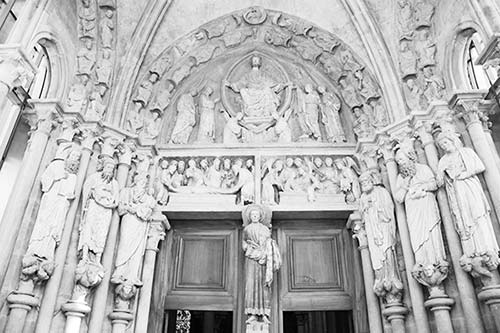
The church’s highlight is on the way back out: Head up the aisle the way you came and watch on the left for the door that leads to the light-bathed painted portal. This was the church’s main entrance in the Middle Ages. Today, it’s glassed in to protect its remarkable painted Gothic statuary. Imagine being a pilgrim approaching this beautifully painted main entrance to one of the great churches of Europe: On the left are six Old Testament prophets and on the right are six apostles—all standing upon symbols of evil and welcoming you with benevolent smiles. High above you, Jesus is about to crown Mary “Queen of Heaven.” And then you step inside.
Tower: In the back-right corner of the church, you’ll find a TI/welcome center and gift shop, and the entrance to the tower climb (224 steps, grand lake views, lots of Alps, 5 CHF, Mon-Sat 9:30-12:30 & 13:30-18:30, Sun 13:00-17:30, shorter hours off-season).
Since the Middle Ages, a night watch has lived in the church’s tower. As the city was originally built of wood, fire was a constant fear. The job: to watch for fires and to call out the hours. The city is made of stone today—so there’s little danger of fire—and people wear their Swiss timekeepers on their wrists. Nevertheless, Lausanne retains this 600-year-old tradition—the only Swiss city to do so. (Even in this “progressive” city, it took until 2022 to hire a female night watch.) Every night on the hour, from 22:00 to 2:00 in the morning, the night watch steps onto the balcony and hollers. Their first announcement: “I am the watchman. I am the watchman. We just had 10 o’clock. We just had 10 o’clock.”
• Back outside, belly up to the fine viewpoint immediately in front of the cathedral.
6 Esplanade de la Cathédrale
On a clear day, look beyond the spire of the Church of St. Francis to see the French Alps (Chamonix and Mont Blanc, over there somewhere, are just out of sight). Evian-les-Bains, the famous French spa town, is immediately opposite Lausanne. On the right, the soft, rolling Jura Mountains, which mark the border of France and Switzerland, stretch all the way from Lake Geneva to Germany.
• On the left side of the terrace (as you face the view) is the City History Museum (described later, under “Sights in Lausanne”). Now’s a good time to visit.
A covered wooden staircase called Escaliers du Marché leads down from the cathedral’s front door. When you’re two-thirds of the way down the stairs, notice the blue plaque with the stylized seashell icon, marked Chemin de St. Jacques (“Way of St. James”—another name for the Camino de Santiago.
Just beyond, head through the tunnel marked 1975 under the busy road. Continue down the covered steps along a row of funky businesses, bear right to pass the recommended Café du Grütli, and land on a long and narrow cobbled square.
7 Place de la Palud
This square is marked by its colorful Fountain of Justice. Since 1585 this blindfolded figure of Justice, holding her sword and scales, has commanded fairness as she stands triumphantly over kings and bishops. Imagine the neighborhood moms sending kids here to fetch water in the days before plumbing. Behind the fountain is a mechanical clock, with animated figures that perform with recorded French narration every hour, on the hour (daily 9:00-19:00). The Town Hall at the bottom of the square dates from 1685.
• Uphill from Town Hall, Rue de la Madeleine leads to the vast and modern...
8 Place de la Riponne
The Palais du Rumine (former university), overlooking the square, now houses a collection of museums (all of which are skippable). The recommended Great Escape, a fun hamburger bar with a nice selection of beers, fills the terrace a few flights of stairs above you (between the square and the cathedral tower). There’s a free WC on the first floor of the Palais du Rumine.
• Our tour is over. To reach the Collection de l’Art Brut, walk northwest about 15 minutes. Or—much easier—catch bus #87 from this square (the stop is across the street, in front of La Vaudois café).
Or, to head down to the lakefront Ouchy district, ride the Métro from this square (the Riponne-M. Béjart stop) all the way down to the end of the line, Ouchy-Olympique.
Or...simply enjoy poking around more of the old town’s twisty lanes.
Sights in Lausanne
IN AND NEAR THE OLD TOWN
▲City History Museum (Musée Historique de Lausanne)
This museum, housed in what was the bishop’s residence (facing the cathedral), has nicely presented displays that trace life in Lausanne from Roman times to the present.
Cost and Hours: 12 CHF, covered by Swiss Travel Pass, Tue-Sun 11:00-18:00, closed Mon except July-Aug, bags must be checked in lockers, Place de la Cathédrale 4, +41 21 315 4101, www.lausanne.ch/mhl.
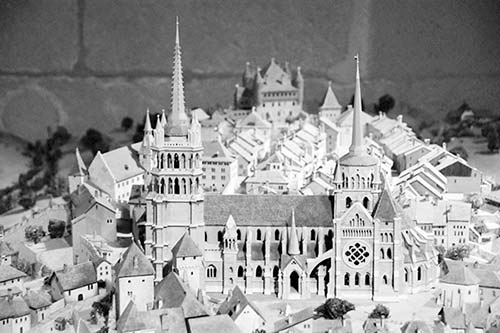
Visiting the Museum: The highlight for many is the 1:200-scale model of Lausanne in the 17th century. When you enter the museum, request to hear the eight-minute recorded English commentary on the model. Then head upstairs and follow the one-way route of Lausanne, L’Exposition.
The model, in the first room, is based on an engraving from 1638 (see copy on wall). It will give you a feel for how this hilly city and its quirky street plan developed. You’re viewing the town from the perspective of the lakefront district of Ouchy, with the Church of St. Francis in the foreground. You can see river valleys that have since been built over by the modern city. The little water mills mark the birthplace of industrial Flon. Though the city’s walls are long gone, its vineyards survive.
From here, the mild-mannered but interesting exhibits tell the rest of Lausanne’s story. You’ll see a variety of exhibits on how, as Lausanne grew, city leaders and engineers attempted to tame this unruly landscape—including for example, the construction of the Grand-Pont.
On the lower levels, you’ll find exhibits on city transportation and religious life, as well as rooms dedicated to the economic, social, and cultural history of Lausanne: the Enlightenment (when Lausanne was a printing center), high society, commerce, and industry (including chocolate-making, which remains a big business in this part of Switzerland). The grand finale is an endearing exhibit called “From Lausanne with Love,” recalling Lake Geneva’s arrival on the world tourism stage as part of the Grand Tour of 19th-century aristocrats (who brought money and fame to Lausanne). The final display features holograms of locals describing what their hometown means to them.
▲▲Collection de l’Art Brut
This well-displayed, evocative collection shows art produced by untrained artists, many labeled (and even locked up) by society as “criminal” or “insane.” It’s a beautiful testament to the fragility and resilience of the human spirit. Many of the featured artists had a history of war, illness, and/or abandonment—and yet created something unique, moving, and worthy of thoughtful contemplation. It’s tragic and uplifting at the same time—in other words, utterly human.
Cost and Hours: 12 CHF, covered by Swiss Travel Pass, Tue-Sun 11:00-18:00, closed Mon except July-Aug, bags must be checked in lockers, Avenue des Bergières 11, +41 21 315 2570, www.artbrut.ch.
Getting There: From the old town, the museum is a dull 15-minute walk or an easy ride on the frequent bus #87 (from Place de la Riponne, direction: Désert, get off at Beaulieu stop and backtrack a short block). From the train station, take bus #3 or #21 (also very frequent, direction: Bellevaux or Blécherette, get off at Beaulieu stop for bus #21, or Beaulieu-Jomini stop for bus #3).
Visiting the Museum: In 1945, artist Jean Dubuffet began collecting art he called brut (“raw” or “crude”)—created by untrained, highly original individuals who weren’t afraid to ignore rules. In the 1970s, he donated his huge collection to Lausanne, and it has now expanded to 60,000 works by hundreds of artists—loners, mavericks, fringe people, prisoners, and mental-ward patients. Dubuffet said, “The art does not lie in beds ready-made for it. It runs away when its name is called. It wants to be incognito.”
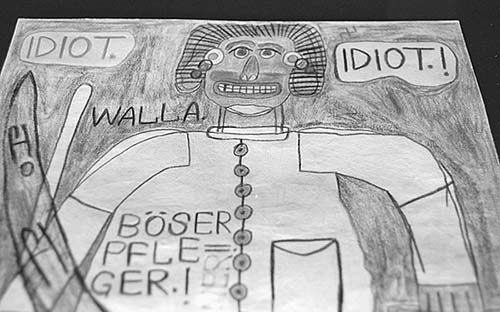
About 800 works are displayed at a time, (perhaps fittingly) without much rhyme or reason on four floors. Rooms with black walls are part of the permanent collection; white walls indicate temporary exhibits. Read the posted thumbnail biographies of these outsiders, and then enjoy their unbridled creativity.
Here’s just a sampling of the artists you’ll see in the permanent collection: Emile Ratier, a blind farmer who made rudimentary statues out of wood; Madge Gill, an Englishwoman who drew portraits of a grieving mother; Sylvain Fusco, a cabinetmaker who went to war, stopped talking, and began drawing; August Walla, a psychiatric hospital inmate who painted boldly colorful murals; Pascal-Désir Maisonneuve, who created portraits of monarchs and politicians using seashells; Philippe Dereux, whose favored media were fruit and vegetable peels and various grains; David Braillon, from a family of railway workers, who crayoned long, detailed illustrations of trains; and Paul Amar, who assembled elaborate dioramas using brightly painted shells from the seafood he consumed.
As you tour the thought-provoking collection and learn about the artists, ponder the fine line that separates “sanity” and “insanity” when it comes to creative output. The thoughtful visitor ponders what “normal” really means, and why some innovators become cultural icons...while others get ridiculed, ignored, or locked up.
NEAR THE TRAIN STATION
▲Plateforme 10 Arts Complex
Just a five-minute walk from the train station on Place de la Gare, this arts district consolidates three museum collections. Art aficionados will find a visit here worth ▲▲, but casual visitors may find the collections less satisfying and more challenging to appreciate than some of Lausanne’s (and Lake Geneva’s) bigger thrills. Lausanne Cantonal Museum of Fine Arts (Musée Cantonal des Beaux-Arts Lausanne, or MCBA), in a large, white-brick building, combines works of local artists with lesser works by big names (as well as frequent temporary exhibits), all beautifully displayed in a vast, open, custom-built space. A boxy building houses two more museums: Upstairs is the Museum for Contemporary Design and Applied Arts (MUDAC) and downstairs is the Musée de l’Elysée photography collection.
Cost and Hours: 15 CHF each; 25 CHF for 3-museum combo-ticket; all are covered by the Swiss Travel Pass; MCBA closed Mon, MUDAC and Musée de l’Elysée closed Tue, otherwise all are open 10:00-18:00, Thu until 20:00; +41 21 318 44 00, www.plateforme10.ch.
IN OUCHY, LAUSANNE’S WATERFRONT
The lazy resort charm of Lausanne lies on its lakefront. The place is lively from Easter through October, and dead otherwise. Start at the Ouchy-Olympique stop, connected by Métro with the train station and the old town every few minutes.
Before you leave the Métro, notice the parade of Olympic athletes literally hanging from the ceiling. Walk straight out to the main road, Quai d’Ouchy. Several restaurants are a block to the left. Also to the left, notice the grand Hotel Château d’Ouchy. It was built around a 13th-century tower—a reminder of Lausanne’s importance in the Middle Ages. Before the hotel gates is an Olympic countdown clock (marking the days, and even seconds, remaining until the next winter and summer games). Continuing past the hotel, you’ll pass an elaborate kids’ playground on the left and a sprawling festival zone on the right before reaching the lakefront. Environmentalism is popular in this city, which boasts 300 square feet of green space per inhabitant—more than nearly any city in Europe.
Straight ahead, the big C-shaped weathervane stands on the breakwater, indicating to sailors if the wind is vaudaire (roughly southeast, over the lake from Montreux), bise (northerly), joran (northwest), or vent (southwest). It’s a puzzle, as the “C” is designed to line up with the semicircle cutouts in the four strangely placed stone pillars. Crouch down, match the “C” with the pillar that creates an “O,” then look down at the pavement for the corresponding name of today’s wind.
At the harbor—to the left from the weathervane—you’ll find the departure docks for boat cruises (see next). A five-minute stroll farther along the lake takes you to Ouchy’s main attraction, the Olympic Museum and Park (described later).
Boat Rides
Lake Geneva cruise boats operated by CGN leave from the piers just to the left (see “Getting Around Lake Geneva,” earlier). Stop by dock 3, next to the main boat-ticket office, for information on the lake’s still-steaming historic paddleboats (1904-1927).
▲▲▲Olympic Museum and Park (Le Musée et Parc Olympique)
This museum celebrates the colorful history of the Olympic Games. It’s set in a beautiful lakeside park where the Olympic flame flickers between editions of the games. The exhibits and park celebrate the ideals of Pierre de Coubertin, who in 1894 founded the International Olympic Committee and restarted the games after a 1,500-year lapse. Coubertin acknowledged that to ask nations to love one another was naive, but to ask them to respect one another was a realistic and worthy goal.
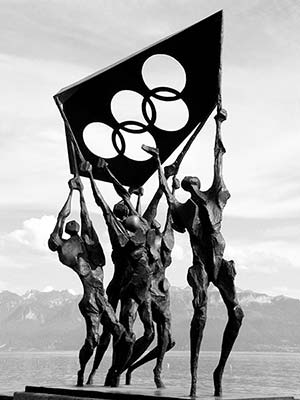
The museum is a thrill for Olympics buffs—and plenty of fun for those of us who just watch every two years. This is your chance to see Jesse Owens’ spiked jumping shoes, a basketball signed by the 1992 American “Dream Team,” and Cathy Freeman’s running shoes. The exhibits are lively (with fun, interactive stations designed to keep kids’ attention), and plenty of seating to let you rest your feet while listening to the audio-guide.
Cost and Hours: 20 CHF, family deals, free with Swiss Travel Pass; Tue-Sun 9:00-18:00, closed Mon, Quai d’Ouchy 1, +41 21 621 6511, www.olympic.org/museum.
Getting There: From the Ouchy-Olympique Métro stop, turn left and walk five minutes along the water to the big, white fountain, then walk up the stairs. On the way, you’ll pass the Beau-Rivage Palace, Lausanne’s venerable belle époque hotel that, since 1857, has hosted a glamorous guest list including Winston Churchill, Charlie Chaplin, Dizzy Gillespie, Liz Taylor, and, uh, Richard Nixon and Woody Allen.
Visiting the Museum: As you approach the building—perched on a grassy hill above the lakefront—appreciate the statue-studded park, filled with Olympics symbolism. Just before the entrance, look left to see a high-jump bar set at the current Olympic record level. Imagine trying to clear it yourself—these are no average feats. Just beyond is a full-scale track on which you can measure your pace against the performance of Olympic athletes.
Inside, buy your ticket at level 0, then head up the spiral ramp to enter at level 1 and follow the one-way route. First up, The Olympic World covers the history of the games and their organization. You’ll learn how the Olympics were born in ancient Greece, then reconceived by French aristocrat Pierre de Coubertin (1863-1937). Coubertin, a progressive thinker with socialist leanings, believed that strict French schools needed more physical education. He looked to British traditions as a model, and worked with British and Greek educators to hold the first modern games in Athens in 1896. Fourteen nations participated (more than 200 have competed in recent summer games). The exhibit covers the different host cities since then, the complex politics involved, the tradition of the torch, and the games’ planning and organizational challenges. You’ll see past Olympic flags, stadiums, and mascots; an example of every single torch from each modern Olympics; and an audiovisual display of opening ceremonies across the years.
One level down, The Olympic Games covers the winter, summer, and Paralympic games, displaying uniforms, shoes, and other memorabilia of competitors through the decades. A circular projection theater serves up a riveting medley of dramatic replays of competition highlights.
The basement exhibit, The Olympic Spirit, is about athletes’ lives in the Olympic village—what they eat, where they live, drug tests and anti-cheating measures, and the “Olympic Truce” that athletes from hostile nations commit to observe. Interactive displays allow you to try your hand at Olympic sports and a thought-provoking body-image wall shows the diverse bodies of Olympic athletes and how little they resemble fashion-model stereotypes. The exhibit concludes with a room of shiny replica medals from each of the modern games.
The museum’s top-floor $$ Tom Café has nice views and decent prices.
LAKESIDE AND VINEYARD EXCURSIONS NEAR LAUSANNE
The countryside immediately surrounding Lausanne—with farms and villages, winding lanes, picturesque vineyards, and glorious mountain and lake views—is enticing, and those with plenty of time may be tempted to get out of the city and explore. Here are a few ideas (ask local TIs for details):
Hike: A delightful promenade stretches in both directions from the Ouchy-Olympique Métro stop; it’s fun to stroll about one hour east to Pully (left as you face the lake), then catch the train back to Lausanne.
Wine Country Visit: Beyond Pully are the terraced vineyards of the Lavaux wine country. Of the hiking trails that snake from Pully to Montreux, the best stretch is between Lutry and Vevey. One short, easy, rewarding walk is the hike from Chexbres-Village down to St-Saphorin (both with train stations).
Bike Ride: Pedal east from Ouchy along the road for about a half-mile, then follow the bike path that hugs the shoreline for about six miles to Morges (easy return by boat or train). You’ll pass Vidy (with its scant Roman ruins), the headquarters of the International Olympic Committee, and lots of sports facilities.
Nightlife in Lausanne
Trendy Quartier du Flon, Lausanne’s old industrial district, is a dull commercial zone by day and thriving entertainment area in the evening. This is where hardworking Lausanners come for an après-work cocktail with colleagues and friends. While a vibrant scene, it’s mainly bars with afterthought food rather than a dining destination; come here for the lively al fresco ambience and a stylish cocktail rather than a memorable meal. From the Flon Métro station, the main drag Voie du Chariot leads to the central Flon square (following what was the original train line serving the warehouses). Convivial cocktail bars lead to the area’s central square, which has a cinema (multiplex; “VO” means it’s playing in the original language), bowling, and MàD (an iconic nightclub with four floors of dancing and pricey cover, starting well after my bedtime).
Sleeping in Lausanne
Lausanne hotels are priciest between April and October, but with a summer lull in July and August. At many places, prices also fall on weekends, as the city gets more business than leisure travelers. Courtesy of Lausanne’s tourist tax, along with your hotel room you’ll get a Lausanne Transport Card, which gives you free access to the city’s public transportation (plus discounts at many recommended museums) for the duration of your stay.
If you’re arriving by car, ask for parking advice from your hotel (many offer discounted rates at a nearby garage, or have parking on site). Otherwise, leave your car at a park-and-ride and arrive by Métro.
IN THE OLD TOWN
$$$ Hôtel de la Paix is an enticing splurge, a short walk beyond the old town. This classic, classy hotel—built in 1910 and run by the same family since the 1930s—has more than 100 rooms, including some with Lake Geneva views (for an extra charge). It comes with Old World charm and the professional predictability of a well-run business-class hotel (elevator, air-con, fitness room, restaurant, pay parking immediately in front of hotel, 5 Avenue Benjamin-Constant, +41 21 310 71 71, www.hoteldelapaix.net, info@hoteldelapaix.net).
$$ Hôtel des Voyageurs rents 35 classy, if nondescript, Swiss-modern rooms. It feels comfortable and well run, with a good breakfast served in a bright, open, and cheery space. Streetside rooms overlook a picturesque pedestrian lane but can by noisy; rooms in back face a quiet courtyard (elevator, air-con in some rooms, Rue Grand Saint-Jean 19, +41 21 319 9111, www.voyageurs.ch, hotel@voyageurs.ch). To find the hotel, take the Métro to the Lausanne-Flon stop, ride the elevator up to the pedestrian bridge, cross Rue du Grand-Pont, walk up Rue Pichard, and take the first right.
$$ Fassbind Hotels: This Swiss chain operates several straightforward, moderately priced hotels around Lausanne, many with kitschy themes. The rooms are functional with midrange charm and can be a decent value in this pricey city. Their Hôtel Swiss Wine has 62 rooms—and, of course, a wine cellar—just across the bridge from the cathedral (cathedral-facing rooms are quieter and pricier than street-facing rooms in the back, Rue Caroline 5, +41 21 320 21 41). Hôtel Swiss Chocolate has 54 rooms a bit farther from the old town (some with views of Lake Geneva or the cathedral, a few minutes’ walk from the Bessières and Ours Métro stops at Rue Marterey 15, +41 21 601 80 00). Both have elevators but no air-con (www.byfassbind.com).
NEAR THE TRAIN STATION
This hotel is easier for drivers and offers rooms with lake views (unlike most hotels in the old town).
$$ Hôtel Elite, run by the Zufferey family, is on a quiet, leafy, residential street just above the train station. Its 33 dated rooms are pleasant without being plush—a few have balconies (elevator, free parking; from station, cross the street and go uphill around McDonald’s, take first right to Avenue Sainte-Luce 1; +41 21 320 2361, www.elite-lausanne.ch, info@elite-lausanne.ch).
IN OUCHY
Scenic, great for a waterfront stroll, and close to the Olympic Museum, Ouchy is a short Métro ride from the more interesting dining and nightlife zones higher up.
$$$$ Hôtel Angleterre & Résidence is a luxurious splurge across the street from Lake Geneva. The 75 rooms are spread through four buildings—some more traditional, others contemporary—around a grassy lawn (air-con, elevator, outdoor pool, gym, restaurant, pay parking, Place du Port 11, +41 21 613 34 34, www.angleterre-residence.ch, ar@brp.ch).
$ Hôtel du Port, your “cheap and cheery” option, rents 22 basic rooms right along the restaurant strip near Ouchy’s Métro station (breakfast extra, elevator, Place du Port 5, +41 21 612 04 44, www.hotel-du-port.ch, info@hotel-du-port.ch).
Eating in Lausanne
By Swiss standards, you can eat well and affordably here. Lausanne restaurants typically offer a weekday lunch deal for about 20-25 CHF (sometimes on Saturday, too). This usually just means a main course, perhaps with a side salad or coffee included.
OLD TOWN
Restaurants with Table Service
$$$ Café du Grütli, named for the meadow south of Luzern where Switzerland was born, offers typical French Swiss cuisine near Place de la Palud. While they have outside tables on a cozy cobbled lane, I prefer their 1849 dining room, with century-old tables. It’s a bit touristy, but the Prutsch family (Willi, Heike, and Vanessa) is hands-on, the food’s fresh, and the service is very good. The family is into hunting, so you’ll find game on the menu as well as an award-winning fondue (Mon-Sat 10:00-14:30 & 18:00-23:30, closed Sun, Rue de la Mercerie 4, +41 21 312 9493).
$$$$ Au Chat Noir is worth a 10-minute walk beyond the old town for an upscale yet accessible brasserie experience with scarcely a tourist in sight. In broken English, cheery waiters translate the chalkboard menu, which changes frequently—but everything’s delicious. It’s worth reserving before you make the walk here (Mon-Fri 12:00-14:00 & 19:00-22:00, closed Sat-Sun, tucked down a side street near the opera house at Rue Beau-Séjour 27, +21 312 95 85).
$$ Café Romand is a venerable, simple brasserie filled with locals enjoying hearty Swiss home cooking, and comes with tables out on the square facing St. Francis Church. It feels like a city hangout—students, pensioners, and professionals sit under old-time photos like they own the place (Swiss wines by the glass, Mon-Sat 11:45-23:00, closed Sun, Place St-François 2, +41 21 312 6375).
$$$ Le Vaudois, facing lively Place de la Riponne, is a modern brasserie with charming seating inside and out, serving all the traditional French and Swiss dishes (daily 7:00-24:00, food from 11:30, Place de la Riponne, +41 21 331 2222).
Affordable Eats
$$ The Great Escape is a happening spot in good weather. The fun-loving crew cranks out great burgers and bar-type food on nights and weekends (order inside), but offers a few nicer options and table service for lunch (weekdays only). The restaurant is like a big woody pub (with classic rock playing, one screen showing sports, and a long bar), but I prefer the rickety tables outside on the gravelly square. When it’s busy, people perch throughout the small park with their little Great Escape trays (you’ll pay a 2-CHF deposit for your tray—turn it in to get your coin back). While quiet early, it gets loud and crazy late—but remains welcoming for all ages (daily 11:00-23:00, Place de la Madeleine, above the Métro stop on Place de la Riponne—head up three flights of stairs to reach it, +41 21 312 3194).
$$ Inglewood Hamburger is a thriving joint with friendly service in the old center near Place de la Palud. Happy locals munch creative burgers on the small terrace or within the quaint interior (beer on tap, Mon-Sat 11:30-14:00 & 18:30-21:30, closed Sun, Rue St. Laurent 14, +41 21 323 6388).
$$ PZ Pizza, on a serene pedestrian street in the heart of the old town, has good wood-fired pizza on super-crispy thin crusts. Choose from a variety of toppings, order at the counter, then find a table—either in the pleasant, split-level, modern interior or out on the lane (Mon-Sat 11:30-22:30, closed Sun, Rue Grand Saint-Jean 5, +41 21 312 8282).
$ Traiteur Bosphore, a brighter-than-average kebab shop, is a good option for a quick and inexpensive takeaway lunch or early dinner. There’s no seating—stand at the back counter or walk to the nearby Place de la Louve and find a bench (Mon-Fri 10:00-18:45, Sat 9:00-17:00, closed Sun, Rue de la Louve 7).
Supermarket: The Co-op department store in the center has a big supermarket in the basement (there’s also a lunch cafeteria upstairs; store open Mon-Fri 8:00-19:00, Sat until 18:00, closed Sun, Rue St-Laurent 24).
OUCHY
The lakeside Ouchy district is the place to relax. Immediately in front of the Métro stop is a fun zone with fountains, parks, playgrounds, promenades, and restaurants.
$$$ Café du Vieil-Ouchy, charming and reasonably priced, seems a bit out of place among all the fancy, expensive restaurants. It offers traditional Swiss cuisine, including the local filet of perch, cheese fondue, and various versions of Rösti (outdoor seating, main courses listed on chalkboard, daily 12:00-22:00, Place du Port 3, +41 21 616 2194).
Picnics: The most affordable option is a picnic with the local office gang on any of the many inviting benches or scenic lakeside perches. Leaving the Métro station, head left one block to Avenue d’Ouchy, where you’ll find several eateries including a Co-op supermarket (at #70, daily 6:00-22:00) and $ Fleur de Pains, a bakery offering sandwiches, quiche, tarts, and a few humble tables (daily 6:00-19:00, at #73).
Lausanne Connections
By Plane: If arriving by plane, you’ll land at the manageable Geneva airport (code: GVA, www.gva.ch). Exiting from baggage claim, you’re met by various local TI desks and ATMs. Turn left to reach the airport’s train station, with handy connections to points all over Switzerland. Trains leave for Lausanne about every 20 minutes (27 CHF, 50 minutes). Geneva’s city-center train station is the first stop on any train departing from the airport (3 CHF for this short hop). If you’ll be buying a train ticket, you can save time by using the ticket machine in the baggage claim area while waiting for your bag (there can be lines at the ones in the station). It’s possible to take a taxi to Lausanne, but it’s very pricey (170 CHF or more) and takes longer than the train.
From Lausanne by Train to: Montreux (5/hour, 30 minutes), Château de Chillon (hourly, 35 minutes, station name: Veytaux-Chillon, more with change in Montreux or Clarens), Gruyères (2/hour, 1.5 hours, 2 changes), Geneva (7/hour, 45 minutes), Geneva Airport (at least 4/hour direct, 50 minutes), Bern (3/hour, 1.5 hours), Murten (hourly direct, 1.5 hours, more with changes), Interlaken (at least 2/hour, 2 hours, change in Bern and sometimes Spiez; or go by Golden Pass scenic route—see the Scenic Rail Journeys chapter), Luzern (3/hour, 2.5 hours; or go by Golden Pass scenic route—see the Scenic Rail Journeys chapter), Zürich (2/hour direct, 2 hours, more with change in Bern or Yverdon-les-Bains), Zermatt (2/hour, 3 hours, change in Visp), Lyon (hourly, 3 hours, 1-2 changes), Chamonix (hourly, 2.5 hours, 3 changes), Paris (5/day direct, 4 hours, more with changes). Train info: www.rail.ch.
By Boat: For boat connections from Lausanne, see “Getting Around Lake Geneva” near the beginning of this chapter.
ROUTE TIPS FOR DRIVERS
If connecting the Lake Geneva sights by car, note the various routes. The expressway high above the lake zips you quickly between Lausanne and Montreux; although slower, the lakeside road provides great lake-and-vineyards views for about half of the drive (but also passes through several congested towns along the way).
For an even slower but more scenic approach, consider detouring to the Corniche de Lavaux. This rugged, sometimes frightening Swiss Wine Road swerves through picturesque towns and the stingy vineyards that produce Lake Geneva’s tasty but expensive wine. It lies roughly between Lausanne and Montreux; to get a taste, detour from the lakeside road between Cully (near Lausanne) and Vevey (near Montreux). Going in either direction, follow signs for Chexbres to find the wine road. The Route de la Corniche between Chexbres and Cully is particularly well known. Note that this isn’t a tidy, straightforward route; expect lots of exploring on twisty vineyard roads. Getting lost is the point.
Château de Chillon
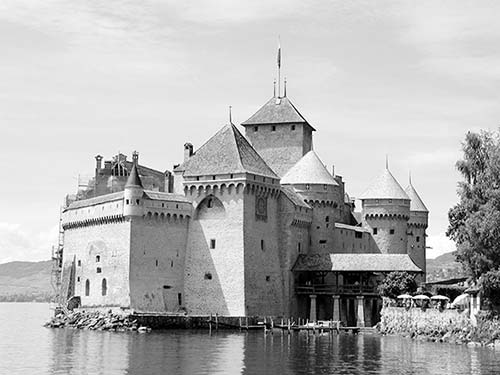
This medieval castle, set wistfully at the edge of Lake Geneva on the outskirts of Montreux, is a ▲▲▲ joy. Because it’s built on a rocky island, it has a uniquely higgledy-piggledy shape that combines a stout fortress (on the land side) and a residence (on the lake side). Remarkably well-preserved, Château de Chillon (shee-yohn) has never been damaged or destroyed—always inhabited, always maintained. Today it’s Switzerland’s best castle experience. Enjoy the château’s tingly views, dank prison, battle-scarred weapons, simple Swiss-style mobile furniture, and 800-year-old toilets. Stroll the patrol ramparts, then curl up on a windowsill to enjoy the lake.
GETTING THERE
The castle sits at the eastern tip of Lake Geneva, about 20 miles east of Lausanne and about 2 miles east of Montreux. From Lausanne, you can connect to the castle using a combination of methods. For a memorable outing, consider mixing and matching these options. For instance, if the timing works out, consider this plan: Ride the regional train straight to Veytaux-Chillon for the short walk to the castle. Then take the boat (ideally an antique steamer) to Montreux, wander that city’s lovely embankment back to the train station, and ride a fast train back to Lausanne.
By Train Plus a Short Walk: The S5 regional train (14.80 CHF one-way, hourly, 30 minutes, direction: Villeneuve) takes you to the station at Veytaux-Chillon, a five-minute walk along the lake from the castle.
By Train Plus a Bus Ride or Hike: The faster, more frequent IR (interregional) train whisks you to Montreux (13 CHF one-way, 2/hour, 20 minutes), where you transfer to a bus that takes you straight to the castle. Exiting the Montreux station, cross the street and go down the stairs to Grand-Rue (or take the elevator down, marked Ascenseur public Grand-Rue). Cross the street and find the blue bus stop on your right, where you can hop bus #201 to Château de Chillon (3.50 CHF, 6/hour, less frequent on Sun, 10 minutes, direction: Rennaz Village, stop: Chillon, ticket machines on board, covered by Swiss Travel Pass, www.vmcv.ch). You can also walk the two miles from Montreux to Château de Chillon (figure about 45 minutes one-way).
To return to Lausanne, simply reverse the above directions: Catch the regional S5 train from the Veytaux-Chillon station back to Lausanne (hourly), or hop the more frequent bus from Château de Chillon to Montreux’s train station (direction: Vevey, stop: Escaliers de la Gare and ride the escalator up to the station).
By Boat: A slower but more scenic route to Château de Chillon is to cruise there from Montreux (15 minutes), Vevey (30-60 minutes), or even Lausanne (2 hours). For details, see “Getting Around Lake Geneva,” near the beginning of this chapter.
ORIENTATION TO CHATEAU DE CHILLON
Cost and Hours: 13.50 CHF, free with Swiss Travel Pass, 35-CHF family ticket, daily 9:00-18:00, Nov-March 10:00-17:00, last entry one hour before closing, +41 21 966 8910, www.chillon.ch.
Parking: There’s free, easy parking along the road above the castle, but you’ll need a blue cardboard clock (the ticket desk can give you one).
Tours: My self-guided tour hits all the highlights, but for more depth, rent the excellent 1.5-hour audioguide (6 CHF, leave ID as deposit) or download the audioguide app (3 CHF) from the château’s website.
Baggage Storage: The castle has free lockers, and pay lockers are at the Montreux train station. There are no lockers at the Veytaux-Chillon train station or the Chillon boat dock.
Eating: Consider bringing a picnic to enjoy outside the castle on benches by the lake. Food at the garden $$ Byron Café next to the castle is on the pricey side, but there are few other options nearby.
BACKGROUND
The Savoy family—who later ruled a newly united Italy from 1860 through World War II (their seal is the skinny red cross on the towers)—enlarged Château de Chillon to its current state in the 13th century. From the outside, the castle has looked pretty much the same for 800 years. The only major difference: In the Middle Ages, it gleamed with a bright whitewash.
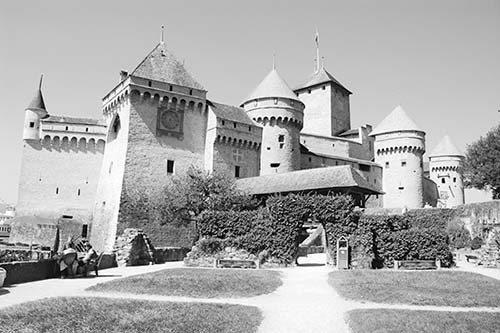
This was the Savoys’ fortress and residence, with four big halls (a major status symbol) and impractically large lake-view windows (because their powerful navy could defend against possible attacks from the water). But when the Bernese invaded in 1536, the castle was conquered in just two days, and the new governor made Château de Chillon his residence (and a Counter-Reformation prison). With the help of French troops, the French-speaking Swiss on Lake Geneva finally kicked out their German-speaking Bernese oppressors in 1798. The castle became—and remains—the property of the canton of Vaud. It’s been used as an armory, warehouse, prison, hospital, and tourist attraction. Jean-Jacques Rousseau’s writings first drew attention to the castle, inspiring visits by Romantics such as Lord Byron, Goethe, and Victor Hugo, plus other notables, including Dickens and Hemingway. During the Grand Tour of aristocratic tourism, the castle became a major draw.
 SELF-GUIDED TOUR
Before entering the castle, go for a little lakeside stroll beyond it (to the south); just five minutes takes you past the boat dock, to where you can look back for classic views of the mighty little fort poking out into the lake, with jagged peaks beyond. (If an old-fashioned steamboat happens to pull up to the dock while you’re snapping photos, so much the better.) This view helps you understand why the Romantics fell in love with Chillon.
Walking back to the castle, you can detour down into the little garden below the drawbridge. From here, you can see how the château is built on an island, so the lake creates a natural “moat” that enhanced its fortifications.
When you buy your ticket, ask for the free English brochure and map (there’s also a kids’ version). The numbers in my tour correspond to those in the brochure, on the audioguide, and posted at the site.
Now enter the château: You’ll cross a bridge and enter the first courtyard (#3, with handy fountains for your water bottle). In the room marked #4, you can pick up an audioguide and get oriented with a good model of the castle (if the audioguide desk isn’t open, check the gift shop—Room 2). Also in this area, you’ll find a room with vending machines and lockers; a bit farther along are WCs.
• Start by heading down the stairs marked 5/9 to a series of...
Cellars: You can see how the castle was built upon a foundation of jagged natural stone. In Room 8, find the hidden water gate—a secret escape route for the castle lord, who could (and did, in 1536) hightail it into a waiting boat when the Bernese invaded. Room 9 is Bonivard’s Prison, named for a renegade Savoyard who was tortured here for six years (lashed to the fifth column from the entrance). When the Romantic poet Lord Byron came to visit, Bonivard’s story inspired him to write The Prisoner of Chillon, which vividly recounts a prisoner’s dark and solitary life (“And mine has been the fate of those / To whom the goodly earth and air / Are bann’d, and barr’d—forbidden fare”; full text available in the gift shop). You can still see where Byron scratched his name in a column (third from entrance, covered by glass).
• Head back out the way you came in and turn left through the big gate into the second courtyard (#12), dominated by the towering keep (more on that later). Just before the keep, on the left, go into the...
Constable’s Dining Room (#13): This is one of the château’s finest halls. Look up to the six-centuries-old wooden ceiling. The gigantic fireplace was used to roast large animals (including bears and boars) for feasts. The opposite wall has the first of many grand lake-view windows you’ll see in the castle. From here the lords of Savoy had a view of all their land holdings.
• Climb up the spiral staircase to the...
Aula Nova (#14): This room has a striking barrel-vaulted ceiling that was restored in the 1920s. The collection of mobile furniture recalls a time when nobility traveled throughout their realm (and took their belongings with them) to keep an eye on things and collect taxes. In fact, in many European languages, the word for “furniture” implies that it’s mobile—German Möbel, French mobilier, and so on. Enjoy the ornate decorations on each traveling chest.
• Continue up to the...
Private Quarters (#15-17): The bedroom (#16) has a short bed—only about five and a half feet long. Not only were people shorter back then, but they also slept half-upright, propped up on pillows. The coat-of-arms hall (#18) is usually filled with temporary exhibits. The walls are lined with the family crests of some 50 “bailiffs” who governed this territory during Bernese rule. Capping this hall is another great wooden ceiling reminiscent of a waffle.
• Exit at the far end of the hall, and turn right into the...
Camera Domini (#19): This was the bedroom of the master of the house. Its location—at the farthest end of the castle from the entrance—was particularly secure. In the corner, notice the spiral stairs (closed to the public) that the lord could use to scamper down to Mass in his private chapel, or up to the ramparts. Under a sumptuous fleur-de-lis ceiling, wall paintings (imitating tapestries) illustrate various animals, including a camel, lion, griffin (with the body of a lion and the head and wings of an eagle), and the trademark Bernese bear. Study the model in the middle of the room, which helps you imagine what this room looked like in all its original colorful splendor.
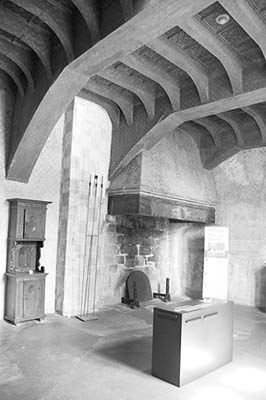
• Exit the room and turn right (following the 20/24 sign). In Room 21, make sure to see the medieval latrines, which take a looooong drop straight down into the lake—a feature that aims to please a certain class of traveler. Take the narrow stairs down and pass through Room 22. You’ll end up in a small courtyard (#23), where stairs lead up to an observation post with good views. From the courtyard, squeeze into that private chapel (#24) where the lord’s staircase ended up. Leave this room following the signs for 26, and you’ll wind up in the...
Third Courtyard (#25): Notice that the courtyard’s irregular shape causes the angled walkways to focus your attention on the grand window of the master’s bedroom—the camera domini we visited earlier. There’s no question who was king of this castle.
• Go in the door marked 26/33. The aula magna (#26) is yet another grand hall—this one for banquets—with spectacular (for their time) lake-view windows. Proceed through a few more rooms (including more latrines, #29) to the...
Domus Clericorum (#31): In this “house of the clerks,” the castle bean-counters kept meticulous records of all money and goods that passed through here, creating an invaluable historical record. In Room 32 a series of models and illustrations explain the gradual construction of the château over time.
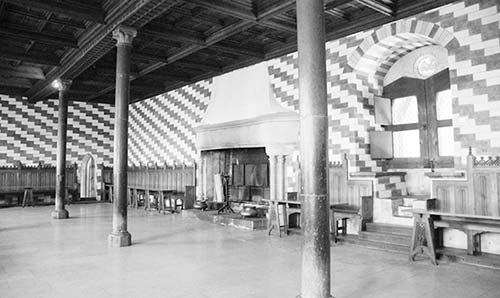
• Follow signs for 34 to climb back up into the third courtyard again, then hook left to find the...
Fourth Courtyard (#34): From this vantage point you can see how the entire defensive system of the castle developed over the years. The first phase was the steep ramp, followed by the thick walls, and finally the semicircular towers with just enough of an opening to attack invaders below. This is quite a contrast to the grand windows on the other side of the castle, where the lake served as a natural defense.
• Now’s the time to scramble along the...
Sentry Walk: As you pass through various indoor rooms and outdoor galleries (marked 38/46), pretend that you’re defending the château from invaders. Enjoy the castle courtyard and lake views. Circle all the way around, finally squeezing through the archway (rather than going down the wooden stairs) into the...
Keep (#42): This was the last line of defense and final refuge in the event of a siege. To climb to the top of the eight-story tower, you can scale 76 claustrophobic steps (marked 42/46) for views over the castle, lake, and surrounding mountains. From here you can see France (across the lake) as well as three different Swiss cantons.
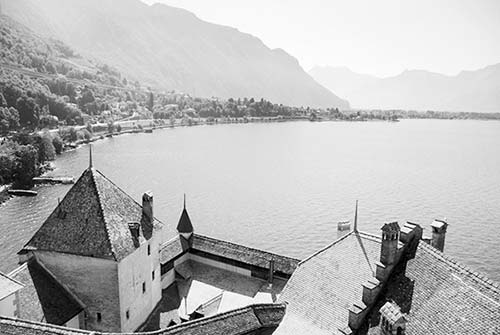
• Our tour is over. You may scramble the ramparts, enjoy the lake views, and play king (or queen) of the castle at will.
Montreux
This expensive resort—primarily famous for its jazz festival each July—doesn’t offer much to see. But its laid-back vibe and lakeview accommodations help you remember that you’re on vacation. Montreux is also a major rail junction; it’s both a terminus for the Golden Pass (described in the Scenic Rail Journeys chapter), and the starting and ending point for the Chocolate Train, which choo-choos travelers into the green interior of French Switzerland (described on here). About five miles to the northwest, the town of Vevey is home to the worthwhile Chaplin’s World museum.
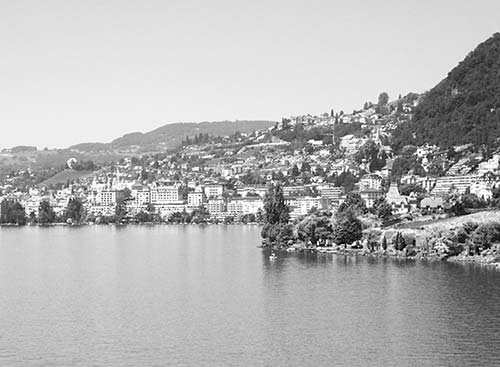
The Montreaux train station—one steep block uphill from the main waterfront road—has lockers both at track 1 and at tracks 3-4. Tickets for most journeys are sold in the main part of the station, facing the lake; however, the Chocolate Train and Golden Pass are operated by MOB, which has its own ticket office and tracks at the back of the station.
To get to the lakefront promenade, exit the station via the escalator down to Avenue des Alpes, cross the street, and continue down the escalator to the lake. Cross busy Grand-Rue, turn left, and stroll along the promenade about 200 yards to reach the TI and boat dock.
The Montreux TI has extensive information about the region and possible excursions (Mon-Fri 9:00-18:00, Sat-Sun 10:00-15:00, Place de l’Eurovision, +41 848 868 484, www.montreuxriviera.com).
Visiting Montreux: The lakeside promenade takes you along parks, palm trees, crêperies, ice-cream stands, and modern sculptures. Starting below the train station, stroll along the lovely waterfront promenade (with the lake on your right). You’ll reach the TI, then the dock for boats to other lakefront communities. Farther along is the town’s main landmark: the gigantic lakefront canopy (marché couvert) that’s filled with a produce market each Friday. Nearby, close to the water, stands a beloved statue of Freddie Mercury, with one arm raised triumphantly. His band, Queen, bought the local Mountain Recording Studios here in 1978, and the late singer has strong ties to Montreux.
Montreux Connections: Trains go from Montreux to Lausanne (4-5/hour, 30 minutes), Vevey (5/hour, 10 minutes), Gruyères (2/hour, 1-2 hours, 1-3 changes), Bern (3/hour, 2 hours, change in Lausanne, more with additional changes), Geneva (2-3/hour direct, 70 minutes, more with change in Lausanne), Zermatt (1-2/hour, 2.5 hours, change in Visp). For trips to Interlaken or Luzern, you can take either the slower Golden Pass trains (see the Scenic Rail Journeys chapter); or faster, less scenic normal trains, which change in Visp (for Interlaken) or Lausanne (for Luzern).
Bus #201 goes from Montreux to Chillon and Vevey (for the Chaplin’s World museum). Catch it on Grand-Rue; facing the lake, the Chillon bus (direction: Rennaz Village) is headed to the left, and the Vevey bus to the right (6/hour, fewer on Sun, 10 minutes to Chillon, 20 minutes to Vevey). The boat connecting Montreux to Lausanne, Château de Chillon, and several other Lake Geneva destinations departs from the big park next to the TI (see “Getting Around Lake Geneva,” earlier).
NEAR MONTREUX
▲▲Chaplin’s World
This museum explores the colorful life of actor and filmmaker Charlie Chaplin (1889–1977), who relocated here in 1952 after being denied re-entry into the US for his outspoken political beliefs. Although a bit out of the way, Chaplin’s World is worth a visit—even for those with no prior interest in Chaplin or his films. The museum (and Chaplin’s former home) sit on 10 acres surrounded by landscaped gardens with expansive views. With film clips, re-created film sets, and tons of memorabilia, the three-part visit (studio/museum, house, and gardens) celebrates Chaplin’s groundbreaking career and provides insight into the man behind The Tramp.
Cost and Hours: 29 CHF; daily 10:00-18:00, Nov-March until 17:00; Route de Fenil 2, +41 842 422 422, www.chaplinsworld.com.
Getting There: From the Vevey train station, take bus #212 (departs in front of the post office, 3 CHF, 2/hour, 15 minutes, direction: Fenil, stop: Chaplin, buy tickets from machines). Drivers should take the A9 to the Vevey exit. There is easy pay parking at the museum.
Eating: The estate’s former barn is now $$ The Tramp café, a nice place for a light snack or drink.
Visiting the Museum: Your visit starts just beyond the gift shop with a short biographical film. Then, you’re invited into the studio-like “Chaplin’s World.” The first room covers Chaplin’s early years in Victorian-era London (after his father’s death, his mother was committed to a psychiatric hospital). Young Charlie and his brother took odd jobs to survive, and at age nine, Chaplin joined a dance and comedy troupe, touring the UK and eventually the US.
His big break came in 1912 when he was “discovered” by a US film producer. Film set re-creations highlight Chaplin’s rise to stardom, from The Immigrant (1917) to Gold Rush (1925; be sure to test the movable cabin—constructed on rockers to make it sway). By 1923 Chaplin had starred in more than 70 films and started his own movie company (United Artists, based in the heart of Hollywood). The final room houses treasures from Chaplin’s career, including an Honorary Academy Award (bestowed in 1929, at the inaugural award ceremony) and the oversized shoes, signature derby hat, and cane he used in character as the mustachioed, sure-footed Tramp.
Next you can walk through Chaplin’s former home, the Manoir de Ban, for a closer look at his life in Vevey and his role as a husband and father. The first floor focuses on the controversies that led Chaplin to settle in Switzerland at age 63. You’ll explore memorabilia-strewn reconstructions of Chaplin’s library, living room, and dining room, where you can imagine Chaplin’s bilingual family gathering for dinner (while his eight children primarily spoke French, Chaplin insisted they speak English at dinner). The second floor highlights Chaplin’s encounters with celebrities from Albert Einstein to Mahatma Gandhi. You’ll see Chaplin’s bedroom, with numerous family photos. The last room—wife Oona’s bedroom—displays home movies filmed here.
Outside, the manicured gardens are great for roaming. Picture Chaplin and Oona playing with their children on the lawn. You’re encouraged to do the same.
French Swiss Countryside
The sublime French Swiss countryside is sprinkled with crystal-clear lakes, tasty chocolates, fragrant cheese, and sleepy cows. Those with a car will enjoy twisting and turning through this idyllic corner of the Swiss Alps. (For most, it’s not worth the trouble by public transit—though the Chocolate Train from Montreux offers an efficient, well-organized all-day excursion taking in some of this area’s best bits.)
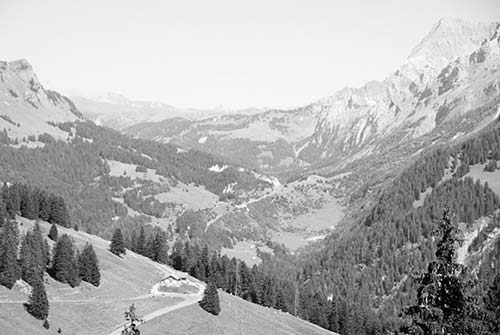
The Gruyères area, just north of Lake Geneva, is particularly handy if you’re traveling between Lake Geneva and points north (such as Bern, Murten, or the Berner Oberland). The town of Gruyères, famous for cheesemaking, is charming but touristy; nearby, you can visit two very different cheesemakers, a chocolate factory, an appealing little mountain with surprisingly big views, a workaday town with a fine folk museum, and more. East of Lake Geneva are even more cute villages that can be laced together with a scenic drive.
Southeast of the lake is the mountainous Diablerets region, highlighted by a picturesque hillside village and a lift up to an icy peak.
GETTING AROUND THE FRENCH SWISS COUNTRYSIDE: THE CHOCOLATE TRAIN
The misnamed “Chocolate Train”—it’s more about cheese than chocolate, and the route’s mostly by bus—is nevertheless a fun, efficient way to connect several French Swiss countryside sights on a day out from Lake Geneva. It’s worth ▲▲.
The excursion begins in Montreux (with easy connections from Lausanne) in the morning, shortly before 10:00. The first leg is a narrow-gauge train ride in old-time belle époque coaches that twist up through vineyards over Lake Geneva (note that this trip is described—in the opposite order—at the end of the Golden Pass route in the Swiss Rail Journeys chapter). You’ll transfer to a bus in Montbovon, which takes you first for a visit to the Maison du Gruyère cheese factory, then up to the town center of Gruyères. Here you’ll have about two and a half hours—plenty of time for lunch and to see the town’s few sights. Then the bus brings you downhill to Broc for a visit/tasting at the Cailler Chocolate Factory, before returning you to Montreux around 17:15. A “guide” offers very little commentary but ensures that nobody gets lost. While a bit pricey, the excursion is a good value when you consider how efficiently it uses your time to combine a cross-section of worthwhile sights and scenery (90 CHF second class or 99 CHF first class, discounts with Swiss Travel Pass; runs July-Aug daily, May-June and Sept Tue and Thu only, none Oct-April; +41 21 989 8190, www.mob.ch).
Gruyères
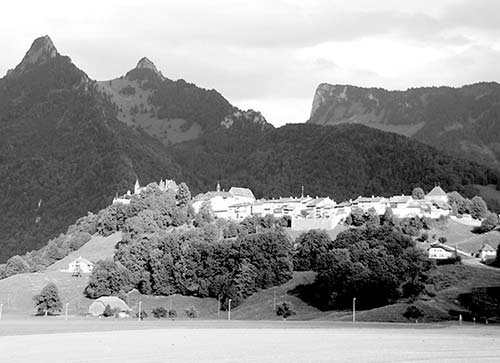
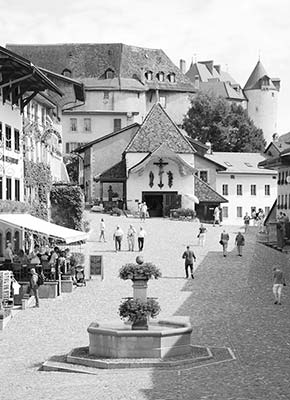
This ultratouristy town, a household name because of its cheese, fills its fortified hilltop like a beautiful bouquet—but when you get up close, you realize the flowers are fake. But even a hardened cynic has a tough time dismissing the town’s undeniable charm. Gruyères’ quaint, cobbled main square, which blankets its hilltop, sags in the middle around its flower-bedecked fountain, with sharp mountain peaks rising on the horizon. The town ramparts are now a park, offering grand views from a lofty perch.
There’s no doubt you’ll be sharing Gruyères: Its ancient buildings serve only tourists; everything is expensive, from museums to food to its other culinary claim to fame, merengues; and it seems the local cafés conspire to ensure there’s nowhere free to sit. And yet somehow, even with those downsides, Gruyères is still worth a visit.
GETTING TO GRUYÈRES
By Train: The Chocolate Train, described earlier, makes things easy. But if you’re coming on your own, the larger town of Bulle is the area’s transit hub, with direct trains from Bern and easy connections from Lausanne (both about an hour away). From Bulle, local trains and buses connect easily to Gruyères (trains run hourly, 7 minutes).
Orientation to Gruyères
Tourist Information: The TI is at the entrance to town just above the main parking lot, where drivers and bus passengers arrive (daily 9:30-17:30, May-June and Sept-Oct closed for lunch 12:00-13:00, shorter hours Nov-April, Rue du Bourg 1, +41 26 919 8500, www.la-gruyere.ch/gruyeres).
Arrival in Gruyères: The town’s train station (gare) is at the foot of the hill, a steep 15-minute hike up to the village itself (as you face town, take the path that angles up to the left through the field; you’ll enter town via the old ramparts). To make things easier, a bus meets each train (stops at curb just outside station shack, 3 CHF, covered by Swiss Travel Pass, 3-minute ride, get off at first stop: Gruyères Ville).
Drivers: Follow signs up to town and shoot for a spot in the handy P1 lot (2 CHF/hour, 5-hour max). On your way uphill, you’ll pass two other lots (P3 on the right, then P2 on the left)—parking in either saves you a few francs but requires a longer walk up into town. On busy days, when P1 is full, the road may be blocked—forcing you to use the lower lots.
Festivals: The town center hosts a one-day cheese festival on the first Sunday in May, and over a weekend in late June the castle goes full medieval with the midsummer festivities of La Saint-Jean. The region’s most colorful autumn cow processions (désalpes) are in nearby Charmey, Albeuve, and Jaun (www.la-gruyere.ch). If you’re here on a summer weekend, you might happen to catch a free alphorn concert on the main square (about a dozen performances a year, mostly Sat or Sun, some on Thu, always 14:30-16:30).
Sights in Gruyères
All of the town center sights are covered by the Swiss Travel Pass. Combo-tickets can save money if you visit more than one sight.
▲▲Old Town and Main Square
Gruyères’ main attraction is the charming town itself—especially the big square that dominates the town center, which feels like a movie set. You’ll see the town symbol—the crane (grue in French)—everywhere. While overtaken by tourism, Gruyères still offers hints of the hard life of centuries past. Imagine the jubilation in 1755 when the fountain (with its wooden pipes) first brought the town running water. If you head down the steep lane to the left of the fountain, you’ll find a small area of surviving ramparts that you can climb on.
Back on the main square, carry on uphill about 40 yards past the fountain and look right to find a big stone block with hollowed-out holes in the top. These were once measuring bins used by merchants when a lively market occupied this square.
Just beyond is the Calvaire, a former guardhouse now converted into a gallery that displays works by local artists (April-Oct only); a picturesque, trough-like fountain gurgles along its left side.
If you bear left around the Calvaire and continue uphill, you’ll pass the H. R. Geiger Museum and the Tibet Museum on your way up to the town’s castle—built in the 13th century and once the fortified home of a leading medieval Swiss noble family, the counts of Gruyères.
Even if you’re skipping the castle interior, don’t miss its garden and ramparts, which are free to enter—you can walk all the way around to enjoy sweeping views of the surrounding countryside.
▲Castle
Gruyères’ castle is nicely restored and works to illustrate its long history. A one-way route takes you through rooms that cover three eras: the 13th century (counts of Gruyères), the 16th century (“bailiffs” period, when financial ruin put the castle under the control of a neighboring state), and the 19th century (the Romantic Age). You’ll climb up and down through several levels, from the hardworking kitchens to beautifully decorated salons and halls. The finest rooms were restored during the Romantic 1800s, when Gruyères’ picturesque townscape put it on the Grand Tour of traveling aristocrats. Two of the highlights, dating from this period, are on the top floor. First is a small exhibit on vintage guidebooks from the Grand Tour age (dating as far back as the early 19th century)—plus a balcony with smashing views over the manicured gardens, ramparts, and mountains beyond. And second is the Knights’ Room, which in the 1850s was slathered with Romantic scenes from the town’s history and illustrious residents. At the end, you’ll be funneled down into the ramparts and idyllic gardens.
Cost and Hours: 12 CHF, covered by Swiss Travel Pass, daily 9:00-18:00, Nov-March 10:00-17:00, +41 26 921 2102, www.chateau-gruyeres.ch.
H. R. Giger Museum
A spooky contrast to idyllic Gruyères, this museum is dedicated to the Swiss artist (1940-2014) best known for designing the gruesome “xenomorphs” in the Alien movies. Not for young kids or the easily creeped out, this museum shares those movies’ dark aesthetic. In this deceptively large space, you’ll climb through three floors of dark rooms filled with dark images, ranging from Geiger’s designs for the films (including life-size models and costumes) to thematically adjacent works that are even more unsettling. Then, on the top floor, you’ll find selections from Geiger’s personal collection of his fellow surreal artists; this feels almost like a mini-Art Brut museum. Most visitors leave with an obvious question: Why Gruyères? Years ago, Geiger came to the castle—just uphill—to present an exhibit of his works. He got a kick out of the juxtaposition between his boldly challenging art and cutesy, traditional Gruyères...so he wanted this to be the home of his legacy.
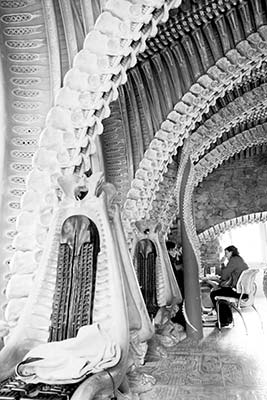
Cost and Hours: 12.50 CHF, covered by Swiss Travel Pass, daily 10:00-18:00, Sat-Sun until 18:30; Nov-March closed 12:00-13:00 and all day Mon; below the castle in the Château St. Germain, +41 26 921 2200, www.hrgigermuseum.com.
Tibet Museum
This museum displays an offbeat but genuinely interesting collection of art and artifacts—statues, paintings, and other objects—from the top of the world. These prized Tibetan possessions of a Swiss collector are thoughtfully displayed inside a former church, making it feel as though the Tibetan deities are squatting in Jesus’ old house. Dim lighting and mood music add to the mellow ambience. It’s very small—especially considering its high price—but might interest anyone who enjoys Tibetan culture. You can use the free Wi-Fi to access English descriptions.
Cost and Hours: 10 CHF, covered by Swiss Travel Pass; daily 11:00-18:00, Nov-Easter shorter hours and closed Mon; 4 Rue de Château, +41 26 921 3010, www.tibetmuseum.ch.
NEAR THE TRAIN STATION
▲La Maison du Gruyère Cheese Factory
Gruyères is justifiably famous for its Gruyère cheese (no “s” at the end when it’s the cheese itself). The cheese is an A.O.C. (appellation d’origine controlée) product, meaning that to be called Gruyère, it must be made right here, according to exacting standards. This modern cheese-production center at the foot of Gruyères is handy for train travelers (it’s right across from the station). To see the same cheese made in a more traditional setting, head to the hillside fromagerie in Moléson (described later). Admission here includes a sample of three varieties of Gruyère cheese (aged 6, 9, and 12 months), plus a cheesy cow-narrated audioguide, essential for understanding the otherwise sparse exhibits.
Cost and Hours: 7 CHF, 12-CHF family ticket, covered by Swiss Travel Pass, daily 9:00-18:00, restaurant, well-stocked gift shop also serves as a decent minimart for picnic fixings and travel essentials, across the street from the train station—or straight ahead as you come down the road from Gruyères’ hilltop, +41 26 921 8400, www.lamaisondugruyere.ch.
Visiting the Fromagerie: A cow consumes 220 pounds of grass and 22 gallons of water each day to produce 6 gallons of milk, while 100 gallons of milk goes into making one 77-pound wheel of cheese. You’ll come across these fun cheese facts and more en route to the viewing area. Smell the various alpine flowers and plants—see if you can discern the subtle flavors they lend the cheese—and hold some cheesemaking tools in your hands. Above the production floor, big windows give you a view down into the milky vats (most interesting when cheese production is going on, generally 9:00-12:30)—watch as the curds are pulled from the vats. Even if cheesemakers aren’t working during your visit, videos show the process. The finale is the cellar (near the ticket desk), where long rows of cheese wheels age. Watch a robot cheesemaker move up and down the aisles, lovingly flipping and rubbing each wheel just right.
Sleeping and Eating in Gruyères
Sleeping: $ Hotel le Saint-Georges is ideal if you want to sleep right on the main square. It has 14 comfortable, traditionally outfitted rooms above a restaurant (Rue du Bourg 22, +41 26 921 8300, info@lesaintgeorges.ch, www.lesaintgeorges.ch).
$ La Ferme du Bourgoz, a quaint farmhouse midway between the walled town and the train station, is a B&B with three homespun rooms and a big family room (Chemin du Bourgo 14, +41 79 252 7451, www.lafermedubourgoz.ch, info@lafermedubourgoz.ch, Eliane).
Eating: Gruyères’ main square is surrounded by $$$ eateries serving (guess what?) all manner of Gruyère cheese dishes. These places are more or less interchangeable; pick the spot with the view that strikes your fancy. (Note that many of them, especially on the right side of the square as you enter town, also have terraces out back with views over the countryside.)
A less romantic but perhaps more practical option: the $$ cafeteria/restaurant at the cheese factory down by the train station. It has a cheery, open, and airy dining hall, some outdoor seating, and good, reasonably priced cheese specialties (same hours as museum—see earlier).
Near Gruyères
The following worthwhile sights are just a short hop from Gruyères in the towns of Moléson-sur-Gruyères, Bulle, and Broc. Bulle and Broc have train stations; Moléson is served by bus. The sights are just minutes apart by car and clearly sign-posted. Drivers can link them with one of my scenic countryside drives through this region, both of which include a stop to summit 10,000-foot Les Diablerets.
Moléson-sur-Gruyères
The sleepy vacation-home village of Moléson-sur-Gruyères, about five miles from Gruyères, is basically a big parking lot with a bundle of condos on one side and three attractions on the other: a mountain lift, the luge ride, and an old farmhouse that offers a cheesemaking demo. The village has a TI (+41 26 921 8500, www.moleson.ch), plenty of free parking, and hourly bus service from Gruyères.
▲▲Le Moléson Mountain
The verdant hills and pastures immediately surrounding Gruyères are beautiful but relatively undramatic, with one exception: the rocky-headed Moléson massif, which stretches up into the air over the hills behind Gruyères. At 6,678 feet, it’s not much by Swiss standards, but its solitary prominence makes for impressive 360-degree views from its summit.
From the parking lot, a funicular takes you to the Plan-Francey transfer point (4,987 feet), where you can catch a cable car to the mountaintop perch. From the top of the lift, you can climb to its rooftop viewing platform—or, for a grand king-of-the-mountain climax, hike 10 minutes up a long set of stairs to the actual summit. From there (weather permitting) you can see Lake Geneva, Mont Blanc, and even some peaks of the Berner Oberland.
The mountain’s hiking options include the 2.5-hour, not-as-steep-as-it-looks Panoramic Trail from the summit to Plan-Francey via Gros-Plané—get details and free hiking maps from the Moléson TI before heading up. There’s a good self-service restaurant at the top of the lift.
Cost and Hours: 35 CHF round-trip to summit, 46 CHF day-ticket covers unlimited funicular and cable-car rides plus the summer luge (described later), no discounts with Swiss Travel Pass or Eurail Global Pass; lifts run daily 3/hour until 18:00 (last descent at 17:40), also Fri-Sat June-Oct 2/hour 18:00-23:00 for stargazing from observatory, and Sat-Sun Nov-Dec 3/hour until 18:00, closed April-mid-May, www.moleson.ch.
▲Fromagerie d’Alpage du Moléson
Each morning at 9:45, the traditional old Fromagerie d’Alpage du Moléson hosts a small group of visitors for a cheesemaking demonstration. In stark contrast to the sterile Maison du Gruyère’s cheese factory, this rustic 17th-century farmhouse gives you an intimate look at the traditional, smelly method of crafting cheese in a huge cauldron over an open fire.
Cost and Hours: 5 CHF for 45-minute cheesemaking demonstration, daily at 9:45, closed Oct-April, lunches served in restaurant; at Place de l’Aigle 12—from the main Moléson parking lot, hike about 5 minutes up to the fromagerie.
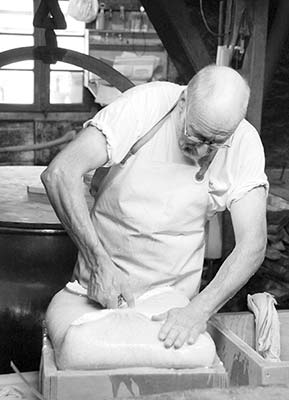
Reservations: Space at the demos is limited to 50 people, so it’s wise to reserve a slot the day before. Use the email link from their website, or call (+41 26 921 1044, www.moleson.ch, Isabelle).
Visiting the Fromagerie: A slow-moving video (with some English captions) traces the entire process. Then they repeat the whole thing in the flesh: First the milk is brought to the proper temperature and consistency. Then the cheesemaker skims out the curds with a cloth and packs it into a frame to drain and compress. Finally, they chop it into blocks and separate it into smaller circular frames that will turn it into wheels of cheese. Visitors are offered cups of the cheesemaking leftovers (milk minus curds, a.k.a. whey) to taste—it’s like sweet skim milk. Then the cheesemaker takes buckets of whey out to feed to the pigs. Unfortunately, there’s not a word of English during the presentation, but even for non-Francophones, it’s still memorable.
Summer Luge
On the hillside next to the fromagerie is a low-key luge ride—not Switzerland’s best, but worthwhile for kids, luge fans, and anyone with the Moléson day-ticket, which covers unlimited rides (6 CHF/ride, daily 11:00-17:00, closed Nov-May and in bad weather).
▲Musée Gruèrien
Bulle’s refreshing, cheery folk museum teaches you all about life in these parts and leaves you feeling good. A two-minute walk behind the castle, the museum is located in the basement of the modern library, with thoughtfully displayed cheesemaking and cow-culture artifacts and fine 19th-century photographs of village and folk life. In this cheese-crazy region, cows are key—notice the many cowbells and the panels from barns painted with murals of the cows’ twice-yearly procession up and down the Alps.
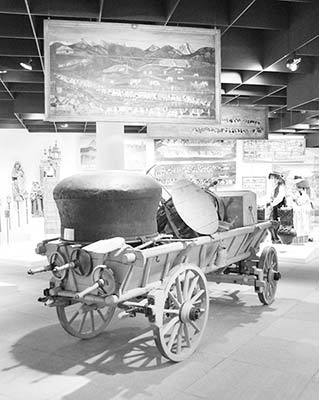
Cost and Hours: 12 CHF, covered by Swiss Travel Pass; Tue-Sat 10:00-17:00, Sun from 13:30, Oct-May closes Tue-Fri 12:00-13:30, closed Mon year-round; Rue de la Condémine 25, +41 26 916 1010, www.musee-gruerien.ch.
Broc
The sweet-smelling town of Broc (pronounced “broh”) is 30 minutes from Gruyères by an hourly train—which takes you right to the chocolate factory (use the Broc-Fabrique stop; they may instead be using a bus if the train line is being worked on). By car, just follow the signs once you get to Broc and park for free in the big square, a five-minute walk from the factory entrance. The Chocolate Train—ahem, bus—brings you right here.
Cailler Chocolate Factory
This giant factory fills Broc’s otherwise tranquil meadow. And the factory’s fun “Maison Cailler” visitors center is an engaging, if expensive, way to learn about Swiss chocolate. It features a tries-to-be-high-tech presentation, followed by the chance to sample several types of chocolate, peek into a working factory, and peruse a gigantic shop. (Note that you only get a glimpse of the production process; for a more in-depth education on how chocolate is made, consider the Alprose factory near Lugano—see here.)
Cost and Hours: 15 CHF, covered by Swiss Travel Pass, daily 10:00-18:00, Nov-March until 17:00, last entry one hour before closing, at Rue Jules Bellet 7, follow signs to Chocolaterie Maison Cailler, +41 26 921 5960, www.cailler.ch. Try to visit in the morning, when it’s less busy. On weekends and in summer, book a time slot in advance online—otherwise the wait can be up to three hours.
Visiting the Factory: Tours depart every five minutes. You’ll be given a “choco-guide” and, with a small group, you walk through a series of eight rooms that present a goofy history of chocolate, from the Aztecs to the present day. You’ll learn how a chocolate-making industry thrived along the shores of Lake Geneva and in the surrounding countryside, and how, over time, several big names—Cailler, Kohler, Peter, and of course Nestlé—incrementally merged into one giant Swiss chocolaterie.
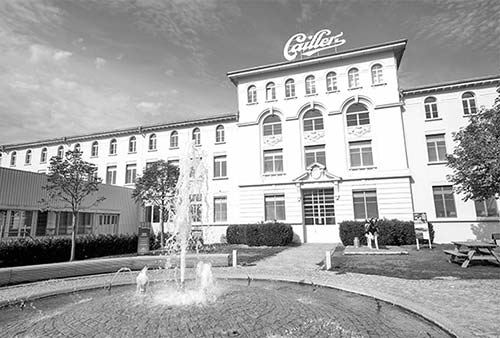
After this 20-minute “tour,” you enter a zone where you learn about Switzerland’s chocolate industry. You’ll smell almonds and hazelnuts, crumble a cocoa bean in the palm of your hand, and touch a block of cocoa butter. Peek into the actual working factory, as video screens explain the process, then taste a variety of Cailler chocolates. Your tour ends in the choc-full gift shop. There’s also a small café with hot chocolate, coffee, and basic sandwiches, and a great playground for kids.
▲▲Scenic Drives in Les Alpes Suisses
Many rent a car in Switzerland simply to better experience the country’s dramatic scenery. And the French-speaking Alps put the “joy” in joyride. In this part of the Swiss Alps east of Lake Geneva, narrow but smooth roads wind past grand old working farms, antique shops, cheesemakers, hilltop churches, lots of lumber industry, and romantic covered wooden bridges. I’ve outlined two scenic driving routes that offer a taste of the area’s remote and pristine landscape. While you can rely on GPS or buy a map, most tourist offices have a free “Grand Tour de Suisse” map that provides the same detail. Before setting out, plot your route by the series of towns and villages you’ll lace together. A highlight of both drives is the most impressive Glacier 3000 mountain lift up Les Diablerets.
Valley Loop Drive from Gruyères (or Bulle)
To see how your car does on steep inclines—and how your travel partner does with carsickness—consider this half-day (3-hour) loop from Gruyères through the Simmental Valley to the town (and cable car) of Les Diablerets. You’ll cover about 80 miles in all, making a tidy little loop around this scenic region. You can also do this loop from Bulle; just follow signs to Broc, then pick up my driving route below.
From Gruyères, head northeast, following signs to Broc (with its chocolate factory, described earlier), then Charmey. The stretch between Gruyères and Broc has fantastic views back to Gruyères town (on the right). From Broc, you’ll follow a tiny road over 4,951-foot Jaun Pass, leaving the French-speaking region for the German-speaking zone. Then you’ll descend scenically into the Simmental Valley (famous for its cows and richly ornamented farmhouses). About 45 minutes into your drive, you’ll reach a fork in the town of Boltigen. Turn right (following the sign to Zweisimmen) to head south on highway 11 through Zweisimmen and Saanen. (From here you could cut the loop short by staying on highway 11 and going directly to Château-d’Œx.) For the full loop, leave highway 11 at Saanen, head straight through two roundabouts, and follow the smaller road south. Continue to resorty Gstaad, pass through idyllic farm country to the cute little hamlet of Gsteig, go over the 5,072-foot pass at Col du Pillon (consider stopping here for its famed Glacier 3000 lift), and arrive at the town of Les Diablerets. Continue west for about six miles to Le Sépey, then head north over the pass called Col des Mosses. At Château-d’Œx, head west and then north (perhaps side-tripping to the scenic village of Grandvillard) back to Gruyères.
From Interlaken to Montreux, Chamonix, or Zermatt
The touristy town of Interlaken (see the Berner Oberland chapter) is a handy base for joyriding through the mountains to other Swiss and French alpine destinations. Drivers leaving Interlaken for Zermatt (with its crowd-pleasing Matterhorn), Montreux (on Lake Geneva), or Chamonix (in France), can spend a couple of hours exploring the region en route. Though most of the drive is the same for all three destinations, expect a total drive time of 2.5 hours to Montreux (80 miles), 3 hours to Chamonix (115 miles), and 3.5 hours to Zermatt (150 miles). (There’s a faster, 70-mile, 2.5-hour route from Interlaken to Zermatt but it misses the charming towns and sights I describe below.)
From Interlaken, head southwest on highway 11, hugging the south side of Lake Thun. When you reach the town of Spiez, take exit 19 (continuing on highway 11) and drive for about 30 miles (roughly an hour) through the pastoral Simmental Valley. At Saanen, head straight through two roundabouts and drive about 12 miles (20 minutes) on a smaller road south through the famed mountain resort of Gstaad, the cute village of Gsteig, and on to Col du Pillon (with the fun Glacier 3000 lift). Next, you’ll pass through Les Diablerets, where you’ll take the fork south (signed Rue des Ormonts) and drive 33 miles (about an hour), climbing over the 5,833-foot pass at Col de la Croix to the delightful little village of Gryon before winding down about 25 minutes to the autobahn (A9/E62) that cuts across southwest Switzerland. From the autobahn, it’s an easy drive to Montreux (20 minutes), Chamonix (1 hour), or Zermatt (1.5 hours).
▲▲▲Diablerets Summit (Glacier 3000)
For a grand alpine trip to the tip of a 10,000-foot peak, take a cable car from Col du Pillon pass to the top of the Diablerets massif, high above the town of Les Diablerets. Up top you’ll enjoy views of peaks all around, a vast glacier slowly oozing down below, and some fun mountaintop diversions. While similar lifts in the Lauterbrunnen Valley and Zermatt area are more thrilling, this is French Switzerland’s answer to high-altitude fun. Allow two hours to get your money’s worth.
Cost and Hours: 85 CHF round-trip, 43 CHF with Swiss Travel Pass or Eurail Global Pass; 3/hour 9:00-16:50, closed mid-Oct-early Nov, +41 24 492 3377, www.glacier3000.ch.
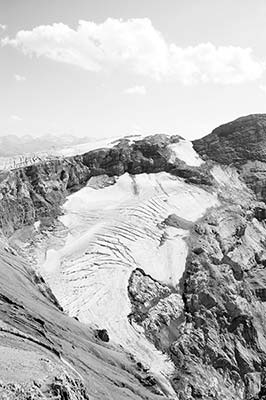
Getting There: It’s about a 1.5-hour drive from Gruyères to the pass called Col du Pillon, where you’ll find free parking at the base of the Les Diablerets cable car. By public transit, catch the train to the town of Les Diablerets; from here public buses connect to the lift (hourly, 15 minutes).
Ascending Diablerets: At Col du Pillon you’ll load into the cable car, ride five minutes up, switch to another car (follow Glacier 3000 signs), then ride another five minutes to the summit. In just 15 minutes total, you’re standing on a perch overlooking a glacier, with panoramic alpine views.
The top of the lift is called Glacier 3000—it’s at nearly 3,000 meters elevation (over 9,800 feet). At your feet sprawls a glacier filled with skiers from fall through spring. I remember summer skiing here—but, with climate change, those days are over. From the top of the cable car you’ll find an elevator (the air is thin so you’ll appreciate the lift), gift shop, view terrace, cafeteria, and restaurant.
To summit the peak called Scex Rouge (which is actually two peaks), climb 100 steps to a viewing platform. From there, walk the thrilling Peak Walk suspension bridge, which stretches 100 yards to the second peak (with the best viewpoint). Free telescopes have built-in labels identifying the peaks. You can see the Matterhorn, Jungfrau, and a bit of Mont Blanc, the Alps’ highest peak.
High-Altitude Luge: From the top of the lift you can ride the “alpine coaster”—the world’s highest summer luge course, perched on a rocky bluff (9 CHF/ride). You’ll sit on a plastic sled and shoot down a 3,000-foot-long metal rail, with twists and turns that feel like they’re about to send you over the edge (pull back on your handles to brake). At the end, you and your sled are pulled safely back up to the top.
Chairlift: A chairlift (included in your lift ticket) takes you down to the glacier. From here, a level but slushy walk across the ice field leads (for about an hour) to a bowling-pin-like rock called Quille du Diable (“pin of the devil”), where you’ll find a restaurant with a terrace and more grand views.
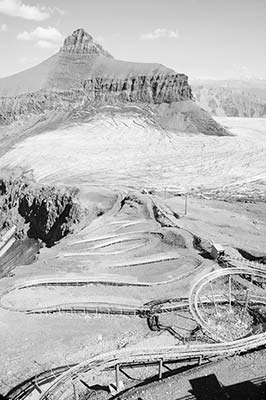
Town of Les Diablerets
The pleasant if scruffy and modern-feeling town of Les Diablerets is 10 minutes from the base of the cable car. It’s a good overnight stop for drivers seeking an evening surrounded by dramatic and snowy mountain views (TI open daily, +41 24 492 0010, www.alpesvaudoises.ch/en/stories/les-diablerets-summer). For public-transit travelers just passing through, Les Diablerets offers bus connections for destinations not served by trains.
My favorite place to stay is $ Auberge de la Poste, offering 10 comfortable rooms with plenty of rustic flavor despite its location in the center of town. Alex Pichard is the latest in a line of Pichards since the French Revolution who’ve run this creaky, low-ceilinged coaching inn (two blocks from the station, just past the TI at Rue de la Gare 8, +41 24 492 3124, www.aubergedelaposte.ch, info@aubergedelaposte.ch). Their $$ restaurant is a reliable choice for an affordable dinner (daily 18:30-21:00).