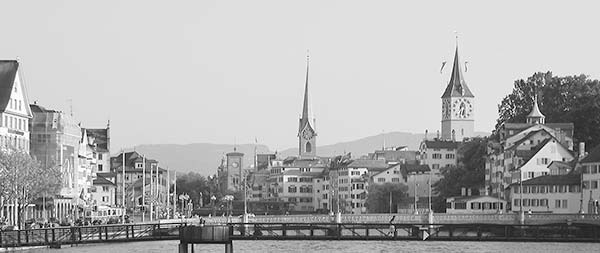
ZÜRICH
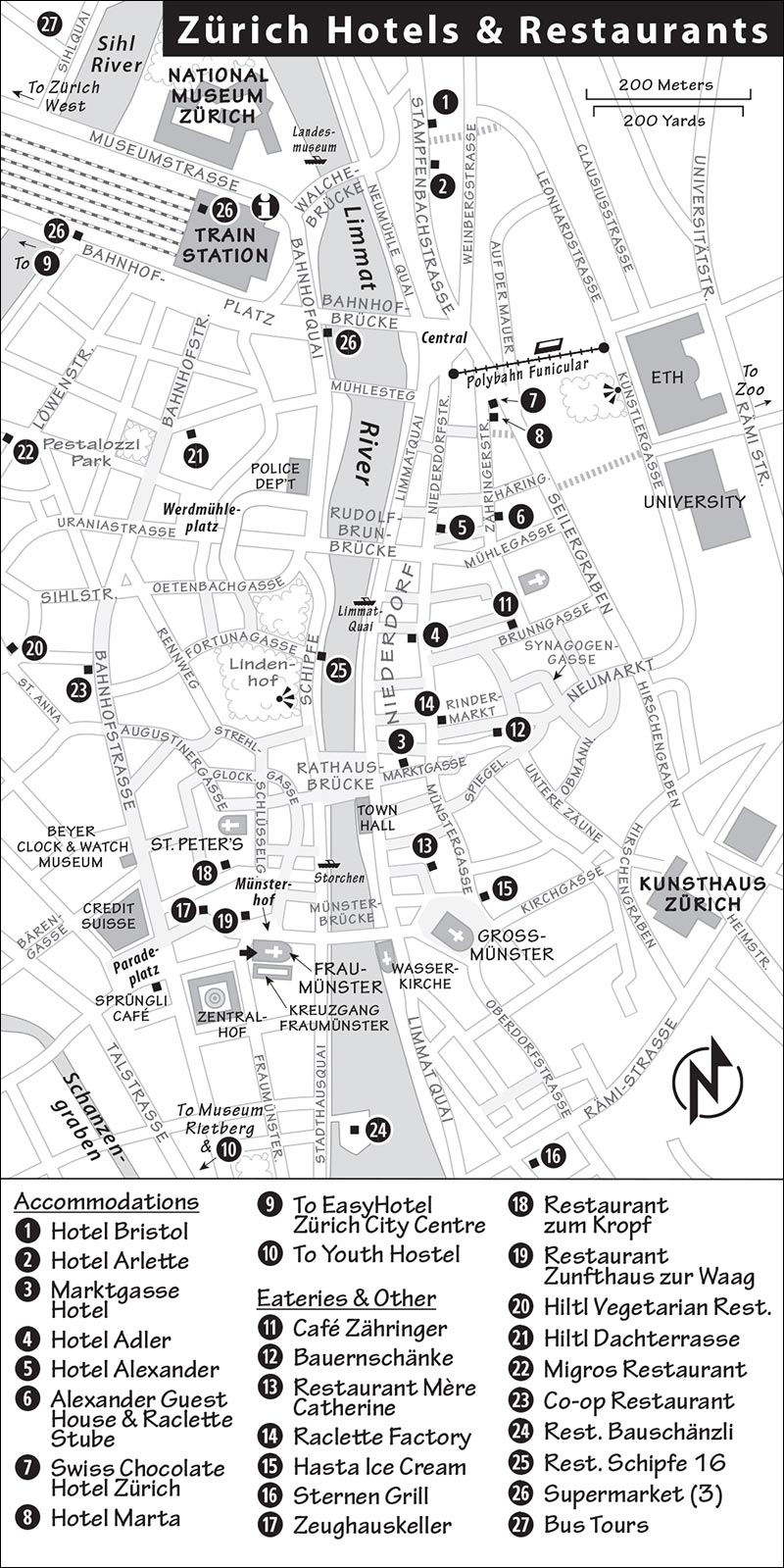
Map: Zürich Hotels & Restaurants
ALONG THE WEST BANK OF THE RIVER
Zürich is one of those cities that tourists tend to skip right over. Since it’s a transportation hub, people fly in or change trains here, but don’t give stopping a serious thought. The local graffiti jokes: Zürich = zu reich, zu ruhig (“too rich, too quiet”). But even though you won’t find a hint of Swiss Miss in Switzerland’s leading city, Zürich is rewarding and worth getting to know.
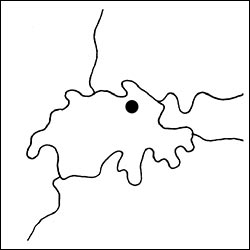
In prehistoric times, people lived on pilings near the shores of Lake Zürich. Later, the Romans founded a city here as a customs post. Roman Turicum eventually became Zürich. It gained city status in the 10th century, flourished thanks to the hard work of its many powerful guilds, and was a center of the Swiss Reformation. By the 19th century it was a leading European financial and economic center. Today, thanks largely to Switzerland’s long-term economic and political stability, Zürich is a major hub of international banking. Assuming you’ve got the money to enjoy it, Zürich is by many measures the world’s most livable city.
For the traveler, Zürich is a city of contrasts. It’s diverse and cosmopolitan, but also quiet and quaint. Fragrant fondue restaurants sit next door to cheap Thai takeout joints and designer boutiques that put Milan to shame. One-third of its residents come from countries other than Switzerland (169 nationalities, at last count), and one-third of its territory is nature (“if you count the river and lake,” locals explain).
While not the capital, Zürich is far and away Switzerland’s biggest city—a hub for both business and transportation (with the country’s dominant train station and airport). Perhaps Zürich’s hard-to-pin-down character is rooted in its role as home to Switzerland’s Reformation: The city retains a no-fuss, no-muss, nose-to-the-grindstone Protestant work ethic that leaves little time for colorful flourishes. Locals pride themselves on being private, discreet, and no-drama.
Zürich is the only place in Switzerland where I’ve seen men in ties running in the streets. And it’s the only place I’ve seen a shop clerk dispose of a cigarette by slipping it into the finger hole of a manhole cover, rather than just tossing it on the ground.
PLANNING YOUR TIME
While Luzern and Bern provide more charming and compact urban experiences, Zürich is worth a look. With two weeks in Switzerland, I’d spend a day here. Begin by visiting the impressive National Museum Zürich (a.k.a. Landesmuseum), then wander along the river, using my self-guided walk, and take a river/lake cruise. With less time, do only the walk. With more time, check out the excellent art museum, visit the up-and-coming Zürich West area, or head to the countryside (zoo or Uetliberg viewpoint). While there are more charismatic places to overnight, you won’t regret sleeping in Zürich—the city offers plenty to keep visitors engaged.
Orientation to Zürich
Zürich—with about 430,000 people (1.4 million in greater Zürich)—is draped around the northern tip of the long, skinny Lake Zürich (Zürichsee). The grand Bahnhofstrasse cuts through the city’s glitzy shopping center, connecting the train station with the lakefront (a 15-minute walk). Across the Limmat River is the Niederdorf neighborhood—a vibrant, cobbled, Old World zone of colorful little shops, cafés, and restaurants. West of the train station is the emerging Zürich West dining and nightlife zone.
TOURIST INFORMATION
The helpful TI is off the great hall of the train station, near the giant blue angel hanging from the ceiling (Mon-Sat 8:00-20:30, Sun 8:30-18:30, shorter hours off-season, +41 44 215 4000, www.zuerich.com).
For a whirlwind visit, consider the TI’s Zürich Card, which covers public transit (including trips to the airport and up to the Uetliberg viewpoint); river boats and short and mini lake cruises; admission to most of the city’s museums and discounts on others; half off the TI’s city walking tour; and freebies in many restaurants (27 CHF/24 hours, 53 CHF/72 hours, sold at TI). The one-day card pays for itself if you do the walking tour and one museum.
ARRIVAL IN ZÜRICH
By Train: The slick train station is at the north end of downtown. Many platforms are underground; to orient yourself, follow signs for tracks 3-17, which dead-end at the great hall of the station.
In the hall (with your back to the tracks), the ticket office is to your left (daily 6:00-21:00), with the TI just beyond it. Exiting through the front doors—straight ahead—brings you to the river (cross it to reach most recommended hotels). Lockers are down one flight below the big blue angel, and a pricey WC (with showers) is down two flights. A long-hours Migros supermarket is in the maze-like shopping mall one level down. The right-hand doors of the hall lead to tram stops and Bahnhofstrasse, while the left-hand doors lead toward the National Museum Zürich.
By Plane: If arriving at Zürich Airport, see the end of the chapter.
GETTING AROUND ZÜRICH
Much of Zürich is walkable, but it’s big enough that trams, buses, and boats can make things easier. Handy trams run south from the station to the lake on either side of the river: #4 along Limmatquai and #11 along Bahnhofstrasse. The riverboats and short lake cruise are part of the system, but longer lake cruises are not.
The Swiss Travel Pass, Eurail Global Pass, and Zürich Card cover all city transit. Otherwise, individual tickets cost 2.70 CHF for a “short stretch” ticket of a few stops (Kurtzstrecke), or 4.40 CHF for one hour (Einzelbillett). A 24-hour pass (Tageskarte) for 8.80 CHF is a good investment for a full day in Zürich (13.60 CHF for three-zone version that includes airport and other outlying sights). For transit information, visit www.zvv.ch.
HELPFUL HINTS
Medical Help: The Permanence drop-in clinic on the main floor of the train station offers on-the-spot medical aid (daily 7:00-22:00, Bahnhofplatz 15, +41 44 215 4444, www.permanence.ch). The Bahnhof Apotheke is a convenient pharmacy next door (daily 7:00-24:00). A dentist is on the lower level.
Laundry: A short ride north from downtown, Expresswäscherei Selfservice is next to the Kinkelstrasse tram stop for trams #9 and #10 (daily 7:00-22:00, Wintherthurstrasse 62, +41 76 577 4164 or +41 76 305 1111).
Parking: Parking a car in Zürich will cost you. Downtown garages run about 45 CHF/24 hours; park-and-ride lots on the city outskirts are about 30 CHF/24 hours. For a list of lots, see www.pls-zh.ch.
Shopping on Sunday: Though most stores are closed on Sunday, the vast mall under the train station is wide open.
Tours in Zürich
Walking Tours
Group Tours: The TI’s two-hour guided walk is similar to the self-guided walk in this chapter (25 CHF, half-price with Zürich Card; leaves from TI Mon, Wed-Thu, and Sun at 11:00, Sat at 13:00; Nov-March tours run Wed and Sat-Sun only; confirm times and book at www.zuerich.com). Unfortunately, the tour is usually given in both German and English (sometimes heavily favoring German—depending on who signs up). The TI website also links to a range of specialized group tours run by private companies.
Private Tours: The TI can arrange private walking tours (280 CHF/2-3 hours). On the TI website (www.zuerich.com) choose “Tours and Excursions” under “Things to Do,” then look for the private version request option. Alternatively, write to info@zuerich.com. You can request energetic and informative Nicole Berger.
Bus Tours
If you’d rather ride than walk, consider a bus tour. Two companies offer similar two-hour tours several times a day for 34 CHF, leaving from the bus lot behind the train station. It’s easiest to book through the TI website (www.zuerich.com).
Zürich Walk
3 Bahnhofstrasse to Pestalozzi Park
4 Police Department (Stadtpolizei)
7 St. Peter’s Church (St. Peterskirche)
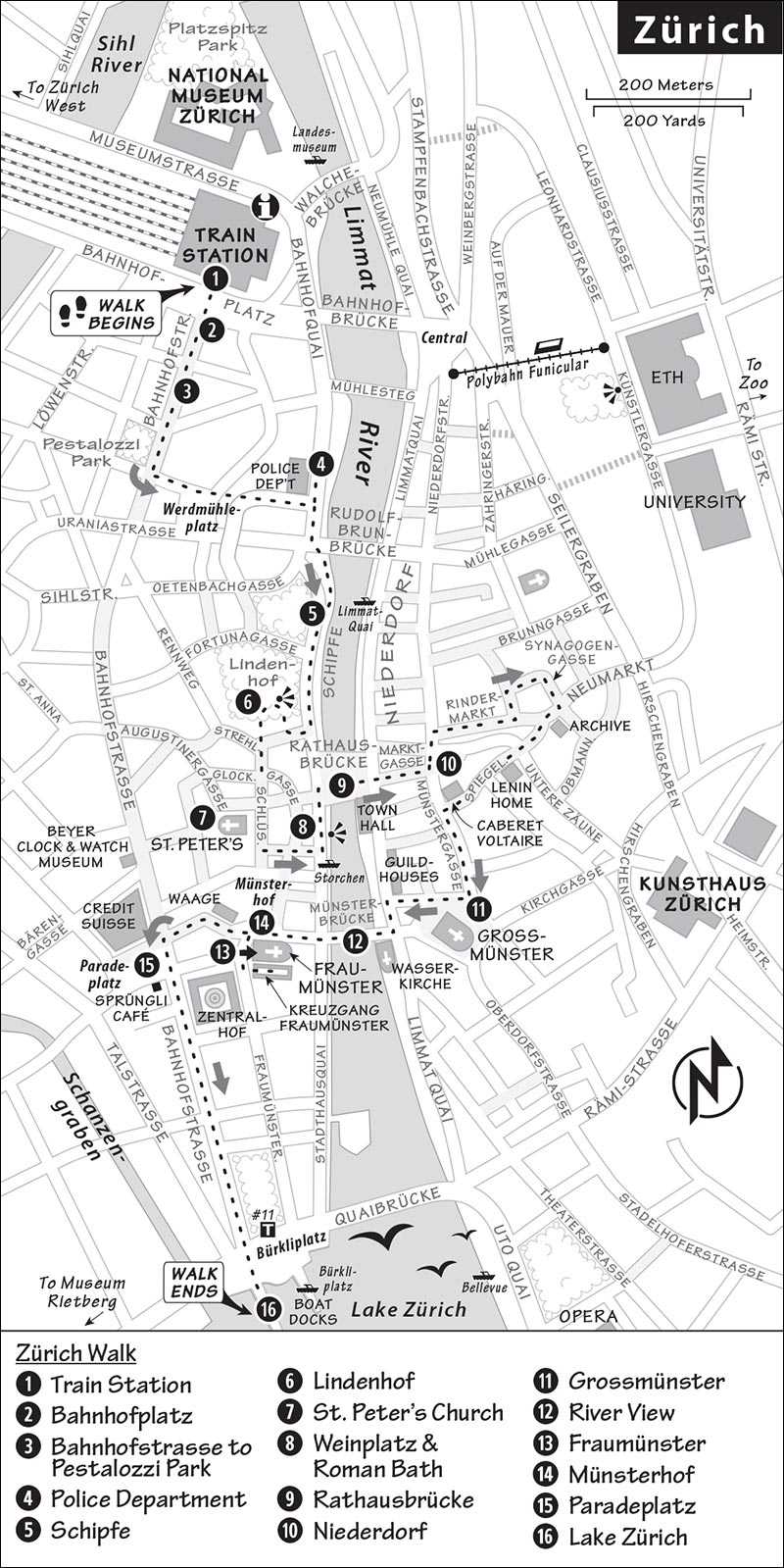
If you’re blitzing Zürich from the train station, this self-guided walk is a great way to connect the city center’s main sights. It crisscrosses the river en route to the boat dock for a lazy lake-cruise finale (or a quick tram ride back to the station). Allow about 1.5 hours. Add 30 minutes to enter the two major churches (Grossmünster and Fraumünster).
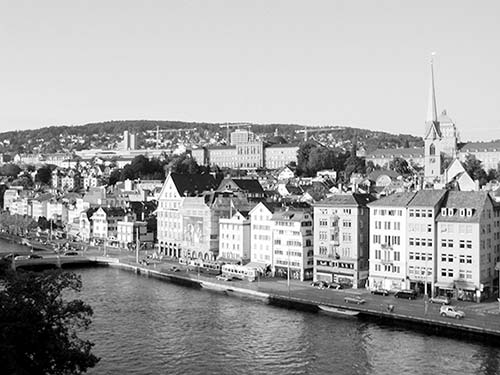
1 Train Station
We’ll start on the ground level of the train station, in the cavernous main hall (follow signs for tracks 3-17, and you’ll see the hall at the end of the platforms). This major European hub handles 2,000 trains a day, including InterCity expresses to many major capitals. To keep up with Europe’s ever-faster transportation expectations, some of the station’s tracks have been tunneled two stories underground so trains can zip through the city rather than dead-ending at the station.
The vast main hall, built in 1870, once housed six tracks and platforms. Today, it doubles as a community-events venue busy with concerts, exhibitions, and even “beach” volleyball—and a farmers market on Wednesdays. Between the ground level and the lower tracks is a modern shopping mall.
Above you in the main hall hangs a zäftig blue angel, Zürich’s “Guardian Angel,” protecting all travelers. The angel (sculpted by French-American artist Niki de St. Phalle) was placed here in 1997 to celebrate the 150th anniversary of the Swiss rail system.
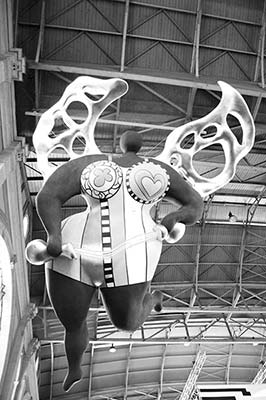
If the angel hopped down, walked toward the tracks, turned right, and crossed the street, she’d arrive at the National Museum Zürich (Landesmuseum). It’s the best museum in town, offering an essential introduction to Swiss history. Consider touring this museum before starting the walk (see listing under “Sights in Zürich,” later).
• Exit the station hall to the angel’s left, following a passage leading to Bahnhofplatz (also well-signed).
2 Bahnhofplatz
Mile-long Bahnhofstrasse, stretching from the train station to the lake, is lined with all the big-name shops. Cross the street (watch for silent trams), but before heading down the street, pause on Bahnhofplatz and look back at the station.
The station facade is a huge triumphal arch, built in 1871 to symbolize the rise of industry. In the Industrial Age, Zürich emerged as Switzerland’s leading city. Sitting atop the arch and presiding over all this triumph is Helvetia, the personification of Switzerland (she sits beneath a Swiss flag). The Helvetii were the Celtic tribe that the Romans defeated in 58 BC to gain control of what is now Switzerland. Helvetia was adopted as a symbol of the Swiss confederation in 1848 (a Swiss version of France’s Marianne), when the diverse cantons that banded together to create Switzerland needed some symbol of unity to transcend all their linguistic and regional differences. The same word was put to use in the Latin name for the new federal state (Confoederatio Helvetica). Today, this neutral name is used when there’s a need to avoid favoring any of the country’s four languages—thus the “CH” on Swiss license plates, in web addresses, and in the abbreviation for the country’s currency (CHF).
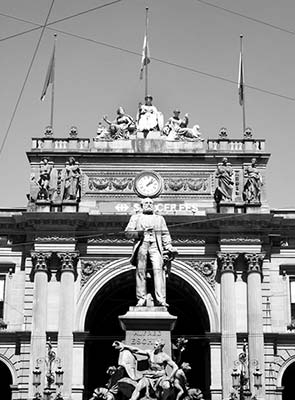
Helvetia is flanked by allegories of river travel (the goddess sitting on the boat) and rail travel (another goddess sitting on a locomotive), reminding us that Zürich has long been a transportation hub. Zürich’s river, the Limmat, starts from the lake and eventually flows into the Rhine (reaching the Atlantic at Rotterdam).
The statue in the foreground honors Alfred Escher, the Zürich-born politician who, in the mid-19th century, spearheaded the creation of the infrastructure—railways, universities, and banks—that allowed Switzerland to function efficiently within its mountains and connected this country with the rest of Europe. It was his idea, for example, to link the flat, urban north of Switzerland to Italy with the nearly 10-mile Gotthard Tunnel (completed in 1882). He was also instrumental in founding Credit Suisse bank and Swiss Life insurance company. Without Escher, it’s quite possible Switzerland would never have become such an economic powerhouse. Infrastructure!
• Start strolling down Bahnhofstrasse.
3 Bahnhofstrasse to Pestalozzi Park
Bahnhofstrasse was built in the 1860s, when the newfangled train station needed a suitable approach road. Long before there was a train station, this would have been the moat lining the town’s 13th-century fortifications. Today, you can stroll the entire boulevard from here to the lakefront. As a center of the banking and insurance industries, there’s a lot of wealth in Zürich, as evidenced by the department stores, elegant shops, and banks you pass along the way—and their well-dressed clientele. Locals say that prices go up and shops get fancier as you get closer to the lake.
Among the Swiss, Zürichers have a reputation for being hardworking, impatient, and a bit snobby. Notice how the traffic lights flip from green to yellow to red at an unforgiving pace—nobody has time to waste.
Near the end of the first block are three chocolate shops: Lindt and Bachmann on the right, and Läderach on the left.
• In two blocks (on the right), you’ll see a park.
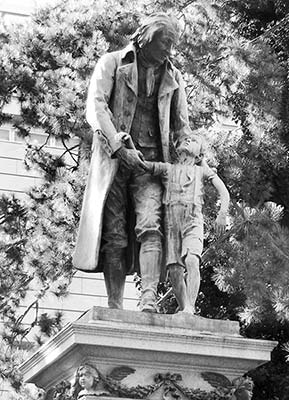
The only park along this pedestrian- and tram-only boulevard is dedicated to a famous Swiss educational reformer, Johann Heinrich Pestalozzi (1746-1827). He promoted the then-radical notions that good education should focus on the whole child (not just on specific skills) and should be available to everyone (not only the sons of rich families). He’s standing in front of the Globus building, which used to be a school. Parks like this are rare in central Zürich because of sky-high property values—Swiss real estate is among the most expensive in the world.
In the park’s far corner gurgles a green, Parisian-style fountain. More than 1,200 fun and fresh fountains are sprinkled around town, spouting water that’s as good as bottled mineral water (the city regularly checks its quality). This is a blessing in a town where restaurants charge for a glass of tap water. Tourist brochures brag that Zürich is Europe’s most “fountainous” city.
• From the green fountain, turn left across the street and head two blocks down Werdmühlestrasse. Then follow white Stadtpolizei signs up and around to the river side of the grand building facing the water. This is the...
4 Police Department (Stadtpolizei)
Enter the big police building at Bahnhofquai 3 for a peek at a fine example of Swiss Art Nouveau, called Jugendstil in German (free, open daily 9:00-11:00 & 14:00-16:00). The Swiss artist Augusto Giacometti (1877-1947) painted the arched vaults of the building’s entry hall in the 1920s. Awash in vibrant orange and red, with flowery motifs, the “Hall of Flowers” reflects the relief and joy the artist felt when World War I ended. (Augusto’s nephew, Alberto, is the more famous Giacometti, well known for his tall, skinny statues.) Before the police moved into the building in the early 20th century, it was the city orphanage and prison, and in earlier centuries there was a Dominican cloister on the site.
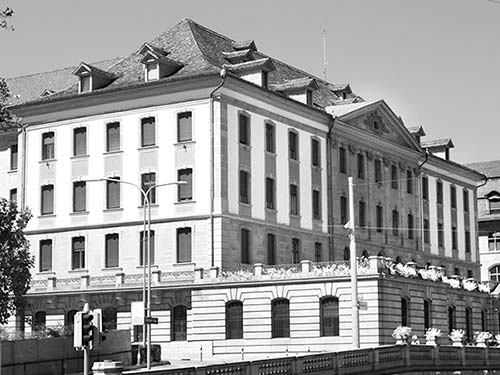
• From the door of the police building, head to the right, upstream along the river. (Notice the towering old observatory off to your right.) Ahead of you, the inviting Schweizer Heimatwerk shop shows off Swiss folk crafts. It originated long ago as a place for farmers and mountain folk to showcase and retail the handiwork that the boredom of their long winters inspired.
From there, go down the stairs and continue walking upstream. You’ll pass curious and arty little shops and come to a delightful riverside square. (High above you on the right is a viewpoint on a bluff. That’s Lindenhof, where we’re heading.)
Switzerland has a progressive drug policy that aims to reduce the overall harm to its society, rather than focus on punishing users. Even by European standards, the country’s approaches to soft and hard drugs are unusually pragmatic.
Switzerland’s policy has swung harder and softer in recent years. When polls showed that more than 30 percent of Swiss people had used marijuana, the parliament decided to decriminalize the drug. But the laws, which vary between cantons, remain ambiguous: The Swiss can possess and use pot, but they can’t sell it. Each spring, there’s a push for stricter control. Word gets out that Switzerland is no haven for pot, and then things ease up. Now medical marijuana shops can legally sell very weak strains of marijuana that contain less than 1 percent THC. Smoking this gets you relaxed but not high.
Unlike marijuana, hard drugs remain illegal. Still, Swiss laws treat addicts as people needing medical help, rather than as criminals. Zürich was ground zero for junkies in the 1980s and early 1990s. Beginning in 1987, heroin use was tolerated in the park called Platzspitz, along the river just behind the National Museum Zürich. Dubbed “Needle Park,” the space became a magnet for thousands of users, a hotbed of crime, and one big public health hazard. In a confrontation that looms large in local history, local police reclaimed Platzspitz in 1992.
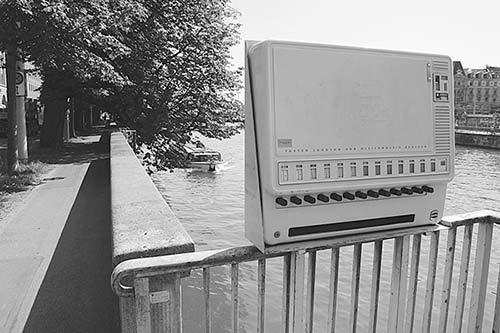
That year, Zürich pivoted to a harm-reduction, addiction-maintenance model by providing the heroin replacement drug methadone (or actual heroin) to addicts who couldn’t get clean. The city funds needle exchanges and counselor-staffed safe houses where addicts unable to recover can proceed, without endangering themselves or others. If you know where to look, you can see evidence of this policy. For instance, across the river from the station, on the far side of the Walchebrücke bridge, there’s a big, nondescript vending machine selling safe, government-subsidized syringes.
The policy shift worked. Nationally, the opioid-related death rate has dropped by two-thirds, and heroin use among young people has dwindled to historic lows. Crime also decreased, and you see very few street addicts in Zürich. A similar approach was quickly embraced nationwide, later confirmed by 70 percent of Swiss voters in a national referendum in 2008. As the US grapples with its own opioid crisis, perhaps we can take inspiration from the pragmatic, compassionate, and highly successful Swiss approach.
5 Schipfe
Back when the city’s trade depended on river traffic, this small street was Zürich’s harbor. Today it retains its old river-merchant ambience. This area has several businesses that are subsidized by the city government to support down-on-their-luck locals and worthy causes. On the left at #24, the Marktlücke shop aids single mothers; they sell interesting gifts, including items made from recycled materials. At the far end of the little square is a fun waterfront eatery—the recommended Restaurant Schipfe 16—that operates as a charity, employing people who are trying to get back on their feet.
Continue past the restaurant, admiring the antiques in the windows of the Vock shop (which painstakingly restores classic pieces). Bear left at the fork, and soon you’ll reach an arcade that runs along the river. Head through it, passing an interesting strip of little artisan workshops and boutiques (also subsidized by the local government, to enliven this central area with traditional crafts).
• Emerging at the far end of the arcade, near a fine fountain, turn right (away from the river) and head up the stairs. Bear right at the fork (with the Old Crow sign), then left at Wohllebgasse. Climbing up from the river, watch on the right for Pfalzgasse, which leads steeply to a park with fine views.
6 Lindenhof
Important forts and strategic buildings stood on this bluff from Roman times through the ninth-century Carolingian era. The statue commemorates the local women who cleverly defended the town in 1292. Their men were engaged in another battle when the Habsburgs encircled the city. The women put on armor and made like a big, rowdy army, tricking the Habsburgs into thinking the whole city was prepared to attack.
In the early 13th century, Zürich became a free city of the Holy Roman Empire, meaning it was relatively autonomous and self-ruling. The townspeople destroyed the fort here and established a law forbidding any new construction. The citizens realized that whoever lived on this hill would control the city—and they didn’t want any more such rulers. Today, this is a people’s square, where locals relax under linden trees (for which the square is named) and enjoy the commanding city view.
Look out and survey the city. Zürich University (behind the skinny green spire) is the largest in Switzerland, with 25,000 students (and was the first German-speaking university to allow women students, in 1847). Left of that is Zürich’s renowned technical college, the ETH (Eidgenössische Technische Hochschule—the Federal Institute of Technology), with 15,000 students. The ETH has graduated more than 20 Nobel Prize winners, including Albert Einstein and Wilhelm Röntgen (who discovered X-rays). The ETH terrace offers a great city viewpoint (which you can visit later by riding the little Polybahn funicular). Below these storied institutions, lining the opposite side of the river, the Niederdorf is a lively district of restaurants, cafés, and bars. We’ll walk through there soon. On a clear day, you can see the Alps beyond the twin domes of the Grossmünster.
• Descend the stairs at the back corner of the park, just beyond where you entered (near the giant chessboard), to a little square with a fountain. The fountain’s armpit points you down Glockengasse. Heading that way, you’ll reach a big golden bell (at the Haus zur Glocke); take the narrow lane around its left side (Robert-Walser-Gasse). You’ll pass a characteristic eatery, Restaurant Kaiser’s Reblaube, made famous by visits from Goethe in 1779. He’d meet here for long, wine-fueled discussions with the minister of...
7 St. Peter’s Church (St. Peterskirche)
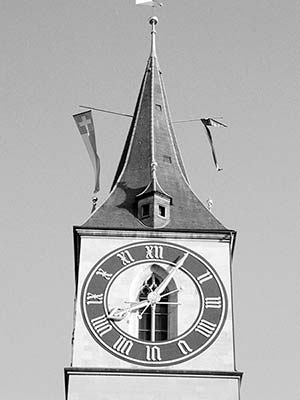
Founded in the seventh century, this church—Zürich’s oldest—has one of Europe’s largest clock faces (28 feet in diameter). The town watchman used to live above the clock. If he spotted a fire, he would ring the alarm and hang a flag out of the window facing the blaze. This system seems to have worked—Zürich never suffered a devastating fire.
• Continue past the church on Schlüsselgasse and take the first left, down the narrow Thermengasse (Bath Lane). Here we meet a bit of Roman Zürich. Glass cases in the wall contain artifacts, and under your feet are the excavations of a Roman bath, discovered by accident in 1984. You’re standing over studs that elevated the floor, which was heated from below.
The lane empties out on...
8 Weinplatz
This pleasant spot was a wine market in centuries past (look for the happy grape picker on the fine little fountain). Zürich never had a centralized market hall, and this is just the first of many such market-themed squares that ran through town; I’ll mention several of them in the next few blocks. (Notice the dock here for the riverboat-bus—described later, under “Sights in Zürich.”)
• Now cross the wide...
9 Rathausbrücke
Built on the site of the town’s first bridge, this is, quite possibly, the ugliest bridge in Switzerland. You’ll see a fancy Neoclassical police station (on the left).
At the far end of the bridge, the big building on the right is the 17th-century, Renaissance-style Town Hall. Below the second-story windows, find the fruits and vegetables carved into the stonework—a subtle reminder that this bridge was once the Gemüsebrücke, where produce (Gemüse) was sold. The bridge still hosts a farmers market on Saturdays in summer (and locals still call it by that old nickname). Above the ground-floor windows, you’ll see busts of Greek, Roman, and Swiss heroes, including (at the far end just before the street) William Tell and his crossbow. Before crossing the tram tracks, look back, along the street-facing side of the Town Hall. Instead of veggies, this side is decorated with fish—indicating the historic location of a fish market.
• At the end of the bridge, cross the street and walk a block straight uphill along Marktgasse. Pause where the street hits a T-intersection. You’re standing in the heart of the bustling neighborhood called...
10 Niederdorf
“Niederdorf” means “nether town”—across the river from the historic core of Zürich. Today Niederdorf is a district of colorful streets, fun shopping, restaurants, and nightlife. This is a great spot for dinner (scope out menus as we explore, and see my dining suggestions later, under “Eating in Zürich”).
Let’s take a little loop through Niederdorf to see some facets of this neighborhood that many visitors miss. Turn left to continue along narrow Marktgasse, which was the leading commercial street before the old city wall was torn down to create Bahnhofstrasse. After two short blocks, turn right up Rindermarkt (“Cattle Market”)—yet another street named for its onetime commerce. Follow this broad street one long block, past high-end shops, art boutiques, furniture shops, and some tempting restaurants. This atmospheric street is still lit with gas lamps.
Just after the Travel Book Shop (on your right), turn left on Froschaugasse. Then, just a few doors down, squeeze through the green doors on the right (just before #8), entering Synagogengasse (Lane of the Synagogues). Follow this narrow passage, which is where the city’s Jews once lived, mixed in among their non-Jewish neighbors, until the pogrom of 1249. The alley bends right before popping out at Neumarkt, where historically household goods were sold.
Head directly across wide Neumarkt—passing inviting café tables huddled around a fountain—and find the door at #4, with the stone plaque that says Zvm Vntern Rech. This is the City Archive (free, closed Sun). If it’s open, go in and head straight back to a big room with a wonderfully detailed city model of Zürich around the year 1800 (based on the two maps you see hanging on the wall). Notice the moat—which is now Bahnhofstrasse—and the outer, star-shaped fortifications that beefed up the city in the 17th century. (You can still see echoes of this in a city map.)
Exiting the archive, immediately turn left to head up the narrow lane called Spiegelgasse—watching on the left for a cute little interior garden (at #22). Locals brag about how green their city is; there are many such private, hidden gardens even in the dense medieval center.
Find #16, on the left. Now a clothing store, this was once a butcher. Notice the cleaver motif in the ornate window frames, and peek inside to see how old meat hooks still hang from a meat-themed ceiling fresco.
Next door, at #14, look up to see a plaque identifying where Vladimir Lenin lived in exile from February 1916 until April 1917. When he left here, he traveled north to Helsinki, boarded a train, and was greeted as a conquering hero upon arriving in St. Petersburg, where he took leadership of the revolution that would topple the monarchy and introduce communism to Russia.
Cresting the hill and passing a fountain, continue straight downhill along Spiegelgasse. On the right is the Cabaret Voltaire, where a different type of revolution was taking place. In 1916, the “anti-art” Dada movement was started here by a group of rebellious young artists and writers. Although the Dada movement picked up steam, the cabaret itself lasted only until 1917...complaints about excessive nightly noise forced its closure.
You’ve made a loop, and you’re back near where we started our tour of Niederdorf. Turn left on Münstergasse. A couple of doors down on the right at #19, pop into Schwarzenbach, a delightful specialty grocery store that’s been operating here for more than 100 years. They still sell things the old-fashioned way (in loose bags, by weight). Inhale. Pick up 100 grams of dried bananas from Togo or whatever appeals (closed Sun). They also roast coffee beans next door on Tuesday and Thursday mornings, making this whole street smell like coffee.
Across the street and up three steps is Café 1842, a venerable chocolate shop that feels like a time warp, with a fine perch from which to enjoy a cup of coffee or hot chocolate. Across the lane to the left is a Swiss schnapps shop.
• Farther along, Münstergasse runs into the...
11 Grossmünster
Literally the “big cathedral,” this is where Huldrych Zwingli—whose angry religious fervor made Martin Luther seem mellow—sparked the Reformation in German-speaking Switzerland. The domes of its towers (early examples of Neo-Gothic) are symbols of Zürich. They were rebuilt following a 1781 fire, and after much civic discussion were left a plain stone color.
Cost and Hours: Church—free, Mon-Sat 10:00-18:00, Sun from 12:30, off-season until 17:00; tower climb—5 CHF, closes 30 minutes earlier than church; cloister—free, Mon-Fri 10:00-17:00, closed Sat-Sun; www.grossmuenster.ch.
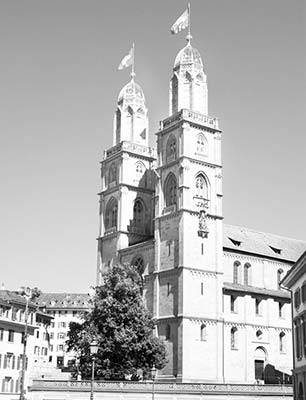
Visiting the Church: Step inside and sit down. Let the strength and purity of the 12th-century Romanesque architecture have its way with you. The simple round arches seem strong, and the pulpit—surrounded by none of the old Catholic ornamentation—gave you almost no alternative other than to be riveted by Zwingli’s fiery sermons. Zwingli’s reforms led to a clean sweep of Catholic decor in 1519. (For the story of the Swiss Reformation, pick up the church’s English-language leaflet.)
Behind the altar in the apse are three choir windows by Augusto Giacometti (c. 1933). Mary and the Baby Jesus (at her feet) meet two of the three kings bearing their gifts, while angels hover above with offerings of flowers. You can walk to just below the windows for a closer look. While there, check out the 1531 Zürich Bible. (Like Luther, Zwingli was a fan of having the Bible available in the people’s language—which is what got them in hot water with the Church.)
In the dank crypt (stairs below altar), you’ll see an original 15th-century statue of Charlemagne (a copy now fills its niche on the river side of the church exterior).
For a sweeping city view, climb the 187 steps to the top of the Karlsturm, one of the church’s twin towers.
Leaving the church, go right and into the corner, where a door leads to a fine Romanesque cloister ringed with fanciful 12th-century carvings. Upon entering, take 10 steps to the left and meet the sculptor (self-portrait on the highest arch).
Before moving on, circle around to the river side of the church. Up eight steps, find the bronze door depicting scenes from the life of Zwingli.
• Head down to the bridge and walk halfway across the river. Pause in the middle of the bridge for a...
12 River View
This spot—flanked by Zürich’s two most important churches—is one of the most scenic places in town.
Look back toward the Grossmünster. The building sticking out into the river on your right is the Wasserkirche (Water Church). According to the city’s foundational legend, two early Christians (Felix and Regula) were beheaded by Roman authorities on this spot in the third century. Miraculously, they picked up their heads, walked 40 paces up the hill, and lay back down again on the site of today’s Grossmünster. (Later, they were joined by a third headless body—so you’ll see the “three headless bodies” motif around the city.) Flash forward 600 years: It’s said that Charlemagne was out hunting when he discovered the bodies, and decided that this would be the optimal site of the city’s main church. The only statue that adorns the church—high up on the side of the steeple facing this bridge—shows Charlemagne, with his golden crown.
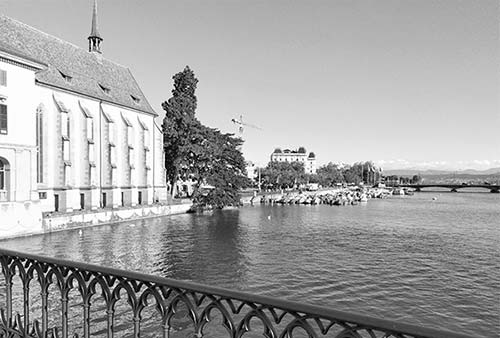
Looking left along the river, you see stately old houses. Many of these are guildhouses (Zunfthaus). Merchant towns like Zürich were dominated by guilds—groups of like-minded, wealthy burghers, often of the same profession, who combined to have serious clout. In fact, guilds dominated the city’s civic life; the city is sometimes called Bürgertum (town of burghers) or Zunftstadt (guild city). As we stand between two giant churches, notice that both are called Münster—not “cathedral.” Zürich didn’t want a cathedral—or the bishop who’d come along with it and constantly boss around the burghers.
Guilds have loomed so large in the story of Zürich, in fact, that they still survive today, as modern-day social institutions (similar to a Rotary or Elks club). There are about a dozen historical guilds, and about a dozen modern ones—but none of them admit women. Each Zunft (guild) meets in its own Zunfthaus, which have both meeting rooms and restaurants or reception halls that are open to the public. You can see three guildhouses along the water: Below and to the left of the Grossmünster (with the red turret) is the Zunfthaus zur Zimmerleuten (for carpenters); next door is the Haus zum Rüden (“House of the Hound,” for an association of noblemen); and across the river is the big, pink fishermen’s guild (now the swanky Hotel Storchen).
• Continue the rest of the way over the river to the tall-steepled church with “1732” on the tower.
13 Fraumünster
This ▲▲ church was founded along with a convent in 853, when Zürich was little more than a village. The current building, which sits on the same footprint as its predecessor, dates from 1250. With the Reformation of Zwingli, the church was taken by the Zürich town council in 1524 and—you know the drill—gutted to fit Zwingli’s taste. Today, the Fraumünster’s claim to fame is a collection of 30-foot-tall stained-glass windows by Marc Chagall (1887-1985), the Russian-born French artist. The included audioguide also explains the rest of the church—including the historic crypt with fine and well-described artifacts (stairs from near the altar).
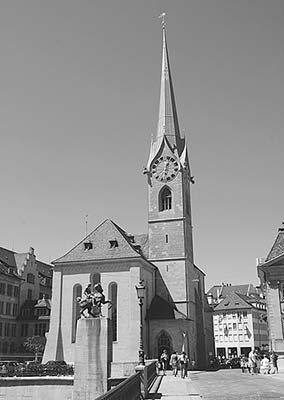
Cost and Hours: 5 CHF, includes excellent audioguide or a brochure; Mon-Sat 10:00-18:00, Sun from 12:00, Nov-Feb until 17:00; occasional evening concerts, www.fraumuenster.ch.
Background: In 1967, Zürich’s art museum hosted a Chagall retrospective. It so impressed the Fraumünster’s pastor that he offered the world-famous artist a commission. To his surprise, the 80-year-old Chagall accepted. He designed the windows to stand in the church’s spacious choir zone behind the altar—a space where he intuitively felt his unique mix of religious themes could flourish.
For the next three years, Chagall threw his heart and soul into the project, making the sketches at his home on the French Riviera, then working in close collaboration with a glassmaking factory in Reims, France. After the colored panes were made, he outlined the figures in black, which were then baked into the glass. Chagall spent weeks in Zürich overseeing the installation, completed in 1970.
Chagall’s inimitable painting style—deep colors, simple figures, and shard-like Cubism—is perfectly suited to the medium of stained glass. Blending Jewish and Christian traditions, he created a work that can make people of many faiths comfortable.
Visiting the Church: Grab a seat in the front of the church with the five Chagall windows towering above you and enjoy the entire audioguide description (or follow this explanation).
The five windows depict Bible scenes, culminating in the central image of the crucified Christ. From left to right, they are:
The Prophets (red): The prophet Elisha (bottom) looks up to watch a horse-drawn chariot carry his mentor Elijah off to heaven. Farther up, Jeremiah (blue in color and mood) puts his hand to his head and ponders the destruction of wicked Jerusalem. Up in heaven (top), a multicolored, multifaceted God spins out his creation, sending fiery beams down to inspire his prophets on earth. This window is artificially lit, as it’s built into an interior wall.
Jacob (blue—Chagall’s favorite color): Jacob (bottom, riding a skateboard amid the deep blue) dreams of a ladder that snakes up to heaven, with red-tinged angels ascending and descending, symbolizing the connection between God above and Jacob’s descendants (the Children of Israel) below.
Christ (green): The middle, and biggest, window depicts the central figure in God’s plan of salvation—Jesus Christ, who, as the Messiah, fulfills the promises of the Old Testament prophets. Mother Mary suckles Baby Jesus (bottom) amid the leafy family tree of Jesus’ Old Testament roots. The central area is an indistinct jumble of events from Christ’s life, leading up to his Crucifixion. The life-size ascendant Christ is crucified in a traditional medieval pose, but he’s surrounded by a circle that seems to be bearing him, resurrected, to heaven. Chagall signed and dated the work (1970).
Zion (yellow): King David (bottom right) strums his harp and sings a psalm, while behind him stands his mistress Bathsheba, who gave birth to Solomon, the builder of Jerusalem’s temple. At the end of history, an angel (top) blows a ram’s horn, announcing the establishment of a glorious New Jerusalem, which descends (center), featuring rust-colored, yellow, and green walls, domes, and towers.
The Law (blue): At the very top, Moses—with horns of light and the Ten Commandments—looks sternly down on law-breaking warriors on horseback wreaking havoc. At the bottom, an angel (in red) embraces the prophet Isaiah (very bottom) and inspires him to foretell the coming of the Messiah (in red, above the angel).
Everyone comes away with a different interpretation of this complex work, which combines images from throughout the Bible. Some feel that the tall, skinny windows seem to emphasize the vertical connection between heaven above and earth below, both bathed in the same colored light. Some think Chagall used colors symbolically: Blue and green represent the earth; red and yellow, heavenly radiance. But all recognize that the jumble of images—evoking the complexity of God’s universe—reaches its Point Omega in the central window, celebrating the idea of salvation through Christ’s Crucifixion.
• Head into the square alongside the church. This is the...
14 Münsterhof
This original courtyard of a fortified convent was made into a traffic-free public space in 2016. Each spring, on the Monday after the equinox, people gather here to celebrate Sächsilüüte—the end of winter. In the middle of the square stands a six-story-tall pyre topped with a giant snowman figure (called the Böögg). The pyre is lit with great ceremony and burns its way up to the snowman, whose head is loaded with fireworks. The bigger the explosion, the better the spring will be.
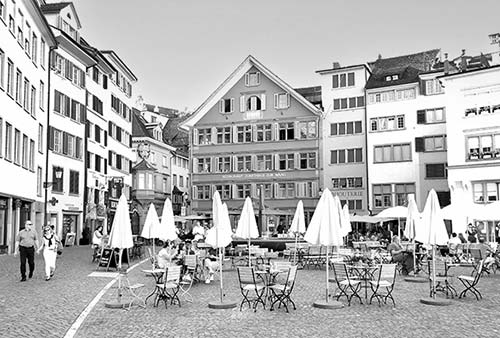
This square is also home to more of Zürich’s surviving guilds. At the bottom (river end) of the square is the elegant Zunfthaus zur Meisen, historically the guild for innkeepers, painters, and saddle makers. Near the top of the square, behind the fountain, is the Zunfthaus zur Waag—once the wool and linen weavers’ guild.
Before moving on, consider a little detour to see some hidden illustrations of Zürich’s legendary past: Circle around to face the “front door” of the Fraumünster, then duck through the gate on its right side, into the Kreuzgang Fraumünster (free, closed Sun). This passage, once a nunnery, is now part of the city administration building. The inside is painted with vivid, dreamy depictions of important local legends. In one, a magical, glowing deer shows two nuns the place where they should build what is today the Fraumünster. In the other, you can see those early Christian martyrs who, after being beheaded by Romans, picked up their heads and carried them to what’s now the Grossmünster (in this version, they are guided by angels carrying doves).
• Back out on Münsterhof, follow the small lane on the left side of Zunfthaus zur Waag, passing (or walking through) the recommended Zeughauskeller restaurant (500 years ago the city armory, it has a weapons theme for its decoration today—including what they call an “authentic replica” of William Tell’s crossbow). As you round the corner, you’ll hit busy...
15 Paradeplatz
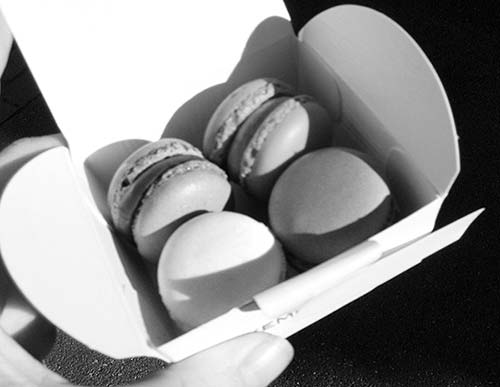
Survey the scene, a triumph of urban planning and people-friendly vision: The train station is a 10-minute walk to your right up Bahnhofstrasse, and the lake is a few minutes to your left, down the classiest stretch of Bahnhofstrasse. On the left is $$$ Sprüngli, Zürich’s top café for the past century. Its “Luxemburgerli” macarons—little cream-filled, one-inch macaron-meringue treats—are a local favorite (you can buy just a couple; if you buy 100 grams, you’ll get a selection of 12). Sprüngli also sells elegant sandwich lunches, either in its café (upstairs/outside) or to go (perfect for a lakeside snack; open Mon-Fri until 18:30, Sat until 17:30, closed Sun).
Across the square is Credit Suisse, with a luxurious ground floor full of fancy shops. If you like, detour a block back up Bahnhofstrasse to #31 and visit the fine little Beyer Clock and Watch Museum, in the basement of the elegant Beyer watch shop (10 CHF, Zürich Card valid but not Swiss Travel Pass; Mon-Fri 14:00-18:00, closed Sat-Sun; www.beyer-ch.com).
• From here, you’ve seen the heart of Zürich; if time is short, simply hop a tram back to the station.
But if time allows and you’d like a peek at the city’s lake—and the chance to go on a lake cruise—you can head several minutes farther down Bahnhofstrasse. From where you entered the square, turn left and follow Bahnhofstrasse past a few more elegant shops and mighty banks to the boats and riverside terrace at Bürkliplatz. We’ll finish this walk at...
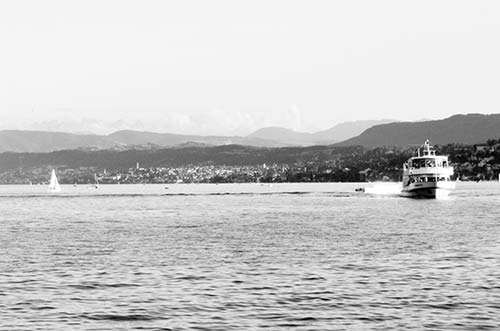
16 Lake Zürich (Zürichsee)
Lake Zürich is 17 miles long, 2.5 miles wide, and—because it’s relatively shallow—warm enough for swimming in the summer. From here, you can enjoy the lakeside promenade (a fine strolling path stretching 3 miles in either direction; left is sunnier and more interesting) or a short cruise. To go back to the station, catch tram #11 (from the inland side, across the street) or the Limmat riverboat. Both cruise and riverboat options are described later, under “Cruises on Limmat River and Lake Zürich.”
Sights in Zürich
▲▲National Museum Zürich (Landesmuseum)
By the late 19th century, it was clear that the world was changing, and the Swiss wanted to protect their unique heritage. A national competition was held, Zürich won, and it created the country’s national museum. Located in a Neo-Gothic castle dating from 1898—with a striking modern wing added in 2016—this massive museum provides an engaging, in-depth exploration of Swiss history and identity.
If Zürich is your first stop in Switzerland, visiting here for a primer on all things Swiss can help put the rest of your trip in context. Even if you’re not staying the night in Zürich, the museum (just across the street from the train station) can be a worthwhile rainy-day excursion from other cities (especially if you have a train pass) or a quick stop while passing through. A stairway from the train station’s underground hall leads conveniently up to the museum (look for Landesmuseum signs).
Cost and Hours: 10 CHF, covered by Swiss Travel Pass and Zürich Card; Tue-Sun 10:00-17:00, Thu until 19:00, closed Mon; audioguide-5 CHF (or download the free app), guided tours in English available—check website for schedule, mandatory bag check, quality café; Museumstrasse 2, +41 44 218 6511, www.landesmuseum.ch.
Visiting the Museum: The museum is well designed and well described in English. Be prepared to walk up and down stairs, and down long hallways, to traverse the sprawling, mazelike layout. Ask for and review the floor plan before you get going. I’ve described the permanent exhibits below, but there are good temporary exhibits, too. With limited time, prioritize the History of Switzerland exhibit: To reach it, follow signs left from the ticket desk—you’ll go upstairs, then back down.
History of Switzerland: The main exhibit tells the story of this unique land, using ample artifacts to illustrate each theme. The story begins in the 14th century, as the cantons that would eventually become Switzerland started to unify. This is the time of William Tell and the Rütli Oath, in which the three founding cantons threw off the shackles of the aristocracy to assert self-rule. The bristling column of pikes and halberds symbolizes this militaristic age.
The exhibit proceeds through the 16th century, when the Reformation split Switzerland—spiritually and ideologically—right down the middle. See Zwingli’s Bible translation into German (from 1531, designed to put the Word of God into the hands of the people), and study the giant triptych painting of saints with old Zürich as a backdrop—completed in 1502, removed from display by Reformation iconoclasts in 1524.
Meanwhile, Switzerland became famous for exporting its men as mercenaries in foreign wars (a tradition that continues with today’s Swiss Guard at the Vatican). Find the tapestry of Swiss officials renewing their alliance with Louis XIV (inside Notre-Dame) to provide mercenaries. Compare the simply dressed, unpretentious Swiss on the left with the lavish court of the Sun King on the right. Cities also flourished during this age; see the huge cabinet from 1657, displaying the many guilds of Zürich (which survive today).
The 18th century brought the Enlightenment, including the scientific study of the Alps, the development of alpine infrastructure, and a Romantic appreciation of the beauty of nature, as preached by French-Swiss philosopher Jean-Jacques Rousseau, who presented an idealized image of Switzerland.
In the 19th century, the federal state of Switzerland was born (1848) with Bern as its seat of government (see model of the parliament). The 1829 painting of 135 Swiss founding fathers includes politicians, scholars, scientists, and Reformers (all identified by the touchscreen). Nationhood came with a single currency (see some of the 800 different coins, issued by 79 authorities, that were phased out in 1850). It also came with neutrality, which both defines Swiss identity and remains one of this country’s most controversial features.
This age also saw the rise of tourism, including the first cogwheel train to Rigi (1871—it still runs today) and the Gotthard Tunnel connecting Swiss cities to Italy (1882). See the vintage travel posters and the official rail map from that era. But the mid-1800s were also difficult times for the poor, with many emigrating to find a better life in the New World. The painting Pain of Parting shows grief-stricken parents collapsing on the train platform after saying goodbye to their adult children forever.
The 20th century was a tough time to be neutral, but Switzerland doubled down on not taking sides. See the machine gun and cannon that defended the Gotthard Pass from potential invasion (had it happened, Swiss leadership planned to abandon its cities and hole up in the rugged alpine interior, creating a fortified “Swiss National Redoubt”). To preserve its neutrality, Switzerland turned each of its citizens into a soldier, with standard-issue gear to protect against “NBC” (nuclear, biological, and chemical weapons). Meanwhile, to differentiate themselves from the Nazis ideologically, the Swiss created the Pro Helvetia movement (for “spiritual national defense”). At the Landi national exhibition on Lake Zürich in 1939, 10 million Swiss celebrated their folk culture and dialects; look for the flags from that event.
Switzerland did take in refugees, though critics say hardly enough: 26,000 in World War I, and 51,000—including 21,000 Jews—in World War II. The exhibit examines this issue with candor; contrast the postcard of Lady Switzerland comforting war refugees with illustrations of desperate refugees waiting at the border. The bullet-holed sign from the Swiss embassy in Budapest recalls how the Swiss diplomat Carl Lutz heroically saved some 62,000 Jews there—while others, including Switzerland’s ambassador to Germany, ignored the crisis (find the tattered Swiss flag from the Berlin embassy).
The postwar era kicked off with an economic boom, but it also saw Switzerland grapple with social challenges, including workers’ rights; the global student movement of 1968; and—in 1971—the vote that finally guaranteed Swiss women the right to vote, which passed by a two-thirds majority. The exhibit ends with a look at the rise of consumer culture and 21st-century challenges, including climate change, migration, and sovereignty in the age of the EU.
While that’s the most essential exhibit for the foreign visitor, there are other permanent exhibits worth checking out:
Simply Zürich: This second-floor exhibit displays objects that tell stories about Switzerland’s largest city (each one explained by touchscreens), plus a giant sculpture by the local art collective Mickry 3.
Ideas of Switzerland: This small but thought-provoking exhibit explores what it means to be Swiss (enter from the opposite side of the ticket desk, near the café). Virtual “books” introduce you to four prominent Swiss figures: theologian John Calvin, historian Petermann Etterlin, philosopher Jean-Jacques Rousseau, and humanitarian Henry Dunant, who co-founded the Red Cross. Touchscreens next to a giant granite relief map of the Swiss Alps offer an enhanced-reality view of the country’s highlands. On the wall is a beautiful 19th-century map of Switzerland; aim the provided binoculars at it to superimpose important statistics.
Archaeology in Switzerland: Here you’ll see items found in prehistoric graves, a stela (carved pillar) showing a man from about 3000-2500 BC, an exquisite golden dish made as a gift for the gods (from around 1100 BC), and tools made from stone, bronze, and iron. Meet the Celts (Helvetii—see their large golden rings from around 390 BC, thought to help protect travelers), who were Romanized beginning around the second century BC. Most of the objects are in large cases on the wall; move the giant sliding screen into position over each item to learn more.
The Collection: This large wing shows off over 7,000 pieces of Swiss art and crafts spanning centuries.
Exhibition for Families: This is a partially hands-on kids’ zone, optimistically designed to keep small children occupied.
Shop: Before leaving, check out the shop near the ticket desk, which has one of the city’s best selections of quality Swiss souvenirs that go beyond the clichés (and, also, some clichés).
▲Kunsthaus Zürich
It’s worth the tram/bus ride (or 10-minute stroll up from the heart of Niederdorf) to see Switzerland’s top collection of fine art. The museum features a combination of quality works by European masters, mixed in with fine examples by Swiss artists (whom I’ve highlighted here). For art lovers, it’s worth ▲▲. The curator embraces change, so the collection gets shuffled around frequently—and there are often high-quality special exhibits, too. Pick up a map as you enter and go with the flow.
Cost and Hours: 16 CHF, more for special exhibits, includes audioguide, free on Wed, not covered by Swiss Travel Pass; open Tue-Sun 10:00-18:00, Wed-Thu until 20:00, closed Mon; mandatory bag check, café; at Heimplatz 1—take tram #3, #5, #8, or #9, or bus #31 to Kunsthaus stop; +41 44 253 8484, www.kunsthaus.ch.
Visiting the Museum: The collection runs the gamut, from Old Masters (Guardi, Tiepolo, Rembrandt, Brueghel, Hals) to present-day greats.
In the 18th-and-19th-century section, look for works by three Swiss painters. Johann Heinrich Füssli—a.k.a. Henry Fuseli (1741-1825)—was born in Zürich but spent most of his career in London. Füssli’s works exhibit a marked chiaroscuro technique (with a strong contrast between light and dark); the supernatural was a favorite theme of his. Arnold Böcklin (1827-1901), from Basel, was a Symbolist who painted fantastical landscapes and evocative creatures. The War (1896) began as four horsemen of the apocalypse—but then Böcklin went in a different direction, winding up with three grotesque horseback figures. Ferdinand Hodler (1853-1918) was also quite mystical, working with bright, cheery colors, symbolic figures, and shimmering landscapes. The Day (1904-1906) depicts five young women in a semicircle, who embody the way that light changes over the course of a day.
The excellent 20th-century collection includes works by Picasso, Kokoschka, Ernst, Beckmann, Corinth, Magritte, Miró, Degas, Renoir, Monet, and Chagall (whose stained-glass windows adorn the Fraumünster). The museum owns the best collection of Edvard Munch works outside of Norway; these typically share a room with works by Giovanni Segantini (1858-1899). While Italian-born and trained in Milan, Segantini later moved to the Graubünden and Engadine regions of Switzerland, where he did his best work. His gorgeous, grand-scale Alpine Pasture (1893-1894) shows off Segantini’s mastery of his late-Impressionist style, where collages of dots and streaks form a vivid, beautiful scene of pastoral Swiss countryside.
There’s usually a large exhibition of hauntingly stretched-out sculptures by Alberto Giacometti (1901-1966)—one of Switzerland’s best-known artists beyond his homeland. Giacometti built on the foundation of Rodin but took things in a Surrealist direction, abstracting and elongating human figures until they were barely recognizable. Over time, Giacometti’s style evolved—going through phases with sculptures just a few inches tall to figures several feet tall. Elsewhere, you’ll also see paintings by Alberto’s father, Giovanni Giacometti (1868-1933). Giovanni was the cousin of Augusto Giacometti, whose work we’ve already seen on the town walk, in the entrance hall of the police station and in the Grossmünster. And, of course, you’ll see a few works by the great Swiss painter Paul Klee (1879-1940), with his exuberant, colorful, abstract, almost childlike compositions. The collection carries through to the present day, with pieces by Warhol, Lichtenstein, Rothko, Merz, Twombly, Beuys, Bacon, and Baselitz.
Cruises on Limmat River and Lake Zürich
A boat ride down the Limmat River or on Lake Zürich can be a nice, lazy contrast to your busy, urban visit. Small riverboat-buses take commuters and joy-riding visitors up and down the river and to points nearby on the lake. Big, romantic ships take tourists on longer rides around Lake Zürich. All boats are run by ZSG and do not include commentary (+41 44 487 1333, www.zsg.ch). The first two options are fully covered by the Swiss Travel Pass, Zürich Card, or 24-hour transit pass (also covered by the Global Pass, but uses a flexi day—so do it the day you arrive or depart).
Riverboat-Buses: These low-to-the-water boats (designed to squeeze under bridges) start where the National Museum Zürich and Platzspitz Park meet on the banks of the Limmat River. The boats do a 55-minute loop, making several stops along the river en route to Bürkliplatz (pier #6, where lake cruises begin), and then a quick circle around the lake before returning to their starting point. You can either do the full circuit, or hop on and off as you like. These boats can be handy for connecting the museum and the lake (4.40 CHF/ride—up to the entire loop, departs from museum 2/hour daily May-Sept 10:50-19:50, April and Oct until 17:20, no boats in winter).
Big Lake-Only Excursion Boats: These start at Bürkliplatz and go farther down the lake. The basic 1.5-hour “short lake cruise” goes as far as Erlenbach, a quarter of the way down the lake (8.80 CHF; 2/hour daily May-Sept 10:00-20:00, April and Oct until 19:00, fewer off-season; buy tickets near pier #3, boats depart from piers #1-6). They also offer longer trips and jazz and dinner cruises (not covered by the Zürich Card or transit passes). With plenty of time, you could even ride the boat all the way to Rapperswil (at the far end of Lake Zürich), enjoy that town for lunch, and then catch the train back to Zürich.
Zürich West (Züri Wescht)
This trendy, up-and-coming former industrial zone is just a few minutes’ tram ride behind the train station. Though not as funky or interesting as similar zones in other European cities, it’s worth a wander if you’re curious to see a contemporary side of this otherwise staid city. Note that many shops here are closed Sundays.
From the train station area, ride tram #4, #13, or #17 to the Löwenbräu stop. Here the arches of two old railway viaducts have been creatively converted into commercial space. The first few arches house Markthalle Viadukt, a covered market with cheesemongers, greengrocers, microbrew and wine vendors, and a few eateries, including bakeries with sandwiches and the good $$ Restaurant Markthalle, which serves an international menu (check out the selection of vendors at www.im-viadukt.ch). Exit the market hall at the far end, and follow the viaduct past the smokestack, exploring as you go the many shops tucked under the 52 arches (selling clothing, housewares, home decor, and more food). At arch #1 (the viaduct’s end), turn right and head toward the city’s only skyscraper.
Your next stop is the big tower of stacked shipping containers—the flagship store for Freitag, which started in Zürich manufacturing bags from recycled materials. Just beyond is Frau Gerolds Garten, a mixture of small shops up front and a decidedly alternative beer garden in back. The place has a funky, mismatched-furniture-under-twinkle-lights vibe, but it’s also modern and sophisticated—as chic as it is shabby (Mon-Sat 11:00-24:00, Sun 12:00-22:00, shorter hours in winter, Geroldstrasse 23, www.fraugerold.ch).
From Frau Gerolds Garten, continue a few steps toward the skyscraper, then head up the ramp to the overpass, where tram #8 or bus #37 will take you two stops to Escher-Wyss-Platz. On the way, you’ll pass the Schiffbau theater, occupying a former shipbuilding factory (which is what its name means). At Escher-Wyss-Platz, descend to ground level and look for the stop for trams #4, #13, and #17, which bring you back to the train station along Limmatstrasse.
Museum Rietberg
Filling historic villas set in a beautiful park west of the lake, this museum houses art from Asia, Africa, the Americas, and the South Pacific.
Cost and Hours: 18 CHF, covered by Swiss Travel Pass, discount with Zürich Card; Tue-Sun 10:00-17:00, Wed until 20:00, closed Mon; tram #7 from station (direction: Wollishofen) to Museum Rietberg stop, Gablerstrasse 15, +41 44 415 3131, www.rietberg.ch.
Zürich Zoo
With 360 species, an impressive Madagascar rainforest hall, and a huge indoor exhibit, the city’s zoo is a fun place to see locals at play. It’s located within a large green space to the east of the center.
Cost and Hours: 29 CHF, slightly cheaper online; daily 9:00-18:00, Nov-Feb until 17:00; tram #6 from Bahnhofstrasse in front of the station (direction: Zoo), ride to last stop, Zürichbergstrasse 221, +41 44 254 2500, www.zoo.ch.
Nearby: James Joyce fans can find the grave of the Irish author (adorned with a life-size statue) in the parklike Friedhof Fluntern cemetery, next to the zoo.
Lindt Home of Chocolate
This museum in the upscale suburb of Kilchberg pays for itself if you think of the visit as a 15-CHF chocolate feast. The sampling stations are the highlight: At the first you taste liquified dark, milk, and white chocolate; at the second, dispensers drop pieces of flavored chocolate into your outstretched hand and invite you to guess the ingredients; at the third, you’re welcome to as many Lindor filled chocolate spheres as you can eat. In between, the museum provides an education in chocolate. Exhibits cover cocoa bean harvesting and the history of chocolate-making in Switzerland; there’s a model chocolate production line, as well as an array of games and activities and a room downstairs showing promotional films. A 30-foot-high chocolate fountain towers over visitors in the main hall.
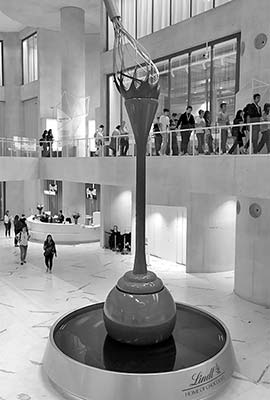
The Lindt & Sprüngli factory surrounds the museum. The Sprüngli family started producing chocolate in Zürich in the 1830s, and in 1899 they bought out the Lindt company (which started in Bern).
Cost and Hours: 15 CHF, Swiss Travel Pass not valid; chocolate-making classes from 28 CHF, reservations essential for classes and recommended for regular entry; daily 10:00-18:00; café, mandatory bag check; Schokoladenplatz 1 in Kilchberg, +41 44 716 2000, www.lindt-home-of-chocolate.ch.
Getting There: Kilchberg is set along the southwest lakeshore, a 10-minute trip from downtown on the S8 or S24 suburban train (4/hour, 13.60 CHF three-zone Tageskarte covers round-trip and 24 hours of free transport in Zürich); from Kilchberg station, it’s a flat 10-minute walk to the museum (follow Lindt Home of Chocolate signs).
Uetliberg
For an interesting 1.5-hour excursion high above the city and lake, take the small red/orange S10 excursion train that climbs from the main train station to this little mountain peak (17.60 CHF four-zone Tageskarte covers your round-trip plus 24 hours of free transport around town, also covered by Zürich Card; 2-3/hour, runs 6:30-24:00, 25 minutes, www.zvv.ch). From the Uetliberg station, it’s a moderately steep, 10-minute climb up a paved pedestrian road to a hotel and a tall observation tower overlooking the city. The view is particularly striking at sunset.
Sleeping in Zürich
High season in Zürich is May, June, September, and October. In this business-oriented city, rooms tend to be cheaper on weekends and pricier during festivals and conventions (September can be particularly busy). Some hotels let you save a little on the rate by skipping breakfast—ask.
Most of my listings are across the river from the train station (about a 10- to 15-minute walk)—ideal for those passing through or leaving on an early-morning train or plane. To avoid nighttime noise, ask for a room on a high floor.
ACROSS FROM THE TRAIN STATION
With this efficient neighborhood as your home base, you’re a quick stroll away from the train station, National Museum Zürich, riverboat-bus dock, a huge underground mall of services and shops (under the station), and the Niederdorf restaurant and nightlife zone. From the station, exit through the front doors of the great hall and cross the river.
$$$ Hotel Bristol, well-run by Martin Hämmerli and his staff, has 56 rooms that are handy to the train station. Though not fancy, it’s very comfortable. Martin loves my readers and gives a 12 percent discount when you book direct by email (RS%, family rooms, air-con, elevator, pay laundry, Stampfenbachstrasse 34, +41 44 258 4444, www.hotelbristol.ch, info@hotelbristol.ch).
$$ Hotel Arlette is stuck in a time warp, with 28 no-frills rooms. The central location and affordable rates help make up for the often gruff reception staff (air-con, elevator, Stampfenbachstrasse 26, +41 44 252 0032, www.hotelarlette.ch, hotel@hotelarlette.ch, Schlotter family).
NIEDERDORF DISTRICT
The atmospheric, cobblestoned old town of Zürich is just a few minutes farther from the station than the previous listings. During the day, it’s busy with shoppers and workers on lunch breaks; at night, restaurants and clubs keep the pedestrian streets vibrant (and, in some places, noisy). From the train station, cross the Bahnhofbrücke bridge (to your right as you leave the main hall), go through the square called Central, and head to the right along Niederdorfstrasse (or, with wheeled luggage, stay along the river to avoid cobblestones). You can also take tram #4 two stops to Rudolf-Brun-Brücke.
$$$$ Marktgasse Hotel impresses well-heeled urbanites. Located at the quiet end of Niederdorf, its 39 rooms feel sophisticated, with hip, minimalist decor. The first-floor lounge/reception area, with free coffee and big windows, is a tempting place to hang out (breakfast extra, air-con, elevator, Marktgasse 17, +41 44 266 1010, www.marktgassehotel.ch, info@marktgassehotel.ch).
$$$ Hotel Adler, nestled in the heart of the Niederdorf, is the place to stay if you don’t want to risk forgetting that you’re in Switzerland. It has a popular Swiss restaurant on the ground floor, a cow peeking out over the balcony, and 52 pleasantly cheesy rooms with woody, half-timbered accents (family rooms, air-con, elevator, Rosengasse 10—at Hirschenplatz, +41 44 266 9696, www.hotel-adler.ch, info@marktgassehotel.ch).
$$$ Hotel Alexander is a 41-room business-class hotel in a busy central location. It’s right at the edge of a somewhat seedier side of Niederdorf, but it feels solid, well-designed, and well-run, and the serious windows help keep out street noise—though if quiet is a priority, ask for a back room (RS%, family rooms, air-con, elevator, free mobile Wi-Fi boxes, Niederdorfstrasse 40, +41 44 251 8203, www.hotel-alexander.ch, info@hotel-alexander.ch). They also run the $$ Alexander Guest House, a block away at Zähringerstrasse 16, housing 20 twin-bedded rooms with modern bathrooms and cheaper prices (breakfast extra, fans, elevator, check in at Hotel Alexander, www.alexander-guesthouse.ch).
$$$ Swiss Chocolate Hotel Zürich occupies a renovated trapezoid-shaped building around the corner from Central square, beneath the Polybahn funicular. The 57 rooms are dark but comfortable, with triple-paned windows that keep out most of the street noise (air-con, elevator, Zähringerstrasse 46, +41 44 267 2670, www.byfassbind.com, scz@byf.ch).
$$ Hotel Marta, on a side street near Central square, is run by a nonprofit foundation that assists women with disabilities in finding employment. The 39 spare yet modern rooms vary in size and quietness (street-facing rooms can be noisy). The hotel’s website describes them with unusual honesty and lets you choose (family room, fans, elevator, Zähringerstrasse 36, +41 44 269 9595, www.hotelmarta.ch, info@hotelmarta.ch).
FARTHER FROM THE CENTER
You can sleep a little more cheaply if you’re willing to compromise a bit on rooms and location.
$ EasyHotel Zürich City Centre is a decent value in this pricey town, with 33 small, modern rooms located away from all the sights, a 10-minute walk from the station in an area known for its bar scene. It has four floors but no elevator (except for a luggage dumbwaiter); no common space aside from the basement computer room; most bathrooms are teeny, modular installations with opaque glass; and rooms are only cleaned after four nights (no breakfast, Zwinglistrasse 14, +41 43 322 0551, www.easyhotel.com). From the station: Walk or take bus #31 (direction: Schlieren Zentrum) to Kanonengasse stop, walk a block down Kanonengasse with back to train station, then right on Zwinglistrasse to #14.
¢ Zürich Youth Hostel is big, modern, and well-equipped with lots of services in a pleasant neighborhood near the lake that’s easy to reach from the station. Its rooms with private bath compete favorably with hotels (fair-trade breakfast, lunch, dinner, and packed lunches available, elevator, no curfew, pay parking, Mutschellenstrasse 114, +41 43 399 7800, www.youthhostel.ch/zuerich, zuerich@youthhostel.ch). From the station, take tram #7 (direction: Wollishofen) to Morgental, then walk back 5 minutes along Mutschellenstrasse.
Eating in Zürich
While famously expensive and formal, Zürich has a good variety of places to eat memorably. My recommendations include romantic Swiss places (both traditional and modern), cheesy raclette bars, beer gardens, and quality vegetarian choices. If you’re up for a splurge, some of Zürich’s venerable guildhouses are now convivial traditional restaurants. At finer places, reservations are wise.
Zürich’s most typical dish is Kalbsgeschnetzeltes (or Zürcher Geschnetzeltes)—diced veal with mushrooms in cream sauce, often served with Rösti. Zürcher Eintopf is a stew of pork, vegetables, and white wine that’s satisfying in the winter. You’ll also see quite a few traditional country Swiss restaurants featuring raclette and fondue. These are designed entirely for tourists; when the Swiss want these foods, they have them at home. Also, much as the Swiss love their cheese, they’re almost comically sensitive about it stinking up their clothing (they don’t like the smell unless they’re actually eating it). It seems that restaurants either do cheese or don’t do cheese.
NIEDERDORF DISTRICT
Niederdorf is Zürich’s dining district, and the traffic-free Niederdorfstrasse is its restaurant row. The countless eateries lining this main drag don’t offer the best values, though the people-watching is hard to beat. Just a block or two away, you’ll feel like you’re far from the tourist crush and rubbing elbows with a smarter clientele.
$$ Café Zähringer is an artsy, bohemian co-op serving reasonably priced, healthy food. Linger in the stay-awhile interior, or enjoy the leafy seating with the older hippies out on the square (daily special served all day, always good veggie and vegan plates, breakfasts, organic produce, salads, also meat dishes and good coffee; open Tue-Sat 10:00-24:00, Sun until 22:00, closed Mon; food served 11:30-14:00 & 17:30-22:00; facing the tall steeple at Zähringerplatz 11, +41 44 252 0500, www.zaehringer.ch).
$$$ Bauernschänke (Farmer’s Tavern), facing Rindermarkt, is a favorite of upscale local foodies. While the setting is traditional, with inviting wooden tables and paneling, the menu has a modern sensibility. Chef Nenad Mlinarevic won “Swiss Chef of the Year” in 2016 and owns two Michelin stars at another location. When I last stopped by, his menu included a Swiss bento box lunch and spelt risotto with chanterelle mushrooms. Reservations are smart (Mon-Fri 11:30-14:30 & 18:00-24:00, Sat 18:00-24:00, closed Sun, Rindermarkt 24, +41 44 262 4130, www.bauernschaenke.ch).
$$$ Restaurant Mère Catherine is a little oasis of Provençal elegance tucked away in the old town, popular for its south-of-France menu and good wines by the glass. Both the interior and its secluded courtyard are delightful and cozy (Mon-Sat 11:30-15:00 & 17:30-23:00, closed Sun, Nägelihof 3, +41 44 250 5940).
Cheesy Swiss Clichés, Old and New: While having traditional Swiss food in Zürich is like having Southern comfort food in New York City, there are plenty of touristy options to choose from. These two are a good value for getting your melted cheese fix. $$$ Raclette Stube is the traditional choice, and the place to go if you want your clothes to smell like good Swiss cheese for days to come. In a bright, modern mountain chalet interior they do only the cheese specialties: all-you-can-eat raclette or fondue (nightly from 18:00, Zähringerstrasse 16, +41 44 251 4130). $$ Raclette Factory, the IHOP of melted Swiss cheese, serves your choice on a variety of potatoes with the traditional onion and pickle. You can even do a raclette tasting, combining a selection of different types. Big, open windows ventilate the place, making it less cheesy inside. It’s a fun perch overlooking the action in the heart of the Niederdorf district (daily 11:30-22:00, Rindermarkt 1, +41 44 261 0410).
Ice Cream: Tucked behind the Grossmünster, Hasta is a quality shop with lots of creative flavors (Mon-Sat 12:30-18:30, Sun from 14:00, Zwingliplatz 3).
Popular Sausage Stand: Locally beloved since 1963, $ Sternen Grill, about a five-minute walk south of the Grossmünster (at the Bellevue transit hub, by the lake) is Zürich’s favorite place to grab a cheap, good-quality sausage (about 10 CHF). They have a few indoor tables and lots of outdoor ones, or you can get your sausage to go and eat along the water. Locals from every walk of life line up here—from scruffy artists to well-dressed theatergoers to formal businesspeople (daily 10:30-23:00, Theaterstrasse 22, +41 43 268 2080).
ON OR JUST OFF BAHNHOFSTRASSE
$$$ Zeughauskeller is a massively popular tourist trap filling an atmospheric 500-year-old armory with medieval battle gear (including a “William Tell crossbow”) and the lively energy of happy eaters enjoying typical German-Swiss cuisine. Their fun, accessible menu—designed to stuff out-of-towners—offers big (splittable) portions, traditional dishes (their Kalbsgeschnetzeltes is the house special), and lots of soft meats. While it has a few outdoor tables, the interior has all the character and stays cool even when it’s hot. On busy evenings, there are lines out the door; you may find yourself sharing a table. Weekday lunch specials go for around 24 CHF (daily 11:30-23:00, plenty of beer and wine, kid-friendly, near Paradeplatz at Bahnhofstrasse 28, +41 44 220 1515, www.zeughauskeller.ch [URL inactive]).
$$$ Restaurant zum Kropf serves traditional Zürich cuisine in a grand and dressy beer hall with a sophisticated yet cozy atmosphere (27-CHF weekday lunch specials; Mon-Sat 11:30-14:00 & 18:00-23:00, closed summer weekends and first half of Aug; +41 44 221 1805, next to Zeughauskeller at In Gassen 16, www.zumkropf.ch [URL inactive]).
$$$$ Restaurant Zunfthaus zur Waag is your chance to dine inside one of Zürich’s historic guildhouses (from 1315), overlooking Münsterhof and the Fraumünster. It’s dressy and expensive—a memorable place to enjoy a special occasion (75-CHF fixed-price dinners, Mon-Sat 11:30-14:00 & 18:00-22:00, closed Sun, Münsterhof 8, +41 44 216 9966, www.zunfthaus-zur-waag.ch).
$$ Hiltl Vegetarian Restaurant is a popular treat for vegetarians. In 1898, Ambrosius Hiltl was fighting rheumatoid arthritis. His doctor said, “No more meat,” so Ambrosius established what may have been Europe’s first vegetarian restaurant. Over a century later, it’s still in the family and a Zürich institution (claiming to be the oldest vegetarian restaurant in the world). The vast and appetizing buffet is the main attraction, with food sold by weight (the tab can add up quickly). There are two seating zones: regular self-service (plain tables) and fancier table service (where you can still visit the buffet, but it costs 20 percent more). The à la carte menu comes with delightful salads, curries, and fancy fruit juices. Hiltl’s food is legendary for its freshness and lack of preservatives (Mon-Thu 7:00-22:00, Fri 7:00-23:00, Sat 8:00-23:00, Sun 10:00-22:00, 2 blocks off Bahnhofstrasse where it kinks, Sihlstrasse 30, +41 44 227 7000, www.hiltl.ch).
$$ Hiltl Dachterrasse, closer to Bahnhofstrasse and a bit hipper, is on the third floor of an upscale women’s clothing store. The glassy, convivial space, which feels like a chirpy birdhouse, is jammed with locals taking a break from shopping to meet up with friends. It’s like the other Hiltl, but all self-service—line up at the counter and pay by weight (Mon-Sat 9:00-23:00, Sun 10:00-22:00, inside the PKZ store at Bahnhofstrasse 88, ride elevator to third floor).
Department Store Cafeterias: As in other Swiss cities, Zürich’s Migros and Co-op department stores have top-floor eateries offering solid food at family-friendly prices, plus free tap water. Main dishes are cooked to order, while everything else is served buffet-style, and you can eat well for 20 CHF. The Migros Restaurant is a long block from Pestalozzi Park, beyond the Globus building (tap water near the cashiers, Löwenstrasse 31, 4th floor, Mon-Sat 9:00-20:00, closed Sun). The Co-op Restaurant is right along Bahnhofstrasse at #57 (tap water by the door, same hours).
Supermarkets and Prepared Foods near the Train Station: A convenient, midsized, long-hours Migros supermarket is in the underground mall at the train station, near the National Museum Zürich entrance/exit (Mon-Fri 6:30-22:00, Sat-Sun from 8:00). Around the corner (also under the station) is the Migros Takeaway, which sells big portions of main dishes, packaged to go for about 10 CHF (similar hours). A much larger Co-op supermarket is kitty-corner from the station by the Bahnhofbrücke bridge (Mon-Sat 6:00-22:00, closed Sun).
ALONG THE WEST BANK OF THE RIVER
$$ Restaurant Bauschänzli is a leisurely beer garden with a huge buffet line, lots of picnic-table seating, and a fine riverside setting. A block inland from the boat docks at Bürkliplatz, it fills a small island on the river. Its fun-loving and popular self-serve restaurant offers a great beer-garden experience—like a Munich Biergarten without the kraut—and it’s reasonably priced. Help yourself to the salad bar and the beer and wine from big casks (grab the glass or carafe of your choice). A little vocabulary is helpful: Bürl is a roll; Beilage is a side dish; Penache is a Radler (beer with lemonade). It’s open from mid-April through mid-September in good weather only (daily 11:30-23:00, Stadthausquai 2, +41 44 212 4919, www.bauschaenzli.com). Live music sometimes has people up and dancing, giving the place a polka-party feel. For a little peace, grab a table at the quieter tip of the island.
$$ Restaurant Schipfe 16, gorgeously and peacefully situated on the river with an old-town view, is part of a city-run organization providing work for hard-to-employ people. It was originally a soup kitchen, but the location was just too charming to stay that way, so it was turned into a restaurant open to everyone. Don’t expect polished service; instead, feel good that you’re contributing to a worthy cause and enjoying healthy and decent food at a great price. The menu is small—always with a fish, meat, and veggie dish—with lighter dishes available after 14:00. The best seats are right along the river (two-course weekday lunch specials; Mon-Sat 10:00-22:00, closed Sun; Schipfe 16, +41 44 211 2122, www.stadt-zuerich.ch/schipfe, reservations smart).
Zürich Connections
BY TRAIN
From Zürich by Train to: Luzern (2/hour, 40-50 minutes), Interlaken (2/hour, 2 hours, transfer in Bern and sometimes Spiez), Bern (2/hour, 1 hour), Murten (2/hour, 2 hours, change in Bern and sometimes Kerzers), Appenzell (2/hour, 2 hours, change in Gossau), Lausanne (2/hour, 2 hours, some change in Bern), Zermatt (1-2/hour, 3.5 hours, change in Visp and sometimes Bern), Chur (2/hour, 1.5 hours), St. Moritz (2/hour, 3-3.5 hours, change in Chur or Landquart), Lugano (1-2/hour, 2 hours, some change in Arth-Goldau), Munich (6/day direct, 3.5 hours—or go by bus from Sihlqual bus terminal), Frankfurt (hourly, 4 hours, some change in Basel), Berlin (9 hours, 1 change; 1 direct overnight option, 12 hours), Vienna (5/day direct, 8 hours; 1 night train, 11 hours), Paris (5/day direct, 4 hours, more with transfers). Train info: www.rail.ch.
BY PLANE
User-friendly Zürich Airport (code: ZRH, www.zürich-airport.com [URL inactive]) has three levels and is an eye-opening introduction to Swiss efficiency. On the lower level you’ll find a train station (with ticket desk). The main level has a top-end food court, Migros and Co-op supermarkets, fancy souvenir shops, a post office, mobile-phone shops, banks, ATMs, and lockers. The upper level has departures, TI, lockers, rental car desks, and an observation deck. Check-in areas (numbered 1 through 3) are scattered around the complex; use the screens to identify your zone, then follow signs.
Getting Between the Airport and Downtown: From the station underneath the airport, trains whisk you to downtown Zürich in about 10 minutes (6.80 CHF for three-zone single ticket, 13.60 CHF for three-zone 24-hour pass, leaves every 10 minutes 5:00-24:00). You can also ride tram #10 into town (takes much longer—35 minutes; same price as the train). Your ticket into Zürich is also good for one hour on all city public transportation. Either option is much cheaper than the 60-CHF taxi ride.
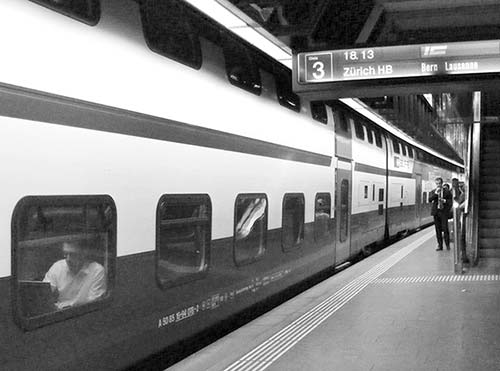
Sleeping at the Airport: Since most of my recommended accommodations are near the station, and the train connection to the airport is so fast and frequent, there’s little reason to sleep at the airport. But if you really want to stay close to the airport, choose a hotel within a few miles that has a free shuttle service, such as the Ibis Zürich Messe Airport or the Mövenpick Hotel in Glattbrugg.
Zürich Airport Connections: From the airport you can take the train to Luzern (2/hour, 70 minutes), Interlaken (about 2/hour, 2.5 hours, change in Bern), Bern (2/hour, 75 minutes), Murten (2/hour, 2 hours, change in Bern and sometimes Kerzers), Appenzell (2/hour, 1.5 hours, change in Gossau), Lausanne (hourly, 2.5 hours), Zermatt (hourly, 3.5 hours, change in Visp), Chur (hourly, 1.5 hours, change at Zürich main station), Lugano (2/hour, 2.25 hours, change at Zürich main station and sometimes Arth-Goldau), Munich (6/day direct, 3.5 hours).