INVERNESS & LOCH NESS
Inverness • Culloden Battlefield • Clava Cairns • Cawdor Castle • Loch Ness • Urquhart Castle
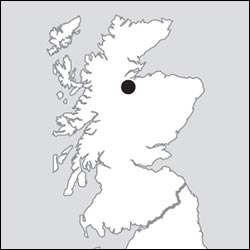
Inverness, the Highlands’ de facto capital, is an almost-unavoidable stop on the Scottish tourist circuit. It’s a pleasant town and an ideal springboard for some of the country’s most famous sights. Hear the music of the Highlands in Inverness and the echo of muskets at Culloden, where government troops drove Bonnie Prince Charlie into exile and conquered his Jacobite supporters. Ponder the mysteries of Scotland’s murky prehistoric past at Clava Cairns, and enjoy a peek at Highland aristocratic life at Cawdor Castle. Just to the southwest of Inverness, explore the locks and lochs of the Caledonian Canal while playing hide-and-seek with the Loch Ness monster.
PLANNING YOUR TIME
Though it has little in the way of sights, Inverness does have a workaday charm and is a handy spot to spend a night or two between other Highland destinations. With two nights, you can find a full day’s worth of sightseeing nearby.
With a car, the day trips around Inverness are easy. Without a car, you can get to Inverness by train (better from Edinburgh, Stirling, Glasgow, or Pitlochry) or by bus (better from Skye, Oban, or Glencoe), then side-trip to Culloden, Loch Ness, and other nearby sights by public bus or with a package tour.
Note that Loch Ness is between Inverness and Oban, Glencoe, and the Isle of Skye. If you’re heading to or from one of those places, it makes sense to see Loch Ness en route, rather than as a side-trip from Inverness. (And, frankly, for most visitors it’s not worth more than an on-the-way glance anyway.)
Inverness
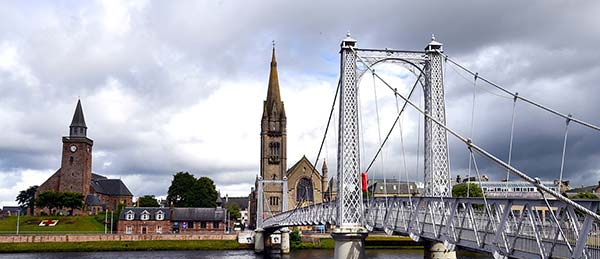
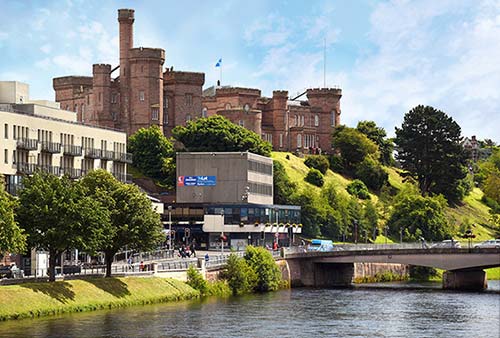
Inverness is situated on the River Ness at the base of a castle turned tourist attraction/community center. Inverness’ charm is its normalcy—it’s a nice, midsize Scottish city that gives you a palatable taste of the “urban” Highlands and a contrast to cutesy tourist towns. It has a disheveled, ruddy-cheeked grittiness and is well located for enjoying the surrounding countryside sights and as a jumping off point for the North Coast 500 (NC-500) driving route (see the Northern Scotland chapter). Check out the bustling, pedestrianized downtown, or meander the picnic-friendly riverside paths and islands—best at sunset, when the light hits the castle and couples holding hands stroll along the water and over its footbridges. Inverness is also an ideal place for traditional Scottish folk music, great for unwinding at the end of a busy day of sightseeing.
Orientation to Inverness
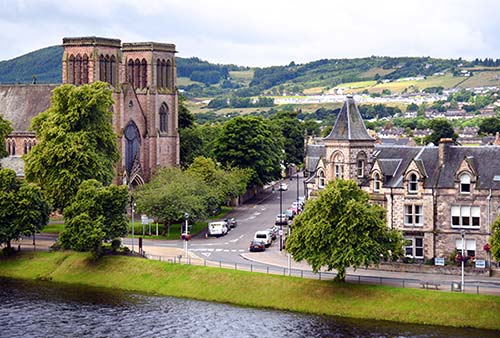
Inverness, with about 70,000 people, is one of the fastest-growing cities in Scotland. Yet it still feels almost like a small town. Marked by its castle, Inverness clusters along the River Ness. High Street offers an appealing pedestrian shopping zone a few blocks away from the river; nearby are the train and bus stations. Most of my recommended B&Bs huddle atop “The Crown,” a gentle hill behind the castle (a 10-minute uphill walk from the city center).
TOURIST INFORMATION
The TI is on High Street in the center of town and is worth a stop to pick up the self-guided City Centre Trail walking-tour leaflet (daily 9:30-17:00, possibly longer in peak season, 36 High Street, +44 1463 252 401, www.visitscotland.com and www.visitinvernesslochness.com).
ARRIVAL IN INVERNESS
By Train: At the small, modern train station, you’ll find lockers near the tracks. Exit straight ahead, between the waiting room and ticket office, to emerge into a parking lot where taxis wait (about £8 to recommended accommodations). It’s possible to walk from the station, but there are a lot of stairs between you and my B&Bs in The Crown neighborhood—I’d take a cab and save my energy for later. To walk, follow Academy Street to Inglis Street, then head up the Market Brae steps into The Crown.
By Bus: The bus station is a block over from the train station, where you can catch a cab. Exit straight ahead—in the direction the buses are pointed—and walk one block to Academy Street, then turn left to find the train station.
By Car: Drivers should ask their accommodations about parking. For those dipping into town, a variety of affordable options are close to the city center: the Old Town Rose Street garage (just off the busy A-82 on Rose Street); the Cathedral parking lot (south of the cathedral on the west bank of the River Ness); and—up in The Crown B&B neighborhood—the Rainings Stairs lot (at the top of the stairs down into town). It’s generally not too difficult to find street parking (pay-and-display or RingGo app, free overnight, avoid permit-only spaces).
HELPFUL HINTS
Charity Shops: Like many Scottish cities, Inverness is home to several pop-up charity shops. Occupying vacant rental spaces, these are staffed by volunteers who are happy to talk about their philanthropy. You can pick up a memorable knickknack, adjust your wardrobe for the weather, and learn about local causes.
Festivals and Events: The summer is busy with special events; book far ahead during these times: Etape Loch Ness bike race (early June), Highland Games (late July), Belladrum Tartan Heart Festival (music, early Aug), Black Isle farm show (early Aug), and Loch Ness Marathon (late Sept).
In summer (June-Sept), the TI can let you know whether a ceilidh (traditional dance and music) is scheduled at City Hall.
For a real Highland treat, catch a shinty match (a combination of field hockey, hurling, and American football—but without pads). Inverness Shinty Club plays at Bught Park, along Ness Walk. The TI or your B&B can tell you if there are any matches on, or check www.facebook.com/InvernessShintyClub.
Bookstore: Located in a converted church and with a collection of more than 100,000 titles, Leakey’s Bookshop is a fun place to browse teetering towers of old books and vintage maps (Mon-Sat 10:00-17:30, closed Sun, Church Street, +44 1463 239 947, Charles Leakey).
Baggage Storage: The train station has lockers. Radical Storage has a location near the Eastgate Mall (www.radicalstorage.com).
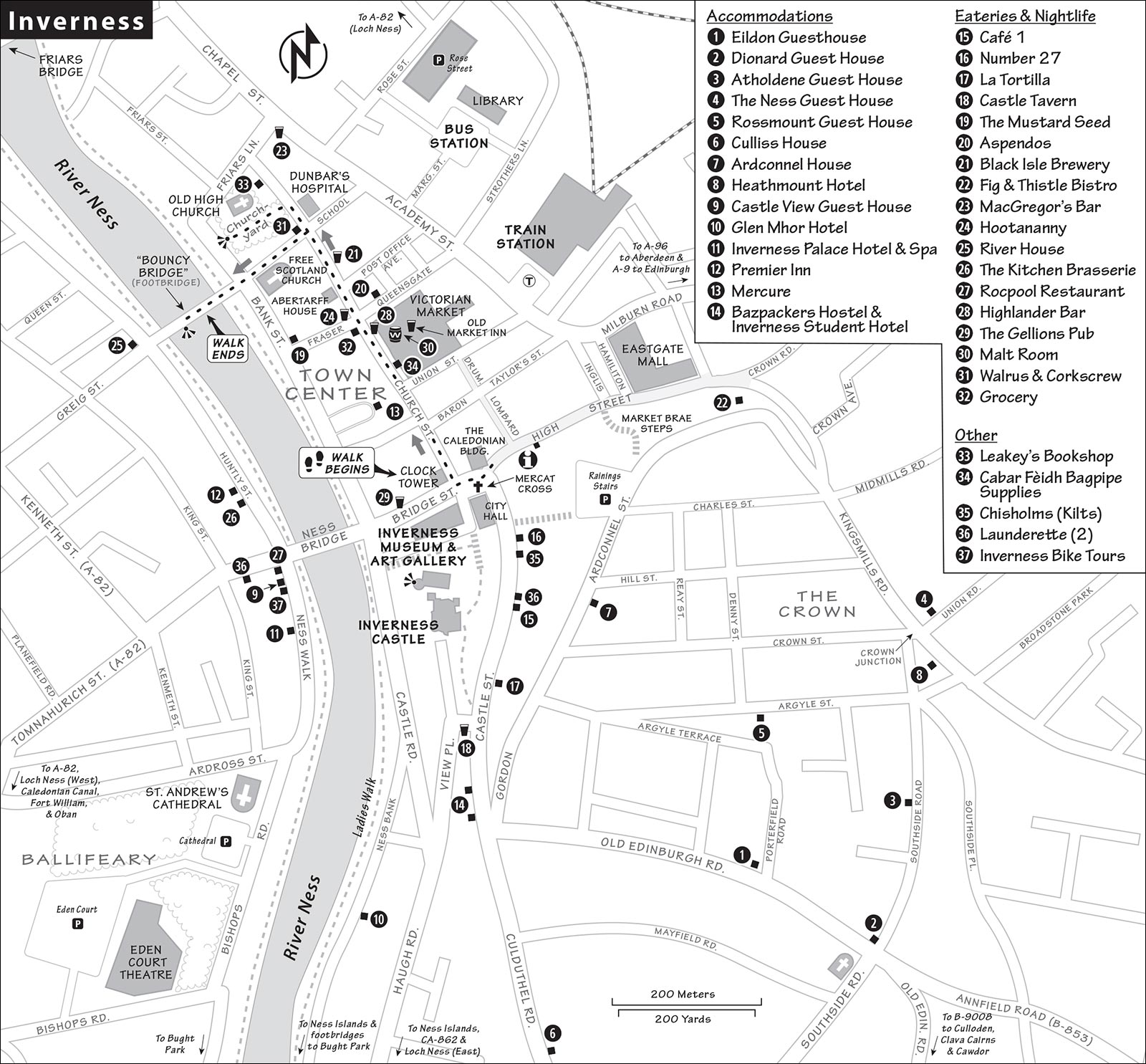
Laundry: You’ll find New City Launderette on the west end of the Ness Bridge (self-service or same-day full-service, Mon-Sat 8:00-20:00, Sun 10:00-16:00, last load one hour before closing, 17 Young Street, +44 1463 242 507). Ness Castle Laundry is behind the castle and convenient if you’re staying in The Crown (full-service only, Mon-Fri 10:30-17:00, closed Sat-Sun, 79 Castle Street, +44 7450 291 745). For locations, see the “Inverness” map in this chapter.
Tours in Inverness
IN TOWN
Skip the City Sightseeing hop-on, hop-off bus tour (this format doesn’t work well in Inverness).
Walking Tours
Two different companies offer walking tours through Inverness. I enjoy Cath’s Walk Inverness Tours, run by Cath Findlay and her associates. They offer 1.5-hour walking tours departing from the TI most days through the summer at 11:00. You’ll learn about the history of Inverness, its castle, Victorian Market, and Old High Church, with a few Outlander landmarks thrown in for good measure (£14, www.walkinverness.com). Cath also organizes private Inverness walking tours and driving tours to Culloden or Loch Ness—see website for details. Another company—called Walking Tours in Inverness—runs 1.5-hour tours that depart each morning (£12, daily at 11:30 from in front of TI, in summer they do a second walk at 17:30, www.walkingtoursin.com/inverness).
Inverness Bike Tours
Hardworking Alison leads small groups on two-hour bike tours. Her six-mile Waterways route is nearly all on traffic-free paths along canals and lochs outside of the city and comes with light guiding along the way. You’ll pedal through Ness Island, stop at the Botanical Gardens, ride along the Caledonian Canal with its system of locks (you may even catch a boat passing through), and cycle through a nature preserve (£26, generally no kids under 14, 10-person max; daily March-Oct at 10:00 and 14:45; best to book online in advance, goes even in light rain, meet at the Prime Restaurant, near the west end of Ness Bridge at 4 Ness Walk, call or text +44 7443 866 619, www.invernessbiketours.co.uk). Arrive 15 minutes early to size up your bike and helmet.
EXCURSIONS FROM INVERNESS
Inverness is a popular home base for day trips. While the big sellers are the many Loch Ness tours, I far prefer an all-day trip to the Isle of Skye, which provides a good-enough look at Loch Ness and Urquhart Castle along the way. It’s smart to reserve well in advance, especially for summer and Isle of Skye.
Loch Ness
The (in)famous loch is just a 20-minute drive from Inverness. Tours often include a short boat ride, a visit to Urquhart Castle, and a stop at the Loch Ness monster exhibits. The loch is not particularly scenic, the castle is just a shell, and the monster is a gimmick—but if you’re determined to tick this off your list, a tour is an efficient way to do it. One well-established outfit is Jacobite Tours, with a three-hour visit including the bus to Loch Ness, a 30-minute cruise, and time at Urquhart Castle (+44 1463 233 999, www.jacobite.co.uk). Many of the companies listed below also offer Loch Ness trips.
Isle of Skye
Several companies do good day tours to the Isle of Skye. They typically depart Inverness around 8:00 and travel 110 miles (a 2.5-hour drive) to Portree, in the heart of Skye. With about five hours of driving, and one hour for lunch in Portree, that leaves two or three hours for a handful of quick and scenic photo stops. The tours travel along Loch Ness (so you can see Urquhart Castle and pretend to look for a sea monster) and stop for a view of Eilean Donan Castle. Longer versions (12 hours-plus) loop around the stunning Trotternish Peninsula—worth adding on if the weather’s decent.
Wow Scotland’s ambitious 12-hour “Ultimate” big-bus itinerary includes short but smart and adequate stops all along the way—including the Trotternish Peninsula and a chance to hike at the Fairy Pools (£104, nearly daily April-Oct, +44 1808 511 773, www.wowscotlandtours.com). I’d pay extra to upgrade to the front or second row of their 30-seat bus.
Highland Experience Tours offers a similar tour—but without the Fairy Pools hike—in a smaller, 24-seat bus (£54, nearly 12 hours, daily April-Oct, fewer off-season, +44 131 285 3314, www.highlandexperience.com). Their £86 Skye and Fairy Pools route includes the pools and parts of the NC-500 driving route.
Happy Tours Scotland organizes daily minibus tours on a nine-hour joy ride (including Portree and the Old Man of Storr) with top-notch guides (£85, 8 people per minibus, +44 7828 154 683, www.happy-tours.biz, Cameron).
By Train Plus Tour: To avoid a long bus ride, ride the train from Inverness to Kyle of Lochalsh, where the locally based Skye Tours will pick you up and take you around Skye, with stops including the Quiraing and Fairy Pools (£65, 5 hours, 16-person minibus, +44 1471 822 716, www.skye-tours.co.uk). The train leaves Inverness before 9:00 and arrives around 11:30; the return train is around 17:15.
Other Destinations
The above companies offer a variety of other options from Inverness. Popular choices include Culloden and Clava Cairns, Cairngorms National Park, Royal Deeside and the Speyside Whisky Trail, the far north of the Highlands and John O’Groats, Outlander-themed tours, and multiday trips that include the Orkney Islands. Peruse websites for your options, or ask at the TI.
Inverness Walk
Although humble Inverness is best as a jumping-off point for exploring the countryside, spare an hour or two for the town’s fun history and quirky charm with this short self-guided walk (walk route shown on “Inverness” map, earlier).
• Start right in the heart of town, along Bridge Street, in front of the clock tower.
Clock Tower: This structure, looming 130 feet above you, is all that remains of a tollbooth building erected in 1791. This is the highest spire in town, and for generations was a collection point for local taxes. Here, four streets—Church, Castle, Bridge, and High—come together, integrating God, defense, and trade—everything necessary for a fine city.
About 800 years ago, a castle was built on the bluff overhead and the town of Inverness coalesced right about here. For centuries, this backwater town’s economy was based on cottage industries. Artisans who made things also sold them. In 1854, the train arrived, injecting energy and money from Edinburgh and Glasgow, and the Victorian boom hit. With the Industrial Age came wholesalers, distributors, mass production, and affluence. Much of the city was built during this era, in Neo-Gothic style—over-the-top and fanciful, like the City Hall (from 1882, kitty-corner to the clock tower). With the Victorian Age also came tourism.
Notice the Gaelic language on directional and street signs all around you. While virtually no one speaks Gaelic as a first language (and only about 60,000 Scottish people speak it fluently), this old Celtic language symbolizes the strength of Scottish Highland culture.
• Take a few steps up (away from the river) High Street.
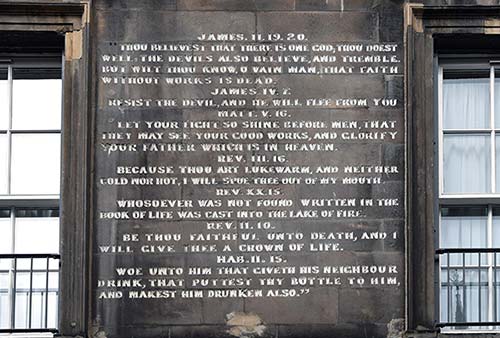
High Street: At the next building, look up to see the Bible quotes chiseled into the facade (upper floor). A civic leader, tired of his council members being drunkards, edited these Bible verses for maximum impact, especially the bottom two.
Now do an about-face. Hiding just up the hill (behind the eyesore concrete home of the Inverness Museum and Art Gallery) and likely covered in scaffolding is Inverness Castle, which is in the midst of an ambitious renovation project to convert it from a courthouse and prison into a cultural center and community gathering place. If the grounds are open, it’s worth hiking up to the castle at some point during your visit to enjoy some of the best views of Inverness and its river.
The next building up the street, called The Caledonian, faces McDonald’s at the base of High Street. (Caledonia was the ancient Roman name for Scotland.) It was built in 1847, complete with Corinthian columns and a Greek-style pediment, as the leading bank in town, back when banks were designed to hold the money of the rich and powerful...and intimidate working blokes. Just a few steps up from here, notice how nicely pedestrianized High Street welcomes people and seagulls...but not cars.
• Now cross the street and face the City Hall (which is known here as the “Town House”). To the left of the entrance is the well-worn...
Mercat Cross: This cross designated the market in centuries past. This is where the townspeople gathered to hear important proclamations, share news, watch hangings, gossip, and so on. The scant remains of a prehistoric stone at the base of the cross are what’s left of Inverness’ “Stone of Destiny.” According to tradition, whenever someone moved away from Inverness, they’d take a tiny bit of home with them in the form of a chip of this stone—so it’s been chipped and pecked almost to oblivion.
• Backtrack a few steps and use the crosswalk to cross High Street. Let’s head up pedestrianized Church Street, which begins between the clock tower and The Caledonian.
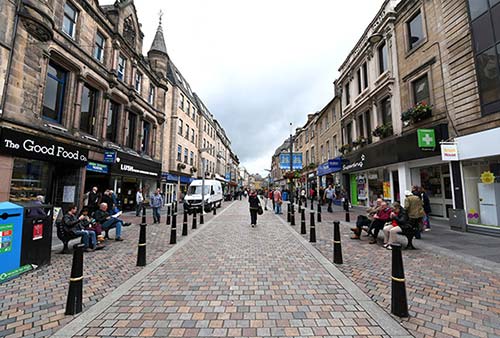
Church Street: The street art you’ll trip over at the start of Church Street is called Earthquake—a reminder of the quake that hit Inverness in 1816. As the slabs explain, the town’s motto is “Open-heartedness, Insight, and Perseverance.”
Stroll down Church Street. Look up above the modern storefronts to see centuries-old facades, more interesting than the town’s regrettable post-WWII architecture. Union Street (the second corner on the right)—stately, symmetrical, and Neoclassical—was the fanciest street in the Highlands when it was built in the 19th century. Its buildings had indoor toilets. That was big news.
Midway down the next block of Church Street (on the right), an alley marked by a purple sign overhead leads to the Victorian Market. Venturing down the alley, you’ll pass The Malt Room (a small and friendly whisky bar eager to teach you to appreciate Scotland’s national tipple; see “Nightlife in Inverness”) and The Old Market Inn (a dive bar worth a peek).
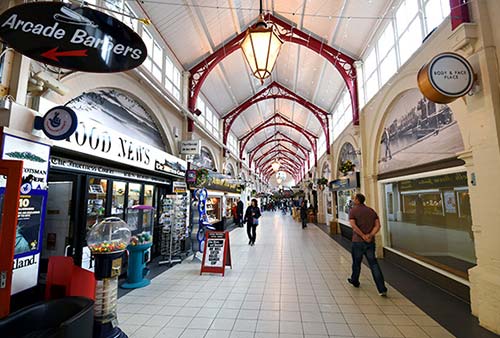
Stepping into the Victorian Market, you’ll find a gallery of shops under an iron-and-glass domed roof dating from 1876. The first section is a small food court with seating encircled by a handful of eateries; delve deeper to find a mix of local shops and tacky “tartan tat” souvenir stands. (If you can’t get into the market through here, loop around to enter from Union Street.)
Go back out of the market the way you came in (pausing to read the sign with some market history as you re-enter the food court) and continue down Church Street. At the next corner, you come to Hootananny, famous locally for its live music (on the left; pop in to see what’s on tonight). Just past that is Abertarff House, the oldest house in Inverness. It was the talk of the town in 1593 for its “turnpike” (spiral staircase) connecting the floors.
Continue about a block farther along Church Street. On the left you’ll pass the recommended Walrus & Corkscrew wine bar, facing the little lane that leads to the “Bouncy Bridge” (where we’ll finish this walk). Opposite that lane (on the right) is Dunbar’s Hospital, with four-foot-thick walls (now a pancake shop). In 1668, Alexander Dunbar was a wealthy landowner who built this as a poor folks’ home. Try reading the auld script in his coat of arms above the door.
A few steps farther up Church Street, walk through the iron gate on the left and into the churchyard (we’re focusing on the shorter church on the right—ignore the bigger one on the left). Looking at the memorial on the church’s wall, it’s clear which of the 20th century’s world wars hit Scotland harder (WWI dead are listed in the middle; WWII to either side). While no one famous is buried here, many tombstones go back to the 1700s.
• Dodging rabbits, head for the bluff overlooking the river and turn around to see...
Old High Church: There are a lot of churches in Inverness (mostly Protestant, a few Catholic, and a mosque), but these days, most are used for other purposes. This one, dating from the 11th century, is the most historic and served as a church up until just the last few years. It was built on what was likely the site of a pagan holy ground. Early Christians called upon St. Michael to take the fire out of pagan spirits, so it only made sense that the first Christians would build their church here and dedicate the spot as St. Michael’s Mount.
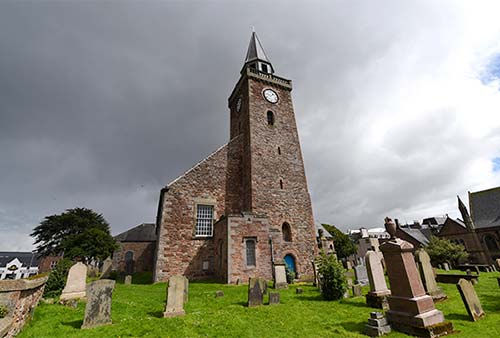
In the sixth century, the Irish evangelist monk St. Columba brought Christianity to northern England, the Scottish islands (at Iona), and the Scottish Highlands (in Inverness). He stood here amongst the pagans and preached to King Brude and the Picts.
Study the bell tower from the 1600s. The small door to nowhere (one floor up) indicates that back before the castle offered protection, this tower was the place of last refuge for townsfolk under attack. They’d gather inside and pull up the ladder. Every night from 1730 until 2020, the bell in the tower rang out 100 times—a tradition that began as a way to remind townsfolk that it’s dangerous to be out after dinner.
This church tower became a prison for Jacobites after the Battle of Culloden; many of the prisoners were executed in the churchyard. (Look for marks where bullets hit the tower wall.)
• From here, you can circle back to the lane leading to the “Bouncy Bridge” and then walk out onto the pedestrian bridge. Or you can just survey the countryside from this bluff.
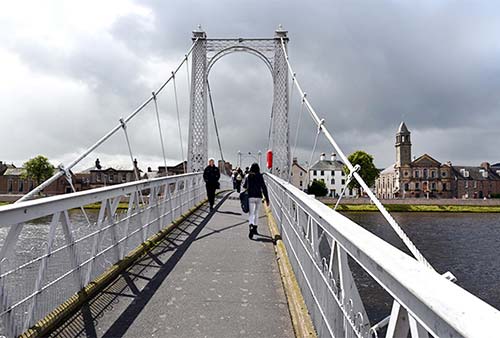
The River Ness: Emptying out of Loch Ness and flowing seven miles to the sea (a mile from here), this is one of the shortest rivers in the country. While it’s shallow (you can almost walk across it), there are plenty of fish in it. A 64-pound salmon was once pulled out of the river right here. In the 19th century, Inverness was smaller, with open fields across the river. Then, with the Victorian boom, the suspension footbridge (a.k.a. “Bouncy Bridge”) was built in 1881 to connect new construction across the river with the town.
• Your tour is over. Inverness is yours to explore.
Sights in Inverness
Inverness Museum and Art Gallery
This free, likable town museum gets a bad rap for its eyesore building, but is worth poking around on a rainy day to get a taste of Inverness and the Highlands. The ground-floor exhibits on geology and archaeology peel back the layers of Highland history: Bronze and Iron ages, Picts (including some carved stones), Scots, Vikings, and Normans, plus wildlife. The upstairs covers the Jacobites to the present day, including traditional Highland music (fiddles and bagpipes), clothing, swords, muskets, and more. The Art Gallery hosts temporary exhibits.
Cost and Hours: Free; Tue-Sat 10:00-17:00, shorter hours off-season, closed Sun-Mon year-round; cheap café, in the ugly modern building in front of the castle, +44 1349 781 730, more info under the visitor attractions tab at www.highlifehighland.com.
Inverness Castle
The scenic castle that caps the hill above the River Ness may be closed when you visit—it’s undergoing a top-to-bottom renovation, with reopening expected in 2025. Plans call for displays delving into Scottish history and culture; bars for sipping whisky; a performance space showcasing traditional music; a roof terrace with expansive views; elaborate gardens populated with native plant species; and a glassy new “link building” that connects the two castle structures and houses a sit-down restaurant. The goal is to make the complex both a tourist attraction and a community gathering spot. For the latest, see https://invernesscastle.scot.
Historically, the wooden fortress that first stood here was replaced by a stone structure in the 15th century. In 1715, that castle was named Fort George to assert English control over the area. In 1745, it was destroyed by Bonnie Prince Charlie’s Jacobite army and remained a ruin until the 1830s, when the present castle was built. In modern times, the castle was converted into a courthouse and prison, but didn’t see a lot of action. As locals like to say, “No guns, no problems.” While hunters can own a rifle, gun ownership in Scotland is tightly regulated.
The statue outside the castle (from 1899) depicts Flora MacDonald, who helped Bonnie Prince Charlie escape from the English (see here).
River Walks
As with most European cities, where there’s a river, there’s a walk. Inverness, with both the River Ness and the Caledonian Canal, does not disappoint. Consider an early-morning stroll along the Ness Bank to capture the city at sunrise, or a post-dinner jaunt to Bught Park for a local shinty match. The path is lit at night. The forested islands in the middle of the River Ness—about a 15-minute walk south of the center—are a popular escape from the otherwise busy city.
Here’s a good plan for your Inverness riverside constitutional: From the Ness Bridge, head south along the riverbank under the castle (along the path called “Ladies Walk”). As you work your way up the river, you’ll see the architecturally bold Eden Court Theatre (across the river), pass a white pedestrian bridge, see a WWI memorial, and peek into the gardens of several fine old Victorian sandstone riverfront homes. Nearing the tree-covered islands, watch for fly-fishers in hip waders on the pebbly banks. Reaching the first, skinny little island, take the bridge with the wavy, wrought-iron railing and head down the path along the middle of the island. Notice that this is part of the Great Glen Way, a footpath that stretches from here all the way to Fort William (79 miles). Enjoy this little nature break, with gurgling rapids—and, possibly, a few midges. Reaching the bigger bridge, cross it and enjoy strolling through tall forests. Continue upriver. After two more green-railinged bridges, traverse yet another island, and find one last white-iron bridge that takes you across to the opposite bank. You’ll pop out at the corner of Bught Park, the site of shinty practices and games—are any going on today?
From here, you can simply head back into town along the path on this bank. If you’d like to explore more, near Bught Park you’ll find minigolf, a skate park, the Highland Archive building, the free Botanic Gardens, and the huge Active Inverness leisure center, loaded with amusements including a swimming pool with adventure slides, a climbing wall, a sauna and steam area, and a gym (www.highlifehighland.com/il).
Continuing west, you’ll soon hit the Caledonian Canal; to the south, this parallels the River Ness, and to the north it empties into Beauly Firth, then Moray Firth and the North Sea. From the Tomnahurich Bridge, paths on either bank allow you to walk along the Great Glen Way until you’re ready to turn around. It takes about an hour to circle from the center of Inverness all the way back north to Clachnaharry, where the river meets Beauly Firth.
Shopping in Inverness
This city has more “tartan tat” shops per square mile than perhaps any place in Scotland. So, if you’re looking for the same knock-off souvenirs you can get anywhere, at least Inverness makes for easy comparison shopping. The city also has outlets of some higher-end (but still tourist-oriented) Scotland-wide chains. For something with a bit more serious quality, seek out the places noted here. For shop locations, see the “Inverness” map on here.
Leakey’s Bookshop, at the far end of Church Street, is a fun place to browse; their namesake tote bag makes a unique gift (see contact details under “Helpful Hints,” earlier).
Cabar Fèidh Bagpipe Supplies is the place for those who are seriously into bagpipes. American expat Brian sells CDs and sheet music, and repairs and maintains the precious instruments of local musicians (Mon-Sat 10:00-16:00, closed Sun, upstairs at 28 Church Street, +44 1463 223 030, www.cabarfeidh.scot).
Chisholms is a quality outfitter for finding traditional, properly manufactured kilts and other Highland dress (Mon-Tue and Thu-Sat 10:00-16:00, closed Wed and Sun, 47 Castle Street, +44 1463 234 599, www.kilts.co.uk).
Nightlife in Inverness
Scottish Folk Music
While you can find traditional folk-music sessions in pubs and hotel bars anywhere in town, these places are well established as the music pubs. There’s rarely a cover charge, unless a bigger-name band is playing.
MacGregor’s Bar is run by Bruce MacGregor, a founding member of the Scottish group Blazin’ Fiddles, and his wife, Jo. Their passion for local music (with music nearly nightly at 18:00 and 20:30) is matched by good food, local beers on tap, and a fun local crowd (it’s also one of my recommended eating options). From spring through fall, they also offer a whisky tasting accompanied by traditional Scottish music and stories (£42.50, April-Oct Mon-Fri at 19:00—reservations essential; a few blocks past the pedestrian bridge at 113 Academy Street, +44 1463 719 629, www.macgregorsbars.com).
Hootananny is an energetic place that specializes in traditional folk music, but occasionally mixes in rock, blues, or cover bands (it’s also one of my recommended eateries). There’s usually music nightly, often starting about 21:30 (traditional music sessions Sun-Thu, trad bands on weekends; also a daytime session on Sat afternoon around 14:30; 67 Church Street, +44 1463 233 651, www.hootanannyinverness.co.uk).
Highlander is a welcoming venue with live Scottish music daily, including a rare early set. Perch at the bar or tap your toes at one of the wine-barrel tables (music nightly at 16:00 and 20:00, craft beers and ciders on tap, 46 Church Street, +44 1463 213 958, www.facebook.com/HighlanderBarInverness).
The Gellions has live folk and Scottish music nightly in summer (from 21:30 or sometimes earlier). Very local and a bit rough, it has local ales on tap and brags it’s the oldest bar in town (14 Bridge Street, +44 1463 233 648, www.gellions.com).
Whisky Tastings
For a whisky education, or just a fine cocktail, drop in to the intimate Malt Room, with more than 300 different whiskies ranging from £4 to £195. The whisky-plus-chocolate flight, for £35, makes for a fun nightcap (daily until late, just off Church Street in the alley leading to the Victorian Market, 34 Church Street, +44 1463 221 888, Matt, www.themaltroom.co.uk).
MacGregor’s Bar (listed earlier) also offers whisky tastings and beer flights.
Wine Bar
Walrus & Corkscrew is a fun wine bar with indoor and outdoor seating just off Church Street, on the way to the Bouncy Bridge. They also have a good selection of whiskies and beers, and offer small plates to pair with your drink (daily until late, 105 Church Street, +44 1463 221 237, www.thewalrusandcorkscrew.co.uk).
Sleeping in Inverness
Accommodations in Inverness can book up very early—by March, the entire busy summer season (May-Sept, especially July-Aug) can already be spoken for. Book early to get your choice of rooms.
B&BS IN THE CROWN
Inverness’ best B&B neighborhood is the area called “The Crown,” which sits on a ridge just above the castle. The intersection at the center, where Kingsmills meets Crown (known as the Junction at the Crown), is home to a pharmacy and handful of local-feeling eateries.
This area has a real “Goldilocks” appeal: It feels calm, welcoming, and residential, but you also have quick access to the very heart of town (about a 10-minute walk, often including some stairs). Parking can be tricky: Ask when you book. All of these serve cooked breakfast.
$$ Eildon Guesthouse offers five tranquil rooms with spacious baths. The cute-as-a-button 1890s brick home is centrally located yet exudes countryside warmth and serenity from the moment you open the gate (family rooms, 2-night minimum in summer, no kids under 10, in-room fridges, parking, 29 Old Edinburgh Road, +44 1463 231 969, www.eildonguesthouse.co.uk, eildonguesthouse@yahoo.co.uk, Jacqueline).
$$ Dionard Guest House, wrapped in a fine hedged-in garden, has cheerful common spaces, seven lovely rooms, and lively host Gail (family suite, in-room fridges, laundry service available, parking, 39 Old Edinburgh Road, +44 1463 233 557, www.dionardguesthouse.co.uk, enquiries@dionardguesthouse.co.uk).
$$ Atholdene Guest House, run by amiable Gillian and Andrew, welcomes many return visitors—maybe they come back for the savory homemade tattie scones? Its nine rooms are comfortable and well appointed; ones in the front are bigger but face the street. Classical music in the morning makes for a civilized breakfast (2-night minimum in summer, guests must be 18 or older, private parking, 20 Southside Road, +44 1463 233 565, www.atholdene.com, info@atholdene.com).
$$ The Ness Guest House, well run by exuberant Susan and Richard, is friendly, cozy, and tidy, offering good value and lots of special touches in its four rooms, including one on the ground floor (no kids under 12, private parking includes EV chargers, 48 Union Road, +44 1463 559 174, www.thenessguesthouse.com, rooms@thenessguesthouse.com).
$$ Rossmount Guest House feels like home, with its curl-up-on-the-couch lounge space, three unfussy rooms, hardwood-meets-modern style, and friendly hosts Ruth and Robert, plus Milo the dog (family room, 2-night minimum in summer, on a residential stretch of Argyle Street, +44 1463 229 749, www.rossmount.co.uk, mail@rossmount.co.uk).
$$ Culliss House is at the edge of The Crown, with three spacious rooms in a woodsy, modern, chalet-like home tucked behind a medical practice (private parking, 15 Culduthel Road, +44 1463 234 334, www.invernesscitybedandbreakfast.co.uk, stay@invernesscitybedandbreakfast.co.uk, Joan).
On Ardconnel Street: Several basic places sit side-by-side very close to the top of the Market Brae steps into the town center. Of these, I recommend $$ Ardconnel House, a classic, traditional place offering a large guest lounge, along with six spacious, if dated, rooms (family room, 2-night minimum preferred in summer, no children under 5, closed Nov-Easter, 21 Ardconnel Street, +44 1463 418 242, www.ardconnel-inverness.co.uk, ardconnel@gmail.com, Elaine).
Hotel: $$$$ Heathmount Hotel’s understated facade hides a chic retreat for comfort-seeking travelers. Its eight elegant rooms—tucked in the heart of the B&B neighborhood—come with unique decor, parking, and fancy extras (family room, no elevator, restaurant, parking, Kingsmills Road, +44 1463 235 877, www.heathmounthotel.com, info@heathmounthotel.com).
ON THE RIVER
$$ Castle View Guest House sits right along the River Ness at the Ness Bridge—and, true to its name, it owns smashing views of the castle. Its five big and comfy rooms (some with views) are beautifully furnished, and the delightful place is lovingly run by Eleanor. Breakfast includes tasty homemade scones and jams, smoked haddock and Hebridean salmon, and is served in a bright, high-ceilinged room above the river (family rooms, street parking or affordable lot nearby, 2A Ness Walk, +44 1463 241 443, www.castleviewguesthouseinverness.com, enquiries@castleviewguesthouseinverness.com).
CHAIN HOTELS
In addition to the more personally run places listed above, Inverness has a number of big chain hotels. These tend to charge a lot when it’s busy but are worth a look if the B&Bs are full or if it’s outside the main tourist season. Options include the Glen Mhor Hotel (right along the river, with an on-site distillery), Inverness Palace Hotel & Spa (a Best Western fancy splurge right on the river with a pool and gym), Premier Inn (River Ness location), and Mercure (in the town center off Church Street).
HOSTELS
For funky and cheap dorm beds near the center and the recommended Castle Street restaurants, consider these friendly side-by-side hostels, geared toward younger travelers. They’re about a 12-minute walk from the train station.
¢ Bazpackers Hostel, a stone’s throw from the castle, has a quieter, more private feel for a hostel with dorm beds arranged in pods (private rooms with shared bath available, reception open 11:00-23:00, pay laundry service, 4 Culduthel Road, +44 1463 717 663, www.bazpackershostel.co.uk, info@bazpackershostel.co.uk). They also rent a small apartment nearby (sleeps up to 4).
¢ Inverness Student Hotel has brightly colored rooms and a laid-back lounge with a bay window overlooking the River Ness. The knowledgeable, friendly staff welcomes any traveler over 18 (breakfast extra, free tea and coffee, pay laundry service, kitchen, 8 Culduthel Road, +44 1463 236 556, www.invernessstudenthotel.com, info@invernessstudenthotel.com).
Eating in Inverness
In high season, Inverness’ top restaurants (including many of those recommended below) fill up quickly—reservations are wise.
BY THE CASTLE
These eateries line Castle Street, facing the back of the castle.
$$$ Café 1 serves up high-quality modern Scottish and international cuisine with trendy, chic bistro flair. Fresh meat from their farm adds to an appealing menu (lunch and early-bird dinner specials until 18:15; Mon-Tue dinner only, Wed-Sat lunch and dinner, closed Sun; 75 Castle Street, +44 1463 226 200, www.cafe1.net).
$$ Number 27 has a straightforward, crowd-pleasing menu that offers something for everyone—burgers, pastas, and more. The food is surprisingly elegant for this price range (daily, generous portions, local ales on tap, 27 Castle Street, +44 1463 241 999, https://number27inverness.com).
$$ La Tortilla has Spanish tapas, including spicy king prawns (the house specialty) and two-person paellas, plus a vegan menu. It’s an appealing, colorfully tiled, and vivacious dining option that feels like Spain. With the tapas format, figure three dishes per person, and plan to share (daily, 99 Castle Street, +44 1463 709 809, www.latortillaasesina.co.uk).
$$ Castle Tavern serves the expected pub classics kitty-corner from the castle. The atmospheric beer garden hums with happy diners until late (open daily for dinner, also open Sat-Sun for lunch, 1 View Place, +44 1463 718 178, www.castletavern.pub).
IN THE TOWN CENTER
$$$$ The Mustard Seed serves Scottish food with a creative twist in an old church with a river view. It’s a lively place with nice outdoor tables over the river when sunny. Reservations are essential for this popular spot (two-course lunch deals, early-bird specials before 18:30, open daily, on the corner of Bank and Fraser Streets, 16 Fraser Street, +44 1463 220 220, www.mustardseedrestaurant.co.uk).
$$$$ Aspendos serves up freshly prepared, delicious, pricey Turkish and East Mediterranean dishes in a spacious, dressy, and exuberantly decorated dining room (daily, 26 Queensgate, +44 1463 711 950, highlandaspendos.co.uk).
$$ Black Isle Brewery, a taphouse right in the center of town, produces organic beers and ciders just across the River Ness. Screens over the bar list two dozen different choices on tap—and they also serve good wood-fired pizzas. If the main space is jammed—as it often is—follow signs upstairs to the “Secret Garden,” a hidden roof deck with lots of fun and cozy alcoves (daily until late, 68 Church Street, +44 1463 229 920, www.blackislebrewery.com).
$$$ Fig & Thistle Bistro, at the end of High Street, offers modern Scottish cuisine in a tight space over two floors or at picnic tables outside, with a focus on locally sourced steak and seafood. The abbreviated lunch menu is a good value (closed Sun-Tue, across from Eastgate Mall at 4a Stephens Brae, +44 1463 712 422, www.figandthistle.co.uk).
Nightlife Spots with Great Food: Two places listed earlier, under “Nightlife in Inverness,” also have good food. $$ MacGregor’s Bar serves excellent traditional and updated Scottish dishes in its dining room (reserve ahead) or accompanied by live music in the bar or at adjacent outdoor seating (no reservations). $$ Hootananny has a fun menu of Scottish pub grub (no food served Sat-Sun).
Picnic: There’s a Co-op market with plenty of cheap picnic grub at 59 Church Street (daily).
ACROSS THE RIVER
$$$$ River House, a classy, sophisticated, but unstuffy place, is the brainchild of Cornishman Alfie—who prides himself on melding the seafood know-how of both Cornwall and Scotland with Venetian-style cicchetti small plates. Reserve ahead (dinner only, closed Sun-Mon, 1 Greig Street, +44 1463 222 033, www.riverhouseinverness.co.uk).
$$$$ The Kitchen Brasserie stands out in its modern glass box of a building overlooking the river, serving a menu of elevated seafood and land food (early-bird special until 18:00, open daily, dinner only, 15 Huntly Street, +44 1463 259 119, www.kitchenrestaurant.co.uk).
$$$$ Rocpool Restaurant is a hit with locals and traveling foodies. Owner/chef Steven Devlin serves creative modern European food in a sleek, contemporary dining room. Reservations are essential (early-bird weekday special available 17:30-18:15, closed Sun-Mon, 1 Ness Walk, +44 1463 717 274, www.rocpoolrestaurant.com).
Inverness Connections
From Inverness by Train to: Pitlochry (nearly hourly, 1.5 hours), Stirling (nearly hourly, 3 hours), St. Andrews (roughly hourly, 3.5 hours, 1-2 changes), Kyle of Lochalsh near Isle of Skye (4/day, 2.5 hours), Edinburgh (nearly hourly, 3-4 hours, some with change), Glasgow (4/day direct, 3.5 hours, more with change in Perth), Thurso (for ferries to Orkney; 4/day, 4 hours). The Caledonian Sleeper provides overnight service to London (www.sleeper.scot). Train info: +44 345 748 4950, NationalRail.co.uk.
By Bus: Inverness has a direct bus to Portree on the Isle of Skye (bus #917, 3-4/day, 3 hours), but for other destinations in western Scotland, you’ll first head for Fort William (bus #919, 6/day, 2 hours, fewer on Sun). For connections onward to Oban (figure 4 hours total) or Glencoe (3 hours total), see “Fort William Connections” on here. Inverness is also connected by direct bus to Edinburgh (#M90, 8/day, 4 hours; stops en route at Pitlochry, 1.5 hours) and Glasgow (#M10, 5/day, 3 hours). Bus info: Citylink.co.uk [URL inactive].
Tickets are sold in advance online, by phone at +44 871 266 3333, or in person at the Inverness bus station (daily 8:30-17:00, 2 blocks from train station on Margaret Street, +44 1463 233 371).
By Plane: Inverness Airport is about 10 miles east of town (code: INV, www.hial.co.uk) and has car rental desks and a taxi stand (20-minute trip). Stagecoach Highlands bus #11 also connects to the city center every half-hour (www.stagecoachbus.com).
ROUTE TIPS FOR DRIVERS
Inverness to Edinburgh (160 miles, 3.25 hours minimum): Leaving Inverness, follow signs to the A-9 (south, toward Perth). If you haven’t seen Culloden Battlefield yet, it’s an easy detour: Just as you leave Inverness, head four miles east off the A-9 on the B-9006. Back on the A-9, it’s a wonderfully speedy, scenic drive (A-9, M-90, A-90) all the way to Edinburgh. If you have time, consider stopping en route in Pitlochry (just off the A-9; see the Eastern Scotland chapter).
Inverness to Portree, Isle of Skye (110 miles, 2.5 hours): The drive from Inverness to Skye is pretty but much less so than the valley of Glencoe or the Isle of Skye itself. You’ll drive along boring Loch Ness, and then follow signs to Portree and Skye on A-87 along Loch Cluanie (a loch tamed by a dam built to generate hydroelectric power). This valley was once a “drovers’ route” for the cattle drive from the islands to the market—home of the original Scottish cowboys.
Inverness to Fort William (65 miles, 1.5 hours): This city, southwest of Inverness via the A-82, is a good gateway to Oban and Glencoe. See the Glencoe & Fort William chapter.
Near Inverness
Inverness puts you in the heart of the Highlands, within easy striking distance of several famous and worthwhile sights: Commune with the Scottish soul at historic Culloden Battlefield, where British history reached a turning point. Wonder at three mysterious Neolithic cairns, which remind visitors that Scotland’s story goes back thousands of years. And enjoy a homey country castle at Cawdor. Loch Ness—with its elusive monster—is another popular and easy, if overrated, day trip.
In addition to the sights in this section, note that sights including the Speyside Whisky Trail, the Working Sheepdogs demonstration, and the Highland Folk Museum are also within side-tripping distance of Inverness (see the Eastern Scotland chapter).
CULLODEN BATTLEFIELD
Jacobite troops under Bonnie Prince Charlie were defeated at Culloden by supporters of the Hanover dynasty (King George II’s family) in 1746. Sort of the “Scottish Alamo,” this last major land battle fought on British soil spelled the end of Jacobite resistance and the beginning of the clan chiefs’ fall from power. Wandering the desolate, solemn battlefield at Culloden (kuh-LAW-dehn), you sense that something terrible occurred here. Locals still bring white roses and speak of “The Forty-Five” (as Bonnie Prince Charlie’s entire campaign is called) as if it just happened. Engaging even if you’re not interested in military history, the battlefield at Culloden and its high-tech visitors center together are worth ▲▲▲.
Orientation to Culloden
Cost and Hours: Book ahead for £14 timed premium ticket that includes battlefield tour (see below); £12 standard ticket, only sold on-site, includes audioguide but no tour; open daily 9:00-18:00, shorter hours off-season, confirm exact times on website; £5 guidebook, café, +44 1463 796 090, www.nts.org.uk/visit/culloden.
Tours: The guided 40-minute battlefield tours are worth planning your visit around (see the exhibit on your own before or after the tour). It’s best to book ahead online, though premium tickets are sold on-site if they’re still available. Near the ticket desk, you’ll also see a posted schedule for thoughtful, engaging, in-depth presentations about various topics that take place in the big room at the end of the exhibits.
Getting There: It’s a 15-minute drive east of Inverness. Follow signs to Aberdeen, then Culloden Moor—the B-9006 takes you right there (well signed on the right-hand side). Parking is £2 (cash or card). Public buses leave from across from Marks & Spencer in Inverness and drop you off in front of the entrance (£2.20, bus #27, roughly hourly, 22 minutes, www.stagecoachbus.com). A taxi costs around £15 one-way.
Length of This Tour: Allow 2 hours.
Background
The Battle of Culloden (April 16, 1746) marks the steep decline of the Scottish Highland clans and the start of years of cruel repression of Highland culture by the British. It was the culmination of a year’s worth of battles, and at the center of it all was the charismatic, enigmatic Bonnie Prince Charlie (1720-1788).
Though usually depicted as a battle of the Scottish versus the English, in truth Culloden was a civil war between two opposing dynasties: Stuart (Charlie) and Hanover (George). However, as the history has faded into lore, the battle has come to be remembered as a Scottish-versus-English standoff—or, in the parlance of the Scots, the Highlanders versus the Strangers.
Charles Edward Stuart, from his first breath, was raised with a single purpose—to restore his family to the British throne. His grandfather was King James II (VII of Scotland), deposed in 1688 by the English Parliament for his tyranny and pro-Catholic bias. The Stuarts remained in exile in France and Italy until 1745, when young Charlie crossed the Channel from France to retake the throne in the name of his father. He landed on the west coast of Scotland and rallied support for the Jacobite cause. Though Charles was not Scottish-born, he was the rightful heir directly down the line from Mary, Queen of Scots—and why so many Scots joined the rebellion out of resentment at being ruled by a “foreign” king (King George II, who was born in Germany, couldn’t even speak English).
Bagpipes droned, and “Bonnie” (handsome) Charlie led an army of 2,000 tartan-wearing, Gaelic-speaking Highlanders across Scotland, seizing Edinburgh. They picked up other supporters of the Stuarts from the Lowlands and from England. Now 6,000 strong, they marched south toward London—quickly advancing as far as Derby, just 125 miles from the capital—and King George II made plans to flee the country. But anticipated support for the Jacobites failed to materialize in the numbers they were hoping for (both in England and from France). The Jacobites had so far been victorious in their battles against the Hanoverian government forces, but the odds now turned against them. Charles retreated to the Scottish Highlands, where many of his men knew the terrain and might gain an advantage when outnumbered. The English government troops followed closely on his heels.
Against the advice of his best military strategist, Charles’ army faced the Hanoverian forces at Culloden Moor on flat, barren terrain that was unsuited to the Highlanders’ guerrilla tactics. The Jacobites—many of them brandishing only broadswords, targes (wooden shields covered in leather and studs), and dirks (long daggers)—were mowed down by King George’s cannons and horsemen. In less than an hour, the government forces routed the Jacobite army, but that was just the start. They spent the next weeks methodically hunting down ringleaders and sympathizers (and many others in the Highlands who had nothing to do with the battle), ruthlessly killing, imprisoning, and banishing thousands.
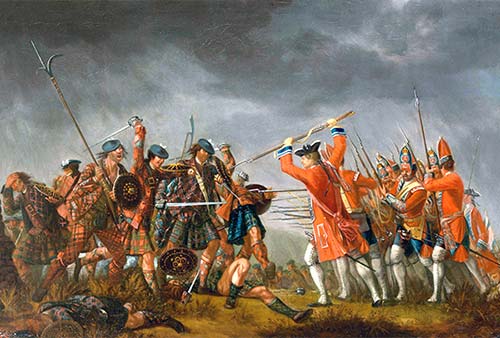
Charles fled with a £30,000 price on his head (an equivalent of millions of today’s pounds). He escaped to the Isle of Skye, hidden by a woman named Flora MacDonald (her grave is on the Isle of Skye, and her statue is outside Inverness Castle). Flora dressed Charles in women’s clothes and passed him off as her maid. Later, Flora was arrested and thrown in the Tower of London before being released and treated like a celebrity.
Charles escaped to France. He spent the rest of his life wandering Europe trying to drum up support to retake the throne. He died in obscurity, without an heir, in Rome.
The Battle of Culloden was the end of 60 years of Jacobite rebellions, the last major battle fought on British soil, and the final stand of the Highlanders. From then on, clan chiefs were deposed; kilts and tartans were outlawed; and farmers were cleared off their ancestral land, replaced by more-profitable sheep. Scottish culture is still recovering from the events of the campaign called “The Forty Five.”
 Self-Guided Tour
This tour takes you through two sections: the exhibit and the actual battlefield.
The Exhibit
Just past the ticket desk, note the family tree: Bonnie Prince Charlie (“Charles Edward Stuart”) and George II were distant cousins. Then the exhibit’s shadowy-figure touchscreens connect you with historical figures who give you details from both the Hanoverian and Jacobite perspectives. A map shows the other power struggles happening in and around Europe, putting this fight for political control of Britain in a wider context. This battle was no small regional skirmish, but rather a key part of a larger struggle between Britain and its neighbors, primarily France, for control over trade and colonial power. In the display case are medals from the early 1700s, made by both sides as propaganda.
From here, your path through this building is cleverly designed to echo the course of the Jacobite army. Your short march (with lots of historic artifacts) gets under way as Charlie sails from France to Scotland, then finagles the support of Highland clan chiefs. As he heads south with his army to take London, you, too, are walking south. Along the way, maps show the movement of troops, and wall panels cover the buildup to the attack, as seen from both sides. Note the clever division of information: To the left and in red is the story of the “government” (a.k.a. Hanoverians/Whigs/English, led by the young and ambitious Duke of Cumberland); to the right, in blue, is the Jacobites’ perspective (Prince Charlie and his Highlander/French supporters).
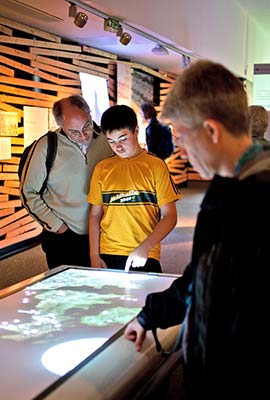
But you, like Charlie, don’t make it to London—in the dark room where the route reverses, you can hear Jacobite commanders arguing over whether to retreat back to Scotland. Pessimistic about their chances of receiving more French support, they decide to U-turn, and so do you. Heading back north, you’ll get some insight into the strategizing that went on behind the scenes, with the English hot on Charlie’s heels.
By the time you reach the end of the hall, it’s the night before the battle. Round another bend into a dark passage, and listen to the voices of the anxious troops. While the English slept soundly in their tents (recovering from celebrating the duke’s 25th birthday), the scrappy but exhausted Jacobites struggled through the night. Their original plan, a surprise night attack at Nairn, fell apart; the Highlanders instead retreated back toward Inverness in the dead of night, before ultimately deciding to turn and fight right here.
The next stage of the exhibit takes you into a theater. As you wait to enter, study the chart depicting how the forces were arranged on the battlefield. At last the two sides meet. Inside the theater, you’re surrounded by the views and sounds of a windswept moor. An impressive four-minute 360° movie projects the re-enacted battle with you right in the center of the action. The movie drives home just how outmatched the Jacobites were.
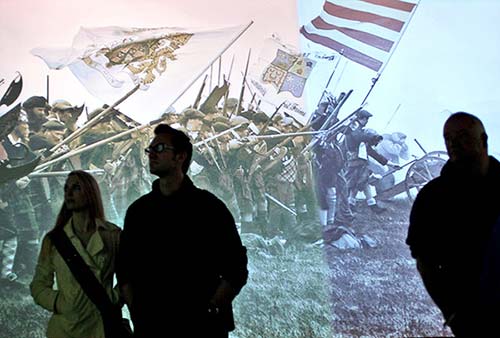
The last room has period weapons, including ammunition and artifacts found on the battlefield, as well as historical depictions of the battle. You’ll also find a section describing the detective work required to piece together the story from historical evidence. The huge virtual map illustrates the combat you’ve just experienced while giving you a bird’s-eye view of the field through which you’re about to roam.
While you can head straight out to the battlefield from here, don’t miss (on the way back to the ticket desk) the aftermath corridor (“End of the Rising”), which covers the years following the battle and the cultural wake of this event to this day.
The Battlefield
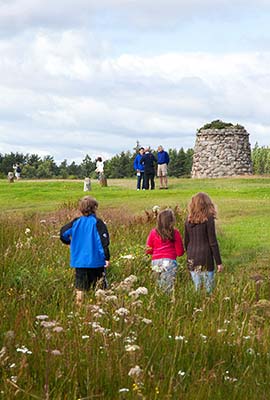
Leaving the visitors center, survey the battlefield. Red flags show the front line of the government army (8,000 troops). This is where most of the hand-to-hand fighting took place. The blue flags in the distance are where the Jacobite army (5,500 troops) lined up.
As you explore the battlefield, notice how uneven and boggy the ground is in parts, and imagine trying to run across this hummocky terrain with all your gear, toward almost-certain death. The Jacobite line broke in the rain and mud, and the duke’s men circled them in a ring of gunfire. The entire battle was over in less than an hour.
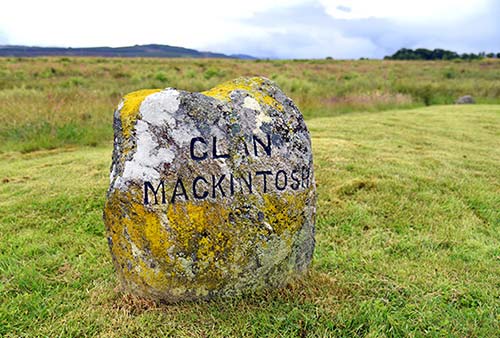
The old stone memorial cairn, erected in 1881, commemorates the roughly 1,500 Jacobites buried in this field. It’s known as the Graves of the Clans. As you wander the battlefield, you’ll pass by other mass graves, marked by small headstones, and ponder how entire clans fought, died, and were buried here. Outlander fans seek out the Fraser clan headstone (near the big cairn, often adorned with fresh flowers).
Near the visitor center, the restored stone-and-turf Leanach Cottage predates Culloden and may have been used as a field hospital during the battle. A small exhibit inside explains plans to preserve Culloden for future generations and protect the surrounding landscape from development.
Heading back to the parking lot, consider climbing up the stairs to the rooftop deck, which provides a higher vantage point from which to consider this monumental event.
On your way out, walking alongside the building, notice the wall of protruding bricks. Each represents a soldier who died. The handful of Hanoverian casualties are on the left (about 50); the rest of the long wall’s raised bricks represent the multitude of dead Jacobites.
CLAVA CAIRNS
Scotland is littered with reminders of prehistoric peoples—especially in Orkney and along the coast of the Moray Firth—but the Clava Cairns, worth ▲ for a quick visit, are the easiest to reach. You’ll find them nestled in the countryside just beyond Culloden Battlefield.
Cost and Hours: Free, always open; just after passing Culloden Battlefield on the B-9006 coming from Inverness, signs on the right point to Clava Cairns. Follow this twisty road a couple miles, over the “weak bridge” and to the free parking lot by the stones. Skip the cairns if you don’t have a car.
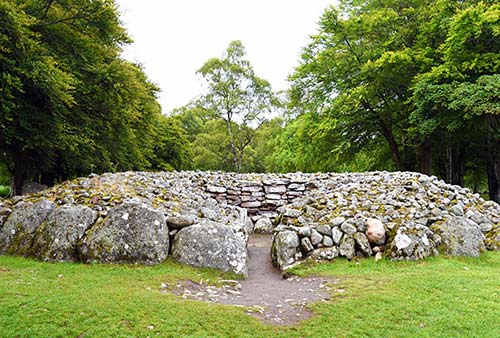
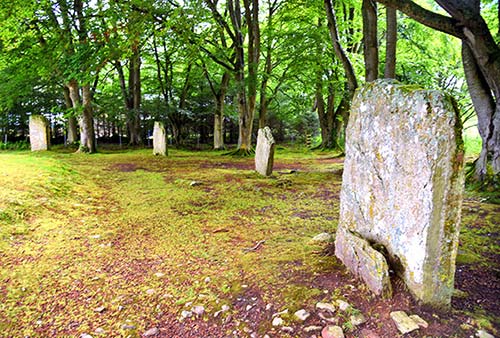
Visiting the Cairns: These “Balnauran of Clava” are Neolithic burial chambers dating from 3,000 to 4,000 years ago. Although they appear to be just some giant piles of rocks in a sparsely forested clearing, a closer look will help you appreciate the prehistoric logic behind them. (The site is explained by a few information plaques.) There are three structures: a central “ring cairn” with an open space in the center but no access to it, flanked by two “passage cairns,” which were once buried under turf-covered mounds. The entrance shaft in each passage cairn lines up with the setting sun at the winter solstice. Each cairn is surrounded by a stone circle, and the entire ensemble is framed by evocative trees—injecting this site with even more mystery.
Enjoy the site’s many enigmas: Were the stone circles part of a celestial calendar system? Or did they symbolize guardians? Why were the clamshell-sized hollows carved into the stones facing the chambers? Was the soul of the deceased transported into the next life by the ray of sunlight on that brief moment that it filled the inner chamber? How many Outlander fans have taken selfies in front of the split standing stone (which inspired a similar stone in the novel)? No one knows.
CAWDOR CASTLE
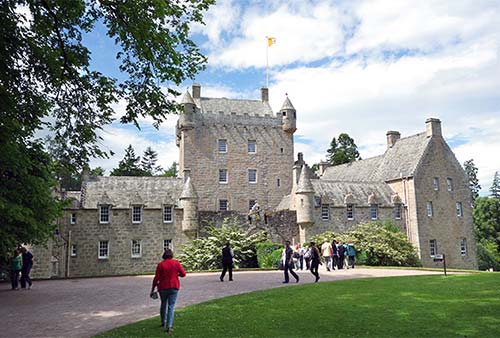
Atmospheric, intimate, and worth ▲, this castle is still the residence of the Dowager (read: widow) Countess of Cawdor, a local aristocratic branch of the Campbell family. While many associate the castle with Shakespeare’s Macbeth (because “Cawdor” is mentioned more than a dozen times in the play), there is no historic connection with Shakespeare (Macbeth is set 300 years before the castle was even built). The castle is worth a visit simply because it’s historic and beautiful in its own right—and because the woman who owns it flies a Buddhist flag from its tower. She is from Central Europe and was the Earl’s second wife.
Cost and Hours: Castle and gardens-£14.50, includes audioguide; gardens only-£8; daily 10:00-17:00, closed Oct-April; café, playground, +44 1667 404 401, www.cawdorcastle.com. The good £7 guidebook provides more detail on the family and the rooms. Lockers are available for backpacks, which cannot be brought into the castle.
Getting There: It’s on the B-9090, just off the A-96, about 15 miles east of Inverness (6 miles beyond Culloden and Clava Cairns). Public transportation to the castle is scant; ask at the TI for current options.
Visiting the Castle: You’ll follow a one-way circuit around the castle with each room well described with posted explanations written by the countess’ late husband, the sixth Earl of Cawdor. His witty notes bring the castle to life and make you wish you’d known the old chap. Cawdor feels very lived-in because it is. While the Dowager Countess moves out during the tourist season, for the rest of the year this is her home. You can imagine her stretching out in front of the fireplace with a good book. Notice her geraniums in every room.
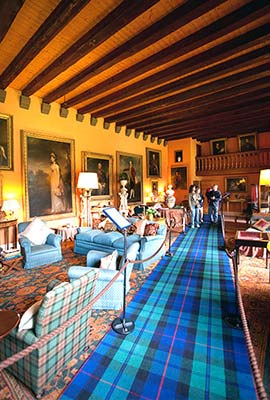
The drawing room (for “with-drawing” after dinner) is lined with a family tree of portraits looking down. In the Tapestry Bedroom you’ll see the actual marriage bed of Sir Hugh Campbell from 1662 and 17th-century tapestries warming the walls. In the Yellow Room, a flat-screen TV hides inside an 18th-century cabinet (ask a docent to show you). In the Tartan Passage, lined with modern paintings, find today’s dowager—Lady Angelika—in a beautiful 1970 pastel portrait, staring at her late husband’s predecessors. Notice how their eyes follow you creepily down the hall—but hers do not.
A spiral stone staircase near the end of the tour leads down to the castle’s proud symbol: a holly tree dating from 1372. According to the beloved legend, a donkey leaned against this tree to mark the spot where the castle was to be built...and it was, around the tree.
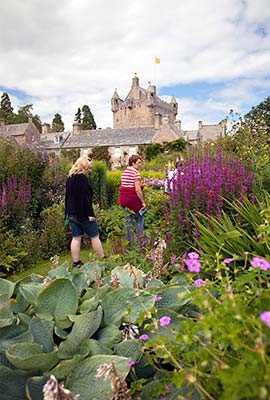
The gardens are worth exploring, with some 18th-century linden trees and several surprising species (including sequoia and redwood). You can circle the hedge maze, crowned by a minotaur and surrounded by a laburnum arbor (dripping with yellow blossoms in spring), but the maze itself is not open to the public.
The nine-hole golf course on the castle grounds provides a quick and affordable way to have a Scottish golfing experience. The par-32 course is bigger than pitch-and-putt and fun even for non-golfers (£20/person with clubs). If it’s open, you’re welcome to try the putting green for £5.
Nearby: The close but remote-feeling village of Cawdor—with a few houses, a village shop, and a tavern—is also worth a stop if you’ve got time to kill.
Loch Ness
Don’t let silly gimmicks distract you from this area’s true grandeur: Loch Ness is 23 miles long, less than a mile wide, and 754 feet deep. It’s essentially the vast chasm of a fault line, filled with lots and lots of water (its volume exceeds all the freshwater bodies of England and Wales combined).
The people of Inverness and environs adore the giant loch at their doorstep. They spend a lifetime’s worth of weekends exploring its contours, and especially enjoy its untrampled eastern shore (along the B-852). If you’ve got ample time to spend, do some homework and really dig into Loch Ness beyond Nessie (for starters, check out www.lochnessliving.com).
But the local tourist industry—despite insisting that there’s “so much more to Loch Ness”—is unable to resist cashing in on the legend of the Loch Ness monster. It seems like every visitor to this part of Scotland gets funneled into a pair of kitschy sights at the small town of Drumnadrochit, which seems designed to extract as much of your money as possible. But if you want to say you’ve seen Loch Ness, this is the easiest place to do it.
Here’s my recommended Loch Ness strategy: If you’re driving past anyway, it can be worth a stop at a lochside pullout to snap a photo pretending you’re “looking for Nessie” and maybe visit the ruins of Urquhart Castle. I wouldn’t go to special effort to side-trip here or to visit either of the Loch Ness exhibits—there are far better places to spend your limited time and money—but if you consider it a “must”...suit yourself.
Getting There: The Loch Ness sights are a 20-minute drive southwest of Inverness. To drive the full length of Loch Ness takes about 45 minutes. Portree-bound bus #917 and Fort William-bound bus #919 make stops at Urquhart Castle and Drumnadrochit (8/day, about 40 minutes).
Sights on Loch Ness
In July 1933, a couple swore they saw a giant sea monster shimmy across the road in front of their car by Loch Ness. Within days, ancient legends about giant monsters in the lake (dating as far back as the sixth century) were revived—and suddenly everyone was spotting “Nessie” poke its head above the waters of Loch Ness. Further sightings and photographic “evidence” have bolstered the claim that there’s something mysterious living in this unthinkably deep and murky lake. (Many sightings take place near Urquhart Castle, at the deepest part of the loch.) Most witnesses describe a water-bound dinosaur resembling the real, but extinct, plesiosaur. Others cling to the slightly more plausible theory of a gigantic eel. And skeptics figure the sightings can be explained by a combination of floating logs, boat wakes, and mass hysteria. The most famous photo of the beast (dubbed the “Surgeon’s Photo”) was later discredited—the “monster’s” head was actually attached to a toy submarine. But that hasn’t stopped various cryptozoologists from seeking photographic, sonar, and other proof.
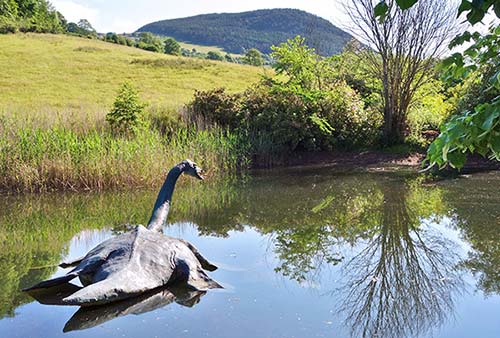
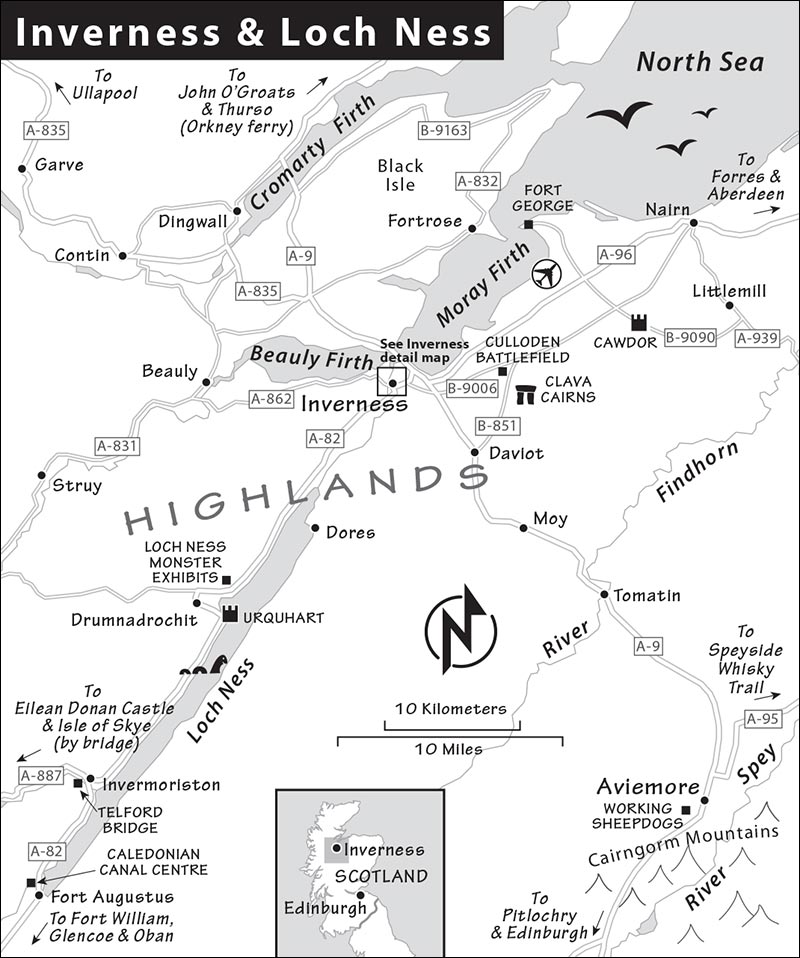
And that suits the thriving local tourist industry just fine. The Nessie commercialization is so extreme that two different monster exhibits coexist within 100 yards of each other, both in the town of Drumnadrochit with nary a view of the loch. Nessieland is cheesily simplistic, with more square footage devoted to shops than to the exhibits, while the Loch Ness Centre boasts a surprisingly high-tech, 30-minute “experience.” Both are effectively tourist traps, but the Loch Ness Centre may appease that small part of you that knows the real reason you wanted to see Loch Ness.
Loch Ness Centre
Housed in the Drumnadrochit Hotel, this longtime attraction was recently overhauled and expanded by a British amusement-park company. Every 10 minutes, a new group of visitors is ushered through a six-room exhibit with high-tech visuals that examine the history of Loch Ness and Scotland’s ancient myths, various sightings of the monster, and attempts to prove or disprove Nessie’s existence. In the last room, you’ll get a chance to vote: Nessie or Nonsense? Actors portray historical figures from the Loch Ness story such as Aldie Mackay, the Drumnadrochit Hotel manager who first spotted Nessie in 1933, and Tim Dinsdale, the engineer who filmed the most famous Loch Ness monster footage in 1960. Real-life founder of the Loch Ness Project Adrian Shine recounts the many investigations into what may be lurking below the loch’s waters. Walking through the exhibit is something like being immersed in an episode of Unexplained Mysteries. The redeeming quality is the exhibit’s earnestness and the voiceover from noted Scottish actor David Tennant. I’d skip it unless you’re a big Nessie fan or need something to do on a rainy day.
Cost and Hours: £14; “tours” depart every 10 minutes daily 10:00-17:00, Nov-March 10:00-15:00, last entry 45 minutes before closing; in the big stone mansion right on the main road to Inverness, café, +44 1456 450 573, www.lochness.com.
Boat Cruise: The Loch Ness Centre offers one-hour loch cruises for up to 12 people, mixing scenery with a little history and a look at the onboard sonar (£19, April-Oct hourly 10:00-17:00 except no 13:00 cruise).
▲Urquhart Castle
The ruins at Urquhart (UR-kurt), just up the loch from the Nessie exhibits, are gloriously situated with a view of virtually the entire lake but create a traffic jam of tourism on busy days. Views of the castle and loch from the parking lot are usually blocked off, preventing freeloaders from sneaking a peek without paying.
Cost and Hours: £13 booked ahead online, £14.50 on-site (if available); daily 9:30-18:00, longer hours some days in summer, shorter hours off-season, check website for exact times, last entry 45 minutes before closing; guidebook-£6, café, +44 1456 450 551, www.historicenvironment.scot.
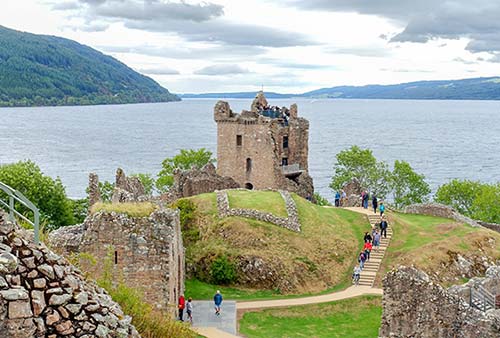
Crowd-Beating Tips: The castle can be jammed, especially in July and August, when it’s wise to prebook online to guarantee an entry time. The parking lot can also fill up—reserve a free parking spot along with your ticket.
Tours: You can download a free audioguide by scanning a QR code at the sight; there are occasional free informational talks down amid the ruins (ask for schedule at entrance).
Visiting the Castle: The visitors center is below the parking lot (access via stairs or elevator) and has a tiny exhibit with interesting castle artifacts. It’s worth starting with the eight-minute film taking you on a sweep through a thousand years of tumultuous history—from St. Columba’s visit to the castle’s final destruction in 1689. The castle itself, while dramatically situated and fun to climb through, is an empty shell. After its owners (who supported the crown) blew it up to keep the Jacobites from taking it, the largest medieval castle in Scotland (and the most important in the Highlands) wasn’t considered worth rebuilding or defending, and was abandoned. Well-placed, descriptive signs help you piece together this once-mighty fortress. As you walk downhill from the visitors center toward the ruins, take a close look at the trebuchet (a working replica of one of the most destructive weapons of English King Edward I) and ponder how this giant catapult helped Edward grab almost every castle in the country away from the native Scots.
Loch Ness Cruises
Cruises on Loch Ness are as popular as they are pointless. The lake is far from Scotland’s prettiest—and the time-consuming boat trips show you little more than what you’ll see from the road. As it seems that Loch Ness cruises are a mandatory part of every “Highlands Highlights” day tour, there are several options, leaving from the top, bottom, and middle of the loch. The basic one-hour loop costs around £18 and includes views of Urquhart Castle and lots of legends and romantic history (Jacobite is the dominant outfit of the many cruise companies, www.jacobite.co.uk). The Loch Ness Centre also runs a cruise (see listing, earlier). I’d rather spend my time and money at Fort Augustus or Urquhart Castle.
▲Fort Augustus
Perhaps the most idyllic stop along the Caledonian Canal is the little lochside town of Fort Augustus. It was founded in the 1700s—before there was a canal here—as part of a series of garrisons and military roads built by the English to quell the Highland clansmen, even as the Jacobites kept trying to take the throne in London. Before then, there were no developed roads in the Highlands—and without roads, it’s hard to keep indigenous people down.
Two hundred million years ago, two tectonic plates collided, creating the landmass we know as Scotland and leaving a crevice of thin lakes slashing diagonally across the country. This Great Glen Fault, from Inverness to Oban, is easily visible on any map.
Scottish engineer Thomas Telford connected the lakes 200 years ago with a series of canals so ships could avoid the long trip around the north of the country. The Caledonian Canal runs 62 miles from Scotland’s east to west coasts; 22 miles of it is man-made. Telford’s great feat of engineering took 19 years to complete, opening in 1822 at a cost of one million pounds. But bad timing made the canal a disaster commercially. Napoleon’s defeat in 1815 meant that ships could sail the open seas more freely. And by the time the canal opened, commercial ships were too big for its 15-foot depth. Just a couple of decades after the Caledonian Canal opened, trains made the canal almost useless...except for Romantic Age tourism. From the time of Queen Victoria (who cruised the canal in 1873), the canal has been a popular tourist attraction. To this day the canal is a hit with vacationers, recreational boaters, and lock-keepers who compete for the best-kept lock.
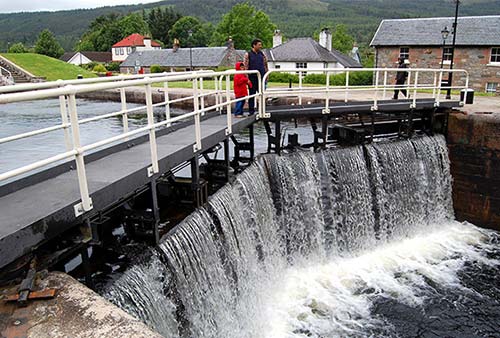
The scenic drive from Inverness along the canal is entertaining, with Drumnadrochit (Nessie centers), Urquhart Castle, Fort Augustus (five locks), and Fort William (under Ben Nevis, with the eight-lock “Neptune’s Staircase”). As you cross Scotland, you’ll follow Telford’s work—22 miles of canals and locks between three lochs, raising ships from sea level to 51 feet (Ness), 93 feet (Lochy), and 106 feet (Oich).
While Neptune’s Staircase, a series of eight locks near Fort William, has been cleverly named to sound intriguing (see here), the best lock stop is midway, at Fort Augustus, where the canal hits the south end of Loch Ness. In Fort Augustus, the Caledonian Canal Centre, overlooking the canal just off the main road, gives a good rundown on Telford’s work (see “Fort Augustus” at the end of this chapter). Stroll past several shops and eateries to the top for a fine view.
Seven miles north, in the town of Invermoriston, is another Telford structure: a stone bridge, dating from 1805, that spans the Morriston Falls as part of the original road. Look for a small parking lot just before the junction at A-82 and A-887, on your right as you drive from Fort Augustus. Cross the A-82 and walk three minutes back the way you came. The bridge, which is still in use, is on your right.
From 1725 to 1733, the English built 250 miles of hard roads and 40 bridges to open up the region; Fort Augustus was a central Highlands garrison at the southern tip of Loch Ness, designed to awe clansmen. It was named for William Augustus, Duke of Cumberland—notorious for his role in destroying the clan way of life in the Highlands. (When there’s no media and no photographs to get in the way, ethnic cleansing has little effect on one’s reputation.)
Fort Augustus makes for a delightful stop if you’re driving through the area. Parking is easy. There are plenty of B&Bs, charming eateries, and an inviting park along the town’s five locks. You can still see the capstans, surviving from the days when the locks were cranked open by hand.
The Caledonian Canal Centre offers visitor information and tells the story of the canal’s construction (free, open daily, café, gift shop, +44 1463 725 581). Also, consider the pleasant little canalside stroll out to the head of the loch.
Eating in Fort Augustus: You can eat reasonably at a string of $ eateries lining the canal. Consider The Lock Inn, cozy and pub-like with great canalside tables, ideal if it’s sunny; The Bothy, another pub with decent food; and the Canalside Chip Shop offering fish-and-chips to go (no seating, but plenty of nice spots on the canal). A small grocery store is at the gas station, a few steps from the canal just after crossing the River Oich.