OBAN & THE INNER HEBRIDES
Oban • Isles of Mull, Iona & Staffa • Glasgow to Oban Drive
Isles of Mull, Iona, and Staffa
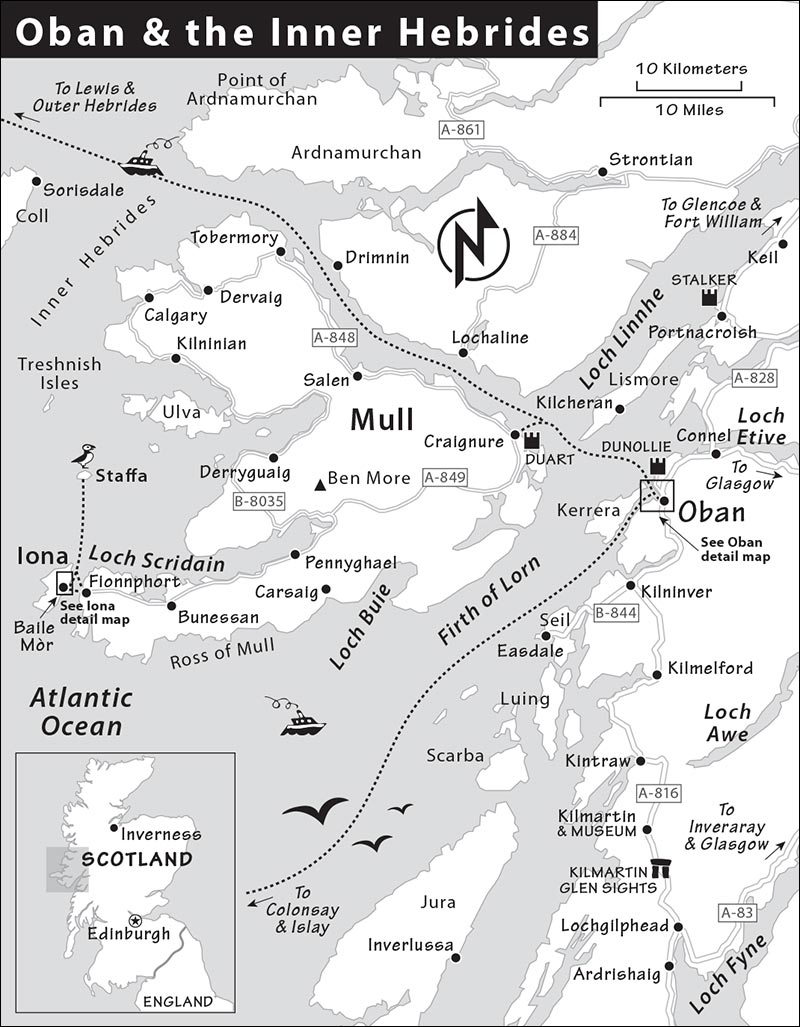
Map: Oban & the Inner Hebrides
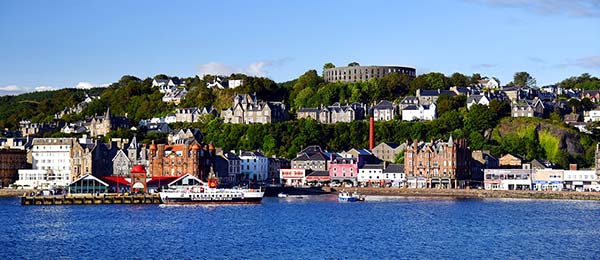
For a taste of Scotland’s west coast, head to Oban, a port town that’s equal parts endearing and functional. This busy little ferry and train terminus has no important sights, but makes up the difference in character, in scenery (with its low-impact panorama of overlapping islets and bobbing boats), and with one of Scotland’s best distillery tours. Oban is also convenient: It’s midway between the Lowland cities (Glasgow and Edinburgh) and the Highland riches of the north (Glencoe, Isle of Skye). And it’s the “gateway to the isles,” with handy ferry service to the Hebrides Islands.
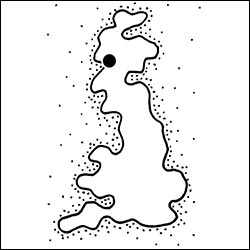
If time is tight and serious island-hopping is beyond the scope of your itinerary, Oban is ideally situated for a busy and memorable full-day side trip to three of the most worthwhile Inner Hebrides: big, rugged Mull; pristine little Iona, where buoyant clouds float over its historic abbey; and Staffa, a remote, grassy islet inhabited only by seabirds. (The best of the Inner Hebrides—the Isle of Skye—is covered in its own chapter.) Sit back, let someone else do the driving, and enjoy a tour of the Inner Hebrides.
This chapter also outlines the most scenic route between Glasgow and Oban (along the bonnie, bonnie banks of Loch Lomond and through the town of Inveraray, with its fine castle), plus a detour through Kilmartin Glen, the prehistoric homeland of the Scottish people.
PLANNING YOUR TIME
If you’re on a speedy blitz tour of Scotland, Oban is a strategic and pleasant place to spend the night. But you’ll need two nights to enjoy Oban’s main attraction: the side-trip to Mull, Iona, and Staffa. There are few actual sights in Oban itself, beyond the distillery tour, but—thanks to its manageable size, scenic waterfront setting, and great restaurants—the town is an enjoyable place to linger.
Oban
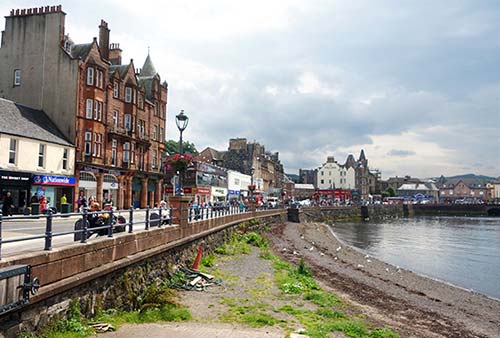
Oban (pronounced OH-bin) is a low-key resort. Its winding promenade is lined by gravel beaches, ice cream stands, fish-and-chips joints, a tourable distillery, and a good choice of restaurants. Oban means “little bay” in Gaelic: Everything in Oban is close together, and the town seems eager to please its many visitors. Wool and tweed are perpetually on sale, and posters announce a variety of day tours to Scotland’s wild and wildlife-strewn western islands. When the rain clears, sun-starved Scots sit on benches along the Esplanade, leaning back to catch some rays. Wind, boats, gulls, layers of islands, and the promise of a wide-open Atlantic beyond give Oban a rugged charm.
Orientation to Oban
Oban, with about 10,000 people, is where the train system of Scotland meets the ferry system serving the Hebrides Islands. As “gateway to the isles,” its center is not a square or market, but its harbor. Oban’s business action, just a couple of streets deep, stretches along the harbor and its promenade. Drivers should pack patience: Oban’s streets are a mix of one-way and two-way traffic leading to and from Argyll Square and can be congested at peak times.
TOURIST INFORMATION
Oban’s TI, located at the North Pier, sells intercity bus tickets and can help you sort through your island-hopping day-trip options (generally daily 9:30-17:00, shorter hours off-season, in the stately red-sandstone Columba Hotel building at 3 North Pier, +44 1631 563 122, www.oban.org.uk).
ARRIVAL IN OBAN
The small train station is right on the pier, a short walk from the giant ferry terminal (ticket windows open Mon-Sat 5:00-20:30, Sun 10:45-18:00; no baggage storage). The bus “station” is just a couple of bus-stop canopies on the big roundabout in front of the train station, marked by a stubby clock tower. Arriving either by train or bus, simply walk around the harbor (with the water on your left) and you’ll be in the heart of town in a few minutes.
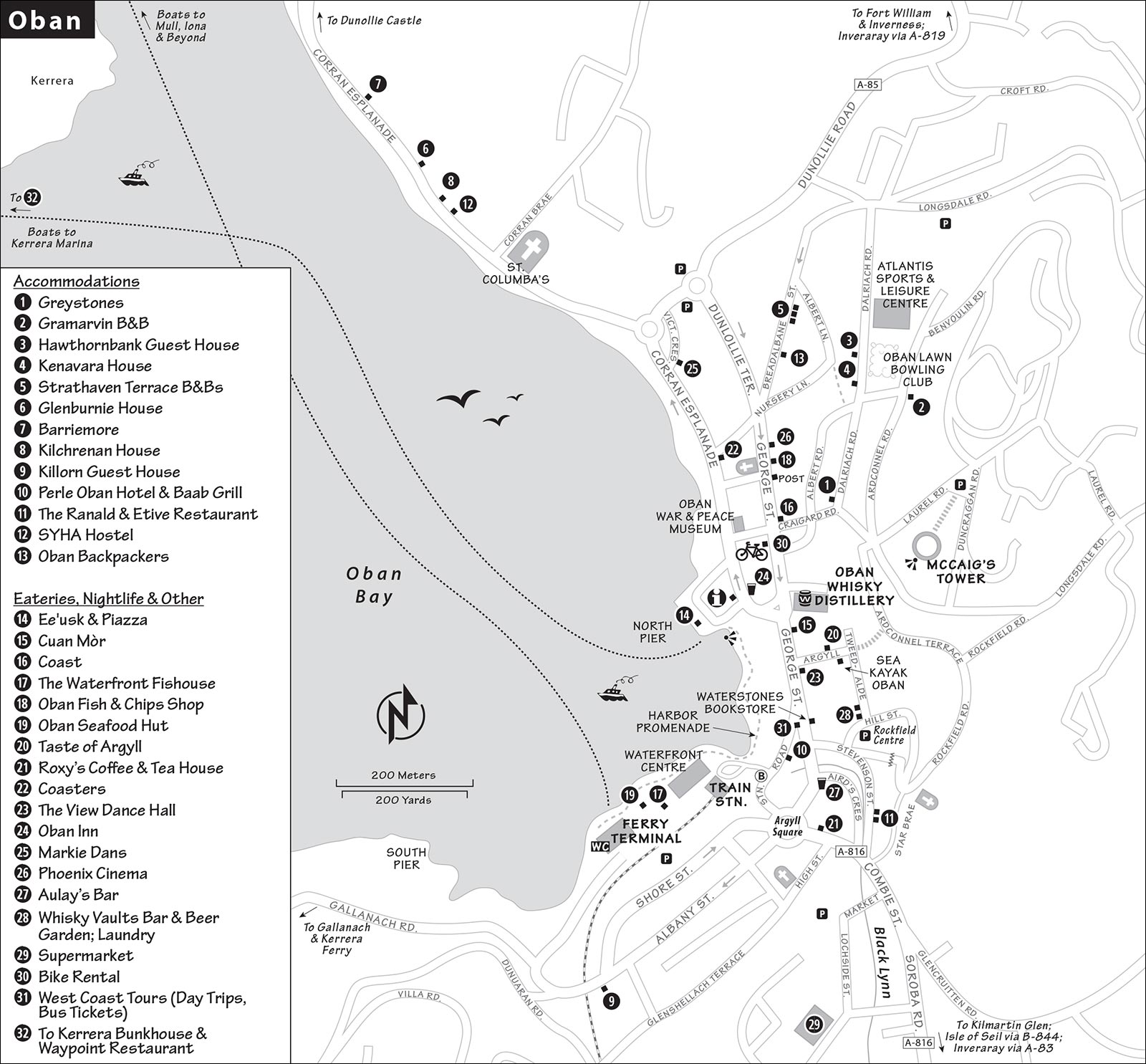
Drivers can get parking advice from their hotelier; most have free parking on site. If you’re just dipping into town, there’s a large pay parking lot near the ferry terminal. However, this lot can fill up on busy days, so leave time to find an alternative if you’re rushing to catch a ferry. Rockfield Centre, a pay lot not far from the ferry (on Hill Street) may have space. There’s pay-and-display street parking throughout town, but check signs carefully to make sure you’re legal.
HELPFUL HINTS
Bookstore: Overlooking the harborfront, Oban’s outpost of the Waterstones chain is well stocked with maps and an excellent selection of books on Scotland (daily 9:30-17:30, 12 George Street, +44 843 290 8529).
Laundry: You’ll find Oban Quality Laundry tucked a block behind the main drag just off Stevenson Street (drop off Mon-Fri by 12:00 for next-day service, no self-service; open Mon-Fri 9:00-17:00, Sat until 13:00, closed Sun; +44 1631 563 554, www.obanlaundry.co.uk [URL inactive]).
Supermarket: The giant Tesco is a five-minute walk from the train station (long hours daily, walk through Argyll Square and look for entrance to large parking lot on right, Lochside Street).
Bike Rental: Get wheels at Oban Cycles, right on the main drag (Tue-Sat 10:00-17:00, closed Sun-Mon, 87 George Street, +44 1631 566 033, www.obancyclescotland.com).
Bus and Island Tour Tickets: A block from the train station in the bright-red building along the harbor, West Coast Tours sells bus- and island-tour tickets and distributes tickets bought online (daily 8:30-17:30, helpful staff can explain your options, 17 George Street, +44 1586 555 893, www.westcoasttours.co.uk).
Festivals and Events: Oban hosts its annual Sea Shanty festival in June (www.obanshanty.org.uk) and its touristy Highland Games every August (www.obangames.com). Nearby Taynuilt, a 20-minute drive east, hosts their sweetly small-town Highland Games in mid-July (www.taynuilthighlandgames.com).
Tours from Oban
For the best day trip from Oban, tour the islands of Mull, Iona, and/or Staffa (offered daily Easter-Oct, described later)—or consider staying overnight on remote and beautiful Iona. With more time or other interests, consider one of many other options you’ll see advertised.
Wildlife Tours
If you just want to go for a boat ride, the easiest option is a one-hour seal-watching tour or two-hour history and coastal wildlife trip (£14-36, various companies—look for signs at the harbor). Try Oban Sea Tours (www.obanseatours.co.uk), Allan’s Boat Trips (www.facebook.com/SealTripsScotland), or Argyll Sea Tours (www.argyll-seatours.co.uk).
For a longer day-trip, generally leaving from marinas about 30 minutes from Oban, SeaFari (www.seafari.co.uk/oban) and Basking Shark (https://baskingsharkscotland.co.uk)—run full- and half-day wildlife cruises that seek out rare minke whales, basking sharks, bottlenose dolphins, and porpoises. For an even more ambitious itinerary, the holy grail is the Treshnish Isles (out past Staffa), which brim with puffins, seals, and other sea critters. Be clear on cancellation policies and departure points.
Various companies run multiday, overnight cruising trips around the islands, including The Majestic Line (www.themajesticline.co.uk) and St. Hilda Sea Adventures (www.sthildaseaadventures.com)—book well ahead.
Sea Kayak Tours
If the weather is good and you’d like to get out on the water under your own power, Sea Kayak Oban rents gear and offers guided tours and classes for novice and experienced kayakers. A full-day tour costs £105, including equipment (book ahead in summer—if no tours are available online call to see if a last-minute spot opens up, office a block up from the harbor at 6 Argyll Street, +44 1631 565 310, www.seakayakoban.com).
Sights in Oban
▲The Burned-Out Sightseer’s Visual Tour from the Pier
If the west-coast weather permits, get oriented to the town while taking a break: Head out to the North Pier, just past the TI, and find the benches that face back toward town (in front of the recommended Piazza restaurant). Take a seat and get to know Oban.
Scan the harborfront from left to right, surveying the mix of grand Victorian sandstone buildings and humbler modern storefronts. At the far-right end of town is the ferry terminal and—very likely—a huge ferry loading or unloading. Oban has always been on the way to somewhere, and today is no different. (A recent tourism slogan: Oban...it’s closer than you think.) The townscape seems dominated by Caledonian MacBrayne, Scotland’s biggest ferry company. CalMac’s 33 ships serve 27 destinations and transport more than 5 million passengers a year. The town’s port has long been a lifeline to the islands.
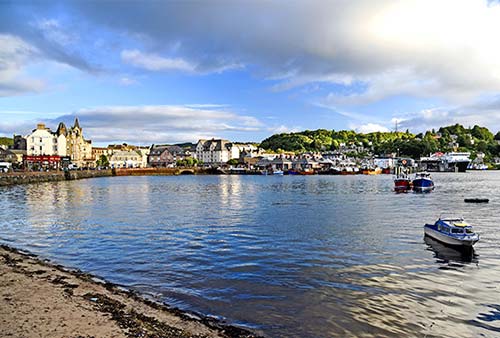
Hiding near the ferry terminal is the train station. With the arrival of the train in 1880, Oban became the unofficial capital of Scotland’s west coast and a destination for tourists. Just to the left is the former Caledonian Hotel, the original terminus hotel (now the Perle Oban Hotel) that once served those train travelers.
Tourism aside, herring was the first big industry. A dozen boats still fish commercially—you’ll see them tucked around the ferry terminal—and seafood features prominently on local menus. But as the ocean’s supply has become depleted, most local fish is farmed. There’s still plenty of shellfish.
After fishing, big industries here historically included tobacco (imported from the American colonies), then whisky. At the left end of the embankment, find the building marked The Oban Distillery. It’s rare to find a distillery in the middle of a town, but Oban grew up around this one. With the success of its whisky, the town enjoyed an invigorating confidence, optimism, and, in 1811, a royal charter. Touring Oban’s distillery is the best activity in Oban (that doesn’t involve heading to the islands).
Above the distillery, you can’t miss the odd mini-Colosseum. This is McCaig’s Tower, an employ-the-workers-and-build-me-a-fine-memorial project undertaken by an Oban tycoon in 1900. McCaig died before finishing the structure, so his complete vision for it remains a mystery. This is an example of a “folly”—that uniquely British notion of an idiosyncratic structure erected by a wealthy aristocrat. Building a folly was an in-your-face kind of extravagance many super-rich people enjoyed even when surrounded by struggling working-class people (sound familiar?). While the building itself is nothing to see up close, a 10-minute hike through a Victorian residential neighborhood leads you to a peaceful garden and a commanding view (nice at sunset).
Now turn and look out to sea, and imagine this: At the height of the Cold War, Oban played a critical role when the world’s first two-way transatlantic telephone cable was laid from Gallanach Bay to Newfoundland in 1956—a milestone in global communication. This technology later provided the White House and the Kremlin with the “hotline” that was created after the Cuban Missile Crisis to help avoid a nuclear conflagration.
▲▲Oban Whisky Distillery Tours
Oban grew up around the Oban Whisky Distillery, founded in 1794 just feet from the harbor. Today the distillery continues to follow the same traditional processes developed 200 years ago. A free exhibit (upstairs) gives a quick, whisky-centric history of Oban and Scotland, and explains Oban whisky’s smoky (“peaty”) flavor, with hints of sea salt, citrus, and honey. If you’re unable to join a tour, the adjacent bar offers tasting flights.
The distillery’s popular and fragrant one-hour tours explain the process from start to finish, and include three smooth samples of their signature product along the way. You’ll also receive a whisky glass and a discount in the shop. This is the handiest whisky tour you’ll encounter—just a block off the harbor—and one of the best. Come 10 minutes before your tour starts to check out the exhibit upstairs. Then your guide will walk you through each step of the process: malting, mashing, fermentation, distillation, and maturation.
For details on the distilling process and tips on tasting whisky, see here.
Cost and Hours: Exhibit-free; tours-£22, limited to 16 people, departures about once per hour (10:30-15:30). Tours fill up in summer—book at least a month ahead on their website, or drop in to see if there are any cancellations. The shop is open daily 10:15-17:00 and the upstairs bar 13:00-16:00 (Stafford Street, +44 1631 572 004, www.obanwhisky.com).
Oban War & Peace Museum
Opened in 1995 on the 50th anniversary of Victory in Europe Day, this charming little museum focuses on Oban’s experience during World War II. But it covers more than just war and peace. Photos show Oban through the years, and a 15-minute looped video gives a simple tour around the town and region. Volunteer staffers love to chat about the exhibit—or anything else on your mind.
Cost and Hours: Free, Sat-Thu 10:00-16:00, Fri until 14:00, maybe later in summer, next to Regent Hotel on the promenade, +44 1631 570 007, www.obanmuseum.org.uk.
Dunollie Castle and Museum
In a park just a mile up the coast, a ruined castle and an old house hold an intimate collection of clan family treasures. This spartan, stocky castle with 10-foot walls offers a commanding, windy view of the harbor—a strategic spot back in the days when transport was mainly by water. For more than a thousand years, clan chiefs ruled this region from this ancestral home of Clan MacDougall, until the castle was abandoned in 1746. The adjacent house, which dates from 1745, shows off the MacDougall clan’s heritage with a handful of rooms filled with a humble yet fascinating trove of treasures. While the exhibit won’t dazzle you, the family and clan pride in the display, their “willow garden,” and the lovely walk from Oban make the visit fun.
Cost and Hours: £9, ticket valid for a year; open April-Oct Sun-Fri 10:00-16:00, closed Nov-March and Sat year-round; last entry 45 minutes before closing; ticket includes optional one-hour tour offered Mon-Fri at 11:30 and 14:00, and bagpiping on the lawn Sun at 12:30; +44 1631 570 550, www.dunollie.org.
Getting There: By foot, it’s a 30-minute walk: Head out of town along the harborfront promenade. At the war memorial (with inviting seaview benches), cross the street. A gate leads to a little lane (the Woodland Trail), lined with historic and nature boards along the way to the castle. Drivers stay on the harborfront road another quarter-mile past the trailhead, then turn right at the larger Dunollie sign. Mind the sheep!
ACTIVITIES IN OBAN
Atlantis Leisure Centre
This industrial-type sports center has a rock-climbing wall, tennis courts, indoor “soft play centre” (for kids under 5), and indoor swimming pool with a big water slide. The outdoor playground is free and open all the time (pool only-£4.90, no rental towels or suits, fees for other activities; open Mon-Fri 6:15-21:00, Sat 9:00-16:00, Sun 10:00-15:00; on the north end of Dalriach Road, +44 1631 566 800, www.atlantisleisure.co.uk).
Oban Lawn Bowling Club
The club has welcomed visitors since 1869. This elegant green is the scene of a wonderfully British spectacle of old men tiptoeing wishfully after their balls. It’s fun to watch, and—if there’s no match scheduled and the weather’s dry—anyone can rent shoes and balls and actually play (£5/person; generally daily “however long the weather lasts”; just south of leisure center on Dalriach Road, +44 1631 570 808).
ISLANDS NEAR OBAN
The isles of Mull, Iona, and Staffa require a full day to visit, and are described later in this chapter. For a quicker glimpse at the Inner Hebrides, consider these two options.
Isle of Kerrera
Functioning like a giant breakwater, the Isle of Kerrera (KEH-reh-rah) makes Oban possible. Just offshore from Oban, and only four square miles, this stark but very green island offers a quick, easy opportunity to get that romantic island experience. Home to about 70 people, Kerrera offers nice hikes, a ruined castle, and a few sheep farms. It’s also a fine place to bike (ask for advice at Oban Cycles, see “Helpful Hints,” earlier); there’s a handy map at https://isleofkerrera.org. You may see the Kerrera ferry filled with sheep heading for Oban’s livestock market.
Getting There: You have two options for reaching the island. A private boat operated by the Kerrera Marina goes from Oban’s North Pier to the Kerrera Marina on the northern part of the island (£5 round-trip, roughly every hour—see timetable and available seats online, 10-minute trip, book ahead at www.kerreramarina.com). To book you’ll need to set up an account and buy “credits”; 2 credits equals £5.
A CalMac ferry departs from Gallanach (two miles south of Oban) and goes to the middle of the island. This is the best option if you want to hike to Kerrera’s castle (passengers only, £3.40 round-trip, advance “Turn Up and Go” tickets available online (www.calmac.co.uk/tickets/turn-up-and-go), bikes free, runs 8:20-12:30 & 14:00-18:00, none off-season, 5-minute ride, +44 1475 650 397, www.calmac.co.uk). To reach Gallanach, drive south, following the coast road past the ferry terminal (parking available).
Sleeping and Eating on Kerrera: Amenities cluster at either end of the island. At the south end, from the dock for the ferry from Gallanch, follow the teapots on a pleasant two-mile walk from the dock to the $$ Kerrera Bunkhouse, a refurbished 18th-century stable that can sleep up to seven people in a small, cozy space (1 double and 5 single bunks, 2-night minimum, includes bedding and towels, open April-Sept but must book ahead, kitchen, +44 7951 964 231, www.kerrerabunkhouse.co.uk, info@kerrerabunkhouse.co.uk, Martin and Aideen). They also run a tea garden that serves meals outside and under the rafters of a charmingly rebuilt stone house (Thu-Mon 11:00-16:00, closed Tue-Wed and Oct-Easter).
Near the Kerrera Marina, at the north end, the $$$$ Waypoint Restaurant has a laid-back patio and works hard to put out good-quality food; on a nice day, the open-air waterside setting is unbeatable (Wed-Sat 17:00-20:00, Sun 12:00-15:00, bar for drinks open longer hours, closed Mon-Tue and in winter, dinner reservations highly recommended—email waypoint@kaerreramarina.com, +44 1631 565 333, www.kerreramarina.com). They rent a converted boathouse to groups of up to eight guests.
Isle of Seil
Enjoy a drive, a walk, some solitude, and the sea. Drive 12 miles south of Oban on the A-816 to the B-844 to the Isle of Seil (pronounced “seal”), connected to the mainland by a bridge (which, locals like to brag, “crosses the Atlantic”...well, maybe a small part of it).
Just over the bridge on the Isle of Seil is a pub called Tigh-an-Truish (“House of Trousers”). After the Jacobite rebellions, a new law forbade the wearing of kilts on the mainland. Highlanders on the island used this pub to change from kilts to trousers before they made the crossing. The pub serves great meals and good seafood dishes to those either in kilts or pants (pub generally open daily—call ahead, +44 1852 300 242).
Seven miles across the island, on a tiny second island and facing the open Atlantic, is Easdale, a historic, touristy, windblown little slate-mining town with a small folk museum (shuttle ferry goes the 300 yards). Wildlife/nature tours plus tours to Iona and Staffa also run from Easdale.
Nightlife in Oban
Little Oban has a several options for entertaining its many visitors; for more ideas ask at the TI, or try checking ObanWhatsOn.co.uk. Fun low-key activities may include open-mic or quiz theme nights in pubs, bingo or comedy nights at The View, and occasional Scottish folk shows.
Ceilidh Dancing: On summer nights, you can climb the stairs from the main drag to The View for music and dancing. The sprawling second-floor venue feels like a smalltown Elks Club, and offers ceilidh (KAY-lee) dancing a couple of times per week, where you can learn group dances to music performed by a folk band (sometimes including a piper). These group dances are a lot of fun—wallflowers and bad dancers are warmly welcomed, and the staff is happy to give you pointers (£10; generally May-mid-Oct Mon and Thu at 20:00 and Tue at 19:00; Aug-mid-Oct they add dances Fri at 20:00 and Sun at 19:00; restaurant/bar, 34 George Street, +44 1631 569 599, www.obanview.com).
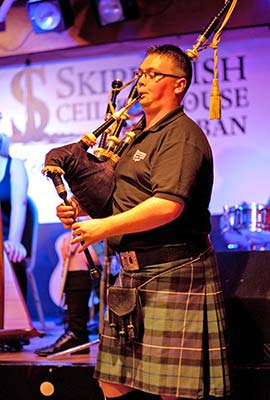
Traditional Music: Various pubs and hotels have live traditional music in the summer; the TI compiles these into its Oban Music Trail map—see www.oban.org.uk/music-trail or ask your B&B host or at the TI. Two reliable venues are the Oban Inn, right at the corner of the harborfront near the TI (more traditional, www.obaninn.co.uk); and Markie Dans, between the town center and the Esplanade B&Bs (younger crowd, https://markiedans.co.uk/gig-guide).
Cinema: When Oban’s longtime Highland Theater closed in 2010, the community rallied to save it, and The Phoenix Cinema was born. It’s now a nonprofit and booming (140 George Street, +44 1631 562 905, www.obanphoenix.com).
Characteristic Pubs: With decor that shows off Oban’s maritime heritage, Aulay’s Bar has two sides, each with a different personality (I like the right-hand side). Having a drink here invariably comes with a good “blether” (conversation), and the gang is mostly local (daily 11:00-24:00, 8 Airds Crescent, just around the corner from the train station and ferry terminal). The Oban Inn, mentioned earlier, has been slinging pub food and drinks since 1790 and is a memorable place for a pint and possibly live music. The Whisky Vaults Bar & Beer Garden, a block off the main drag, has covered outdoor seating, occasional music, and an extensive whisky selection (daily 13:00-late, 3 Tweedale Street).
Sleeping in Oban
Oban’s B&Bs offer a much better value than its hotels. Several places have recently gone to “no breakfast”—you’ll be on your own to picnic-breakfast in your room or visit a café in town. (If you’re heading to Mull in the morning, the on-ferry cafeteria serves a full breakfast menu.)
ABOVE THE TOWN CENTER
These places perch on the hill above the main waterfront zone—a short (but steeply uphill) walk from all the action. Many rooms come with views and are priced accordingly. The first three include breakfast.
$$$$ Greystones is an enticing splurge. It fills a big, stately, turreted mansion at the top of town with five spacious rooms that mix Victorian charm and sleek gray-and-white minimalism. Built as the private home for the director of Kimberley Diamond Mine, it later became a maternity hospital, and today Archie and Mo run it as a stylish and restful retreat. The breakfast room offers stunning views over Oban and the offshore isles (closed Nov-March, 1 Dalriach Road, +44 1631 570 795, www.greystonesoban.com, info@greystonesoban.com).
$ Gramarvin B&B, an exceptional value, has just two rooms, but each is spacious, homey, and filled with personal touches. Window seats in each room provide a lovely view over Oban, but be warned—the climb up from town and then up their stairs is steep. Warm host Mary delivers an ample breakfast basket to your room each morning (cash only, 2-night minimum in summer preferred, mini fridges, on-street parking, Benvoulin Road, +44 1631 564 622, www.gramarvin.co.uk, mary@gramarvin.co.uk, Mary and Joe).
$ Hawthornbank Guest House fills a big Victorian sandstone house with seven traditional-feeling rooms. Half of the rooms face bay views, and the other half overlook the town’s lawn-bowling green. Breakfast is served in a lovely high-ceilinged room (2-night minimum in summer, Dalriach Road, +44 1631 562 041, www.hawthornbank.co.uk, info@hawthornbank.co.uk, Karin and Clive).
$$$ Kenavara House offers five spacious and chic rooms in a freshly renovated Victorian house a block downhill from Gramarvin. Half the rooms have views and all guests can enjoy the large view deck (no breakfast, private parking, Albert Road, +44 7595 219 066, reserve via Booking.com, stay@kenavarahouse.com, Louise).
ON STRATHAVEN TERRACE
“Strathaven Terrace” is actually just the name for this row of houses on quiet Breadalbane Street, nicely situated two blocks off the harbor, three blocks from the center, and a congested 10-minute walk from the train station. It’s basic—rooms here are compact and don’t have views, and none offers breakfast. But the location is handy and prices are reasonable.
To get here by car, as you enter town from the north, turn left immediately after King’s Knoll Hotel, and take your first right onto Breadalbane Street. Ask about parking when you book.
$ Rose Villa Guest House has five crisp and cheery rooms, including a true single with adjacent shower room (no breakfast, at #5, +44 1631 566 874, www.rosevillaoban.co.uk, info@rosevillaoban.co.uk, Stuart and Jacqueline).
$ Sandvilla Guest House rents six pleasant, polished rooms (no breakfast, mini fridges, at #4, +44 1631 564 483, www.holidayoban.co.uk, sandvilla@holidayoban.co.uk, welcoming Josephine and Robert).
$ Raniven Guest House has eight decent but impersonal rooms, usually operating by self check-in (no breakfast, private parking, at #1, +44 1631 562 713, www.ranivenoban.com, bookings@ranivenoban.com, Liam).
ALONG THE ESPLANADE
These are a 10-minute walk from the center (20 minutes to the train station) along the Corran Esplanade, which stretches north of town above a cobble beach. Rooms here are generally spacious and many have beautiful bay views. Walking from town, you’ll reach them in this order: Kilchrenan, Glenburnie, and Barriemore.
$$$ Glenburnie House, a stately Victorian home, has 12 spacious, comfortable, classy rooms. There’s a tiny sunroom with a stuffed “hairy coo” head (no breakfast, mini fridges, closed Nov-Easter, +44 1631 562 089, www.glenburnie.co.uk, stay@glenburnie.co.uk, Graeme and Dan).
$$$ Barriemore, at the very end of Oban’s grand waterfront Esplanade, is a welcome refuge after a day of exploration. Its 14 well-appointed rooms come with sherry, in-room fridges, yoga mats, and other thoughtful touches. It has a nice front patio, spacious lounge, and glassed-in sun porch with a view of the water (no breakfast, pastries available at extra cost, family suite, shared freezer and microwave in lounge, indoor bike storage, closed Nov-March, +44 1631 566 356, www.barriemore.co.uk, info@barriemore.co.uk, Jan and Mark). They also offer a seaview apartment that sleeps four.
$$ Kilchrenan House, the turreted former retreat of a textile magnate, has 15 large rooms, most with bay views. Rooms #5, #9, and #15 are worth the few extra pounds, while the “standard” rooms in the newer annex are a good value (2-night minimum for some rooms, continental breakfast buffet, welcome drink of whisky or sherry, family rooms, closed Oct-March, +44 1631 562 663, www.kilchrenanhouse.co.uk, info@kilchrenanhouse.co.uk, Colin and Frances).
NEAR THE TRAIN AND FERRY
$$$ Killorn Guest House, in a tall townhouse on the east end of town, is a five-minute walk from the ferry and train station via Argyll Square. The five fresh rooms are warmly furnished and all but one have views of the harbor and islands (street parking, optional continental breakfast, Cawdor Terrace—look for the red door, +44 7470 156 257, https://killornguesthouse.com info@killornguesthouse.com, Kerry).
CENTRAL HOTELS
Oban has so many good-value, characteristic guesthouses that I’d stay in a hotel only if you need a town-center location and are willing to pay for it.
$$$$ Perle Oban Hotel is your luxury splurge in a golden-pink 1882 Victorian building. Right across from the harbor, it has 59 super-sleek rooms (suites, bar with light bites, pay parking nearby, Station Square, +44 1631 700 301, www.perleoban.co.uk, stay@perleoban.co.uk).
$$$ The Ranald is a modern change of pace from the B&B scene. This narrow, 17-room, three-floor hotel has a budget-boutique vibe; they also rent 10 studio apartments (family rooms, bar, no elevator, street parking, a block past Argyll Square at 41 Stevenson Street, +44 1631 562 887, https://theranaldhotel.com, info@theranaldhotel.com).
HOSTELS
¢ The official SYHA hostel occupies a grand building on the waterfront Esplanade (private en suite rooms available, dog-friendly, family rooms, 8-bed apartment with kitchen, bike storage, laundry, +44 1631 562 025, www.hostellingscotland.org.uk, oban@hostellingscotland.org.uk).
¢ Oban Backpackers, a Hostel World affiliate, is central and laid-back (dorms only, 10-minute walk from station, 5 Breadalbane Street, +44 1631 562 107, https://obanbackpackers.com, info@obanbackpackers.com).
Eating in Oban
Oban brags that it is the “seafood capital of Scotland,” and indeed its sit-down restaurants are surprisingly high quality for such a small town. For something more casual, consider a fish-and-chips joint or an easygoing café.
NICE, SIT-DOWN RESTAURANTS
These fill up in summer, especially on weekends. To ensure getting a table, you’ll want to book ahead.
$$$$ Ee’usk (Scottish Gaelic for “fish”) is a popular, stylish seafood place on the waterfront. It has a casual-chic, yacht-clubby atmosphere, with a bright and glassy interior and sweeping views on three sides—fun for watching the ferries come and go. They sometimes offer an early-bird special until 18:45 (daily, covered outdoor seating, no kids under age 12 at dinner, North Pier, +44 1631 565 666, www.eeusk.com, MacLeod family).
$$$ Cuan Mòr is a popular, casual restaurant that combines traditional Scottish food with modern flair—both in its crowd-pleasing cuisine and in its furnishings, made of wood, stone, and metal scavenged from the beaches of Scotland’s west coast. Its harborside tables on the sidewalk are popular when it’s warm (daily, reservations for groups of 6 and up only, brewery in back, 60 George Street, +44 1631 565 078, www.cuanmor.co.uk).
$$$$ Coast proudly serves fresh local fish, meat, and veggies in a mod pine-and-candlelight atmosphere. As everything is cooked to order and presented with care by husband-and-wife team Richard and Nicola—who combine traditional Scottish elements in innovative new ways—this is no place to dine and dash (daily except closed Sun for lunch, two- and three-course “lite bite” specials, 104 George Street, +44 1631 569 900, www.coastoban.co.uk).
$$$ The Waterfront Fishouse perches above the busy ferry landing and Seafood Hut. It’s easy to miss the ground-floor entrance, but the upstairs dining room is nicely contemporary with views of the islands. In other towns, this would be the seafood place; here in Oban, it’s simply one more solid, well-regarded choice (daily, early bird specials before 18:45; No. 1 Railway Pier, +44 1631 567 415, https://waterfrontfishouse.co.uk).
$$$$ Etive is a foodie oasis where chef John and sommelier David proudly display their Michelin award in the window. The £95 nightly land-and-sea tasting menu uses local ingredients such as Loch Fyne crab, Appin venison, and Mull cheddar, matched with an excellent selection of wines and craft cocktails. Reservations are a must (Wed-Sun dinner only, closed Mon-Tue, off Argyll Square, one door down from The Ranald hotel at 43 Stevenson Street, +44 1631 564 899, www.etiverestaurant.co.uk).
$$ Baab Grill brings a refreshing taste of the Eastern Mediterranean to Western Scotland. Besides the usual standbys (baba ghanoush, tabbouleh, moussaka) the menu includes some “fusion” dishes such as Scottish salmon with za’atar in a tahini sauce (daily dinner only, attached to the Perle Oban Hotel, Station Road, +44 1631 707 130, www.baabgrill.co.uk [URL inactive]).
SIMPLE PLACES FOR AN AFFORDABLE MEAL
$$ Oban Fish and Chips Shop—run by Lewis, Sammy, and their family—serves praiseworthy haddock and mussels among other tasty options in a cheery cabana-like dining room. You can bring your own wine for no charge (daily, sit-down section closes at 19:30, takeaway available later, 116 George Street, +44 1631 569 828, obanfishandchipshop.co.uk).
$$ Oban Seafood Hut, a.k.a. The Original Green Shack, is a finger-licking festival of cheap and fresh seafood located just across from the ferry dock. This place is so famous and beloved that members of Parliament sent condolences when founder John Ogden passed away in 2023. It’s the best spot to pick up a super-fresh seafood sandwich or snack. They sell smaller bites (such as cold sandwiches), as well as some bigger cold platters and a few hot dishes (outdoor seating only, daily from 10:00 until the boat unloads from Mull around 18:00).
$$ Piazza, next door to Ee’usk, is a busy, affordable, family-friendly place serving basic Italian dishes with a great harborfront location. They have a large outdoor area and big windows facing the sea (smart to reserve ahead July-Aug, +44 1631 563 628, www.piazzaoban.com).
$$ Taste of Argyll—with the motto “from field to fork”—is a humble, simple little hole-in-the-wall that enjoys celebrating fresh local ingredients. They have all-day breakfasts, a burger bar, and other comfort food (Sun-Thu 9:00-15:00, Fri-Sat until 21:00, 9 Argyll Street, +44 1631 358 160).
$$ Roxy’s Coffee and Tea House, just off Argyll Square, is a fun, welcoming place for breakfast, a light lunch, or coffee and a sweet treat from their glass case of fresh-baked goodies (Tue-Sat 9:00-17:00, closed Sun-Mon, 7 Argyll Square—look for the pink bicycle out front, +44 1631 570 307).
$$ Coasters, on the Esplanade a few blocks beyond the TI, is a good breakfast option for those staying on this end of town (also open for lunch and dinner, 38 Corran Esplanade, +44 1631 705 244).
Oban Connections
By Train: Trains link Oban to the nearest transportation hub in Glasgow (6/day, fewer on Sun, 3 hours); to get to Edinburgh, you’ll transfer in Glasgow (roughly 6/day, 4.5 hours). To reach Fort William (a transit hub for the Highlands), you’ll take the same Glasgow-bound train, but transfer in Crianlarich (3/day, 4 hours)—the direct bus is easier (see next). Train info: +44 845 748 4950, NationalRail.co.uk.
By Bus: Bus #918 passes through Ballachulish—a half-mile from Glencoe—on its way to Fort William (4/day, 1 hour to Ballachulish, 1.5 hours total to Fort William—but never runs on Sun). Take this bus to Fort William, then transfer to reach Inverness (4 hours) or Portree on the Isle of Skye (5 hours)—see here for onward bus information. A different bus (#976 and #977) connects Oban with Glasgow (5/day, 3 hours), from where you can easily connect by bus or train to Edinburgh (figure 4.5 hours). Buses tend to fill up during the busy summer months—book well in advance (online at the Citylink website, or at the TI or West Coast Tours shop). Bus info and tickets: www.citylink.co.uk.
By Boat: Ferries fan out from Oban to the southern Hebrides (see information on the islands of Iona and Mull, later). Caledonian MacBrayne Ferry info: +44 800 066 5000, www.calmac.co.uk.
ROUTE TIPS FOR DRIVERS
From Glasgow to Oban via Loch Lomond and Inveraray: For details on this photogenic route from Glasgow to the coast, see the “Glasgow to Oban Drive” at the end of this chapter.
From Oban to Glencoe and Fort William: It’s an easy one-hour drive from Oban to Glencoe. From Oban, follow the coastal A-828 toward Fort William. After about 20 miles—as you leave the villages of Appin and Portnacroish—you’ll see the photogenic Castle Stalker marooned on a lonely island (you can pull over at the Castle Stalker View Café for a good photo from just below its parking lot). At North Ballachulish, you’ll reach a bridge spanning Loch Leven; rather than crossing the bridge, turn off and follow the A-82 into the Glencoe valley. (For tips on the best views and hikes in Glencoe, see the next chapter.) After exploring the dramatic valley, make a U-turn and return through Glencoe village to the bridge at North Ballachulish (great view from bridge) and cross it, following the A-82 north.
For a scenic shortcut directly back to Glasgow or Edinburgh, continue south on the A-82 after Glencoe via Rannoch Moor and Tyndrum. Crianlarich is where the road splits, and you’ll either continue on the A-82 toward Loch Lomond and Glasgow or pick up the A-85 and follow signs for Stirling, then Edinburgh.
Isles of Mull, Iona, and Staffa
For the easiest one-day look at a good sample of the dramatic and historic Inner Hebrides (HEB-rid-eez) islands, take a tour from Oban to Mull, Iona, and Staffa. Though this trip is spectacular when it’s sunny, it’s worthwhile in any weather (though there’s not much to do on Iona if it’s pouring, and if rain or rough seas are expected, I’d skip the Staffa option). For an even more in-depth look at the Inner Hebrides, head north to Skye.
GETTING AROUND THE ISLANDS
Visiting Mull and Iona
To visit Mull and ultimately Iona, you’ll take a huge CalMac ferry from Oban to the town of Craignure on Mull (45 minutes). From there, you’ll ride a bus or drive across Mull to its westernmost ferry terminal, called Fionnphort (1.25 hours), where you can catch the ferry to Iona (10 minutes) for several hours of free time. It’s a long journey, but it’s all incredibly scenic.
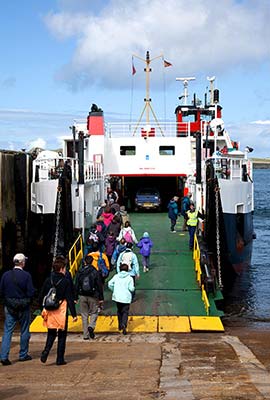
By Tour (Easiest): If you book a tour with West Coast Tours, all your ferry and bus transportation is taken care of and your seat is guaranteed. The Mull and Iona tour costs £49 and runs every day, all summer long (no tours Nov-Easter). Because tours can sell out, book in advance at www.westcoasttours.co.uk—several days ahead in July and August. Even at other times, it’s smart to book a few days ahead—ideally, once you have a sense of the weather forecast. Save your emailed confirmation to show at each stage of your journey. In addition, you’ll need to pick up your ferry tickets in person at the West Coast Tours office the morning of your trip (you’ll get a stack of paper tickets, one for each leg).
Tour Tips: Ferry tickets in hand, walk on the Oban-Mull ferry that leaves from the Oban pier at 9:55 (confirm times locally and board at least 20 minutes before departure). The best inside seats on the ferry—with the biggest windows—are in the sofa lounge on the “observation deck” (level 4) at the back end of the boat. (Follow signs for the toilets, and look for the big staircase to the top floor.) The ferry has a cafeteria with hot meals (including cooked breakfast items) and packaged sandwiches, a small snack bar on the top floor (hot drinks and basic sandwiches), and a gift/book shop. If it’s a clear day, ask a local or a crew member to point out Ben Nevis, the tallest mountain in Britain. About 10 minutes before landing on Mull, on the left, you’ll see the striking 13th-century Duart Castle—the seat of Clan MacLean.
Reaching Mull’s port, called Craignure, walk-on passengers disembark from deck 3, across from the bookshop (port side). It’s worth queuing up a few minutes early and making a beeline outside to your bus for the entertaining and informative ride across the Isle of Mull. (The bus is usually full, and early arrivals get the best seats; the right/driver’s side offers better sea views during the second half of the journey to Fionnphort, while the left side has fine views of Mull’s rolling wilderness.) The driver spends the entire ride chattering away about life on Mull, slowing to point out wildlife, loudly complaining about each passing motorist who hasn’t mastered the single-track road system, and sharing adages like, “If there’s no flowers on the gorse, snogging’s gone out of fashion.” These hardworking locals make historical trivia fascinating—or at least fun.
At Fionnphort, you’ll board a small, rocking ferry to Iona, landing in the village of Baile Mòr. You’ll have about two hours to roam freely around the island. Then you’ll reverse the route: Pay attention as your driver tells you which ferry to return on, and what time his bus will leave. There’s little to no commentary on the way back, and the bus is coordinated with the ferry back from Mull to Oban (arrives in Oban a bit before 18:00).
By Public Transit: For an early start and more time on Iona (including spending the night; see “Sleeping on Iona,” later)—but with a degree of uncertainty—you can do this trip by public transportation. You’ll take the early ferry and public bus across Mull, paying individually per leg (early ferries run Mon-Sat only; round-trip price: £7.80 for Oban-Mull ferry, £18.50 for public bus across Mull, £3.70 for Mull-Iona ferry). It’s smart to book the popular Oban-Mull ferry online in advance (note this is a timed ticket, www.calmac.co.uk), and convenient to buy the Mull 24-hour island bus ticket online (www.westcoastmotors.co.uk); tickets are also sold by the driver (contactless pay). The Mull-Iona ferry is a “Turn Up and Go” route, meaning you can purchase open tickets valid at any time.
Take the first boat of the day (departs Mon at 6:45, Tue-Sat at 7:25), then connect at Mull to bus #96 or #496 to Fionnphort (departs 8:30, 75 minutes, no tour narration, no guarantee you’ll get to sit), then hop on the Iona ferry (roughly every 30 minutes, buy open ticket in advance or on-site from small trailer ferry office; if closed, purchase ticket from ferry worker at the dock; cash or card accepted; leaving Iona, do the same, as there’s no ferry office). Allow about four hours on Iona and return to Fionnphort in time for the bus back (15:20). It’s important to confirm all of these times in Oban (just pop into the West Coast Tours office).
By Car: You can do this trip on your own by driving your car onto the ferry to Mull (£29.40 round-trip for the car, passengers extra, www.calmac.co.uk), then driving across the island and walking on the ferry to Iona (no visitor cars are allowed on Iona). Space on the Oban-Mull ferry is limited, so book well in advance. Keep in mind that because of tight ferry timings, you’ll wind up basically following the tour buses across Mull anyway, but you’ll miss all the commentary.
By Taxi: Alan from Mull Taxi can get you around his home island and also offers day trips (+44 7760 426 351, www.mulltaxi.co.uk).
Visiting Staffa
With two extra hours, you can add a Staffa side trip to your Mull/Iona visit (£86 total for the “Three Isles Tour” through West Coast Tours in Oban; or if you’re getting to Fionnphort on your own, you can book the £30 Staffa portion directly via Staffa Tours—+44 7831 885 985, www.staffatours.com).
While Staffa is a thrill for nature lovers, it’s far more appealing in good weather than in bad (and, given its popularity, you may have to book before you know for sure...so it can be a crapshoot). You’ll begin the same as the Mull/Iona tour (ferry from Oban, then bus or drive across Mull). But then, upon arrival at Fionnphort, you’ll board a much smaller boat bound for Staffa (35-minute trip, about an hour of free time on Staffa). From Staffa, you’ll head to Iona for about two hours before returning to Mull. If you’re on West Coast’s Three Isle Tour, you can either depart Oban on the 9:55 ferry, arriving back to Oban around 20:15; or do the “early bird” tour, departing at 7:25 and returning a bit before 18:00.
For a more relaxed schedule, both Staffa Tours (listed above) and Staffa Trips (www.staffatrips.co.uk, +44 1681 700 755) offer other variations that include more time on Staffa.
Turus Mara offers nature/wildlife tours from Oban or Mull to just Staffa or Staffa and the Treshnish Isles (www.turusmara.com, +44 1688 400 242).
Picnic Tip: If you’re taking a later departure to Staffa, be aware you won’t have much access to food until you arrive on Iona in the midafternoon. It’s smart to pack along a lunch (buy something near the Oban terminal before you board, or in the on-board ferry café).
Mull
The Isle of Mull, the second largest of the Inner Hebrides (after Skye), has nearly 300 scenic miles of coastline and castles and a 3,169-foot-high mountain, one of Scotland’s Munros. Called Ben More (“Big Mountain” in Gaelic), it was once much bigger. At 10,000 feet tall, it made up the entire island of Mull—until a volcano erupted. Things are calmer now, and, similarly, Mull has a noticeably laid-back population of only about 2,850 residents. My bus driver reported that there are no deaths from stress, and only a few from boredom.
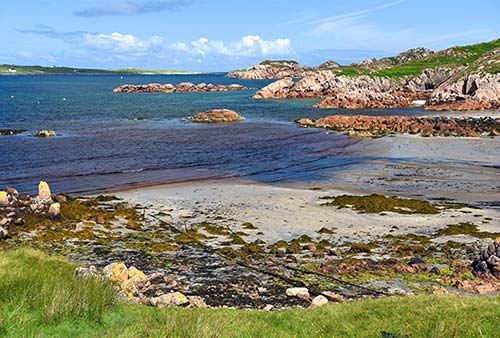
With steep, fog-covered hillsides topped by cairns (piles of stones, sometimes indicating graves) and ancient standing stones and stone circles, Mull has a gloomy, otherworldly charm. It’s sparsely populated and very scenic. Bring plenty of rain protection and wear layers in case the sun peeks through the clouds. As my driver said, Mull is a place of cold, wet, windy winters and mild, wet, windy summers.
As the road is almost entirely single-track, on your trip across Mull you’ll get an unforgettable education in how to drive on British back roads. (“We don’t drive on the left,” my driver said. “We drive on what’s left.”) If you’re driving, my driver made me promise to remind you: Always stay to the left at passing places, even if that means you’re along the straight part of the road and the oncoming car (or bus) must use the turnout to get around you. In other words, don’t cross over into the “other” lane’s passing place in an attempt to be helpful...it isn’t.
The Drive Across Mull: From where the Oban ferry docks at Craignure, to get to Fionnphort and boats to Iona or Staffa, you’ll ride the bus (or drive) about 1.25 hours across the island. The road passes or traverses several picturesque 300-year-old stone bridges, built by the great Scottish engineer Thomas Telford. You’ll drive by Loch Spelve (with a thriving mussel-farming operation), follow the Lussa River, go past an intense forestry operation (they replant trees every 30 years, rotating the harvest each year), then climb up over the empty and lonesome glen that defines the middle of the island.
Passing three lochs on your left, you’ll begin to coast downhill to the southwestern lobe of Mull, following the trout-rich River Coladoir. You’ll see loads of sheep as you drive through the village of Pennyghael, on the banks of Loch Scridain. As this sea loch opens up, you’ll begin to see the hazy form of Staffa and the nearby Treshnish Isles (off on the right horizon). Going through the farming community of Bunessan, you’re just around the corner from Fionnphort—and your next boat trip.
On the far side of Mull, the caravan of tour buses unloads at Fionnphort (FIH-nih-fort)—a tiny ferry landing with a small ferry-passenger building with a meager snack bar and a pay WC; a more enticing seafood bar is across the street. Parking is clearly marked for drivers.
The ferry to the island of Iona takes about 200 walk-on passengers. Bus riders should listen to your driver’s instructions and follow the blue path to the dock to catch the first trip over (otherwise, it’s a 30-minute wait; on extremely busy days, those who dillydally may not fit on the first ferry). On board, the ferry has tight little indoor lounges, crowded outdoor decks, and free WCs. After the 10-minute ride, you wash ashore on sleepy Iona, and the ferry mobs that crowded you on the boat seem to disappear up Baile Mòr’s main road and into Iona’s back lanes.
Iona
The tiny island of Iona, just 3 miles by 1.5 miles, is famous as the birthplace of Christianity in Scotland. If you’re on the West Coast Tours ferry-and-bus trip from Oban outlined earlier, you’ll have about two hours here on your own before you retrace your steps (your bus driver will tell you which return ferry to take back to Mull).
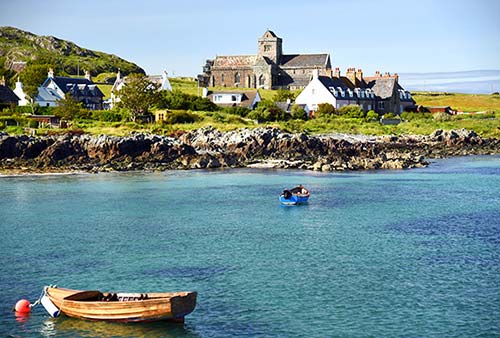
A pristine quality of light and a thoughtful peace pervade the stark, (nearly) car-free island and its tiny community. With buoyant clouds bouncing playfully off distant bluffs, sparkling-white crescents of sand, eerily colorful water in its yawning bays, and lone tourists perched thoughtfully atop huge rocks just looking out to sea, Iona is a place that’s perfect for meditation. To experience Iona, it’s important to get out and take a little hike; you can follow some or all of my self-guided walk outlined below. And you can easily climb a peak—nothing’s higher than 300 feet above the sea.
Orientation to Iona
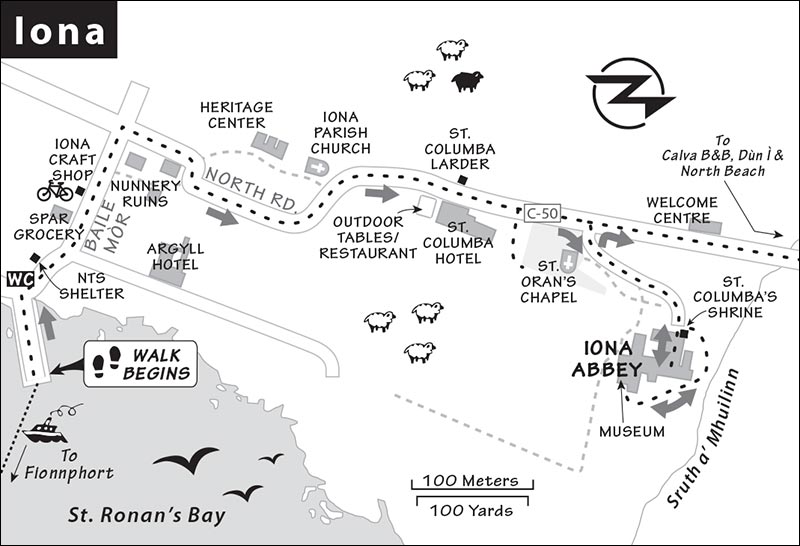
The ferry arrives at the island’s only real village, Baile Mòr, with shops, a restaurant/pub, a few accommodations, and no bank. (Bring cash—some businesses here don’t accept credit cards.) The only taxi based on Iona is Iona Taxi (+44 7810 325 990, www.ionataxi.co.uk).
Leaving the ferry dock, on the left, look for free WCs. Up the road, also on the left, is the National Trust for Scotland “Shelter”—a small indoor exhibit offering a quick orientation to the island. Straight ahead and just a bit farther up the hill is a little Spar grocery (one of many places to get a takeaway lunch—others are noted under “Eating,” later). Next door, the Iona Craft Shop sells good coffee drinks and rents bikes (£15/3 hours).
Iona has no real TI, though the Welcome Center—up near the Iona Abbey, at the end of my self-guided walk—is close enough. The official website www.welcometoiona.com has good information about the island.
Open Days: Unless otherwise noted, everything I mention on Iona should be open every day during the window of time when tours from Oban are in town.
Iona Walk
Here’s a basic self-guided route for exploring the village and points nearby on foot (since no private cars are allowed unless you’re a resident or have a permit). With the standard two hours on Iona that a day trip allows, you will have time for a visit to the abbey and then a light stroll; or do the entire walk described below, but skip the abbey (unless you’re speedy and have time for a quick visit on your way back).
Nunnery Ruins: From the ferry dock, head directly up the single paved road that passes through the village and up a small hill to visit one of Britain’s best-preserved medieval nunneries (free).
Immediately after the nunnery, turn right on North Road. You’ll curve up through the fields—passing the parish church.
Heritage Center: This little museum, tucked behind the church (watch for signs), is small but well done, with displays on local and natural history and a garden café (free but donation requested, closed Sun and off-season, +44 1681 700 576, www.ionaheritage.co.uk).
St. Oran’s Chapel and Iona Abbey: Continue on North Road. After the road swings right, you’ll pass the St. Columba Hotel and Larder, then see St. Oran’s Chapel, in the graveyard of the Iona Abbey. This chapel is the oldest church building on the island. Inside you’ll find a few grave slabs carved in the distinctive Iona School style, which was developed by local stone carvers in the 14th century. On these tall, skinny headstones, look for the depictions of medieval warrior aristocrats with huge swords. Many more of these carvings have been moved to the abbey, where you can see them in its cloister and museum.
It’s free to see the graveyard and chapel; the ▲ Iona Abbey itself has an admission fee, but it’s worth the cost just to sit in the stillness of its lovely, peaceful interior courtyard (£10, includes audioguide; open daily in summer, closed Sun in winter; +44 1681 700 512, www.historicenvironment.scot—search for “Iona Abbey”).
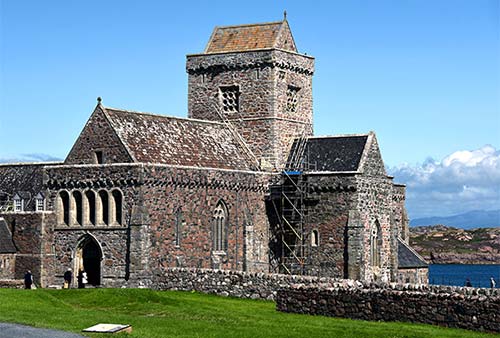
The abbey marks the site of Christianity’s arrival in Scotland. You’ll see Celtic crosses, the original shrine of St. Columba, a big church slathered with medieval carvings, a tranquil cloister, and an excellent museum with surviving fragments of this site’s fascinating layers of history. While the present abbey, nunnery, and graveyard go back to the 13th century, much of what you’ll see was rebuilt in the 20th century. Be sure to read the “History of Iona” sidebar to prepare for your visit.
At the entrance building, pick up your included audioguide—or ask whether any guided tours are available. Then head toward the church. You’ll pass two faded Celtic crosses (and the base of a third); the originals are in the museum at the end of your visit. Some experts believe that Celtic crosses—with their distinctive shape so tied to Christianity on the British Isles—originated right here on Iona.
St. Columba (521-597), an Irish scholar, soldier, priest, and founder of monasteries, got into a small war over the possession of an illegally copied psalm book. Victorious but sickened by the bloodshed, Columba left Ireland, vowing never to return. According to legend, the first bit of land out of sight of his homeland was Iona. He stopped here in 563 and established an abbey.
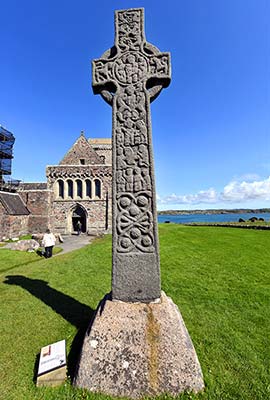
Columba’s monastic community flourished, and Iona became the center of Celtic Christianity. Missionaries from Iona spread the gospel throughout Scotland and northern England, while scholarly monks established Iona as a center of art and learning. The Book of Kells—perhaps the finest piece of manuscript art from early medieval Europe—was probably made on Iona in the eighth century. The island was so important that it was the legendary burial place for ancient Scottish clan chieftains and kings (including Macbeth, of Shakespeare fame) and even some Scandinavian monarchs.
Slowly, the importance of Iona ebbed. Vikings massacred 68 monks in 806. Fearing more raids, the monks evacuated most of Iona’s treasures to Ireland (including the Book of Kells, which is now in Dublin; there’s a replica in the Iona Abbey museum). Much later, with the Reformation, the abbey was abandoned, and most of its finely carved crosses were destroyed. In the 17th century, locals used the abbey only as a handy quarry for other building projects.
Iona’s population peaked at about 500 in the 1830s. In the 1840s, a potato famine hit, and in the 1850s, a third of the islanders emigrated to Canada or Australia. By 1900, the population was down to 210, and today it’s only around 200.
But in our generation, a new religious community has given the abbey fresh life. The Iona Community is an ecumenical gathering of men and women who seek new ways of living the Gospel in today’s world, with a focus on worship, peace and justice issues, and reconciliation (http://iona.org.uk).
Facing the entrance to the church, you’ll see the original shrine to St. Columba (a small chapel) on your left—a magnet for pilgrims.
Head inside the church. It feels like an active church—with hymnals neatly stacked in the pews—because it is, thanks to the Iona Community. While much of this space has been rebuilt, take a moment to look around. Plenty of original medieval stone carving (especially the capitals of many columns) still survives. To see a particularly striking example, stand near the pulpit in the middle of the church and look back to the entrance. Partway up the left span of the pointed arch framing the transept, look for the eternally screaming face. While interpretations vary, this may have been a reminder for the priest not to leave out the fire-and-brimstone parts of his message. Some of the newer features of the church—including the base of the baptismal font near the entrance, and the main altar—are carved from locally quarried Iona marble: white with green streaks. In the right/south transept is the tomb of George Campbell—the Eighth Duke of Argyll, who donated this property in 1900, allowing it to be restored.
When you’re ready to continue, find the poorly marked door into the cloister. (As you face the altar, it’s about halfway down the nave on the left, before the transept.) This space is filled with harmonious light, additional finely carved capitals (these are modern re-creations), and—displayed along the walls—several more of the tall, narrow tombstones like the ones displayed in St. Oran’s Chapel. On these, look for a couple of favorite motifs: the long, intimidating sword (indicating a warrior of the Highland clans) and the ship with billowing sails (a powerful symbol of this seafaring culture).
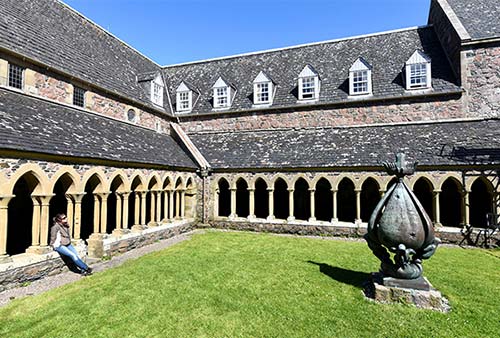
Around the far side of the cloister is the shop, and just beyond that is the door back outside. But before leaving the abbey grounds, don’t overlook the easy-to-miss museum. (To find it, head outside, turn right, and walk around the far side of the abbey complex, toward the sea.) The modern, well-presented “Iona: Across Time” exhibit displays a remarkable collection of original stonework from the abbey—including what’s left of the three Celtic crosses out front—all eloquently described.
Iona Community’s Welcome Centre: Just beyond and across the road from the abbey is the Iona Community’s Welcome Centre (free WCs), which runs the abbey with Historic Scotland and hosts modern-day pilgrims who come here to experience the birthplace of Scottish Christianity. (If you’re staying longer, you could attend a worship service at the abbey—check the schedule here; +44 1681 700 404, www.iona.org.uk.) Its gift shop is packed with books on the island’s important role in Christian history.
Views: Walk as far as you like beyond the abbey, following the only real road across the island. If you need a destination, one good choice is about a 10-minute walk past the welcome center, where you can find the footpath for Dùn Ì (the name for the bulbous, rocky hill that rises up in the middle of the island)—a steep but short climb with good views of the abbey looking back toward Mull.
North Beach: If you have plenty of time and a hankering to walk, back on the main road, carry on another 20-25 minutes to the end of the paved road, where you’ll arrive at a gate leading through a sheep- and cow-strewn pasture to Iona’s pristine white-sand beach. Dip your toes in the Atlantic and ponder what this Caribbean-like alcove is doing in Scotland. Be sure to allow at least 40 minutes to return to the ferry dock.
Sleeping on Iona
For a chance to really experience peaceful, idyllic Iona, spend a night or two. To do so, you’ll have to buy each leg of the ferry-bus-ferry (and return) trip separately (see “By Public Transit,” earlier). The first two hotels listed have restaurants that are open to the public for lunch, tea, and dinner and closed in winter (for more, see “Eating on Iona,” below). It’s important to reserve far ahead. In summer, Scots bring their kids and stay on this tiny island for a week, while spring through fall, spiritual retreats and writing workshops can fill up all the beds. For more accommodation options, see listings at www.welcometoiona.com.
$$$ St. Columba Hotel, up near the Iona Abbey and situated in the middle of a peaceful garden with picnic tables, has 27 institutional rooms and spacious lodge-like common spaces—such as a big, cushy seaview lounge (closed Nov-March, +44 1681 700 304, www.stcolumba-hotel.co.uk, info@stcolumba-hotel.co.uk).
$$$ Argyll Hotel, built in 1867, proudly overlooks the waterfront, with 17 cottage-like rooms and pleasingly creaky hallways lined with bookshelves. Of the two hotels, this one feels classier, with comfortable lounges with a piano and a fireplace, and a sunroom (+44 1681 700 334, www.argyllhoteliona.co.uk, reception@argyllhoteliona.co.uk).
$$ Calva B&B, a five-minute walk past the abbey, has three spacious rooms (second house on left past the abbey, look for sign in window and gnomes on porch, +44 1681 700 340—no email, just call to reserve; friendly Janetta and Ken).
Eating on Iona
For a little island, Iona has multiple options for lunch. Everything here is rated $; while some of the bigger restaurants are open for dinner, when prices are much higher, at lunchtime it’s easy to find a simple (sandwich) lunch anywhere for less than £10. I’ve listed these roughly in the order you reach them, coming up from the ferry dock.
Argyll Hotel, down the little seaview side lane to the right as you head up from the ferry, has a fine dining room and some outdoor tables that are a good value at lunch.
Spar, the only grocery store on the island, is one place to grab a simple sandwich and snacks to go.
St. Columba Hotel also has a good restaurant, with a humdrum dining room and a beautiful lawn strewn with picnic tables.
St. Columba Larder—just above/across the street from the hotel—used to go by the name “The Low Door” (for reasons you’ll understand as you enter). They sell coffee drinks, sweets, gourmet picnic fixings, and some prepared sandwiches you can enjoy at the picnic tables outside (no indoor seating).
Staffa
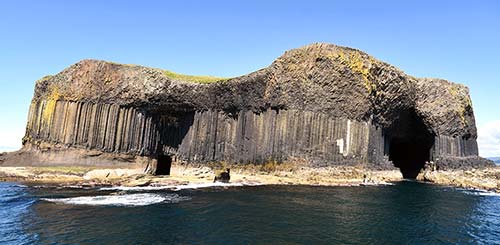
Those more interested in nature than in Christian history will enjoy the trip to the wildly scenic Isle of Staffa. Completely uninhabited (except for seabirds), Staffa is a knob of rock draped with a vibrant green carpet of turf. Remote and quiet, it feels like a Hebrides nature preserve.
Most day trips give you an hour on Staffa—barely enough time to see its two claims to fame: the basalt columns of Fingal’s Cave and (in summer) a colony of puffins. To squeeze in both, be ready to hop off the boat and climb the staircase. Partway up to the left, you can walk around to the cave (about 7 minutes). Or continue up to the top, then turn right and walk across the spine of the grassy island (about 10-15 minutes) to the cove where the puffins gather. Be sure to get clear instructions from your captain on how and where to best watch the puffins. It’s worth doing right.
▲▲Fingal’s Cave
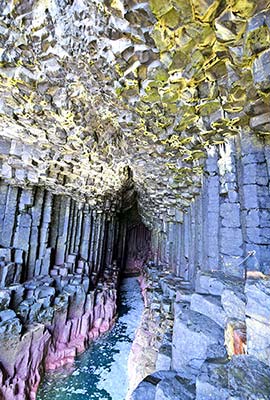
Staffa’s shore is covered with bizarre, mostly hexagonal basalt columns that stick up at various heights. It’s as if the earth were offering God his choice of thousands of six-sided cigarettes. (The island’s name likely came from the Old Norse word for “stave”—the building timbers these columns resemble.) This is the other end of Northern Ireland’s popular Giant’s Causeway. You’ll walk along the uneven surface of these columns, curling around the far side of the island, until you can actually step inside the gaping mouth of a cave—where floor-to-ceiling columns and crashing waves combine to create a powerful experience. Listening to the water and air flowing through this otherworldly space inspired Felix Mendelssohn to compose his overture The Hebrides.
While you’re ogling the cave, consider this: Geologists claim these unique formations were created by volcanic eruptions more than 60 million years ago. As the surface of the lava flow quickly cooled, it contracted and crystallized into columns (resembling the caked mud at the bottom of a dried-up lakebed, but with deeper cracks). As the rock later settled and eroded, the columns broke off into the many stair-like steps that now honeycomb Staffa.
Of course, in actuality, these formations resulted from a heated rivalry between a Scottish giant named Fingal, who lived on Staffa, and an Ulster warrior named Finn MacCool, who lived across the sea on Ireland’s Antrim Coast. Knowing that the giant was coming to spy on him, Finn had his wife dress him as a sleeping infant. The giant, shocked at the infant’s size, fled back to Scotland in terror of whomever had sired this giant baby. Breathing a sigh of relief, Finn tore off the baby clothes and prudently knocked down the bridge.
▲▲Puffin Watching
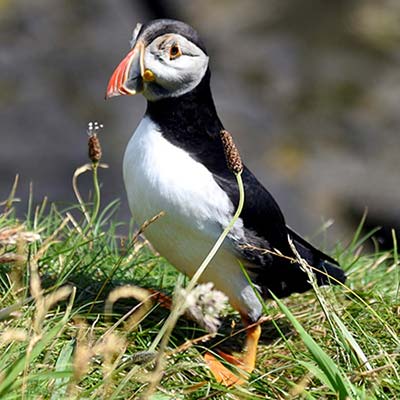
A large colony of Atlantic puffins settles on Staffa each spring and summer during mating season (generally early May through early August). The puffins tend to scatter when the boat arrives. But after the boat pulls out and its passengers hike across the island, the very tame puffins’ curiosity gets the better of them. First, you’ll see them flutter up from the offshore rocks, with their distinctive, bobbing flight. They’ll zip and whirl around, and finally they’ll start to land on the lip of the cove. Sit quietly, move slowly, and be patient, and soon they’ll get close. (If any seagulls are nearby, shoo them away—puffins are undaunted by humans, who do them no harm, but they’re terrified of predatory seagulls.)
In the waters around Staffa—on your way to and from the other islands—also keep an eye out for a variety of marine life, including seals, dolphins, porpoises, and the occasional minke whale, fin whale, or basking shark (a gigantic fish that hinges open its enormous jaw to drift-net plankton).
Glasgow to Oban Drive
The following drive outlines the best route from Glasgow to Oban, including the appealing town of Inveraray, with an optional detour to one of Scotland’s most important prehistoric sites, Kilmartin Glen.
GLASGOW TO OBAN VIA INVERARAY
The drive from Glasgow (or Edinburgh) to Oban via Inveraray provides dreamy vistas and your first look at the dramatic landscapes of the Highlands, as well as historic sites and ample opportunity to stop for a picnic.
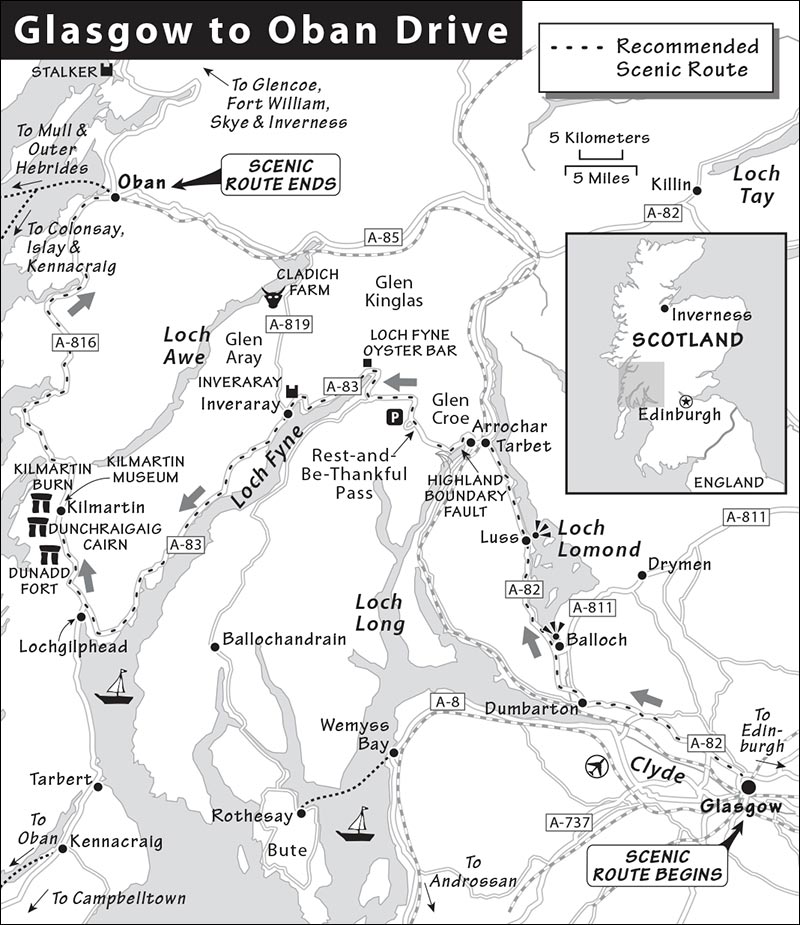
• Leaving Glasgow on the A-82, you’ll soon be driving along the west bank of...
Loch Lomond
The first picnic turnout, at the town of Balloch, has good views of this famous lake (described on here), benches, a park, and a playground. You’re driving over an isthmus between Loch Lomond and a sea loch (inlet). Farther along, Luss is a smaller village where you’ll see more mountains. Halfway up the loch, you’ll find the town of Tarbet—the Viking word for isthmus, a common name on Scottish maps. Imagine, a thousand years ago, Vikings dragging their ships across this narrow stretch of land to reach Loch Lomond.
• At Tarbet, the road forks. The signs for Oban keep you on the direct route along A-82. For the scenic option that takes you past Loch Fyne to Inveraray (about 30 minutes longer to drive), keep left for the A-83 (toward Campbeltown).
Highland Boundary Fault
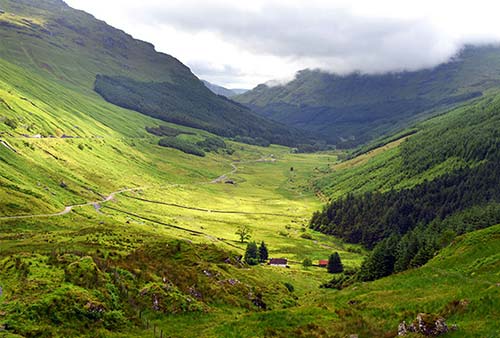
You’ll pass the village of Arrochar, then drive along the banks of Loch Long. The scenery crescendos as you pull away from the loch and twist up over the mountains and through a pine forest, getting your first glimpse of bald Highlands mountains—it’s clear that you’ve just crossed the Highland Boundary Fault. Enjoy the waterfalls, and notice that the road signs are now in Gaelic as well as English. As you climb into more rugged territory—up the valley called Glen Croe—be mindful that the roads connecting the Lowlands with the Highlands (like the one down in the glen below) were originally a military project designed to facilitate government quelling of the Highland clans.
• At the summit, watch for the large parking lot with picnic tables on your left (signed for Argyll Forest Park). Stretch your legs at what’s aptly named...
Rest-and-Be-Thankful Pass
The colorful name comes from the 19th century, when just reaching this summit was exhausting. At the top of the military road, just past the last picnic table, there’s actually a stone (dated 1814) put there by the military with that phrase.
As you drive on, enjoy the dramatic green hills. You may see little bits of hillside highlighted by sunbeams. Each of these is known as a “soot” (Sun’s Oot Over There). Look for soots as you drive farther north into the Highlands.
• Continue twisting down the far side of the pass. You’ll drive through Glen Kinglas and soon reach...
Loch Fyne
This saltwater “sea loch” is famous for its shellfish (keep an eye out for oyster farms). In fact, Loch Fyne is the namesake of a popular UK restaurant chain with locations across the UK. $$$$ Loch Fyne Oyster Bar and Deli, in the big white building at the end of the loch, is the original. It’s a famous stop for locals—an elegant seafood restaurant and oyster bar worth traveling to. In summer, it’s wise to reserve ahead for seating in the restaurant or in the more casual bar area (generally 12:00-16:00, but check hours online, reservations advised via email or phone, +44 1499 600 482, www.lochfyne.com, oyster.bar@lochfyne.com). Even if you’re not eating, it’s fun to peruse their salty deli (tasty treats to go, picnic tables outside, good coffee).
• Looping around Loch Fyne, you approach Inveraray. As you get close, keep an eye on the right (when crossing the bridge, have your camera ready) for the dramatic...
▲Inveraray Castle
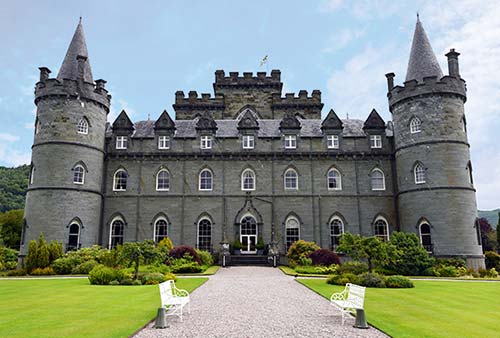
This residence of the Duke of Argyll comes with a dramatic, turreted exterior (one of Scotland’s most striking) and an interior that feels spacious, neatly tended, and lived in. Historically a stronghold of one of the more notorious branches of the Campbell clan, this castle is most appealing to those with Campbell connections or fans of Downton Abbey—this was “Duneagle Castle” (a.k.a. Uncle Shrimpy’s pad) from the first Christmas special.
Cost and Hours: £16; Thu-Mon 10:00-17:00, closed Tue-Wed and Nov-March, last entry 45 minutes before closing; nice basement tearoom, downloadable app available, buy tickets online or at the car-park booth, +44 1499 302 203, www.inveraray-castle.com.
Visiting the Castle: Roam from room to room, reading the laminated descriptions and asking questions of the gregarious docents. The highlight is the Armoury Hall that fills the main atrium, where swords and rifles are painstakingly arrayed in starburst patterns. The rifles were actually used when the Campbells fought against the Jacobites at the Battle of Culloden in 1746.
Upstairs are more fine rooms, often displaying temporary exhibits. As with many such castles, the aristocratic clan still lives here (private signs mark rooms where the family resides). The room in the turret is like an Argyll family scrapbook; for example, see photos of the duke playing elephant polo—the ultimate aristocratic sport. The kids attend school in England, but spend a few months here each year; in the winter, the castle is closed to the public and they have the run of the place. The basement holds an old kitchen and a café, which has outdoor seating at the base of the fortress.
The Romans called the people living in what is now Ireland the “Scoti” (meaning pirates). When the Scoti crossed the narrow Irish Sea and invaded the land of the Picts 1,500 years ago, that region became known as Scoti-land. Ireland and Scotland were never fully conquered by the Romans, and they retained similar clannish Celtic traits. Both share the same Gaelic branch of the linguistic tree.
On clear summer days, you can actually see Ireland—just 17 miles away—from the Scottish coastline. The closest bit to Scotland is the boomerang-shaped Rathlin Island, part of Northern Ireland. Rathlin is where Scottish leader Robert the Bruce retreated in 1307 after defeat at the hands of the English. Legend has it that he hid in a cave on the island, where he observed a spider patiently rebuilding its web each time a breeze knocked it down. Inspired by the spider’s perseverance, Bruce gathered his Scottish forces once more and finally defeated the English at the decisive battle of Bannockburn (see here).
Flush with confidence from his victory, Robert the Bruce decided to open a second front against the English...in Ireland. In 1315, he sent his brother Edward over to enlist their Celtic Irish cousins in an effort to thwart the English. After securing Ireland, Edward hoped to move on and enlist the Welsh, thus cornering England with their pan-Celtic nation. But Edward’s timing was bad: Ireland was in the midst of famine. His Scottish troops had to live off the land and began to take food and supplies from the starving Irish. Some of Ireland’s crops may have been intentionally destroyed to keep it from being used as a colonial “breadbasket” to feed English troops. The Scots quickly wore out their welcome, and Edward the Bruce was eventually killed in battle near Dundalk in 1318.
It’s interesting to imagine how things could be different today if Scotland and Ireland had been permanently welded together as a nation 700 years ago. You’ll notice the strong Scottish influence in Northern Ireland when you ask a local a question and he answers, “Aye, a wee bit.” And in Glasgow—near Scotland’s west coast, closest to Ireland—an Ireland-like division between royalist Protestants and republican Catholics survives today in the form of soccer team allegiances. In big Scottish cities (like Glasgow and Edinburgh), you’ll even see “orange parades” of protesters marching in solidarity with their Protestant Northern Irish cousins. The Irish—always quick to defuse tension with humor—joke that the Scots are just Irish people who couldn’t swim home.
And what about the Downton Abbey connection? The Campbells seem content to move on; you’ll find only a few scant reminders of the castle’s moment of television fame—mostly down in the basement (ask the docents what there is to see).
After touring the interior, do a loop through the finely manicured gardens. The best views are at the far end from where you entered.
• After visiting the castle, spend some time exploring...
▲Inveraray Town
Nearly everybody stops at this lovely, seemingly made-for-tourists town on Loch Fyne. Browse the main street—lined with touristy shops and cafés all the way to the church at its top. As this is the geological and demographic border between the Highlands and the Lowlands, traditionally church services here were held in both Scots and Gaelic. Just before the church is Loch Fyne Whiskies with historic bottles on its ceiling.
There’s free parking on the main street and plenty of pay-and-display parking near the pier (public WCs at end of nearby pier).
The Inveraray Jail is the main sight in town—an overpriced, corny, but mildly educational former jail converted into a museum. This “living 19th-century prison” includes a courtroom where mannequins argue the fate of the accused. Then you’ll head outside and explore the various cells of the outer courtyard. The playful guards may lock you up for a photo op, while they explain how Scotland reformed its prison system in 1839—you’ll see both “before” and “after” cells in this complex (£14.95, includes 75-minute audioguide, open daily, +44 1499 302 381, www.inverarayjail.co.uk).
• To continue directly to Oban from Inveraray (about an hour), leave town through the gate at the woolen mill and get on the A-819, which takes you through Glen Aray, past the turnoff for the Cladich Highland Cattle Farm Tour, then along the aptly named Loch Awe. A left turn on the A-85 takes you into Oban.
But if you have a healthy interest in prehistoric sites, you can go to Oban by way of Kilmartin Glen (adds about 45 minutes of driving). To get there from Inveraray, head straight up Inveraray’s main street and get on the waterfront A-83 (marked for Campbeltown); after a half-hour, in Lochgilphead, turn right onto the A-816, which takes you through Kilmartin Glen and all the way up to Oban. (To avoid backtracking, be ready to stop at the prehistoric sites lining the A-816 between Lochgilphead and Kilmartin village.)
OTHER SIGHTS BETWEEN GLASGOW AND OBAN
▲▲Cladich Highland Cattle Farm Tour
In rolling hills on the south shore of Loch Awe, 30 miles from Oban and 10 miles from Inveraray, Cladich Farm offers private tours that get up close to some of their 100 head of Highland cattle. Queenie and Jon (or farm manager Stuart) begin by showing you around the barn and explaining their operation. Then you’ll board an ATV to head out into the hills for sweeping views over Loch Awe and the Cruachan mountain...and to find some cattle. The specifics of the tour can change with the weather, time of year, and your interests, but you’ll always get up close and personal with some hairy coos—scratching them behind the ears, brushing their shaggy coat, and so on. This is a real, working farm (be prepared for cow pats, smells, and any kind of weather), but your hosts—who were both accountants in a previous life—offer boots and include some classy touches. The private tour, which takes about two hours, must be arranged in advance. This is a small operation and capacity is limited; book 2-3 months ahead (£140 for two people, larger groups may be possible—ask, usually at 10:00 and 14:30; +44 7718 524 158, www.visitcladich.co.uk [URL inactive], highlandcattle@cladich-argyll.co.uk).
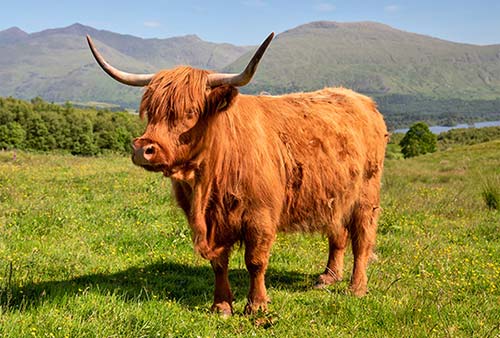
Sleeping at Cladich Farm: The property also includes the comfortable, well-equipped $$ Cladich House B&B, a three-room cottage (minimum 1-week stay, +44 1838 200 845, stay@visitcladich.co.uk).
Kilmartin Glen
Except for the Orkney Islands, Scotland isn’t rich with prehistoric sites. But the ones in Kilmartin Glen, while faint, are some of Scotland’s most accessible—and most important. This wide valley, imbued with some combination of spiritual and strategic power, contains reminders of several millennia worth of inhabitants. Today it’s a playground for those who enjoy tromping through grassy fields while daydreaming about who moved these giant stones here so many centuries ago.
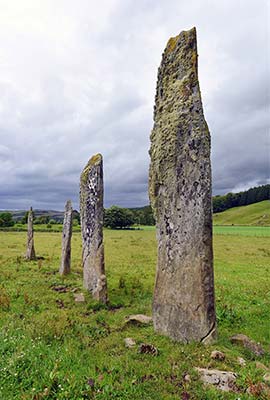
Four to five thousand years ago, Kilmartin Glen was inhabited by Neolithic people who left behind fragments of their giant, stony monuments. And 1,500 years ago, this was the seat of the kings of the Scoti, who migrated here from Ireland around AD 500, giving rise to Scotland’s own branch of Celtic culture. From this grassy valley, the Scoti kings ruled their empire, called Dalriada (also sometimes written Dál Riata), which encompassed much of Scotland’s west coast, the Inner Hebrides, and the northern part of Ireland. The Scoti spoke Gaelic and were Christian; as they overtook the rest of the Highlands—eventually absorbing their rival Picts—theirs became a dominant culture, which is still evident in pockets of present-day Scotland. Today, Kilmartin Glen is scattered with burial cairns, standing stones, and a hill called Dunadd—the fortress of the Scoti kings.
Visiting Kilmartin Glen: Sites are scattered throughout the valley, including some key locations along or just off the A-816 south of Kilmartin village. If you’re coming from Inveraray, you’ll pass these before you reach the village and museum itself. Each one is explained by good informational signs.
Dunadd: This bulbous hill sits just west of the A-816, about four miles north of Lochgilphead and four miles south of Kilmartin village (watch for blue, low-profile Dunadd Fort signs). A fort had stood here since the time of Christ, but it was the Scoti kings—who made it their primary castle from the sixth to ninth centuries—that put Dunadd on the map. Park in the big lot at its base and hike through the faint outlines of terraces to the top, where you can enjoy sweeping views over all of Kilmartin Glen; this southern stretch is a marshland called “The Great Moss” (Moine Mhor) and is one of the few remaining raised bogs in Europe. Look for carvings in the rock: early Celtic writing, the image of a boar, and a footprint (carved into a stone crisscrossed with fissures). This “footprint of fealty” (a replica) recalls the inauguration ceremony in which the king would place his foot into the footprint, symbolizing the marriage between the ruler and the land.
Dunchraigaig Cairn: About two miles farther north on the A-816, brown Dunchraigaig signs mark a parking lot where you can cross the road to the 4,000-year-old, 100-foot-in-diameter Dunchraigaig Cairn—the burial place for 10 Neolithic VIPs. Circle around to find the opening, where you can still crawl into a small recess. This is one of at least five such cairns that together created a mile-and-a-half-long “linear cemetery” up the middle of Kilmartin Glen.
From this cairn, you can walk five minutes to several more prehistoric structures: Follow signs through the gate, and walk to a farm field with Ballymeanoch—an avenue of two stone rows (with six surviving stones), a disheveled old cairn, and a stone circle.
Sites near Kilmartin Burn: About one more mile north on the A-816, just off the intersection with the B-8025 (toward Tayvallich), is the small Kilmartin Burn parking lot. From here, cross the stream to a field where the five Nether Largie Standing Stones have stood in a neat north-south line for 3,200 years. Were these stones designed as an astronomical observatory? Burial rituals or other religious ceremonies? Sporting events? Or just a handy place for sheep to scratch themselves? From here, you can hike the rest of the way through the field (about 10 minutes) to the Nether Largie South Cairn and the Temple Wood Stone Circles (which don’t have their own parking). The larger, older of these circles dates to more than 5,000 years ago, and both were added onto and modified over the millennia.
Kilmartin Museum: This museum is in the center of Kilmartin village and occupies a cute stone house with a recently opened modern addition. Inside, an engaging exhibit explains this area’s powerful history and the prehistoric people who created its cairns and rock art. Displays of prehistoric artifacts—drawn from the museum’s collection of more than 22,000 pieces—are mingled with re-creations and videos exploring life in the glen over the past 5,000 years. You’ll see the remains of a Bronze Age woman found in Kilmartin Glen in 2015 and an artist’s rendition of what she may have looked like, finely crafted jewelry, and decorated pottery from the Glebe Cairn—displayed with a view toward the Bronze Age cairn where it was found (£9.50, daily 10:00-17:00, Nov, Dec, and Feb 11:00-16:00, closed Jan, café, gift shop, +44 1546 510 278, www.kilmartin.org).
Nearby: From the museum café, you can look out across the fields to see Glebe Cairn, one of the five cairns of the “linear cemetery.” Another one, the Nether Largie North Cairn, was reconstructed in the 1970s and can be entered (a half-mile south of the museum). Many more prehistoric sites fill Kilmartin Glen (more than 800 within a six-mile radius); the museum sells in-depth guidebooks for the curious, and can point you in the right direction for what you’re interested in.