SCOTLAND
Welcome to Rick Steves’ Europe
Map: PLACES COVERED IN THIS BOOK
Scotland’s Best Two-Week Trip by Car
Rick’s Free Audio Tours and Video Clips
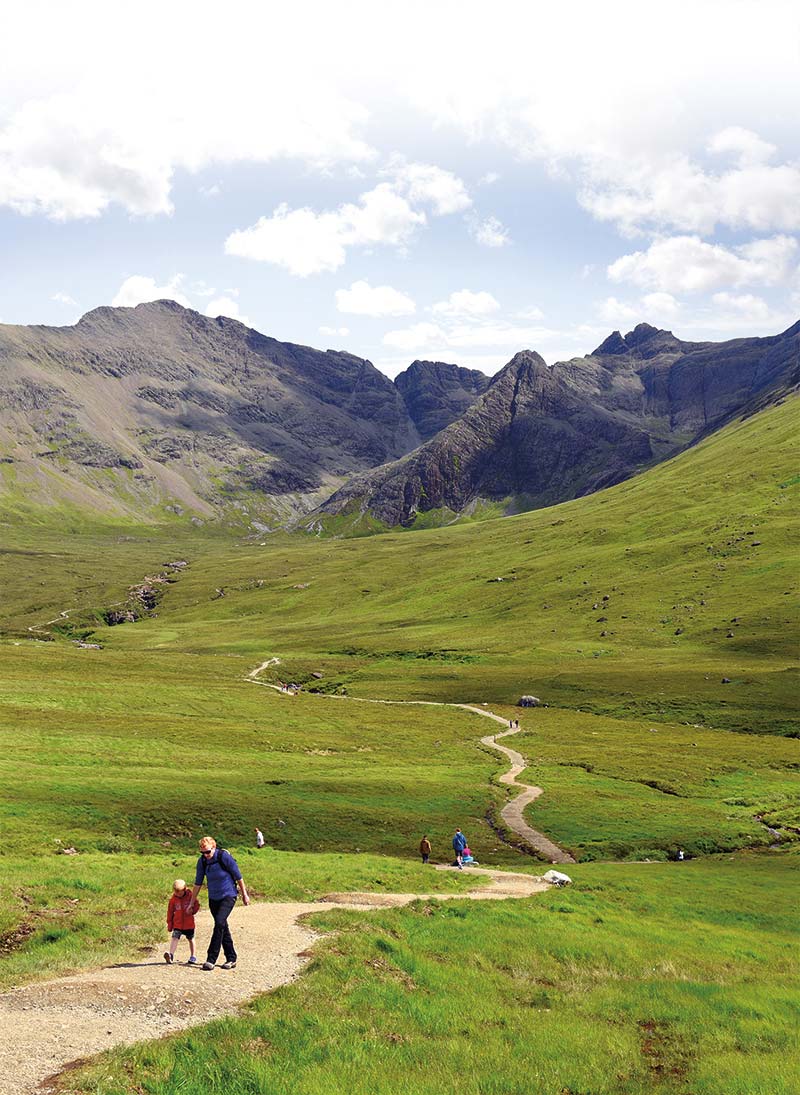
Rugged, colorful, and feisty, Scotland stands apart. From its stony architecture to its striking landscape to its charming people—and their peculiar fondness for haggis—this little land packs a big punch. A proud identity unites the sparsely populated country, all the way from the southern Lowlands, which border England just north of Hadrian’s Wall, up to the Norwegian latitudes of the rocky Highlands and remote coastal islands.
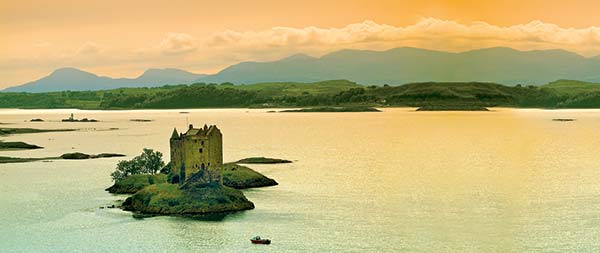
Across Scotland, fortunes have long been tied to the sea; its leading cities, Edinburgh and Glasgow, are located along firths (estuaries), where major rivers connect to ocean waters. Outside those cities, Scotland boasts misty glens, brooding castles, windswept moors, peaty whisky, shaggy Highland cattle (hairy coos), and Celtic ambience.
The northern Highlands are characterized by wild, undulating terrain, punctuated by lochs (lakes) and fringed by sea lochs (inlets) and islands. The southern Lowlands are relatively flat and urbanized.
The geologic fault line that divides the Highlands from the Lowlands also divides Scotland culturally. Historically, the country had two distinct identities: refined Lowlanders in the southern flatlands and rougher Highlanders in the northern wilderness. After the 16th-century Scottish Reformation, the Lowlanders embraced Protestantism, while most Highlanders stuck to Catholicism.
Today, the Lowlands are dominated by rival cities: bustling Edinburgh, on the east coast, and friendly Glasgow, on the west. Edinburgh, the capital, teems with history and is rich in culture. It’s been home to esteemed writers (Robert “Rabbie” Burns, Robert Louis Stevenson, Sir Walter Scott) and hosts a huge international arts festival every August. Glasgow, once gloomy and industrial, is now a hip, laid-back center of art, music, and architecture. Other Lowlands highlights include the town of Stirling with its grand castle, and the university town and golf mecca of St. Andrews.
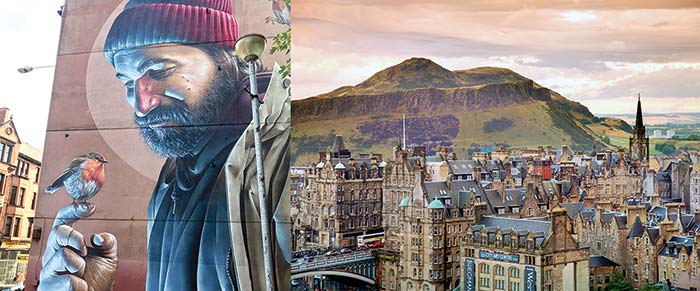
Enormous murals enliven Glasgow’s streets; Arthur’s Seat hovers over Edinburgh’s old town.
The remote Highlands, once the home of rival clans, are now the domain of nature lovers. Here you’ll experience what many think of as traditional Scotland: weathered bluffs, countryside castles, whisky distilleries, deep lochs, heather-strewn moors, and lush green mountains (called Munros). Throughout the summer, towns host traditional Highland Games, where travelers can enjoy a full dose of Scottish culture. To the tune of bagpipes, locals compete in contests of intricate Highland dancing and feats of strength from stone lifting to caber tossing (log throwing).
While the Highlands’ most touristed city is modern Inverness, the region’s beauty is best experienced in the countryside, in smaller towns like Oban and on the islands. Those who really want to get off the beaten path drive the North Coast 500 (NC-500)—up the mountainous west coast and along the northern beaches to John O’Groats—and ride a ferry to the Orkney Islands.
The kilt, Scotland’s national dress, is intimately tied to the country’s history. It originated in the 1500s as a multipurpose robe, toga, tent, poncho, and ground cloth. A wearer would lay a length of fabric (roughly 2 x 6 yards) on the ground, scrunch it up into pleats, then wrap it around the waist and belt it. Extra fabric was thrown over the shoulder or tucked into the belt, creating both a rakish sash and a rucksack-like pouch.
The colors and patterns of the first kilts depended on who wove them and what dyes were available in a locale (colors were muted, unlike later kilts). Because members of one clan tended to live in the same area, they often wore similar patterns—but they weren’t specifically designed to represent a single clan until much later.
The kilt became standard Highlands dress and a patriotic statement during conflicts with England. After the Battle of Culloden in 1746, the victorious English dismantled the Scottish clan system. Wearing the kilt, speaking Gaelic, and playing the bagpipes were all outlawed.
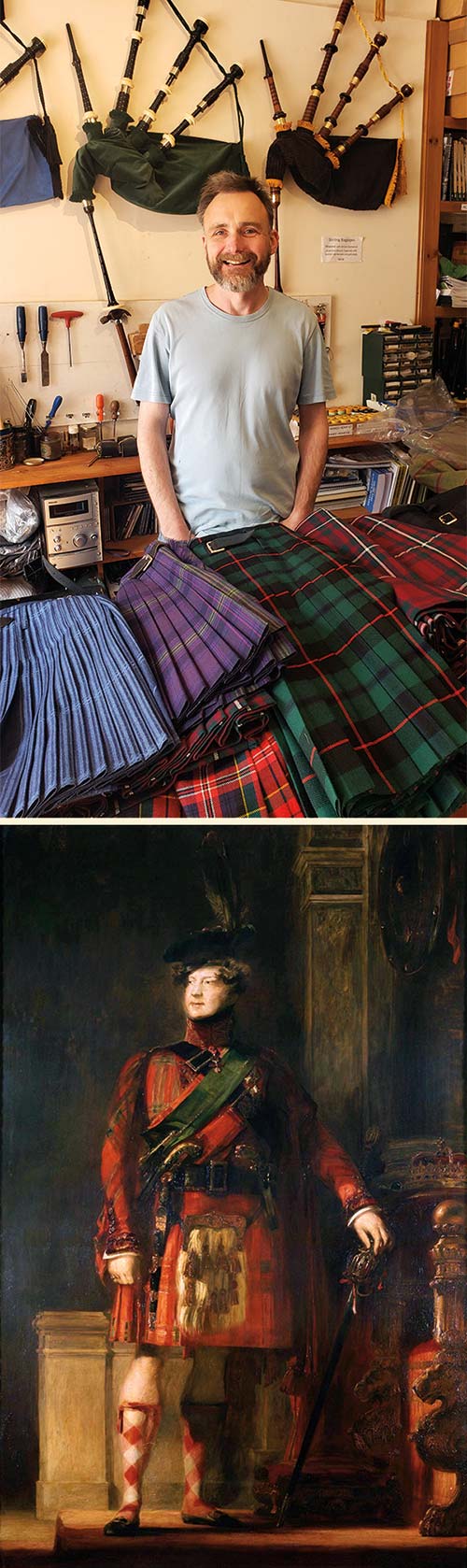
Custom kilt shops offer colorful tartans; King George IV on his 1822 trip to Edinburgh
In 1782, kilts were permitted again, but by then the tradition had faded, and many Scots no longer wanted to wear one. Then, in 1822 King George IV visited Edinburgh (the first royal visit in 200 years). In a not-so-subtle assertion of his authority over Scotland, he wore a kilt. That bit of pageantry charmed Scottish noblemen, and the kilt was in vogue once more.
During the king’s visit, Sir Walter Scott organized a Highland festival that reinvented and romanticized the image of traditional Scottish culture, giving it a newfound respectability. The brightly colored “clan tartans” you’ll see in Scottish souvenir shops got their start at this time, as fabric salesmen hastily designed and assigned patterns to particular clans to capitalize on the newfound enthusiasm for kilts.
A generation later, Queen Victoria, who adored Scotland, enhanced the cachet of the kilt even more. She wallpapered her palace at Balmoral with tartan patterns and wore dresses made from tartan fabric. Since then, tartanry has been embraced as if it were historic. (By the way, Scots use these key terms differently than Americans do: “Tartan” is the pattern itself, while “plaid” is the piece of cloth worn over the shoulder with a kilt.)
If shopping for a kilt, consider where you’ll wear it. Unless you want just a casual kilt for festivals and pubs, the rule of thumb is to get the best you can afford, since it never goes out of style. You’ll choose a tartan and fabric weight (a heavier weight is considered higher quality, hangs well, and is easier to press). The kilt should sit high on the waist a couple of inches above the hip bone.
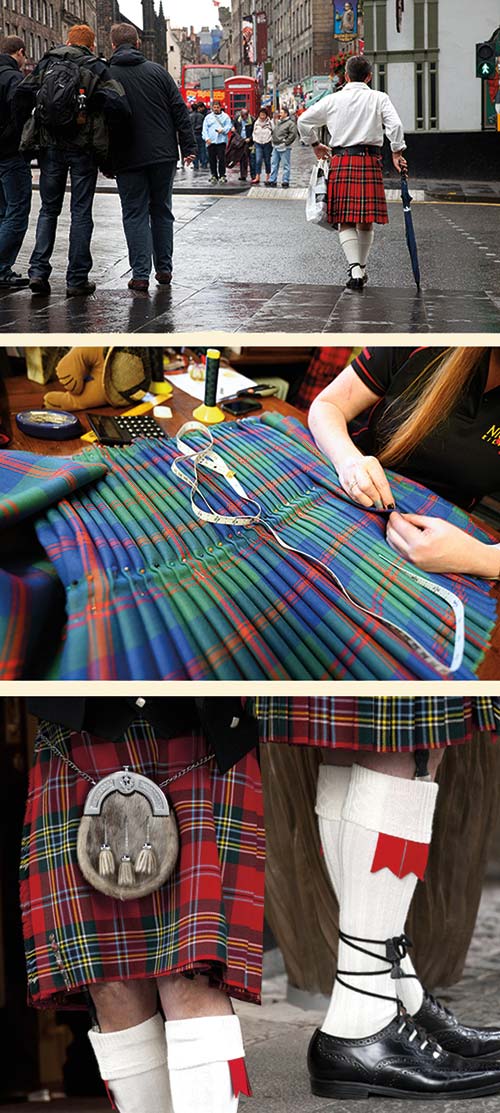
You’ll still find traditional dress in today’s Scotland; skilled artisans craft custom kilts; standard kilt accessories include the leather pouch, worn at the waist, and the sgian dubh knife, tucked into a sock.
Kilt-related gear includes the kilt pin, worn on the front fringed side of the kilt; kilt hose (socks) and flashes (sock garters, with a decorative ribbon that peeks from the sock cuff); the sporran, the leather pouch worn around the waist; and the sgian dubh (pronounced skee-an doo; “black knife”), the short blade worn in the top of the sock. Traditional shoes worn with kilts are ghillie brogues, with laces wrapped around the ankles and tied in front.
At these northern latitudes, cold and drizzly weather isn’t uncommon—even in midsummer. Blue skies and sun can quickly give way to dark clouds and howling wind. Your B&B host will warn you to prepare for “four seasons in one day.” (On the upside, summer days are long; a gloomy day can end with several hours of post-dinner sunshine.)
Scotland is one of three countries, along with England and Wales, that make up Great Britain. Add Northern Ireland, and you’ve got the United Kingdom (UK). Scotland is not a sovereign state (it shares the monarchy with the rest of the UK), but it is a “nation” in that it has its own traditions, ethnic identity, languages, and football league. To some extent, it also has its own government.
Scotland is enjoying its greatest measure of political autonomy in centuries—the Scottish parliament convened in 1999 for the first time in almost 300 years. Though most major political decisions are still made in London, the question of total independence from the UK remains a pivotal issue in Scottish politics.
Scotland even has its own currency...sort of. Scotland uses the same coins as England, Wales, and Northern Ireland but prints its own bills, featuring Scottish people and landmarks (rather than English). Fortunately for visitors, all UK currency is accepted throughout the realm.
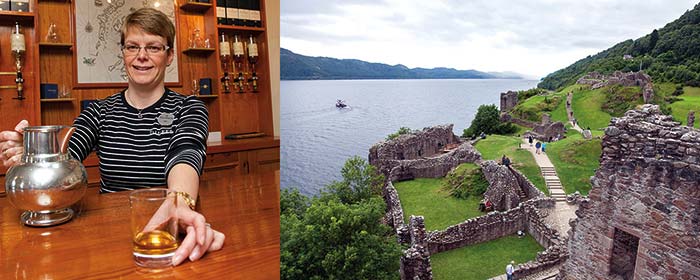
Whisky tasting at Talisker Distillery; historic Urquhart Castle perched on the shores of Loch Ness
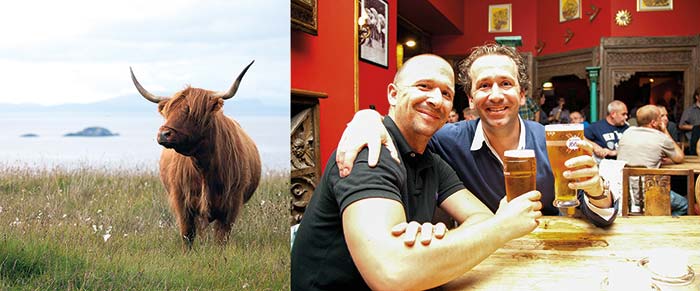
Even in “English-speaking” Scotland, you may encounter a language barrier. The lovely, lilting Scottish brogue may take a while to understand. You may also hear an impenetrable dialect of Scottish English that many linguists consider to be a separate language, called “Scots” (you already know several Scots words: lad, lassie, wee, bonnie, glen, loch, and aye). And about one percent of the population, particularly in the Highlands, speaks the ancient Celtic language of Gaelic (pronounced “gallic”).
Travelers of Scottish descent enjoy coming “home” to Scotland. If you’re Scottish, your surname will tell you which clan your ancestors likely belonged to. The prefix “Mac” (or “Mc”) means “son of”—so “MacDonald” means the same thing as “Donaldson.” Tourist shops everywhere can help you track down the distinctive plaid pattern of your clan’s tartan.
Rural Scotland offers more natural beauty than tourist attractions, and you’ll encounter engaging friendliness everywhere. Whether toasting with beer, whisky, or Irn-Bru (Scotland’s favorite bright-orange soft drink), you’ll enjoy meeting the Scottish people. It’s easy to fall in love with the irrepressible spirit and beautiful landscape of this faraway corner of Britain.
Scotland’s Top Destinations
This bonnie wee country offers plenty to see. This overview sorts its top destinations by location—Lowlands or Highlands—and categorizes them into must-see places (to help first-time travelers plan their trip) and worth-it places (for those with extra time or special interests). I’ve also suggested a minimum number of days to allow per destination.
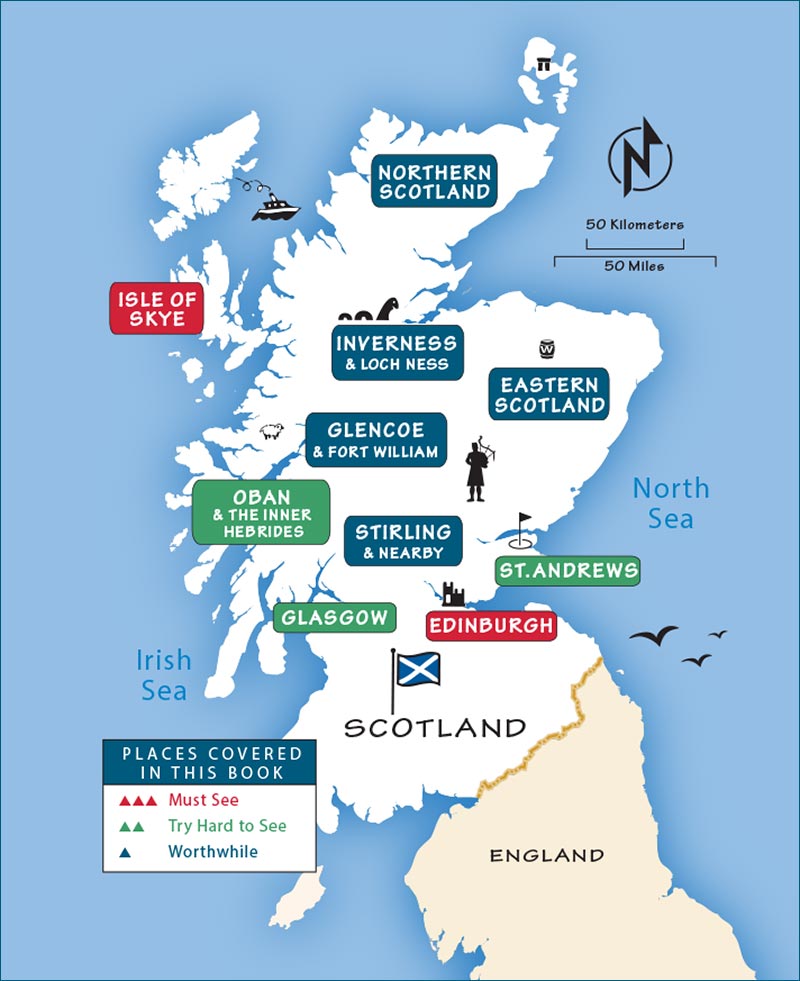
THE LOWLANDS
Southern Scotland’s vibrant cities and excellent museums provide a superb introduction to Scottish culture and history.
▲▲▲Edinburgh (allow 2-3 days)
Tucked amid craggy bluffs, Scotland’s delightful capital offers world-class museums and lively culture. The attraction-studded Royal Mile, lined with medieval “skyscrapers,” links a grand castle at the top end to a stately palace at the bottom. The city’s exuberance—enjoyable year-round—bustles nonstop during August’s festivals.
▲▲Glasgow (2 days)
Glasgow, once a mighty ship-building center, is now rejuvenated, funky, and fun, offering warm hospitality, great food and nightlife, top-notch museums, and a treasure trove of Art Nouveau architecture, courtesy of Charles Rennie Mackintosh.
▲▲St. Andrews (1 day)
This coastal town hosts Scotland’s top university and the world’s most famous golf course. With a medieval old town, cathedral ruins, sandy beaches, and a student vibe, St. Andrews attracts visitors of all ages, whether they prefer tee time, teatime, or a fun time. Dundee (with fine museums) and the East Neuk’s seaside villages are nearby.
▲Stirling & Nearby (1 day)
Stirling proudly showcases the home of the Stuart kings, Stirling Castle, overlooking a historic plain where three pivotal battles were fought. Falkirk, to the south, has the Kelpies (two gigantic steel horse heads) and a working Ferris wheel for boats. To the north are Doune Castle and the wooded glens known as the Trossachs.
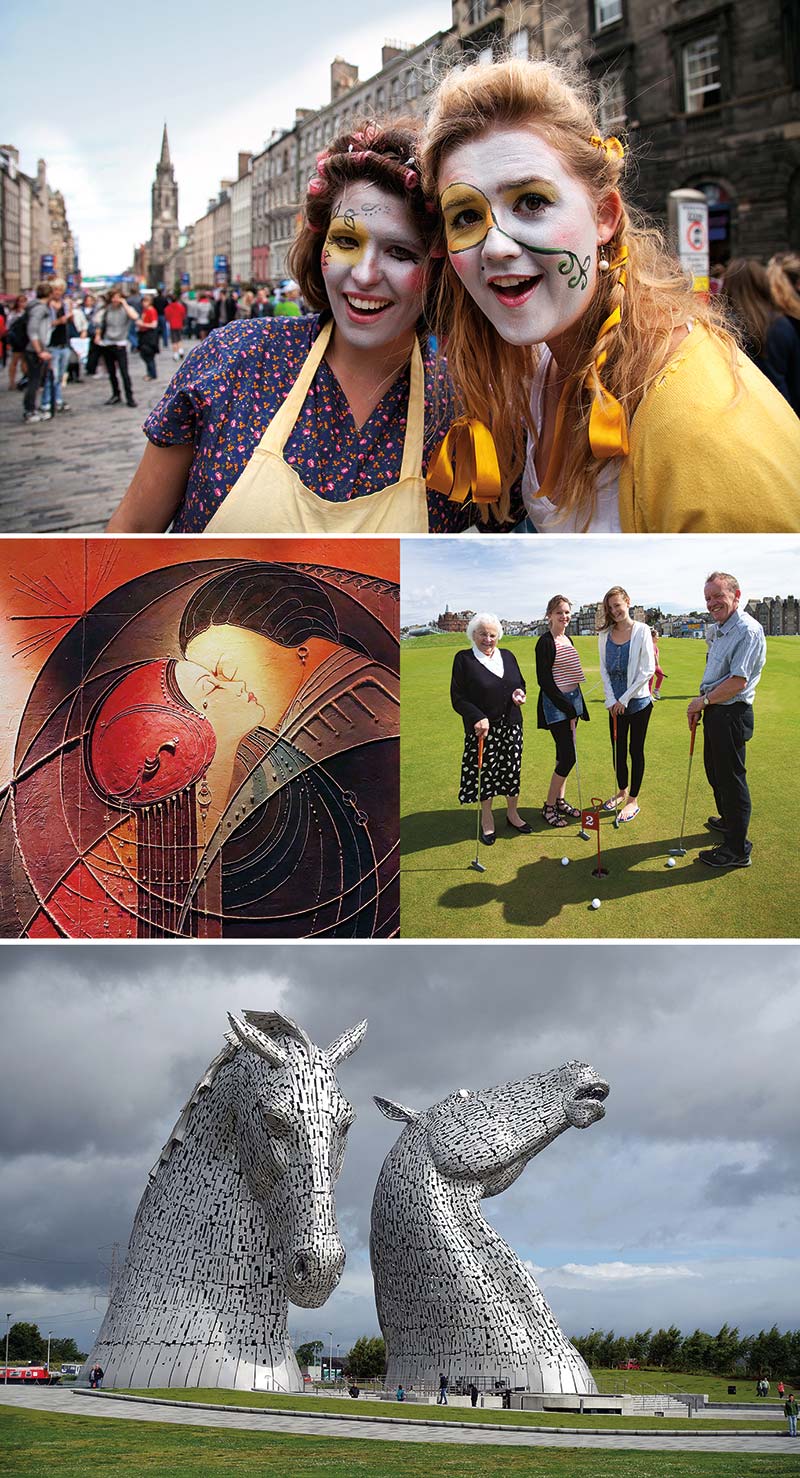
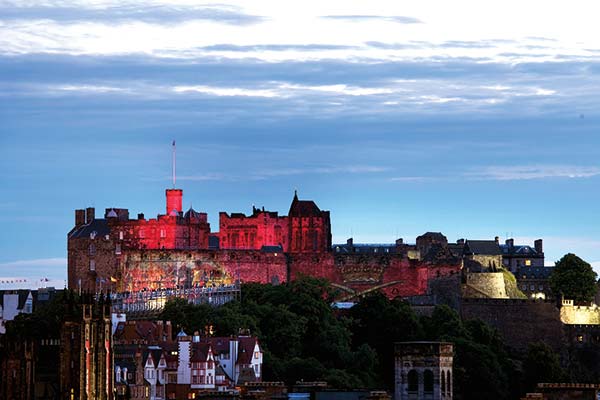
Floodlit Edinburgh Castle (opposite); lively locals at the Edinburgh Festival; teeing off in St. Andrews; giant Kelpies sculptures near Falkirk; Glasgow’s Art Nouveau
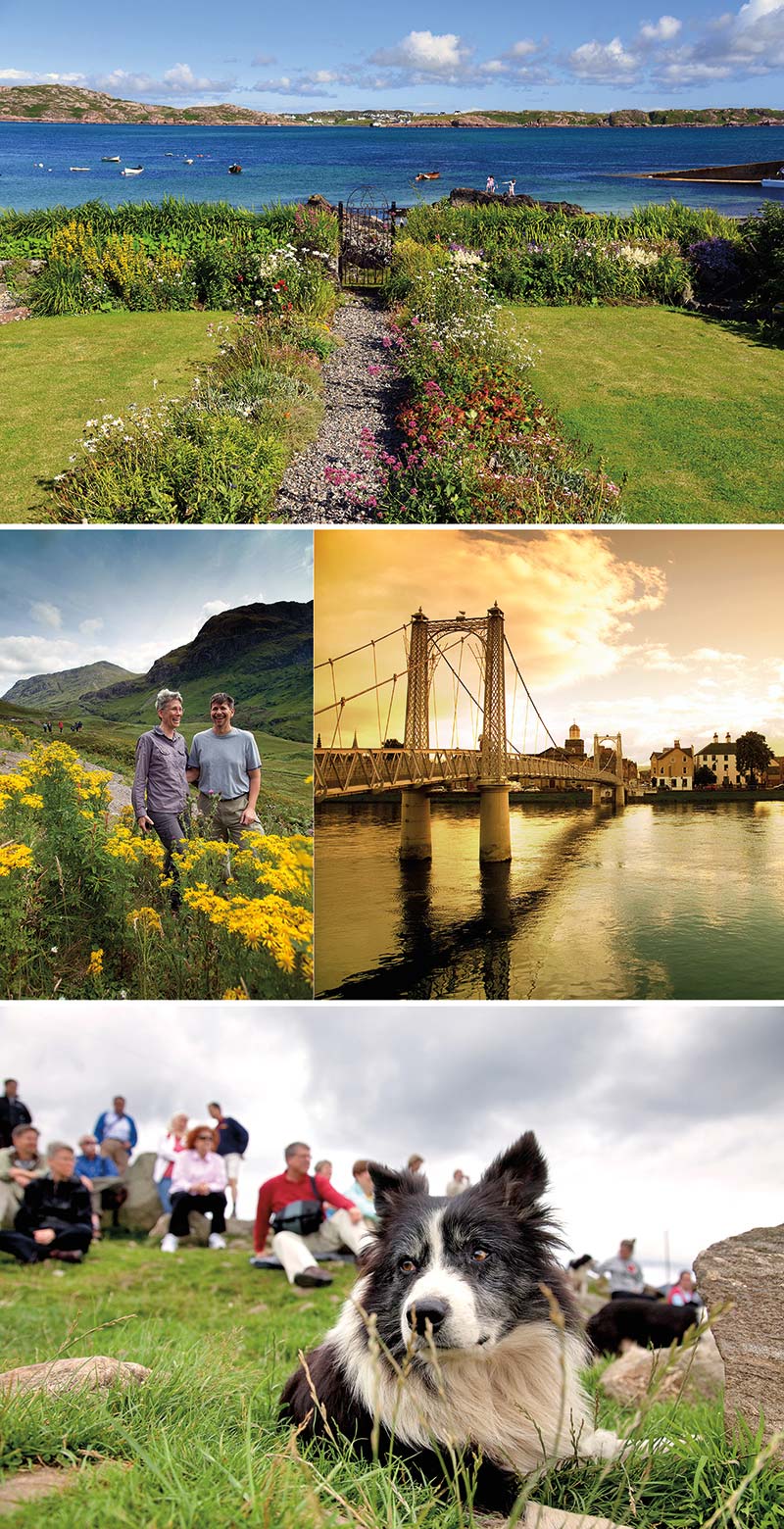
Finding serenity on the Isle of Iona; Inverness footbridge spanning the River Ness; sheepdogs running the show at a Highlands sheep farm; hiking amid the blooms in Glencoe
THE HIGHLANDS
Northern Scotland’s scenic beauty shines in the Highlands, bordered by quaint ports and islands, and dotted with castles, distilleries, historic battlefields, and sweeping loch and mountain vistas.
▲▲▲Isle of Skye (1 day)
The dramatically scenic island—the best of the Inner Hebrides—offers a concentrated dose of the Highlands, featuring craggy Cuillin Hills, the jagged Trotternish Peninsula, historic castles, fun-to-tour distilleries, dynamic clan history, and the colorful harbor town of Portree.
▲▲Oban & the Inner Hebrides (1 day)
The handy home base of Oban hosts a fine distillery tour, great restaurants, and boat excursions. This charming “gateway to the isles” is the jumping-off point for day trips by ferry to the islands of the Inner Hebrides: hilly Mull, spiritual Iona, and small Staffa, populated by puffins in summer.
▲Glencoe & Fort William (half-day)
The stirring “Weeping Glen” of Glencoe offers some of the Highlands’ saddest clan history and best mountain scenery, with a range of hikes for all abilities. And all roads pass through the transit-hub town of Fort William, leading to the historic Road to the Isles (to the Isle of Skye and more).
▲Inverness & Loch Ness (1 day)
The de facto capital of the Highlands, modern Inverness is a springboard to nearby sights, including Culloden Battlefield (where Bonnie Prince Charlie was defeated), Loch Ness (famous for monster spotting), the ruins of medieval Urquhart Castle, and the tranquil Caledonian Canal.
▲Eastern Scotland (2 days)
Appealing sights between Inverness and Edinburgh include Pitlochry (a town known for whisky and hill walking), an early Iron Age crannog site on Loch Tay, sheepdog shows, the distilleries of Speyside, the royal retreat at Balmoral Castle, grand Cairngorms scenery around Ballater, and cliff-topping Dunnottar Castle.
▲Northern Scotland (2-4 days)
This remote, less-touristed region includes Wester Ross (the mountainous west coast, with winding, narrow roads), and the beachy north coast—linked by the stunning North Coast 500 (NC-500) road trip. A short ferry ride away are the Orkney Islands—with Scotland’s best prehistoric sites and a naval harbor with a fascinating wartime past.
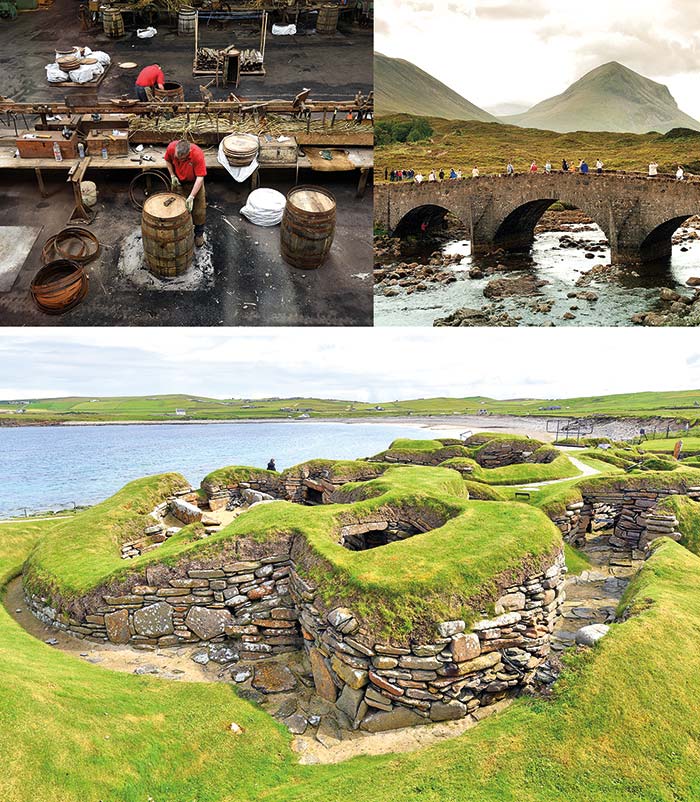
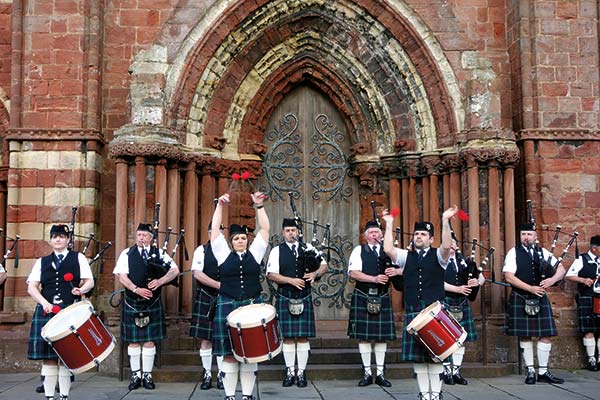
Barrel makers at the Speyside Cooperage; the old Sligachan Bridge, Isle of Skye; Neolithic settlement at Skara Brae, Orkney Islands
Planning Your Trip
To plan your trip, you’ll need to design your itinerary—choosing where and when to go, how you’ll travel, and how many days to spend at each destination. For general advice on sightseeing, accommodations, restaurants, and more, see the Practicalities chapter.
DESIGNING AN ITINERARY
As you read this book and learn your options...
Choose your top destinations.
My recommended itinerary (see the sidebar on the next page) gives you an idea of how much you can reasonably see in 14 days, but you can adapt it to fit your own interests and schedule.
Edinburgh and Glasgow offer the most art, architecture, history, and nightlife.
Nature lovers add extra time in the Highlands for hiking in Glencoe, on the Isle of Skye, and in the Cairngorms near Ballater. Try to fit in a Highland Games or the Working Sheepdogs demonstration (near Inverness). Golfers make a pilgrimage to St. Andrews.
Whisky aficionados savor Speyside and Pitlochry (though most towns have a spot for tastings). Prehistorians prioritize Kilmartin Glen (near Oban), the Crannog Centre (Loch Tay), Clava Cairns (near Inverness), and the Orkney Islands.
Those interested in Scotland’s industrial heritage check out the Caledonian Canal, Falkirk Wheel, and museums in Dundee.
If you’re crazy for castles, tour Edinburgh, Dunvegan (Isle of Skye), and Stirling. (There are many more; see “Scottish Castles at a Glance” in the Past & Present chapter for a list.) Castle ruins set in the scenic Highlands can be stunning, though photographers will be happy wherever they go.
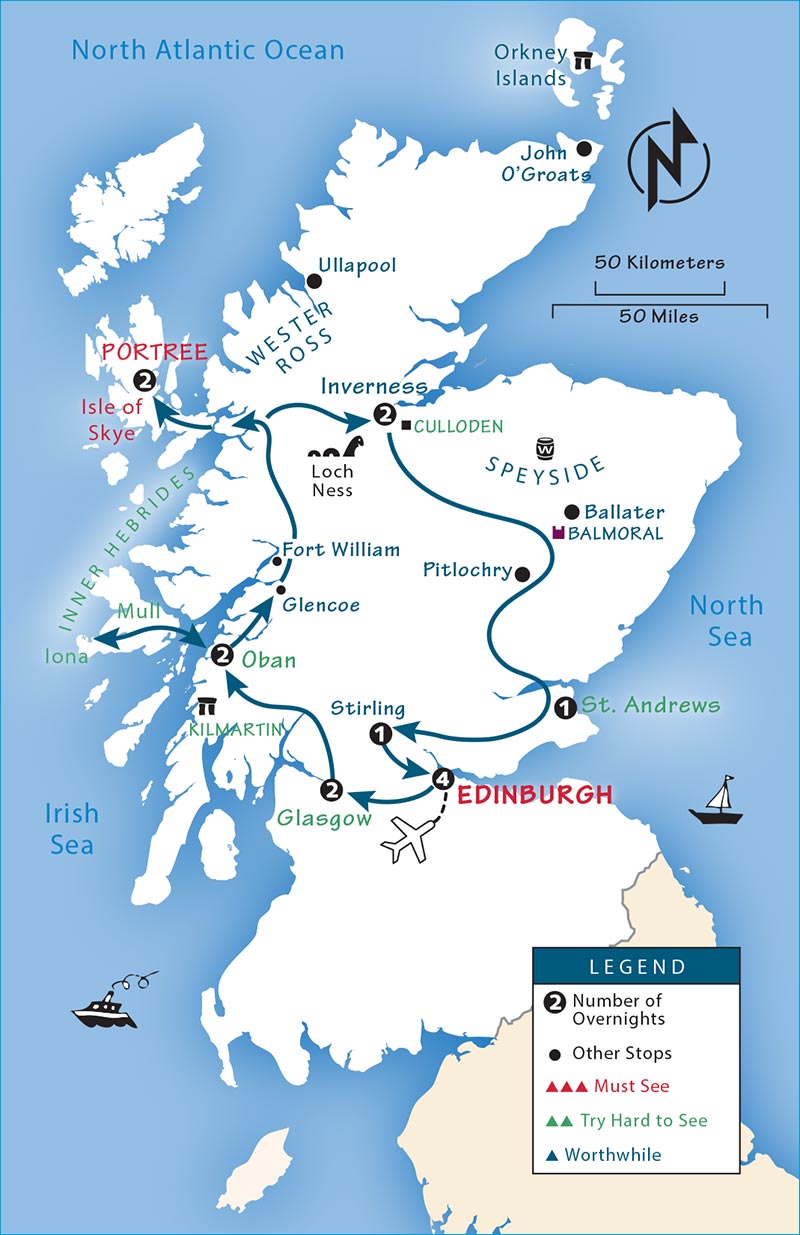
Taking geographic proximity into account, I’ve organized my recommended sightseeing priorities into a doable two-week itinerary. Except for the two city stops at the outset, you’ll travel by car.
| Day | Plan | Sleep |
| 1 | Arrive in Edinburgh | Edinburgh |
| 2 | Edinburgh | Edinburgh |
| 3 | Edinburgh | Edinburgh |
| 4 | More time in Edinburgh, then train to Glasgow | Glasgow |
| 5 | Glasgow | Glasgow |
| 6 | Pick up car; drive to Oban | Oban |
| 7 | Side trip to Mull and Iona | Oban |
| 8 | Drive through Glencoe this morning, then to Isle of Skye | Isle of Skye |
| 9 | Isle of Skye | Isle of Skye |
| 10 | Drive along Caledonian Canal and Loch Ness to Inverness | Inverness |
| 11 | Inverness and side trip to Culloden and other sights | Inverness |
| 12 | Head south, enjoying your choice of sights in Eastern Scotland or St. Andrews | Pitlochry, Ballater, or St. Andrews |
| 13 | More Eastern Scotland or St. Andrews sightseeing; spend evening in Stirling | Stirling |
| 14 | Stirling Castle and nearby sights; drive to Edinburgh (or Glasgow) | Edinburgh (or Glasgow) |
| Fly home |
Without a Car: While this two-week itinerary is designed to be done by car, most connections can be made by bus, with a few modifications: You may want to rent a car for your time on Skye; consider a package tour for Highland side-tripping from Inverness; and at the end, go from Inverness straight to Stirling (skipping Eastern Scotland sights, which are out of the way by public transit).
Notes: If you’d like to prioritize the countryside over cities, you could skip Glasgow, or do it at the end of your trip, as a day trip from Stirling or Edinburgh.
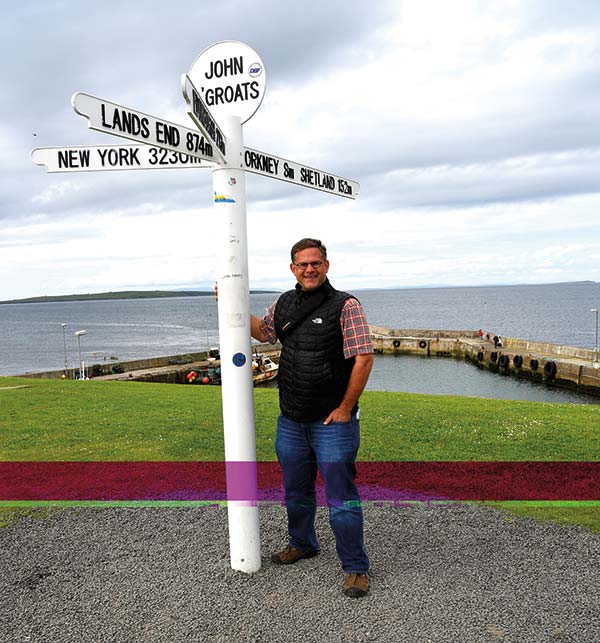
With more time, there are many ways to slow down and linger in the Highlands. Stretch out your visit by adding an overnight in Glencoe (more time for hiking) and/or Wester Ross (more scenery).Do the NC-500 driving loop around the north of Scotland, and add a night (or two) on the Orkney Islands (see the Scottish Highlands chapter for more details).
Decide when to go.
Most tourists visit between mid-May and mid-September. In most of Scotland, July and August offer the best weather and busiest schedule of tourist fun—and consequently jam-packed B&Bs and restaurants. Edinburgh is especially swamped throughout August, the city’s festival season. Any town is busy during its Highland Games.
Travel from April to mid-May and mid-September to mid-October is easier. Those times tend to have fewer tourists, a full range of activities and open sights, and better room availability (and prices). While you can get lucky, the weather is less reliable than in summer. In the off-season, castles and historic sites may be closed, and the weather can be uninviting. But cities welcome visitors any time of year.
Temperatures below 32°F cause headlines, and days that break 80°F—while more frequent in recent years—are still rare in Scotland. While sunshine may be uncommon, summer daylight hours are very long (6:30-22:30). Any season can have rainy spells. For weather specifics, see the climate chart in the appendix.
Run a reality check on your dream trip. You’ll have major transportation costs in addition to daily expenses.
Flight: A round-trip flight from the US to Edinburgh costs about $900-1,500, depending on where you fly from and when.
Transportation: For a two-week trip, allow $250 per person for public transportation (train and bus tickets). In some cases, a short flight can be cheaper than the train.
Car Rental: Allow $350-500 per week (booked well in advance), not including tolls, gas, parking, and insurance.
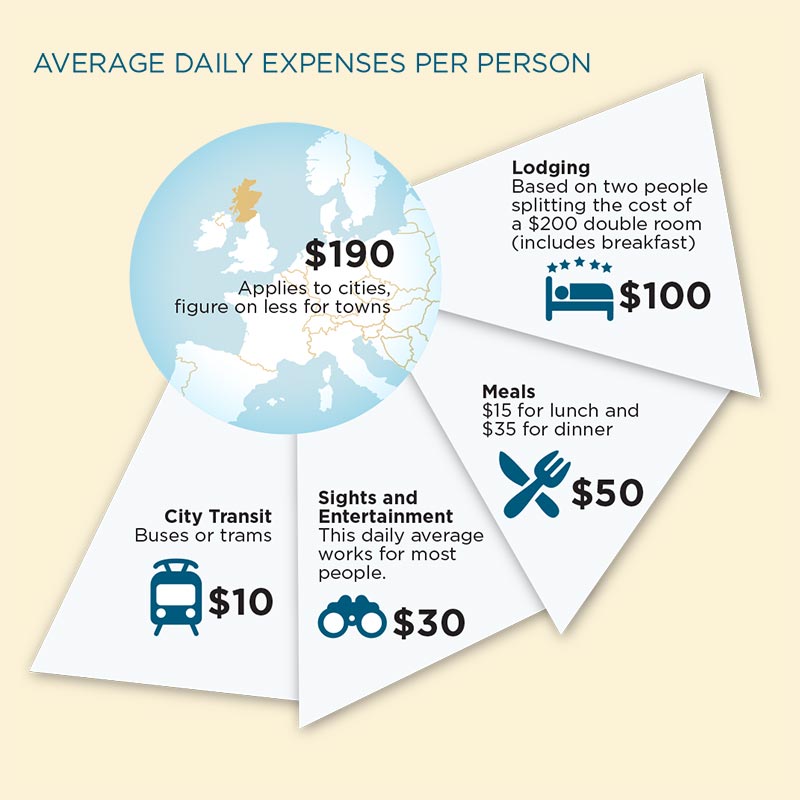
To cut your daily expenses, take advantage of the deals you’ll find throughout Scotland and mentioned in this book.
The Royal Edinburgh Ticket is a good deal if you’ll use the hop-on, hop-off buses and see Edinburgh Castle, the Palace of Holyroodhouse, and the Royal Yacht Britannia. The Historic Scotland’s Explorer Pass can save some money if you visit the castles in both Edinburgh and Stirling, or are also going to the Orkney Islands. Throughout Scotland, seek out free sights and experiences (people-watching counts).
Some businesses—especially hotels and walking-tour companies—offer discounts to my readers (look for the RS% symbol in the listings in this book).
Reserve your rooms directly with the hotel or B&B. Some places offer a discount if you pay in cash and/or stay three or more nights (check online or ask). Rooms can cost less in early spring and late fall. And even seniors can sleep cheaply in hostels (most have private rooms) for about $30 per person. Or check Airbnb-type sites for deals.
It’s no hardship to eat inexpensively in Scotland. You can get tasty, affordable meals at bakeries, “chippies” (fish-and-chips shops), cafeterias, sandwich shops, pubs, cheap chain restaurants, and takeaway spots. Cultivate the art of picnicking in atmospheric settings.
When you splurge, choose an experience you’ll always remember, such as a fancy dinner, a scenic bus tour, or a flight to the Orkney Islands. Minimize souvenir shopping; focus instead on collecting wonderful memories.
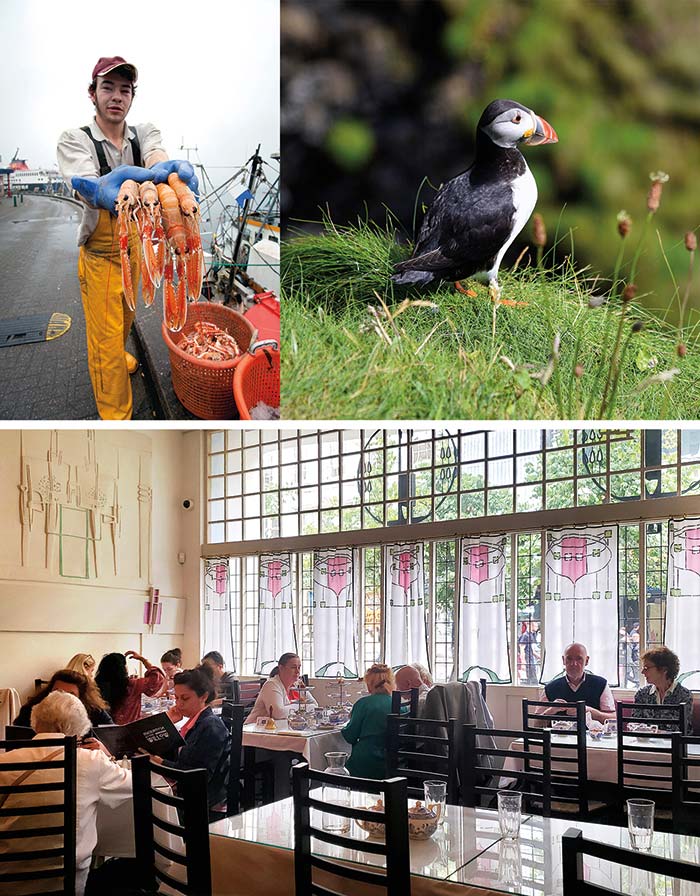
Try the catch of the day; observe puffins on the Isle of Staffa; sip tea at Glasgow’s famous Art Nouveau tearoom.
Connect the dots.
Link your destinations into a logical route. Determine which cities you’ll fly into and out of. Begin your search for transatlantic flights on Google Flights.
Decide if you’ll travel by car or public transportation, or a combination. For Scotland, a combination works well: Connect the big cities by train, then rent a car for the Highlands.
If relying on public transportation, you’ll generally use trains in the Lowlands and a mix of buses and trains in the hilly Highlands. To reach scattered regional sights from a major city, consider the efficiency of a minibus excursion. With more time, everything is doable without a car.
To determine approximate travel times between destinations, study the driving map in the Practicalities chapter or check Google Maps; visit NationalRail.co.uk for train schedules and Citylink.co.uk [URL inactive] for bus schedules. Budget flights can be an alternative to long train rides; check Skyscanner.com for intra-European flights (but keep in mind air travel’s larger carbon footprint).
Write out a day-by-day itinerary.
Figure out how many destinations you can comfortably fit in your time frame. Don’t overdo it—few travelers wish they’d hurried more. Allow enough days per stop (see estimates in “Scotland’s Top Destinations,” earlier). Minimize one-night stands. It can be worth taking a late-afternoon drive or train ride to settle into a town for two consecutive nights—and gain a full uninterrupted day for sightseeing. Include sufficient time for transportation; whether you travel by car, train, or bus, it’ll take you a half-day to get between most destinations.
Staying in a home base and making day trips can be more time-efficient than changing locations and hotels.
Take sight closures into account. Avoid visiting a town on the one day a week its must-see sights are closed. Check if any holidays, festivals, or Highland Games fall during your trip—these attract crowds and can close sights (for the latest, visit Scotland’s tourist website, VisitScotland.com).
Give yourself some slack. Every trip, and every traveler, needs downtime for doing laundry, picnic shopping, people-watching, and so on. Pace yourself. Assume you will return.
BEFORE YOU GO
You’ll have a smoother trip if you tackle a few things ahead of time. For more details on these topics, see the Practicalities chapter and RickSteves.com, which has helpful travel-tip articles and videos.
Make sure your travel documents are valid. If your passport is due to expire within six months of your ticketed date of return, you need to renew it. Allow 12 weeks or more to renew or get a passport. Be aware of any entry requirements: Get passport and country-specific travel info at Travel.State.gov.
Arrange your transportation. Book your international flights. Overall, Google Flights is the best place to start searching for flights. Figure out your transportation options within Scotland: Consider buying train tickets online in advance, getting a rail pass, renting a car, or booking cheap European flights if traveling outside Scotland. (You can wing it once you’re there, but it may cost more.)
Book rooms well in advance, especially if your trip falls during peak season or any major holidays or festivals. Those visiting Edinburgh in August or Northern Scotland destinations (such as the Isle of Skye and Orkney Islands) in high season should book far in advance. Especially in smaller communities, the best B&Bs book up for the entire summer by late winter.
Reserve ahead for key sights and activities. Make reservations or buy tickets in advance for major sights, including Edinburgh and Stirling castles and the Neolithic sites on Orkney Islands. Tickets to Edinburgh’s Military Tattoo (Aug) sell out early—book as far ahead as possible. If you’ll be in Edinburgh at festival time (most of Aug), check the schedule and consider buying tickets in advance for any must-see shows. Tours and tastings at the more famous whisky distilleries can book up weeks ahead. To golf at St. Andrews’ famous Old Course, you’ll need to reserve the preceding fall, or put your name in for the “daily ballot” two days before.
Hire guides in advance. Popular guides can get booked up. If you want a specific guide, reserve by email as far ahead as possible—especially for Edinburgh and Glasgow.
Consider travel insurance. Compare the cost of insurance to the cost of your potential loss. Understand what protections your credit card might offer and whether your existing insurance (health, homeowners, or renters) covers you and your possessions overseas.
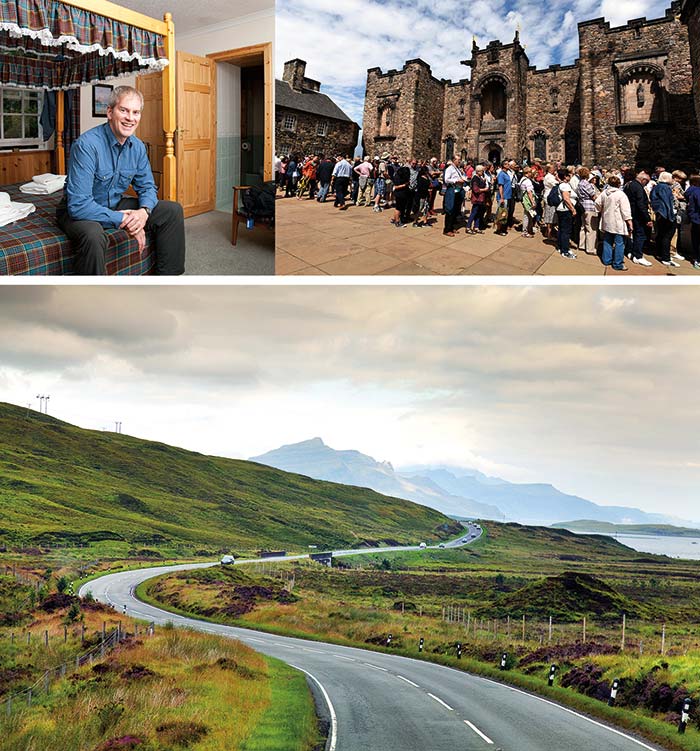
Book rooms early for the best selection; buy tickets in advance to avoid lines at Edinburgh Castle; learning how to drive on the left gives you freedom and flexibility.
Manage your money. “Tap-to-pay” or “contactless” cards are widely accepted and simple to use. You may need your credit card’s PIN for some purchases—request it if you don’t have one. Alert your bank that you’ll be using your debit and credit cards in Europe. You don’t need to bring pounds for your trip; you can withdraw pounds from ATMs in Scotland (you’ll use cards more than cash).
Use your smartphone smartly. Sign up for an international service plan, or rely on Wi-Fi instead. Download any apps you’ll want on the road, such as maps, translators, and Rick Steves Audio Europe (see sidebar).
Pack light. You’ll walk with your luggage more than you think. I travel for weeks with a single carry-on bag and a day pack. Use the packing checklist in the appendix as a guide.
Rick Steves Audio Europe, a free app, makes it easy to download my audio tours and listen to them offline as you travel. For this book, the app includes a free audio version of my Edinburgh Royal Mile Walk (look for the  ) and many interviews relating to Scotland from my public radio show. Scan the QR code to find it in your app store, or visit RickSteves.com/AudioEurope.


Rick Steves Classroom Europe, a powerful tool for teachers, is also useful for travelers. This video library contains about 600 short clips excerpted from my public television series. Enjoy these videos as you sort through options for your trip and to better understand what you’ll see in Europe. Check it out at Classroom.RickSteves.com.

Travel Smart
If you have a positive attitude, equip yourself with good information (this book), and expect to travel smart, you will.
Read—and reread—this book. To have an “A” trip, be an “A” student. Note opening hours of sights, closed days, crowd-beating tips, and whether reservations are required or advisable. Check the latest at RickSteves.com/update.
Be your own tour guide. As you travel, get up-to-date info on sights, reserve tickets and tours, reconfirm hotels and travel arrangements, and check transit connections. Visit local tourist information offices (TIs, marked “iCentre” in Scotland). Upon arrival in a new town, lay the groundwork for a smooth departure; confirm the train, bus, or road you’ll take when you leave.
Outsmart thieves. Pickpockets abound in crowded places where tourists congregate. Treat commotions as smokescreens for theft. Keep your passport and backup cash and cards secure in a money belt tucked under your clothes; carry only a day’s spending money and a card in your front pocket or wallet. Don’t set valuable items down on counters or café tabletops, where they can be quickly stolen or easily forgotten.
Minimize potential loss. Keep expensive gear to a minimum. Bring copies or take photos of important documents (passport and cards) to aid in replacement if they’re lost or stolen. Back up photos and devices to the cloud as you travel.
Guard your time and energy. Taking a taxi can be a good value if it saves you a long wait for a cheap bus or an exhausting walk across town. To avoid long lines, follow my crowd-beating tips, such as buying tickets in advance, or sightseeing early or late.
Be flexible. Even if you have a well-planned itinerary, expect changes, strikes, closures, sore feet, bad weather, and so on. Your Plan B could turn out to be even better.
Connect with the culture. Interacting with locals carbonates your experience. Enjoy the friendliness of the Scottish people. You speak the language—use it! Ask questions; most locals are happy to point you in their idea of the right direction. Set up your own quest for the best hike, castle, or whisky. When an opportunity pops up, make it a habit to say “yes.”
Scotland...here you come!