ISLE OF SKYE
Portree • Touring the Isle of Skye
The rugged, remote-feeling Isle of Skye has a reputation for unpredictable weather (“Skye” comes from the Old Norse for “The Misty Isle”). But it also offers some of Scotland’s best scenery, and it rarely fails to charm its many visitors. Narrow, twisty roads wind around Skye in the shadows of craggy, black, bald mountains, and the coastline is ruffled with peninsulas and sea lochs (inlets).
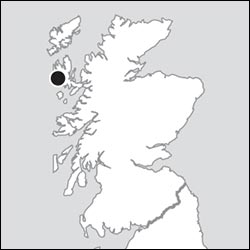
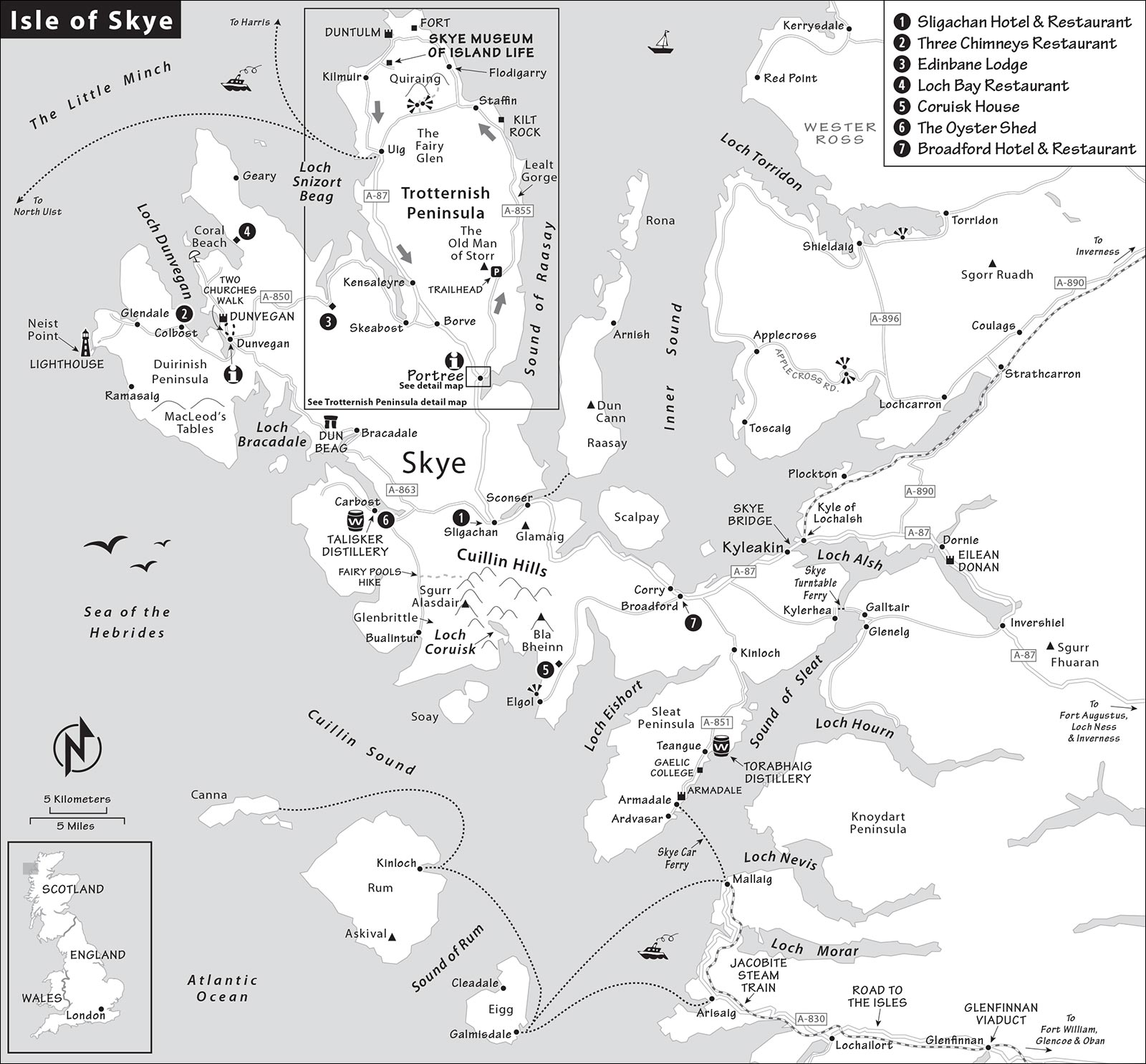
Skye is the largest of the Inner Hebrides, and Scotland’s second-biggest island overall (over 600 square miles), but it’s still manageable: You’re never more than five miles from the sea. The island has only about 13,000 residents; roughly a quarter live in the main village, Portree. The mountain-like Cuillin Hills separate the northern part of the island (Portree, Trotternish, Dunvegan) from the south (Skye Bridge, Kyleakin, Sleat Peninsula).
Set up camp in Portree, Skye’s charming, low-key tourism hub. Then dive into Skye’s attractions. Drive around the appealing Trotternish Peninsula, enjoying Scotland’s scenic beauty: sparsely populated rolling fields, stony homes, stark vistas of jagged rock formations, and the mysterious Outer Hebrides looming on the horizon. Go for a hike in (or near) the dramatic Cuillin Hills, sample a peaty dram of whisky, and walk across a desolate bluff to a lighthouse at the end of the world. Learn about the clan history of Skye, and visit your choice of clan castles: the MacLeods’ base at Dunvegan, the MacDonalds’ ruins near Armadale, and—nearby but not on Skye—the postcard-perfect Eilean Donan fortress, previously a Mackenzie stronghold but today held by the Macraes. Or just settle in, slow down, and enjoy island life.
One thing to be aware of: Skye is no secret. This lovely island has been discovered and is struggling with growing pains. Cruise ships visit a few times a week, flooding the streets with an influx of visitors. Places are short-staffed, service can be slow, and hotels and restaurants book up far in advance, especially (but not exclusively) in the peak months of July and August. A burgeoning destination for gourmands, Portree has multiple Michelin-listed restaurants, and prices are as high here as anywhere outside of Edinburgh. Come prepared to share Skye, get a head start on booking your accommodations, and scout (and reserve) restaurants for dinner well before your trip.
PLANNING YOUR TIME
With two weeks in Scotland, Skye merits two nights, allowing a full day to hit its highlights: Trotternish Peninsula loop, Dunvegan Castle, the Fairy Pools hike (or another hike in the Cuillin Hills), and the Talisker Distillery tour. Mountaineers need extra time for hiking and hillwalking. Because it takes time to reach, Skye is skippable if you only have a few days in Scotland—instead, focus on the more accessible Highlands sights (Oban and its nearby islands, and Glencoe).
Situated between Oban/Glencoe and Loch Ness/Inverness, Skye fits neatly into a Highlands itinerary. To avoid seeing the same scenery twice, it works well to drive the “Road to the Isles” from Fort William to Mallaig, then take the ferry to Skye; later, leave Skye via the Skye Bridge and follow the A-87 east toward Loch Ness and Inverness, stopping at Eilean Donan Castle en route; or vice versa. With (much) more time, take the very long and scenic North Coast 500 (NC-500) route north from Skye, up Wester Ross and across Scotland’s north coast, then down to Inverness (see the Northern Scotland chapter).
GETTING TO THE ISLE OF SKYE
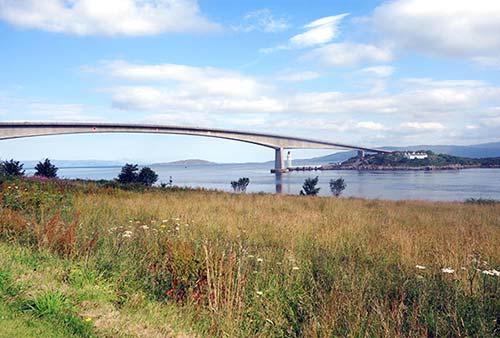
By Car: Your easiest bet is the slick, free Skye Bridge that crosses from Kyle of Lochalsh on the mainland to Kyleakin on Skye.
The island can also be reached by car ferry. The major ferry line connects the mainland town of Mallaig (west of Fort William along “The Road to the Isles”—see here) to Armadale on Skye (£17/car with 2 people, reservations required, April-mid Oct 9/day each way, fewer on Sun, off-season very limited Sat-Sun connections, must check in at least 30 minutes before sailing or your place will be sold and you will not get on, 30-minute trip, can be canceled in rough weather, operated by Caledonian MacBrayne, +44 1475 650 397, www.calmac.co.uk).
There’s yet another route, which is favored by romantics who are in no hurry whatsoever: A tiny, six-car, proudly local “turntable” ferry crosses the short gap between Glenelg on the mainland and Kylerhea on Skye, allowing for a more scenic route that avoids the obvious tourist path (£18, April-mid-Oct daily 10:00-18:00, about every 20 minutes, 15-minute trip, can be canceled in rough weather, view café on hill above ferry, www.skyeferry.co.uk). Engineers and mechanics get a thrill out of riding the world’s only manually operated turntable ferry.
By Bus: Skye is connected to the outside world by Scottish Citylink buses (www.citylink.co.uk), which use Portree as their Skye hub. From Portree, buses connect to Inverness (bus #917, 3-4/day, 3 hours) and Glasgow (buses #915/#916, 3/day, 7 hours, buses also stop at Fort William and Glencoe). For Edinburgh, you’ll transfer in either Inverness, Fort William, or Glasgow (5/day, 8-9 hours total). For connections within Skye, see “Getting Around the Isle of Skye,” below.
Train-plus-bus connections are possible but complicated: Take the train from Edinburgh or Glasgow to Fort William; transfer to the “Sprinter” train to Mallaig (4/day, 1.5 hours); walk on to the ferry to Armadale; then catch Stagecoach bus #52 to Portree (1 hour). Or go by train from Edinburgh or Glasgow to Inverness, take another train to Kyle of Lochalsh, then catch a bus to Portree.
GETTING AROUND THE ISLE OF SKYE
By Car
Once on Skye, you’ll need a car to thoroughly enjoy the island. Even if you’re doing the rest of your trip by public transportation, a car rental is worthwhile here to make maximum use of your time (car-rental options listed later, under “Orientation to Portree”). The roads here are simple and well signposted, but a good map can be helpful for exploring. Sample driving times: Kyleakin and Skye Bridge to Portree—45 minutes; Portree to Dunvegan—30 minutes; Portree to the tip of Trotternish Peninsula and back again—2 hours (more with sightseeing stops); Portree to Armadale/ferry to Mallaig—1 hour; Portree to Talisker Distillery—40 minutes.
By Public Bus
Getting around Skye can be frustrating by bus (slow and limited). Portree is the hub for bus traffic. Most buses within Skye are operated by Stagecoach (www.stagecoachbus.com). You can buy individual tickets, or consider the £8.70 all-day Dayrider ticket or the £29.50 weeklong Megarider ticket (buy tickets on Stagecoach bus app or onboard from driver with contactless card). From Portree, you can loop around the Trotternish Peninsula on bus #57A (counterclockwise route) or bus #57C (clockwise route; Mon-Sat 6/day in each direction, very infrequent on Sun). Bus #56/56X connects Portree and Dunvegan Castle (2/day, none on Sun, 40 minutes).
A few longer-distance buses are operated by Citylink (not covered by the Stagecoach tickets described above). Buses #915, #916, or #917 connect Portree to Kyleakin (7/day, 1 hour) before continuing a few minutes farther to Eilean Donan Castle (get off at Dornie and walk 5 minutes); #915/#916 continue on to Fort William while #917 goes to Inverness (www.citylink.co.uk).
By Tour
Several operations on the island take visitors to hard-to-reach spots. Figure about £55-60 per person to join an all-day island tour (about 8 hours). Compare the offerings at the following companies, which use smaller 8- or 16-seat minibuses: Skye Scenic Tours (based on Skye, +44 1478 617 006, www.skyescenictours.com), SkyeBus (based in Portree, +44 1470 532 428, www.realscottishjourneys.com), and Tour Skye (based in Edinburgh, +44 1478 613 514, www.tourskye.com). As these can sell out, it’s smart to book ahead for high season.
Historian Michelle Rhodes runs Skye History and Heritage Day Tours and offers all-day guided drives around the island, tailored to your interests. Her specialty: clan battles, fairies, myths, and legends (£190/person, includes all admissions, +44 7833 073 951, http://skyehistoryandheritagetours.com, michellelorrainerhodes@gmail.com).
Other Activities: Sea kayaking is popular and is based on the southern end of the island (www.southskyeseakayak.co.uk or https://highlandexperiences.com). For more adrenaline-pumping activities—such as coasteering, canyoning, and gorge walking—check your options at Skye Adventure (www.skyeadventure.com).
By Taxi
For private rides around the island, consider Don’s Taxis (+44 1478 613 100, https://donstaxis.vpweb.co.uk [URL inactive]) or BW’s Taxi (+44 1478 612 865, www.skye-taxi-tours.co.uk).
Portree
Skye’s main attraction is its natural beauty, not its villages. But of those villages, the best home base is Portree (pore-TREE), Skye’s largest settlement, transportation hub, and tourism center—ideally located for exploring Skye’s quintessential sights on my Trotternish Peninsula Loop Drive.
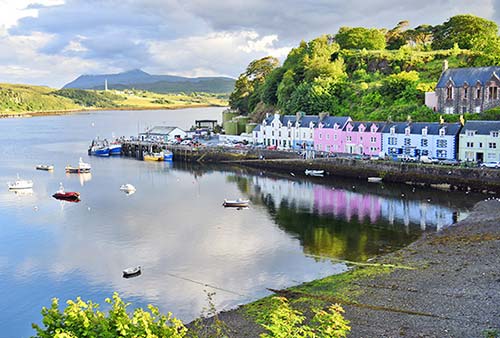
Portree is nestled deep in its protective, pastel harbor; overlapping peninsulas just offshore guard it from battering west coast storms. Most of today’s Portree dates from its early 19th-century boom time as a kelp-gathering and herring-fishing center.
As the most popular town on Scotland’s most popular island, Portree is absolutely jammed with visitors in the summer. There are lots of hotels, B&Bs, and good restaurants—all of which book up well in advance. To avoid disappointment, book your room as soon as you know your travel dates, and restaurants several weeks ahead.
Orientation to Portree
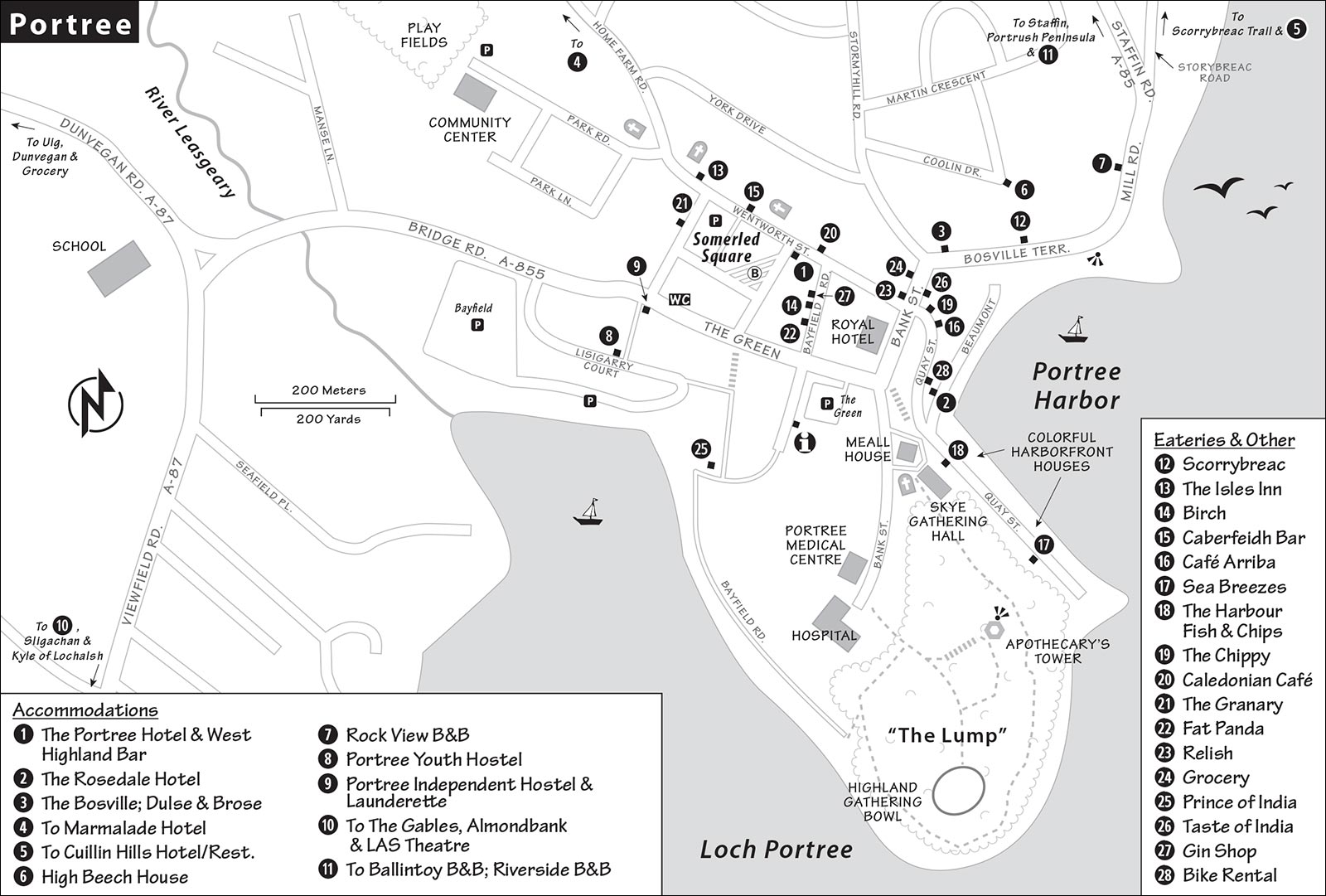
Portree boasts a charming harbor with amazing views and—in the streets above—all of the necessary tourist services: a good TI, great restaurants, a small supermarket, a launderette, and so on. The main business zone of this functional town of about 3,000 residents is in the tight grid of lanes on the bluff just above the harbor, anchored by Portree’s tidy main square, Somerled Square. From here, buses fan out across the island and to the mainland. B&Bs line the roads leading out of town.
Tourist Information: Portree’s helpful TI is a block off the main square (Mon-Sat 9:30-17:30, closed Sun, just below Bridge Road, +44 1478 612 992, www.visitscotland.com). The Skye Guide website (www.isleofskye.com) has detailed turn-by-turn slideshow guides to local hikes.
HELPFUL HINTS
Pack Patience: Portree is grappling with increasing popularity coupled with staffing shortages that may persist through your visit. As a result, restaurants may close at lunch or on additional days of the week, bars that usually serve food may not have kitchen staff, and takeout may be your only dining option. Consider the opening days/hours I list as a general guide, but before making a special trip somewhere, call ahead or confirm hours locally.
WCs: Public WCs are across the street and down a bit from the Independent Hostel.
Laundry: There’s a self-service launderette below the Independent Hostel, just off the main square (usually daily 9:00-17:00, last load at 14:00, The Green, +44 1478 613 737). With advance notice, Skye Laundry will pick up and deliver your laundry to your hotel (call +44 7703 645 707 or use the form at www.skyelaundry.co.uk, Eve).
Car Rental: To make the most of your time on Skye, rent a car (from £60/day; smart to book well in advance). In Portree, try Morrison (+44 1478 612 688, www.morrisoncarhire.co.uk).
DriveSkye is based in the southern part of the island, in Armadale. They’re strategically located for this clever open-jaw plan: Take the train along the “Road to the Isles” to Mallaig and walk onto the ferry to Armadale, where you’ll pick up a rental car for your time on Skye. You can pay extra to drop it off across the Skye Bridge in Kyle of Lochalsh and take the train onward from there (+44 1471 844 361, www.driveskye.com).
Parking: Expect to pay about £1 for an hour or two for the following places. For a quick visit, the easiest choice is the small, short-stay parking strip right on Somerled Square (2-hour limit, free 18:00-8:00, contactless pay or RingGo app). There’s also a small pay lot called “The Green” next to the TI. For a longer stay, and free parking, from Somerled Square head up Park Road to the lot by the Community Center. A pay long-term lot is the “Bayfield” parking lot at water level (watch for signs on the right as you enter town, free 20:00-8:00, head up the stairs to the TI).
Bike Rental: Bikes on the Brae is a family-run bike shop offering regular and e-bike rentals plus coffee and homemade pastries (daily 10:00-17:00, look for signs on the left as you walk down Quay Brae toward the harbor, www.bikesonthebrae.com, Paul).
Sights in Portree
There’s not a turnstile in town, but Portree is fun to explore. Below I’ve described the village’s three areas: the main square and “downtown,” the harborfront, and the hill above the harbor.
Somerled Square and the Town Center
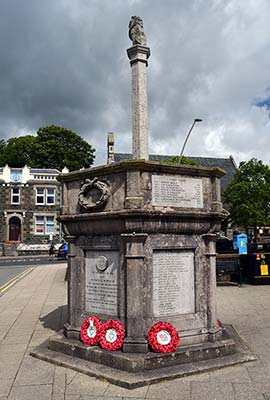
Get oriented to Portree on the broad main square, with its mercat cross, bus stops, parking lot, and highest concentration of public benches. The square is named for Somerled (Old Norse for “Summer Wanderer”), the 12th-century ruler who kicked off the MacDonald clan dynasty and first united Scotland’s western islands into the so-called Lordship of the Isles.
It seems every small Scottish town has both a mercat cross and a WWI memorial—and in Portree, they’re combined into one A mercat cross indicated the right for a town to host a market, and was the community gathering point for celebrations, public shamings, and executions. The WWI memorial is a reminder of the disproportionate loss of life that Scotland suffered in the Great War. In the case of wee Portree, a band of 28 Gaelic-speaking brothers went to war...and eight came back. (Ten were killed in a single night of fighting.)
Much of present-day Portree was the vision of Sir James MacDonald, who pushed to develop the town in the late 18th century. City leaders commissioned the impressive engineer Thomas Telford (famous for his many great canals, locks, and bridges) to help design the village’s harbor and the roads connecting it to the rest of the island.
Wentworth Street, running from this square to the harbor, is the main shopping drag. Several English-sounding streets in Portree (Wentworth, Bosville, Douglas, Beaumont) are named for aristocratic families that the MacDonalds married into, helping to keep the clan financially afloat. Window-shop your way along Wentworth Street, poking into stores that catch your attention. A quick detour down Bayfield takes you to Portree’s Gin School and Shop, offering tastings and a chance to bottle your own gin. Back on Wentworth, continue another block and turn right on Bank Street. The Royal Hotel, built on the site of MacNab’s Inn, is where Bonnie Prince Charlie bid farewell to Flora MacDonald following his crushing defeat at Culloden, then set sail, never again to return to Scotland.
Across from the Royal Hotel, find Quay Street, which leads down the hill to the harbor.
▲▲Portree Harbor
Portree’s most pleasant space (unless you’ve got food the seagulls want) is its harbor, where colorful old homes look out over bobbing boats and the surrounding peninsulas. As one of the most protected natural harbors on the west coast, it’s the reason that Portree emerged as Skye’s leading town. Find a scenic perch at the corner of the harbor and take it all in.
While tourism is today’s main industry, Portree first boomed in the mid-18th century thanks to kelp. Seaweed was gathered here, sun-dried, and burned in kilns to create an ashy-blue substance that was rich in soda, an essential ingredient in the production of glass and soap. But with the defeat of Napoleon at Waterloo, international sources of kelp opened up, causing this local industry to crash. This economic downturn coincided with a potato famine (similar to the one across the sea in Ireland), and by the mid-1800s, many locals were setting sail from this harbor to seek a better life in North America. But Portree soldiered on, bolstered by its prime location for fishing—especially for herring. By the early 20th century, a nationwide herring boom had again buoyed Portree’s economy, with hundreds of fishing boats crowding its harbor.
Notice the stone building with the sealed-off door at the base of the stairs leading up into town. This was the former ice house, which was in operation until the 1970s. The winch at the peak of the building was used to haul big blocks of ice into an enormous subterranean cellar, to preserve Atlantic salmon throughout the summer.
Survey the harbor, enjoying the pastel homes. Rumor has it that these used to be more uniform, until a proud gay couple decided to paint their house pink (it’s now a hotel annex). What used to be a blue-and-white house next door (now an all-blue hotel) belonged to a fan of the West Ham United soccer team. Soon the other homeowners followed suit, each choosing their own color.
Speaking of bright colors, look for the traffic-cone-orange boat floating in the harbor. This belongs to the Royal National Lifeboat Institution (RNLI), Britain’s charity-funded answer to the US Coast Guard.
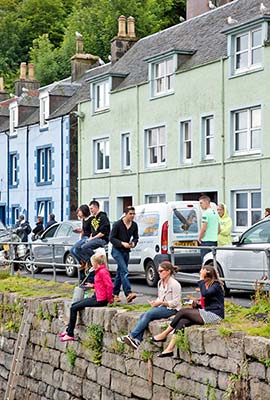
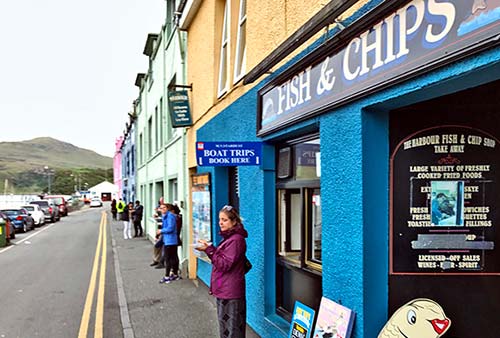
You may notice the busy fish-and-chips joint, with its customers standing guardedly against the nearby walls and vicious seagulls perched on rooftops ready to swoop down at the first sight of battered cod.
Go for a stroll along the Telford-built pier. Along here, a couple of different companies offer two-hour excursions out to the sea-eagle nests and around the bay, including by RIB—high-speed rigid inflatable boat (ask the captains at the port, or inquire at the TI). At the far end of the pier is a gas station with huge, underwater tanks for fueling visiting boats. When big cruise ships are in port, they drop the hook and tender their passengers in to this pier.
Ascending “The Lump” (Hill Above the Harbor)
For a different perspective on Portree—and one that gets you away from the tourists—hike up the bluff at the south end of the harbor. From the Royal Hotel, head up Bank Street.
After a few steps, you’ll spot the white Meall House on your left—supposedly Portree’s oldest surviving home (c. 1800) and once the sheriff’s office and jail. Today it’s a center for the Gaelic cultural organization Fèisean nan Gàidheal, which celebrates the Celtic tongue that survives about as well here on Portree as anywhere in Scotland. Hiding behind the Meall House, along the harborview path, is the stepped-gable Skye Gathering Hall (from 1879). This is where Portree’s upper crust throws big, fancy, invitation-only balls on the days before and after Skye’s Highland Games. The rest of the year, it hosts cultural events and—on occasion—a fun little market with a mix of crafts and flea-market-type items.
Back on Bank Street, continue uphill. Soon you’ll approach the Portree Medical Centre—one of just two hospitals on the entire Isle of Skye. (Is it just me, or do those parking spots each come with a graveyard cross?)
Just before the hospital’s parking lot, watch on the left for the uphill lane through the trees. Use this to hike on up to the top of the hill that locals call “The Lump” (or, for those with more local pride, “Fancy Hill”). Emerging into the clearing, you’ll reach a huge, flat bowl that was blasted out of solid rock to hold 5,000 people during Skye’s annual Highland Gathering. In addition to the typical Highland dancing, footraces, and feats of strength, Skye’s games have a unique event: From this spot, runners climb downhill, swim across Loch Portree, ascend the hill on the adjacent peninsula, then swim back again.
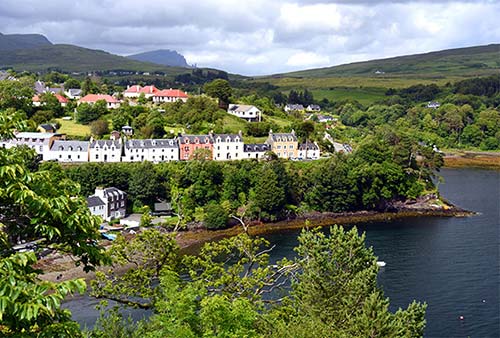
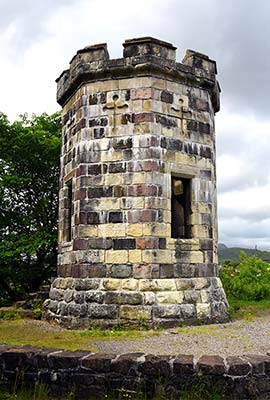
Walk left, toward the harbor, then head left again onto a path leading away from the bowl; you’ll run into the crenellated Apothecary’s Tower. It was built in 1834, not as a castle fortification but to alert approaching sailors that a pharmacist was open for business in Portree. This tower was blown over by gale-force winds in a 1991 storm, but has since been rebuilt. It’s usually open if you’d like to climb to the top for views over the harbor and the region—on a clear day, you can see all the way to the rock pinnacle known as the Old Man of Storr.
Walks and Hikes near Portree
The Portree TI can offer advice about hikes in the area; if the below options interest you, get details there or at www.isleofskye.com before you head out.
Scorrybreac Trail: This popular choice doesn’t require a car. To get to the trailhead—three-quarters of a mile from Somerled Square—walk north out of Portree on Mill Road, veer right onto Scorrybreac Road when you’re just leaving town (following the sign for Budhmor), then follow the coastline to the start of the hiking trail, marked by signs. From here, you’ll walk along the base of a bluff with fine views back on Portree’s colorful harborfront. The two-mile loop takes about an hour.
Old Man of Storr: Drivers can tackle the more ambitious 2.5-mile hike up to this rocky formation. You’ll drive about 15 minutes north of town (following the start of my Trotternish Peninsula Loop Drive) and park at the Old Man of Storr trailhead, where you’ll find a ranger station and WC. Use the good info boards to pick your route: The yellow “Storr Interpretive Trail” circles out to the left as it makes a gentler ascent; it meets the well-trod, steeper blue “Old Man of Storr” gravel path at the top of the first bluff. Where the two trails meet, take the right fork to continue on the “Old Man of Storr” trail all the way up to the pinnacle. Plan on about two hours round-trip. (If you don’t mind a longer drive, a better hike is at The Quiraing—see here.)
Nightlife in Portree
Portree goes to bed pretty early, but in high season a couple of venues offer live music most evenings. The West Highland Bar, attached to the recommended Portree Hotel, has music on weekends. The recommended Isles Inn hosts bands several nights a week in summer. Also check what’s on at the LAS Theatre, in the Isle of Skye Candle Company Visitors Centre at the edge of town; in addition to movies—tempting on a rainy day—they often have live music and other performances (Viewfield Road, www.lasportrigh.co.uk).
Sleeping in Portree
Portree is crowded with hikers and tourists in July and August, and can be fully booked between April and September. Reserve your room months in advance—as far ahead as you can. The B&Bs I list are just a representative sampling; Portree has dozens upon dozens of small B&Bs beyond what I’ve listed here (also try Airbnb). If looking last-minute, try the Facebook group “Skye Rooms,” where hotels, B&Bs, and short-term rentals with late cancelations and random openings list late-notice availability. Travelers looking for accommodations can also post their desired dates.
When comparison-shopping online, an en-suite double room at a solid, midrange, comfortable, friendly B&B within walking distance of town should run in the neighborhood of £100-140. Be wary of price gouging: Some guesthouses and self-catering places in the same areas offer a room with no breakfast, add a few extra amenities (mini fridges, for example), and charge double those rates—worthwhile if you’re desperate but otherwise not a good value.
BIGGER HOTELS
These places offer predictable service and higher prices.
On Somerled Square: $$$ The Portree Hotel is your functional, dependable town-center accommodation, with 24 small but modern rooms on three floors and no elevator (family rooms, bar/restaurant, no parking—must use public lots, +44 1478 612 511, www.theportreehotel.com, contact@theportreehotel.com).
On the Harbor: $$$ The Rosedale Hotel fills three former fishermen’s houses with mazelike hallways and a mix of 17 modern and more traditional rooms (full cooked breakfast, family room, no-view doubles available; no elevator and lots of stairs; restaurant and bar, parking lot down the road; Beaumont Crescent, +44 1478 613 131, www.rosedalehotelskye.co.uk, reservations@rosedalehotelskye.co.uk, Lyndall). Avoid their neglected Pink House annex.
Other Hotels: If things are booked up, or for a more upscale experience, try one of the bigger, more expensive hotels in town. These two share the same owner: $$$$ The Bosville, with 20 rooms right in the heart of Portree; and $$$$ Marmalade Hotel, with 34 rooms a short walk above the town center (www.perlehotels.com). And $$$$ Cuillin Hills Hotel has 39 rooms around the harbor—a short drive away—on a nice lawn with views back toward town (www.cuillinhills-hotel-skye.co.uk). While pricey, each of these offers a high level of modern predictability and professionalism.
CHARACTERISTIC PLACES IN TOWN
$$ High Beech House wows guests with stupendous views from its breakfast room. Its two cozy rooms are a short walk up the hill above town, still central but with a peaceful and secluded vibe (2-night minimum preferred, includes full breakfast, driveway parking, closed Nov-Feb, Coolin Drive, +44 7767 216 205, www.highbeechhouse.co.uk, info@highbeechhouse.co.uk, Jonathan and Pauline).
$$ Rock View B&B boasts modern comfort and harbor views with three rooms in a renovated 200-year-old house a 10-minute walk from the center. Climb to the garden behind the house for even more views (full breakfast, family room, street parking only, 3 Mill Road, +44 1478 861 2652, www.rockviewskye.co.uk, stay@rockviewskye.co.uk, Mairi and Andrew).
¢ Portree Youth Hostel, run by Hostelling Scotland (SYHA), is a modern-feeling, institutional, cinderblock-and-metal building with 50 beds in 16 rooms (private and family rooms available, continental breakfast extra, kitchen, laundry, +44 1478 612 231, www.hostellingscotland.org.uk, portree@hostellingscotland.org.uk).
¢ Portree Independent Hostel, in the unmissable yellow building just off the main square, has 60 beds and equally bold colors inside what was once the town post office (one twin room and several 4-person rooms, no breakfast, kitchen, laundry, +44 1478 613 737, www.hostelskye.co.uk, skyehostel@yahoo.co.uk).
JUST OUTSIDE TOWN
For more choices, head a bit out of town. These options are a longish walk or a very short drive from the heart of Portree.
South of Portree, off Viewfield Road
Viewfield Road, stretching south from Portree, is B&B and guesthouse central, with many more places than I’ve listed here. All offer convenient parking and are within walking distance of town (figure 10-20 minutes). Some are on smaller side lanes that stretch down toward the water, but all are well marked from the main road.
$ The Gables is a low-slung, one-level home set on a manicured bluff boasting panoramic views of Portree’s harbor. Two of the three bright and spacious rooms have great water views, and the big breakfast room has comfy leather couches for rainy days (family room, fridges, Viewfield Road, +44 1478 613 184, www.gablesportree.com, mdgables@btinternet.com, Margaret).
$ Almondbank, just below the main road, has four homey, traditional rooms. Two have grand views over the water, and one has a private bathroom down the hall (Viewfield Road, +44 1478 612 696, jan@jans.co.uk, Effie).
North of Portree
These places are excellent values a 15-minute walk from town on Staffin Road, toward the Trotternish Peninsula.
$ Ballintoy Bed and Breakfast, set back from the road and surrounded by a large field, has three immaculate ground-floor rooms accessorized with fun pops of color and artwork (family room, 2-night minimum preferred, continental breakfast, Staffin Road, +44 1478 611 719, www.ballintoy-skye.co.uk, ballintoyskye@gmail.com, Gillian and Gavin).
$ Riverside B&B is a beautiful shoes-off-tidy home with three fresh rooms—two with Cuillin Hills views—in a big modern house perched above the road. Use Fred’s hand-drawn maps to plan your day, or just take in the view from the cathedral-ceilinged lounge (full breakfast, Staffin Road, +44 1478 612 117, www.riversideskye.co.uk, reservations@riverside.co.uk, Jane and Fred).
BETWEEN PORTREE AND KYLEAKIN
$$$$ Sligachan Hotel (pronounced SLIG-a-hin), perched at a crossroads in the scenic middle of nowhere (yet handy for road-tripping sightseers) is a compound of sleeping and eating options that is a local institution and a haven for hikers. The hotel’s 21 rooms are comfortable, if a bit dated and simple for the price, while the nearby campground and bunkhouse offer a budget alternative. The setting—surrounded by the mighty Cuillin Hills—is remarkably scenic (£50 nonrefundable deposit, restaurant/bar, closed Dec-Feb, on the A-87 between Kyleakin and Portree in Sligachan, hotel and campground +44 1478 650 204, bunkhouse +44 1478 650 458, www.sligachan.co.uk, reservations@sligachan.co.uk). For location, see the “Isle of Skye” map near the beginning of this chapter.
Eating in Portree
Always reserve ahead for dinner here; these places can book up weeks ahead in peak season. Portree’s eateries tend to close early (21:00 or 22:00). Due to ongoing staffing shortages, be prepared for unexpected closures (especially at lunch).
UP IN TOWN
$$$$ Scorrybreac is Portree’s Michelin splurge, offering a delightful array of well-presented international dishes that draw from local ingredients and traditions. The cozy, modern, unpretentious dining room fills up quickly, so reservations are a must (set multicourse menus only, dinner only, closed Sun-Tue, 7 Bosville Terrace, +44 1478 612 069, www.scorrybreac.com).
$$$ Dulse & Brose is refined but unpretentious, with wooden bookshelves along the wall and old wooden benches (comfier than they sound). Part of the recommended Bosville Hotel, it offers a small menu of well-executed fish, beef, fowl, and veggie dishes, mostly using Scottish ingredients (daily, dinner only, Bosville Terrace, +44 1478 612 846, https://perlehotels.com/the-bosville/dulse-brose).
$$ The Isles Inn is a rare place that doesn’t take reservations—plan to wait when it’s busy. Its two halves—a brighter, high-energy dining area and the darker pub—serve the same menu, and you can eat at the bar. Offering a fun energy and warm service, they dish up simple, honest food one notch above pub grub (daily, no reservations, facing Somerled Square, +44 1478 612 129).
$$ Birch is a pleasant little café that would be at home in hipster Glasgow or Edinburgh, but instead it’s tucked on a quiet side street in the heart of Portree. The minimalist interior, facing a mural of the Cuillin Hills across the street, is inviting. The focus is on specialty coffee, with a brief menu of thoughtfully curated brunch and lunch dishes that provide a welcome, foodie break from the heavier traditional fare elsewhere in town. Their pastries are excellent (Tue-Sat 8:00-17:00, Sun 10:00-16:00, closed Mon, Bayfield Road, www.birch-skye.co).
$$ Caberfeidh Bar, cooler than the Portree norm, is a cocktail bar and pizza joint offering wood-fired pizzas with both predictable and adventurous toppings. The name is Scots Gaelic for “Stag’s Antlers”—an important symbol of Clan Mackenzie (dinner only, closed Sun-Mon, facing the parking lot on Somerled Square, +44 1478 613 794).
$$ Café Arriba is a fun and welcoming attic space offering refreshingly eclectic flavors in this small Scottish town. With a menu that can include all-day breakfast, local specialties, burgers, and international dishes, this youthful, colorful, easygoing eatery is worth the likely wait. Climb the stairs to peek at today’s blackboard menu (often vegetarian options, Tue-Sun 8:00-16:00, closed Mon, no reservations, Quay Brae, +44 1478 611 830, www.cafearriba.co.uk).
DINING BY THE WATER
Portree’s little harbor has a scattering of good eateries but none have actual waterfront seating. My hunch: It’s because of the mean seagulls that hang out here.
$$$ Sea Breezes is a basic, salty, no-nonsense seafood eatery, with plain decor and good-value seafood platters for two (reserve ahead; Mon and Thu-Sat dinner only, Tue lunch and dinner, closed Wed and Sun and Nov-Easter, +44 1478 612 016, https://sea-breezes-skye.co.uk).
$$$$ Cuillin Hills Hotel Restaurant is in a big, classy, old-world hotel set on a lawn high above the water, a five-minute drive from the town center. It has a peaceful and formal dining room, a commanding view, delightful service, and tasty food. They may have space when places in town are full, but call before heading out (daily, Coolin Hills Gardens, +44 1478 612 003, www.cuillinhills-hotel-skye.co.uk).
EATING CHEAPER
Fish-and-Chips: Portree has two chippies, both cash only: $ The Harbour Fish & Chips Shop is delightfully located on the charming harbor with good fish that’s cheap and in big portions (daily, 1 Quay Street). The downside: Aggressive seagulls drive diners up against the wall. It’s funny to watch. For a more relaxing meal, $ The Chippy sells very basic fish-and-chips and burgers, just up the harbor lane (on Bank Street) with peaceful covered tables and no seagulls.
Simple Lunches: The $ Caledonian Café, a few steps off the main square, is a busy, popular hometown ice cream parlor scooping up homemade ice cream alongside fruit-topped waffles, soup-and-sandwich combos, and fresh bagels (Mon-Fri 9:00-17:00, closed Sat-Sun, Wentworth Street, +44 1478 612 553).
Takeaway Places: $$ The Granary bakery and coffee shop serves breakfast, soup, and toasties at a takeaway counter across from Somerled Square (closed Sat-Sun). $$ Fat Panda Asian restaurant on Bayfield Road is satisfying (closed Tue). $ Relish is a deli serving good, fresh sandwiches (eat in or to go, Mon-Sat 9:00-16:00, Sun 10:00-15:00, end of Wentworth Street). And for a picnic, the Co-op grocery on Bank Street has a small selection of sandwiches and other prepared foods (daily). There’s also a larger Co-op supermarket on the way out of town, on the road toward Uig and Dunvegan Castle.
When Other Places Are Full: If you can’t get into any of the above, and you don’t want to do takeout, consider Portree’s two Indian restaurants (Prince of India on Bayfield Road and Taste of India, upstairs on Bank Street), or see if they can squeeze you in at the Portree Hotel’s restaurant (on Somerled Square, outdoor seating).
EATING ELSEWHERE ON THE ISLE OF SKYE
For the locations of these places, see the “Isle of Skye” map near the beginning of this chapter.
In Sligachan: The Sligachan Hotel (described earlier) is a grand and rustic old hotel in an extremely scenic setting, nestled in the Cuillin Hills. Popular with campers and hikers, it’s also family-friendly, with a zip line for kids in the playground. There are two eateries here: The more refined $$$ Harta Restaurant offers “casual dining with fine food.” On the other side of the complex, the big, open-feeling $$ Seumas Bar serves microbrews and mountaineer-pleasing grub, plus a pleasing range of more than 400 whiskies (call for latest hours, closed in winter; on the A-87 between Kyleakin and Portree, +44 1478 650 204). There’s also a microbrewery on site (separate owners).
In Colbost, near Dunvegan: About a 15-minute drive west of Dunvegan (about 45 minutes each way from Portree), the $$$$ Three Chimneys Restaurant is out on a deserted road with just sheep for neighbors. This place is known throughout Scotland as a magnet for gourmands; now well established, it was the original “destination” restaurant on the island. The intimate tables fill an old three-chimney croft house, with a stone-and-timbers decor that artfully melds old and new—a perfect complement to the modern Scottish cuisine. It’s cozy, classy, candlelit, and a bit dressy (do your best), but not stuffy. Reservations are essential (set multicourse menus only, daily, check seating times on website, +44 1470 511 258, www.threechimneys.co.uk). They also rent six swanky, pricey $$$$ suites next door.
Other Foodie Splurges: Beyond the Three Chimneys, Skye has a variety of newish, well-regarded gourmet hotspots scattered around the island. If you’re serious about dining well (at high prices), research these choices—and always book far ahead: $$$$ Edinbane Lodge is about a 25-minute drive west of Portree, on the way to Dunvegan Castle (www.edinbanelodge.com). $$$$ Loch Bay Restaurant is a 10-minute detour from the Portree-Dunvegan road (about 35 minutes from Portree) on the Waternish Peninsula (www.lochbay-restaurant.co.uk). And $$$$ Coruisk House is down in the southern part of the island, near Elgol, about an hour’s drive south of Portree (www.coruiskhouse.com). $$$$ Scorrybreac, right in the heart of Portree and described earlier, is also in this category.
Touring the Isle of Skye
TROTTERNISH PENINSULA LOOP DRIVE
The Giant Angus MacAskill Museum
Broadford: Birthplace of Drambuie
Armadale Castle, Gardens, and Museum of the Isles
ON THE MAINLAND, NEAR THE ISLE OF SKYE
There is a well-trodden tourist path around Skye, and it’s clearly the most memorable way for someone with a car to spend the day. The three big sights are the Trotternish Peninsula (to the north of Portree), with its memorable Skye Museum of Island Life; Dunvegan Castle (to the east); and Talisker Distillery (to the south).
Planning Your Time: It’s possible—but rushed—to see all three in one day. (The challenge: The Skye Museum of Island Life closes at 17:00.) Start with the first distillery tour at 10:00, tour the castle, and circle the peninsula to get to the museum by 16:30, when the last entry is allowed. This will rush the wonderful natural sights along the peninsula, but it may be worth it if time is short and you want to experience it all. While you could drive directly from Dunvegan Castle to the Skye Museum of Island Life and then tour the Trotternish Peninsula in a clockwise direction, it’s far more scenic to drive it in a counterclockwise route as proposed here. Summer days are long, and the light can be wonderful in the early evening for the scenic west coast of the Trotternish Peninsula.
Another option is to skip the distillery, do the castle first, and then take a leisurely tour of the peninsula. If you’re planning to hike, the earlier you can get on the trails, the more likely you’ll have some nature to yourself before the crowds catch up to you. With two days, you can do it all at a more comfortable pace.
TROTTERNISH PENINSULA LOOP DRIVE
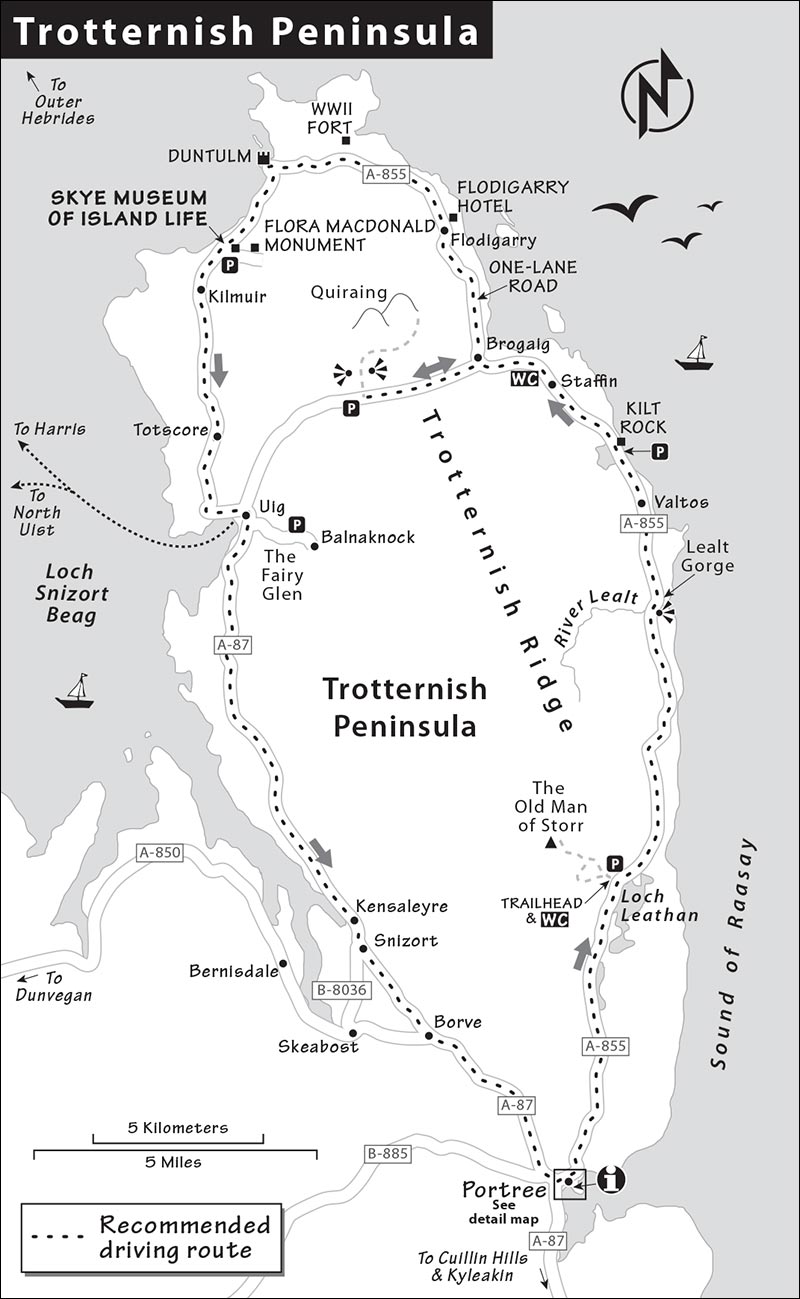
This inviting peninsula north of Portree is packed with windswept castaway views, unique geological formations, a few offbeat sights, and some of Scotland’s most dramatic scenery. The following loop tour starts and ends in Portree, circling the peninsula counterclockwise (see the “Trotternish Peninsula” map). Along the way, you’ll explore a gaggle of old-fashioned stone homes, learn about Skye’s ancient farming lifestyles, and pay homage to a brave woman who rescued a bonnie prince. In good weather, a spin around Trotternish is the best activity Skye offers and is worth ▲▲▲.
Planning Your Drive: With minimal stops, this self-guided drive takes about two hours—but it deserves a half-day or more. Note that during several stretches, you’ll be driving on a paved one-lane road; use the occasional “passing places” to pull over and allow oncoming traffic or faster cars to go by. If you don’t have enough time to do the entire drive, at least go to the Old Man of Storr (allow 30 minutes round-trip from Portree).
• Head north of Portree on the A-855, following signs for Staffin. About three miles out of town, you’ll begin to enjoy some impressive views of the Trotternish Ridge. You’ll be passing peat bogs and may notice stretches where peat has been cut from the fields by the roadside. As you pass the small loch on your right, straight ahead is the distinctive rock tower called the...
Old Man of Storr
This 160-foot-tall tapered slab of basalt stands proudly apart from the rest of the Storr (as the mountain is called). The unusual landscape of the Trotternish Peninsula is due to massive landslides (the largest in Britain). This block slid down the cliff about 6,500 years ago and landed on its end, where it has slowly been whittled by weather into a pinnacle. An icon of Skye, the Old Man of Storr has been featured in many films—from Flash Gordon to Prometheus. The lochs on your right supply drinking water for the town of Portree and have been linked together to spin the turbines at a nearby hydroelectric plant that once provided all of Skye’s electricity.
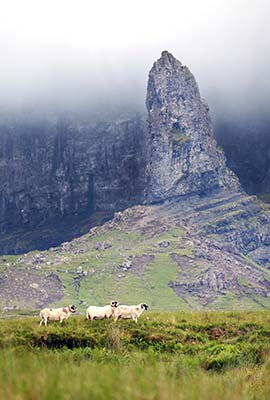
If you’d like to tackle the hike to the Old Man (two hours round-trip, shorter option possible), there’s a ranger station, pay parking lot, and pay WC directly below the formation (pay with contactless card; for details on the hike, see here).
• After passing the Old Man, enjoy the scenery on your right, overlooking nearby islands and the mainland.
As you drive, you’ll notice that Skye seems to have more sheep than people. During the Highland Clearances of the early 19th century, many human residents were forced to move off the island to make room for more livestock. The people who remain are some of the most ardently Gaelic Scots in Scotland. While only about 1 percent of all Scottish people speak Gaelic (pronounced “gallic”), one-third of Skye residents are fluent. A generation ago, it was illegal to teach Gaelic in schools; today, Skye offers its residents the opportunity to enroll in Gaelic-only education, from primary school to college (Sabhal Mòr Ostaig, on Skye’s Sleat Peninsula, is the world’s only college with courses taught entirely in Scottish Gaelic; see here).
• About four miles after the Old Man parking lot, you’ll pass a sign for the River Lealt. Immediately after, the turnoff on the right is an optional stop at the...
Lealt Gorge
Where the River Lealt tumbles toward the sea, it carves out a long and scenic gorge. From the lower parking lot, a viewing platform juts out over the gorge, overlooking a protected, pebbly cove and some dramatic rock formations. The formations on the left, which look like stacked rocks, are the opposite: They’ve been weathered by centuries of battering storms, which have peeled back any vegetation and ground the stones to their smooth state. Follow the path along the top of the bluff to a cliffside overlook. Peering down to the beach, you’ll see a smokestack and some other ruins of a plant that once processed diatomite—a crumbly, clay-like substance made from algae fossils, which has hundreds of industrial uses. This factory, which closed in 1960, is a reminder of a time when tourism wasn’t the island’s main source of income. When this was functioning, no roads connected this point to Portree, but the factory’s waterfront location made it possible to ship the diatomite far and wide.
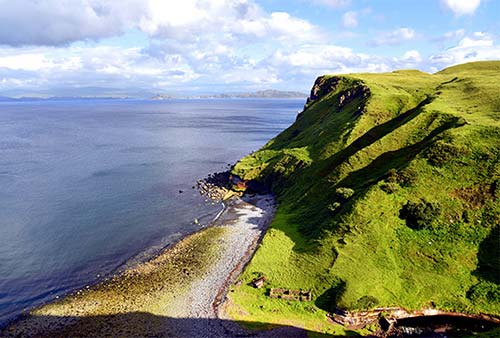
• Continue along the road. Just after the village of Valtos (about two miles after the Lealt Gorge viewpoint), you’ll reach a loch (left), next to a parking lot (right). Park at the well-marked Kilt Rock viewpoint to check out...
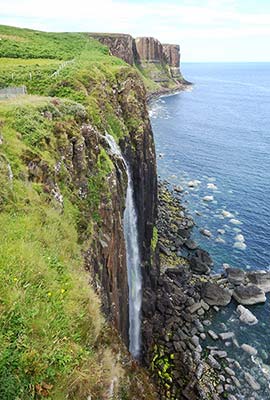
▲Kilt Rock
So named because of its resemblance to a Scottish tartan, this 200-foot-tall sea cliff has a layer of volcanic rock with vertical lava columns that look like pleats (known as columnar jointing), sitting atop a layer of horizontal sedimentary rock. The dramatic formations in the opposite direction are just as amazing.
• Continuing north, as you approach the village of Staffin, you’ll begin to see interesting rock formations high on the hill to your left.
Staffin’s name, like that of the isle of Staffa, comes from Old Norse and means “the place of staves” (or “pillars”)—both boast dramatic basalt rock columns. If you need a public WC, partway through town, watch on the left for the Staffin Community Hall (marked Talla Stafainn, sharing a building with a grocer). Or for a coffee or lunch break, you could visit (on the right) the Columba 1400 Centre, a Christian-run retreat for struggling teens from big cities. They run a nice café and shop to support their work (Mon-Fri 10:00-16:00, longer hours possible in summer, closed Sat-Sun, handy WCs for customers, +44 1478 611 400).
• Just after you leave Staffin, watch for signs on the left to turn off and head up to the quintessential Isle of Skye viewpoint—a rock formation called...
▲▲The Quiraing
You’ll get fine views of this jagged northern end of the Trotternish Ridge (locals pronounce it “kerr-ANG”) as you drive up. Landslides caused the dramatic scenery in this area, and each rock formation has a name, such as “The Needle” or “The Prison.”
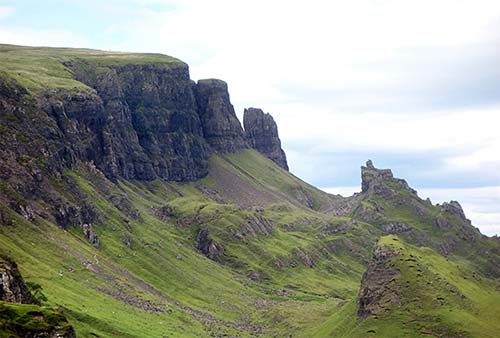
At the summit of this road, you’ll reach a parking area (which gets very busy in high season). Even a short walk to a nearby bluff—to get away from the cars and alone with the wind and the island wonder—is rewarding. And there are several exciting longer hikes from here for a closer look at the formations. If you’ve got the time, energy, and weather for a rewarding hike, here’s your chance. You can follow the trail toward the bluff, and at the fork, decide to stay level (to the base of the formations) or veer off to the left and switch back up (to the top of the plateau). Both paths are faintly visible from the parking area. Once up top, your reward is a view of the secluded green plateau called “The Table,” another landslide block, which isn’t visible from the road.
• You could continue on this road all the way to Uig, at the other end of the peninsula. But it’s more interesting to backtrack, then turn left onto the main road (A-855, now a one-lane road), to reach the...
Tip of Trotternish
A few miles north, after the village of Flodigarry, you’ll pass the Flodigarry Hotel, with a cottage on the premises that was once home to Bonnie Prince Charlie’s protector, Flora MacDonald (the cottage is now part of the hotel and not open to the public).
Soon after, at the top of a ridge ahead, you’ll see the remains of an old fort from World War II, when the Atlantic was monitored for U-boats from this position.
Farther down the road, near the tip of the peninsula, you’ll pass (on the right) the crumbling remains of another fort, this one much older: Duntulm Castle (free, roadside parking, 5-minute walk from road), which was the first stronghold on Skye of the influential MacDonald clan. It was from here that the MacDonalds fought many fierce battles against Clan MacLeod (for more on these clan battles, see “The Feuding Clans of Skye” sidebar later in this chapter). The castle was abandoned around 1730 for Armadale Castle on the southern end of Skye. While the castle ruins are fenced off, travelers venture in at their own risk. In the distance beyond, you can see the Outer Hebrides—the most rugged, remote, and Gaelic part of Scotland. The strait between Skye and these islands is called “The Minch.”
• A mile after the castle, watch for the turnoff on the left to the excellent...
▲▲Skye Museum of Island Life
This fine little stand of seven thatched stone huts, organized into a family-run museum, explains how a typical Skye family lived a century and a half ago.
Cost and Hours: £6, Mon-Sat 10:00-17:00, closed Sun and Oct-Easter, +44 1470 552 206, www.skyemuseum.co.uk, run by Hector and his team. Though there are ample posted explanations, the inexpensive guidebook is worth buying.
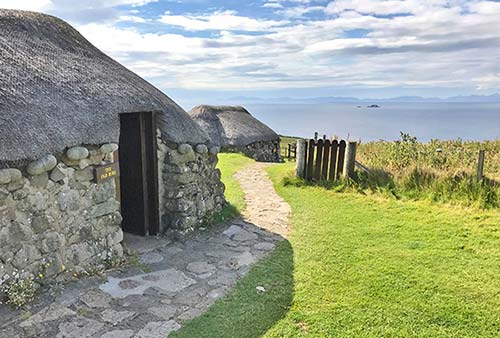
Visiting the Museum: The three huts closest to the sea are original (more than 200 years old). Most interesting is The Old Croft House, which was the residence of the Graham family until 1957. Inside you’ll find three rooms: kitchen (with peat-burning fire), parents’ “master bedroom,” and a bedroom for the 10 kids. All are fully furnished and endearingly cluttered with historic bric-a-brac. Nearby, The Old Byre (Barn) displays farm implements, and the Old Ceilidh House (a gathering place for the entire community) contains dense but very informative displays about crofting (the traditional tenant-farmer lifestyle on Skye), the Gaelic poet Màiri Mhòr nan Òran, Bonnie Prince Charlie and Flora MacDonald, and old tales from the area.
The four other huts, reconstructed in this location, house exhibits about weaving; the village smithy; fishing, tilling, and peat harvesting; a local shop/post office—this isolated community’s lifeline to the outside world; and more. As you explore, admire the smart architecture of these humble but deceptively well-planned structures. Rocks hanging from the roof keep the thatch from blowing away, and the streamlined shape of the structure embedded in the ground encourages strong winds to deflect around the hut rather than hit it head-on.
• After touring the museum, drive or walk out to the very end of the small road that leads past the parking lot, to a lonesome cemetery. Let yourself in through the gate to reach the tallest Celtic cross at the far end, which is the...
Monument to Flora MacDonald
This fine old cemetery, with mossy and evocative old tombs to ponder, features a tall cross dedicated to the local heroine who rescued the beloved Jacobite hero Bonnie Prince Charlie at his darkest hour. (After the original was chipped away by 19th-century souvenir seekers, this more modern replacement was placed here.) After his loss at Culloden, and with a hefty price on his head, Charlie retreated to the Outer Hebrides. But the Hanover dynasty, which controlled the islands, was closing in. Flora MacDonald rescued the prince, disguised him as her Irish maid, Betty Burke, and sailed him to safety on Skye. (Charlie pulled off the ruse thanks to his soft, feminine features—hence the nickname “Bonnie,” which means “beautiful” or “handsome.”)
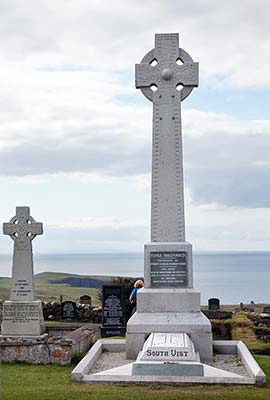
His flight inspired a popular Scottish folk song, “The Skye Boat Song”: “Speed bonnie boat like a bird on the wing, / Onward, the sailors cry. / Carry the lad that’s born to be king / Over the sea to Skye.” You may recognize the tune as the theme to Outlander.
• Return to the main road and proceed about six miles around the peninsula. Soon after what was once a loch (now a giant depression), you’ll drop down over the town of Uig (“OO-eeg”), the departure point for ferries to the Outer Hebrides (North Uist and Harris islands, 1-3/day) and a handy spot for services (cafés, a gas station, pottery shop, Isle of Skye Brewing Co. brewery and bottle shop, and WC).
Continue past Uig, climbing the hill across the bay. To take a brief detour to enjoy some hidden scenery, consider a visit to the Fairy Glen. To find it, just after passing the big Uig Hotel, take a very hard left, marked for Sheadar and Balnaknock. Follow this one-lane road about a mile through the countryside. You’ll emerge into an otherworldly little valley. Wind through the valley to just past the tiny lake and park below the towering Fairy Castle rock (pay parking).
▲The Fairy Glen
Whether or not you believe in fairies, it’s easy to imagine why locals claim that they live here. With evocatively undulating terrain—ruffled, conical hills called “fairy towers” reflected in glassy ponds, rising up from an otherwise flat and dull countryside—it’s a magical place. There’s little to see on a quick drive-by, but hikers enjoy exploring these hills, discovering little caves, weathered stone fences, and delightful views. As you explore, keep an eye out for “Skye landmines” (sheep droppings). Hardy hikers enjoy clambering 10 minutes up to the top of the tallest rock tower, the “Fairy Castle.” (By the way, the sheep are actually fairies until a human enters the valley.)
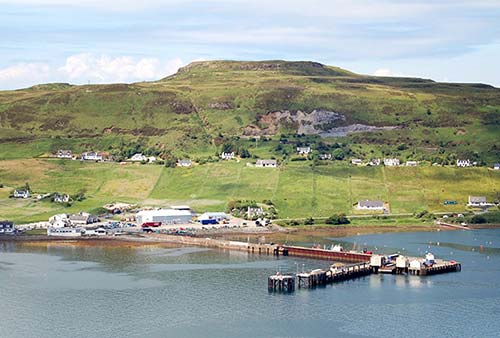
• Head back the way you came and continue uphill on the main road (A-87), with views down over Uig’s port. Looking back at Uig, you can see a good example of Skye’s traditional farming system—crofting.
Historically, arable land on the island was divided into plots. If you look across to the hills above Uig, you can see strips of demarcated land running up from the water—these are crofts. Crofts were generally owned by landlords (mostly English aristocrats or Scottish clan chiefs, and later the Scottish government) and rented to tenant farmers. The crofters lived and worked under very difficult conditions and were lucky if they could produce enough potatoes and livestock to feed their families. Rights to farm the croft were passed down from father to eldest son over generations, but always under the auspices of a wealthy landlord.
• But you live in a more affluent and equitable world, and more Scottish memories await to be created here on Skye. From here, you can continue along the main road, A-87, south toward Portree (and possibly continue from there to the Cuillin Hills). Or you can take the shortcut road just after Kensaleyre (B-8036) and head west on the A-850 to Dunvegan and its castle. All your Skye options are described in the following pages.
NORTHWEST SKYE
For locations of these sights, see the “Isle of Skye” map, near the beginning of this chapter.
▲▲Dunvegan Castle
Perched on a rock overlooking a sea loch, Dunvegan Castle is the residence of the MacLeod (pronounced “McCloud”) clan. One of Skye’s preeminent clans, the MacLeods often clashed with their traditional rivals, the MacDonalds, whose castle is on the southern tip of the island (see “The Feuding Clans of Skye” sidebar, later). The MacLeods claim that Dunvegan is the oldest continuously inhabited castle in Scotland. The current (and 30th) clan chief, Hugh Magnus MacLeod, is a film producer who divides his time between London and the castle, where his noble efforts are aimed at preserving Dunvegan for future generations. Worth ▲▲▲ to people named MacLeod, the castle offers an interesting look at Scotland’s antiquated clan system, provides insight into rural Scottish aristocratic lifestyles, and has fine gardens that are a delight to explore.
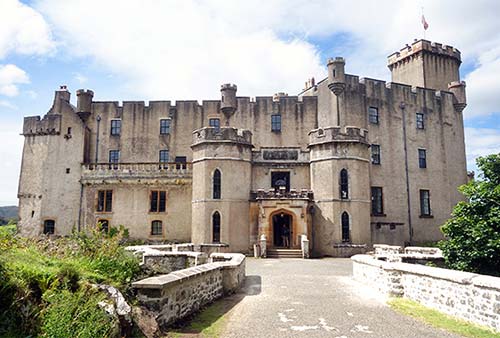
Cost and Hours: £16 for castle and gardens, £14 for gardens only; daily 10:00-17:30, closed mid-Oct-March; café in parking lot, +44 1470 521 206, www.dunvegancastle.com.
Getting There: It’s near the small town of Dunvegan in the northwestern part of the island, well signposted from the A-850 (free parking). From Portree, bus #56 takes you right to the castle’s parking lot.
Visiting the Castle: From the parking lot, cross the road, buy your ticket (you may have to wait in line), enter through the big gates, and walk five minutes through the gardens to the castle entrance. Follow the one-way route through the interior, borrowing laminated descriptions in many rooms—and don’t hesitate to ask the helpful docents if you have any questions. You’ll start upstairs and then make your way to the ground floor.
Up the main staircase and left down the main hallway, you’ll reach the bedroom, in the “Fairy Tower.” On the elegant canopy bed, look for the clan’s seal and motto, carved into the headboard. The words “Hold Fast,” which you’ll see displayed throughout the castle, recall an incident where a MacLeod chieftain saved a man from being gored by a bull by literally taking the bull by the horns and wrestling it to the ground.
Beyond the bedroom, you’ll ogle several more rooms, including the dining room. Here and throughout the castle, portraits of clan chieftains and the MacLeod family seem to be constantly looking down on you. The library’s shelves are crammed with rich, leather-bound books.
Then you’re routed back across the top of the stairs to the right wing, with the most interesting rooms. The 14th-century drawing room is the oldest part of the castle—it served as the great hall of the medieval fortress. But today it’s a far cry from its gloomy, stony, Gothic-vaulted original state. In the 18th century, a clan chief’s new bride requested that it be brightened up and modernized, so they added a drop ceiling, painted plaster walls, and hardwoods over the stone floor. The only clue to its original bulkiness is how thick the walls are (notice that the window bays are nine feet thick). In the drawing room, look for the tattered silk remains of the Fairy Flag, a mysterious swatch with about a dozen different legends attached to it (explained by the posted description).
Leaving the drawing room, notice the entrance to the dungeon—a holdover from that stout medieval fortress. Squeeze inside the dungeon and peer down into the deep pit. (Hey, is that a MacDonald rotting down there?)
At the end of this wing is the north room, a mini-museum of the clan’s most prestigious artifacts (Fairy Flag aside). In the display case in the corner, find Rory Mor’s Horn—made from a horn of the subdued bull that gave the clan its motto. Traditionally, this horn would be filled with nearly a half-gallon of claret (Bordeaux wine), which a potential heir had to drink in one gulp to prove himself fit for the role. See the photo of the previous clan chief, in 1956, draining the horn in under two minutes.
Other artifacts include bagpipes and several relics related to Bonnie Prince Charlie (including his vest—framed on the wall). In the center glass case, near a lock of Charlie’s hair, is a portrait of Flora MacDonald and some items that belonged to her.
Hiding in the small glass cabinet (look for the puffin) is perhaps the most fascinating exhibit in the castle. The MacLeods owned the rugged and remote St. Kilda islands (40 miles into the Atlantic, the most distant bit of the British Isles). They collected rent from the hardscrabble St. Kilda community of 100 or so (who were finally evacuated in 1930). Inside the cabinet, you’ll see a puffin trap, a door latch carved out of driftwood, and a little wooden boat that the islanders would insert a letter into and simply toss into the sea—trusting the prevailing currents to deliver it (“message in a bottle”-style) to correspondents on the mainland.
From here a staircase leads to the ground floor, with a few more exhibits. In the darkened room, a glass case holds the Claymore Sword—one of two surviving swords made of extremely heavy Scottish iron rather than steel. Dating from the late 15th or early 16th century, this unique weapon is the bazooka of swords—designed not for dexterous fencing, but for one big kill-’em-all swing. You’ll also peek into what would have been the servants’ quarters, and watch a very dry 12-minute video about the castle and the MacLeods, solemnly narrated by the 29th chief of the clan (showing an entirely different side of the man who chugged a half-gallon of wine in his youth).
Between the castle and the parking lot are five acres of plush gardens to stroll through while pondering the fading clan system. Circling down to the sea loch, you’ll enjoy grand views back up to the castle (and see a dock selling 30-minute boat rides on Loch Dunvegan to visit a seal colony on a nearby island; £12—must also buy castle or gardens ticket). Higher up and tucked away are some of the finer, hidden parts of the gardens: the walled garden, the woodland walk up to the water garden (with a thundering waterfall and a gurgling stream), and the wide-open round garden.
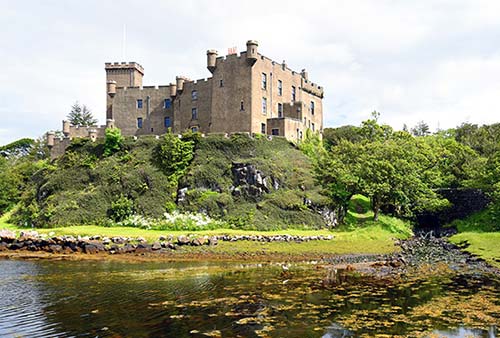
The flaunting of inherited wealth and influence in some English castles rubs me the wrong way. But here, I had the opposite feeling: sympathy and compassion for a proud way of life that’s dissolving with the rising tide of modernity. You have to admire the way they “hold fast” to this antiquated system (in the same way the Gaelic tongue is kept alive). Paying admission here feels more like donating to charity than padding the pockets of a wealthy family. In fact, watered-down MacLeods and MacDonalds from America, eager to reconnect with their Scottish roots, help keep the Scottish clan system alive.
The Giant Angus MacAskill Museum
This oddball museum fills a humble roadside barn in the town of Dunvegan. Peter Angus MacAskill (whose son, Danny, is a YouTube star for his extreme mountain biking on Skye) is happy to tell the story of his very distant cousin, “The Giant”—all seven feet, nine inches of him—who teamed up with Tom Thumb to travel around the US in the circus and make Barnum and Bailey lots of money until he died in 1863.
Cost and Hours: £2, daily 9:30-18:00, closed off-season, www.dunveganmuseums.co.uk.
Hikes and Walks Near Dunvegan
While neither of these easy walks are worth lingering for (or missing other sights on the island), they’re fun to consider if you have some extra time while you’re in the area.
Duirinish Standing Stone and Two Churches Walk: As you approach Dunvegan on the road from Portree, watch on the right for the ruins of St. Mary’s Church and its kirkyard—and, on a knob of land just above and beyond, the dramatic outline of the Duirinish Standing Stone. You can pull over at the little roadside parking lot, where a green sign outlines the 45-minute Two Churches Walk, an easy and satisfying hillwalk that takes you from here almost to Dunvegan Castle, before circling back and depositing you at the Duirinish Parish Church, just around the corner. In addition to (or instead of) that walk, you can huff up the hill to get a closer look at the Duirinish Standing Stone. While this may appear to be some ancient artifact of a bygone civilization, it was actually erected here in 2000—to celebrate the millennium.
Coral Beach: For another popular walk—especially on a nice day—drive north about four miles (past Dunvegan Castle) to the end of the road and a crowded parking lot. From there, walk about a mile through farmland to Coral Beach—an arcing bay with crystal-clear water and bleached-white algae underfoot (not actually “coral”).
▲Dun Beag Broch (Fort)
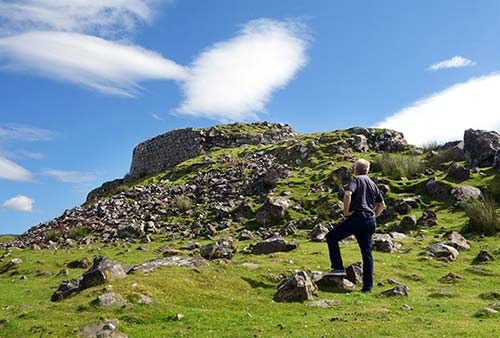
If driving between Talisker distillery and Dunvegan on A-863, you’ll pass Skye’s best-preserved Iron Age fort. This 2,000-year-old round stone tower caps a hill a 10-minute walk above its parking lot (just north of the village of Struan). The walk rewards you with an unforgettable chance to be alone in an ancient stone structure with a commanding view. With all the stones scattered around Dun Beag, you can imagine it standing four times as tall—perhaps with three wood-framed floors inside protecting an entire community with their animals in times of threat—back before Julius Caesar sailed to Britannia.
▲Neist Point and Lighthouse
To get a truly edge-of-the-world feeling, consider an adventure on the back lanes of the Duirinish Peninsula, west of Dunvegan. This trip is best for hardy drivers looking to explore the most remote corner of Skye and undertake a moderately strenuous hike to a lighthouse. Although it looks close on the map, give this trip 30 minutes each way from Dunvegan, plus at least 30 minutes to hike from the parking lot to the lighthouse (with a steep uphill return). After hiking around the cliff, the lighthouse springs into view, with the Outer Hebrides beyond.
Getting There: Head west from Dunvegan, following signs for Glendale. You’ll cross a moor, then twist around the Dunvegan sea loch, before heading overland and passing through rugged, desolate hamlets that seem like the setting for a BBC sitcom about backwater Britain. After passing through Glendale, carefully track Neist Point signs until you reach an end-of-the-road parking lot.
Eating: It’s efficient and fun to combine this trek with lunch or dinner at the pricey, recommended Three Chimneys Restaurant, on the road to Neist Point at Colbost (reservations essential; see here).
WESTERN SKYE
▲▲Talisker Distillery
Talisker, a Skye institution, has been distilling here since 1830 and takes its tours seriously. This venerable whisky distillery is situated at the base of a hill with 14 springs, and at the edge of a sea loch—making it easier to ship ingredients in and whisky out. On summer days, the distillery swarms with visitors: You’ll sniff both peated and unpeated grains; see the big mash tuns, washbacks, and stills; and sample a wee dram at the end. Island whisky tends to be smokier than mainland whisky due to the amount of peat smoke used during malting. Talisker workers describe theirs as “medium smoky,” with peppery, floral, and vanilla notes.
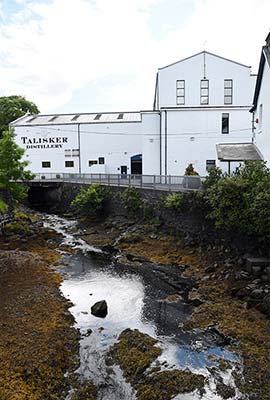
Tours and Tastings: This is a popular spot, and tours and tastings are limited. Check their website to confirm tour times and book a spot well in advance during busy times. If you’re making the trip out here, you might as well spring for the £20, one-hour distillery tour with three tastings—but these sell out faster. The other option is the £15, 30-minute “Made by the Sea” experience, which includes a multimedia show and three tastings, but no tour. For aficionados, they offer a more expensive cask draw and tasting (daily 10:00-17:00, Nov-Feb until 16:00, along the loch in Carbost, about a 45-minute drive from Portree, +44 1478 614 308, www.malts.com [URL inactive]).
Nearby: Note that the Fairy Pools Hike—an easy walk that includes some of the best Cuillin Hills views on the island—starts from near Talisker Distillery (described later).
Eating near Talisker: A fun “budget foodie” eating option is just up the road past the distillery. $$ The Oyster Shed may sound like a faux-rustic name for some fancy restaurant—but it actually is a giant shed that sells a short menu of fresh seafood dishes for lunch. Besides oysters, options may include lobster, pan-fried scallops, or smoked salmon, trout, or kippers and chips. There’s no seating, but a covered lean-to area on the side of the shed is where a United Nations of tourists huddles around stand-up tables, shucking and slurping oysters (Mon-Sat 11:00-17:00, closed Sun; to get here, take the road past the distillery and start up the hill, then watch for the turnoff to the left where the road switchbacks sharply to the right; +44 7751 025 074).
CENTRAL SKYE
▲▲Cuillin Hills
These dramatic, rocky “hills” (which look more like mountains to me) stretch along the southern coast of the island, dominating Skye’s landscape. Unusually craggy and alpine for Scotland, the Cuillin (“cool-in”) seem to rise directly from the deep. You’ll see them from just about anywhere on the southern two-thirds of the island, but no roads actually take you through the heart of the Cuillin—that’s reserved for hikers and climbers, who love this area. To get the best views with a car, consider these options.
Sligachan: The road from the Skye Bridge to Portree is the easiest way to appreciate the Cuillin (you’ll almost certainly drive along here at some point during your visit). These mountains are all that’s left of a long-vanished volcano. As you approach, you’ll see that there are three separate ranges (from right to left): red, gray, and black. The steep and challenging Black Cuillin is the most popular for serious climbers; the granite Red Cuillin ridge is more rounded.
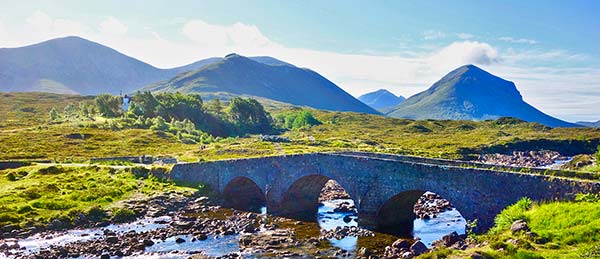
The crossroads of Sligachan is worth a quick stop to see an old triple-arched stone Telford bridge—one of Skye’s iconic views—and bronze statues of early 20th-century mountaineers Norman Collie and John Mackenzie. The crossroads, nestled in the foothills of the Cuillin and home to the landmark Sligachan Hotel (see “Between Portree and Kyleakin” on here), is a popular launchpad for mountain fun. The 2,500-foot-tall cone-shaped hill looming over Sligachan, named Glamaig (“Greedy Lady”), is the site of an annual 4.5-mile hill race in July: Speed hikers begin at the door of the hotel, race to the summit, run around a bagpiper, and scramble back down to where they started. The record: 44 minutes (30 minutes up, 13 minutes down, 1 minute dancing a jig up top). A Gurkha from Nepal did it in near record time...barefoot. The Sligachan Hotel feels like a virtual mountaineering museum, with great old photos and artifacts throughout its ground floor (especially behind the reception desk). You’re welcome to browse around.
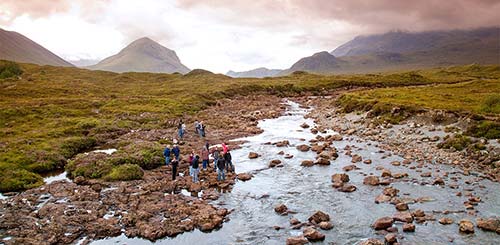
Fairy Pools Hike: Perhaps the best easy way to get some Cuillin views—and a sturdy but manageable hike—is to follow the popular trail to the Fairy Pools. This is relatively near Talisker Distillery (in the southwestern part of the island).
To reach the hike from the A-863 between Sligachan and Dunvegan, follow signs to Carbost. Just before reaching the village of Carbost, watch for signs and a turn-off on the left to Glenbrittle. Follow this one-track road through the rolling hills, getting closer and closer to the Cuillin peaks. The well-marked Fairy Pools turnoff will be on your right. There’s a large pay parking lot with WCs. From here, you can easily follow the well-tended trail down across the field and toward the rounded peaks. (While signs suggest a 9.5-mile, 4- to 5-hour loop, most people simply hike 30 minutes to the pools and back; it’s mostly level.)
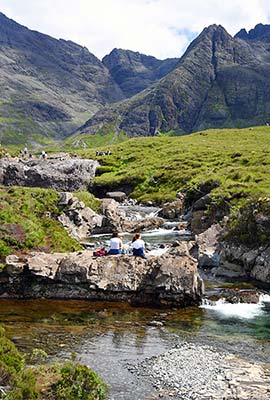
Very soon you’ll reach a gurgling river, which you’ll follow toward its source in the mountains. Because the path is entirely through open fields, you enjoy scenery the entire time (and you can’t get lost). Soon the river begins to pool at the base of each waterfall, creating a series of picturesque pools. Although footing can be treacherous, many hikers climb down across the rocks to swim and sunbathe. This is a fun place to linger (bring a picnic, if not a swimsuit).
Elgol: For the best view of the Cuillin, locals swear by the drive from Broadford (on the Portree-Kyleakin road) to Elgol, at the tip of a small peninsula that faces the Black Cuillin head-on. While it’s just 12 miles as the crow flies from Sligachan, give it a half-hour each way to drive to the tip (mostly on single-track roads). For even more scenery, take a boat excursion from Elgol into Loch Coruisk, a sea loch surrounded by the Cuillin (April-Oct, departures several times a day, fewer Sun and off-season, standard cruise about £28, 3 hours round-trip including 1.5 hours free time on the shore of the loch, mistyisleboattrips.co.uk).
SOUTH SKYE
Kyleakin
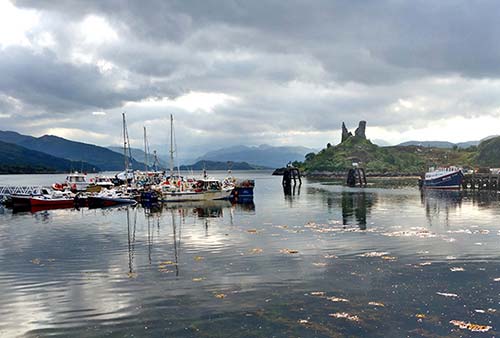
Kyleakin (kih-LAH-kin), the last town in Skye before the Skye Bridge, used to be a big tourist hub...until the bridge connecting it to the mainland enabled easier travel to Portree and other areas deeper in the island. Today this unassuming little village, with a ruined castle (Castle Moil), a cluster of lonesome fishing boats, and a forgotten ferry slip, is worth a quick look but little more.
Broadford: Birthplace of Drambuie
Up the road from Kyleakin, in the wide spot in the road called Broadford, you’ll drive past the Broadford Hotel. It was at this hotel that a secret elixir—supposedly once concocted for Bonnie Prince Charlie—was re-created by hotelier James Ross after finding the recipe in his father’s belongings. Now known as Drambuie, the popular liqueur—which caught on in the 19th century—is made with Scotch whisky, heather honey, and spices. With its wide variety of Drambuie drinks, the Broadford’s Spinnakers Bar is the place to try it. (The hotel also has a good $$$ restaurant; +44 1471 822 204, www.broadfordhotel.co.uk.)
Skye Bridge
Connecting Kyleakin on Skye with Kyle of Lochalsh on the mainland, the Skye Bridge was Europe’s most expensive toll bridge per foot when it opened to great controversy in 1995 amid concerns that it would damage B&B business in the towns it connects and disrupt native otter habitat. Years of protests later, the bridge was bought by the Scottish government in 2004, the fare was abolished, and the Skye natives were somewhat appeased. There’s no denying that the bridge has been a boon for Skye tourism, making a quick visit to the island possible without having to wait for a ferry.
SKYE’S SLEAT PENINSULA
Armadale Castle, Gardens, and Museum of the Isles
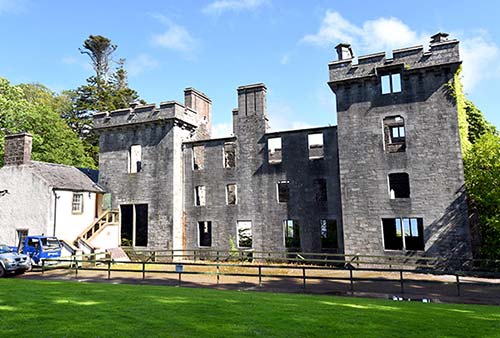
Facing the sea just outside Armadale is the ruined castle of Clan Donald, also known as the MacDonalds (Mac/Mc = “son of”), at one time the most powerful clan in the Scottish Highlands and Hebrides. Today it is the “spiritual home of clan Donald,” a sprawling site with castle ruins, woodland walks, manicured gardens, and the Museum of the Isles. While interesting to historians—and riveting for people named MacDonald—given that there’s not much of the actual castle to see, it’s not worth a long detour for anyone else. Because it’s right along the main road near the Armadale-Mallaig ferry, it can be an enjoyable place to kill some time while waiting for your boat.
Cost and Hours: £13, daily 9:30-17:00, closed off-season, free parking, 2 minutes north of the Armadale ferry landing, +44 1471 844 305, www.armadalecastle.com.
Background: Armadale Castle—more of a mansion than a fortress—was built in 1790, during the relatively peaceful, post-Jacobite age when life at the MacDonalds’ traditional home, Duntulm Castle at the tip of the Trotternish Peninsula, had become too rugged and inconvenient. Today the Armadale Castle ruins (which you can view, but not enter) anchor a sprawling visitors center that celebrates the MacDonald way of life.
Visiting the Castle: Start at the ticket office (also home to the gift shop), then head into the sprawling grounds and bear left to walk about five minutes to the Museum of the Isles. This modern museum tells the history of Scotland and Skye through the lens of its most influential clan. While it has only a few artifacts, the museum is well presented and uses replicas to evoke various periods of Skye’s history (for the full story, borrow the free 1.5-hour audioguide). You’ll begin with the geology of the island and early civilizations (with a replica stone circle) and continue through the Kingdom of the Isles and the rise and fall of the Highland clan system. It finishes with an exhibit on emigration, including the causes and effects of many Skye natives moving to the New World.
After touring the museum, follow signs (and use the free map) to navigate the rest of the gardens. You’ll also have a chance to see the ruins of Armadale Castle. Refreshments are available from a coffee wagon and the gift shop, or you’re welcome to bring a picnic.
Nearby: Heading north on the A-851 from the castle, keep an eye out for Sabhal Mòr Ostaig (a big complex of white buildings on the point). Skye is very proud to host this college, with coursework taught entirely in Scottish Gaelic. Named “the big barn” after its origins, its mission is to further the Gaelic language (spoken today by about 60,000 people).
Torabhaig Distillery
While Talisker is Skye’s classic distillery to tour, this newer option—opened in 2017 within the restored buildings of a 19th-century farmstead with views back to the mainland—is convenient for those traveling along the Sleat Peninsula (it’s right along the road to the Mallaig ferry and Armadale Castle). Given its newness, this is not the place for aficionados to expect mature whisky. But knowing they’re the “new kids on the block,” they hustle to put on good tours. It’s also one of the most affordable tours you’ll come across.
Cost and Hours: £12 for 45-minute distillery tour; shop generally open in summer Mon-Fri 10:00-17:00, Sat-Sun until 15:00; café, +44 1471 833 447, an hour south of Portree in Teangue, www.torabhaig.com.
ON THE MAINLAND, NEAR THE ISLE OF SKYE
▲Eilean Donan Castle
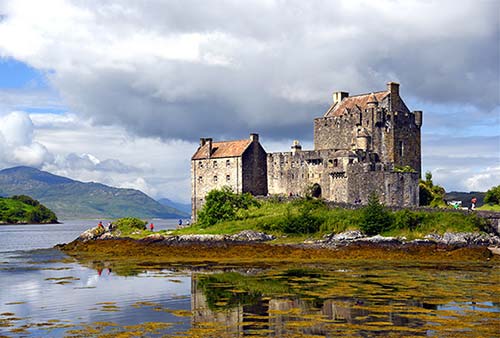
This postcard-perfect castle, watching over a sea loch from its island perch, is scenically (and conveniently) situated on the road between the Isle of Skye and Loch Ness. While the photo op is worth ▲▲, the interior—with cozy rooms—is worth only a peek and closer to ▲. Eilean Donan (EH-lan DOHN-an) might be Scotland’s most photogenic countryside castle. Strategically situated at the confluence of three sea lochs, this was, for 500 years, the stronghold of the Mackenzies—a powerful clan that was, like the MacLeods at Dunvegan, a serious rival to the mighty MacDonalds (see sidebar). Though it looks ancient, the current castle is actually less than a century old. The original castle on this site (dating from 800 years ago) was destroyed in battle in 1719, then rebuilt between 1912 and 1932 by the Macrae family as their residence. (The Macraes became bodyguards to the Mackenzies in the 14th century and later took over from their bosses as holders of the castle.)
Cost and Hours: £11; daily 10:00-18:00, July-Aug from 9:00, last entry one hour before closing, shorter hours off-season and closed mid-Dec-Jan; audioguide-£3, good guidebook-£6, no backpacks, café, +44 1599 555 202, www.eileandonancastle.com.
Getting There: It’s not actually on the Isle of Skye, but it’s quite close, in the mainland town of Dornie. Follow the A-87 about 15 minutes east of Skye Bridge, through Kyle of Lochalsh and toward Loch Ness and Inverness. The castle is on the right side of the road, just after a long bridge (pay parking). Buses stop at Dornie, a short walk from the castle (#915/#916/#917 from Portree, 7/day, 1 hour).
Visiting the Castle: Buy tickets at the visitors center, then walk across the bridge and into the castle complex. “Eilean” means “island”—and this strategic location was both easily defensible (because of the constantly shifting tides) and sustainable (because of a natural freshwater supply).
Enter just to the left of the main gate, where you’ll begin with some audiovisual introductory exhibits. Then you’ll continue deeper into the castle complex, climbing stairs into the bulky main keep, and work your way through the historic rooms. While the castle is a footnote on a Scottish scale, the exhibits work hard to make its story engaging. Docents posted throughout can tell you more.
First you’ll see the claustrophobic, vaulted Billeting Room (where soldiers had their barracks), then head upstairs to the inviting Banqueting Room, with grand portraits of the honorable John Macrae-Gilstrap and his wife (who spearheaded the modern rebuilding of the castle). This room comes to life when you get a docent to explain the paintings and artifacts here. After the renovation, this was a sort of living room.
Another flight of stairs takes you to the circa-1930 bedrooms, which feel cozier and more accessible than those in many other castles—and do a great job of evoking the lifestyles of the aristocrats who built the current version of Eilean Donan as their personal castle playset.
Downstairs is a cute kitchen exhibit, with mannequins preparing a meal and a very well-stocked larder. Finally, you’ll pass the gears for operating the portcullis and some WWI memorials on your way to the exit.
To extend your visit, stairs lead down to a path around the base of the castle, where you can observe kelp swaying in the currents. Watch for the WWI memorial, flanked by two cannons; it lists MacRaes from around the world who were lost in that conflict.
Heading back over the bridge to the mainland, notice the trail on the left, following the coastline to the village of Dornie—offering more great views back on the castle.