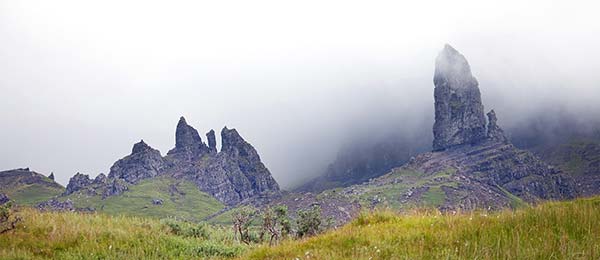
THE SCOTTISH HIGHLANDS
Two- to Three-Day Highland Highlights Blitz
Six-Day Highlands and Islands Loop
10-Day (or More) Highlands Explorer Extravaganza
Filled with more natural and historical mystique than people, the Highlands are where Scottish dreams are set. Legends of Bonnie Prince Charlie linger around crumbling castles as tunes played by pipers in kilts swirl around tourists. Avid hikers—called “Munro baggers”—scale bald mountains, grizzled islanders man drizzly ferry crossings, and midges make life miserable (bring bug spray). The Highlands are the most mountainous, least inhabited, and—for many—most scenic and romantic part of Scotland.
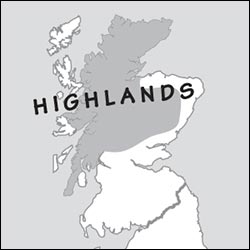
The Highlands are covered with mountains, lochs, and glens, scarcely leaving a flat patch of land for building a big city. Geographically, the Highlands are defined by the Highland Boundary Fault, which slashes 130 miles diagonally through the middle of Scotland just north of the big cities of the more densely populated “Central Belt” (Glasgow and Edinburgh).
This geographic and cultural fault line is clearly visible on maps, and you can even see it in the actual landscape—especially around Loch Lomond and the Trossachs, where the transition from rolling Lowland hills to bald Highland mountains is almost too on-the-nose. Just beyond the fault, the Grampian Mountains (which include Cairngorms National Park) curve across the middle of Scotland; beyond that, the Caledonian Canal links the east and west coasts (slicing diagonally through the Great Glen, another geologic fault, from Oban to Inverness), with even more mountains to the north.
Though the Highlands’ many “hills” are technically too short to be called “mountains,” they do a convincing imitation. (Just don’t say that to a Scot.) Scotland has 282 hills above 3,000 feet. A list of these was first compiled in 1891 by Sir Hugh Munro, and to this day the Scots call their high hills “Munros.” (Hills from 2,500-3,000 feet are known as “Corbetts,” and those from 2,000-2,500 are “Grahams.”) Munro baggers love to tick these mini mountains off their list: According to the Munro Society, more than 5,000 intrepid hikers can brag that they’ve climbed all the Munros. (To get started, you’ll find lots of good information at www.walkhighlands.co.uk/munros).
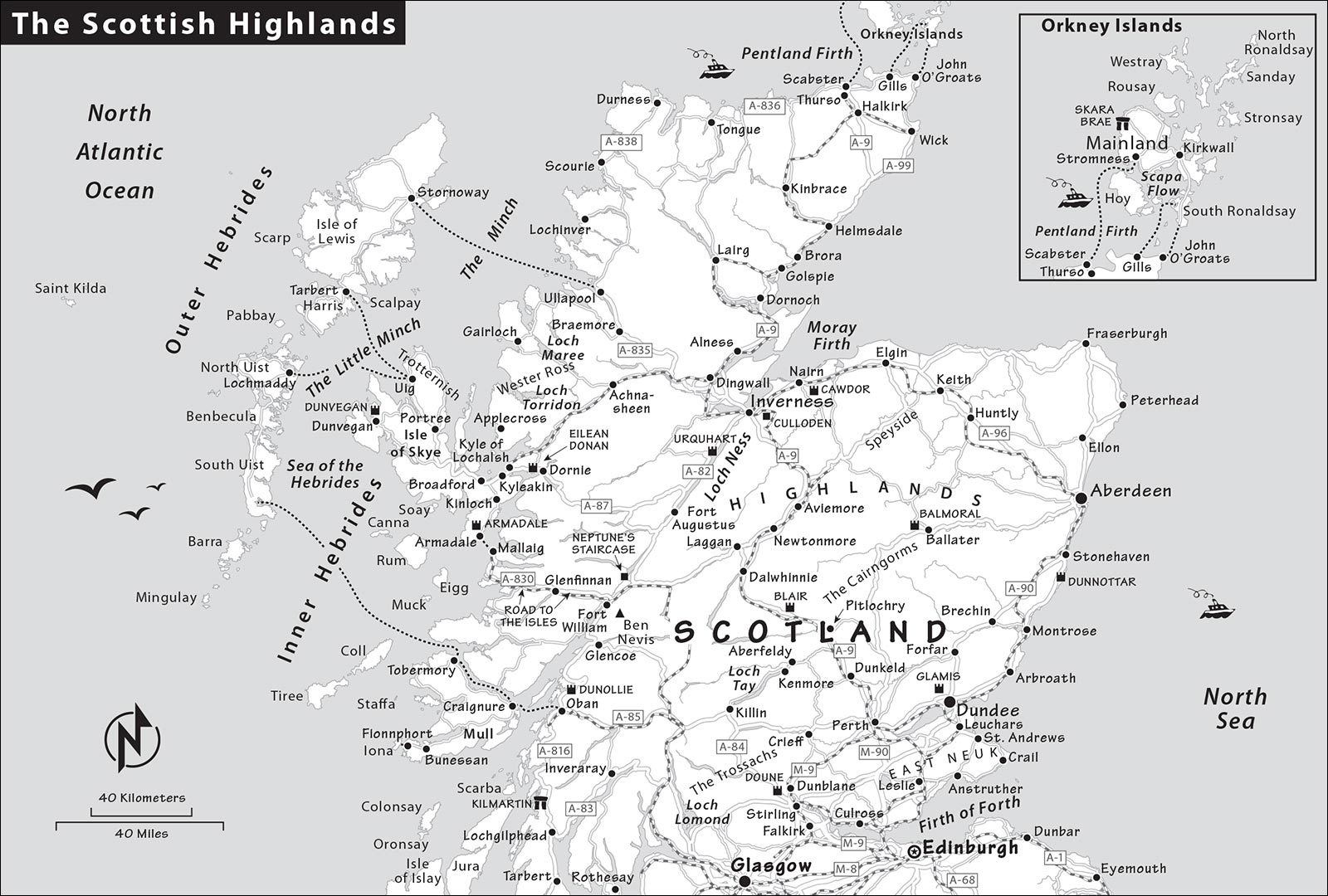
The Highlands occupy more than half of Scotland’s area, but are populated by less than five percent of its people—a population density comparable to Russia’s. Scotland’s Hebrides Islands (among them Skye, Mull, Iona, and Staffa), while not, strictly speaking, in the Highlands, are often included simply because they share much of the same culture, clan history, and Celtic ties. (Orkney and Shetland, off the north coast of Scotland, are a world apart—they feel more Norwegian than Highlander.)
Inverness is the Highlands’ de facto capital, and often claims to be the region’s only city. (The east coast port city of Aberdeen—Scotland’s third largest, and quadruple the size of Inverness—has its own Doric culture and dialect, and is usually considered its own animal.)
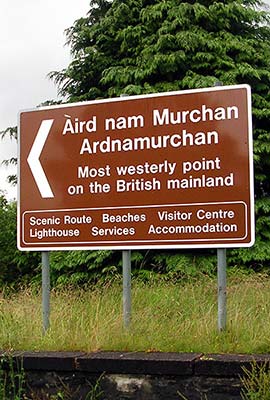
The Highlands are where you’ll most likely see Gaelic—the old Celtic language that must legally accompany English on road signs. While few Highlanders actually speak Gaelic—and virtually no one speaks it as a first language—certain Gaelic words are used as a nod of respect to their heritage. Fàilte (welcome), Slàinte mhath! (cheers!—literally “good health”), and tigh (house—featured in many business names) are all common. If you’re making friends in a Highland pub, ask your new mates to teach you some Gaelic words.
The Highlands are also the source of many Scottish superstitions, some of which persist in remote communities, where mischievous fairies and shape-shifting kelpies are still blamed for trouble. In the not-so-distant past, new parents feared that their newborn could be replaced by a devilish imposter called a changeling. Well into the 20th century, a midwife called a “howdie” would oversee key rituals: Before a birth, doors and windows would be unlocked and mirrors would be covered. And the day of the week a baby is born was charged with significance (“Monday’s child is fair of face, Tuesday’s child is full of grace...”).
Many American superstitions and expressions originated in Scotland (such as “black sheep,” based on the idea that a black sheep was terrible luck for the flock). Just as a baseball player might refuse to shave during a winning streak, many perfectly modern Highlanders carry a sprig of white heather for good luck at their wedding (and are careful not to cross two knives at the dinner table). And let’s not even start with the Loch Ness monster...
In the summer, the Highlands swarm with tourists...and midges. These miniature mosquitoes—like “no-see-ums”—are bloodthirsty and determined. They can be an annoyance from late May through September, depending on the weather. Hot sun or a stiff breeze blows the tiny buggers away, but they thrive in damp, shady areas. Locals suggest blowing or brushing them off, rather than swatting them—since killing them only seems to attract more (likely because of the smell of fresh blood). Scots say, “If you kill one midge, a million more will come to his funeral.” Even if you don’t usually travel with bug spray, consider bringing or buying some for a summer visit. Locals recommend Avon’s Skin So Soft, which is effective against midges, but less potent than DEET-based bug repellants. The brand Smidge, while pricey, is also popular (sold at many outdoor-supply shops).
Ticks are also numerous in the Highlands—and can carry Lyme disease and other ailments. When tramping through fields of brush or grass, experienced hikers tuck their pant legs into their socks to keep their skin covered. After a hike, inspect your clothes carefully and brush off any ticks that have hitched a ride. If you do get bitten by a tick, pull it out carefully (without squeezing, and trying to keep the head intact). If you notice a “bullseye” rash around the bite, seek medical attention without delay.
Scotland is a hiker’s paradise...as long as you bring rain gear. I’ve recommended a few hikes of varying degrees of difficulty throughout this book. Remember: Wear sturdy (ideally waterproof) shoes, and be prepared for any weather. For serious hikes, pick up good maps and get advice at local TIs or from a knowledgeable resident (such as your B&B host). Be sure to bring food, water, and bug repellent. A good resource for hiking route tips is WalkHighlands.co.uk.
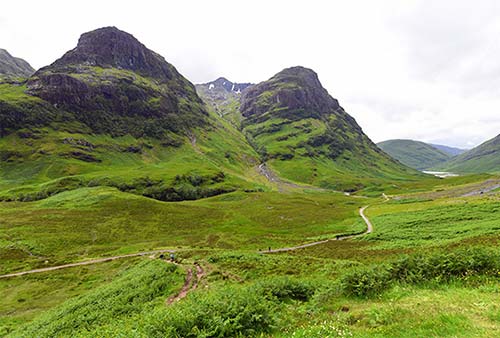
For a more in-depth experience, consider one of Scotland’s famous multiday walks. These are the most popular:
West Highland Way: 95 miles, 5-10 days, Milngavie to Fort William by way of Loch Lomond, Glencoe, and Rannoch Moor
Great Glen Way: 79 miles, 5-6 days, Fort William to Inverness along the Caledonian Canal, Fort Augustus, and Loch Ness
John Muir Way: 134 miles, 9-10 days, coast to coast through the Central Belt of Scotland, from Helensburgh to Dunbar via Falkirk, the Firth of Forth, and Edinburgh
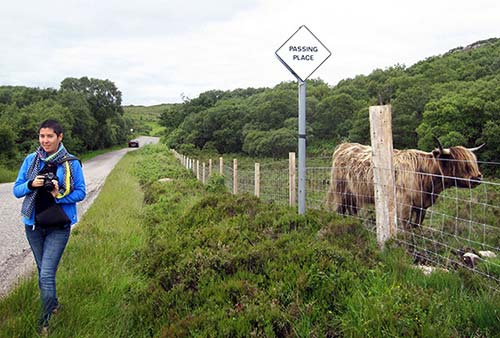
Keep an eye out for another, far more lovable Scottish animal: shaggy Highland cattle called “hairy coos.” They’re big and have impressive horns, but are best known for their adorable hair falling into their eyes (the hair protects them from Scotland’s troublesome insects and unpredictable weather). Hairy coos graze on sparse vegetation that other animals ignore and, with a heavy coat (rather than fat) to keep them insulated, they produce a lean meat that resembles venison. Highland cattle meat is not commonly eaten, and the relatively few hairy coos you’ll see are kept around mostly as a national symbol.
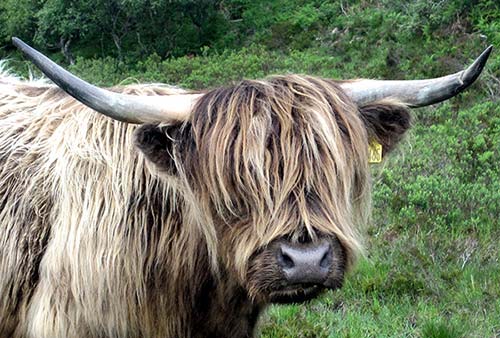
Seeing a herd of hairy coos at the side of the road is thrilling—they’re often mobbed by shutterbug tourists. Most you see are females, with horns that curve distinctively upward as they narrow. (If you get a close look, you can actually count the “rings” on a female’s horns—one for each calf she’s birthed.) Males’ horns are directed straight ahead. Be respectful and keep your distance from these giant, usually docile animals; don’t hop over a fence to approach them—they can become agitated, especially if you get too close to a mother and her calf. (To see some hairy coos up close, you can tour the Cladich Highland Cattle Farm near Loch Awe—see here.)
While the prickly, purple thistle is the official national flower, heather is the unofficial national shrub. This scrubby vegetation blankets much of the Highlands. It’s usually a muddy reddish-brown color, but it bursts with purple flowers in late summer; the less common bell heather blooms in July. Heather is one of the few things that will grow in the inhospitable terrain of a moor, and it can be used to make dye, rope, thatch, and even beer (look for Fraoch Heather Ale).
Highlanders are an outdoorsy bunch. For a fun look at local athletics, check whether your trip coincides with one of the Highland Games that enliven Highland communities in summer (see the sidebar later in this chapter). And keep an eye out for the unique Highland sport of shinty: a brutal, fast-paced version of field hockey, played for keeps. Similar to Irish hurling, shinty is a full-contact sport that encourages tackling and fielding airborne balls, with players swinging their sticks (called camans) perilously through the air. The easiest place to see shinty is at Bught Park in Inverness (see here), but it’s played across the Highlands.
PLANNING YOUR TIME
Here are three recommended Highland itineraries: two to three days, six days, and 10 or more days. These plans assume you’re driving, but can be done (with some modifications) by bus. Think about how many castles you really need to see: One or two is enough for most people. You can review your options in the “Scottish Castles at a Glance” sidebar on here.
Two- to Three-Day Highland Highlights Blitz
This ridiculously fast-paced option squeezes the maximum Highland experience out of a few short days, and assumes you’re starting from Glasgow or Edinburgh.
Day 1: In the morning, head up to the Highlands. (If coming from Edinburgh, consider a stop at Stirling Castle en route.) Drive along Loch Lomond and pause for lunch in Inveraray. Arrive in Oban in time for the day’s last distillery tour (see here; book ahead). Have dinner and spend the night in Oban.
Day 2: Get an early start from Oban and make a beeline for Glencoe, where you can enjoy a quick, scenic drive up the valley and visit the folk museum. Then drive to Fort William and follow the Caledonian Canal to Inverness, stopping at Fort Augustus to see the locks (and have a late lunch). Zip along Loch Ness and overshoot Inverness on your way to the Culloden Battlefield (outside Inverness) in the late afternoon (confirm the closing time and plan around it). Finally, make good time south on the A-9 back to Edinburgh (3 hours, arriving late).
Day 3: To extend this plan, take your time getting to Inverness on Day 2 and spend the night there. Follow my self-guided Inverness Walk either that evening or the next morning. Leaving Inverness, tour Culloden Battlefield, visit Clava Cairns, then head south, stopping off at any place that appeals: The best options near the A-9 are Pitlochry and the Scottish Crannog Centre on Loch Tay, or take the more rugged eastern route to see the Speyside whisky area, Balmoral Castle and Ballater village, and Cairngorms mountain scenery. Or, if this is your best chance to see Stirling Castle or the Falkirk sights (Falkirk Wheel, Kelpies sculptures), fit them in on your way south.
Six-Day Highlands and Islands Loop
While you’ll see the Highlands on the above itinerary, you’ll whiz past the sights in a misty blur. This more reasonably paced plan is for those who want to slow down a bit.
Day 1: Follow the plan for Day 1, above, sleeping in Oban (2 nights).
Day 2: Do an all-day island-hopping tour from Oban, with visits to Mull, Iona, and (if you choose) Staffa.
Day 3: From Oban, head up to Glencoe for its museum and valley views. Consider lingering for a (brief) hike. Then zip up to Fort William and take the “Road to the Isles” west (pausing in Glenfinnan to see its viaduct) to Mallaig. Take the ferry over the sea to Skye, then drive to Portree to sleep (2 nights).
Day 4: Spend today enjoying the Isle of Skye. In the morning, do the Trotternish Peninsula loop; in the afternoon, take your pick of options (Talisker Distillery, Dunvegan Castle, multiple hiking options).
Day 5: Leaving Portree, drive across the Skye Bridge for a photo-op pit stop at Eilean Donan Castle. The A-87 links you over to Loch Ness, which you’ll follow to Inverness. If you get in early enough, consider touring Culloden Battlefield this evening. Sleep in Inverness (1 night).
Day 6: See the Day 3 options for my Highlands Highlights Blitz, earlier.
Throughout the summer, Highland communities host traditional festivals of local sport and culture. These Highland Games (sometimes called Highland Gatherings) combine the best elements of a track meet and a county fair. They range from huge and glitzy (such as Braemar’s world-famous games, which members of the royal family attend, or the Cowal Highland Gathering, Scotland’s biggest) to humble and small-town. Some of the more modern games come with loud pop music and corporate sponsorship, but still manage to celebrate the Highland spirit.
Most Highland Games take place between mid-June and late August (usually on Saturdays, but occasionally on weekdays). The games are typically a one-day affair, kicking off around noon and winding down in the late afternoon. Some games are free; at others, you’ll pay around £10. Events are rain or shine (so bring layers) and take place in a big park ringed by a running track, with the heavy events and Highland dancing stage at opposite ends of the infield. Surrounding the whole scene are junk-food stands, a few test-your-skill carnival games, and local charities raising funds by selling hamburgers, fried sausage sandwiches, baked goods, and bottles of beer and Irn-Bru. The emcee’s running commentary is a delightful opportunity to just sit back and enjoy a lilting Scottish accent.
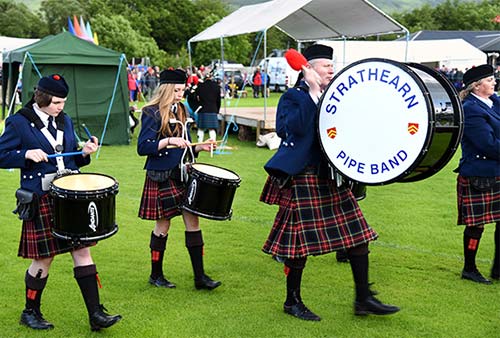
The day’s events typically kick off with a pipe band parading through town—often led by the local clan chieftain—and ending with a lap around the field. Then the sporting events begin.
In the heavy events—or feats of Highland strength—brawny, kilted athletes test their ability to hurl various objects of awkward shapes and sizes as far as possible. In the weight throw, competitors spin like ballerinas before releasing a 28- or 56-pound ball on a chain. The hammer throw involves a similar technique with a 26-pound ball on a long stick, and the stone put (with a 20-to-25-pound ball) has been adopted in American sports as the shot put. In the “weight over the bar” event, Highlanders swing a 56-pound weight over a horizontal bar that begins at 10 feet high and ends at closer to 15 feet. (That’s like tossing a 5-year-old child over a double-decker bus.) And, of course, there’s the caber toss: Pick up a giant log (the caber), get a running start, and release it end-over-end with enough force to (ideally) make the caber flip all the way over and land at the 12 o’clock position. (Most competitors wind up closer to 6.)
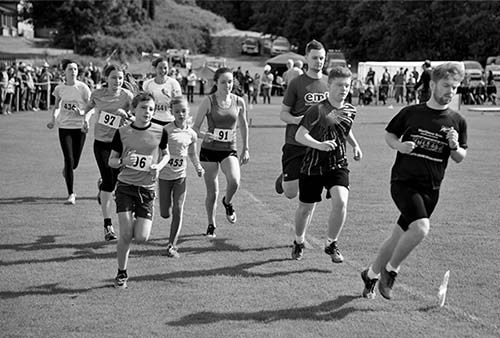
Meanwhile, the track events run circles around the muscle: the 90-meter dash, the 1,600-meter, and so on. The hill race adds a Scottish spin: Combine a several-mile footrace with the ascent of a nearby summit. The hill racers begin with a lap in the stadium before disappearing for about an hour. Keep an eye on nearby hillsides to pick out their colorful jerseys bobbing up and down a distant peak. This custom supposedly began when an 11th-century king staged a competition to select his personal letter carrier. After about an hour—when you’ve forgotten all about them—the hill racers start trickling back into the stadium to cross the finish line.
And the games wouldn’t be complete without Highland dancing, in which dancers—usually women performing in groups of two to four, or solo—toe their routines with intense concentration for the judges (for more, see the “Highland Dancing” sidebar, later).
Other events further enliven the festivities. The pipe band periodically assembles to play a few tunes, often while marching around the track (giving the runners a break). Larger games may have a massing of multiple pipe bands, or bagpipe and drumming competitions. You may also see reenactments of medieval battles, herd-dog demonstrations, or dog shows (grooming and obedience). Haggis hurling—in which participants stand on a whisky barrel and attempt to throw a cooked haggis as far as possible—has caught on recently. And many small-town events end with the grand finale of a town-wide tug-of-war, during which everybody gets bruised, muddy, and hysterical.
If you’re traveling to Scotland in the summer, check online schedules to see if you’ll be near any Highland Games before locking in your itinerary. Rather than target the big, famous gatherings, I make a point of visiting the smaller clan games. A helpful website—listing dates for most but not all the games around Scotland—is RSHGA.org [URL inactive]. For many travelers to Scotland, attending one of the games can be a trip-capping highlight. And, of course, many communities in the US and Canada also host their own Highland Games.
10-Day (or More) Highlands Explorer Extravaganza
Using the six-day Highlands and Islands Loop as a basis, pick and choose from these possible modifications (listed in order of where they’d fit into the itinerary):
• Add an overnight in Glencoe to make more time for hiking there.
• Leaving the Isle of Skye, drive north along Wester Ross (the scenic northwest coast). Go as far as Ullapool, then cut back down to Inverness, or...
• Take another day or two (after spending the night in Ullapool) to carry on northward through remote and rugged scenery to the far reaches of Scotland—the famous North Coast 500 (NC-500) driving route. Drive east along the coast all the way to John O’Groats; then either take the ferry from Scrabster or Gills Bay across to Orkney, or shoot back down to Inverness on the A-9 (about 3 hours).
• Visit Orkney (2-night minimum). This can fit into the above plan before or after John O’Groats. If you’re not doing the full North Coast loop, simply zip up on the A-9 from Inverness (about 3 hours)—or fly up from Inverness, Edinburgh, or Aberdeen.
• On the way south from Inverness, follow the Speyside whisky trail, cut through the Cairngorms, visit Balmoral Castle, and sleep in Ballater. Between Balmoral and Edinburgh, consider visiting Glamis Castle (Queen Mum’s childhood home), Dundee (great industrial museums), or Culross (scenic firthside village).
• Add an overnight wherever you’d like to linger; the best options are the Isle of Skye (to allow more island explorations) or Inverness (to fit in more side trips).
GETTING AROUND THE HIGHLANDS
By Car
The Highlands are made for joyriding. There are a lot of miles, but they’re scenic, the roads are good, and the traffic is light. The farther north you go, the more away-from-it-all you’ll feel. Even on a sunny weekend, you can go miles without seeing another car. Yet in peak season you may spend those miles dodging parades of campervans and motorcycles. Don’t wait too long to gas up—village gas stations are few and far between, and can close unexpectedly. Stay alert on single-lane roads, and slow down on blind corners. When you encounter an oncoming vehicle, the driver closest to a pullout is expected to use it—even if you have to back up. Remember to always stay on the left side of the road—don’t cross over to a pullout on the right. (Rather, stay on the left side and let the oncoming car use the pullout to pass you.)
Highland dancing has been a highlight of the Highland Games since the games were revived in the late 1800s. Go to any Highland Games and you’ll find groups of dancers dressed in their peasant blouses, tartan skirts, long plaid stockings, and lace-up slippers, dancing perfectly in sync to the melody of a lone bagpiper. No less competitive than events like the caber toss and hammer throw, Highland dancing is recognized as a sport by the Sport Council of Scotland—and watching the dancers, it’s easy to see why.
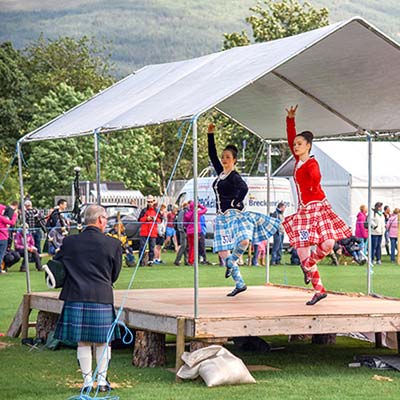
Highland dancing is highly technical, involving precise footwork, intense concentration, and excellent balance and stamina. Competitors—dancing solo or in groups of two or four—must dance only on the balls of their feet, with one hand in the air and the other on their hip as they step, spin, and twirl. They’re judged on their poise, the height of their jumps, how well they stay in time with the music, their arm-and-hand gestures, and even their outfits. Similar to gymnastics, all dancers start with a baseline score (in this case 100), and points are deducted by the judge for poor technique or flawed execution.
The origins of Highland dancing are obscure, but we know that men were the first dancers. One popular dance, the Highland Fling, may have originally been a courtship dance, where men imitated the movements of a rutting stag. Sword dances, where dancers must step gingerly over two crossed swords on stage, might have been started by soldiers as a victory celebration, a good-luck charm before battle, or a simple training exercise.
Today, Highland dancing is 90 percent female, and you’ll see competitors of all ages leaping across the stage. You may also see folk dances from other countries, like the jig (from Ireland) and the hornpipe (from English sailors). These exuberant dancers have become emblematic of the sheer joy of the Highland Games.
By Public Transportation
Glasgow is the gateway to this region (so you’ll most likely have to transfer there if coming from Edinburgh). Trains zip from Glasgow to Fort William, Oban, and Kyle of Lochalsh in the west; and up to Stirling, Pitlochry, and Inverness in the east. For more remote destinations (such as Glencoe), the bus is better.
Most buses are operated by Scottish Citylink. In peak season—when these buses fill up—it’s smart to buy tickets a few days in advance: Book at Citylink.co.uk [URL inactive], or stop by a bus station or TI.
Glasgow’s Buchanan Station is the main Lowlands hub for reaching Highlands destinations. From Edinburgh, it’s best to transfer in Glasgow (fastest by train, also possible by bus)—though there are direct buses from Edinburgh to Inverness, where you can connect to Highlands buses. Once in the Highlands, Inverness and Fort William serve as the main bus hubs.
Note that bus frequency can be substantially reduced—sometimes to zero—on Sundays and in the off-season (Oct-mid-May). Unless otherwise noted, I’ve listed bus information for summer weekdays. Always confirm schedules locally. These buses are particularly useful:
Connections from Glasgow: Buses #975, #976, and #977 connect Glasgow with Oban (5/day, 3 hours).
Buses #914/#915/#916 go from Glasgow to Fort William, stopping at Glencoe (8/day, 2.5 hours to Glencoe, 3 hours total to Fort William). From Fort William, some of these buses continue all the way up to Portree on the Isle of Skye (3/day, 7 hours for the full run).
Buses #M9 and #M10 connect Glasgow and Inverness (hourly, 3.5 hours; also stop in Pitlochry).
Connections from Edinburgh: Bus #M90 runs from Edinburgh to Inverness (8/day, 4 hours; stops en route at Pitlochry, 2 hours).
Bus #913 runs just once daily (in the morning) from Edinburgh into the Highlands, stopping at Glencoe (4 hours) and Fort William (4.5 hours); with a transfer, you can continue on to Oban (4.5 hours, change in Tyndrum) and Portree on the Isle of Skye (8 hours, change in Fort William). For additional options, take the train to Glasgow and transfer to a bus from there.
Connections Within the Highlands: Bus #918 goes from Oban to Fort William, stopping en route at Ballachulish near Glencoe (4/day, 1 hour to Ballachulish, 1.5 hours total to Fort William, no buses Sun).
Bus #N44 (operated by Shiel Bus) is a cheaper alternative for connecting Glencoe to Fort William (about 8/day, fewer Sat-Sun, www.shielbuses.co.uk).
Bus #919 connects Fort William with Inverness (9/day, 2 hours, fewer on Sat-Sun).
Bus #917 connects Inverness with Portree, on the Isle of Skye (3-4/day, 3 hours).