EDINBURGH
NEW TOWN WALK: GEORGIAN EDINBURGH
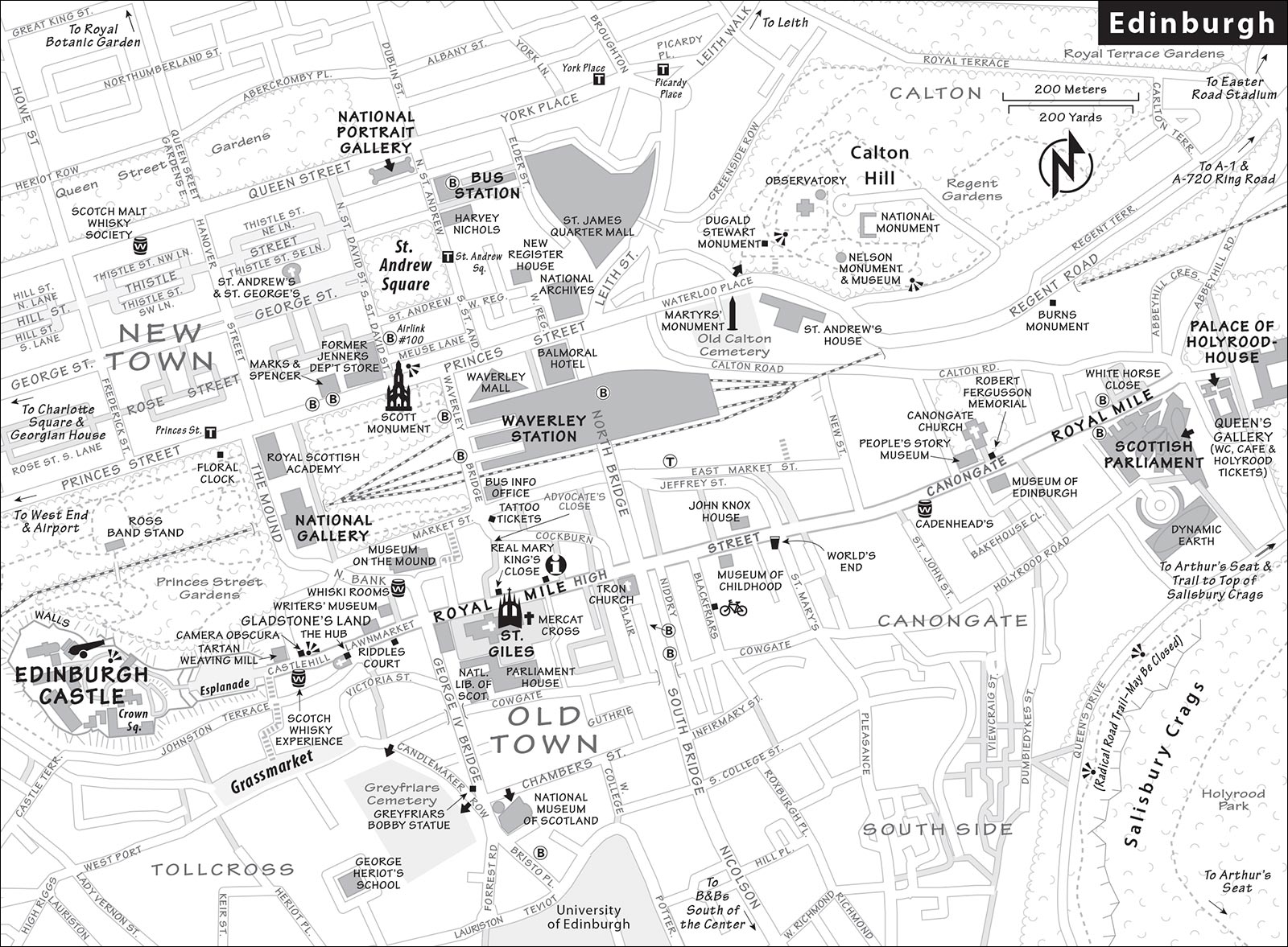
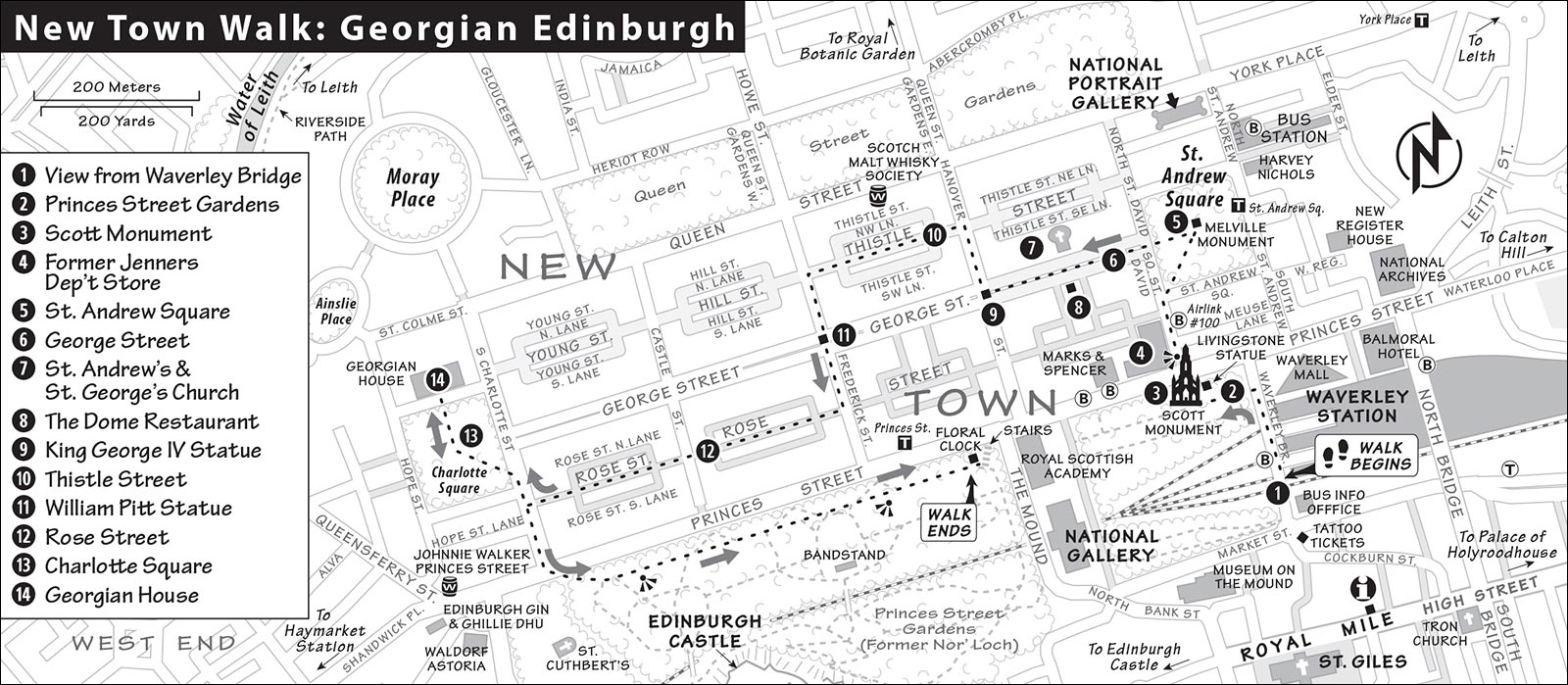
Map: New Town Walk: Georgian Edinburgh
SHOPPING STREETS AND NEIGHBORHOODS
Map: Edinburgh City Center Hotels
Map: West End Hotels & Restaurants
Map: B&Bs & Restaurants South of the City Center
Map: Edinburgh City Center Eateries
IN THE B&B NEIGHBORHOOD, TO THE SOUTH
ROUTE TIPS FOR DRIVERS HEADING SOUTH
Edinburgh is the historical, cultural, and political capital of Scotland. For nearly a thousand years, Scotland’s kings, parliaments, writers, thinkers, and bankers have called Edinburgh home. Today, it remains Scotland’s most sophisticated city.
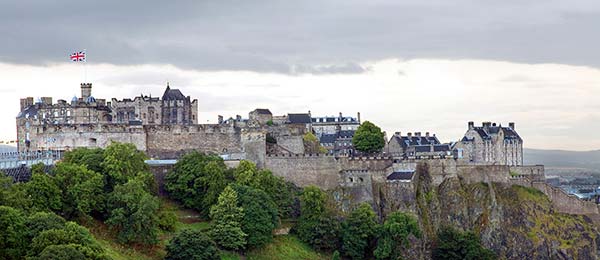
Edinburgh (ED’n-burah—only tourists pronounce it like “Pittsburgh”) is Scotland’s showpiece and one of Europe’s most entertaining cities. It’s a place of stunning vistas—nestled among craggy bluffs and studded with a prickly skyline of spires, towers, domes, and steeples. The commanding Edinburgh Castle sits boldly on a rock high above it all. Proud statues of famous Scots dot the urban landscape. Many of the buildings, a harmonious yellow-gray, are built from the same local sandstone.
Culturally, Edinburgh has always been the place where Lowland culture (urban and English) met Highland style (rustic and Gaelic). Tourists will find no end of traditional Scottish clichés: kilt shops, bagpipe-playing buskers, and gimmicky tours featuring Scotland’s bloody history and ghost stories. Whisky tastings abound.
Today’s Edinburgh is big in banking, scientific research, and scholarship at its four universities. Since 1999, when Scotland regained a measure of self-rule, Edinburgh reassumed its place as home of the Scottish Parliament. The city hums with life. Students and professionals pack the pubs and art galleries. It’s especially lively in August, when the Edinburgh Festival takes over the town. Historic, monumental, fun, and well organized, Edinburgh is a tourist’s delight.
PLANNING YOUR TIME
While the major sights can be seen in a day, I’d give Edinburgh two days and three nights.
Day 1: Tour the castle, then take my self-guided Royal Mile walk, stopping in at St. Giles’ Cathedral and whichever shops and museums interest you (Gladstone’s Land is especially worthwhile). At the bottom of the Mile, consider visiting the Scottish Parliament, the Palace of Holyroodhouse, or both. If the weather and your energy are good, you could tackle Arthur’s Seat, the ancient hill that rises up behind the palace.
Day 2: Visit the National Museum of Scotland. After lunch, stroll through the Scottish National Gallery. Then follow my self-guided walk through the New Town, visiting the Scottish National Portrait Gallery and the Georgian House—or zip out to Leith to squeeze in a quick tour of the good ship Britannia (confirm last entry time before you go).
Evenings: Options include various “haunted Edinburgh” walks, the literary pub crawl, or live music. Perhaps the most authentic evening out is just settling down in a pub to sample the whisky and local beers while meeting the locals...and attempting to understand them through their thick Scottish accents.
Orientation to Edinburgh
A VERBAL MAP
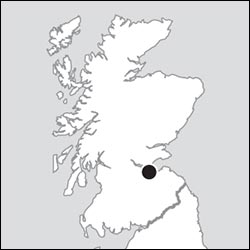
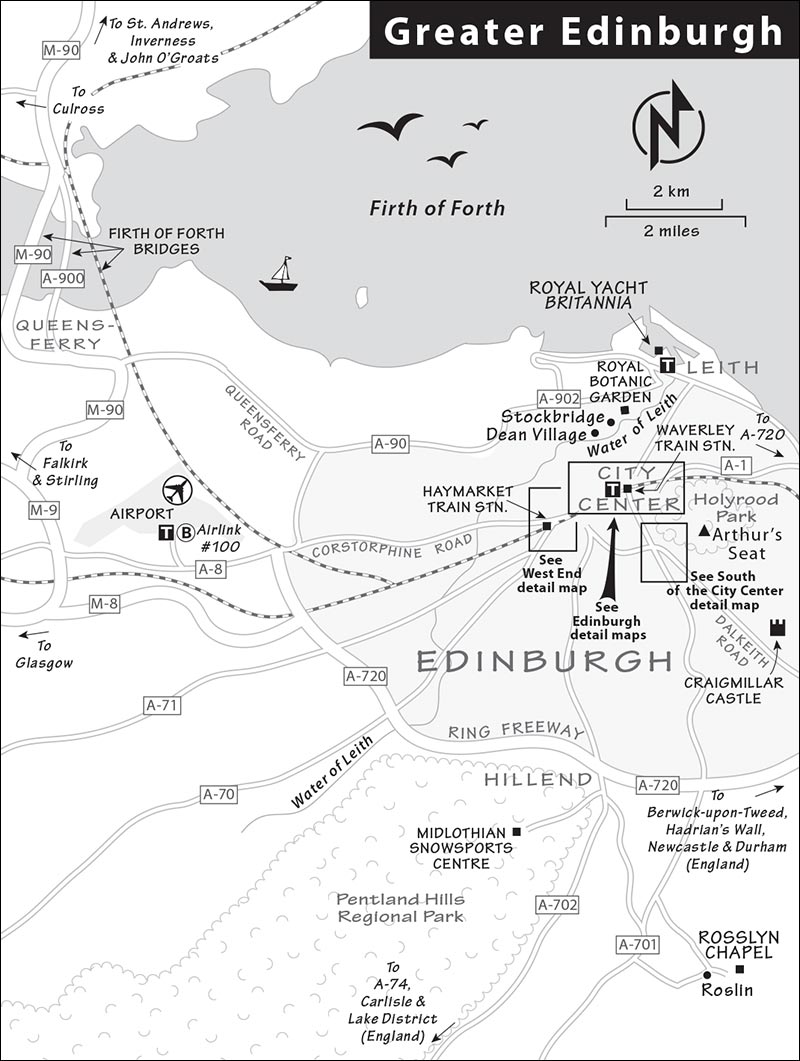
With 500,000 people (835,000 in the metro area), Edinburgh is Scotland’s second-biggest city, after Glasgow. But the tourist’s Edinburgh is compact: Old Town, New Town, West End, and the B&B area south of the city center.
Edinburgh’s Old Town stretches across a ridgeline slung between two bluffs. From west to east, this “Royal Mile” runs from the Castle Rock—which is visible from anywhere in town—to the base of the 822-foot extinct volcano called Arthur’s Seat. Along this colorful labyrinth of cobbled streets and narrow lanes, medieval skyscrapers stand shoulder to shoulder, hiding peaceful courtyards. For visitors, this east-west axis is the center of the action. Just south of the Royal Mile are the university and the National Museum of Scotland; farther to the south is a handy B&B neighborhood that lines up along Dalkeith Road and Mayfield Gardens.
A few hundred yards north of the Old Town lies the New Town. In this magnificent planned neighborhood from the 1700s, you’ll enjoy upscale shops, broad boulevards, straight streets, square squares, circular circuses, and Georgian mansions decked out in Greek-style columns and statues.
Just to the west of the New Town, the West End, near Charlotte Square, is a prestigious and quieter neighborhood boasting more Georgian architecture, cobbled lanes, fine dining options, and a variety of concert and theater venues.
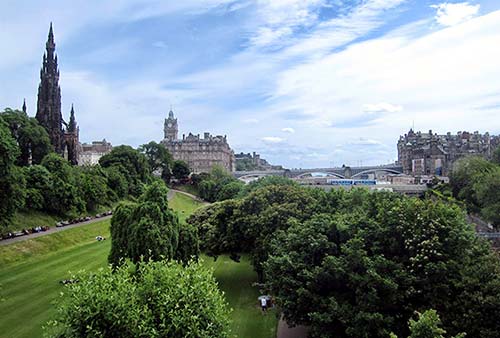
In the center of it all—in a drained lakebed between the Old and New Towns—sit the Princes Street Gardens park and Waverley Bridge, where you’ll find Waverley train station, Waverley Mall, a bus info office (starting point for most city bus tours), and the Scottish National Gallery.
TOURIST INFORMATION
The TI, branded “iCentre,” is on the Royal Mile across from St. Giles’ Cathedral. Though the office has the feel of a booking agency for local tours, they offer a good free map and the staff can answer most questions (daily 9:30-17:00, may close 13:00-14:00 for lunch; 249 High Street, +44 131 473 3820, www.visitscotland.com). If you’re interested in evening music, ask for the free monthly Gig Guide.
Sightseeing Passes: Edinburgh Tours sells a £65 Royal Edinburgh Ticket that covers 48 hours of unlimited travel on three different hop-on, hop-off buses (described under “Tours in Edinburgh,” later), plus admission at Edinburgh Castle, the Palace of Holyroodhouse, and the Royal Yacht Britannia (www.royaledinburghticket.co.uk). This is a good deal if you plan to use the buses and see all three sights. If your travels take you beyond Edinburgh, consider the Historic Scotland’s Explorer Pass, which can save money if you visit the castles at both Edinburgh and Stirling, or are also visiting the Orkney Islands (for details, see here). You’ll need to book an entry time for Edinburgh Castle with either pass.
ARRIVAL IN EDINBURGH
By Train: Most long-distance trains arrive at Waverley Station in the city center (those staying at West End accommodations might consider disembarking instead at Haymarket Station). Waverley Station is a bit of a maze; follow signs carefully to find your way. For groceries to go, M&S Simply Food, near track 2, is economical and efficient (long hours daily). There are three major exits:
Princes Street Exit: Use this exit to reach buses to B&Bs south of the city center. Follow signs for #1, Princes Street. You’ll ride a series of escalators (passing the Waverley Mall on your left) and pop out along busy Princes Street, facing the New Town. Cross the street and head left to the two bus stops in front of the Marks & Spencer store. Numerous buses go from here to the B&B neighborhood south of the city center; confirm bus numbers and stops on Google Maps or with your B&B host.
Waverley Bridge Exit: This exit sends you up a long ramp; you’ll pop out between the Old Town and the New Town, handy for those who’d like to walk to either area.
Market Street Exit: The nearest official taxi stand is outside this exit. Once outside, turn left and walk 100 yards under the bridge to find the taxis.
By Bus: Scottish Citylink, Megabus, and National Express buses use the bus station (with luggage lockers) in the New Town, two blocks north of Waverley Station just past St. Andrew Square.
By Car: No matter where you’re coming from, avoid needless driving in the city by taking advantage of Edinburgh’s bypass road, A-720. To conveniently reach my recommended B&Bs, circle the city on the A-720 (direction: Edinburgh South), until the last roundabout, named Sheriffhall. Exit the roundabout at the first left (A-7 Edinburgh). From here it’s four miles to the B&B neighborhood south of the center. After a while, the A-7 becomes Dalkeith Road. If you see the huge Royal Commonwealth Pool, you’ve gone a couple of blocks too far.
By Plane: Edinburgh’s airport is eight miles west of downtown—about a 30-minute tram or taxi ride. For information, see “Edinburgh Connections,” at the end of this chapter.
HELPFUL HINTS
Book Ahead: Reservations are a must for just about everything in August, when the biggest festivals are on. You’ll want to buy tickets for Edinburgh Castle as early as you can; in summer it’s also smart to reserve ahead for the Camera Obscura and the Palace at Holyroodhouse.
Markets: On weekends, open-air markets have food stalls and artisans (10:00-16:00, www.stockbridgemarket.com). Saturday is at Grassmarket (below the castle) and in Leith (at Dock Place), plus there’s a Saturday morning farmers market in the Edinburgh Castle parking lot. Sunday is market day in Stockbridge, along Saunders Street and the Water of Leith Walkway.
Festivals: August is a crowded, popular month in Edinburgh thanks to the multiple festivals hosted here, including the official Edinburgh International Festival, the Fringe Festival, and the Military Tattoo. Book ahead for hotels, events, and restaurant dinners, and expect to pay significantly more for your room. Many museums and shops have extended hours in August. For more festival details, see here.
Baggage Storage: There’s a luggage storage office at the train station and cheaper lockers at the bus station near St. Andrew Square, just two blocks north.
Laundry: The Ace Cleaning Centre launderette is located between my recommended B&Bs south of town and the city center (full service or do-it-yourself, pick-up/delivery possible, Mon, Tue, Thu 8:00-19:30, Wed and Fri until 16:00, Sat 9:00-17:00, Sun 10:00-16:00, right at the Bernard Terrace bus stop, 13 South Clerk Street—see map on here, +44 131 667 0549, www.acelaunderetteanddrycleaners.co.uk). In the West End, Johnsons the Cleaners will do your laundry (Mon-Fri 8:30-17:30, Sat until 17:00, closed Sun, 5 Drumsheugh Place—see map on here, +44 131 225 8077).
Bike Rental and Tours: The laid-back crew at Cycle Scotland happily recommends good bike routes with your rental (e-bikes available, generally open daily 10:00-18:00, closed mid-Nov-mid-March, just off Royal Mile at 29 Blackfriars Street, +44 131 556 5560, www.cyclescotland.co.uk, Peter). They also run guided three-hour bike tours daily at 11:00 that start on the Royal Mile and ride through Holyrood Park, Arthur’s Seat, Duddingston Village, Doctor Neil’s (Secret) Garden, and along the Innocent railway path (£35/person, £50/person for e-bikes, book ahead).
Dress for the Weather: Weather blows in and out—bring your sweater and be prepared for rain.
GETTING AROUND EDINBURGH
By Bus: Many of Edinburgh’s sights are within walking distance of one another, but Lothian city buses come in handy—especially if you’re staying at a B&B south of the city center. Numerous buses run between the New Town, South Bridge on the Royal Mile, and the B&B neighborhood south of town. Bus #35 runs along the Royal Mile between South Bridge and the Scottish Parliament, and is useful for connecting the Royal Mile to the National Museum or Leith (Royal Yacht Britannia). Double-decker buses have fine views upstairs.
A single ride costs £2; pay with a contactless card, payment app, or exact change (tell the driver “single ticket”). Contactless payment is automatically capped at £4.80/day or £22/week. A £5 day ticket, covering buses and the tram (see below), can be purchased from bus drivers or tram ticket machines. If you purchase from a bus driver, be sure to ask for a paper ticket.
Mapping apps like Google Maps work great for determining the best bus for your journey, including real-time departure times and delays. Pick up a route map at the TI or at the TravelHub bus information office at the Old Town end of Waverley Bridge (+44 131 555 6363, www.lothianbuses.com).
By Tram: Edinburgh’s single tram line runs every seven minutes from 6:00 until midnight and connects the airport, central Edinburgh, and the port at Leith (£2/ride, £5 day ticket includes Lothian city buses, £7.50 to airport, buy at ticket machine before boarding—credit card or exact change, www.edinburghtrams.com). There are handy stops near my recommended West End hotels, Princes Street and St. Andrew Square near the Waverley train station, and the Royal Yacht Britannia.
By Taxi or Uber: The 1,300 taxis cruising Edinburgh’s streets are easy to flag down (a ride between downtown and the B&B neighborhood south of the center costs about £8-10; rates go up after 18:00 and on weekends). You can hail cabs on the street (taxis can turn on a dime, so hail them in either direction) or call +44 131 228 1211 or +44 131 229 2468.
You can also summon a taxi using Uber or the Free Now app (easy to set up, works like Uber). Uber may save a few pounds—or cost more during “surge” times; use the Free Now app to compare Uber and taxi prices.
Tours in Edinburgh
Royal Mile Walking Tours
Walking tours are an Edinburgh specialty; you’ll see groups trailing entertaining guides all over town. Below I’ve listed good all-purpose walks; for literary pub crawls and ghost tours, see “Nightlife in Edinburgh” on here.
Edinburgh Tour Guides offers a good historical walk (without all the ghosts and goblins). Their Royal Mile tour is a gentle three-hour downhill stroll from the top of the Mile to the palace (£25; daily at 9:30 and 19:00—evening tour is only two hours; meet outside Tolbooth Church/The Hub, near the top of the Royal Mile; must reserve ahead, +44 785 888 0072, www.edinburghtourguides.com). Their other offerings include Outlander-themed Edinburgh walks and day tours.
Mercat Tours offers a “Secrets of the Royal Mile” walk that’s more entertaining than intellectual (£22, 1.5 hours; £40 adds optional, 45-minute guided Edinburgh Castle visit that lets you skip the ticket line; daily at 10:00 and 13:00, leaves from Mercat Cross on the Royal Mile, +44 131 225 5445, www.mercattours.com). The guides, who enjoy making a short story long, ignore the big sights and take you behind the scenes with piles of barely historical gossip, bully-pulpit Scottish pride, and fun but forgettable trivia. They also offer ghost walks, whisky tastings, and Outlander sights, among others.
Sandemans New Edinburgh runs “free” tours multiple times daily; you won’t pay upfront, but the guide will expect a tip (check schedule online, 2.5 hours, meet at 130 High Street, www.neweuropetours.eu).
The Voluntary Guides Association offers free two-hour walks during the Edinburgh Festival. You don’t need a reservation—just show up (check website for times, generally depart from City Chambers across from St. Giles’ Cathedral on the Royal Mile, www.edinburghfestivalguides.org). You can also hire their guides (for a small fee) for private tours outside of festival time.
Blue Badge Local Guides
The following guides charge similar prices and offer half-day and full-day tours: Jean Blair (a delightful teacher and guide, walking tours only—no car, £190/half-day, £295/day, +44 798 957 0287, www.travelthroughscotland.com); Sergio La Spina (an Argentinean who adopted Edinburgh as his hometown more than 30 years ago, £220/half-day, £320/day, can also do driving tours, +44 797 330 6579, www.vivaescocia.com; Ken Hanley (who wears his kilt as if pants don’t exist, £180/half-day, £350/day, extra charge if he uses his car—seats up to six, +44 771 034 2044, www.small-world-tours.co.uk); Liz Everett (walking tours only—no car; £215/half-day, £315/day, +44 782 168 3837, liz.everett@live.co.uk); Maggie McLeod (another top-notch guide, £200/half-day walking tour, £700 day trips with car to farther-flung destinations +44 775 151 6776, www.scotlandandmore.com); and Ann Stewart (a former high-school geography teacher turned guide who is excited to show you around Edinburgh or Glasgow, £225/half-day, £325/day, +44 771 635 8997, www.comeseescotland.com). Ann is also available for full-day guided excursions outside either city in her car (rates negotiable).
Hop-On, Hop-Off Bus Tours
Three one-hour hop-on, hop-off bus tour routes, all run by the same company, circle the town center, stopping at the major sights. Edinburgh Tour (green buses) focuses on the city center, with live guides (stay on for the entire 75-minute loop if you like your guide). City Sightseeing (red buses, focuses on Old Town) has recorded commentary, as does the Majestic Tour (blue-and-yellow buses, goes to the port of Leith and includes a stop at the Britannia and Royal Botanic Garden). You can pay for just one tour (£16/24 hours), but most people pay a few pounds more for a ticket covering all buses (£22/24 hours, £26/48 hours). It’s a great convenience to be able to hop on any bus that goes by with the same ticket (buses run April-Oct roughly 9:00-18:00, shorter hours off-season; about every 10 minutes, buy tickets on board or online, +44 131 475 0618, www.edinburghtour.com). On sunny days, the buses go topless. As is true for most such tours, there’s patter the entire time but almost nothing of real importance other than identifying what you’re driving by.
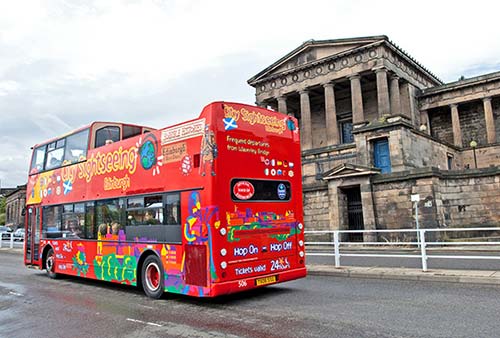
The 3 Bridges Tour combines a hop-on, hop-off bus to South Queensferry with a boat tour on the Firth of Forth (£30, 3-3.5 hours total).
Day Trips from Edinburgh
Many companies run a variety of day trips to regional sights, as well as multiday and themed itineraries. (Several of the local guides listed earlier have cars, too.)
The most popular tour is the all-day Highlands trip, which gives those with limited time a chance to experience the wonders of Scotland’s wild and legend-soaked Highlands in a single long day (about £55-75, roughly 8:00-20:00). Itineraries vary, but you’ll generally visit/pass through the Trossachs, Rannoch Moor, Glencoe, Fort William, Fort Augustus on Loch Ness (some tours offer an optional boat ride), and Pitlochry. To save time, look for a tour that gives you a short glimpse of Loch Ness rather than driving its entire length or doing a boat trip. (Once you’ve seen a little of it, you’ve seen it all.) Also popular are all-day tours of locations from the Outlander novels and TV series (similar price and timing); for more about Outlander sights, see here.
Larger outfits, typically using bigger buses, include Timberbush Tours (www.timberbush-tours.co.uk), Gray Line (www.graylinescotland.com), Highland Experience (www.highlandexperience.com), and Highland Explorer (www.highlandexplorertours.com). Rabbie’s (www.rabbies.com) keeps its group sizes small, using 16-seat minibuses.
For young backpackers, Haggis Adventures runs day tours plus overnight trips of up to 10 days (www.haggisadventures.com).
At Discreet Scotland, Matthew Wight and his partners specialize in tours of greater Edinburgh and Scotland in spacious SUVs—good for families (£505/2 people, 8 hours, +44 798 941 6990, www.discreetscotland.com).
Walks in Edinburgh
I’ve outlined two walks in Edinburgh: along the Royal Mile, and through the New Town. Many of the sights we’ll pass on these walks are described in more detail later, under “Sights in Edinburgh.”
THE ROYAL MILE
4 Bank/High Streets Intersection
10 Scottish Parliament Building
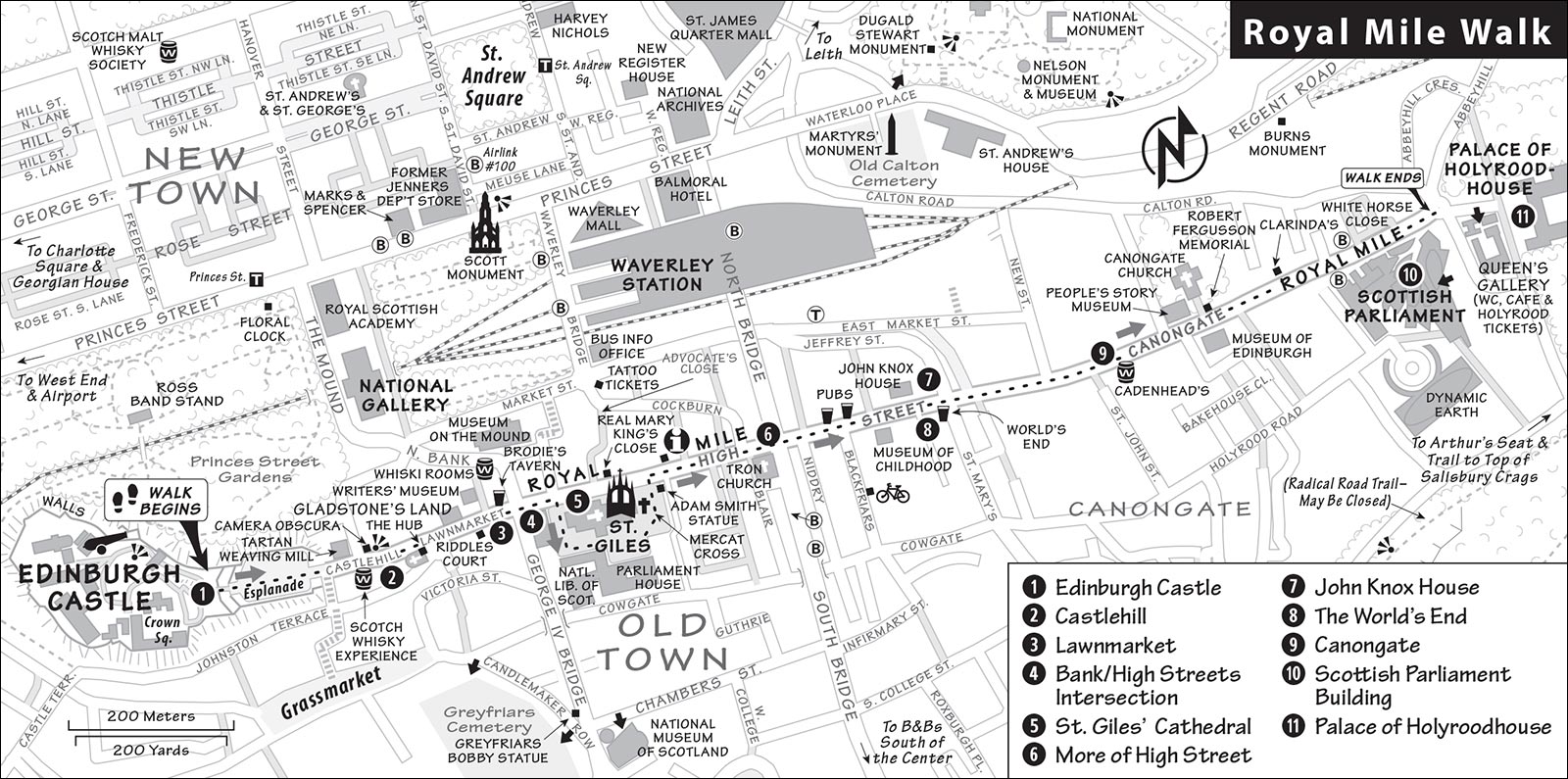
The Royal Mile is one of Europe’s most interesting historic walks (rated ▲▲▲).  Download my free Royal Mile Walk audio tour and I’ll narrate as you walk.
This 1.5-hour walk covers the Royal Mile’s landmarks but skips the many museums and indoor sights along the way (these are described in walking order under “Sights in Edinburgh,” later in this chapter). Doing this walk as an orientation upon arrival in the early morning or evening allows you to focus on the past without having to dodge crowds. You can return later to stroll the same walk during the much livelier business hours when shops, museums, and the cathedral are all open.
Another option is to review the sight descriptions beforehand, plan your walk around their open hours, and pop into those that interest you as you pass them. Several of the sights you’ll pass on this walk are free to enter (though some request a small donation), including the Writers’ Museum, St. Giles’ Cathedral, the old Parliament House, People’s Story Museum, Museum of Edinburgh, and Scottish parliament building.
Overview
Start at Edinburgh Castle at the top and amble down to the Palace of Holyroodhouse. The street itself changes names—Castlehill, Lawnmarket, High Street, and Canongate—but it’s a straight, downhill shot totaling just over one mile. And nearly every step is packed with shops, cafés, and lanes leading to tiny squares.
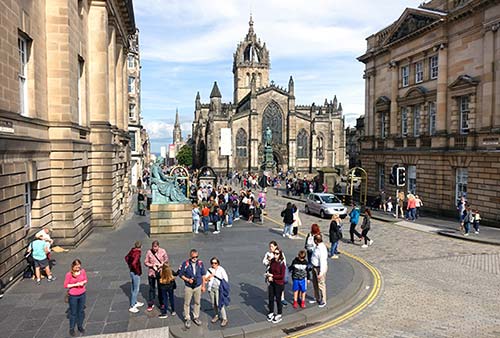
Celtic tribes (and maybe the Romans) once occupied the rock at the top, where the castle stands today. As the town grew, it spilled downhill along the sloping ridge that became the Royal Mile. Because this strip of land is so narrow, there was no place to build but up. So, in medieval times, it was densely packed with multistory tenements—large edifices under one roof that housed a number of tenants.
As you walk, you’ll be tracing the growth of the city: its birth atop Castle Hill, its Old Town heyday in the 1600s, its expansion in the 1700s into the Georgian New Town (leaving the old quarter an overcrowded, disease-ridden Victorian slum), and on to the 21st century at the modern Scottish parliament building (2004).
Most of the Royal Mile feels like one long Scottish shopping mall, selling all manner of kitschy souvenirs (known locally as “tartan tat”), shortbread, and whisky. But the streets are also packed with history, and if you push past the postcard racks into one of the many side alleys, you can still find a few surviving rough edges of the old city. Despite the drizzle, be sure to look up—spires, carvings, and towering Gothic “skyscrapers” give this city its unique urban identity.
As you stroll this mostly traffic-free tourist strip, you’ll navigate a can-can of low-grade souvenir shops and eateries, tourists with rolling suitcases, and cruise groups following their guides’ umbrellas. Along the way, you’ll be entertained by buskers, perused by pickpockets, hit up by beggars, and tempted by street merchants. Oh, and as it’s quite haunted, you may feel the presence of a few ghosts.
• We’ll start at the castle esplanade, the big parking lot at the entrance to...
1 Edinburgh Castle
Edinburgh was born on the bluff—a big rock—where the castle now stands. Since before recorded history, people have lived on this strategic, easily defended perch (for a self-guided castle tour, see its sight listing, later).
The castle esplanade—built as a military parade ground (1816)—is now the site of the annual Military Tattoo. This spectacular massing of regimental bands fills the square nightly for most of August. Fans watch from temporary bleacher seats to see kilt-wearing dancers and bagpipers marching against the spectacular backdrop of the castle. (It takes three months to set up the bleachers, so you’ll see them, in some form, for most of the summer—and if the area is closed off, you may need to start this walk down where the esplanade meets the road.)
When the bleachers aren’t up, there are fine views in both directions from the esplanade. Facing north, you’ll see the body of water called the Firth of Forth (the estuary where the River Forth flows into the North Sea) and Fife beyond that. Still facing north, find the lacy spire of the Scott Monument and two Neoclassical buildings housing art galleries. Beyond them, the stately buildings of Edinburgh’s New Town rise. Panning to the right, find the Nelson Monument and some faux Greek ruins atop Calton Hill.
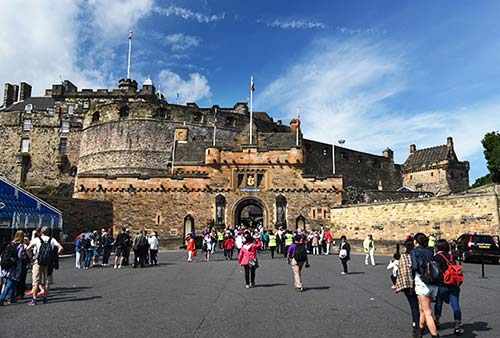
The city’s many bluffs, crags, and ridges were built up by volcanoes, then carved down by glaciers—a city formed in “fire and ice,” as the locals say. During the Ice Age, as glaciers swept in from the west (behind today’s castle), they ran into the super-hard volcanic basalt of Castle Rock and flowed around it, cutting valleys on either side and leaving a tail that became the Royal Mile you’re about to walk.
At the bottom of the esplanade, where the square hits the road, look left (with your back to the castle) to find a plaque on the wall above the tiny witches’ well (now a planter, on the side of the Tartan Weaving Mill). This memorializes 300 women who were accused of witchcraft and burned here. Below was the Nor’ Loch, the swampy lake where those accused of witchcraft were bound and dropped into the water. If they sank and drowned, they were innocent. If they floated, they were guilty, and were burned here in front of the castle, providing the city folk a nice afternoon out. The plaque shows two witches: one good and one bad. Tickle the serpent’s snout to sympathize with the witches. (I just made that up.)
• Start walking down the bustling Royal Mile. The first block is a street called...
2 Castlehill
The big, squat, tank-like building immediately on your left was formerly the Old Town’s reservoir. While it once held 1.5 million gallons of water, today it’s filled with the touristy Tartan Weaving Mill (open daily 9:00-18:30), a massive four-floor complex selling every kind of Scottish cliché. At the bottom level (a long way down) is a floor of big looms and weavers sometimes at work.
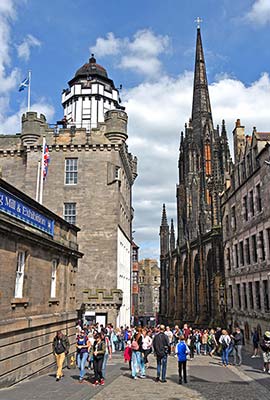
The black-and-white tower ahead on the left has entertained visitors since the 1850s with its camera obscura, a darkened room where a mirror and a series of lenses capture live images of the city surroundings outside. (Giggle at the funny mirrors as you walk fatly by.) Across the street, filling the old Castlehill Primary School, is a gimmicky if intoxicating whisky-sampling exhibit called the Scotch Whisky Experience (a.k.a. “Malt Disney”; see the “Whisky and Gin Tasting” sidebar, later).
• Just ahead, in front of the church with the tall lacy spire, is the old market square known as...
3 Lawnmarket
During the Royal Mile’s heyday, in the 1600s, this intersection was bigger and served as a market for fabric (especially “lawn,” a linen-like cloth). The market would fill this space with hustle, bustle, and lots of commerce. The round white hump in the middle of the roundabout is all that remains of the official weighing beam called the Butter Tron—where all goods sold were weighed for honesty and tax purposes.
Towering above Lawnmarket, with the highest spire in the city, is the former Tolbooth Church. This impressive Neo-Gothic structure (1844) is now nicknamed the Hub and functions as Edinburgh’s festival-ticket and information center. While it’s closed much of the year, during the festivities this is a handy stop for its WC, café, and information. The world-famous Edinburgh Festival fills the month of August with cultural action, while other August festivals feature classical music, traditional and fringe theater (especially comedy), art, books, and more.
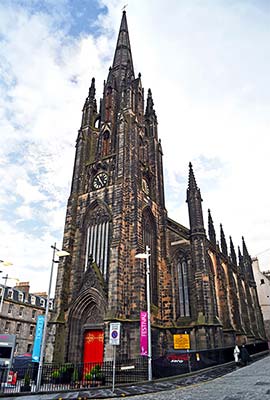
In the 1600s, this—along with the next stretch, called High Street—was the city’s main street. At that time, Edinburgh was bursting with breweries, printing presses, and banks. Tens of thousands of citizens were squeezed into the narrow confines of the Old Town.
Here on this ridge stood tenements (multiple-unit residences), rising 10 stories and more; they were some of the tallest domestic buildings in Europe. The living arrangements shocked class-conscious English visitors to Edinburgh because rich and poor alike occupied the tenements—usually the poor in the cellars and attics, and the rich in the middle floors.
• Continue a half-block down the Mile.
Gladstone’s Land (at #477b, on the left), a surviving original tenement, was acquired by a wealthy merchant in 1617. Stand in front of the building and look up at this centuries-old skyscraper. This design was standard for its time: a shop or shops on the ground floor, with columns and an arcade, and residences on the floors above. Because window glass was expensive, the lower halves of window openings were made of cheaper wood, which swung out like shutters for ventilation—and were convenient for tossing out garbage. Now a museum, Gladstone’s Land is worth visiting for its intimate look at life here 400 years ago.
Branching off the spine of the Royal Mile are narrow alleyways that go by various local names. A “wynd” (rhymes with “kind”) is a narrow, winding lane. A “pend” is an arched gateway. “Gate” is from an Old Norse word for street. And a “close” is a tiny alley between two buildings (originally with a door that “closed” at night). A “close” usually leads to a “court,” or courtyard.
To explore one of these alleyways, head into Lady Stair’s Close (on the left, 10 steps downhill from Gladstone’s Land). This alley pops out in a small courtyard, where you’ll find the Writers’ Museum. It’s free and well worth a visit for fans of Scotland’s holy trinity of writers (Robert Burns, Sir Walter Scott, and Robert Louis Stevenson), but also for a glimpse of what a typical home might have looked like in the 1600s. Burns actually lived for a while in this neighborhood, in 1786, when he first arrived in Edinburgh. Notice that the courtyard is paved with stones memorializing various Scottish-born writers.
Opposite Gladstone’s Land (at #322), another close leads to Riddles Court. Wander through here and imagine Edinburgh in the 17th and 18th centuries, when tourists came to marvel at its skyscrapers. Some 40,000 people were jammed into the few blocks between here and the World’s End pub (which we’ll reach soon). Visualize the labyrinthine maze of the old city, with people scurrying through these back alleyways.
No city in Europe was as densely populated—or perhaps as filthy. Without modern hygiene, it was a living hell of smoke, stench, and noise, with the constant threat of fire, collapse, and disease. The dirt streets were soiled with sewage from bedpans emptied out windows. By the 1700s, the Old Town was rife with poverty and disease. The smoky home fires rising from tenements and the infamous smell (or “reek” in Scottish) that wafted across the city gave it a nickname that sticks today: “Auld Reekie.”
• Return to the Royal Mile and continue down it a few steps to take in some sights at the...
4 Bank/High Streets Intersection
Several sights cluster here, where Lawnmarket changes its name to High Street and intersects with Bank Street and George IV Bridge.
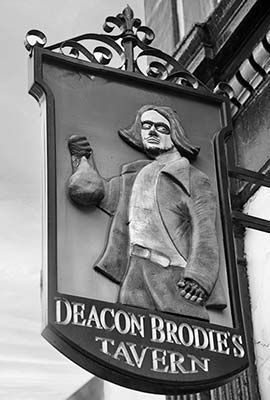
Begin with Deacon Brodie’s Tavern, on the left corner. Read the “Doctor Jekyll and Mr. Hyde” story of this pub’s notorious namesake on the wall facing Bank Street. Then, to see his spooky split personality, check out both sides of the hanging signpost. Brodie—a pillar of the community by day but a burglar by night—epitomizes the divided personality of 1700s Edinburgh. It was a rich, productive city—home to great philosophers and scientists, who actively contributed to the Enlightenment. Meanwhile, the Old Town was riddled with crime and squalor. The city was scandalized when this respected surgeon—driven by a passion for medical research and needing corpses—was accused of colluding with two lowlifes, named Burke and Hare, to acquire freshly murdered corpses for dissection. (A century later, novelist Robert Louis Stevenson would capture the dichotomy of Edinburgh’s rich-poor society—and, perhaps, borrow some specifics from the tale of Brodie himself—in his Strange Case of Dr. Jekyll and Mr. Hyde.)
In the late 1700s, Edinburgh’s upper class moved out of the Old Town into a planned community called the New Town (a quarter-mile north of here). Eventually, most tenements were torn down and replaced with newer Victorian buildings. You’ll see some at this intersection.
Look left down Bank Street to the green-domed building. From 1805, this was the headquarters of the Bank of Scotland, the country’s first and oldest bank, founded in 1695 to capitalize and develop trade. The building now houses the Museum on the Mound, with a free exhibit on banking history. It’s also the Scottish headquarters for Lloyds Banking Group, which swallowed up the Bank of Scotland after the financial crisis of 2008.
If you detour left down Bank Street toward the bank, you’ll find the recommended Whiski Rooms Shop. If you head in the opposite direction, down George IV Bridge, you’ll reach the National Library of Scotland (with its fine “Treasures” exhibit), the excellent National Museum of Scotland, the famous Greyfriars Bobby statue, photogenic Victoria Street, which leads to the pub-lined Grassmarket square (all described later in this chapter), and several recommended eateries. Victoria Street is so dreamy, many Harry Potter fans figure it must be the inspiration for that series’ Diagon Alley.
Across the street from Deacon Brodie’s Tavern is a seated green statue of hometown boy David Hume (1711-1776)—one of the most influential thinkers not only of Scotland, but in all of Western philosophy. The atheistic Hume was one of the towering figures of the Scottish Enlightenment of the mid-1700s. Thinkers and scientists were using the scientific method to challenge and investigate everything, including religion. Hume questioned cause and effect in thought puzzles such as this: We can see that when one billiard ball strikes another, the second one moves, but how do we know the collision “caused” the movement? Notice his shiny toe: People on their way to trial (in the high court just behind the statue) or students on their way to exams (in the nearby university) rub it for good luck.
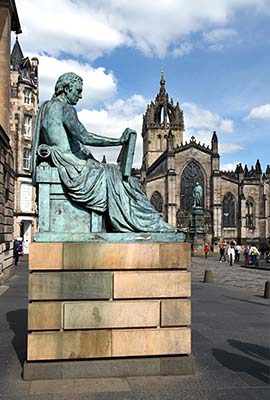
Follow David Hume’s gaze to the opposite corner, where a brass H in the pavement marks the site of the last public execution in Edinburgh in 1864. Deacon Brodie himself would have been hung about here (in 1788, on gallows whose design he had helped to improve—smart guy).
• From the brass H, continue down the Royal Mile, pausing just before the church square at a stone wellhead with the pyramid cap.
All along the Royal Mile, wellheads like this (from 1835) provided townsfolk with water in the days before buildings had plumbing. These neighborhood wells were served by the reservoir up at the castle. Imagine long lines of people in need of water standing here, gossiping and sharing the news. Eventually buildings were retrofitted with water pipes—the ones you see running along building exteriors.
• Ahead of you (past the Victorian statue of some duke), embedded in the cobblestones near the street, is a big heart.
The Heart of Midlothian marks the spot of the city’s 15th-century municipal building and jail. In times past, in a nearby open space, criminals were hanged, traitors were decapitated, and witches were burned. Citizens hated the rough justice doled out here. Locals still spit on the heart in the pavement. Go ahead...do as the locals do—land one right in the heart of the heart. By the way, Edinburgh has two soccer teams—Heart of Midlothian (known as “Hearts”) and Hibernian (“Hibs”). If you’re a Hibs fan, spit again.
• Make your way to the entrance of the church.
5 St. Giles’ Cathedral
This is the flagship of the Church of Scotland (Scotland’s largest denomination)—called the “Mother Church of Presbyterianism.” The interior serves as a kind of Scottish Westminster Abbey, filled with monuments, statues, plaques, and stained-glass windows dedicated to great Scots and moments in history.
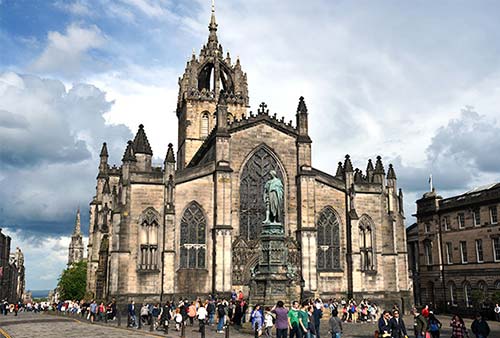
A church has stood on this spot since 854, though this structure is an architectural hodgepodge, dating mostly from the 15th through 19th century. In the 16th century, St. Giles was a kind of national stage on which the drama of the Reformation was played out. The reformer John Knox (1514-1572) was the preacher here. His fiery sermons helped turn once-Catholic Edinburgh into a bastion of Protestantism. During the Scottish Reformation, St. Giles was transformed from a Catholic cathedral to a Presbyterian church. The spacious interior is well worth a visit (for a self-guided tour, see here).
• Facing the church entrance, curl around its right side, into a parking lot.
Sights Around St. Giles
The grand building across the parking lot from St. Giles is the old Parliament House. Since the 13th century, the king had ruled a rubber-stamp parliament of nobles and bishops. But the Protestant Reformation promoted democracy, and the parliament gained real power. From the early 1600s until 1707, this building evolved to become the seat of a true parliament of elected officials. That came to an end in 1707, when Scotland signed an Act of Union, joining what’s known today as the United Kingdom and giving up its right to self-rule. (More on that later in the walk.) To peek inside, head through the door at #11 (described on here).
The great reformer John Knox is buried—with appropriate austerity—under parking lot spot #23. The statue among the cars shows King Charles II riding to a toga party back in 1685.
• Continue through the parking lot, around the back end of the church.
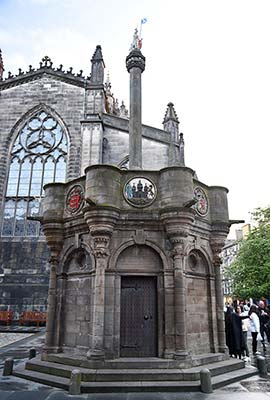
Every Scottish burgh (town licensed by the king to trade) had three standard features: a “tolbooth” (basically a Town Hall, with a courthouse, meeting room, and jail); a “tron” (official weighing scale); and a “mercat” (or market) cross. The mercat cross standing just behind St. Giles’ Cathedral has a slender column decorated with a unicorn holding a flag with the cross of St. Andrew. Royal proclamations have been read at this mercat cross since the 14th century. In 2022, a town crier heralded the news that Britain had a new king—three days after the actual event (traditionally the time it took for a horse to speed here from London). Today, Mercat Cross is the meeting point for many of Edinburgh’s walking tours—both historic and ghostly.
• Circle around to the street side of the church, to the statue at the nearest corner.
This memorial to Adam Smith honors the Edinburgh author of the pioneering Wealth of Nations (1776), in which he laid out the economics of free-market capitalism. Smith theorized that an “invisible hand” wisely guides the unregulated free market. Stand in front of Smith and imagine the intellectual energy of Edinburgh in the mid-1700s, when it was Europe’s most enlightened city. Adam Smith was right in the center of it. He and David Hume were good friends. James Boswell, the famed biographer of Samuel Johnson, took classes from Smith. James Watt, inventor of the steam engine, was another proud Scotsman of the age. With great intellectuals like these, Edinburgh helped create the modern world. The poet Robert Burns, geologist James Hutton (who’s considered the father of modern geology), and the publishers of the first Encyclopedia Britannica all lived in Edinburgh. Steeped in the inquisitive mindset of the Enlightenment, they applied cool rationality and a secular approach to their respective fields.
Across the street from Smith, you’ll see the entrance to a fun attraction called The Real Mary King’s Close (described under “Sights in Edinburgh”).
• Head on down the Royal Mile.
6 More of High Street
Continuing down this stretch of the Royal Mile, which is traffic-free most of the day (notice the bollards that raise and lower for permitted traffic), you’ll see the Fringe Festival shop (on the right, at #180), street musicians, and another wellhead (with horse “sippies,” dating from 1675).
Notice those three red boxes. In the 20th century, people used these to make telephonic calls to each other. (Imagine that!) These cast-iron booths were produced in Scotland for all of Britain. As phone booths are decommissioned, some are finding new use as tiny shops and ATMs, and even showing up in residential neighborhoods as nostalgic garden decorations.
At the next intersection, on the left, is Cockburn Street (pronounced “COE-burn”), with a reputation for its eclectic independent shops and string of trendy bars and eateries. In the Middle Ages, only tiny lanes (like Fleshmarket Close just uphill) interrupted the long line of Royal Mile buildings. Cockburn Street was cut through High Street’s dense wall of medieval buildings in the 1860s to give easy access to the Georgian New Town and the train station. Notice how the sliced buildings were thoughtfully capped with facades that fit the aesthetic look of the Royal Mile.
• When you reach the Tron Church (with a fine 17th-century interior, currently housing history exhibits and shops), you’re at the intersection of North and South Bridge streets. These major streets lead left to Waverley Station and right to the B&B neighborhood south of the center. Several handy bus lines run along here.
This is the halfway point of this walk. Stand on the corner diagonally across from the church. Look up to the top of the Royal Mile at the former Tolbooth Church and its 240-foot spire. In front of that, take in the spire of St. Giles’ Cathedral—inspired by the Scottish crown and the thistle, Scotland’s national flower.
Downhill, with its faux turret and made-up 16th-century charm, the Radisson Blu Hotel is entirely new construction, dating only from 1990 but built to fit in. The city is protecting its historic look. The Inn on the Mile, directly across, was once a fancy bank with a lavish interior. As modern banks are moving away from city centers, their sumptuous buildings are being converted into ornate pubs and restaurants.
Continue downhill. In the next block are two characteristic pubs (The Mitre and Whiski) that offer free folk music many evenings. On the facing buildings, notice the chimneys. Tenement buildings shared stairways and entries, but held individual apartments, each with its own chimney.
• Go down High Street another block, passing near the Museum of Childhood (on the right, at #42, and worth a stop).
Across the street, just below another wellhead, is the...
7 John Knox House
Remember that Knox was a towering figure in Edinburgh’s history, converting Scotland to a Calvinist style of Protestantism. His religious bent was “Presbyterianism,” in which parishes are governed by elected officials rather than appointed bishops. This more democratic brand of Christianity also spurred Scotland toward political democracy. If you’re interested in Knox or the Reformation, this sight is worth a visit. Full disclosure: It’s not certain that Knox ever actually lived here. Attached to the Knox House is the Scottish Storytelling Centre, where locals with the gift of gab perform regularly; check the schedule posted outside during open hours.
• A few steps farther down High Street, at the intersection with St. Mary’s and Jeffrey streets, you’ll reach...
8 The World’s End
For centuries, a wall stood here, marking the end of the burgh of Edinburgh. For residents within the protective walls of the city, this must have felt like the “world’s end,” indeed. You can even pop in for a pint at the recommended World’s End pub, to your right. The area beyond was called Canongate, a monastic community associated with Holyrood Abbey. At the intersection, find the brass bricks in the street that trace the gate (demolished in 1764).
Look to the right down St. Mary’s Street about 200 yards to see a surviving bit of that old wall, known as the Flodden Wall. In the 1513 Battle of Flodden, the Scottish king James IV made the disastrous decision to invade northern England. James and 10,000 of his Scotsmen were killed. Fearing a brutal English counterattack, Edinburgh scrambled to reinforce its broken-down city wall.
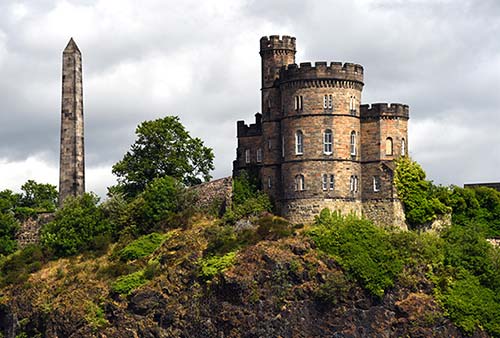
Look left down Jeffrey Street past the train tracks for a good view of Old Calton Cemetery up on Calton Hill. The obelisk, called Martyrs’ Monument, remembers a group of 18th-century patriots exiled by London to Australia for their reform politics. The round building to the left is the grave of philosopher David Hume. Today, the main reason to go up Calton Hill is for the fine views.
• Continue down the Royal Mile—leaving old Edinburgh—as High Street changes names to...
9 Canongate
A couple blocks farther along (on the right at #172) you reach Cadenhead’s, a serious whisky shop (see “Shopping in Edinburgh,” later in this chapter). Beyond that, you’ll pass two worthwhile and free museums, the People’s Story Museum (on the left, in the old tollhouse at #163) and the Museum of Edinburgh (on the right, at #142), with the entry to the characteristic Bakehouse Close next door. But our next stop is the church just across from the Museum of Edinburgh.
The 1688 Canongate Kirk (Church)—located not far from the royal residence of Holyroodhouse—is where the royal family worships whenever they’re in town. (So, don’t sit in the front pew, marked with a crown.) The gilded emblem at the top of the roof, high above the door, has the antlers of a stag from the royal estate of Balmoral.
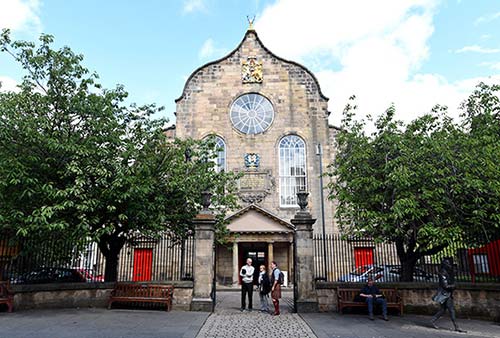
The church is open only when volunteers have signed up to welcome visitors. Chat them up and borrow the description of the place. Then step inside the lofty blue and red interior, renovated with royal money; the church is filled with light and the flags of various Scottish regiments. In the narthex, peruse the photos of royal family events here, and find the list of priests and ministers of this parish—it goes back to 1143 (with a clear break with the Reformation in 1561).
Outside, turn right as you leave the church and walk up into the graveyard. The large, gated grave (abutting the back of the People’s Story Museum) is the affectionately tended tomb of Adam Smith, the father of capitalism. (Throw him a penny or two.)
In the sidewalk in front of the church is a memorial to the poet Robert Fergusson, one of the first to write verse in the Scots language. He so inspired Robert Burns that Burns paid for Fergusson’s tombstone in the Canongate churchyard and composed his epitaph.
Now look across the street at the gabled house next to the Museum of Edinburgh. Scan the facade to see shells placed there in the 17th century to defend against the evil power of witches yet to be drowned.
• Walk about 300 yards farther along (past the recommended Clarinda’s Tea Room). In the distance you can see the Palace of Holyroodhouse (the end of this walk) and soon, on the right, you’ll come to the modern Scottish parliament building.
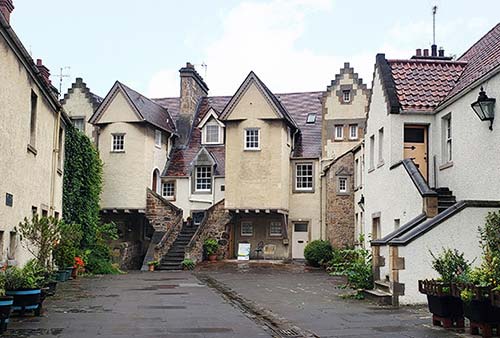
Just opposite the parliament building is White Horse Close (on the left; passage marked 27 in the white arcade that juts out over the sidewalk). Step into this 17th-century courtyard. It was from here that the Edinburgh stagecoach left for London. Eight days later, the horse-drawn carriage would pull into its destination: Scotland Yard.
• Now walk up around the corner to the flagpoles (flying the flags of Europe, Britain, and Scotland) in front of the...
10 Scottish Parliament Building
Finally, after centuries of history, we reach the 21st century. And finally, after three centuries of London rule, Scotland has a parliament building...in Scotland. When Scotland united with England in 1707, its parliament was dissolved. But in 1999, the Scottish parliament was reestablished, and in 2004, it moved into this striking home. Notice how the eco-friendly building, by the Catalan architect Enric Miralles, mixes wild angles, lots of light, bold windows, oak, and native stone into a startling complex. (People from Catalunya—another would-be breakaway nation—have an affinity for Scotland.) From the front of the parliament building, look in the distance at the rocky Salisbury Crags, where people hike the traverse up to the dramatic next summit called Arthur’s Seat. Now look at the building in relation to the craggy cliffs. The architect envisioned the building as if it were rising right from the base of Arthur’s Seat, almost bursting from the rock.
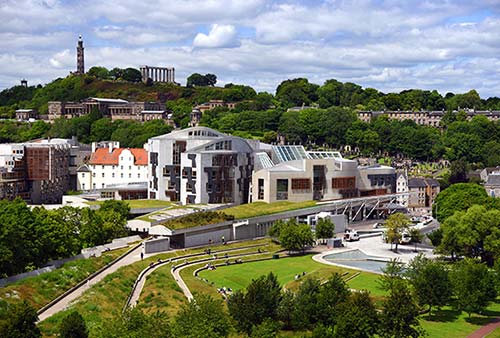
Since it celebrates Scottish democracy, the architecture is not a statement of authority. There are no statues of old heroes. There’s not even a grand entry. You feel like you’re entering an office park. Given its neighborhood, the media often calls the Scottish Parliament “Holyrood” for short (similar to calling the US Congress “Capitol Hill”).
• Across the street is the Queen’s Gallery, with a sampling of the late Queen Elizabeth II’s personal art collection (may be closed for renovation when you visit). Finally, walk to the end of the road (Abbey Strand), and step up to the impressive wrought-iron gate of the palace. Look up at the stag with its holy cross, or “holy rood,” on its forehead, and peer into the palace grounds. (The ticket office and palace entryway, a fine café, and a handy WC are just through the arch on the right.)
11 Palace of Holyroodhouse
Since the 16th century, this palace has marked the end of the Royal Mile. An abbey—part of a 12th-century Augustinian monastery—originally stood in its place. While most of that old building is gone, you can see the surviving nave behind the palace on the left. According to one legend, it was named “holy rood” for a piece of the cross, brought here as a relic by Queen (and later Saint) Margaret. Another version of the story is that King David I, Margaret’s son, saw the image of a cross upon a stag’s head while hunting here and took it as a sign that he should build an abbey on the site.
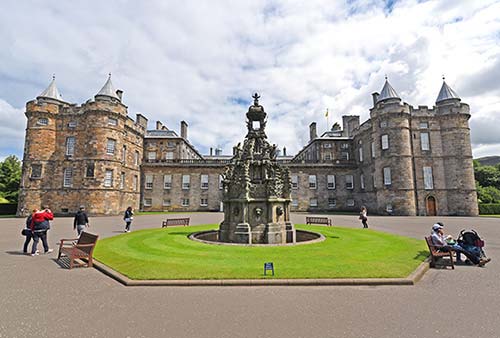
Because Scotland’s royalty preferred living at Holyroodhouse to the blustery castle on the rock, the palace grew over time. If the royals aren’t visiting, the palace welcomes visitors.
• Your walk—from the castle to the palace, with so much Scottish history packed in between—is complete. But if your appetite is whetted, don’t worry, there’s much more to see. Enjoy the rest of Edinburgh.
NEW TOWN WALK: GEORGIAN EDINBURGH
Many visitors, mesmerized by the Royal Mile, never venture to the New Town. And that’s a shame. With the city’s finest Georgian architecture (from its 18th-century boom period), the New Town has a completely different character than the Old Town. This self-guided walk—worth ▲▲—gives you a quick orientation in about one hour.
• Begin on Waverley Bridge, spanning the gully between the Old and New towns; to get there from the Royal Mile, just head down the curved Cockburn Street near the Tron Church (or cut down any of the “close” lanes opposite St. Giles Cathedral). Stand on the bridge overlooking the train tracks, facing the castle.
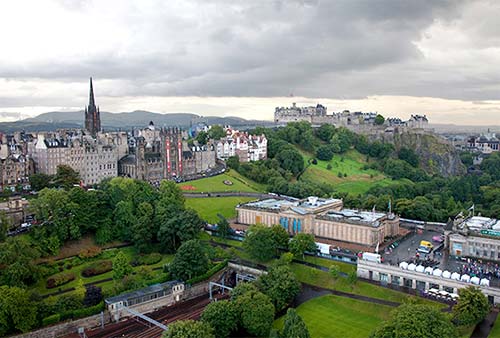
1 View from Waverley Bridge: From this vantage point, you can enjoy fine views of medieval Edinburgh, with its 10-story-plus “skyscrapers.” It’s easy to imagine how miserable crowding in the Old Town prompted the city to expand during the Georgian period. Pick out landmarks along the Royal Mile, most notably the open-work “thistle steeple” of St. Giles.
A big lake called the Nor’ Loch once was to the north (nor’) of the Old Town; now it’s a valley between Edinburgh’s two towns. The lake was drained around 1800 as part of the expansion. Before that, the lake was the town’s water reservoir...and its sewer. The town’s nickname, “Auld Reekie,” referred to both the smoke of its industry and the stench of its squalor.
The long-gone loch was also a handy place for drowning witches. With their thumbs tied to their ankles, they’d be lashed to dunking stools. Those who survived the ordeal were considered “aided by the devil” and burned as witches. If they died, they were innocent and given a good Christian burial. Edinburgh was Europe’s witch-burning mecca—any perceived “sign,” including a small birthmark, could condemn you. Scotland burned more witches per capita than any other country—17,000 souls between 1479 and 1722.
Facing the Old Town, look right and visually trace the train tracks as they disappear into a tunnel below the Scottish National Gallery (with the best collection anywhere of Scottish paintings; you can visit it during this walk; it’s described in “Sights in Edinburgh,” later). The two fine Neoclassical buildings of the National Gallery date from the 1840s and sit upon a mound that’s called...The Mound. When the New Town was built, tons of rubble from the excavations were piled here (1781-1830), forming a dirt bridge that connected the new development with the Old Town to allay merchant concerns about being cut off from the future heart of the city.
Turning 180 degrees (and facing the ramps down into the train station), notice the huge, turreted building with the clock tower. (The clock is famously four minutes fast to help locals not miss their trains.) The Balmoral was one of the city’s two grand hotels during its glory days (its opposite bookend, the Waldorf Astoria Edinburgh, sits at the far end of the former lakebed—near the end of this walk). Aristocrats arriving by train could use a hidden entrance to go from the platform directly up to their plush digs.
• Now walk across the bridge toward the New Town. Before the corner, enter the gated gardens on the left, and head toward the big, pointy monument. You’re at the edge of...
2 Princes Street Gardens: This grassy park, filling the former lakebed, offers a wonderful escape from the bustle of the city. Once the private domain of the wealthy, it was opened to the public around 1870—not as a democratic gesture, but in hopes of increasing sales at the Princes Street department stores. Join the office workers for a picnic lunch break.
• Take a seat on the bench as encouraged by the statue of Livingstone (Dr. Livingstone, I presume?). The Victorian explorer is well equipped with a guidebook but is hardly packing light—his lion skin doesn’t even fit in his rucksack carry-on.
Look up at the towering...
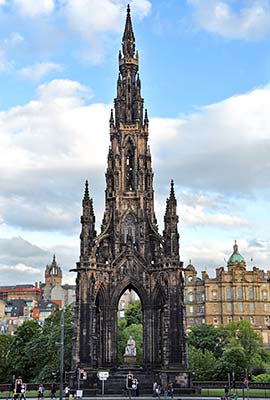
3 Scott Monument: Built in the early 1840s, this elaborate Neo-Gothic monument honors the great author Sir Walter Scott, one of Edinburgh’s many illustrious sons. When Scott died in 1832, it was said that “Scotland never owed so much to one man.” Scott almost singlehandedly created the image of the Scotland we know. Just as the country was in danger of being assimilated into England, Scott celebrated traditional songs, legends, myths, architecture, and kilts, thereby reviving Highland culture and cementing a national identity. And, as the father of the Romantic historical novel, he contributed to Western literature in general. Nicknamed “the Gothic Rocket,” this 200-foot-tall monument shelters a marble statue of Scott and his favorite pet, Maida, a deerhound who was one of 30 canines this dog lover owned during his lifetime. Climbing the tight, stony spiral staircase of 220 steps earns you a peek at a tiny museum midway and a fine city view at the top (£8, open daily 10:00-15:30 but may close 12:30-13:45; 30-minute tours depart on the half hour, last tour at 15:30; www.edinburghmuseums.org.uk).
• Exit the park and head across busy Princes Street to the...
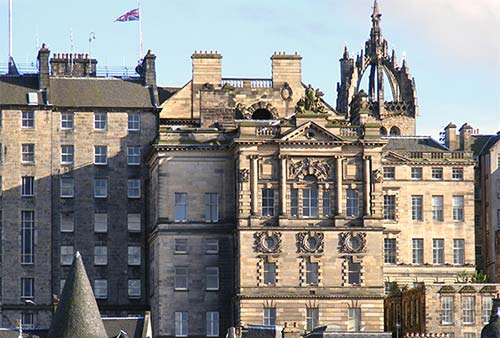
4 Former Jenners Department Store: As you wait for the light to change, notice how statues of women support the building—just as real women once supported the business. The arrival of new fashions here was such a big deal in the old days that they’d announce it by flying flags on the Nelson Monument atop Calton Hill (which you can see in the distance on the right). But Jenners began to struggle in the age of online shopping. After 183 years of continuous operation, it closed its doors during the Covid-19 lockdown...and never reopened. Plans call for refurbishment of this historic building, likely with a new tenant.
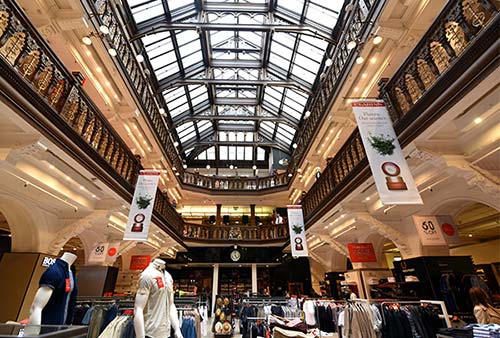
• Walk straight up South St. David Street. At the top of the block, kitty-corner on your right, you’ll see...
5 St. Andrew Square: This green space is dedicated to the patron saint of Scotland. In the early 19th century, there were no shops around here—just fine residences, and this was a private garden for the fancy people living here. Now open to the public, the square is a popular lunch hangout for workers. The Melville Monument honors a powermonger member of parliament who, for four decades (around 1800), was nicknamed the “uncrowned king of Scotland.”
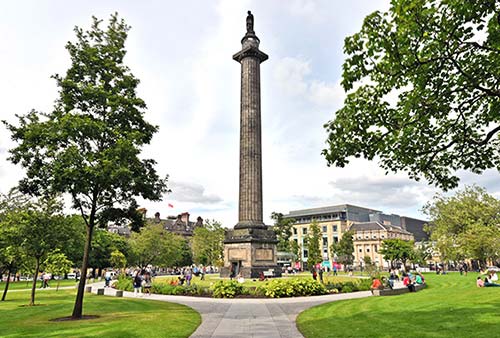
One block beyond the top of the park on Queen Street is the excellent Scottish National Portrait Gallery, which introduces you to the biggest names in Scottish history.
• Follow the Melville Monument’s gaze straight ahead out of the park. Cross the street and stand at the top of...
6 George Street: This is the main drag of Edinburgh’s grid-planned New Town. Laid out in 1776, when King George III was busy putting down a revolution in a troublesome overseas colony, the New Town was a model of urban planning. The architectural style is “Georgian”—British for “Neoclassical.” And the street plan came with an unambiguous message: to celebrate the union of Scotland with England into the United Kingdom. (This was particularly important, since Scotland was just two decades removed from the failed Jacobite uprising of Bonnie Prince Charlie.)
If you look at a map, you’ll see the politics in the street plan: St. Andrew Square (patron saint of Scotland) and Charlotte Square (George III’s queen) bookend the New Town, with its three main streets named for the royal family of the time (George, Queen, and Princes). Thistle and Rose streets—which we’ll see near the end of this walk—are named for the national flowers of Scotland and England.
The plan for the New Town was the masterstroke of the 23-year-old urban designer James Craig. George Street—20 feet wider than the others (so a four-horse carriage could make a U-turn)—was the main drag. Running down the high spine of the area, it afforded grand, unobstructed views. As you stroll down George Street, you’ll notice that, with Craig’s grid, grand cross streets come with fine Old Town and river views to the left and right, and monuments seem placed to accentuate the perspectives.
• Halfway down the first block of George Street, on the right, is...
7 St. Andrew’s and St. George’s Church: Designed as part of the New Town plan in the 1780s, the church is a product of the Scottish Enlightenment. It has an elliptical plan (the first in Britain) so that all can focus on the pulpit. If it’s open, step inside. The church conveys the idea that God is space, light, reason, and ordered beauty. A fine leaflet tells the story of the church, and a handy cafeteria downstairs serves cheap and cheery lunches.
• Directly across the street from the church is another temple, this one devoted to money.
8 The Dome: This former bank building now houses a recommended restaurant; consider ducking inside to view the stunning domed atrium. Its pediment is filled with figures demonstrating various ways to make money, which they do with all the nobility of classical gods.
• Continue down George Street to the intersection with a statue.
9 Statue of King George IV: This statue commemorates George IV’s visit to Edinburgh in 1822. Notice the particularly fine axis formed by this cross-street: The National Gallery lines up perfectly with the Royal Mile’s skyscrapers and the former Tolbooth Church, creating a Gotham City collage. If you look in the opposite direction, you’ll see the Firth of Forth glimmering in the distance—a reminder of how close Edinburgh is to the sea.
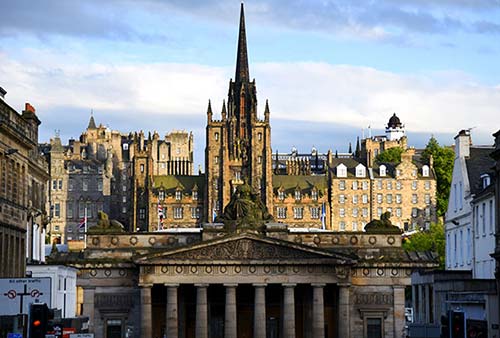
• By now you’ve gotten your New Town bearings. Feel free to stop this walk here: If you were to turn left and head down Hanover Street, in a block you’d run into the Scottish National Gallery; the street behind it curves back up to the Royal Mile.
But to see more of the New Town—including the Georgian House, offering an insightful look inside one of these fine 18th-century homes—stick with me for a few more long blocks, zigzagging through side streets to see the various personalities that inhabit this rigid grid.
Cross over Hanover Street, turn right, and walk along Hanover just one (short) block. Turn left down...
10 Thistle Street: Of the many streets in the New Town, this has perhaps the most vivid Scottish character. And that’s fitting, as it’s named after Scotland’s national flower. At the beginning and end of the street, also notice that Craig’s street plan included tranquil cul-de-sacs within the larger blocks. Thistle Street holds characteristic boutiques and good restaurants (see “Eating in Edinburgh,” later).
• You’ll soon reach Frederick Street. Turn left and head toward the...
11 Statue of William Pitt the Younger: Pitt was a prime minister under King George III during the French Revolution and the Napoleonic Wars. His father gave his name to the American city of Pittsburgh (which Scots pronounce as “Pitts-burrah”...I assume).
• For an interesting contrast, we’ll continue down another side street. Carrying on past the statue of Pitt (heading toward Edinburgh Castle), turn right onto...
12 Rose Street: As a rose is to a thistle, and as England is to Scotland, so is brash, boisterous Rose Street to sedate, thoughtful Thistle Street. This stretch of Rose Street is more commercialized, jammed with chain stores. The far end is packed with pubs and restaurants. As you walk, keep an eye out for the cobbled Tudor rose embedded in the brick sidewalk. When you cross the aptly named Castle Street, linger over the grand views to Edinburgh Castle. It’s almost as if they planned it this way...just for the views.
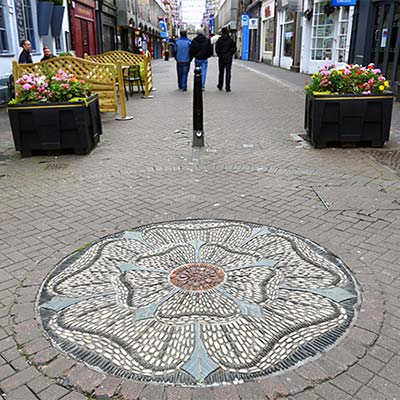
• Popping out at the far end of Rose Street, across the street and to your right is...
13 Charlotte Square: The building of the New Town started cheap with St. Andrew Square but finished well with this stately space. In 1791, the Edinburgh town council asked the prestigious Scottish architect Robert Adam to pump up the design for Charlotte Square. The council hoped that Adam’s plan would answer criticism that the New Town buildings lacked innovation or ambition—and they got what they wanted. Adam’s design, which raised the standard of New Town architecture to “international class,” created Edinburgh’s finest Georgian square. To this day, the fine garden filling the square is private, reserved for residents only.
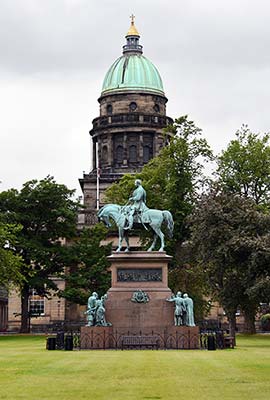
• Along the right side of Charlotte Square, at #7, you can visit the 14 Georgian House, which gives you a great peek behind these harmonious Neoclassical facades (see “Sights in Edinburgh,” later).
When you’re done touring the house, we’ll make a restful return to our starting point.
Return Through Princes Street Gardens: From Charlotte Square, drop down to busy Princes Street (noticing the red building to the right—the grand Waldorf Astoria Hotel and twin sister of The Balmoral at the start of our walk). But rather than walking along the busy bus-and-tram-lined shopping drag, head into Princes Street Gardens (cross Princes Street and enter the gate on the left). With the castle looming overhead on your right, walk back toward The Mound. You’ll pass a playground, a fanciful Victorian fountain, more monuments to great Scots, and war memorials). Finally, you’ll reach a staircase up to the Scottish National Gallery and the oldest floral clock in the world—perhaps telling you it’s time for a spot of tea.
• Our walk is over. From here, you can tour the gallery; head up Bank Street just behind it to reach the Royal Mile; or continue through the Princes Street Gardens to the Scott Monument and our starting point.
Sights in Edinburgh
SIGHTS ON AND NEAR THE ROYAL MILE
▲▲Scottish Parliament Building
▲Queen’s Gallery, Palace of Holyroodhouse
SIGHTS SOUTH OF THE ROYAL MILE
Greyfriars Bobby Statue and Greyfriars Cemetery
▲▲Scottish National Portrait Gallery
Scottish National Gallery of Modern Art
▲▲▲EDINBURGH CASTLE
The fortified birthplace of the city 1,300 years ago, this imposing symbol of Edinburgh sits proudly on a rock high above the town. The home of Scotland’s kings and queens for centuries, the castle has witnessed royal births, medieval pageantry, and bloody sieges. Today it’s a complex of various buildings, the oldest dating from the 12th century, linked by cobbled roads that survive from its more recent use as a military garrison. The castle—with expansive views, plenty of history, and the stunning crown jewels of Scotland—is a fascinating and multifaceted sight.
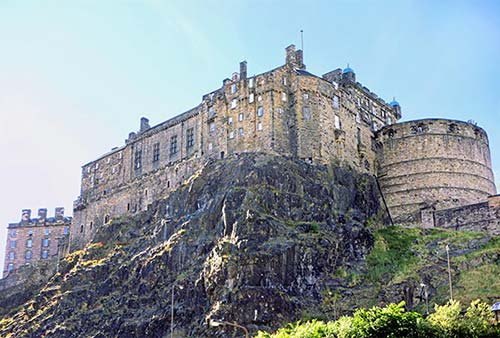
Cost and Hours: £19.50 for timed-entry ticket—book online; daily 9:30-18:00, Oct-March until 17:00, last entry one hour before closing; +44 131 668 8831, www.edinburghcastle.scot.
Advance Booking Essential: If you hope to get in, you’ll need to book a castle time slot before you go. Though you may get lucky and find an open slot at the last minute, it’s best to book as far in advance as you can, particularly in high season or if you’d like to join a tour (see below). Tickets are sold on-site only in the rare times that they haven’t already sold out online.
Advance Booking for Sightseeing Passes: Even if your castle admission is covered by a Historic Scotland’s Explorer Pass (described on here) or Royal Edinburgh Ticket (described on here), you’ll need to book an entry time in advance online.
When to Go: If you arrive shortly after the castle opens, you will likely not find a long line. There’s often an exodus after the one o’clock gun, and the castle is usually less crowded after 15:00.
Getting There: Simply walk up the Royal Mile (if arriving by bus from the B&B area south of the city, get off at South Bridge and huff up the Mile for about 15 minutes). Taxis get you closer, dropping you a block below the esplanade at Tolbooth Church/The Hub.
Tours: Official 30-minute guided tours can be booked when you buy your castle ticket (£21.50 for castle entry and tour, 4-6 tours per day). You can also rent an informative audioguide with four hours of descriptions, including the National War Museum Scotland (£3.50, pick up handset inside Portcullis Gate or download to your phone before coming to the castle, where Wi-Fi is spotty).
Eating: The $ Redcoat Café—just past the Argyle Battery—is a big, bright, efficient cafeteria with great views. On Crown Square, you’ll find $$ tea rooms with table service and afternoon tea (complete with sandwiches) served 11:00-15:00 (book ahead online when buying castle admission).
 Self-Guided Tour
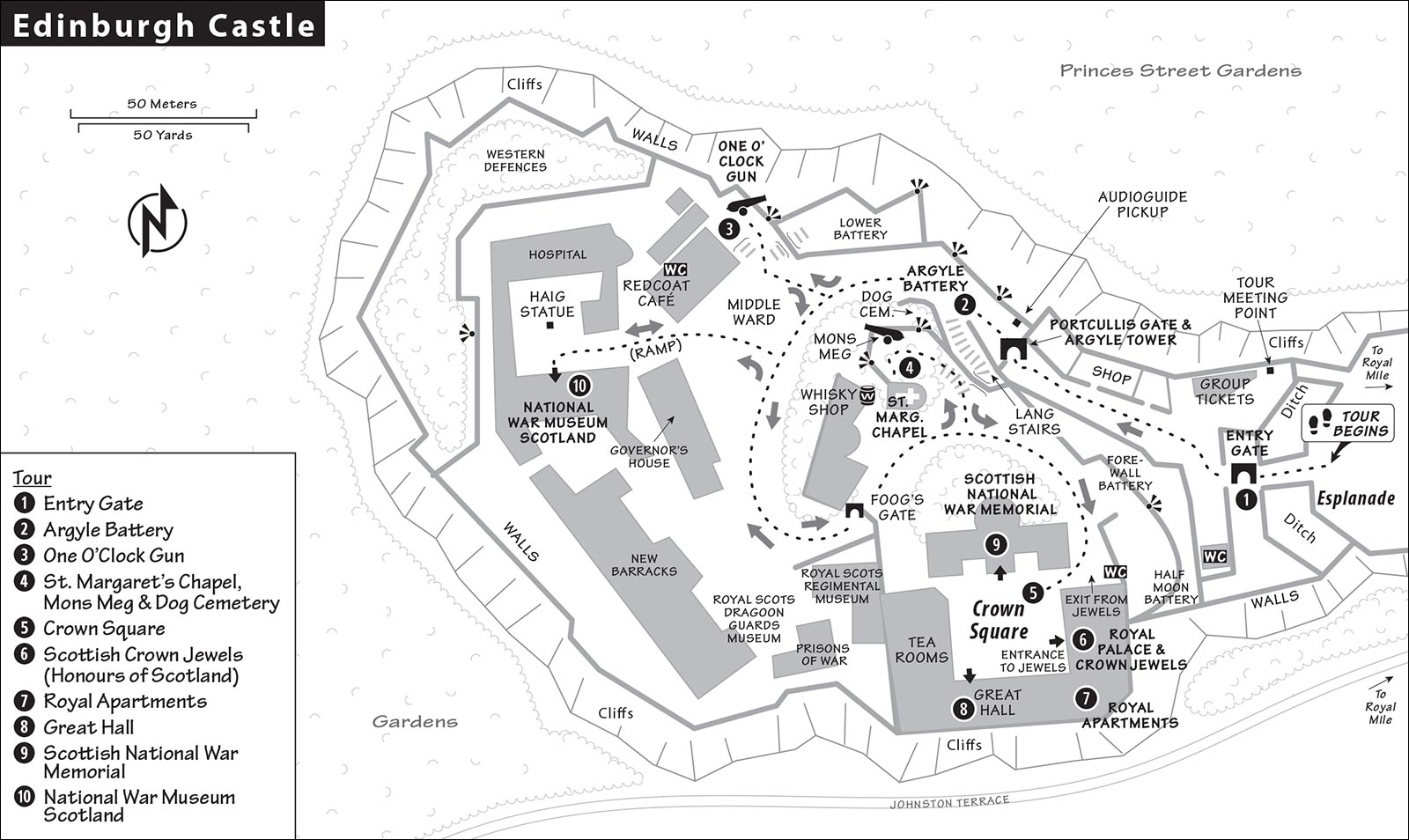
Seeing the castle’s highlights—described on this tour—takes about 1.5 hours.
1 Entry Gate: Approaching from the esplanade, you’re greeted by the two greatest Scottish heroes. Flanking the entryway are statues of the fierce warriors who battled English invaders, William Wallace (on the right) and Robert the Bruce (left). Between them is the Scottish motto, Nemo me impune lacessit—roughly, “No one messes with me and gets away with it.”
Once inside, start winding your way uphill toward the main sights—the crown jewels and the Royal Palace—located near the summit. Since the castle was protected on three sides by sheer cliffs, the main defense had to be here at the entrance. During the castle’s heyday in the 1500s, a 100-foot tower loomed overhead, facing the city.
• Passing through the portcullis gate, you reach the...
2 Argyle (Six-Gun) Battery, with View: These front-loading, cast-iron cannons are from the Napoleonic era, around 1800, when the castle was still a force to be reckoned with.
From here, look north across the valley to the grid of the New Town. The valley (directly below) sits where the Nor’ Loch once was; this lake was drained and filled in when the New Town was built in the late 1700s, its swamps replaced with gardens. Later the land provided sites for the Greek-temple-esque Scottish National Gallery (above the train line tunnels), Waverley Station (with its glass roof), and the tall, lacy Sir Walter Scott Memorial. Looking farther north, you can make out the port town of Leith (facing the island of Inchkeith), the Firth of Forth, and—in the far, far distance (to the extreme right)—the cone-like mountain of North Berwick Law, a former volcano.
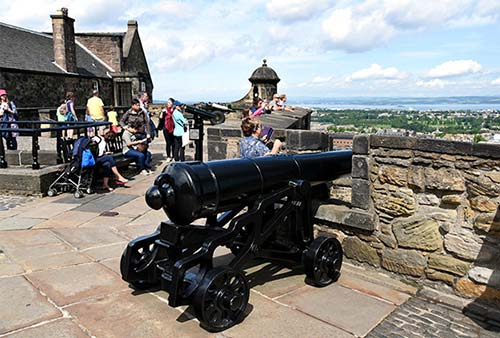
Now look down. The sheer north precipice looks impregnable. But on the night of March 14, 1314, 30 armed men silently scaled this rock face. They were loyal to Robert the Bruce and determined to recapture the castle, which had fallen into English hands. They caught the English by surprise, took the castle, and—three months later—Bruce defeated the English at the Battle of Bannockburn.
Looking back at the gate you just entered, the curved stairway to the right known as Lang Stairs leads steeply up to St. Margaret’s Chapel and Crown Square—where we’ll end up eventually. But we’ll take a more gradual approach.
• A little farther along, to the right of the Redcoat Café, is the...
3 One O’Clock Gun: Crowds gather for the 13:00 gun blast (which comes with a little military ceremony), a tradition that gives ships in the bay something to set their navigational devices by. Before the gun, sailors set their clocks with help from the Nelson Monument—that’s the tall pillar in the distance on Calton Hill. The monument has a “time ball” affixed to the cross on top, which drops precisely at the top of the hour. But on foggy days, ships couldn’t see the ball, so the cannon shot was instituted instead (1861). The tradition stuck, every day at 13:00. (Locals joke that the frugal Scots don’t fire it at high noon, as that would cost 11 extra rounds a day.) For more information, there’s a small exhibit just down the stairs.
• Continue uphill, winding to the left and passing through Foog’s Gate. At the very top of the hill, climb up the stairs on your left to reach...
4 St. Margaret’s Chapel: This tiny stone chapel is Edinburgh’s oldest building (around 1120) and sits atop its highest point (440 feet). It represents the birth of the city.
In 1057, Malcolm III murdered King Macbeth (of Shakespeare fame) and assumed the Scottish throne. Later, he married Princess Margaret, and the family settled atop this hill. Their marriage united Malcolm’s Highland Scots with Margaret’s Lowland Anglo-Saxons—the cultural mix that would define Edinburgh.
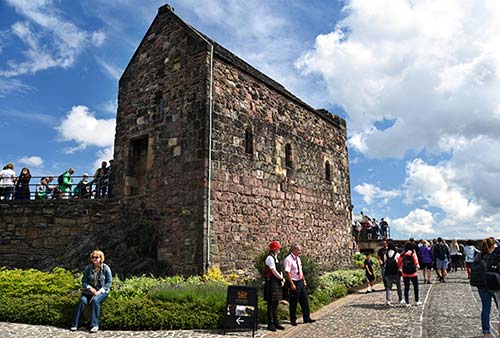
Step inside the tiny unadorned church, a testament to Margaret’s reputed piety. The elegant stone structure is Romanesque. The nave is wonderfully simple, with classic Norman zigzags decorating the round arch that separates the tiny nave from the sanctuary. You’ll see a facsimile of St. Margaret’s 11th-century gospel book. The small (19th-century Victorian) stained-glass windows feature St. Margaret herself, St. Columba, St. Ninian (who brought Christianity to Scotland in AD 397), St. Andrew (Scotland’s patron saint), and William Wallace (the defender of Scotland). These days, the place is popular for weddings. (As it seats only 20, it’s particularly popular with parents funding the festivities.)
Margaret died at the castle in 1093, and her son King David I built this chapel in her honor (she was sainted in 1250). David expanded the castle and also founded Holyrood Abbey, across town. These two structures were soon linked by a Royal Mile of buildings, and Edinburgh was born.
Mons Meg, in front of the church, is a huge and once-upon-a-time frightening 15th-century siege cannon that fired 330-pound stones nearly two miles. Look at the huge granite cannon balls and imagine. It was a gift from Philip the Good, duke of Burgundy, to his great-niece’s husband King James II of Scotland.
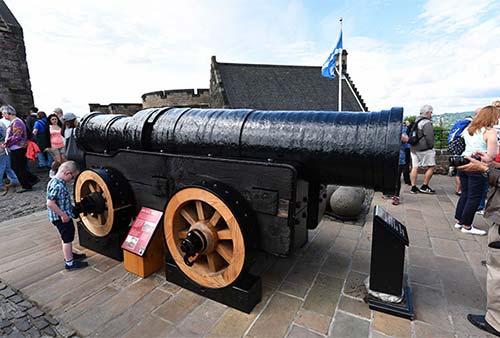
Nearby, belly up to the banister and look down to find the Dog Cemetery, a tiny patch of grass with a sweet little line of doggie tombstones, marking the graves of soldiers’ faithful canines-in-arms.
• Head back down the stairs and carry on straight ahead, along more cannons. Curve right around the big building to enter...
5 Crown Square: This courtyard is the center of today’s castle complex. Get oriented. You’re surrounded by the crown jewels, the Royal Palace (with its Great Hall), and the Scottish National War Memorial.
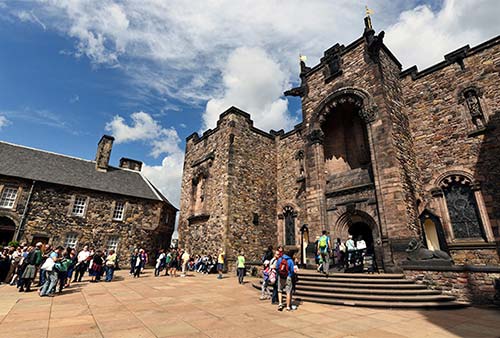
The castle has evolved over the centuries, and Crown Square is relatively “new.” After the time of Malcolm and Margaret, the castle was greatly expanded by David II (1324-1371), complete with tall towers, a Great Hall, dungeon, cellars, and so on. This served as the grand royal residence for two centuries. Then, in 1571-1573, the Protestant citizens of Edinburgh laid siege to the castle and its Catholic/monarchist holdouts, eventually blasting an earlier castle to smithereens. The palace was rebuilt nearby—around what is today’s Crown Square.
In 1286, Scotland’s king died without an heir, plunging the prosperous country into a generation of chaos. As Scottish nobles bickered over naming a successor, the English King Edward I—nicknamed “Longshanks” because of his long legs—invaded and assumed power (1296). He placed a figurehead on the throne, forced Scottish nobles to sign a pledge of allegiance to England (the “Ragman’s Roll”), moved the British parliament north to York, and took the highly symbolic Stone of Scone to London, where it would remain for centuries.
A year later, the Scots rose up against Edward, led by William Wallace. A mix of history and legend portrays Wallace as the son of a poor but knightly family that refused to sign the Ragman’s Roll. Exceptionally tall and strong, he learned Latin and French from two uncles, who were priests. In his teenage years, his father and older brother were killed by the English. Later, he killed an English sheriff to avenge the death of his wife, Marion. Wallace’s rage inspired his fellow Scots to revolt.
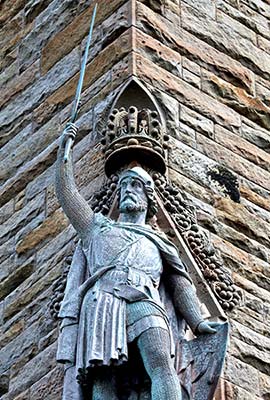
In the summer of 1297, Wallace and his guerrillas scored a series of stunning victories over the English. On September 11, a well-equipped English army of 10,000 soldiers and 300 horsemen began crossing Stirling Bridge. Wallace’s men attacked, and in the chaos, the bridge collapsed, splitting the English ranks in two. The ragtag Scots drove the confused English into the river. The Battle of Stirling Bridge was a rout, and Wallace was knighted and appointed guardian of Scotland.
All through the winter, King Edward’s men chased Wallace, continually frustrated by the Scots’ hit-and-run tactics. Finally, at the Battle of Falkirk (1298), they drew Wallace’s men out onto the open battlefield. The English with their horses and archers easily destroyed the spear-carrying Scots. Wallace resigned in disgrace and went on the lam, while his successors negotiated truces with the English, finally surrendering unconditionally in 1304. Wallace alone held out.
In 1305, the English tracked him down and took him to London, where he was convicted of treason and mocked with a crown of oak leaves as the “king of outlaws.” On August 23, they stripped him naked and dragged him to the execution site. There he was strangled to near death, castrated, and dismembered. His head was stuck on a spike atop London Bridge, while his body parts were sent on tour to spook would-be rebels. But Wallace’s martyrdom only served to inspire his countrymen, and Robert the Bruce picked up the torch of independence (see the next sidebar in this chapter).
• We’ll tour the buildings around Crown Square. First up: the crown jewels, on your left. There’s often a long line outside; pass the time by reading up on the history, next.
6 Scottish Crown Jewels: For centuries, Scotland’s monarchs were crowned in elaborate rituals involving three wondrous objects: a jewel-studded crown, scepter, and sword. This regalia, along with the ceremonial Stone of Scone (pronounced “skoon”), is known as the “Honours of Scotland.” Scotland’s crown jewels may not be as impressive as England’s, but locals treasure them as a symbol of Scottish nationalism. They’re also older than England’s; while Oliver Cromwell destroyed England’s jewels, the Scots managed to hide theirs.
History of the Jewels: In 1306, Robert the Bruce was crowned with a “circlet of gold” in a ceremony at Scone—a town 40 miles north of Edinburgh, which Scotland’s earliest kings had claimed as their capital. Around 1500, King James IV added two new items to the coronation ceremony—a scepter (a gift from the pope) and a huge sword (a gift from another pope). In 1540, James V had the original crown augmented by an Edinburgh goldsmith, giving it the imperial-crown shape it has today.
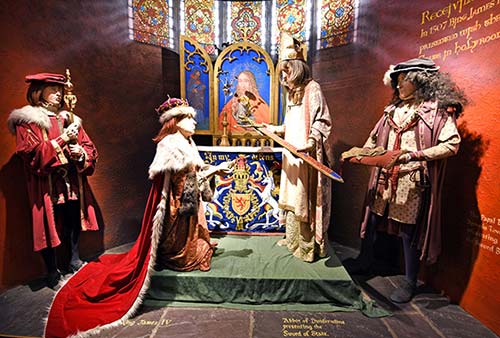
These Honours were used to crown every monarch: nine-month-old Mary, Queen of Scots (she cried); her one-year-old son James VI (future king of England); and Charles I and II. But the days of divine-right rulers were numbered.
In 1649, the parliament had Charles I (king of both England and Scotland) beheaded. Soon Cromwell’s rabid English antiroyalists were marching on Edinburgh. Quick! Hide the jewels! Legend says two women scooped up the crown and sword, hid them in their skirts, and buried them in a church far to the northeast until the coast was clear.
When the monarchy was restored, the regalia were used to crown Scotland’s last king, Charles II (1660). Then, in 1707, the Treaty of Union with England ended Scotland’s independence. The Honours came out for a ceremony to bless the treaty and were then locked away in a strongbox in the castle. There they lay for over a century, until Sir Walter Scott—the writer and great champion of Scottish tradition—forced a detailed search of the castle in 1818. The box was found...and there the Honours were, perfectly preserved. Within a few years, they were put on display, as they have been ever since.
The crown was taken across town to the grand opening of the reinstated parliament in 1999, marking a new chapter in the Scottish nation. As it represents the monarchy, the crown is present whenever a new session of parliament opens. (And if Scotland ever secedes, you can be sure that crown will be in the front row.)
The Honours: After spiraling up a short stone staircase, you’ll enter the Crown Room to see the regalia. The four-foot steel sword was made in Italy under orders of Pope Julius II (who also commissioned Michelangelo’s Sistine Chapel and St. Peter’s Basilica). The scepter is made of silver, covered with gold, and topped with a rock crystal and a pearl. The gem- and pearl-encrusted crown has an imperial arch topped with a cross. Legend says the band of gold in the center is the original crown that once adorned the head of Robert the Bruce.
The Stone of Scone (a.k.a. the “Stone of Destiny”) sits plain and strong next to the jewels. It’s a rough-hewn gray slab of sandstone, about 26 x 17 x 10 inches. As far back as the ninth century, Scotland’s kings were crowned atop this stone, when it stood at the medieval capital of Scone. But in 1296, the invading army of Edward I of England carried the stone off to Westminster Abbey. For the next seven centuries, English (and subsequently British) kings and queens were crowned sitting on a coronation chair with the Stone of Scone tucked in a compartment underneath.
In 1950, four Scottish students broke into Westminster Abbey on Christmas Day and smuggled the stone back to Scotland in an act of foolhardy patriotism. But what could they do with it? After three months, they abandoned the stone, draped in Scotland’s national flag. It was returned to Westminster Abbey, where (in 1953) Queen Elizabeth II was crowned atop it. In 1996, in recognition of increased Scottish autonomy, Elizabeth agreed to let the stone go home, on one condition: that it be returned to Westminster Abbey for all British coronations.
• Exit the crown jewel display, heading down the stairs. But just before exiting into the courtyard, turn left through a door that leads into the...
7 Royal Apartments: Scottish royalty lived in the Royal Palace only when safety or protocol required it (they preferred the Palace of Holyroodhouse at the bottom of the Royal Mile). Here you can see several rooms that are historic, if not quite thrilling. From the main room where you enter, peek into the smaller, wood-paneled room labeled Birthplace of James VI—where Mary, Queen of Scots (1542-1587) gave birth to James VI of Scotland, who later became King James I of England. Farther along, Laich Hall (Lower Hall) was the dining room of the royal family.
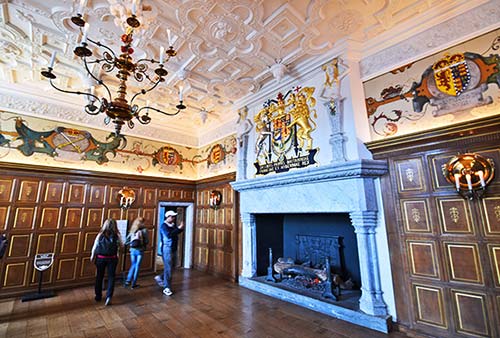
• Head back outside, turn left across the square, and find the entry on the left to the...
8 Great Hall: Built by James IV to host the castle’s official banquets and meetings, the Great Hall is still used for such purposes today. Most of the interior—its fireplace, carved walls, pikes, and armor—is Victorian. But the well-constructed wood ceiling is original. This hammer-beam roof (constructed like the hull of a ship) is self-supporting. The complex system of braces and arches distributes the weight of the roof outward to the walls, so there’s no need for supporting pillars or long cross beams. Look for the tiny iron-barred window above the fireplace, on the right. This allowed the king to spy on his subjects while they partied.
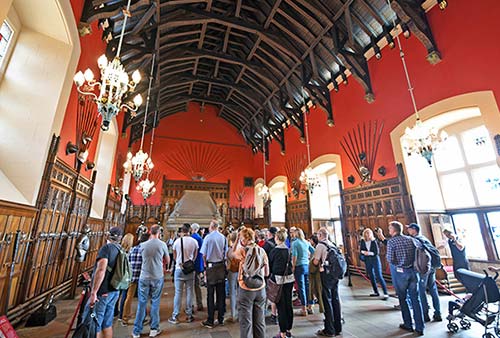
• Back outside, across the Crown Square courtyard is the...
9 Scottish National War Memorial: This commemorates the 149,000 Scottish soldiers lost in World War I, the 58,000 who died in World War II, and the nearly 800 (and counting) lost in British battles since. Before entering, notice how the Art Deco facade (built in the 1920s with the historic stones of a church that once stood on this spot) fits perfectly with the surrounding buildings.
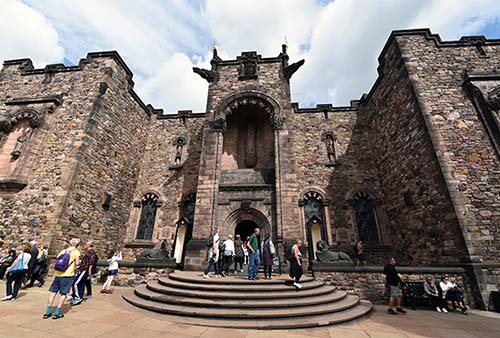
Inside, the main memorial is directly ahead, and there’s a wing on each side to wander through. Scenes in the stained-glass windows refer to World War I. Memorials honor regiments from each of the four branches of the British military; maroon remembrance books list all the names of the fallen.
The main shrine, featuring a green Italian-marble memorial that contains the original WWI rolls of honor, sits on an exposed chunk of the castle rock. Above you, the Archangel Michael is busy slaying a dragon. The bronze frieze accurately shows the attire of various wings of Scotland’s military. The stained glass starts with Cain and Abel on the left and finishes with a celebration of peace on the right. To appreciate how important this place is, consider that Scottish soldiers died at twice the rate per capita of other British soldiers in World War I.
• There are several other exhibits (including “Prisons of War,” which re-creates prison life in the castle in 1781), memorials, and regimental museums in the castle. If you have seen enough, the Lang Stairs near St. Margaret’s Chapel are a shortcut leading down to the Argyle Battery and the exit.
But there is one more important stop—the National War Museum. Backtrack down the hill toward the Redcoat Café (and the One O’Clock Gun). Just before the café head downhill to the left to the museum courtyard. (If you were in a horse-drawn carriage, you’d be thankful for the courtyard’s cobblestone design—rough stones in the middle so your horse could get a grip, and smooth stones on the outside so your ride was even.) The statue in front of the museum is Field Marshal Sir Douglas Haig—the Scotsman who commanded the British Army through the WWI trench warfare of the Battle of the Somme and in Flanders Fields.
10 National War Museum Scotland: This thoughtful museum covers four centuries of Scottish military history. Instead of the usual musty, dusty displays of endless armor, there’s a compelling mix of videos, uniforms, weapons, medals, mementos, and eloquent excerpts from soldiers’ letters. Your castle audioguide includes coverage of this museum, and the 12-minute introductory video in the theater is worth watching.
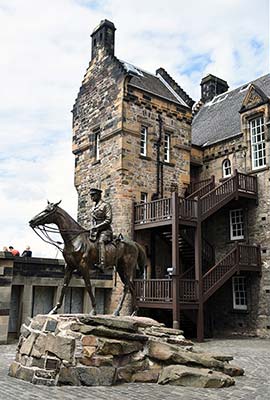
Here you’ll learn how the fierce and courageous Scottish warrior changed from being a symbol of resistance against Britain to being a champion of that same empire. Along the way, these military men received many decorations for valor and did more than their share of dying in battle. But even when fighting alongside—rather than against—England, Scottish regiments still promoted their romantic, kilted-warrior image.
Queen Victoria fueled this ideal throughout the 19th century. She was infatuated with the Scottish Highlands and the culture’s untamed, rustic mystique. Highland soldiers, especially officers, went to great personal expense to sport all their elaborate regalia, and the kilted men fought best to the tune of their beloved bagpipes. For centuries the stirring drone of bagpipes accompanied Highland soldiers into battle—raising their spirits and announcing to the enemy that they were about to meet a fierce and mighty foe.
In 1314, Robert the Bruce’s men attacked Edinburgh’s Royal Castle, recapturing it from the English. It was just one of many intense battles between the oppressive English and the plucky Scots during the Wars of Independence.
In this era, Scotland had to overcome not only its English foes but also its own divisiveness—and no one was more divided than Robert the Bruce. As earl of Carrick, he was born with blood ties to England and a long-standing family claim to the Scottish throne.
When England’s King Edward I (“Longshanks”) conquered Scotland in 1296, the Bruce family welcomed it, hoping Edward would defeat their rivals and put Bruce’s father on the throne. They dutifully signed the “Ragman’s Roll” of allegiance—and then Edward chose someone else as king.
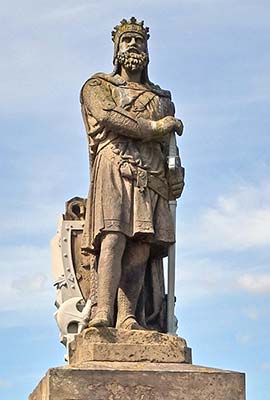
Twentysomething Robert the Bruce (the “the” comes from his original family name of “de Bruce”) then joined William Wallace’s revolt against the English. As legend has it, he was the one who knighted Wallace after the victory at Stirling Bridge. When Wallace fell from favor, Bruce became a guardian of Scotland (caretaker ruler in the absence of a king) and continued fighting the English. But when Edward’s armies again got the upper hand in 1302, Robert—along with Scotland’s other nobles—diplomatically surrendered and again pledged loyalty.
In 1306, Robert the Bruce murdered his chief rival and boldly claimed to be king of Scotland. Few nobles supported him. Edward crushed the revolt and kidnapped Bruce’s wife, the Church excommunicated him, and Bruce went into hiding on a distant North Sea island. He was now the king of nothing. Legend says he gained inspiration by watching a spider patiently build its web.
The following year, Bruce returned to Scotland and wove alliances with both nobles and the Church, slowly gaining acceptance as Scotland’s king by a populace chafing under English rule. On June 24, 1314, he decisively defeated the English (now led by Edward’s weak son, Edward II) at the Battle of Bannockburn. After a generation of turmoil (1286-1314), England was finally driven from Scotland, and the country was united under Robert I, king of Scotland.
As king, Robert the Bruce’s priority was to stabilize the monarchy and establish clear lines of succession. His descendants would rule Scotland for the next 400 years, and even today, Bruce blood runs through the veins of King Charles III and his descendants.
This museum shows the human side of war as well as the cleverness of government-sponsored ad campaigns that kept the lads enlisting. Two centuries of recruiting posters make the same pitch that still works today: a hefty signing bonus, steady pay, and job security with the promise of an adventurous life—all spiked with a mix of pride and patriotism.
Leaving the castle complex, you’re surrounded by cannons that no longer fire, stony walls that tell an amazing story, dramatic views of this grand city, and the clatter of tourists (rather than soldiers) on cobbles. Consider for a moment all the bloody history and valiant struggles, along with British power and Scottish pride, that have shaped the city over which you are perched.
SIGHTS ON AND NEAR THE ROYAL MILE
For locations, see the “Royal Mile Walk” map, earlier.
▲Camera Obscura
A big deal when it was built in 1853, this observatory topped with a mirror reflected images onto a disc before the wide eyes of people who had never seen a photograph or a captured image. Today, you can climb 100 steps for an entertaining 10-minute demonstration (3-4/hour). At the top, enjoy the best view anywhere of the Royal Mile. This attraction is a goofy and entertaining break from all the heavy history and culture of the city’s standard sights—it’s just flat-out fun. On your way up and down, you’ll be routed through five floors of illusions, holograms, and entertaining gags. You can even use live cams to zoom in and out on locations nearby.
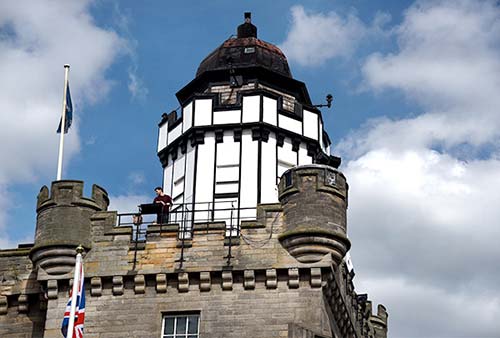
Cost and Hours: £21.95; in peak season book online a few days in advance to ensure entry and to skip the ticket-buying line; open daily July-Aug 9:00-22:00, off-season until 19:00—but often later on weekends, +44 131 226 3709, www.camera-obscura.co.uk.
▲▲Gladstone’s Land
This is a typical 16th- to 17th-century merchant’s “land,” or tenement building. These multistory structures—in which merchants ran their shops on the ground floor and lived upstairs—were typical of the time (the word “tenement” didn’t have the slum connotation then that it has today). At six stories, this one was still just half the height of the tallest “skyscrapers.” Gladstone’s Land comes complete with an almost lived-in, furnished interior under 400-year-old painted ceiling beams. While this is a fascinating sight in its own right, it’s made meaningful by wonderful, informative volunteers who love to tell its story—don’t visit without chatting with them.
You can order whisky and gin in just about any bar in town, but a guided tasting or distillery tour brings meaning to your experience. Here are some top picks for whisky and gin tasting in Edinburgh. For suggestions on where to buy whisky, see the Shopping section; for tips on tasting whisky, see the Practicalities chapter.
A tour of Scotland is alluring to all whisky lovers, and Edinburgh is a fine place to begin the pilgrimage. Whether you’re a novice taster or a longtime connoisseur, you’ll enjoy being immersed in whisky lore. The Scotch Whisky Experience is an easy point of entry; the Scotch Malt Whisky Society caters to aficionados; and Johnnie Walker Princes Street is a newer hot spot pairing food and cocktail culture. Explore the websites below—and book ahead if you see something you don’t want to miss. Just outside Edinburgh, the Port of Leith Distillery is another good tasting opportunity (see here).
One of the most accessible, if expensive, places to learn about whisky is just steps from the castle on the Royal Mile. The 50-minute tour consists of a “Malt Disney” whisky-barrel ride through the production process followed by an explanation and movie about Scotland’s five main whisky regions. Though gimmicky, it succeeds in providing an entertaining yet informative orientation to Scottish firewater (things get pretty psychedelic when you hit the yeast stage). The basic ticket includes sampling a wee dram and the chance to stand amid the world’s largest Scotch whisky collection (almost 3,500 bottles). At the end, you’ll find yourself in the bar, with a fascinating wall of unusually shaped whisky bottles. Serious connoisseurs should stick with the more substantial shops in town, but this place can be worthwhile for beginners.
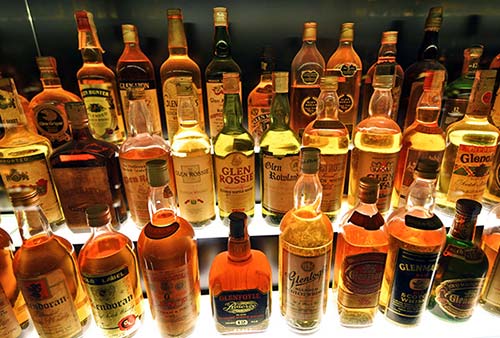
Cost and Hours: £21 “silver tour” includes one sample, £34 “gold tour” includes five samples—one from each main region; generally daily 10:00-18:30, last tour at 17:30; +44 131 220 0441, www.scotchwhiskyexperience.co.uk. Tip: Couples can buy one “silver” ticket and one “gold” ticket and share the samples.
In the New Town, this place is for more serious whisky fans. Its top two floors are for members only, but the ground-floor Kaleidoscope bar is open to all for tastings of single malts from across Scotland and beyond. Each bottle—pure from the cask and not blended—is described but not named. You read the description and make your choice...or enlist the help of the bartender, who will help you find a flavor profile you like. While the shrouded-in-mystery approach may be lost on novices, aficionados enjoy it.
Cost and Hours: £30-50 for scheduled tasting events (see website), private tastings available; Tue-Sun noon until late, closed Mon; bar serves fine $$ lunches and dinners, 28 Queen Street, +44 131 220 2044, www.smws.com.
This experiential destination in the New Town offers glitzy tasting tours—some complete with light shows and live performances—and two rooftop bars. Food is taken seriously here, too, via a partnership with James and Maria Close of Raby Hunt, a British Michelin-starred restaurant.
Cost and Hours: Tours from £30—check website for times, 145 Princes Street, +44 131 376 9494, www.johnniewalker.com [URL inactive].
The residents of Edinburgh drink more gin per person than any other city in the United Kingdom. The city is largely responsible for the recent renaissance of this drink, so it’s only appropriate that you visit a gin distillery while in town. Two distilleries right in the heart of Edinburgh offer hour-long tours with colorful guides who relate the history of gin, show off the stills used in the production process, and ply you with libations. These tours are popular and fill up; book ahead online.
Pickering’s gin is produced at Summerhall Distillery, located in a former animal hospital halfway between the Royal Mile and the B&B neighborhood. The funky distillery has a cool, young, artsy vibe, with skeletons and X-rays still hanging around. You’ll hear about the origins of Pickering’s 1947 gin recipe and see how they make their small batch gin. A mellow bar serves cheap pub grub.
Cost and Hours: £25 tour includes welcome gin and tonic, 4 samples plus your own miniature bottle to take with you; 2 tours/day Thu-Sun, daily in Aug, meet at the Royal Dick Bar in the central courtyard at 1 Summerhall—for location see the map on here, +44 131 290 2901, https://pickeringsgin.com.
This small distillery in the West End, near the Waldorf Astoria Hotel, offers a one-hour behind-the-scenes tour with five tastings. If you can’t join one of their tours, visit their Heads & Tales bar (Tue-Sat 17:00-24:00, closed Sun-Mon).
Cost and Hours: £25 tour, 1A Rutland Place, enter off Shandwick Place next to the Ghillie Dhu bar—for location see the map on here, +44 131 656 2810, www.edinburghgin.com.
Cost and Hours: £10, daily 10:00-15:00—last entry time, +44 131 226 5856, www.nts.org.uk/visit/gladstones-land.
Visiting the Museum: Buy your ticket at the café counter downstairs, then head up the external staircase to go inside. Until 14:30, your entry is self-guided—you’ll visit on your own and learn from the docents in various rooms. Each day at 15:00, you can join a complete guided tour of the complex (no extra charge; explained on sign at entrance).
Each of the three floors has been restored to a different time period. You’ll begin high up on the third floor, a boarding house from the 1910s. Three men would have shared this small space, with its wrought-iron beds, newspaper clippings and pinup girls stuck to the walls, and old-time records on the phonograph. The second floor is a drapers’ shop (selling cloth, clothes, and hats) from 1766, with a work counter and a space for entertaining customers in the front, and a small back office behind. The first floor is the most atmospheric, done up as the 1632 residence of an upper-middle-class trader of exotic goods. You’ll see the 17th-century penchant for dark, chunky oak furniture, then head through the kitchen (with the maid’s cot in the corner) to a back room that displays some of the goods that were shipped far and wide. There’s also a small exhibit on the history of the building.
Keep this place in mind as you stroll the rest of the Mile, imagining other houses as if their interiors still looked like this. (For a comparison of life in the Old Town versus the New Town, visit the Georgian House, described later.)
▲The Writers’ Museum
This aristocrat’s house, built in 1622, is filled with well-described manuscripts and knickknacks of Scotland’s three greatest literary figures: Robert Burns, Robert Louis Stevenson, and Sir Walter Scott. If you’d like to see Scott’s pipe and Burns’ snuffboxes, you’ll love this little museum. You’ll wind up steep staircases through a maze of rooms as you peruse first editions and keepsakes of these celebrated writers.
Makars’ Court, outside the museum, is paved with flagstones inscribed with quotes from Scottish writers from the 14th century until the present. (“Makar,” the Scots’ word for a courtly Scottish poet, is now applied to all writers of note.)
Cost and Hours: Free, donation suggested, daily 10:00-17:00, +44 131 529 4901, www.edinburghmuseums.org.uk.
Museum on the Mound
Located in the basement of the former Bank of Scotland building, this exhibit tells the story of the bank, which was founded in 1695 (making it only a year younger than the Bank of England) and claims to be the longest operating bank in the world. Featuring lots of artifacts and displays on cash production, safe technology, and bank robberies, this museum (with a case holding £1 million in cash) makes banking almost interesting. It’s worth popping in if you have extra time or find the subject appealing.
Cost and Hours: Free; Tue-Fri 10:00-17:00, Sat from 13:00, closed Sun-Mon; down Bank Street from the Royal Mile—follow the street around to the left and enter through the gate, +44 131 243 5464, https://museumonthemound.com.
▲National Library of Scotland
Just a half-block off the Royal Mile, the National Library’s Treasures room hosts thought-provoking exhibits about the Scottish literary tradition. It’s worth the detour for book lovers.
Cost and Hours: Free, donation suggested; Mon-Tue and Thu 9:30-19:00, Wed from 10:00, Fri-Sat until 17:00, closed Sun; shop and café, near George IV Bridge at 92 Cowgate, +44 131 623 3700, www.nls.uk.
Visiting the Library: To the right of the main entrance, the small Treasures collection is lovingly displayed and well described in three languages: English, Gaelic, and Scots. While displays may rotate in and out, the library’s treasures include the Iona Psalter (a precious ecclesiastical book from around 1180-1220); Rabbie Burns’ handwritten lyrics to his love song, “Ae Fond Kiss” (1791); and a 15th-century Gaelic manuscript about folk remedies. You may also see maps and contemporary accounts of the Jacobite Rising and battle at Culloden; tales and watercolors from Isobel Wylie Hutchison’s journeys to Greenland, arctic Canada, and Alaska in the 1920s and ’30s; correspondence between Scottish composer George Thomson and Beethoven; elegantly bound books showing off the “wheel” and “herringbone” binding methods from 17th-century printers; and a Gutenberg Bible. A nearby room hosts temporary exhibits.
▲▲St. Giles’ Cathedral
This is Scotland’s most important church, founded in 1124. Its ornate spire—the Scottish crown steeple from 1495—is a proud part of Edinburgh’s skyline. The fascinating interior contains nearly 200 memorials honoring distinguished Scots through the ages.
Cost and Hours: Free, donation suggested; Mon-Fri 10:00-18:00, Sat 9:00-17:00, Sun 13:00-17:00; one-hour guided tours Mon-Fri at 10:30 and 14:30 (donation requested, book online), downloadable audioguide-£5.50; +44 131 226 0677, www.stgilescathedral.org.uk.
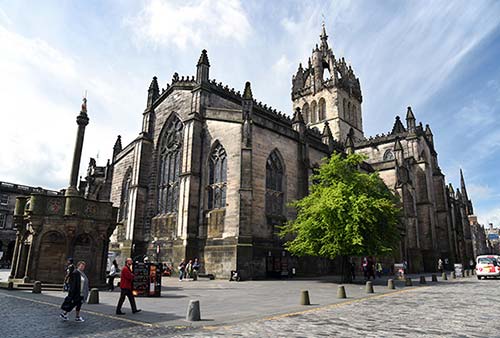
Concerts: St. Giles’ busy concert schedule includes organ recitals (some free) and visiting choirs (schedule posted on-site and online—or ask for What’s On at St. Giles pamphlet at welcome desk or gift shop).
Self-Guided Tour: Today’s facade is 19th-century Neo-Gothic, but most of what you’ll see inside is from the 14th and 15th centuries. Engage the cathedral guides in conversation; you’ll be glad you did.
As you enter, begin by looping around the right side of the cathedral. Partway along this wall, above an alcove just before the organ, look for the dramatic 1 stained-glass window showing the commotion that surrounded the great reformer John Knox (1514-1572) when he preached. The bearded, fiery-eyed Knox had a huge impact on this community.
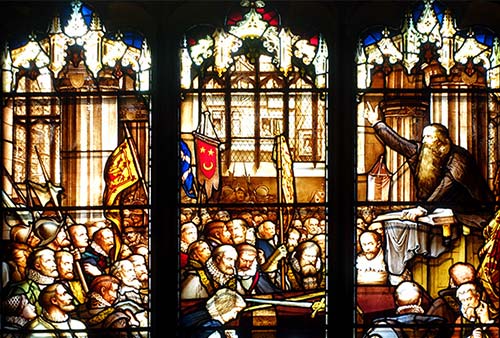
Knox, the founder of austere Scottish Presbyterianism, first preached here in 1559. His insistence that every person should be able to personally read the word of God gave Scotland an educational system 300 years ahead of the rest of Europe. Thanks partly to Knox, it was Scottish minds that led the way in math, science, medicine, and engineering. Voltaire called Scotland “the intellectual capital of Europe.”
Knox preached Calvinism. Consider that the Dutch and the Scots both embraced this creed of hard work, frugality, and strict ethics. This helps explain why the Scots are so different from the English (and why the Dutch and the Scots—both famous for their thriftiness and industriousness—are so much alike).
Looking at this window, notice how there were no pews back then. The church was so packed, people even looked through clear windows from across the street. With his hand on the holy book, Knox seems to conduct divine electricity to the Scottish faithful.
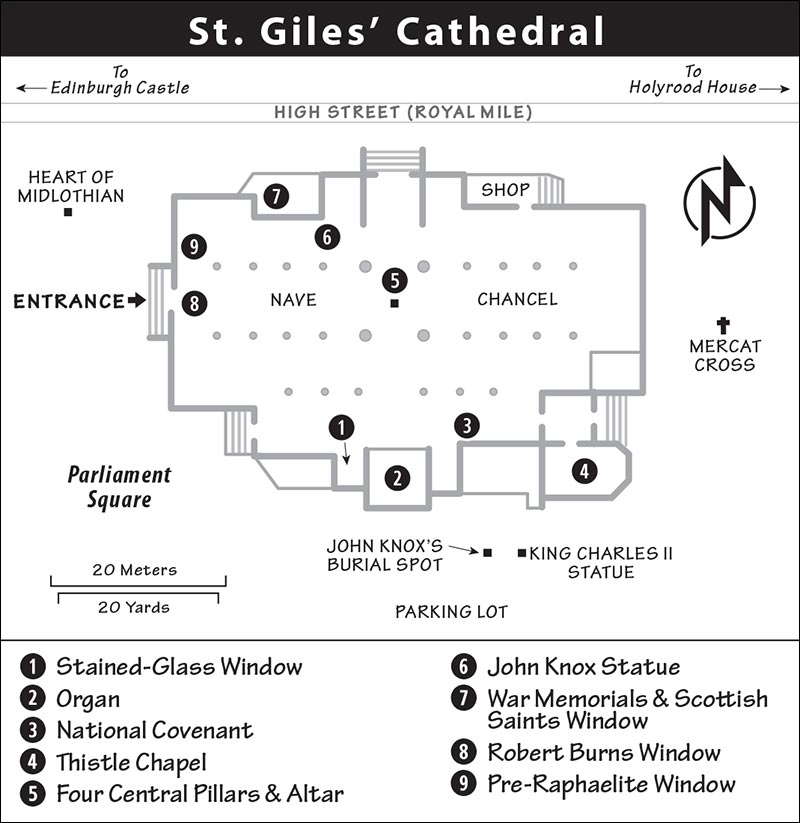
Next up, take in the sheer might of the giant Austrian-built 2 organ (1992), one of Europe’s finest.
Just past the organ, look for a glass case in a stand that holds a replica of the 3 National Covenant. The original was signed in blood in 1638 by Scottish heroes who refused to compromise their religion for the English king’s. Most who signed were martyred (their monument is nearby, at Grassmarket). You can see the original National Covenant in the Museum of Edinburgh.
Head toward the east (back) end of the church and turn right to find the Neo-Gothic 4 Thistle Chapel. The interior is filled with intricate wood carving. Built in two years (1910-1911) entirely with Scottish materials and labor, this is the private chapel of the Order of the Thistle, the only Scottish chivalric order and second only to England’s Order of the Garter. The reigning British monarch recognizes Scotland’s leading citizens by bestowing an order appointment upon them. Every other year, the chapel is the setting for the Thistle service, when new members are installed with pomp and ceremony. The sovereign presides over the ritual from a fancy stall, marked by the Scottish coat of arms—a heraldic zoo of symbolism. Are there bagpipes in heaven? Find the tooting stone angel at the top of a window to the left of the altar, and the wooden one to the right of the doorway you came in.
Now head to the center of the nave and take it all in. Slowly walk up to the altar in the very middle of the building, surrounded by 5 four massive central pillars—the oldest part of the church. These are Norman and date from the 12th century. They supported a mostly wooden superstructure that was lost when an invading English force burned it in 1385. The Scots rebuilt it bigger and better than ever, and in 1495 its famous crown spire was completed.
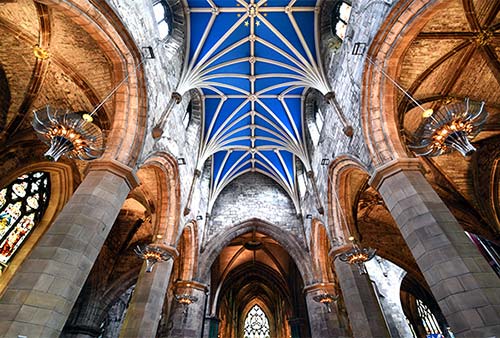
During the Reformation—when Knox preached here (1559-1572)—the place was simplified and whitewashed. Before this, when the emphasis was on holy services provided by priests, there were lots of little niches. With the new focus on sermons rather than rituals, the grand pulpit took center stage.
Knox preached against anything that separated you from God, including stained glass (considered the poor man’s Bible, as illiterate Christians could learn from its pictures). Knox had the church’s fancy medieval glass windows replaced with clear glass, but 19th-century Victorians took them out and installed the brilliantly colored ones you see today.
Continue past the altar to the other side of the church. Along this north wall, look for the 6 John Knox statue (standing like a six-foot-tall bronze chess piece). Get up close. Look into his eyes and think of the Reformation struggles of the 16th century.
Past Knox, the wall is lined with 7 war memorials, recalling those lost in battle. The second stained-glass window you’ll see features saints who may be less familiar to you, but who are near and dear to the Scots. If you’re traveling around Scotland, remember these names—you’ll see them everywhere: Columba, Andrew, Cuthbert, Margaret, Giles, and King David I.
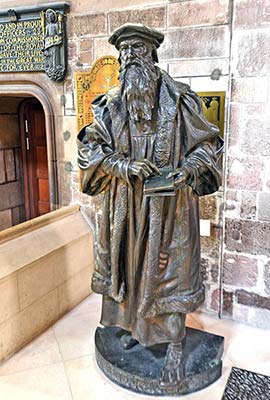
Before leaving, head back into the nave and look above the entrance toward the modern stained-glass 8 Robert Burns window, which celebrates Scotland’s favorite poet. It was created in 1985 by the Icelandic artist Leifur Breiðfjörð. The green of the lower level symbolizes the natural world—God’s creation. The middle zone with the circle shows the brotherhood of man—Burns was a great internationalist. The top is a rosy red sunburst of creativity, reminding Scots of Burns’ famous line, “My love is like a red, red rose”—part of a song close to every Scottish heart.
Finally, to the right of the Burns window is a fine 9 Pre-Raphaelite window. Like most in the church, it’s a memorial to an important patron (in this case, John Marshall, a judge).
Parliament House
This space housed the Scottish parliament until the Act of Union in 1707. The building now holds the Scottish Supreme Court, so you’ll need to go through security as you enter. Peruse the grand hall, with its fine 1639 hammer-beam ceiling and stained glass. The biggest stained-glass window depicts the initiation of the first Scottish High Court in 1532. The building is busy with wigged and robed lawyers hard at work in the old library (peek through the door) or pacing the hall deep in discussion. Trials open to the public are held just across the street at the High Court—the doorman has the day’s docket.
Cost and Hours: Free, public welcome Mon-Fri 9:00-16:30, closed Sat-Sun, no photos, enter behind St. Giles’ Cathedral at door #11; basement café open to public until 14:30, www.scotcourts.gov.uk.
▲The Real Mary King’s Close
For an unusual peek at Edinburgh’s gritty, plague-ridden past, join a costumed performer on an entertaining hour-long trip through an excavated underground street and buildings on the northern slope of the Royal Mile. Tours include a goofy, crowd-pleasing ghost story or two but focus on authentic and historical insight into a part of town entombed by later construction.
Cost and Hours: £21, book at least one day in advance during peak season; tours leave every 15-30 minutes; Mon-Fri 9:30-18:00, Sat-Sun until 19:00, these are last tour times, hours vary by season; across from St. Giles at 2 Warriston’s Close—but enter through door on High Street, +44 131 225 0672, www.realmarykingsclose.com.
▲Museum of Childhood
This three-story playground of historical toys and games is rich in nostalgia. Each well-signed gallery is as jovial as a Norman Rockwell painting, highlighting the delights and simplicity of childhood. The museum does a fair job of representing culturally relevant oddities, such as ancient Egyptian, Peruvian, and voodoo dolls, and displays early versions of toys it’s probably best didn’t make the final cut (such as a grim snake-centered precursor to the popular board game Chutes and Ladders).
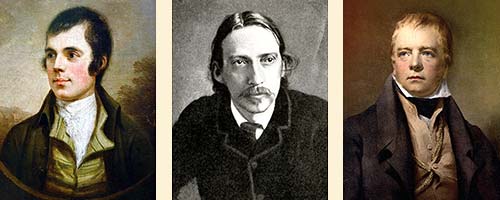
Edinburgh was home to Scotland’s three greatest literary figures: Robert Burns, Robert Louis Stevenson, and Sir Walter Scott. The best way to learn about and experience these literary greats is to visit the Writers’ Museum (see listing, earlier) and to take Edinburgh’s Literary Pub Tour (see “Nightlife in Edinburgh,” later).
Robert Burns (1759-1796), known as “Rabbie” in Scotland and quite possibly the most famous and beloved Scot of all time, moved to Edinburgh after achieving overnight celebrity with his first volume of poetry (staying in a house on the spot where Deacon Brodie’s Tavern now stands). Even though he wrote in the rough Scots dialect and dared to attack social rank, he was a favorite of Edinburgh’s high society, who’d gather in fine homes to hear him recite his works.
One hundred years later, Robert Louis Stevenson (1850-1894) also stirred the Scottish soul with his pen. An avid traveler who always packed his notepad, Stevenson created settings that are vivid and filled with wonder. Traveling through Scotland, Europe, and around the world, he distilled his adventures into Romantic classics, including Kidnapped and Treasure Island (as well as The Strange Case of Dr. Jekyll and Mr. Hyde). Stevenson, who was married in San Francisco and spent his last years in the South Pacific, wrote, “Youth is the time to travel—both in mind and in body—to try the manners of different nations.” He said, “I travel not to go anywhere...but to simply go.” Travel was his inspiration and his success.
Sir Walter Scott (1771-1832) wrote the Waverley novels, including Ivanhoe and Rob Roy. He’s considered the father of the Romantic historical novel. Through his writing, he generated a worldwide interest in Scotland and reawakened his fellow countrymen’s pride in their heritage. His novels helped revive interest in Highland culture—the Gaelic language, kilts, songs, legends, myths, the clan system—and created a national identity. An avid patriot, he wrote, “Every Scottish man has a pedigree. It is a national prerogative, as unalienable as his pride and his poverty.” Scott is so revered in Edinburgh that his towering Neo-Gothic monument dominates the city center.
While these three writers dominate Edinburgh sightseeing, consider the other great writers with Edinburgh connections: current resident Ian Rankin (with his “tartan noir” novels); J. K. Rowling (Harry Potter series); J. M. Barrie (who attended University of Edinburgh and later created Peter Pan); Sir Arthur Conan Doyle (who was born in Edinburgh, went to medical school here, and is best known for inventing Sherlock Holmes); and James Boswell (who lived 50 yards away from the Writers’ Museum, in James Court, and is revered for his biography of Samuel Johnson).
Cost and Hours: Free, donation suggested, daily 10:00-17:00, 42 High Street, www.edinburghmuseums.org.uk.
▲John Knox House
Intriguing for Reformation buffs, this fine medieval house dates back to 1470 and offers a well-explained look at the life of the great 16th-century reformer. Although most contend he never actually lived here, preservationists called it “Knox’s house” to save it from the wrecking ball in the 1840s. Regardless, the place has good information on Knox and his intellectual sparring partner, Mary, Queen of Scots. Imagine the Protestant firebrand John Knox and the devout Catholic Mary sitting face-to-face in old rooms like these, discussing the most intimate matters of their spiritual lives as they decided the course of Scotland’s religious future. The sparsely furnished house contains some period furniture, an early 1600s hand-painted ceiling, information on the house and its resident John Mossman (goldsmith to Mary, Queen of Scots), and exhibits on printing—an essential tool for early reformers.
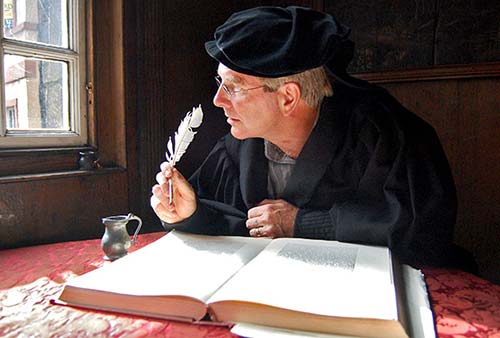
Cost and Hours: £7, includes downloadable audioguide, daily 10:00-18:00, last entry one hour before closing, 43 High Street, +44 131 556 9579, www.scottishstorytellingcentre.com.
▲People’s Story Museum
This engaging exhibit, which occupies the Canongate Tolbooth (built in 1591), traces the working and social lives of ordinary people through the 18th, 19th, and 20th centuries (including 1970s punks and 1980s mallrats). You’ll see tools, products, and objects related to important Edinburgh trades (printing, brewing), a wartime kitchen, and a small theater on the top floor with a video.
Cost and Hours: Free, donation requested, daily 10:00-17:00, 163 Canongate, +44 131 529 4057, www.edinburghmuseums.org.uk.
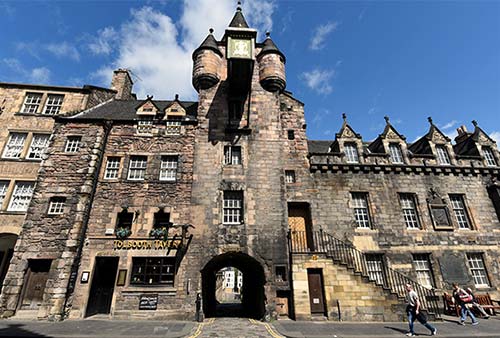
▲Museum of Edinburgh
Another old house full of old stuff, this one is worth a stop for a look at its early Edinburgh history (and its handy ground-floor WC). Be sure to see the original copy of the National Covenant—written in 1638 on animal skin. Scottish leaders signed this, refusing to adopt the English king’s religion—and were killed for it. Exploring the rest of the collection, keep an eye out for Robert Louis Stevenson’s antique golf ball, James Craig’s architectural plans for the Georgian New Town, an interactive kids’ area with dress-up clothes, a sprawling top-floor exhibit on Edinburgh-born Field Marshal Sir David Haig (who led the British Western Front efforts in World War I and later became Earl Haig), and locally made glass and ceramics.
Cost and Hours: Free, donation suggested, daily 10:00-17:00, 142 Canongate, +44 131 529 4143, www.edinburghmuseums.org.uk.
Nearby: Next to the museum (uphill) is the entry to Bakehouse Close, a well-preserved 18th-century alleyway. It’s worth a peek (and recognizable to fans of the Outlander TV series—the exterior of Jamie’s print shop was filmed here).
▲▲Scottish Parliament Building
Scotland’s parliament originated in 1293 and was dissolved when Scotland united with England in 1707. But in 1997 the Scottish electorate voted to reinstate “a Scottish parliament guided by justice, wisdom, integrity, and compassion.” Formally reconvened by Queen Elizabeth in 1999 (note that, while she was “II” in England, she was only the first “QE” for the people of Scotland), the Scottish parliament now enjoys self-rule in many areas (except for matters of defense, foreign policy, immigration, and taxation). The current government is pushing for even more independence.
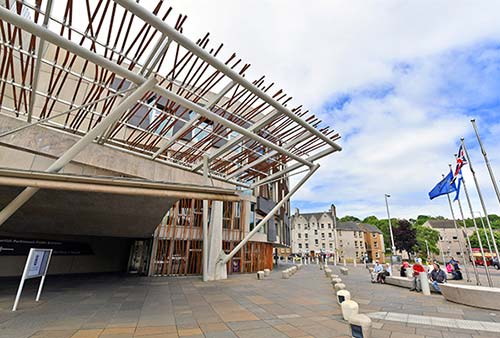
The innovative building, opened in 2004, brought together all the functions of the fledgling parliament in one complex. It’s a people-oriented structure conceived by Catalan architect Enric Miralles. Signs are written in both English and Gaelic (the Scots’ Celtic tongue).
For a peek at the building and a lesson in how the Scottish parliament works, drop in, pass through security, and find the visitors’ desk. You’re welcome in the public parts of the building, including a small ground-floor exhibit on the parliament’s history and function and, up the stairs, a viewing gallery overlooking the impressive Debating Chambers.
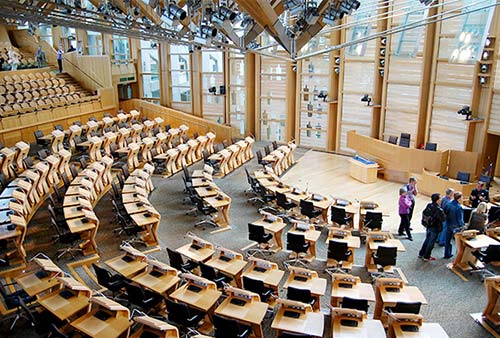
Cost and Hours: Free; Mon-Sat 10:00-17:00, Tue-Thu 9:00-18:30 when parliament is in session (Sept-June), closed Sun year-round. For a complete list of recess dates or to book tickets for debates, check their website or call their visitor services line, +44 131 348 5200, www.parliament.scot. There’s a $ café near the entrance after you pass security.
Tours: Proud locals offer worthwhile free 45-minute tours covering history, architecture, parliamentary processes, and other topics. Tours generally run throughout the day Mon and Fri-Sat in session (Sept-June) and Mon-Sat in recess (July-Aug). While you can try dropping in, these tours can book up—it’s best to reserve ahead online or over the phone.
Seeing Parliament in Session: The public can witness the Scottish parliament’s hugely popular debates (usually Tue-Thu 14:00-18:00, but hours can vary). Book ahead online no more than seven days in advance, over the phone, or at the info desk. You’re not required to stay the whole session.
You can also watch parliamentary committees in session (usually Tue-Thu mornings). Topics are published the Friday before (see business bulletin on website), and you must book ahead just as you would for debates.
On Thursdays from 11:40 to 12:45 the First Minister is on the hot seat and must field questions from members across all parties (reserve ahead for this popular session over the phone a week in advance; spots book up quickly—call at 9:00 sharp on Thu for the following week). If you don’t get tickets over the phone, show up at 10:00 and ask if you can get in—they sometimes have standby tickets.
▲▲Palace of Holyroodhouse
Built on the site of the abbey/monastery founded in 1128 by King David I, this palace was the true home, birthplace, and coronation spot of Scotland’s Stuart kings in their heyday (James IV; Mary, Queen of Scots; and Charles I). It’s particularly memorable as the site of some dramatic moments from the short reign of Mary, Queen of Scots—including the murder of her personal secretary, David Rizzio, by agents of her jealous husband. Until her death, it was one of Queen Elizabeth II’s official residences. She managed her Scottish affairs here during Holyrood Week, from late June to early July (and generally stayed at Balmoral in August). Holyrood is open to the public outside of royal visits. Touring the interior offers a more polished contrast to Edinburgh Castle and is particularly worth considering if you don’t plan to go to Balmoral. The one-way multimedia guide route leads you through the fine apartments and tells some of the notable stories that played out here.
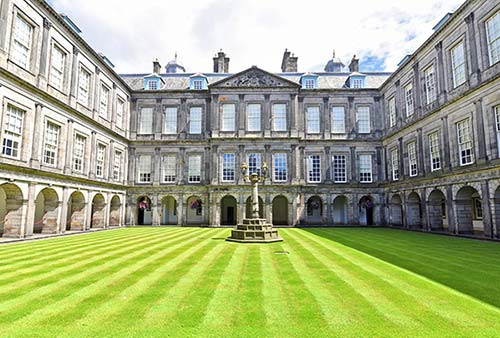
Cost: £19.50, includes quality one-hour multimedia guide, book online to skip the line; ask about combo-ticket with the Queen’s Gallery (may be closed for renovation when you visit).
Hours: Daily 9:30-18:00, Nov-March until 16:30, last entry 1.5 hours before closing, +44 131 556 5100, www.rct.uk. It’s still a working palace, so it’s closed when VIPs are in residence.
Eating: The $$$ café on the palace grounds, to the right of the palace entrance, has an inviting afternoon tea.
Visiting the Palace: The building, rich in history and decor, is filled with elegantly furnished Victorian rooms and a few darker, older rooms with glass cases of historic bits and Scottish pieces that locals find fascinating. The tour route leads you into the grassy inner courtyard, then up to the royal apartments: dining rooms, Downton Abbey-style drawing rooms, and royal bedchambers. Along the way, you’ll learn the story behind the 96 portraits of Scottish leaders (some real, others imaginary) that line the Great Gallery, why the king never slept in his official “state bed,” and why the exiled Comte d’Artois took refuge in the palace. Then you’ll twist up a tight spiral staircase to the private chambers of Mary, Queen of Scots, where conspirators stormed in and stabbed her secretary 56 times.
You’ll exit the palace into the evocative ruined abbey (destroyed by the English during the time of Mary, Queen of Scots, in the 16th century) and the palace gardens (closed Nov-March except some weekends). Some 8,000 guests—including many honored ladies sporting fancy hats—gather here every July when the royal family hosts a magnificent tea party. (They get help pouring.)
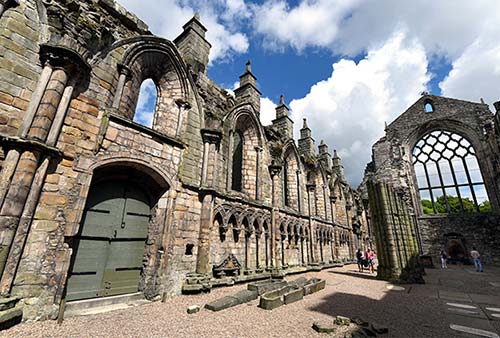
Nearby: Hikers, note that the wonderful trail up Arthur’s Seat starts just across the street from the gardens (see “Experiences in Edinburgh,” later, for details).
▲Queen’s Gallery, Palace of Holyroodhouse
Over more than five centuries, the royal family has collected a wealth of art treasures. While most of the collection is kept in the royals’ many private palaces, they share an impressive sampling of it in this small museum, with themed exhibits changing about every six months. Though the gallery occupies just a few rooms, its displays can be exquisite.
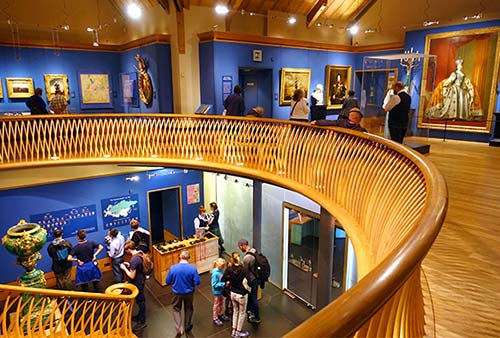
Cost and Hours: £8.50 includes excellent multimedia guide, ask about combo-ticket with Palace of Holyroodhouse; daily 9:30-18:00, Nov-March until 16:30, last entry one hour before closing; www.rct.uk.
Dynamic Earth
Located about a five-minute walk from the Palace of Holyroodhouse, this immense exhibit tells the story of our planet, filling several underground floors under a vast, white Gore-Tex tent. It’s pitched, appropriately, at the base of the Salisbury Crags. The exhibit is designed for younger kids and does the same thing an American science exhibit would do—but with a charming Scottish accent. You’ll learn about the Scottish geologists who pioneered the discipline, then step into a “time machine” to watch the years rewind, from cave dwellers to dinosaurs to the Big Bang. After viewing several short films on stars, tectonic plates, ice caps, and worldwide weather (in a “4-D” exhibit), you’re free to wander past salty pools and a re-created rain forest.
Cost and Hours: £19.50, kids-£12; Mon-Tue 10:00-16:00, Wed-Fri until 17:00, Sat-Sun until 18:00, last entry two hours before closing; on Holyrood Road between the palace and mountain, +44 131 550 7800, https://dynamicearth.co.uk.
SIGHTS SOUTH OF THE ROYAL MILE
For locations, see the “Royal Mile Walk” map, earlier.
▲▲National Museum of Scotland
This gigantic museum has amassed more historic artifacts than every other place I’ve seen in Scotland combined. It’s all wonderfully displayed, with fine descriptions offering an insightful and substantial hike through the history of Scotland.
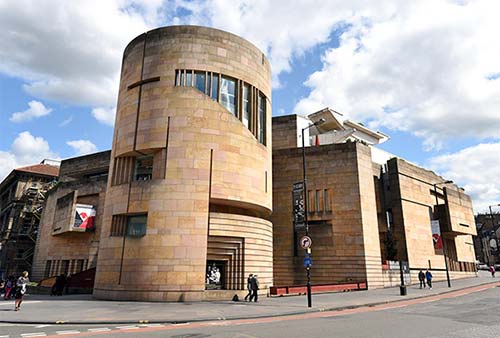
Cost and Hours: Free, daily 10:00-17:00; two long blocks south of St. Giles’ Cathedral and the Royal Mile, on Chambers Street off George IV Bridge, www.nms.ac.uk.
Tours: The museum offers two free one-hour tours daily of the Scottish history galleries: an 11:00 tour covers early history through the Middle Ages and a 14:00 tour covers the 16th through 18th centuries. Sign up at the info desk starting an hour before each tour. You can also scan a QR code to get brief audio tracks for 15 stops throughout the museum (use the museum’s free Wi-Fi). Everything inside is well described, and interactive kiosks help you navigate the stories behind important artifacts and figures.
Eating: A $$ restaurant is on the ground floor right next to the entrance door, and a $ café with coffee, tea, cakes, and snacks is on the level 3 balcony overlooking the Grand Gallery.
Overview: The museum can be overwhelming, so pick up the map when you enter to sort through your options. There are exhibits about natural science (T. Rex skeletons and other animals), technology, fashion, art, design, world cultures, and more.
My tour is devoted to the Scotland galleries, which lead you through Scottish history covering Roman and Viking times, Edinburgh’s witch-burning craze and clan massacres, the struggle for Scottish independence, the Industrial Revolution, and right up to Scotland in the 21st century.
Self-Guided Tour: From the subterranean entrance zone, head upstairs to get oriented on level 1 in the impressive glass-roofed Grand Gallery.
Before diving in, head through the door in the center of the hall marked Collecting Stories to find the millennium clock, a 30-foot-high clock with figures that move to a Bach concerto on the hour from 11:00 to 16:00. The clock has four parts (crypt, nave, belfry, and spire) and represents the turmoil of the 20th century, with a pietà at the top.
• To reach the Scottish history wing, exit the Grand Gallery at the far-right end (as you face the main part of the museum, with the big windows and busy street at your back); you’ll go under the clock and past the statue of Scottish inventor James Watt.
On the way, you’ll pass through the science and technology wing. While walking through, on your left, look for a slowly revolving glass case containing Dolly the sheep—the world’s first cloned mammal—born in Edinburgh and now preserved here.
Continue into Hawthornden Court, passing a bank of elevators, and find the door marked Kingdom of the Scots on the left. This is where we’ll begin our sweep through Scottish history (if you’d like to begin even earlier, detour downstairs to level -1 for Scotland’s prehistoric origins—geologic formation, Celts, Romans, Vikings).
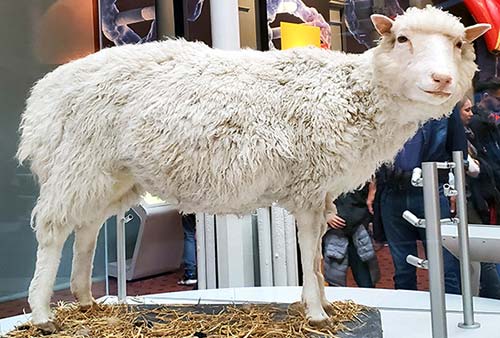
Kingdom of the Scots (c. 900s-late 1600s): From its very start, Scotland was determined to be free. You’re greeted with proud quotes from what’s been called the Scottish Declaration of Independence—the Declaration of Arbroath, a defiant letter written to the pope in 1320. As early as the ninth century, Scotland’s patron saint, Andrew (see the small wooden statue in the next room), had—according to legend—miraculously intervened to help the Picts and Scots of Scotland remain free by defeating the Angles of England. Andrew’s X-shaped cross still decorates the Scottish flag today.
Enter the first room on your right, with imposing swords and other objects related to Scotland’s most famous patriots, William Wallace and Robert the Bruce. Bruce’s descendants, the Stuarts, went on to rule Scotland for the next 300 years. Eventually, James VI of Scotland (see his baby cradle) came to rule England as well (as King James I of England). In the middle of the room, a massive banner of the royal arms of Britain is adorned with the motto of James VI: “Blessed are the peacemakers.”
In the next room, a guillotine recalls the harsh justice meted out to criminals, witches, and “Covenanters” (17th-century political activists who opposed interference of the Stuart kings in affairs of the Presbyterian Church of Scotland). Out in the larger hall, also check out the tomb (a copy) of Mary, Queen of Scots, the 16th-century Stuart monarch who opposed the Presbyterian Church of Scotland. Educated and raised in Renaissance France, Mary brought refinement to the Scottish throne. After she was imprisoned and then executed by Elizabeth I of England in 1587, her supporters rallied each other by invoking her memory; see the pendants and coins with her portrait in the display case next to tomb.
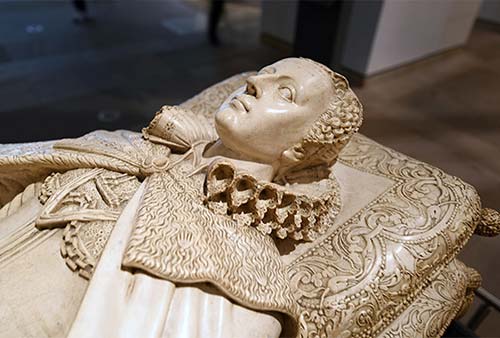
Browse the rest of level 1 to see everyday objects from that age: carved panels, cookware, and sculptures.
• Backtrack to Hawthornden Court and head up to level 3.
Scotland Transformed (1700s): You’ll see artifacts related to Bonnie Prince Charlie and the Jacobite rebellions as well as items related to the Treaty of Union document, signed in 1707 by the Scottish parliament. This act voluntarily united Scotland with England under the single parliament of the United Kingdom. For some Scots, this move was an inevitable step in connecting to the wider world, but for others it symbolized the end of Scotland’s existence.
Union with England brought stability and investment to Scotland. In this same era, the advances of the Industrial Revolution were making a big impact on Scottish life. Mechanized textile looms (on display) replaced hand craftsmanship. The huge Newcomen steam-engine water pump helped the mining industry to develop sites with tricky drainage. Nearby is a model of a coal mine (or “colliery”); coal-rich Scotland exploited this natural resource to fuel its textile factories.
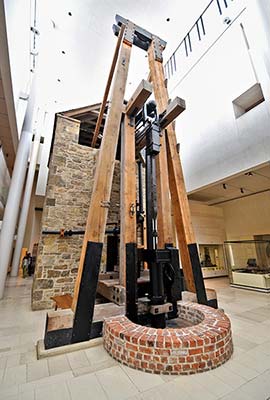
How the parsimonious Scots financed these new, large-scale enterprises is explained in an exhibit on the Bank of Scotland. Powered by the Scottish work ethic and the new opportunities that came with the Industrial Revolution, the country came into relative prosperity. Education and medicine thrived. With the dawn of the modern age came leisure time, the concept of “healthful sports,” and golf—a popular Scottish pastime. On display (near the back, in a small corridor behind the machinery) are some early golf balls, which date from about 1820, made of leather and stuffed with feathers.
• Leave this hall the way you came in, and journey up to level 5.
Industry and Empire (1800s): Turn right and do a counterclockwise spin around this floor to survey Scottish life in the 19th century. Industry had transformed the country. Highland farmers left their land to find work in Lowland factories and foundries. Modern inventions—the phonograph, the steam-powered train, the kitchen range—revolutionized everyday life. In Glasgow near the turn of the century, architect Charles Rennie Mackintosh helped to define Scottish Art Nouveau. Scotland was at the forefront of literature (Robert Burns, Sir Walter Scott, Robert Louis Stevenson), science (Lord Kelvin, James Watt, Alexander Graham Bell...he was born here, anyway!), world exploration (John Kirk in Africa, Sir Alexander Mackenzie in Canada), and whisky production.
• Climb the stairs to level 6.
Scotland: A Changing Nation (1900s-present): Turn left and do a clockwise spin through this floor to bring the story to the present day. The two world wars decimated the population of this already wee nation. In addition, hundreds of thousands emigrated, especially to Canada (where one in eight Canadians has Scottish origins). Other exhibits include shipbuilding and the fishing industry; Scots in the world of entertainment (from folk singer Donovan to actor-comedian Billy Connolly); “New Scots,” non-native-born Scottish citizens who are adding their story to the tapestry of this great nation; a look at devolution from the United Kingdom (1999 opening of Scotland’s own parliament, the landmark 2014 referendum on Scottish independence, and Brexit—in which 51.9 percent of the greater UK voted to leave the European Union, but only 38 percent of Scots did); and a sports Hall of Fame (from tennis star Andy Murray to auto racer Jackie Stewart to long-distance runner Liz McColgan).
• Finish your visit on level 7, the rooftop.
Garden Terrace: The well-described roof garden features grasses and heathers from every corner of Scotland and spectacular views of the city.
Greyfriars Bobby Statue and Greyfriars Cemetery
This famous statue of Edinburgh’s favorite dog is across the street from the National Museum of Scotland. Every business nearby, it seems, is named for this Victorian Skye terrier, who is reputed to have slept upon his master’s grave in Greyfriars Cemetery for 14 years. The story was immortalized in a 1960s Disney flick, but recent research suggests that 19th-century businessmen bribed a stray to hang out in the cemetery to attract sightseers. If it was a ruse, it still works.
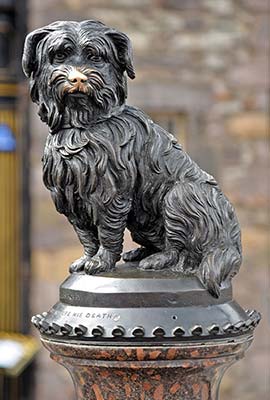
Just behind Greyfriars Bobby is the entrance to his namesake cemetery (open until late). Stepping through the gate, you’ll see the pink marble grave of Bobby himself. Rather than flowers, well-wishers bring sticks to remember Bobby. Find a twig to add to the pile, and say a word of thanks to a loyal pet or two from your own life.
The well-tended cemetery is an evocative place to stroll and a nice escape from the city’s bustle. Harry Potter fans could turn it into a scavenger hunt: J. K. Rowling sketched out her saga just around the corner at The Elephant House café—and a few of the cemetery’s weather-beaten headstones bear familiar names, including McGonagall and Thomas Riddell. At the far end, past a stretch of the 16th-century Flodden Wall, peek through the black iron cemetery fence to see the frilly Gothic spires of posh George Heriot’s School, said to have inspired Hogwarts. And just a few short blocks to the east is a street called...Potterrow.
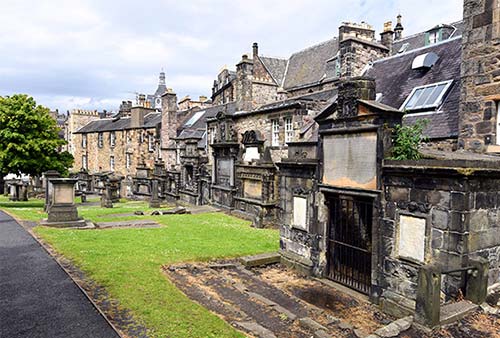
The cemetery just feels made for ghost walks. It’s said that the tombs with iron cages over them were designed so thieves couldn’t break into the grave and steal bodies to sell to the medical school across the street (which always needed cadavers).
Grassmarket
Once Edinburgh’s site for hangings (residents rented out their windows—above the pub wryly named The Last Drop—for the view), today Grassmarket is a people-friendly piazza. It was originally the city’s garage, a depot for horses and cows (hence the name). It’s rowdy here at night—a popular place for “hen dos” and “stag dos” (bachelorette and bachelor parties). In the early evening, the Literary Pub Tour departs from here (see “Nightlife in Edinburgh,” later). Some good shopping streets branch off from Grassmarket; see “Shopping in Edinburgh,” later, for details.
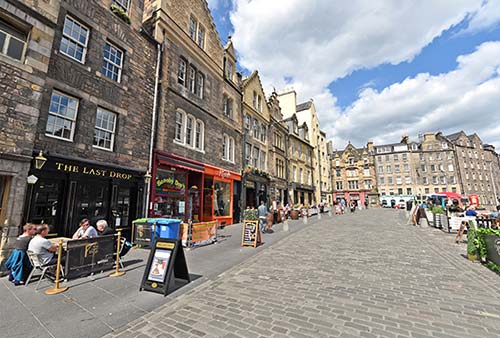
At the top of Grassmarket is the round monument to the Covenanters. These strict 17th-century Scottish Protestants were killed for refusing to accept the king’s Episcopalian prayer book. To this day, Scots celebrate their national church’s emphatically democratic government. Rather than big-shot bishops (as in the Anglican or Roman Catholic Church), they have a low-key “moderator” who’s elected each year.
MUSEUMS IN THE NEW TOWN
These sights are linked by my “New Town Walk,” earlier.
▲▲Scottish National Gallery
This delightful museum has Scotland’s best collection of paintings—both European and Scottish. In a short visit, you can admire well-described works by Old Masters (Raphael, Rembrandt, Rubens) and Impressionists (Monet, Degas, Gauguin) and get an introduction to talented lesser-known Scottish artists who capture their nation’s outsized spirit on canvas. Although there are no iconic masterpieces, it’s a surprisingly enjoyable collection that’s truly world class.
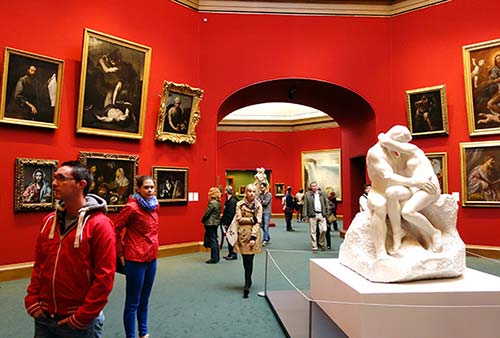
Cost and Hours: Free, daily 10:00-17:00, The Mound (between Princes and Market streets), +44 131 624 6200, www.nationalgalleries.org.
Eating: Just inside the lower Gardens entrance you’ll find the inviting $$$ Scottish Café & Restaurant, offering breakfast, lunch, and afternoon tea. There’s a smaller café just inside the upper entrance on The Mound.
Next Door: The Royal Scottish Academy hosts temporary art exhibits of more contemporary works that are usually skippable. The building is connected to the Scottish National Gallery through a corridor at the Gardens entrance.
Self-Guided Tour: I’ve selected a few great works that best represent the collection. First up, I’ve covered the European masters—focusing on pieces that have ties to Scotland, or ones that are simply undisputed highlights. Then, it’s Scotland’s turn—with artists and paintings that you may not yet have met...but that I’d love to introduce to you.
European Masters
The gallery’s strong points include Gothic and Renaissance art; Northern (Dutch) art; and Impressionism and Post-Impressionism.
Botticelli, The Virgin Adoring the Sleeping Christ Child, c. 1485: Mary looks down at her baby, peacefully sleeping in a flower-filled garden. It’s easy to appreciate Botticelli’s masterful style: the precisely drawn outlines, the Virgin’s pristine skin, the translucent glow. Botticelli creates a serene world in which no shadows are cast. The scene is painted on canvas—unusual at a time when wood panels were the norm. For the Virgin’s deep blue cloak, Botticelli used a pigment made from lapis lazuli (a very pricey semiprecious stone), and her hem is decorated with gold leaf.
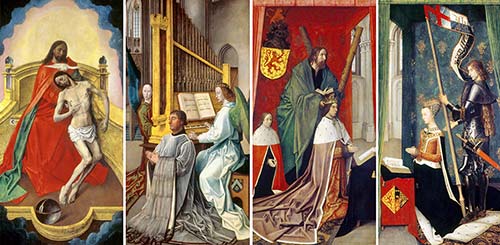
Renaissance-era art lovers would instantly catch the symbolism. Mary wears a wispy halo and blue cloak that recalls the sky blue of heaven. The roses without thorns and enclosed garden are both symbols of virginity, while the violet flowers (at bottom) represent humility. Darker symbolism hints at what’s to come. The strawberries (lower right) signify Christ’s blood, soon to be shed, while the roses—though thornless now—will become the crown of thorns. For now, Mary can adore her sleeping, blissful baby in a peaceful garden.
Raphael, The Holy Family with a Palm Tree, 1506-1507: Mary, Joseph, and the Christ Child fit snugly within a round frame (a tondo), their pose symbolizing geometric perfection and the perfect family unit. Joseph kneels to offer Jesus flowers. Mary curves toward him. Baby Jesus dangles in between, linking the family together. Raphael also connects the figures through their focused eye contact. Graceful and harmonious, the canvas characterizes the High Renaissance ideal of perfection.
Van der Goes, The Trinity Altarpiece, c. 1473-1479: These two double-sided panels likely were the wings of a triptych, flanking a central scene of the Virgin Mary that may have been destroyed by Protestant vandals during the Reformation. The altarpiece once stood in Edinburgh’s Chapel of the Trinity, which was leveled in 1848 to make room for Waverley Station. (The panels had left Scotland for England long before then, only to return as part of the royal collection at Holyroodhouse sometime in the late 19th century.)
In one panel is the Trinity: God the Father, in a rich red robe, cradles a spindly, just-crucified Christ, while the dove of the Holy Spirit hovers between them. (This is what would have been seen when the triptych was closed.) The flip side of the Christ panel depicts Scotland’s king and queen, who are best known to history as the parents of the boy kneeling alongside them. He grew up to become James IV, the king who made Edinburgh a cultural capital. On the other panel, the church’s director (the man who commissioned the painting from the well-known Flemish painter) kneels and looks on while an angel plays a hymn on the church organ. On the opposite side is Margaret of Denmark, Queen of Scots, being presented by a saint.
In typically Netherlandish style, the details are meticulous—expressive faces, intricate folds in the robes, Christ’s pallid skin, observant angels. The donor’s face is a remarkable portrait, with realistic skin tone and a five-o’clock shadow.
Rubens, Feast of Herod, c. 1635-1638: All eyes turn to watch the dramatic culmination of the story of John the Baptist. Salome (standing in center) presents John’s severed head on a platter to a horrified King Herod, who clutches the tablecloth and buries his hand in his beard to stifle a gag. Meanwhile, Herod’s wife—who cooked up the nasty plot—pokes spitefully at John’s head with a fork. A dog tugs at Herod’s foot like a nasty conscience. The canvas—big, colorful, full of motion and drama—is totally Baroque. Some have suggested that the features of Herod’s wife and Salome are those of Rubens’ wife and ex-wives, and the head Rubens himself.
Rembrandt, Self-Portrait: It’s 1655, and the middle-aged Rembrandt is on the brink of bankruptcy. Besides financial hardship and the auctioning-off of his personal belongings, he’s also facing social stigma and behind-his-back ridicule. Once Holland’s most renowned painter, he’s begun a slow decline into poverty and obscurity.
His face says it all. Holding a steady gaze, he stares with matter-of-fact acceptance, with his lips pursed. He’s dressed in dark clothes against a dark background, with the only spot of light shining on the worry lines of his forehead. Get close enough to the canvas to see the thick paste of paint he used for the wrinkles around his eyes—a study in aging.
Gainsborough, The Honourable Mrs. Graham, 1775-1777: The slender, elegant, lavishly dressed woman was the teenage bride of a wealthy Scottish landowner. She leans on a column, ostrich feather in hand, staring off to the side. (Thoughtfully? Determinedly? Haughtily?) Her faultless face and smooth neck stand out from the elaborately ruffled dress and background foliage. This 18th-century woman wears a silvery dress that echoes 17th-century style—Gainsborough’s way of showing how, though she was young, she was classy. Thomas (“Blue Boy”) Gainsborough—the product of a clothes-making father and a flower-painting mother—uses aspects of both in this lush portrait. The ruby brooch on her bodice marks the center of this harmonious composition.
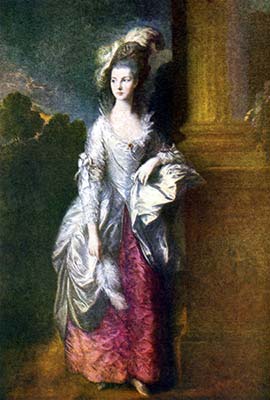
Gauguin, Vision of the Sermon, 1888: Gauguin shows French peasant women imagining the miraculous event they’ve just heard preached about in church—when Jacob wrestles with an angel. The painting is a watershed in art history, as Gauguin throws out the rules of “realism” that had reigned since the Renaissance. The colors are surreal, there are no shadows, the figures are arranged almost randomly, and there’s no attempt to make the wrestlers appear distant. The diagonal tree branch is the only thing separating the everyday world from the miraculous. Later, when Gauguin moved to Tahiti, he painted a similar world, where the everyday and magical coexist, with symbolic power.
Monet, Poplars on the Epte, 1891: This canvas comes from one of the artist’s famous “series” paintings. Monet set up several canvases in a floating studio near his home in Giverny. He’d start on one canvas in the morning (to catch the morning light), then move to the next as the light changed. This one captures a perfect summer day, showing both the poplars on the riverbank and their mirror image in the still water. The subject matter begins to dissolve into a pure pattern of color, anticipating abstract art.
Sargent, Lady Agnew of Lochnaw, 1892: This work launched the career of this American-born portrait artist. Lady Agnew—the young wife of a wealthy old Scotsman—lounges back languidly and gazes out self-assuredly. The Impressionistic smudges of paint on her dress and the chair contrast with her clear skin and luminous eyes. Her relaxed pose (one arm hanging down the side) contrasts with her intensity: head tilted slightly down while she gazes up, a corner of her mouth askew, and an eyebrow cocked seductively.
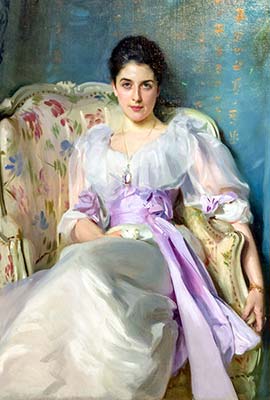
John Emms, Callum, 1895: A Dandie Dinmont terrier proudly stands over a rat corpse and looks up intently at his owner. If paintings could move, you’d see Callum’s tail wagging. While hardly in a league with Botticelli, Rembrandt, or Sargent, this work by the dog painter Emms has become something of a mascot for the museum. For one thing, it’s cute. And for another, the dog’s owner made a sizable donation to the gallery back in 1919, and one condition was that this painting must always be on display. Now that Callum has become a star, if the curators ever dared to take it down...they’d never hear the end of it.
Scottish Artists
One of the joys of this museum is the opportunity to encounter talented Scottish artists who capture their national spirit, but who you’ll rarely hear about outside of their home country. Here are a few Scottish artists and works to seek out on your visit to the museum.
Allan Ramsay (1713-1784): The son of the well-known poet of the same name painted portraits of curly-wigged men of the Enlightenment era (the philosopher David Hume, King George III) as well as likenesses of his two wives. Ramsay’s portrait of the duke of Argyll—founder of the Royal Bank of Scotland—appears on the front of notes printed by that bank.
Sir Henry Raeburn (1756-1823): This portraitist chronicled the next generation, from Sir Walter Scott to the proud, kilt-wearing Alastair MacDonell. His most beloved work, commonly known as The Skating Minister, captures Reverend Robert Walker, minister of the Canongate Church, in a moment of ice-skating reverie as he glides gracefully across the surface of Duddingston Loch.
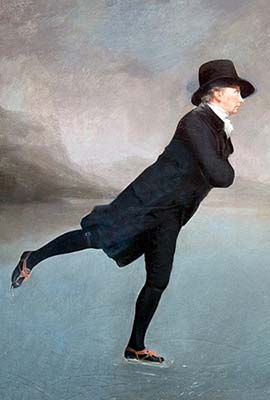
Sir David Wilkie (1785-1841): Wilkie’s forte was small-scale slices of everyday life (also called “genre scenes”). The Letter of Introduction (1813) captures Wilkie’s own experience of trying to impress skeptical art patrons in London; even the dog is sniffing the Scotsman out. Distraining for Rent (1815) shows the plight of a poor farmer about to lose his farm—a common occurrence during 19th-century industrialization.
Sir Edwin Landseer (1802-1873): The aptly named Landseer was known for his Romantic depictions of the rugged Highlands. His finest work (and one of this collection’s prized pieces) is The Monarch of the Glen (c. 1851). A 12-point stag looks nobly, even heroically, into the distance, in front of a dramatic, craggy backdrop—capturing the wild beauty of Scottish nature. You may see other works by Landseer—which more typically juxtapose nature with humans—but this stag is iconic.
William Dyce (1806-1864): Dyce was involved in the Pre-Raphaelite movement, known for rejecting sentimental Romantic excesses and returning to medieval (that is, “Pre-Raphael”) simplicity and clarity, often with bright, pure colors and a melancholy mood. Francesca da Rimini (1837) depicts star-crossed lovers—a young wife and her husband’s kid brother—who can’t help but indulge their passion. The husband later finds out and kills her; at the far left, you see his ominous hand.
William McTaggart (1835-1910): A generation younger than Landseer, McTaggart was also a landscape painter. But his work shows the influence of Impressionism—providing a glimpse of the unique light, powerful clouds, and natural wonder of the Highlands.
John Duncan (1866-1945): Duncan was a Symbolist, who depicted otherworldly scenes in pursuit of a greater truth. His intoxicating Saint Bride (1913) presents the story of the Celtic fifth-century saint who lived at the intersection of history and mythology. According to legend, Saint Bride was miraculously transported from the Hebrides to witness the birth of Jesus. This lyrical painting captures the fantastical scene vividly: Examine the fine details on the angels’ garments and wings. Notice the seal tagging along through the churning sea under a dramatic Hebridean sky. And notice how the wings and halo break the edges of the frame-within-a-frame, creating the illusion of three dimensions.
Anne Redpath (1895-1965): Redpath was the first female painter fully admitted to the Royal Scottish Academy (in 1947) and is best known for her vivid still lifes of household objects. If you’re interested in other pioneering Scottish women artists, look for portraits by Christina Robertson (1796-1854) and landscapes by Josephine Haswell Miller (1890-1975), who also taught etching and printing at the Glasgow School of Art.
▲▲Scottish National Portrait Gallery
Put a face on Scotland’s history by enjoying these portraits of famous Scots from the earliest times until today. With a Neo-Gothic facade, a grand entry hall highlighting Scottish history, and galleries showcasing the great Scots of each age, this impressive museum will fascinate anyone interested in Scottish culture. The gallery also hosts temporary exhibits showcasing the work of more contemporary Scots.
Cost and Hours: Free, daily 10:00-17:00, good cafeteria, 1 Queen Street, +44 131 624 6490, www.nationalgalleries.org.
Visiting the Gallery: While the entrance hall is stirring—with a well-lit statue of poet Rabbie Burns facing all who enter, its history frieze up above is better viewed from the first-floor balcony (described later).
The meat of the collection is on the top floor (level 2), where Scottish history is illustrated by portraits and vividly described by information plaques next to each painting. With the 20th and 21st centuries, the chronological story spills down a level into Room 12 on the first floor. The rest of the gallery is devoted to special (and often very interesting) exhibits.
• Start on the top floor, diving right into the thick of the struggle between Scotland and England over who should rule this land.
Reformation to Revolution (Room 1): The collection starts with a portrait of Mary, Queen of Scots (1542-1587), her cross and rosary prominent. This controversial ruler set off two centuries of strife. Mary was born with both Stuart blood (the ruling family of Scotland) and the Tudor blood of England’s monarchs (Queen Elizabeth I was her cousin). Catholic and French-educated, Mary felt alienated from her own increasingly Protestant homeland. Her tense conversations with the reformer John Knox must have been epic. Then came a series of scandals: She married unpopular Lord Darnley, then (possibly) cheated on him, causing Darnley to (possibly) murder her lover, causing Mary to (possibly) murder Darnley, then (possibly) run off with another man, and (possibly) plot against Queen Elizabeth.
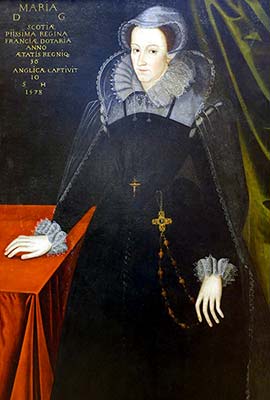
Amid all that drama, Mary was forced by her own people to relinquish her throne to her infant son, James VI. Find his portraits as a child and as a grown-up. James grew up to rule Scotland, and when Queen Elizabeth (the “virgin queen”) died without an heir, he also became king of England (James I). But after a bitter civil war, James’ son, Charles I, was arrested and executed in 1649: Continuing into Room 2, see the large Execution of Charles I painting, his blood-dripping head displayed to the crowd. His son, Charles II, restored the Stuarts to power. He was then succeeded by his Catholic brother James VII of Scotland (II of England), who was sent into exile in France. There the Stuarts stewed, planning a return to power, waiting for someone to lead them in what would come to be known as the Jacobite rebellions.
The Jacobite Cause (a few rooms later, in Room 4): One of the biggest paintings in the room—straight ahead as you enter—is The Baptism of Prince Charles Edward Stuart. Born in 1720, this Stuart heir to the thrones of Great Britain and Ireland is better known to history as “Bonnie Prince Charlie.” (See his bonnie features in various portraits on the wall to the left, as a child, young man, and grown man.) Charismatic Charles convinced France to invade Scotland and put him back on the throne there. In 1745, he entered Edinburgh in triumph. But he was defeated at the tide-turning Battle of Culloden (1746). The Stuart cause died forever, and Bonnie Prince Charlie went into exile, eventually dying drunk and wasted in Rome, far from the land he nearly ruled.
• Pass through the blue Room 6, featuring the theme “Scots in Italy”—from the time when Scotland’s king-in-exile, James VII/II, lived in Rome. Then move into...
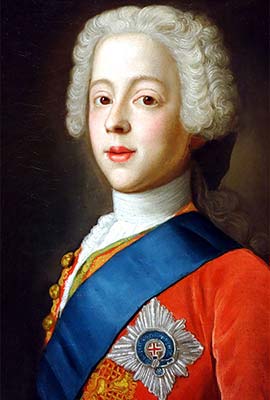
The Remaking of Scotland (Room 7): The faces portrayed here belonged to a new society whose hard work and public spirit achieved progress with a Scottish accent. Social equality and the Industrial Revolution transformed Scotland—you’ll see portraits of the great poet Robert Burns, the son of a farmer (Burns was heralded as a “heaven-taught ploughman” when his poems were first published), and the man who perfected the steam engine, James Watt (on the wall to the left of Burns, upper portrait). But the era’s flip side included the human cost in slavery and warfare and the environmental cost of mining and burning coal.
Heroes and Heroines (Room 8): The first part of this room celebrates female Scots from the early 20th century, including suffragette Margaret Liddell Linck; children’s author and antiwar poet Lady Margaret Sackville; and opera star turned wartime nurse Mary Garden. The other half focuses more on male heroes: Glasgow Art Nouveau pioneer Charles Rennie Mackintosh; WWI Field Marshal Sir Earl Haig; Sir James Matthew Barrie (who created Peter Pan); and Andrew Carnegie. There’s also a portrait of a young Winston Churchill—who, despite not being Scottish, has managed to crash this gathering.
• Finish up on this level. Room 10 features Victorian Scots, including scientist Mary Somerville and author Robert Louis Stevenson. Then head back down to the first floor for a good look at the...
Central Atrium (level 1): Great Scots! The atrium is decorated in a parade of late-19th-century Romantic Historicism. The frieze (below the banister, working counterclockwise) is a visual encyclopedia, from an ax-wielding Stone Age man and a druid, to the early legendary monarchs (Macbeth), to warriors William Wallace and Robert the Bruce, to many kings (James I, II, III, and so on), to great thinkers, inventors, and artists (Allan Ramsay, Flora MacDonald, David Hume, Adam Smith, James Boswell, James Watt), the three greatest Scottish writers (Robert Burns, Sir Walter Scott, Robert Louis Stevenson), and culminating with the historian Thomas Carlyle, who was the driving spirit (powered by the fortune of a local newspaper baron) behind creating this portrait gallery.
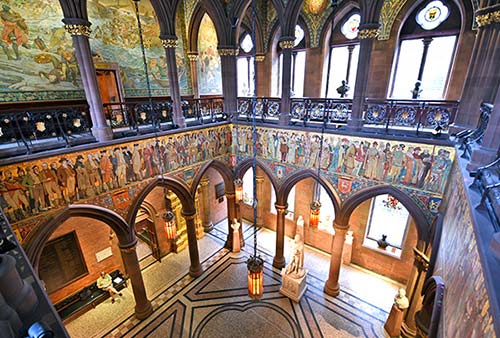
Around this mezzanine are large-scale murals depicting great events in Scottish history, including St. Columba converting the Picts (sixth century), the landing of St. Margaret at Queensferry in 1068, the Battle of Stirling Bridge in 1297, the Battle of Bannockburn in 1314, and the marriage procession of James IV and Margaret Tudor through the streets of Edinburgh in 1503.
• Also on this floor you’ll find the...
Modern Portrait Gallery (Rooms 11-12): This space is dedicated to rotating art and photographs highlighting Scots who’ve made a more recent impact, such as actors Tilda Swinton and Sean Connery, Scottish composer Thea Musgrave, and physicist Peter Higgs (theorizer of the Higgs boson, the so-called God particle). Look for the Three Oncologists, a ghostly painting depicting the anxiety and terror of cancer and the dedication of those working so hard to conquer it.
• And finally, also on the first floor—across the atrium—is the...
Library: Step into this elegant old space, with two tiers of neatly stacked books and some interesting sculpture.
▲▲Georgian House
This refurbished Neoclassical house, set on Charlotte Square, is a trip back to 1796. It recounts the era when a newly gentrified and well-educated Edinburgh was nicknamed the “Athens of the North.” Begin on the second floor, where you’ll watch a fascinating 16-minute video dramatizing the upstairs/downstairs lifestyles of the aristocrats and servants who lived here. Try on some Georgian outfits, then head downstairs to tour period rooms and even peek into the fully stocked medicine cabinet. Info sheets are available in each room, along with volunteer guides who share stories and trivia, such as why Georgian bigwigs had to sit behind a screen while enjoying a fire. A walk down George Street after your visit here can be fun for the imagination.
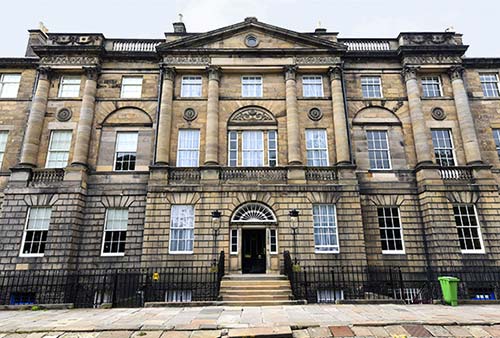
Cost and Hours: £12; daily 10:00-17:00, shorter hours and possibly closed Nov-March, last entry one hour before closing, free guided tour at 10:00; 7 Charlotte Square, +44 131 225 2160, www.nts.org.uk.
SIGHTS NEAR EDINBURGH
▲▲Royal Yacht Britannia
This much-revered vessel, which transported Britain’s royal family for more than 40 years on 900 voyages (an average of once around the world per year) before being retired in 1997, is permanently moored in Edinburgh’s port of Leith. The late Queen Elizabeth II said of the ship, “This is the only place I can truly relax.” Today it’s open to the curious public, who have access to its many decks—from engine rooms to drawing rooms—and offers a fascinating time-warp look into the late 20th-century lifestyles of the rich and royal. It’s worth the 25-minute bus, tram, or taxi ride from the center; figure on spending about 1.5 hours seeing the ship and visitors center.
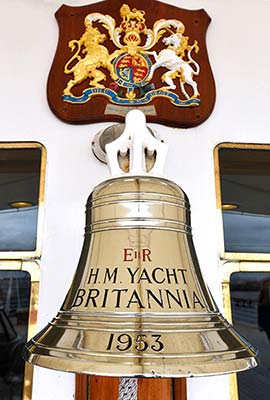
Cost and Hours: £18.50, includes 1.5-hour audioguide, book online in summer (especially August) to guarantee your preferred entry time; daily 9:30-18:00, shorter hours off-season, last entry two hours before closing; tearoom; at the Ocean Terminal Shopping Mall on Ocean Drive in Leith; +44 131 555 5566, www.royalyachtbritannia.co.uk.
Getting There: From central Edinburgh, take the tram from the Princes Street stop (near Waverley Station) all the way to Ocean Terminal. You can also catch Lothian bus #10 or #16 from Princes Street, or #35 from the National Museum or from the bottom of the Royal Mile (alongside the parliament building), to Ocean Terminal (last stop). From the B&B neighborhood south of the center, either bus to the city center and transfer to one of the buses above or hop on the tram. The Majestic Tour hop-on, hop-off bus stops here as well. Drivers can park free in the blue parking garage.
To reach the yacht’s ticket office and visitors center, enter the shopping center near the bus or tram stop and follow signs.
Visiting the Ship: First, explore the visitors center, filled with engrossing royal-family-afloat history. You’ll see lots of family photos that evoke the fine times the Windsors enjoyed on the Britannia, as well as some nautical equipment and uniforms. Then, armed with your audioguide, you’re welcomed aboard.
This was the last in a line of royal yachts that stretches back to 1660. With all its royal functions, the ship required a crew of more than 200. Begin in the captain’s bridge, which feels like it’s been preserved from the day it was launched in 1953. Then head down a deck to see the officers’ quarters, then the garage, where a Rolls Royce was hoisted aboard to use in places where the local transportation wasn’t up to royal standards. The Veranda Deck at the back of the ship was the favorite place for outdoor entertainment. Ronald Reagan, Boris Yeltsin, Bill Clinton, and Nelson Mandela all sipped champagne here. The Sun Lounge, just off the back Veranda Deck, was the queen’s favorite, with Burmese teak and the same phone system she was used to in Buckingham Palace. When she wasn’t entertaining, the queen liked it quiet. The crew wore sneakers, communicated in hand signals, and (at least near the queen’s quarters) had to be finished with all their work by 8:00 in the morning.
Take a peek into the adjoining his-and-hers bedrooms of Queen Elizabeth and the Duke of Edinburgh (check out the spartan twin beds), and the honeymoon suite where then-Prince Charles and Princess Di began their wedded bliss.
Heading down another deck, walk through the officers’ lounge (and learn about the rowdy games they played) and past the galleys (including custom cabinetry for the fine china and silver) on your way to the biggest room on the yacht, the state dining room. Now decorated with gifts given by the ship’s many noteworthy guests, this space enabled the queen to entertain a good-size crowd. The drawing room, while rather simple (the queen specifically requested “country house comfort”), was perfect for casual relaxing among royals. Princess Diana played the piano, which is bolted to the deck. Note the contrast to the decidedly less plush crew’s quarters, mail room, sick bay, laundry, and engine room.
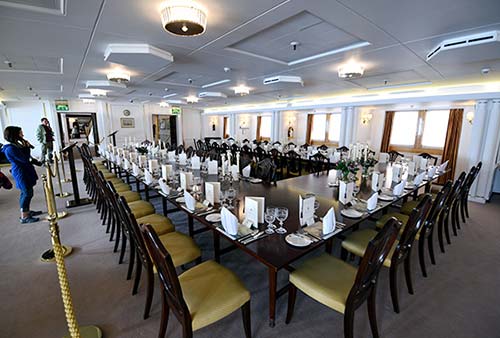
Port of Leith Distillery
Next to the Royal Yacht Britannia, on the appropriately named Whisky Quay (once lined with bonding warehouses for maturing whisky), is Scotland’s first vertical distillery—an unabashedly modern nine-story tower engineered to use gravity, rather than pumps, to move the grain through the process of milling, mashing, fermentation, and distilling. It’s a design born of necessity: Owners Ian Stirling and Paddy Fletcher were drawn to Leith’s heritage as a center for whisky making, but acquired a smaller parcel than they’d hoped for. Embracing verticality as a feature, they hired creative engineers to design a wind-resistant building with distilling equipment bolted right into the joists.
Now they envision their distillery anchoring the port’s ambitious planned redevelopment into a renewable energy hub (including offshore windmills) and a new walkable neighborhood—with heat from the distillery even being pumped into homes. Ninety-minute tours take you through all the levels of production and get you up close to the mash tuns, washbacks, and big copper stills.
The panoramic top-floor bar (daily, small plates) boasts two stories of whiskies from around the world, as well as other spirits—bartenders use ladders to access them all—and views of the East Lothian mountains, three Firth of Forth bridges, and back to Edinburgh Castle and Calton Hill. The sixth-floor shop sells whiskies from around Scotland (daily, long hours).
Cost and Hours: £26 tour, Wed-Sun at least hourly 12:00-20:00, reserve online, includes samples plus your own mini bottle of new-make spirit; 11 Whisky Quay, +44 131 600 0144, www.leithdistillery.com.
▲Rosslyn Chapel
This small but fascinating countryside church, about a 20-minute drive outside Edinburgh, is a riot of carved iconography. The patterned ceiling and walls have left scholars guessing about the symbolism for centuries. To avoid overcrowding, visits here are limited to 90-minute time slots (best to book ahead online).
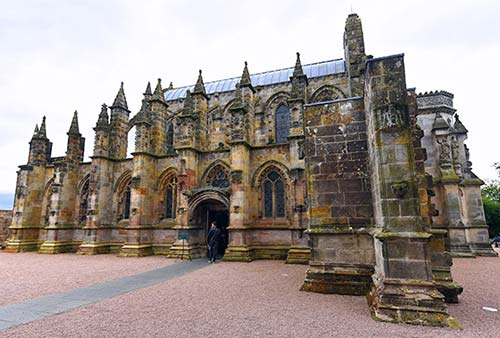
Cost and Hours: £9.50, includes short talk by guide, Mon-Sat 9:00-17:00, Sun from 12:00, located in Roslin Village, +44 131 440 2159, www.rosslynchapel.com.
Getting There: Ride Lothian bus #37 (direction: Penicuik/Deanburn) from Princes Street (stop PJ), North Bridge, or Newington Road in the B&B neighborhood (1-2/hour, 45 minutes). By car, take the A-701 to Penicuik/Peebles, and follow signs for Roslin; once you’re in the village, you’ll see signs for the chapel.
Background: Founded in 1446 as the private mausoleum of the St. Clair family—who wanted to be buried close to God—the church’s interior is carved with a stunning mishmash of Christian, pagan, family, Templar, Masonic, and other symbolism. After the Scottish Reformation, Catholic churches like this fell into disrepair. But in the 18th and 19th centuries, Romantics such as Robert Burns and Sir Walter Scott discovered these evocative old ruins, putting Rosslyn Chapel back on the map. Even Queen Victoria visited and gently suggested that the chapel be restored to its original state. Today, after more than a century of refits and refurbishments, the chapel transports visitors back to a distant and mysterious age.
Visiting the Chapel: At the ticket desk and visitors center, ask about the timing of the included talk, then head to the chapel. If you have time to kill, pick up the good laminated descriptions for a clockwise tour of the carvings. In the crypt—where the stonemasons worked—you can see faint architectural drawings engraved in the wall, used to help them plot out their master design.
Elsewhere, look for these fun details: In the corner to the left of the altar, find the angels playing instruments—including one with bagpipes. Nearby, you’ll see a person dancing with a skeleton. This “dance of death” theme—common in the Middle Ages—is a reminder of mortality: We’ll all die eventually, so we might as well whoop it up while we’re here. On the other side of the nave are carvings of the seven deadly sins and the seven acts of mercy. One inscription reads: “Wine is strong. Kings are stronger. Women are stronger still. But truth conquers all.”
Flanking the altar are two carved columns that come with a legend: The more standard-issue column, on the left, was executed by a master mason, who soon after (perhaps disappointed in his lack of originality) went on a sabbatical to gain inspiration. While he was gone, his ambitious apprentice carved the beautiful corkscrew-shaped column on the right. Upon returning, the master flew into an envious rage and murdered the apprentice with his carving hammer.
Scattered throughout the church, you’ll also see the family’s symbol, the “engrailed cross” (with serrated edges). Keep an eye out for the more than one hundred “green men”—chubby faces with leaves and vines growing out of their orifices, symbolizing nature. This paradise/Garden of Eden theme is enhanced by a smattering of exotic animals (monkey, elephant, camel, dragon, and a lion fighting a unicorn) and some exotic foliage: aloe vera, trillium, and corn. That last one (framing a window to the right of the altar) is a mystery: It was carved well before Columbus sailed the ocean blue, at a time when corn was unknown in Europe. Several theories have been suggested—some far-fetched (the father of the man who built the chapel explored the New World before Columbus), and others more plausible (the St. Clairs were of Norse descent, and the Vikings are known to have traveled to the Americas well before Columbus). Others simply say it’s not corn at all—it’s stalks of wheat. After all these centuries, Rosslyn Chapel’s mysteries still inspire the imaginations of historians, novelists, and tourists alike.
Royal Botanic Garden
Britain’s second-oldest botanical garden (after Oxford) was established in 1670 for medicinal herbs, and this 70-acre refuge is now one of Europe’s best. A visitors center has temporary exhibits. The vintage “glasshouses” (greenhouses) are being restored and will eventually reopen with paid admission.
Cost and Hours: Free; daily 10:00-18:00, Feb and Oct until 17:00, Nov-Jan until 16:00, last entry 45 minutes before closing; café and restaurant, a mile north of the city center at Inverleith Row, +44 131 248 2909, www.rbge.org.uk.
Getting There: It’s a 10-minute bus ride from the city center: Take bus #8 from North Bridge, or #23 or #27 from George IV Bridge (near the National Museum) or The Mound. The Majestic Tour hop-on, hop-off bus also stops here. Or you can walk from Dean Village near the West End, by way of the lovely Water of Leith Walkway (see “Experiences in Edinburgh,” later).
Scottish National Gallery of Modern Art
This museum, with two buildings set in a beautiful parkland, houses Scottish and international paintings and sculpture from 1900 to the present, including works by Matisse, Duchamp, Picasso, and Warhol. The grounds include a pleasant outdoor sculpture park and a café.
Cost and Hours: Free, daily 10:00-17:00, 75 Belford Road, +44 131 624 6200, www.nationalgalleries.org.
Getting There: It’s about a 20-minute walk west from the city center.
Craigmillar Castle
On the southern outskirts of Edinburgh—near the B&B neighborhood—atop a flat, grassy hill sits the fortified country residence of the Prestons of Craigmillar. While the castle is essentially an empty shell (with no significant artifacts or exhibits), it’s pretty, and the top level offers distant views over Edinburgh. Kids (and kids-at-heart) enjoy clambering around through its dark passages and halls. In the central, fortified Tower House (from 1374), you’ll see the room where an ailing Mary, Queen of Scots recovered from an illness; while she was here, a plan was hatched to assassinate her husband, Lord Darnly (known to Scottish history buffs as “The Craigmillar Bond”). Outlander fans might recognize this place as the filming location for fictional Ardsmuir Prison. While not worth a special trip, those staying in the neighborhood might enjoy a quick stop here.
Cost and Hours: £7.50; daily 9:30-17:30, Oct-March 10:00-16:00; small fee for guidebooklet, free parking, Craigmillar Castle Road, +44 131 661 4445, www.historicenvironment.scot.